

Onstage Maria looks as regal and exotic as a Russian princess; offstage, she is as American as wampum and apple pie. (“American as Wampum,” Time, February 26, 1951)
On October 11, 1954, American ballerina Maria Tallchief made the cover of Newsweek magazine accompanied by a headline that read: “The Ballet's Tallchief: Native Dancer.” In the foreground of the image, the dancer appears in regal profile, gaze inclined slightly upward, neck gracefully elongated. Crowned with a silver tiara, Tallchief's jet-black hair is pulled back in an elegant chignon, accented by delicate diamond drop earrings. All of these elements bring her radiant face into focus, with its high, prominent cheekbones, luminous light-olive skin, and full lips. As if the headline and stately portrayal of the dancer were not enough to convey the ballerina's poise and stature in the world of dance, in a blurry background are what appear to be Tallchief's legs and feet. Shown from the mid-thigh down, their elongated muscles sheathed in light pink tights, they hold a fourth position en relevé, legs and feet slightly apart, the dancer balanced securely on satin pointe shoes. Objects of both envy and desire, with their sinewy tone, oval-shaped knees, and dainty ankles, these shapely legs and sculptural feet clearly have been earned through a lifetime of classical ballet training (Photo 1).Footnote 1
Maria Tallchief on the cover of Newsweek. From Newsweek, October 11, 1954 © 1954 IBT Media. All rights reserved. Used by permission and protected by the Copyright Laws of the United States. The printing, copying, distribution, or retransmission of this content without express written permission is prohibited.

Newsweek's “crowning” of Tallchief, a dancer of Anglo-European and indigenous heritage who had spent her early childhood on an Osage reservation in Fairfax, Oklahoma, as America's most heralded prima ballerina stood as a paramount accomplishment by any measure. Perhaps Tallchief best captured the magnitude of the honor herself in her autobiography when she wrote: “[T]o have my picture run on the cover of a national news magazine with a profile inside—space that was usually reserved for national politicians and world figures—was remarkable” (1997, 197). Tallchief took great pleasure in the article “dubbing me American's Native Dancer, the finest American-born ballerina the twentieth century had ever produced, saying I was equal of Margot Fonteyn in England and Galina Ulanova in the Soviet Union” (1997, 197). Seen in the context of Tallchief's meteoric rise in the world of professional ballet during the 1940s and 1950s, Newsweek's laudatory treatment of the dancer was wholly consistent with her achievements thus far. Within a decade, Tallchief had catapulted from a member of the corps de ballet in Sergei Denham's Ballet Russe de Monte Carlo, for which she was hired in 1942 at the age of seventeen, to prima ballerina with the New York City Ballet by the late 1940s.
Tallchief's elevation, both in the ballet world and in the eyes of the public, was not happenstance. As I will argue here, narrative and iconographic portrayals of Tallchief's rise by popular magazines in the early 1950s advanced an account of ballet's Americanization during the postwar period that placed the dancer front and center stage. What is more, when seen in the contemporaneous contexts both of the formation of ballet in the U.S. and debates over Native American citizenship during the Tribal Termination Era, these portrayals of Tallchief take on greater significance—as signifiers on several registers of the meanings of “assimilation” in mid-century America.
My argument has two parts. First I investigate how photographs of Tallchief gracing the covers of mainstream magazines between 1952 and 1954, including Holiday, Newsweek, and Dance Magazine, fed a story told in words and in images of ballet's cultural assimilation, or, to borrow the parlance of the time, of the successful “transplantation” of what most Americans considered a foreign dance form into “native” cultural soil.Footnote 2 Focusing on her head, legs, and feet, these images gave corporeal form to dualistic claims about Tallchief's exoticism (read “Russian” and/or “Native American”), on the one hand, and her “girl next door” sensibility (read “Anglo” and/or “American”), while at the same time displaying the corporeal results of her rigorous ballet training and technical virtuosity in a manner that was both prosaic and alluring. In these ways, Tallchief's personal story, and the iconographic images that came to stand for it, “naturalized” ballet as a “native” concert dance form in popular and critical discourses about ballet's coming of age in the U.S.Footnote 3 Central to this argument is the role of inscription in Tallchief's efforts to master ballet, specifically in the process by which she physically assimilated elements of classical technique, which transformed both her body and the look of “American” ballet.
Second, turning on the meanings of assimilation as acquisition, as naturalization, and as acclimatization, I examine how Tallchief became an unwitting protagonist in a cultural debate over Native American self-determination—a symbol of ballet's acclimatization to a “native” cultural context, on the one hand, and an exemplar of an exceptional Indian, on the other. I then indicate how Tallchief's model of self-determination, self-discipline, and initiative indirectly legitimated nostalgic arguments about the successful “citizenship” of white ethnic immigrants, while, at the same time, lending credibility to historically retrogressive claims about the viability of Indian assimilation during the tribal termination era.
“Ballet in the U.S. Is Not Esoteric Any More”
Tallchief's decision in the fall of 1954, to take a leave of absence from the New York City Ballet in order to go on a year-long tour with the Ballet Russe de Monte Carlo, made headline news when Newsweek revealed that she would be paid $2,000 a week, “considerably more than any ballerina makes with any major ballet company” (“Talented Tallchief” Reference Coleman1954, 102).Footnote 4 Prompted by the newsworthiness of Tallchief's earning power demonstrated by this latest series of events, Newsweek went further to equate the ballerina with ballet's overall rise in popularity in the U.S. at mid-century. The national magazine used Tallchief's relatively astronomical salary offer to serve as a guest artist for the Ballet Russe as a cause to celebrate both her “crowning” as the nation's ballerina and classical ballet's rise as a concert dance form in mid-century America.Footnote 5 Playing on Tallchief's Native American heritage, Newsweek author Emily Coleman (Reference Coleman1954) depicted the ballerina's “native” bona fides as prima facie evidence that ballet, a foreign transplant, had sent down American roots. And, although the irony seemed to be lost on Coleman, as she does not mention it in her article, the fact that the Ballet Russe de Monte Carlo would hire Tallchief as their featured guest—an American dancer to draw audiences to performances by a Russian ballet company, and not the other way around—marked a turning of the aesthetic and cultural tides.
Stemming from the European courts and later commercial theaters in urban centers such as London, Paris, Copenhagen, and Milan, ballet had been performed in the U.S. as “part of a ‘shared public culture’” (Fried-Gintis Reference Fried-Gintis2010, 69).Footnote 6 For the most part, American audiences had been introduced to ballet through its incorporation in mass cultural settings such as vaudevillian variety shows, movie theaters (“live prologs”), and within movies themselves, which, according to Sarah Fried-Gintis, drew heavily on the concert performances of foreign/Russian dancers such as Anna Pavlova, who debuted in the U.S. in 1910, or Diaghilev's Ballets Russes, which toured the country in 1916 (1910 82–94; see also Levy Reference Levy1990).Footnote 7 The tradition of producing “Russian-style” ballet in the U.S. continued with annual performances in New York City and cross-country tours by Colonel de Basil's Ballets Russes from 1933–1937 and again in 1940, and then by Sergei Denham's Ballet Russe de Monte Carlo, which performed first in 1938 in New York City.Footnote 8 According to Nancy Reynolds and Malcom McCormick:
From 1938 to 1948, under the zealous artistic direction of [Lèonide] Massine, Denham's company epitomized what the American public had come to believe a ballet troupe was all about. It had a colorful, varied repertory (some of it comfortingly familiar from the tours of de Basil); it had an air of cosmopolitan chic that attracted café society patrons; all its leading dancers were foreigners; and it had Massine, at that time the most famous ballet personality in the world. (2003, 125)
Reynolds and McCormick's characterization of the popular conception of ballet in the U.S. as “Russian” is consistent with Suzanne Carbonneau Levy's research, which demonstrates how, “[b]y the time Balanchine and the post-Diaghilev Ballets Russes companies came to the United States in 1933, Russian ballet was a staple of American show business. While it was still accepted as exotic, in no way could it be classified as unfamiliar” (Reference Levy1990, 377). In other words, mid-century American audiences were arguably more familiar with Russian-style ballet, and its aura of foreign exoticism, than they were with native approaches.
In fact, while it had existed in some form or another in the U.S. for decades, ballet as a so-called “homegrown” American concert tradition faced formidable obstacles to its establishment. These were due in large part to a lack of “sustained infrastructure,” including government support, schools for dance training, and the monopolization of concert performers by powerful impresarios, prior to the mid-twentieth century (Fried-Gintis Reference Fried-Gintis2010, 68–9). These barriers persisted, even as American-born choreographers such as Agnes de Mille, William Dollar, Eugene Loring, Michael Kidd, and Ruth Page labored to pioneer the field on their own terms in the 1930s and 1940s, and in spite of costly and sustained efforts by philanthropists Lincoln Kirstein and Edward Warburg, who bankrolled the “transplantation” of European ballet to American cultural soil with the commissioning in 1933 of George Balanchine to lead the charge, thus laying the groundwork for the institutionalization of ballet in the U.S. (Garafola 2005; Harris Reference Harris2012; Reynolds Reference Reynolds, Dils and Albright2001, 324–5; Reynolds and McCormick Reference Reynolds and McCormick2003, 131–40; Taper Reference Taper1984, 150–1).Footnote 9 Kirstein established the School of American Ballet in 1933, provided financial backing for several significant fledgling ballet companies such as Ballet Caravan and Ballet Society through the early 1940s, and formed the New York City Ballet in 1948.Footnote 10 Similarly, Lucia Chase founded the repertory company Ballet Theatre in 1939, which, in the words of New York Times critic John Martin, “laid [with its debut] the solidest foundation that had yet been laid for the development of the art of ballet in America” (quoted in Ewing Reference Ewing2009, 68).Footnote 11
What is more, overriding critical and public perception endured that American ballet and ballet dancers could not live up to what had become a Russian standard in the eyes of the public. Authors and critics expressed these opinions in numerous and varied contemporaneous sources and are exemplified in the following illustrative examples. One way was through a discourse of mystification. Even as a detractor of the Russian mystique in ballet, for example, Lincoln Kirstein nevertheless recognized its power in an observation he made in a 1938 issue of Dance Magazine that the Russian “stereotype” was “suave, youthful yet wisely unreal, and tinged with courtly nostalgia which somehow sets the dancers apart from their audience, like royalty,” and the “sex appeal” of Russian dancers as “dark and anomalous. They are people from another time and place, and that they are here before us is in itself exotic” (quoted in Reynolds and McCormick Reference Reynolds and McCormick2003, 125).
Another prevailing view was that American ballet was in its infancy compared to its artistically mature Russian counterpart. Both New York Herald Tribune dance critic Walter Terry and dance historian Olga Maynard portrayed American ballet in these terms in books they published at mid-century. For his part, in considering what he called the “birth” of American ballet in The Dance in America (Reference Terry1956), Terry contended that Anna Pavlova's appearances with partner Mordkin in Coppelia at New York City's Metropolitan Opera House, which, he asserted, “electrified the [New York] metropolitan public” in 1910, were the only bright spots in this history following what he saw as “a half-century period of balletic decline in America” (Reference Terry1956, 149). Similarly, in Bird of Fire: The Story of Maria Tallchief, Maynard characterized American ballet of the 1940s as “less a phoenix than the amoeba of the Russian ballet.” She continued: “Day by day, with reluctance and animus, the foreign influence and the native response were merging toward the graphic style and spirit that would animate an American ballet tradition. There was still a narrow but marked chasm between ‘Russian’ and home-grown ballet, and the dancers treading the bridge between walked over oblivion” (1961, 75). Maynard's assessment that the formation of what would become American ballet would be accomplished through what she saw as a “merging” of “the foreign influence and the native response” invites an analogy to the assimilation process, which in dance is operationalized as much on a physical level, through the act of incorporating new and familiar movement material/information, as it is on an aesthetic level, as a dancer's physical process of incorporation makes the result look novel and/or different.
Finally, a perception reigned that American ballet was in direct competition with its Russian counterpart for financial resources as much as for audiences. Kirstein made this point in a diary entry on October 25, 1948, in which he referred to an observation made by Emily Coleman of Newsweek magazine, the self-same author who would write the piece on Tallchief in 1954, “[that] The New York City Ballet must support itself or leave the boards. This season, appealing to a broader public [than Ballet Society], at popular prices, is Kirstein's final stand” (quoted in Kirstein Reference Kirstein1978, 194). Reflecting on the possible reasons why “Our ‘season,’ restricted to weak Mondays and Tuesdays, pulled only fifty percent of capacity,” he reflected: “Immediately before we opened, the Ballet Russe de Monte Carlo enjoyed a successful engagement at the Metropolitan, draining the curiosity and purses of many ballet lovers who were accustomed to standard repertory and well-known stars. Our situation was certainly sticky” (104). In other words, Kirstein and the fledgling NYCB struggled to find its own audience in its early years, fighting to establish itself in a marketplace saturated by the more familiar Russian-style approach.
Certainly American ballet had its proponents in the 1940s, among them Kirstein himself, choreographer Jerome Robbins, and critics John Martin and Edwin Denby, all of whom labored to envision the process by which the foreign would, in Denby's words, “acclimatize” itself to the native. As early as 1937, for example, Kirstein predicted that the development of a ballet tradition in the U.S. would depend on choreographers, whose movement language would, over time, incorporate kinesthetic and thematic elements that audiences would associate as “national,” and on dancers whose performance of classical movement technique, would, as Kirstein described, “show an American quality” (Reference Kirstein1937, 103).Footnote 12
Choreographer Jerome Robbins picked up the charge into the 1940s, exemplified in a October 14, Reference Robbins1945 essay, “The Ballet Puts on Dungarees: A Choreographer Describes How Ballet Emerged from the Hothouse and Become in America a People's Entertainment” published in The New York Times. Here Robbins traced the warming climate for ballet to 1933, when “Hurok first brought ballet back to America” in the form of de Basil's Ballets Russes, while noting how far in his opinion ballet had come in establishing itself in an American context. To his lights, “What has happened is that ballet, that orchidaceous pet of the Czars, has come out of the hothouse and become a people's entertainment, in our energetic land. A democratic people's mark on the ballet is directly evidenced in its subject matter, its dancers, and the kind of audiences that attend it” (SM9). Reading democracy in Russian balletic form and content, as well as in the mass audience it attracted, Robbins envisioned an entrée for American-born choreographic “newcomers” who “approach the ballet modestly, have learned its traditions with respect, and have contributed the color of their own background,” dancers “who learned their sautés and entrechats in the cities of America,” and viewers “who cared less for champagne out of a ballet slipper than for a good cold beer between ballets.” A case in point, he thought, had been Ballet Theatre's successful cross-country tours. Measuring the familiarity of the dance form in the extent to which “a choreographer can justifiably look to the ballet as a medium in which he can say pertinent things about ourselves and our world,” Robbins expressed optimism about ballet's future in the U.S. thus: “The touch of the exotic and the glamorous will probably always hover about the ballet, just as it will always keep a toe-hold on its classic origins. But the audience's happy reaction to ballets it can understand, about people it can recognize, is an augury of the ballet's future in a democracy.”
And in 1947, critic Edwin Denby pointed to signs of what he saw as evidence that ballet had “acclimated” itself to America, in this case not based on the resonance of choreographic themes (Robbins Reference Robbins1945) to strike a chord with U.S. audiences, but instead on the evidence of American dancers' physical mastery of the form. “Ballet has now become acclimated because nobody thinks of it as foreign anymore,” he wrote. He continued, “And it has become homegrown because almost everyone onstage nowadays was born and trained in America. … Their collective innocently American flavor in action is a novelty in big-time ballet but it looks natural to the audience that sees it here, and pleasing” (Denby Reference Denby1986, emphasis mine, 509–10).
Scholars have focused on the cultural process by which Balanchine's neo-classical aesthetic emerged as dominant during the postwar period, a “consensus” resolution to what Lynn Garafola (2005, 391) has characterized as a “heterodoxical tradition” within American ballet during the 1930s and 1940s (Harris Reference Harris, Demastes and Fischer2007, Reference Harris2012; Homans Reference Homans2010).Footnote 13 As Andrea Harris has expressed: “Today it is commonly agreed across critical, popular, and historical dance discourses that Balanchine's modernist neo-classicism represents the ‘Americanization’ of ballet” (2012, 32). Whereas this is likely true, there is more to the story, as my research on Tallchief's rise to prominence both in the ballet world and in the public eye attests.
Coinciding with the establishment of the New York City Ballet in 1948, which some would argue was the single most important factor in making her an international star, Tallchief came of age at the same time as ballet saw major aesthetic shifts: from the demi-caractère styles characteristic of the interwar years to what would become known as the “leotard” ballets following World War II; from a more representational or narrative approach to a more formal or classical one; and from content derived from characteristically “American” scenarios, character types, and cultural forms, to a more abstract, aesthetic-driven approach epitomized by Balanchinian neo-classicism.Footnote 14
Tallchief emerged in the midst of these shifts in which aesthetic instability mapped onto cultural debate. Her story provided a coherent narrative logic that could tie together myriad strands of discursive speculation about the definition of “American” ballet. Moreover, mass-circulated images of Tallchief concretized qualitative notions about what made ballet “American.” This suggests that in the eyes of the general American public, therefore, “American” ballet was not understood as a unified stylistic choreographic approach (i.e., “Americana” or “neo-classicism”), but rather an approach to doing the dance by American dancers.
In this unsettled cultural context, Tallchief came to epitomize the idea of the “native” American ballet dancer.Footnote 15 Coverage of Tallchief in the popular media not only made hers a household name, but also made hers a familiar face to millions of Americans, many of whose exposure to ballet came in popular formats such as the movie or, before that, the movie prolog, or through cross-country tours by “post-Diaghilev Ballets Russes companies” (Levy Reference Levy1990, 377; see also Fried-Gintis Reference Fried-Gintis2010).
“American Flavor in Action”
Tallchief was one of the first American dancers to embody what Denby meant by “American flavor in action.” Born Betty Marie Tall Chief in Fairfax, Oklahoma, Tallchief was the daughter of a “full-blooded” Osage Indian father, whose family had become wealthy due to oil “headrights” negotiated by the tribe and U.S. government in the 1920s, and of a Scotch-Irish-Dutch mother, whose sister worked as a cook and housekeeper for his family.Footnote 16 “Born,” as she liked to say, “in a house, not a teepee,” she started piano and ballet lessons as a toddler, learning to perform in settings such as “Boy Scout functions” and “rodeos.” Footnote 17 To escape the provincialism of reservation life, a place where Ruth Tall Chief thought “people wasted their lives” (Tallchief Reference Tallchief1997, 12),Footnote 18 when she was nine years old Tallchief moved with her family to Los Angeles, where she trained with Bronislava Nijinska of de Basil's Ballets Russes, among others. She debuted in 1942 at age seventeen with Denham's Ballet Russe de Monte Carlo,Footnote 19 married Russian émigré George Balanchine in 1946 (whom she divorced in 1950), and rose to principal status with the City Ballet in the late 1940s.
Coming of age as a woman and an artist during these years, with her autobiography, regal yet familiar good looks, star quality, and work ethic, Tallchief played a central role in the gradual process by which audiences warmed to the idea of a native ballet tradition. Arguably, Tallchief's breakout role was that of the “Firebird,” in Balanchine's 1948 adaptation of the Michel Fokine/Igor Stravinsky 1910 fairytale classic of the same name. Captivated by Tallchief's “complete and incomparable brilliance,” John Martin, of The New York Times, exclaimed that, knowing the ballerina's “capabilities so well … [Balanchine] has really created a role for her that is hard to match, and she dances it like a million dollars. On second thought, make it two million.” He continued: “Her movements are sharp and quick and clean, and we are always aware that the air is her true milieu. Miss Tallchief has been a fine dancer for some time, but here she has really outdone herself. It is no wonder that they audience shouted itself hoarse” (Reference Martin1948, 22). In another review of this piece published on 4 December Reference Martin1949, Martin recognized what he believed to be “an uncanny unity” between Tallchief and Balanchine. “Undoubtedly, Tallchief has been his inspiration,” Martin wrote. “Hers is the key role, and he has built it for her astonishing virtuosity almost as if he were challenging it.” Commenting on the significance of her performance of the role for Balanchine's creative development, Martin exclaimed: “[A]s she gives us each of the choreographer's inventions, he is ready with another for her, as if he were actually feeding creatively on her performance” (X10). In her autobiography, Tallchief suggests her knowledge of her key role in Balanchine's development as a choreographer when speaking about her artistic partnership with him. Acknowledging the mutual benefit of their collaboration, she as muse and he as choreographer, as well as Balanchine's policy within the New York City Ballet of “treating dancers equally,” Tallchief wrote:
[W]e both understood that my position in the company was unique, that I existed apart from the others. George never shrank from acknowledging my talents in the service of his choreography were an impetus for him to found and establish the company, and that I continued to inspire him. He was also the first to admit that I was an audience favorite with devoted fans. (1997, 157)
What is interesting about Martin's and Tallchief's accounts of the Tallchief/Balanchine artistic relationship is their similarity in stressing that while Tallchief worked “in service of [Balanchine's] choreography,” her persona and her dancing fueled the development of both his creativity and of the New York City Ballet.
Mainstream press coverage of Tallchief during the 1950s certainly supports this claim, in indicating the degree to which audiences adored her, and the extent to which the general public identified her, rather than a neo-classical aesthetic, with the Americanization of ballet. Repeatedly, stories about the ballerina highlighted her humility and ability to remain grounded even in the most sophisticated ballet circles. Reporters frequently asserted in essentialist fashion that there was something basic about Tallchief, which, regardless of her virtuosic habituation of ballet's regal mannerisms, would prevent her attainment of prima status from tainting a fundamental down-home “American” nature, or from penetrating a “native” core.
In 1951, for example, Time magazine depicted Tallchief as nonplussed by fame and fortune: “Maria is America's ranking classical ballerina, but she lives the role American style, without fits of backstage temperament or expensive habits,” citing examples such as her living with a roommate, sharing in household chores and shopping, and playing poker for relaxation (“American as Wampum” 1951, 77). While I cannot argue this rigorously here, I believe that such media portrayals of Tallchief align with a broader cultural sentiment that grew during the postwar years, within the context of the U.S. victory in WWII, the rise of American global imperialism, and the American Century. As an icon, Tallchief stood for the ideas that Americans could now be selective about what they “took” from Europe's past, and that, while amalgamating such traditions would only add layers to a layered cultural tapestry, it was now American's turn to shine on the world stage. In a similar light, Time dichotomized Tallchief's on-stage and off-stage personae, calling her “as regal and exotic as a Russian princess,” yet as American as “wampum and Apple Pie” (“American as Wampum” 1951, 6). Coleman's 1954 cover story in Newsweek cast Tallchief in a similar light: “First by heritage and now by money … Miss Tallchief represent[s] a new order in the ancient and honorable clan of ballerinas. Caviar was their dish; she prefers Fig Newtons. Professionally, however, she is like her predecessors. In an art form which has graced the world for nearly four centuries she must observe the same conventions” (“Talented Tallchief” Reference Coleman1954, 102).Footnote 20
Allusions such as these to Tallchief's “American style,” shown in examples of her ordinary culinary tastes, penchant for poker, or small-town modesty, underlined that she was no Continental-style diva; on the contrary, in this case the dancer's “American” nature trumped the “European” aspects of the form, even at the most elite level of prima. Articles such as those in Time and Newsweek magazines concretized what Tallchief and audiences already intuited: Tallchief offered living proof that “Ballet in the U.S. [was] not esoteric any more” (“Talented Tallchief” Reference Coleman1954, 102). It is highly debatable whether or not Tallchief was more down to earth than other prima ballerinas, such as Margot Fonteyn or Galina Ulanova, hailing from the United Kingdom or Russia, respectively. What is important here is Coleman's rhetorical strategy of drawing on what she believed were cultural stereotypes of the “Continental-style diva,” on the one hand, and the perception she hoped to promote of Tallchief as embodying a different kind of prima.
“They're Born, Not Made”
In December 1957, Dance Magazine published an “Informal Report on Oklahoma's Ballerinas and Their Families,” taking the occasion of the Oklahoma Indian Ballerina Festival in Tulsa to look into the personal and professional lives of the nation's most successful Native American ballerinas. Guests of honor included Maria Tallchief, Rosella Hightower, Yvonne Chouteau, and Moscelyne Larkin along with their families. Ballerina Marjorie Tallchief, Maria's sister, was absent from the discussion, having “missed the festival” (Henderson Reference Henderson1957, 18).
In large measure, the article reviewed the ballerinas' careers, establishing them as preeminent in their field. Yet the reporter also paid significant attention to the dancers' childhoods, interviewing family members about “how their offspring had evolved into such exquisite examples of home-grown talent” (Henderson Reference Henderson1957, 18), and wondering explicitly if their talent was a factor of nature, nurture, or both. Giving her opinion on these topics, Tallchief's mother replied: “They're born, not made.” She continued: “Musicality and line are essential … And these qualities you must be born with” (18). The reporter inquired about the girls' participation in “pow-wows” as children, as well as about other “chances to absorb the feelings of disciplined Indian dancing” (18). Concluding, as had Ruth Tallchief, that participation in indigenous traditions might have left a cultural imprint on the dancers, the “families agreed” that “that's about as far as the Indian influence goes” (21). As if providing more support for this answer, the reporter then provided a quantification of the amount of “blood” heritage in each dancer thus: “The Tallchief girls are nearly half Osage, but Rosella is only one-quarter Cherokee as is Yvonne, and Moscelyne is one-quarter Shawnee” (21).
The author's attempts to tease out the elements of talent that were “natural” from those that had been cultivated through ballet training illuminate the persistence of misunderstanding, bias, and double standards for dance artists of color in the U.S. at mid-century.Footnote 21 This discussion in Dance magazine recalls Lois Balcom's “The Negro Dances Himself,” published in Dance Observer over a century prior (December Reference Balcom1944), which cautioned choreographer Pearl Primus against representing her “African heritage” in her work for fear that it would obstruct her path toward becoming a “modern dancer” (Kowal Reference Kowal2010, 126). Similarly, in the latter case, the Oklahoma ballerinas are recognized as “Indian enough” to prompt inquiry about the extent to which their heritage plays a role in their artistic work, regardless of their personal points of cultural identification. Left unspoken and yet strongly implied is the author's assumption that while the ballerinas may have been “homegrown” in their indigenous communities, ballet training and professional experience provided a means for their successful assimilation to dominant aesthetic and cultural ideals.
Assimilation occurs on the body level through a process Sally Ann Ness calls “inscription,” or “writ[ing] something into a place” (Reference Ness, Noland and Ness2008, 1). According to Ness, this process is especially operative in classical dance forms such as ballet, one of the “most tradition-bound, technically developed, and hierarchically institutionalized varieties of dance” (13). Begun at a young age and practiced on a nearly daily basis through the course of one's dance career, classical ballet technique training “inscribes” the terms of a value system into a dancer's body, and, as a result, “the body's [very] connective tissues themselves bear the evidence of that practice” (12). In varying degrees, aforementioned accounts about how Tallchief and other dancers labored to make ballet “American” assume a bodily mechanics of inscription. Yet at the time, these mechanics were left unexamined. In their allusions to “homegrown” talent, or “homegrown” ballet, for example, writers imply that a dancer's body is like a visceral “native” soil available for the planting and gestation of a foreign seed, when, having taken root and geminated, will yield a “homegrown” aesthetically and culturally assimilated offspring.
While it is true that many ballet dancers across the country during this period did not have access to the kind of regular and methodical training that Ness describes, a dancer such as Tallchief, who had begun her training as a young child and continued to pursue it with some of the most qualified teachers available to her, might approximate the kind of ballet student to which Ness refers. Similarly, it is relatively easy to imagine how physical inscription might occur in an academy setting, such as the School of American Ballet (SAB), which produced the likes of the preternaturally Balanchinian ballerina Tanaquil LeClercq, who began her studies there as a young teen.
That said, because of the itinerant nature of Tallchief's family life, while pursued seriously, Tallchief's training was characterized by “learning and unlearning,” acquisition and re-patterning, a journey of planting and supplanting running through rural Oklahoma, Los Angeles, and finally New York City. Without going into exhaustive detail, a consideration of just a few emblematic chapters of Tallchief's ballet training, seen through Ness's lens of inscription, makes it possible both to imagine the mid-century corporeal mechanics of ballet assimilation, and also to suggest its kinetic, social, and cultural implications. This is especially important because it was Tallchief, perhaps more than any other mid-century ballet performer, whose body seemed to offer irrefutable proof that “native” dancers could make ballet American.
Mrs. Sabin, “an itinerant ballet teacher from Tulsa,” was Tallchief and her sister Marjorie's earliest teacher, a woman who, “when she heard about the two little girls in the town's most prominent family, … headed for the house on the hill” (Tallchief Reference Tallchief1997, 6). Sabin ingratiated herself with Maria and Marjorie's mother, Ruth, who went along with the instructor's idea to put the girls on toe as toddlers so as to maximize their opportunities for public appearances. Tallchief recalls: “I think I must have been about four at that time. … I was much too young, and one shouldn't start that early unless you're just doing little tiny exercises, picking flowers or something. However, I did start and was put immediately on my toes, which was a terrible mistake” (Tallchief 1978, 1). Reflecting on the deficiencies of her early training, Tallchief criticized her mother's “frugal” ways, leading her to buy toe shoes a size too big, which “she'd stuff with cloth pads so they'd fit and I'd be able to perform the double and triple turns on pointe that seemed to thrill everybody” (Tallchief Reference Tallchief1997, 6). She also faulted Sabin for having established a technical foundation that she and her sister had relentlessly to overcome, or, in Marjorie's words, “[go] back to the basics … to unlearn everything we had been taught” (Livingston Reference Livingston1997, 37).
When Ernest Belcher, the girls' first teacher in Los Angeles, first saw Marie and Marjorie dance, he told them and their mother that “they would have to go back to beginners class and throw out their pointe shoes or he would not accept them in his school” (Livingston Reference Livingston1997, 37).Footnote 22 Apparently he believed that their prior training with Sabin had built a detrimental technical foundation that they would have to break down by starting over from the beginning. The girls found a similar value placed on technical fundamentals in Nijinska's “pointe class, [in which they] had to repeat steps over and over, learning how to balance and how to hold a position so that our entire backs were being utilized” (16).
Maria and Marjorie Tallchief's experience with Belcher and Nijinska underlines the importance of developing an effective approach to precision footwork within the classical ballet technique, as well as the effort it takes to do so. According to Ness, a ballerina's feet are more than a static symbol. Holding a position en pointe, for example, is an action of finding “balance points” or “‘lines’ of balanced energy” (Reference Ness, Noland and Ness2008, 17). This is certainly true in considering Belcher's recommendation that the girls recommence their training at the beginner's level, and Tallchief's recollection of the value of repeating steps in Nijinska's class.
The final chapter necessary to examine are the years in which Tallchief studied with George Balanchine, with whom she first worked in 1944 in his role as guest choreographer for the Ballet Russe de Monte Carlo. Exposure to Mary Ann Moylan, a SAB-trained dancer who joined the Ballet Russe as a company member, made Tallchief realize yet again that she “needed to go to learn how to dance all over again” (quoted in Livingston Reference Livingston1997, 88). According to Tallchief: “I wanted to be just like her and use my legs the way she used hers. Her movements were precise, clearly articulated, but delicate and highly expressive. She seemed to dance in a new way. It was brisk and fleet and classically pure” (1997, 39).Footnote 23
Tallchief carried these goals of teaching her body to dance more like Moylan to SAB, where she began training at the age of nineteen. As she recalls, “At that time, I was still a little pudgy, had awful feet and essentially no turnout, but all [Balanchine] ever said to me was that if I could learn to do battements tendus properly, I wouldn't have to learn anything else” (quoted in Livington Reference Livingston1997, 88). Yet training at the school allowed her to make the changes she desired. As she put it: “My muscles were stretching, my legs were changing shape, and I could see the turnout coming. Because it was a gradual process, I never lost what technical strength I had. It just improved, slowly” (quoted in Livingston Reference Livingston1997, 91). According to Foster, the training of the legs and feet is paramount in neoclassical ballet because “so much of the choreographic focus goes to [their] articulation, how the direction they take will establish a certain tension between mobility and precariousness” (1996, 13). Having mastered the compulsory dimensions of her technical training, Tallchief enjoyed significant professional success in the late 1940s, for example, debuting Balanchine's work at the Paris Opera in 1947 to critical acclaim,Footnote 24 and originating the title role in Balanchine's version of Stravinsky's Firebird, a role that made her famous. Clearly, by now, she had become a master of classical ballet technique.
Yet, in spite of, or perhaps because of, Tallchief's artistic growth, her now-husband Balanchine felt she could go further in her technical competence. According to Tallchief, during the summer of 1949, Balanchine “launched a campaign to raise the level of my technique so I would be able to surpass what I had done and dance the repertory he intended to create for me in the precise way he wanted” (1997, 80). Justifying this “campaign” as a “working vacation,” Balanchine moved Tallchief and her pas de deux partner Nicholas Magallanes to California for the summer so that he could school them for six to seven hours a day on “the basics, the rudiments of classical dancing he had learned as a child at the Maryinsky” (116). Tallchief describes the rigor of Balanchine's approach in which she and Magallanes “worked on placement, barre work, port de bras, and on individual steps … In every session, George paid particular attention to battement tendu with characteristic precision” (116).
According to Ness, inscription “chang[es] the fundamental character of something from that of brute surface … to that of a sign” (Reference Ness, Noland and Ness2008, 5). She continues: “It is also to change a signifying character from conveying a transient to conveying a permanent meaning” (5). In Tallchief's case, the experience of lifelong ballet training, of learning and relearning, wrote a coherent identity into place through the bodily inscription of discipline and according to a classical aesthetic code. Through her repeated submission to ballet's discipline, and her subsequent mastery of its conventions, she demonstrated her ability to subjugate both her self and her will to the choreographer, and for the good of the whole. Tallchief had synthesized the elements of her identity, as a woman and as a dancer through real and metaphorical bodily transformation. Ballet made her exceptional as both a woman and a dancer.
I use the term “exceptional” here drawing on the research of Steven P. Wainwright, Clare Williams, and Bryan S. Turner (Reference Wainwright, Williams and Turner2006), who investigate the social production of “physical capital” through the training regime associated with classical ballet. They employ Pierre Bourdieu's notion of “habitus” to illuminate the “embodiment of social structure” (2006, 537) in the careers of professional ballet dancers, teachers, and administrators. They argue that “differences in physical capital produce differences in individual habitus and these are then developed (and usually reproduced) in the way a choreographer inscribes his steps upon a dancer” (538). From the angle of this research, it is possible to see how Tallchief's development as a dancer, and her acquisition of physical capital through her rigorous training with Balanchine, enabled Balanchine in turn to define and refine further his approach to making dances. In other words, their relationship “illustrates the interconnection and reciprocity between individual and institutional habitus” (538). Tallchief as an embodied persona came to stand for Balanchine's neoclassical approach, the establishment of ballet in the U.S., and for the institution of the New York City Ballet.Footnote 25 And, as I will illustrate below, images of her body (and body parts), which circulated in national magazines in the early 1950s, evidenced Tallchief's personal and physical capital in convincing ways, lending credibility not only to accounts of her talent and rise to balletic stardom, but also to perceptions about Balanchine's cultural assimilation.
The Iconography of Assimilation: Realistic Idealizations
At this point in my argument, I must disclose an important fact: The legs on Newsweek's October 1954 cover belonged to Helen Kramer, not to Tallchief. Tallchief explains as much in her autobiography thus:
Naturally the editors had to use a head shot. But they also wanted to show my legs. If they ran the full-figure, my head wouldn't be big enough to work as a cover portrait. Then the photographer came up with a solution. He designed a shot in which he'd pose me in the forefront of the frame wearing a tiara, and then use another dancer in the background dressed in my Nutcracker tutu showing only her legs. Helen gladly helped out. She has a beautiful figure and shapely limbs. The finished effect was beautiful. (1997, 197)
The editorial “solution” to superimpose Tallchief's face with Kramer's “stand-in” legs—to portray a real yet impossible situation—makes vividly apparent Tallchief's real and idealized roles in making the case that ballet, in Denby's words, had “acclimated” to America.
Convention at Newsweek likely dictated the requirement that the cover include a facial portrait; it is likely too that the editorial decision to include a pair of legs—however this would be accomplished—also followed precedent. In 1949, Time magazine established a postwar precedent on its November 14 cover, which featured British prima ballerina Margot Fonteyn. Although representing Fonteyn similarly, as a set of body parts (as face, and as legs and feet), Time had employed a strikingly different approach compared to the one that Newsweek used (Photo 2).
Margot Fonteyn on the cover of TIME. From TIME Magazine, November 14, 1949, Time Inc. Used under license.
Time's cover, which had been painted, portrayed Fonteyn in soft pastels, her glamorously crowned visage in the foreground of what appear to be stage curtains, her body striking an impossibly floating arabesque in the background. Newsweek's cover image, by contrast, depicted Tallchief through the medium of photography, even though the image presented had been impossible to produce using a single dancer. If Time, therefore, had set a mid-century representational precedent requiring that a cover portrait of a ballerina's face be accompanied by the legs and feet that would serve to mark her profession, Newsweek had countered with an approach to photojournalism featuring an image of a “real-life” ballerina, rather than depict her as Time had done as image in a romanticized fantasy. That said, in its deceptive solution of having Kramer “stand-in” for Tallchief, Newsweek fabricated an impossible image—depicting an impossible situation—that no ballerina, not even one the likes of Tallchief, could actually accomplish.
In some ways, Newsweek's 1954 cover also followed the precedent set by Holiday magazine's November 1952 cover, which depicted Tallchief only from the waist down (Photo 3. Advertising John Kobler's article, “The Exciting Rise of Ballet in America,” Holiday's image featured the ballerina's torso, sheathed in a decorative leotard and hip-length tutu. Here again is what must be presumed to be her sleek, statuesque legs holding a modified fourth position en relevé, neatly bisecting the picture frame. Inside the cover, the teaser text for Kobler's article made reference to Tallchief's striking legs, thus amplifying their significance as an emblem of the contemporary American ballet dancer. It read: “The remarkable legs on our cover belong to Maria Tallchief, prima ballerina of the New York City Ballet Company, and are Photographer Bradley Smith's nomination for ‘the ideal ballerina's legs—long, shapely, strong but not muscular’” (quoted in Garafola Reference Garafola and Foner1999, frontispiece to Chapter 1; see also Kobler Reference Kobler1949, Reference Kobler1952). Perhaps Smith's comment says it best: Within the cultural discourse about the Americanization of ballet, Tallchief's legs and feet epitomized the standard for the ballerina's new physical ideal.
Maria Tallchief on the November 1952 cover of Holiday magazine.
Following Holiday, Newsweek had lured readers to its cover story entitled “Talented Tallchief: We Find Our Own Ballerina” by indicating a synecdochal relationship between parts and whole. Tallchief's elegantly exotic yet familiar visage symbolized classical ballet's acclimatization to a “native” American context. And, in their virtuosic “articulation” of the finest choreographic detail, Kramer's legs and feet signify the unification of the body acting as one entity, or, as Susan Foster has put it, “The power of these legs springs from their fleshy realization of an abstract ideal … sheathed in unblemished nylon from high hip bone to pointe shoe … they seem at times almost detached from the rest of the body” (1996, 13). Holiday's cover had relied upon the depiction of Tallchief's legs and feet within the photographic frame to indicate her entire body outside of the frame. By contrast, Newsweek's cover, in bringing these parts together as one image, suggested that as individual images, Tallchief's face and Kramer's legs and feet seem not to possess enough iconic power to stand alone. The magazine's editorial staff elected therefore to “assimilate” these parts even at the risk of public deception. Correlated to one another and as parts of a total photographic image, therefore, Tallchief's body parts, as depicted on the cover of Newsweek, intimate a physical and conceptual assimilation to a larger structure, Tallchief's entire body, so as to make the cover portrait whole.
Tallchief's legs and head therefore required each other in order to serve as mutually supportive signs of the total image that editors wished to paint of Tallchief—one of poise, radiance, regality, and virtuosity.Footnote 26 Sally Ann Ness argues: “The ballerina's arched feet are perhaps the predominant symbolic term of ballet. Their structural deformations reflect the most deeply held convictions of this particular classical tradition” (emphasis in original, Reference Ness, Noland and Ness2008, 16). Considering Ness's idea, featuring a traditional headshot of Tallchief would not have been sufficient to stand on its own. The image needed “legs” and “feet” even, if they did not belong to Tallchief, to carry the impact of the visual argument and its presentation of a realistic if impossible idealization.
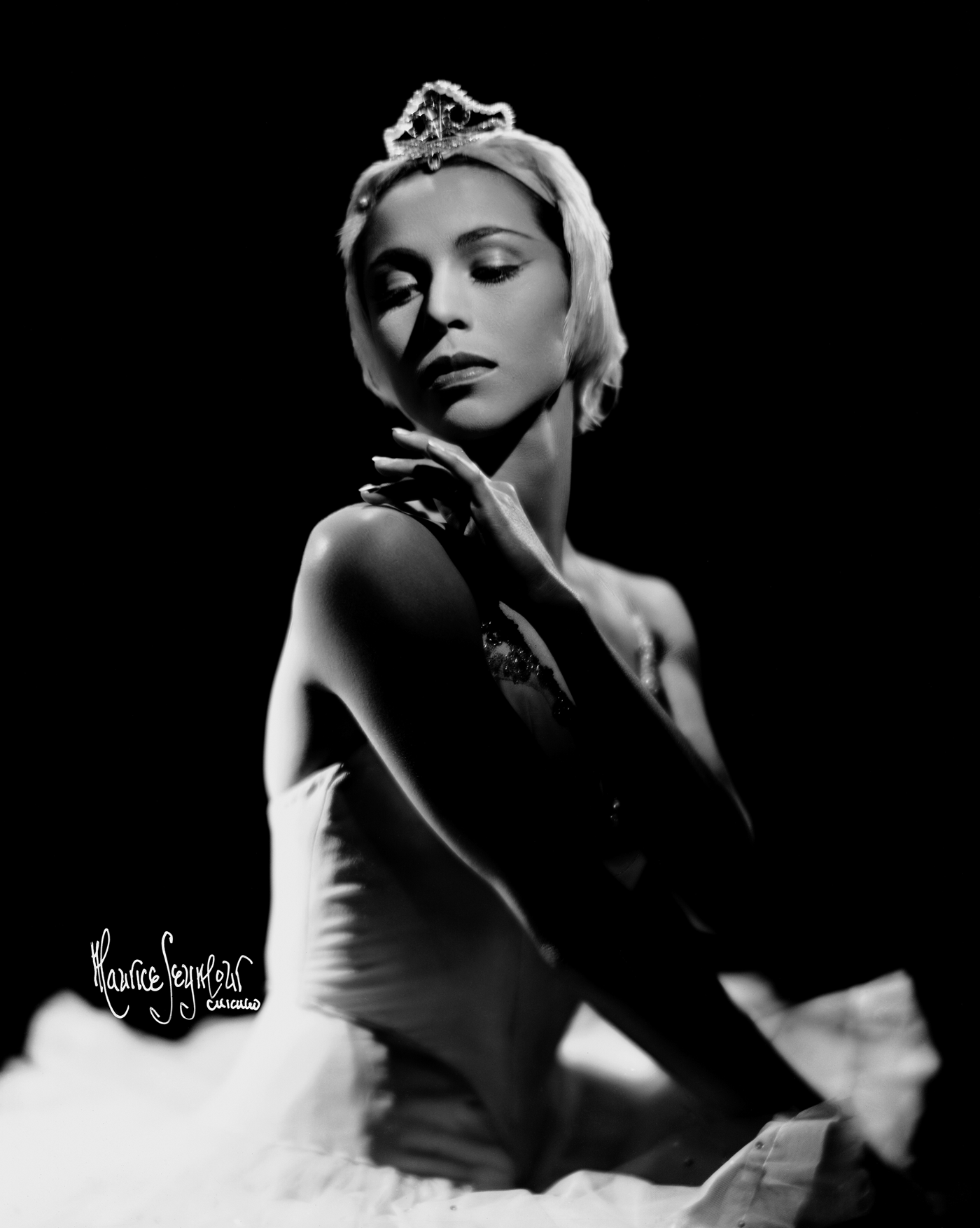
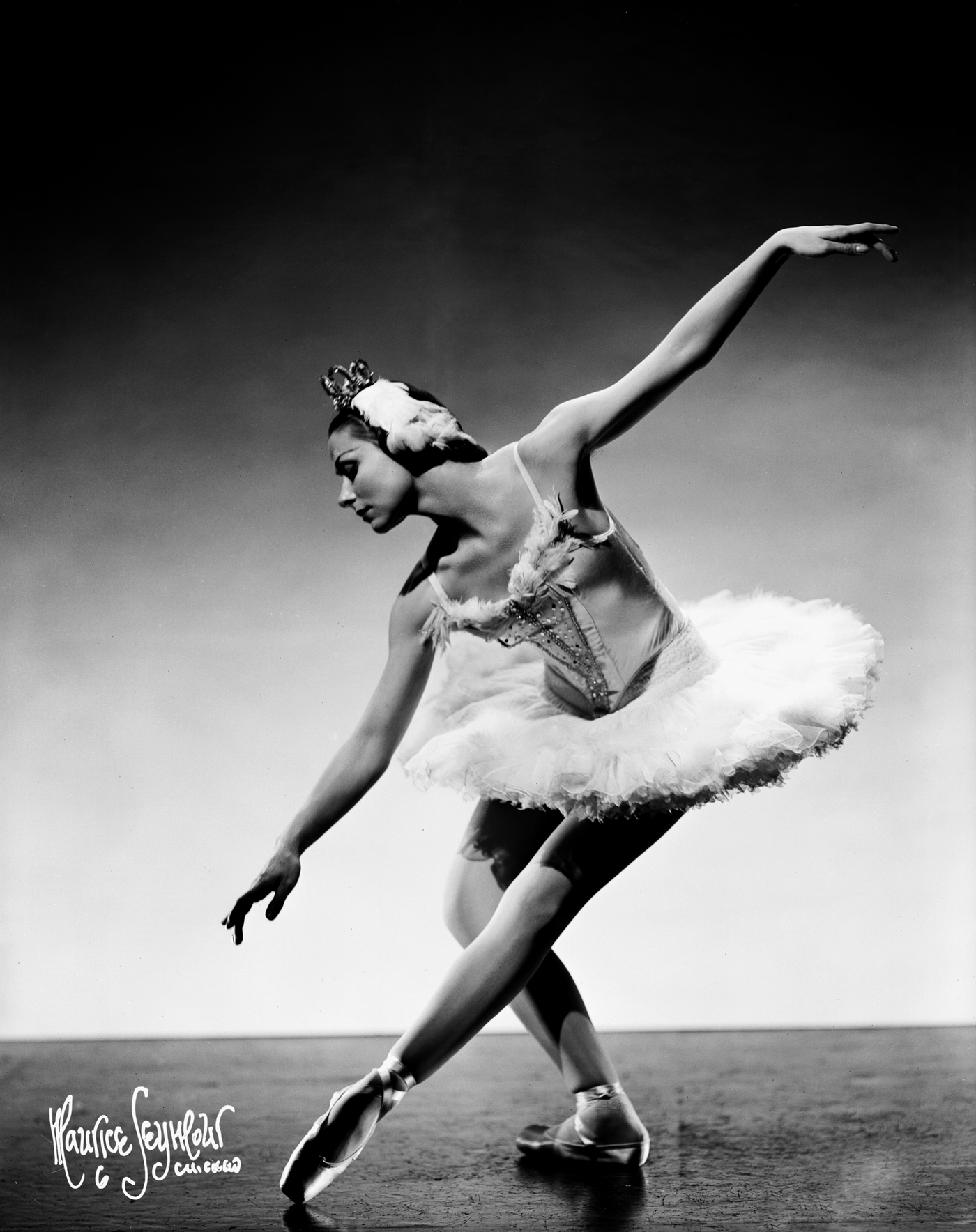
Additionally, it is important to note the ways in which the photos of Tallchief that were featured on the covers of Holiday and Newsweek departed from the conventions of standard ballet portraiture reigning at the time. Exemplary of these conventions is Maurice Seymour's Ballet Portraits, a book published in 1952 containing images of ballet dancers from around the world, including but not limited to Tallchief, Fonteyn, Alicia Alonzo, Alexandra Danilova, Nora Kaye, Tanaquil LeClerq, Moira Shearer, and Melissa Hayden. In not one of the nearly one hundred twenty-five photos assembled is a dancer depicted without his or her head, or, to put it another way, only from the waist down. Every portrait includes the dancer's head and face, shown either facing front or in full or three-quarter profile. The images taken by Maurice Seymour included here, of Tallchief as Odette in Swan Lake, illustrate not only Seymour's approach but also the representational conventions standard at the time adopted by other prominent photographers such as George Platt Lynes, for example.Footnote 27Dance Magazine's February 1954 cover abided by these standards, featuring Tallchief in bust style, her face in nearly full profile (Photos 4–6).
Maria Tallchief as Odette in Swan Lake. Photo by Maurice Seymour. Courtesy of Ronald Seymour.
Maria Tallchief as Odette in Swan Lake. Photo by Maurice Seymour. Courtesy of Ronald Seymour.
Maria Tallchief on the February 1954 cover of Dance Magazine. Reprinted with permission of Dance Magazine, copyright 1954.
By contrast, the cover images for Holiday and especially in Newsweek contributed to the ballerina's exoticization, on the one hand, and her cultural exceptionalism, on the other. Departing from contemporaneous representational conventions established by best practices at the time, these cover photographs shed uncharacteristic light on what photographers and editorial staff not accustomed to depicting dancers thought was important to feature—signifying parts referring to but visually unrelated to the dancer as a whole. In depicting Tallchief as a set or sets of isolated body parts, which served as synecdochal references to the ballerina's body as a whole, these mainstream cover images served to naturalize in the popular imagination an iconography of classical ballet that ran against the grain of contemporaneous ballet portraiture in prioritizing the dancer's face, legs, and feet. What is more, these slick but “impossible” images naturalized Tallchief herself as an invented fusion of types: the “exotic” and the “American”; the “Russian princess,” the “girl next door”; and the foreign and the assimilated, the non-white and the Anglo—an amalgamation of fantasies that at once disparaged and idealized her.
Brenda Dixon-Gottschild's research has led the way in “retriev[ing] the hidden legacy [of] the black text in Balanchine's Americanization of ballet” (Reference Dixon-Gottschild1996, 60). She finds a variety of “Africanisms” evident in Balanchine's neo-classical style, including its “high contrast” visual aesthetic and rhythmic sensibilities, speed, attitudinal “coolness,” angularity, isolation of components of the torso including “the hips, chest, pelvis, and shoulders”; and preference for a high-waisted, long legged female body type (quotations taken in order from pages 62, 63, and 70). Dixon-Gottschild's observations about the “inter-textual” nature of Balanchine's neo-classicism enables scholars to better understand the complex nature of aesthetic formation as a dynamic process of “borrowings, receivings, and exchanges” (78). Seen through this lens, the mainstream cover images of Tallchief suggest additional meanings that complicate Dixon-Gottschild's theories about black invisibilization. Holiday's cover managed an erasure of the ballerina's non-whiteness by presenting only her legs and feet, thus disassociating these body parts from their physical and cultural origin implied by the ballerina's whole body in and of itself. By contrast, and in different ways, both Newsweek's and Dance Magazine's covers used images of Tallchief to depict portraits of cultural assimilation, both of which unwittingly but nevertheless effectively implied the fused and multicultural nature of American ballet at mid-century.
Native Exceptions
In his seminal 1978 book The White Man's Indian, Robert Berkhofer argues that Native American identity, when seen through Anglo eyes, is predominately a projection of the viewer's own “values and ideals” rather than a perception that squares with an indigenous person's own impression of self. Berkhofer's idea serves as a useful framework not only for considering the reasons why Tallchief became both a central protagonist and a symbol of ballet's acclimatization in a U.S. cultural context, but also for understanding the politics of assimilation that underwrote mid-century debates about Indian “self-determination” and tribal termination. Whereas I have spent the balance of this article addressing the first part of this equation, in the discussion that follows I hope to suggest how impossibly idealized narratives and iconographies demonstrating Tallchief's balletic prowess indicate how, in the same manner in which she became an exquisite dancer, she also became an “exceptional Indian.”
In 1953, one year before Tallchief appeared on the cover of Newsweek, the U.S. Congress passed House Concurrent Resolution 108: “To end the wardship status of the Indians and to grant them all the rights and prerogatives pertaining to American citizenship” (quoted in Officer Reference Officer and Philp1986, 114). According to Native American historian, James E. Officer, “with this action, the lawmakers declared themselves disposed, as a matter of official policy, to dissolve the special relationship that through much of the country's history had bound the federal government to the Native American population” (114). Under the assumptions that assimilation to the dominant culture would be best for native peoples, and that, according to Berkhofer, “all Indians could be completely incorporated into American society within a generation” (1978, 187), the bill phased in the dissolution of Federal support and supervision for waves of select tribal groups over the course of several decades. Justifying what would become a devastating plan of action as an attempt to promote Indian “self-determination,”Footnote 28 Congress initiated a reversal of policies that had been in place since the Depression Era under the Indian New Deal, and later the Indian Reorganization Act (IRA) of 1934.Footnote 29 Instead mid-century policies reverted to nativist positions that drove the passage of vehemently restrictive immigration policies in the mid-1920s (i.e., the Johnson-Reed Act of 1924), which not only established quotas favorable to countries that dominated the U.S. population prior to 1880 and the great migrations from Eastern and Southern Europe, but also legislated preferential treatment to “native” peoples born in the U.S., as well as the congressional passage of the Indian Citizenship Act (1924), and which bestowed American citizenship on indigenous peoples living within sovereign nations who were born in the U.S.Footnote 30 Historian Kenneth Philp (Reference Philp1999) argues that mid-century federal legislation, aimed at mainstreaming Native Americans by pushing them off their land and reservations, also provided the government cause to acquire formerly protected lands. Such laws also had the desired consequence of expanding the U.S. tax base because they recognized indigenous individuals as citizen taxpayers, not as members of tribes with sovereign status.Footnote 31
Justified by arguments about ideal American citizenship, the premises that drove the debates over federal responsibility to native tribes masked a conservative and moralistic agenda to acquire native lands and increase federal revenue through the taxation of “self-determined” citizens. Within these debates, proponents of tribal termination held up as exemplars of successful integration second- and third-generation European immigrants, a group which historically had been a target of previous waves of xenophobia and repeated “red scares.” Appearing to have woven themselves and their traditions into mainstream American culture, these peoples now symbolized a kind of model citizenship.Footnote 32 By contrast, supporters cynically cast Indians as “non-citizens,” due to their perception that they lived on the social margins, in insular tribal groups, and on the U.S. government's dole.
For example, in testimony to the U.S. Senate in Reference Butler1952, Senator Hugh A. Butler (R., Nebraska), one the leading advocates of Native tribal termination put it this way: “I do not know of any other people, native or immigrant, except the Indians, who have been placed on the reservations and held down, instead of being permitted to advance themselves in the way that the people of other classes of our citizenry are permitted to do” (Congressional Record, Appendix, p. A4769). Even Indian rights activists of the period saw the situation in similar terms, as evidenced in a Reference Russell1953 article by Charles Russell, then–Special Assistant to the Director of the American Museum of Natural History, in which he stresses the commonalities between immigrants, who left their homeland to settle in the new world, and Native Americans, for whose “need of integration into the fabric of the American of tomorrow is as great as America's need for them” (3). While on opposites sides of the U.S. political system, Butler's and Russell's views converged on at least one point: although each cited different causes of what they believed was an insularity among Native American peoples, both elevated assimilation, or, in Russell's words, “integration” above all other possible solutions to this perceived problem. Within this political context, mainstream portraits of Tallchief, represented both in words and in images, implied an idealized resolution to the problem of native insularity—apparently inconvertible truth that such a problem could be surmounted under the proper circumstances, with the proper cultural “training.”
Conclusion
In the context of mid-century debates about cultural assimilation, and the struggle to define model citizenship in the tribal termination era, Tallchief's bi-ethnic/bi-cultural/bi-class upbringing resonated more with themes of intercultural marriage, work ethic, class mobility, and striving individualism associated with the first waves of European immigrants than with reigning cultural stereotypes about Native Americans. Appealing to nostalgic ideals of first-wave, white, ethnic immigration, media portrayals of Tallchief as ambitious, hardworking, self-determined, self-disciplined, and non-exceptional when it came to her attitude about her fame offered living proof that native peoples could find their footing within the cultural mainstream. Tallchief's example and public standing as “America's ballerina,” therefore, lent credibility to arguments advocating the viability of Indian assimilation.
In the context of mid-century debates over the Americanization of ballet, Tallchief played a prominent role in encouraging the perception that ballet, like the ballerina, had come of age in the postwar period. Featured on national magazine covers between 1952 and 1954, Tallchief became ballet's mid-century “cover-girl.” Images of her face, legs, and feet lent visual credibility to claims that ballet, which many at the time considered a “foreign” dance form, had assimilated to a U.S. cultural context. Iconographic portrayals of Tallchief's face, legs, and feet, which illustrated the dancer's physical assimilation of Balanchine's approach to dance technique, along with narratives of her personal story, advanced an account of ballet's Americanization that placed the dancer, not Balanchine or neo-classicism, at center stage.
Thinking in terms of inscription, the laborious process by which Tallchief assimilated Euro-Russian ballet, seen as the paragon of Western cultural sophistication, vindicated a precarious “native” status that otherwise would have been disparaged by widespread anti-Indian racism—the very same “native” status that had legitimated the case for the installation of “American” ballet. If postwar American ballet can be seen as a metaphor for the coordination of cultural diversity to one unifying idea, then Tallchief's balletic prowess becomes symbolic not only of her personal transformation into the most celebrated mid-century American ballerina, but also of an assimilation process by which, within a dominant cultural formula, the U.S. had moved from being a nation composed of a myriad of ethnic “others” to a consolidated identity to which these others became subordinated.