


Introduction
The question of who should be regarded as monolingual or bilingual is not as clear as it would first seem. Current research in bilingual language processing is sensitive to a variety of developmental and usage contexts: for example, whether bilinguals have learned an L2 early vs. late in life (e.g., Byers & Yavas, Reference Byers and Yavas2017), their languages were learned simultaneously vs. sequentially (e.g., Gross, Buac & Kaushanskaya, Reference Gross, Buac and Kaushanskaya2014), they are balanced vs. unbalanced bilinguals or heritage speakers (e.g., Polinsky, Reference Polinsky2018; Rosselli, Ardila, Lalwani & Vélez-Uribe, Reference Rosselli, Ardila, Lalwani and Vélez-Uribe2016), or whether they tend to mix languages, code-switch frequently or use them in entirely separate contexts (Kroll, Dussias & Bajo, Reference Kroll, Dussias and Bajo2018). Some studies have investigated whether the linguistic distance between languages affects how they are processed (e.g., Kirk, Fiala, Scott-Brown & Kempe, Reference Kirk, Fiala, Scott-Brown and Kempe2014; Kormi-Nouri, Moradi, Moradi, Akbari-Zardkhaneh & Zahedian, Reference Kormi-Nouri, Moradi, Moradi, Akbari-Zardkhaneh and Zahedian2012; Oschwald, Schättin, Von Bastian & Souza, Reference Oschwald, Schättin, Von Bastian and Souza2018). However, research into development and usage is often confounded by the sociolinguistic status of varieties, with those that have a considerable amount of lexical overlap regarded as dialects rather than separate languages, and their speakers recognised as “monolingual” rather than as being “bilingual”.
Several recent studies have investigated “bidialectal” language processing in speakers of closely related varieties such as Standard and Swiss German (Vorwerg, Suntharam & Morand, Reference Vorwerg, Suntharam and Morand2019), (Norwegian) Nyorsk and Bokmal (Lundquist & Vangsnes, Reference Lundquist and Vangsnes2018) and Dutch and West Flemish (Antoniou, Veenstra, Kissine & Katsos, Reference Antoniou, Veenstra, Kissine and Katsos2020), indicating very close similarities to bilingual language processing. However, in other studies, speakers are broadly assigned “bilingual” status regardless of the degree of similarity between varieties, such as speakers of Spanish and English (Gollan & Goldrick, Reference Gollan and Goldrick2016), Dutch and Frisian (Blom, Boerma, Bosma, Cornips & Everaert, Reference Blom, Boerma, Bosma, Cornips and Everaert2017), and Italian and Venetian dialect (Scaltritti, Peressotti & Miozzo, Reference Scaltritti, Peressotti and Miozzo2017). Thus, because of sociolinguistic factors that influence the status of varieties, the distinction between what constitutes a language, a minority language or a dialect is blurred, and who is considered ‘bilingual’, ‘bidialectal’, or even ‘monolingual’ is inconsistent across the field.
Despite the importance of providing sociolinguistic context, in a recent systematic review, Surrain and Luk (Reference Surrain and Luk2019) report that only 17% of studies comparing bilingual and monolingual adults present any sociolinguistic information about the languages used by participants. Almost a third (31%) of the reviewed studies simply label their bilingual participants as ‘bilingual’, without any further qualification of their language pairings, dominance, or acquisition patterns. Furthermore, and central to our main concern, Surrain and Luk report that only 10% of studies provide qualifying information about monolinguals, and that the vast majority of studies assume a homogeneous degree of language dominance in this group. Thus, despite the emergent literature on processing of non-standard varieties (e.g., Antoniou, Grohmann, Kambanaros & Katsos, Reference Antoniou, Grohmann, Kambanaros and Katsos2016; Blom et al., Reference Blom, Boerma, Bosma, Cornips and Everaert2017; Kirk et al., Reference Kirk, Fiala, Scott-Brown and Kempe2014; Melinger, Reference Melinger2018; Vorwerg et al., Reference Vorwerg, Suntharam and Morand2019), many studies still fail to capture the true linguistic experiences of their participants because some language varieties are not afforded the status of languages or even dialects.
Sociolinguistic situation in Scotland
Scotland is one such place with different indigenous language varieties that vary in status. Scottish Standard English (SSE) is the dominant prestige variety, used in education and broadcasting, and in spoken form is often considered “Standard English in a more or less Scottish accent” (Aitken, Reference Aitken1985). SSE exists alongside Scots, a Germanic variety closely related to English, which has several regional varieties including Doric, Dundonian, Glaswegian and Orcadian. Scots is spoken by around 35% of the population, although it has no standardised written form (not to be confused with Scottish Gaelic, a minority Celtic language spoken by about 1% of the Scottish population; Scottish Census, 2011). While Gaelic faces some hostility in being promoted as a national language of Scotland (McLeod, Reference McLeod2019), it is undoubtedly regarded as a language in its own right, whereas Scots generally is not (Matheson & Matheson, Reference Matheson and Matheson2000). Despite being referred to as “the Scots language”, and recognised by the European Charter for Regional or Minority languages, its close relationship to English means Scots is often regarded as a low-prestige dialect, with its speakers facing linguistic discrimination, and even being ridiculed for suggesting that Scots is an independent language (McDermott, Reference McDermott2019). This is consistent with Scottish Government (2010) data showing that 65% of respondents view Scots not as a language, but rather as “just a way of speaking”. Thus, despite regularly using two varieties, speakers of Scots are likely regarded as ‘monolingual’ English speakers, even by themselves (see Kirk, Kempe, Scott-Brown, Philipp & Declerck, Reference Kirk, Kempe, Scott-Brown, Philipp and Declerck2018).
Language control in bilinguals and bidialectals
In many communicative situations, bilingual language processing is characterised by the need to inhibit the non-target language. The mechanisms that govern this ability have been studied using the language switching paradigm (for a review, see Declerck & Philipp, Reference Declerck and Philipp2015a), where bilingual participants are cued to name pictures in one or the other language. An abundance of studies has shown that switching languages incurs a cost compared to naming a picture in the same language as in the preceding trial (e.g., Christoffels, Firk & Schiller, Reference Christoffels, Firk and Schiller2007; Costa & Santesteban, Reference Costa and Santesteban2004; Declerck, Kleinman & Gollan, Reference Declerck, Kleinman and Gollan2020a; Jevtović, Duñabeitia & de Bruin, Reference Jevtović, Duñabeitia and de Bruin2020; Timmer, Calabria, Branzi, Baus & Costa, Reference Timmer, Calabria, Branzi, Baus and Costa2018). According to the Inhibitory Control Model, these switch costs have been attributed to reactive inhibition (e.g., Green, Reference Green1998; Meuter & Allport, Reference Meuter and Allport1999; but see Finkbeiner, Almeida, Janssen & Caramazza, Reference Finkbeiner, Almeida, Janssen and Caramazza2006) which prevents intrusion of co-activated words from the non-target language, but at a cost. Paradoxically, switching back into the dominant language tends to take longer than switching into the less-dominant language as greater inertia needs to be overcome resulting in asymmetrical switch costs (e.g., Dias, Villameriel, Giezen, Costello & Carreiras, Reference Dias, Villameriel, Giezen, Costello and Carreiras2017; Meuter & Allport, Reference Meuter and Allport1999; Peeters, Runnqvist, Bertrand & Grainger, Reference Peeters, Runnqvist, Bertrand and Grainger2014).
Recent research has extended the switching paradigm to “monolinguals” who routinely use different varieties but would typically not be regarded as bilinguals (Kirk et al., Reference Kirk, Kempe, Scott-Brown, Philipp and Declerck2018; Vorwerg et al., Reference Vorwerg, Suntharam and Morand2019). Despite the fact that active and passive speakers of Dundonian Scots self-identified as English monolinguals, they exhibited costs for switching between Dundonian and SSE in Kirk et al. (Reference Kirk, Kempe, Scott-Brown, Philipp and Declerck2018), suggesting that the control processes that govern use of these varieties are similar, if not identical, to those described for bilinguals. Moreover, while switching costs were symmetrical in bidialectals who had equal proficiency in both varieties, Kirk et al. (Reference Kirk, Kempe, Scott-Brown, Philipp and Declerck2018) found asymmetrical switch costs in speakers of Standard (Anglo-) English who had only recently been exposed to Dundonian. These participants took longer to overcome the inertia associated with having just inhibited their dominant variety suggesting that reactive inhibition (Abutalebi & Green, Reference Abutalebi and Green2008; Green, Reference Green1998) is involved in the use of bidialectal lexical access as well.
However, as with bilinguals, such findings become more complex once research is extended to different sociolinguistic contexts. Swiss–German bidialectals, who live in a diglossic situation where the social constraints of usage are clearly defined and for whom the dialect is the preferred high-status variety, showed a switch cost asymmetry with longer naming latencies when switching back from Standard German into Swiss German (Vorwerg et al., Reference Vorwerg, Suntharam and Morand2019). This indicates that language control mechanisms can flexibly adapt to the socio-linguistic factors that affect usage of linguistic varieties.
On the other hand, using the picture-word interference paradigm, Melinger (Reference Melinger2018) did not demonstrate that Scots is processed like a different language. While bilinguals typically exhibit faster naming when exposed to translation equivalents due to successful inhibition of lexical competition that allows shared semantic features to be primed, the bidialectals in this study did not show such translation equivalent facilitation. This suggests that, because of their similarity, speakers of SSE and Scots store their varieties as part of one “co-dependent” language, rather than as independent languages as suggested by Kirk et al. (Reference Kirk, Kempe, Scott-Brown, Philipp and Declerck2018). However, Melinger (Reference Melinger2018) did not report the extent to which these participants regularly spoke Scots, only that it was their “dispreferred dialect”. This raises the question as to whether it is inherent similarity between varieties, or how speakers use them, which affects how they are cognitively represented. Thus, the issue of whether there are qualitative differences in mechanisms of lexical selection between bilinguals and bidialectal monolinguals is far from settled and requires further investigation. However, this issue is important for research that compares processing between monolinguals and bilinguals such as the research on whether regular engagement of language control mechanisms leads to a bilingual executive control advantage (e.g., Bialystok, Reference Bialystok2017; but see Paap, Johnson & Sawi, Reference Paap, Johnson and Sawi2015). The question is whether such comparisons are valid if monolinguals also engage cognitive processes that allow them to control use of different varieties.
The current study
Given the limited cross-linguistic evidence for bidialectal language processing, and its apparent sensitivity to sociolinguistic differences, we extend this research to a unique population whose geographical location may sanction a greater degree of diglossia despite their perceived monolingualism – speakers of Orcadian Scots who reside on the islands of Orkney situated off the north coast of Scotland. Unlike urban Dundonian, Orcadian is a rural variety spoken as a preferred variety across social strata as a marker of local identity (Forsythe, Reference Forsythe1980), alongside an education system where SSE is the variety of delivery, and media exposure is dominated by standard varieties of English. Adapting the paradigm used by Kirk et al. (Reference Kirk, Kempe, Scott-Brown, Philipp and Declerck2018), we should expect to find switch costs for these speakers, but it is not clear whether the higher prestige afforded to Orcadian as an indicator of regional identity will be reflected in higher switch costs into this variety.
To further examine similarities between bidialectal and bilingual language processing, we extended the paradigm to examine mixing costs – longer naming latencies for non-switch trials in mixed variety blocks compared to pure variety blocks (e.g., Ma, Li & Guo, Reference Ma, Li and Guo2016; Peeters & Dijkstra, Reference Peeters and Dijkstra2018; Stasenko, Matt & Gollan, Reference Stasenko, Matt and Gollan2017; Timmer, Calabria & Costa, Reference Timmer, Calabria and Costa2019). Mixing costs are considered a measure of proactive language control (e.g., Ma et al., Reference Ma, Li and Guo2016; for a further discussion and alternative interpretations, see Declerck, Reference Declerck2020). In pure language blocks, the target variety is proactively activated and the non-target variety is proactively deactivated in order to prevent interference while both varieties are presumably proactively activated in mixed language blocks incurring longer naming latencies due to cross-language interference.
Another aim was to investigate the effects of cognate items on picture naming. An interesting finding about cognates in the bilingual literature is that they are produced and recognized faster than non-cognate words (e.g., Costa, Caramazza & Sebastian-Galles, Reference Costa, Caramazza and Sebastian-Galles2000; Declerck, M Koch, I & Philipp, Reference Declerck, Koch and Philipp2012; Hoshino & Kroll, Reference Hoshino and Kroll2008; Libben & Titone, Reference Libben and Titone2009; Verhoef, Roelofs & Chwilla, Reference Verhoef, Roelofs and Chwilla2009). This increase in performance is commonly referred to as the cognate facilitation effect (CFE). A prominent explanation of the CFE in the literature is based on the assumption that lemmas are separated across languages and phonological representations are shared (Costa et al., Reference Costa, Caramazza and Sebastian-Galles2000; see Costa, Santesteban & Caño, Reference Costa, Santesteban and Caño2005 for a review on different explanations of the CFE). According to this cascading activation account, lemmas in both languages activate to some extend their phonological representations. In the case of cognates this would mean that a large amount of phonological representations would receive activation from both lemmas, since cognates are phonologically very similar across languages, which would account for the CFE. Thus, we expect to observe this effect in the current study because of the lexical overlap between Orcadian Scots and SSE.
Method
Experimental design and hypotheses were preregistered using the AsPredicted.org template published on the Open Science Framework (available at http://osf.io/8qb5s/). The study received ethical approval from Abertay University's ethics committee.
Participants
Sixty-one active-bidialectal speakers of Scottish Standard English (SSE) and Orcadian Scots were recruited. One participant did not fully complete the study. To ensure consistency with Kirk et al. (Reference Kirk, Kempe, Scott-Brown, Philipp and Declerck2018), data for twelve participants over the age of 60 were excluded. Data collection stopped when the pre-registered target of 48 participants had been reached; however, data for two of these participants were subsequently deemed unusable due to equipment error and thus were not included in the final analyses.
The remaining 46 participants (16 Males – mean age of 41.1 years) reported using Orcadian on average 66.01% of the time (s.d. = 18.1%, range = 10–90%). According to the Language Background Questionnaire adapted from Kirk et al. (Reference Kirk, Kempe, Scott-Brown, Philipp and Declerck2018), participants rated themselves on average at 6.67 on a scale from 1 to 7 as being able to understand an Orcadian speaker (s.d. = 0.52; range = 5–7). All participants lived on Orkney at the time of testing and were tested in their own homes or in a community facility by an experimenter fluent in Orcadian (RJK). Thus, while written instructions for the experiment were presented on-screen in English, participants and the researcher predominantly communicated using Orcadian (see Discussion).
Due to a printing error, information about knowledge of other languages and age of acquisition was not collected; however, recruitment conditions stipulated that participants were not proficient beyond basic knowledge in any language varieties other than SSE and Orcadian.
Materials
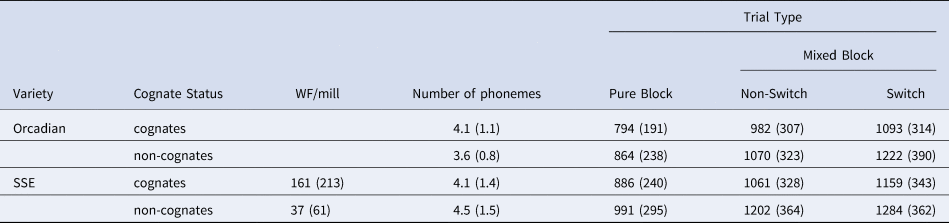
Eighteen concrete objects, clearly nameable in both SSE and Orcadian (see Appendix A), were depicted as 300 x 300 pixel images. Each picture was presented concurrently with a blue or green image border serving as cue for the variety in which participants should name the picture, with mapping of colour to variety counterbalanced across participants. Nine object labels were cognates in both varieties (e.g., house/hoose); nine were non-cognates (e.g., beetle/gablo). Word length was identical across varieties for cognates and there were no significant differences for cognates and noncognates between SSE and Orcadian (all p's were > .23; see Table 1). Word frequency for cognates and non-cognates was matched based on frequency per million of English words (van Heuven, Mandera, Keuleers & Brysbaert, Reference van Heuven, Mandera, Keuleers and Brysbaert2014) only as no databases exist for the Orcadian items (see Table 1). Due to the limited pool of contrasting items to draw from, several items unavoidably shared phonological and semantic features, which may have the potential to impact picture naming. However, any contaminating effects were mitigated by the random presentation of items, which was unique for each participant.
Mean number of phonemes, word frequency per million (where available) and mean naming latencies in milliseconds (standard deviations computed by participant are given in parentheses).
Procedure
The Dialect Switching Paradigm was adapted from Kirk et al. (Reference Kirk, Kempe, Scott-Brown, Philipp and Declerck2018) using E-prime version 2 and presented on a Windows 10 laptop with a microphone connected to a Chronos serial response box. Participants were first familiarised with the stimuli by presenting a block containing each individual picture and its corresponding English and Orcadian labels and were asked to name each label out loud. Participants then proceeded to the naming task which consisted of two consecutive pure language blocks and two mixed language blocks; order of pure and mixed blocks was counterbalanced across participants. Each pure block comprised 18 objects presented four times in randomised order for a total of 72 trials, with participants naming objects using the same variety. Order of SSE and Orcadian pure blocks was counterbalanced across participants. Mixed blocks comprised 72 trials with objects named twice in each variety, with variety cued in a pseudo-random fashion. To ensure roughly equal numbers of switch (50.7%) and non-switch (49.3%) trials for both varieties, two pseudo-random trial sequence lists were constructed. Item lists were nested within these trial sequence lists, so that objects would be presented in random sequence for each participant across the four possible combinations of variety and trial type. One random additional filler item was added at the beginning of the mixed block to provide a context that would determine trial type (non-switch vs. switch) of the first item. Before each new block type, participants practised naming each item once (18 trials for each pure block, and 36 trials for the mixed block). For each trial, picture and coloured border remained on screen until the voice key was triggered by the onset of the participant's vocal response. Once triggered, the picture remained on the screen for a further 1250 ms before the next picture appeared. Participants’ responses were audio recorded and subsequently coded for accuracy.
Results
Participants made fewer than 3.5% errors overall, rendering analyses of accuracy fairly uninformative, which is why we do not report them here but provide them at http://osf.io/8qb5s/.
Incorrect trials, trials immediately following an incorrect response, and first trials in the mixed block were excluded from the analysis of naming latencies. As there was no fixation cross or blank screen between trials, it was occasionally possible for trials to be a replica of the previous trial by displaying the same picture and border combination as a result of the nested item lists. Such replica trials were removed as they were not immediately distinguishable from the previous trial. Trials with naming latencies under 150ms, over 3000ms, or three standard deviations above participant mean were also removed, leaving 89.9% of trials for analysis. Mean naming latencies are presented in Table 1.
Switch costs
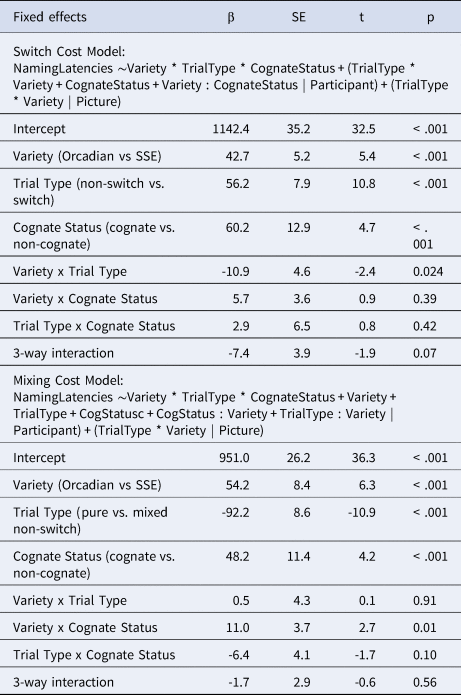
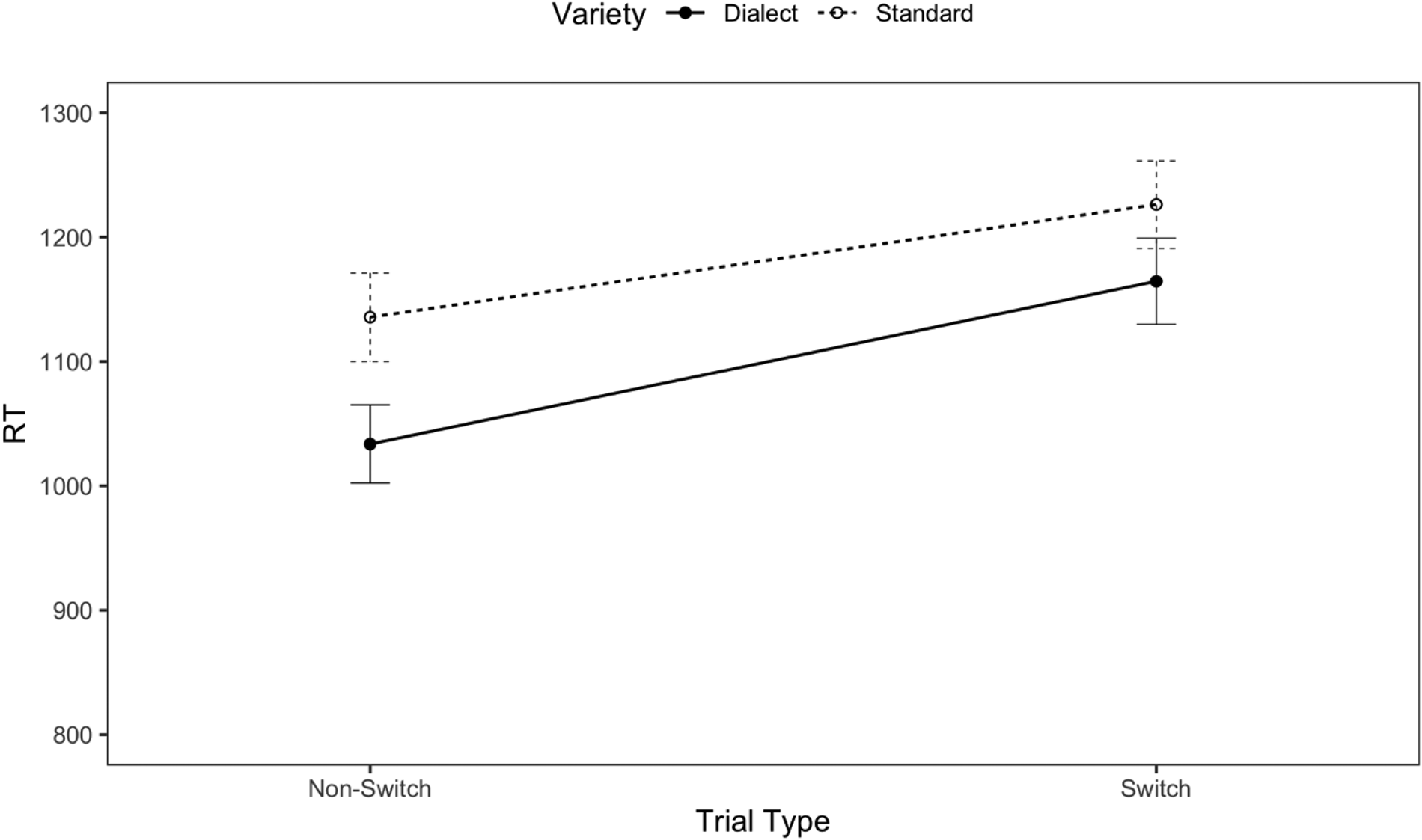
Naming latencies were analysed using a mixed-effect linear model with Trial Type (non-switch vs. switch), Variety (SSE vs. Orcadian) and Cognate Status (cognates vs. non-cognates)1 and all interactions between these factors as centred fixed effects and random effects of Participants and Picture. To allow the model to converge, we removed the 3-way interaction slope from the random effects of Participants. This model yielded main effects of Variety (SSE: 1176.5 ms, Orcadian: 1091.8 ms), Trial Type (Non-Switch: 1078.8 ms, Switch: 1189.5 ms), and Cognate Status (Cognates: 1073.8 ms, Non-cognates: 1194.5 ms; see Table 2). Crucially, we found a significant interaction between Trial Type and Variety (see Figure 2), demonstrating a switch cost asymmetry with higher costs for switching back into Orcadian. Including number of phonemes as a covariate into a second model confirmed all the effects reported above (see http://osf.io/8qb5s/).
Parameter estimates and results of significance tests in mixed-effects models.
Mixing costs
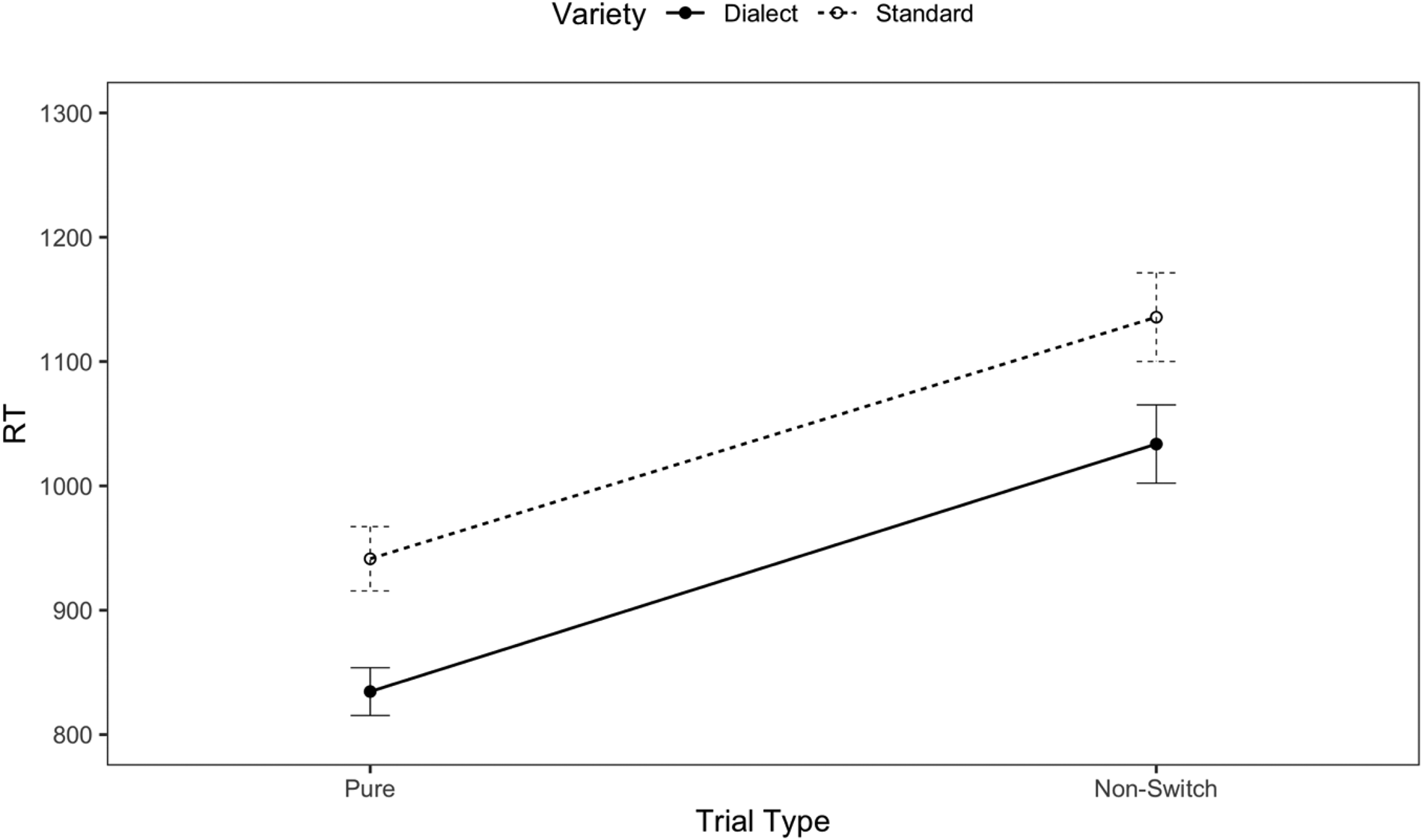
We fitted a mixed-effect linear model with Trial Type (trial from the pure block vs. non-switch trials from the mixed block), Variety (SSE vs. Orcadian) and Cognate Status (cognates vs. non-cognates)1 and all interactions between these factors as centred fixed effects and crossed random effects of Participant and Picture. To allow the model to converge we removed the slope for the 3-way-interaction and the interaction between Cognate Status and Trial Type from the random effects by Participants. This model yielded main effects of Variety (SSE: 970.3 ms, Orcadian: 927.5 ms), Trial Type (Pure: 883.8 ms, Non-switch: 1078.8ms) and Cognate Status (Cognates: 930.8 ms; Non-cognates: 1031.8 ms; see Table 2), confirming longer naming latencies for SSE compared to Orcadian, mixing costs (see Figure 1) and cognate facilitation. The analysis also yielded an interaction between Variety and Cognate Status, indicating a larger cognate facilitation effect in SSE, which is likely to reflect the fact that SSE non-cognates were slightly longer than Orcadian non-cognates. To control for word length, we included number of phonemes as a covariate into a second model, which confirmed significance of the three main effects reported above but did not confirm the interaction between Variety and Cognate Status, p = .07, suggesting that cognate effects may have been confounded with differences in word length.
Naming latencies for non-switch and switch trials by variety. Error bars represent 1 S.E.M. computed with participants as random effects.
Naming latencies for pure and non-switch trials in the mixed block by variety. Error bars represent 1 S.E.M. computed with participants as random effects.
Because naming latencies remain skewed after outlier removal, we explored whether log-transformed latencies would yield different results. These results are at http://osf.io/8qb5s/. They show that all effects remained the same except for the interaction between Variety and Cognate Status in the analysis of mixing costs which did not reach significance after log-transformation. This does not change conclusions that can be drawn from these data with respect to effects of Variety and Trial Type.
Comparison with a previous bidialectal switching study
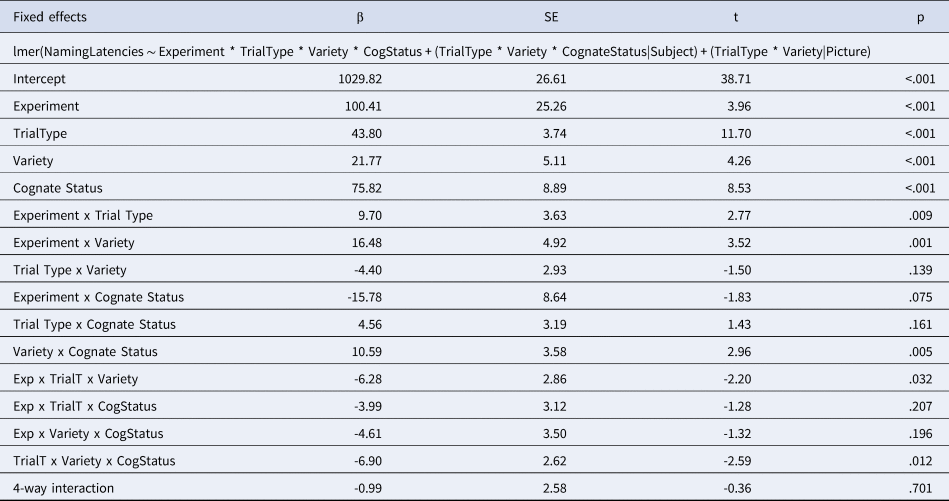
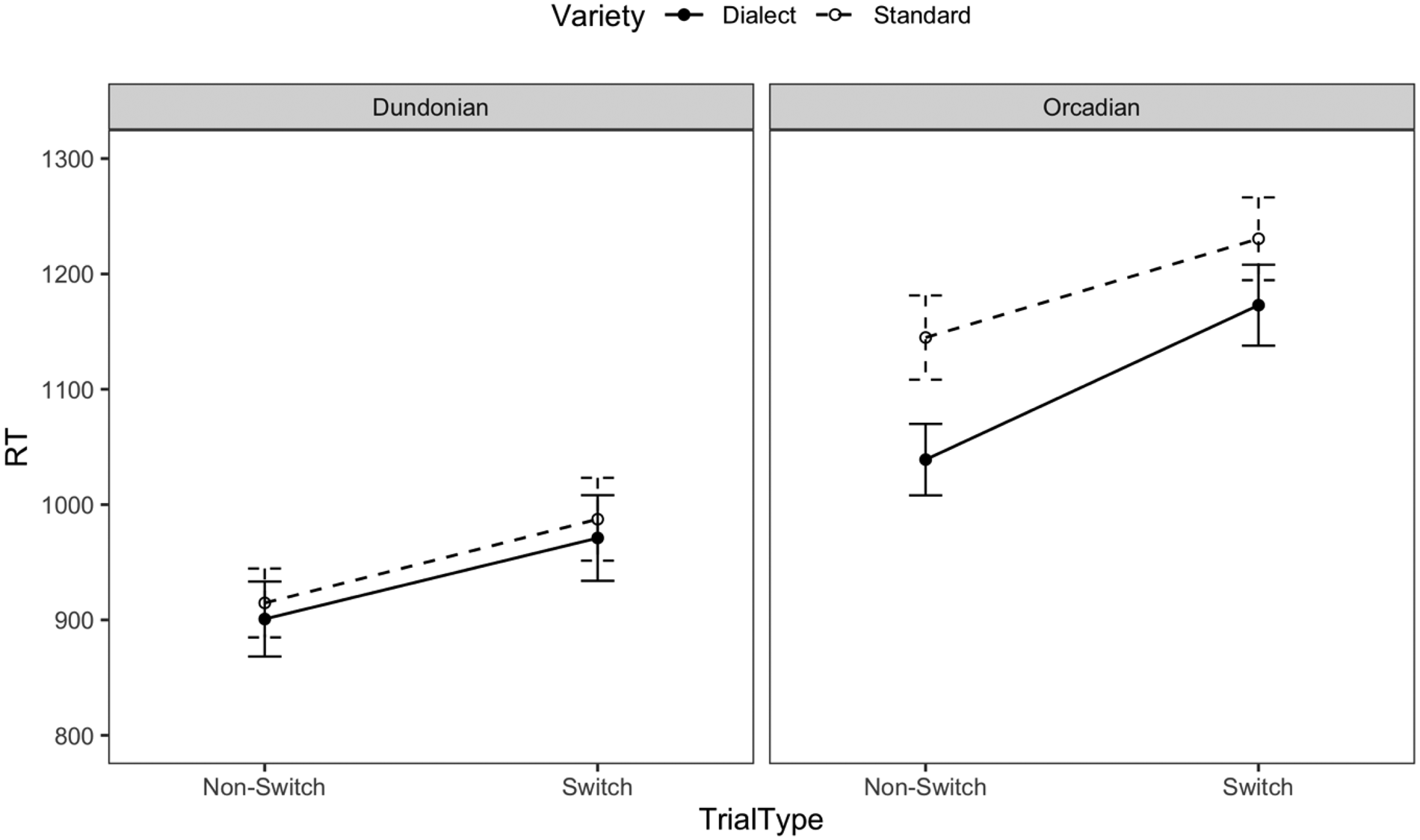
Because our findings appear to differ from a previous, methodologically similar study on switch costs in Dundonian bidialectals (Kirk et al., Reference Kirk, Kempe, Scott-Brown, Philipp and Declerck2018), we report here the results of a joint analysis of switching performance of these two groups to ascertain whether the pattern of switch costs observed here is indeed different from other bidialectal contexts. If so, the joint analysis should reveal a three-way interaction between Experiment, Variety and Trial Type. Naming latencies were analysed using a mixed-effect linear model with Trial Type (non-switch vs. switch), Variety (Scots vs SSE), Cognate Status (cognates vs. non-cognates) and Experiment (Dundonian/SSE vs Orcadian/SSE) and all interactions between these factors as centred fixed effects and random effects of Participants and Picture. The main effects corroborate findings from the previous study and are reported in Appendix B. Crucially, the three-way interaction between Experiment, Variety and Trial Type was significant (β = -6.28, SE = 2.86, t = -2.20, p < .05), confirming that switch costs for Dialect and SSE were almost identical for speakers of Dundonian but for speakers of Orcadian, the dialect incurred larger switch costs but overall shorter latencies than SSE.
Discussion
The findings of the present study indicate that the use of two closely related language varieties engages similar language control mechanisms as used by bilingual speakers. It should be stressed that the participants recruited into the present study are not commonly regarded as being bilingual and would likely be considered “monolingual”. We will discuss our findings with respect to four important indicators of bilingual language control – switch cost patterns, mixing cost patterns, cognate facilitation, and global differences in naming latencies – as well as the sociolinguistic and geographical context of the testing environment.
Switch costs
In line with previous findings on dialect switching (Kirk et al., Reference Kirk, Kempe, Scott-Brown, Philipp and Declerck2018; Vorwerg et al., Reference Vorwerg, Suntharam and Morand2019), our results confirmed that switching between closely related varieties incurs a substantial cost. Indeed, we observed a switch cost of 91 ms for Orcadian → SSE and of 131 ms for SSE → Orcadian. The significant Experiment x Trial Type interaction obtained in our joint analysis shows that this is substantially larger than the switch costs observed for a different group of bidialectals: namely, speakers of Dundonian Scots (Kirk et al., Reference Kirk, Kempe, Scott-Brown, Philipp and Declerck2018). For those speakers, we observed switch costs of 67 ms fo the Dundonian → SSE and of 71 ms for SSE → Dundonian. Moreover, the significant 3-way-interaction between Experiment, Trial Type and Variety obtained in the joint analysis suggests that the switch cost asymmetry in the Orcadian-SSE is different from the symmetrical switch costs in Dundonian-SSE bidialectals. It is worth pointing out that in both studies the participants’ ages ranged from their late teens/early twenties to the mid/late fifties, so age is unlikely to account for any differences between these studies. Rather, our results suggest that, combined with a global naming benefit for Orcadian compared to SSE, the higher switch cost into Orcadian confirms that the local dialect, rather than the standard variety, was the dominant variety for these participants. This aligns with findings of asymmetrical switch costs in unbalanced bilinguals who often display larger costs when switching into their dominant language due to the need to overcome the stronger inertia from inhibition of lexical entries of the dominant language (Costa & Santesteban, Reference Costa and Santesteban2004; Meuter & Allport, Reference Meuter and Allport1999). For example, in Costa and Santesteban (Reference Costa and Santesteban2004) the symmetrical switch cost for highly balanced Spanish–Catalan bilinguals was 47 ms for both L1 and L2 for a set of ten items (Experiment 2), and 65 ms for L1 vs. 69 ms for L2 for a set of 40 items (Experiment 3) – values that are of similar magnitude to what we observed in our previous study for Dundonian bidialectals using 18 items (Kirk et al., Reference Kirk, Kempe, Scott-Brown, Philipp and Declerck2018). In contrast, for unbalanced bilinguals, Costa and Santesteban (Reference Costa and Santesteban2004) observed switch costs of 71 ms for L1 and 35 ms for L2 in Spanish–Catalan bilinguals and of 81 ms for L1 and 42 ms for L2 in Korean–Spanish bilinguals. While the overall switch cost is somewhat lower than in the Orcadian speakers, presumably due to the smaller number of items in that study, the magnitude of the asymmetry of about 40 ms is very similar suggesting that Orcadian-SSE bidilialectals exhibit a switch cost pattern similar to unbalanced bilinguals. Moreover, in a previous study we trained monodialectal speakers of Anglo-English to use Scots words in a bidialectal naming experiment of the type described here (Kirk et al., Reference Kirk, Kempe, Scott-Brown, Philipp and Declerck2018), and found asymmetrical switch costs similar to those in unbalanced bilinguals. Thus, the pattern of switch costs observed in bidialectals appears to be similar to that from bilinguals: in that Dundonian speakers showed switch costs in line with those from balanced bilinguals while Orcadian speakers show a pattern more in line with that found in unbalanced bilinguals, suggesting that for them SSE is the less dominant variety despite the fact that for all practical purposes they would be considered as English monolinguals. It should be borne in mind, however, that not all studies have found that degree of L2 proficiency influences the pattern of switch costs (e.g., Bonfieni, Branigan, Pickering & Sorace, Reference Bonfieni, Branigan, Pickering and Sorace2019; see also Declerck, Wen, Snell, Meade & Grainger, Reference Declerck, Wen, Snell, Meade and Grainger2020b) suggesting switch cost patterns reflect different factors associated with variety usage and should not be taken as the sole indicator of differences in variety dominance. Our findings on asymmetrical switch costs in Orcadian point to the possibility that social prestige of a local variety may be one such factor.
Mixing costs
When comparing latencies between the pure blocks and the non-switch trials of the mixed block, we found that the mere presence of two varieties in the response set incurs a cost of 195 ms on average. Such a sizeable mixing cost can be taken as an indicator of proactive language control: bidialectals proactively activate both languages in mixed language blocks. This results in more cross-language interference, and thus worse performance, than when only the target variety is proactively activated and the nontarget variety proactively inhibited in pure blocks – a pattern of results that is also similar to bilinguals (Jylkkä, Lehtonen, Lindholm, Kuusakoski & Laine, Reference Jylkkä, Lehtonen, Lindholm, Kuusakoski and Laine2018; Ma et al., Reference Ma, Li and Guo2016; Peeters & Dijkstra, Reference Peeters and Dijkstra2018; Stasenko et al., Reference Stasenko, Matt and Gollan2017).
Cognate facilitation
In line with findings from bilingual language switching, we also observed cognate facilitation: words that sound similar in both varieties were on average named 110 ms faster. This demonstrates that, as for bilinguals, for bidialectals facilitation arises either because lexical representations of non-target cognates exert additional top-down activation of the phonological form (Costa et al., Reference Costa, Caramazza and Sebastian-Galles2000) or because segments shared between cognates exert bottom-up activation (Bernolet, Hartsuiker & Pickering, Reference Bernolet, Hartsuiker and Pickering2012). In Kirk et al. (Reference Kirk, Kempe, Scott-Brown, Philipp and Declerck2018) we had found that the cognate facilitation effect was more pronounced in SSE. Here, we found a similar effect, but only in the mixed block, and only when word length was not controlled and latencies were not log-transformed. Since cognate facilitation effects are usually larger in the dominant language in mixed language blocks (e.g., Verhoef et al., Reference Verhoef, Roelofs and Chwilla2009), yet all indictors – as discussed below – point to Orcadian being the dominant variety in these participants, unavoidable differences in word length between varieties may be the most parsimonious explanation for such an interaction (but see Damian, Bowers, Stadthagen-Gonzalez and Spalek, Reference Damian, Bowers, Stadthagen-Gonzalez and Spalek2010 for an argument against effects of word length on single word naming).
Global differences in naming latencies
Unlike the Dundonian-SSE bidialectal speakers tested in Kirk et al., (Reference Kirk, Kempe, Scott-Brown, Philipp and Declerck2018) and the diglossic speakers of Swiss and Standard German tested in Vorwerg et al. (Reference Vorwerg, Suntharam and Morand2019), who showed no overall differences in naming latencies between varieties, the Orcadian-SSE bidialectals tested here showed a pronounced overall naming benefit of 93 ms for naming pictures in Orcadian dialect. This global dialect benefit occurred both in the mixed block and in the pure blocks. Previous evidence from bilingual language switching is equivocal with respect to language dominance effects in mixed blocks, with some studies showing faster overall naming latencies in the dominant variety while others show faster naming latencies in the non-dominant variety (Declerck et al., Reference Declerck, Kleinman and Gollan2020a; for a review, see Declerck, Reference Declerck2020), depending on the difference in proficiency between the two languages. However, while a reversed language dominance effect can be observed in mixed language blocks, this is not the case in pure language blocks where language dominance is directly reflected in processing speed (Hanulová, Davidson & Indefrey, Reference Hanulová, Davidson and Indefrey2011). In keeping with these findings, the difference in naming latencies between varieties observed in the pure blocks indicates that Orcadian was the stronger, preferentially activated variety, most likely because it is the dominant variety for these speakers, at least under the given testing conditions.
Two factors may be responsible for the strong dominance of Orcadian exhibited in this experiment: first, the geographical position of the Orkney Isles may reduce the influence of mainland standard varieties and contribute to the social prestige of the local variety. This is reflected by the Orcadian Scots pejorative term “chanting”, used to describe opting to speak SSE rather than Orcadian, which is conceptually similar to the term “knappin” used by Shetland dialect speakers (Smith & Durham, Reference Smith and Durham2011). Secondly, the fact that the experimenter was a native speaker of Orcadian and used this variety in interactions with participants, while the experiment was conducted in community settings as opposed to a laboratory may have primed for preferential activation of this variety, in line with research showing greater priming from the ambient language that can manifest itself in increased tip-of-the-tongue states (Kreiner & Degani, Reference Kreiner and Degani2015). Future research will have to determine what, if any, role the variety used when administering such naming tasks plays.
Conclusions
We wish to highlight two conclusions. First, our results clearly show that Orcadian Scots, rather than the geographically relevant standard variety of English (SSE), appeared to be the dominant variety for our participants. This finding has important repercussions for our understanding of what it means to be a monolingual: in most studies, participants of the kind tested here would be categorised as monolingual English speakers. Even if given a language background questionnaire like the widely used LEAP (Marian, Blumenfeld & Kaushanskaya, Reference Marian, Blumenfeld and Kaushanskaya2007), such participants would likely not list their local dialect as an additional variety when asked about which “languages” they speak. This, in turn, would render any findings with respect to linguistic processing and lexical representation of English as questionable at best as the potential cost of suppressing a second variety will not be accounted for. Indeed, the difference switch cost patterns between Orcadian and Dundonian bidialectals observed here attests to the different situations and contexts of variety use that should be considered when assessing language background.
Secondly, the pattern of results for bidialectal picture naming mirrors very closely observations from bilingual picture naming reported in the literature (e.g., Costa & Santesteban, Reference Costa and Santesteban2004). This finding lends support to the notion that mechanisms of bidialectal lexical access can be similar to those found in bilinguals, especially if varieties tend to be used in distinct, non-overlapping social contexts (Vorwerg et al., Reference Vorwerg, Suntharam and Morand2019). Failing to account for non-standard variety usage therefore has repercussions for research investigating the existence of a bilingual cognitive advantage as it calls into question the homogeneity of monolingual controls (see Kempe, Kirk & Brooks, Reference Kempe, Kirk and Brooks2015). This may, in part, account for some of the contradictory findings with respect to the existence of a bilingual advantage in cognitive control (for an account of how these contradictory findings may be reconciled by a more fine-grained account of linguistic diversity see de Bruin, Dick & Carreiras, Reference De Bruin, Dick and Carreiras2021).
We echo de Bruin's (Reference De Bruin2019) call for bilingual experiences to be investigated using more detailed assessment tools, and would like to extend it to include monolinguals as well. We argue that some of the discrepancies in the literature on whether there is a bilingual executive control advantage may arise from variability among monolinguals: while some may indeed use only one variety others may be bidialectals who engage cognitive mechanisms to control their two varieties with potential consequences for cognitive control. Although previous research conducted with Dundonian-SSE speakers has not shown any bidialectal executive control advantage in children (Ross & Melinger, 2017) or older adults (Kirk et al., Reference Kirk, Fiala, Scott-Brown and Kempe2014), the present results suggest that the difference between monolinguals and bilinguals in terms of language control may be one of degree rather than type and that bidialectals may exhibit different profiles of variety dominance and variety use.
One limitation of this study is that the comparison to bilingual language processing is indirect as it draws on data from the literature. It would be desirable to provide a direct comparison between bidialectal and bilingual processing, using participants that are similar in terms of demographic and cultural background and differ only in whether they use a regional dialect or a second language. However, finding such comparable groups has so far proven to be difficult. In the meanwhile, our findings highlight the need for researchers to be sensitive to the use of different linguistic varieties that are not typically considered different languages when querying prospective participants about their language background. Future research should account for the possibility that speakers may represent and process varieties as different regardless of each variety's linguistic status, social prestige or similarity to a standard language.
Appendix A
List of Scottish Standard English (SSE) and Orcadian Scots words used in the dialect switching task.

Appendix B
Results of the joint analysis with data from speakers of Dundonian Scots tested in Kirk et al. (Reference Kirk, Kempe, Scott-Brown, Philipp and Declerck2018). Figure B1 depicts the interaction between Experiment (Dundonian vs. Orcadian Scots) x Variety (Scots vs SSE) x Trial Type (Non-Switch vs. Switch)
Naming latencies for non-switch and switch trials by experiment and variety. Error bars represent 1 S.E.M. computed with participants as random effects.


 Open access

