


A large number of studies have assessed the human energy expenditure associated with common daily activities in middle- and high-income countries(Reference James1,Reference Afshin, Forouzanfar and Reitsma2) . The evidence base is much thinner for low-income countries, where residents regularly engage in activities that are rarely practiced in higher income settings. For example, a recent meta-analysis of global energy expenditure studies found that of ninety-eight qualifying studies, only fourteen were from low- or middle-income countries(Reference Dugas, Harders and Merrill3). The 2004 United Nations FAO report on human energy requirements provides a number of recommendations for future research including the ‘need to update and expand the data bank on the energy cost of a range of activities undertaken in real-life conditions by children and adults, distinguishing weight-bearing from non-weight-bearing activities, and specifying whether energy costs refers to “net” activity or is integrated over tasks(4)’. Furthermore, the report states the need for ‘reliable documentation on life-styles and time use needs to be collected in order to improve the existing energy expenditure estimates using adults, children and the elderly in diverse contexts, with special efforts to include information from developing country and transitional society contexts(4)’.
The question therefore becomes, which human activities should be the focus of additional studies on energy expenditure in low-income settings? A particularly important set of activities include household or domestic tasks, which make up what Blackden & Wodon(Reference Blackden and Wodon5) refer to as the ‘household economy’. These activities, which go largely unaccounted for in economic data, illuminate gender disparities by demonstrating how individuals’ work responsibilities and time are allocated within households(Reference Blackden and Wodon5). Time analyses of the household economy reveal that these activities have an immense effect on welfare, poverty and development outcomes(Reference Blackden and Wodon5). While the time necessary to complete these tasks is essential to understanding them, temporal data alone are an incomplete reflection of the full burden of domestic labour.
A more complete understanding of the cost of an activity not only includes assessments of time opportunity costs but also considers the energy needed to perform the activity. For example, different activities are represented by different ratios of time and energy, most often quantified as metabolic equivalent of task (MET). Sitting still for an hour is equal to one MET while running at a 10 min/mile pace for an hour would be almost ten times that energy requirement at 9·8 MET(Reference Ainsworth, Haskell and Herrmann6). Consequently, energy expenditure is not proportional to time cost for all activities.
Accurately quantifying energy expenditure for household activities can be difficult in even the most research-friendly locations. For example, the amount of energy expended on household activities is often undervalued in surveys of physical activity in the USA(Reference Ainsworth7). A study by Ainsworth et al. (Reference Ainsworth, Irwin and Addy8) found that only 41 % of minority women met the Centers for Disease Control and American College of Sports Medicine recommendation of >30 min/d of moderate activity when recording activities like sports, recreational pursuits and gardening. However, that number rose to 87 % when household or domestic activities were also included(Reference Ainsworth7).
Addressing these understudied activities is increasingly important, especially in the context of growing worldwide concerns over diseases caused by obesity or undernutrition(4,Reference Prentice9) . The FAO notes that ‘a science-based definition of human energy requirements is crucial for the control and prevention of undernutrition due to insufficient intake of food energy, which remains a major problem for many countries. It is also essential to efforts to curb the excessive intake of food energy that is a major determinant of nutrition-related chronic diseases, at present an important cause of worldwide morbidity and mortality among adults(4)’.
While the FAO and other organisations have called for greater measurement of energy costs of a wider range of activities, domestic tasks are rarely the focus of new studies. Consider two common, time-consuming and energy-intensive domestic activities in sub-Saharan Africa: water fetching and hand pounding of grain(Reference Clarke and Rottger10). The United Nations Development Programme has estimated that women in sub-Saharan Africa devote roughly 40 billion hours each year to fetching water(11). Likewise, using traditional mortar and pestle technologies can require as much as 13 person hours to pound a quantity of maize sufficient to feed a family of four for 5 d(Reference Blackden and Wodon5,Reference Clarke and Rottger10) . Despite the ubiquity of these tasks, there are few existing data from which to estimate energy expenditure for fetching water and hand-pounding grain(4,Reference Ainsworth, Haskell and Herrmann6,Reference Vaz, Karaolis and Draper12) . Additional details concerning the measurement and reporting of existing data as well as energy intake are presented in the online supplementary material.
To precisely measure energy expenditure for specific activities, methods like indirect calorimetry are needed. Indirect calorimetry estimates energy expenditure by measuring the amount of O2 consumed and CO2 produced by a participant during an activity(Reference Leonard13,Reference Ndahimana and Kim14) . However, this method can be expensive, complicated and cumbersome, even under laboratory conditions. As a result, few studies using direct measurement techniques have occurred in the remote and difficult environments where residents of rural, low-income communities reside. The FAO’s recommendations not only call for measuring the energy expenditure of a larger range of activities but also for applying techniques that are accurate, precise, portable, cheap and appropriate for field-based studies worldwide(4).
Fortunately, wearable heart rate monitors enable collection of precise data without restricting participant movement under challenging conditions. Small and robust heart rate monitors can be worn under clothing, are relatively inexpensive and do not require uninterrupted power sources. A number of studies have validated the use of heart rate monitors for estimating energy expenditure during a variety of activities under real-world conditions(Reference Bharathi, Kuriyan and Kurpad15–Reference Ueno, Ikeda and Tai24). Thus, heart rate monitors provide an opportunity to accurately estimate energy expenditure in a variety of hard-to-access locations.
Calculating energy expenditure estimates from wearable heart rate monitor data relies on the use of existing heart rate-to-energy expenditure conversion equations. Keytel et al. (Reference Keytel, Goedecke and Noakes20) published one of the more frequently used heart rate-to-energy conversion equations from a 127 participant sample of individuals performing treadmill and cycling activities. The Keytel et al.’s(Reference Keytel, Goedecke and Noakes20) equation was created using participants in South Africa and is recommended for use in large population health studies. It is therefore appropriate for an analysis using heart rate-to-energy expenditure prediction equations to begin with the Keytel et al.’s(Reference Keytel, Goedecke and Noakes20) equation when measuring household activities in sub-Saharan Africa.
However, obtaining precise results from Keytel et al.’s(Reference Keytel, Goedecke and Noakes20) conversion equations assumes a linear relationship between heart rate and energy expenditure for a given activity. This linear relationship is most consistently found in moderate-to-vigorous intensity ambulatory activities(Reference Ndahimana and Kim14,Reference Ceesay, Prentice and Day17,Reference Keytel, Goedecke and Noakes20,Reference Rennie, Hennings and Mitchell22,Reference Spurr, Prentice and Murgatroyd23,Reference Schrack, Zipunnikov and Goldsmith25) . It has been established that the heart rate-to-O2 consumption ratio is not comparable between large muscle mass groups used in ambulatory activities like walking or running and non-ambulatory, smaller muscle mass activities like lifting weights(Reference Bassett and Howley26,Reference Welk27) . As previously mentioned, two such contrasting activities which are common for residents of sub-Saharan Africa are water fetching and hand pounding of grain(Reference Clarke and Rottger10). Water fetching and hand pounding are especially common among low-income households who cannot afford time- and energy-saving alternatives like household piped water connections or commercial milling services.
Given the gaps in the literature identified above, we provide novel calculations of the rate of energy expended while head-hauling water and pounding grain under laboratory conditions in Mozambique. We also assess the potential for heart rate monitoring to accurately estimate energy expenditure of these activities outside of a laboratory setting. The goals of the study were to measure energy expenditure in Mozambican university students to (i) estimate the MET value for head-hauling water and hand-pounding grain with a traditional pilão (mortar and pestle) using indirect calorimetry and (ii) assess the suitability of using heart rate monitor data, coupled with the Keytel et al.’s(Reference Keytel, Goedecke and Noakes20) conversion equation, to estimate energy expenditure for these same activities.
Methods
Study site
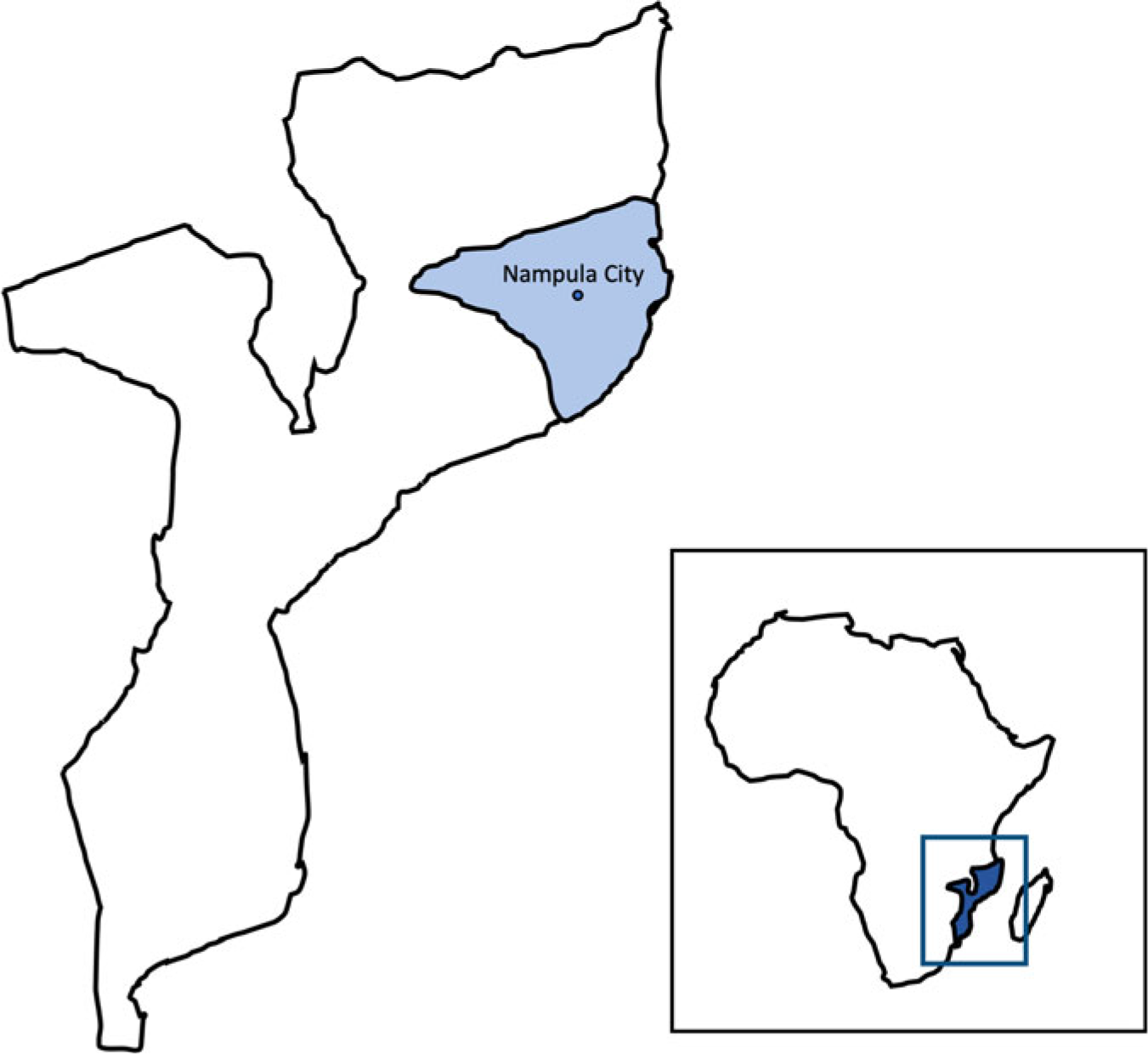
The current study was hosted at the Universidad Lúrio in Nampula city, located in Nampula province, Mozambique (Fig. 1). At the time of data collection, approximately 1 % of rural households and 25 % of urban households in Mozambique had piped water in their homes or yards(28). The remaining three quarters of Mozambicans fetched water at some distance from their home, often from shared water points such as borewells. The most common method of processing grain in Mozambique for both urban and rural populations is with a pilão, although wealthier households may pay to have their grain milled professionally(Reference Byerlee and Eicher29). Nampula thus provides a setting in which both head-hauling water and pilão usage are common. Moreover, both men and women are intimately familiar with the activities, although women tend to perform these activities more frequently.
Map of study location, Nampula city in Nampula province, Mozambique. Inset map shows location of Mozambique relative to Africa as a whole.  , Nampula province;
  , Mozambique
Participant recruitment
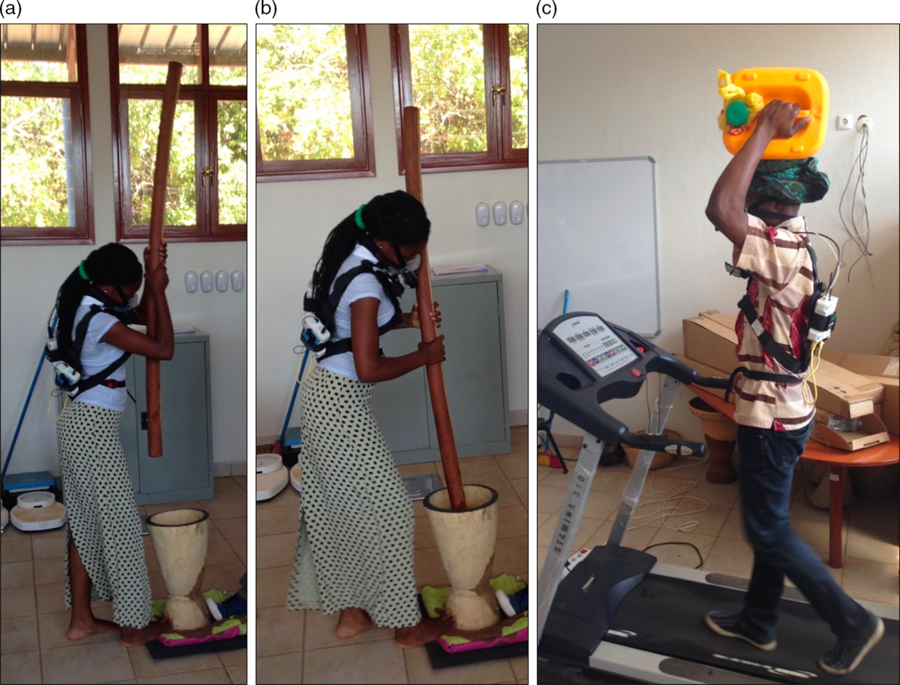
For the current study, we measured human O2 uptake using indirect calorimetry and heart rate measurements in Mozambican men and women, aged 18–31 years (a) using a pilão to pound maize in a laboratory setting and (b) carrying a 20-litre container of water (20·5 kg, including container) on their head while walking on a motor-driven treadmill (Fig. 2). To recruit participants, the research was briefly presented to students from the university’s nutrition programme during several classes, detailing the study’s aims and procedures. Approximately sixty female and eighty male students were informed about the study. At the end of each announcement, contact information was collected from students who expressed interest in participating, and individual follow-up appointments were set. During that appointment, student participants completed a written informed consent and their eligibility to participate was verified. Next, anthropometric measurements were made, followed by the completion of indirect calorimetry measurements (Table 1). All recruited participants were free of known cardiovascular, metabolic, orthopaedic or other potential activity-limiting conditions. Each participant verified that she/he neither had eaten in the past 2 h nor had consumed caffeine or alcohol in the previous 12 h. None of the participants reported smoking tobacco products regularly.
(a and b) Study participant uses a traditional pilão by repeatedly raising the long wooden pestle above her head and striking it down into the large wooden mortar. (c) Study participant walks on treadmill with 20 litres of water (20·5 kg, including container) loaded on her head. Photo Credit: Kory Russel
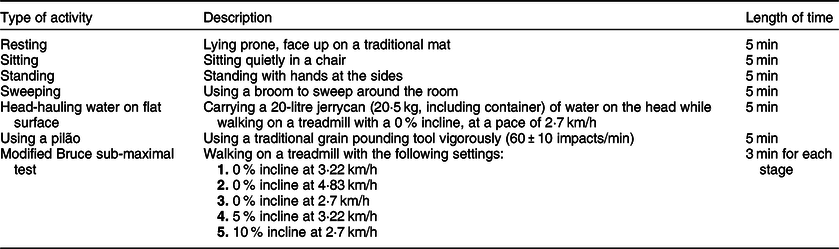
Activities performed by participants during indirect calorimetry measurement (laboratory)
Data collection
Following informed consent, each participant’s body weight (±0·2 kg) was determined using a Tanita™ digital scale (Tanita Corporation). Standing height was determined using a Seca™ Stadiometer (Seca), and waist circumference was measured with a flexible medical measuring tape starting and ending at the umbilicus. All anthropometric measurements were made in duplicate. If measurements were not within ±0·2 cm (height, waist) or ±0·2 kg (weight) of each other, then additional measurements were taken until the last two measurements fell within the designated range. We estimated the regular physical activity level of each participant using a Stanford brief activity survey modified to include activities common to rural Mozambique(30,Reference Taylor-Piliae, Fair and Haskell31) .
A Polar Heart Rate Belt™ (Polar) and a Zephyr Bioharness 3™ (Zephyr Technology Corporation) were used simultaneously to collect heart rate data from each participant, providing a method by which to check data consistency. For indirect calorimetry measurements, an Oxycon Mobile™ (Jaeger) was used to obtain respiratory gas measurements and estimate energy expenditure. Measurements included expired air volume, as well as the volumes of O2 (VO2) consumed and carbon dioxide (VCO2) expelled. Before each trial, the Oxycon Mobile™ was calibrated using a gas mixture of 4 % CO2 and 16 % O2. Additionally, the Oxycon Mobile™ calculated and recorded MET values.
During the indirect calorimetry measurements, each participant completed seven separate activities: lying prone, sitting quietly in a chair, standing quietly, sweeping, walking on a motor-driven treadmill at a pace of 2·7 km/h (0 % gradient) with a full 20-litre container (20·5 kg, including container) of water on their head, using a traditional pilão (3·8 kg pestle) to pound simulated grain (small paper pellets), and completing a modified Bruce sub-maximal test(30). The mortar portion of the pilão was approximately 46 cm in height with an approximately 24 cm circumference opening at the top which tapered in a cone-like fashion to a floor two-thirds of the height of the mortar, with the remaining height composing a solid wood base. The pestle portion of the pilão consisted of a single piece of solid wood, approximately 1·55 m in length with a circumference of approximately 5·5 cm and weighing 3·8 kg. Both the mortar and pestle were purchased in a local market and made of local wood (exact species unknown). Participants were instructed to use the pilão as they would under normal conditions which resulted in 60 ± 10 impacts/min. No measurements were taken of the pounding force. Most participants lifted the pestle above their head before dropping it into the mortar, and the force thus resulted primarily from the pestle falling (Fig. 2).
Each of the first six activities was performed for 5 min to reach respiratory and heart rate steady state (Table 1). Participants were given as much recovery time as they needed between each of the first six activities. The sub-maximal test lasted for a duration of 15 min, with changes in the treadmill speed and incline every 3 min as summarised in Table 1. The five activities in the sub-maximal treadmill test were performed continuously with no breaks between activities. All activities were performed in the same order by every participant. MET characterisations and heart rate-to-energy expenditure calibration calculations were made using the final 2 min of respiratory and heart rate data collected from each activity. Four participants did not complete all activities due to power outages during the indirect calorimetry measurements. Additionally, one participant’s face mask seal failed and the subsequent activity data were discarded. Only activities completed in their entirety were included in the analysis.
Statistical analyses
A mixed model, using a random intercept for participants to incorporate individual energy expenditure variation, was used to test the heart rate-to-energy expenditure correlation. This predictive energy expenditure mixed model was derived from previously published studies but fit to the data in the current study(Reference Keytel, Goedecke and Noakes20,Reference Schrack, Zipunnikov and Goldsmith25) . The participants were modelled as random effects in the mixed model to account for clustering as a result of multiple activity measurements for the same participant. Only medium- and high-intensity activities were included in the model while low-intensity activities, defined as activities with average heart rates below 100 beats/min (bpm), were excluded since heart rate monitoring has proven inaccurate for measuring the energy expenditure of sedentary and low-intensity activities(Reference Ndahimana and Kim14,Reference Spurr, Prentice and Murgatroyd23) .
Predictors were tested based on their inclusion in previous studies(Reference Keytel, Goedecke and Noakes20,Reference Rennie, Hennings and Mitchell22,Reference Schrack, Zipunnikov and Goldsmith25) . The initial model included heart rate, sex, age, activity level, body weight and breathing rate. The final mixed model for the estimation of energy expenditure included heart rate (in bpm), sex (a dichotomous variable, female = 0), body weight (in kg) and breathing rate (in breaths/min) as fixed effects. Age, height and the Stanford brief activity survey score were dropped from the final model, as they were NS predictors of energy expenditure.
Mixed model:
 $${\rm{EE (kJ/min)}} = {\beta _0} + {\beta _1}({\rm{heart\ rate}}) + {\beta _2}(sex) + {\beta _3}({\rm{weight}}) + {\beta _4}({\rm{breathing\ rate}}) + {e_{ij}} + {u_{1j}}.$$
Following the identification of the significant predictors using the mixed model, a linear prediction equation was created, defining sex as 1 for males and 0 for females.
Prediction equation:
 $$\hskip -15pt{\rm{EE (kJ/\min \rm) = \rm sex \times ( - 49\!\cdot\!925 + 0\!\cdot\!\!231 \times \rm{heart\ rate}}}\ + {0\!\cdot\!634 \times {\rm{weight}} + 0\!\cdot\!\!149 \times {\rm{breathing\ rate}})}\\ + {(1 - {\rm{sex}}) \times ( - 24\!\cdot\!\!572 + 0\!\cdot\!\!240 \times {\rm{heart\ rate}}} + {0\!\cdot\!\!125 \times {\rm{weight}} + 0\!\cdot\!066 \times {\rm{breathing\ rate}}).}$$
Note that the Keytel et al.’s(Reference Keytel, Goedecke and Noakes20) equation also identified sex, heart rate and weight as significant predictors but did not include breathing rate. Keytel et al. (Reference Keytel, Goedecke and Noakes20) did not indicate if they had measured breathing rate in their analysis.
Keytel equation:
 $${\rm{EE }\left( \rm kJ/\min \right) = \rm sex \times ( - 55\!\cdot\!0969 + 0\!\cdot\!6309 \times \rm heart\ rate} + {0\!\cdot\!\!1988 \times {\rm{weight}} + 0\!\cdot\!2017 \times {\rm{age}})} \\ + {(1 - {\rm{sex}}) \times ( - 20\!\cdot\!4022 + 0\!\cdot\!4472} \times {{\rm{heart\ rate}} - 0\!\cdot\!\!1263 \times {\rm{weight}} + 0\!\cdot\!074 \times {\rm{age}}).}$$
Using an ordinary least squares method, the indirect calorimetry estimated energy expenditure was regressed against the energy expenditure calculated from equation (2). The indirect calorimetry estimated energy expenditure was also regressed against energy expenditure calculated from equation (3)(Reference Keytel, Goedecke and Noakes20).
All statistical analyses were performed using SPSS Statistics version 24.0 (SPSS Inc.).
Results
Participant characteristics
A total of forty university students, thirty women (18–31 years old) and ten men (19–31 years old) participated in the study. Three-quarters of participants were originally from Nampula or a neighbouring province. Likewise, three-quarters of participants also reported fetching water as part of their daily routine. All participants reported familiarity with the activity even if they did not perform it daily. The physical characteristics of both female and male study participants are generally similar to female and male Nampula residents more broadly(32). A notable exception was that both male and female study participants were on average, approximately 11 % heavier than typical Nampula residents (Table 2).
Comparison of study participants and the female Nampula population’s mean, and sd, anthropometric characteristics
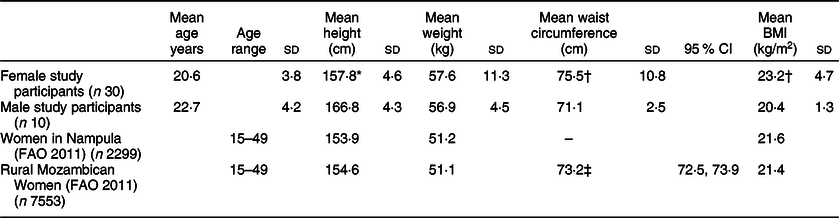
* Mean value for study females is significantly different than mean values for study males (P ≤ 0·01).
† Mean value for study females is significantly different than mean values for study males (P ≤ 0·05).
‡ Waist circumference and CI values from a nationally representative sample of rural Mozambican women (age range 25–65 years) were taken from Gomes et al. (Reference Gomes, Damasceno and Azevedo33). Gomes et al. (Reference Gomes, Damasceno and Azevedo33) only provided 95 % CI, no sd values. All other values in this row and the row above were taken from the 2011 FAO report(32) which did not proved sd values.
Metabolic equivalent of task values
The mean MET values for low-intensity activities were found to closely reflect (±0·2 MET difference) the ranges of values previously reported in the Compendium of Physical Activity(Reference Ainsworth, Haskell and Herrmann6), hereinafter ‘the Compendium’. Thus, it is unlikely that this specific population is an outlier in terms of energy expenditure (Tables 3 and 4).
Mean, and sd, metabolic equivalent of task (MET) values, heart rate and volume of oxygen (VO2) consumed by activity for all female participants*
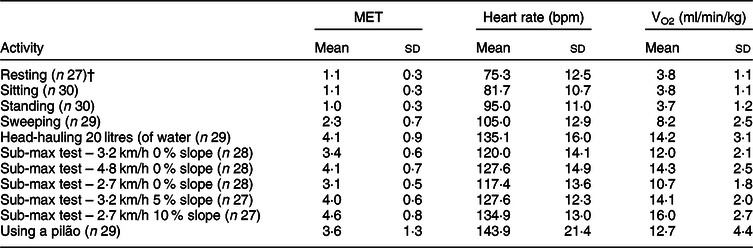
* MET values represent the final 2 min of each 5- and 3-min activity, in order to reach respiratory and heart rate equilibrium.
† Not all participants completed all activities due to power outages during four measurement periods and one face mask seal failure. Only completed activities were included in the analysis, which explains the variation in reported sample sizes.
Mean, and sd, metabolic equivalent of task (MET) values, heart rate and volume of oxygen (VO2) consumed by activity for all male participants*
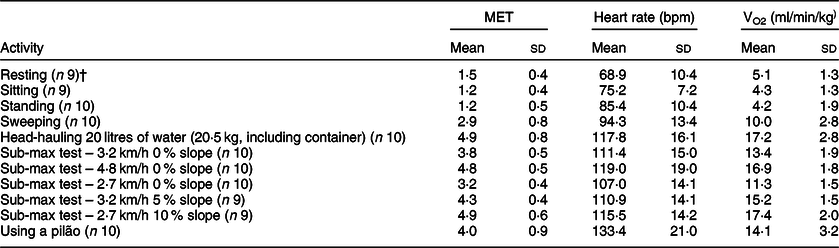
* MET values represent the final 2 min of each 5- and 3-min activity, in order to reach respiratory and heart rate equilibrium.
† Not all participants completed all activities due to power outages during four measurement periods and one face mask seal failure. Only completed activities were included in the analysis, which explains the variation in reported sample sizes.
The mean MET value of all participants (4·3 (sd 0·9)) for head hauling 20 litres (20·5 kg, including container) of water at a velocity of 2·7 km/h on a 0 % slope falls far below the Compendium reported 6·1 MET for head hauling 20 litres of water(Reference Ainsworth, Haskell and Herrmann6,Reference Rao, Gokhale and Kanade34) . Head-hauling water resulted in a 28 % greater energy expenditure than walking unloaded at the same speed and slope (MET 3·1 (sd 0·5); n 38) (Fig. 3).
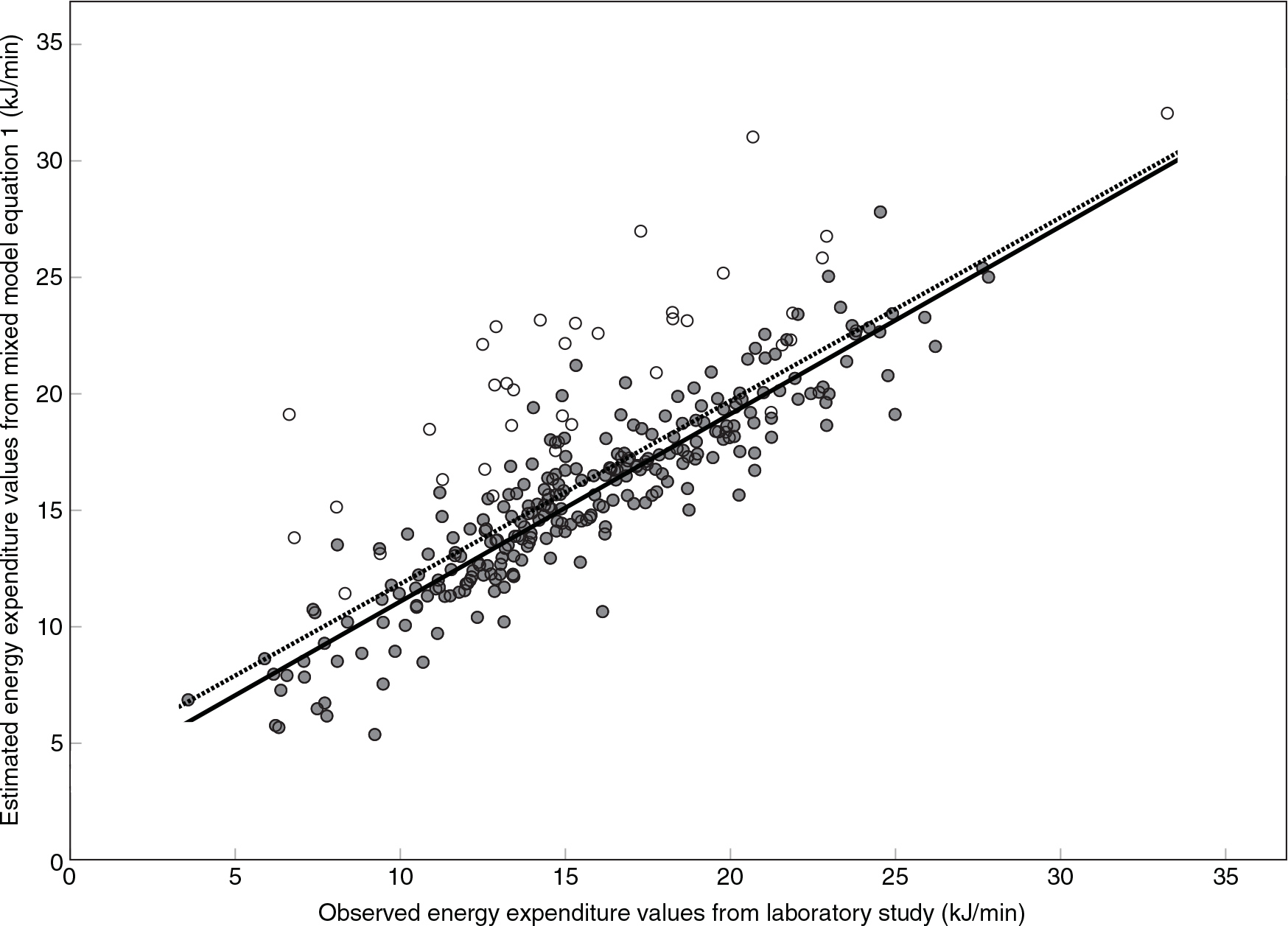
Scatter plot of estimated energy expenditure values from mixed model equation (1) regressed against laboratory-observed energy expenditure for all activities with heart rates >100 bpm. The model including pilão use data (hollow circles and dotted line) has a poorer correlation than the model excluding pilão use data (solid circles and solid line).  , excluding pilão data;
  , including pilão data;
  , excluding pilão data;
  , including pilão data
Sex is an important predictor in the mixed model (equation (1)). MET values were 13 % lower on average for activities performed by female participants in comparison with those performed by male participants (Tables 3 and 4). Specifically, head-hauling and pilão use MET values for female participants (4·1 (sd 0·9) and 3·6 (sd 1·3), respectively) produced lower MET values than for male participants (4·9 (sd 0·8) and 4·0 (sd 0·9), respectively). Nevertheless, only resting, head-hauling water and walking at 4·8 km/h on a 0 % slope resulted in a statistically significant difference (P < 0·01) between male and female participants. Additional details are presented in the online supplementary material, Supplemental Table S1.
Pilão use energy expenditure v. heart rate
Pilão use, while primarily a small muscle mass activity, produced the highest average heart rate (141·2 bpm) of any activity in the current study. On average, pilão use was 8 % higher than head-hauling water (130·7 bpm) for all participants. However, the 13·1 VO2 ml/min/kg consumed for pilão use was on average 13 % lower than head-hauling water for all participants, and the pilão use MET value was 14 % lower on average than head-hauling water (see online supplementary material, Supplemental Table S1).
Energy expenditure mixed model performance (equation (1))
Heart rate, sex, breathing rate and body weight proved significant when only medium- and high-intensity activities, those ≥100 bpm, were included (Fig. 3). Estimated energy expenditure predictions from the mixed model were found to correlate reasonably well overall with observed energy expenditure (n 298 values from thirty-nine participants, r 2 0·68, r 0·82, y = 3·97 + 0·79x). However, there was a relatively weak correlation between heart rate and energy expenditure during pilão use (Fig. 3). Therefore, the model was re-estimated after excluding the pilão data and model fit improved considerably (n 260 values from thirty-nine participants, r 2 0·83, r 0·91, y = 3·03 + 0·81x). Clustering was accounted for in all regressions at the individual participant level. Additional details concerning the performance of the mixed model are presented in the online supplementary material, Supplemental Tables S2 and S3.
Prediction equation performance (equation (2))
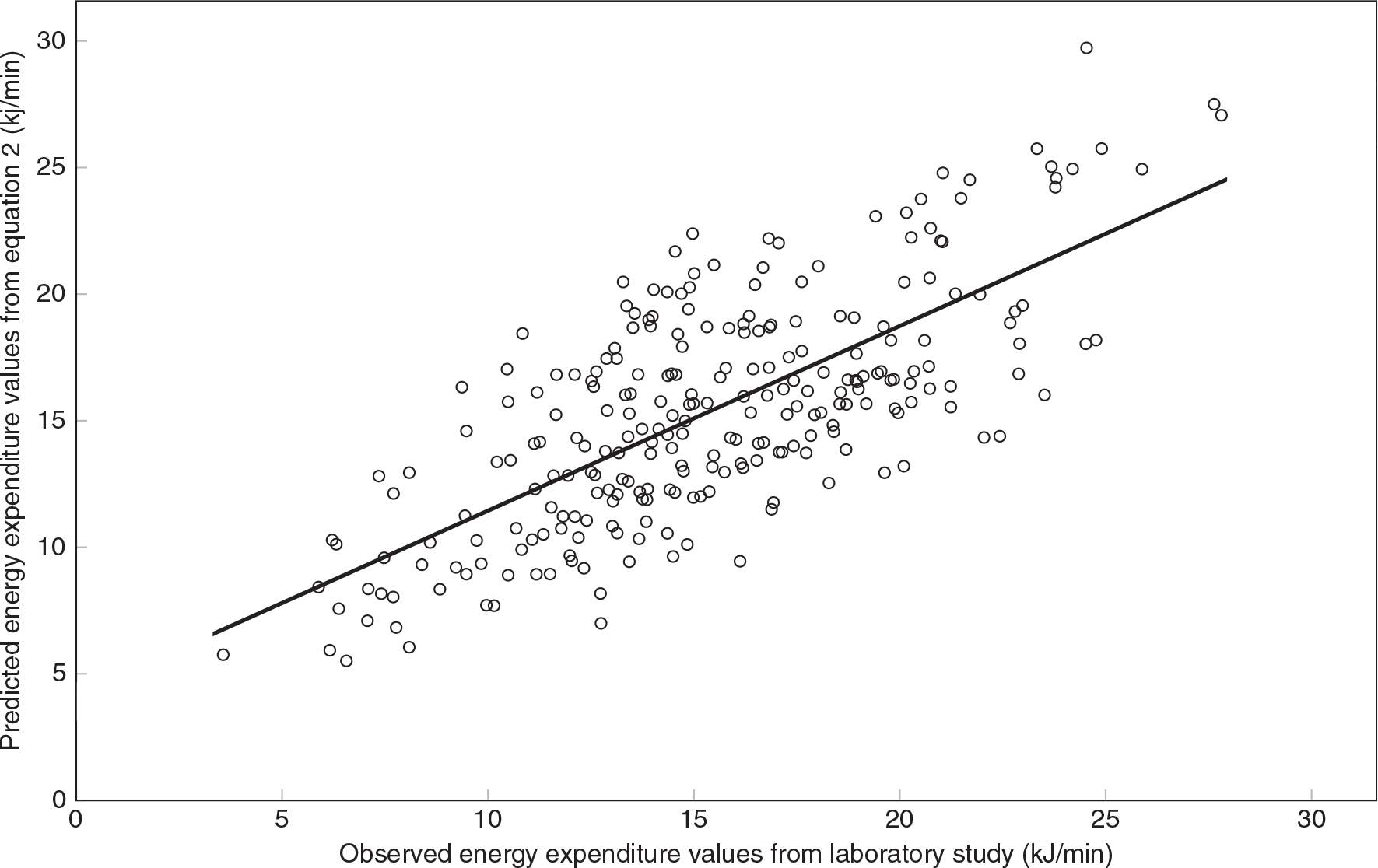
We regressed the calculated values from equation (2) developed from the mixed model against the observed energy expenditure values for each participant (Fig. 4). Predicted energy expenditure was found to correlate moderately well overall with observed energy expenditure (n 261 values from thirty-nine participants, r 2 0·52, r 0·72, y = 4·15 + 0·73x).
Scatter plot of energy expenditure calculated from prediction equation (2) regressed against observed energy expenditure, for activities with average heart rates above 100 bpm excluding pilão use data
Keytel et al.’s(Reference Keytel, Goedecke and Noakes20) equation performance (equation (3))
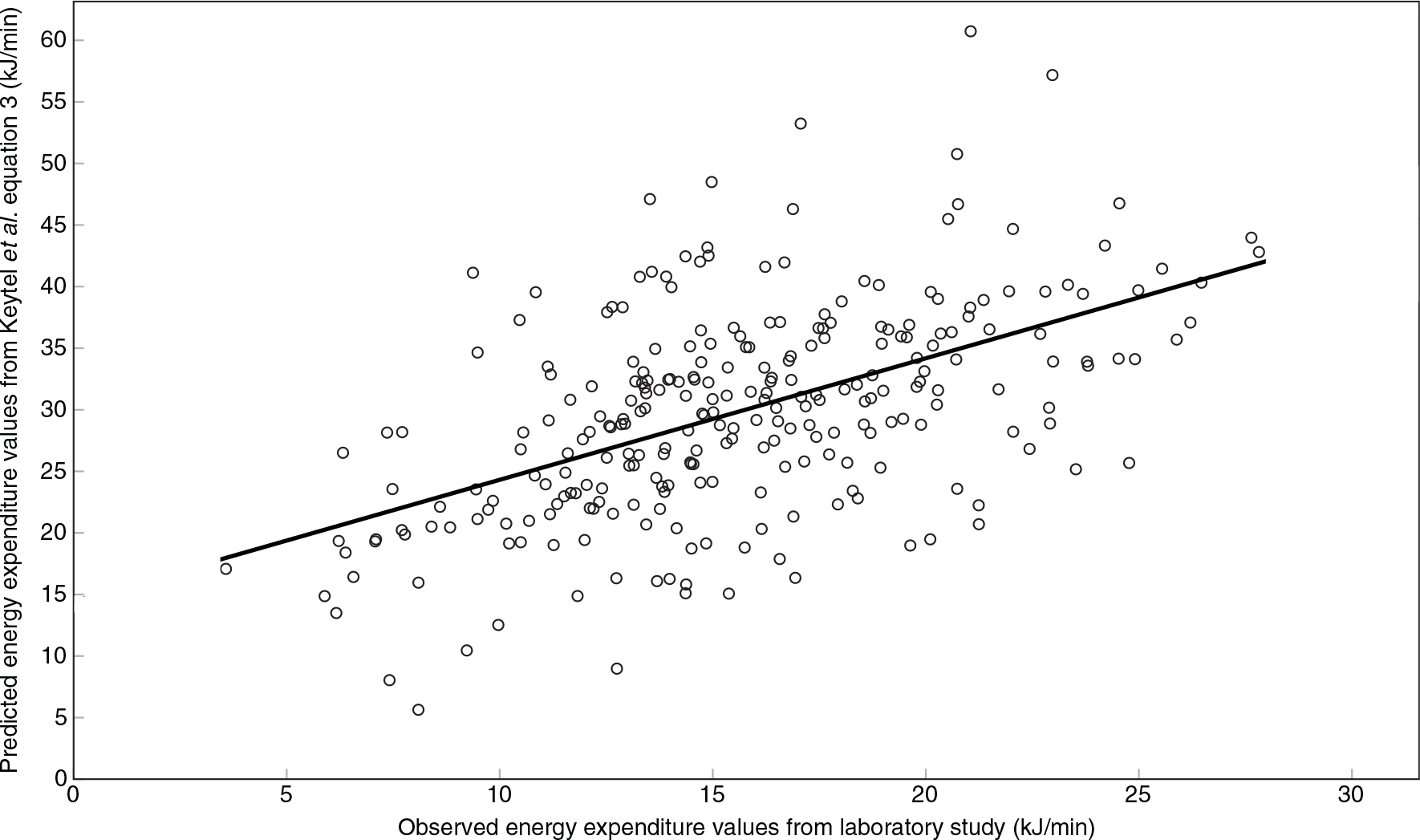
For this study sample, the Keytel et al.’s(Reference Keytel, Goedecke and Noakes20) equation (3) was less accurate as an estimator of energy expenditure than equation (2) (Fig. 5). The coefficient of correlation is r 0·53, and with 28 % of the variation in the measured energy expenditure explained by the Keytel et al.’s(Reference Keytel, Goedecke and Noakes20) estimation equation (n 269 values from forty participants, r 2 0·28, r 0·53, y = 14·44 + 0·99x). It is important to note that energy expenditure correlation coefficients are commonly reported in terms of r instead of r 2; r-values >0·5 are considered practically significant(Reference Hills, Mokhtar and Byrne35,Reference Swartz, Strath and Bassett36) .
Scatter plot of energy expenditure calculated with Keytel et al. (Reference Keytel, Goedecke and Noakes20) Equation 3 regressed against measured energy expenditure for activities with average heart rates above 100 bpm excluding pilão use
Discussion
To our knowledge, this is the first study examining the relationship of heart rate to energy expenditure for head-hauling water and hand-pounding grain in Mozambique. Additionally, this is the first presentation of a MET value for hand-pounding grain (pilão use) in Mozambique. Some of the most common activities performed by women globally are understudied because energy cost research has mainly focused on tasks in higher income locations and urban areas around the world. The results of the current study help fill in some gaps in the limited energy expenditure information on rural household activities in sub-Saharan Africa. Water fetching and hand-pounding grain remain some of the most ubiquitous activities in low-income settings and have the potential to significantly alter women’s daily energy balances. The use of heart rate monitors to measure water fetching energy expenditure creates the possibility of measuring energy expenditure in numerous, previously unstudied real-world settings.
The MET value for head-hauling water as measured under laboratory conditions was substantially less (4·3) than the value (6·1) reported by Ainsworth et al. (Reference Ainsworth, Haskell and Herrmann6) and Rao et al. (Reference Rao, Gokhale and Kanade34). Participants in our study walked at a speed of 2·7 km/hr on a treadmill set to a 0 % slope. Rao et al. (Reference Rao, Gokhale and Kanade34) did not report the velocity or slope at which its participants were walking; however, real-world water fetching is often performed on sandy or uneven ground, with varying slopes and in direct sun. Thus, the MET value of 4·3 for head hauling is likely a conservative estimate. Given the divergence between the previously published MET value for head hauling and our study, further measurements of water-fetching sub-activities (walking, queuing, filling containers and hauling water) under real-world conditions would be useful for making informed water-fetching energy cost estimates(Reference Rao, Gokhale and Kanade34).
The current study also found that it is appropriate to use a linear heart rate-to-energy expenditure prediction model to estimate energy expenditure for head-hauling water. As such, using heart rate monitors (Zephyr Bioharness™) and a heart rate-to-energy expenditure conversion equation (Keytel et al. (Reference Keytel, Goedecke and Noakes20)) for measuring water fetching in real-world situations in the future without first performing another comparison study with indirect calorimetry is likely acceptable in most contexts. It should also be generally noted that heart rate-to-energy expenditure estimates tend to be less exact for individual predictions but provide reasonable accuracy when used to predict population-level energy expenditure(Reference Spurr37).
In contrast to water fetching, the use of common calibration equations for the estimation of energy expenditure as it relates to the hand-pounding grain is not advisable. At any given heart rate, energy expenditure will be lower for an activity that uses smaller muscle mass (arms) groups than for those that use large muscle mass (legs) groups(Reference Bassett and Howley26,Reference Welk27) . The use of a pilão is similar to ‘resistance’ exercise such as weightlifting, predominately engaging upper body muscle groups when a participant repeatedly lifted a 3·8 kg pestle above his or her head and dropping it down into a mortar. Consequently, the heart rate-to-O2 consumption ratio is not correlated with the linear trend of the other ambulatory-dominant activities measured in the current study. This means that estimating energy expenditure from heart rate for pilão use will likely overestimate the energy expended. Thus, it is prudent to estimate pilão use energy expenditure from a measured MET value like the one reported in the current study or use a calibration equation specifically for arm-dominant activities. This finding also indicates that when measuring water fetching with a heart rate monitor, researchers should be cautious when interpreting results from arm-dominant activities, such as using a rope pump to fill containers.
The use of the Stanford brief activity survey score as a measure of the regular level of activity was a limitation of equation (2) developed in the current study. Other studies have used a measure of fitness or exercise capacity, such as a VO2max test instead of an activity survey(Reference Keytel, Goedecke and Noakes20). Although other studies have found physical fitness measures to be significant in prediction models, the level of activity as measured by the modified Stanford brief activity survey score was NS here(Reference Keytel, Goedecke and Noakes20,Reference Rennie, Hennings and Mitchell22) . Therefore, the model may be biased by the lack of an actual fitness indicator. While physical characteristics of study participants were generally similar to the greater Nampula provincial population, all study participants mean weights were approximately 11 % heavier(32). Thus, this lack of a significant fitness indicator in the model could result in bias given that university students – who typically have access to better nutrition – are potentially healthier than the larger Nampula province population.
Another limitation of equation (2) is the relatively homogenous age range (18–34 years) of the participants. Previous research has warned that while population-level inferences remain reliable, caution should be exercised when making individual-level inferences about heart rate-to-energy-expenditure for advanced age individuals, especially those >65 years of age(Reference Schrack, Zipunnikov and Goldsmith25).
We did not intend to develop a new model for calculating heart rate-to-energy expenditure values in the current study. Instead, the model presented here was designed merely to determine if the MET values for the activities of head-hauling water and using a pilão were consistent with previously published heart rate-to-energy expenditure estimation equations for participants who are familiar with both activities. We found that equation (2), developed in the current study, was more accurate than equation (3) (Keytel et al. (Reference Keytel, Goedecke and Noakes20)), which overestimated the energy expenditure of all activities reported here. However, equation (2) lacked a second independent sample of participants to test internal validity and given the limitations noted above, the use of equation (3) (Keytel et al. (Reference Keytel, Goedecke and Noakes20)) is recommended for future population-level estimates for activities like water fetching.
A final limitation of the current study was a lack of testing for Fe-deficient anaemia. Lower levels of Fe in the blood are linearly correlated with higher heart rate levels for the same activities, and individuals with anaemia have been shown to expend higher amounts of energy than non-anaemic individuals when completing similar activities(Reference Gardner, Edgerton and Senewiratne38–Reference Haas and Brownlie40). In Nampula, 52 % of women suffer from some form of Fe-deficiency anaemia (<12 g/gd)(Reference Maputo41). The participants in the current study were not tested for anaemia, and thus the MET values obtained in the current study could be biased as a result. While previous studies measuring water fetching energy expenditure did not test for anaemia levels either, future research should take this factor into consideration(Reference Rao, Gokhale and Kanade34,Reference Brun, Geissler and Mirbagheri42,Reference Brun, Bleiberg and Goihman43) . Global anaemia prevalence was 32·9 % in 2010, and given that previous studies took place in some of the highest anaemia-impacted regions of the world (Africa and India), published MET values are likely biased in some form by high levels of anaemia within study populations(Reference Kassebaum, Jasrasaria and Naghavi44).
Conclusion
Most analysis of energy expenditure for domestic activities – water fetching in particular – in low-income settings relies on the use of MET values from a few noteworthy studies. While this is a viable method for population-level estimations, it has the potential to produce erroneous results if the MET values do not accurately match the activity. For example, if one were to use the MET value measured at a velocity of 2·7 km/hr with 0 % slope, on a solid surface to estimate the energy expenditure of an individual with a 3·1 km/hr velocity at a 4 % slope and on a sand surface, such an analysis would underestimate the energy expenditure of the activity by roughly 50 %. The scarcity of published MET values for water-fetching activities is just one example of the larger set of understudied domestic activities likely to be encountered in low-income settings. Heart rate monitors have been shown to be appropriate for estimating energy expenditure, thereby producing additional MET values that better match the variety of activities performed in diverse locations. However, for domestic activities like water fetching and hand-pounding grain, the approach had previously not been compared with indirect calorimetry measurements. The key finding of the current study is to demonstrate that using heart rate monitors to estimate energy expenditure of water fetching is a valid method of estimation when compared with indirect calorimetry.
Acknowledgements
Acknowledgements: First, we specially thank the following Universidade Lúrio students without them the current study could not have been completed: Gimo Pequete, Francisco Filipe Ganijo, Valdimiro Francisco Paposseco, João Paulo Fernandes and Ornila Macuiane. We thank Universidade Lúrio, the UniLúrio faculty, and in particular Professor Carla Ganhão. Invaluable logistical support was provided by Marcelino Sendela and Nick Cariello. The current study was made possible by the Millennium Challenge Corporation through an impact evaluation of the Millennium Challenge Account’s Rural Water Point Implementation Program in Nampula, Mozambique. Financial support: Primary funding for the current research came from a United Stated Environmental Protection Agency STAR Fellowship (grant no. FP917363) for K.R. Additional funding came from a Rotary District Scholar Fellowship and a Stanford University Center for African Studies Summer Fellowship for K.R. The current study was funded in part by the Millennium Challenge Corporation through an impact evaluation of the Millennium Challenge Account’s Rural Water Point Implementation Program in Nampula, Mozambique (reference ID: DDI-MCC-MOZ-StanfordVT-2014-v01). The current study was hosted free of charge at the Universidad Lúrio in Nampula city, located in Nampula province, Mozambique. The funders were not involved in the design, analysis or writing of the current article. Conflict of interest: There are no conflicts of interest. Authorship: The research question and study design were formulated by K.C.R., J.D., M.P.B. and W.L.H.; the study was carried out by K.C.R.; data analysis was carried out by K.C.R., J.D. and W.L.H; and the article was written by K.C.R., with editing by J.D., M.P.B. and W.L.H. All authors read and approved the final manuscript. Ethics of human subject participation: The current study was conducted according to the guidelines laid down in the Declaration of Helsinki, and all procedures involving research study participants were approved by the Institutional Review Board of Stanford University, California, USA and by the Comité Institucional Bioética Ciência de Universidade Lúrio in Nampula, Mozambique. Witten informed consent was obtained from all participants.
Supplementary material
For supplementary material accompanying this paper visit https://doi.org/10.1017/S1368980020001019



