


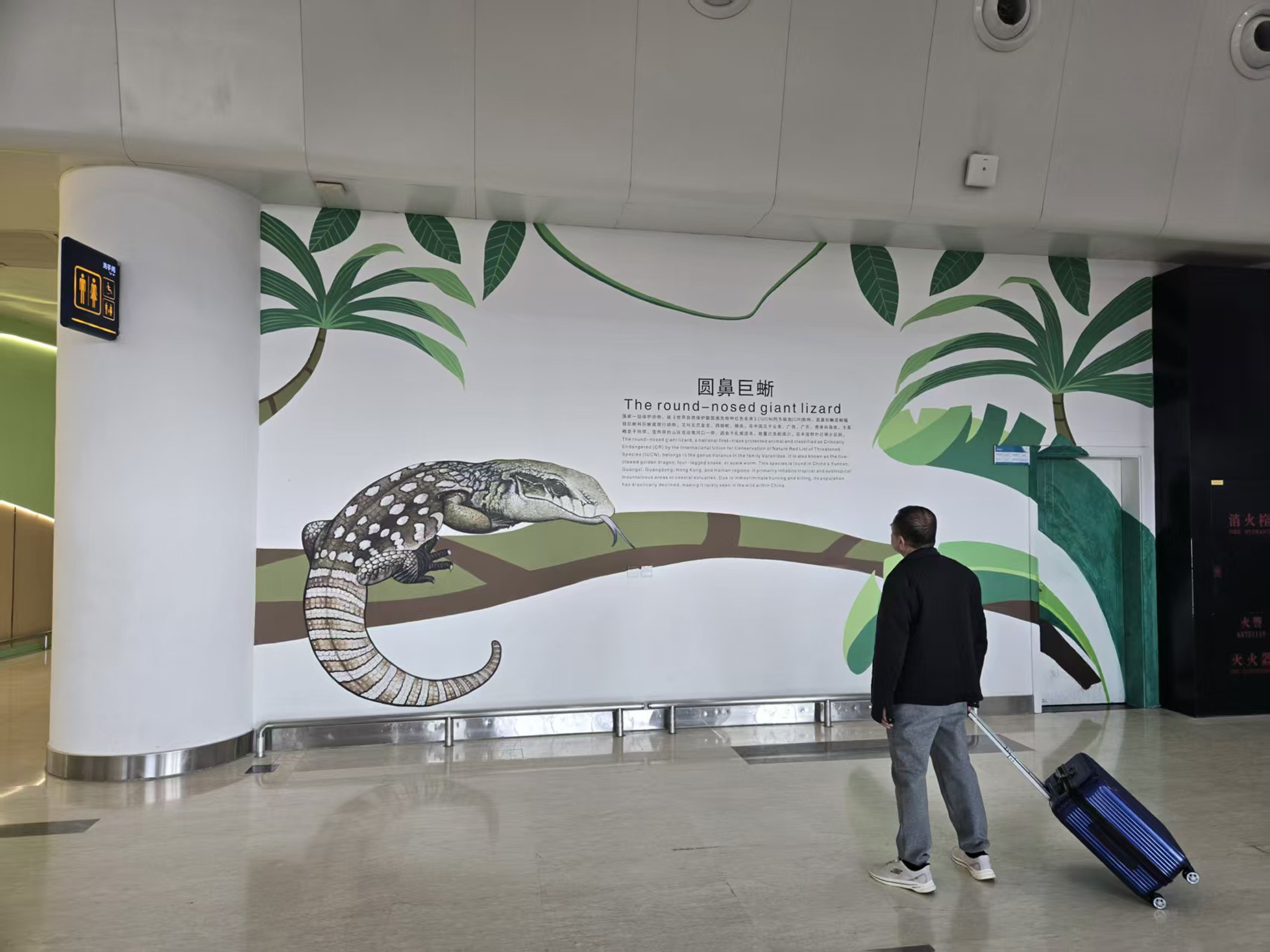
In January 2026, a large conservation-themed mural was painted on a prominent wall in the main departure hall of Meilan International Airport in Haikou, Hainan Province, China. The mural depicts a native monitor lizard Varanus salvator, accompanied by a brief text introducing its ecological significance, conservation status and threats. Located in a high-traffic area of the terminal, the mural is viewed daily by large numbers of domestic and international travellers.
The importance of this mural lies primarily in its location. International airports are among the most commercially valuable public spaces, typically dominated by advertising, branding and transport-related information. The decision to allocate a prominent wall in an international airport terminal to biodiversity conservation imagery is a deliberate departure from conventional priorities. By integrating conservation messaging into everyday transit infrastructure, biodiversity protection is framed as a matter of public relevance rather than a specialist concern confined to protected areas, museums or academic contexts.
The choice of V. salvator as the focal species further strengthens this message. As a conspicuous yet rarely encountered reptile, the species serves as an ambassador for broader ecological values and conservation challenges in southern China. Rather than relying on abstract or globalized narratives, the mural anchors biodiversity conservation in a local species, reinforcing connections between regional natural heritage and public awareness. The accompanying text avoids technical terminology, reflecting an intentional effort to engage a wide, non-specialist audience.
This initiative reflects a broader shift in China towards mainstreaming biodiversity conservation into public life. Although national strategies and policy commitments to biodiversity protection are well established, their visibility in everyday settings has often been limited. High-profile visual messaging in public infrastructure translates policy aspirations, making conservation visible within spaces associated with modern development, mobility and tourism.
Presenting biodiversity conservation imagery in such a setting indicates how conservation priorities are being integrated into public spaces in contemporary China. Although the direct behavioural impacts of such murals are difficult to quantify, their broader value lies in normalizing conservation messages within social environments. As biodiversity loss increasingly demands engagement beyond protected areas, this example from Haikou illustrates how simple visual interventions in public infrastructure can serve as platforms for conservation communication both nationally and internationally.
Mural of the monitor lizard Varanus salvator painted on a prominent wall in the main departure hall of Meilan International Airport in Haikou, Hainan Province, China.

 Open access

