




IntroductionFootnote 1
Poppy (Papaver somniferum) is cultivated as a food crop for its seeds and seed oil and as a medicinal plant for opium, the sap, which is obtained by incising the unripe poppy capsules. Opium contains over thirty different alkaloids, a class of naturally occurring chemical compounds, of which morphine was first isolated in 1805 and is still considered the archetype of opioid painkillers. The discovery of morphine led to a double semantics of the poppy. On the one hand, opium, which was ingested and smoked, was associated with Asian “backwardness.” On the other hand, morphine epitomized modern industrialism. Not only was morphine easy to mass-produce by means of chemical reactions and machines, but its consistency as an odourless, white crystalline powder and its administration by hypodermic syringe made it seem modern. From a medical perspective, its precise dosage indicated for conditions associated with the industrial lifestyle such as respiratory problems and chronic pains, contrasted with the complex composition of opium concoctions, with a variable and potentially dangerous effect. Thus, morphine can be considered the drug of the industrial age par excellence.
The double semantics of the poppy as a signifier of imperialism and industrialism is particularly evident in the Japanese case for historiographical reasons. Two contradictory views have their roots in the 1930s and 1940s and have influenced historical research to this day. On the one hand, Japanese drug production and trafficking in Asia has been portrayed as a weapon of imperialism following allegations by the League of Nations, reports by U.S. policy advisers in the interwar period and the judgment of the Military Tribunal for the Far East after Japan’s defeat in 1945; on the other hand, the Japanese government considered that the pharmaceutical industry had developed “in the face of disrupted trades” during the First World War and regarded it as a necessary business for self-sufficiency and “an important sign of scientific modernization.”Footnote 2
As a result of these contrasting views, a great deal of historical research has paid attention to the origins and character of Japan’s “opium empire.” Historians have shown that the Japanese government established an opium monopoly in Japan in the 1870s to prevent opium smuggling. Subsequently, in 1897, an opium monopoly was introduced in Taiwan by the Japanese colonial authorities to gradually suppress the vice of opium smoking; it was upheld due to its role of profit-creation. Following this model, monopolies followed in the Kwantung Leased Territory (KLT) in 1906, in Korea in 1919, and in Manchukuo in 1932. By then opium and manufactured drugs of a few licensed Japanese companies entered illicit circuits in Northeast Asia. In other words, the focus of historians has been on the opium monopolies set up by Japanese authorities and the black markets that emerged together with the advance of the Japanese Imperial Army, war profiteers and smugglers in territories under Japanese control between the 1890s and 1940s.Footnote 3
Nevertheless, to date, little attention has been paid to the domestically oriented morphine industry.Footnote 4 This article redirects attention from Japan’s opium empire to domestic developments. It argues that the Japanese morphine industry had a significant impact on Japanese agriculture, promoted the rationalization of production processes in factories and stood for a modern medical consumer culture. It was not until the 1930s and 1940s that poppy cultivation and morphine manufacture increasingly relied on resources and labour from the colonies. This also reflected a shift to a war economy. Drugs were then mainly produced for the military and found their way onto black markets in Japan and Northeast Asia. The article begins with an overview of the spread of poppy cultivation in the south-central part of Japan’s main island Honshu. It then discusses the introduction of experimental laboratories and machinery in drug factories. It concludes with considerations on hyper-productivity in the 1930s and 1940s, made possible by the autarchic production regime linking Japan and its colonies of Taiwan and Korea.
Japanese Poppy Cultivation from the 1880s to 1930s
Several factors contributed to the spread of poppy cultivation in Japan in the early twentieth century: apart from climate and soil properties, the promotion of cultivation by the government, private initiatives for the dissemination and improvement of crops, and the socioeconomic organization of rural households.
The Meiji government, established in 1868, was aware of the importance of opium as a medicine in the West, but feared that imported opium would escape control and be used for smoking. For this reason, the government excluded foreign drug retailers from the opium business and promoted domestic poppy cultivation through an opium monopoly, beginning in the 1870s. Under the monopoly, the government compensated Japanese farmers for opium with a minimum morphine content of 6 to 11 percent.Footnote 5
Nevertheless, domestic poppy cultivation developed only slowly. Officials assumed that Tsugaru in the northeast of Japan, with a history of poppy cultivation dating back to the late seventeenth century would advance to a production centre of opium. The Shokusan ryakusetsu (Outline of Production Increase), a report of local products written in preparation for Japan’s participation at the Vienna World’s Fair of 1873, includes a “report on Tsugaru opium.”Footnote 6 The report mirrored the modernizing ambitions of the government, since as indicated by Peter-Paul Bänziger in this issue, the world’s fair opium section was represented by up-and-coming chemical-pharmaceutical companies. But Tsugaru yields turned out to be below expectations. Another centre of poppy cultivation was Mishima District in Osaka Prefecture. Drug wholesalers from Doshōmachi in Osaka City, who dominated the drug trade in the eighteenth and nineteenth centuries, introduced poppy cultivation from Tsugaru to Mishima in the 1830s. The district was conveniently located on the west bank of Yodo River on the way from Osaka to Kyoto. In the 1870s and 1880s, poppy cultivation in Mishima and other areas of Osaka Prefecture steadily increased and overtook the industry in Tsugaru. But a collapse of the domestic poppy cultivation occurred in 1887, when a regulation lifted the minimum morphine content of opium, submitted by farmers, from 6 to 9 percent.Footnote 7
Poppy cultivation experienced its first boom after the Japanese colonization of Taiwan. In 1897, the Monopoly Bureau of the Governor-General of Taiwan began to supply Taiwan’s opium smokers with its paste. The poppy does not grow in the subtropical climate of the island—cultivation trials with poppy carried out from 1902 to 1904 and from 1917 to 1920 failed.Footnote 8 The Taiwan monopoly purchased opium from Benares and Patna in India, Persia, Turkey, and Sichuan in China by way of British and Japanese intermediaries.Footnote 9 At the same time, Japanese farmers whose yields of opium had a morphine content below 9 percent, that is, deemed insufficient for medicinal use but suitable for smoking, were able to receive compensation through the export to Taiwan. In 1898, Nitanchō Otozō (1875–1951), an agricultural engineer and son of a farmer in the village of Fukui in Mishima successfully applied to Gotō Shinpei (1857–1929), director of the Civil Administration Bureau of Taiwan, for the export of opium to Taiwan.Footnote 10
A second boom occurred during the First World War, when the Japanese government promoted drug manufacturing due to a shortage of imports. From 1915, designated Japanese companies became involved in the extraction of alkaloids and the manufacture of their salts and derivatives, including cocaine, quinine, morphine hydrochloride, and diacetylmorphine (also known by its brand name Heroin). Japanese opium farmers supplied these companies with opium through the Tokyo monopoly.Footnote 11
In other words, whereas poppy cultivation was initially enabled because the risk of yields that did not meet government quality criteria could be mitigated by exporting to Taiwan, by the time of the First World War Japan’s opium production increased due to the takeoff of a domestically oriented morphine industry.
In 1914, the domestic production of opium was barely 1,429 kg (37,890 kan).Footnote 12 The statistics for the war years suggest a steady increase: 1,120 kg in 1916, 1,860 kg in 1919, 3,470 kg in 1920, and 4,900 kg in 1921.Footnote 13 Poppy cultivation expanded during the 1920s. According to a statistical yearbook of 1928 by the Home Ministry, the quality too steadily improved over the 1920s. In 1928, the average morphine content of Japanese opium was 14.66 percent.Footnote 14 By then, the domestic yield of 12,820 kg (3,418,672 kan) was sufficient to meet the needs of Japanese drug companies.Footnote 15 In 1929, the first year of the operation of the Geneva Opium Convention of 1925, which required signatory countries to adjust production to the calculated medicinal demand, the Japanese Home Ministry limited the areas of poppy cultivation. Still, yields increased in the early 1930s.Footnote 16
Japan’s homegrown opium stood in contrast to Europe, where morphine-manufacturing countries relied on the import of raw opium from far-flung regions, separated by tariff conventions, mainly Yugoslavia, Turkey, Persia, and India. In the run-up to the Vienna World’s Fair, a report by E. Merck & Company of Darmstadt, which as James H. Mills and Peter-Paul Bänziger show in this issue, advanced to a global supplier of cocaine and morphine, indicates the reason. According to the report, not only was soil not always suitable in German regions, but opium production was not viable “especially in view of the high wages paid here.”Footnote 17
In Japan, apart from climatic and soil conditions, the socioeconomic structure of Japan’s countryside provided ideal conditions for poppy cultivation. The opium poppy grows well in temperate and highland areas, in sandy or loamy black soils that allow water penetration. Poppy is preferably sown in fall before the first snow to harvest opium with a high morphine content. As a cold crop, poppy can be alternated with summer crops, thus providing additional income. But poppy is vulnerable to pests, and its cultivation leads to a deterioration of soil minerals, requiring fallows or the use of fertilizers. Furthermore, the collection of opium is a time-consuming operation. All this requires skilled, but inexpensive manual labour, which was found in the rural areas of southwestern Japan.
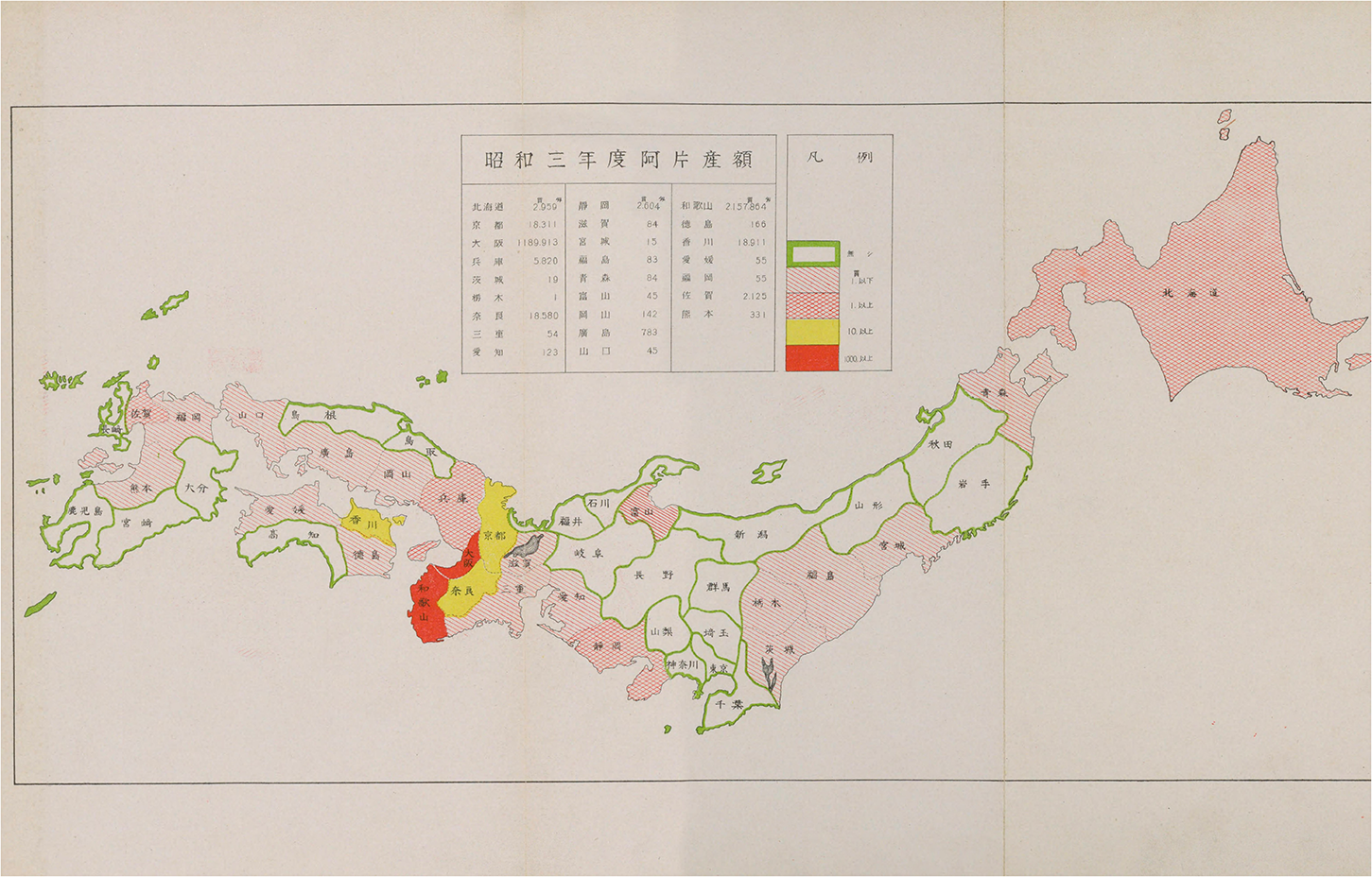
In 1915, the centres of opium production were Osaka and Okayama Prefectures, followed by Fukuoka Prefecture. These prefectures had the greatest area and largest workforce involved in poppy cultivation. In the 1920s, Wakayama Prefecture, connected to Osaka’s pharmaceutical centre by the Kii River, turned into a leading producer of opium. In 1928, about 97 percent of the yield was from Wakayama and Osaka Prefectures. Wakayama alone supplied over 60 percent. But poppy fields stretched from Kyushu to Hokkaido, as visualized in a graph published in the statistical yearbook of 1928 (Figure 1).Footnote 18
Naimushō Eisei Shikensho, Ahen seiseiki, fu: ahen hō, Shōwa san nendo [Opium results, appendix: opium law for the fiscal year 1928] (Osaka: Ōsaka Eisei Shikensho, 1929), no. 1, National Diet Library Tokyo, DOI: 10.11501/1186434.

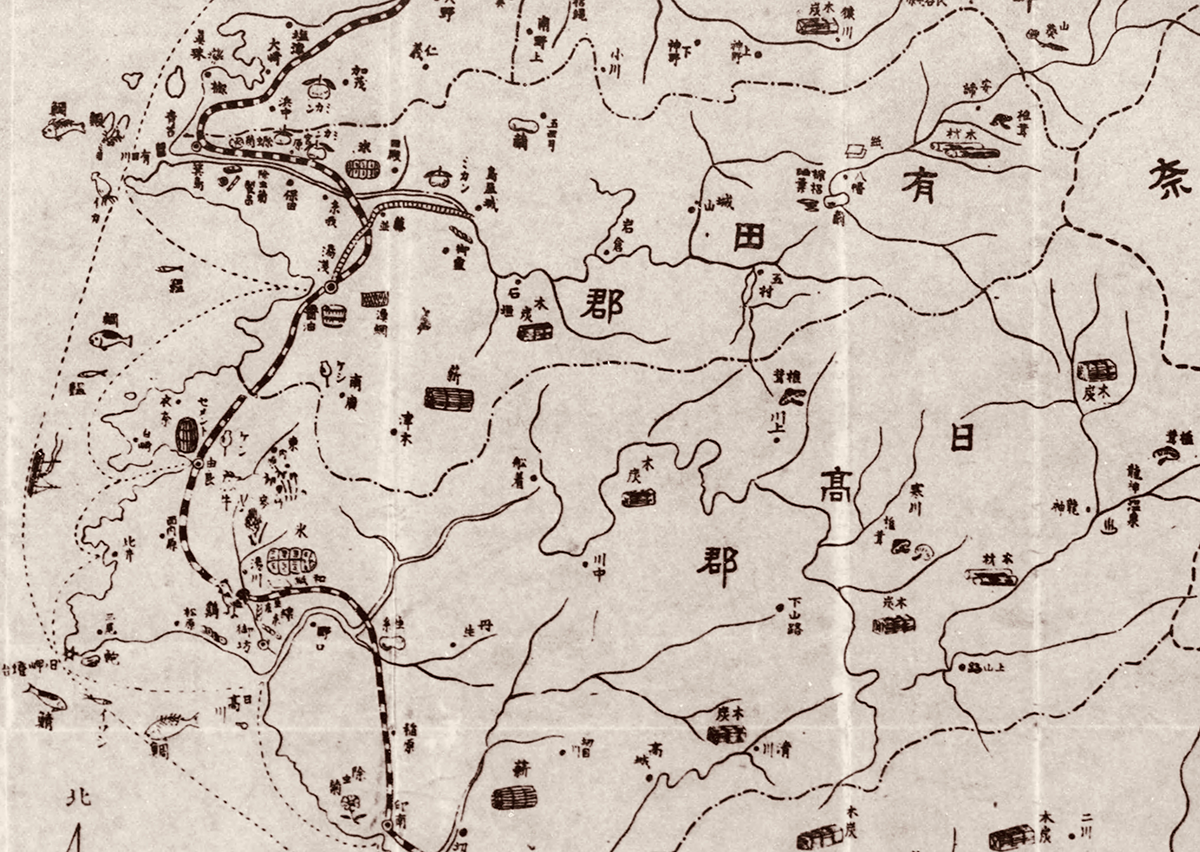
One reason given for Wakayama Prefecture’s successful poppy cultivation was the high lime content of the soil, which was said to produce poppies with a high morphine content. But another reason was also the high percentage of tenants. Wakayama Prefecture’s three most profitable products were mandarins, pyrethrum (a flowering plant used as insecticide), and poppy, in this order.Footnote 19 Whereas landowners engaged in the cultivation of mandarins, tenants engaged in the cultivation of poppy. Because poppies were grown from November to June as a cover crop outside the harvest season of cereals, such as barley and beans, and, unlike mandarins, could be cultivated on small plots of land, they provided significant additional income in poverty-stricken rural areas. A “map on the distribution of products in Wakayama Prefecture” (Wakayama ken butsusan bunpu ezu) published by Wakayama prefecture in 1934 shows the cultivation areas of mandarins, pyrethrum, poppies, and other products (Figure 2). As the icons of poppy seedpods in the map suggests, the centre of opium production in the prefecture was the mountainous districts of Hidaka and Arida. One source indicates that in 1935 Arida District ranked first in the prefecture, providing one-ninth of the domestic yield.Footnote 20 A saying among farmers from Yuasa-chō in Arida District before the Second World War was: “If you want to see a hundred-yen bill, plant poppy.”Footnote 21
“Map on the distribution of products in Wakayama Prefecture” (Wakayama ken butsusan bunpu ezu), in Saikin no Wakayama ken, Shōwa 9 nenban [Recent Wakayama Prefecture, edition of 1934], 1934, addendum. National Diet Library Tokyo, DOI: 10.11501/1464803, reproduced in Kurahashi, Nihon no ahen, 80, Figure 5.

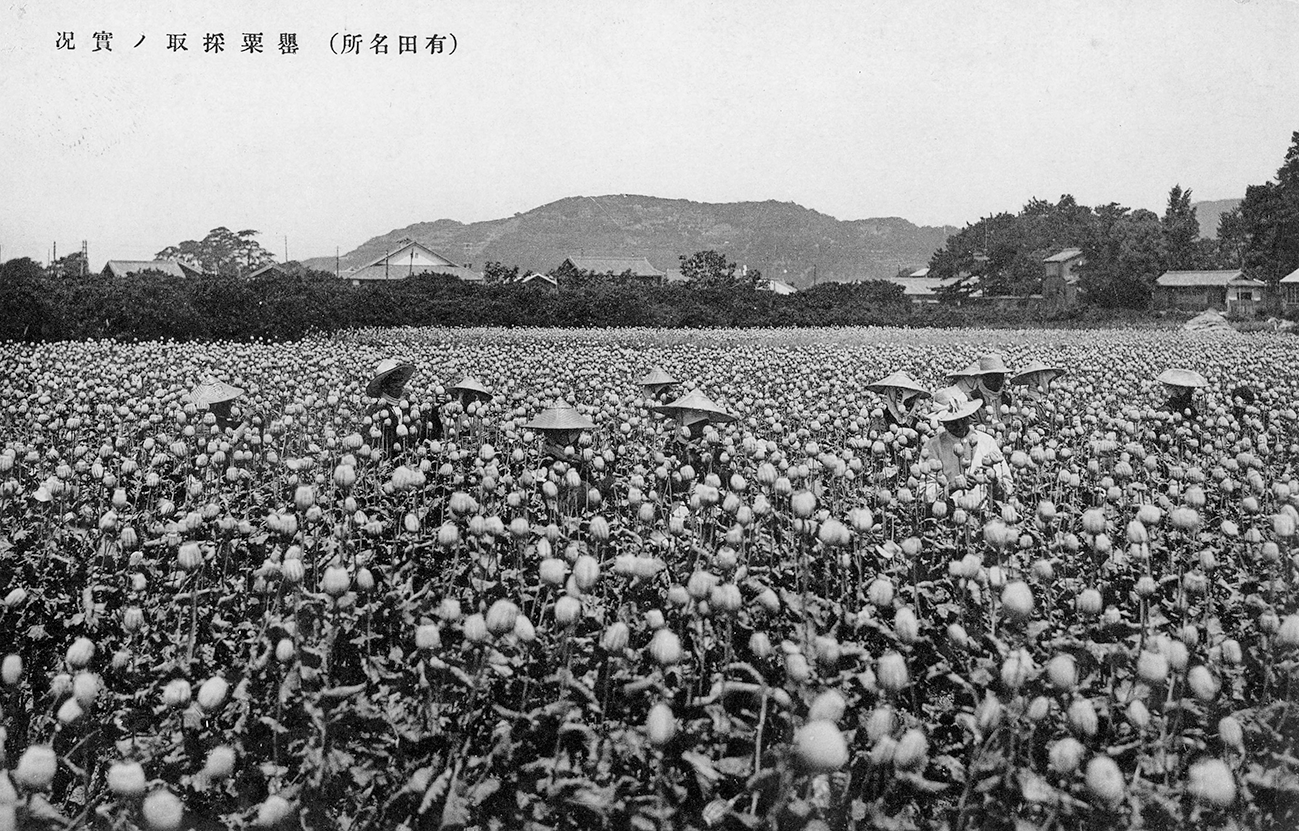
One advantage for poppy cultivation in Japan, apart from the low tenant wages, was the organization of agricultural work in rural communities. As indicated by Carl A. Trocki, in nineteenth-century British-ruled India the Koeri were the only caste that managed to cultivate the poppy with efficiency, because women and children were involved in field labour.Footnote 22 In Japan, men, women, and children traditionally worked on the fields. This also applied to poppy cultivation. Japanese statistics from 1943, admittedly reflecting mobilization of the home front during the war, indicate that women were half of the workforce for preparing the fields, the involvement in sewing and fertilizing was equal, and only women collected the sap and produced opium.Footnote 23 Even before the war, women were firmly involved in the harvest, as suggested by prewar photographs (Figure 3). An eyewitness remembers that children were not allowed to enter poppy fields, but others indicate that upper primary school children helped during the harvest in May and June.Footnote 24
“Poppy Harvest” (Keshi saishu no jikkyō), ed. Taishō shashin kōgeisho, Prewar postcards, no. 170, Wakayama University, https://www.wakayama-u.ac.jp/kisyuken/database/picture/center/arida1.html.

Recommended cultivation methods show that growing opium poppies was not a challenge for experienced farmers. Nitanchō, who had started exporting opium to Taiwan in 1898, promoted domestic poppy cultivation through the “Methods on poppy cultivation and opium production” (Keshi saibai oyobi ahen seizō hō) of 1915, revised with more detailed statistics in 1917 and again in 1930. In the book, he points to commonly available fertilizers, namely human urine during germination, night soil during the growth period, and fish manure during the harvest season. Against pathogens, he recommends Bordeaux mixture (a mixture of copper sulphate and quicklime used as a fungicide), and the pulling out of damaged plants. Also, according to him, during the flowering and harvest period, small crawlers appear on the back of the leaves, which can eat the poppy seeds. But since they are easy to spot, it is sufficient to pick the leaves and trample them.Footnote 25 In other words, poppy cultivation could easily be integrated into Japan’s agriculture, as it could be carried out on existing fields, sufficient labour was available and cultivation methods were familiar.
The rationalization of agricultural work processes was facilitated by the homogenization of poppy varieties. In 1883, experiments with poppies were conducted in the Trial Planting Garden of Medicinal Herbs of the Hygiene Bureau of the Home Ministry (Naimushō Eiseikyoku Yakusō Shishokuen). In 1904, Nitanchō received permission to experiment with poppy seeds.Footnote 26 In his book, Nitanchō refers to the importance in the choice of poppy varieties: decisive was not only the morphine content, but also an early flowering period, which allowed a smooth transition to growing food grain on the same fields, the amount of collected sap, as well as the thickness of the seedpods and the height of the stems, which facilitated the incision and collection of sap. According to Nitanchō, the white- and red-flowered variety used in his home region of Mishima must be distinguished from the Fukui variety, named after his home village, with white and purple flowers, both of which he introduced from India in 1898. The Fukui variety—after being acclimatized to the colder climate—thrived from 1904. He writes that he introduced over hundred different varieties from India, Turkey, Persia, Russia, and other countries at his own expenses, but that none matched the Mishima and Fukui varieties: “While many varieties were grown in the past, only two varieties are now grown in all prefectures, namely the Mishima and Fukui varieties.”Footnote 27 Nitanchō also mentions three new varieties, two of which are descended from the Fukui variety, and one from the Mishima variety, the latter with a morphine content of 23 percent. This must be the variety, currently known as Ikkanshu (lit., “one kan variety,” from the saying that 1 kan or 3.75 kg opium can be yielded from an area of 1 tan or 991.74 square meters).Footnote 28
In Japan, knowledge about innovations, such as new seed varieties, was not only passed on from the top down, but also spread through the connections between local agricultural associations of villages.Footnote 29 For example, Nitanchō’s book served as a model for other manuals, such as the one published by the Hokkaidō Society for the Promotion of Poppy Cultivation and Opium Production in 1924.Footnote 30 The rapid spread of Ikkanshu poppies is evident from prefectural yearbooks and newspaper reports on poppy cultivation in Wakayama Prefecture from the 1930s; they repeatedly mention poppies, like “large, pure white teacups,” or “a white cloth covering the fields.”Footnote 31 Pictures from the same period show white poppies growing as far as the eye can see.Footnote 32 The white flowers of Ikkanshu displaced the white, red, pink, purple, and crimson red poppy flowers that used to be grown in Japan. Ikkanshu also spread to Japan’s overseas territories of Korea and Manchuria in the 1930s and 1940s.Footnote 33 So, patches of white-flowering poppies became emblematic for Japan’s chemical-pharmaceutical industry. The homogenization of poppy varieties reflected industrial processes.
The “Romance of Chemistry”
Japan’s chemical-pharmaceutical industry took off in the last three decades of the nineteenth century due to the close cooperation of government officials and private entrepreneurs. The opium regulations, later, in 1897, the opium law, were the basis for the government opium monopoly, whereas the “medical regulations” (isei) regulated the import, manufacture, sale, and distribution of other poisonous and deleterious drugs, including opium alkaloids. But all these substances were checked by the Imperial Japanese Laboratories (Shiyakujō, later Eisei Shikensho, Hygienic Laboratories) of the Home Ministry, established in Tokyo and other Japanese cities. The laboratories were also responsible for checking applications of pharmacists who wished to sell opium and other scheduled poisons, and for supplying these pharmacists, as well as military and civil hospitals with these drugs.Footnote 34
Thereby, bureaucrats relied on the knowhow of private entrepreneurs. For instance, the Imperial Laboratory in Osaka, built in 1875, employed members of the Osaka Drug Trade Association (Ōsaka yakushushō kumiai), founded by former wholesalers of Doshōmachi (the wholesalers who had introduced poppy cultivation to Mishima in the 1830s). Members of the association were not only involved in testing drugs for the government, but also distributed imported pharmaceutical ingredients, such as German morphine, to drug manufacturers, while they themselves managed leading companies.Footnote 35 The “opium preparation” (ahen seizai), available in licensed pharmacies, is illustrative. It was manufactured by Dainippon Pharmaceutical Co., a government-backed company founded in Tokyo in 1883. The company was absorbed by Osaka Pharmaceutical Co. Ltd. in 1897, whose directors were also members of the Osaka Drug Trade Association.Footnote 36
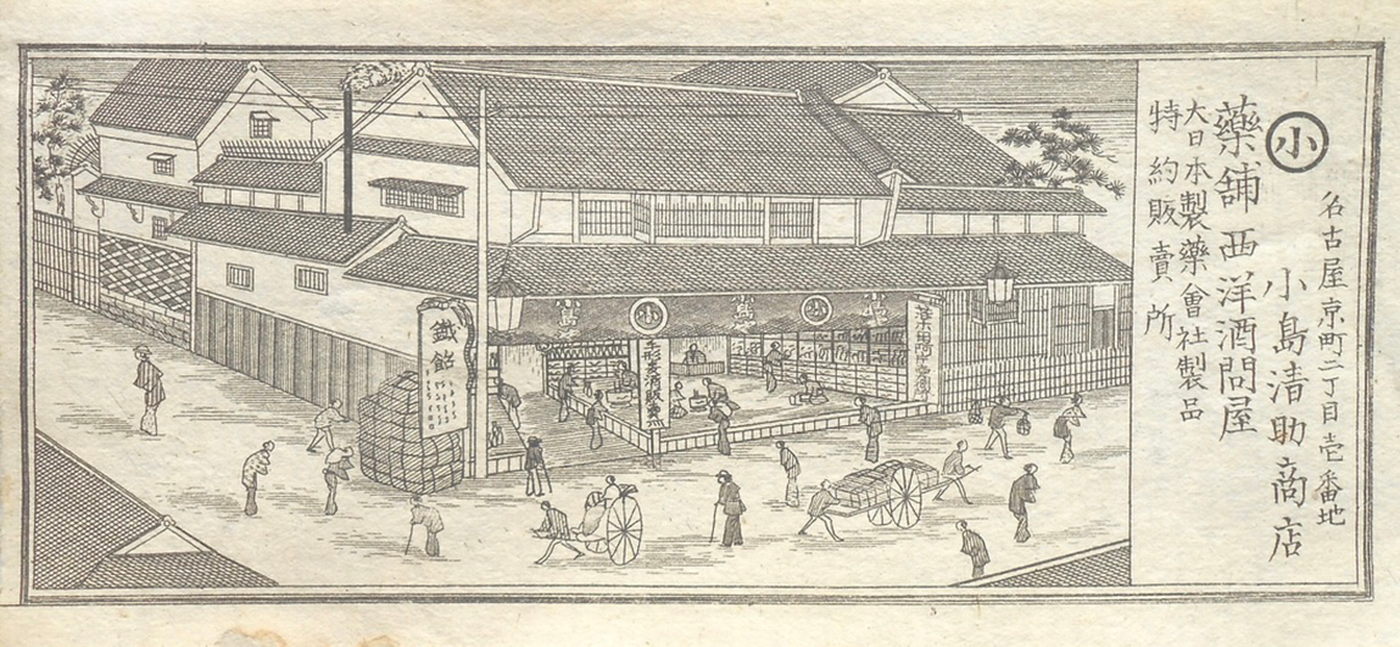
Generally, the market for patent medicines (baiyaku), that is, preparations sold without prescription, reflected the affiliation of bureaucrats and private entrepreneurs. With the revision of the medical regulations and the publication of the Japanese pharmacopeia in 1886, the Home Ministry promoted patent medicines made according to Western formulas, and established a license on approved formulas, thereby privileging large-scale companies. Since a fixed amount and number of scheduled poisons was allowed in patent medicines, over-the-counter drugs, compounded with opium or morphine, were available on the market. Advertisements in newspapers, leaflets, and business guides refer to the regulated drug commodity chains leading from the Imperial Japanese Laboratories, large-scale companies, pharmacies, and drugstores to the consumers. For instance, an almanac of shops in Nagoya, published in 1888, reproduces a copperplate engraving of a drug store, which offers several patent medicines made according to Western formulas, among which Shin’yaku, a copycat drug of the popular British Chlorodyne, compounded with chloroform and morphine.Footnote 37 Two other engravings refer to wholesalers, holding a license to sell the opium preparation, manufactured by Dainippon (Figure 4).
“Kojima Seisuke Shop at Nagoya Kyōmachi 2 chōme 1 banchi, drug and wine wholesaler, Dainippon Pharmaceutical Company’s special sales office, selling point of opium for medicinal use” (Nagoya Kyōmachi ni chōme ichi banchi Kojima Seisuke shōten, yakuyo seiyōshu ton’ya, Dai Nippon seiyaku gaisha tokuyaku seihin hanbaisho, yakuyō ahen risabakisho), in Kawasaki Gentarō, Biyō shōkō benran [Handbook on the commerce of trade and industry in Aichi Prefecture]. (Sakai: Ryūsendō, 1888), unpag. National Diet Library, DOI: 10.11501/803769.

The emergence of a pharmaceutical market, regulated by the government and dominated by a few large-scale companies, was the basis for the take-off of the Japanese alkaloid industry. Two laws accelerated its development during the First World War.
The first law, the “patent medicine law” (baiyaku hō), came into force in 1914. The law excluded scheduled poisons from over-the-counter drugs after concerns arose due to poisoning and suicides cases with opium and morphine preparations. In effect, it paved the way for the administration of more potent hypodermic morphine under the supervision of doctors and licensed pharmacists. The second law, the “Act for the promotion of the manufacture of dyes and drugs” (Senryō iyakuhin seizō shōreihō), followed in 1915, when Japan, like other countries, was faced with rising import prices for pharmaceuticals due to the outbreak of the First World War.Footnote 38 According to Maki Umemura, the law “introduced subsidies for pharmaceutical production, nullified Germany’s patent rights, and disclosed detailed production methods from government laboratories.”Footnote 39 In other words, the government created favourable scientific and legal environments to allow Japanese companies to participate in the alkaloid industry. The government also imported large quantities of morphine, resulting in considerable stocks after the war.Footnote 40
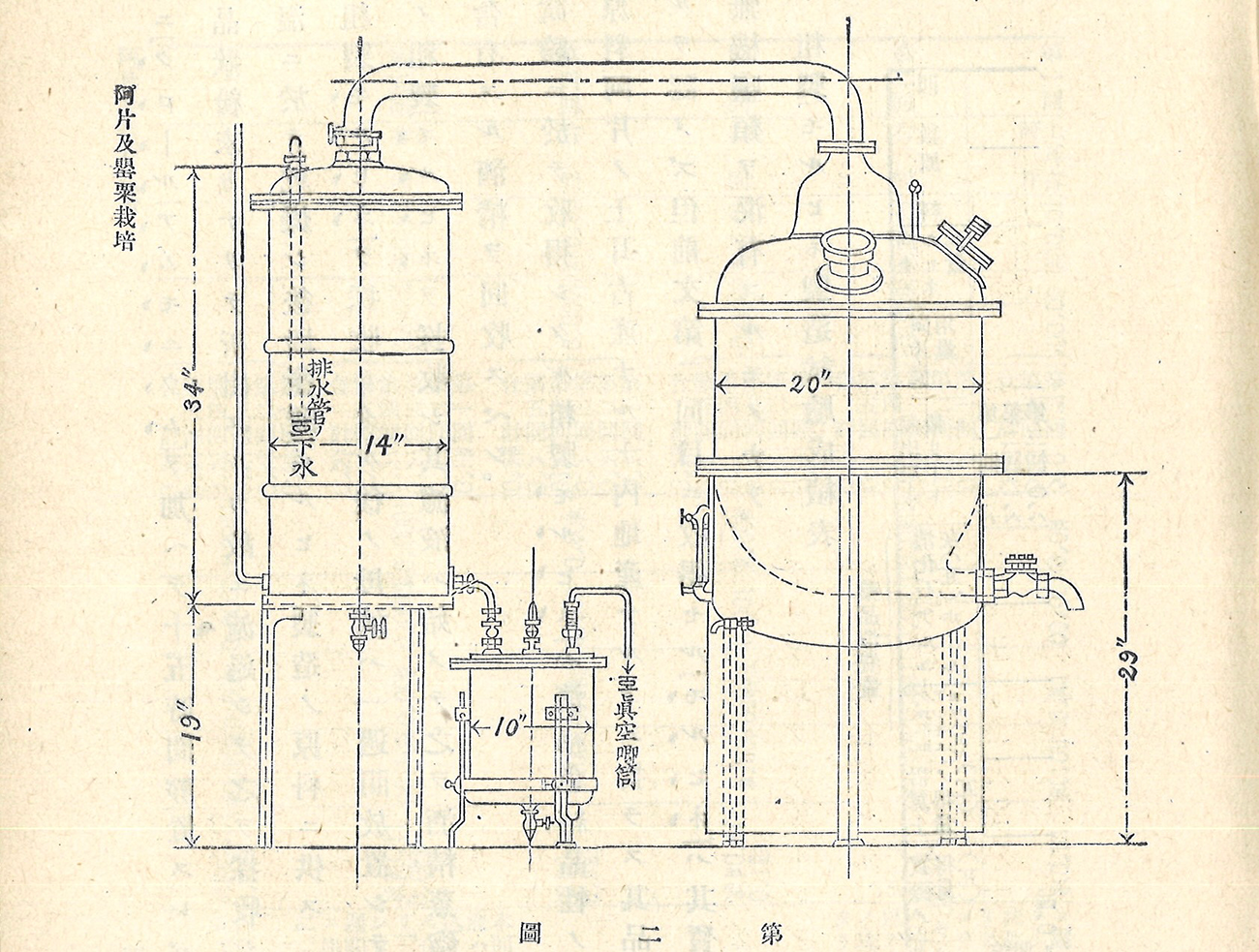
In the same year that the law of 1915 was promulgated, the Sanitary Bureau of the Home Office published a “report on test results of the manufacture of morphine hydrochloride” (ensan moruhine seizō shiken seiseki hōkoku). The report was reproduced in various publications of 1915, 1917, 1920, and 1926. It describes the method developed by Carl Friedrich Mohr (1806–79), by which the amount of morphine in a sample of opium might be ascertained. This was not only relevant to determine the quality of the sample, but also to evaluate whether the precipitation of morphine from it was successful and thus the isolation method appropriate for large-scale manufacture. The report also advertises the Mohr process to isolate morphine from opium through reactions with milk of lime and ammonium chloride. The crude morphine obtained is a light brown and crystalline powder. It is purified, by adding salts, in the Mohr process hydrochloric acid, to form water-soluble, white crystals. The report of the Sanitary Bureau not only contains details on the proportions of solutions, but also reproduces sketches of the equipment with precise dimensions, namely a “tub with a stirrer” (kakuhanki tsuki no oke), used to dissolve the opium before being treated, and a “copper vacuum evaporator” (dōzei shinkū jōhatsukan), allowing the obtained solutions to be crystalized (Figure 5).Footnote 41
“Copper vacuum evaporator,” in Okita Hideaki, Nihon yakusō saishu sabai oyobi riyōhō, Daini han zōho [Chemical manufacturing test result report] (Tokyo: Ōkura Shoten, 1918), 123.

Given that vacuum evaporators had been introduced from France to Japan for the sugar industry in 1879 and adapted in Japan’s salt industry in the 1900s, and that a small workforce was sufficient to operate a morphine factory, as soon as the laws were adjusted and the tests of the laboratories were published, there were no technical impediments for Japan’s alkaloid industry to take off.Footnote 42
In 1915, Hoshi Pharmaceutical received government approval to manufacture morphine from residues left over from the manufacturing process of opium paste, produced for local smokers, in the drug factory in Taiwan. The water-insoluble residue, remaining after the dissolution of opium, is rich in morphine, narcotine, and codeine. It was considered a waste product by the drug factory in Taiwan. But Hoshi used it for the manufacture of morphine.Footnote 43 Furthermore, in 1917, the government revised the opium law of 1897 to allow Hoshi and three other companies, namely the above-mentioned Dainippon, the equally government backed Naikoku (absorbed by Sankyō in 1920), and Radium (merging with Takeda in 1944), to purchase raw opium to produce processed drugs. Thereafter, these companies bypassed the Tokyo and Taiwan monopolies and directly purchased opium in Istanbul or Izmir.Footnote 44
John M. Jennings has indicated that by the end of 1918, “the Japanese pharmaceutical industry had developed the capacity to produce enough, or nearly enough, morphine, heroin, and cocaine to meet the nation’s annual medical requirements.”Footnote 45 Ihno J. Bensussan, who himself was involved in the opium business as a representative of the Turkish and Jugoslav monopolies, estimated that the production of Japanese morphine jumped from 45 kg in 1915 to 5,044 kg in 1921.Footnote 46
At the end of the First World War, the progress of the Japanese alkaloid industry was an occasion to represent what Oskar Nagel called the “romance of chemistry” (Romantik der Chemie).Footnote 47 The Chemical Industrial Expositions (Kagaku Kōgyō Hakurankai), which followed Japan’s participation in the world’s fairs and organization of domestic industrial expositions, show this point. The first exposition dedicated to the chemical industry was held in Ueno Park in Tokyo in 1917. Another followed in Osaka in 1918, and two further ones in Ueno Park in 1926 and 1931. In the English catalogue to the first exposition, the organizers write: “Before the war, we were dependent upon Western nations for many kinds of manufactures, especially chemical products. But the stimulus that the crisis brought to bear upon us was a factor in the development of several new industries … . We are now self-supporting industrially.”Footnote 48 As was customary at the time, the organizers emphasized the large number of visitors. The symbolic and not just commercial function of the exposition was also suggested by the display of objects. They included equipment of laboratories and factories, as well as products and raw materials such as metals and gases from Japan and its overseas territories, including Taiwan, Korea, Sakhalin, and the KLT.
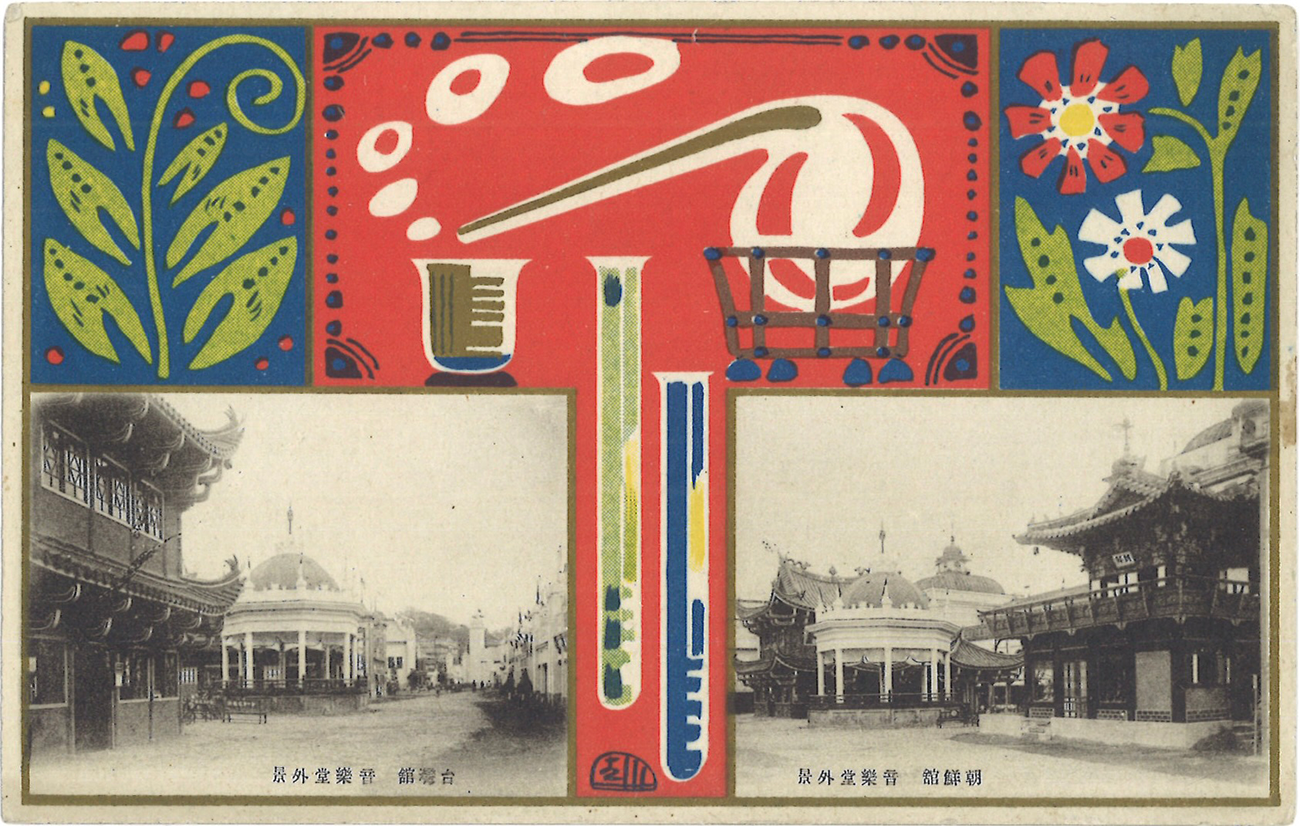
A postcard, commemorating the exposition, refers to the envisioned relationship between Japan and its overseas territories: colonies providing natural resources and a market for Japan’s industry, and a commodity-processing centre in Japan. The composition is made up by a collage of two black-and-white photographs and three coloured sketches. The two photographs show the Taiwan and Korea Pavilions respectively built in a traditional style, which were in the front yard of the main building of the exposition. On the left, the Taiwan Pavilion is designated by a verdant coca branch, and to the right the Korean Pavilion is combined with poppies. The two halves of the picture are divided by a representation of laboratory equipment, including test tubes and a distilling bottle (Figure 6).
“Taiwan and Korea Pavilions, Exterior view of the Concert Hall” (Taiwankan, Chōsenkan, Ongakudō gaikei), Chemical Industrial Exposition at Ueno, 1917, ed. by Kagaku Kōgyō Hakurankai, Postcard from a three-part series.

The postcard is the middle one in a series of three. Taken together, the three subject-matters allude to temporal development, because the first shows a photograph of the main hall of the exhibition, combined with an orientalist sketch of an ancient wall painting, showing a man and a woman, who are harvesting safflowers between palm trees. Finally, the last postcard shows a photograph of the entrance of the exhibition area. The framing sketch represents a sea of factory roofs and chimneys, seen from the window of a director reading a book and seated next to laboratory equipment—the same director, a man with glasses and a beard, perhaps originally an allusion to Emil Fischer (1852–1919), appears on an advertising poster for the “Exhibition of substitutes” (Ersatzmittel-Ausstellung) in Vienna in 1918.Footnote 49 So, the postcards insinuate an expansion of sites providing natural resources, as well as technical progress over time. The family of alkaloids served the purpose of the exhibition particularly well, by representing the linkage between Japan’s industrial productivity and the wealth of natural resources in its overseas possessions.
An advertisement by Hoshi, published in a daily newspaper in 1919, shows the alkaloids and their derivatives, supplied by Japanese companies by the end of the First World War. The ad announces eight important products manufactured according to the Japanese pharmacopeia: cocaine hydrochloride, morphine hydrochloride, diacetylmorphine hydrochloride, quinine hydrochloride, quinine sulphate, atropine sulphate, caffeine, and scopolamine bromide.Footnote 50 After the introduction of a law in 1920, in response to Japan’s ratification of the International Opium Convention of 1912, which regulated the production, sale, and distribution of “morphine, cocaine and their salts,” such ads seem to have been removed from newspapers. Nonetheless, these drugs were produced and used in Japan in the 1920s.Footnote 51
In 1928, which was the most successful business year of the 1920s, Japanese companies manufactured in total 2,412 kg morphine (59 percent, or 1,171 kg, were used for the manufacture of heroin, with a remaining 890 kg morphine). In 1929, the output was 1,989 kg morphine (62 percent, or 1,501 kg was converted into heroin, with a remaining 818 kg morphine), which was sufficient to cover the calculated domestic demand for medicinal morphine.Footnote 52 By the end of the 1920s, though Japan officially did not advance to a “manufacturing exporting country,” with little imports and exports, Japan had a positive balance, and considerable stocks of narcotics.Footnote 53
Whereas historians have indicated that a large proportion of narcotic drugs manufactured by Japanese companies spilled into the black market in Asia, Japan had a medical demand of its own. In the 1920s, the sale of cocaine, morphine, and heroine involved about 80,000 small drug-dealers and retailers, doctors, dentists and other persons in Japan.Footnote 54 Morphine, heroin and cocaine were to be sold under prescription at pharmacies only, or administered by doctors respectively, and the amount allowed to be sold at a time was specified. But there was no limitation of the period of use. Thus, there were no legal restrictions on the regular and prolonged use of these substances. The trend to prescribe morphine in the 1920s was fuelled by medical and social ideas introduced in the late nineteenth century that Western drugs were effective to treat modern diseases, including epidemics, such as diarrhoea and tuberculosis, which spread in the cramped conditions of barracks and factories, as well as chronic ailments such as agitation and insomnia. In the 1920s, Japanese doctors used morphine to treat a wide range of conditions, including “asthma, gallstone surgery, gastric spasms, neuralgia, women’s disease, and respiratory illness.”Footnote 55 In 1929, the estimated Japanese consumption of morphine “expressed in terms of opium was 141.4 kg per million inhabitants,” that is, 8,964 kg of opium on an estimated population of 63.4 million, or 885 kg morphine and 1,296 kg heroin.Footnote 56
By the end of the decade and in the early 1930s, reports in newspapers and literary magazines increasingly associated morphine with the downsides of modernity, particularly with the lifestyle of migrant workers from Korea, as well as actors and prostitutes. In parallel, in accordance with the Geneva Opium Convention of 1925, and the Convention for limiting the Manufacture and Regulating the Distribution of Narcotic Drugs of 1931, which limited the stocks of narcotics worldwide and thereby forced countries to check domestic medicinal consumption, the Japanese Home Ministry expanded the control formulas as regards the production and distribution of drugs to the monitoring of drug users. A concern about a domestic drug problem in the 1930s is also suggested by the debates at the sessions of the Prefectural Departments for Sanitary Techniques (Chihō Eisei Gijutsu Kan).Footnote 57
Paradoxically, “under military pressure and to meet the needs of an ever-increasing consumption,” with the outbreak of the Sino-Japanese War in 1937, the Japanese morphine industry grew, drawing on economic ties with the colonies of Taiwan and Korea.Footnote 58
The Connections between Japan, Taiwan, and Korea
As suggested by the Chemical Industrial Expositions, since the First World War Japanese authorities and colonial officials expected that raw materials would be imported from the colonies to Japan, and manufactured goods moved back to the colonies. But the development in Taiwan and Korea diverged. In Taiwan, following the example of sugar cane, coffee bean, camphor, and cinchona bark, used in the alkaloid industry to produce quinine, coca bushes were introduced in 1916. By the late 1920s, Taiwan’s yield of coca leaves was three to four times the amount of foreign coca leaves imported to Japan—figures vary between 68,596 kg and 204,640 kg of coca leaves of Taiwanese origin for 1927—and sufficient to meet the needs of Japanese companies that manufactured cocaine.Footnote 59 As mentioned above, Taiwan’s climate and soil were unsuitable for poppy cultivation, but crude morphine left over from the production of opium paste went to the processing industry in Japan. This was possible because of the rationalization of factory work in Taiwan.
Hsu Hung Bin has indicated that the drug factory of the Government-General of Taiwan (Taiwan Sōtokufu Seiyakujo), manufacturing the paste for local smokers from 1897, was “the first modern, fully functional factory in Taiwan.”Footnote 60 The factory was operated with electric power, was of considerable size, with about three-hundred workers, and had modern equipment: a crushing machine to cut the opium into small pieces, a pressing filter machine to filter the diluted opium from impurities such as soil and twigs, and modern two-layer copper pans to boil the solution into a paste, which were soon improved by replacing the workers who fanned solutions manually with a lid that accelerated the evaporation of the water. The factory included a separate compartment to package the prepared opium into tins, and a storeroom for the imported opium cases. Japanese colonial bureaucrats also transported the testing methods of the Imperial Japanese Laboratories together with the factory equipment, since the factory had a laboratory to test the quality of the opium. Despite the dark rooms, wooden floors, dispersed tables, pans and vats, steam, disagreeable smell, and the unusual silence of humans and machines, so that one could hear the bubbling of the opium, the factory embodied the modernization achievements of Japanese colonial rule.Footnote 61 Between 1925 and 1929, Japanese companies manufactured 1,517 kg pure morphine from 2,292 kg crude morphine from Taiwan. Thus, Taiwan’s crude morphine covered about 15 percent of Japan’s morphine manufacture in this period.Footnote 62
Taiwan initially formed a contrast to Korea, which was annexed in 1910. Government officials and entrepreneurs expected Korea to supply Japanese companies with opium. During the First World War, authorities established a Japanese-style monopoly system in Korea to encourage poppy cultivation and the manufacture of morphine. In 1919, the year when the Monopoly Bureau of the Government-General of Korea was established, poppy cultivation was limited to five provinces in the rural southwest of the peninsula, namely Keiki-dō, Chūseihoku-dō, Zenrahoku-dō, Kokai-dō, and Kogen-dō. The amount of opium produced in Korea was 7,586 kg. In the same year, Taishō Pharmaceutical received a license for the manufacture of morphine. However, as world market prices for opium fell after the war, poppy farmers shifted to more profitable crops. Also, the authorities failed to introduce improved poppy varieties or cultivation methods. Opium production in Korea decreased in the 1920s, not even reaching 1000 kg per year during half of the decade. At the same time, Taishō was involved in smuggling scandals in the KLT. After Taishō’s license expired in 1928, the Monopoly Bureau in Korea resumed control of the manufacture of morphine. Its factory commenced operation with twenty workers in Keijō (Seoul) in 1930. In that year, stocks of manufactured drugs and opium amounted to barely 1,400 kg. Due to a shortage of raw opium stocks, the Monopoly Bureau drug factory imported crude morphine from Taiwan and the KLT. It manufactured approximately 195 kg morphine and 103 kg heroin in 1930. The factory, which sold its morphine and heroin to licensed wholesale dealers, ceased production in 1935, after the number of registered drug users in Korea declined. But the factory resumed production two years later, at the outbreak of the war with China. By that time, production was export-oriented to Manchukuo.Footnote 63
In parallel, poppy cultivation recovered in Korea. In 1932, opium production reached again the approximate level of 1919, in 1933 it nearly doubled to 14,058 kg, and, in 1937, quadrupled to 28,847 kg.Footnote 64 In that year, the Monopoly Bureau came to rely on the Oriental Development Company (Tōyō Takushoku Kabushiki Gaisha), one of the principal landholders in Korea, to promote poppy cultivation in four designated places, namely Kimhae, Miryang, and Susan (now an area of Miryang) in the southeast, and Kosŏng in the northeast of the peninsula. According to the enquiry of the company, the possibility to use women as labour from December to June and the profit for tenants made poppy cultivation a promising enterprise in Korea. As we know from other sources, children were engaged in the work on poppy fields as well.Footnote 65 But poppy cultivation under the company was unsuccessful. Historians have pointed out that agricultural technicians used coercive measures to enforce cultivation by farming households in Korea; the Oriental Development Company has been linked to land grabs and the brokering of land to Japanese immigrants. In 1941, Korean landholders and tenants resisted poppy cultivation for the company, because it affected the cultivation of food crops such as dryland rice, chestnuts, soybeans and wheat; the poppy growing season overlapped with the main food crop wheat.Footnote 66 Thereafter, apart from the company, police officers of the Hygiene Departments of provinces managed land for poppy cultivation. For example, in Kogen-dō, fields reclaimed by slash-and-burn were cleared for poppy cultivation. In 1943, poppy cultivation expanded to eleven of thirteen provinces, being concentrated on Kogen-dō as well as Kankyōnan-dō and Kankyōhoku-dō, two provinces in the northeast of Korea. In that year, 65 percent of Korean opium originated from Kankyōnan-dō.Footnote 67 According to Jennings, “the authorities encouraged the practice of poppy planting on barren and rocky soil, increasing the designated cultivation area in the plateau regions” in Kankyōnan-dō and Kankyōhoku-dō on the border of Manchuria. The land on which Korean emigrants cultivated poppies in Manchuria was similarly inhospitable.Footnote 68 Another source confirms that the land upon which poppy was grown in Korea was in “remote and mountainous areas,” which was “not very adaptable for food crops.”Footnote 69
In short, despite the similarities with the division of labour in Japanese rural households, the lack of investment in agricultural knowledge transfer, the paternalistic and coercive measures by colonial agencies, as well as the farmers’ preference for dry and cold food crops, led to a different situation of poppy cultivation in Korea. Poppy cultivation became a symbol of barren, remote and poor areas.
In the same decade, Japanese poppy cultivation continued to thrive, with an average opium yield of 17,948 kg between 1934 and 1938. From 1937 to 1943, Japanese poppy farmers produced about 20,400 kg opium annually, which was entirely used in the manufacture of drugs.Footnote 70 In addition, the volume of imports from the Middle East was substantial towards the end of the 1920s. In 1929, 5,612 kg Turkish and 26,410 kg Persian opium or a total of 32,022 kg opium reached Japan; 31,776 kg opium from Persia was imported to Taiwan. Between 1934 and 1938, the average import of opium to Japan from Turkey and Persia together was 28,041 kg. A peak was reached in 1937, at the outbreak of the war with China, when Japan imported 70,869 kg from the Middle East. In 1938, Japan terminated its cooperation with the Opium Advisory Committee of the League of Nations and imports stopped.Footnote 71
But by then Japan’s self-sufficiency had come full circle: Korean poppy cultivation met Taiwan’s demand for opium, while Taiwan supplied its crude morphine to Japan. This is evident from statistics. In 1941, Korea reached a peak in opium production of 50,735 kg, being one of the eleven largest producers of opium in the world. In that year, Korea was the sole exporter of opium to Taiwan.Footnote 72 Thereafter, poppy cultivation slightly decreased. In 1943, 4,770 kg opium were produced for Taiwan, 15,000 kg for the KLT, and 17,000 kg for Manchukuo; in 1944, 2,900 kg opium remained in Korea, whereas 26,700 kg were exported to Japan proper, and another 14,000 kg to “other destinations.”Footnote 73
In parallel, the drug factory in Taiwan reduced the morphine content of the paste for the smokers on the island, so that even more crude morphine could be extracted. In the late 1930s, the stocks of crude morphine in Taiwan were estimated at 9,000 kg.Footnote 74 In 1937 alone, the factory produced 262 kg of “pure morphine,” by reducing the morphine content of the paste for Taiwan’s opium smokers to 6 percent.Footnote 75
Although high-productivity was promoted during the war, an overview of the Japanese drug industry by the economic geographer Satō Hiroshi (1897–1962) in 1943 suggests that drug supply was collapsing in the 1940s. Apart from manufactured drugs, Satō reviews pyrethrum, manila hemp, palm oil, tin, and the like, showing that he assessed the basic resources of the empire for the war economy. He indicates that Japan had the fourth rank in the world production of morphine and first rank of heroin in 1935 and portrays this as an achievement: “The fact that Japan, which until the end of the last Great War was dependent on foreign countries, has achieved such a prosperity in the manufacture of these medicines, is a result of the efforts of the government and the private sector.”Footnote 76 But Satō forecasted a shortage of raw opium. According to him, domestic demand had tripled since the outbreak of the war, with the military accounting for 60 percent of domestic consumption.Footnote 77 Military needs should not be underestimated, even if opium and narcotics were also traded illegally in the regions controlled by the military.Footnote 78
Similarly, the manufacture of poppy straw (also, poppy chaff) in Japan in the 1940s indicates not only a rise in prices like during the First World War, but a serious shortage in drugs. The process, during which morphine is extracted from the stems, leaves, and dry capsules, not incised but emptied of their seeds, was first patented by a Hungarian chemist in 1933. It caused a lot of attention, because it was seen as a method that allowed the maximum use of raw materials but still remained competitive.Footnote 79 The innovation reflects the search for ever-more extractive methods in the industry in the 1930s; parallels can be drawn to the experimentation with the conversion of coal to fuel. By the end of the Second World War, occupation authorities reported that ten companies in Japan manufactured poppy straw in Japan between 1937 and 1945, namely Taishō, Kimei, Daiwa, Nakakita, Tomimatsu, Taisei, Sasatora, and Yamamoto Pharmaceutical Companies, Extract of Poppy Straw Manufacturing Company, and Nakajima Company. However, the report notes that no morphine or codeine was extracted from poppy straw. Rather, poppy straw, not being controlled by regulations, was manufactured into poppy straw extract and poppy straw powder. Though the process reflected an effort to rationalize production, the report suggests a serious shortage of drugs in wartime Japan.Footnote 80 This, coupled with an increased repression against drugs users, must have promoted a domestic black market.Footnote 81
After the war, U.S. occupying forces prohibited poppy cultivation in Japan, and it remains so to this day. By contrast, as indicated by a questionnaire to the United Nations, they considered designating South Korea (the American zone) an opium-producing country. The reasoning was that prohibition was not very successful in Korea and that opium was “one of the comparatively few items that can be exported.” Still, the questionnaire continues, “farmers will he advised of the prohibition and they will be urged to grow millet, beans and potatoes on the land.”Footnote 82 In Korea, poppy cultivation continued until the Korean War.Footnote 83
Conclusion
Turning from Japan’s opium empire to the domestic market, an interesting picture emerges. The Japanese morphine industry led to an upswing in agriculture in the 1910s and 1920s. Apart from the climate and soil, the tradition of crop rotation on small plots, low wages, the community organization of agriculture, and the rapid spread of new poppy varieties through agricultural associations helped the domestic poppy cultivation to flourish. In parallel, the government presented the chemical-pharmaceutical industry as an emblem of modernization and self-sufficiency and promoted the transfer of knowledge and machines—an indication of the importance of the alkaloid industry in the understanding of Western countries at the time. Finally, the prescription and use of morphine was reinforced by its associations with modern, Western medicine. In other words, in the 1920s Japan had a self-supporting drug market, characterized by high supply and high demand.
In contrast to Western countries, an advantage for Japan was the proximity of its colonies. First, in the late 1890s, the Taiwan opium monopoly boosted Japanese poppy cultivation. Then, after the First World War, colonial authorities invested in the operation of the drug factory, so that semi-refined drugs from Taiwan went back to the processing industry in Japan. The flexible distribution of poppy fields and factories within Japan and its empire, and short distances, with low shipping costs, partly explain the growth of Japan’s morphine industry.
The Japanese morphine industry that developed in the early twentieth century is thus one of the areas that illustrate the penetration of industrialization into all areas of modern life, promoting not only laboratories and factories, but a more rationalized—and intensive—agriculture, as well as new consumption habits. Also, the development of the Japanese morphine industry refutes the notion of a colonial periphery, providing raw materials, and a commodity-processing centre. The distribution of agricultural and industrial areas in Japan and its empire was more convoluted.
By the 1930s to 1940s, industrial integration fully extended to Japan’s overseas territories. Poppy cultivation in Korea enabled Taiwan to be independent from foreign opium imports, whereas Taiwan’s crude morphine was imported to Japan. John M. Jennings has pointed out that the promotion of opium production by colonial officials in that period was consistent with “the Japanese policy of promoting regional self-sufficiency, rather than part of a conspiracy to debauch local inhabitants, as prosecutors at the Tokyo War Crimes Trial later charged.” Footnote 84 According to him, drug smuggling was not intended but rather a consequence of incomplete control of the occupied territories. The development of Japan’s domestic market confirms this point. The opium and narcotics trade developed not only as a source of financial revenues for colonial authorities and the army, but the Japanese morphine industry was also the result of Japanese efforts to achieve industrial progress, a self-supporting market and a modern medical culture. Ultimately, Japan’s quest for self-sufficiency, gave rise to a narcotics economy, governed by industrial hyper productivity, coercive agriculture labour, and illegal markets. These elements conformed to the requirements of the war economy.
Acknowledgements
I am grateful to Oleg Benesh, Diana Kim, Miriam Kingsberg Kadia, William Clarence-Smith and other participants at the workshop Drugs and the Industrial Situation in Zurich in 2022 for their helpful feedback. I would like to thank Oleg Benesh for reading an earlier version of this article and two anonymous reviewers for their valuable comments. I would also like to thank Charles-François Mathis for pointing out the production of fuel from coal.

 Open access

