




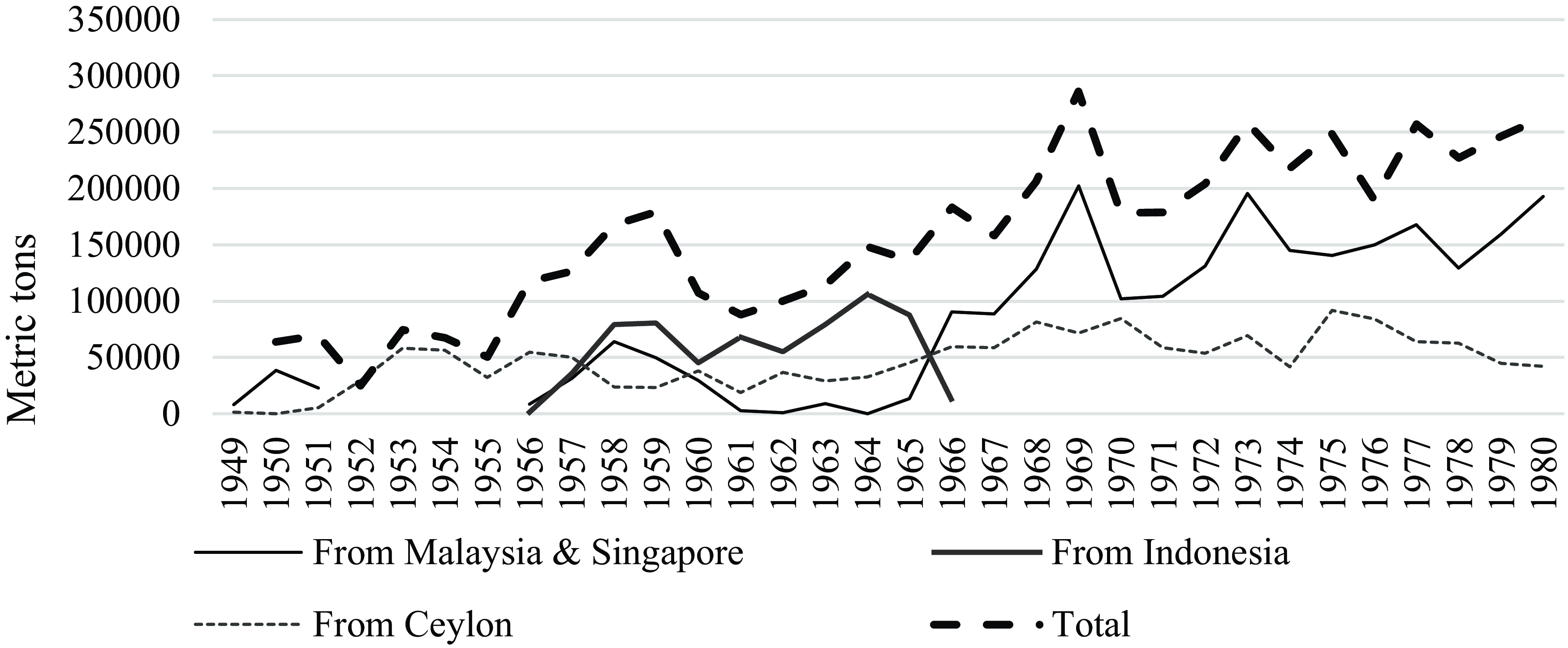
In the era of the Cold War, as John Wong has noted, natural rubber (hereafter rubber or NR), a raw material with strategic importance for any modern economy, was the only item that the People’s Republic of China (hereafter PRC or China) wanted in large quantities from Malaysia (Federation of Malaya before 1963). Malay(si)a depended heavily on rubber production and exports to sustain its economy and had a long history of trade deficits with China. Meanwhile, it was important for China, whose industrialization continuously demanded large quantities of rubber (Graph 1) but whose production of rubber and synthetic rubber (SR) remained limited, to maintain and increase their importation of rubber.Footnote 1 Not surprisingly, in 1956 and again in 1971, when both Beijing and Kuala Lumpur wanted to improve their bilateral relations, the first significant initiative was the dispatching of critical rubber trade missions from Malaysia to China, which received warm welcomes from Beijing. But curiously, for many years, this trade fluctuated sharply, meanwhile receiving no special encouragement from either government.Footnote 2
China’s Natural Rubber Imports, 1949-80.
Sources: All data are from John Wong, The Political Economy of China’s Changing Relations with Southeast Asia, 210-11.
To date, related studies of this significant trade have been limited in number and to unilateral and bilateral perspectives, ignoring the larger international context. Most economic historians have neglected this trade altogether, given its marginal share of the global rubber trade and Malaysia’s total rubber exports.Footnote 3 Only John Wong has traced the evolution of this trade from the perspective of both governments and tried to explain why it both fluctuated and continued. During this period Kuala Lumpur and Beijing diverged politically and differed ideologically, but neither deliberately stopped this trade. According to Wong, historical and economic factors – such as the long history of bilateral trade between the countries, the presence of millions of overseas Chinese in Malaysia, China’s continuous need for rubber, and Malaysia’s long-lasting trade deficits with China – all resulted in an economic pragmatism shared by both sides which sufficed to sustain the trade. Nevertheless, Wong did not substantiate his analysis with primary sources.Footnote 4
Diplomatic historians have been more concerned about why Kuala Lumpur sent two rubber trade missions to Beijing in 1956 and 1971. Most emphasized that these visits functioned as feelers sent out from new leadership in Kuala Lumpur to test China’s willingness to pursue a path to improving bilateral relations, but usually just concentrated on the roles of local Chinese merchants in these visits.Footnote 5 Only Abdul Baginda, using declassified documents, analyzed how the Malaysian government made its decision in 1971. According to Baginda, Prime Minister Tengku Razak decided on the 1971 visit not just because of his resolution to reform Malaysia’s Cold War foreign policy towards China, but also from his strong desire after the 1969 race riot to transform Malaysia’s domestic ethnic power balance.Footnote 6 Baginda concluded that this trade visit improved bilateral diplomatic relations, even though differences on important issues such as how to deal with the Malayan Communist Party (MCP) remained.Footnote 7
Though different in focus, existing studies primarily depict and analyze this trade from unilateral and bilateral viewpoints, only occasionally discussing the roles of global events, such as the connections between the UN’s embargo against China during the Korean War and the fluctuation of this trade in the early 1950s, or between the Sino-American rapprochement and the visit of a Malaysian trade mission to Beijing in 1971. However, some studies revealed that in the 1950s this trade was consistently and greatly influenced by the Sino-Soviet and Malaya-US rubber trades, which suggests more attention should be paid to global perspectives.Footnote 8 Based on accessible primary sources in Malaysia, China, Russia, the United States, and elsewhere, this article seeks to establish a new narrative about how Beijing and Kuala Lumpur dealt with this trade during the period from 1950 to 1980, with a focus on how global pressures and opportunities consistently shaped their policies and this trade.Footnote 9 It will show that the politics of the Cold War, including the occasional direct intervention of the United States and the Soviet Union in the trade, affected the often significant fluctuations in trade at least as much, if not more than, traditional economic factors such as price and competition. Even the availability of alternative sources was also affected by the politics involved. It will cover the trade chronologically according to the three phases which it underwent, corresponding roughly to the three decades.
The formation of the Soviet-Sino-Malayan triangle rubber trade, 1950-58
In 1950, just one year after its establishment, the PRC suddenly increased its annual rubber imports from the Malay Peninsula to eight times what it had been between 1946 and 1949 - from approximately 8,000 to 70,000 tons.Footnote 10 This sudden move was deliberate on the part of Beijing, but not a calculated effort to prepare for the Korean War as John Wong has assumed.Footnote 11 Beijing did it actually as a middle-man for Moscow, who was the real buyer of most of the rubber imported by China.
China’s sudden increased importation of rubber began towards the end of 1950 as a direct result of an urgent telegram from Soviet leader Joseph Stalin to Chinese leader Mao Zedong on 21 November 1950, by which time the People’s Volunteer Army of China had already entered the Korean War. Stalin wanted China to buy 50,000 tons of top-grade rubber for the Soviet Union as soon as possible from Southeast Asia where China had strong economic ties, since the Soviets could no longer obtain rubber from their traditional markets in London following the outbreak of the Korean War.Footnote 12 This demand did not surprise Mao. In Mao’s first visit to Moscow during the winter of 1949-50, Stalin had already requested a rubber supply from China.Footnote 13
In 1950, importing enough natural rubber was a crucial issue for Moscow. From the end of the Second World War, the Soviet’s rubber needs had dramatically increased due to Moscow’s placing the automobile, aviation, and aerospace industries at the top of its economic development plans; the emergence of the Cold War and the onset of the Korean War only served to heighten this need.Footnote 14 Since 1947, the Soviet Union also had to supply rubber to its satellites in Eastern Europe, given its demands of the latter to minimize their imports from Western countries. However, as Stalin admitted in another telegram to Mao on 24 November 1950, the Soviet’s sodium butadiene could not be used for the industrial production of tyres and other rubber products without a mixture with top-grade rubber at a ratio of 100/30. Footnote 15 In 1948, the Soviets managed to import 120,000 tons of rubber through direct purchases in Southeast Asia and two trade agreements with the UK and the Netherlands in late 1947 and early 1948 respectively. But these deals could not last.Footnote 16 Though they had ordered top-grade Malayan rubber in Singapore, what the Soviets finally received in Odessa was the lowest-grade rubber, which resulted in a loss of US$3 million by the Soviet Union. Footnote 17 Meanwhile, the Soviet’s large-scale purchase alarmed the United States. Starting in early 1949, Washington blocked an attempt by Moscow to buy all of the top-grade Sri Lankan rubber and established the multilateral trade control organization Consultative Group (CG)/Coordinating Committee (COCOM) that forced the reluctant UK and Netherlands to cut their rubber exports to socialist countries. Footnote 18 Consequently, the Soviet Union only imported 51,300 tons of rubber between 1 July 1949 and 1 July 1950, of which it had to transfer 5,300 tons to its satellites. Footnote 19
Although China’s economic leader Chen Yun disapproved of Stalin’s expensive plan, and many Chinese soldiers were fighting in Korean battlefields without adequate rubber footwear, Mao and China’s Premier Zhou Enlai insisted that ‘the spirit of internationalism’ was more important. Besides immediately transferring China’s 8,000-ton rubber stockpile to the Soviet Union in exchange for sterling, newspapers, and cloth, Mao and Zhou generously promised to purchase 70,000 tons of top-grade rubber for the Soviet Union.Footnote 20 Then, with full governmental support in terms of transportation, customs clearance, credit, and so on, the leading state-owned importers such as Huarun (China Resources, in Hong Kong) and Nam Kwong (in Macau), alongside many small private and joint private-state companies, engaged in a ‘rush purchase’ (qianggou) of rubber by all means possible, including numerous illicit ones. Footnote 21
This rush purchase succeeded with the help from many overseas elements. Besides British and overseas Chinese companies receiving orders from Chinese companies and shipping rubber to China by using British, Polish, and Panamanian vessels,Footnote 22 many businessmen in Hong Kong and Macau even smuggled rubber to the mainland with the acquiescence of local authorities. Footnote 23 The British and Portuguese colonial authorities established a licensing system of strategic exports to China in the mid-1950, but they tolerated those unlicensed deals not just because of corruption. The British and Portuguese feared that their intervention would hurt the local economy and induce revenge from China.Footnote 24 Consequently, China’s rubber imports jumped from 10,000 tons in the first ten months of 1950 to reach 69,000 tons by the end of the year, almost all from the Malay Peninsula. In 1951, China still obtained 40,000 tons of Malayan rubber from Hong Kong in the first five months, which accounted for 57.65% of its total natural rubber imports in 1951, and nearly 10,000 tons from Macau in the second half of 1951.Footnote 25
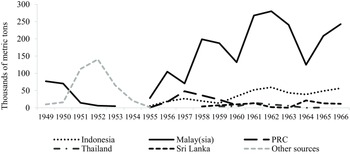
Most of this rubber that China obtained in 1950 and early 1951 went to the Soviet Union. Chinese sources recorded that in 1950 China re-exported 80,000 tons out of the 120,000 tons of rubber it imported to the Soviet Union, and that in 1951 the rubber export comprised 15.14% of China’s total export value to the Soviet Union. Footnote 26 Soviet official statistics show that between 1951 and 1953 it gained most of its imported rubber from unknown sources, which we now know means from China (Graph 2). As of that period, China established a grand triangular rubber trade from Southeast Asia to the Soviet Union via China, in which Malaya played a key role, even though it seemed unaware of this fact, at least initially. Footnote 27
Soviet Union Imports of Natural Rubber, 1949-66.
Data Source: М-во внешней торговли СССР (The Ministry of Foreign Trade of the Soviet Union), Внешняя морговля СССР 1918-1966 г: Смамисмический сборник (1918-66 Soviet Foreign Trade: Statistical Compilation) (Moscow: International Relations, 1967), 152-153.

This grand triangular rubber trade consolidated the Sino-Soviet alliance. On 26 May 1951, Stalin informed Mao that as compensation for China’s rubber exports to Russia, he would deliver new MiG-15 fighters to China without any further charge and consider as gifts the MiG-9 fighters China had bought and that proved outdated in air battles of the Korean War. Footnote 28 China’s loyal performance in rubber supply alleviated Stalin’s deep suspicions towards Mao and his China that had persisted even after Beijing and Moscow had become allies in early 1950. Footnote 29
In spite of everything, the Sino-Malayan rubber trade was hard to maintain from mid-1951 onwards given the counter-pressures coming from the United States (Graph 1). Washington led the passing of the UN General Assembly Resolution No. 500 (on 14 May) calling for an international embargo against China, and forced its allies to install a China Committee within CG/COCOM to tighten trade with China, all of which aimed to prohibit exports of rubber and other strategic goods to China. More importantly, the US Congress passed the Mutual Defense Assistance Control Act (August 1951) that commanded the executive branch to terminate American economic aid to any country which disobeyed the UN resolution.Footnote 30 Under this pressure, Indonesia, the largest rubber producer in the early 1950s, abided by the UN’s resolution from mid-May 1951 onwards.Footnote 31 The United Kingdom also took action to cut off rubber exports to China. At the end of May, the British Navy intercepted the British freight Nancy Moller which was shipping 3,750 tons of Malayan rubber to Guangzhou. Singapore authorities confiscated 750 tons of rubber loaded in the Panamanian freight ship Norbay also bound for China, and the Singapore police arrested local businessmen and Huarun’s representatives involved into these two cases.Footnote 32 Sri Lanka lost American aid in October, as it was found to have permitted the shipment of 5,800 tons of rubber to China by a Polish vessel Mickiewicz. Footnote 33
Malaya and other rubber producers only got temporary compensation. Preventive purchases of all stocked rubber in Southeast Asia by the United States and its allies led to a sharp increase in the international rubber price on the London market from $1.28 per kilogram in March 1950 to $5.41 in February 1951.Footnote 34 However, Kuala Lumpur quickly found out that the prospect of Malaya’s rubber exports to the United States was extremely limited. Besides the American government’s decision to maintain a large domestic SR industry for fear of a possible rubber shortage,Footnote 35 a rumour emerged in late 1951 that Americans were searching for an alternative rubber supply in Latin America,Footnote 36 and from the beginning of 1952 American rubber consumers showed a strong inclination to use more styrene-butadiene rubber (SBR), a major SR that could substitute for rubber in many uses, with the excuse of the unstable quality of Malayan rubber.Footnote 37
China was still hungrily searching for rubber for its big brother in 1952. Since April 1951, Britain, the Soviet’s major rubber supplier, had reduced its rubber supply to Russia to only 7,000 tons monthly, which just met the latter’s essential civilian needs. Footnote 38 And since the end of 1950, the Soviets were short of hard currency to buy rubber. Footnote 39 So, in early September 1952 when Zhou Enlai in Moscow requested the Soviets’ assistance in China’s First-Five Year Plan, Stalin asked to continue the rubber supply by China. Zhou briefly hesitated due to the international rubber embargo, but Stalin’s promise of extensive economic assistance coupled with the threat of decreasing truck exports to China proved irresistible. On 15 May 1953, as Moscow formally agreed to help China build ninety-one large-size industrial plants, Beijing also promised to transfer 90,000 tons of rubber and other commodities in the next five years.Footnote 40 Though China was somewhat reluctant at the outset, China’s rubber re-exports to the Soviet Union pushed forward Sino-Soviet economic cooperation and consolidated the alliance.
At the end of 1952, China found an opportunity to prove how generous it could be to recover rubber trade with Southeast Asia. In December, Beijing signed a five-year barter agreement with Colombo, according to which China promised to ship 270,000 tons of high-grade rice annually to Sri Lanka in exchange for 50,000 tons of rubber, which meant China was buying rubber from Sri Lanka at 20% above the average price in Western markets.Footnote 41 This deal was very attractive to Sri Lanka which was facing a looming national famine, as no Western buyers wanted its comparatively low-quality rubber thus depriving Colombo of the financial means to import much-needed rice. Kuala Lumpur enviously found that even though Washington immediately suspended its economic aid to Sri Lanka,Footnote 42 Colombo earned enough revenue from this deal and financed a 60,000-acre rubber-tree replantation plan from 1953 onwards that would make Sri Lanka’s rubber more competitive against Malayan rubber in the world market. Footnote 43
In contrast, the United States further frustrated Malaya and other rubber producers who maintained a rubber embargo against China under American pressure.Footnote 44 As they worried about the serious rubber surplus and the quick drop in the international price of rubber in 1953 and 1954, almost to the level from before the Korean War, the United States, as the biggest SR producer and rubber consumer, proved ruthless and selfish. Washington refused to alleviate competition from its SR or to participate in establishing an international price stabilization scheme for rubber, which had repeatedly been suggested by Malaya and its neighbors since 1953.Footnote 45 Britain did initiate a replantation scheme of high-yield rubber trees in the Malay Peninsula in 1953, but it primarily served large estates owned by British corporations and mostly ignored the small rubber farms held by Malay peasants.Footnote 46
In contrast, China maintained large-quantity rubber imports from Sri Lanka to meet the increasing needs of its allies. During China’s First Five-Year Plan (1953-57), China expanded its rubber supply to Czechoslovakia, Hungary, Bulgaria, and North Korea, which lacked hard currencies to purchase rubber by themselves.Footnote 47 In total over these five years, China imported 436,000 tons of rubber from Southeast Asia, but re-exported 190,000 tons to other socialist states.Footnote 48
Ironically, it was the United States which first retreated on the issue of the rubber embargo against China. Between 1953 and 1955, when Washington found that Burma and Indonesia had exported some rubber to China, it only warned Jakarta and Rangoon against further rubber shipments without imposing any harsh punishment.Footnote 49 In early 1956, Washington took no preventive actions against attempts by Thailand and Indonesia to export rubber to China.Footnote 50 It even resumed its economic assistance to Colombo in March, with the condition that the latter’s rubber exports to China would not exceed 50,000 tons annually. Footnote 51 At this point, Washington had no reason to continue to refuse strong demands from Britain and its colonies to abandon the rubber embargo against China. On 27 April, Washington informed London that it would acquiesce to London’s liberal use of the exception procedure of the China Committee for rubber trade with China.Footnote 52
Malaya could not wait anymore. With permission from London, Kuala Lumpur and Singapore declared on 4 June that they were abandoning the rubber embargo against China. Then a so-called ‘private’ joint Malaya-Singapore trade mission visited China between August and October with the support of both of their governments. This visit immediately brought a recovery of Malayan rubber exports to China, going from almost zero in 1955 to 8,707 tons in 1956, then 31,367 tons in 1957 and 64,036 tons in 1958 (Graph 1).Footnote 53 Although Malaya had lost its dominant position in China’s rubber imports to Sri Lanka and Indonesia, these new exports were significant in helping offset two blows to Malaya’s rubber economy. First, soon after gaining independence on 31 August 1957, the new Federation of Malaya faced a large-scale withdrawal of UK rubber corporations from approximately 300 advanced rubber estates with 230,000 acres. Second, world rubber prices continued their decline, under pressure from increased SR production in Western countries.Footnote 54 To expand its rubber exports to China, Kuala Lumpur declared no limit on rubber exports to China on 4 July 1957, which meant in practice that American political influence and interference in this rubber trade had completely ceased. Footnote 55 As a result, China’s rubber imports from the Malay Peninsula grew to nearly 65,000 tons in 1958, the highest level since 1952 (Graph 1).
The stalemate of the Sino-Malay(si)an rubber trade, 1958-68
By October 1958, however, the Sino-Malaysian rubber trade had lost its momentum, and neither side took action to improve this trade until 1969. Unilateral and bilateral events contributed to this stalemate, including the so-called 1958-59 ‘trade war’ between the two nations, China’s severe economic crisis in the early 1960s brought on by Mao’s utopian Great Leap Forward (1958-1960), and a general worsening of bilateral relations in all fields during this period. Footnote 56 But the roles of many global and regional elements cannot be ignored.
In early 1958 when Beijing commenced its Second Five-Year Plan (1958-62), it included one million tons of rubber importation from Southeast Asia, of which 410,000 tons would be re-exported to its socialist allies. However, some Chinese top officials quickly complained that this re-exportation programme drew too heavily on China’s foreign exchange reserves, which had become more restricted as the Great Leap Forward had led to a sharp increase in the importation of expensive industrial equipment and materials for China itself.Footnote 57 Furthermore, as the Sino-Soviet relationship deteriorated quickly in general during these years, Chinese officials decided to free themselves from this burden.Footnote 58 At the end of 1959, Beijing first cut 10,000 tons of rubber from the planned 1960 re-export plan, then the Chinese delegation in negotiations in early 1960 firmly insisted on only supplying 125,000 tons of rubber to the Soviets for the years 1961-65, even though the Soviet delegation wanted 175,000 tons, again threatening to cut off its industrial equipment supply and technical support to China’s chemical industry.Footnote 59 When the Soviet Union suddenly withdrew all its specialists from China in July 1960 (which became a key symbol of the Sino-Soviet split), and Beijing had exhausted most of its foreign exchange reserves to buy food, China all but stopped this rubber re-exportation, delivering only 7,900 tons of rubber to the Soviet Union in 1961 (Graph 2).Footnote 60
The end of the great triangular rubber trade between Southeast Asia, China, and Eastern Europe in 1961 had a profound influence on the Sino-Malaysian rubber trade. Because China no longer had to act as a middleman for the USSR and its own need for rubber had declined due to the economic crisis of 1959-1962, it could import what it required from its old friend Sri Lanka and new ideological partner Indonesia, rather than from Malaya.Footnote 61 Consequently, China’s rubber imports from Malaya dropped sharply from 29,507 tons in 1960 to 2,633 tons in 1961 and 766 tons in 1962 (Graph 1). This sharp reduction led Malaya and Singapore to increase their rubber sales directly to the Soviet Union and Eastern European countries, with which they had no major or direct disputes (Graph 2). The Sino-Malayan rubber trade had lost the importance it once had for both sides.
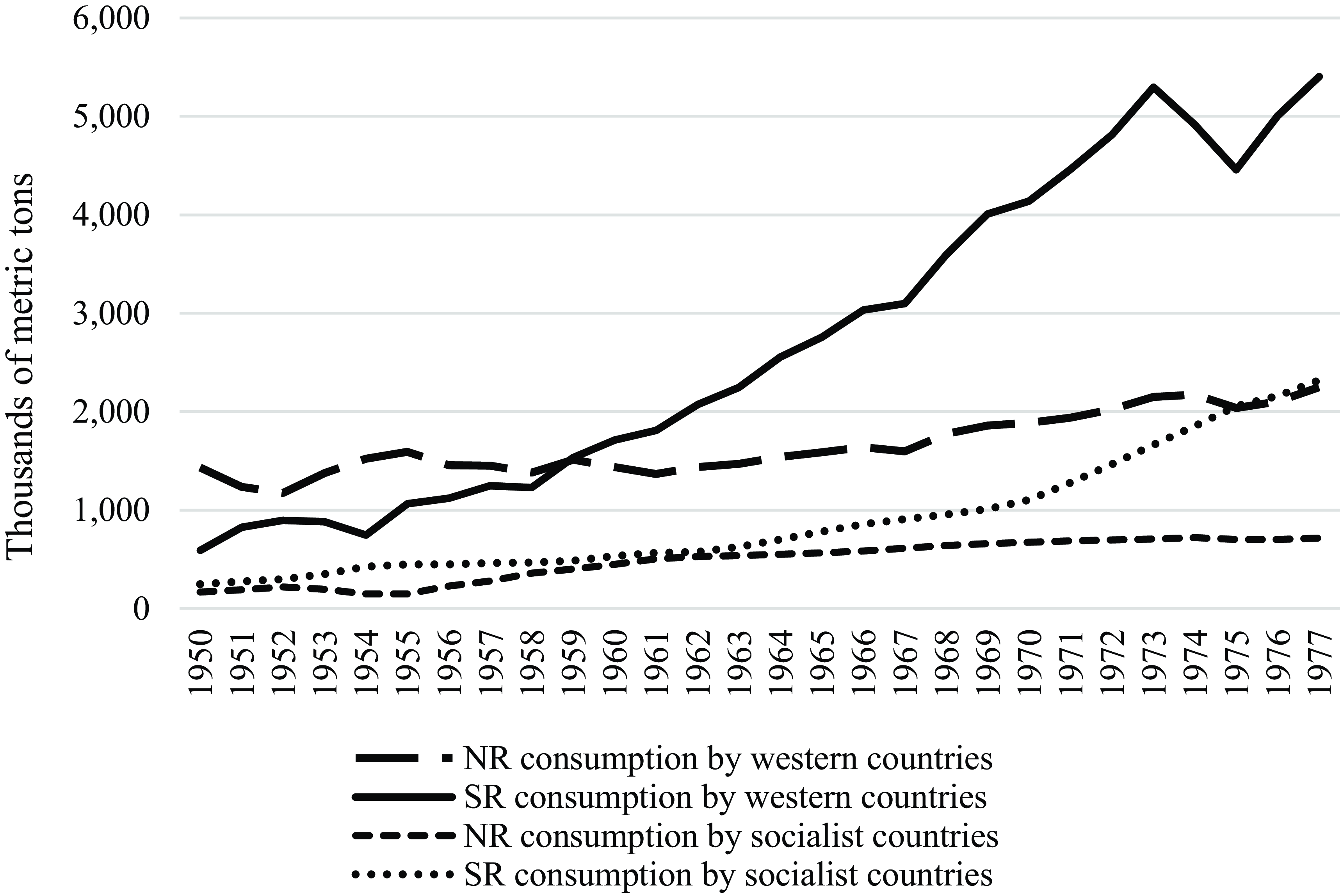
But Malaya still needed to expand its rubber exports due to economic competition from the rubber stockpile and synthetic rubber industry in the West, even though both sides cooperated closely in other fields such as security, politics, and economic aid.Footnote 62 From October 1959 to July 1961, the US General Service Administration (hereafter USGSA) dumped 110,117 long tons of low-priced rubber stockpile into the market, until strong objections from Malaya and other rubber producers caused them to stop.Footnote 63 Furthermore, from 1960 onwards, Western chemical giants expanded their outputs of Butyl Rubber (IIR) and started large-scale production of two new general-purpose SR – polybutadiene (BR) and synthetic polyisoprene (IR) – all of which could substitute rubber in many ways (Graph 3).Footnote 64 These helped the world’s production of SR to surpass rubber and depressed world rubber prices by almost 50% in the 1960s (Graphs 4 and 5).Footnote 65 Malaya only maintained its rubber revenue in this decade by doubling its production and exportation, at a time when its total exports, trade balances, and GNP all showed a decline in the early 1960s.Footnote 66
NR and SR Consumption by Western and Socialist Countries, 1950-77.
Data Source: Grilli et al., The World Rubber Economy, 190-1.
Prices of Ribbed Smoked Sheet No. 1 in Bales, 1960-84, FOB Singapore.
Data source: United Nations Conferences on Trade and Development, ‘Commodity Price Bulletin, Free market commodity prices, monthly, Jan. 1960 – Dec. 2017 (Discontinued)’, https://unctadstat.unctad.org/wds/TableViewer/tableView.aspx?ReportId=28768, accessed on 2 August 2023.

World Production Capacities of NR and Major SR, 1960-80.
Data source: Barlow, The World Rubber Industry, 32, 76-7, and Grilli et al., The World Rubber Economy, 80, 84-5, 184-5.

The heavy loss in Western and Chinese markets forced Kuala Lumpur to explore trade with communist states and sheds new light on why Malaya sought to improve all kinds of relationships with European socialist countries after 1962, while still maintaining close relations with the West.Footnote 67 On 18 October 1962, the Ministry of Commerce and Industry of Malaya (hereafter MCI) declared that an official rubber mission might visit Eastern Europe to persuade those countries to buy more Malayan rubber. The local Malay Mail reported that the MCI also wanted to send an official rubber mission to Beijing, which excited Malayan rubber dealers who instantly expressed their desire to join the mission. This news annoyed the Malayan Ministry of External Affairs (hereafter MEA) who strenuously warned the MCI to withdraw this statement. The MEA warned that such a visit would violate Kuala Lumpur’s strict non-recognition policy of the PRC because any visit by an official trade mission would make recognition almost inevitable according to international law.Footnote 68 After the MCI clarified that its declaration was misread by the Malay Mail, the MEA confirmed to all overseas posts that Kuala Lumpur did not intend to change its diplomatic policy towards the PRC.Footnote 69
In 1963, China suddenly increased its imports to more than 110,000 tons of rubber from all sources and 9,060 tons specifically from the Malay Peninsula, a sharp contrast to its imports in 1962 of 100,000 and 766 tons respectively (see Graph 1). This change can be explained by both military and economic considerations: from mid-1962, Beijing had initiated a large-scale stockpile programme for rubber and other strategic materials as a response to threats from the Taiwan Strait, Indochina, and India.Footnote 70 Moreover, to increase foreign exchange reserves that were almost exhausted by the economic crisis of the previous three years, Beijing adopted a new trade strategy of converting imported rubber and other raw materials into more profitable products for export.Footnote 71
However, neither Kuala Lumpur nor Beijing were ready to improve the bilateral rubber trade in 1963. Strongly opposed to the merger of Malaya, Singapore, Sarawak, and Sabah in September of 1963 into the nation of Malaysia, Indonesia’s Sukarno imposed a ‘konfrontasi’ against Malaysia that included calling for rubber orders from all socialist states to be filled by Indonesia.Footnote 72 As China stood firmly with its ideological ally Indonesia in this confrontation, it is not surprising to see that Malaysia’s rubber exports to China dropped to only 114 tons in 1964 (Graph 1). Singapore, who wanted to cover the severe economic losses incurred from this confrontation, proposed Kuala Lumpur on 3 March 1964 for a trade mission to China. But Malaysia’s MEA denied this suggestion on 31 March by emphasizing that this kind of visit would expose Singapore businessmen to China’s communist propaganda and influence.Footnote 73 Malaysian officials also watched Singapore businessmen closely to prevent any private visits to China.Footnote 74
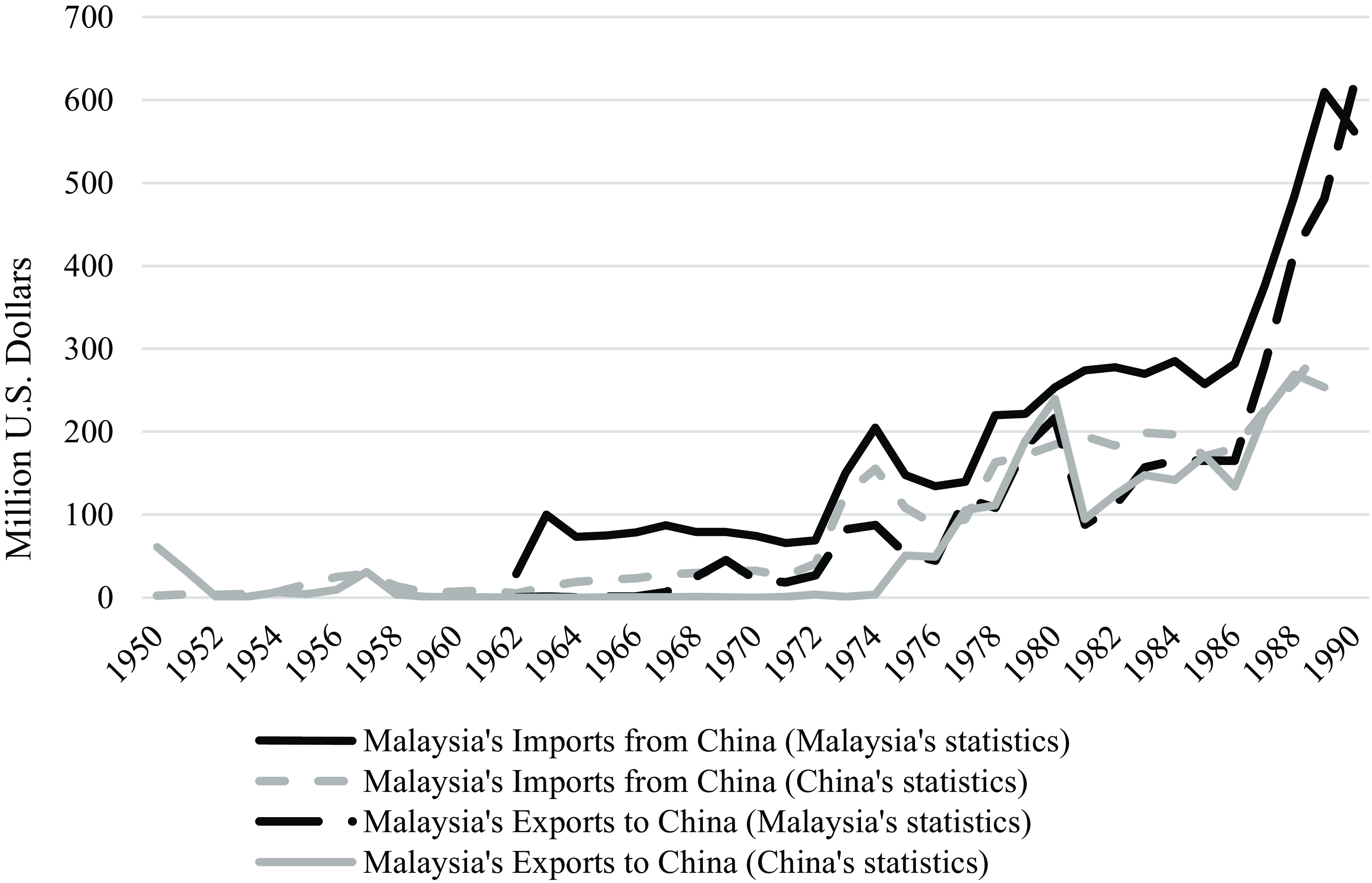
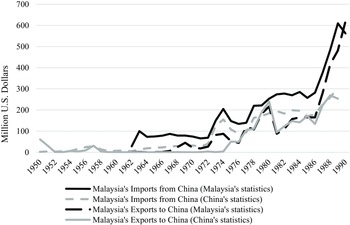
Singapore’s declaration of independence from Malaysia on 9 August 1965 removed Kuala Lumpur’s caution towards its rubber trade with China. With its newfound freedom, Singapore announced on 21 August that it would develop trade relations with all countries, including China which soon recognized Singapore’s independence.Footnote 75 As a reaction to Singapore’s competition, Malaysia’s Secretary of MCI Lim Swee Aun declared that Kuala Lumpur would now welcome any request from Malaysian commercial unions to visit China. Lim justified this policy change by arguing that exporting more rubber to China complied with Malaysia’s ‘open door’ trade policy and would contribute to reducing Malaysia’s trade deficits with China (Graph 6). However, Malaysian traders were hesitant. For example, the Associated Chinese Chambers of Commerce in Malaysia publicly stated that its members feared being labelled as communists and preferred to wait for further clarification from the government.Footnote 76
Statistics of Sino-Malaysian Trade, 1950-90.
Data Sources: Malaysia’s statistics came from UN Comtrade, SITC Rev. 1. China’s statistics cited from Zhonghua Renmin Gongheguo Duiwai Jingji Maoyi Bu (China’s Foreign Economic Trade Ministry), Duiwai Maoyi Tongji Ziliao Huibian: 1950-1989 (Collections of Foreign Trade Statistic Sources: 1950-1989) (Beijing: Zhonghua Renmin Gongheguo Duiwai Jingji Maoyi Bu, 1990), 52. Data covering 1950-57 included Singapore’s imports from and exports to China.
However, only one month later Kuala Lumpur found no need to change its cautious position. When the pro-western General Suharto came to power in Indonesia after the 30 September Movement, and reversed Sukarno’s pro-socialist diplomacy, Indonesia quickly reduced its rubber exports to socialist countries.Footnote 77 This change forced the Soviet Union, Eastern Europe, and China to re-establish their rubber trade with Malaysia.Footnote 78 Particularly China, fearing a possible war with a United States which was escalating its intervention in Vietnam, wanted to build up a stockpile as a safeguard, and therefore stepped up its rubber imports from Malaysia from 114 tons in 1964 to 90,000 tons in 1966, though most of it was coming indirectly through Singapore.Footnote 79 Kuala Lumpur welcomed China’s move, for it eased pressure put on the Malaysian rubber industry by the US. In March 1966, the USGSA started another large-scale rubber stockpile recycling scheme and only stopped in 1967 after Malaysia agreed to give substantial support to the US’s military operations in Vietnam.Footnote 80
In 1967 Kuala Lumpur kept a cautious but flexible position towards its rubber trade with China, as illustrated by its conduct on a direct rubber purchase between Huarun and a local company in the Malaysian port town of Butterworth. This local company reported to Kuala Lumpur that Huarun wanted to purchase 70,000 tons of rubber directly, which had seldom happened before. Even though Huarun accepted the condition that this deal could only be done through a Singapore firm, Kuala Lumpur first permitted this local company to ship 2,000 tons directly from Butterworth to China, and then in July even allowed a Chinese cargo vessel to enter Port Klang to load more rubber.Footnote 81 Beijing’s efforts to develop a direct rubber trade with Malaysia might have been a deliberate punishment against Hong Kong, which relied heavily on entrepot trade between Malaysia and China. In May and June, the Hong Kong authority suppressed a radical riot supported by Beijing.Footnote 82
In 1968, China’s direct rubber imports from Malaysia reached US$72.88 million, more than three times that of 1967 (only US$19.66 million).Footnote 83 Kuala Lumpur took no action to interfere with this trade, for Malaysia was suffering from a sharp drop in rubber prices in the first half of that year and a severe foreign debt increase across the whole year.Footnote 84 But this increase was not sufficient for Kuala Lumpur to take the initiative in promoting this trade and improving Sino-Malaysian relations. Meanwhile, in that same year Malaysia established diplomatic relationships with the Soviet Union as the latter became the largest buyer of Malaysian rubber.Footnote 85
The transformation of the Sino-Malaysian rubber trade, 1969-80
In 1969, China’s purchase of rubber from Malaysia, Singapore, and Sri Lanka reached its all-time peak (Graph 1). In July, it became the largest buyer of Malaysian rubber by ordering 120,000 tons of rubber worth US$190 million. Beijing made such a purchase for two reasons: firstly, Chinese officials sought to increase China’s rubber stockpile in case the armed conflict with the Soviet Union over the Zhenbaodao Island would escalate; and secondly, China hoped it would help avoid financial losses caused by a possible devaluation of major Western currencies which had become obvious since April.Footnote 86 China’s large-scale imports, together with the halt of the USGSA’s rubber stockpile dump, pushed Malaysian rubber prices to their highest point since 1961.Footnote 87
The new Razak Administration, which came to power in Malaysia after a destructive race riot that took place in Kuala Lumpur on 19 May 1969, was pleased with China’s rubber orders. Illustrative of the warming economic relations between the two countries was the visit by American scholar Alexander Eckstein to Kuala Lumpur, hosted by Pusat Pengajian Pembangunan Malaysia (Malaysian Centre for Development Studies, an official institute located in Kuala Lumpur). Eckstein, a Professor at the University of Michigan specializing in the Chinese economy, was perhaps the leading figure in America who advocated the normalization of the Sino-American relationship for economic reasons. Eckstein’s lecture, entitled ‘Communist China’s Economic Growth and Foreign Trade with Special Reference to Malaysia’, was attended by many senior Malaysian diplomats.Footnote 88
In the first seven months of 1970, China disappeared from rubber markets, causing substantial anxiety among Malaysian rubber dealers who were already worried because of ominous events in the West. During these months, USGSA released 7,000 tons of rubber every month into the American market and only stopped in August under sharp critiques from major rubber producers. This hit Malaysian Standard Rubber (MSR) prices, dropping from 70.5 cents per pound in January to below 50 cents per pound in September, even though the Razak Administration threatened several times to intervene in the market for price stabilization.Footnote 89 Then a large-scale General Motors strike from 14 September to 23 November joined by nearly 500,000 American workers cut US rubber demand. In early November, the Far Eastern Freight Conference, which monopolized the shipping of commodities from Southeast Asia to the US and Europe, decided on a freight fee increase.Footnote 90
As early as September of 1970, some Malaysian politicians openly suggested that now was the time to send a trade mission to persuade China to buy more rubber from Malaysia.Footnote 91 Many Malaysian business leaders agreed. On 21 December, the Sarawak Associated Chinese Chambers of Commerce requested the Sarawak State government to approve a trade mission led by its organization to China, effectively arguing that this visit would help the exportation of Sarawak rubber to China and lessen its trade deficits with China.Footnote 92 This request was so popular in Sarawak that after some hesitation the Sarawak State Government submitted it on 15 March 1971 to Kuala Lumpur for a final decision.Footnote 93 Rubber producers from western Malaysia echoed the Sarawak proposal since they were concerned that after importing 101,859 tons of rubber from Malaysia and Singapore in 1970, China in the first three months of 1971 had only bought US$3 million worth of rubber.Footnote 94
On 27 March 1971, Prime Minister Razak himself announced that his government would allow a private trade mission to visit China, believing that this visit would serve Malaysia’s national interests.Footnote 95 Razak was so confident about this visit partly because in early 1971 several trade missions from Western European countries and Japan had already successfully visited China and received many orders. More importantly, China had already shown its goodwill to Malaysia a year earlier through a series of instances of private ‘people diplomacy’ where, through secret channels, Kuala Lumpur and Beijing had begun planning such a visit.Footnote 96 By 2 April, the Malayan Rubber Fund Board, the government organization that sponsored the production and exports of Malaysian rubber, had mailed technical literature about MSR to China through its agents in Hong Kong, obviously in preparation for the visit.Footnote 97
The support from the Prime Minister excited Malaysian rubber dealers,Footnote 98 but the MFA feared moving too fast, even though the MIC and Ministry of Internal Affairs all supported the mission.Footnote 99 In an undated memo, Malaysian diplomats listed the risks of such a visit: it might harm domestic security because China still openly supported the rebels of the MCP, and other members of the Association of the Southeast Asian Nations (ASEAN) might suspect the neutralism that the Razak Administration was trying hard to promote.Footnote 100 To ease the MFA’s fears, Razak announced on 25 April that although a trade mission would leave for China soon, this mission was purely a ‘private’ one.Footnote 101
Led by Tengku Razaleigh, the head of state-owned trading corporation PERNAS who acted as a private envoy of Razak, this ‘private’ trade mission first arrived in Guangzhou on 8 May to attend the Canton Trade Fair.Footnote 102 In Beijing on the night of 15 May 1971, Razaleigh had a pleasant meeting with Zhou Enlai. Both sides reached a consensus on crucial issues like the dual citizenship of Malaysian Chinese and Malaysia’s idea of neutralizing Southeast Asia, avoiding all the time the problem of the MCP.Footnote 103 After this meeting, this mission got what they wanted most: Chinese officials promised to purchase 150,000-200,000 tons of rubber annually directly from the Malayan Rubber Fund Board.Footnote 104
Although gratified by the success of the mission, Razak still cautiously sought to control how it was perceived in domestic circles. Immediately following this visit, Kuala Lumpur commanded all overseas diplomats to clarify to host countries that the mission was only for trade, and that Malaysia had no intention of establishing a formal relationship with China.Footnote 105 Furthermore, the MIA warned all members of this trade mission to keep low profiles and persuaded the local press to not report their experiences in China.Footnote 106 As a sharp contrast, in 1970 and 1971 Malaysia warmly welcomed trade missions from Bulgaria, the Soviet Union, Czechoslovakia, and Hungary, and signed many official agreements to enhance trade and other relations.Footnote 107
Several months later, the Razak Administration took more active steps to develop the rubber trade with China, more as a hedge to economic pressures from the West than as a reaction to the changing Sino-American relations caused by Henry Kissinger’s secret visit to Beijing in July. The ailing economic performance of the Western world, a prolonged strike by dockworkers in the United States, and especially the recovery of the USGSA’s rubber stockpile releasing scheme in July 1971, all caused the price of Malaysia’s RSS 1 to drop from 104 cents per kilo in July of 1971 to 85 cents in December, ‘a distressing 32-year low’ for the period since the end of the Second World War, as described by the local press.Footnote 108 A deal for the purchase of 40,000 tons of rubber signed by an official Chinese trade mission in Kuala Lumpur in August only temporarily stabilized prices.Footnote 109 To persuade the Chinese to buy more rubber, in December 1971 Malaysia sent a technical rubber mission to China to introduce the advantages of Malaysian rubber over SR or NR produced in other countries.Footnote 110
In 1972, Malaysia realized that it had to count more on China and other communist countries in the rubber trade. USGSA continued to manipulate rubber prices by only reducing the release of US rubber stockpiles from 6,000 to 3,000 tons per month. The Razak administration sought to influence prices by directly buying lower-grade rubber for its stockpiles, but this intervention was unsuccessful, and Malaysian rubber prices remained low in the early months of 1972.Footnote 111 Only after China and European socialist countries all expressed their intentions to buy more Malaysian rubber, did Malaysian rubber prices become more stable.Footnote 112
But other challenges still confronted Malaysia in 1972. When Razak and his deputies visited Moscow in October, Soviet officials threatened to reduce rubber orders if Malaysia did not buy more Soviet products.Footnote 113 Malaysia also faced stiff competition from cheap Japanese SR on the world market. In 1972, Japan became the third largest SR producer in the world, just behind the United States and the U.S.S.R., and the second largest SR exporter whose sales in the world market sharply increased from about 1,000 tons in 1960 to 193,000 tons in 1970 and 234,000 tons in 1980.Footnote 114 In response, an angry Razak mobilized all ASEAN members, many of which were rubber producers, for a boycott against Japan in early 1973.Footnote 115 To address these concerns, Malaysian business leaders raised strong voices for Razak himself or an all-party delegation to visit Beijing as soon as possible.Footnote 116
Responding to pressures from within and without Malaysia, the Razak Administration in October had collected information about China’s trade with those countries that had already established diplomatic relations with China, and then sent the first official trade mission to China between 11 and 19 November.Footnote 117 Led by Razak’s economic adviser Tun Raja Mohar, the mission met with Zhou Enlai in Beijing on 19 November. Among all topics concerning both sides, in trade Mohar cared most was whether China could import more rubber.Footnote 118
Fortunately for Malaysia, the world oil crisis in 1973 increased the cost of SR production and pushed rubber prices upward. This helped give Kuala Lumpur enough time to reflect upon how to approach normalizing relations with China in a way that best served Malaysia’s economy. In May and early June of 1973, the MIC and PERNAS proposed two economic guidelines for the MFA to follow. To prevent further deterioration of Malaysia’s deficit in bilateral trade, the MIC and PERNAS all stressed that Kuala Lumpur must try its best to persuade Beijing to buy more rubber from Malaysia without brokering by Hong Kong and Singapore.Footnote 119
With these considerations in mind, Razak visited Beijing in the spring of 1974 and normalized Sino-Malaysian relations. Following normalization, Malaysian diplomats stationed in Beijing watched closely for any opportunity to expand rubber exports to China. In a report dated 16 October 1974, the Malaysian embassy suggested some long-term bilateral commercial arrangements with Beijing to promote China’s direct imports of rubber and other raw materials. This report excited the MFA. In October and November, the MFA twice commanded the Beijing Embassy to collect and study all texts of similar agreements that China had signed with other countries, as preparation for negotiations with Beijing.Footnote 120
Kuala Lumpur’s eagerness for an economic agreement with China was understandable, as competition from SR caused RSS 1 prices to drop by about fifty percent in 1974 (Graph 4). Meanwhile, the cost of living in Malaysia increased quickly, and small Malay rubber farms began to fail. In November, the first Malay peasant protest since the independence of Malaya broke out, and tens of thousands of poor Malay rubber farmers flooded into Kuala Lumpur to show their anger. Terrified Malay elites considered means to pacify the farmers, including expanding rubber exports.Footnote 121 But as Beijing openly celebrated the anniversary of the MCP on 30 April 1975, the annoyed Razak Government took no initiative to increase its rubber exports to China.
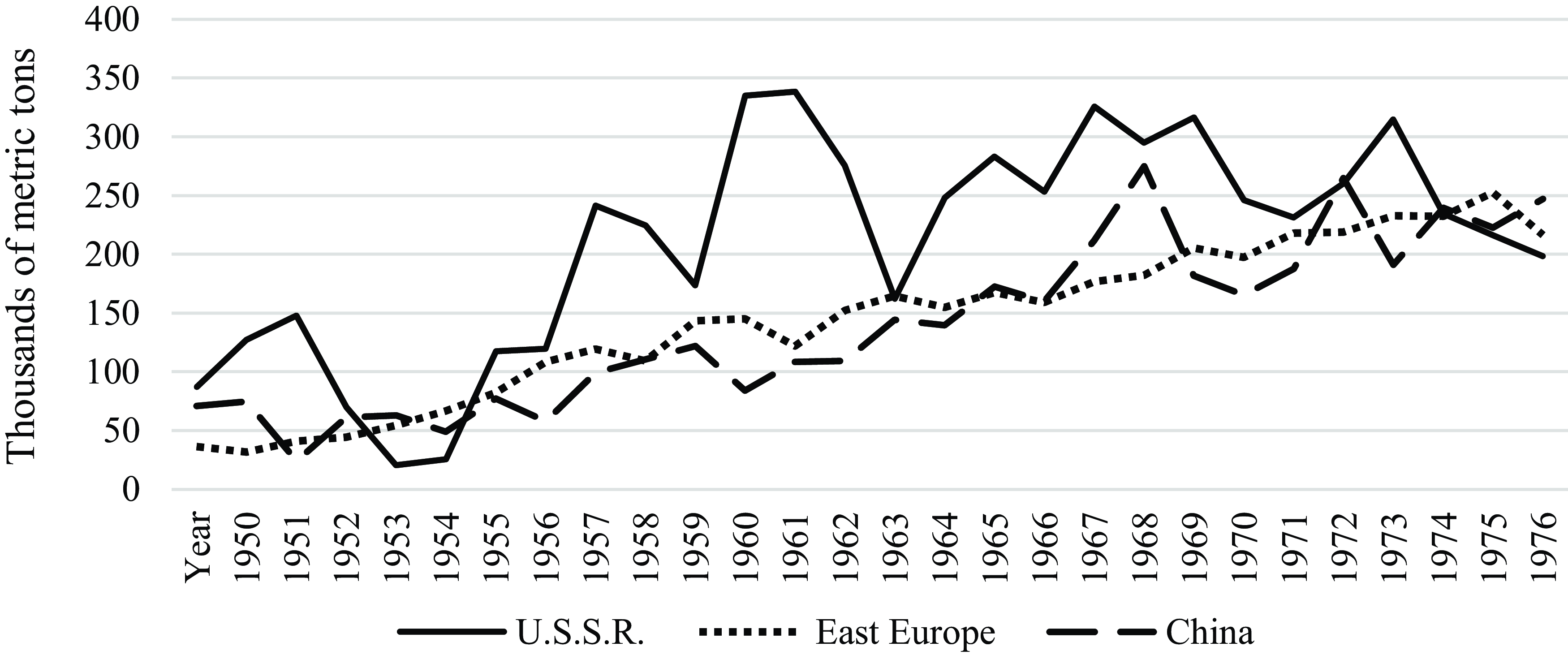
It was not until 1978 that the Hussein Onn Administration, which had come to power in 1976, tried once again to promote rubber trade with China when post-Mao China seemed headed toward industrialization and abandoned its radicalism. Having faced weak rubber prices since 1975 and a decrease in its rubber exports to the Soviet Union (Graph 7), which was quickly expanding its SR production, Malaysian officials again turned to China seeking a rubber market.Footnote 122 The president of the Malaysia Chamber of Commerce and Senator Kamarul Ariffin, and the Minster of Foreign Affairs Tengku Ahmad Rithauddeen visited Beijing in July and August, each seeking a larger share of Malaysian’ rubber and other materials in China’s imports.Footnote 123
Natural Rubber Imports by U.S.S.R., East Europe and China 1950-76.
Data Source: Grilli et al., The World Rubber Economy, 188.
However, it was China that made the fundamental breakthrough at the end of 1978. In November, China’s new leader Deng Xiaoping suddenly visited Thailand, Malaysia, and Singapore. Besides collecting support for China’s possible war against the Socialist Republic of Vietnam, Deng made this trip also to develop trade to serve his plan of ‘Reform and Opening-up’. In his meeting with Deng, Prime Minister Onn raised the issue of a possible increase in rubber imports by China, and Deng acknowledged that China wanted more rubber and other goods from Malaysia to assist in its industrialization.Footnote 124 After Deng’s return to Beijing, China immediately ordered more rubber and palm oil from Malaysia.Footnote 125 In March 1979, China’s Minister of Foreign Trade Li Qiang visited Kuala Lumpur. In his negotiations with Malaysia’s Vice Prime Minister Mahathir on the issue of bilateral trade, Li reassured Mahathir that China would increase its direct imports of rubber and other materials from Malaysia, and even suggested a bilateral trade agreement that had been desired by the MIC and PERNAS since 1973. The Chinese also showed interest in buying Malaysian rubber processing machines and palm refinery equipment.Footnote 126 In May, Onn visited Beijing, followed by the Malaysian Vice Minister of MIC, Datuk Lew Sip Hon in June. In these meetings, Chinese officials confirmed that China’s imports of rubber and palm oil from Malaysia would not decrease, and the portion of direct importation would increase.Footnote 127 China kept its word, and its increased rubber imports from Malaysia in 1979 and 1980 contributed to the improved trade imbalance of Malaysia with China (Graphs 6 and 7). After 1980, the Sino-Malaysian rubber trade entered a stable pattern, albeit with periodic fluctuations. By 2008, China had become the largest buyer of Malaysian rubber.
Conclusion
Drawing upon sources from the many different countries involved so as to have multiple perspectives, this article reveals that the Sino-Malaysian rubber trade between 1950 and 1980 had a global dimension which has remained unexplored in existing studies. In its first ten years, this trade was part of the triangular rubber trade with China representing a bridge between Southeast Asian and European socialist countries. In the following twenty years, this rubber trade continually evolved under the shadows of other powers who significantly shaped the nature and direction of trade. The global dimension of this trade sheds new light on why this trade fluctuated so frequently and sharply. China and Malaysia’s relations with the major international players were so complicated and changing that Beijing and Kuala Lumpur were frequently forced to review their positions amid the evolving international climate, to recalculate new risks and opportunities, and to readjust their policies towards the rubber trade, sometimes radically. The Asian rubber trade in the last half of the twentieth century had been inherently unstable because of the rise of SR production and the vagaries in unilateral and bilateral economic relations of producers and consumers, but with the arrival of the Cold War and the subsequent intrusion of major world-power politics into the equation rendered the Sino-Malaysian rubber trade particularly unstable. It is clear that the most significant factor determining whether and how much rubber was traded between the Malay Peninsula and China was international Cold War politics, and that across these three decades the politics of everyone involved changed often, in such a way as to make the trade amounts vary hugely. No bilateral studies can explain the scope and nature of the shifts in this rubber trade in the way that this multi-lateral study has shown, and that both China and Mala(si)a were forced, greatly to their economic disadvantage at times, to sacrifice economic to political interests.
This global view also provides a deeper understanding of how China and Malaysia conducted this trade throughout these thirty years. In the early 1950s, China and Malaysia each constructed their rubber trade relations to satisfy the needs of their most powerful Cold War allies, but they often realized their economic sacrifices were not worth it. In the 1960s and 1970s, Malaysia and China each acted with a pragmatic attachment to their interests, rather than their political inclinations. However, their pragmatism was not just created by historic or economic ties as John Wong has assumed. More often the Sino-Malaysian rubber trade only functioned for both sides as a counterbalance to the negative pressures imposed by other countries. In short, during these thirty years, China and Malaysia often maintained this trade more because of negative global factors than positive bilateral ones.
Funding statement
The research and writing of this article have been supported by the General Projects of the National Social Science Foundation of the People’s Republic of China, project #18BSS019.
Competing interests
The author(s) declare none.
Yu Yao is a Professor of the History Department and Academy of Socialist History and Documentation, at East China Normal University. He is currently studying China’s foreign economic relations in the era of the Cold War, with a special focus on China’s trade and aid activities with the third world and U.S. reactions.
Youxin Guo is an Associate Professor Academy of Socialist History and Documentation, at East China Normal University. She is studying China’s relations with Southeast Asian countries and overseas Chinese in the 20th century.





 Open access

