


Rome’s infamous moniker, the Eternal City, suggests a permanent, timeless, even inevitable cityscape, but such notions are misleading, especially when considering the city’s prehistory. Scholars working on early Rome — faced with a fragmentary and late historical record as well as deeply buried material evidence — have tended to imagine the early city as set in the topography of the historical period, just thinking away the accretions of later buildings. The Tiber Island is a perfect example, as it is ubiquitous in conceptions of early Rome. Generations of classical scholars have imagined the Tiber Island (Fig. 1) as a relatively stable, old land mass that long pre-dated prehistoric settlement in the area — even though ancient historians and modern geologists both indicated that the island was a more recent formation. The early presence of this island in the river was thought to have created the hydrological conditions necessary for a crossing point on the Tiber, thereby explaining Rome’s position and potential for regional dominance in the prehistoric era.
Google Earth image of the Tiber Island.

Geoarchaeological investigations have shed fresh light on Rome’s river valley and the Tiber Island specifically, revealing that this was actually a highly dynamic landscape, especially in the sixth century b.c.e.Footnote 1 Building on earlier findings from a coring survey along the adjacent riverbank in the Forum Boarium (Fig. 2), this contribution presents results from a sediment core drilled on the island as well as micromorphological analyses performed on sediment samples. Ultimately, we argue that the Tiber Island did not exist prior to the sixth century b.c.e.; the island first emerged as a permanent land mass above the river channel as a result of intensive and rapid sedimentation over the course of the sixth century b.c.e. Prior to this period, there existed only a seasonal bar formation on the Tiber’s riverbed: a low sandy beach that likely did aid river crossings during dry seasons in prehistory. These advantageous hydrological conditions at Rome, however, would have been eliminated as the area rapidly silted up during the late sixth century.
Topographic map of the centre of Rome, showing the elevation of modern surfaces but labelled with the ancient names of the city districts. (Andrea L. Brock).

In addition to examining more closely the sediment deposited in Rome’s central river valley, we also consider in greater depth the complex question of causation: how and why did the sedimentation occur in this place and in this period? Although a range of natural drivers could have contributed to changes in the fluvial system, we stress the widespread production of a new technology — terracotta roof systems — during a major period of settlement growth in Tyrrhenian central Italy in the Archaic Period (late seventh to early fifth centuries b.c.e.). As part of these urban and architectural transformations occurring throughout the region, consumption of timber resources in the river valley became intensive, likely for the first time. This resource exploitation then spurred unprecedented erosion from hillslopes upriver from Rome — sediment that produced rapid, large-scale topographic changes in the Tiber River valley, including the emergence of the Tiber Island.
I Divergent conceptions of the Tiber Island
Three sources from ancient Rome recount a legend of the Tiber Island’s emergence in the city’s archaic past. Writing in the first and second centuries c.e., Livy (2.5.1-4), Dionysius of Halicarnassus (Ant. Rom. 5.13), and Plutarch (Publ. 8) each relate with some variety of detail the same story: when king Tarquinius Superbus was ousted from power in 509 b.c.e., crops from land the king had impiously sowed in the Campus Martius (a space dedicated to the god Mars) were dumped into the nearby river as propitiation for his religious transgression. This event supposedly occurred in the middle of the summer: not only is the description of ripe or recently harvested grain suggestive of a mid-summer point in the agricultural cycle, but the accounts also describe the river as having shallows and flowing with a feeble current, as it would during the driest months of the year. Because of these conditions, the discarded crops accumulated in the riverbed, rather than being washed away. Upon this vegetal base,Footnote 2 the sources tell us, the Tiber deposited additional sediments that contributed to the growth of the island. The ancient authors conclude the episode by acknowledging that at some point thereafter the island was adorned with temples and other urban embellishments. Given that these ancient sources post-date the island’s supposed emergence by more than five centuries, scholars have long approached this episode (like the rest of the literary record on early Rome) with a healthy dose of scepticism. Not only are there questions about how such information could be reliably transmitted in a prehistoric context, but also this association between topographical change (land clearance and the formation of the island) and a foundational moment in the political narrative (the fall of the monarchy and rise of the republic) could reasonably be explained as literary trope, typical for the generation and genre. The legend of the island’s origins, therefore, was understood to be an etiological myth, and not a reliable record of actual events from the city’s archaic past.Footnote 3
Readily willing to discount this legend, the first generation of scholars working on the topography of the ancient city instead imagined the Tiber Island to be a permanent feature of the landscape that was geologically related to the tuff stone deposits that form the internal structure of Rome’s hills, which were the products of Pleistocene volcanic eruptions between 600,000 and 300,000 years ago.Footnote 4 A French historian, Maurice Besnier, performed the first comprehensive study of the Tiber Island in 1902.Footnote 5 Referencing nineteenth-century geological treatises, Besnier concluded that a rocky outcrop of this volcanic tuff extended from the Capitoline Hill into the river valley, where it caused the Tiber River to split into two channels. Supporting this hypothesis, Besnier reported verbal communications with engineering technicians from the Ufficio del Genio Civile di Roma: during work on the Ponte Cestio, one of the island’s bridges, they had exposed scraps of volcanic tuff (‘lambeaux de tuf volcanique’ as reported by Besnier) beneath a thick layer of sands, silts, peat and gravels.Footnote 6 This crucial, visual confirmation of the island’s substructure represented proof of its very early geological origin, and the notion of the island’s volcanic tuff origins percolated in topographic studies of Rome through the early twentieth century.Footnote 7
By the mid-twentieth century, however, this tuff stone theory became irreconcilable with the growing scientific understanding of the region’s geology. In 1944, an Italian geologist, Gioacchino De Angelis d’Ossat, offered a comprehensive reanalysis of the island’s origins. He repeatedly lamented his inability to conduct direct investigations, but he still managed both to undermine the tuff stone theory and to argue effectively that the island was formed of alluvium (sediment deposited by water). De Angelis d’Ossat noted that material typical of alluvial deposition (sands, clays, gravels and peat) had been exposed during the construction of bridges and other public works.Footnote 8 He also astutely critiqued Besnier’s interpretation of the verbal communication with civil engineers, questioning whether the volcanic tuff stone exposed during work on the island was actually in situ or just in secondary deposition.Footnote 9 By 1971, another Italian geologist, Ugo Ventriglia, offered a concise and unequivocable assessment of the question in La Geologia della Città di Roma: ‘As regards the geological formation of the Tiber Island, its position in the middle of a vast alluvial zone with thicknesses of the alluviums found nearby, certainly exceeding 50 m, suggests that it is made up of alluvial deposits of recent times and this is the consensus of virtually all Roman geologists.’Footnote 10 Indeed, numerous geological publications have conveyed this knowledge: the Tiber River valley (including its riverbanks, floodplains and Tiber Island) marks a vast zone of alluvial sediments deposited during the most recent geological epoch, the Holocene (the last 11,700 years).Footnote 11 Large portions of the modern city sit directly on top of this Holocene alluvium (represented with a pale yellow colour in Ventriglia’s Reference Ventriglia1971 map, detailed in Fig. 3), which extends up to 50 m below the modern surface in Rome’s central river valley. The Tiber’s aggradation history — its sedimentation as the river tracked post-glacial sea-level rise — has been the subject of various scientific investigations, including our own project.Footnote 12
Detail of the Geological Map of the city of Rome (Ventriglia Reference Ventriglia1971) showing the Tiber Island within a vast zone of Holocene alluvium represented with the pale yellow colour.

Even while lacking direct investigations of the island’s internal structure, the Holocene alluvial origin of the Tiber Island has been well established within geological circles for decades. Despite this unambiguous determination amongst the scientific community as early as 1971, however, the island’s volcanic tuff substructure continued to be referenced in topographic scholarship into the twenty-first century.Footnote 13 We reiterate that this specious hypothesis is simply incongruous with the modern scientific understanding of the palaeogeological development of Rome’s landscape. Crucially, the elevations of the geological strata do not align: the tuffaceous strata in the hills of Rome are situated more than 10 m above the modern sea level (hereafter masl),Footnote 14 covering pre-existing Plio-Pleistocene formations, whereas the substructure of the island is lower, below 10 masl. As sea levels fell in the Late Pleistocene, streams incised older geological layers, carving deep U-shaped river valleys. This process of erosion removed any pre-existing, underlying geological strata, including the volcanic tuff stone, within the river valleys in the region. Basic laws of geology make it illogical that an outcrop of stone — whether volcanic tuff, which is otherwise shown to be readily prone to the effects of erosion, or some other unidentified but exceptionally durable stone deposit — could be preserved in situ in the middle of the Tiber River valley, even as lower strata were eroded away. Furthermore, it is worth pointing out that during our investigations of the river valley, we have uncovered stratigraphy similar to that described by the civil engineers at the turn of the twentieth century and reported by the early historian Besnier as visual proof of the island’s tuff stone substructure: fragments of volcanic tuff buried beneath and within alluvial sediments.Footnote 15 Such material, however, is clearly not in its primary, geological context. These findings of volcanic tuff fragments in the river valley are only indicative of the prevalence of this material on the surrounding landscape and are not related to any outcrop of tuff stone in situ in the river.
This volcanic stone confusion is admittedly a minor detail within the broader discourse on the topography of ancient Rome, and some classical scholars did rightly assert the geologists’ determination that the island’s substructure was alluvial.Footnote 16 But even among those sceptical of the tuff stone theory, there remained a widespread perception that the island must be much older than 509 b.c.e. In her seminal 1961 book Janus and the Bridge, Louise Adams Holland offered a detailed consideration of the longstanding debate. She concluded that the physical process that created the island was likely alluvial and that it ‘was probably complete long before the first human occupation of the region’ — a determination not at odds with the geological consensus.Footnote 17 This entrenched conception of the island as older than the city is associated with the widely held view that Rome evolved at a natural crossing point on the river.Footnote 18 From the mid-nineteenth into the twenty-first century, generations of classical scholars have assumed that it was the existence of the Tiber Island that made these advantageous conditions possible.Footnote 19 According to some versions, the island’s structure was sufficiently durable that it acted as a physical barrier, splitting and slowing the river’s current, so that prehistoric people and animals were able to cross by ford or ferry in the calmer waters immediately downstream.Footnote 20 Alternatively, a few imagined that the island offered a stable land surface that could serve as a natural pylon across which early engineers constructed bridges linking the two sides of the river.Footnote 21 Some of this scholarship further inflated the importance of the site by suggesting that it was the first, or even the only, available crossing point in the lower river valley, making it a critically important liminal place at the intersection of two cultural and linguistic spheres in prehistoric Italy: Etruscan- and Latin-speaking peoples on either side of the Tiber River.Footnote 22
In these ways, the Tiber Island became a small but enduring cornerstone in the modern historical narrative of Rome’s beginnings. A deep geoarchaeological examination of the island’s substructure now permits a reconsideration of these bedrock assumptions underpinning our conceptions of early Rome. As we have previously argued and elaborate upon in Section III, the environmental evidence collected from Rome’s central river valley is indeed suggestive of conditions that would have facilitated river crossings in prehistory.Footnote 23 Contrary to previous scholarship, however, it was not the structure of the Tiber Island that made such operations possible; rather, the island’s rapid emergence in the sixth century likely marked the end of fording activity at Rome.
II New geoarchaeological investigations of the Tiber Island
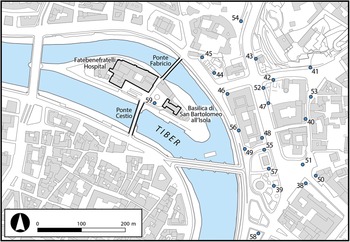
Given that direct investigations of the Tiber Island have long been restricted by modern structures (notably the Fatebenefratelli Hospital, one of Rome’s primary medical facilities since the sixteenth century), we were fortunate to be granted permission to drill a single deep borehole on the island in 2019. This was one part of a broader geoarchaeological coring survey of Rome’s ancient riverbank district in the Forum Boarium (Fig. 4).Footnote 24 The borehole on the island, core 59, was drilled in the front courtyard of the Basilica di San Bartolomeo all’Isola, a location deemed viable for such work, as the space was free of gas lines and other underground infrastructure, and the Beretta T46 rig could perform the drilling without obstructing ambulance access to the hospital (Fig. 5). This borehole produced a 23.6 m long sediment core from an elevation of 14.6 masl at the modern street level.Footnote 25 With a diameter of 8 cm, the cylindrical core was successfully recovered with negligible loss of material and sediment. After performing an initial stratigraphic analysis of the entire core (describing and documenting sediments and visible inclusions), we selected samples for macro-botanical study (flotation to isolate organic matter) as well as micromorphological analysis (via thin section). Figure 6 illustrates the major stratigraphic horizons as well as the chronological markers identified in core 59. As expected for the immediate subsurface of the modern street, the top few metres of the core contained various anthropic materials (chunks of tile, mortar and stone) to a depth of 5.5 m (9.1 masl).Footnote 26 From this point we observed an abrupt transition; the stratigraphy contained in the rest of core 59 to its base at an elevation of 9 m below sea level (hereafter mbsl) consisted of a 14.5 m deep sequence of alluvial sediments.
Map of Rome’s central river valley with the locations of the mechanised boreholes and other relevant structures. (Daniel P. Diffendale).

View of the Beretta drilling rig at work on the Tiber Island borehole with the Fatebenefratelli Hospital in the background. (Photograph: Andrea L. Brock).

Profile drawing of core 59, noting major stratigraphic horizons and chronological markers. (Andrea L. Brock).

The Tiber Island’s prehistoric beginnings as a seasonal bar formation
While the hypothesis of the island’s tuff substructure has been definitively excluded, what has been previously unclear is how this alluvial structure formed in the Holocene and whether that occurred before or alongside prehistoric habitation at the site of Rome. Core 59 and the 21 other deep sediment cores from the adjacent Forum Boarium have for the first time provided definitive evidence on the chronology and process of the island’s formation. The core drilled on the Tiber Island exposed a key stratigraphic horizon at 0 masl: the deepest anthropic material, rounded prehistoric sherds (including impasto bruno) within coarse-grained alluvial sediments deposited in the active river channel.Footnote 27 These findings provide an unambiguous chronological signal for the alluvium deposited above 0 masl in core 59: this sediment accumulated in late prehistory, after humans had settled in the area, not earlier in the Holocene, as has been previously assumed.
The alluvial deposits exposed around 0 masl in core 59 on the Tiber Island are suggestive of a low-relief bar formation contemporary with prehistoric habitation. Bars are typical features of a river: sandy deposits on the riverbed which are exposed during periods of low water flow.Footnote 28 Bar formations are ephemeral. As they are low in elevation, bars are submerged during any increase in water levels, gradually amassing size within the river channel until a high-energy event like a seasonal flood erodes away the accumulated sediment. Then, new bars begin to form. A survey of the modern Tiber River reveals multiple bar features, including some that present as islands within the river channel (Fig. 7). Bars are particularly prevalent along the inside bank of river bends (e.g. Fig. 7b) as well as in wider sections of a river channel including when two streams meet (e.g. Fig. 7a). Both of these factors — a river bend at the confluence of two (now extinct) tributary streams — were operative in Rome’s central river valley. As these are areas within the river channel where water velocity decreases, relative to parts of the river immediately adjacent, this causes rivers to slow and deposit sediments, especially sands. Wide and shallow sections of river channel are, therefore, prone to the formation of bar features, when compared to areas that are narrow and deep.Footnote 29
Google Earth images of bar formations in the modern Tiber River, including examples located near (A) Frangellini, (B) Foglia and (C) Ostia.

A close reading of core 59 (Fig. 8) reveals sediment from the last, uneroded bar in the location: the section between 0 masl and 1 masl contains sequences of coarse-grained alluvial sediments (devoid of the fine matrix), indicative of high-energy waters deposited within the active river channel. Just below 0 masl, it is possible to see remnants of older bars in this location: a series of thin layers with variable grain-size and somewhat indistinct boundaries suggestive of a cyclical pattern of deposition followed by erosion during flood events. The sediment immediately above the surface of this bar formation, at an elevation of 1.1 masl, contained waterlogged plant tissue, which returned a broad radiocarbon age between 746 and 404 cal. b.c.e.Footnote 30
Part of core 59 showing the early stages of the Tiber Island’s emergence, including a key transition at 1 masl from the sandy sediments characteristic of a bar formation on the riverbed (below) to silty sediments deposited during flood events (above). (Photographs: Andrea L. Brock).

In order to improve the chronological resolution, the Tiber Island core must be considered alongside the other cores from Rome’s central river valley, as river valleys commonly contain residual materials (older artifacts mixed into younger deposits). Along the adjacent riverbank of the Forum Boarium, the deepest anthropic material was similarly uncovered within alluvial sediments around 0 masl; this horizon marks the low base level of Rome’s central river valley during the early centuries of prehistoric habitation in the area.Footnote 31 While this ceramic debris scattered across the valley floor includes heavily rounded sherds and older impasto wares, the identification of more recent ceramic fabrics diagnostic for the Archaic Period, sherds that are angular and not residual products of distant river transport, indicates that the ground level remained very low (around 0 masl) at least until the beginning of the sixth century.Footnote 32 When taken together, it appears as though both sectors (the Tiber Island and the high riverbank in the Forum Boarium, stretching 100 m east of the modern river channel) were still in a low position within or near the active river in 600 b.c.e. These areas were in the river channel, not yet in an elevated position like floodplain or riverbank topography.Footnote 33
The rapid emergence of the Tiber Island in the sixth century b.c.e.
Beginning sometime in the sixth century b.c.e., sections of Rome’s central river valley experienced a large accumulation of alluvial sediment in a relatively short timeframe. We estimate between 4–6 vertical metres of sediment was deposited in the former river channel in the area of the Tiber Island and Forum Boarium before the early fifth century b.c.e., and another 3 m of sediment was deposited during the early to mid-republican period, until these areas were finally paved and alluvial aggradation ceased. This process transformed parts of Rome’s once low, wide central river channel from a riverbed zone into raised floodplain terrain. While sedimentation in the area of Rome’s eastern riverbank has been previously presented,Footnote 34 we argue here that a large portion of the Tiber Island’s substructure similarly formed during this intensive sedimentation in the latter half of the sixth century b.c.e. It was only at this point that the island became a permanent land mass in the Tiber’s channel that continued to accumulate sediment but was never fully eroded away.
Floodplains lie adjacent to active river channels; these are landscapes that are not regularly subjected to the river’s direct erosional force but that aggrade as a result of sediment deposition during overbank flood events. Such deposits are characterised by fine-grained alluvial sediments, like the fine sands and silty clays visible above 1 masl in core 59 (see Fig. 8), which are dropped during the falling stage of flood events as energy levels decrease. In the core on the island, the coarse-grained alluvial sediments characteristic of a bar formation within the river channel (below 1 masl) transition abruptly to fine-grained alluvial sediments (above 1 masl), indicating a notable decrease in energy typical of sedimentation that occurs some distance from the active river channel. In this process, the low, seasonal bar formation emerged above the river channel, as a new, permanent land mass.
Micromorphological analysis of these sections above 1 masl in core 59 indicates that the alluvium accumulated rapidly, as there were few signs of post-depositional disturbances, such as advanced soil formation processes or bioturbation, which might otherwise occur if the land remained stable and exposed for a sufficient length of time. The fact that the microscopic investigation revealed pristine sediment structures offers further support that surfaces were exposed for only brief periods of time before being buried by further sediment deposition.Footnote 35
The apparent rapid rate of sedimentation is reinforced when core 59 is again compared with the more prolific chronological makers from cores drilled in the adjacent Forum Boarium, where it is apparent that the ground level rose from elevations around 0 masl to 5 masl in the sixth century alone. The collection of ceramic sherds from riverbed deposits, discussed above, provide an early archaic terminus post quem for the sedimentation above 0 masl: the sediment above this level was deposited no earlier than 600 b.c.e. Coring along the riverbank in the Forum Boarium also revealed a late archaic stratigraphic horizon around 5 masl. Core 47, in particular, exposed building blocks associated with the early-fifth-century b.c.e. platform from the Sant’Omobono sanctuary sitting on alluvium at an elevation of 5 masl — this offers a secure terminus ante quem for the underlying accumulations.Footnote 36 Although this thick package of sediment appears to have accumulated rapidly (i.e. likely in the latter half of the sixth century b.c.e.), even a conservative interpretation that the sedimentation occurred over the entire century still represents a staggering rate and scale of change: approximately 5 vertical metres of alluvial sediment accumulated in sections of Rome’s central river valley within the sixth century alone. The equivalent average annual sedimentation rate is 50 mm/year, which is orders of magnitude greater than sedimentation in the same area during the preceding millennia and well beyond the bounds of typical floodplain aggradation.Footnote 37
Immediately adjacent to the alluvial aggradation documented in the area of the Forum Boarium, we suggest that the ground level of the Tiber Island similarly rose from the surface of the bar formation on the riverbed (c. 1 masl) to around 5 masl by the early fifth century. Although the river would continue to submerge this land during seasonal flood events, we posit that this package of alluvial sediment reached sufficient mass in the Tiber’s channel in a relatively short timeframe such that it would have required an exceptionally high-energy flood to completely displace it. The Tiber did not erode this massive sediment that had suddenly accumulated within its river channel, but instead split into a second, permanent branch around the island.
III The ford and the island
The Tiber Island familiar to ancient and modern Romans — a stable land surface that the river did not erode away, standing some metres above the river — did not exist until the Archaic Period. But even without a permanent river island, the long-held assumption that Rome was positioned at a prehistoric river crossing still appears to have merit. The evidence suggests low-relief riverbank topography and relatively shallow water in this location in the late prehistoric period, conditions which would have facilitated humans and livestock to both access and wade across the river on a seasonal basis.
As we have shown, the area that would later become the Tiber Island marked the position of a low, seasonal bar on the riverbed on the inner side of the river bend. Such bars are typically visible during periods of low water flow, so that prehistoric people looking to cross the river during the dry months of the year could have relied on the existence of this bar in the Tiber’s channel to aid their transit. While core 59 arguably marks a sandy beach on the western side of the presumptive ford, the eastern side would have been located in the area north of the Aventine Hill: prior to the changes of the sixth century b.c.e., the southern part of the Forum Boarium district was defined by a relatively low shore that gently sloped up into the tributary valleys.Footnote 38 The topography in this prehistoric context, therefore, offered some ease of access to the river on both sides of the channel, not simply for people and livestock, but also boats, which were conceivably hauled out of the river and beached on the low riverbanks.
Determining past water levels is difficult, but the coring survey has revealed areas within the active prehistoric river channel, indicating that this section of the Tiber’s channel was markedly wider in prehistory than in the historical or modern period. From the riverbed sediments exposed around 0 masl in the vicinity of cores 43, 47 and 52 to the riverbed exposed in core 59, the prehistoric river channel appears to have had a width of at least 250 m. For comparison, the Tiber’s modern channel in the area is roughly 90 m wide, expanding to a width of 190 m (inclusive of the Tiber Island) where the channel splits into two branches. We suggest that this wide section of the prehistoric river channel created conditions where waters could spread and dissipate, so that during dry seasons, the surface of the bar formation (at 1 masl in core 59) could have been exposed above the low flow of the river. In such a scenario, the water depth would have been less than 1 m (to the riverbed around 0 masl), making it feasible for people to wade across in this particular location.
Although the topography and hydrology of this sector in prehistory appear to have been conducive to river fording as well as early harbour activity, the rapid sedimentation of the sixth century would have had major consequences for any such operations. At what was once a wide, low section of the riverbed, massive new sediment accumulations would have constrained the river to a narrower channel, where it would flow faster and deeper than it had previously. Conditions that arguably once facilitated fording activity in prehistoric Rome would have disappeared by the late sixth century. From this period, the Tiber Island stood as a new, permanent land mass in the river channel, and people would have had to rely on the use of a ferry and/or bridge to cross the river in the vicinity of the extinct ford, as well as port infrastructure to secure boats along the high riverbank. As the available evidence indicates that these changes in the river valley occurred rapidly, even within a generation or two, we suggest that the process would have been acutely perceptible to contemporary inhabitants. Although it is difficult to prove that real memories of this major landscape transformation were transmitted in legends of the island’s emergence after 509 b.c.e. (as recorded by Livy and other ancient authors and discussed in Section I), at a minimum, such myths of the Tiber reflect a society with an intimate awareness of the mutability of the river valley and the river’s capacity to flood and create new land.Footnote 39
IV Explaining the sedimentation
The geoarchaeological survey of Rome’s central river valley has revealed major topographic changes resultant from intensive sedimentation beginning in the sixth century b.c.e. It is difficult to identify the driving forces behind this sedimentation with absolute certainty, because river valleys are large, dynamic systems sensitive to even subtle changes in their regional catchment area. An expanding corpus of palaeoenvironmental and archaeological data, however, makes it possible to consider the complex question of causation.Footnote 40 First, we examine the depositional process, including why the sediment accumulated in Rome’s central river valley and whether other locations may have been impacted. Then, we consider the source of the sediment, including its geographic origins as well as various mechanisms that could explain how and why there was a sudden spike in sediment entering the river system. We ultimately argue that deforestation to support novel building activity in the region in the Archaic Period (late seventh to early fifth centuries b.c.e.) caused large-scale sediment influx. The Tiber Island, therefore, stands as a physical symptom of the environmental exploitation that occurred alongside archaic urban development in Tyrrhenian central Italy.
Sediment deposition at Rome and elsewhere
Rome sits in a tectonically active region, and previous publications from our project have examined possible tectonic drivers behind the rapid sedimentation.Footnote 41 While the form of the Tiber’s channel and the position of tributary streams in this sector were undoubtedly influenced by the position of fault lines, the current evidence for hypothesised tectonic displacement does not satisfactorily explain the documented landscape changes and the rapid alluvial accumulations of approximately 5 vertical metres at least in Rome’s central river valley. We, therefore, largely exclude tectonic activity as a significant driver of the sedimentation.Footnote 42
As the ground where two tributaries intersected the riverbend of the Tiber was low and wide, this sector appears to have been especially susceptible to silting up, as it had been prone to the formation of bar features in prehistory. We should not assume, however, that this phenomenon was isolated to one bend of the Tiber River. It is reasonable to expect that other areas on the local and regional landscape, especially the delta, were similarly impacted by increased sedimentation in this period. Very recently, a 35 m deep borehole drilled in the Caffarella valley, about 1.5 km southeast of our study area, exposed more than 4 m of alluvium associated with this sixth century b.c.e. sedimentation process.Footnote 43 Additionally, various geoarchaeological coring surveys have been carried out at the mouth of the Tiber near Ostia in recent years, revealing evidence of alluvial inputs into the marsh landscapes north and south of the river delta. These sedimentary anomalies have been interpreted as resultant from climate-driven flooding in the early first millennium b.c.e.Footnote 44 After the eighth century b.c.e., and possibly in relation to these hydrological changes, the Tiber moved south, creating a new delta in the area of ancient Ostia.Footnote 45 Starting in the fifth century b.c.e., the progradation of the new river mouth was quick (6 mm/year) and interpreted as driven by anthropogenic forces on the landscape.Footnote 46 Although the timing of alluvial sedimentation at the delta does not seem to align exactly with the evidence for the urban tract of the river,Footnote 47 the period between the eighth and the fourth century b.c.e. is characterised in the delta by significant environmental changes that would not be at odds with the sixth-century sedimentation documented at Rome.Footnote 48
Further study and finer resolution could clarify the stratigraphic record at the delta and other areas in the lower Tiber River valley, but these investigations are challenged to collect enough high-resolution chronological markers (especially archaeological materials, as radiocarbon dates typically provide less resolution) in order to distinguish the sixth-century sedimentation within the longer Holocene alluvial sequence. The fact remains that we have been able to reconstruct this sedimentation process at Rome only because of the concentration of archaeological materials and investigations in our study area. Without sufficient chronological resolution, the details of sedimentation processes across the river valley become far less visible.Footnote 49
Sediment erosion upriver from Rome
Although the full scale of the sedimentation is difficult to judge without more extensive geoarchaeological coring survey across the lower Tiber River valley, the fact that these are alluvial sediments means we should consider their source on a regional scale, somewhere upriver from Rome, and not as originating from the local landscape. Sediments and materials of local origin would look much different in their composition. Indeed, the cores have exposed deposits within the river valley that unambiguously entered from the local landscape, including colluvial deposits of angular tuff fragments that could have been the products of erosion, refuse from domestic or quarrying activity on the adjacent hills, among other sources. Deposits suggestive of colluvial erosion or anthropic dumping into the river valley are, however, a very small minority of the stratigraphic record in this part of Rome. What dominates are alluvial sediments, as described above: clays, silts and fine sands, which are part of a river’s suspended load, as well as sands and gravels that are part of its bed load. Such sediments are carried and sorted by the force of the river, so that they accumulate in a distinctive fashion that reflects their transport by high-energy streams over some distance. As such, we do not interpret this alluvial package as a result of significant inputs from the two small tributary streams that once intersected the Tiber in this area. These tributaries had very small, local catchment areas (see Fig. 3) that would not easily account for the volume of eroded sediment or the energy and space necessary to allow for the alluvial sorting processes visible in the boreholes. The sediment must have originated within the wider catchment area of the Tiber River valley some distance upriver, even though it is not yet possible to identify a geographic source of the sediment with much more precision.Footnote 50
There are various mechanisms that can contribute to sediment influx into river systems. In particular, a spike in precipitation could increase erosion of sediment from hillslopes across the region. Such an event would require a change beyond the scale of normal seasonal weather fluctuations (rainy winters and dry summers), instead requiring a sequence of excessively rainy seasons in relatively close succession. These phenomena are not uncommon during periods of rapid climate change (RCC), which can alter regional precipitation patterns over decades and centuries. Various palaeoenvironmental records from this part of the Mediterranean indicate rapid shifts between wetter and drier periods over the mid to late Holocene, as driven by the North Atlantic Oscillation (NAO).Footnote 51 The most reliable precipitation proxies for Italy are oxygen isotope records from speleothems, mineral deposits that form from dripping water in caves. There are currently four speleothem records relevant for the Archaic Period: from the cave sites Corchia, Renella and Rio Martino as well as the newly published record from Basura.Footnote 52 These sites all show generally wetter conditions between 800 and 400 b.c.e., with pronounced instability and peaks of higher and lower precipitation of varying duration and intensity, not always in sync across the sites. It is important to note that these caves are all in the northern Apennines or the Alps, at least 300 km away from the study area. While these data are valuable for regional climates, the expression of the Mediterranean climate is so locally variable — and the NAO influences precipitation differently in northern versus central Italy — that this record might be not informative for local hydrological conditions along the Tiber River.Footnote 53 Additionally, the volcanic lakes in the region have produced a wealth of pollen studies, which have been used to reconstruct climate signals over the past 10,000 years. However, it is now recognised that it is simply impossible to disentangle anthropogenic from climatic drivers in pollen records during what has been termed the ‘mid-Holocene mélange’. Pollen alone cannot satisfactorily reveal precipitation shifts for the period considered here.Footnote 54 Recent studies also consider the NAO patterns and estimates of Total Solar Irradiance to identify precipitation shifts and wetter periods, but there is, again, no conclusive or precise evidence for the period of interest.Footnote 55
Because of this local variability as well as issues of chronological resolution and timescale across the different climate proxy datasets, it is difficult directly to link a major pulse of precipitation specifically to the sixth century b.c.e.Footnote 56 Nevertheless, the currently available evidence does indicate that climate-driven oscillations between wet and dry periods were occurring in the region over (multi)centennial timescales. Such rapid climate changes, however, would normally be expected to produce a different stratigraphic record. Episodic spikes in precipitation and sediment erosion would be separated by stable phases, during which exposed surfaces could undergo the physical, chemical and biological changes associated with soil formation. These processes would arguably produce a more heterogeneous alluvial sequence that accumulated more gradually or as a result of differentiated deposition events spread over many decades and centuries. But that is not what we see in the sedimentary record from Rome’s central river valley where there are deep, relatively homogeneous alluvial deposits beginning in the sixth century b.c.e.: several metres of fine sands and silty clays, without indications of advanced soil formation processes (see, for example, the sediment on the left side of Fig. 8).Footnote 57 The alluvial deposits in Rome’s central river valley are not suggestive of erosion that is climate-driven: episodic inputs over a longer timescale that would reflect oscillations between a series of wetter and drier periods. Rather, the stratigraphic record indicates that this package of sediment accumulated by repeated or continuous flood events that deposited a tremendous amount of mud in a relatively short timeframe.
While the current climatological evidence does not fully explain the form or rate of sedimentation in sixth-century Rome, contemporary human activity documented in the region certainly could account for it. Archaeological investigations in recent decades, including numerous excavations and surveys, have revolutionised our understanding of prehistoric activity in the city of Rome and the surrounding region. It is now apparent that the Archaic Period (late seventh to early fifth centuries b.c.e.), and especially the latter half of this era, was transformational for the central Italian landscape. Changes in building scale, materials and design reflect a watershed period of urbanisation as Rome and its regional peers transitioned from hut settlements to urban centres. As revealed by numerous excavations across the city since the early twentieth century, Rome was embellished with more than a dozen new monumental building projects now securely dated to the Archaic Period.Footnote 58 In stark contrast to the scarcity of solid-built, permanent constructions identified in Rome prior to this period, the sixth century witnessed a proliferation of buildings constructed for the first time using durable materials, including tuff stone foundation blocks and terracotta tile roof systems. Archaeological field surveys in the middle Tiber River valley (one of the most intensively surveyed regions in the world) have revealed a similar spike in archaic settlement activity. The British School at Rome’s Tiber Valley Project recently completed an extensive reassessment of data collected from various surveys conducted since the mid-twentieth century and refined their ceramic chronologies to offer finer resolution to site identifications.Footnote 59 Importantly for our understanding of building activity in the region contemporary with the documented sedimentation, their results demonstrate that ‘on both sides of the Tiber in the sixth century b.c.e. there was a true settlement explosion in the territory … more than double that of previous periods’.Footnote 60
In addition to timber required for architectural frames and supports in building construction, we should expect that vast quantities of trees were felled to fuel ceramic kilns for producing the first roof tiles and terracotta décor.Footnote 61 Appearing in central Italy in the second half of the seventh century b.c.e., terracotta roof systems became widespread in subsequent generations.Footnote 62 Larger kilns were introduced by the second half of the sixth century, thereby intensifying terracotta production over the course of the Archaic Period.Footnote 63 Ceramic and tile kilns required temperatures that could be attained by burning raw wood.Footnote 64 Given that this is an extremely heavy resource, which dramatically increases costs associated with transport, river valleys are a common source and means of transporting timber, as the logs can be cut and easily floated downstream.Footnote 65 Of course, deforestation operations are closely linked to increased erosion and sedimentation in river valleys, as the loss of root systems causes sediment to be released, washed downslope into the river, and eventually deposited in the lower stretches of the alluvial plain.
While pollen datasets for the second half of the Holocene cannot reliably signal climate, they can inform us of reductions in forest coverage, precisely the deforestation processes that could explain a sudden increase in erosion. Like the palaeoclimatic proxy datasets discussed above, however, these pollen records have low chronological resolution, which makes it frustratingly difficult to link them to specific historical processes. Palynological data nevertheless indicate that humans have influenced forest cover in central Italy since the Late Bronze Age, with evidence of intensified activity during the first half of the first millennium b.c.e. Studies have shown a general correlation between forest clearing in central Italy and the emergence of early urban centres at the beginning of the first millennium b.c.e.,Footnote 66 even though the limited chronological precision of these trends has long precluded recognition of short-term peaks in deforestation. Very recently, however, the application of algorithmic models to pollen data from lakes in the region has proved to be more productive for recognising shifts in regional land cover on the timescales relevant for this project, identifying a peak in deforestation between 600 and 400 b.c.e.Footnote 67
Micromorphological analysis performed on the Forum Boarium cores offers additional support for the deforestation theory. Thin sections collected from multiple stretches of the sixth-century sedimentation have revealed the appearance of papulae, which are fragments of palaeosol horizons (very old, buried soil horizons associated with the volcanic strata in the region) that have been displaced from their original position and eroded away.Footnote 68 The presence of these papulae at Rome is therefore indicative of novel erosion in parts of the river valley which had previously been stable and buried for many millennia. Additionally, micromorphology revealed an increase in microcharcoal inclusions within alluvial sediments in core 59 above 2.2 masl, which reflects an increase in burned vegetation on the regional landscape.Footnote 69 Although it is not possible to exclude natural fires, such microcharcoals are also characteristic signals of deforestation activities.Footnote 70 Taken together, these micromorphological signals offer further support for conclusions of intensive deforestation in the region upriver from Rome in the Archaic Period.
As the concurrence of monumental wooden construction, mass tile production and rapid alluvial aggradation is strongly suggestive, we argue that significant woodland clearance was the main trigger of the erosive processes that produced the sediment influx during the Archaic Period. Major settlement development and a boom in terracotta production in the region required intensive and novel exploitation of the Tiber River valley’s timber resources. It nevertheless remains possible that an acute spike in demand for timber happened to coincide with a contemporary wetter climate episode. Any uptick in regional precipitation would both accelerate surface runoff and increase the frequency and/or intensity of flood events, thereby expediting the sedimentation process in the lower river valley. Such a contribution from the climate, if applicable, could help explain the rapid sedimentation rates documented by this project. With or without a contemporary spike in precipitation, however, intensive deforestation activities in the Tiber’s catchment area would have released a large volume of sediment into the river system, sediment which would subsequently be deposited in the lower stretches of the alluvial plain.
V Urbanising the Tiber Island
We have argued that the scale and speed of the sedimentation in the Tiber’s channel helped to ensure that the massive bar feature that evolved in the late sixth century b.c.e. persisted over time, rather than being eroded away by the force of the Tiber. In the centuries after the sixth century b.c.e., various urban investments reinforced and ossified the structure of the Tiber Island, but the coring data do not provide a precise timeline for this process of urbanisation. Floods of the Tiber continued to impact this sector and deposit additional sediment even after the sixth century, gradually bringing the alluvial surface to an elevation of 9.1 masl.Footnote 71 This c. 9 masl stratigraphic horizon on top of the alluvial package was similarly documented in the area of the Forum Boarium and with pavements exposed in the few excavations carried out on the Tiber Island.Footnote 72 Once the surface was paved, the Tiber Island remained highly susceptible to overbank flood events, but deposits of sediment would have been cleaned up rather than left in situ.
The historical record — which dates back to the third century b.c.e., as contemporary written records become substantially more prolific — suggests that the first major urban development on the island occurred in the early third century. Several ancient sources record the invocation of Aesculapius, the Greek god of healing, and the establishment of his temple on the island following a plague that struck the city in 293 b.c.e.Footnote 73 Thus began the Tiber Island’s lengthy history of serving as a place of religious veneration and medicinal care, which continues to the modern day.Footnote 74 The Temple of Aesculapius is thought to have stood on the southern part of the island in the vicinity of the Basilica di San Bartolomeo, and numerous other artefacts, including dedicatory inscriptions and anatomical votives, and a nearby well have been associated with the healing cult.Footnote 75 Additional deities were honoured on the island from the mid-republican period onwards, but these structures are only known through the historical or epigraphic record.Footnote 76 The sources record two temples dedicated in the year 194 b.c.e., one to Faunus and another to Veiovis.Footnote 77 Temples or shrines to the river god Tiberinus and to Jupiter Iurarius on the island are attested in later calendars and in an inscription, respectively, but their details and construction date remain unclear.Footnote 78
Although the third-century b.c.e. Temple of Aesculapius may well have been the first major urban investment on the island, it is not possible to exclude smaller-scale activity in previous generations. As deposits above 9.1 masl in core 59 contain mortar inclusions, these layers date no earlier than the mid-second century b.c.e.;Footnote 79 these deposits are not likely to be the very first occupation of the island, however, as this mortar-based activity could have obliterated earlier materials. The material evidence for earlier activity on the Tiber Island is limited to a damaged terracotta antefix found in the riverbed near the island in the late nineteenth century. Identified as a dancing maenad and satyr — a style and subject that commonly adorned religious structures of the early fifth century b.c.e. — the fragment has been cited as evidence of a shrine or temple on the island that pre-dated that of Aesculapius.Footnote 80 The association with the fifth-century antefix and a structure on the island, however, is tenuous, as the piece could also have originated on the adjacent riverbank. When considering the appeal of urbanising the island during the early centuries of its existence, it is worth stressing that the land would have been new and less stable than other areas. The island was subjected to periodic flooding and sedimentation through the early and mid-republican periods, so architectural investments in this area would have been particularly risky in an era prior to the introduction of hydraulic concrete when superstructures were primarily formed of mudbrick or wattle and daub. We might assume, in the absence of conclusive material evidence, that the Tiber Island was initially (from its emergence as a permanent land mass in the late sixth century) an appealing location for only ephemeral, seasonal, or small-scale building activity, such as temporary wooden bridges.
Major renovation works on the island in the 60s b.c.e. included a travertine embankment designed to imitate a ship’s prow, reliefs that remain partially visible today.Footnote 81 This sculptural programme commemorates the legendary origins of the Roman cult of Aesculapius: a sacred serpent from Aesculapius’ original sanctuary in Epidarus arrived by ship, disembarked, and swam to the Tiber Island.Footnote 82 Seeing this as an omen, the island became dedicated to Aesculapius and its physical appearance was later embellished as a ship to honour that event. Although a range of urban investments from the mid-republican period onwards undoubtedly manipulated the structure of the island, it is worth stressing that its general form — with a wider central section drawing to a point at either end — mimics the natural topography of river bar features (see Fig. 7). It is difficult to judge the precise shape or size of the island prior to intensive urbanisation, but it is nonetheless plausible that construction of permanent features on the island, such as the installation of a mock ship’s prow, followed the contours of the massive alluvial structure that emerged first in the sixth century b.c.e.
VI Conclusion
Although the broad contours of Rome’s central river valley retained a roughly similar form from the ancient period into the modern day,Footnote 83 seemingly eternal or frozen in time, this topography (e.g. Fig. 2) more accurately reflects the setting as it came to be in the mid to late republican periods when the Tiber Island and adjacent floodplains had become extensively managed, paved, built upon and woven into Rome’s urban fabric. In late prehistory and particularly during the city’s first centuries, this sector was highly dynamic. In the case of the Tiber Island, geoarchaeological evidence shows how the land there was simultaneously stable and unstable. In its earliest form, the shallow patch of sand in the river channel was periodically eroded away, only to reappear reliably in the riverbend when the Tiber was at a low flow. After the large package of sediment arrived in the sixth century, the Tiber Island — now a permanent land mass — was still fundamentally unstable in other ways: regularly submerged during flood events, its surface continued to aggrade over time. Even after the Tiber Island was fully urbanised in the historical period — a process that helped to stabilise its physical structure — the area remained at perpetual risk of flooding. It is, therefore, becoming increasingly apparent that the inhabitants of Rome were intimately familiar with the Tiber’s power and had a recurrent need to adapt their activities in the river valley over time. By examining more closely the various adaptive strategies that the ancients employed in response to these shifting environmental realities, we will better understand how Rome managed to become the Eternal City.




 Open access

