



Anaemia continues to be an important public health problem in many regions of the world, and there has been a little decrease in the global prevalence in recent years( Reference Stevens, Finucane and De-Regil 1 ). It is a major public health problem in many regions, particularly low- to middle-income countries with prevalence exceeding 40 %( Reference de Benoist, McLean and Egli 2 ) for pre-school children in Central and West Africa, East Africa and Southern Africa, South Asia, and Oceania, and for non-pregnant and pregnant women of reproductive age in Central and West Africa and South Asia( Reference Stevens, Finucane and De-Regil 1 ). Compared with 1995, 2011 estimates of the prevalence of anaemia declined by 5 % points or less, from 47 to 43 % in pre-school children, 33 to 29 % in non-pregnant women (NPW) and 43 to 38 % in pregnant women( Reference Stevens, Finucane and De-Regil 1 ). Nutritional causes of anaemia include Fe and other nutrient deficiencies, while non-nutritional causes include malaria, infections and haemoglobinopathies( Reference de Benoist, McLean and Egli 2 ).
Food fortification can address many of the nutritional causes of anaemia. That is, the risk for anaemia is lowered if foods are fortified( Reference Allen, de Benoist and Dary 3 ) with nutrients known to influence Hb synthesis such as the minerals Cu, Fe, Se and Zn, and the vitamins A, B2, B6, folic acid (B9), B12 and E( Reference Kraemer and Zimmermann 4 ). A meta-analysis of efficacy trials has indicated that fortifying food with Fe increases Hb levels and decreases the prevalence of anaemia( Reference Gera, Sachdev and Boy 5 ). Currently, eighty-one countries mandate fortification of wheat flour alone or in combination with maize flour( 6 ). Fe and folic acid, the synthetic form of folate (vitamin B9), are the combinations of fortificants most commonly used.
The evidence on the effectiveness of flour fortification for reducing anaemia is inconsistent. Ten publications were reviewed that summarise studies completed in twelve countries reporting Hb levels before and after initiation of flour fortification; inconsistent methodology across the studies precluded completing a meta-analyses of their results( 7 ). The nutrients added to wheat and maize flour in these studies included Fe, Zn and vitamins A, B1, B2, B3, B6, B12 and folic acid. Notably, in eight of the countries, the recommended Fe compounds( 8 ) were used. The post-fortification measurement was conducted as early as 6·5 months after fortification began in one Australian study( Reference Kamien, Woodhill and Nobile 9 ) and as late as 8 years after fortification began in Bushehr province in Iran( Reference Sadighi, Sheikholeslam and Mohammad 10 ). A total of twenty-three subgroup analyses were reported. Of them, eleven reported an increase in Hb levels after flour fortification began. The increase ranged from 1 g/l in Brazilian pregnant women( Reference Fujimori, Sato and Szarfarc 11 ) to 21 g/l in Tajik children( Reference Tazhibayev, Dolmatova and Ganiyeva 12 ). Of the total subgroups, twelve showed a decrease in Hb levels after fortification began, or no change in relation to a control group (nine analyses)( Reference Nestel, Nalubola and Sivakeneshan 13 ). In summary, the evidence from effectiveness trials is equivocal on whether fortification of flour with one or several nutrients improves Hb.
The objective of the present study was to use nationally representative anaemia surveys to assess whether anaemia prevalence was reduced in NPW after countries began fortifying wheat flour, alone or in combination with maize flour, with at least Fe, folic acid, vitamin A or vitamin B12.
Methods
No identifying information of human subjects was used; thus, the present study was exempt from Institutional Review Board review.
Survey collection and determining anaemia prevalence
Nationally representative anaemia surveys of NPW were identified through Demographic and Health Surveys (DHS)( 14 ), the WHO Vitamin and Mineral Nutrition Information System database( 15 ), Multiple Indicator Cluster Surveys( 16 ) and internet searches. The total number of NPW with measured Hb values and the proportion with anaemia were abstracted from each survey report. Anaemia proportions specific to NPW were not always reported in the final DHS reports; thus, data files were used to determine these values among countries with DHS (Table 1). To be consistent with DHS methodology, the anaemia variables were weighted as described by DHS( 17 ) and Hb values between 0 and 60 g/l were considered implausible values for calculation and excluded. Altitude-adjusted Hb is included as a variable in the DHS data files and was used to determine anaemia prevalence. Anaemia prevalence was calculated as the proportion of NPW with Hb < 120 g/l.
Summary of country characteristics, survey results and covariate values for fortification (n 12) and non-fortification (n 20) countries that conducted nationally representative anaemia surveys on non-pregnant women (NPW)

HDI, human development index; DHS, Demographic and Health Surveys; FFI, Food Fortification Initiative; NA, not applicable.
* Information obtained from most recently available data in FFI's database( 6 ).
† HDI closest to the year the survey was conducted was obtained from a UN Development Program report( 18 ). All values are between 0 and 1, where 1 represents higher social and economic development.
‡ Endemic malaria was obtained from the WHO's 2011 global burden of malaria report( 19 ), where 0 represents not endemic and 1 represents endemic.
§ All anaemia prevalence from DHS were calculated using the data files and analysis guidelines provided through the DHS Website.
Inclusion/exclusion criteria
To ensure data consistency within a country, surveys were excluded if altitude was not consistently adjusted for (i.e. if one survey was adjusted for altitude and another was not), if different cut-offs were used to define anaemia, or if either the blood-draw site (i.e. venous or capillary) or the Hb-quantification method (i.e. HemoCue or Cyanmethaemoglobin) differed.
Countries were included in the analysis if at least two nationally representative anaemia surveys were conducted on NPW and met the inclusion criteria. Countries with flour-fortification programs were included if at least one anaemia survey was available before fortification was implemented, at least one survey was available at least 2 years after fortification was implemented, and the above criteria were met. A country was considered a ‘fortification country’ if wheat flour was fortified either alone, or in combination with maize flour, with at least Fe, folic acid, vitamin A or vitamin B12 (Table 1). Non-fortification countries were included if at least two surveys were available, they met the inclusion criteria, and no mandatory flour fortification was ongoing during the survey period.
Data collection of covariates
To control for factors associated with anaemia, data on the human development index (HDI) and malaria were collected. HDI data were obtained from the UN Development Program( 18 ). HDI is a single statistic that combines life expectancy, education and income indices into a composite value that represents a county's social and economic development. HDI values range between 0 and 1; higher values are indicative of greater social and economic development. If an index was not available from the same year of a nutrition survey, then the index value from the closest available year ( ± 4 years) was used (Table 1). A cross-sectional assessment of countries with endemic malaria was obtained from the WHO's 2011 global malaria report( 19 ) (Table 1).
Statistical analysis
Anaemia prevalence ratios were studied using logistic regression models separately for countries that fortified and for those that did not. A continuous exposure variable was used for countries that fortified and countries that never fortified. For countries with data during the pre- and post-fortification periods, exposure was coded as years since fortification was implemented ((before (negative values) or after (positive values)). For countries that never fortified, exposure was similarly coded as years since baseline (positive values), where baseline was defined as the year of the first available anaemia survey. Data were managed in Excel. In addition to the exposure variable, each model included HDI and endemic malaria (dummy coded 0/1). Modelling anaemia prevalence using the events/trials format of logistic regression allowed the sample sizes of each survey to be taken into account. All analyses were conducted using SAS 9.3 (SAS Institute, Inc.). Prevalence ratios were reported along with their corresponding 95 % CI, and an α level of 0·05 was used to determine statistical significance.
Results
Characteristics of data sets
Anaemia data from two countries with pre- and post-fortification data (El Salvador( Reference Stetler and Huong 20 – 23 ) and Guatemala( 24 – 26 )) and seven countries that never fortified (Azerbaijan( Reference Branca, Burkholder and Hamel 27 , Reference Serbanescu, Morris and Rahimova 28 ), Guinea( 14 , 29 ), Liberia( 14 , Reference Mulder-Sibanda, Dahn and Duworko 30 ), Mozambique( 14 , 31 ), Sri Lanka( Reference Mudalige and Nestel 32 , Reference Piyasena and Mahamithawa 33 ), Vanuatu( 16 , Reference Harvey, Carlot and Menere 34 ) and Vietnam( Reference Yip 35 , Reference Khoi, Khan and Tam 36 )) were excluded because they did not meet the inclusion criteria. Table 1 ( 6 , 14 , Reference Pena-Rosas and Sinclair 37 – 67 ), therefore, summarises data from fortification countries that met the inclusion criteria (n 12) and from countries that did not fortify and met the inclusion criteria (n 20).
Modelling
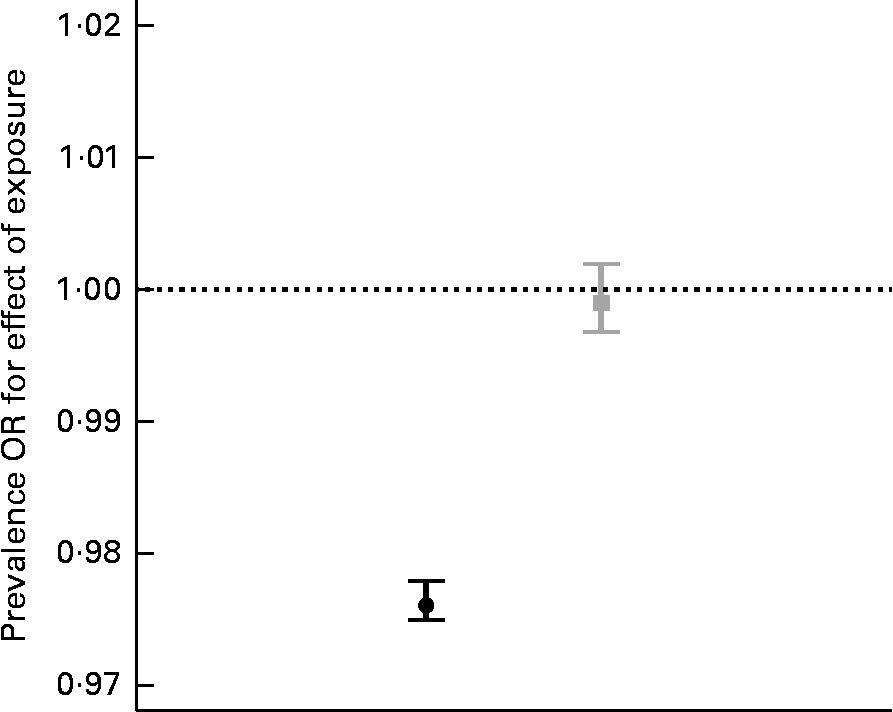
Adjusting for HDI and malaria, each year of flour fortification was associated with a 2·4 % decreased odds of anaemia (prevalence OR (PR) 0·976, 95 % CI 0·975, 0·978; Fig. 1). Among countries that never fortified, no reduction in anaemia over time was observed (PR 0·999, 95 % CI 0·997, 1·002). In both models, HDI and malaria were significantly associated with anaemia, but with differing directions of association (P< 0·001). HDI was inversely associated with anaemia among fortification countries such that a unit increase was associated with a large reduction in the odds of anaemia (PR 0·040, 95 % CI 0·036, 0·045); however, endemic malaria was also associated with reduced anaemia odds (PR 0·546, 95 % CI 0·522, 0·571). Among countries that never fortified, endemic malaria was positively associated with odds of anaemia (PR 2·805, 95 % CI 2·703, 2·911), and increasing HDI was also associated with increased anaemia odds (PR 3·890, 95 % CI 3·443, 4·394).
Prevalence OR and 95 % CI for the effect of exposure on anaemia prevalence in non-pregnant women after controlling for human development index and endemic malaria. Exposure was coded as years since fortification was implemented for fortification countries (●, n 12) and year since baseline survey for non-fortification countries ( , n 20).
Discussion
The purpose of the present study was to use existing data sources to examine anaemia trends in NPW among countries that fortified wheat flour, alone or in combination with maize flour, and among those that did not. We found that after controlling for endemic malaria and HDI, significant reductions in anaemia prevalence were only observed among countries that initiated fortification. Among countries that fortified, each year of fortification was associated with a 2·4 % reduction in the odds of anaemia compared with each previous year. Although this type of evidence precludes a definitive conclusion, overall, the results suggest that flour fortification may be able to significantly reduce anaemia burden at the population level.
The reduction in anaemia prevalence in NPW found in the present study is consistent with the small (4 % points) global reduction in anaemia observed between 1995 and 2011 in NPW( Reference Stevens, Finucane and De-Regil 1 ). This small reduction is also consistent with the fact that fortification can only address nutritional causes of anaemia, such as Fe deficiency( Reference Kassenbaum, Jasrasaria and Naghavi 68 ) or other nutrient deficiencies.
However, the conclusion that fortification can significantly lower the burden of anaemia at a population level contradicts findings from a desk review( Reference Hurrell, Ranum and de Pee 69 ). Hurrell et al. ( Reference Hurrell, Ranum and de Pee 69 ) reviewed the design of flour-fortification programs and concluded that most countries that fortify with Fe use non-recommended forms with low bioavailability that would not be sufficient to lower anaemia prevalence at the population level (n 50 of 78). Among the twelve fortification countries that were included in the analyses, seven currently use a higher-bioavailability Fe compound recommended by the WHO( 8 ). Since a greater proportion of countries that fortify using higher bioavailability Fe compounds were included in the present study, this may help explain why reductions in anaemia prevalence were observed. Fe levels and flour consumption among the included countries may have also influenced this result. In addition, Hurrell et al. ( Reference Hurrell, Ranum and de Pee 69 ) noted that compliance to fortification programs is often low and can play a contributing role to non-improvement over time. However, the present analysis did not assess the contributing effect of fortification compliance.
The present study attempted to address non-nutritional causes of anaemia by controlling for HDI and endemic malaria. HDI, composed from life expectancy, education and income indices, synthesises social and economic development – two underlying causes of anaemia( Reference Teta, Kuate-Defo and Receveur 70 ) – into a single statistic. As expected, increased social and economic development (HDI) was inversely associated with anaemia prevalence in countries that initiated flour fortification. However, surprisingly, increased HDI was positively associated with anaemia among non-fortification countries. This unexpected result may be explained in part by differences in regional representativeness between the two groups of countries. As presented in Table 1, the non-fortification countries were more representative of Africa and tended to have lower HDI than the fortification countries. Since HDI values tended to be low in non-fortification countries (mean 0·46) compared with fortification countries (mean 0·63), it is possible that these values were not able to adequately capture differences in economic and social development between countries. Thus, among the non-fortification countries included in this analysis, large improvements in a macro index such as HDI would be probably necessary to capture population shifts in living conditions that would relate to improved nutrition and concomitant reductions in anaemia. Although endemic malaria was positively associated with anaemia among non-fortification countries, it was unexpectedly associated with decreased anaemia prevalence among fortification countries. This inverse effect may be partially explained by the fact that in a country that fortifies, those with malaria are also likely to consume fortified foods and are therefore getting more nutrients in their diets. Thus, in these countries, malaria status may not be as strong of a predictor of anaemia prevalence. This result may be further explained by the geographic representativeness of the countries, in addition to limitations due to how malaria was coded. African countries tend to have larger anaemia burdens due to malaria, infections, inflammation and hook worms. In regions where these non-nutritional anaemia causes play a role, food fortification would be expected to have less effect. Countries that fortified were more representative of the Americas (Table 1), which has a much lower malaria burden than Africa. Specifically, 83 % of confirmed reported malaria cases occurred in Africa, while only 4 % occurred in the Americans( 19 ). The graduations in endemic malaria exposure cannot be captured by the current 0/1 dummy variable coding, and thus, this may explain why the expected association was not observed among the fortification countries. This dummy coding was employed since poor malaria surveillance systems exist for many countries( 19 ). Unlike HDI, endemic malaria was assessed at one point in time (based on a 2011 WHO global malaria report( 19 )), and thus was not able to account for temporal changes in disease risk. However, since no significant impact was made on reducing global malaria prevalence between 1992 and 2002( Reference Hay, Guerra and Tatem 71 ), and the malaria endemic countries as identified by WHO's malaria reports (only available since 2008) have remained largely unchanged, using a one-time assessment for malaria was likely acceptable. Nevertheless, in future investigations, employing more categories to represent graduations of malaria burden would be preferable. Other issues, such as the seasonality of malaria and differential participation rates, may have also influenced the malaria results among countries that fortified. Malaria has a lower disease burden during dry seasons( 19 ); thus, each survey's results could be biased depending on the season and the disease status (malaria or non-malaria) of those who agreed to provide blood samples.
There are both advantages and limitations to the present study that are important to recognise for future investigations that further explore these associations. This analysis was able to account for elapsed time through the use of continuous exposure variables (years since fortification implementation for fortification countries, and years since baseline survey for non-fortification countries). Countries that have been fortifying for a longer time are more likely to see reductions in anaemia simply because the intervention has had more time to take effect. Thus, considering exposure in this way can lead to more valid results than simply comparing countries that fortify to those that do not. The main advantage is that analyses were restricted to nationally representative surveys and an attempt was made to ensure data quality and consistency by excluding surveys that were not comparable within countries. In cases where raw data files were available for the countries, consistent adjustments for altitude were made so that data were not unnecessarily excluded.
However, the fact that exclusions were made may have influenced the results. As mentioned, two and seven countries were excluded from the fortification and non-fortification groups, respectively, because they did not meet the inclusion criteria. The most common reason for exclusion (n 7) was that both the blood-draw and Hb-quantification methods differed between surveys. It has been shown that each of these factors can influence reported anaemia prevalence( 72 ); thus, for future comparisons, it would be helpful if surveys followed consistent methodology over time. DHS were the most common source for anaemia data (Table 1) and consistently used capillary blood and the HemoCue method to measure Hb. Thus, if other investigations similarly followed consistent methodology, more accurate comparisons could be made between and within countries.
A main limitation of the present study was the small sample size. This limited the number of covariates that could be adjusted for in the analyses and may have led to biased associations. Residual confounding could still be present either from imprecision/measurement errors associated with covariates we adjusted for or from those that could not be considered in the present study. A final limitation worth noting is the generalisability of the results. Due to data availability, most non-fortification countries were from Africa (n 14 of 20), while most countries that initiated fortification were from Latin America (n 6 of 12). Due to these differences, a single model that matched a non-fortification country to a fortification country was not viable, and instead two separate logistic models were run. Using this approach still allows for conclusions to be made about each group of countries, and effects due to unmeasured or unknown confounders were likely similar within each group because the fortification and non-fortification countries were generally from the same region. Furthermore, despite small sample sizes, the CI obtained for the measures of effect between both groups of countries were narrow, suggesting good precision of the estimates.
In conclusion, after adjusting for important factors associated with anaemia, flour fortification was associated with decreased anaemia prevalence in NPW. Since efforts were made to control for other factors associated with anaemia, this observation is encouraging. Evidence that low bioavailable Fe compounds are typically used, as stated by Hurrell et al. ( Reference Hurrell, Ranum and de Pee 69 ), suggests there is room to improve Hb concentration through Fe fortification. Of the eighty-one countries that mandate fortification of wheat flour alone, or in combination with maize flour, only twelve had consistent, nationally representative anaemia data suggesting that increased surveillance efforts are important for most countries. As more anaemia surveys are conducted using consistent methodology, the association between flour fortification and anaemia prevalence will be better elucidated, and stronger support for the effectiveness of flour fortification may be achieved.
Acknowledgements
The authors thank Dr Yaw Addo of Emory University for his statistical help and assistance with SAS and R programs; Drs Aryeh Stein, David Kleinbaum and Eli Rosenberg of Emory University for their helpful statistical consults; Ms Katie Kendrick of Emory University for performing anaemia prevalence calculations for Indonesia; DHS Program support staff for responding to data-related inquiries; and Ms Sarah Zimmerman from the Food Fortification Initiative for editorial assistance.
J. S. B. and K. S. W.'s time was jointly funded by Emory University's Rollins Earn and Learn (REAL) program and the Food Fortification Initiative (FFI). H. P.'s time was supported by an appointment to the Research Participation Program at the US Centers for Disease Control and Prevention (CDC) administered by the Oak Ridge Institute for Science and Education through an interagency agreement between the US Department of Energy and CDC.
None of the authors has any conflicts of interest to declare.
The authors' contributions are as follows: J. S. B., K. S. W. and H. P. designed the study; J. S. B. and K. S. W. conducted the study; J. S. B. analysed the data; J. S. B., K. S. W. and H. P. wrote the manuscript; J. S. B. had primary responsibility for the final content of the manuscript. All authors read and approved the final manuscript.



