


Childhood obesity represents one of the most serious public health challenges in the 21st century. The prevalence has been rising at an alarming rate during the past two to three decades. In China, according to the criteria of the US Centers for Disease Control and Prevention (2000), 14·8 % of pre-school children of Beijing were overweight or obese in 2004( Reference Shan, Xi and Cheng 1 ), and 23·0 % of pre-school children in six cities (randomly selected from low, medium and high socio-economic zones) of north-east China were overweight or obese in 2009( Reference Ma, Chen and Wang 2 ). The prevalence of overweight in Chinese cities may have increased substantially from 2004 to 2009. The prevalence (23·0 % in 2009) was lower than that in Italy and the USA (32·0 % in 2006 and 31·6 % in 2007, respectively) by the same criteria( Reference Maffeis, Consolaro and Cavarzere 3 , Reference Singh, Kogan and van Dyck 4 ), but comparable to that in most European countries according to the International Obesity Taskforce( 5 ). Given that obesity in today's children will persist into their adulthood and impose a considerable economic burden on society, obesity prevention programmes are urgently needed.
Some unhealthy eating behaviours (e.g. faster eating, overeating) will promote positive energy balance and then lead to overweight or obesity over a long time( Reference Dubois, Farmer and Girard 6 , Reference Tanihara, Imatoh and Miyazaki 7 ). The association between higher eating rate and higher BMI and development of obesity has been well documented( Reference Webber, Hill and Saxton 8 – Reference Jahnke and Warschburger 10 ), and Kokkinos et al. ( Reference Kokkinos, le Roux and Alexiadou 11 ) demonstrated that eating the same meal over 30 min instead of 5 min led to higher concentrations of anorexigenic gut peptides and favoured earlier satiety. ‘Eating slowly’ has been advocated for control of food intake and thus body weight( Reference Andrade, Greene and Melanson 12 ). Overeating, eating until full or having larger portion size of food also led to increase in energy intake and thus overweight or obesity( Reference Dubois, Farmer and Girard 6 , Reference Maruyama, Sato and Ohira 13 – Reference Laessle, Uhl and Lindel 15 ). However, previous studies on the relationship between these eating behaviours and overweight were focused on parent-reported behaviours( Reference Webber, Hill and Saxton 8 – Reference Jahnke and Warschburger 10 ) or conducted in standardized laboratory settings or clinical research facilities( Reference Kokkinos, le Roux and Alexiadou 11 , Reference Andrade, Greene and Melanson 12 , Reference Laessle, Uhl and Lindel 15 ), and no information has yet been available on observed meal duration and excess energy intake of commonly consumed foods in daily life in pre-school children. Eating practices tend to be established early in life, and it is necessary to estimate the actual contributions of some unhealthy eating behaviours to childhood overweight in the context of children's usual food-consumption environment. The objectives of the present study were to investigate the associations between the aforementioned two eating behaviours and overweight in pre-school children, in the context of the usual food-consumption environment.
Methods
Participants and procedures
Children from seven kindergartens of similar size and infrastructure, staffed with similar numbers of teachers and health-care workers (doctors and assistants), were included in the study. Kindergartens of this kind are commonest and account for about 30 % in Beijing. We carefully explained the aims and methods of the study to principals and health-care doctors of these kindergartens; they were very supportive and all principals provided oral consent. At the first Parents’ Meeting during the first week of spring term in March 2010, all parents were informed about the objectives and methods of the study and were assured of confidentiality of the data. Parent-reported data were obtained through questionnaires, with completed questionnaires and written consents collected after the meeting. Absent parents got questionnaires through their children and the questionnaires were also collected within 2–5 d. Objective data on meal duration and excess energy intake of children were harvested via on-site observation of participants having lunch in kindergartens. Data about children's height and weight were collected in kindergartens by trained health-care doctors and researchers. Exclusion criteria included exposure to hormonal treatment or development of secondary obesity due to endocrinopathy or serious intercurrent illness. A total of forty-nine classes and 1209 children participated in the study, and 1145 (94·7 % response rate) eligibly completed questionnaires and provided written consents. Records consisted of questionnaire information, measurements and on-site observation data; records with missing data on sex or height or weight (n 7, height and weight was measured later in kindergartens) were excluded. The impact of missing data was evaluated and analysis showed that they had no significant influence on the final results. The final study population included 1138 children (age range 3·1–6·7 years, mean age 4·84 (sd 0·77) years, 52·4 % boys and 47·6 % girls). Ethical approval was obtained from the Ethics Committee of Tongji Medical College, Huazhong University of Science and Technology, Wuhan, China (IRB No: FWA00007304). The study was registered with the Chinese Clinical Trial Registry (No. ChiCTR-TRC-12001880).
Parent-reported eating behaviours
Information on the participants, including their eating behaviours, was collected through questionnaires at the first week of spring term in 2010. The first section of the questionnaire inquired about the child's sex, age, main caregivers of the child (parents, grandparents, baby-sitters or others), parents’ education background, family type (nuclear family, stem family, extended family, single-parent family) and monthly family income. The educational level of parents was divided into three groups: low (9–12 years of schooling), medium (13–16 years of schooling) and high (>16 years of schooling). Parent-reported eating behaviours of children (eating fast and overeating) were included in the second section. In the questionnaire, the two questions concerning the eating behaviour at home were asked: ‘How would you judge the quantity of your child's food intake when you have ordinary family meals?’ Responses included ‘less than needed’, ‘medium’ and ‘more than needed’. The other question was: ‘How would you judge your child's eating pace when you have ordinary family meals?’ Responses included ‘slow’, ‘medium’ and ‘fast’. Only one response was selected for each question. In China, family meals, which are a time for family members to get together, usually refer to lunch or dinner. Generally speaking, the meals in the aforementioned two questions, if not specified, are usually taken as main meals (lunch or dinner) by Chinese. Experts in the fields of paediatric obesity and child health care assessed the questionnaires and face validity. The survey was pilot-tested with a sample of thirty parents of 3–6-year-old children, who were not included in the final study population, one month before the study commenced, and the repeatability for parent-reported eating fast and overeating of children was tested by re-conducting the questionnaire survey after 3 weeks. The κ statistics were 0·62 for eating fast and 0·68 for overeating.
On-site observation of two eating behaviours
On-site observation of participants was conducted at the second week of spring term in 2010 to avoid the potential effects of winter vacation on eating behaviours. The study investigated children's behaviours of lunch of main meals. In Chinese culture, main meals of the day refer to the midday and evening meals (lunch and dinner). Breakfast tends to be light, while lunch and dinner, as main meals, are usually heavy; in a day, the food of main meals is roughly the same but very different from that of breakfast. Simply put, the contents of main meals are relatively rich. Typical Chinese lunch and dinner consist of rice, all kinds of mixed hot foods (usually made of seasonal vegetables, meat, eggs, etc.) and soup. Therefore, eating behaviours of lunch are representative with Chinese subjects.
As a standard practice in Chinese kindergartens, lunch consists of rice, a meat dish, a vegetable dish and a low-energy-density soup, served to all children in classrooms at a scheduled time, and is consumed at a table occupied by five to eight children. The scheduled lunch time was 30 min in all participating kindergartens. The children of all kindergartens used the same stainless steel tableware of age-appropriate size, and rice and cooked dishes were served in one bowl. Most Chinese school cafeterias and kindergartens provide low-energy-density soup to children, and the soup contains a little vegetables and a large amount of water. Soup, taken as a drink, is usually served after the main course. Generally, no other beverage is provided during a meal in Chinese kindergartens. The time for consuming soup was not counted and the energy from soup was ignored because the soup usually contained very low energy (1–2 % of the total lunch energy intake).
One day before the formal observation, in each kindergarten, researchers trained two teachers of each study class about the observation and recording methods. Data of children's lunch energy intake and lunch duration in each class were recorded by the trained teachers and researchers. The data were recorded in a record table. The last column of the record table was left blank for remarks and if anything special happened to any child, teachers should report the event in this column (e.g. the child went to the toilet during lunch, left food in his/her bowl, etc.). All dos and don'ts were mentioned during the training sessions of teachers and were printed on the back of the record table.
On the day prior to each test, children were instructed to avoid strenuous physical activity and to keep their diet as close to normal as possible (no extremes of nutrients and energy). On the morning of test days, all participants had breakfast in kindergartens as usual. At the dining area of each class, about a half hour before lunch, two teachers were asked to estimate an age-appropriate portion size of rice and cooked dishes according to the children's age and to put foods of relevant amount aside as references (rice, meat and vegetable dishes), then the teachers distributed the same portion size of each food item to each child. The teachers gave an order to start the lunch after all children of the class had the food distributed and recorded the start time. At the start of each test meal, children were told that they could eat as much or as little of the rice and cooked dishes as desired and they were not allowed to talk with each other during the lunch. Once a child finished what he/she already had, he/she could ask for more as usual and the teachers would give him/her food as asked. The increased amount was recorded as ‘half’, ‘the same’, ‘double’ or ‘three times’ the reference amount. Subjective estimation based on the child's body type or his/her usual consumption amount in kindergartens was not allowed. Each child handed his/her bowl to teachers once he/she finished his/her lunch. Then the teachers recorded the finish time and the soup was served. The duration of lunch was the finish time minus the start time. Some children would occasionally go to the toilet during the meal time, and the toilet time (in minutes) was recorded and deducted from the total time. A small number of the children (n 51) went to the toilet during the meal time, but the percentage of the time that children spent going to the toilet during lunch (range: 6–33 % of the time) did not influence the results of the analyses. Any factors which would interfere with the process of eating were controlled whenever possible (e.g. teachers were forbidden to talk about anything concerning either eating or foods).
During on-site observation, researchers measured and recorded the weight of the reference portion size of rice and cooked dishes of each study class by employing an electronic scale (item EK3550; Guangdong Xiangshan Weighing Apparatus Group Ltd, Zhongshan, China). The total weight of foods consumed by each child was equal to the weight of the reference portion size of food plus the weight of increased portions of each item. Energy of the foods consumed was calculated according to the weight of consumed foods and the published Chinese food composition tables( 16 ).
The on-site observation and the energy calculation method were validated by experts in nutrition. Researchers compared this method with direct food weighing to evaluate the validity. In the first week of spring term in 2010, the amount of the lunch on the test day was individually measured to the nearest gram at the kindergartens, by weighing food that was offered before and after consumption in a sub-sample of twenty-nine participants (a class of fourteen boys and fifteen girls). On the next day, researchers recorded the weight of the foods that were consumed by the same sample, by using the on-site observation method of the present study. As expected, the weight of food intake recorded by the traditional weighing method was significantly correlated with that recorded by the method used in the study (r = 0·76, P < 0·05), providing evidence of validity for the dietary measurement.
Children's BMI
Data about height and weight of the children were collected at the first week of spring term in 2010 in kindergartens by trained health-care doctors and researchers. Height was measured to the nearest centimetre and weight to 0·1 kg, with the participants in light clothing and without shoes, by using an electronic scale equipped with a height gauge (item LDJGZ-50; Beijing Centrwin Technology Co., Ltd, Beijing, China). BMI was calculated as weight in kilograms divided by the square of height in metres (kg/m2). Children's weight status was categorized into two groups in accordance with the 2000 US Centers for Disease Control and Prevention Growth Charts. ‘Overweight’ was defined as a BMI at or above the sex- and age-specific 85th percentile and ‘normal weight’ referred to children below the 85th percentile. Note that the overweight category (BMI ≥ 85th percentile) includes obese children (BMI ≥ 95th percentile).
Statistical analysis
Statistical analyses were performed with the statistical software package SAS version 9·1·3 (2006). P < 0·05 was considered statistically significant. Continuous variables were presented as mean values with their standard deviations and categorical variables as absolute frequencies and proportions (Table 1). Differences were assessed using Student's t test or the Wilcoxon rank-sum test (depending on parametric/non-parametric distribution) and the χ 2 test for categorical variables to compare the differences between two weight groups. Energy intake and meal duration of each age group were presented as median values with 25th and 75th percentiles (Table 2).
Table 1 Anthropometric and family characteristics of study participants by weight group: pre-school children (1138) from seven kindergartens in Beijing, China, spring term 2010
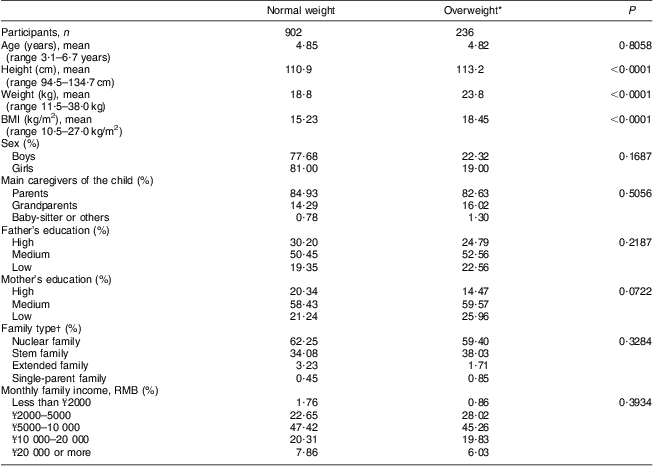
RMB, renminbi.
*Overweight is defined as sex- and age-specific BMI ≥ 85th percentile (US Centers for Disease Control and Prevention (2000)); the overweight category (BMI ≥ 85th percentile) includes obese children (BMI ≥ 95th percentile).
†Nuclear family consists of the parents and the only child; stem family consists of grandparents, parents and the only child; extended family is one with grandparents, parents, parents’ brothers or sisters and the children as family members; single-parent family consists of only one of the parents and the only child.
Table 2 Lunch energy intake and time spent consuming lunch (meal duration) among study participants by age group: pre-school children (1138) from seven kindergartens in Beijing, China, spring term 2010

P25, 25th percentile; P75, 75th percentile.
Logistic regression was used to estimate associations between children's eating behaviours and overweight status. All independent variables and children's weight categories, which were used as the dependent variable, were first studied in a univariate model (Table 3) and variables whose odds ratio for overweight presented a P value < 0·25 in the univariate analysis were included in a multivariate model (Table 4). Increment of lunch energy intake and meal duration, analysed as a continuous variable, was assessed for each additional 418·7 kJ (100 kcal) intake and 5 min. Associations between increased portions of food items (rice and cooked dishes) and overweight status were also assessed. The correlations between parent-reported eating behaviours and observed behaviours were analysed by using the bivariate Spearman rank-correlation test.
Table 3 Odds ratios of independent variables for overweight among study participants in univariate logistic regression analysis: pre-school children (1138) from seven kindergartens in Beijing, China, spring term 2010
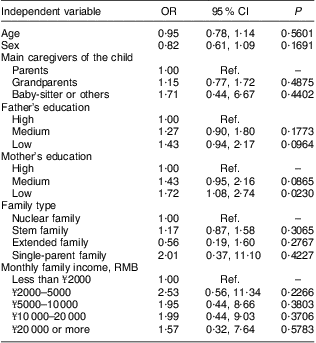
RMB, renminbi; Ref., referent category.
All variables were analysed as dummy variables except for children's age and sex; the dependent variable was children's weight categories (normal weight and overweight, again the overweight category includes obese children).
Table 4 Odds ratios of eating behaviours for overweight among study participants in logistic regression analysis: pre-school children (1138) from seven kindergartens in Beijing, China, spring term 2010
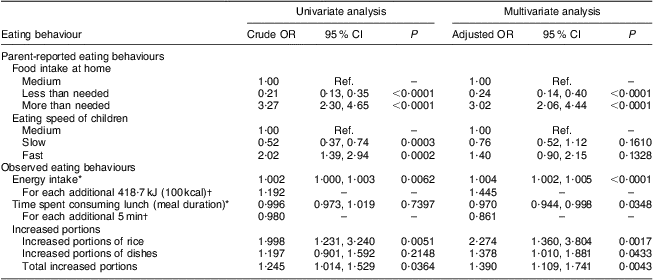
Ref, referent category.
Adjusted OR were adjusted for children's age, sex, mother's education, monthly family income and the clustering within kindergartens (n 7).
*OR for overweight for each unit increase of energy (4·187 kJ or 1 kcal) or time (1 min).
†OR for overweight for each additional 418·7 kJ (100 kcal) or 5 min.
Results
Sample characteristics
Anthropometric and family characteristics of normal-weight and overweight children are presented in Table 1. As expected, there existed statistically significant differences in anthropometric measurements between the two groups. Prevalence of overweight was higher in boys (22·3 %) than in girls (19·0 %). Objective data on lunch energy intake and meal duration of each age group, expressed as median values (25th–75th percentiles), are given in Table 2. Energy intake during lunch increased with age, while meal duration decreased starting from age 4 years to age 6 years.
Analysis of children's eating behaviours
According to the findings shown in Table 3, main caregivers of the child and family type were not associated with children's weight status. Variables whose odds ratios for overweight presented P < 0·25 in the univariate analysis were included in the multivariate model. Therefore, these two variables were not controlled in later analyses (adjusted OR in Table 4). Maternal and paternal education background were closely correlated (r = 0·72, P < 0·0001) and only the maternal education background was included in the multivariate model since it had more impact on BMI. Prevalence of overweight varied according to different kindergartens, so with the multivariate model analyses were controlled for clustering within kindergartens (n 7) as well. In general, the multivariate model was adjusted for age, sex, maternal education, monthly family income (salary) and the clustering within kindergartens.
The univariate logistic regression analyses (crude OR in Table 4) showed that parent-reported more than needed food intake and higher eating speed of children at home were significantly associated with an increased likelihood of overweight. Specifically, in the multivariable analyses, the odds of overweight in the ‘more than needed food intake’ group was 3·02 (95 % CI 2·06, 4·44) when compared with the ‘medium food intake’ group. For directly observed behaviours, the multivariate logistic regression revealed that each 418·7 kJ (100 kcal) increase of lunch energy intake significantly increased the likelihood for overweight by a factor of 1·445, and each 5-min increase in meal duration significantly decreased the likelihood for overweight by a factor of 0·861 (Table 4). Associations between increased portions of food items and overweight status were also assessed in the multivariate logistic regression model. Increased portions of rice and cooked dishes were significantly associated with overweight status in pre-school children (OR = 2·274; 95 % CI 1·360, 3·804 and OR = 1·378; 95 % CI 1·010, 1·881, respectively) after adjustments for age, sex, maternal education, monthly family income and the clustering within kindergartens.
Spearman's rank correlation between parent-reported eating pace levels and the observed meal duration was 0·224 (P < 0·001), and the correlation between parent-reported food intake levels and the observed lunch food intake was 0·104 (P < 0·001).
Discussion
The prevalence of overweight (defined as sex- and age-specific BMI ≥ 85th percentile) observed in the present study was 20·7 % (boys: 22·3 %, girls: 19·0 %), which was higher than the prevalence of overweight among pre-school children in Beijing in 2004 (14·8 %) and comparable to that among pre-school children of six cities in north-east China in 2009 (23·0 %) according to the US Centers for Disease Control and Prevention (2000) criteria( Reference Shan, Xi and Cheng 1 , Reference Ma, Chen and Wang 2 ). This finding suggests that the prevalence of overweight and obesity in Beijing increased from 2004 to 2010, and already has become a serious public health concern that needs to be addressed.
Parent-reported eating speed of children at home was significantly associated with childhood overweight, which was consistent with the results reported by previous studies conducted in children( Reference Webber, Hill and Saxton 8 – Reference Jahnke and Warschburger 10 ) and adults( Reference Leong, Madden and Gray 17 – Reference Otsuka, Tamakoshi and Yatsuya 19 ). The present study further assessed the eating rate of pre-school children by actually observing their eating behaviours under the usual food-consuming environment in kindergartens. The results showed that lunch duration was associated with childhood overweight, which was coincident with the findings of a previous study that used video-recording to observe eating behaviours( Reference Llewellyn, van Jaarsveld and Boniface 20 ). The video-recording study examined associations between eating rate and BMI in 10–12-year-old children who ate standard meals at home. On the other hand, our findings were different from those of another study conducted in adults by Zijlstra et al.( Reference Zijlstra, Bukman and Mars 21 ) and the differences might be due to the following factors. Zijlstra's study was conducted in a laboratory whereas the present study was done at kindergartens, and subjects under different settings might respond differently. Furthermore, food palatability might be another reason for the difference. We used common foods and in Zijlstra's study subjects had a spiced rice meal plus apple pie yoghurt. One study found that slow ingestion rate led to a significant decrease in energy intake( Reference Andrade, Greene and Melanson 12 ); another study demonstrated that eating fast was independently associated with insulin resistance in middle-aged Japanese men and women( Reference Otsuka, Tamakoshi and Yatsuya 19 ); and a study examining obese mini-pigs showed that slower eating rate is independently related to gastric emptying( Reference Val-Laillet, Guerin and Malbert 22 ). These studies partially reveal the possible mechanisms by which some factors (e.g. energy intake, insulin resistance or gastric emptying) influence weight.
Long-term excessive energy intake will lead to accumulation of fat( Reference Iossa, Lionetti and Mollica 23 ), and overweight or obesity might ensue. The current study showed that increased lunch energy intake was significantly associated with overweight, and parent-reported food intake levels of children were also associated with overweight. The findings are consistent with a previous research( Reference Huang, Howarth and Lin 24 ). Since the on-site observation only examined energy intake during a single meal, the question may arise as to the possibility that the children might have less food later in the day. Some previous studies have shown that children might self-regulate daily energy intake to a meaningful degree( Reference Birch, Johnson and Andresen 25 , Reference Shea, Stein and Basch 26 ). But two other studies found that there was no meal-to-meal compensation for increased energy intake in adults( Reference Rolls, Roe and Meengs 27 , Reference Rolls, Roe and Kral 28 ) and another study also indicated that 4–6-year-old children displayed very poor self-regulation of energy intake( Reference Mrdjenovic and Levitsky 29 ). Since parent-reported behaviours, which reflected the habitual eating behaviours of main meals of children at home, bore a significant relationship with observed behaviours and the present study was conducted in real consuming settings, the findings might reflect the actual consuming habits of the participants. The analyses of associations between increased portions of food items and overweight in the present study revealed that rice accounted for substantially more of the total lunch energy intake as compared with cooked dishes (non-rice food). The results indicate that teachers in kindergartens can deal with the problem of childhood obesity by reducing the portion size of rice and increasing that of a vegetable dish.
To our knowledge, the present study is the first one to examine the contributions of meal duration and excess energy intake of main meals to childhood overweight/obesity in China. Moreover, different from most studies that relied on self-reported information, our study obtained information about energy intake and meal duration through on-site observation in a relatively lager population of participants.
The study does, however, have several limitations. First, its cross-sectional design precluded conclusions about the causal direction of the relationship between eating behaviour and obesity. However, the findings of a longitudinal study indicated that eating fast would lead to obesity( Reference Tanihara, Imatoh and Miyazaki 7 ) and another study found, in Japanese men and women, that the rate of eating was positively associated with BMI at age 20 years and long-term BMI change from age 20 years to middle age( Reference Otsuka, Tamakoshi and Yatsuya 30 ). Second, in our study, the food consumed by each child during lunch was not weighed directly but calculated on the basis of the weight of the reference portion size, so the measurement error of the study might be greater than that of the traditional food weighing method. Given this, the on-site observation and the energy calculation method might not be suitable for accurate calculation of nutrients. However, the weight of food intake recorded by the traditional weighing method was correlated with that recorded by the on-site observation method, suggesting that the method used in the present study was valid. Furthermore, teachers were trained one day before the test day and quality control was strictly implemented in the process of on-site observation to minimize the measurement errors. Third, soup consumption may influence eating rate and energy intake. In our study, lunch consisted of rice, two cooked dishes and a low-energy-density soup. Previous studies found that soup consumption could impact eating rate, satiation and energy intake( Reference Spill, Birch and Roe 31 – Reference Kuroda, Ohta and Okufuji 33 ). But in those studies, soup was served as a first course, which was different from the present study in which soup was served as the last course and the time spent consuming the soup was not included in meal duration.
Conclusion
To sum up, the current study revealed that meal duration or time was inversely associated with childhood overweight, while excess energy intake of lunch or increased portions of food were positively associated with overweight status. Effort should be made to find effective strategies to change eating behaviours, thereby slowing eating speed and limiting excess energy intake of main meals in young overweight children. Future research endeavour should be directed at examining the changes in children's BMI before and after implementation of the strategies. Since currently available weighing methods are costly when used in a large sample, our method provides a cost-effective alternative.
Acknowledgements
Sources of funding: This study was financially supported by the Pediatrics Department of Union Hospital, Tongji Medical College, Huazhong University of Science and Technology and the National Center for Women and Children's Health, China Center for Disease Control and Prevention, which are non-profit organizations. The funders had no role in the design, analysis or writing of this article. Conflict of interest declaration: None declared. Authors’ conributions: M.L., L.P. and R.J. designed the study. M.L., L.P., L.T. and Y.W. collected the data. M.L., L.P. and L.T. ran the statistical analyses. M.L. and L.P. drafted the manuscript. R.J. provided the materials and technical support. R.J. was responsible for the critical revision of the manuscript.



