

Introduction
We live in a world where information is abundant, and attention is a scarce good (Simon, Reference Simon1996). Like all people, policymakers cannot pay attention to everything they are responsible for all the time, or process all the information that would apply to their decisions (Workman et al., Reference Workman, Jones and Jochim2009; Jones and Baumgartner, Reference Jones and Baumgartner2012; Cairney and Kwiatkowski, Reference Cairney and Kwiatkowski2017). Policymakers thus face ‘bounded rationality’. They are limited in their cognitive capacity and time to process the vast amount of information they receive at any given time (Simon, Reference Simon1974), and their information processing is selective. Selecting the correct information is key for informed, effective policymaking, and leaving out key components or dimensions can impede innovation and lead to policy failures (Jones and Baumgartner, Reference Jones and Baumgartner2005). Civil servantsFootnote 1 are expected to be information processing specialists and to rely on other actors for information and advice concerning policymaking. At the same time, recent research (e.g., Rimkuté and Van der Voet, Reference Rimkuté and Van der Voet2023; Van der Voet and Lerusse, Reference Van der Voet and Lerusse2024; Lerusse, Reference Lerusse2025) shows that civil servants’ information processing is shaped by limited attention and cognitive constraints, leading them to prioritize some sources of information over others. Using diverse sources of information greatly affects the quality of decision-making (Koski and Workman, Reference Koski and Workman2018). Failing to consider diverse perspectives is particularly problematic when the context becomes highly complex (Page, Reference Page2007; Kelman et al., Reference Kelman, Sanders and Pandit2016). This is often the case during the early stages of policymaking (e.g., the pre-implementation phase), when the policy framework remains under development. At this stage, policymakers have yet to reach a definitive consensus, as they must still incorporate the perspectives of affected stakeholders and implementing entities (Hoppe, Reference Hoppe2010, Reference Hoppe2018). This study zooms in on information selection by civil servants in the early stage of policymaking and investigates whether the selection of more diverse information can be stimulated by implementing a social nudge. In addition, it is examined whether the effect of a social nudge is different in situations with low versus high levels of complexity.
While there is extensive research on information acquisition at the institutional level (e.g., Jones and Baumgartner, Reference Jones and Baumgartner2005, Reference Jones and Baumgartner2012) and how social nudges affect the behaviors of citizens (Thaler and Sunstein, Reference Thaler and Sunstein2008), we know surprisingly little about whether and when nudges can improve the quality of internal policy work, such as civil servants’ information selection under cognitive and time constraints. Prior research (e.g., Janis, Reference Janis1989; Larrick, Reference Larrick2016; Koski and Workman, Reference Koski and Workman2018) has shown that the input of multiple individuals or groups increases the probability of success in highly complex contexts in particular, because (1) different (groups of) individuals have different ideas and (2) unpopular opinions for one group might still be mentioned by another group, ensuring an exhaustive list with all possible alternatives. Importantly, this implies that the societal returns to diverse information selection vary systematically with the level of complexity: while diversity may be essential for effective decision-making in complex settings, its benefits are more limited in less complex ones. Yet, what we do not know is whether civil servants’ propensity to seek diverse information is itself sensitive to contextual complexity, and whether behavioral interventions – such as social nudges – operate indiscriminately or instead exert stronger effects precisely in contexts where the value of diverse information is highest. Studying social nudges across low- and high-complexity settings therefore allows us to assess not only whether such interventions are effective but also whether they are context-sensitive, a question that is central to both theoretical debates on bounded rationality and normative concerns about the appropriate use of nudges in public policymaking. This vignette experiment conducted in a Dutch medium-sized municipality tests the effects of a social nudge on diverse information selection and disentangles the effect for highly complex versus less complex situations. When studying information selection at the individual level, several endogeneity problems may arise as certain personal attributes may be more present in some types of jobs than in others (see Vries et al., Reference Vries, Bekkers and Tummers2016). To tackle this issue, the current study uses an online vignette experiment with a two-by-two design (i.e., low versus high complexity; social nudge versus no social nudge). One of the main advantages of a vignette study is that it stays close to the phenomenon under study, maintaining a high external validity.
This study makes two significant contributions to public administration research. First, it experimentally investigates the individual behavior of civil servants. The individual-level perspective is needed next to the more dominant institutional perspective (Moseley and Thomann, Reference Moseley and Thomann2021), since civil servants are the ones who interact with the public daily and are essential for policy feedback, as well as problem detection and solutions for the design of new policies (see also Lipsky, Reference Lipsky2010). Second, with the increased implementation of interventions building on insights from behavioral economics into public administration, a portion of healthy skepticism has arisen, with scholars questioning the eligibility of the use of specific nudges in particular circumstances (Schnellenbach, Reference Schnellenbach2012; Barton and Grüne-Yanoff, Reference Barton and Grüne-Yanoff2015; Weimer, Reference Weimer2020; Banerjee and John, Reference Banerjee and John2021). By explicitly comparing low- and high-complexity decision contexts, this study provides insights into whether social nudges operate as blunt instruments that indiscriminately increase information acquisition, or whether they exert context-sensitive effects by primarily influencing behavior when the behavioral response is more profitable from a societal point of view. For managers of government institutions, this study provides insights into the appropriateness of using nudges to influence civil servants’ behavior. In addition, it tests the effectiveness of a new tool, a social nudge, to influence information selection by civil servants. This tool may complement other important but often more expensive solutions, such as (entrepreneurial) training programs that seek to achieve similar goals (Frisch-Aviram et al., Reference Frisch-Aviram, Beeri and Cohen2021).
Theoretical framework and development of hypotheses
Understanding information prioritizing and selection amongst civil servants is essential because the selected information does affect the quality of policymaking (Jones and Baumgartner, Reference Jones and Baumgartner2005). Interest in individual-level information selection of external sources to compensate for one’s own knowledge limitations is nothing new. In 1989, Janis introduced the idea of vigilant decision-making, a process in which the decision-maker reaches out for input from advisors and other informational sources, specifically selected for their diverse knowledge and opinions (Janis, Reference Janis1989). In this process, the decision-maker must be willing to revise their initial predispositions and let them be influenced by those solicited. It thus focuses on dissenting views so that there are more opportunities for debate and discussion, with a “more is better” approach for diverse information and an aim to avoid too much conformity and a quick rush to judgment in complex situations (Kelman et al., Reference Kelman, Sanders and Pandit2016).
There has been an extensive research program on institutional information selection (Jones and Baumgartner, Reference Jones and Baumgartner2005, Reference Jones and Baumgartner2012), focusing on the politics of attention. Evidence on individual behavior is scarce. Exceptions include a study on elite politicians (Walgrave and Dejaeghere, Reference Walgrave and Dejaeghere2017) and research on policy entrepreneurship by civil servants (Cohen, Reference Cohen2021; Frisch-Aviram et al., Reference Frisch-Aviram, Beeri and Cohen2021). The latter emphasizes that civil servants are essential for implementing and formulating policy. Yet, civil servants often have work demands that typically exceed the time and resources available. Therefore, strict trade-offs must be made on spending time and budget (Tummers et al., Reference Tummers, Bekkers, Vink and Musheno2015). Jones (Reference Jones2017) argued that the “connection between organizational agendas and human attention is based not on organizational limits but on human ones” (Jones and Baumgartner, Reference Jones and Baumgartner2005; Jones, Reference Jones2017). Thus, decision-making in this environment leans on the use of heuristics. Research on behavioral public administration has recently begun to explore these cognitive heuristics and biases (Battaglio Jr et al., Reference Battaglio, Belardinelli, Belle and Cantarelli2019; Gofen et al., Reference Gofen, Moseley, Thomann and Kent Weaver2021). Most of the focus has been on ‘debiasing’ public policy rather than policymakers themselves (Moseley and Thomann, Reference Moseley and Thomann2021). Yet, cognitive biases and heuristics of civil servants are expected to translate into inequities and inefficiencies in the policies they may develop (Cantarelli et al., Reference Cantarelli, Belle and Belardinelli2020; Moseley and Thomann, Reference Moseley and Thomann2021).
One of these biases is satisficing, a term coined by Herbert Simon (Reference Simon1955), which constitutes a combination of the words to satisfy and suffice. Satisficing is the antipode of the ‘rational’, value-maximizing decision-maker that considers all alternative options, determines the consequences of these alternatives, evaluates them in line with the needs and goals, and selects the alternative that is most consistent with those needs and goals (March and Simon, Reference March and Simon1993). Satisficing leads to selecting good-enough information for the decision process rather than an optimal exhaustive information selection. Research in public administration by Rimkuté and Van der Voet (Reference Rimkuté and Van der Voet2023), Van der Voet and Lerusse (Reference Van der Voet and Lerusse2024), and Lerusse (Reference Lerusse2025) shows that this process is reflected in how civil servants allocate attention and prioritize information under conditions of limited time and cognitive capacity: rather than engaging in comprehensive searches, they selectively attend to some sources of information while others receive little attention. As a result, information selection in public organizations is not neutral, but structured by prioritization processes in which certain stakeholders and perspectives are more likely to be consulted than others. Heuristics such as satisficing in the selection processes (e.g., how to acquire, weigh, and sort information) lead civil servants to make decisions based on their perception of reality rather than reality itself (Gofen et al., Reference Gofen, Moseley, Thomann and Kent Weaver2021). Information is not scarce. One could even argue that an infinite amount of potentially relevant information is available (Walgrave and Dejaeghere, Reference Walgrave and Dejaeghere2017). Some satisficing in public policymaking is thus needed; however, the extent of satisficing needs to be counterbalanced with the diversity of information to ensure effective policymaking (Koski and Workman, Reference Koski and Workman2018). The literature on behavioral public administration aims to explore if public managers’ individual-level decision processes can be more effective by addressing cognitive and decision biases in combination with the interactions between civil servants and citizens (Battaglio Jr et al., Reference Battaglio, Belardinelli, Belle and Cantarelli2019; Gofen et al., Reference Gofen, Moseley, Thomann and Kent Weaver2021; Moseley and Thomann, Reference Moseley and Thomann2021). In practice, behavioral interventions that steer behavior thus have the potential to lead to higher individual performance, overall productivity, and more evidence-based policymaking (Battaglio Jr et al., Reference Battaglio, Belardinelli, Belle and Cantarelli2019; Gofen et al., Reference Gofen, Moseley, Thomann and Kent Weaver2021; Moseley and Thomann, Reference Moseley and Thomann2021).
A popular way to steer behavior is by implementing a nudge. As defined by Thaler and Sunstein (Reference Thaler and Sunstein2008), a nudge is ‘any aspect of the choice-architecture that alters people’s behavior in a predictable way without forbidding any options or significantly changing their economic incentives’. Nudges are low-cost signals or procedures that encourage (from the optimal planner’s point of view) socially desirable behavior change. They can be an extra tool in the toolbox that can complement training and incentive changes (Beshears and Kosowsky, Reference Beshears and Kosowsky2020). Several studies (e.g., Rigtering et al., Reference Rigtering, Weitzel and Muehfeld2019) have shown that managers can apply nudges in intraorganizational settings to stimulate specific behaviors amongst employees. Social nudges aim at increasing people’s contribution to overall social welfare, even when doing so is inconsistent with maximizing private welfare. In the setting of information acquisition by civil servants, the shift toward more diverse information is often against the individual’s routine behavior. For example, selecting more homogeneous information causes less friction and transaction costs, and allows civil servants to work more quickly. Reaching out to more diverse groups for information brings conflicting views and interests of stakeholders (Scott et al., Reference Scott, Thomas and Magallanes2019), causing the process to slow down. However, decisions are expected to improve by including more diverse views (Page, Reference Page2007; Koski and Workman, Reference Koski and Workman2018) in complex settings. To align individual behavior with social benefits, this study uses social nudging. This type of nudge exploits individual and collective mechanisms and shifts from the I-frame to the we-frame. Thaler and Sunstein (Reference Thaler and Sunstein2008) suggest two mechanisms of how social nudges can encourage prosocial behavior: expectation-based and priming-based mechanisms. First, the social nudge creates an expectation of what others will do, a so-called social norm engineering. It does so by informing the receiver about the behavior of others, but also by creating the belief that others will follow the norm too. A notable example of expectation-based social norm engineering is the Home Energy Reports developed by the U.S.-based company Opower. These reports compare a household’s energy usage to similar neighboring homes, providing feedback on their consumption relative to their peers. By doing so, they leverage social norms to encourage energy conservation (Allcott, Reference Allcott2011). The second mechanism targets the priming of one frame (I-frame) to another frame (we-frame). It changes the focus from the individual benefit to the social welfare by making it more explicit (Nagatsu, Reference Nagatsu2015). An example is using priming to encourage waste composting (Rouillé, Reference Rouillé2023). Here, the authors subtly influenced individuals to adopt pro-environmental behaviors by exposing them to cues that highlight the collective benefits of such actions. The method involved shifting the individual mindset from an ‘I-frame’, focusing on personal convenience, to a ‘we-frame’, emphasizing community and environmental well-being.
Social norms are a frequently used nudge within behavioral public administration research to overcome individual cognitive limitations (see Battaglio and Hall, Reference Battaglio and Hall2020 for an application of a social nudge; John et al., Reference John, Sanders and Wang2019 for a recent overview of social norms and their use in public administration). One way of social nudging is by making social norms salient. Social norms are supported by shared expectations about what is and should be done in different situations. Often, the distinction is made between injunctive and descriptive norms. Injunctive norms refer to what one ‘ought’ to do, while descriptive norms refer to what others are doing (Cialdini et al., Reference Cialdini, Reno and Kallgren1990). Successfully implemented social nudges often combine the two types of norms by benchmarking a reference (or small successful) group’s behavior and including an injunctive component to the benchmark. This mechanism guides behavior by comparing one’s own behavior to others, while the injunctive component attaches a positive value to the benchmarked behavior. The use of social nudges targeted at changing perceived social norms, or making them more salient, has been successful in other fields (Brandon et al., Reference Brandon, List, Metcalfe, Price and Rundhammer2019; Köbis et al., Reference Köbis, Troost, Brandt and Soraperra2022). Thus, it is expected that a social nudge that describes the benefits of selecting more diverse information makes civil servants aware of the behavior of relevant others, changes expectations of what others will do, and makes the social benefit more salient, thereby altering the behavior from the default of satisficing to a more diverse information selection. This leads to the following hypothesis:
Hypothesis 1: The implementation of a social nudge – in the form of a benchmark with an injunctive component – will increase the diversity of information selection.
Nudges are often used to diminish cognitive biases of sufficing individuals (Battaglio and Hall, Reference Battaglio and Hall2020) without distorting the behavior of optimizing individuals (Chetty, Reference Chetty2015). Nudging does not remove freedom of choice or change the incentives of decisions and thus leaves room for professional autonomy (Thaler and Sunstein, Reference Thaler and Sunstein2003). Since nudges allow individuals to maintain autonomy, a nudge is expected to influence those who see the benefit in changing their behavior according to the nudge. In contrast, those who do not (consciously) recognize the benefit will not change their behavior. While collecting more diverse information from a larger number of stakeholders might not be best suited for decision-making in all situations, it is widely considered the most effective process for decision-making in complex cases (Page, Reference Page2007; Kelman et al., Reference Kelman, Sanders and Pandit2016). It is therefore expected that a social nudge will have a larger effect when people are asked to make a decision in a highly complex situation, because then the perceived benefits of consulting more stakeholders will be greater.
Examining the effects of social nudges in both low- and high-complexity decision-making situations also allows us to assess whether such interventions influence information selection in a general or in a context-dependent manner. If a social nudge simply stimulates civil servants to select more information, its effect should be similar across situations, regardless of the level of complexity. However, if nudges leave room for professional autonomy and primarily affect behavior when the benefits of consulting a broader range of stakeholders are higher, their effects should be more pronounced in complex decision-making situations and remain limited in less complex ones. Including low-complexity situations therefore provides an important benchmark that allows to distinguish between a general increase in information selection and a selective effect that aligns with the varying value of diverse information across different policy contexts. This leads to the second hypothesis:
Hypothesis 2: Implementing a social nudge will more strongly increase diverse information selection in a situation with high(er) complexity compared to a situation with low(er) complexity.
Methods
Overall experimental design
This study makes use of an online vignette experiment and adopts a 2 × 2 between-subject design manipulating (a) the degree of complexity (higher versus lower) and (b) the communication of a social nudge (present versus absent) regarding information selection. After completion, respondents were asked to complete a brief questionnaire. Below, the empirical setting, incentivization and randomization are described.
The study is conducted in a municipality with approximately 48,000 inhabitants in the Netherlands. The selected municipality can be characterized as a medium-sized Dutch local government organization in terms of size, organizational structure, and range of policy responsibilities. Dutch municipalities operate in a highly institutionalized and professionalized administrative context, with civil servants working across diverse policy domains under conditions of legal accountability, stakeholder involvement and time pressure. Medium-sized municipalities, in particular, combine a broad policy portfolio with relatively limited internal capacity, making trade-offs in information selection especially salient. Studying information selection in this setting therefore provides insight into everyday policymaking practices in a mainstream public organization rather than in an exceptional or highly specialized case. The study was conducted online to ensure that civil servants could participate in their regular work environment. All civil servants in the municipality (332) received an email with a link to participate.Footnote 2 A total of 157 employees completed the vignette experiment (response rate = 47.29%). The experiment was programmed in oTree (Chen et al., Reference Chen, Schonger and Wickens2016).
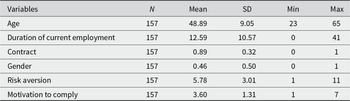
The sample summary statistics can be found in Table 1. The municipality’s HR department provided all demographic information.Footnote 3 Participants’ risk aversion and motivation to comply with social norms were measured as control variables in the survey. These characteristics might relate to the outcome measures and could thus be an alternative explanation of the results. Risk aversion was measured with Holt and Laurie’s (Reference Holt and Laury2002) multiple price list measurements (1 = ‘least risk-averse’, 11 = ‘most risk-averse’). Subjects were prevented from switching more than once between options (Holzmeister, Reference Holzmeister2017). Motivation to comply (1 = ‘lowest motivation’, 7 = ‘highest motivation’) was measured building on Beck and Ajzen’s theory of planned behavior questionnaire (Reference Ajzen1991). A test for non-response bias that compares pre-experimental respondent demographics to the whole population show no indications for a response bias (see the Appendix for more details).
Sample description of participants

Those civil servants who work in more externally focused functions are expected to have a more diverse pre-experimental information selection behavior. Therefore, the randomization process controls for (1) the extent to which teams worked together with external stakeholders and (2) the department in which they work, using stratified clustered randomization. Work activity with externals was measured at the team level 6 months before the experiment, as reported by managers and coded by the researchers (high, medium, low). The HR department provided information on the departments (societal issues, organizational management, and public space management). Combined, this led to 9 strata used for randomization. Additionally, post hoc tests for differences between the experimental groups were calculated and no significant differences between experimental groups were found (see Appendix, Table A1).
Design of the vignettes
The vignettes were designed to represent a realistic project typical for civil servants’ regular work activities (see the section on ‘Experimental Details’ in the Appendix for the exact wording of the vignettes). To develop the vignettes, several semi-structured interviews (N = 13) were held with civil servants at different divisions and functions in the municipality. The vignettes specifically focused on complex projects in which diverse information is vital. The vignettes were refined in close collaboration with top management to ensure realism. In total, four vignettes were developed to prevent specific behavioral responses that could be correlated to one vignette due to familiarity with a particular situation or type of project. Each vignette was designed to be realistic for both the high and low complexity conditions. Finally, five civil servants who worked in different departments tested all four vignettes to ensure that the vignettes were generally understood by employees working across various functions and departments.
All vignettes represented projects that were new to the municipality. This representation ensured that no respondent had prior knowledge or specific experience. Each participating civil servant went through all four vignettes. The vignettes were randomly ordered for all participants to prevent any sequential effects. Vignette 1 described the development of an industrial port. Vignette 2 described the reconstruction of the historical city center after a fire. Vignette 3 addressed new ways of working within the municipality and was based on a neighboring municipality that recently sold off most of its property and used flex-locations for civil servants to work and meet with citizens. Finally, vignette 4 described the merging of the municipality with one of the neighboring municipalities, based on similar municipal reorganizations in recent years in other regions of the Netherlands. The vignettes are provided in the Appendix.
Treatments
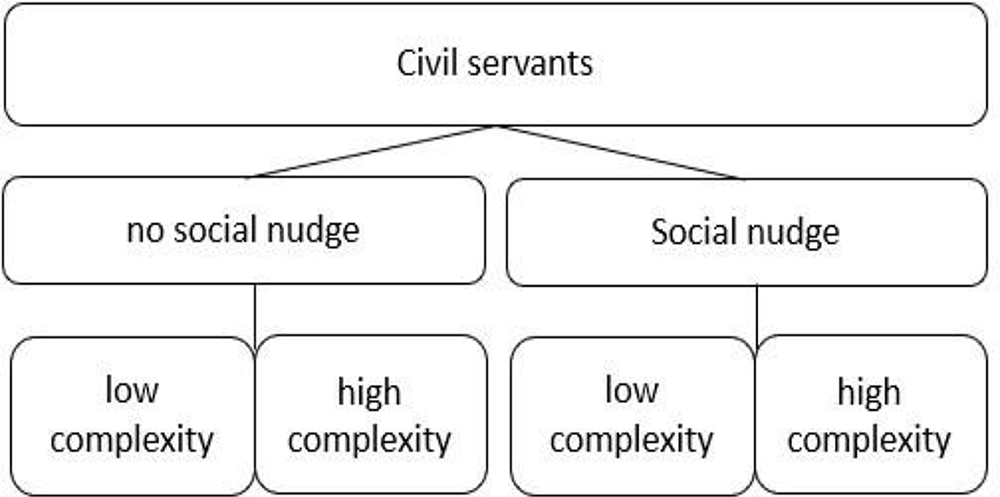
The treatment manipulations were constructed in two sequential stages (see Figure 1). In the first stage, the social nudge was implemented (i.e., before the vignettes were provided). Half of the participants (randomly selected) were presented with a social nudge regarding another municipality’s benchmark of information selection. In the second stage, participants received the vignettes in random order. Participants were randomly classified into either higher or lower complexity projects. Both treatment manipulations are explained in more detail below.
Treatment groups (procedure of randomization).

Complexity. Complexity in public administration is often determined by the range of conceptual dimensions and the number of interested stakeholders. More actors, more extended time spans and more involved programs increase complexity (Sabatier and Weible, Reference Sabatier and Weible2014). Complexity was manipulated by varying the size of projects described in the vignettes, both physically and financially. When the size of a project increases, there are more dimensions, interested stakeholders and higher potential losses (and gains) to be dealt with by civil servants. For two vignettes, emphasis was given to the magnitude of the financial scale of the project. For the other two vignettes, emphasis was placed on the scale of the project itself. In the Appendix (section on Experimental Details), we provide the exact wording of the vignettes for low and high complexity.
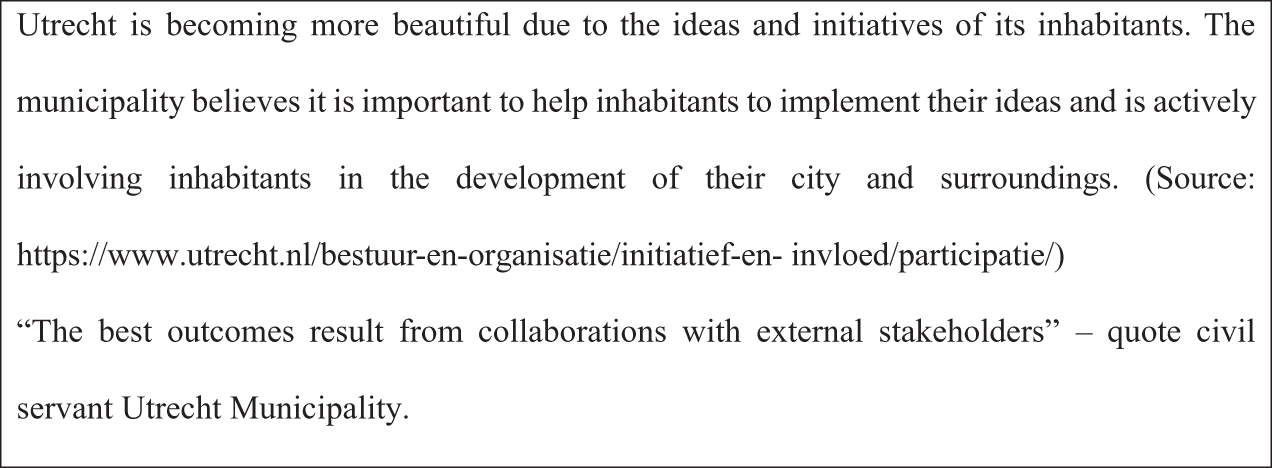
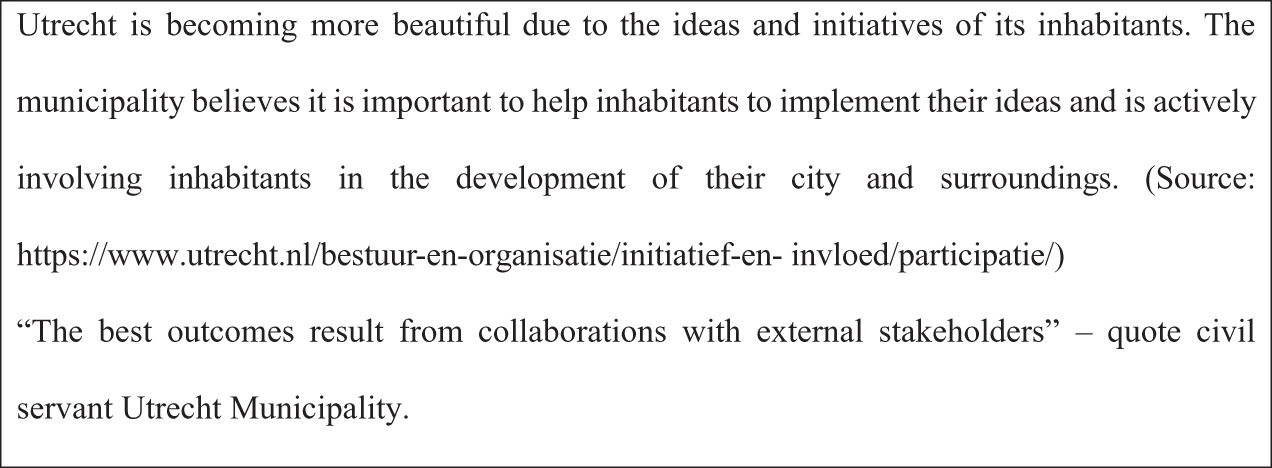
Social nudge. Since municipalities have limited resources, civil servants cannot pursue all available information, and the choice of where attention is allocated affects policy outcomes (Jones and Baumgartner, Reference Jones and Baumgartner2005, Reference Jones and Baumgartner2012). The social nudge consisted of an abstract of a newspaper article that positively portrayed a large municipality in the Netherlands and a quote from a civil servant referring to the information selection (descriptive component) and the positive outcome (injunctive component). A link to the newspaper article and the municipality website was included to ensure participants could fact-check the provided material. The portrayed municipality is among the five biggest municipalities in the Netherlands. In addition, the municipality is well known for its excellent record of including views of different groups and, therefore, serves as a suitable reference group for both the descriptive and injunctive components of the social nudge. The text that was provided, together with the original links, is shown in Figure 2.
Pre-vignette social nudge.
Measurement of the dependent variable
After each vignette, respondents were asked to indicate which stakeholders they would approach for information to write a policy report to prepare the project. An identical list with 30 potential stakeholders with information, ranging from organizations and associations to influential individuals within the broad network of the municipality, was included for all four vignettes (the exact list is provided in the section ‘Experimental Details’ of the appendix). In addition, an open box to include other sources of information was provided. Similar to Barrutia and Echebarria (Reference Barrutia and Echebarria2019), rational choice was assumed, and civil servants are expected to choose their collaborators according to their potential contribution and weigh this in terms of transaction costs. The outcome variable was constructed by counting the number of sources selected.
Results
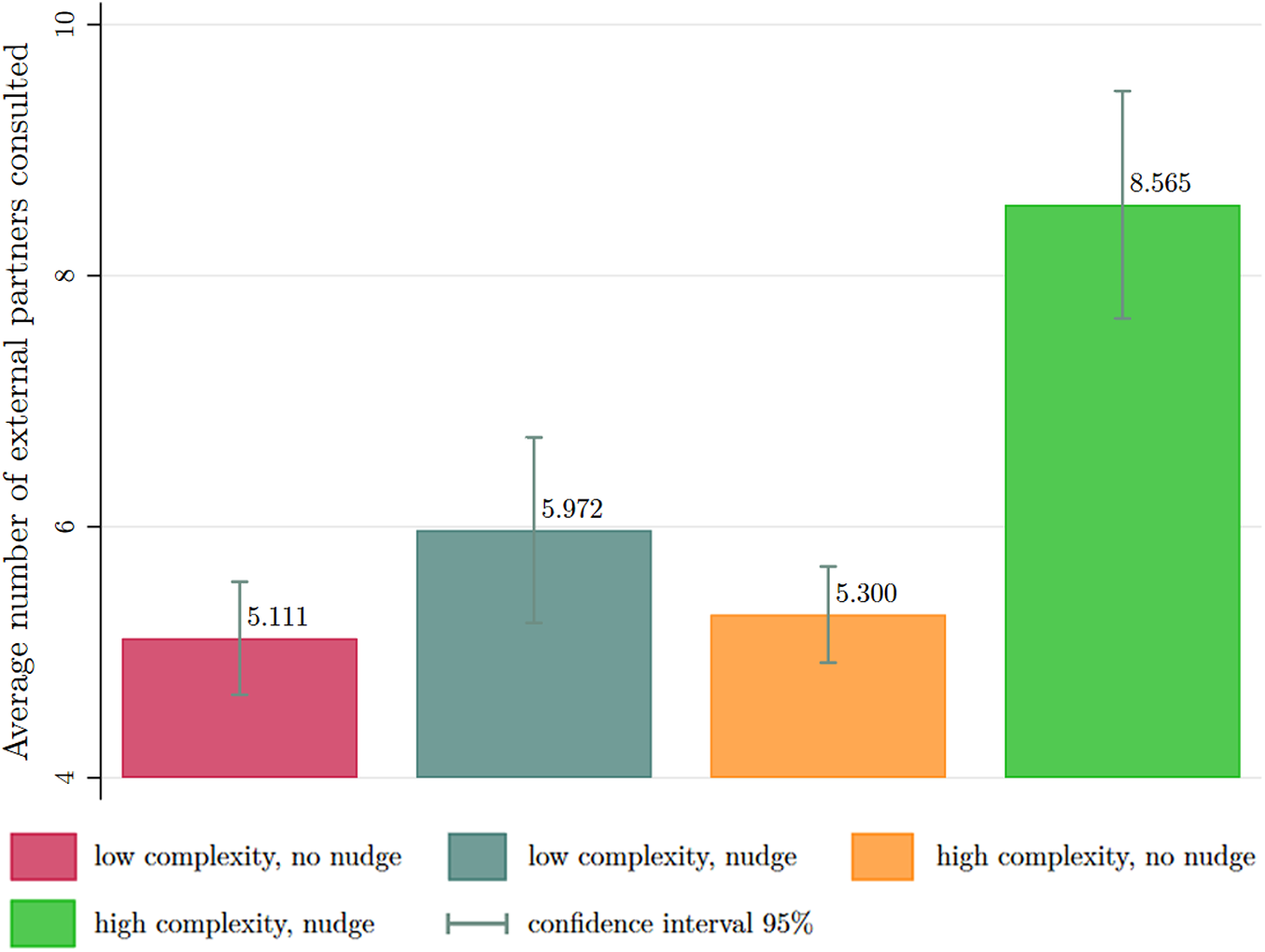
On average, the civil servants selected six external stakeholders to consult before writing the project report. The standard deviation is around four stakeholders, meaning that civil servants’ information selection strategies vary substantially. Figure 3 shows the number of partners selected and the confidence interval per treatment group. A small increase in the number of external stakeholders is observed when a nudge is present in combination with a vignette with low complexity, and a larger effect for settings with high complexity.
Average number of stakeholders consulted (left low complexity, right high complexity).

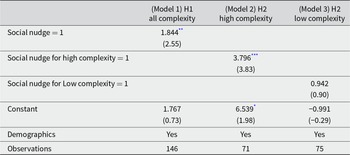
Three distinct OLS specifications (see Table 2) are estimated. In the first model, the experimental treatment of the social nudge is included, and the effect of the treatment manipulation on the total number of stakeholders that civil servants selected to inform their decision is estimated to test the first hypothesis. The results show that a social nudge increases the number of stakeholders selected 1.844 (t = 2.55, p = 0.012). Therefore, Model 1 supports the hypothesis that a social nudge can stimulate civil servants to select a larger variety of information sources.
Number of external stakeholders selected by civil servants to inform their decision
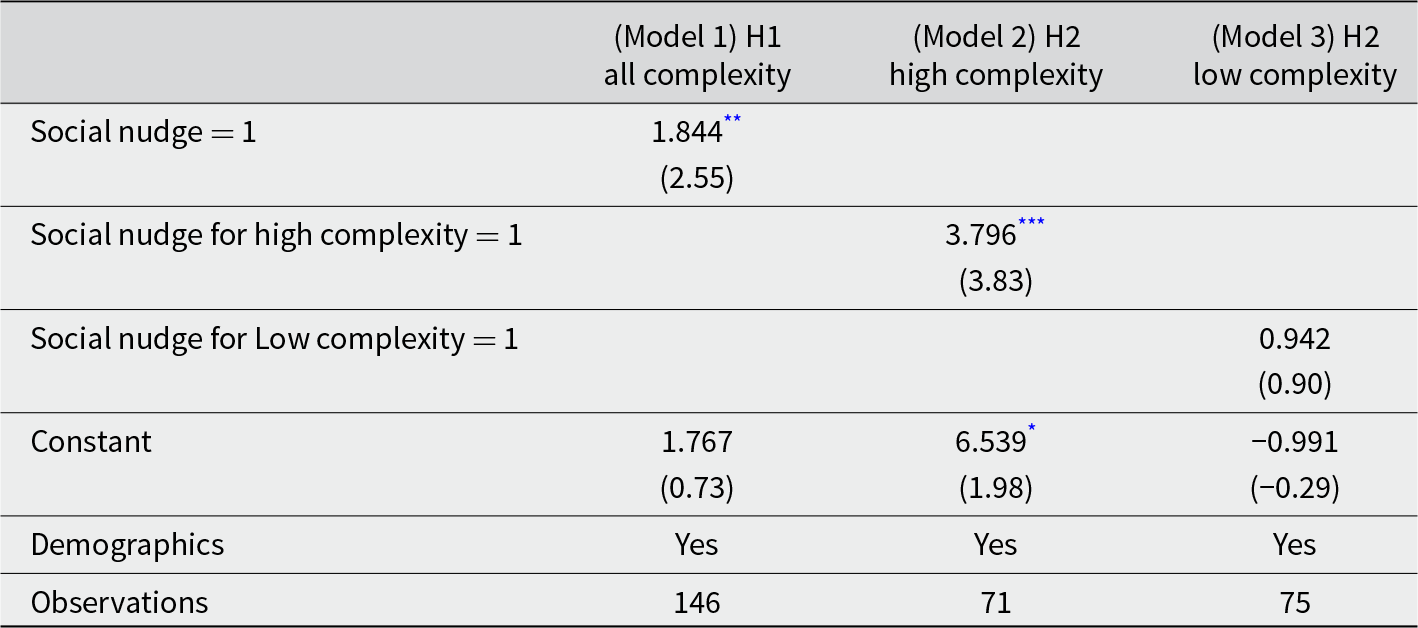
t statistics in parentheses.
* p < 0.10, **p < 0.05, ***p < 0.01.
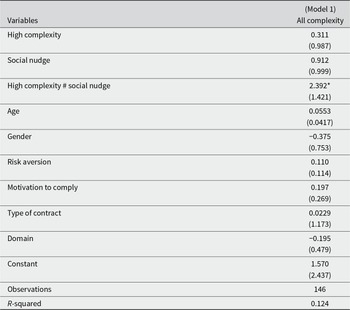
The second hypothesis involved the effect of a social nudge in a higher versus lower complexity setting. Model 2 shows the experimental treatment effect of the social nudge for more complex settings. In comparison, Model 3 shows the effect for less complex settings. Disentangling the effect of the social nudge, Model 2 shows that the social nudge leads to an increase of 3.796 (t = 3.83, p < 0.000) partners, compared to the baseline of 6.539. This is an increase of 58%. In the low-complexity condition (Model 3), the estimated effect of the social nudge is small and not statistically significant (t = 0.90, p = 0.374), a result that should be interpreted cautiously given the limited statistical power of this subgroup analysis. Taken together, these results support the second hypothesis, as the effect of the social nudge is significantly stronger in the high-complexity condition than in the low-complexity condition. The analysis also shows that the positive effect of a social nudge observed in Hypothesis 1 is mainly driven by civil servants who select more information sources in the setting with high complexity and high benefits for external stakeholders. To formally test whether the effect of the social nudge differs across levels of decision-making complexity, we also estimated a regression model including an interaction term between the treatment indicator and the complexity condition (see Table 3). The interaction term is positive and moderately statistically significant (t = 1.68, p < 0.1), confirming that the effect of the social nudge on information selection is significantly stronger in the high-complexity condition than in the low-complexity condition.
Interaction effect between high complexity and social nudge
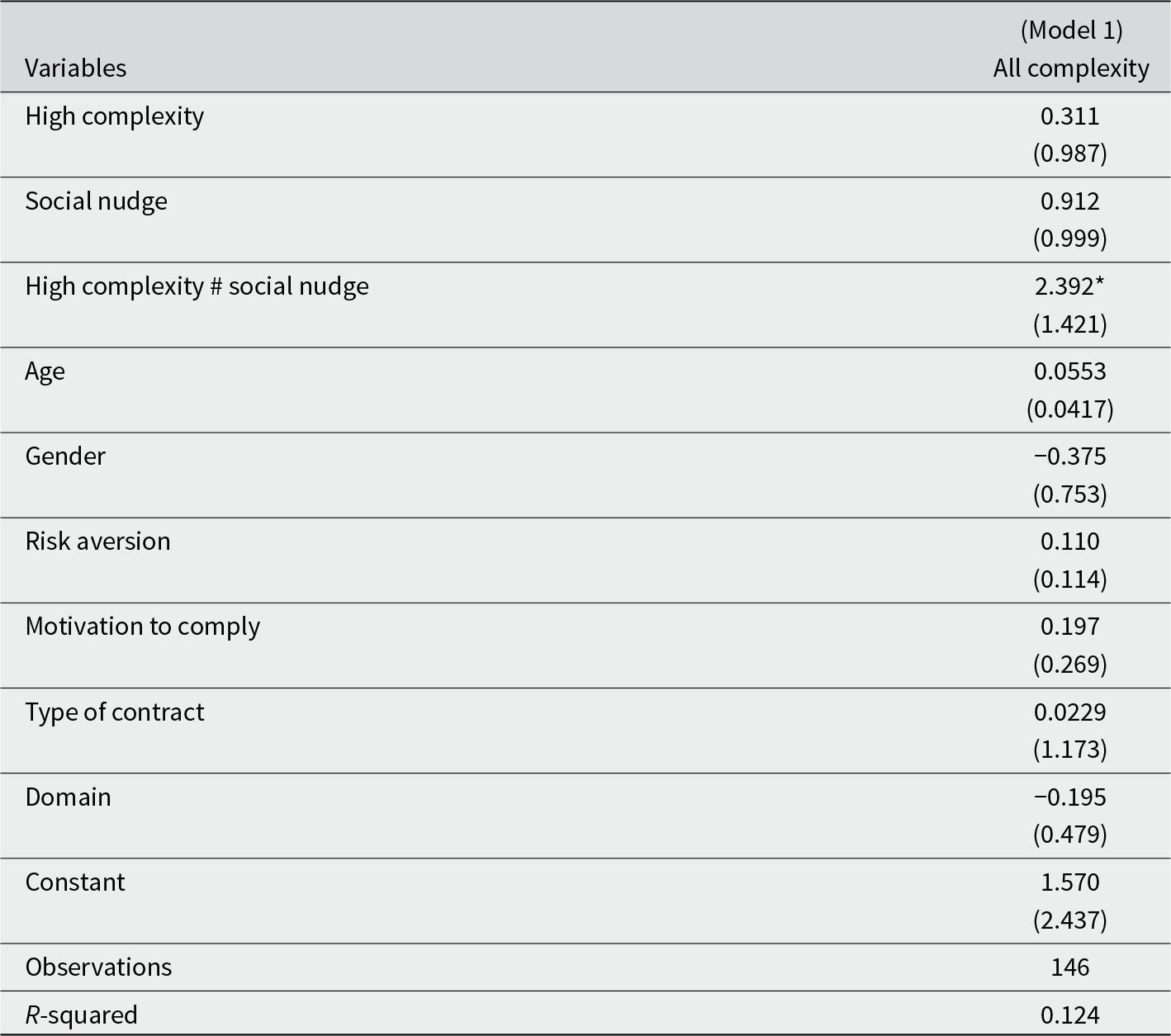
Standard errors in parentheses
***p < 0.01, **p < 0.05, *p < 0.1
The appendix includes several robustness checks. Table A3 re-estimates the main result without any demographic variables included. The results do not change significantly. Since the dependent variable is a count measure, we also estimate Poisson regression models (Table A4), which yield substantively identical conclusions. Additionally, re-estimating the main results with two alternative dependent variables to measure the number of stakeholders (Table A5) does not significantly change the coefficients. Lastly, a non-parametric estimation is included in the Appendix (Table A6). Even though the coefficients here are somewhat smaller, the findings for Hypotheses 1 and 2 remain robust.
Contributions and discussion
This study shows that civil servants’ information selection can be steered toward a more diverse information selection when a social nudge, in the form of a benchmark for effective behavior, is provided in complex decision-making situations. An important implication of this finding concerns the differing effects of the social nudge across decision-making situations characterized by varying levels of complexity. While the social nudge significantly increased the diversity of information selection in highly complex situations, no significant effect was observed in settings with lower complexity. This contrast is informative rather than incidental. It indicates that the social nudge does not operate as a general stimulus to increase information acquisition in all circumstances, but instead steers behavior primarily when the perceived benefits of consulting a broader range of stakeholders are higher. In less complex situations, where the added value of diverse information is more limited, civil servants appear to rely on their existing information-selection strategies. This pattern is consistent with the idea that nudges can counterbalance satisficing behavior in contexts where it is more likely to lead to societally suboptimal outcomes, while leaving decision-making largely unaffected in situations where existing heuristics are sufficient. In this sense, the findings support the view that social nudges can influence information selection in a selective and context-sensitive manner, rather than distorting behavior indiscriminately across different policy tasks.
The study makes two key contributions to public administration research. First, it offers an individual-level perspective on information selection that has been mainly studied from an institutional perspective (Jones and Baumgartner, Reference Jones and Baumgartner2005). By focusing on how civil servants select information from different stakeholders in the early stages of policymaking, the study complements recent work that emphasizes attention, information processing, and issue prioritization in public organizations (e.g., Rimkuté and Van der Voet, Reference Rimkuté and Van der Voet2023; Van der Voet and Lerusse, Reference Van der Voet and Lerusse2024; Lerusse, Reference Lerusse2025). This body of research shows that civil servants operate under conditions of limited attention and must prioritize among multiple information sources and external demands. Our findings add to this literature by demonstrating that information selection is not only constrained by attention scarcity, but can also be steered by a social nudge that encourages civil servants to broaden the range of perspectives they take into account, particularly in complex decision-making situations. By prioritizing information from different stakeholders to understand the problem and possible solutions better, public policy decisions are expected to improve (Workman et al., Reference Workman, Jones and Jochim2009; Jones and Baumgartner, Reference Jones and Baumgartner2012). A fundamental trade-off exists between gathering homogeneous versus diverse heterogeneous information under time pressure. Given the work pressure on civil servants, diversity and homogeneity compete for attention and time. Selecting more homogeneous information causes less friction and transaction costs and allows civil servants to work more quickly. Reaching out to more diverse groups for information brings conflicting views and interests of stakeholders (Kelman et al., Reference Kelman, Sanders and Pandit2016), causing the process to slow down. At the same time, diverse views lead to better decision-making, especially in complex situations (Page, Reference Page2007; Koski and Workman, Reference Koski and Workman2018). Given the practical problems of reaching out to diverse groups, ‘satisficing’ is the default heuristic for civil servants in many situations. The second contribution is that the results of this study tackle some of the criticisms nudging has received (see among others Grüne-Yanoff, Reference Grüne-Yanoff2012; Schnellenbach, Reference Schnellenbach2012). While the results show significant support for the effectiveness of a social nudge in more complex cases, our study did not support a behavioral change in information selection in less complex situations. This is in line with the view of libertarian paternalism, which states that nudges can steer behavior while preserving individual autonomy. Following this view, nudges will alter the behavior of those who act with a ‘bias from a societal point of view’ and thus are not making ‘optimal decisions’ while not affecting those who are (Chetty, Reference Chetty2015). This study supports this view for a social nudge in the realm of information selection. This adds to the discussion regarding this type of social nudges and refutes the view of those who (1) argue that there is no retainment of liberty and therefore a nudge might help some while harming others, and (2) fear a discrepancy of objectives of the designer and receiver of the nudge and therefore steer behavior in the wrong direction (for example, see Grüne-Yanoff, Reference Grüne-Yanoff2012; Schnellenbach, Reference Schnellenbach2012; Weimer, Reference Weimer2020).
Limitations
It is important to note that, in many countries (including the Netherlands), the early stages of policymaking are increasingly characterized by hybrid governance arrangements, in which external consultants are often involved. At the same time, this development varies across countries and policy domains, and civil servants typically retain responsibility for structuring the policy process and selecting which actors, sources and perspectives are consulted. The empirical setting of this study, which represents a public–sector organization with a broad policy portfolio and diverse civil service roles, allows us to observe information-selection behavior across different functions. However, the institutional features of the Dutch municipal system may shape these processes, and generalization to other contexts should therefore be made with caution, creating a need to replicate the results in other contexts. In addition, while the behavioral response to the social nudge in high versus low complex decision-making situations is captured, the study, unfortunately, does not capture the behavioral drivers that cause this response discrepancy. This leads to the question of whether civil servants are aware of the difference in benefits of both contexts and respond accordingly. The social nudge might work as a reminder of these benefits and trigger behavior. An alternative explanation would be that behavior is easier steered in high uncertainty contexts since those who encounter the social nudge in complex contexts need to deal with more uncertainties.
A further limitation of this study concerns the external validity of the experimental treatment. The social nudge was implemented in a vignette-based setting and therefore represents a simplified version of how such interventions may operate in practice. At the same time, the treatment closely resembles common forms of managerial communication, where managers frequently highlight benchmarks, role models, or examples of desired behavior to guide professional conduct. Prior research shows that such norm-based framing can meaningfully shape employee behavior (see Rigtering et al., Reference Rigtering, Weitzel and Muehfeld2019). Relatedly, the study focuses on one specific type of social nudge. Other social nudges (e.g., peer comparison feedback or norm-based performance feedback) are also commonly used in public organizations. Future research could examine how these alternative nudges compare in terms of effectiveness and contextual sensitivity, particularly in relation to decision-making complexity.
Finally, the control condition did not include additional information beyond the vignette itself. This allows for a clear comparison between the presence and absence of the social nudge, but it also implies that the estimated effect may partly capture responses to receiving any additional normative information. Although this raises the possibility of placebo-like effects, the absence of a significant effect in low-complexity situations suggests that the observed results are not driven by information provision alone, but rather by the interaction between the nudge and decision-making context.
Practical implications
Despite these limitations, this study has interesting practical implications for the early phases of policymaking in complex situations. First, this study provides practitioners a new tool, a social nudge, to counterbalance the trade-offs between time and diverse information selection. This tool is a supplement or alternative to, for example, employee training programs that promote a more diverse outreach for information (Frisch-Aviram et al., Reference Frisch-Aviram, Beeri and Cohen2021). The management of public organizations can be advised to implement social nudges that benchmark, including a wide variety of different stakeholders to ensure a correct problem definition and problem structuring, as well as finding the optimal solution among a variety of viable alternatives. There is no reason to fear that this will trigger civil servants to involve too many parties in the decision-making process, as our results show that social nudges only steer civil servants’ behavior when the value of information acquisition increases (i.e., in highly complex situations). Such social nudges can be implemented at low costs and in various ways. For example, when it comes to expectation-based social nudges, providing civil servants with regular reports showing how similar institutions consult a diverse range of stakeholders can be helpful. Managers may also create behavioral feedback loops where they provide feedback on how diverse the consulted sources are compared to best practices. Another option is to set a norm where policymakers are encouraged to present findings to an external expert panel before making a final decision. Priming-based social nudges may even be easier to implement. Sharing success stories and testimonials is a powerful way of highlighting how diverse stakeholder engagement leads to effective policy. In addition, using collective language (‘we’ instead of ‘I’ or ‘the institution’) during meetings and policy briefings may also help to reinforce the idea of collective decision-making. Some municipalities, like the City of Vaughan in Ontario, Canada, go one step further and formalize normative expectations by including them in their corporate policies. For example, they instruct civil servants to offer ‘an exceptional citizen-centered experience’ and to provide ‘a consistent, strategic, and corporate-wide approach for planning and executing community engagement with internal and external audiences’ (City of Vaughan, 2021).
Future research
While most research initially agreed on the role nudges play in the automatic unconscious, more intuitive ‘System 1’ from the dual processing theory (Kahneman, Reference Kahneman2011), more recently, attention has been paid to the different types of nudges and their distinctive characteristics (Barton and Grüne-Yanoff, Reference Barton and Grüne-Yanoff2015; Beshears and Kosowsky, Reference Beshears and Kosowsky2020). The results regarding the contrasting effect of a social nudge in contexts that differ in complexity might not hold for all types of nudges. The social nudge that was used makes use of social referencing, and therefore it might have a less ‘automatic’ effect on behavior than other types of nudges. A social nudge using benchmarking with others might activate more ‘rational thinking’ than other nudges. The criticisms on nudging mentioned above, of among others, Barton and Grüne-Yanoff (Reference Barton and Grüne-Yanoff2015) mostly focus on the automatic ‘heuristic-triggering’ types of nudges. More research is needed into different types of nudges and the mechanisms at play in the (civil servants’) decision-making process.
Supplementary material
The supplementary material for this article can be found at https://doi.org/10.1017/bpp.2026.10039.
Acknowledgments
We would like to thank the management team and all participants at the municipality where we conducted our research, for their feedback, support and participation in the research.
Funding statement
This work was supported by the Dutch Foundation for Psychotechnics (NsvP). The NSvP was not involved in the design or execution of the research nor in the preparation of the article.
Conflicting interests
None.


 Open access

