


Influencer marketing has experienced significant advances in recent years, driven by the rise of social media platforms and their impact on consumer behavior. In a short time, the relevance of influencers has increased dramatically as short video formats on platforms such as Instagram, TikTok, Twitter, Twitch, and YouTube have become increasingly popular. These videos are extensively used by influencers as a strategy to engage with their followers and build their online presence (Zimmermann et al. Reference Zimmermann2022). Currently, only a limited number of influencers have a large online following. This reach can be used to introduce new ideas and to promote products and services (as market research has made clear), but also to advocate for specific political attitudes.
Influencers are regarded by their followers as experts in their pitches, leading to a strong level of trust in their opinions and recommendations. This credibility extends beyond their niche topics to other subjects. Unlike traditional celebrities or political figures, influencers are seen as authentic individuals, unaffiliated with mainstream politics, which further enhances their trustworthiness. Their immersive communication style, including frequent updates about their personal lives (Ferchaud et al. Reference Ferchaud, Grzeslo, Orme and Lagroue2018) and direct interaction with followers, fosters trust. Additionally, influencers are perceived as offering alternative viewpoints to mainstream media, thereby making politics more understandable and accessible to their audience (Harff and Schmuck Reference Harff and Schmuck2023).
Influencers wield significant impact on their audience’s purchasing decisions. While their substantial earnings highlight this power, scholarly attention has only recently turned to their potential impact on public opinion. For example, recent research has explored the strategies and content of far-right political influencers and how these new right-wing activists have established a whole ecosystem of digital media platforms for metapolitical goals (Maly Reference Maly2024).
An important type of metapolitical influencer are those engaged in what they refer to as the “gender war.” They promote anti-feminist views and advocate for the return to the “natural order,” emphasizing heteronormative nuclear families and traditional gender roles for both men and women in society. This includes hypermasculine male influencers as well as women in far-right movements who often appropriate practices, genres, and norms from preexisting progressive online communities to advance the global new radical right agenda (García Mingo and Díaz Fernández Reference García Mingo and Fernández2023; Leidig Reference Leidig2023). While research in this area has advanced in uncovering the online communication strategies of radical influencers and their role in promoting a global new right culture, this study focuses on non-political mainstream influencers. Can they also act as digital opinion leaders?
More specifically, we focus on the exploration of the role of non-political influencers in shaping feminist views in Spain, a country where feminism and the topic of gender equality have gained prominence in recent years. The research question is: to what extent do influencers’ views on feminism align with those of their followers? To answer this research question, we pursue a twofold strategy. First, in December 2022, we conducted a survey representative of the Spanish population aged 15–80, gathering data on participants’ exposure to influencers and their views on feminism. Second, over a three-month period, including the survey period, we analyzed posts and videos from the influencers’ profiles to categorize them as either supporters or opponents of feminism through manual content analysis.
Our findings highlight the persuasive power of influencers to shape public opinion, as they display a relevant connection between influencers and their audiences’ views on feminism. This link remains robust even after accounting for potential self-selection biases through propensity score matching estimation. In the conclusion section, we address the implications of our findings and draw a connection between recent troubling evidence of young men’s anti-gender attitudes (Off, Charron, and Alexander Reference Off, Charron and Alexander2022) and their exposure to anti-feminist sentiments endorsed by certain highly popular influencers on various platforms.
When Influencers Turn Political and Persuade Their Audiences
In the digital age, the presence of social influencers is a constant on social media platforms such as Instagram, Snapchat, Twitter, TikTok, and YouTube. Social media platforms are not only a source of entertainment for users, but also an important source of information about current political events, which has an impact on civic political engagement and knowledge (Kim Reference Kim2023; van Erkel and van Aelst Reference van Erkel and van Aelst2020). It is also common for traditional media outlets to maintain accounts on social networks, where they adapt and share their news content using formats tailored to these platforms. However, within these social media platforms, it is the influencers who have gained the most prominence and relevance over the last years. For instance, evidence from Pew ResearchFootnote 1 revealed that in 2024, approximately 20% of Americans — and 37% of adults under 30 — regularly obtain news from social media influencers. Most news influencers are on X (85%), with many also active on Instagram (50%) and YouTube (44%). This study focuses on the role of these new relevant social actors.
Following prior research, here we consider an influencer as an individual who uses their presence and content on social media to influence the attitudes, behavior, and decisions of their audience based on their perceived expertise, credibility, trust, and authenticity established within their digital community (Abidin Reference Abidin2016). Influencers exist in various niches and industries such as beauty and fashion, sports, travel, lifestyle, gaming, and fitness, to name a few. They leverage their online presence to share their personal experiences and make recommendations with the goal of influencing the tastes, choices, and behavior of their target audience. Influencers usually partner with brands and companies to promote products or services to their audience. These partnerships are an important source of revenue or “monetization” of their content creation. Additionally, influencers’ revenue also comes from the platforms on which their videos and/or content are viewed, thanks to the resources derived from advertising.
Influencers, with their strong online presence and focus on specific niches, engage with a large and interactive audience. They regularly update their social media profiles with content related to their expertise, positioning themselves at the center of vast virtual networks. The content they share varies based on niche, audience, and personal style, ranging from real-time updates in ephemeral stories to detailed reviews, how-to guides, and recommendations.
Influencers can also provide their followers with information about politics (Harff and Schmuck Reference Harff and Schmuck2023). For example, they can raise awareness about certain topics, or even advocate for social or political causes, or promote a far-right agenda (Leidig Reference Leidig2023). To do this, they use various strategies, such as asking their audience to engage in a discussion, commenting on current issues, asking provocative questions, providing puzzling examples, or even offering fact-checking information. By posting political information, influencers can make politics easier and more accessible to people who are not cognitively engaged with the world of politics. Moreover, far-right political influencers have significantly contributed to the emergence of a global new right-wing cultural niche. These political influencers leverage algorithmic knowledge to produce metapolitical content aimed at capitalizing on sociocultural and technological trends and spaces (Maly Reference Maly2024). We posit that even influencers who typically avoid political topics may occasionally address them, albeit with varying degrees of intensity and awareness of potential repercussions on their social media and business connections.
The way in which influencers can persuade their followers’ views on feminism can be illustrated by Zaller’s (Reference Zaller1992) RAS model, which uses four axioms to explain how individuals process and form their opinions about politics in general: i) reception: people are more likely to receive political messages if they are cognitively engaged with the issue; ii) resistance: people avoid arguments that clearly contradict their prior beliefs, but only if they have detailed information to figure out such contradiction; iii) accessibility: people recall and use the considerations that are most accessible or recent in their memory; and iv) response: people answer survey questions by averaging across the most accessible considerations. These well-known axioms illustrate how public opinion is influenced by political communication and individual predispositions.
Although Zaller’s axioms were derived to explain public opinion formation in a non-digital era, we posit that they are still extremely useful to explain persuasion by influencers. First, the axioms of reception and resistance suggest that the message posted by an influencer is more likely to persuade his or her audience if they are not particularly engaged with the topic. This leads to an apparent paradox. On the one hand, an audience that is not particularly engaged with the topic of feminism is more likely to ignore (and not receive) messages on the topic than an audience that is. On the other hand, these audiences are more likely to absorb messages about feminism because, at least in principle, they follow influencers for reasons that are far removed from ideas about feminism, such as fashion, fitness, beauty, travel, technology, or video games.
Previous studies have shown that viewers who consume entertainment content on television programs that blur the line between news and entertainment are more likely to change their minds and/or learn about politics when they receive political news through these channels (Arceneaux and Johnson Reference Arceneaux and Johnson2013; Ferrin, Fraile, and García-Albacete Reference Ferrín, Fraile and García-Albacete2019). Others have shown that persuasion effects are more likely to occur on issues that are relatively new and on which people do not yet have a settled opinion (Arcenaux and Kolodny Reference Arceneaux and Kolodny2009; Foos and Bischof Reference Foos and Bischof2022). Building on these findings, we argue that influencers have a special ability to reach a large and heterogeneous audience with respect to their political views, as this audience follows them for specific reasons that are often unrelated to politics. This implies that influencers’ audiences i) receive messages and views about feminism as a by-product and ii) are less likely to have a crystallized opinion about feminism. Moreover, we know that the way messages are framed for people has relevant effects on their opinions/attitudes (Iyengar Reference Iyengar1990). Influencers are powerful vehicles for political framing effects because the political messages they convey are one-sided.
Regarding the axiom of accessibility, influencers excel in creating messages that are easily accessible, comprehensible, and appealing. This ability is related to both their wide audience reach and the formats they use to convey their content. First, the public visibility of influencers enhances the likelihood that they will reach a substantial audience, often leading to a viral spread of their messages. Algorithms play a crucial role in shaping the visibility and reach of influencers’ content on online platforms (Cotter Reference Cotter2018), using various instruments such as content suggestions based on users’ preferences, behavior, and engagement history. If an influencer’s niche content aligns with the interests of a particular audience segment, algorithms are more likely to recommend that content to users within that segment, increasing its visibility. Algorithms also promote content that generates higher levels of engagement, especially if it is posted at times when followers are more active.
Additionally, influencers can use algorithms to target specific audience demographics, considering factors such as age, location, interests, and online behavior. Previous studies have demonstrated that celebrities in traditional media, who reach a wide audience through their extensive television exposure, have played a significant role in shaping public opinion on various issues such as LGTBQI+ rights, racial prejudice, and climate change (see Marble et al. Reference Marble, Mousa and Siegel2021; Pollock, Reference Pollock1994; Wright and Nyberg Reference Wright and Nyberg2022). Building on this, we propose that contemporary influencers, empowered by digital platforms and often amplified by algorithmic mechanisms, have an equal, if not more influential, capacity to shape public opinion.
Secondly, influencers use formats and styles that make their messages easy to understand and follow. For example, they use photos, images, and videos that show different aspects of their lives, from fashion and beauty, to sports, travel, or cooking. Many influencers rely on an entertaining style, creating content to engage with their followers. In contrast to celebrities in traditional media, who often exude an aura of distance and inaccessibility toward their audience, influencers come across as normal people who share their lived experiences, appearing accessible and relatable to their followers (Duffy Reference Duffy2017). This authenticity and accessibility is often attributed to influencers’ focus on their personal experiences and knowledge (Suuronen et al. Reference Suuronen, Reinikainen, Borchers and Strandberg2022). Essentially, influencers play a crucial role in making even abstract or complex topics more accessible and understandable. They achieve this by simplifying messages through visually engaging formats that are easy to comprehend.
Influencers have the ability to connect with others on a personal or emotional level, fostering a sense of understanding and identification. Their personal communication style resonates with the audience, evoking feelings of connection, empathy, and understanding. Relatability hinges on being perceived as approachable, authentic, and having qualities or experiences that others can recognize and share. This quality is invaluable for building connections, nurturing trust, and creating a shared sense of commonality (Duffy Reference Duffy2017). Prior studies have argued that influencers’ capacity to shape the attitudes and behaviors of their followers is linked to their relatability (Harff and Schmuck Reference Harff and Schmuck2023). When influencers are perceived as real people with relatable experiences, their followers often view them as friends (Berryman and Kavka Reference Berryman and Kavka2017).
Influencers enhance their relatability through online accessibility, fostering immersive communication environments (Ferchaud et al. Reference Ferchaud, Grzeslo, Orme and Lagroue2018). Unlike traditional media where audiences are mere information or entertainment consumers, influencers’ followers have the opportunity to engage in a two-way online conversation. Influencers often build communities around themselves, engaging with followers and sometimes drawing on this interaction as a source of inspiration for creating new content. Their responsiveness via platform messages reinforces the perception of approachability, promoting authenticity and trust. By utilizing relatability and personalized communication, influencers establish enduring online relationships with followers. They achieve this through tactics like live streams, Q&A sessions, sharing personal anecdotes, and posting engaging visual content.
Finally, influencers show remarkable skill to make certain issues palatable and salient to their followers, which is in line with Zaller’s (Reference Zaller1992) axiom 4. This ability allows them to engage audiences that might not have initially been interested in these particular topics. Influencers often present their political views as spontaneous and simple: those of a “normal person” in clear contrast to the views expressed by mainstream political actors or traditional media celebrities. Moreover, according to the axioms of accessibility and response, the opinions expressed by followers depend on the balance of considerations that are most important or accessible to them at the moment of response. For example, if an influencer posts a viral video discussing a topical political issue that is widely debated on social media, their followers will be more likely to draw from that message when asked for their opinion on that specific issue.
Feminism and Influencers in Spain
This study addresses the role of influencers on public opinion in Spain, focusing on attitudes toward feminism. Spain has a history of progressive gender equality policies, such as a law against gender-based violence and party quotas, which have been implemented mainly through top-down interventions since 2011. In addition, the Spanish women’s movement has gained significant relevance since 2011. Previous studies have shown that after the anti-austerity movement 15-M in 2011 (also known as the “Indignados”), feminist activism in Spain experienced an upsurge leading to initiatives such as the “Marea Violeta” in 2012, which opposed labor reforms and regressions in gender equality policies (Galdón Corbella Reference Galdón Corbella2018; Jiménez-Sánchez, Fraile, and Lobera Reference Jiménez-Sánchez, Fraile and Lobera2022). In 2014, the demonstrations intensified in response to the conservative People’s Party’s proposal to reform the abortion law (Bustelo Reference Bustelo2016; Fraile and Hernández Reference Fraile and Hernández2024; Jiménez-Sánchez, Fraile, and Lobera Reference Jiménez-Sánchez, Fraile and Lobera2022).
A turning point was the gang rape case of La Manada (The Wolf Pack) in 2016, which sparked widespread protests and campaigns on social media such as #YoSiTeCreo (I believe you). This activism culminated in a massive mobilization on International Women’s Day 2018 with an estimated five million participants, from which the 8-M movement emerged. The demonstrations were comparable in scale to other global women’s movements, such as the US Women’s March and #NiUnaMenos (Not One Woman Less) in Argentina. Since then, feminism in Spain has gained unprecedented visibility and salience (Gándara-Guerra Reference Gándara-Guerra2024; Jiménez-Sánchez, Fraile, and Lobera Reference Jiménez-Sánchez, Fraile and Lobera2022).
During the December 2022 survey period, significant feminist discussions unfolded, notably concerning the “trans” and “Solo sí es sí” (Only yes is yes) laws. The Congress of Deputies approved the “trans” law on December 22, 2022, despite opposition from right-wing parties.Footnote 2 Similarly, the “Solo sí es sí” law, emphasizing consent in sexual relationships and addressing sexual violence issues, sparked intense debates. These conversations underscored the public agenda and revealed partisan conflicts, even among parties within the governing coalition at the time. Concurrently, some Latin American countries, culturally and linguistically linked to Spain, witnessed widespread protests against gender-based violence and abortion rights such as in Argentina, Chile, or Mexico (Daby and Moseley Reference Daby and Moseley2022; Fernández Anderson Reference Fernández Anderson, Bada and Rivera-Sánchez2021). Therefore, the feminist and anti-feminist dynamics in Spain offer an ideal setting to examine the influence of digital influencers as opinion leaders on feminist perspectives.
In summary, feminism was a prevalent topic during the survey collection, with some influencers occasionally discussing it in their posts, despite their non-political niches or initial rise to fame for reasons unrelated to politics. The landscape of digital influencers in Spain is diverse and dynamic, with individuals hailing from various backgrounds and catering to diverse audiences with a range of content and perspectives. According to a study by the Spanish Association of Advertisers, the use of influencers in Spain has surged in recent years, with 80% of Spanish companies incorporating them into their marketing campaigns in 2020 (AEA 2020). Instagram, Twitter, TikTok, and YouTube are the primary platforms for influencers in Spain.
Data indicate significant engagement between social media users and influencers, though limited due to the rapidly evolving nature of influencer trends and varying follower metrics across platforms (Michaelsen et al. Reference Michaelsen and Collini2022). For instance, a 2023 survey revealed that 51% of social media users in Spain follow influencers, primarily on Instagram and YouTube (Statista 2023). Spanish influencers typically have an average of around 50,000 followers, with some of the most popular ones boasting millions. The widespread use of Spanish as a common language in many countries increases the potential reach and influence of Spanish digital influencers beyond national borders. Spanish-speaking influencers can reach a large and diverse audience in 20 states and territories worldwide, particularly in Latin America, where over 455 million people speak Spanish as their first language. This makes Spain a relevant case to examine the role of digital influencers in shaping public opinion on feminist issues.
Research Design: Data and Empirical Strategy
To analyze the link between influencers’ views on feminism and those of their followers, we collected an online survey in Spain in December 2022, with a representative sample of the Spanish population aged 15 to 80 years (a total of 5,012 observations). To gauge individuals’ attitudes and opinions about feminism, we included a battery of eight different statements aiming to capture a spectrum of views, ranging from unequivocal support for feminism to undeniable hostility toward it. These sentences reflect various views and opinions about feminism conveyed by celebrities, politicians, academics, and influencers in the media throughout the period 2021–2022.Footnote 3 The exact wording of the question is: “To what extent do you agree or disagree with the following statements (the statements were presented to participants in a random order, and the response categories range from 0-complete disagree to 10-completely agree): i) Feminism is essential to end patriarchy; ii) Feminism must include both women and men; iii) Feminism is necessary to achieve true equality between men and women; iv) What is important is neither feminism nor sexism, but equality; v) Feminism is just as dangerous as sexism; vi) Today’s feminism has ended up dividing society; vii) Today’s feminism is overly politicized; viii) Feminism promotes hatred of men.”
Despite the global increase in the saliency of women’s issues and mobilization over the last decade (Gándara-Guerra Reference Gándara-Guerra2024; Jiménez-Sánchez, Fraile, and Lobera Reference Jiménez-Sánchez, Fraile and Lobera2022), studies addressing public opinion about feminism remain scarce (see, however, Elder, Greene, and Lizotte Reference Elder, Greene and Lizotte2021). Typically, these studies focus on survey questions seeking respondents’ identification with the feminist movement. We contribute to this emerging line of research by providing a more comprehensive depiction of citizens’ views on feminism. We employed principal component analysis to determine which of the eight items could be included in a single index. Results from the factor analysis indicate that items i, ii, and iii load on one factor, whereas items iv, v, vi, vii, and viii load on a second factor. Accordingly, we created two dependent variables: the Feminism and the Anti-feminism index, standardizing each item included in each index. Subsequently, we combined the three and five corresponding survey items into additive indexes and computed the normalized value (0–1) for both indexes. The raw alpha value is 0.75 for the Feminism index and 0.83 for the Anti-feminism index.
To construct the main independent variable, this study relies on an original and innovative empirical strategy to measure individuals’ exposure to influencers with an online survey instrument, and a subsequent content analysis. Despite the lack of previous studies addressing the measurement of citizens’ consumption of specific influencers’ content in a survey, we used a threefold strategy. First, we asked participants to indicate the frequency with which they engage in various leisure activities such as gambling, practicing sports, or playing video games.Footnote 4 We then considered only those participants who had previously indicated that they very often or sometimes watch videos or streams from content creators, and/or listen to podcasts. This refined our sample to 3,734 respondents, which accounts for approximately 75% of our initial participant pool, who reported consuming influencers’ content across various online platforms.Footnote 5
Second, we asked this sample of participants an open-ended question in which they had to name three influencers, streamers, or content creators they regularly consume. This spontaneous answer provides information about the participants most frequent consumption of online content.Footnote 6 After coding the spontaneous responses, we identified the most frequently mentioned influencers in our survey. Finally, to maximize the comprehensiveness of the list of influencers, we included a closed-ended question asking the selected participants to what extent they follow a given list of 10 influencers (each influencer name was presented to participants in a random order). Participants were asked to rate their level of exposure to these influencers on a scale from 0 - “Never watched/listened to” to 10 - “I watch/listen to them regularly.” The selection of these 10 influencers was based on their relevance in terms of: i) the number of followers — ranging from 264,000 to 40,400,000 followers; ii) their main non-political content — including a variety of different niches such as video games, beauty, humor, or lifestyle; iii) their sex — including an equal number of men and women; and iv) their primary online platform — including YouTube, Instagram, Twitter, Twitch, and TikTok.
We compiled a final list of 26 influencers, consisting of the 20 most frequently mentioned influencers from the open-ended question (and therefore spontaneous answers), and six influencers from the closed-ended list of 10 that did not rank in the top 20 most mentioned influencers in our open-ended question. These 26 influencers have an average of 6.5 million followers, considering only the social media platforms they predominantly use.
We conducted a comprehensive manual content analysis of the 26 influencers’ posts to identify their distinct niches and the typical content they disseminate on their social media profiles. The analysis covered a three-month period leading up to and including the survey collection phase. This duration was strategically chosen for two reasons: to ensure a broad spectrum of content from the influencers, thereby increasing the chances of identifying sporadic references to feminism or anti-feminism; and to maintain the relevance of the influencers’ content to the survey responses. While some influencers in Spain are overtly feminist or anti-feminist, such as “Afrofeminas” or “UnTioBlancoHetero,”Footnote 7 our study concentrates on those whose content indirectly touches upon these themes. The aim is to explore the impact of influencers who do not primarily focus on feminism or anti-feminism, but have hybrid content and only occasionally address these issues. This approach is designed to reduce self-selection bias and to assess the influence of prominent Spanish influencers on public opinion. We classified influencers based on spontaneous comments that, even if only tangentially, relate to feminism or anti-feminism. It was imperative to analyze content over an adequate time frame to capture these occasional mentions. Simultaneously, we needed to align influencers’ content with the survey timeframe for an accurate portrayal of the content consumed by individuals both regularly and intermittently.
During these three months, we divided the content published by each influencer into weeks and selected a specific post or publication that related to topics relevant to our research, such as feminism, women’s rights, gender equity, and equality between men and women. If there was no publication related to our research topic, we coded the one with the most views or likes for that week. If there was no content of any kind, we also registered this in our analysis. We coded a total of 364 posts published during the 14 weeks of observation.
Finally, to classify influencers according to whether they can be considered feminist or anti-feminist, we established a benchmark where at least 20% of their weekly posts were coded as pro-feminist or anti-feminist by our coding team.Footnote 8 For example, an influencer who has posted or uploaded a video every week for the last three months is classified as incidental feminist if at least three of those posts are identified as pro-feminist by our coders.Footnote 9 This criterion is consistent with our main argument about the fact that influencers are followed by their audiences for non-political motives such as music, video games, humor, beauty, cars, or animals, but may sporadically present pro-feminist or anti-feminist material. We therefore, opted for a criterion that captures occasional yet more than singular instances of such content. The 20% threshold was chosen to ensure a minimal frequency of relevant content without indicating a regular pattern (which would be suggested by a rate of 50% or more). Confirmatory tests with a 30% threshold yielded identical classifications, bolstering our confidence that our categorization is robust and not overly sensitive to minor variations in coding rules.Footnote 10
The content analysis shows that most of the publications that all of these 26 influencers included in their online profiles were hardly linked to gender issues. They cover a wide range of topics, including video games, sports, makeup, and lifestyle, but they only sporadically advocate or support feminist or anti-feminist perspectives in their discussions. Consequently, we labeled them as “incidental feminist/anti-feminist influencers.” We therefore classified each of the 26 influencers into three different types: Incidental feminist influencers (IFI): those who occasionally advocate feminist theoretical perspectives and women’s rights. These publications were mainly commentaries on events or news occurring daily in public life from a clearly feminist perspective; Incidental anti-feminist influencers (IAFI): content focused on criticizing and rejecting the feminist movement, its ideas, and demands, often claiming that it promotes animosity and hostility toward men and division in society. These influencers included critical content about the legitimacy of the Spanish Ministry of Equality, and all public policies initiated by it, while also publicly denouncing and criticizing other feminist influencers. Their content also included opinions or behaviors endorsing clear anti-feminist positions. Finally, Neutral influencers: those who did not produce any content related to feminism or anti-feminism, or had less than three posts related to these topics during our 14-week observation period.
We follow a threefold strategy to present the main findings of this study. First, we focus on presenting the results of our content analysis in the following section. Second, we identify the audience profile of each of the three types of influencers through binomial logit estimations. In a subsequent section, we explore the distribution of public attitudes toward feminism and anti-feminism — our two main dependent variables — and summarize the results of two robust “naive” OLS estimations, where the main independent variable is the type of influencer respondents claim to follow. Finally, as a robustness check, we use a complementary empirical strategy using Propensity Score Matching (PSM).
Findings
Influencer Content
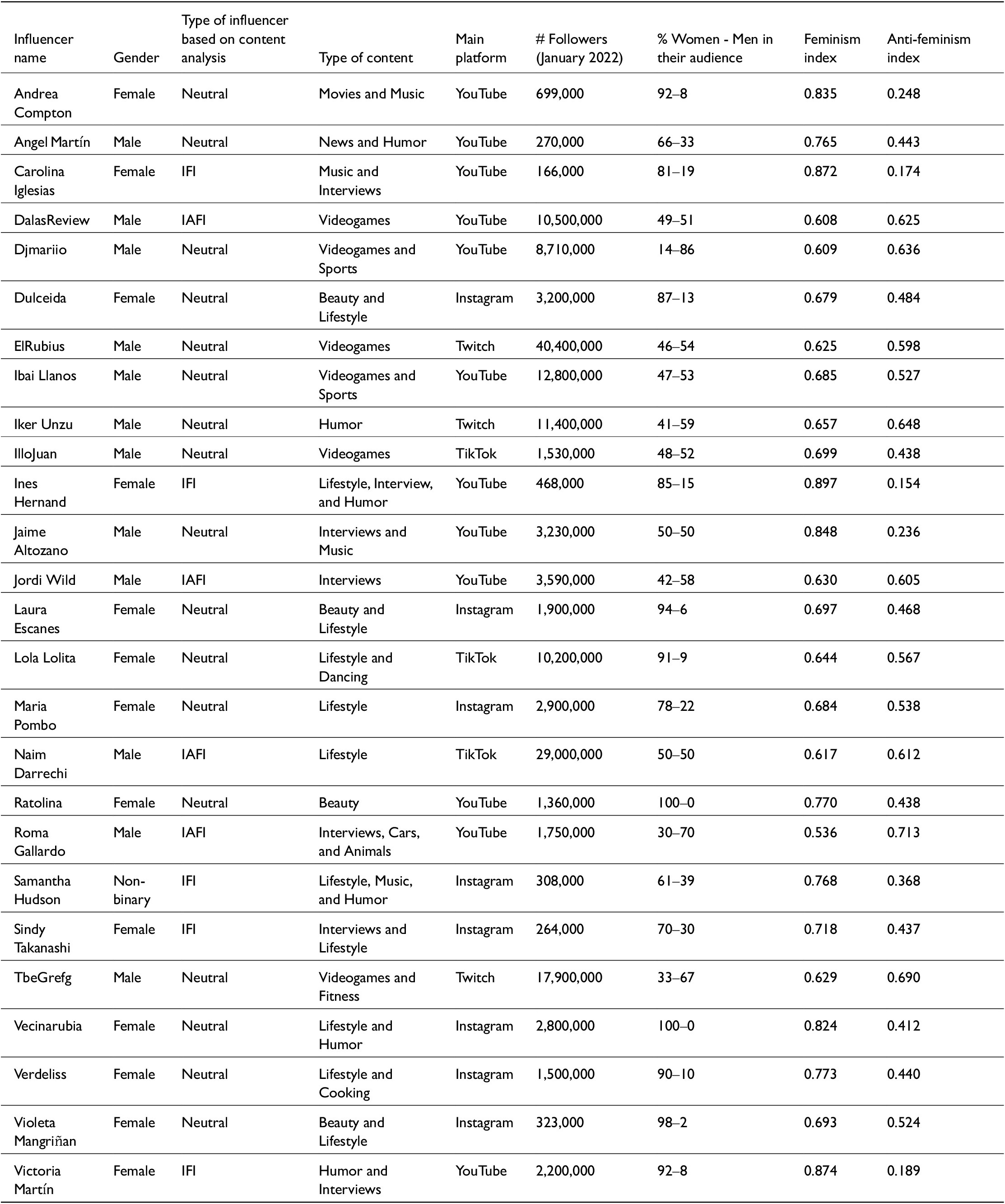
Table 1 provides the characteristics of the 26 influencers. Thirteen influencers are female, 12 are male, and one identifies as non-binary (see the second column). All influencers classified as incidental feminist (from now on IFI) are female and one is non-binary, while all incidental anti-feminist influencers (from now on IAFI) are male. In contrast, Neutral influencers have a mixed gender distribution. The majority of IFI and IAFI influencers primarily conduct interviews where feminist or anti-feminist issues surface sporadically (except DalasReview, who posts video games on YouTube, and Naim Darrechi, who posts lifestyle content on TikTok). In contrast, Neutral influencers present more diverse content. This pattern indicates that interviews may serve as a conducive format for the incidental emergence of non-central topics, potentially shaping opinions toward or against feminism.
Main characteristics of influencers

Source: Our data, December 2022.
Note: IFI: Incidental Feminist Influencer, IAFI: Incidental Anti-Feminist Influencer.
Table 1 also highlights a significant disparity in follower counts between IFI and IAFI. IAFIs (μ = 5.2 million) have a significantly larger follower base on their main platforms than IFIs (μ = 681,000). Although the number of followers does not automatically imply the same level of engagement across all published content, this finding suggests that IAFIs have the potential capacity to reach a larger audience. However, the virality of the publications depends on many other factors beyond the number of followers, such as platform algorithms.
Moving on to the description of their audiences according to our survey, Table 1 (see the seventh column) shows gender disparities among influencer audiences.Footnote 11 Female influencers attract predominantly female followers across various niches like beauty, humor, or interviews, indicating a gender affinity among their audiences. However, male influencers’ audiences show less skewed gender distributions, with the exception of TheGregf, Roma Gallardo, and DjMariio, whose followers are mainly male.
The last two columns of Table 1 show relevant differences in the mean values of attitudes toward feminism and anti-feminism among the audiences of the 26 influencers examined here. Generally, followers of IFIs demonstrate the highest mean scores for feminism and the lowest for anti-feminism, while the opposite trend is observed among IAFI followers. Notably, followers of Neutral influencers, who did not focus on feminist or anti-feminist content during the study period, also show intriguing patterns in their attitudes toward feminism. For instance, audiences of influencers like TheGregf, Djmariio, and Iker Unzu, who cover topics such as video games, soccer, and humor, exhibit high mean levels of anti-feminism. Conversely, followers of influencers like Andrea Compton and Jaime Altozano, who are also classified as Neutral, consistently display above-average levels of feminism.
Profile of the Influencers’ Audiences
We have argued that influencers’ audiences might receive messages and views about feminism or anti-feminism as a byproduct of following these influencers for other motives such as consumption, creative inspiration, or entertainment, and that followers are therefore less likely to have a crystallized opinion about feminism. We have also argued that the political messages that influencers convey may be one-sided. That is, influencers’ audiences are less likely to be exposed to opposing frames about feminism than audiences engaged with the topic. If someone is not interested in a given topic, the odds that they actively search for information about that topic are lower than if they are engaged in the topic. In the case of social media, there is evidence suggesting that algorithms amplify this tendency by suggesting people selected information about the topics that best fit their interests and opinions (Huszár et al. Reference Huszár2022).
This is an assumption that we cannot directly test with our evidence. However, an implication of this argument is that individuals declaring to follow influencers should not be politically motivated to do so. We tested this assumption by profiling the main sociodemographic and political characteristics associated with declaring to be followers of the three types of influencers we described: IFI, IAFI, and Neutral.
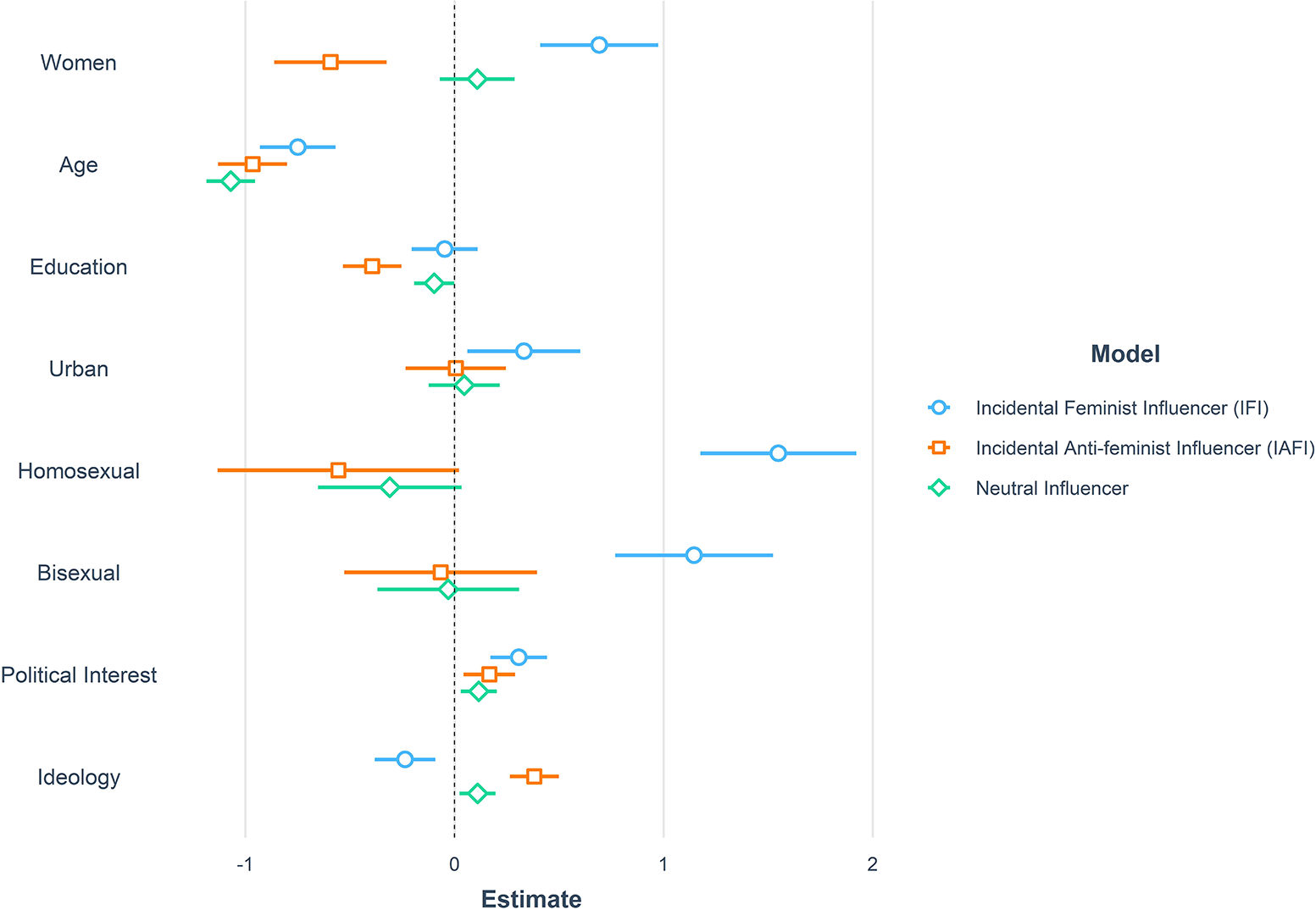
Figure 1 summarizes the standardized coefficients for declaring to follow each of the three types of influencers. The full results of the binomial logit estimations are summarized in Table A1 in the Supplementary Materials. Figure 1 confirms that women are more likely to follow IFIs, and less likely to follow IAFIs. These results are consistent with previous research showing that men tend to engage more with anti-feminist content, particularly in spaces such as the “Manosphere” — that is, a loose collection of online communities, blogs, forums, and social media spaces that focus on issues related to men and masculinity (Díaz Fernández and García Mingo Reference Díaz-Fernández and García-Mingo2024). In contrast, there are no significant differences between men and women in the likelihood of following Neutral influencers.
Profile of the audiences of the three types of influencers.
Source: Our data, December 2022.
Note: Standardized coefficients from estimations summarized in Table A1 in the Supplementary Materials.

Regarding age, Figure 1 suggests that younger people generally tend to follow more influencers, possibly due to generational differences in digital engagement (see negative coefficient for age, measured in years). However, there are no relevant age differences in the likelihood of following any of the three types of influencers. The chances of following IAFIs and Neutral influencers decreases with education, while there are no relevant differences in the education levels of followers of IFIs. IFI followers are more likely to reside in urban areas than IAFI and Neutral followers, who show no relevant differences in residential location. Finally, sexual orientation emerges as an important factor linked to social media audiences: IFIs are more likely to be followed by individuals with non-normative sexual orientation (i.e., bisexual or homosexual) compared to heterosexual individuals. However, when it comes to IAFI and Neutral influencers, no significant patterns related to sexual orientation are observed.
Concerning political indicators, Figure 1 partially supports our argument that followers are not self-selecting into receiving political messages about feminism. While interest in politics is associated with the likelihood of following influencers of any kind, this association is relatively small compared to age, gender, and sexual orientation. Furthermore, the association between political ideology and influencer preferences is statistically different from zero in all cases: left-wing people are more likely to follow IFIs, while a right-wing orientation is linked to a higher likelihood of following IAFIs. However, the differences in the political profile of influencers’ audiences compared to age, gender, and sexual orientation are relatively minor. Having identified the distinct traits of followers associated with each influencer type, we now explore how following influencers’ content relates to attitudes toward or against feminism. We present the main findings in the following section.
Feminist and Anti-feminist Attitudes
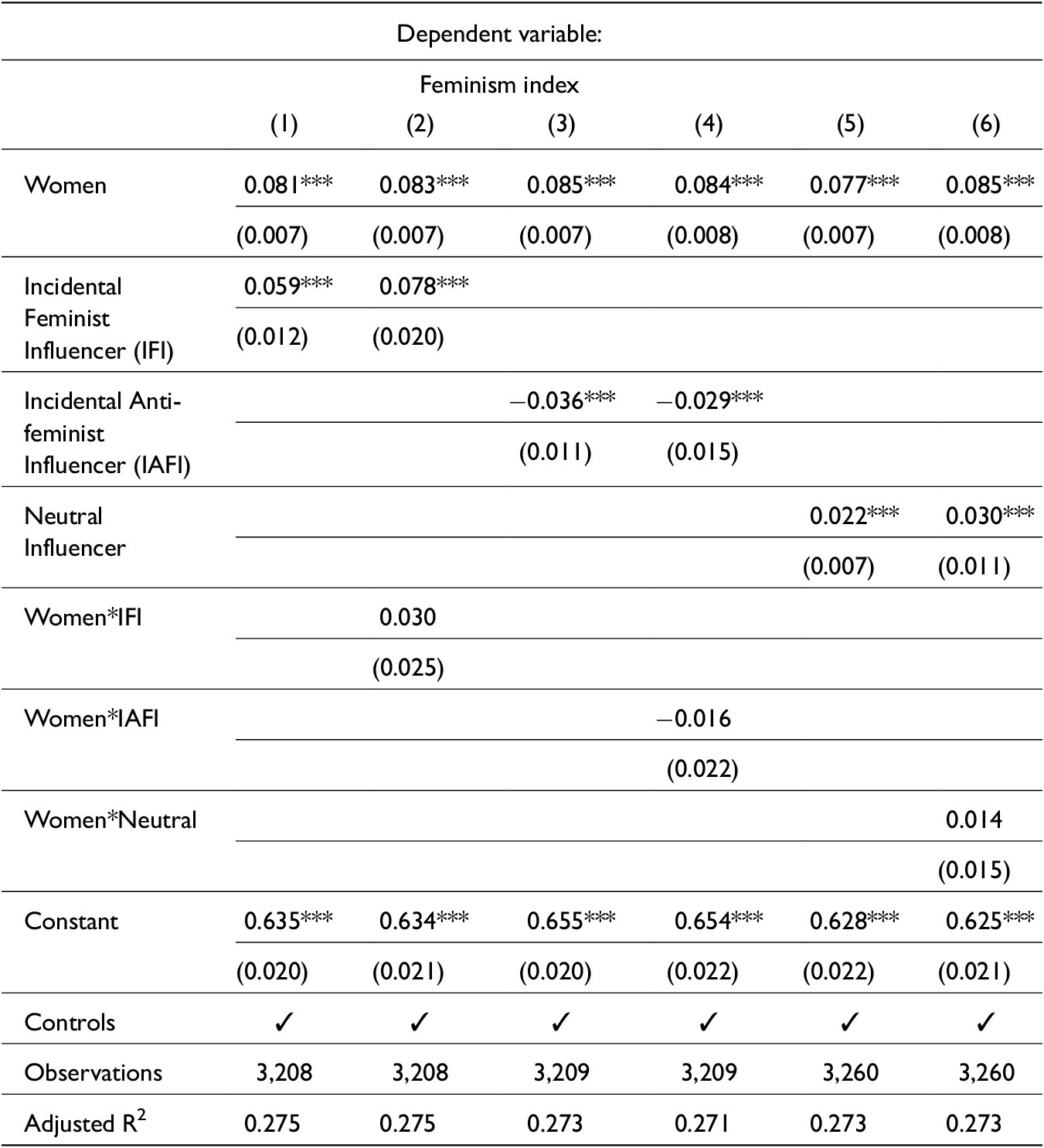
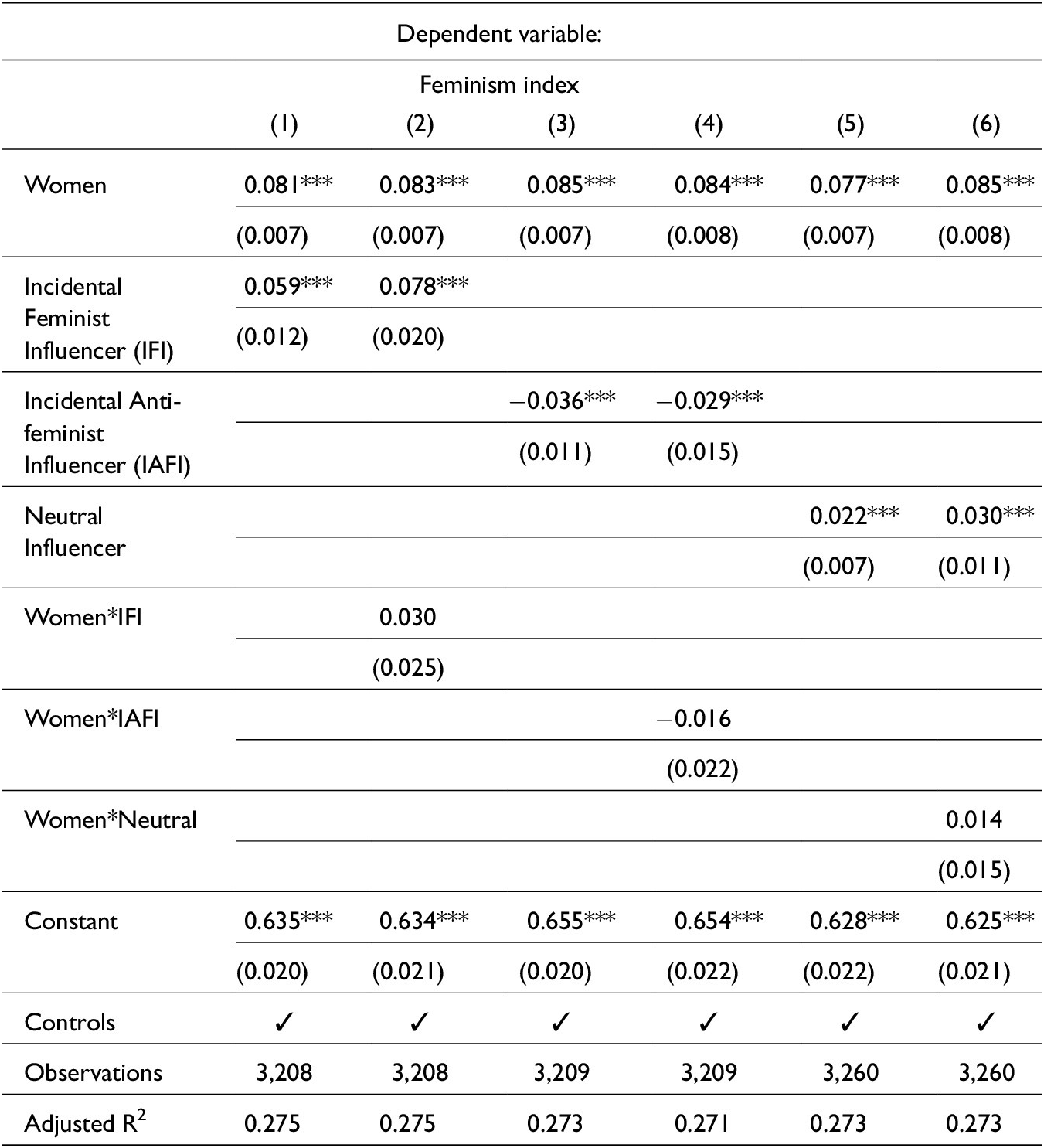
Table 2 shows the results of the OLS robust standard errors estimations of feminist attitudes by gender and the type of influencer, including a number of control variables: age, education, sexual orientation, urban/rural environment, and interest in politics — not shown in Table 2, full OLS estimates are shown in Table A2 in the Supplementary Materials. Table 2 suggests a positive association between following IFIs and presenting pro-feminist attitudes (see column 1). This positive correlation is also observed, though to a lesser degree, among followers of Neutral influencers (see column 5). Conversely, following IAFIs is inversely linked to support for feminist ideas — see the negative coefficient corresponding to IAFI in column 3. Finally, Table 2 confirms that women exhibit higher levels of pro-feminist attitudes, confirming prior studies (Elder, Greene, and Lizotte Reference Elder, Greene and Lizotte2021).
Feminist attitudes and following different kinds of influencers
Source: Our data, December 2022.
Note: Full OLS estimations in Table A2.
* p < 0.1; ** p < 0.05; *** p < 0.01.
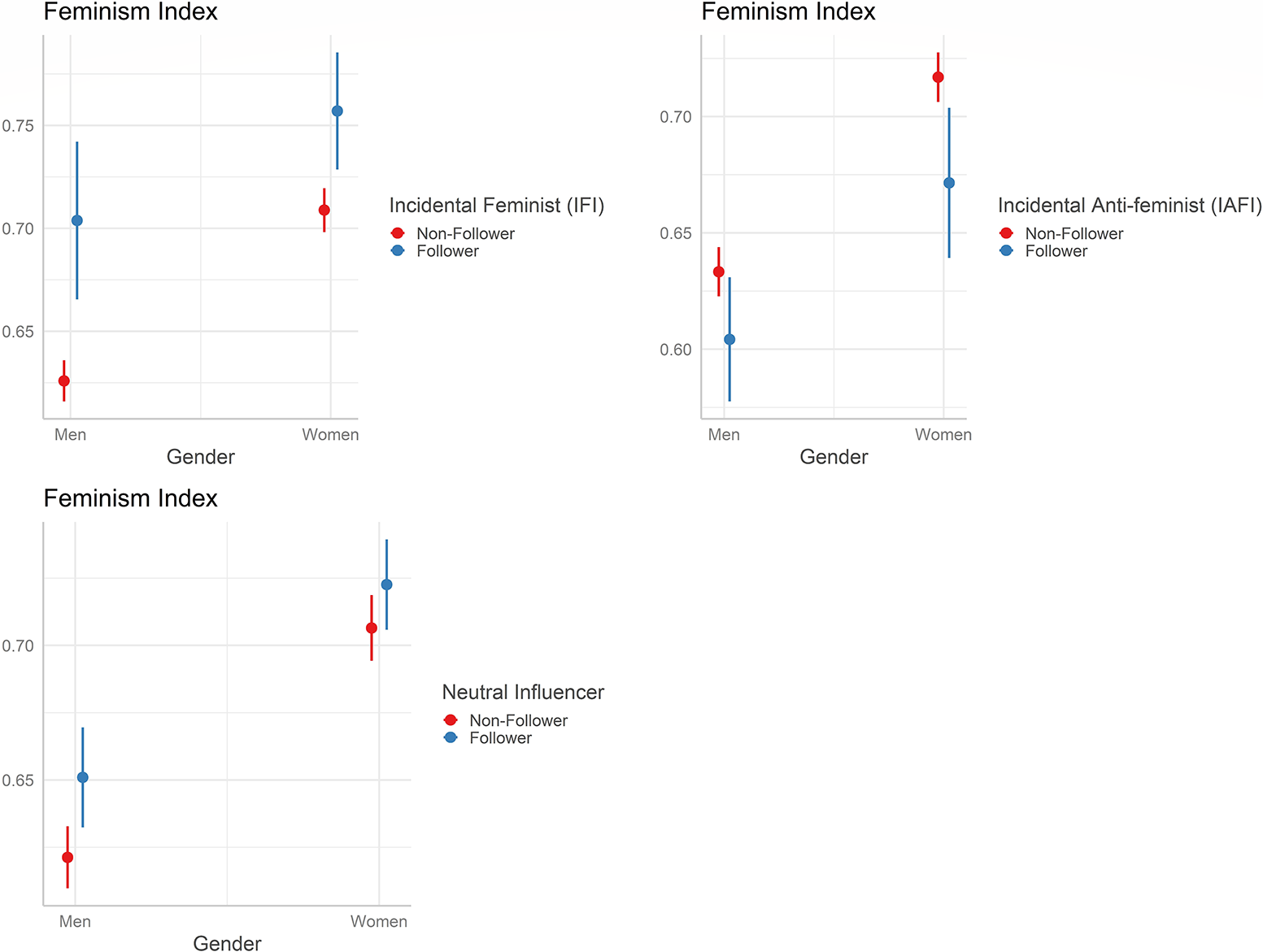
Next, we test whether the identified empirical association between the audiences of IFIs and support for feminism differs for men and women. One plausible scenario suggests that exposure to IFIs might have a greater impact on men. We have reported that women show greater levels of pro-feminist attitudes (see coefficient for women in Table 2), and follow IFIs more than men do (see coefficient for women in Figure 1). Consequently, there may be more potential for men to increase their level of feminism compared to women. To test this possibility, we included an interaction term of declared exposure to the three types of influencers and gender in the estimation, as shown in Table 2, columns 2, 4, and 6 respectively. However, the coefficients corresponding to these three interaction terms are not significantly different from zero. Figure 2 summarizes the main results.
Feminist index by gender and type of influencer followed.
Source: Our data, December 2022.
Note: Predicted probabilities calculated on the base of the estimations summarized in Table 2, columns 2, 4, and 6.

The findings indicate that both men and women show higher levels of feminism when they engage with IFIs, while they show lower levels of feminism when they follow IAFIs. These associations hold true across all instances and are statistically significant. A positive correlation can even be observed among those who follow Neutral influencers, although the size of the differences in the predicted values of feminism between followers and non-followers of Neutral influencers is small compared to the same differences for the case of followers versus non- followers of IFIs.
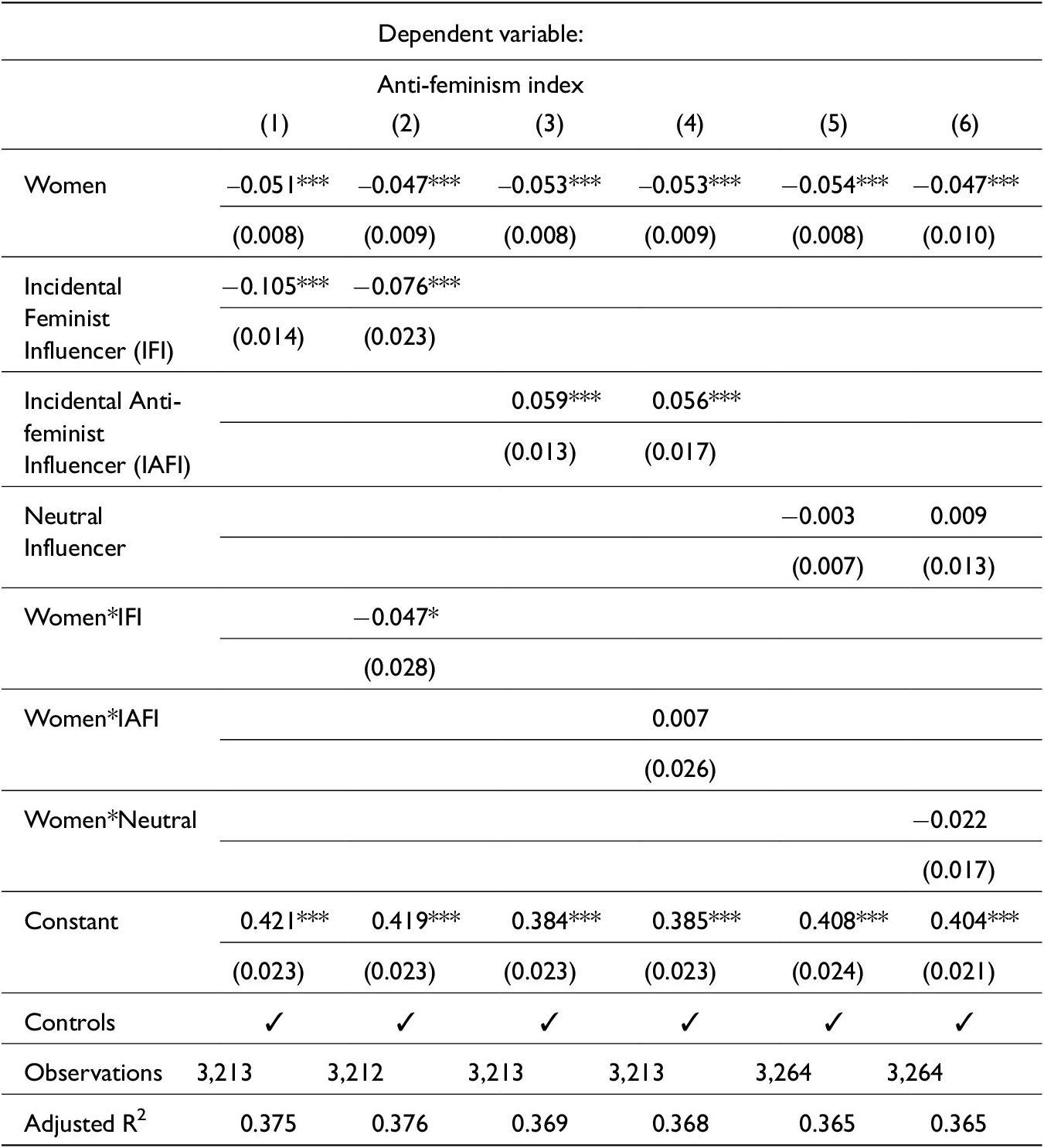
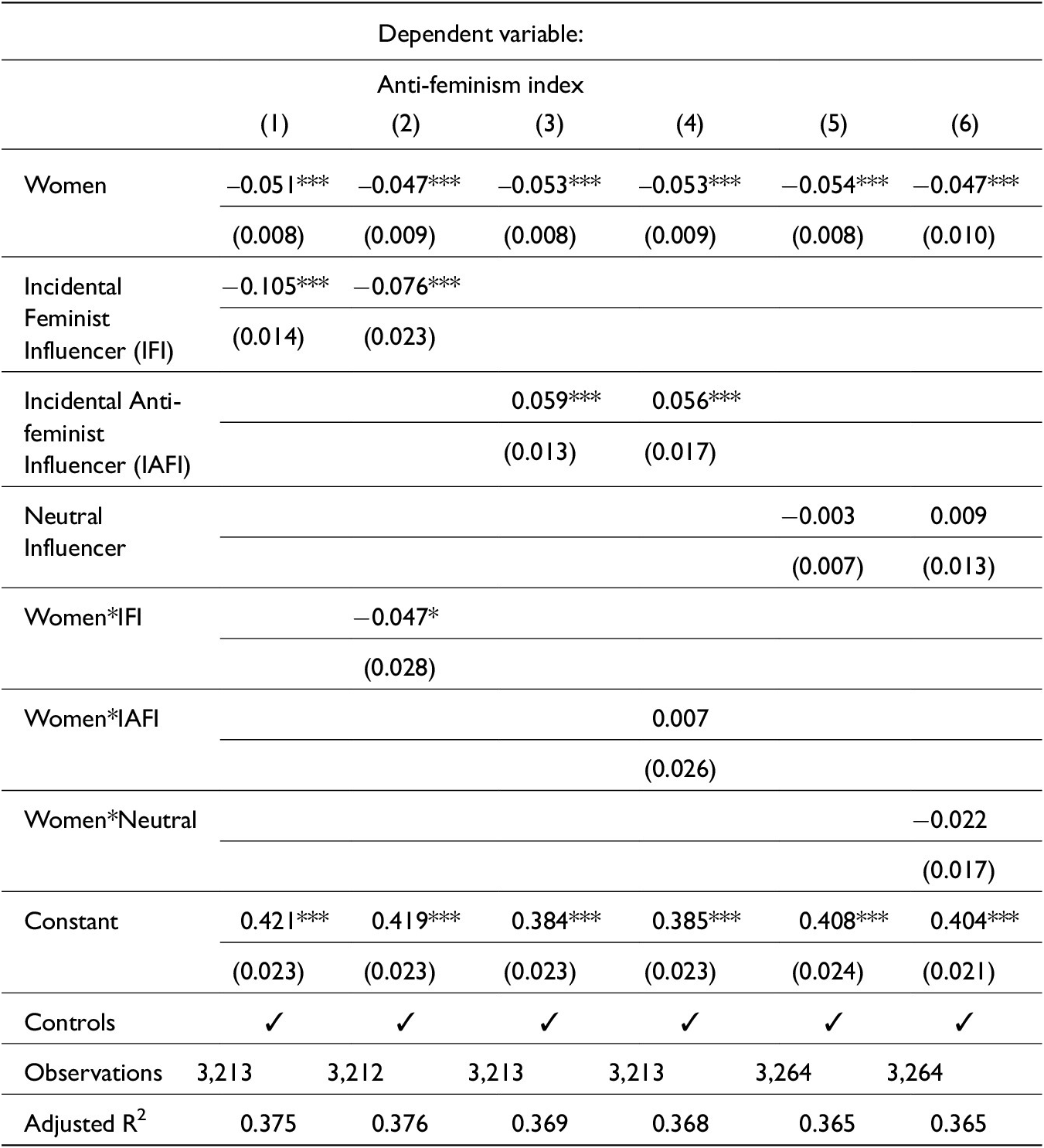
Table 3 repeats the same analysis for anti-feminist attitudes. Individuals who declare to engage with content from IFIs tend to exhibit lower levels of anti-feminism (see the negative coefficient corresponding to IFI in column 1 of Table 3), while those following IAFIs show a significant and positive association with the anti-feminist attitudes (see column 3 of Table 3). In contrast, following Neutral influencers does not appear to be associated with anti-feminist attitudes (see column 5 of Table 3). As in the previous estimation, we test whether the size of the association between the audience of IAFIs and support for anti-feminism differs between men and women. This means that we include an interaction term between reported exposure to the three types of influencers and gender in the estimation — see Table 3, columns 2, 4, and 6 respectively. The coefficient corresponding to the interaction term is statistically significant only in the case of IFIs audiences.
Anti-feminist attitudes and following different kinds of influencers
Source: Our data, December 2022.
Note: Full OLS estimations in Table A3.
* p < 0.1; ** p < 0.05; *** p < 0.01.
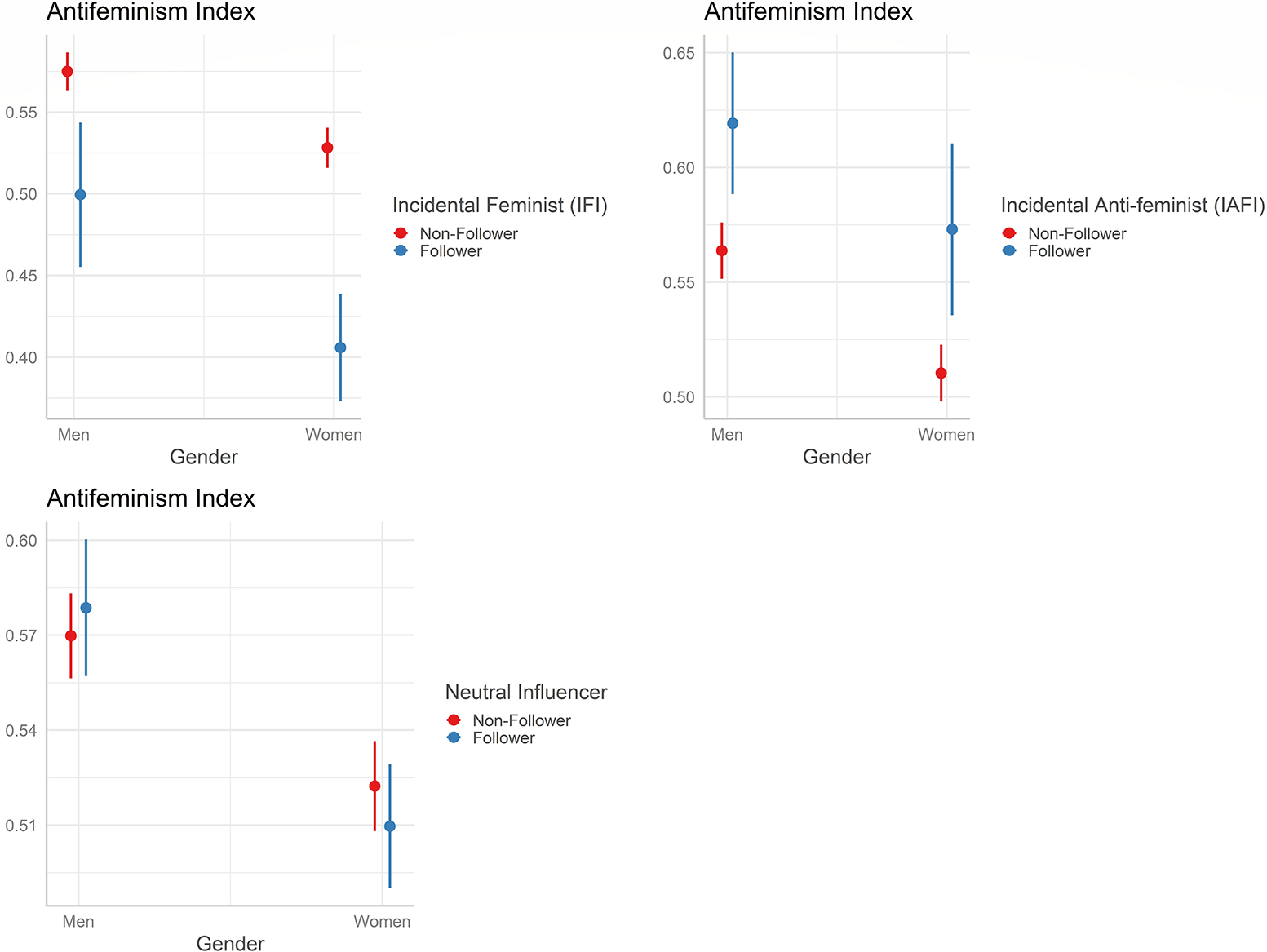
Figure 3 summarizes the main results. Findings indicate that both men and women show lower levels of anti-feminism when they engage with IFIs, and conversely, both show higher levels of anti-feminism when they follow IAFIs. However, the differences between followers and non-followers of IFIs are more pronounced for women. Specifically, the predicted value of the Anti-feminist index for female IFI followers is 0.41, whereas it is 0.53 for women who do not follow IFIs, resulting in a difference of 0.12 for women. In contrast, the corresponding values for men are 0.50 for audiences of IFIs and 0.57 for those not following IFIs, indicating a smaller difference of 0.07 — almost half as large.
Anti-feminist index by gender and type of influencer followed.
Source: Our data, December 2022.
Note: Predicted probabilities calculated on the base of the estimations summarized in Table 3, columns 2, 4, and 6.

In summary, the evidence presented in Tables 2 and 3, as well as Figures 2 and 3, indicates a clear link between public opinion on feminism and anti-feminism and the decision to follow specific types of influencers. We have shown that the assumption that influencers’ audiences do not self-select into receiving political messages about feminism holds true, as interest in politics and ideology show weak associations with following influencers of any kind, especially when compared to age, gender, and sexual orientation. Additionally, we have found that influencers offer a relatively small percentage of content with explicitly anti-feminist or pro-feminist messages. However, we recognize that with these findings we cannot discard the possibility that individuals with strong feminist views may be more inclined to follow influencers who align with their beliefs, even if they follow them for non-political reasons. Similarly, we cannot rule out the possibility that some individuals may even stop following influencers as soon as they express their opinion on a political issue. Accordingly, we have commented our results with causal skepticism (and avoiding the use of causality language), as we cannot resolve the circularity between feminist attitudes and following both IFIs and IAFIs. This is why we have replicated our analyses using propensity score matching. We discuss the results of this additional analysis in the following section.
Robustness Analysis
Following prior studies that have used PSM to show the persuasive effects of traditional media on public opinion (see, for example, Fraile and Iyengar Reference Fraile and Iyengar2014, and Soroka et al. Reference Soroka2013 for the case of newspapers and television news programs) we replicate our analyses using this technique. PSM allows us to compare individuals that are identical in terms of their sociodemographic and political background, except for the fact that some individuals follow a particular type of influencer while others do not. This strategy provides more conservative estimates that adjust for self-selection tendencies within particular audiences.
To create the matched samples in the PSM, we used the same variables that were used to identify the most typical profile of the audiences of the three types of influencers shown in Figure 1: gender, age, educational level, rural or urban, sexual orientation, interest in politics, and ideology. We confirmed that the PSM satisfied the necessary balancing properties since both the standardized mean differences (SMD) and variance ratios (VR) met the required standards (SMD < 0.25 and VR = 0.5-2.0).
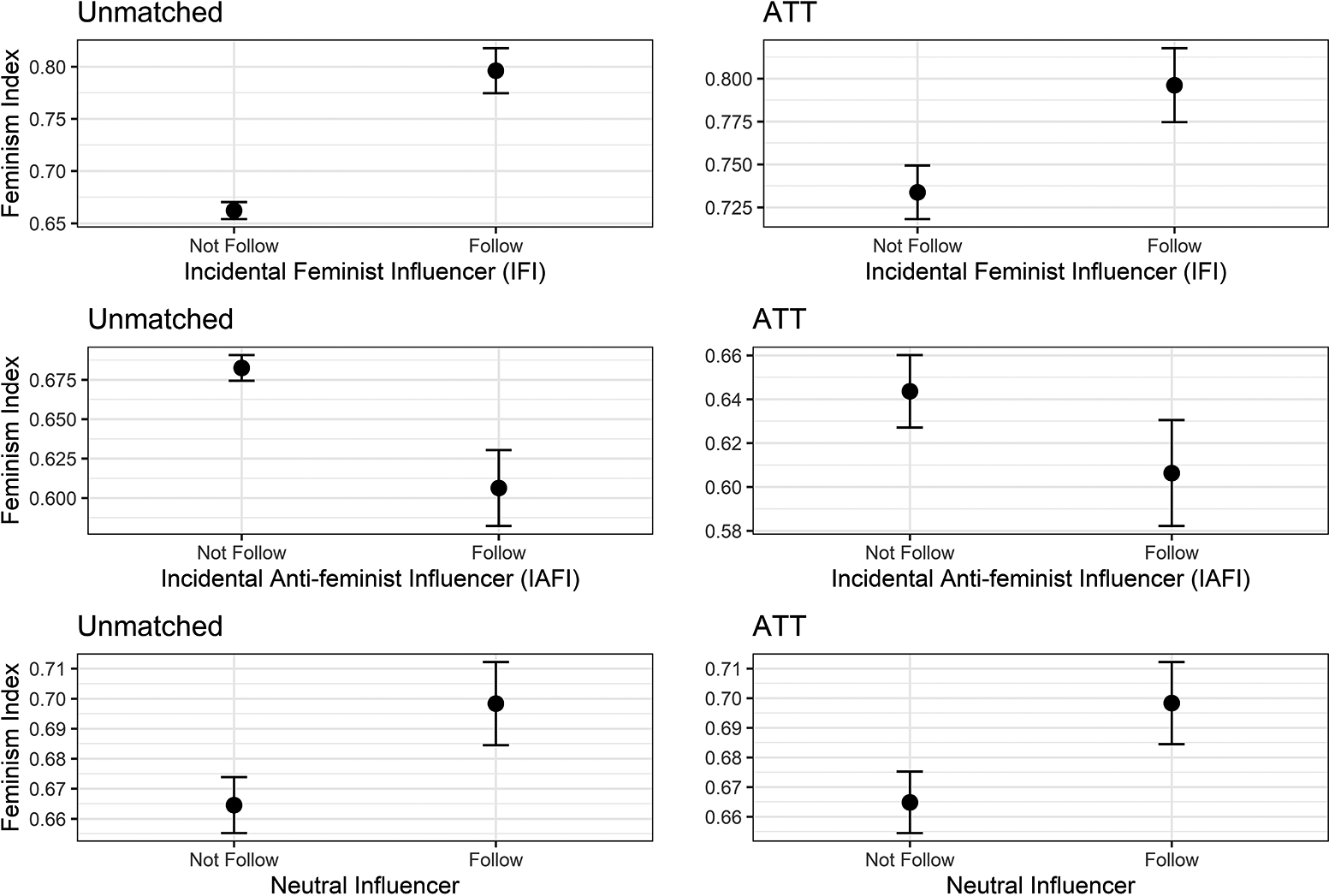
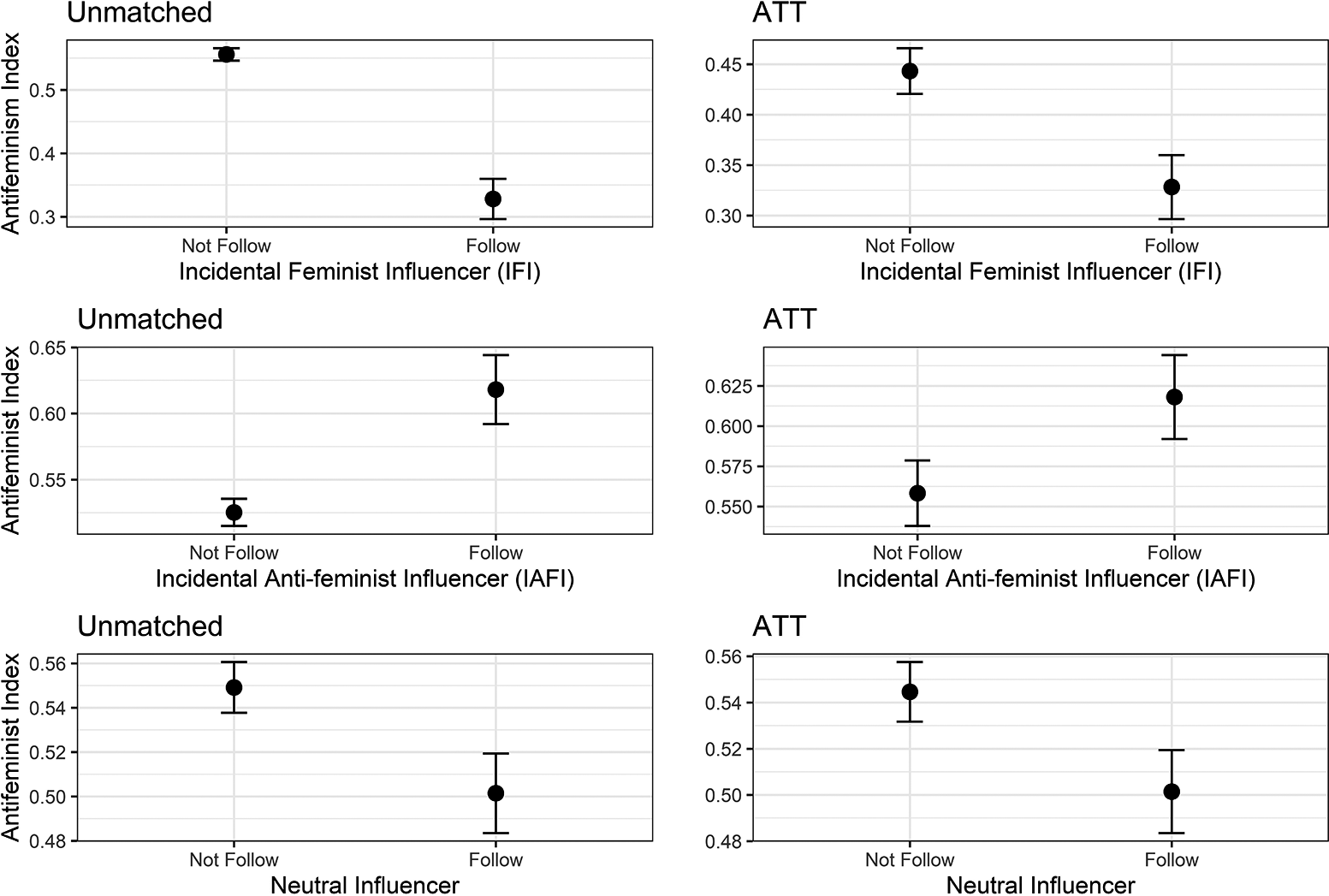
Table A4 in the Supplementary Materials summarizes the PSM results contrasting the estimated differences in the values of the Feminist index between the treated and untreated group — that is, followers and non-followers of each type of influencer — while Table A5 provides the same information for the Anti-feminist index. More specifically, in the first row we see the differences in feminist (Table A4) and anti-feminist (Table A5) attitudes between followers and non-followers of each type of influencer before matching, while in the second row we see the same differences after matching (that is, once we implemented the PSM technique). Figures 4 and 5 visually display these differences by comparing the predicted values of the Feminism and Anti-feminism indexes for audiences versus non-audiences of each type of influencer. It shows this comparison both in the unmatched sample, using a naive OLS estimation, and in the context of the Average Treatment Effect (ATT) with PSM.
Exposure to influencers and predicted feminist attitudes.
Source: Our data, December 2022.
Note: Full PSM results in Table A4 in the Supplementary Materials.

Exposure to influencers and anti-feminist attitudes.
Source: Our data, December 2022.
Note: Full PSM results in Table A5 in the Supplementary Materials.

In Figure 4, the upper left corner indicates an average 12 percentage point increase in support for feminism among followers of IFIs. After applying PSM (top right of Figure 4), the effect size decreases by almost half but remains positive and statistically significant, showing a 6 percentage point impact on support for feminism. Similarly, support for feminist ideas decreases by 3.4 percentage points when following IAFIs. For Neutral influencers, the results remain positive and significant, albeit with a less substantial effect (3.4 percentage point increase).
Regarding the Anti-feminist index (Figure 5), following IFIs results in a decrease of over 11.5 percentage points in support for anti-feminist ideas compared to similar profiles (top right of Figure 5). Conversely, following IAFIs leads to a 6 percentage point increase in support for anti-feminist ideas (middle section of Figure 5). Interestingly, these findings suggest that IFIs have more persuasive power to discourage anti-feminism than to promote feminism. Finally, following neutral influencers reduces support for anti-feminism by 4 percentage points (bottom right of Figure 5).
Conclusions and Implications
The power of influencers extends far beyond merely shaping their audience’s purchasing decisions. Emerging research suggests that influencers can also significantly impact public opinion, as well as political attitudes and behaviors (Allgaier Reference Allgaier2020; Harff and Schmuck Reference Harff and Schmuck2023; Riedl, Lukito, and Woolley Reference Riedl, Lukito and Woolley2023). Moreover, recent studies have convincingly reported how radical right-wing influencers contribute to the rise and spread of a global radical right agenda (Leidig Reference Leidig2023; Maly Reference Maly2024). However, the persuasive power of non-political influencers remains largely underexplored. This study aims to fill this gap by investigating the impact of non-political influencers. We demonstrate that spontaneous, offhand comments by these influencers about feminism can impact attitudes toward feminism in Spain, either reinforcing or altering them.
Influencers can leverage their enormous reach and perceived authenticity to subtly influence the opinions of their audiences, even on topics not directly related to the niche in which they have built their audiences. We argue that influencers facilitate persuasive communication by making political content more accessible, understandable, and salient to audiences who might not otherwise seek such information. Influencers also draw from the content generated by their communities, strategically adapting it to foster greater engagement. Nevertheless, the centralized social media networks in which influencers operate give them a powerful position to disproportionately sway not only the behavior of their followers (as commercial brands have recognized by financing them), but also their political attitudes. Unlike decentralized, egalitarian networks where the spread of ideas depends on their quality, centralized networks centered on influencers enable these figures to have an outsized impact on the virtual communities around them (Centola Reference Centola2021).
Our findings are relevant beyond the Spanish context, particularly in Latin America, where influencers can reach audiences across Spanish-speaking countries where feminism is also prominent in public discourse. Feminist mobilizations in Latin America have gained significant momentum over the past decade, addressing issues such as gender-based violence, reproductive rights, and femicide. Movements such as Argentina’s #NiUnaMenos (Not One Woman Less) and Chile’s LasTesis Collective have achieved global visibility, contributing to substantial legal and social change across the region (Fernández Anderson Reference Fernández Anderson, Bada and Rivera-Sánchez2021).
From a comparative perspective, the role of influencers in shaping public opinion may differ in countries that are less open to feminist ideas. In contexts where discussions of feminism and gender equality are prohibited by law, influencers may avoid even casual comments on feminism or anti-feminism altogether. Conversely, in a conservative environment lacking specific legal barriers against the spread of hate, threats, or discriminatory messages, radical anti-feminist content may be more easily disseminated and normalized, which could amplify the effects observed in our study.
While much work remains to be done, the findings presented in this study highlight the important role that social media influencers can play in public discourse on contentious social debates. For example, recent survey evidence in Europe indicates the emergence of critical public opinion regarding certain advancements achieved by women. In particular, a relevant segment of young men perceives the promotion of women’s rights as a threat to their own opportunities (Off, Charron, and Alexander Reference Off, Charron and Alexander2022), fueling resentment against the progress women have made in their societies. Our study suggests that while there are few influencers who can be classified as clearly anti-feminist, they enjoy massive popularity on their platforms — such as Naim Darrechi with more than 29 million followers on TikTok in 2022 — and therefore have the potential to contribute to the development and spread of anti-genderism in their respective societies.
The role of non-political mainstream influencers in the spread of anti-gender movements is incidental but potentially far-reaching. These influencers can reach people who are not initially interested in gender issues, as the reception mechanism suggests. They can help normalize hostile attitudes toward gender equality and feminism by spreading the messages in accessible and engaging ways. Moreover, they can make these messages salient for their audiences, who can later remember them when forming opinions about feminist issues, as the response mechanism suggests. This makes generalist influencers significant, albeit occasional, actors in the spread of anti-gender equality sentiments.
Furthermore, the power of influencers can extend beyond citizenship and shape the communication style of certain political leaders. For example, another new line of research has highlighted the rise of the so-called “influencer-politician figure” (Gandini, Ceron, and Lodetti Reference Gandini, Ceron and Lodetti2022). These are politicians who adopt the practices, style, and aesthetics of influencers in their political communication strategies in order to quickly gain widespread popularity.
To conclude, ongoing interdisciplinary research is crucial to fully understand the impact of influencers on social life. With this study, we hope to have contributed to opening up a new research agenda for the near future. Of course, this study has its limitations. Due to its observational nature, no definitive causal conclusions can be drawn about the link between influencer content and audience attitudes. Future research could use a longitudinal approach to examine individual variations in exposure to influencers over time, facilitating a deeper understanding of causality in a broader context.
Supplementary material
The supplementary material for this article can be found at http://doi.org/10.1017/S1743923X24000539.
Acknowledgments
We extend our gratitude to Teresa Martínez, Lidia Nuñez, Raúl Villegas and María Hernández for their exceptional coding efforts, which were essential to building the content database of the 26 influencers. We also thank the editor and reviewers at P&G for their valuable feedback on earlier versions of this article. Furthermore, we appreciate the insightful comments provided by participants in seminars held at the Forum de Recerca (UPF), the IPP-Permanent Seminar (CSIC), and the VI Jornada de Comportament Polític i Opinió Pública.
Support for our study was provided by the project GenPsyche (PID2019-107445GB-I00/AEI/https://doi.org/10.13039/501100011033) directed by Fraile and financed by AEI (the Ministry of Science and Innovation, Spain), by the project GenYstereo financed by La Caixa flash call FS22_1B (and co-directed by Fraile and Zuluaga), and by a Juan de la Cierva grant to Zuluaga (FJC2021-047752-I/AEI/10.13039/501100011033) financed by AEI and NextGenerationEU/PRTR.
Competing interest
None.


 Open access

