


One differential characteristic of some strains of lactic acid bacteria (LAB) used as probiotics compared with other microorganisms is their ability to survive during gastrointestinal transit Reference Ljungh and Wadstrom1. This allows them to interact with commensal microbiota and/or intestinal epithelial cells and also with mucosa-associated lymphoid cells Reference Guerin-Danan, Chabanet, Pedone, Popot, Vaissade, Bouley, Szylit and Andrieux2, Reference Vitini, Alvarez, Medina, Medici, de Budeguer and Perdigon3. The communications between these systems result in the induction or modulation of a number of biological activities that can provide beneficial effects for health Reference Yasui, Shida, Matsuzaki and Yokokura4. It is accepted that not all LAB strains show probiotic effects and that, with respect to their effects on the host's immune system, a high variability among species and among different strains of the same species is to be expected.
Probiotics are thought to reinforce the intestinal barrier and help maintain normal permeability. On the other hand, LAB have been described binding to the luminal side of the M cells present in the epithelium over the intestinal Peyer's patches and providing antigen transport that facilitates the stimulation of the underlying lymphoid tissue. There is also the possibility that dendritic cells anchored between epithelial cells provide a sampling function of luminal bacteria Reference Corthesy, Gaskins and Mercenier5. Following capture by dendritic cells, the activation of IgA responses is triggered locally and at distant mucosal sitesReference Macpherson and Uhr6 which enhances immune exclusion of foreign antigens Reference Fang, Elina, Heikki and Seppo7. In addition, the interaction of probiotic strains with immune cells in the mucosal environment has a principal role in a number of processes directly dependent on the mucosa associated lymphoid tissue (MALT), such as oral tolerance induction, the modulation of cytokine and chemokine release (i.e. induction of regulatory T cell cytokines) and in general, the regulation of immune responses in the intestinal mucosa which are important in the pathogenesis of inflammatory bowel diseaseReference Isolauri8.
Exposure to different challenges during life, either internal or environmental, interferes with the normal development and balance of the healthy gut microbiota. These factors include the early encounter of environmental insults in the newborn, dietary issues such as infant formula feeding, antibiotic treatment, age-related changes in the intestinal physiology and hence in the microbiota, and gastrointestinal diseases and stress. These factors act upon the idiosyncratic immune characteristics of each individual, derived from their genetic background, and drive the development of the immune system and the immune responses triggered by variable stimuli. As the number of environmental insults increases, the damage to the microbiota increases, along with the risk of inflammatory and allergic diseases Reference Isolauri, Kirjavainen and Salminen9. Probiotics might help restore gastrointestinal health and immune responses in such circumstances. Physiological and pathological conditions occurring at different stages in life that might benefit from probiotic therapy will be addressed below.
Gestation and newborns
The effect of Lactobacillus GG on the prevention of atopic disease has been studied in a group of pregnant women from atopic familiesReference Rautava, Kalliomaki and Isolauri10. A Lactobacillus rhamnosus GG (LGG) supplement was consumed by the mothers for 4 weeks at the end of their pregnancy and during the breast-feeding period until the child was 3 months old. The potential immunoprotection provided by breast milk was increased as assessed by the concentration of anti-inflammatory transforming growth factor β2 (TGF-β2) in the milk of mothers who received probiotics compared with a placebo group. Moreover, the risk of developing atopic eczema during the first 2 years of life in the infants whose mothers received probiotics was significantly reduced in comparison with that of infants whose mothers received the placebo (15 % and 47 %, respectively). These results support the protective effect of this probiotic strain against atopic eczema during the first 2 years of life. A more recent study by Kukkonen et al. Reference Kukkonen, Savilahti, Haahtela, Juntunen-Backman, Korpela, Poussa, Tuure and Kuitunen11 was carried out in pregnant women carrying children at high-risk of allergic disease. Mothers received capsules containing LGG, L. rhamnosus LC705, Bifidobacterium breve Bb99 and Propionibacterium freudenreichii ssp. shermanii JS during the 2 to 4 weeks before delivery. Their infants received the same combination of probiotics plus galacto-oligosaccharides or a placebo for 6 months. At 2 years of age the probiotic treatment showed no effect on the cumulative incidence of allergic diseases but significantly prevented eczema and especially atopic eczema (a 34 % relative risk reduction) supporting the inverse association between atopic diseases and colonisation of the gut by probiotics.
The potential use of probiotics in allergic asthma has been investigated in murine models after oral-allergen sensitisation and development of airway inflammation and hyper-reactivityReference Feleszko, Jaworska and Rha12, Reference Blumer, Sel, Virna, Patrascan, Zimmermann, Herz, Renz and Garn13. In these models, the protective effect of probiotics has been assessed through an early administration given either to newbornsReference Feleszko, Jaworska and Rha12 or perinatally, to the pregnant and lactating motherReference Blumer, Sel, Virna, Patrascan, Zimmermann, Herz, Renz and Garn13. Significant effects have been observed in relation to the suppression of inflammation (i.e. reduced eosinophil influx and allergy related cytokines such as IL-5 and IL-10) and airway reactivity with strains such as LGG or Bifidobacterium lactis.
Infants and children
Immunosuppression is usually secondary to malnutrition and has negative health effects. In an attempt to correct these situations, different studies have been focused on the immunological effects of LAB in malnourished children. The effect of yoghurt (milk fermented with Lactobacillus bulgaricus and Streptococcus thermophilus) was studied in the refeeding of hospitalised malnourished children showing a weight for height value between 70 and 80 %, compared with a control group with similar characteristics, receiving the same amount of milk without probiotics in their diet. An increase in serum IFN-γ was found in the group consuming yoghurtReference Solis, Nova, Gomez, Samartin, Mouane, Lemtouni, Belaoui and Marcos14, which might indicate maintenance of an improved resistance against pathogens.
The efficacy of LAB on the treatment of infantile diarrhoea (especially that due to rotavirus infection) has been assessed in many studies. LGG is one of the most extensively studied strainsReference Isolauri, Juntunen, Rautanen, Sillanaukee and Koivula15–Reference Guandalini, Pensabene and Zikri18. Two meta-analyses have reported that LGG is associated with moderate clinical benefits in the treatment of acute diarrhoea in children, namely a significant reduction in diarrhoea duration (approximately 1 day), particularly of rotavirus aetiology (about 2 days shorter), and duration of hospitalisation Reference Szajewska, Skorka, Ruszczynski and Gieruszczak-Bialek19, Reference Huang, Bousvaros, Lee, Diaz and Davidson20. However no significant reductions in the number of stools or total stool volume were found. Sometimes the reduced duration of diarrhoea has been accompanied by an increase in rotavirus-specific IgA-secreting cellsReference Kaila, Isolauri, Soppi, Virtanen, Laine and Arvilommi16, Reference Majamaa, Isolauri, Saxelin and Vesikari17. Lactobacillus acidophilus might provide similar effectsReference Simakachorn, Pichaipat, Rithipornpaisarn, Kongkaew, Tongpradit and Varavithya21, Reference Lee, Lin, Hung and Wu22 but not all studies have confirmed these resultsReference Khanna, Alam, Malik and Malik23. LGG might also be effective in the prevention of antibiotic associated diarrhoeaReference Arvola, Laiho, Torkkeli, Mykkanen, Salminen, Maunula and Isolauri24, Reference Vanderhoof, Whitney, Antonson, Hanner, Lupo and Young25, nosocomial infection diarrhoeaReference Szajewska and Mrukowicz26 and diarrhoea secondary to malnutritionReference Oberhelman, Gilman, Sheen, Taylor, Black, Cabrera, Lescano, Meza and Madico27. Some species of bifidobacteria, such as B. infantis and B. bifidum, in combination with lactobacillus have been evaluated in the treatment and prevention of diarrhoea with good resultsReference Lee, Lin, Hung and Wu22, Reference Saavedra, Bauman, Oung, Perman and Yolken28.
Adolescents
Eating disorders
Anorexia nervosa (AN), which is a relatively frequent eating disorder in modern society during adolescence, causes patients to present a very undernourished status with peculiar immunological alterationsReference Nova, Gomez-Martinez, Morande and Marcos29, Reference Marcos30. We studied the effect of yoghurt intake (375 g/day) over 10 weeks in a group of AN patients recruited at hospital admissionReference Nova, Toro, Varela, Lopez-Vidriero, Morande and Marcos31. The findings suggested that the inclusion of yoghurt in the refeeding therapy of AN patients may exert positive effects on the immunological markers related to the nutritional status of these patients, as shown by the higher ratio of CD4+ to CD8+ cells in the blood of patients consuming yoghurt compared to those consuming milk and by the increased production of IFN-γ by PHA-stimulated peripheral blood mononuclear cells (PBMC) both in anorexia nervosa patients and healthy adolescents receiving yoghurt treatmentReference Nova, Toro, Varela, Lopez-Vidriero, Morande and Marcos31.
Adults
Healthy youth
A variety of experimental approaches in vivo and in vitro have been followed in order to test the effects of LAB on cytokine production by immune cells. Firstly, the incubation of PBMC from healthy young adults with Lactobacillus casei, Lactobacillus acidophilus or Bifidobacterium, in vitro, induced an enhancement of IL-1, TNF-α and IFN-γ productionReference Solis-Pereyra, Aattouri and Lemonnier32. In addition, a number of in vivo or ex vivo studies have demonstrated that LAB consumption has a positive effect on IFN production in humansReference De Simone, Vesely and Bianchi-Salvadori33–Reference Halpern, Vruwink and Van de Water35 possibly leading to an improved capacity of macrophages and NK cells to kill virus-infected cells or tumour cells. An increase in the 2’ 5’ adenylate synthetase activity (an enzyme which is induced by IFN-γ) in PBMC has been observed in subjects 24 hours post-consumption of a single dose of yoghurt containing 10Reference Kukkonen, Savilahti, Haahtela, Juntunen-Backman, Korpela, Poussa, Tuure and Kuitunen11 bacteriaReference Solis Pereyra and Lemonnier36 and also after yoghurt consumption during 15 days compared with milk consumption in a cross-over studyReference Solis-Pereyra, Aattouri and Lemonnier32.
Stressful situations in youth
The effects of psychological and physical stress on health are an increasingly relevant topic of research due to the current lifestyle in our society. Although a certain amount of moderate stress is even considered beneficial, surpassing the threshold has some negative effects on the immune system and causes an impaired resistance to infection. The effect of milk fermented with yoghurt cultures plus Lactobacillus casei DN-114001 (108/ml) on the immune system of subjects under academic examination stress was evaluated in a study with university students consuming either 200 ml/day of the fermented product or 200 ml/day of semi-skimmed milk. Although both groups showed increased cortisol and anxiety levels during the exam-taking period, the control group showed a decrease in NK cells that was prevented in the group consuming the fermented milk, who, in addition, showed an increase in numbers of lymphocyte cellsReference Marcos, Warnberg, Nova, Gomez, Alvarez, Alvarez, Mateos and Cobo37. This result could influence susceptibility to infection, which is believed to be higher under stressful conditions.
Infections
Probiotics are also considered beneficial in the prevention of urinary tract infections (UTIs) in fertile women as observed in a case-control study comparing dietary and lifestyle habitsReference Kontiokari, Laitinen, Jarvi, Pokka, Sundqvist and Uhari38. However, oral ingestion of LGG did not display any clinical efficacy in the protection against UTIs in a controlled intervention trial, which might indicate differences between strainsReference Kontiokari, Sundqvist, Nuutinen, Pokka, Koskela and Uhari39. Regarding microecology of the vagina, in a randomised, double-blind, placebo-controlled study of 64 healthy women, daily intake of L. rhamnosus GR-1 and L fermentum RC-14 resulted in significantly less yeast and fewer coliforms in the vaginaReference Reid, Charbonneau and Erb40. Administration of the probiotic organisms even normalised flora in some cases of bacterial vaginosis, making it feasible to study this as an approach to long-term therapy for pregnant women and those susceptible to bacterial vaginosis and urinary tract infections. Adhesion and colonisation of the vaginal epithelium by the strain for days or even weeks may be necessary. Insertion of lactobacilli into the vagina via a pessary or capsule is an effective means of boosting the content of the flora and overcoming some pathogens or reducing their ability to dominateReference Reid and Bruce41.
Allergies
The possible utility of probiotics in allergy has received a considerable amount of attention during the last fifteen years. However the evidence is still not strong enough to define any one strain as clearly beneficial in allergy treatment; neither are the mechanisms leading to the observed effects well defined. Remission of nasal allergy symptoms has been described in 42 young subjects and 56 adults consuming 200 g of yoghurt/day for one year in two separate studiesReference Trapp, Chang and Halpern42, Reference Van de Water, Keen and Gershwin43. No differences, however, were found in the immunological parameters measured. On the other hand, a study in adults with asthma taking 225 g of milk fermented with L. acidophilus twice a day for one month showed a tendency towards increased concentrations of IFN-γ and a decrease in eosinophil countsReference Wheeler, Shema, Bogle, Shirrell, Burks, Pittler and Helm44. In this last study, however, no improvement was observed in the clinical symptoms or quality of life. A putative capacity of probiotics to direct immune responses towards the production of Th1 profile cytokines could be a possible mechanism to substantiate the use of LAB in the treatment of allergic diseases.
A study with L. rhamnosus administered for 3·5 months to young adult patients suffering from birch allergy showed no effect of the probiotic treatment on the allergy symptoms or the use of medication compared to the placebo groupReference Helin, Haahtela and Haahtela45. In summary, the evidence for a positive effect of probiotics in allergic diseases is still weak except in the case of atopic eczema.
Phagocytic activity
One of the immune functions for which more evidence of susceptibility to modulation by probiotic consumption exists is phagocytic activity by peripheral blood leukocytes. It has been documented in healthy volunteers that dietary deprivation of fermented foods for 2 weeks decreases the phagocytic activity of leukocytesReference Olivares, Paz Diaz-Ropero, Gomez, Sierra, Lara-Villoslada, Martin, Miguel Rodriguez and Xaus46. In addition, the consumption of fermented milk containing Lactobacillus acidophilus (7 × 10¹⁰ cfu/d)Reference Schiffrin, Rochat, Link-Amster, Aeschlimann and Donnet-Hughes47 or Lactobacillus johnsonii La1 (107 cfu/d)Reference Donnet-Hughes, Rochat, Serrant, Aeschlimann and Schiffrin48 for 3 weeks increased the phagocytic capacity of healthy adults. Likewise, the consumption of Lactobacillus gasseri CECT 5714 and Lactobacillus coryniformis CECT 5711 or yoghurt alone for 2 weeks increased the phagocytic activity of monocytes and neutrophils in healthy subjectsReference Olivares, Diaz-Ropero, Gomez, Lara-Villoslada, Sierra, Maldonado, Martin, Rodriguez and Xaus49. The dose of bacteria consumed daily has been proven important in achieving the desired effectReference Donnet-Hughes, Rochat, Serrant, Aeschlimann and Schiffrin48. Other effects of probiotic consumption have also been documented in placebo-controlled intervention trials, such as increases in IgA concentration, increased numbers of NK cells and activity, and increased oxidative burst capacity of monocytesReference Olivares, Diaz-Ropero, Gomez, Lara-Villoslada, Sierra, Maldonado, Martin, Rodriguez and Xaus49, Reference Parra, Martinez de Morentin, Cobo, Mateos and Martinez50. However, not all the trials have yielded significant results. A probiotic product containing Bifidobacterium lactis and Lactobacillus paracasei assayed at 5 different concentrations, from low (108) to high (1011), in groups of young healthy adults failed to demonstrate any significant modification of phagocytic activity, faecal IgA concentration or production of IFN-γ and IL-10 by blood cellsReference Christensen, Larsen, Kaestel, Rosholm, Sternberg, Michaelsen and Frokiaer51. Finally, a combination of probiotic bacteria (Lactobacillus gasseri PA 16/8, Bifidobacterium longum SP 07/3, B. bifidum MF 20/5; 5 x 10⁷ cfu/d) in a dietary vitamin and mineral supplement offered to healthy adults for 3 or 5 months in winter/spring seasons, respectively, significantly decreased the incidence, and also the symptoms, of common cold infections in comparison with the vitamin mineral preparation given to the control groupReference de Vrese, Winkler and Rautenberg52.
Elderly
Aging is accompanied by a reduction in the functional capacity of all the organs in the body and accordingly the activity of the immune system also declines with age. The senescence of the immune system especially affects cell-mediated immunity with a decrease in lymphocyte proliferation capacity and IL-2 production. However, IgA concentration and antibody titers following immunisation are decreased as wellReference Chandra53. A decrease has also been observed in the ratio of mature to immature T lymphocytesReference Lesourd and Mazari54 and an increase in proinflammatory cytokine and reactive oxygen species (ROS) productionReference Victor and De la Fuente55. Perhaps associated with these immunological changes, and certainly with other physiological and environmental factors, the bifidobacteria numbers in the gut decrease markedly after 55-60 years of age. Functional foods such as probiotic products may have a particular application in this high-risk group, especially in terms of protection against entero- and urogenital pathogens, and perhaps also in the prevention of several age-related diseases.
Two 3-week intervention trials have shown that Bifidobacterium lactis HN019 supplementation (109-1010 cfu/d) increases the phagocytic capacity of monocytes and polymorphonuclear cells and the NK cell tumoricidal activity in elderly subjects Reference Gill, Darragh and Cross56, Reference Chiang, Sheih, Wang, Liao and Gill57. The same bacteria used in a 6 week intervention trial significantly increased the phagocytic activity and the IFN-α production capacity by PBMC in elderly volunteers Reference Arunachalam, Gill and Chandra58. Similar results regarding phagocytic and NK cell activities have been also described following the supplementation of middle aged and elderly subjects with Lactobacillus rhamnosus HN001 in similar doses for 3 weeksReference Sheih, Chiang, Wang, Liao and Gill59.
A randomised, controlled pilot study has been carried out to assess the effect of milk fermented with yoghurt cultures and L. casei DN-114001 on the incidence and severity of winter infections (gastrointestinal and respiratory) in elderly peopleReference Turchet, Laurenzano, Auboiron and Antoine60. 360 free-living elderly subjects took part in the study and those in the treatment group consumed two doses of 100 ml fermented product per day for 3 weeks. Although no difference was found in the incidence of winter infections between groups, the duration of all pathologies was significantly lower in the treatment group than in the control group (19·5 % reduction in days), as was maximal temperature (mean 38·3 s.d 0·5°C treatment group vs. mean 38·5 s.d 0·6 °C control; P = 0·01). Further studies with a double-blind placebo-controlled design should be performed for a better assessment of the usefulness of the fermented product in the enhancement of immune defence in the elderly population.
Conclusion
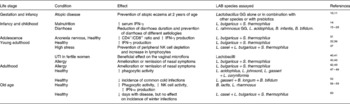
This review has summarised studies that, at different stages during the lifespan, have used probiotics to provide benefits regarding immune responses and health maintenance (Table 1). There is, however, a need for basic and applied research providing new insight into the nature of the interaction established between the probiotic bacteria and the intestinal mucosa, the mechanisms involved and the active component(s) responsible for the effect, whether bacteria wall components, end products of bacteria metabolism or milk proteins which might be immunologically relevant. In addition, increased knowledge about the specific strains that are the most adequate for each specific purpose, as well as the definition of the recommended dose and duration of supplementation is essential in order to substantiate health claims, and to be able to make specific recommendations to individuals and population groups.
Summary of some of the significant effects of different species of LAB shown for different conditions during the lifespan
Conflict of interest statement
AM has had research funding from Danone and Phergal, received consultancy fees from Danone and speaking fees from Danone and Phergal. EN, SGM, LED have received consultancy fees from Danone. JW and JR have no conflicts of interest to declare. All authors co-wrote the manuscript.



