


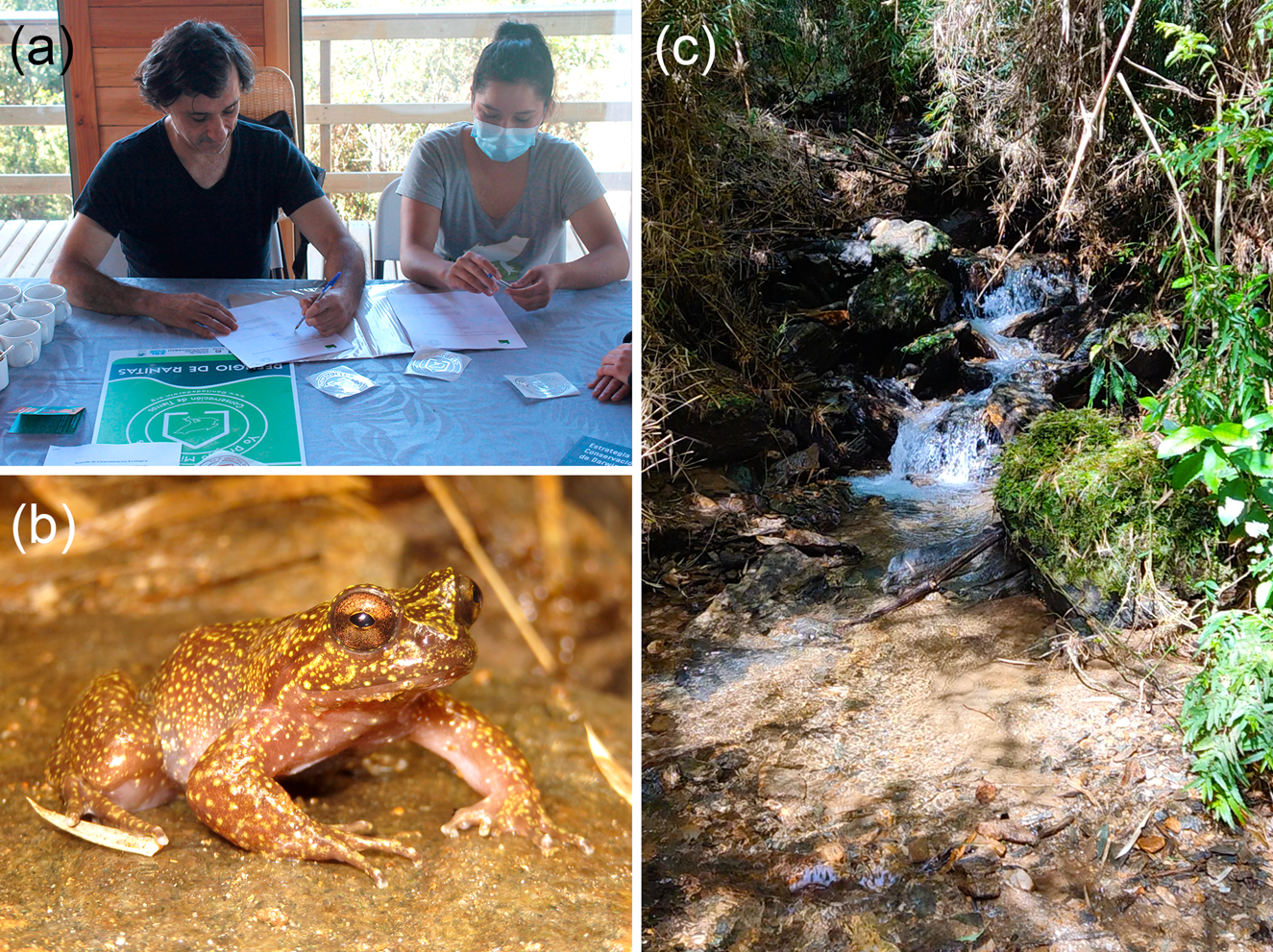
Private land conservation is an important approach that is increasingly utilized to protect biodiversity and can help contribute to the 30 by 30 target of the Global Biodiversity Framework (Cortés Capano et al., Reference Cortés Capano, Toivonen, Soutullo and Di Minin2019; Dinerstein et al., Reference Dinerstein, Vynne, Sala, Joshi, Fernando and Lovejoy2019). In Chile, private initiatives are protecting at least 16,692 km2 of land (Moya Ramírez et al., Reference Moya Ramírez, Palma Torres and Fernández Grossi2016), covering key terrestrial ecosystems that are not protected by the national system of public protected areas (Pliscoff & Fuentes-Castillo, Reference Pliscoff and Fuentes-Castillo2011). Aiming to further increase the conservation value of private lands, in 2018 the NGO Ranita de Darwin designed and launched a land conservation programme to build long-term partnerships with private landowners and protect critical habitat for threatened amphibians in Chilean Patagonia (Azat et al., Reference Azat, Valenzuela-Sánchez, Delgado, Cunningham, Alvarado-Rybak and Bourke2021). Here we describe a new locality record of the micro-endemic, Endangered Barrio's frog Insuetophrynus acarpicus found in the Refugio de Ranitas Aldea del Viento protected area, a 7-ha property that joined the land conservation programme in 2020 (Plate 1a). This is the eighth known locality of this species and one of only three occurring within a protected area (Fig. 1).
(a) Signing of a voluntary land conservation agreement between the landowner (co-author SM) and the NGO Ranita de Darwin for the creation of the protected area Refugio de Ranitas Aldea del Viento, Los Pellines, Valdivia, Chile. (b) An adult Barrio's frog Insuetophrynus acarpicus found in this protected area. (c) The high-gradient stream where the species occurs.
Previously known localities (circles) and new locality record (square) of Barrio's frog Insuetophrynus acarpicus in southern Chile. The shaded area represents the extent of occurrence of Barrio's frogs from the species’ IUCN Red List assessment (IUCN SSC Amphibian Specialist Group, 2018). We extracted geographical coordinates of previously known localities from Contreras et al. (Reference Contreras, Bustos and Rodríguez-Jorquera2020), except for Queule, which we obtained from Méndez et al. (Reference Méndez, Torres-Pérez, Correa, Soto, Nuñez, Veloso and Armesto2006).
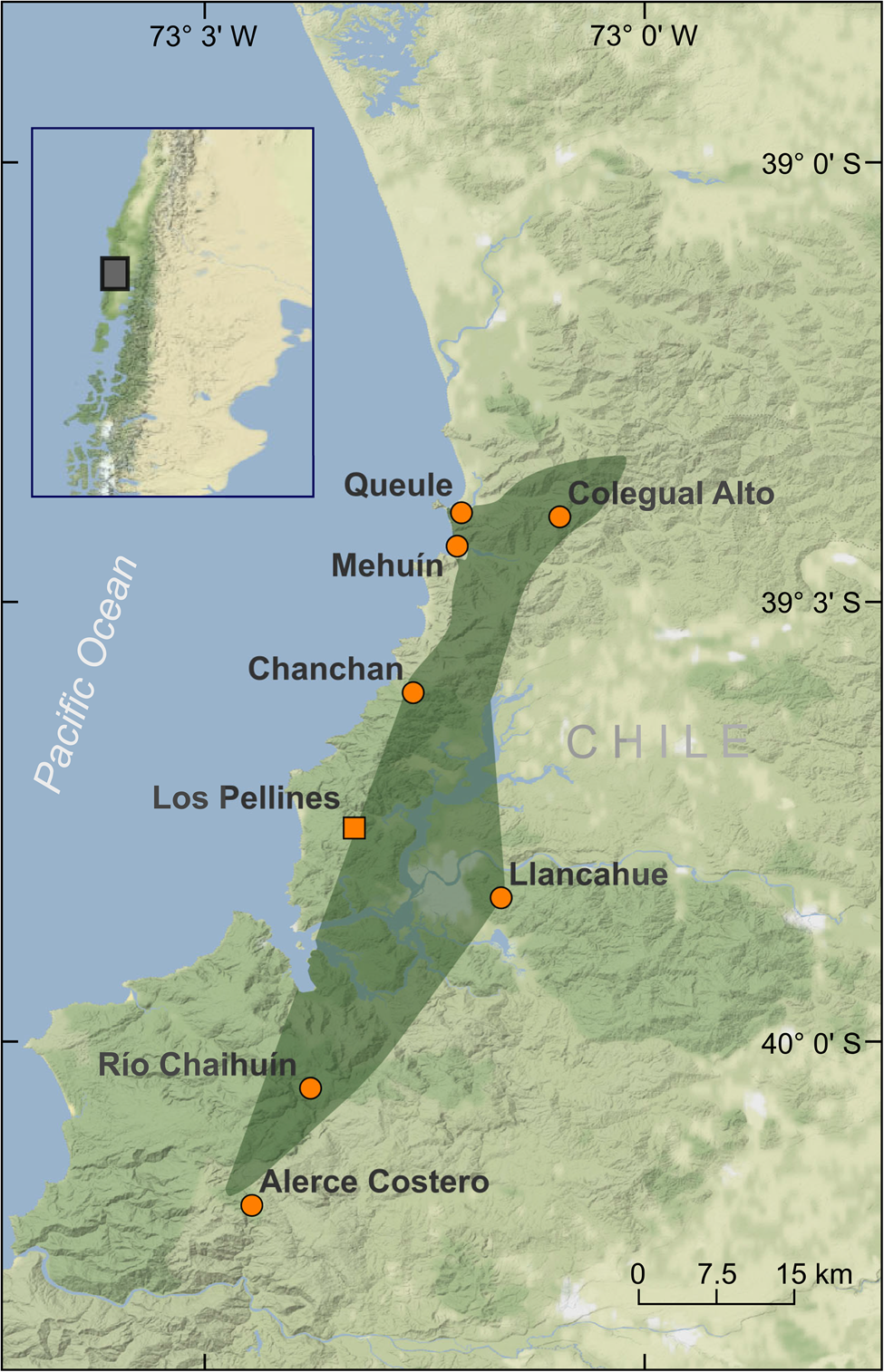
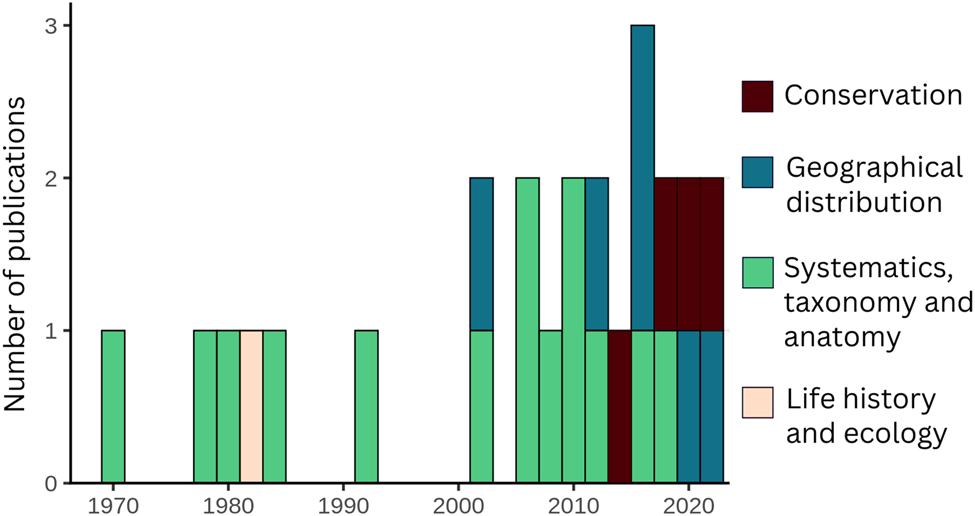
Barrio's frog, along with the northern and southern Darwin's frogs Rhinoderma rufum and Rhinoderma darwinii, are the only known members of the family Rhinodermatidae, a 70 million year-old group of neotropical frogs considered to be the oldest known hyloids, a species-rich clade encompassing 54% of extant anuran species (Feng et al., Reference Feng, Blackburn, Liang, Hillis, Wake, Cannatella and Zhang2017). Darwin's frogs are highly threatened, particularly the northern Darwin's frog, a species last seen over 40 years ago and categorized as Critically Endangered (Possibly Extinct) on the IUCN Red List (IUCN SSC Amphibian Specialist Group, 2015). This situation highlights the importance of Barrio's frog as one of the last representatives of the Rhinodermatidae. Barrio's frog is one of the top 100 most evolutionarily distinct amphibian species (Jetz & Pyron, Reference Jetz and Pyron2018) and is ranked 11th in the Evolutionarily Distinct and Globally Endangered (EDGE) list of amphibians (Safi et al., Reference Safi, Armour-Marshall, Baillie and Isaac2013). This Chilean micro-endemic species is categorized as Endangered because of its limited geographical distribution (1,323 km2; Fig. 1), its highly isolated populations and the continuing decline in the extent and quality of its habitat (IUCN SSC Amphibian Specialist Group, 2018). Most aspects of the natural history and ecology of the species remain unknown (Fig. 2, Supplementary Material 1), limiting our capability to implement evidence-based conservation actions.
Research publications on Barrio's frog published since the description of the species in 1970. We searched for publications using Web of Science and Google Scholar with the terms ‘Insuetophrynus’ OR ‘Barrio's frog’. We excluded species checklists or reviews that mentioned the species without providing novel information or analyses. The search was performed on 7 August 2023. The full list of articles is in Supplementary Material 1.
In April 2022, we identified a Barrio's frog population in the Refugio de Ranitas Aldea del Viento protected area, Los Pellines, Chile. This population, which is 18 km from the nearest known population in Chanchan, fills a gap in the known distribution of Barrio's frogs along the coast of Valdivia (Fig. 1). We found five Barrio's frog individuals along a 200-m section at the source of one of two high-gradient streams in the private protected area (Plate 1b–c). We found most individuals under small boulders within the stream. Habitat quality assessments following the protocol by Barbour et al. (Reference Barbour, Gerritsen, Snyder and Stribbling1999) indicated optimal conditions for most of the measured habitat parameters at both streams in the area, although habitat quality was slightly higher in the stream where Barrio's frog was found (Supplementary Table 1). These streams are characterized by abundant epifaunal substrate, low embeddedness and sediment deposition, minimal amounts of channel substrate exposition, stable banks, absence of channelization and frequent riffles and pools, and the riparian zone is covered by native vegetation. Similarly, in a locality near Mehuín there was a positive relationship between the occurrence of Barrio's frog and stream habitat quality measured using the same habitat assessment protocol (I. Vásquez & A. Valenzuela-Sánchez, unpubl. data, 2020). Our findings are consistent with previous field observations that this species is a stream-breeding amphibian, with individuals generally found near or in water (Méndez et al., Reference Méndez, Torres-Pérez, Correa, Soto, Nuñez, Veloso and Armesto2006; Contreras et al., Reference Contreras, Bustos and Rodríguez-Jorquera2020; see also references in Supplementary Material 1). Motivated by the discovery of this population, the landowner (co-author SM) is considering new ways to increase the level of protection given to the species in the area (e.g. upgrading the voluntary land conservation agreement with Ranita de Darwin by signing a conservation easement under the framework of the Derecho Real de Conservación law).
This case study illustrates that long-term partnerships between private landowners and conservationists can be used as an effective tool for protecting the habitat of highly threatened amphibians. This is particularly relevant in the case of evolutionarily distinct amphibian species, which are disproportionally susceptible to local extinction as a result of habitat loss (Greenberg et al., Reference Greenberg, Palen, Chan, Jetz and Mooers2018). The voluntary land conservation agreement between a landowner and Ranita de Darwin defines clear targets (e.g. conservation of native amphibians, including Barrio's frog) and conservation goals (e.g. protection of the habitat of native amphibians and control of threats to ensure self-sustaining amphibian populations). It also sets a list of strategies to achieve these goals, including a broad array of conservation actions, such as habitat protection and restoration, management of invasive species and promotion of conservation-focused research, and it provides a monitoring plan to evaluate success and enable adaptation. An important priority in the Refugio de Ranitas Aldea del Viento is to determine the presence and impact of potential threats to Barrio's frog, especially those that could originate from surrounding lands because, to our knowledge, these areas are not managed for conservation. This will facilitate the development and prioritization of effective strategies to prevent or reduce threats. Potential direct and indirect threats to Barrio's frog in this protected area include: (1) free-roaming cattle, (2) the fungus Batrachochytrium dendrobatidis, (3) pollution runoff from a road 200 m away, (4) domestic sewage from nearby residential buildings, (5) freshwater abstraction, (6) illegal logging, (7) increased land subdivision for residential development in nearby native forests, (8) neighbouring exotic tree plantations, and (9) climate change (Rodriguez et al., Reference Rodriguez, Barbosa, Azat, Alvarado-Rybak, Correa and Méndez2022).
Collaborative efforts between private landowners and conservationists have enabled the protection of critical habitat for amphibians in the USA (Milmoe, Reference Milmoe2008; Symonds, Reference Symonds2008; Kuyper, Reference Kuyper2011) and the UK (Pond Conservation, 2012). To succeed, these types of conservation initiatives need to consider the local context, including case-specific factors driving landowner participation and permanence within the programme (Selinske et al., Reference Selinske, Coetzee, Purnell and Knight2015; Valenzuela-Sánchez et al., Reference Valenzuela-Sánchez, Agostini, Maynard, Cisternas, Hansen-Hendrikx and Márquez-García2022). A study conducted in the northern portion of the distribution of Barrio's frog found that landowners (mainly subsistence farmers) would be willing to join a land conservation programme only if this resulted in direct government-related economic incentives (Vásquez & Marchant, Reference Vásquez and Marchant2021), a mechanism not yet available in Chile. In contrast, semi-structured interviews with people participating in the Ranita de Darwin land conservation programme showed that most landowners joined the scheme primarily because of their conservation values, and increasing their knowledge regarding amphibians was one of the most prevalent landowner expectations of signing up to the programme (Hernández, Reference Hernández2022). Our medium-term goal is to continue targeting this type of audience in Chilean Patagonia, to incorporate additional habitat suitable for Barrio's frog in this land conservation network.
Amphibian-focused land conservation programmes can be used not only to engage people in amphibian conservation but also to communicate the importance of amphibians for ecosystem functioning and human well-being (Valenzuela-Sánchez et al., Reference Valenzuela-Sánchez, Agostini, Maynard, Cisternas, Hansen-Hendrikx and Márquez-García2022). We recommend increasing public and stakeholder knowledge about amphibians as a priority in amphibian conservation, as evidence demonstrates that even a modest increase in knowledge can enhance the positive attitudes and behaviours of people towards these animals (Valenzuela-Sánchez et al., Reference Valenzuela-Sánchez, Agostini, Maynard, Cisternas, Hansen-Hendrikx and Márquez-García2022). However, public knowledge regarding amphibians is generally poor (Valenzuela-Sánchez et al., Reference Valenzuela-Sánchez, Agostini, Maynard, Cisternas, Hansen-Hendrikx and Márquez-García2022). For instance, prior to their inclusion in the land conservation programme led by Ranita de Darwin, most landowners lacked knowledge regarding the level of diversity and endemism of native amphibians (Hernández, Reference Hernández2022). Partnerships between landowners and conservationists can also be used to boost the co-production of knowledge, potentially resulting in scientific insights that are actionable for amphibian conservation (Valenzuela-Sánchez et al., Reference Valenzuela-Sánchez, Agostini, Maynard, Cisternas, Hansen-Hendrikx and Márquez-García2022). As part of the Refugio de Ranitas Aldea del Viento monitoring plan we will implement a long-term capture–recapture study of the Barrio's frog population in this protected area. This study should contribute new knowledge regarding the demography and spatial ecology of this understudied species, but most importantly it will help to inform species-specific conservation actions within this private protected area. Similar ecological studies are required to evaluate the population status of and prioritize conservation efforts for other Barrio's frog populations across the species' range.
Author contributions
Study design, fieldwork: AV-S, SM, RM-G, JGe, RC, JGu, SD-O, MN, MBZ; data analysis, writing: AV-S, with contributions from RM-G, AAC, MBZ.
Acknowledgements
This amphibian-focused land conservation programme is led by Ranita de Darwin in collaboration with the Zoological Society of London and the Centro de Investigación para la Sustentabilidad, Universidad Andrés Bello. This programme has been funded by Zoo Leipzig, the Weeden Foundation, The Rufford Foundation, the Stiftung Artenschutz Amphibian Conservation Fund, The Mohamed bin Zayed Species Conservation Fund and the National Geographic Society.
Conflicts of interest
SM is the owner of the Refugio de Ranitas Aldea del Viento protected area.
Ethical standards
This research abided by the Oryx guidelines on ethical standards, and was conducted in accordance with Chilean law under permit number 226/2021 of the Servicio Agrícola y Ganadero de Chile.
Data availability
All data used in this study are available in the main text and Supplementary Material.


 Open access

