





1. Introduction
One of the earliest documented speculations about the influence of language on cognition is found in Herodotus’ opus Histories (around 430 B.C.), in which he discusses the possible causes underlying the frequent conflicts between the Greek and Egyptian civilisations. Writing, he suggested, may be behind this clash, because Egyptians write from right to left, but Greeks from left to right. While Herodotus’ remark was left unanswered, modern research within the cognitive sciences have been able to shed light on the impact of script direction on thinking, particularly thinking about time (e.g., Beracci et al., Reference Beracci, Santiago and Fabbri2021; Bergen & Chan, Reference Bergen and Chan2012; Bonato et al., Reference Bonato, Zorzi and Umiltà2012; Casasanto & Bottini, Reference Casasanto and Bottini2014; Chokron & Imbert, Reference Chokron and Imbert1993; Fuhrman & Boroditsky, Reference Fuhrman and Boroditsky2010; Ishihara et al., Reference Ishihara, Keller, Rossetti and Prinz2008; Pérez González, Reference Pérez González2012; Pitt & Casasanto, Reference Pitt and Casasanto2020; Román et al., Reference Román, Flumini, Lizano, Escobar and Santiago2015; Santiago et al., Reference Santiago, Lupáñez, Pérez and Funes2007; Starr & Srinivasan, Reference Starr and Srinivasan2021; Torralbo et al., Reference Torralbo, Santiago and Lupiáñez2006; Tversky et al., Reference Tversky, Kugelmass and Winter1991). Results from these studies show that people who read from left to right tend to think about time as flowing in this specific direction, whereas reading from right to left yields the opposite behaviour. In view of these findings, it is often stated that writing direction is an important determiner of the mental timeline. These findings are consistent with the notion of Ad Hoc Categories (Barsalou, Reference Barsalou1983, Reference Barsalou1993) and the Ad Hoc Cognition framework (Casasanto & Lupyan, Reference Casasanto, Lupyan, Margolis and Laurence2015), according to which concepts are not fixed but flexibly modulated by experiential priors and current context.
However, there is a glaring gap in existing research on script direction and temporal cognition: more than three decades after the initial studies on this topic were conducted, the actual effect that writing in a certain direction may have on thought remains untested. The evidence accumulated so far is merely correlational: people who are known to write from right to left tend to arrange temporal sequences rightward, and vice-versa, but since the same people also read from right to left, it is impossible to single out their writing practices as a causing factor (this is not the case of reading, which has a proven causal role for temporal thought, see Casasanto & Bottini, Reference Casasanto and Bottini2014; Pitt & Casasanto, Reference Pitt and Casasanto2020). Consequently, statements about the role of writing, or reading and writing, for the spatial mapping of time are only partially founded. Seeing that the impact of cultural practices on abstract thought is more selective than previously assumed (Pitt & Casasanto, Reference Pitt and Casasanto2020), the lack of evidence on the role of writing direction constrains our understanding of the precise way in which experiential history and context shape mental representations. The present study addresses this gap by experimentally testing for the first time whether writing in different directions indeed causes a reversal of the mental timeline, using as a starting point paradigms that manipulate orthographic direction across experimental conditions (e.g., Casasanto & Bottini, Reference Casasanto and Bottini2014; Román et al., Reference Román, Flumini, Lizano, Escobar and Santiago2015; Pitt & Casasanto, Reference Pitt and Casasanto2020). In doing so, the study subscribes to the view that concepts are of an ad hoc nature, in the sense that context and experiential priors (broadly understood as language, culture, and the body) shape the instantiation of concepts on every timescale (Barsalou, Reference Barsalou1993; Casasanto & Lupyan, Reference Casasanto, Lupyan, Margolis and Laurence2015).
In the absence of previous research on the impact of writing on temporal concepts, two competing hypotheses can be formulated. On the one hand, it could be expected that the act of writing indeed shapes the way an individual maps time onto space. In fact, as mentioned above, this already seems to be the default assumption in current research, as reflected in standard formulations that do not differentiate between reading and writing, but instead talk about ‘reading and writing’. For instance, in discussing the direction of the mental timeline, Fuhrman et al. (Reference Fuhrman, McCormick, Chen, Jiang, Shu, Mao and Boroditsky2011) suggest that English speakers have rightward flowing timelines because they “read and write text” (p. 1308, italics added) from left to right. One of the first studies on the topic (Tversky et al., Reference Tversky, Kugelmass and Winter1991) even described the study participants in terms of writing practices: “English-speaking American children, who write from left to right” (p. 517, italics added). The assumption that writing is a (co-)determinant of the mental timeline is also reflected in general statements, such as that offered by Bergen and Chan (Reference Bergen and Chan2012):
“Knowing how to read and write a particular language thus entails mastery of perceptual and motor routines whose particular spatial characteristics are determined by the conventional orientation of the writing system. To write in English, one starts with the first word at the top left and moves rightward and then downward” (p. 2).
Even though empirical evidence for a role of writing in temporal cognition is effectively lacking, it is difficult to deny that the act of writing is a bodily experience that spatialises time: in the case of Western scripts, writing involves moving the hand from the left side to the right, and seeing the written side of the page to the left, indicative of a recent past action, and the blank side of the page to the right, to be written on in an imminent future action. Through associative learning, the left side would then be paired with the past, and the right side with the future. The associative learning taking place during writing would be similar not only to the associative learning taking place during reading, but also to other bodily experiences of space–time progression, such as walking, where the path travelled is behind the individual and associated with the past, and the path to be travelled is in front of the individual and associated with the future. The idea that writing shapes temporal cognition would thus be consistent not only with general assumptions of the field but also with predictions deriving from grounded cognition and associative learning (Matheson & Barsalou, Reference Matheson, Barsalou and Wixted2018).
However, there is also the possibility that the act of writing does not impact temporal cognition. First, research has shown that the impact of script direction on cognitive processing is not a given (Masson et al., Reference Masson, Andres, Alsamour, Bollen and Pesenti2020; McCrink & de Hevia, Reference McCrink and de Hevia2018). Second, there are certain characteristics of writing that could limit its potential influence on the mental timeline. Producing fine, detailed symbols that grow in different directions makes the act of writing a form-focused motor-attentional exercise of ambiguous directional nature. According to the CORrelations in Experience (CORE) principle (Pitt & Casasanto, Reference Pitt and Casasanto2020), abstract domains such as time are spatialised in the mind in the way they are spatialised in the real world. For instance, watching rightward movement creates a lateralised spatialisation of time in the mind of the spectator, because points in space correlate with points in time. Applied to writing, CORE would predict that the form focus, and especially the fact that individual letters are drawn in different, multiple directions, may interfere with the lateral-temporal association of writing. Thus, under this account, writing does not provide a clear-cut case of lateral time–space correlation, and therefore its direction would not impact concepts of time.
2. Baseline experiment
The current experiments implemented a lateral version of the temporal diagram task, introduced by de la Fuente et al. (Reference de la Fuente, Santiago, Roman, Dumitrache and Casasanto2014), as a means to examine the mental timeline. In this task, participants are asked to map a future event and a past event in relation to the person performing the events. The temporal diagram task has been successfully used in a number of priming and non-priming experiments on temporal cognition (e.g., Callizo-Romero et al., Reference Callizo-Romero, Tutnjević, Pandza, Ouellet, Kranjec, Ilić, Gu, Göksun, Chahboun, Casasanto and Santiago2020; de la Fuente et al., Reference de la Fuente, Santiago, Roman, Dumitrache and Casasanto2014; Li et al., Reference Li, Bui and Cao2018; Li & Cao, Reference Li and Cao2017, Reference Li and Cao2018b, Reference Li and Cao2018a; Starr & Srinivasan, Reference Starr and Srinivasan2021). To ensure that the task was also suitable for the purposes of the current study, we tested its potential to measure the priming of the mental timeline, using a reading task. The rationale here was that reading exercises have been shown by previous research to robustly modulate the mental timeline (e.g., Casasanto & Bottini, Reference Casasanto and Bottini2014; Pitt & Casasanto, Reference Pitt and Casasanto2020), and can therefore be expected to yield the same effect with the temporal diagram.
2.1. Method
2.1.1. Participants
Sixty-four participants (Mage = 20, SDage = 1.1) took part in the reading experiment. They were English-speaking students at a South African university, with normal to corrected vision and no history of reading or writing disorders. None of them was proficient in a language with right-to-left or top-to-bottom orthography. Sample sizes were determined a priori using G*Power (Faul et al., Reference Faul, Erdfelder, Lang and Buchner2007), based on medium effect sizes, generating a power of 80%. The sample size is comparable to recent studies on similar topics (e.g., Pitt & Casasanto, Reference Pitt and Casasanto2020).
2.1.2. Materials and procedure
The participants read a 1000-word story in English, in either rightwards- or leftwards-flowing orthography (participants were randomly assigned to conditions).
In the temporal diagram task, participants read that a person named John visited a friend yesterday who likes plants and will visit another friend tomorrow who likes animals, and were then asked to write a “P” (plants) in the box that they think represents the yesterday event, and a “A” (animals) in the box that represents tomorrow’s event (each participant took the temporal diagram once, in which they mapped the two events). The orders of yesterday and tomorrow, and plants and animals, were counterbalanced. In the present iteration of the task, the boxes were placed on the left- and right-hand side of John (Figure 1). The timescale of the diagram task stretches from yesterday to tomorrow.
The lateral temporal diagram task (modified from de la Fuente et al., Reference de la Fuente, Santiago, Roman, Dumitrache and Casasanto2014).

Following the temporal diagram task, participants answered 4 control questions on the content of the 1000-word story.
2.1.3. Analysis
Participants’ responses on the temporal diagram task were coded according to their left/right placement of the yesterday- and tomorrow-event, and entered as a dependent variable into a chi-square analysis with condition (standard versus mirror orthography) as the grouping variable.
In addition to significance testing, we ran Bayesian factor analyses to assess data sensitivity. Following Jeffreys (Reference Jeffreys1961), Bayesian factors <1/3 were interpreted to indicate true support for the null hypothesis, and > 3 to indicate substantial evidence for the alternative hypothesis. Bayesian factors were calculated in JASP using default priors (=1).
After presenting the results from all experiments, we also ran a meta-analysis in SPSS to assess the robustness of the findings as a whole.
Data can be accessed on the following link:
https://osf.io/3auv9/?view_only=95dfa864091a444a81b089c7be13a21c
2.2. Results
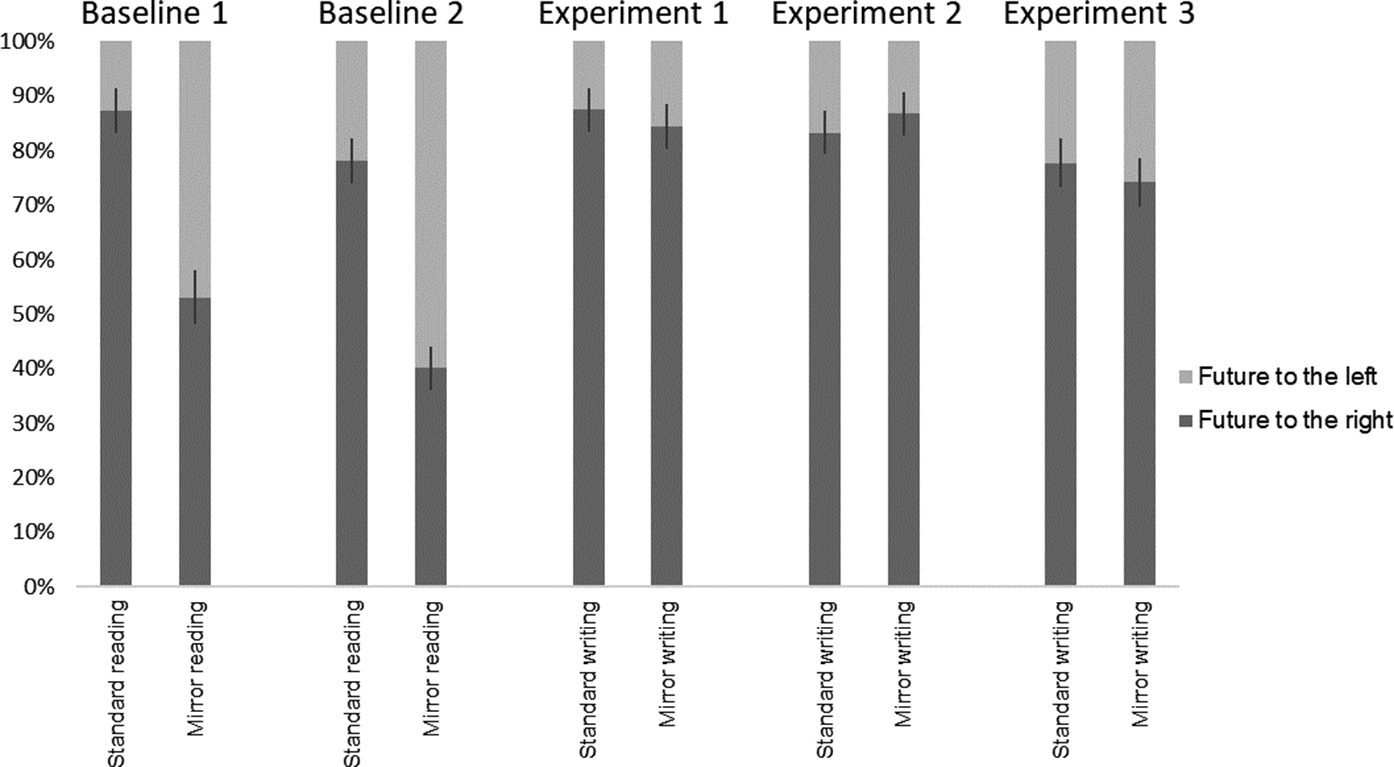
In the standard reading condition, the past event was placed to the left by most participants (87.5%). In the mirror reading condition, in contrast, 46.9% mapped the past event onto the right-hand box. This difference was significant at p = .003 (χ 2 = 9.06, Odds Ratio [OR] = 6.18[CI:1.76–21.71]) and indicated robust evidence of a true effect, BF10 = 25.58.
Because the baseline experiment is instrumental for ensuring the suitability of the temporal diagram for the current study, we replicated it to minimise the risk that the first iteration was a false positive. In the second round, another 64 participants (Mage = 20.3, SDage = 1.6) took part. The results were similar to the first round’s: Among the participants who were exposed to standard orthography, 78.1% mapped the past to the left, whereas in the mirror condition, not more than 40.6% did so, χ 2 = 9.33, p = .002, OR = 1.59[CI:0.52–2.66], and BF10 = 30.71.
These findings show that a reversal of the mental timeline along the lateral axis can be reliably obtained with a lateral version of the temporal diagram task.
3. Experiment 1
Having established a functioning baseline for examining the impact of script direction on temporal concepts, we proceeded to test the potential influence of standard versus mirror writing exercises on space–time mappings.
3.1. Method
3.1.1. Participants
Sixty-four new individuals (Mage = 20.5, SDage = 1.1) took part in the first writing experiment. They had the same background as the participants in the baseline experiment.
3.1.2. Materials, procedure, and analysis
The 1000-word story used in the baseline experiment was read aloud to the participants, in a sentence-to-sentence fashion, for transcription. This took approximately 40 minutes. Participants in the mirror writing condition (randomly assigned) were explicitly told they must write from right to left, reversing each individual letter, and shown an example of mirrored text.
The lateral temporal diagram from the baseline experiment was used for assessing space–time mappings. The analytical principles were the same as in the baseline experiment.
3.2. Results and discussion
It was found that only 15.6% of participants in the mirror writing condition mapped the past event onto the right-hand box. In the standard writing condition, the corresponding number was 12.5% (Figure 2). There was no statistically significant difference between conditions, χ 2 = 0.13, p = .72, OR = 0.77(CI:0.19–3.18). As indicated by BF10 = 0.23, this was a true null effect. In other words, no reversal of the mental timeline took place as a function of prior writing direction. Instead, all participants were equally prone to map the past event onto the left-hand box.
Space–time mappings across the baseline experiments (reading manipulation) and main Experiments 1, 2, and 3 (writing manipulation).
There was, however, one feature about this experiment that could have mitigated any effect induced by mirror writing: After performing the writing exercise, participants from both conditions encountered the instructions for the temporal diagram task in standard orthography. Seeing that priming of the mental timeline does not necessarily induce long-lasting reversals (e.g., Casasanto & Bottini, Reference Casasanto and Bottini2014) and that the default way of construing the flow of time may become easily re-activated due to its privileged hierarchical status (Casasanto, Reference Casasanto2016), it cannot be ruled out that this short exposure cancelled out the potential effect of mirror writing.
4. Experiment 2
To address the possibility that the effects of mirror writing were abolished by a brief exposure to standard orthography, Experiment 2 reversed the instructions of the temporal diagram task.
4.1. Method
With the exception of the temporal diagram instructions being presented in right-to-left orthography, the method of Experiment 2 was identical to that of Experiment 1. A new group of participants (n = 64, Mage = 20.4, SDage = 1.2) with backgrounds similar to those of previous experiments was recruited and randomly assigned to the standard and mirror writing conditions.
4.2. Results and discussion
Participants from both the standard writing condition and the mirror writing condition showed a similar tendency to map the past event onto the left-hand side (84.4% and 81.2%, respectively, Figure 2), χ 2 = 0.11, p = .74, OR = 0.80[CI:0.22–2.95]. This, again, was a true null effect, BF10 = 0.24.
It seems, in other words, as though reversing the instructions of the temporal diagram task did not reverse the preferences for space–time mappings. This, in extension, would suggest that the null effect obtained in Experiment 1 was not an artefact of the participants’ brief exposure to standard orthography following the writing task. This finding is also consistent with the baseline experiments, in which the script direction of the temporal diagram instructions did not seem to abolish the priming effect. There might, however, be another reason why the mirror writing did not flip participants’ mental timeline. Unlike mirror reading, mirror writing has a fine-motoric component and may require some practice (e.g., Kushnir et al., Reference Kushnir, Arzouan, Karni and Manor2013; Portex et al., Reference Portex, Hélin, Ponce and Foulin2018). The challenge inherent in mirror writing might have disrupted the intended priming effects in that participants may be focused on forming correctly reversed individual letters to such an extent that the association of right-side-earlier and left-side-later remained peripheral.
5. Experiment 3
To reduce the potentially disruptive effect that the novel experience of writing in reverse may bring about, Experiment 3 trained participants longitudinally through mirror writing exercises prior to testing their space–time mappings.
5.1. Method
A new group of participants (n = 64, Mage = 22.3, SDage = 3.8) with similar background took part in Experiment 3. Space–time mappings were assessed using the same materials and procedure as in Experiment 2.
Prior to taking the temporal diagram task, participants had performed writing exercises for five consecutive days. Half of the participants had been assigned to the mirror writing condition, and the other half to the standard writing condition. Each day, participants received a different audio file that had to be transcribed by hand according to the condition they had been assigned to. The text transcribed each day was around 1000 words long. As proof of daily task completion, they sent a photo of their writing to the research assistant. On the fifth and final day, participants transcribed the same story as in Experiments 1 and 2. Upon completion, they immediately took the temporal diagram task.
5.2. Results
Twenty-three percent of the participants in the standard writing condition mapped the past event onto the right-hand box. For the mirror writing condition, the corresponding percentage was 25.8% (Figure 2).Footnote 1 This null effect (χ 2 = .09, p = .77, OR = 1.19[CI:0.37–3.82]) was robust, BF10 = 0.28. In other words, systematic engagement in mirror writing exercises over several days exerted no effect on spatio-temporal mapping preferences. Instead, all participants displayed a left-to-right construal of the flow of time.
5.3. Further analysis
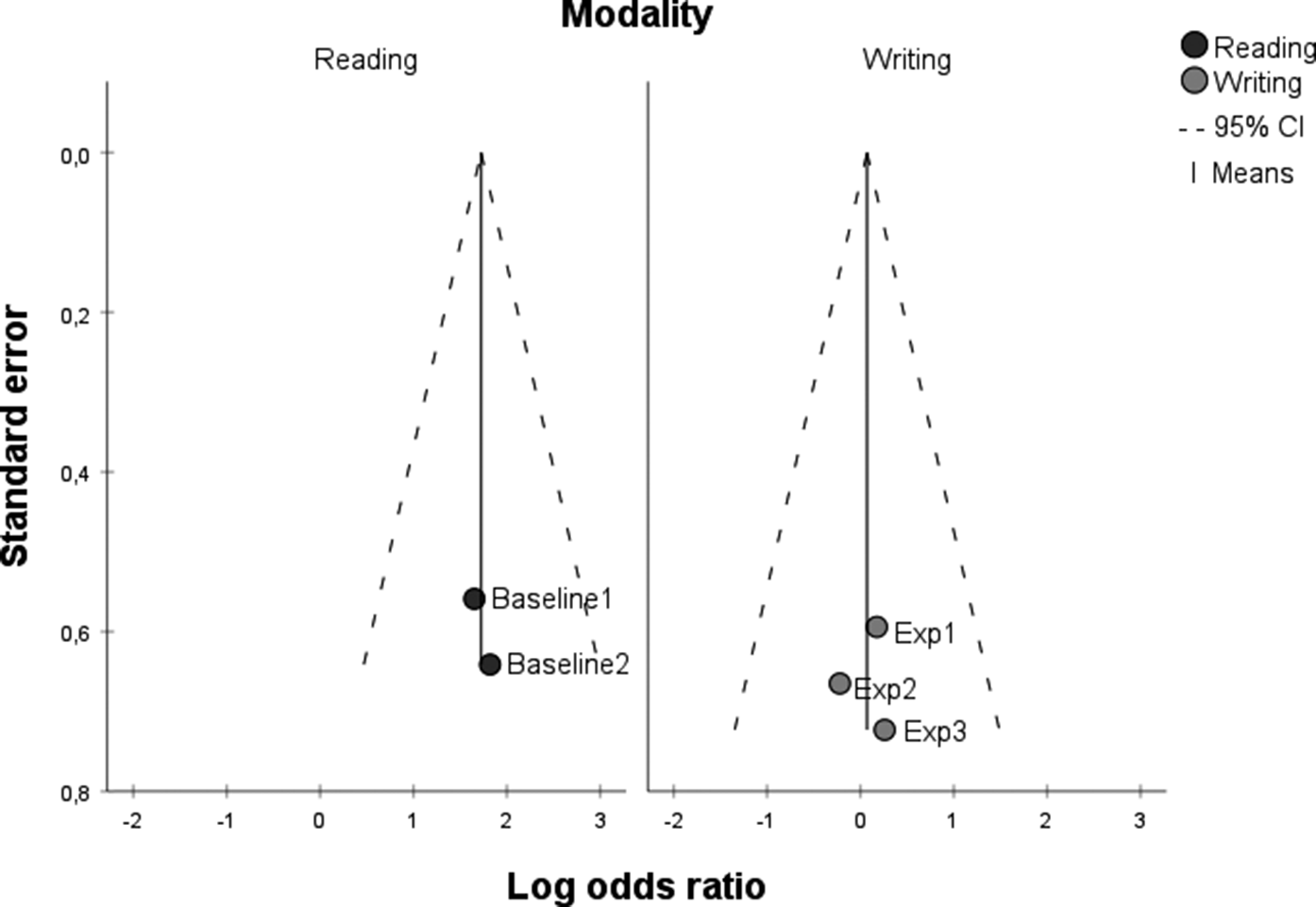
As a final analytical step, the findings from the two baseline reading experiments and all three writing experiments were assessed by means of a meta-analysis. Modality (reading versus writing) was entered as a moderating variable. We found a significant difference between the two modalities, Q = 8.54, p < .001, with robust effects on the mental timeline in the mirror reading experiments, ORlog = 1.73, p < .001, k = 2, but not in the mirror writing experiments, ORlog = 0.071, p = .85, k = 3 (see Figure 3).
Funnel plot of effect sizes of each experiment according to modality.
6. General discussion
Because there is currently no evidence of the causal role of writing practices for the mental timeline, the present study systematically manipulated writing direction in order to probe its effect on space–time mappings. While previous research using reading direction as a primer has yielded convincing evidence of the malleability of the mental timeline (Casasanto & Bottini, Reference Casasanto and Bottini2014; Pitt & Casasanto, Reference Pitt and Casasanto2020; see also our baseline experiment), the current study did not obtain the same effect with writing, even when conditions maximally favoured a reversal. The current findings are therefore at odds with the proposed hypothesis that the act of writing in a certain direction shapes temporal cognition. Crucially, this hypothesis represents the prevailing assumption in the field, which means that our current understanding of the determinants of the mental timeline is in need of revision. One reason for hypothesising that writing direction would influence the mental timeline was its embodied dimension: as the hand moves laterally over the page, left and right become associated with past and future actions. The fact that no such associations were detected in the mapping task may seem at odds with accounts of embodied or grounded cognition, according to which motor action plays a role in cognitive processing (e.g., Barsalou, Reference Barsalou2008; Pulvermüller & Fadiga, Reference Pulvermüller and Fadiga2010; see however, Montero-Melis et al., Reference Montero-Melis, van Paridon, Ostarek and Bylund2022; Solana & Santiago, Reference Solana and Santiago2022). However, a common view of grounded approaches is that the body, in addition to other factors, may “contribute to cognition” (Barsalou, Reference Barsalou2016, p. 1124, emphasis in original) rather than determining it. While the lateral mental timeline does not lack embodiment (cf. Casasanto & Jasmin, Reference Casasanto and Jasmin2012; Cooperrider & Núñez, Reference Cooperrider and Núñez2009; Fabbri et al., Reference Fabbri, Cellini, Martoni, Tonetti and Natale2013; Ishihara et al., Reference Ishihara, Keller, Rossetti and Prinz2008; Santiago et al., Reference Santiago, Lupáñez, Pérez and Funes2007), not all motor experiences can be expected to represent contributing factors.
This brings us to corroborate the competing hypothesis, which emphasised the ambiguous directionality of writing: while the gross-motor movement of writing is unidirectional (in this case, moving the arm/hand left- or rightwards over the page), the fine-motoric movements (i.e., the formation of letters) are multi-directional. In other words, the multidirectional activity of writing individual letters could override the laterality association created by moving the arm/hand sideways. According to the CORE principle, the impact of an activity on the mental timeline depends on “the reliability with which it spatialises time” (Pitt & Casasanto, Reference Pitt and Casasanto2020, p. 1064). It would seem, then, that this reliability is compromised due to the multi-directionality of writing.
A potential objection to this interpretation may be that writing has another property that boosts a lateral spatialisation of time: visual attention allocation. Evidence from eye-tracking shows that during writing, fixations are made at the base of letters and flow laterally – even for letters requiring the pen to move vertically. Notably, this pattern is different from that which occurs during reading, where fixations fall on the centre of words, rather than on their bases (Sita & Taylor, Reference Sita and Taylor2015). While this lateral flow arguably produces an experiential correlation of the past being located on one side of the page, and the future on the opposite side, it is clearly not enough to reverse the mental timeline. The absence of such an effect is consistent with the findings of Afsari et al. (Reference Afsari, Ossandón and König2016), which show that the activity of visually tracking objects moving from right to left on a screen does not change left-to-right biases.
Seen from this perspective, the current findings are consistent with the emerging view that the impact of motor experience on temporal concepts is selective. For instance, the fact that most languages are ripe with spatio-temporal metaphors that directly reflect the way humans typically move through space (e.g., “the past is behind,” “the future lies ahead”; Haspelmath, Reference Haspelmath1997) has traditionally been taken as evidence of how interaction with the physical environment shapes temporal cognition (e.g., Lakoff & Johnson, Reference Lakoff and Johnson1980, Reference Lakoff and Johnson1999). However, recent findings suggest that the link between temporal concepts and locomotor experience is not straightforward, as the spatial mapping of time can be substantially modulated by the degree of attention an individual devotes to the future and the past, respectively (Callizo-Romero et al., Reference Callizo-Romero, Tutnjević, Pandza, Ouellet, Kranjec, Ilić, Gu, Göksun, Chahboun, Casasanto and Santiago2020; de la Fuente et al., Reference de la Fuente, Santiago, Roman, Dumitrache and Casasanto2014; Torralbo et al., Reference Torralbo, Santiago and Lupiáñez2006; see also Bylund et al., Reference Bylund, Gygax, Samuel and Athanasopoulos2020).
The current results gel with recent findings that identify the precise impact and non-impact of various experiential factors on mental representation. For instance, while it has been assumed that reading (and writing) practices influence the direction of the mental number line (e.g., Dehaene et al., Reference Dehaene, Bossini and Giraux1993), recent evidence shows that this is not the case: instead, other activities, such as finger-counting, can prime the mental number line (but, conversely, not the mental timeline; Pitt & Casasanto, Reference Pitt and Casasanto2020; see also Masson et al., Reference Masson, Andres, Alsamour, Bollen and Pesenti2020).
Taken together, the results from the reading and writing experiments conducted in the present study provide important evidence for accounts of Ad Hoc Cognition. The findings from the reading version of the mapping experiment suggest that time concepts may indeed be modulated by recent experience, but that such experience does not include the act of writing. Seen from the perspective of Hierarchical Mental Metaphors Theory (HMMT) (Casasanto, Reference Casasanto2016, Reference Casasanto and Hampe2017), this suggests that while the act of reading mirrored text has the potential to activate left-to-right mappings of time, the act of writing does not sufficiently increase the weight of the (in the current context) culturally dispreferred right-to-left mapping of time. These variations in experiential effects on abstract concepts serve to gain a fine-grained picture of the potentials and limits of the flexible nature of conceptual representation, and encourage a detailed scrutiny of the mechanisms that underlie these processes.
As noted in the introductory paragraphs, the present study is exploratory in nature (i.e., the experiments were not pre-registered). This comes with the caveat that the p-values from its inferential analyses cannot be taken at face value, since factors such as the experimenter’s freedom of analysis may alter the alpha level (Wagenmakers et al., Reference Wagenmakers, Wetzels, Borsboom, van der Maas and Kievit2012). To remedy this, the study also made use of Bayesian statistics as a complement to classical significance testing (Mulder & Wagenmakers, Reference Mulder and Wagenmakers2016) and, moreover, set the sample sizes in advance to ensure 80% power. Besides this, the binary operationalisation of the dependent variable was straightforward, requiring no trimming procedures (e.g., removal of outliers), thus minimising the experimenter’s degrees of freedom (there were no undisclosed experimenter’s degrees of freedom in the analyses reported here, see Simmons et al., Reference Simmons, Nelson and Simonsohn2011). While these measures do not change the fact that the study is exploratory, they may help improve the ground for the confirmatory research on the writing direction that should follow.
7. Conclusions
The current study set out to address a glaring gap in research on script direction and concepts of time: the lack of evidence that the act of writing shapes the spatial mapping of time. The findings reported here show that, unlike reading, writing does not reverse the mental timeline. The robustness of these results notwithstanding, it is worth to point out that it may be early to rule out the idea that writing direction still exerts some degree of influence on temporal cognition. One possibility is that writing direction adds to, rather than independently gives rise to, mental representations of time created by reading and other cultural artifacts. More specifically, writing may contribute to strengthening existing mappings of space–time, but unlike reading, it cannot alone activate alternative mappings. Another aspect relates to the type of writing: while the current study has concerned handwriting, the potential influence of typing remains completely unexplored in the domain of temporal mapping. Since the processes of segmenting and retrieving orthographic information differ substantially between handwriting and typing (Cerni & Job, Reference Cerni and Job2022), along with the fact that the motor action of typing lacks directionality, it is yet to be determined if or how experiential priors of typing may influence the perceived flow of time. A third and final observation concerns the behaviour under study: because the aim here was to examine the mapping of past and future events, it will be important to probe whether alternative operationalisations of the mental timeline (e.g., a lexical decision task with lateralised responses) are equally robust against mirror writing manipulations.
Despite the potential limitations of the current study, we maintain that until actual evidence is found on the causal role of writing for the mental timeline, it will be prudent to assume that the direction of reading, not writing (nor reading and writing), shapes the mental timeline. It should be noted that the implications of the present study do not end with temporal cognition. Scrutinising the assumption that writing in a particular direction influences other types of conceptual and perceptual processing, such as mental modelling, aesthetic preferences, or bisection, is a key direction for future inquiry.
Acknowledgements
The authors are thankful to the reviewers for their constructive feedback on an earlier version of this article. Needless to say, any remaining errors are entirely our own.


 Open access

