





1 Introduction
Spin dynamics in plasmas is a flourishing field of research that studies how the spin of particles such as electrons, ions and positrons evolves in plasma environments, especially under high-energy conditions such as in plasma accelerators or fusion reactors. Key aspects of spin dynamics include generating spin polarization, understanding spin precession and the effects of intense electromagnetic fields in plasma environments. All potential applications critically depend on the ability to maintain the spin alignment of particles (i.e., their polarization) in the plasma for a sufficiently long period of time compared to the typical timescales involved[ Reference Thomas, Hützen, Lehrach, Pukhov, Ji, Wu, Geng and Büscher 1 ].
The worldwide strategic processes[ Reference Mounet 2 – Reference Anderle, Bertone, Cao and Chang 4 ] aiming at the realization of next-generation particle accelerators point at the importance of polarized beams (leptons, protons and ions) for fundamental research and various applications. Dozens of theoretical papers have been published in recent years on the feasibility of polarized beam generation in plasma accelerators (see, e.g., the review paper by Reichwein et al. [ Reference Reichwein, Gong, Zheng, Ji, Pukhov and Büscher 5 ] for an overview).
Almost a century ago, Goldhaber[
Reference Goldhaber
6
] inferred that fusion cross-sections depend on the relative spin orientation of the participating nuclei (i.e., the ‘fuel’). Typical enhancement factors, for example for the total $d+t\to \alpha +n$
cross-section, amount to roughly 50%[
Reference Paetz
7
,
Reference Baylor, Deur, Eidietis, Heidbrink, Jackson, Liu, Lowry, Miller, Pace, Sandorfi, Smith, Tafti, Wei, Wei and Zheng
8
]. In their seminal 1982 paper[
Reference Kulsrud, Furth, Valeo and Goldhaber
9
], Kulsrud et al. predicted time scales for polarization loss in the plasma of a magnetic fusion reactor to be much longer than the characteristic fuel burn-up period. A research project to measure the lifetime of spin-polarized fuel at the DIII-D reactor in San Diego is finally under way[
Reference Baylor, Deur, Eidietis, Heidbrink, Jackson, Liu, Lowry, Miller, Pace, Sandorfi, Smith, Tafti, Wei, Wei and Zheng
8
,
Reference Heidbrink, Baylor, Büscher, Engels, Garcia, Ghiozzi, Miller, Sandorfi, Wei and Zheng
10
]. Further advantages of polarized fusion are facilitated neutron management and an increased tritium burn efficiency that may significantly reduce the startup tritium inventory[
Reference Parisi, Diallo and Schwartz
11
]. Note that all of these advantages should also apply to inertial fusion[
Reference Temporal, Brandon, Canaud, Didelez, Fedosejevs and Ramis
12
]; a more comprehensive discussion can be found in Refs. [Reference Paetz7,Reference Ciullo, Engels, Büscher and Vasilyev13].
$d+t\to \alpha +n$
cross-section, amount to roughly 50%[
Reference Paetz
7
,
Reference Baylor, Deur, Eidietis, Heidbrink, Jackson, Liu, Lowry, Miller, Pace, Sandorfi, Smith, Tafti, Wei, Wei and Zheng
8
]. In their seminal 1982 paper[
Reference Kulsrud, Furth, Valeo and Goldhaber
9
], Kulsrud et al. predicted time scales for polarization loss in the plasma of a magnetic fusion reactor to be much longer than the characteristic fuel burn-up period. A research project to measure the lifetime of spin-polarized fuel at the DIII-D reactor in San Diego is finally under way[
Reference Baylor, Deur, Eidietis, Heidbrink, Jackson, Liu, Lowry, Miller, Pace, Sandorfi, Smith, Tafti, Wei, Wei and Zheng
8
,
Reference Heidbrink, Baylor, Büscher, Engels, Garcia, Ghiozzi, Miller, Sandorfi, Wei and Zheng
10
]. Further advantages of polarized fusion are facilitated neutron management and an increased tritium burn efficiency that may significantly reduce the startup tritium inventory[
Reference Parisi, Diallo and Schwartz
11
]. Note that all of these advantages should also apply to inertial fusion[
Reference Temporal, Brandon, Canaud, Didelez, Fedosejevs and Ramis
12
]; a more comprehensive discussion can be found in Refs. [Reference Paetz7,Reference Ciullo, Engels, Büscher and Vasilyev13].
The typical association of nuclear spin alignment is with low temperatures, making it counter-intuitive that it could endure in a ${10}^8$
Kelvin plasma long enough to have practical applications. On the other hand, a theoretical study[
Reference Thomas, Hützen, Lehrach, Pukhov, Ji, Wu, Geng and Büscher
1
] of the scaling laws for depolarization times indicated the feasibility of polarized particle acceleration in strong plasma fields. Experimental tests on the polarization conservation are challenging[
Reference Baylor, Deur, Eidietis, Heidbrink, Jackson, Liu, Lowry, Miller, Pace, Sandorfi, Smith, Tafti, Wei, Wei and Zheng
8
,
Reference Heidbrink, Baylor, Büscher, Engels, Garcia, Ghiozzi, Miller, Sandorfi, Wei and Zheng
10
,
Reference Raab, Büscher, Cerchez, Engels, Engin, Greven, Holler, Karmakar, Lehrach, Maier, Swantusch, Toncian, Toncian and Willi
14
,
Reference Büscher, Hützen, Ji and Lehrach
15
] and have not been carried out up to now.
${10}^8$
Kelvin plasma long enough to have practical applications. On the other hand, a theoretical study[
Reference Thomas, Hützen, Lehrach, Pukhov, Ji, Wu, Geng and Büscher
1
] of the scaling laws for depolarization times indicated the feasibility of polarized particle acceleration in strong plasma fields. Experimental tests on the polarization conservation are challenging[
Reference Baylor, Deur, Eidietis, Heidbrink, Jackson, Liu, Lowry, Miller, Pace, Sandorfi, Smith, Tafti, Wei, Wei and Zheng
8
,
Reference Heidbrink, Baylor, Büscher, Engels, Garcia, Ghiozzi, Miller, Sandorfi, Wei and Zheng
10
,
Reference Raab, Büscher, Cerchez, Engels, Engin, Greven, Holler, Karmakar, Lehrach, Maier, Swantusch, Toncian, Toncian and Willi
14
,
Reference Büscher, Hützen, Ji and Lehrach
15
] and have not been carried out up to now.
Here, we report the findings of an experimental campaign using a nuclear-spin-polarized 3He gas jet as the target[ Reference Fedorets, Zheng, Engels, Engin, Feilbach, Giesen, Glückler, Kannis, Klehr, Lennartz, Pfeifer, Pfennings, Schneider, Schnitzler, Soltner, Swaczyna and Büscher 16 ] for a petawatt laser pulse. 3He – the isospin partner of 3H – has the advantages that it is not radioactive, can be polarized at room temperature and can be stored over a long time in moderate (mT) magnetic holding fields. Laser-generated 3He plasmas, heated to the fusion resonance energies, are therefore an ideal testbed for polarized fusion. We present the first experimental evidence that the initial nuclear polarization is essentially preserved during the laser-induced heating and ionization and the subsequent acceleration of the ions from the plasma to MeV energies. Our data also point to the need for further scattering experiments with polarized 3He beams or targets, as the absolute polarization values of the accelerated 3He ions could not be determined due to insufficient quality of analysing-power data in literature.
2 Experimental setup
2.1 Polarized target
The laser pulses were provided by the PHELIX petawatt laser at GSI Darmstadt[
Reference Bagnoud, Aurand, Blazevic, Borneis, Bruske, Ecker, Eisenbarth, Fils, Frank, Gaul, Goette, Haefner, Hahn, Harres, Heuck, Hochhaus, Hoffmann, Javorková, Kluge, Kuehl, Kunzer, Kreutz, Merz-Mantwill, Neumayer, Onkels, Reemts, Rosmej, Roth, Stoehlker, Tauschwitz, Zielbauer, Zimmer and Witte
17
] and contained about 50 J energy each. The optimal pulse duration of 2.2 ps for the acceleration of 3He ${}^{1+,2+}$
ions had been found during a previous measurement with unpolarized gas[
Reference Engin, Chitgar, Deppert, Di Lucchio, Engels, Fedorets, Frydrych, Gibbon, Kleinschmidt, Lehrach, Maier, Prasuhn, Roth, Schlüter, Schneider, Stöhlker, Strathmann and Büscher
18
]. The polarizer[
Reference Mrozik, Endner, Hauke, Heil, Karpuk, Klemmer and Otten
19
] for the 3He gas was operated at Forschungszentrum Jülich, located roughly 250 km from GSI. Unfortunately, due to small amounts of oxygen leaking into the polarizer, the initial gas polarization did not exceed approximately 50%, as opposed to values of 75% that were achieved during the preparatory phase[
Reference Fedorets, Zheng, Engels, Engin, Feilbach, Giesen, Glückler, Kannis, Klehr, Lennartz, Pfeifer, Pfennings, Schneider, Schnitzler, Soltner, Swaczyna and Büscher
16
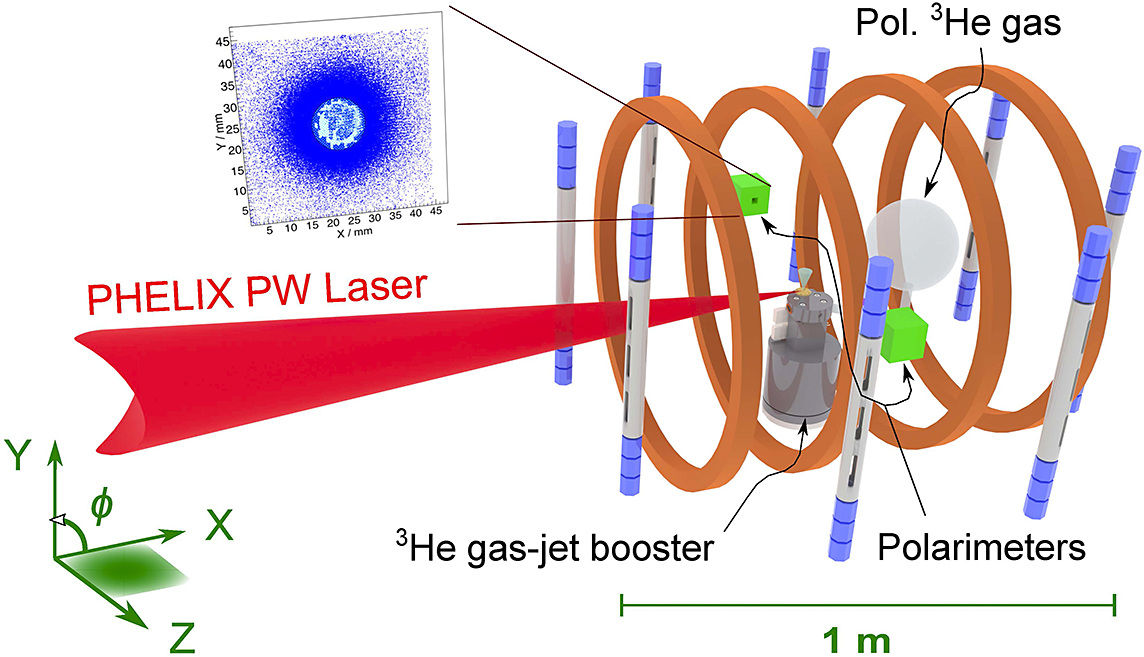
]. Due to various depolarization mechanisms, the initial gas polarization decreases exponentially in time. The polarized gas was stored in transport cells made of a special glass at an initial gas pressure of 3 bar; a glass ball with fresh gas was re-supplied to the PHELIX target chamber (cf. Figure 1) every morning. With the help of a non-magnetic gas compressor this pressure can be enhanced before each laser shot to a maximum value of 30 bar. The jet of 1 mm diameter is formed with the help of a titanium de Laval nozzle mounted on a non-magnetic valve, both located on top of the pressure booster. This leads to super-Gaussian distributed jet densities of a few times
${}^{1+,2+}$
ions had been found during a previous measurement with unpolarized gas[
Reference Engin, Chitgar, Deppert, Di Lucchio, Engels, Fedorets, Frydrych, Gibbon, Kleinschmidt, Lehrach, Maier, Prasuhn, Roth, Schlüter, Schneider, Stöhlker, Strathmann and Büscher
18
]. The polarizer[
Reference Mrozik, Endner, Hauke, Heil, Karpuk, Klemmer and Otten
19
] for the 3He gas was operated at Forschungszentrum Jülich, located roughly 250 km from GSI. Unfortunately, due to small amounts of oxygen leaking into the polarizer, the initial gas polarization did not exceed approximately 50%, as opposed to values of 75% that were achieved during the preparatory phase[
Reference Fedorets, Zheng, Engels, Engin, Feilbach, Giesen, Glückler, Kannis, Klehr, Lennartz, Pfeifer, Pfennings, Schneider, Schnitzler, Soltner, Swaczyna and Büscher
16
]. Due to various depolarization mechanisms, the initial gas polarization decreases exponentially in time. The polarized gas was stored in transport cells made of a special glass at an initial gas pressure of 3 bar; a glass ball with fresh gas was re-supplied to the PHELIX target chamber (cf. Figure 1) every morning. With the help of a non-magnetic gas compressor this pressure can be enhanced before each laser shot to a maximum value of 30 bar. The jet of 1 mm diameter is formed with the help of a titanium de Laval nozzle mounted on a non-magnetic valve, both located on top of the pressure booster. This leads to super-Gaussian distributed jet densities of a few times ${10}^{19}$
cm
${10}^{19}$
cm ${}^{-3}$
which are required for the acceleration of the 3He ions to MeV energies[
Reference Engin, Chitgar, Deppert, Di Lucchio, Engels, Fedorets, Frydrych, Gibbon, Kleinschmidt, Lehrach, Maier, Prasuhn, Roth, Schlüter, Schneider, Stöhlker, Strathmann and Büscher
18
]. During the gas compression and jet formation the final 3He polarization decreased to half of the initial value[
Reference Fedorets, Zheng, Engels, Engin, Feilbach, Giesen, Glückler, Kannis, Klehr, Lennartz, Pfeifer, Pfennings, Schneider, Schnitzler, Soltner, Swaczyna and Büscher
16
].
${}^{-3}$
which are required for the acceleration of the 3He ions to MeV energies[
Reference Engin, Chitgar, Deppert, Di Lucchio, Engels, Fedorets, Frydrych, Gibbon, Kleinschmidt, Lehrach, Maier, Prasuhn, Roth, Schlüter, Schneider, Stöhlker, Strathmann and Büscher
18
]. During the gas compression and jet formation the final 3He polarization decreased to half of the initial value[
Reference Fedorets, Zheng, Engels, Engin, Feilbach, Giesen, Glückler, Kannis, Klehr, Lennartz, Pfeifer, Pfennings, Schneider, Schnitzler, Soltner, Swaczyna and Büscher
16
].
Experimental setup at PHELIX: the laser beam (red) hits the polarized 3He gas jet that is emitted in the $+Y$
direction. The magnetic system comprises a permanent magnet arrangement with eight vertical pillars (horizontal field in the
$+Y$
direction. The magnetic system comprises a permanent magnet arrangement with eight vertical pillars (horizontal field in the $+Z$
direction) and a Helmholtz-coil array for spin-orientation manipulation in the
$+Z$
direction) and a Helmholtz-coil array for spin-orientation manipulation in the $X$
–
$X$
– $Z$
plane. Two polarimeters (green), located inside radiation-protecting boxes (not shown), are mounted at right angles relative to the laser propagation axis
$Z$
plane. Two polarimeters (green), located inside radiation-protecting boxes (not shown), are mounted at right angles relative to the laser propagation axis $X$
with a direct view on the laser–plasma interaction region. The insert shows data from a front detector plate in one polarimeter on elastically scattered 3He ions.
$X$
with a direct view on the laser–plasma interaction region. The insert shows data from a front detector plate in one polarimeter on elastically scattered 3He ions.

The initial 3He polarization along $+Z$
is maintained by a permanent magnetic holding field of 1.3 mT[
Reference Soltner, Büscher, Burgmer, Engin, Nauschütt, Maier and Glückler
20
]. Then the polarization (
$+Z$
is maintained by a permanent magnetic holding field of 1.3 mT[
Reference Soltner, Büscher, Burgmer, Engin, Nauschütt, Maier and Glückler
20
]. Then the polarization ( ${P}_Z/P=1$
) is (anti-)parallel to the momentum vector of the ejected ions (pointing at the two polarimeters) – this is the case of longitudinal polarization, which is undetectable in the polarimeters. Additional Helmholtz coils (maximum current 10 A, corresponding to 5 mT)[
Reference Fedorets, Zheng, Engels, Engin, Feilbach, Giesen, Glückler, Kannis, Klehr, Lennartz, Pfeifer, Pfennings, Schneider, Schnitzler, Soltner, Swaczyna and Büscher
16
,
Reference Soltner, Büscher, Burgmer, Engin, Nauschütt, Maier and Glückler
20
] allow one to rotate the initial 3He polarization in the horizontal plane towards
${P}_Z/P=1$
) is (anti-)parallel to the momentum vector of the ejected ions (pointing at the two polarimeters) – this is the case of longitudinal polarization, which is undetectable in the polarimeters. Additional Helmholtz coils (maximum current 10 A, corresponding to 5 mT)[
Reference Fedorets, Zheng, Engels, Engin, Feilbach, Giesen, Glückler, Kannis, Klehr, Lennartz, Pfeifer, Pfennings, Schneider, Schnitzler, Soltner, Swaczyna and Büscher
16
,
Reference Soltner, Büscher, Burgmer, Engin, Nauschütt, Maier and Glückler
20
] allow one to rotate the initial 3He polarization in the horizontal plane towards $+X$
or
$+X$
or $-X$
to achieve the transverse polarization case (maximum
$-X$
to achieve the transverse polarization case (maximum ${P}_X/P=\pm 0.97$
). Such a polarization is measurable since it can induce a top–bottom (
${P}_X/P=\pm 0.97$
). Such a polarization is measurable since it can induce a top–bottom ( $Y$
direction) rate asymmetry in scattering data of the polarimeters; cf. Figure 2.
$Y$
direction) rate asymmetry in scattering data of the polarimeters; cf. Figure 2.
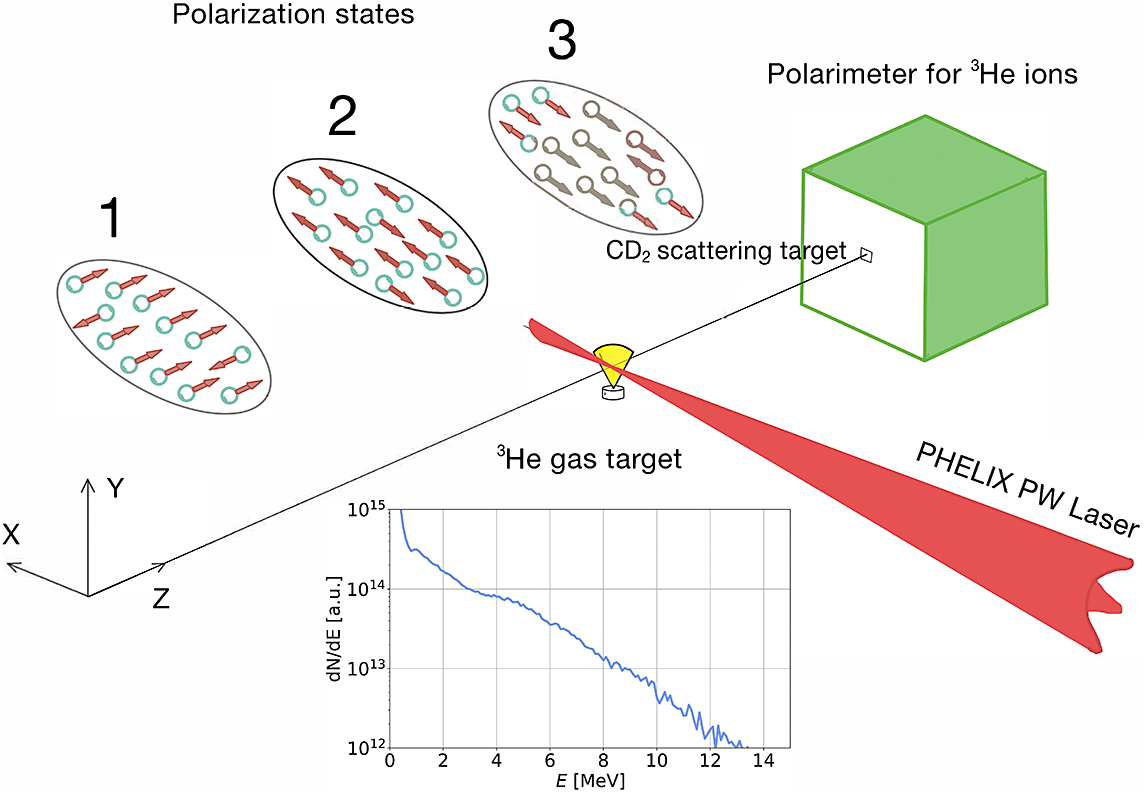
Principle of the polarization manipulation and measurement with the polarized 3He target. Depending on the currents in the Helmholtz coils, the 3He gas can initially be longitudinally (case 1, zero current) or transversally (cases 2 and 3) polarized. The inserted spectrum is an approximation of the measured[ Reference Engin, Chitgar, Deppert, Di Lucchio, Engels, Fedorets, Frydrych, Gibbon, Kleinschmidt, Lehrach, Maier, Prasuhn, Roth, Schlüter, Schneider, Stöhlker, Strathmann and Büscher 18 ] 3He energy distribution by a PIC simulation[ Reference Gibbon, Chitgar, Büscher, Fedorets, Lehrach, Li and Zheng 21 ].

2.2 Polarimetry
Two identical polarimeters[
Reference Zheng, Fedorets, Engels, Kannis, Engin, Möller, Swaczyna, Feilbach, Glückler, Lennartz, Pfeifer, Pfennings, Schneider, Schnitzler, Soltner and Büscher
22
] are used to measure the remaining polarization of the accelerated 3He ions. They are placed at right angles relative to the laser propagation axis $X$
at distances of 95 mm (at
$X$
at distances of 95 mm (at $+Z$
, see Figure 1) and 264 mm (
$+Z$
, see Figure 1) and 264 mm ( $-Z$
), respectively. The angular acceptances of the two polarimeters differ by a factor approximately eight – below we present data for the near polarimeter; the results for its far counterpart support our findings but exhibit lower statistical accuracy. Each cube-shaped polarimeter contains a collimator (defining a 3 mm diameter beam), a CD
$-Z$
), respectively. The angular acceptances of the two polarimeters differ by a factor approximately eight – below we present data for the near polarimeter; the results for its far counterpart support our findings but exhibit lower statistical accuracy. Each cube-shaped polarimeter contains a collimator (defining a 3 mm diameter beam), a CD ${}_2$
foil target for secondary scattering of the ions and five CR-39 detector plates (front, left, right, top, bottom) for particle identification. Two types of reactions in the foil target are used for the analysis, that is, (elastic) Rutherford scattering of the accelerated 3He ions and the 2H(
${}_2$
foil target for secondary scattering of the ions and five CR-39 detector plates (front, left, right, top, bottom) for particle identification. Two types of reactions in the foil target are used for the analysis, that is, (elastic) Rutherford scattering of the accelerated 3He ions and the 2H( ${}^3\overrightarrow{\mathrm{H}}\mathrm{e}$
, 4He)1H fusion reaction that transforms the 3He polarization information into a measurable azimuthal angular (
${}^3\overrightarrow{\mathrm{H}}\mathrm{e}$
, 4He)1H fusion reaction that transforms the 3He polarization information into a measurable azimuthal angular ( $\phi$
as defined in Figure 1) asymmetry of the emitted
$\phi$
as defined in Figure 1) asymmetry of the emitted $\alpha$
particles via a non-vanishing analysing power
$\alpha$
particles via a non-vanishing analysing power $A$
; see Ref. [Reference Zheng, Fedorets, Engels, Kannis, Engin, Möller, Swaczyna, Feilbach, Glückler, Lennartz, Pfeifer, Pfennings, Schneider, Schnitzler, Soltner and Büscher22] for details.
$A$
; see Ref. [Reference Zheng, Fedorets, Engels, Kannis, Engin, Möller, Swaczyna, Feilbach, Glückler, Lennartz, Pfeifer, Pfennings, Schneider, Schnitzler, Soltner and Büscher22] for details.
The Rutherford-scattering data (cf. Figure 1) are dominated by few-MeV 3He ions[
Reference Engin, Chitgar, Deppert, Di Lucchio, Engels, Fedorets, Frydrych, Gibbon, Kleinschmidt, Lehrach, Maier, Prasuhn, Roth, Schlüter, Schneider, Stöhlker, Strathmann and Büscher
18
] deflected by the carbon atoms of the foil, which has a total thickness of approximately 10 μm (6 μm CD2 + 4 μm CH2). It is not sensitive to beam polarization ( $A=0$
); however, it can reveal asymmetries of the beam profile in the transverse phase space (
$A=0$
); however, it can reveal asymmetries of the beam profile in the transverse phase space ( $X$
/
$X$
/ ${X}^{\prime }$
and
${X}^{\prime }$
and $Y$
/
$Y$
/ ${Y}^{\prime }$
), which are caused by the plasma acceleration and space-charge effects. The fusion reaction is much less sensitive to the transverse beam profile due to its large Q value (18.35 MeV) and the small observed effects can be explained by the Rutherford-scattering data. The field of the Helmholtz coils causes a very small deflection of the 3He ions on their way to the polarimeter (
${Y}^{\prime }$
), which are caused by the plasma acceleration and space-charge effects. The fusion reaction is much less sensitive to the transverse beam profile due to its large Q value (18.35 MeV) and the small observed effects can be explained by the Rutherford-scattering data. The field of the Helmholtz coils causes a very small deflection of the 3He ions on their way to the polarimeter ( $\sim 0.2{}^{\circ}$
for 2 MeV ions) and does not affect the transverse beam profile.
$\sim 0.2{}^{\circ}$
for 2 MeV ions) and does not affect the transverse beam profile.
3 Data analysis
We present the results of four days of data acquisition; during each day we recorded five to six laser shots for three different orientations of the 3He polarization and one for the control measurement with unpolarized 3He gas. We focus on a comparison of two data sets for the Helmholtz coils switched on but in the opposite direction (transverse polarization, cases 2 and 3 in Figure 2), with emphasis on the azimuthal angular asymmetries of the $\alpha$
particles from the 2H(
$\alpha$
particles from the 2H( ${}^3\overrightarrow{\mathrm{H}}\mathrm{e}$
, 4He)1H reaction. The flux of 3He ions emitted into the direction of the near polarimeter can be estimated from the number of detected
${}^3\overrightarrow{\mathrm{H}}\mathrm{e}$
, 4He)1H reaction. The flux of 3He ions emitted into the direction of the near polarimeter can be estimated from the number of detected $\alpha$
particles as
$\alpha$
particles as $2.0\times {10}^{12}$
particles/sr per shot, while the average number of 3He ions above the fusion-reaction threshold hitting the CD2 foil target is roughly
$2.0\times {10}^{12}$
particles/sr per shot, while the average number of 3He ions above the fusion-reaction threshold hitting the CD2 foil target is roughly $1.6\times {10}^9$
particles per shot.
$1.6\times {10}^9$
particles per shot.
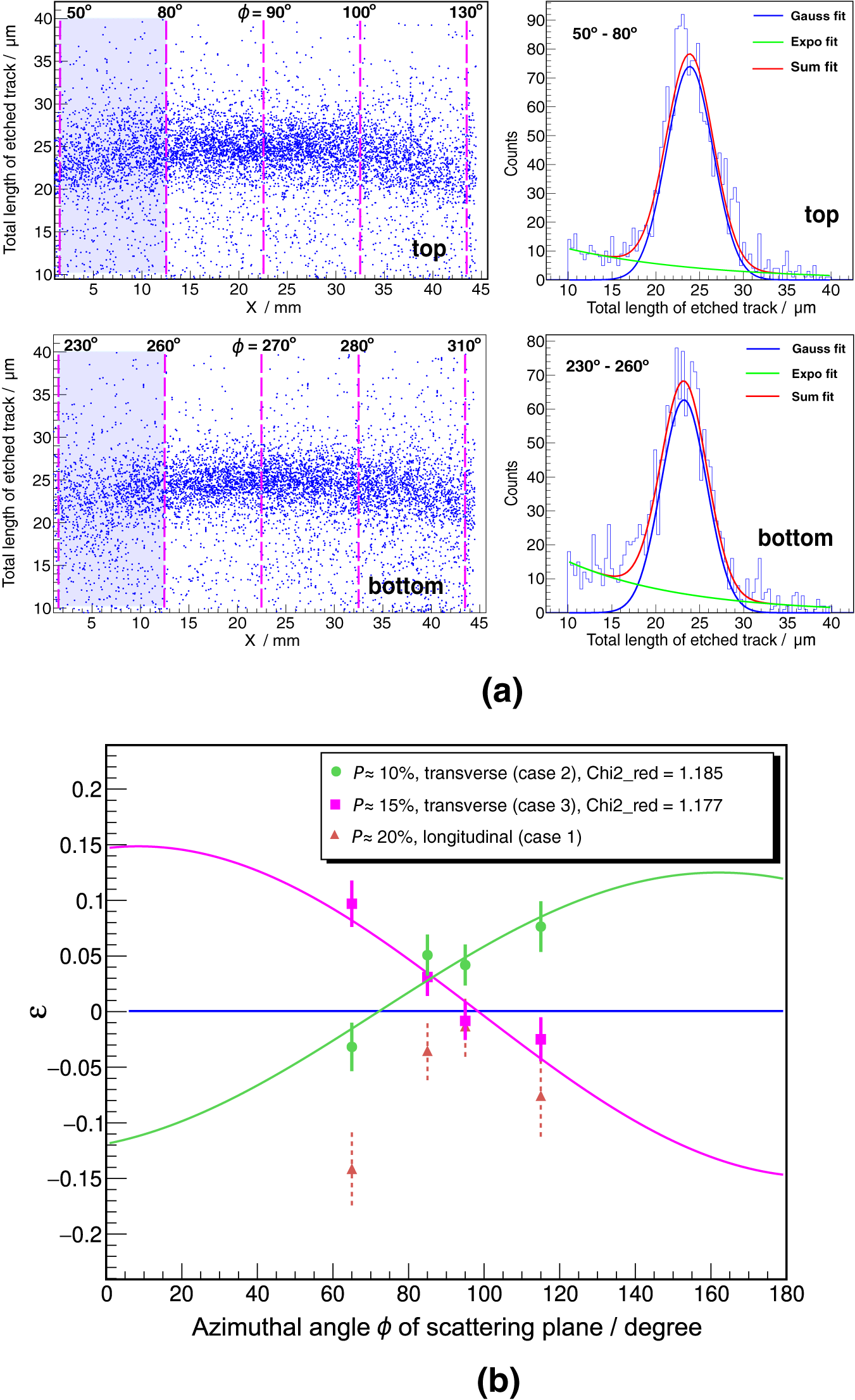
The angular distribution of the count-rate difference $\varepsilon \left(\phi \right)=\left({N}_{\mathrm{top}}\left(\phi \right)-{N}_{\mathrm{bottom}}\left(\phi +180{}^{\circ}\right)\right)/\big({N}_{\mathrm{top}}\left(\phi \right)+{N}_{\mathrm{bottom}}\left(\phi +180{}^{\circ}\right)\big)$
, deduced individually in four separate detector regions, is depicted in Figure 3. We use the rate differences since they are less affected by systematic uncertainties such as background suppression and detector efficiencies. The data points outside the 50°–130° angular range could not be extracted from the left- and right-hand plates since the signal tracks on these plates were not sufficiently well formed during the etching procedure.
$\varepsilon \left(\phi \right)=\left({N}_{\mathrm{top}}\left(\phi \right)-{N}_{\mathrm{bottom}}\left(\phi +180{}^{\circ}\right)\right)/\big({N}_{\mathrm{top}}\left(\phi \right)+{N}_{\mathrm{bottom}}\left(\phi +180{}^{\circ}\right)\big)$
, deduced individually in four separate detector regions, is depicted in Figure 3. We use the rate differences since they are less affected by systematic uncertainties such as background suppression and detector efficiencies. The data points outside the 50°–130° angular range could not be extracted from the left- and right-hand plates since the signal tracks on these plates were not sufficiently well formed during the etching procedure.
(a) Hit pattern of the $\alpha$
particles on the top and bottom plates (left) for one field direction. Extraction of the fusion events by fitting a Gaussian function to the signal and an exponential function to the background (right). This procedure is applied in four angular bins in the
$\alpha$
particles on the top and bottom plates (left) for one field direction. Extraction of the fusion events by fitting a Gaussian function to the signal and an exponential function to the background (right). This procedure is applied in four angular bins in the $\phi$
range of 50°–130° (top detector) and on the opposite side. (b) Count-rate difference
$\phi$
range of 50°–130° (top detector) and on the opposite side. (b) Count-rate difference $\varepsilon$
of the
$\varepsilon$
of the $\alpha$
particles derived from the procedure described in (a). The error bar of each point is calculated from the total number of events under the signal peak including the background within a ‘
$\alpha$
particles derived from the procedure described in (a). The error bar of each point is calculated from the total number of events under the signal peak including the background within a ‘ $3\kern0.1em \sigma$
region’ of the Gaussian function. The green and pink lines are linear fits to the data to provide visual guidance. The initial degree[
Reference Zheng, Fedorets, Engels, Kannis, Engin, Möller, Swaczyna, Feilbach, Glückler, Lennartz, Pfeifer, Pfennings, Schneider, Schnitzler, Soltner and Büscher
22
] and orientation of the polarization in the jet are indicated.
$3\kern0.1em \sigma$
region’ of the Gaussian function. The green and pink lines are linear fits to the data to provide visual guidance. The initial degree[
Reference Zheng, Fedorets, Engels, Kannis, Engin, Möller, Swaczyna, Feilbach, Glückler, Lennartz, Pfeifer, Pfennings, Schneider, Schnitzler, Soltner and Büscher
22
] and orientation of the polarization in the jet are indicated.

The 3He polarization $P$
is related to
$P$
is related to $\varepsilon \left(\phi \right)$
according to the following formula:
$\varepsilon \left(\phi \right)$
according to the following formula:
 $$\begin{align}P=\frac{\varepsilon \left(\phi \right)}{A\left(E,\theta \right)\cdot \sin \left(\phi -{\phi}_{\mathrm{P}}\right)},\end{align}$$
where $A\left(E,\theta \right)$
is the analysing power, which depends on the 3He energy
$A\left(E,\theta \right)$
is the analysing power, which depends on the 3He energy $E$
and the polar angle
$E$
and the polar angle $\theta$
of the detected
$\theta$
of the detected $\alpha$
particles (40°–80°[
Reference Zheng, Fedorets, Engels, Kannis, Engin, Möller, Swaczyna, Feilbach, Glückler, Lennartz, Pfeifer, Pfennings, Schneider, Schnitzler, Soltner and Büscher
22
]), and
$\alpha$
particles (40°–80°[
Reference Zheng, Fedorets, Engels, Kannis, Engin, Möller, Swaczyna, Feilbach, Glückler, Lennartz, Pfeifer, Pfennings, Schneider, Schnitzler, Soltner and Büscher
22
]), and ${\phi}_{\mathrm{P}}$
is the azimuthal polarization angle. In our case a precise determination of
${\phi}_{\mathrm{P}}$
is the azimuthal polarization angle. In our case a precise determination of $P$
from the measured
$P$
from the measured $\varepsilon \left(\phi \right)$
is not possible since it would require the knowledge of
$\varepsilon \left(\phi \right)$
is not possible since it would require the knowledge of $A$
in the full (
$A$
in the full ( $E$
,
$E$
, $\theta$
) space of our measurement (cf. insert in Figure 2 for the 3He energy distribution) as well as the exact energy distribution of the 3He ions undergoing the fusion reaction after deceleration in the CD2 foil.
$\theta$
) space of our measurement (cf. insert in Figure 2 for the 3He energy distribution) as well as the exact energy distribution of the 3He ions undergoing the fusion reaction after deceleration in the CD2 foil.
For the transverse cases a count-rate asymmetry must change sign for a reversal of the Helmholtz field orientation[
Reference Raab, Büscher, Cerchez, Engels, Engin, Greven, Holler, Karmakar, Lehrach, Maier, Swantusch, Toncian, Toncian and Willi
14
,
Reference Zheng, Fedorets, Engels, Kannis, Engin, Möller, Swaczyna, Feilbach, Glückler, Lennartz, Pfeifer, Pfennings, Schneider, Schnitzler, Soltner and Büscher
22
]. This is, of course, only true under the assumption that the 3He ions are still transversely polarized after acceleration. Figure 3 shows that the measured angular distributions $\varepsilon \left(\phi \right)$
exactly reveal this ‘spin-flip’ behaviour. In the absence of a polarization persistence, the green and pink data points would be centred around
$\varepsilon \left(\phi \right)$
exactly reveal this ‘spin-flip’ behaviour. In the absence of a polarization persistence, the green and pink data points would be centred around $\varepsilon \left(\phi \right)=0$
as indicated by the blue line. Figure 3 also shows fits of functions
$\varepsilon \left(\phi \right)=0$
as indicated by the blue line. Figure 3 also shows fits of functions ${\varepsilon \left(\phi \right)={\varepsilon}_0\sin \left(\phi -{\phi}_0\right)}$
to the two data sets. The best fits result in values of
${\varepsilon \left(\phi \right)={\varepsilon}_0\sin \left(\phi -{\phi}_0\right)}$
to the two data sets. The best fits result in values of ${\varepsilon}_0=0.15\pm 0.03$
and
${\varepsilon}_0=0.15\pm 0.03$
and $0.12\pm 0.03$
, respectively, that is, a statistical significance of more than
$0.12\pm 0.03$
, respectively, that is, a statistical significance of more than $5\sigma$
.
$5\sigma$
.
In contrast to the two data sets for transverse polarization, one does not expect an asymmetry for unpolarized 3He gas, which is precisely what was observed for the integrated top–bottom count-rate difference $\varepsilon =\left({N}_{\mathrm{t}}-{N}_{\mathrm{b}}\right)/\left({N}_{\mathrm{t}}+{N}_{\mathrm{b}}\right)= -0.010\pm 0.016$
. An irregular shape, limited to a small
$\varepsilon =\left({N}_{\mathrm{t}}-{N}_{\mathrm{b}}\right)/\left({N}_{\mathrm{t}}+{N}_{\mathrm{b}}\right)= -0.010\pm 0.016$
. An irregular shape, limited to a small $\phi$
-angle range, is observed in the corresponding Rutherford-scattering data on the front plate, and explains a count-rate fluctuation on the left-hand plate. As can be seen from Figure 3, the quality of the data for longitudinal polarization (case 1 in Figure 2) is very poor as the
$\phi$
-angle range, is observed in the corresponding Rutherford-scattering data on the front plate, and explains a count-rate fluctuation on the left-hand plate. As can be seen from Figure 3, the quality of the data for longitudinal polarization (case 1 in Figure 2) is very poor as the $\varepsilon \left(\phi \right)$
distribution exhibits large statistical fluctuations and cannot be reasonably described by a sinosoidal fit function (
$\varepsilon \left(\phi \right)$
distribution exhibits large statistical fluctuations and cannot be reasonably described by a sinosoidal fit function ( ${\chi}_{\mathrm{black}}^2$
values larger than 4). We have therefore excluded these data from a detailed statistical analysis.
${\chi}_{\mathrm{black}}^2$
values larger than 4). We have therefore excluded these data from a detailed statistical analysis.
4 Discussion
4.1 geant 4 simulations
In principle, the asymmetry observed in the distributions of $\varepsilon \left(\phi \right)$
for cases of transverse polarization could be caused by rate fluctuations over the cross-section of the 3He ion beams entering the polarimeter. In order to estimate the relevance of such effects we have carried out simulations with the geant4 and g4beamline codes. These simulations were performed under the assumption that circular 3 mm diameter beams of
$\varepsilon \left(\phi \right)$
for cases of transverse polarization could be caused by rate fluctuations over the cross-section of the 3He ion beams entering the polarimeter. In order to estimate the relevance of such effects we have carried out simulations with the geant4 and g4beamline codes. These simulations were performed under the assumption that circular 3 mm diameter beams of ${10}^9$
3He
${10}^9$
3He ${}^{2+}$
ions enter the polarimeter and the beam profiles vary up to the unrealistic case (since the observed Rutherford-scattering distributions exhibit only small fluctuations in the beam profiles) where all ions are contained within one semicircle of the beam profile. It turns out that the count-rate asymmetries
${}^{2+}$
ions enter the polarimeter and the beam profiles vary up to the unrealistic case (since the observed Rutherford-scattering distributions exhibit only small fluctuations in the beam profiles) where all ions are contained within one semicircle of the beam profile. It turns out that the count-rate asymmetries $\varepsilon \left(\phi \right)$
can be explained to only a small extent by irregularly shaped transverse phase spaces (and mimic a higher polarization value) since space-charge effects in the 3He
$\varepsilon \left(\phi \right)$
can be explained to only a small extent by irregularly shaped transverse phase spaces (and mimic a higher polarization value) since space-charge effects in the 3He ${}^{2+}$
bunches tend to dilute the angular asymmetries.
${}^{2+}$
bunches tend to dilute the angular asymmetries.
4.2 Particle-in-cell simulations
In order to assess the efficiency of the 3He ion acceleration and preservation of spin polarization, we have conducted two-dimensional (2D) particle-in-cell (PIC) simulations[
Reference Gibbon, Chitgar, Büscher, Fedorets, Lehrach, Li and Zheng
21
] with the epoch
[
Reference Arber, Bennett, Brady, Lawrence-Douglas, Ramsay, Sircombe, Gillies, Evans, Schmitz, Bell and Ridgers
23
] and the vlpl codes[
Reference Pukhov
24
,
Reference Pukhov
25
]. To match the experimental parameters, a laser intensity of ${1.38\times {10}^{19}\;\mathrm{W}\;{\mathrm{cm}}^{-2}}$
with
${1.38\times {10}^{19}\;\mathrm{W}\;{\mathrm{cm}}^{-2}}$
with $1.053\;\unicode{x3bc} \mathrm{m}$
wavelength and a pulse duration of 0.8 ps (full width at half maximum, FWHM) was taken, focused down to a spot size of
$1.053\;\unicode{x3bc} \mathrm{m}$
wavelength and a pulse duration of 0.8 ps (full width at half maximum, FWHM) was taken, focused down to a spot size of $25.7\;\unicode{x3bc} \mathrm{m}$
(FWHM) in the centre of a round, 1 mm diameter 3He gas-jet target with a sixth-order super-Gaussian density profile at
$25.7\;\unicode{x3bc} \mathrm{m}$
(FWHM) in the centre of a round, 1 mm diameter 3He gas-jet target with a sixth-order super-Gaussian density profile at $4.75\times {10}^{19}\;{\mathrm{cm}}^{-3}$
. The computational grid covered
$4.75\times {10}^{19}\;{\mathrm{cm}}^{-3}$
. The computational grid covered $2.0\;{\mathrm{mm}}\times 2.0\;{\mathrm{mm}}$
with resolution of
$2.0\;{\mathrm{mm}}\times 2.0\;{\mathrm{mm}}$
with resolution of $0.04\;\unicode{x3bc} \mathrm{m}$
in each dimension and roughly 1.5 particles per cell.
$0.04\;\unicode{x3bc} \mathrm{m}$
in each dimension and roughly 1.5 particles per cell.
The codes include a module for the Thomas–Bargmann–Michel–Telegdi (T-BMT) equation[
Reference Bargmann, Michel and Telegdi
26
] describing spin precession. The assumed initial spin direction is that of laser propagation, that is, ${s}_X=\mathrm{\hslash}/2$
. When the laser pulse irradiates the 3He target, its ponderomotive force expels the electrons mainly towards the front and at right angles to laser propagation, leaving behind a plasma channel with a strong magnetic field (few
${s}_X=\mathrm{\hslash}/2$
. When the laser pulse irradiates the 3He target, its ponderomotive force expels the electrons mainly towards the front and at right angles to laser propagation, leaving behind a plasma channel with a strong magnetic field (few ${10}^3$
T). The charge separation then induces a Coulomb explosion, leading to the acceleration of the 3He ions at a
${10}^3$
T). The charge separation then induces a Coulomb explosion, leading to the acceleration of the 3He ions at a $\pm 90{}^{\circ}$
angle. The same acceleration mechanism was identified in the study of the unpolarized 3He and 4He targets[
Reference Engin, Chitgar, Deppert, Di Lucchio, Engels, Fedorets, Frydrych, Gibbon, Kleinschmidt, Lehrach, Maier, Prasuhn, Roth, Schlüter, Schneider, Stöhlker, Strathmann and Büscher
18
]. At the falling edge of the gas jet, a displacement between the electronic and ionic plasma components leads to an acceleration process in the forward direction similar to target normal sheath acceleration[
Reference Willingale, Mangles, Nilson, Clarke, Dangor, Kaluza, Karsch, Lancaster, Mori, Najmudin, Schreiber, Thomas, Wei and Krushelnick
27
,
Reference Lifschitz, Sylla, Kahaly, Flacco, Veltcheva, Sanchez-Arriaga, Lefebvre and Malka
28
]. These forward accelerated ions, however, make up only a small part of the total number of accelerated 3He ions for our laser-target configuration. If shorter targets were utilized, more ions in the forward direction would be expected[
Reference Gibbon, Chitgar, Büscher, Fedorets, Lehrach, Li and Zheng
21
]. Both simulation codes show that the ions gain only small
$\pm 90{}^{\circ}$
angle. The same acceleration mechanism was identified in the study of the unpolarized 3He and 4He targets[
Reference Engin, Chitgar, Deppert, Di Lucchio, Engels, Fedorets, Frydrych, Gibbon, Kleinschmidt, Lehrach, Maier, Prasuhn, Roth, Schlüter, Schneider, Stöhlker, Strathmann and Büscher
18
]. At the falling edge of the gas jet, a displacement between the electronic and ionic plasma components leads to an acceleration process in the forward direction similar to target normal sheath acceleration[
Reference Willingale, Mangles, Nilson, Clarke, Dangor, Kaluza, Karsch, Lancaster, Mori, Najmudin, Schreiber, Thomas, Wei and Krushelnick
27
,
Reference Lifschitz, Sylla, Kahaly, Flacco, Veltcheva, Sanchez-Arriaga, Lefebvre and Malka
28
]. These forward accelerated ions, however, make up only a small part of the total number of accelerated 3He ions for our laser-target configuration. If shorter targets were utilized, more ions in the forward direction would be expected[
Reference Gibbon, Chitgar, Büscher, Fedorets, Lehrach, Li and Zheng
21
]. Both simulation codes show that the ions gain only small ${s}_Y,{s}_Z$
components in their spin vector due to a precession around the strong magnetic field of the plasma channel that is fully compatible with the observed polarization conservation.
${s}_Y,{s}_Z$
components in their spin vector due to a precession around the strong magnetic field of the plasma channel that is fully compatible with the observed polarization conservation.
4.3 Analytical estimates
In simplified terms, the 3He ${}^{2+}$
ions perform two types of motion in the magnetic field of the plasma: the cyclotron motion and the precession of the nuclear magnetic moment
${}^{2+}$
ions perform two types of motion in the magnetic field of the plasma: the cyclotron motion and the precession of the nuclear magnetic moment ${\overrightarrow{\mu}}_{\kern-1.2pt\mathrm{i}}$
. This can be described by two non-relativistic equations as follows:
${\overrightarrow{\mu}}_{\kern-1.2pt\mathrm{i}}$
. This can be described by two non-relativistic equations as follows:
 $$\begin{align}\frac{\mathrm{d}{\overrightarrow{v}}_{\mathrm{i}}}{\mathrm{d}t}=\frac{q_{\mathrm{i}}}{m_{\mathrm{i}}}\left({\overrightarrow{v}}_{\mathrm{i}}\times \overrightarrow{B}\right),\end{align}$$
 $$\begin{align}\frac{\mathrm{d}{\overrightarrow{\mu}}_{\mathrm{i}}}{\mathrm{d}t}={\gamma}_{\mathrm{h}}\left({\overrightarrow{\mu}}_{\mathrm{i}}\times \overrightarrow{B}\right),\end{align}$$
where ${\overrightarrow{v}}_{\mathrm{i}}$
,
${\overrightarrow{v}}_{\mathrm{i}}$
, ${q}_{\mathrm{i}}$
and
${q}_{\mathrm{i}}$
and ${m}_{\mathrm{i}}$
are ion velocity, charge and mass, respectively, and
${m}_{\mathrm{i}}$
are ion velocity, charge and mass, respectively, and ${\gamma}_{\mathrm{h}}$
is the gyromagnetic ratio of 3He nuclei,
${\gamma}_{\mathrm{h}}$
is the gyromagnetic ratio of 3He nuclei, $\overrightarrow{\mu}={\gamma}_{\mathrm{h}}\overrightarrow{s}$
. The magnetic moment
$\overrightarrow{\mu}={\gamma}_{\mathrm{h}}\overrightarrow{s}$
. The magnetic moment $\overrightarrow{\mu}$
is antiparallel to the nuclear spin
$\overrightarrow{\mu}$
is antiparallel to the nuclear spin $\overrightarrow{s}$
, which is expressed by a minus sign of
$\overrightarrow{s}$
, which is expressed by a minus sign of ${\gamma}_{\mathrm{h}}$
.
${\gamma}_{\mathrm{h}}$
.
We assume a simple model of the magnetic field $\overrightarrow{B}$
around the 1 mm long plasma channel induced by the laser pulse with a focus spot of
$\overrightarrow{B}$
around the 1 mm long plasma channel induced by the laser pulse with a focus spot of $10\kern0.22em \unicode{x3bc} \mathrm{m}\times 10\kern0.22em \unicode{x3bc} \mathrm{m}$
. The electrons are pushed forward along the channel, corresponding to an electric current
$10\kern0.22em \unicode{x3bc} \mathrm{m}\times 10\kern0.22em \unicode{x3bc} \mathrm{m}$
. The electrons are pushed forward along the channel, corresponding to an electric current ${I}_{\mathrm{e}}$
(tens of kA) opposite to the direction of laser propagation, and according to Biot–Savart’s law a vortex magnetic field
${I}_{\mathrm{e}}$
(tens of kA) opposite to the direction of laser propagation, and according to Biot–Savart’s law a vortex magnetic field ${B}_{\varphi }(r)={\mu}_0{I}_{\mathrm{e}}/\left(2\pi r\right)$
builds up around the channel. This field then rotates the velocity vectors
${B}_{\varphi }(r)={\mu}_0{I}_{\mathrm{e}}/\left(2\pi r\right)$
builds up around the channel. This field then rotates the velocity vectors ${\overrightarrow{v}}_{\mathrm{i}}$
and the spin directions
${\overrightarrow{v}}_{\mathrm{i}}$
and the spin directions ${\overrightarrow{\mu}}_{\mathrm{i}}$
in the horizontal plane according to Equations (2) and (3). The rotational effect on
${\overrightarrow{\mu}}_{\mathrm{i}}$
in the horizontal plane according to Equations (2) and (3). The rotational effect on ${\overrightarrow{v}}_{\mathrm{i}}$
was measured in our previous experiment at
${\overrightarrow{v}}_{\mathrm{i}}$
was measured in our previous experiment at $\pm 90{}^{\circ}$
for 4He ions[
Reference Engin, Chitgar, Deppert, Di Lucchio, Engels, Fedorets, Frydrych, Gibbon, Kleinschmidt, Lehrach, Maier, Prasuhn, Roth, Schlüter, Schneider, Stöhlker, Strathmann and Büscher
18
] and leads to a backward bending of
$\pm 90{}^{\circ}$
for 4He ions[
Reference Engin, Chitgar, Deppert, Di Lucchio, Engels, Fedorets, Frydrych, Gibbon, Kleinschmidt, Lehrach, Maier, Prasuhn, Roth, Schlüter, Schneider, Stöhlker, Strathmann and Büscher
18
] and leads to a backward bending of $2{}^{\circ}$
, which is also confirmed by the PIC simulations.
$2{}^{\circ}$
, which is also confirmed by the PIC simulations.
Since the cyclotron motion and the spin precession are caused by the same local magnetic field $\overrightarrow{B}$
, the rotational effect on the magnetic moment
$\overrightarrow{B}$
, the rotational effect on the magnetic moment ${\overrightarrow{\mu}}_{\mathrm{i}}$
along a 3He ion trajectory can be deduced from the cyclotron and the precession frequencies of the 3He
${\overrightarrow{\mu}}_{\mathrm{i}}$
along a 3He ion trajectory can be deduced from the cyclotron and the precession frequencies of the 3He ${}^{2+}$
ions:
${}^{2+}$
ions:
 $$\begin{align}{\omega}_{\mathrm{c}}=\frac{q_{\mathrm{i}}B}{m_{\mathrm{i}}}=0.641\times {10}^8\kern0.1em B\kern0.1em \left[\mathrm{T}\right]\kern0.1em \mathrm{rad}/\mathrm{s},\quad\end{align}$$
 $$\begin{align}{\omega}_{\mathrm{s}}={\gamma}_{\mathrm{h}}B=-2.038\times {10}^8\kern0.1em B\kern0.1em \left[\mathrm{T}\right]\kern0.1em \mathrm{rad}/\mathrm{s},\end{align}$$
which have a fixed ratio of ${\omega}_{\mathrm{s}}/{\omega}_{\mathrm{c}}=-3.18$
. The backward bending angle
${\omega}_{\mathrm{s}}/{\omega}_{\mathrm{c}}=-3.18$
. The backward bending angle $\varDelta {\theta}_{\mathrm{c}}=\int {q}_{\mathrm{i}}/{m}_{\mathrm{i}}{B}_y\left(x,z,t\right)\mathrm{d}t$
is estimated as
$\varDelta {\theta}_{\mathrm{c}}=\int {q}_{\mathrm{i}}/{m}_{\mathrm{i}}{B}_y\left(x,z,t\right)\mathrm{d}t$
is estimated as $2.7{}^{\circ}$
for 3He ions. Then the precession angle
$2.7{}^{\circ}$
for 3He ions. Then the precession angle ${\varDelta {\theta}_{\mathrm{s}}=\int {\gamma}_{\mathrm{h}}{B}_y\left(x,z,t\right)\mathrm{d}t}$
is expected to be
${\varDelta {\theta}_{\mathrm{s}}=\int {\gamma}_{\mathrm{h}}{B}_y\left(x,z,t\right)\mathrm{d}t}$
is expected to be $8.5{}^{\circ}$
opposite to that of the cyclotron motion. This corresponds to a small change of the
$8.5{}^{\circ}$
opposite to that of the cyclotron motion. This corresponds to a small change of the $X$
-component of the initial polarization from
$X$
-component of the initial polarization from ${P}_X/P=1$
to 0.99, which is consistent with the simulation result[
Reference Gibbon, Chitgar, Büscher, Fedorets, Lehrach, Li and Zheng
21
].
${P}_X/P=1$
to 0.99, which is consistent with the simulation result[
Reference Gibbon, Chitgar, Büscher, Fedorets, Lehrach, Li and Zheng
21
].
5 Conclusions and outlook
We present results of a first experiment using a polarized target at a high-power laser facility and demonstrate their feasibility for the acceleration of polarized particles. Most notably we observe an angular asymmetry of the $\alpha$
particles in our polarimeter, which we can only explain by a transverse polarization of the accelerated 3He ions. It is therefore shown that the transverse polarization of the nuclear spins is at least partially conserved (according to PIC simulations to more than 99%) during plasma heating and acceleration to MeV energies. This is a first hint that nuclear polarization survives a laser-induced plasma and, therefore, the advantages of polarized fuel are useable for this type of fusion reactor.
$\alpha$
particles in our polarimeter, which we can only explain by a transverse polarization of the accelerated 3He ions. It is therefore shown that the transverse polarization of the nuclear spins is at least partially conserved (according to PIC simulations to more than 99%) during plasma heating and acceleration to MeV energies. This is a first hint that nuclear polarization survives a laser-induced plasma and, therefore, the advantages of polarized fuel are useable for this type of fusion reactor.
An absolute polarization measurement of the 3He ions is not feasible because the values of the 2H( ${}^3\overrightarrow{\mathrm{H}}\mathrm{e}$
, 4He)1H analysing power are not known for the full energy range of the accelerated 3He ions, and the energy distributions of the 3He ions reaching the polarimeters are not precisely known. Our measurements were also limited by the low (
${}^3\overrightarrow{\mathrm{H}}\mathrm{e}$
, 4He)1H analysing power are not known for the full energy range of the accelerated 3He ions, and the energy distributions of the 3He ions reaching the polarimeters are not precisely known. Our measurements were also limited by the low ( $\lesssim 20$
% in the jet) initial polarization of the target gas due to vacuum leaks in our 3He polarizer. We note that our conclusions are based on relative measurements (such as the change of sign of angular asymmetries in Figure 3(b)) and are averaged over five or six laser shots, making them robust to fluctuations of the laser intensity or target density, and plasma filamentation[
Reference Engin, Chitgar, Deppert, Di Lucchio, Engels, Fedorets, Frydrych, Gibbon, Kleinschmidt, Lehrach, Maier, Prasuhn, Roth, Schlüter, Schneider, Stöhlker, Strathmann and Büscher
18
].
$\lesssim 20$
% in the jet) initial polarization of the target gas due to vacuum leaks in our 3He polarizer. We note that our conclusions are based on relative measurements (such as the change of sign of angular asymmetries in Figure 3(b)) and are averaged over five or six laser shots, making them robust to fluctuations of the laser intensity or target density, and plasma filamentation[
Reference Engin, Chitgar, Deppert, Di Lucchio, Engels, Fedorets, Frydrych, Gibbon, Kleinschmidt, Lehrach, Maier, Prasuhn, Roth, Schlüter, Schneider, Stöhlker, Strathmann and Büscher
18
].
It is planned to continue the experiments at PHELIX at higher gas polarization, and using a narrower (0.5 mm instead of 1.0 mm) gas-jet target. This would have the advantage that the 3He ions should be dominantly emitted under ${0}^{\circ }$
and at significantly higher energies (10–15 MeV)[
Reference Gibbon, Chitgar, Büscher, Fedorets, Lehrach, Li and Zheng
21
]. In parallel we developed a polarized HCl gas target[
Reference Hützen, Thomas, Böker, Engels, Gebel, Lehrach, Pukhov, Sofikitis and Büscher
29
] for laser- or beam-driven acceleration of polarized proton and electron beams[
Reference Wen, Tamburini and Keitel
30
–
Reference Reichwein, Pukhov and Büscher
36
]. This target could also be operated with deuterium iodide (DI) gas[
Reference Sofikitis, Kannis, Boulogiannis and Rakitzis
37
] and be combined with polarized 3He in order to further study options for polarized fusion with high-power lasers.
${0}^{\circ }$
and at significantly higher energies (10–15 MeV)[
Reference Gibbon, Chitgar, Büscher, Fedorets, Lehrach, Li and Zheng
21
]. In parallel we developed a polarized HCl gas target[
Reference Hützen, Thomas, Böker, Engels, Gebel, Lehrach, Pukhov, Sofikitis and Büscher
29
] for laser- or beam-driven acceleration of polarized proton and electron beams[
Reference Wen, Tamburini and Keitel
30
–
Reference Reichwein, Pukhov and Büscher
36
]. This target could also be operated with deuterium iodide (DI) gas[
Reference Sofikitis, Kannis, Boulogiannis and Rakitzis
37
] and be combined with polarized 3He in order to further study options for polarized fusion with high-power lasers.
Acknowledgements
This work has been carried out in the framework of the JuSPARC (Jülich Short-Pulse Particle and Radiation Center) project[ Reference Jülich 38 ] and has been supported by the ATHENA consortium (Accelerator Technology HElmholtz iNfrAstructure) in the ARD programme (Accelerator Research and Development) of the Helmholtz Association. We acknowledge funding through the European Union’s Horizon Europe research and innovation programme under grant agreement No. 101079773 (EuPRAXIA Preparatory Phase Project). Our results are based on experiment P191, which was performed at the PHELIX infrastructure at GSI Helmholtzzentrum für Schwerionenforschung, Darmstadt (Germany) in the context of FAIR Phase-0. The authors gratefully acknowledge the Gauss Centre for Supercomputing e.V.[ 39 ] for funding this project by providing computing time through the John von Neumann Institute for Computing (NIC) on the GCS Supercomputer JUWELS at Jülich Supercomputing Centre (JSC). MB acknowledges support by the CAS President’s International Fellowship Initiative. Special thanks go to Werner Heil (retired Professor from Johannes Gutenberg-University Mainz) for providing the 3He polarizer and for answering many emergency calls.




 Open access

