 kN×W(k)NA−1/Gm
 Dqc,[0,p−1](W(k)syn)→DMF[0,p−1]big(W(k))
 Dqc,[0,p−2](W(k)syn)→DMF[0,p−2]big(W(k))





1 Introduction
1.1 Fontaine–Laffaille theory
Fix a perfect field k of characteristic p, and let W(k) be the ring of Witt vectors. For a smooth p-adic formal schemeFootnote 1 X over W(k) of dimension $\leqslant p-1$
, we have a canonical isomorphism in the derived category of Zariski sheaves on X:
$\leqslant p-1$
, we have a canonical isomorphism in the derived category of Zariski sheaves on X:
 \begin{equation}(\Omega_X^{\bullet},p\cdot d_{\mathrm{dR}})\xrightarrow{\sim}(\Omega_X^{\bullet},d_{\mathrm{dR}}).\end{equation}
Its composition with the inclusion of complexes $(\Omega_X^{\bullet}, d_{\mathrm{dR}})\hookrightarrow (\Omega_X^{\bullet},p\cdot d_{\mathrm{dR}})$
given by
$(\Omega_X^{\bullet}, d_{\mathrm{dR}})\hookrightarrow (\Omega_X^{\bullet},p\cdot d_{\mathrm{dR}})$
given by $\Omega_X^i \xrightarrow{p^i\textrm{Id}}\Omega_X^i$
in degree i, is the crystalline Frobenius morphism. A proof of this fundamental and beautiful result, as well as a more general logarithmic version, appears in [Reference OgusOgu23, Theorem 6.10]. The idea behind the construction of the map (1.1) can be traced back to [Reference MazurMaz73].Footnote
2
One infers from (1.1) that the crystalline Frobenius
$\Omega_X^i \xrightarrow{p^i\textrm{Id}}\Omega_X^i$
in degree i, is the crystalline Frobenius morphism. A proof of this fundamental and beautiful result, as well as a more general logarithmic version, appears in [Reference OgusOgu23, Theorem 6.10]. The idea behind the construction of the map (1.1) can be traced back to [Reference MazurMaz73].Footnote
2
One infers from (1.1) that the crystalline Frobenius $\varphi$
restricted to the ith term of the ‘filtration bête’ is canonically divisible by
$\varphi$
restricted to the ith term of the ‘filtration bête’ is canonically divisible by $p^i$
:
$p^i$
:
 \begin{equation} \frac{\varphi}{p^i}: (\Omega_X,d)^{\geqslant i}\to (\Omega_X,d).\end{equation}
More generally, in [Reference MazurMaz73], Mazur proved that, for a smooth p-adic formal scheme X over W(k) of any dimension and any integer $i\geqslant 0$
, the crystalline Frobenius
$i\geqslant 0$
, the crystalline Frobenius $\varphi$
restricted to
$\varphi$
restricted to $(\Omega_X,d)^{\geqslant i}$
is canonically divisible by
$(\Omega_X,d)^{\geqslant i}$
is canonically divisible by $p^{[i]}$
, where
$p^{[i]}$
, where $[i]:=\min_{m\geqslant i}\mathrm{ord}({p^m}/{m!})$
; we refer the reader to Remark 4.6 for an interpretation of this result. See [Reference KatoKat87, Reference Antieau, Mathew, Morrow and NikolausAMM+22] for a construction of (1.2) via quasi-syntomic descent.
$[i]:=\min_{m\geqslant i}\mathrm{ord}({p^m}/{m!})$
; we refer the reader to Remark 4.6 for an interpretation of this result. See [Reference KatoKat87, Reference Antieau, Mathew, Morrow and NikolausAMM+22] for a construction of (1.2) via quasi-syntomic descent.
The reduction of (1.1) modulo p recovers the Deligne–Illusie isomorphism from [Reference Deligne and IllusieDI87], provided that X has dimension $\leqslant p-2$
.Footnote
3
$\leqslant p-2$
.Footnote
3
Inspired by [Reference Fontaine and LaffailleFL82], we describe the linear-algebraic structure on the de Rham cohomology $\mathrm{R}\Gamma_{\mathrm{dR}}(X)$
induced by the isomorphism (1.1) as follows: we view the complex
$\mathrm{R}\Gamma_{\mathrm{dR}}(X)$
induced by the isomorphism (1.1) as follows: we view the complex $\mathrm{R}\Gamma_{\mathrm{dR}}(X)$
, equipped with the Hodge filtration
$\mathrm{R}\Gamma_{\mathrm{dR}}(X)$
, equipped with the Hodge filtration $F^{\cdot}$
, as an object
$F^{\cdot}$
, as an object $\mathcal{M}$
of the derived category
$\mathcal{M}$
of the derived category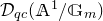 $\mathcal{D}_{qc}(\mathbb{A}^1/\mathbb{G}_m)$
of quasi-coherent sheaves on
$\mathcal{D}_{qc}(\mathbb{A}^1/\mathbb{G}_m)$
of quasi-coherent sheaves on $\mathbb{A}^1/\mathbb{G}_m$
, where
$\mathbb{A}^1/\mathbb{G}_m$
, where $\mathbb{A}^1$
is considered as a p-adic formal scheme over W(k) with the standard
$\mathbb{A}^1$
is considered as a p-adic formal scheme over W(k) with the standard $\mathbb{G}_m$
-action. The isomorphism (1.1) can be rewritten asFootnote
4
$\mathbb{G}_m$
-action. The isomorphism (1.1) can be rewritten asFootnote
4
 \begin{equation}F^*(\mathcal{M}_{v=p})\xrightarrow[]{\sim}\mathcal{M}_{v=1}.\end{equation}
Here $\mathcal{M}_{v=a}$
denotes the (derived) fibre of
$\mathcal{M}_{v=a}$
denotes the (derived) fibre of $\mathcal{M}$
at
$\mathcal{M}$
at $\operatorname{Spf} W(k)\xrightarrow{a}\mathbb{A}^1/\mathbb{G}_m$
and
$\operatorname{Spf} W(k)\xrightarrow{a}\mathbb{A}^1/\mathbb{G}_m$
and $F:W(k)\to W(k)$
is the Frobenius. We define and denote by
$F:W(k)\to W(k)$
is the Frobenius. We define and denote by $\mathscr{DMF}^{\mathrm{big}}(W(k))$
the stable
$\mathscr{DMF}^{\mathrm{big}}(W(k))$
the stable $\infty$
-category consisting of
$\infty$
-category consisting of $\mathcal{M}\in \mathcal{D}_{qc}(\mathbb{A}^1/\mathbb{G}_m)$
equipped with an isomorphism (1.3). We refer to it as the category of big Fontaine–Laffaille modules (see Definition 2.6).
$\mathcal{M}\in \mathcal{D}_{qc}(\mathbb{A}^1/\mathbb{G}_m)$
equipped with an isomorphism (1.3). We refer to it as the category of big Fontaine–Laffaille modules (see Definition 2.6).
For any integer $n\geqslant 0$
, we denote by
$n\geqslant 0$
, we denote by $\mathscr{DMF}_{[0,n]}^{\mathrm{big}}(W(k))\subset \mathscr{DMF}^{\mathrm{big}}(W(k))$
the full subcategory consisting of objects whose Hodge filtration ranges from 0 to n.Footnote
5
The preceding construction describes a contravariant functor from the category
$\mathscr{DMF}_{[0,n]}^{\mathrm{big}}(W(k))\subset \mathscr{DMF}^{\mathrm{big}}(W(k))$
the full subcategory consisting of objects whose Hodge filtration ranges from 0 to n.Footnote
5
The preceding construction describes a contravariant functor from the category $\widehat{\mathrm{Sm}}^{\leqslant p-1}_{W(k)}$
of smooth formal schemes of dimension
$\widehat{\mathrm{Sm}}^{\leqslant p-1}_{W(k)}$
of smooth formal schemes of dimension $\leqslant p-1$
to
$\leqslant p-1$
to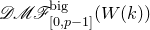 $\mathscr{DMF}^{\mathrm{big}}_{[0,p-1]}(W(k))$
:
$\mathscr{DMF}^{\mathrm{big}}_{[0,p-1]}(W(k))$
:
 \begin{equation} \widetilde{\Phi}_{\mathrm{Maz}}:\widehat{\mathrm{Sm}}^{\leqslant p-1}_{W(k)}\to \mathscr{DMF}^{\mathrm{big}}_{[0,p-1]}(W(k)).\end{equation}
The subcategory $\mathscr{MF}(W(k))$
of
$\mathscr{MF}(W(k))$
of $\mathscr{DMF}^{\mathrm{big}}(W(k))$
with
$\mathscr{DMF}^{\mathrm{big}}(W(k))$
with $\mathcal{M}\in \operatorname{Coh}(\mathbb{A}^1/\mathbb{G}_m)$
is the category of finitely generated (‘small’) Fontaine–Laffaille modules studied in [Reference Fontaine and LaffailleFL82, § 1.5] and in [Reference WintenbergerWin84, § 1.3]. In particular, it is proven in [Reference Fontaine and LaffailleFL82, § 1.5] that
$\mathcal{M}\in \operatorname{Coh}(\mathbb{A}^1/\mathbb{G}_m)$
is the category of finitely generated (‘small’) Fontaine–Laffaille modules studied in [Reference Fontaine and LaffailleFL82, § 1.5] and in [Reference WintenbergerWin84, § 1.3]. In particular, it is proven in [Reference Fontaine and LaffailleFL82, § 1.5] that $\mathscr{MF}(W(k))$
is an abelian category. The original work [Reference Fontaine and LaffailleFL82] does not use the language of sheaves on stacks; see Remark 2.5 for a comparison of the original definition in [Reference Fontaine and LaffailleFL82] and our geometric reinterpretation. In Proposition 2.7 we show that the bounded derived category
$\mathscr{MF}(W(k))$
is an abelian category. The original work [Reference Fontaine and LaffailleFL82] does not use the language of sheaves on stacks; see Remark 2.5 for a comparison of the original definition in [Reference Fontaine and LaffailleFL82] and our geometric reinterpretation. In Proposition 2.7 we show that the bounded derived category $\mathcal{D}^b(\mathscr{MF}(W(k)))$
of
$\mathcal{D}^b(\mathscr{MF}(W(k)))$
of $\mathscr{MF}(W(k))$
is a full subcategory of
$\mathscr{MF}(W(k))$
is a full subcategory of $\mathscr{DMF}^{\mathrm{big}}(W(k))$
consisting of bounded complexes with coherent cohomology.
$\mathscr{DMF}^{\mathrm{big}}(W(k))$
consisting of bounded complexes with coherent cohomology.
Functor (1.4) is an input for various comparison theorems in p-adic Hodge theory. In particular, for $p\gt 2$
, the subcategory
$p\gt 2$
, the subcategory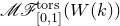 $\mathscr{MF}^{\mathrm{tors}}_{[0,1]}(W(k))$
of p-power-torsion objects in
$\mathscr{MF}^{\mathrm{tors}}_{[0,1]}(W(k))$
of p-power-torsion objects in $\mathscr{MF}_{[0,1]}(W(k))$
is equivalent to the category of commutative finite flat p-group schemes over W(k) (see [Reference Fontaine and LaffailleFL82]).Footnote
6
In [Reference Fontaine and LaffailleFL82], an exact functor
$\mathscr{MF}_{[0,1]}(W(k))$
is equivalent to the category of commutative finite flat p-group schemes over W(k) (see [Reference Fontaine and LaffailleFL82]).Footnote
6
In [Reference Fontaine and LaffailleFL82], an exact functor $\mathcal{T}_\text{ét}^{FL}$
was constructed from
$\mathcal{T}_\text{ét}^{FL}$
was constructed from $\mathscr{MF}_{[0,p-2]}(W(k))$
to the category of
$\mathscr{MF}_{[0,p-2]}(W(k))$
to the category of $\mathbb{Z}_p$
-linear representations of the absolute Galois group
$\mathbb{Z}_p$
-linear representations of the absolute Galois group $G_K$
of
$G_K$
of $K:=\mathrm{Frac}(W(k))$
. A central result of [Fal89, Theorem 5.3] is the following commutative diagram involving the category
$K:=\mathrm{Frac}(W(k))$
. A central result of [Fal89, Theorem 5.3] is the following commutative diagram involving the category $\mathrm{SmPr}^{\leqslant p-2}_{W(k)}$
of smooth proper schemes over W(k) of dimension
$\mathrm{SmPr}^{\leqslant p-2}_{W(k)}$
of smooth proper schemes over W(k) of dimension $\leqslant p-2$
.
$\leqslant p-2$
.

1.2 Prismatic F-gauges
Given a bounded prism $(A,I,\delta)$
equipped with a map
$(A,I,\delta)$
equipped with a map $W(k)\to A/I$
, Bhatt and Scholze constructed in [Reference Bhatt and ScholzeBS22] a new cohomology theory
$W(k)\to A/I$
, Bhatt and Scholze constructed in [Reference Bhatt and ScholzeBS22] a new cohomology theory $X \mapsto R \Gamma_{\mathbb{\Delta}}(X/A)$
for p-adic formal schemes over W(k) with values in the derived category
$X \mapsto R \Gamma_{\mathbb{\Delta}}(X/A)$
for p-adic formal schemes over W(k) with values in the derived category $\mathcal{D}(A)$
of A-modules. Bhatt and Lurie [Reference Bhatt and LurieBL22a] and Drinfeld [Reference DrinfeldDri24] advanced this theory further by organizing all prismatic cohomology theories, equipped with the prismatic Nygaard filtrations and the Frobenii, into a single contravariant functor
$\mathcal{D}(A)$
of A-modules. Bhatt and Lurie [Reference Bhatt and LurieBL22a] and Drinfeld [Reference DrinfeldDri24] advanced this theory further by organizing all prismatic cohomology theories, equipped with the prismatic Nygaard filtrations and the Frobenii, into a single contravariant functor
 \begin{equation} \mathcal{H}_{syn}: \widehat{\mathrm{Sch}}_{W(k)}\to \mathcal{D}_{qc}(W(k)^{syn})\end{equation}
from the category $\widehat{\mathrm{Sch}}_{W(k)}$
of p-adic formal schemes over W(k) to a stable
$\widehat{\mathrm{Sch}}_{W(k)}$
of p-adic formal schemes over W(k) to a stable $\infty$
-category
$\infty$
-category $\mathcal{D}_{qc}(W(k)^{syn})$
. Moreover, the latter category can be interpreted as the derived category of quasi-coherent sheaves on a stack
$\mathcal{D}_{qc}(W(k)^{syn})$
. Moreover, the latter category can be interpreted as the derived category of quasi-coherent sheaves on a stack $W(k)^{syn}$
, called the syntomification of W(k). The prismatic cohomology theory attached to
$W(k)^{syn}$
, called the syntomification of W(k). The prismatic cohomology theory attached to $(A,I,\delta)$
arises from (1.5) via the pullback along a map
$(A,I,\delta)$
arises from (1.5) via the pullback along a map $\operatorname{Spf} A\to W(k)^{syn}$
constructed using
$\operatorname{Spf} A\to W(k)^{syn}$
constructed using $(I, \delta)$
. The syntomification is defined in [Reference DrinfeldDri24, Reference BhattBha23] for any (nice) p-adic formal scheme X; the functor (1.5) carries a p-adic formal scheme X over W(k) to the derived direct image of the structure sheaf under the morphism of stacks
$(I, \delta)$
. The syntomification is defined in [Reference DrinfeldDri24, Reference BhattBha23] for any (nice) p-adic formal scheme X; the functor (1.5) carries a p-adic formal scheme X over W(k) to the derived direct image of the structure sheaf under the morphism of stacks
 \begin{equation} X^{syn} \to W(k)^{syn}\end{equation}
constructed by functoriality.
In this article, we address the following two questions (notation as in (1.4)).
-
(1) Given a smooth scheme X of dimension $\leqslant p-1$
, can one recover the (big) Fontaine–Laffaille module
$\widetilde{\Phi}_{\mathrm{Maz}}(X)$
from
$\mathcal{H}_{syn}(X)$
?
$\leqslant p-1$
, can one recover the (big) Fontaine–Laffaille module
$\widetilde{\Phi}_{\mathrm{Maz}}(X)$
from
$\mathcal{H}_{syn}(X)$
? -
(2) Does
$\mathcal{H}_{syn}(X)$
contain more information than
$\widetilde{\Phi}_{\mathrm{Maz}}(X)$
?


1.3 Main results
For a non-negative integer n, we denote by $\mathcal{D}_{qc,[0,n]}(W(k)^{syn})$
the full subcategory of
$\mathcal{D}_{qc,[0,n]}(W(k)^{syn})$
the full subcategory of $\mathcal{D}_{qc}(W(k)^{syn})$
spanned by objects with Hodge–Tate weights (see Definition 2.11) in the interval [0,n]. In particular, the category
$\mathcal{D}_{qc}(W(k)^{syn})$
spanned by objects with Hodge–Tate weights (see Definition 2.11) in the interval [0,n]. In particular, the category $\mathcal{D}_{qc,[0,n]}(W(k)^{syn})$
contains objects of the form
$\mathcal{D}_{qc,[0,n]}(W(k)^{syn})$
contains objects of the form $\mathcal{H}_{syn}(X)$
for a smooth p-adic formal scheme X of dimension
$\mathcal{H}_{syn}(X)$
for a smooth p-adic formal scheme X of dimension $\leqslant n$
. The main result (Theorem 3) of our article is the following.
$\leqslant n$
. The main result (Theorem 3) of our article is the following.
Theorem. There is a functor
 \begin{equation} \Phi_{\mathrm{Maz}}:\mathcal{D}_{qc,[0,p-1]}(W(k)^{syn}) \xrightarrow{} \mathscr{DMF}^{\mathrm{big}}_{[0,p-1]}(W(k)) \end{equation}
that induces an equivalence of $\infty$
-categories
$\infty$
-categories
 \begin{equation} \mathcal{D}_{qc,[0,p-2]}(W(k)^{syn}) \xrightarrow{\sim} \mathscr{DMF}^{\mathrm{big}}_{[0,p-2]}(W(k)). \end{equation}
In fact, the composition of $\Phi_{\mathrm{Maz}}$
with
$\Phi_{\mathrm{Maz}}$
with $\mathcal{H}_{syn}$
is isomorphic to
$\mathcal{H}_{syn}$
is isomorphic to $\widetilde{\Phi}_{\mathrm{Maz}}$
(see Remark 4.7). The functor
$\widetilde{\Phi}_{\mathrm{Maz}}$
(see Remark 4.7). The functor $\Phi_{\mathrm{Maz}}$
(see (4.4)) restricts to an equivalence
$\Phi_{\mathrm{Maz}}$
(see (4.4)) restricts to an equivalence
 \begin{equation} \operatorname{Perf}_{[0,p-2]}(W(k)^{syn}) \xrightarrow{\sim} \mathcal{D}^b(\mathscr{MF}_{[0,p-2]}(W(k))),\end{equation}
where the left-hand side in (1.9) is the full subcategory $\operatorname{Perf}_{[0,p-2]}(W(k)^{syn})$
of the category of perfect complexes
$\operatorname{Perf}_{[0,p-2]}(W(k)^{syn})$
of the category of perfect complexes $\operatorname{Perf}(W(k)^{syn})$
formed of objects of Hodge–Tate weights in
$\operatorname{Perf}(W(k)^{syn})$
formed of objects of Hodge–Tate weights in $[0,p-2]$
. Moreover, the functor (1.9) is t-exact, i.e. it restricts to an equivalence between abelian subcategoriesFootnote
7
$[0,p-2]$
. Moreover, the functor (1.9) is t-exact, i.e. it restricts to an equivalence between abelian subcategoriesFootnote
7
 \begin{equation} \operatorname{Coh}_{[0,p-2]}(W(k)^{syn})\xrightarrow{\sim}\mathscr{MF}_{[0,p-2]}(W(k)). \end{equation}
We also show that p-torsion objects in $\operatorname{Coh}_{[0,p-2]}(W(k)^{syn})$
are vector bundles on
$\operatorname{Coh}_{[0,p-2]}(W(k)^{syn})$
are vector bundles on $W(k)^{syn}\otimes\mathbb{F}_p$
(see Remark 5.22). We remark that
$W(k)^{syn}\otimes\mathbb{F}_p$
(see Remark 5.22). We remark that $\Phi_{\mathrm{Maz}}$
is not an equivalence (see Remark 5.21).
$\Phi_{\mathrm{Maz}}$
is not an equivalence (see Remark 5.21).
Let us now describe some of the earlier works related to our main theorem.
Firstly, in [Reference Cais and LiuCL19], Cais and Liu constructed a functor from the category of p-torsion-free Fontaine–Laffaille modules with Hodge–Tate weights in $[0,p-2]$
to the category of Breuil–Kisin modules. The abelian category of coherent prismatic F-gauges also admits a functor to the category of Breuil–Kisin modules. We expect that our functors agree.
$[0,p-2]$
to the category of Breuil–Kisin modules. The abelian category of coherent prismatic F-gauges also admits a functor to the category of Breuil–Kisin modules. We expect that our functors agree.
Secondly, using results from [Reference Bhatt and ScholzeBS23], Bhatt and Lurie established an equivalence of categories
 $$\mathcal{T}_\text{ét}^{BL}: \operatorname{Coh}^{\text{refl}}(W(k)^{syn}) \buildrel{\sim}\over{\longrightarrow} \mathrm{Rep}_{G_K}^{crys}(\mathbb{Z}_p)$$
between the category of reflexive coherent sheaves on $W(k)^{syn}$
and the category of
$W(k)^{syn}$
and the category of $\mathbb{Z}_p$
-lattices in
$\mathbb{Z}_p$
-lattices in $\mathbb{Q}_p$
-linear crystalline representations of the absolute Galois group
$\mathbb{Q}_p$
-linear crystalline representations of the absolute Galois group $G_K$
of
$G_K$
of $K:=\operatorname{Frac} (W(k))$
(see [Reference BhattBha23, Theorem 6.6.13]). On the other hand, Fontaine and Laffaille [Reference Fontaine and LaffailleFL82, 7.14] constructed an equivalence of categories
$K:=\operatorname{Frac} (W(k))$
(see [Reference BhattBha23, Theorem 6.6.13]). On the other hand, Fontaine and Laffaille [Reference Fontaine and LaffailleFL82, 7.14] constructed an equivalence of categories $\mathcal{T}_\text{ét}^{FL}$
between the full subcategory
$\mathcal{T}_\text{ét}^{FL}$
between the full subcategory $\mathscr{MF}_{[0,p-2]}^f(W(k))\subset \mathscr{MF}_{[0,p-2]}(W(k))$
of p-torsion-free Fontaine–Laffaille modules and the full subcategory
$\mathscr{MF}_{[0,p-2]}^f(W(k))\subset \mathscr{MF}_{[0,p-2]}(W(k))$
of p-torsion-free Fontaine–Laffaille modules and the full subcategory $\mathrm{Rep}_{G_K, [0, p-2]}^{crys}(\mathbb{Z}_p)\subset \mathrm{Rep}_{G_K}^{crys}(\mathbb{Z}_p)$
, whose objects are lattices in crystalline representations with Hodge–Tate weights lying in
$\mathrm{Rep}_{G_K, [0, p-2]}^{crys}(\mathbb{Z}_p)\subset \mathrm{Rep}_{G_K}^{crys}(\mathbb{Z}_p)$
, whose objects are lattices in crystalline representations with Hodge–Tate weights lying in $[0,p-2]$
.Footnote
8
In Remark 5.25 we prove that the Bhatt–Lurie and Fontaine–Laffaille functors agree via (1.10):
$[0,p-2]$
.Footnote
8
In Remark 5.25 we prove that the Bhatt–Lurie and Fontaine–Laffaille functors agree via (1.10):
 \begin{equation} \mathcal{T}_\text{ét}^{FL} \buildrel{\sim}\over{\longrightarrow} \mathcal{T}_\text{ét}^{BL} \circ \Phi_{\mathrm{Maz}}^{-1}: \mathscr{MF}_{[0,p-2]}^f(W(k)) \to \mathrm{Rep}_{G_K, [0, p-2]}^{crys}(\mathbb{Z}_p).\end{equation}
In particular, the Bhatt–Lurie equivalence carries every object of $\mathrm{Rep}_{G_K, [0, p-2]}^{crys}(\mathbb{Z}_p)$
to a vector bundle over
$\mathrm{Rep}_{G_K, [0, p-2]}^{crys}(\mathbb{Z}_p)$
to a vector bundle over $W(k)^{syn}$
, and not just a reflexive sheaf.
$W(k)^{syn}$
, and not just a reflexive sheaf.
Thirdly, Theorem F (2) from [Reference Antieau, Mathew, Morrow and NikolausAMM+22] suggested that the category of Fontaine–Laffaille modules with small Hodge–Tate weights is a derived full subcategory of the category of prismatic F-gauges. The latter result implies, in particular, that for a smooth p-adic formal scheme X of dimension $\leqslant p-2$
, the syntomic cohomology
$\leqslant p-2$
, the syntomic cohomology $R\Gamma(W(k)^{syn}, \mathcal{H}_{syn}(X)\{i\})$
is isomorphic, for
$R\Gamma(W(k)^{syn}, \mathcal{H}_{syn}(X)\{i\})$
is isomorphic, for $i\leqslant p-2$
, to
$i\leqslant p-2$
, to $\mathrm{RHom}(W(k), \widetilde{\Phi}_{\mathrm{Maz}}(X)(i))$
computed in the category of Fontaine–Laffaille modules. The original proof from [Reference Antieau, Mathew, Morrow and NikolausAMM+22] uses methods from algebraic topology. An algebraic proof of the mod p version is explained in [Reference BhattBha23, Remark 6.5.15]. Our argument is closer in spirit to the latter. We refer the reader to Remark 5.24 for further details and a generalization.
$\mathrm{RHom}(W(k), \widetilde{\Phi}_{\mathrm{Maz}}(X)(i))$
computed in the category of Fontaine–Laffaille modules. The original proof from [Reference Antieau, Mathew, Morrow and NikolausAMM+22] uses methods from algebraic topology. An algebraic proof of the mod p version is explained in [Reference BhattBha23, Remark 6.5.15]. Our argument is closer in spirit to the latter. We refer the reader to Remark 5.24 for further details and a generalization.
Lastly, a version of (1.9) with rational coefficients holds in all Hodge–Tate weights. Indeed, using the results from [Reference BhattBha23, § 6], one can prove [Reference BhattBha24] that the category $\operatorname{Perf}(W(k)^{syn})\otimes \mathbb{Q}_p$
of perfect prismatic F-gauges up to isogeny is equivalent to the bounded derived category of crystalline representations (with arbitrary Hodge–Tate weights). On the other hand, combining [Reference Fontaine and LaffailleFL82, Proposition 7.8] with [Reference Colmez and FontaineCF00, Theorem A], the category of crystalline representations is equivalent to the category of Fontaine–Laffaille modules up to isogeny. This yields an equivalence
$\operatorname{Perf}(W(k)^{syn})\otimes \mathbb{Q}_p$
of perfect prismatic F-gauges up to isogeny is equivalent to the bounded derived category of crystalline representations (with arbitrary Hodge–Tate weights). On the other hand, combining [Reference Fontaine and LaffailleFL82, Proposition 7.8] with [Reference Colmez and FontaineCF00, Theorem A], the category of crystalline representations is equivalent to the category of Fontaine–Laffaille modules up to isogeny. This yields an equivalence
 \begin{equation} \operatorname{Perf}(W(k)^{syn})\otimes \mathbb{Q}_p \xrightarrow{\sim} \mathcal{D}^b(\mathscr{MF}(W(k))) \otimes \mathbb{Q}_p. \end{equation}
1.4 Overview of the proof
Recall from [Reference BhattBha23] that the construction of syntomification can be applied to any p-adic formal scheme over $\mathbb{Z}_p$
. In particular, we can apply it to
$\mathbb{Z}_p$
. In particular, we can apply it to $\operatorname{Spec} k$
; by functoriality, we have a morphism
$\operatorname{Spec} k$
; by functoriality, we have a morphism $\mathfrak{p}_{\mathrm{cris}}: k^{syn}\to W(k)^{syn}$
, and thus the pullback functor
$\mathfrak{p}_{\mathrm{cris}}: k^{syn}\to W(k)^{syn}$
, and thus the pullback functor $\mathfrak{p}_{\mathrm{cris}}^*:\mathcal{D}_{qc}(W(k)^{syn})\to\mathcal{D}_{qc}(k^{syn})$
. The target category has a concrete linear-algebraic description due to [Reference EkedahlEke86, Reference Fontaine and JannsenFJ21, Reference BhattBha23]. In geometric context,
$\mathfrak{p}_{\mathrm{cris}}^*:\mathcal{D}_{qc}(W(k)^{syn})\to\mathcal{D}_{qc}(k^{syn})$
. The target category has a concrete linear-algebraic description due to [Reference EkedahlEke86, Reference Fontaine and JannsenFJ21, Reference BhattBha23]. In geometric context, $\mathfrak{p}_{\mathrm{cris}}^*\mathcal{H}_{syn}(X)$
recovers the crystalline cohomology of
$\mathfrak{p}_{\mathrm{cris}}^*\mathcal{H}_{syn}(X)$
recovers the crystalline cohomology of $X\otimes \mathbb{F}_p$
, equipped with the Nygaard filtration and divided Frobenii. In addition, one has a morphism
$X\otimes \mathbb{F}_p$
, equipped with the Nygaard filtration and divided Frobenii. In addition, one has a morphism $\mathfrak{p}_{\bar{\mathrm{dR}}}:\mathbb{A}^1/\mathbb{G}_m\to W(k)^{syn}$
, which in geometric context recovers the de Rham cohomology equipped with the Hodge filtration. We consider the Cartesian square
$\mathfrak{p}_{\bar{\mathrm{dR}}}:\mathbb{A}^1/\mathbb{G}_m\to W(k)^{syn}$
, which in geometric context recovers the de Rham cohomology equipped with the Hodge filtration. We consider the Cartesian square

and the induced functor
 \begin{equation}\mathcal{D}_{qc}(W(k)^{syn})\to \mathcal{D}_{qc}(k^{syn})\times_{\mathcal{D}_{qc}(\mathfrak{D})} \mathcal{D}_{qc}(\mathbb{A}^1/\mathbb{G}_m),\end{equation}
where $\mathfrak{D}$
is the fibre product in diagram (1.13). A key input for our construction of the functor
$\mathfrak{D}$
is the fibre product in diagram (1.13). A key input for our construction of the functor $\Phi_{\mathrm{Maz}}$
is an explicit description of the fibre product
$\Phi_{\mathrm{Maz}}$
is an explicit description of the fibre product $\mathfrak{D}$
communicated to us by Drinfeld (see § 3.2).Footnote
9
$\mathfrak{D}$
communicated to us by Drinfeld (see § 3.2).Footnote
9
To describe $\mathfrak{D}$
, recall from the end of § 2.3 that
$\mathfrak{D}$
, recall from the end of § 2.3 that $k^{syn}$
is obtained fromFootnote
10
$k^{syn}$
is obtained fromFootnote
10 $k^\mathcal{N} = \operatorname{Spf} A/ \mathbb{G}_m$
, where
$k^\mathcal{N} = \operatorname{Spf} A/ \mathbb{G}_m$
, where $A= W(k)[v_-, v_+]/(v_-v_+-p)$
, by identifying two open points
$A= W(k)[v_-, v_+]/(v_-v_+-p)$
, by identifying two open points

. Let $B^{\flat}$
be the PD-envelope of the ideal
$B^{\flat}$
be the PD-envelope of the ideal $(v_+)$
in A. In Lemma 3.10 and Proposition 3.11 we show that
$(v_+)$
in A. In Lemma 3.10 and Proposition 3.11 we show that $\mathfrak{D}$
is isomorphic to
$\mathfrak{D}$
is isomorphic to $\operatorname{Spf} B^\flat /\mathbb{G}_m$
such that the map
$\operatorname{Spf} B^\flat /\mathbb{G}_m$
such that the map $\mathfrak{D} \to k^{syn} \times \mathbb{A}^1/\mathbb{G}_m$
is given by the natural algebra homomorphisms
$\mathfrak{D} \to k^{syn} \times \mathbb{A}^1/\mathbb{G}_m$
is given by the natural algebra homomorphisms $A\to B^\flat$
and
$A\to B^\flat$
and $W(k)[v]\xrightarrow{v\mapsto v_-} B^\flat$
. We also consider a ‘baby’ version B of
$W(k)[v]\xrightarrow{v\mapsto v_-} B^\flat$
. We also consider a ‘baby’ version B of $B^\flat$
defined to be the quotient of
$B^\flat$
defined to be the quotient of $B^\flat$
by the p-power-torsion elements (see the beginning of § 3.1 for a more concrete description of B). Our main geometric input is the functor
$B^\flat$
by the p-power-torsion elements (see the beginning of § 3.1 for a more concrete description of B). Our main geometric input is the functor
 \begin{equation}\mathcal{D}_{qc, [0, \infty]}(W(k)^{syn})\to \mathcal{D}_{qc, [0, \infty]}(k^{syn})\times_{\mathcal{D}_{qc}(\operatorname{Spf} B/\mathbb{G}_m )} \mathcal{D}_{qc, [0, \infty]}(\mathbb{A}^1/\mathbb{G}_m)\end{equation}
obtained from (1.14) by applying $\mathcal{D}_{qc}(\mathfrak{D}) \to \mathcal{D}_{qc}(\operatorname{Spf} B/\mathbb{G}_m )$
. The target category has a concrete linear-algebraic description. In geometric context, functor (1.14) extracts from the F-gauge
$\mathcal{D}_{qc}(\mathfrak{D}) \to \mathcal{D}_{qc}(\operatorname{Spf} B/\mathbb{G}_m )$
. The target category has a concrete linear-algebraic description. In geometric context, functor (1.14) extracts from the F-gauge $\mathcal{H}_{syn}(X)$
the information about the Nygaard filtered crystalline cohomology with its divided Frobenii, the Hodge filtered de Rham cohomology (i.e. the cohomology theories known before the invention of prismatic cohomology), together with a comparison isomorphism relating Nygaard and Hodge filtrations (that, in particular, recovers (1.2)). See Remark 4.4 for more details. We check (see Remark 4.5) that the functor from
$\mathcal{H}_{syn}(X)$
the information about the Nygaard filtered crystalline cohomology with its divided Frobenii, the Hodge filtered de Rham cohomology (i.e. the cohomology theories known before the invention of prismatic cohomology), together with a comparison isomorphism relating Nygaard and Hodge filtrations (that, in particular, recovers (1.2)). See Remark 4.4 for more details. We check (see Remark 4.5) that the functor from $\mathcal{D}_{qc, [0, p-1]}(k^{syn})\times_{\mathcal{D}_{qc}(k^\mathcal{N})} \mathcal{D}_{qc, [0, p-1]}(\mathbb{A}^1/\mathbb{G}_m) $
to
$\mathcal{D}_{qc, [0, p-1]}(k^{syn})\times_{\mathcal{D}_{qc}(k^\mathcal{N})} \mathcal{D}_{qc, [0, p-1]}(\mathbb{A}^1/\mathbb{G}_m) $
to $ \mathcal{D}_{qc, [0, p-1]}(k^{syn})\times_{\mathcal{D}_{qc}(\operatorname{Spf} B/\mathbb{G}_m)} \mathcal{D}_{qc, [0, p-1]}(\mathbb{A}^1/\mathbb{G}_m)$
, induced by the map
$ \mathcal{D}_{qc, [0, p-1]}(k^{syn})\times_{\mathcal{D}_{qc}(\operatorname{Spf} B/\mathbb{G}_m)} \mathcal{D}_{qc, [0, p-1]}(\mathbb{A}^1/\mathbb{G}_m)$
, induced by the map $\operatorname{Spf} B/\mathbb{G}_m \to k^\mathcal{N}$
, is an equivalence and identifies the left-hand side with
$\operatorname{Spf} B/\mathbb{G}_m \to k^\mathcal{N}$
, is an equivalence and identifies the left-hand side with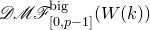 $\mathscr{DMF}^{\mathrm{big}}_{[0,p-1]}(W(k))$
. This defines
$\mathscr{DMF}^{\mathrm{big}}_{[0,p-1]}(W(k))$
. This defines $\Phi_{\mathrm{Maz}}$
from (1.7). The proof of equivalence (1.8) uses a concrete description of the reduced locus
$\Phi_{\mathrm{Maz}}$
from (1.7). The proof of equivalence (1.8) uses a concrete description of the reduced locus $W(k)^{syn}_{red}$
of
$W(k)^{syn}_{red}$
of $W(k)^{syn}$
from [Reference DrinfeldDri24] that leads to an equivalence
$W(k)^{syn}$
from [Reference DrinfeldDri24] that leads to an equivalence $\mathcal{D}_{qc,[0,p-1]}(W(k)^{syn}_{red}) \xrightarrow{\sim} \mathscr{DMF}^{\mathrm{big}}_{[0,p-1]}(W(k))\otimes \mathbb{F}_p$
. Finally, via a deformation theory argument (suggested to us by Bhatt), we prove that the pullback along
$\mathcal{D}_{qc,[0,p-1]}(W(k)^{syn}_{red}) \xrightarrow{\sim} \mathscr{DMF}^{\mathrm{big}}_{[0,p-1]}(W(k))\otimes \mathbb{F}_p$
. Finally, via a deformation theory argument (suggested to us by Bhatt), we prove that the pullback along $W(k)^{syn}_{red} \hookrightarrow W(k)^{syn}\otimes \mathbb{F}_p$
induces an equivalence
$W(k)^{syn}_{red} \hookrightarrow W(k)^{syn}\otimes \mathbb{F}_p$
induces an equivalence
 \begin{equation} \mathcal{D}_{qc,[0,p-2]}(W(k)^{syn}\otimes \mathbb{F}_p) \buildrel{\sim}\over{\longrightarrow} \mathcal{D}_{qc,[0,p-2]}(W(k)^{syn}_{red}).\end{equation}
The last step involves cohomology computations from [Reference BhattBha23, § 6]. We infer that (1.8) induces an equivalence after taking the tensor product with $\mathbb{F}_p$
, which, by p-completeness, completes the proof.
$\mathbb{F}_p$
, which, by p-completeness, completes the proof.
Though functor (1.15) is not an equivalence in large weights, it can be used to construct some interesting invariants of F-gauges. Following a suggestion of Drinfeld’s we define in Remark 4.6 a functor from the right-hand side of (1.15) to a category of Mazur modules $ \mathrm{Mod}_{\mathrm{Maz}}(W(k))$
, giving
$ \mathrm{Mod}_{\mathrm{Maz}}(W(k))$
, giving
 $$\boldsymbol{\Phi}_{\mathrm{Maz}}: \mathcal{D}_{qc,[0, \infty]}(W(k)^{syn})\to \mathrm{Mod}_{\mathrm{Maz}}(W(k)).$$
We refer the reader to Remark 4.7 for an interpretation of this functor in geometric context.
As another application of Drinfeld’s description of $\mathfrak{D}$
, we construct in Remark 4.8 a refinement of the crystalline Frobenius functor on the category of crystals on a smooth p-adic formal scheme X over
$\mathfrak{D}$
, we construct in Remark 4.8 a refinement of the crystalline Frobenius functor on the category of crystals on a smooth p-adic formal scheme X over $\operatorname{Spf} W(k)$
. This construction is related to the Cartier transform studied in [Reference Ogus and VologodskyOV07] and especially to its p-adic lift constructed in [Reference XuXu19].
$\operatorname{Spf} W(k)$
. This construction is related to the Cartier transform studied in [Reference Ogus and VologodskyOV07] and especially to its p-adic lift constructed in [Reference XuXu19].
1.5 Further directions
In a sequel we plan to extend our main results to the case of F-gauges over a smooth p-adic formal scheme X over $\operatorname{Spf} W(k)$
. In [Fal89, pp. 30–38], Faltings defined (at least for
$\operatorname{Spf} W(k)$
. In [Fal89, pp. 30–38], Faltings defined (at least for $p\gt 2$
) an abelian categoryFootnote
11
$p\gt 2$
) an abelian categoryFootnote
11 $\mathscr{MF}_{[0,p-1]}(X)$
of Fontaine–Laffaille modules over X. We expect that there is an exact fully faithful functor
$\mathscr{MF}_{[0,p-1]}(X)$
of Fontaine–Laffaille modules over X. We expect that there is an exact fully faithful functor $\mathscr{MF}_{[0,p-2]}(X) \hookrightarrow \operatorname{Coh} (X^{syn})$
; however, this functor is not derived fully faithfulFootnote
12
: the category
$\mathscr{MF}_{[0,p-2]}(X) \hookrightarrow \operatorname{Coh} (X^{syn})$
; however, this functor is not derived fully faithfulFootnote
12
: the category $\mathscr{MF}_{[0,p-2]}(X)$
is too small to capture the syntomic cohomology even in small weights. For example, the pullback functor
$\mathscr{MF}_{[0,p-2]}(X)$
is too small to capture the syntomic cohomology even in small weights. For example, the pullback functor $\mathscr{MF}_{[0,p-2]}(W(k)) \to \mathscr{MF}_{[0,p-2]}(\mathbb{P}^1)$
is an equivalence. In Remark 4.9, we propose a definition for
$\mathscr{MF}_{[0,p-2]}(W(k)) \to \mathscr{MF}_{[0,p-2]}(\mathbb{P}^1)$
is an equivalence. In Remark 4.9, we propose a definition for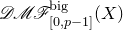 $\mathscr{DMF}^{\mathrm{big}}_{[0,p-1]}(X)$
. We expect to prove that the corresponding subcategory of the latter is equivalent to
$\mathscr{DMF}^{\mathrm{big}}_{[0,p-1]}(X)$
. We expect to prove that the corresponding subcategory of the latter is equivalent to $\mathcal{D}_{qc,[0,p-2]}(X^{syn})$
.
$\mathcal{D}_{qc,[0,p-2]}(X^{syn})$
.
1.6 Notation
Fix a prime number p. For any stack X, we denote by $\mathcal{D}_{qc}(X)$
the stable
$\mathcal{D}_{qc}(X)$
the stable $\infty$
-category of quasi-coherent sheaves on X. For a stack X over W(k), denote by
$\infty$
-category of quasi-coherent sheaves on X. For a stack X over W(k), denote by $X^{\wedge}$
the corresponding p-adic formal stack, i.e. for any ring R, we have that
$X^{\wedge}$
the corresponding p-adic formal stack, i.e. for any ring R, we have that $X^{\wedge}(R)=X(R)$
if p is nilpotent in R, and
$X^{\wedge}(R)=X(R)$
if p is nilpotent in R, and $X^{\wedge}(R)=\varnothing$
otherwise. In other words,
$X^{\wedge}(R)=\varnothing$
otherwise. In other words, $X^{\wedge}=X\times\operatorname{Spf}\mathbb{Z}_p$
. In particular,
$X^{\wedge}=X\times\operatorname{Spf}\mathbb{Z}_p$
. In particular, $\mathcal{D}_{qc}(X^{\wedge})=\underset{n}{\varprojlim} \mathcal{D}_{qc}(X\otimes\mathbb{Z}/p^n\mathbb{Z})$
.
$\mathcal{D}_{qc}(X^{\wedge})=\underset{n}{\varprojlim} \mathcal{D}_{qc}(X\otimes\mathbb{Z}/p^n\mathbb{Z})$
.
For a commutative ring R, we write $\operatorname{Spf} R$
for the formal spectrum of the p-completion of R with respect to the ideal (p), i.e.
$\operatorname{Spf} R$
for the formal spectrum of the p-completion of R with respect to the ideal (p), i.e. $\operatorname{Spf} R=(\operatorname{Spec} R)^{\wedge}$
. For a finitely generated ideal
$\operatorname{Spf} R=(\operatorname{Spec} R)^{\wedge}$
. For a finitely generated ideal $I\subset R$
, we write
$I\subset R$
, we write $\widehat{\mathcal{D}}(R)$
for the full subcategory of
$\widehat{\mathcal{D}}(R)$
for the full subcategory of $\mathcal{D}(R)$
spanned by I-complete objects (see, for example, [Reference Bhatt and LurieBL22a, § 1.9]).
$\mathcal{D}(R)$
spanned by I-complete objects (see, for example, [Reference Bhatt and LurieBL22a, § 1.9]).
2 Preliminaries
2.1 Quasi-coherent sheaves on
$\mathbb{A}^1/\mathbb{G}_m$

We recall the standard dictionary between the derived category of quasi-coherent sheaves on $\mathbb{A}^1/\mathbb{G}_m$
and the filtered derived category of graded W(k)-modules. See [Reference BhattBha23, § 2.2] for additional details.
$\mathbb{A}^1/\mathbb{G}_m$
and the filtered derived category of graded W(k)-modules. See [Reference BhattBha23, § 2.2] for additional details.
Let z denote the coordinate function on $\mathbb{G}_m$
. Consider the standard action of
$\mathbb{G}_m$
. Consider the standard action of $\mathbb{G}_m$
on
$\mathbb{G}_m$
on $\mathbb{A}^1=\operatorname{Spec} W(k)[v_+]$
given by
$\mathbb{A}^1=\operatorname{Spec} W(k)[v_+]$
given by $\mathbb{G}_m\times \mathbb{A}^1\to \mathbb{A}^1, v_+\mapsto z\otimes v_+$
. We shall denote the p-adic formal scheme associated to
$\mathbb{G}_m\times \mathbb{A}^1\to \mathbb{A}^1, v_+\mapsto z\otimes v_+$
. We shall denote the p-adic formal scheme associated to $\mathbb{A}^1$
with the above
$\mathbb{A}^1$
with the above $\mathbb{G}_m$
-action by
$\mathbb{G}_m$
-action by $\mathbb{A}^1_+$
, i.e.
$\mathbb{A}^1_+$
, i.e. $\mathbb{A}^1_+:=\operatorname{Spf} W(k)[v_+]:= (\operatorname{Spec} W(k)[v_+])^{\wedge}$
. Similarly, we define an action of
$\mathbb{A}^1_+:=\operatorname{Spf} W(k)[v_+]:= (\operatorname{Spec} W(k)[v_+])^{\wedge}$
. Similarly, we define an action of $\mathbb{G}_m$
on
$\mathbb{G}_m$
on $\mathbb{A}^1_-:=\operatorname{Spf} W(k)[v_-]$
given by
$\mathbb{A}^1_-:=\operatorname{Spf} W(k)[v_-]$
given by $v_-\mapsto z^{-1}\otimes v_-$
. We write
$v_-\mapsto z^{-1}\otimes v_-$
. We write $\mathbb{A}^1_{\pm}/\mathbb{G}_m$
for the quotient p-adic formal stacks over
$\mathbb{A}^1_{\pm}/\mathbb{G}_m$
for the quotient p-adic formal stacks over $B\mathbb{G}_m$
. Thus, for a p-nilpotent W(k)-algebra R, the groupoid of R-points of
$B\mathbb{G}_m$
. Thus, for a p-nilpotent W(k)-algebra R, the groupoid of R-points of $\mathbb{A}^1_{+}/\mathbb{G}_m$
(respectively,
$\mathbb{A}^1_{+}/\mathbb{G}_m$
(respectively, $\mathbb{A}^1_{-}/\mathbb{G}_m$
) classifies pairs
$\mathbb{A}^1_{-}/\mathbb{G}_m$
) classifies pairs $(L, v_+)$
(respectively,
$(L, v_+)$
(respectively, $(L, v_-)$
), where L is a line bundle over
$(L, v_-)$
), where L is a line bundle over $S:=\operatorname{Spec} R$
and
$S:=\operatorname{Spec} R$
and $v_+: \mathcal{O}_S \to L$
is a section of L (respectively,
$v_+: \mathcal{O}_S \to L$
is a section of L (respectively, $v_-: L \to \mathcal{O}_S$
is a section of
$v_-: L \to \mathcal{O}_S$
is a section of $L^*$
). We denote by
$L^*$
). We denote by $(\mathcal{O}(1), v_+)$
(respectively,
$(\mathcal{O}(1), v_+)$
(respectively, $(\mathcal{O}(1), v_-)$
) the universal pair over
$(\mathcal{O}(1), v_-)$
) the universal pair over $\mathbb{A}^1_{+}/\mathbb{G}_m$
(respectively,
$\mathbb{A}^1_{+}/\mathbb{G}_m$
(respectively, $\mathbb{A}^1_{-}/\mathbb{G}_m$
). We have a map
$\mathbb{A}^1_{-}/\mathbb{G}_m$
). We have a map $\mathbb{A}^1_{\pm}/\mathbb{G}_m \to B\mathbb{G}_m$
classifying the line bundle
$\mathbb{A}^1_{\pm}/\mathbb{G}_m \to B\mathbb{G}_m$
classifying the line bundle $\mathcal{O}(1)$
.Footnote
13
We identify the derived category of quasi-coherent sheaves on
$\mathcal{O}(1)$
.Footnote
13
We identify the derived category of quasi-coherent sheaves on $\mathbb{A}^1_{\pm}/\mathbb{G}_m$
with the derived category of p-complete graded modules over
$\mathbb{A}^1_{\pm}/\mathbb{G}_m$
with the derived category of p-complete graded modules over $W(k)[v_{\pm}]$
Footnote
14
:
$W(k)[v_{\pm}]$
Footnote
14
:
 \begin{equation}\mathcal{D}_{qc}(\mathbb{A}^1_{\pm}/\mathbb{G}_m)\simeq \widehat{\mathcal{D}}_{gr}(W(k)[v_{\pm}]).\end{equation}
The functor $\mathcal{D}_{qc}(\mathbb{A}^1_-/\mathbb{G}_m)\to \widehat{\mathcal{D}}_{gr}(W(k)[v_-])$
is given by
$\mathcal{D}_{qc}(\mathbb{A}^1_-/\mathbb{G}_m)\to \widehat{\mathcal{D}}_{gr}(W(k)[v_-])$
is given by
 \begin{equation}\mathcal{M}\mapsto (\oplus F^i, F^i\xrightarrow{v_-}F^{i-1}, \deg F^i=i),\end{equation}
where $F^i:=\mathrm{R}\Gamma(\mathbb{A}^1_-/\mathbb{G}_m,\mathcal{M}\otimes\mathcal{O}(i))$
with
$F^i:=\mathrm{R}\Gamma(\mathbb{A}^1_-/\mathbb{G}_m,\mathcal{M}\otimes\mathcal{O}(i))$
with $\mathcal{O}(i)$
the line bundle pulled back from
$\mathcal{O}(i)$
the line bundle pulled back from $B\mathbb{G}_m$
. The map
$B\mathbb{G}_m$
. The map $v_-: F^i\to F^{i-1}$
comes from the global section
$v_-: F^i\to F^{i-1}$
comes from the global section $v_-\in \Gamma(\mathbb{A}^1_-/\mathbb{G}_m,\mathcal{O}(-1))$
. Similarly, the functor
$v_-\in \Gamma(\mathbb{A}^1_-/\mathbb{G}_m,\mathcal{O}(-1))$
. Similarly, the functor $\mathcal{D}_{qc}(\mathbb{A}^1_+/\mathbb{G}_m)\to \widehat{\mathcal{D}}_{gr}(W(k)[v_+])$
is given by
$\mathcal{D}_{qc}(\mathbb{A}^1_+/\mathbb{G}_m)\to \widehat{\mathcal{D}}_{gr}(W(k)[v_+])$
is given by
 \begin{equation}\mathcal{M}\mapsto (\oplus G_i, G_i\xrightarrow{v_+}G_{i+1},\deg G_i=i)\end{equation}
where $G_i:=\mathrm{R}\Gamma(\mathbb{A}^1_+/\mathbb{G}_m,\mathcal{M}\otimes\mathcal{O}(i))$
.
$G_i:=\mathrm{R}\Gamma(\mathbb{A}^1_+/\mathbb{G}_m,\mathcal{M}\otimes\mathcal{O}(i))$
.
Definition 2.1. For $a,b\in\mathbb{Z}\cup \{+\infty,-\infty\}$
such that
$a,b\in\mathbb{Z}\cup \{+\infty,-\infty\}$
such that $a\leqslant b$
, let
$a\leqslant b$
, let $\mathcal{D}_{qc,[a,b]}(\mathbb{A}^1_{\pm}/\mathbb{G}_m)$
be a full subcategory of
$\mathcal{D}_{qc,[a,b]}(\mathbb{A}^1_{\pm}/\mathbb{G}_m)$
be a full subcategory of $\mathcal{D}_{qc}(\mathbb{A}^1_{\pm}/\mathbb{G}_m)$
formed of objects
$\mathcal{D}_{qc}(\mathbb{A}^1_{\pm}/\mathbb{G}_m)$
formed of objects $\mathcal{M}$
such that, under the identification (2.3) (respectively, (2.2)),
$\mathcal{M}$
such that, under the identification (2.3) (respectively, (2.2)), $G_j$
(respectively,
$G_j$
(respectively, $F^j$
) is acyclic for
$F^j$
) is acyclic for $j<a$
(respectively,
$j<a$
(respectively, $j \gt b$
) and
$j \gt b$
) and $v_+:G_i\to G_{i+1}$
(respectively,
$v_+:G_i\to G_{i+1}$
(respectively, $v_-:F^i\to F^{i-1}$
) is a quasi-isomorphism for
$v_-:F^i\to F^{i-1}$
) is a quasi-isomorphism for $i\geqslant b$
(respectively,
$i\geqslant b$
(respectively, $i\leqslant a$
). Similarly, one defines a full subcategory
$i\leqslant a$
). Similarly, one defines a full subcategory $\operatorname{Coh}_{[a,b]}(\mathbb{A}^1_{\pm}/\mathbb{G}_m)\subset\operatorname{Coh}(\mathbb{A}^1_{\pm}/\mathbb{G}_m)$
.
$\operatorname{Coh}_{[a,b]}(\mathbb{A}^1_{\pm}/\mathbb{G}_m)\subset\operatorname{Coh}(\mathbb{A}^1_{\pm}/\mathbb{G}_m)$
.
Remark 2.2 Consider the map $B\mathbb{G}_m\to \mathbb{A}^1_{\pm}/\mathbb{G}_m$
given by inclusion of the origin into
$B\mathbb{G}_m\to \mathbb{A}^1_{\pm}/\mathbb{G}_m$
given by inclusion of the origin into $\mathbb{A}^1_{\pm}$
. We identify
$\mathbb{A}^1_{\pm}$
. We identify $\mathcal{D}_{qc}(B\mathbb{G}_m)$
with the derived category of p-complete graded complexes of W(k)-modules. For any
$\mathcal{D}_{qc}(B\mathbb{G}_m)$
with the derived category of p-complete graded complexes of W(k)-modules. For any $\mathcal{M}\in \mathcal{D}_{qc,[a,b]}(\mathbb{A}^1_{\pm}/\mathbb{G}_m)$
, its restriction to
$\mathcal{M}\in \mathcal{D}_{qc,[a,b]}(\mathbb{A}^1_{\pm}/\mathbb{G}_m)$
, its restriction to $B\mathbb{G}_m$
is acyclic in grading degrees outside of [a,b]. Thus we have a well-defined functor
$B\mathbb{G}_m$
is acyclic in grading degrees outside of [a,b]. Thus we have a well-defined functor
 \[\mathcal{D}_{qc,[a,b]}(\mathbb{A}^1_{\pm}/\mathbb{G}_m)\to \mathcal{D}_{qc,[a,b]}(B\mathbb{G}_m).\]
Definition 2.3. A sheaf $\mathcal{M}\in\mathcal{D}_{qc}(\mathbb{A}^1_{\pm}/\mathbb{G}_m)$
is effective if
$\mathcal{M}\in\mathcal{D}_{qc}(\mathbb{A}^1_{\pm}/\mathbb{G}_m)$
is effective if $\mathcal{M}\in\mathcal{D}_{qc,[0,+\infty]}(\mathbb{A}^1_{\pm}/\mathbb{G}_m)$
.
$\mathcal{M}\in\mathcal{D}_{qc,[0,+\infty]}(\mathbb{A}^1_{\pm}/\mathbb{G}_m)$
.
2.2 Fontaine–Laffaille modules
Denote by $F: W(k)\to W(k)$
the Frobenius endomorphism. For
$F: W(k)\to W(k)$
the Frobenius endomorphism. For $a\in W(k)$
, denote by
$a\in W(k)$
, denote by $i_a: \operatorname{Spf} W(k)\hookrightarrow \mathbb{A}^1_- \twoheadrightarrow \mathbb{A}^1_-/\mathbb{G}_m$
the point given by equation
$i_a: \operatorname{Spf} W(k)\hookrightarrow \mathbb{A}^1_- \twoheadrightarrow \mathbb{A}^1_-/\mathbb{G}_m$
the point given by equation $v_{-}=a$
. Given
$v_{-}=a$
. Given $\mathcal{M}\in \mathcal{D}_{qc}(\mathbb{A}^1_-/\mathbb{G}_m)$
, we denote by
$\mathcal{M}\in \mathcal{D}_{qc}(\mathbb{A}^1_-/\mathbb{G}_m)$
, we denote by $\mathcal{M}_{v_-=a}:=i_a^* \mathcal{M}\in \mathcal{D}_{p\text{-}comp}(W(k))$
the derived pullback; for
$\mathcal{M}_{v_-=a}:=i_a^* \mathcal{M}\in \mathcal{D}_{p\text{-}comp}(W(k))$
the derived pullback; for $\mathcal{M}\in\operatorname{Coh}(\mathbb{A}^1_-/\mathbb{G}_m)$
, we write
$\mathcal{M}\in\operatorname{Coh}(\mathbb{A}^1_-/\mathbb{G}_m)$
, we write $ L_0 i_a^* \mathcal{M} \in \textrm{Mod}(W(k))$
for the non-derived fibre.
$ L_0 i_a^* \mathcal{M} \in \textrm{Mod}(W(k))$
for the non-derived fibre.
Definition 2.4 (Cf. [Reference Fontaine and LaffailleFL82, § 1.5]Fontaine-Laffaille and [Reference WintenbergerWin84, § 1.3]). A finitely generated (‘small’) Fontaine–Laffaille module over W(k) is $\mathcal{M}\in\operatorname{Coh}(\mathbb{A}^1_-/\mathbb{G}_m)$
together with an isomorphism between the fibres
$\mathcal{M}\in\operatorname{Coh}(\mathbb{A}^1_-/\mathbb{G}_m)$
together with an isomorphism between the fibres
 \[\varphi: F^*( L_0 i_p^* \mathcal{M})\xrightarrow{\sim} L_0 i_1^* \mathcal{M}.\]
Morphisms between Fontaine–Laffaille modules are morphisms between coherent sheaves on $\mathbb{A}^1_-/\mathbb{G}_m$
compatible with the isomorphisms
$\mathbb{A}^1_-/\mathbb{G}_m$
compatible with the isomorphisms $\varphi$
. We denote the category of Fontaine–Laffaille modules over W(k) by
$\varphi$
. We denote the category of Fontaine–Laffaille modules over W(k) by $\mathscr{MF}(W(k))$
.
$\mathscr{MF}(W(k))$
.
Remark 2.5. The full subcategory $\mathscr{MF}^{\mathrm{tor}}(W(k))$
of
$\mathscr{MF}^{\mathrm{tor}}(W(k))$
of $\mathscr{MF}(W(k))$
spanned by p-power-torsion objects is equivalent to the category
$\mathscr{MF}(W(k))$
spanned by p-power-torsion objects is equivalent to the category $\underline{MF}^f_{tor}$
introduced in [Reference Fontaine and LaffailleFL82, § 1.5]. However, the definition in [Reference Fontaine and LaffailleFL82] does not use the language of stacks. To compare Definition 2.4 with that given in [Reference Fontaine and LaffailleFL82], observe an equivalence between
$\underline{MF}^f_{tor}$
introduced in [Reference Fontaine and LaffailleFL82, § 1.5]. However, the definition in [Reference Fontaine and LaffailleFL82] does not use the language of stacks. To compare Definition 2.4 with that given in [Reference Fontaine and LaffailleFL82], observe an equivalence between $\operatorname{Coh}(\mathbb{A}^1_-/\mathbb{G}_m)$
and the category of finitely generated graded modules
$\operatorname{Coh}(\mathbb{A}^1_-/\mathbb{G}_m)$
and the category of finitely generated graded modules $\bigoplus F^i$
over
$\bigoplus F^i$
over $W(k)[v_-]$
as explained in § 2.1. Under this equivalence, the fibre
$W(k)[v_-]$
as explained in § 2.1. Under this equivalence, the fibre $ L_0 i_1^* \mathcal{M}$
of
$ L_0 i_1^* \mathcal{M}$
of $\mathcal{M}$
over the point
$\mathcal{M}$
over the point $v_-=1$
is sent to
$v_-=1$
is sent to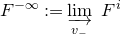 $F^{-\infty}:=\underset{v_-}{\varinjlim}\,\ F^i$
. Giving a morphism
$F^{-\infty}:=\underset{v_-}{\varinjlim}\,\ F^i$
. Giving a morphism $\varphi: F^*( L_0 i_p^* \mathcal{M})\to L_0 i_1^* \mathcal{M}$
is equivalent to giving a collection of F-linear maps
$\varphi: F^*( L_0 i_p^* \mathcal{M})\to L_0 i_1^* \mathcal{M}$
is equivalent to giving a collection of F-linear maps $\varphi_i: F^i\to F^{-\infty}$
such that
$\varphi_i: F^i\to F^{-\infty}$
such that $\varphi_{i-1}v_-=p\varphi_i$
. Assume that
$\varphi_{i-1}v_-=p\varphi_i$
. Assume that $\mathcal{M}$
is of p-power torsion. Then by [Fal89, Theorem 2.1] (see also Proposition 2.7 for the implication in the forward direction), the fact that
$\mathcal{M}$
is of p-power torsion. Then by [Fal89, Theorem 2.1] (see also Proposition 2.7 for the implication in the forward direction), the fact that $\varphi$
is an isomorphism is equivalent to the combination of the following two statements:
$\varphi$
is an isomorphism is equivalent to the combination of the following two statements:
-
(1) each
$v_-: F^i\to F^{i-1}$
is a split injection; and -
(2)
$F^{-\infty}=\sum_i\textrm{Im} (\varphi_i)$
.


These two are precisely the conditions given in [Reference Fontaine and LaffailleFL82, § 1.5] except for the adjective split in (1) which is missing in [Reference Fontaine and LaffailleFL82]. However, using that the W(k)-module $F^{-\infty}$
has finite length, one shows (see [Reference WintenbergerWin84, Proposition 1.4.1 (ii)] or [Fal89, Theorem 2.1]) that the splitting condition for
$F^{-\infty}$
has finite length, one shows (see [Reference WintenbergerWin84, Proposition 1.4.1 (ii)] or [Fal89, Theorem 2.1]) that the splitting condition for $v_-: F^i\to F^{i-1}$
is redundant.
$v_-: F^i\to F^{i-1}$
is redundant.
The whole category $\mathscr{MF}(W(k))$
can be described similarly: an object of
$\mathscr{MF}(W(k))$
can be described similarly: an object of $\mathscr{MF}(W(k))$
consists of a finitely generated W(k)-module
$\mathscr{MF}(W(k))$
consists of a finitely generated W(k)-module $F^{-\infty}$
equipped with an exhaustive filtration by W(k)-submodules
$F^{-\infty}$
equipped with an exhaustive filtration by W(k)-submodules $F^{\bullet}$
together with F-linear maps
$F^{\bullet}$
together with F-linear maps $\varphi_i: F^i\to F^{-\infty}$
,
$\varphi_i: F^i\to F^{-\infty}$
, $\varphi_{i-1}v_-=p\varphi_i$
, such that the conditions (1) and (2) above hold.Footnote
15
This category was introduced in [Reference WintenbergerWin84, § 1.3]. The category of strongly divisible lattices that appeared in [Reference Fontaine and LaffailleFL82, § 7.11] is equivalent to the full subcategory of p-torsion-free objects of
$\varphi_{i-1}v_-=p\varphi_i$
, such that the conditions (1) and (2) above hold.Footnote
15
This category was introduced in [Reference WintenbergerWin84, § 1.3]. The category of strongly divisible lattices that appeared in [Reference Fontaine and LaffailleFL82, § 7.11] is equivalent to the full subcategory of p-torsion-free objects of $\mathscr{MF}(W(k))$
.
$\mathscr{MF}(W(k))$
.
Definition 2.6. Let $\mathscr{DMF}^{\mathrm{big}}(W(k))$
be the stable
$\mathscr{DMF}^{\mathrm{big}}(W(k))$
be the stable $\mathbb{Z}_p$
-linear
$\mathbb{Z}_p$
-linear $\infty$
-category formed of objects
$\infty$
-category formed of objects $\mathcal{M}\in \mathcal{D}_{qc}(\mathbb{A}^1_-/\mathbb{G}_m)$
together with an isomorphism
$\mathcal{M}\in \mathcal{D}_{qc}(\mathbb{A}^1_-/\mathbb{G}_m)$
together with an isomorphism $\varphi:F^*(\mathcal{M}_{v_-=p})\xrightarrow{\sim} \mathcal{M}_{v_-=1}$
, i.e. we have
$\varphi:F^*(\mathcal{M}_{v_-=p})\xrightarrow{\sim} \mathcal{M}_{v_-=1}$
, i.e. we have

where $i_1^*$
denotes the pullback to the point
$i_1^*$
denotes the pullback to the point $v_-=1$
and
$v_-=1$
and $F^*\circ i_p^*$
denotes the pullback to the point
$F^*\circ i_p^*$
denotes the pullback to the point $v_-=p$
post-composed with the Frobenius.
$v_-=p$
post-composed with the Frobenius.
Part (1) of the following Proposition, with $ \mathscr{MF}(W(k))$
replaced by
$ \mathscr{MF}(W(k))$
replaced by $\mathscr{MF}^{\mathrm{tor}}(W(k))$
, is proven in [Reference Fontaine and LaffailleFL82, § 1.8], and in [Reference WintenbergerWin84, Proposition 1.4] in general. Part (2) is proven in [Fal89, Theorem 2.1].
$\mathscr{MF}^{\mathrm{tor}}(W(k))$
, is proven in [Reference Fontaine and LaffailleFL82, § 1.8], and in [Reference WintenbergerWin84, Proposition 1.4] in general. Part (2) is proven in [Fal89, Theorem 2.1].
Proposition 2.7.
-
(1) For every
$(\mathcal{M}, \varphi)\in \mathscr{MF}(W(k))$
and every point
$i_a: \operatorname{Spf} W(k) \to \mathbb{A}_-^1/\mathbb{G}_m$
, the derived pullback
$Li^*_a\mathcal{M}$
is concentrated in cohomological degree 0. In particular, for every
$j\in\mathbb{Z}$
, the map
$F^j\xrightarrow{v_-}F^{j-1}$
is injective.Footnote
16
-
(2) The category
$\mathscr{MF}(W(k))$
is abelian. Moreover, the functor
$\mathscr{MF}(W(k))\to \operatorname{Coh}(\mathbb{A}_-^1/\mathbb{G}_m)$
given by
$(\mathcal{M},\varphi)\mapsto\mathcal{M}$
is exact. -
(3) Let
$\mathcal{D}^b(\mathscr{MF}(W(k)))$
be the bounded derived category of
$\mathscr{MF}(W(k))$
. Then the functor
$\mathcal{D}^b(\mathscr{MF}(W(k)))\to \mathscr{DMF}^{\mathrm{big}}(W(k))$
is fully faithful, and its essential image is formed of pairs
$(\mathcal{M},\varphi)$
with
$\mathcal{M}\in \mathcal{D}^b(\operatorname{Coh}(\mathbb{A}^1_-/\mathbb{G}_m))$
.











Proof. Though the first two assertions are known, for the reader’s convenience, we include a proof.
To prove part (1) we first verify, by induction on n, that if $(\mathcal{M},\varphi)$
is a Fontaine–Laffaille module with
$(\mathcal{M},\varphi)$
is a Fontaine–Laffaille module with $p^n \mathcal{M}=0$
, then
$p^n \mathcal{M}=0$
, then $L_1 i^*_a \mathcal{M} =0$
. For
$L_1 i^*_a \mathcal{M} =0$
. For $n=1$
, we check that the pullback of
$n=1$
, we check that the pullback of $\mathcal{M}$
to
$\mathcal{M}$
to $\mathbb{A}^1_- \otimes k$
is a vector bundle; this would imply the assertion. Indeed, by
$\mathbb{A}^1_- \otimes k$
is a vector bundle; this would imply the assertion. Indeed, by $\mathbb{G}_m$
-equivariance it suffices to show
$\mathbb{G}_m$
-equivariance it suffices to show $\dim L_0i^*_p \mathcal{M}=\dim L_0 i^*_1 \mathcal{M}$
.Footnote
17
But this follows from the existence of
$\dim L_0i^*_p \mathcal{M}=\dim L_0 i^*_1 \mathcal{M}$
.Footnote
17
But this follows from the existence of $\varphi$
. For the induction step, set
$\varphi$
. For the induction step, set $\mathcal{M}'= \textrm{Ker} (\mathcal{M} \to \mathcal{M}/p)$
and consider the following commutative diagram.
$\mathcal{M}'= \textrm{Ker} (\mathcal{M} \to \mathcal{M}/p)$
and consider the following commutative diagram.

Using that $L_1i^*_p (\mathcal{M}/p)=0$
, the rows are exact. It follows that the left downward arrow is an isomorphism. Thus,
$L_1i^*_p (\mathcal{M}/p)=0$
, the rows are exact. It follows that the left downward arrow is an isomorphism. Thus, $(\mathcal{M}', \varphi_{\mathcal{M}'})$
is a Fontaine–Laffaille module. Applying the induction hypothesis to
$(\mathcal{M}', \varphi_{\mathcal{M}'})$
is a Fontaine–Laffaille module. Applying the induction hypothesis to $\mathcal{M}'$
and
$\mathcal{M}'$
and $\mathcal{M}/p$
we infer the assertion for
$\mathcal{M}/p$
we infer the assertion for $\mathcal{M}$
.
$\mathcal{M}$
.
To complete the proof of part (1), let us check that $L_1 i^*_a \mathcal{M} =0$
, for any Fontaine–Laffaille module. Indeed, let M denote the space of global sections of
$L_1 i^*_a \mathcal{M} =0$
, for any Fontaine–Laffaille module. Indeed, let M denote the space of global sections of $\mathcal{M}$
pulled back to
$\mathcal{M}$
pulled back to $\mathbb{A}^1_-$
. Since
$\mathbb{A}^1_-$
. Since $\mathcal{M}$
is coherent, M is a finitely generated module over
$\mathcal{M}$
is coherent, M is a finitely generated module over $ W(k)[v_-]^{\wedge}$
. In particular, M is p-complete in the classical (non-derived) sense,
$ W(k)[v_-]^{\wedge}$
. In particular, M is p-complete in the classical (non-derived) sense, $M\buildrel{\sim}\over{\longrightarrow}R^0\,{\displaystyle\lim_{\longleftarrow}} \, M/p^n\buildrel{\sim}\over{\longrightarrow}R\,{\displaystyle\lim_{\longleftarrow}} \, M/p^n$
. The derived fibre
$M\buildrel{\sim}\over{\longrightarrow}R^0\,{\displaystyle\lim_{\longleftarrow}} \, M/p^n\buildrel{\sim}\over{\longrightarrow}R\,{\displaystyle\lim_{\longleftarrow}} \, M/p^n$
. The derived fibre $i^*_a \mathcal{M}$
is isomorphic to
$i^*_a \mathcal{M}$
is isomorphic to $\operatorname{Cone} (M\stackrel{v_- -a}{\longrightarrow} M)$
. We have
$\operatorname{Cone} (M\stackrel{v_- -a}{\longrightarrow} M)$
. We have $\operatorname{Cone} (M\stackrel{v_- -a}{\longrightarrow} M)= R\,{\displaystyle\lim_{\longleftarrow}} \,\operatorname{Cone} (M/p^n \stackrel{v_- -a}{\longrightarrow} M/p^n)$
. Since
$\operatorname{Cone} (M\stackrel{v_- -a}{\longrightarrow} M)= R\,{\displaystyle\lim_{\longleftarrow}} \,\operatorname{Cone} (M/p^n \stackrel{v_- -a}{\longrightarrow} M/p^n)$
. Since $\mathcal{M} /p^n$
has a structure of Fontaine–Laffaille module,
$\mathcal{M} /p^n$
has a structure of Fontaine–Laffaille module, $\operatorname{Cone} (M/p^n \stackrel{v_- -a}{\longrightarrow} M/p^n)$
is supported in cohomological degree 0, as was shown in the previous paragraph. Thus,
$\operatorname{Cone} (M/p^n \stackrel{v_- -a}{\longrightarrow} M/p^n)$
is supported in cohomological degree 0, as was shown in the previous paragraph. Thus, $L_n i^*_a \mathcal{M} =0$
, for
$L_n i^*_a \mathcal{M} =0$
, for $n\gt 0$
.
$n\gt 0$
.
To prove part (2), we start with a preliminary construction. Let $\mathscr{MF}'(W(k))$
be the category formed of objects
$\mathscr{MF}'(W(k))$
be the category formed of objects $\mathcal{M}\in \operatorname{Coh}(\mathbb{A}^1_-/\mathbb{G}_m)$
together with a morphism
$\mathcal{M}\in \operatorname{Coh}(\mathbb{A}^1_-/\mathbb{G}_m)$
together with a morphism $\varphi:F^* L_0 i^*_p \mathcal{M} \to L_0i^*_1\mathcal{M} $
. Since the functor
$\varphi:F^* L_0 i^*_p \mathcal{M} \to L_0i^*_1\mathcal{M} $
. Since the functor $L_0i^*_1\colon \operatorname{Coh}(\mathbb{A}^1_-/\mathbb{G}_m)\to \operatorname{Coh} (\operatorname{Spf} W(k))$
is exact and
$L_0i^*_1\colon \operatorname{Coh}(\mathbb{A}^1_-/\mathbb{G}_m)\to \operatorname{Coh} (\operatorname{Spf} W(k))$
is exact and $L_0 i^*_p$
is right exact, the category
$L_0 i^*_p$
is right exact, the category $\mathscr{MF}'(W(k))$
is abelian, and the forgetful functor
$\mathscr{MF}'(W(k))$
is abelian, and the forgetful functor $\mathscr{MF}'(W(k)) \to \operatorname{Coh}(\mathbb{A}^1_-/\mathbb{G}_m)$
is exact and conservative. The category
$\mathscr{MF}'(W(k)) \to \operatorname{Coh}(\mathbb{A}^1_-/\mathbb{G}_m)$
is exact and conservative. The category $\mathscr{MF}(W(k))$
is a full subcategory of the abelian category
$\mathscr{MF}(W(k))$
is a full subcategory of the abelian category $\mathscr{MF}'(W(k))$
. Thus, to show that
$\mathscr{MF}'(W(k))$
. Thus, to show that $\mathscr{MF}(W(k))$
is abelian, it suffices to show that, for any morphism f in
$\mathscr{MF}(W(k))$
is abelian, it suffices to show that, for any morphism f in $\mathscr{MF}(W(k))$
, its kernel and cokernel computed in
$\mathscr{MF}(W(k))$
, its kernel and cokernel computed in $\mathscr{MF}'(W(k))$
lie in
$\mathscr{MF}'(W(k))$
lie in $\mathscr{MF}(W(k))$
. The assertion on cokernel is clear from the right exactness properties of
$\mathscr{MF}(W(k))$
. The assertion on cokernel is clear from the right exactness properties of $L_0i^*_p$
and
$L_0i^*_p$
and $L_0i^*_1$
. Let us check that
$L_0i^*_1$
. Let us check that $\textrm{Ker} f \in \mathscr{MF}(W(k))$
. Indeed, using the vanishing of
$\textrm{Ker} f \in \mathscr{MF}(W(k))$
. Indeed, using the vanishing of $L_1 i^*_p $
for Fontaine–Laffaille modules we conclude that
$L_1 i^*_p $
for Fontaine–Laffaille modules we conclude that $L_0i^*_p \textrm{Ker}(\mathcal{M} \stackrel{f}{\longrightarrow} \mathcal{M}') \buildrel{\sim}\over{\longrightarrow} \textrm{Ker}(L_0i^*_p \mathcal{M} \stackrel{f}{\longrightarrow} L_0i^*_p\mathcal{M}')$
which implies that
$L_0i^*_p \textrm{Ker}(\mathcal{M} \stackrel{f}{\longrightarrow} \mathcal{M}') \buildrel{\sim}\over{\longrightarrow} \textrm{Ker}(L_0i^*_p \mathcal{M} \stackrel{f}{\longrightarrow} L_0i^*_p\mathcal{M}')$
which implies that $\phi: F^* L_0i^*_p \textrm{Ker}(\mathcal{M} \stackrel{f}{\longrightarrow} \mathcal{M}') \to L_0i^*_0 \textrm{Ker}(\mathcal{M} \stackrel{f}{\longrightarrow} \mathcal{M}')$
is an isomorphism.
$\phi: F^* L_0i^*_p \textrm{Ker}(\mathcal{M} \stackrel{f}{\longrightarrow} \mathcal{M}') \to L_0i^*_0 \textrm{Ker}(\mathcal{M} \stackrel{f}{\longrightarrow} \mathcal{M}')$
is an isomorphism.
For proof of part (3): by part (1), for any $\mathcal{M} \in \mathscr{MF}(W(k))$
, we have a canonical isomorphism
$\mathcal{M} \in \mathscr{MF}(W(k))$
, we have a canonical isomorphism $F^*i^*_p \mathcal{M}\simeq F^* i^*_p M$
, where the pullbacks are derived. This defines an exact functor
$F^*i^*_p \mathcal{M}\simeq F^* i^*_p M$
, where the pullbacks are derived. This defines an exact functor $\mathscr{MF}(W(k)) \to \mathscr{DMF}^{\mathrm{big}}(W(k))$
that extends uniquely to an exact functor
$\mathscr{MF}(W(k)) \to \mathscr{DMF}^{\mathrm{big}}(W(k))$
that extends uniquely to an exact functor
 \begin{equation} \mathcal{D}^b(\mathscr{MF}(W(k))) \to \mathscr{DMF}^{\mathrm{big}}(W(k)).\end{equation}
Let us check that (2.5) is fully faithful. It suffices to show that, for any two objects $(\mathcal{M}, \varphi_\mathcal{M}), (\mathcal{N}, \varphi_\mathcal{N}) \in \mathscr{MF}(W(k))$
, the map of mapping spectra
$(\mathcal{M}, \varphi_\mathcal{M}), (\mathcal{N}, \varphi_\mathcal{N}) \in \mathscr{MF}(W(k))$
, the map of mapping spectra
 \begin{equation} \operatorname{Hom}_{\mathcal{D}^b(\mathscr{MF}(W(k)))} (\mathcal{M}, \mathcal{N}) \to \operatorname{Hom}_{\mathscr{DMF}^{\mathrm{big}}(W(k))} (\mathcal{M}, \mathcal{N})\end{equation}
is an equivalence. Firstly, we check this for a p-torsion-free $\mathcal{M}$
. Using part (1), this condition is equivalent to
$\mathcal{M}$
. Using part (1), this condition is equivalent to $\mathcal{M}$
being a locally free
$\mathcal{M}$
being a locally free $\mathcal{O}$
-module. By definition of the equalizer category, the spectrum
$\mathcal{O}$
-module. By definition of the equalizer category, the spectrum $ \operatorname{Hom}_{\mathscr{DMF}^{\mathrm{big}}(W(k))} (\mathcal{M}, \mathcal{N})$
is given by
$ \operatorname{Hom}_{\mathscr{DMF}^{\mathrm{big}}(W(k))} (\mathcal{M}, \mathcal{N})$
is given by
 \begin{equation} \mathrm{Fib} (\operatorname{Hom}_{\mathcal{D}_{qc}(\mathbb{A}^1_-/\mathbb{G}_m)} (\mathcal{M}, \mathcal{N} ) \to \operatorname{Hom}_{\mathcal{D}_{qc}(W(k))} (F^* i^*_p\mathcal{M}, i^*_1\mathcal{N})),\end{equation}
where the map carries $f\in \operatorname{Hom}_{\mathcal{D}_{qc}(\mathbb{A}^1_-/\mathbb{G}_m)} (\mathcal{M}, \mathcal{N} )$
to
$f\in \operatorname{Hom}_{\mathcal{D}_{qc}(\mathbb{A}^1_-/\mathbb{G}_m)} (\mathcal{M}, \mathcal{N} )$
to $i^*_1(f) \circ \varphi_{\mathcal{M}}- \varphi_{\mathcal{N}} \circ F^* i^*_p(f)$
. In particular, if
$i^*_1(f) \circ \varphi_{\mathcal{M}}- \varphi_{\mathcal{N}} \circ F^* i^*_p(f)$
. In particular, if $\mathcal{M}$
is a locally free
$\mathcal{M}$
is a locally free $\mathcal{O}$
-module,
$\mathcal{O}$
-module, $ \pi_i \operatorname{Hom}_{\mathscr{DMF}^{\mathrm{big}}(W(k))} (\mathcal{M}, \mathcal{N})=0$
unless
$ \pi_i \operatorname{Hom}_{\mathscr{DMF}^{\mathrm{big}}(W(k))} (\mathcal{M}, \mathcal{N})=0$
unless $i=0$
or
$i=0$
or $-1$
: each mapping spectrum appearing in (2.7) is isomorphic to an abelian group. Using [Reference Bloch and KatoBK90, Lemma 4.4], the same is true for
$-1$
: each mapping spectrum appearing in (2.7) is isomorphic to an abelian group. Using [Reference Bloch and KatoBK90, Lemma 4.4], the same is true for $ \operatorname{Hom}_{\mathcal{D}^b(\mathscr{MF}(W(k)))} (\mathcal{M},\mathcal{N})$
. Since
$ \operatorname{Hom}_{\mathcal{D}^b(\mathscr{MF}(W(k)))} (\mathcal{M},\mathcal{N})$
. Since $\mathscr{MF}(W(k)) \to \mathscr{DMF}^{\mathrm{big}}(W(k))$
is fully faithful and its essential image is closed under extensions (that is, for any morphism
$\mathscr{MF}(W(k)) \to \mathscr{DMF}^{\mathrm{big}}(W(k))$
is fully faithful and its essential image is closed under extensions (that is, for any morphism $\mathcal{N} \to \mathcal{M}[1]$
in
$\mathcal{N} \to \mathcal{M}[1]$
in $\mathscr{DMF}^{\mathrm{big}}(W(k))$
, its fibre is isomorphic to an object of
$\mathscr{DMF}^{\mathrm{big}}(W(k))$
, its fibre is isomorphic to an object of $\mathscr{MF}(W(k))$
), it follows that (2.6) is an equivalence for torsion-free
$\mathscr{MF}(W(k))$
), it follows that (2.6) is an equivalence for torsion-free $\mathcal{M}$
. In general, for any
$\mathcal{M}$
. In general, for any $\mathcal{M}$
, we have a fibre sequence
$\mathcal{M}$
, we have a fibre sequence $\mathcal{M}_{tor} \hookrightarrow \mathcal{M} \twoheadrightarrow \mathcal{M}/\mathcal{M}_{tor}$
, where
$\mathcal{M}_{tor} \hookrightarrow \mathcal{M} \twoheadrightarrow \mathcal{M}/\mathcal{M}_{tor}$
, where $\mathcal{M}_{tor}$
is a torsion Fontaine–Laffaille module and
$\mathcal{M}_{tor}$
is a torsion Fontaine–Laffaille module and $\mathcal{M}/\mathcal{M}_{tor}$
is torsion-free. Thus, it remains to prove that (2.6) is an equivalence for
$\mathcal{M}/\mathcal{M}_{tor}$
is torsion-free. Thus, it remains to prove that (2.6) is an equivalence for $\mathcal{M} =\mathcal{M}_{tor} $
. By dévissage, we may assume that
$\mathcal{M} =\mathcal{M}_{tor} $
. By dévissage, we may assume that $p \mathcal{M}=0$
. In this case the assertion reduces to the torsion-free case using the following observation.
$p \mathcal{M}=0$
. In this case the assertion reduces to the torsion-free case using the following observation.
Lemma 2.8. For any p-torsion Fontaine–Laffaille module $(\mathcal{M}, \varphi)$
, there exists a torsion-free Fontaine–Laffaille module
$(\mathcal{M}, \varphi)$
, there exists a torsion-free Fontaine–Laffaille module $(\tilde{\mathcal{M}}, \tilde{\varphi})$
with
$(\tilde{\mathcal{M}}, \tilde{\varphi})$
with $(\tilde{\mathcal{M}}, \tilde{\varphi}) \otimes \mathbb{F}_p \buildrel{\sim}\over{\longrightarrow} (\mathcal{M}, \varphi)$
.
$(\tilde{\mathcal{M}}, \tilde{\varphi}) \otimes \mathbb{F}_p \buildrel{\sim}\over{\longrightarrow} (\mathcal{M}, \varphi)$
.
Proof. Any vector bundle over $\mathbb{A}^{1}_-/\mathbb{G}_{m} \otimes \mathbb{F}_p$
is isomorphic to a direct sum of line bundles of the form
$\mathbb{A}^{1}_-/\mathbb{G}_{m} \otimes \mathbb{F}_p$
is isomorphic to a direct sum of line bundles of the form $\mathcal{O}(i)$
,
$\mathcal{O}(i)$
, $i\in \mathbb{Z}$
. In particular, it lifts to a vector bundle over
$i\in \mathbb{Z}$
. In particular, it lifts to a vector bundle over $\mathbb{A}^1_-/\mathbb{G}_m$
. Pick a vector bundle
$\mathbb{A}^1_-/\mathbb{G}_m$
. Pick a vector bundle $\tilde{\mathcal{M}}$
over
$\tilde{\mathcal{M}}$
over $\mathbb{A}^1_-/\mathbb{G}_m$
that lifts
$\mathbb{A}^1_-/\mathbb{G}_m$
that lifts $\mathcal{M}$
and then choose any
$\mathcal{M}$
and then choose any $\tilde{\varphi}: F^*(\tilde{\mathcal{M}}_{v_-=p})\xrightarrow{\sim}\tilde{\mathcal{M}}_{v_-=1}$
that lifts
$\tilde{\varphi}: F^*(\tilde{\mathcal{M}}_{v_-=p})\xrightarrow{\sim}\tilde{\mathcal{M}}_{v_-=1}$
that lifts $\varphi: F^*(\tilde{\mathcal{M}}_{v_-=p}) \otimes \mathbb{F}_p\xrightarrow{\sim}\tilde{\mathcal{M}}_{v_-=1}\otimes \mathbb{F}_p$
.
$\varphi: F^*(\tilde{\mathcal{M}}_{v_-=p}) \otimes \mathbb{F}_p\xrightarrow{\sim}\tilde{\mathcal{M}}_{v_-=1}\otimes \mathbb{F}_p$
.
It remains to prove that the essential image of the functor (2.5) consists of all objects $(\mathcal{M}, \varphi)$
whose underlying complex
$(\mathcal{M}, \varphi)$
whose underlying complex $\mathcal{M}\in \mathcal{D}_{qc} (\mathbb{A}^1_-/\mathbb{G}_m)$
is bounded and has coherent cohomology. We induct on length of the complex. If
$\mathcal{M}\in \mathcal{D}_{qc} (\mathbb{A}^1_-/\mathbb{G}_m)$
is bounded and has coherent cohomology. We induct on length of the complex. If $\mathcal{M}$
is supported in a single cohomological degree the assertion is clear. For the induction step, we assume that
$\mathcal{M}$
is supported in a single cohomological degree the assertion is clear. For the induction step, we assume that $\mathcal{M}$
is connective and
$\mathcal{M}$
is connective and $H^0(\mathcal{M}) \ne 0$
. Note that the isomorphism
$H^0(\mathcal{M}) \ne 0$
. Note that the isomorphism $\varphi: F^*i^*_p \mathcal{M} \xrightarrow{\sim} i^*_1 \mathcal{M}$
induces
$\varphi: F^*i^*_p \mathcal{M} \xrightarrow{\sim} i^*_1 \mathcal{M}$
induces $H^0(\varphi): F^*L_0i^*_p H^0(\mathcal{M}) \xrightarrow{\sim} L_0 i^*_1 H^0(\mathcal{M})$
. Thus,
$H^0(\varphi): F^*L_0i^*_p H^0(\mathcal{M}) \xrightarrow{\sim} L_0 i^*_1 H^0(\mathcal{M})$
. Thus, $(H^0(\mathcal{M}), H^0(\varphi))\in \mathscr{MF}(W(k))$
. By part (1) of the proposition
$(H^0(\mathcal{M}), H^0(\varphi))\in \mathscr{MF}(W(k))$
. By part (1) of the proposition $ L_j i^*_p H^0(\mathcal{M})= L_j i^*_1 H^0(\mathcal{M}) =0$
for
$ L_j i^*_p H^0(\mathcal{M})= L_j i^*_1 H^0(\mathcal{M}) =0$
for $j\gt 0$
. It follows that the map
$j\gt 0$
. It follows that the map $\mathcal{M} \to H^0 (\mathcal{M})$
in
$\mathcal{M} \to H^0 (\mathcal{M})$
in $\mathcal{D}_{qc}(\mathbb{A}^1_-/\mathbb{G}_m)$
lifts to a morphism in
$\mathcal{D}_{qc}(\mathbb{A}^1_-/\mathbb{G}_m)$
lifts to a morphism in $\mathscr{DMF}^{\mathrm{big}}(W(k))$
. Applying the induction assumption to its fibre we complete the proof.
$\mathscr{DMF}^{\mathrm{big}}(W(k))$
. Applying the induction assumption to its fibre we complete the proof.
Let $\mathscr{MF}_{[a,b]}(W(k))$
(respectively,
$\mathscr{MF}_{[a,b]}(W(k))$
(respectively,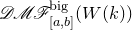 $\mathscr{DMF}^{\mathrm{big}}_{[a,b]}(W(k))$
) be a full subcategory of
$\mathscr{DMF}^{\mathrm{big}}_{[a,b]}(W(k))$
) be a full subcategory of $\mathscr{MF}(W(k))$
(respectively,
$\mathscr{MF}(W(k))$
(respectively, $\mathscr{DMF}^{\mathrm{big}}(W(k))$
) formed of objects
$\mathscr{DMF}^{\mathrm{big}}(W(k))$
) formed of objects $(\mathcal{M},\varphi)\in \mathscr{MF}(W(k))$
(respectively,
$(\mathcal{M},\varphi)\in \mathscr{MF}(W(k))$
(respectively, $\mathscr{DMF}^{\mathrm{big}}(W(k))$
) such that
$\mathscr{DMF}^{\mathrm{big}}(W(k))$
) such that $\mathcal{M}\in \mathcal{D}_{qc,[a,b]}(\mathbb{A}^1_-/\mathbb{G}_m)$
.
$\mathcal{M}\in \mathcal{D}_{qc,[a,b]}(\mathbb{A}^1_-/\mathbb{G}_m)$
.
2.3 Syntomification via filtered Cartier–Witt divisors
Recall from [Reference DrinfeldDri24] and [Reference BhattBha23, § 5.3] definitions of the stacks $W(k)^{\mathbb{\Delta}}$
,
$W(k)^{\mathbb{\Delta}}$
, $W(k)^{\mathcal{N}}$
,
$W(k)^{\mathcal{N}}$
, $W(k)^{syn}$
, and
$W(k)^{syn}$
, and $X^{syn}$
.
$X^{syn}$
.
Throughout this paper we let W be the p-typical Witt ring scheme pulled back to $\operatorname{Spec} \mathbb{Z}_{(p)}$
. For a p-nilpotent W(k)-algebra R, set
$\operatorname{Spec} \mathbb{Z}_{(p)}$
. For a p-nilpotent W(k)-algebra R, set $W_R := W \times \operatorname{Spec} R$
. A
$W_R := W \times \operatorname{Spec} R$
. A $W_R$
-module M is an affine group scheme over R with an action of the ring scheme
$W_R$
-module M is an affine group scheme over R with an action of the ring scheme $W_R$
. We say that M is invertible if, Zariski locally on
$W_R$
. We say that M is invertible if, Zariski locally on $\operatorname{Spec} R$
, M is isomorphic to the free
$\operatorname{Spec} R$
, M is isomorphic to the free $W_R$
-module
$W_R$
-module $W_R$
. Denote by
$W_R$
. Denote by $W(k)^{\mathbb{\Delta}}(R)$
the groupoid whose objects are pairs
$W(k)^{\mathbb{\Delta}}(R)$
the groupoid whose objects are pairs $(M, \xi)$
, where M is an invertible
$(M, \xi)$
, where M is an invertible $W_R$
-module and
$W_R$
-module and $\xi:M\to W_R$
is a morphism of
$\xi:M\to W_R$
is a morphism of $W_R$
-modules such that Zariski locally on
$W_R$
-modules such that Zariski locally on $\operatorname{Spec} R$
the pair
$\operatorname{Spec} R$
the pair $(M, \xi)$
is isomorphic to
$(M, \xi)$
is isomorphic to $(W_R, w\textrm{Id})$
,
$(W_R, w\textrm{Id})$
, $w=(w_1, w_2, \ldots)\in W(R)$
, with
$w=(w_1, w_2, \ldots)\in W(R)$
, with $w_1\in R$
nilpotent and
$w_1\in R$
nilpotent and $w_2\in R^*$
.
$w_2\in R^*$
.
For a $W_R$
-module M, precomposing the
$W_R$
-module M, precomposing the $W_R$
-action on M with the Frobenius
$W_R$
-action on M with the Frobenius $F: W_R\to W_R$
we obtain a new
$F: W_R\to W_R$
we obtain a new $W_R$
-module
$W_R$
-module $F_*M$
whose underlying group scheme is that of M. Applying this to the free
$F_*M$
whose underlying group scheme is that of M. Applying this to the free $W_R$
-module
$W_R$
-module $W_R$
, we have an exact sequence
$W_R$
, we have an exact sequence
 \begin{equation} 0\to \mathbb{G}_{a,R}^{\sharp} \stackrel{}{\longrightarrow} W_R \stackrel{F}{\longrightarrow} F_*W_R \to 0\end{equation}
of $W_R$
-modules.Footnote
18
Note that the action of
$W_R$
-modules.Footnote
18
Note that the action of $W_R$
on
$W_R$
on $\mathbb{G}_{a,R}^{\sharp}$
factors through the ‘first coordinate’ homomorphism
$\mathbb{G}_{a,R}^{\sharp}$
factors through the ‘first coordinate’ homomorphism $W_R\to \mathbb{G}_{a,R}$
. In particular, we have a natural action of the group
$W_R\to \mathbb{G}_{a,R}$
. In particular, we have a natural action of the group $\mathbb{G}_{m,R}$
on the
$\mathbb{G}_{m,R}$
on the $W_R$
-module
$W_R$
-module $\mathbb{G}_{a,R}^{\sharp}$
. Consequently, given an invertible R-module L we can twist
$\mathbb{G}_{a,R}^{\sharp}$
. Consequently, given an invertible R-module L we can twist $\mathbb{G}_{a,R}^{\sharp}$
by L; the resulting
$\mathbb{G}_{a,R}^{\sharp}$
by L; the resulting $W_R$
-module is denoted by
$W_R$
-module is denoted by $ \mathbf{V}(L)^{\sharp}$
. A
$ \mathbf{V}(L)^{\sharp}$
. A $W_R$
-module M is called admissible if M fits into a sequence of
$W_R$
-module M is called admissible if M fits into a sequence of $W_R$
-modules of the form
$W_R$
-modules of the form
 \begin{equation} 0 \to \mathbf{V}(L)^{\sharp} \to M \to F_* M' \to 0,\end{equation}
where $L \in \textrm{Pic}(R)$
and M’ is an invertible
$L \in \textrm{Pic}(R)$
and M’ is an invertible $W_R$
-module. One checks (see [Reference DrinfeldDri24, Lemma 3.12.7]) that L, M’, and the sequence (2.9) are functorial in M. In particular, every morphism
$W_R$
-module. One checks (see [Reference DrinfeldDri24, Lemma 3.12.7]) that L, M’, and the sequence (2.9) are functorial in M. In particular, every morphism $\xi:M\to W_R$
of
$\xi:M\to W_R$
of $W_R$
-modules extends uniquely to a morphism between short exact sequences (2.9) and (2.8). Consider the category
$W_R$
-modules extends uniquely to a morphism between short exact sequences (2.9) and (2.8). Consider the category $W(k)^{\mathcal{N}, c}(R)$
consisting of pairs
$W(k)^{\mathcal{N}, c}(R)$
consisting of pairs $(M, \xi)$
, called filtered Cartier–Witt divisors, where M is an admissible
$(M, \xi)$
, called filtered Cartier–Witt divisors, where M is an admissible $W_R$
-module and
$W_R$
-module and $\xi:M\to W_R$
is a morphism of
$\xi:M\to W_R$
is a morphism of $W_R$
-modules such that the pair
$W_R$
-modules such that the pair $(M', \bar \xi: M' \to W_R)$
, constructed from the morphism of short exact sequences, is an object
$(M', \bar \xi: M' \to W_R)$
, constructed from the morphism of short exact sequences, is an object $W(k)^{\mathbb{\Delta}}(R)$
. Morphisms between
$W(k)^{\mathbb{\Delta}}(R)$
. Morphisms between $(M, \xi)$
and
$(M, \xi)$
and $(M', \xi')$
in
$(M', \xi')$
in $W(k)^{\mathcal{N}, c}(R)$
are given by morphisms
$W(k)^{\mathcal{N}, c}(R)$
are given by morphisms $f: M \to M'$
of
$f: M \to M'$
of $W_R$
-modules such that
$W_R$
-modules such that $\xi' \circ f = \xi$
. The groupoid
$\xi' \circ f = \xi$
. The groupoid $W(k)^{\mathcal{N}} (R)$
is obtained from
$W(k)^{\mathcal{N}} (R)$
is obtained from $W(k)^{\mathcal{N}, c}(R)$
by discarding all morphisms which are not isomorphisms. By definition, the groupoid of R-points of the stack
$W(k)^{\mathcal{N}, c}(R)$
by discarding all morphisms which are not isomorphisms. By definition, the groupoid of R-points of the stack $W(k)^{\mathcal{N}}$
is
$W(k)^{\mathcal{N}}$
is $W(k)^{\mathcal{N}} (R)$
. The functor
$W(k)^{\mathcal{N}} (R)$
. The functor $W(k)^{\mathcal{N}, c}$
from the category of p-nilpotent W(k)-algebras to the 2-category of categories that carries an algebra R to
$W(k)^{\mathcal{N}, c}$
from the category of p-nilpotent W(k)-algebras to the 2-category of categories that carries an algebra R to $W(k)^{\mathcal{N}, c}(R)$
is an example of what Drinfeld calls in [Reference DrinfeldDri24] a c-stack. We do not use this notion in the main body of the paper except for Remark 3.9.
$W(k)^{\mathcal{N}, c}(R)$
is an example of what Drinfeld calls in [Reference DrinfeldDri24] a c-stack. We do not use this notion in the main body of the paper except for Remark 3.9.
Given an object $(M, \xi)$
of
$(M, \xi)$
of $W(k)^{\mathcal{N}}(R)$
, the morphism of
$W(k)^{\mathcal{N}}(R)$
, the morphism of $W_R$
-modules
$W_R$
-modules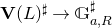 $\mathbf{V}(L)^{\sharp}\to \mathbb{G}_{a,R}^{\sharp}$
derived from
$\mathbf{V}(L)^{\sharp}\to \mathbb{G}_{a,R}^{\sharp}$
derived from $\xi$
lifts uniquely to a morphism of R-modules
$\xi$
lifts uniquely to a morphism of R-modules $L\to R$
(see [Reference DrinfeldDri24, Lemma 3.12.4, (ii)]). This defines a morphism of stacks called the Rees map:
$L\to R$
(see [Reference DrinfeldDri24, Lemma 3.12.4, (ii)]). This defines a morphism of stacks called the Rees map:
 \begin{equation}t_{W(k)}: W(k)^{\mathcal{N}} \to \mathbb{A}^1_-/\mathbb{G}_m.\end{equation}
Sending $(M, \xi)\in W(k)^{\mathcal{N}}(R)$
to
$(M, \xi)\in W(k)^{\mathcal{N}}(R)$
to $(M', \bar \xi: M' \to W_R)\in W(k)^{\mathbb{\Delta}}(R)$
determines a morphism
$(M', \bar \xi: M' \to W_R)\in W(k)^{\mathbb{\Delta}}(R)$
determines a morphism $\pi : W(k)^{\mathcal{N}} \to W(k)^{\mathbb{\Delta}}$
called the structure morphism. Every invertible
$\pi : W(k)^{\mathcal{N}} \to W(k)^{\mathbb{\Delta}}$
called the structure morphism. Every invertible $W_R$
-module is admissible and, moreover, every point
$W_R$
-module is admissible and, moreover, every point $(M, \xi)\in W(k)^{\mathbb{\Delta}}(R)$
is also a point of
$(M, \xi)\in W(k)^{\mathbb{\Delta}}(R)$
is also a point of $W(k)^{\mathcal{N}}(R)$
(see [Reference DrinfeldDri24, § 5.3]). This defines a map
$W(k)^{\mathcal{N}}(R)$
(see [Reference DrinfeldDri24, § 5.3]). This defines a map $j_+: W(k)^{\mathbb{\Delta}} \to W(k)^{\mathcal{N}}$
which exhibits
$j_+: W(k)^{\mathbb{\Delta}} \to W(k)^{\mathcal{N}}$
which exhibits $W(k)^{\mathbb{\Delta}}$
as an open substack of
$W(k)^{\mathbb{\Delta}}$
as an open substack of $ W(k)^{\mathcal{N}}$
(see [Reference DrinfeldDri24, Lemma 5.3.1]). As in [Reference DrinfeldDri24, § 5.6], we define another open embedding
$ W(k)^{\mathcal{N}}$
(see [Reference DrinfeldDri24, Lemma 5.3.1]). As in [Reference DrinfeldDri24, § 5.6], we define another open embedding $j_-: W(k)^{\mathbb{\Delta}} \to W(k)^{\mathcal{N}}$
as follows. For
$j_-: W(k)^{\mathbb{\Delta}} \to W(k)^{\mathcal{N}}$
as follows. For $(M, \theta) \in W(k)^{\mathbb{\Delta}} (R)$
, define a filtered Cartier–Witt divisor
$(M, \theta) \in W(k)^{\mathbb{\Delta}} (R)$
, define a filtered Cartier–Witt divisor $j_-(M, \theta):= (N, \xi)\in W(k)^{\mathcal{N}}(R)$
by the following pullback diagram.
$j_-(M, \theta):= (N, \xi)\in W(k)^{\mathcal{N}}(R)$
by the following pullback diagram.

One can check that open substacks defined by $j_-$
and
$j_-$
and $j_+$
do not intersect (see [Reference DrinfeldDri24, Lemma 5.6.3]). The stack
$j_+$
do not intersect (see [Reference DrinfeldDri24, Lemma 5.6.3]). The stack $W(k)^{syn}$
is obtained from
$W(k)^{syn}$
is obtained from $W(k)^{\mathcal{N}}$
by gluing two copies of
$W(k)^{\mathcal{N}}$
by gluing two copies of $W(k)^{\mathbb{\Delta}}$
using the maps
$W(k)^{\mathbb{\Delta}}$
using the maps $j_-$
and
$j_-$
and $j_+$
.
$j_+$
.
For every $(M, \xi)\in W(k)^{\mathcal{N}}(R)$
one considers the W(k)-algebra stack
$(M, \xi)\in W(k)^{\mathcal{N}}(R)$
one considers the W(k)-algebra stack $\operatorname{Cone}(M \xrightarrow[]{\xi} W_R)$
(we refer the reader to [Reference DrinfeldDri24, § 1.3 and 1.4] and the references therein for a discussion of the notion of a ring stack). As a group stack, this is simply the quotient stack
$\operatorname{Cone}(M \xrightarrow[]{\xi} W_R)$
(we refer the reader to [Reference DrinfeldDri24, § 1.3 and 1.4] and the references therein for a discussion of the notion of a ring stack). As a group stack, this is simply the quotient stack $[W_R/M]$
. The algebra structure on the quotient comes from the natural DG-algebra structure on
$[W_R/M]$
. The algebra structure on the quotient comes from the natural DG-algebra structure on $M \xrightarrow[]{\xi} W_R$
given by the
$M \xrightarrow[]{\xi} W_R$
given by the $W_R$
-module structure on M (see [Reference DrinfeldDri24, § 1.3.3]). By ‘transmutation’ (see [Reference BhattBha23, Remark 2.3.8] and [Reference DrinfeldDri24, § 1.4.2]), this defines a Nygaardization functor
$W_R$
-module structure on M (see [Reference DrinfeldDri24, § 1.3.3]). By ‘transmutation’ (see [Reference BhattBha23, Remark 2.3.8] and [Reference DrinfeldDri24, § 1.4.2]), this defines a Nygaardization functor $X \mapsto X^{\mathcal{N}}$
from the category of bounded p-adic formal schemes over
$X \mapsto X^{\mathcal{N}}$
from the category of bounded p-adic formal schemes over $\operatorname{Spf} W(k)$
to stacks: for a p-nilpotent W(k)-algebra R, an R-point of the groupoid
$\operatorname{Spf} W(k)$
to stacks: for a p-nilpotent W(k)-algebra R, an R-point of the groupoid $X^{\mathcal{N}}(R)$
consists of
$X^{\mathcal{N}}(R)$
consists of $(M, \xi)\in W(k)^{\mathcal{N}}(R)$
together with a morphism
$(M, \xi)\in W(k)^{\mathcal{N}}(R)$
together with a morphism $\operatorname{Spec} (\operatorname{Cone}(M \xrightarrow[]{\xi} W_R)(R)) \to X$
of derived schemes over W(k). For every
$\operatorname{Spec} (\operatorname{Cone}(M \xrightarrow[]{\xi} W_R)(R)) \to X$
of derived schemes over W(k). For every $(M, \theta)\in W(k)^{\mathbb{\Delta}}(R)$
, setting
$(M, \theta)\in W(k)^{\mathbb{\Delta}}(R)$
, setting $j_+ (M, \theta)= (N_+, \xi_+)$
,
$j_+ (M, \theta)= (N_+, \xi_+)$
, $j_- (M, \theta)= (N_-, \xi_-)$
, one constructs (see [Reference DrinfeldDri24, § 5.8]) a natural isomorphism
$j_- (M, \theta)= (N_-, \xi_-)$
, one constructs (see [Reference DrinfeldDri24, § 5.8]) a natural isomorphism $\operatorname{Cone}(N_- \xrightarrow[]{\xi_-} W_R) \buildrel{\sim}\over{\longrightarrow} \operatorname{Cone}(N_+ \xrightarrow[]{\xi_+} W_R)$
of W(k)-algebra stacks (the map is given by the rightward arrows in diagram (2.11)). Consequently, the fibres of
$\operatorname{Cone}(N_- \xrightarrow[]{\xi_-} W_R) \buildrel{\sim}\over{\longrightarrow} \operatorname{Cone}(N_+ \xrightarrow[]{\xi_+} W_R)$
of W(k)-algebra stacks (the map is given by the rightward arrows in diagram (2.11)). Consequently, the fibres of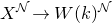 $X^\mathcal{N} \to W(k)^\mathcal{N}$
over the two copies of
$X^\mathcal{N} \to W(k)^\mathcal{N}$
over the two copies of $W(k)^{\mathbb{\Delta}}$
inside
$W(k)^{\mathbb{\Delta}}$
inside $ W(k)^{\mathcal{N}}$
are naturally identified (and denoted byFootnote
19
$ W(k)^{\mathcal{N}}$
are naturally identified (and denoted byFootnote
19 $j_+, j_-: X^{{\mathbb{\Delta}}} \hookrightarrow X^\mathcal{N}$
). The stack
$j_+, j_-: X^{{\mathbb{\Delta}}} \hookrightarrow X^\mathcal{N}$
). The stack $X^{syn}$
is obtained from
$X^{syn}$
is obtained from $X^\mathcal{N}$
by gluing these two open substacks. This procedure defines a functor
$X^\mathcal{N}$
by gluing these two open substacks. This procedure defines a functor $X \mapsto X^{syn}$
from bounded p-adic formal schemes over
$X \mapsto X^{syn}$
from bounded p-adic formal schemes over $\operatorname{Spf} W(k)$
to stacks. In particular, if
$\operatorname{Spf} W(k)$
to stacks. In particular, if $f: X \to \operatorname{Spf} W(k)$
is such a scheme, we have by functoriality a map
$f: X \to \operatorname{Spf} W(k)$
is such a scheme, we have by functoriality a map $f^{syn}: X^{syn} \to W(k)^{syn}$
. We refer to
$f^{syn}: X^{syn} \to W(k)^{syn}$
. We refer to $\mathcal{H}_{syn}(X):= Rf_*^{syn}(\mathcal{O}_{ X^{syn}})\in \mathcal{D}_{qc}(W(k)^{syn})$
as the F-gauge associated to X.
$\mathcal{H}_{syn}(X):= Rf_*^{syn}(\mathcal{O}_{ X^{syn}})\in \mathcal{D}_{qc}(W(k)^{syn})$
as the F-gauge associated to X.
Recall from [Reference DrinfeldDri24, Lemma 5.13.4 (i)] that we have a morphism
 \begin{equation}\mathfrak{p}_{\bar{\mathrm{dR}}}: \mathbb{A}^1_-/\mathbb{G}_m\to W(k)^{\mathcal{N}}\end{equation}
constructed as follows. Recall that an R-point of $\mathbb{A}^1_-/\mathbb{G}_m$
is a pair
$\mathbb{A}^1_-/\mathbb{G}_m$
is a pair $(L ,v_-)$
, where L is an invertible R-module equipped with an R-linear morphism
$(L ,v_-)$
, where L is an invertible R-module equipped with an R-linear morphism $v_-: L \to R$
. The map
$v_-: L \to R$
. The map $\mathfrak{p}_{\bar{\mathrm{dR}}}$
is given by
$\mathfrak{p}_{\bar{\mathrm{dR}}}$
is given by $\mathfrak{p}_{\bar{\mathrm{dR}}}(L,v_-)=(M_{\mathfrak{p}_{\bar{\mathrm{dR}}, R}},\xi )$
, where
$\mathfrak{p}_{\bar{\mathrm{dR}}}(L,v_-)=(M_{\mathfrak{p}_{\bar{\mathrm{dR}}, R}},\xi )$
, where $M_{\mathfrak{p}_{\bar{\mathrm{dR}},R}}= \mathbf{V}(L)^{\sharp} \oplus F_*W_R$
, and
$M_{\mathfrak{p}_{\bar{\mathrm{dR}},R}}= \mathbf{V}(L)^{\sharp} \oplus F_*W_R$
, and
 \begin{equation}\xi:M_{\mathfrak{p}_{\bar{\mathrm{dR}},R}}=\mathbf{V}(L)^{\sharp} \oplus F_*W_R\to W_R\end{equation}
is given by $\xi:=(v_-^\sharp,V)$
. Here V is the Verschiebung and
$\xi:=(v_-^\sharp,V)$
. Here V is the Verschiebung and $v_-^\sharp: \mathbf{V}(L)^{\sharp} \to W_R$
is the composition of the map
$v_-^\sharp: \mathbf{V}(L)^{\sharp} \to W_R$
is the composition of the map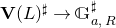 $\mathbf{V}(L)^{\sharp} \to \mathbb{G}_{a,\,R}^\sharp$
induced by
$\mathbf{V}(L)^{\sharp} \to \mathbb{G}_{a,\,R}^\sharp$
induced by $v_-$
and the embedding
$v_-$
and the embedding $\mathbb{G}_{a,\,R}^\sharp \hookrightarrow W_R$
from (2.8). One can verify (see [Reference BhattBha23, Theorem 2.5.6]) that, for a smooth p-adic formal scheme X over
$\mathbb{G}_{a,\,R}^\sharp \hookrightarrow W_R$
from (2.8). One can verify (see [Reference BhattBha23, Theorem 2.5.6]) that, for a smooth p-adic formal scheme X over $\operatorname{Spf} W(k)$
, the complex
$\operatorname{Spf} W(k)$
, the complex $\mathfrak{p}^*_{\bar{\mathrm{dR}}}(\mathcal{H}_{syn}(X)) \in \mathcal{D}_{qc}(\mathbb{A}^1_-/\mathbb{G}_m)$
recovers the Hodge filtered de Rham cohomology of X.
$\mathfrak{p}^*_{\bar{\mathrm{dR}}}(\mathcal{H}_{syn}(X)) \in \mathcal{D}_{qc}(\mathbb{A}^1_-/\mathbb{G}_m)$
recovers the Hodge filtered de Rham cohomology of X.
The stack $k^{\mathcal{N}}$
can be described explicitly as follows. Set
$k^{\mathcal{N}}$
can be described explicitly as follows. Set
 \begin{equation}A:=W(k)[v_+,v_-]/(v_+v_-=p).\end{equation}
We endow A with a grading such that $\deg v_+=1$
and
$\deg v_+=1$
and $\deg v_-=-1$
, and consider the corresponding action of
$\deg v_-=-1$
, and consider the corresponding action of $\mathbb{G}_m$
on
$\mathbb{G}_m$
on $\operatorname{Spf} A$
. Then
$\operatorname{Spf} A$
. Then $k^{\mathcal{N}}$
is identified with
$k^{\mathcal{N}}$
is identified with $\operatorname{Spf} A/\mathbb{G}_m$
. We shall just explain a construction of the map
$\operatorname{Spf} A/\mathbb{G}_m$
. We shall just explain a construction of the map $\operatorname{Spf} A/\mathbb{G}_m \to k^{\mathcal{N}}$
, referring the reader to [Reference BhattBha23, § 5.4] for a proof of the isomorphism property. First, we describe the composite map
$\operatorname{Spf} A/\mathbb{G}_m \to k^{\mathcal{N}}$
, referring the reader to [Reference BhattBha23, § 5.4] for a proof of the isomorphism property. First, we describe the composite map $ \mathfrak{p}_{\mathrm{cris}}:\operatorname{Spf} A/\mathbb{G}_m\xrightarrow{\sim} k^{\mathcal{N}}\to W(k)^{\mathcal{N}}$
explicitly. Here the map
$ \mathfrak{p}_{\mathrm{cris}}:\operatorname{Spf} A/\mathbb{G}_m\xrightarrow{\sim} k^{\mathcal{N}}\to W(k)^{\mathcal{N}}$
explicitly. Here the map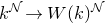 $k^{\mathcal{N}}\to W(k)^{\mathcal{N}}$
comes from the morphism
$k^{\mathcal{N}}\to W(k)^{\mathcal{N}}$
comes from the morphism $\operatorname{Spec} k\to\operatorname{Spf} W(k)$
by functoriality. An R-point of
$\operatorname{Spec} k\to\operatorname{Spf} W(k)$
by functoriality. An R-point of $\operatorname{Spf} A/\mathbb{G}_m$
is given by
$\operatorname{Spf} A/\mathbb{G}_m$
is given by $R \xrightarrow{v_+}L \xrightarrow{v_-} R$
, where L is an invertible R-module and
$R \xrightarrow{v_+}L \xrightarrow{v_-} R$
, where L is an invertible R-module and $v_+v_-=p$
. The map
$v_+v_-=p$
. The map $ \mathfrak{p}_{\mathrm{cris}}$
takes
$ \mathfrak{p}_{\mathrm{cris}}$
takes $(R\xrightarrow{v_+} L \xrightarrow{v_-}R)$
and sends it to
$(R\xrightarrow{v_+} L \xrightarrow{v_-}R)$
and sends it to $(M_{\mathfrak{p}_{\mathrm{cris}},R},\xi)$
, where
$(M_{\mathfrak{p}_{\mathrm{cris}},R},\xi)$
, where $M_{\mathfrak{p}_{\mathrm{cris}},R}:=\textrm{coker}(\mathbb{G}_{a,R}^{\sharp}\xrightarrow{(v_+^{\sharp},-can)} \mathbf{V}(L)^{\sharp} \oplus W_R)$
, and
$M_{\mathfrak{p}_{\mathrm{cris}},R}:=\textrm{coker}(\mathbb{G}_{a,R}^{\sharp}\xrightarrow{(v_+^{\sharp},-can)} \mathbf{V}(L)^{\sharp} \oplus W_R)$
, and $\xi$
is induced by the map
$\xi$
is induced by the map
 \begin{equation} \mathbf{V}(L)^{\sharp} \oplus W_R\xrightarrow{(can\,\circ\,v_-^{\sharp},\cdot p)}W_R.\end{equation}
The notation ‘can’ stands for the canonical embedding $\mathbb{G}_{a,R}^{\sharp}\hookrightarrow W_R$
, and
$\mathbb{G}_{a,R}^{\sharp}\hookrightarrow W_R$
, and $\cdot p$
stands for multiplication by p. This defines the map
$\cdot p$
stands for multiplication by p. This defines the map $ \mathfrak{p}_{\mathrm{cris}}:\operatorname{Spf} A/\mathbb{G}_m\to W(k)^{\mathcal{N}}$
. To lift this map to
$ \mathfrak{p}_{\mathrm{cris}}:\operatorname{Spf} A/\mathbb{G}_m\to W(k)^{\mathcal{N}}$
. To lift this map to $k^{\mathcal{N}}$
we need to endow
$k^{\mathcal{N}}$
we need to endow $\operatorname{Cone}(M_{\mathfrak{p}_{\mathrm{cris}},R} \xrightarrow[]{\xi} W_R)$
with the structure of a k-algebra stack. In fact, we have a map of quasi-ideal pairs
$\operatorname{Cone}(M_{\mathfrak{p}_{\mathrm{cris}},R} \xrightarrow[]{\xi} W_R)$
with the structure of a k-algebra stack. In fact, we have a map of quasi-ideal pairs $ (W_R \stackrel{\cdot p}{\longrightarrow} W_R) \to (M_{\mathfrak{p}_{\mathrm{cris}},R} \xrightarrow[]{\xi} W_R)$
given by
$ (W_R \stackrel{\cdot p}{\longrightarrow} W_R) \to (M_{\mathfrak{p}_{\mathrm{cris}},R} \xrightarrow[]{\xi} W_R)$
given by $ W_R\xrightarrow[]{(0, \textrm{Id})} \mathbf{V}(L)^{\sharp} \oplus W_R \to M_{\mathfrak{p}_{\mathrm{cris}},R}$
on the source and by
$ W_R\xrightarrow[]{(0, \textrm{Id})} \mathbf{V}(L)^{\sharp} \oplus W_R \to M_{\mathfrak{p}_{\mathrm{cris}},R}$
on the source and by $\textrm{Id}$
on the target and, for any W(k)-algebra D, the animated ring
$\textrm{Id}$
on the target and, for any W(k)-algebra D, the animated ring $\operatorname{Cone}(D \xrightarrow[]{\cdot p} D)$
receives a map from
$\operatorname{Cone}(D \xrightarrow[]{\cdot p} D)$
receives a map from $k\buildrel{\sim}\over{\longrightarrow} \operatorname{Cone}(W(k) \xrightarrow[]{\cdot p} W(k))$
. Under the isomorphism
$k\buildrel{\sim}\over{\longrightarrow} \operatorname{Cone}(W(k) \xrightarrow[]{\cdot p} W(k))$
. Under the isomorphism $\operatorname{Spf} A/\mathbb{G}_m \buildrel{\sim}\over{\longrightarrow} k^{\mathcal{N}}$
, the open embedding
$\operatorname{Spf} A/\mathbb{G}_m \buildrel{\sim}\over{\longrightarrow} k^{\mathcal{N}}$
, the open embedding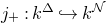 $j_+: k^{{\mathbb{\Delta}}} \hookrightarrow k^\mathcal{N}$
(respectively,
$j_+: k^{{\mathbb{\Delta}}} \hookrightarrow k^\mathcal{N}$
(respectively,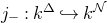 $j_-: k^{{\mathbb{\Delta}}} \hookrightarrow k^\mathcal{N}$
) is identified with
$j_-: k^{{\mathbb{\Delta}}} \hookrightarrow k^\mathcal{N}$
) is identified with $\operatorname{Spf} W(k) \stackrel{F}{\longrightarrow} \operatorname{Spf} W(k) \xrightarrow[]{v_+=1, v_-=p} \operatorname{Spf} A \to \operatorname{Spf} A/\mathbb{G}_m$
(respectively,
$\operatorname{Spf} W(k) \stackrel{F}{\longrightarrow} \operatorname{Spf} W(k) \xrightarrow[]{v_+=1, v_-=p} \operatorname{Spf} A \to \operatorname{Spf} A/\mathbb{G}_m$
(respectively, $\operatorname{Spf} W(k) \xrightarrow[]{v_+=p, v_-=1} \operatorname{Spf} A \to \operatorname{Spf} A/\mathbb{G}_m$
). Let us just construct an isomorphism of k-algebra stacks obtained by pulling back
$\operatorname{Spf} W(k) \xrightarrow[]{v_+=p, v_-=1} \operatorname{Spf} A \to \operatorname{Spf} A/\mathbb{G}_m$
). Let us just construct an isomorphism of k-algebra stacks obtained by pulling back $\mathbb{G}_{a, k}^{\mathcal{N}}$
along
$\mathbb{G}_{a, k}^{\mathcal{N}}$
along $j_{\pm}: \operatorname{Spf} W(k) \to \operatorname{Spf} A/\mathbb{G}_m$
. The restriction of
$j_{\pm}: \operatorname{Spf} W(k) \to \operatorname{Spf} A/\mathbb{G}_m$
. The restriction of $\mathbb{G}_{a, k}^{\mathcal{N}}$
to
$\mathbb{G}_{a, k}^{\mathcal{N}}$
to $\operatorname{Spf} W(k) \xrightarrow[]{v_+=1, v_-=p} \operatorname{Spf} A/\mathbb{G}_m$
is given by
$\operatorname{Spf} W(k) \xrightarrow[]{v_+=1, v_-=p} \operatorname{Spf} A/\mathbb{G}_m$
is given by $\operatorname{Cone}( W \stackrel{\cdot p}{\longrightarrow} W)$
; its restriction along
$\operatorname{Cone}( W \stackrel{\cdot p}{\longrightarrow} W)$
; its restriction along $\operatorname{Spf} W(k) \xrightarrow[]{v_+=p, v_-=1} \operatorname{Spf} A/\mathbb{G}_m$
is
$\operatorname{Spf} W(k) \xrightarrow[]{v_+=p, v_-=1} \operatorname{Spf} A/\mathbb{G}_m$
is $\operatorname{Cone}(F_* W \stackrel{\cdot p}{\longrightarrow} F_* W)$
. As a k-algebra stack the latter is obtained from the former by precomposing the action of k with the Frobenius. Equivalently, the k-algebra stack
$\operatorname{Cone}(F_* W \stackrel{\cdot p}{\longrightarrow} F_* W)$
. As a k-algebra stack the latter is obtained from the former by precomposing the action of k with the Frobenius. Equivalently, the k-algebra stack $\operatorname{Cone}(F_* W \stackrel{\cdot p}{\longrightarrow} F_* W)$
is isomorphic to the pullback of
$\operatorname{Cone}(F_* W \stackrel{\cdot p}{\longrightarrow} F_* W)$
is isomorphic to the pullback of $\operatorname{Cone}( W \stackrel{\cdot p}{\longrightarrow} W)$
along the Frobenius on
$\operatorname{Cone}( W \stackrel{\cdot p}{\longrightarrow} W)$
along the Frobenius on $\operatorname{Spf} W(k)$
. We refer the reader to [Reference BhattBha23, § 3.3] and especially diagram (3.3.2) there for details.
$\operatorname{Spf} W(k)$
. We refer the reader to [Reference BhattBha23, § 3.3] and especially diagram (3.3.2) there for details.
For a smooth p-adic formal scheme X over $\operatorname{Spf} W(k)$
,
$\operatorname{Spf} W(k)$
, $ \mathfrak{p}_{\mathrm{cris}}^*(\mathcal{H}_{syn}(X))$
recovers the crystalline cohomology of
$ \mathfrak{p}_{\mathrm{cris}}^*(\mathcal{H}_{syn}(X))$
recovers the crystalline cohomology of $X\otimes \mathbb{F}_p$
equipped with the Nygaard filtration (see [Reference BhattBha23, § 3.3]).
$X\otimes \mathbb{F}_p$
equipped with the Nygaard filtration (see [Reference BhattBha23, § 3.3]).
2.4 The reduced locus of
$W(k)^{\mathcal{N}}$

Let $C_2:=\operatorname{Spec} k[v_+^p,v_-]/(v_+^pv_-)$
. We endow
$C_2:=\operatorname{Spec} k[v_+^p,v_-]/(v_+^pv_-)$
. We endow $C_2$
with a
$C_2$
with a $\mathbb{G}_m$
-action given by the grading:
$\mathbb{G}_m$
-action given by the grading: $\deg v_+^p=p$
and
$\deg v_+^p=p$
and $\deg v_-=-1$
. The inclusion of
$\deg v_-=-1$
. The inclusion of $k[v_+^p,v_-]/(v_+^pv_-)\hookrightarrow k[v_+,v_-]/(v_+v_-)$
gives the morphism
$k[v_+^p,v_-]/(v_+^pv_-)\hookrightarrow k[v_+,v_-]/(v_+v_-)$
gives the morphism $k^{\mathcal{N}}\otimes\mathbb{F}_p\to C_2/\mathbb{G}_m$
. Recall from [Reference DrinfeldDri24, § 5.16.10] a factorization of
$k^{\mathcal{N}}\otimes\mathbb{F}_p\to C_2/\mathbb{G}_m$
. Recall from [Reference DrinfeldDri24, § 5.16.10] a factorization of $\mathfrak{p}_{\mathrm{cris}}$
:
$\mathfrak{p}_{\mathrm{cris}}$
:
 \begin{equation} k^{\mathcal{N}}\otimes\mathbb{F}_p\to C_2/\mathbb{G}_m\xrightarrow{\widetilde{\mathfrak{p}}_{\mathrm{cris}}} W(k)^{\mathcal{N}}_{red}\to W(k)^{\mathcal{N}}\otimes\mathbb{F}_p.\end{equation}
Let us just explain a construction of the composite
 \begin{equation}C_2 \twoheadrightarrow C_2/\mathbb{G}_m\xrightarrow{\widetilde{\mathfrak{p}}_{\mathrm{cris}}} W(k)^{\mathcal{N}},\end{equation}
given by a pair $(M_{C_2},\alpha:M_{C_2}\to W_{C_2})$
, where
$(M_{C_2},\alpha:M_{C_2}\to W_{C_2})$
, where $M_{C_2}$
is an admissible
$M_{C_2}$
is an admissible $W_{C_2}$
-module and
$W_{C_2}$
-module and $\alpha$
is a
$\alpha$
is a $W_{C_2}$
-module homomorphism. Explicitly,
$W_{C_2}$
-module homomorphism. Explicitly, $M_{C_2}$
is given by the pullback diagram
$M_{C_2}$
is given by the pullback diagram

where the right downward arrow $[v_+^p]$
takes a Witt vector
$[v_+^p]$
takes a Witt vector $w\in W_{C_2}$
to the product
$w\in W_{C_2}$
to the product $[v_+^p]w$
. The morphism
$[v_+^p]w$
. The morphism $\alpha$
is defined by
$\alpha$
is defined by $M_{C_2}=W_{C_2}\times_{F_*W_{C_2}}F_*W_{C_2}\xrightarrow{([v_-],V)}W_{C_2}$
. The isomorphism between the composition
$M_{C_2}=W_{C_2}\times_{F_*W_{C_2}}F_*W_{C_2}\xrightarrow{([v_-],V)}W_{C_2}$
. The isomorphism between the composition
 \[C:=\operatorname{Spec} k[v_+,v_-]/(v_+v_-)\twoheadrightarrow C/\mathbb{G}_m=k^{\mathcal{N}}\otimes\mathbb{F}_p\xrightarrow{\mathfrak{p}_{\mathrm{cris}}} W(k)^{\mathcal{N}}\]
and
 is given by an isomorphism of $W_C$
-modules
$W_C$
-modules
 \begin{equation}\textrm{coker}(W_C^{(F)}\xrightarrow{[v_+],-\textrm{Id}} W_C^{(F)}\times W_C)\xrightarrow{\sim}W_C\times_{F_*W_C}F_*W_C=:C\times_{C_2}M_{C_2}\end{equation}
defined by the matrix $(\begin{smallmatrix} \textrm{Id} & [v_+]\\ 0& F\end{smallmatrix})$
. In [Reference DrinfeldDri24, Corollary 7.5.1], Drinfeld refines the morphism
$(\begin{smallmatrix} \textrm{Id} & [v_+]\\ 0& F\end{smallmatrix})$
. In [Reference DrinfeldDri24, Corollary 7.5.1], Drinfeld refines the morphism $\widetilde{\mathfrak{p}}_{\mathrm{cris}}:C_2/\mathbb{G}_m\to W(k)^{\mathcal{N}}_{red}$
to an isomorphism
$\widetilde{\mathfrak{p}}_{\mathrm{cris}}:C_2/\mathbb{G}_m\to W(k)^{\mathcal{N}}_{red}$
to an isomorphism
 \begin{equation}BH\xrightarrow{\sim} W(k)^{\mathcal{N}}_{red},\end{equation}
where H is an affine group scheme over $C_2/\mathbb{G}_m$
constructed as follows. Let
$C_2/\mathbb{G}_m$
constructed as follows. Let $\widetilde{H}:=W^{(F)}\times C_2$
. For
$\widetilde{H}:=W^{(F)}\times C_2$
. For $(w,t), (w',t)\in \widetilde{H}$
, the formula
$(w,t), (w',t)\in \widetilde{H}$
, the formula $(w,t)*(w',t)=(w+w'-[v_-^p(t)]ww',t)$
defines a map
$(w,t)*(w',t)=(w+w'-[v_-^p(t)]ww',t)$
defines a map $\widetilde{H}\times\widetilde{H}\to \widetilde{H}$
, making
$\widetilde{H}\times\widetilde{H}\to \widetilde{H}$
, making $\widetilde{H}$
a group scheme over
$\widetilde{H}$
a group scheme over $C_2$
. The restriction of
$C_2$
. The restriction of $\widetilde{H}$
to the open subscheme of
$\widetilde{H}$
to the open subscheme of $C_2$
given by
$C_2$
given by $v_-\neq 0$
is
$v_-\neq 0$
is $\mathbb{G}_m^{\sharp}$
, and its restriction to the closed subscheme given by
$\mathbb{G}_m^{\sharp}$
, and its restriction to the closed subscheme given by $v_-=0$
is
$v_-=0$
is $\mathbb{G}_a^{\sharp}$
. Define a
$\mathbb{G}_a^{\sharp}$
. Define a $\mathbb{G}_m$
-equivariant structure on
$\mathbb{G}_m$
-equivariant structure on $W\times C_2$
by
$W\times C_2$
by
 \begin{equation} \mathbb{G}_m\times W\times C_2\to W\times C_2, \quad (\lambda,w,t)\mapsto ([\lambda^p]w,\lambda t).\end{equation}
This restricts to a $\mathbb{G}_m$
-equivariant structure on
$\mathbb{G}_m$
-equivariant structure on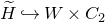 $\widetilde{H}\hookrightarrow W\times C_2$
compatible with the group structure. This defines the promised group scheme H over
$\widetilde{H}\hookrightarrow W\times C_2$
compatible with the group structure. This defines the promised group scheme H over $C_2/\mathbb{G}_m$
.
$C_2/\mathbb{G}_m$
.
We write $(C_2)_{v_+^p=0}$
,
$(C_2)_{v_+^p=0}$
, $(C_2)_{v_-=0}$
for the closed subschemes given by the respective equations. Denote by
$(C_2)_{v_-=0}$
for the closed subschemes given by the respective equations. Denote by $D_{\mathrm{HT}}$
(respectively,
$D_{\mathrm{HT}}$
(respectively, $D_{\mathrm{dR}}$
) the restrictions of
$D_{\mathrm{dR}}$
) the restrictions of $C_2/\mathbb{G}_m$
-stack BH to
$C_2/\mathbb{G}_m$
-stack BH to $(C_2)_{v_-=0}/\mathbb{G}_m$
(respectively,
$(C_2)_{v_-=0}/\mathbb{G}_m$
(respectively,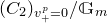 $(C_2)_{v_+^p=0}/\mathbb{G}_m$
). Thus, via (2.20), one has
$(C_2)_{v_+^p=0}/\mathbb{G}_m$
). Thus, via (2.20), one has $W(k)^{\mathcal{N}}_{red}=D_{\mathrm{HT}}\cup D_{\mathrm{dR}}$
. We refer to
$W(k)^{\mathcal{N}}_{red}=D_{\mathrm{HT}}\cup D_{\mathrm{dR}}$
. We refer to $D_{\mathrm{HT}}$
(respectively,
$D_{\mathrm{HT}}$
(respectively, $D_{\mathrm{dR}}$
) as the Hodge–Tate (respectively, de Rham) component of
$D_{\mathrm{dR}}$
) as the Hodge–Tate (respectively, de Rham) component of $W(k)^{\mathcal{N}}_{red}$
. We denote by
$W(k)^{\mathcal{N}}_{red}$
. We denote by $D_{Hod}$
the fibre of BH over
$D_{Hod}$
the fibre of BH over $(C_2)_{v_+^p=v_-=0}/\mathbb{G}_m=B\mathbb{G}_m$
. Geometrically, one pictures
$(C_2)_{v_+^p=v_-=0}/\mathbb{G}_m=B\mathbb{G}_m$
. Geometrically, one pictures $W(k)^{\mathcal{N}}_{red}$
as a union of two components (i.e.
$W(k)^{\mathcal{N}}_{red}$
as a union of two components (i.e. $D_{\mathrm{HT}}$
and
$D_{\mathrm{HT}}$
and $D_{\mathrm{dR}}$
) meeting transversally at
$D_{\mathrm{dR}}$
) meeting transversally at $D_{Hod}$
. The restriction gives a functor
$D_{Hod}$
. The restriction gives a functor
 \begin{equation}\mathcal{R}^*: \mathcal{D}_{qc}(W(k)^{\mathcal{N}}_{red})\to \mathcal{D}_{qc}(D_{\mathrm{HT}})\times_{\mathcal{D}_{qc}(D_{Hod})}\mathcal{D}_{qc}(D_{\mathrm{dR}}).\end{equation}
The following result is explained in [Reference BhattBha23, § 6] as a consequence of a general statement from [Reference LurieLur18b, Theorem 16.2.0.2].
Lemma 2.9.
Functor (2.22) is fully faithful and admits right adjoint $\mathcal{R}_*$
given by
$\mathcal{R}_*$
given by
 \[ (\mathcal{F}_{\mathrm{HT}},\mathcal{F}_{\mathrm{dR}},\alpha: \mathcal{F}_{\mathrm{HT}}|_{D_{Hod}}\simeq \mathcal{F}_{\mathrm{dR}}|_{D_{Hod}})\mapsto \mathrm{Fib}(i_{HT*}\mathcal{F}_{\mathrm{HT}}\oplus i_{\mathrm{dR}*}\mathcal{F}_{\mathrm{dR}}\to i_{Hod*}(\mathcal{F}_{\mathrm{HT}}|_{D_{Hod}})), \]
where $i_{?}$
is the closed embedding of
$i_{?}$
is the closed embedding of $D_{?}$
into
$D_{?}$
into $W(k)^{\mathcal{N}}_{red}$
.
$W(k)^{\mathcal{N}}_{red}$
.
The following result describes the essential image of $\mathcal{R}^*$
in (2.22). Let
$\mathcal{R}^*$
in (2.22). Let $\mathcal{F}:=(\mathcal{F}_{\mathrm{HT}},\mathcal{F}_{\mathrm{dR}},\alpha: \mathcal{F}_{\mathrm{HT}}|_{D_{Hod}}\simeq \mathcal{F}_{\mathrm{dR}}|_{D_{Hod}})$
be an object of the right-hand side of (2.22).
$\mathcal{F}:=(\mathcal{F}_{\mathrm{HT}},\mathcal{F}_{\mathrm{dR}},\alpha: \mathcal{F}_{\mathrm{HT}}|_{D_{Hod}}\simeq \mathcal{F}_{\mathrm{dR}}|_{D_{Hod}})$
be an object of the right-hand side of (2.22).
Lemma 2.10.
Then $\mathcal{F}$
lies in the essential image of
$\mathcal{F}$
lies in the essential image of $\mathcal{R}^*$
if and only if its pullback to
$\mathcal{R}^*$
if and only if its pullback to
 \begin{equation}\mathcal{D}_{qc}((C_2)_{v_-=0}/\mathbb{G}_m){\times}_{\mathcal{D}_{qc}((C_2)_{v_+^p=v_-=0}/\mathbb{G}_m)}\mathcal{D}_{qc}((C_2)_{v_+^p=0}/\mathbb{G}_m)\end{equation}
comes from an object of $\mathcal{D}_{qc}(C_2/\mathbb{G}_m)$
.
$\mathcal{D}_{qc}(C_2/\mathbb{G}_m)$
.
Proof. The object $\mathcal{F}$
lies in the essential image if and only if the canonical morphism
$\mathcal{F}$
lies in the essential image if and only if the canonical morphism $\mathcal{R}^*\mathcal{R}_*\mathcal{F}\to \mathcal{F}$
is an isomorphism. Since the map
$\mathcal{R}^*\mathcal{R}_*\mathcal{F}\to \mathcal{F}$
is an isomorphism. Since the map $\widetilde{\mathfrak{p}}_{\mathrm{cris}}: C_2/\mathbb{G}_m\to W(k)^{\mathcal{N}}_{red}$
is faithfully flat, it suffices to check this after pulling back along
$\widetilde{\mathfrak{p}}_{\mathrm{cris}}: C_2/\mathbb{G}_m\to W(k)^{\mathcal{N}}_{red}$
is faithfully flat, it suffices to check this after pulling back along $\widetilde{\mathfrak{p}}_{\mathrm{cris}}$
to
$\widetilde{\mathfrak{p}}_{\mathrm{cris}}$
to $C_2/\mathbb{G}_m$
.
$C_2/\mathbb{G}_m$
.
In [Reference BhattBha23, § 6.2], Bhatt and Lurie give a convenient description of $D_{\mathrm{HT}}$
, i.e.
$D_{\mathrm{HT}}$
, i.e. $D_{\mathrm{HT}}\simeq (\mathbb{A}^{1,\mathrm{dR}}_+/\mathbb{G}_m)\otimes\mathbb{F}_p$
. To reconcile this isomorphism with the above description, we recall that the Frobenius morphism
$D_{\mathrm{HT}}\simeq (\mathbb{A}^{1,\mathrm{dR}}_+/\mathbb{G}_m)\otimes\mathbb{F}_p$
. To reconcile this isomorphism with the above description, we recall that the Frobenius morphism $\mathbb{A}^1_+\otimes\mathbb{F}_p\to \operatorname{Spec} k[v_+^p]=(C_2)_{v_-=0}$
factors through
$\mathbb{A}^1_+\otimes\mathbb{F}_p\to \operatorname{Spec} k[v_+^p]=(C_2)_{v_-=0}$
factors through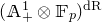 $(\mathbb{A}^1_+\otimes\mathbb{F}_p)^{\mathrm{dR}}$
. Moreover, a choice of
$(\mathbb{A}^1_+\otimes\mathbb{F}_p)^{\mathrm{dR}}$
. Moreover, a choice of $\delta$
-structure on
$\delta$
-structure on $\mathbb{A}^1_+$
, such that
$\mathbb{A}^1_+$
, such that $\delta(v_+)=0$
, gives a
$\delta(v_+)=0$
, gives a $\mathbb{G}_m$
-equivariant isomorphism
$\mathbb{G}_m$
-equivariant isomorphism $(\mathbb{A}^1_+\otimes\mathbb{F}_p)^{\mathrm{dR}}=B\mathbb{G}_a^{\sharp}\times (C_2)_{v_-=0}$
, where the action of
$(\mathbb{A}^1_+\otimes\mathbb{F}_p)^{\mathrm{dR}}=B\mathbb{G}_a^{\sharp}\times (C_2)_{v_-=0}$
, where the action of $\mathbb{G}_m$
on
$\mathbb{G}_m$
on $\mathbb{G}_a^{\sharp}$
is given by
$\mathbb{G}_a^{\sharp}$
is given by $\lambda*z=\lambda^pz$
. Using the identification of the Cartier dual to
$\lambda*z=\lambda^pz$
. Using the identification of the Cartier dual to $\mathbb{G}_a^{\sharp}$
and
$\mathbb{G}_a^{\sharp}$
and $\widehat{\mathbb{G}}_a=\operatorname{Spf} k[[D^p]]$
, we obtain an equivalence
$\widehat{\mathbb{G}}_a=\operatorname{Spf} k[[D^p]]$
, we obtain an equivalence $\mathcal{D}_{qc}(D_{\mathrm{HT}})\simeq \mathcal{D}_{gr,D^p\text{-nilp}}(k[v_+^p,D^p])$
, where the right-hand side is a full subcategory of the derived category
$\mathcal{D}_{qc}(D_{\mathrm{HT}})\simeq \mathcal{D}_{gr,D^p\text{-nilp}}(k[v_+^p,D^p])$
, where the right-hand side is a full subcategory of the derived category $\mathcal{D}_{gr}(k[D^p, v_+^p])$
of graded modules over the polynomial algebra
$\mathcal{D}_{gr}(k[D^p, v_+^p])$
of graded modules over the polynomial algebra $k[D^p,v_+^p]$
with
$k[D^p,v_+^p]$
with $\deg v_+^p=-\deg D^p=p$
. Objects of this full subcategory
$\deg v_+^p=-\deg D^p=p$
. Objects of this full subcategory $\mathcal{D}_{gr,D^p\text{-nilp}}(k[D^p,v_+^p])$
consist of complexes
$\mathcal{D}_{gr,D^p\text{-nilp}}(k[D^p,v_+^p])$
consist of complexes $\mathcal{M}$
such that the action of
$\mathcal{M}$
such that the action of $D^p$
on
$D^p$
on $\bigoplus_iH^i(\mathcal{M})$
is locally nilpotent.
$\bigoplus_iH^i(\mathcal{M})$
is locally nilpotent.
2.5 Coherent sheaves and vector bundles over
$X^{syn}$

Let Q be a p-complete Noetherian regular local ring. In [Reference BhattBha23, Remark 5.5.19], it was shown that the category $ \operatorname{Perf}(Q^{syn})$
of perfect complexes on
$ \operatorname{Perf}(Q^{syn})$
of perfect complexes on $Q^{syn}$
has a unique t-structure whose category of connective objects
$Q^{syn}$
has a unique t-structure whose category of connective objects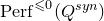 $\operatorname{Perf}^{\leqslant 0}(Q^{syn})$
consists of all
$\operatorname{Perf}^{\leqslant 0}(Q^{syn})$
consists of all $\mathcal{F}\in \operatorname{Perf}(Q^{syn})$
such that, for any p-nilpotent ring R and a map
$\mathcal{F}\in \operatorname{Perf}(Q^{syn})$
such that, for any p-nilpotent ring R and a map $f:\operatorname{Spec} R \to Q^{syn}$
, the pullback
$f:\operatorname{Spec} R \to Q^{syn}$
, the pullback $f^*\mathcal{F}$
is in
$f^*\mathcal{F}$
is in $D^{\leqslant 0}(R)$
. We refer to the heart of this t-structure as the category
$D^{\leqslant 0}(R)$
. We refer to the heart of this t-structure as the category $\operatorname{Coh}(Q^{syn})$
of coherent sheaves on
$\operatorname{Coh}(Q^{syn})$
of coherent sheaves on $Q^{syn}$
. The latter has a more concrete description. Let
$Q^{syn}$
. The latter has a more concrete description. Let $(\tilde Q, (d), \delta)$
be a p-torsion prism with
$(\tilde Q, (d), \delta)$
be a p-torsion prism with $\tilde Q/(d)=Q$
. Then there exists a canonical faithfully flat map
$\tilde Q/(d)=Q$
. Then there exists a canonical faithfully flat map
 \begin{equation} \operatorname{Spf} \tilde{Q}[v_-, v_+]/(v_-v_+-d) \to Q^{syn},\end{equation}
where $\operatorname{Spf} \tilde{Q}[v_-, v_+]/(v_-v_+-d)$
is the (p,d)-adic formal scheme
$\operatorname{Spf} \tilde{Q}[v_-, v_+]/(v_-v_+-d)$
is the (p,d)-adic formal scheme $\text{colim}_N \operatorname{Spec} \tilde{Q}[v_-, v_+]/(v_-v_+-d, d^N, p^N)$
; see [Reference BhattBha23, Remark 5.5.19], cf. the end of § 2.3. Then
$\text{colim}_N \operatorname{Spec} \tilde{Q}[v_-, v_+]/(v_-v_+-d, d^N, p^N)$
; see [Reference BhattBha23, Remark 5.5.19], cf. the end of § 2.3. Then $\mathcal{F} \in\mathcal{D}_{qc}(Q^{syn})$
belongs to
$\mathcal{F} \in\mathcal{D}_{qc}(Q^{syn})$
belongs to $\operatorname{Coh}(Q^{syn})$
if and only of its pullback along (2.24) is coherent, that is, a finite module overFootnote
20
$\operatorname{Coh}(Q^{syn})$
if and only of its pullback along (2.24) is coherent, that is, a finite module overFootnote
20 $\tilde{Q}[v_-, v_+]/(v_-v_+-d)$
.
$\tilde{Q}[v_-, v_+]/(v_-v_+-d)$
.
Recall that, for any stack $\mathcal{X}$
, the category
$\mathcal{X}$
, the category $\textrm{Vect}(\mathcal{X})$
of vector bundles over
$\textrm{Vect}(\mathcal{X})$
of vector bundles over $\mathcal{X}$
is defined to be
$\mathcal{X}$
is defined to be $\lim_{\operatorname{Spec} R \to \mathcal{X}}\textrm{Vect}(\operatorname{Spec} R)$
, where the limit is taken over the category of all affine schemes over
$\lim_{\operatorname{Spec} R \to \mathcal{X}}\textrm{Vect}(\operatorname{Spec} R)$
, where the limit is taken over the category of all affine schemes over $\mathcal{X}$
. An object
$\mathcal{X}$
. An object $\mathcal{F} \in\mathcal{D}_{qc}(Q^{syn})$
is a vector bundle if and only if its pullback along (2.24) is a finite projective module over
$\mathcal{F} \in\mathcal{D}_{qc}(Q^{syn})$
is a vector bundle if and only if its pullback along (2.24) is a finite projective module over $\tilde{Q}[v_-, v_+]/(v_-v_+-d)$
.
$\tilde{Q}[v_-, v_+]/(v_-v_+-d)$
.
2.6 Hodge–Tate weights
Recall that $k^{\mathcal{N}}$
can be identified with
$k^{\mathcal{N}}$
can be identified with $\operatorname{Spf} A/\mathbb{G}_m$
(see [Reference BhattBha23, § 5.4]). Consequently, the category
$\operatorname{Spf} A/\mathbb{G}_m$
(see [Reference BhattBha23, § 5.4]). Consequently, the category $\mathcal{D}_{qc}(k^{\mathcal{N}})$
is equivalent to the subcategory
$\mathcal{D}_{qc}(k^{\mathcal{N}})$
is equivalent to the subcategory $\widehat{\mathcal{D}}_{gr}(A)$
of the derived category
$\widehat{\mathcal{D}}_{gr}(A)$
of the derived category $\mathcal{D}_{gr}(A)$
of graded A-modules spanned by p-complete objects. Given a gauge
$\mathcal{D}_{gr}(A)$
of graded A-modules spanned by p-complete objects. Given a gauge $\mathcal{F}\in \mathcal{D}_{qc}(k^{\mathcal{N}})$
, we denote by
$\mathcal{F}\in \mathcal{D}_{qc}(k^{\mathcal{N}})$
, we denote by
 \begin{equation}\bigg(\mathcal{N}^{\cdot}=\bigoplus_i \mathcal{N}^i, v_-:\mathcal{N}^i\to\mathcal{N}^{i-1}, v_+:\mathcal{N}^i\to \mathcal{N}^{i+1},v_-v_+=v_+v_-=p\bigg)\end{equation}
the corresponding object in $\widehat{\mathcal{D}}_{gr}(A)$
.
$\widehat{\mathcal{D}}_{gr}(A)$
.
Definition 2.11. We say that a gauge $\mathcal{F}\in \mathcal{D}_{qc}(k^{\mathcal{N}})$
has Hodge–Tate weights
$\mathcal{F}\in \mathcal{D}_{qc}(k^{\mathcal{N}})$
has Hodge–Tate weights $\geqslant a$
if, under the identification (2.25), the maps
$\geqslant a$
if, under the identification (2.25), the maps $v_-$
in
$v_-$
in

are all quasi-isomorphisms.
A gauge $\mathcal{F}$
is said to be effective if it has Hodge–Tate weights
$\mathcal{F}$
is said to be effective if it has Hodge–Tate weights $\geqslant 0$
. We say that a gauge
$\geqslant 0$
. We say that a gauge $\mathcal{F}$
has Hodge–Tate weights
$\mathcal{F}$
has Hodge–Tate weights $\leqslant b$
if under the identification (2.25), the maps
$\leqslant b$
if under the identification (2.25), the maps $v_+$
in
$v_+$
in
 are all quasi-isomorphisms.
We say that a gauge $\mathcal{F}\in \mathcal{D}_{qc}(W(k)^{\mathcal{N}})$
has Hodge–Tate weights
$\mathcal{F}\in \mathcal{D}_{qc}(W(k)^{\mathcal{N}})$
has Hodge–Tate weights $\geqslant a$
(respectively,
$\geqslant a$
(respectively, $\leqslant b$
) if its pullback to
$\leqslant b$
) if its pullback to $k^{\mathcal{N}}$
has the corresponding property. Likewise, we say that an F-gauge
$k^{\mathcal{N}}$
has the corresponding property. Likewise, we say that an F-gauge $\mathcal{F}\in \mathcal{D}_{qc}(W(k)^{syn})$
has Hodge–Tate weights
$\mathcal{F}\in \mathcal{D}_{qc}(W(k)^{syn})$
has Hodge–Tate weights $\geqslant a$
(respectively,
$\geqslant a$
(respectively, $\leqslant b$
) if its pullback to
$\leqslant b$
) if its pullback to $k^{\mathcal{N}}$
has the corresponding property. We denote by
$k^{\mathcal{N}}$
has the corresponding property. We denote by $\mathcal{D}_{qc,[a,b]}(k^{\mathcal{N}})$
the full subcategory of
$\mathcal{D}_{qc,[a,b]}(k^{\mathcal{N}})$
the full subcategory of $\mathcal{D}_{qc}(k^{\mathcal{N}})$
that consists of objects with Hodge–Tate weights in [a,b]. Similarly, we define
$\mathcal{D}_{qc}(k^{\mathcal{N}})$
that consists of objects with Hodge–Tate weights in [a,b]. Similarly, we define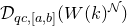 $\mathcal{D}_{qc,[a,b]}(W(k)^{\mathcal{N}})$
.
$\mathcal{D}_{qc,[a,b]}(W(k)^{\mathcal{N}})$
.
Remark 2.12. We observe that $\mathcal{F}\in\mathcal{D}_{qc}(k^{\mathcal{N}})$
has Hodge–Tate weights in [a,b] if and only if the pullbacks of
$\mathcal{F}\in\mathcal{D}_{qc}(k^{\mathcal{N}})$
has Hodge–Tate weights in [a,b] if and only if the pullbacks of $\mathcal{F}$
along both composites
$\mathcal{F}$
along both composites $\operatorname{Spec} k[v_{\pm}]/\mathbb{G}_{m,k}\to k^{\mathcal{N}}\otimes \mathbb{F}_p\to k^{\mathcal{N}}$
lie in
$\operatorname{Spec} k[v_{\pm}]/\mathbb{G}_{m,k}\to k^{\mathcal{N}}\otimes \mathbb{F}_p\to k^{\mathcal{N}}$
lie in $\mathcal{D}_{qc,[a,b]}((\mathbb{A}^1_{\pm}/\mathbb{G}_m)\otimes \mathbb{F}_p)$
in the sense of Definition 2.1.
$\mathcal{D}_{qc,[a,b]}((\mathbb{A}^1_{\pm}/\mathbb{G}_m)\otimes \mathbb{F}_p)$
in the sense of Definition 2.1.
Lemma 2.13.
Suppose $\mathcal{F}\in \mathcal{D}_{qc,[a,b]}(\mathbb{A}^1_-/\mathbb{G}_m)$
, then
$\mathcal{F}\in \mathcal{D}_{qc,[a,b]}(\mathbb{A}^1_-/\mathbb{G}_m)$
, then $t^*\mathcal{F}\in \mathcal{D}_{qc,[a,b]}(k^{\mathcal{N}})$
.
$t^*\mathcal{F}\in \mathcal{D}_{qc,[a,b]}(k^{\mathcal{N}})$
.
Proof. The map $i_{\pm}:(\mathbb{A}^1_{\pm}/\mathbb{G}_m)\otimes \mathbb{F}_p=\operatorname{Spec} k[v_{\pm}]/\mathbb{G}_{m, k}\hookrightarrow k^{\mathcal{N}}$
given by the equation
$i_{\pm}:(\mathbb{A}^1_{\pm}/\mathbb{G}_m)\otimes \mathbb{F}_p=\operatorname{Spec} k[v_{\pm}]/\mathbb{G}_{m, k}\hookrightarrow k^{\mathcal{N}}$
given by the equation $v_{\mp}=0$
is a closed embedding. Since
$v_{\mp}=0$
is a closed embedding. Since $v_+$
is a nonzero divisor in
$v_+$
is a nonzero divisor in $W(k)[v_+,v_-]/(v_+v_--p)$
, the restriction functor along the above embedding corresponds algebraically to taking the cone of
$W(k)[v_+,v_-]/(v_+v_--p)$
, the restriction functor along the above embedding corresponds algebraically to taking the cone of $v_+$
on the corresponding graded module. Then saying that
$v_+$
on the corresponding graded module. Then saying that $\mathcal{G}\in\mathcal{D}_{qc}(k^{\mathcal{N}})$
has weights
$\mathcal{G}\in\mathcal{D}_{qc}(k^{\mathcal{N}})$
has weights $\leqslant b$
is equivalent to saying that the restriction
$\leqslant b$
is equivalent to saying that the restriction $i^*_{-}\mathcal{G}$
has weights
$i^*_{-}\mathcal{G}$
has weights $\leqslant b$
. The composition
$\leqslant b$
. The composition $t\circ i$
is the embedding
$t\circ i$
is the embedding $\operatorname{Spec} k[v_-]/\mathbb{G}_m\to \operatorname{Spf} W(k)[v_-]/\mathbb{G}_m$
given by the equation
$\operatorname{Spec} k[v_-]/\mathbb{G}_m\to \operatorname{Spf} W(k)[v_-]/\mathbb{G}_m$
given by the equation $p=0$
. Since, for any
$p=0$
. Since, for any $\mathcal{F}\in \mathcal{D}_{qc,(-\infty,b]}(\mathbb{A}^1_-/\mathbb{G}_m)$
, its restriction to the special fibre
$\mathcal{F}\in \mathcal{D}_{qc,(-\infty,b]}(\mathbb{A}^1_-/\mathbb{G}_m)$
, its restriction to the special fibre $(\mathbb{A}^1_-/\mathbb{G}_m)\otimes \mathbb{F}_p$
has weights
$(\mathbb{A}^1_-/\mathbb{G}_m)\otimes \mathbb{F}_p$
has weights $\leqslant b$
, we conclude that
$\leqslant b$
, we conclude that $t^*\mathcal{F}\in \mathcal{D}_{qc, (-\infty ,b]}(k^{\mathcal{N}})$
. Saying that
$t^*\mathcal{F}\in \mathcal{D}_{qc, (-\infty ,b]}(k^{\mathcal{N}})$
. Saying that $\mathcal{G}\in\mathcal{D}_{qc}(k^{\mathcal{N}})$
has weights
$\mathcal{G}\in\mathcal{D}_{qc}(k^{\mathcal{N}})$
has weights $\geqslant a$
is equivalent to saying that the restriction
$\geqslant a$
is equivalent to saying that the restriction $i^*_{+} \mathcal{G}$
has weights
$i^*_{+} \mathcal{G}$
has weights $\geqslant a$
. The composition
$\geqslant a$
. The composition $t \circ i_{+}$
is isomorphic to
$t \circ i_{+}$
is isomorphic to $(\mathbb{A}^1_{+}/\mathbb{G}_m) \otimes \mathbb{F}_p \to B\mathbb{G}_m \otimes \mathbb{F}_p \to \mathbb{A}^1_{-}/\mathbb{G}_m$
and the lemma follows.
$(\mathbb{A}^1_{+}/\mathbb{G}_m) \otimes \mathbb{F}_p \to B\mathbb{G}_m \otimes \mathbb{F}_p \to \mathbb{A}^1_{-}/\mathbb{G}_m$
and the lemma follows.
Lemma 2.14.
Suppose $\mathcal{F}\in\mathcal{D}_{qc,(-\infty,b]}(W(k)^{\mathcal{N}})$
, then
$\mathcal{F}\in\mathcal{D}_{qc,(-\infty,b]}(W(k)^{\mathcal{N}})$
, then $\mathfrak{p}_{\bar{\mathrm{dR}}}^*\mathcal{F}\in \mathcal{D}_{qc,(-\infty, b]}(\mathbb{A}^1_-/\mathbb{G}_m)$
.
$\mathfrak{p}_{\bar{\mathrm{dR}}}^*\mathcal{F}\in \mathcal{D}_{qc,(-\infty, b]}(\mathbb{A}^1_-/\mathbb{G}_m)$
.
Proof. By p-completeness, it suffices to show $\mathfrak{p}_{\bar{\mathrm{dR}}}^*\mathcal{F}\otimes \mathbb{F}_p\in \mathcal{D}_{qc,(-\infty,b]}((\mathbb{A}^1_-/\mathbb{G}_m)\otimes \mathbb{F}_p)$
. It remains to observe that the composition
$\mathfrak{p}_{\bar{\mathrm{dR}}}^*\mathcal{F}\otimes \mathbb{F}_p\in \mathcal{D}_{qc,(-\infty,b]}((\mathbb{A}^1_-/\mathbb{G}_m)\otimes \mathbb{F}_p)$
. It remains to observe that the composition $(\mathbb{A}^1_-/\mathbb{G}_m)\otimes \mathbb{F}_p\xrightarrow{}\mathbb{A}^1_-/\mathbb{G}_m\xrightarrow{\mathfrak{p}_{\bar{\mathrm{dR}}}}W(k)^{\mathcal{N}}$
is isomorphic to
$(\mathbb{A}^1_-/\mathbb{G}_m)\otimes \mathbb{F}_p\xrightarrow{}\mathbb{A}^1_-/\mathbb{G}_m\xrightarrow{\mathfrak{p}_{\bar{\mathrm{dR}}}}W(k)^{\mathcal{N}}$
is isomorphic to $(\mathbb{A}^1_-/\mathbb{G}_m)\otimes \mathbb{F}_p\xrightarrow{i_{-}} k^{\mathcal{N}}\xrightarrow{ \mathfrak{p}_{\mathrm{cris}}}W(k)^{\mathcal{N}}$
, where
$(\mathbb{A}^1_-/\mathbb{G}_m)\otimes \mathbb{F}_p\xrightarrow{i_{-}} k^{\mathcal{N}}\xrightarrow{ \mathfrak{p}_{\mathrm{cris}}}W(k)^{\mathcal{N}}$
, where $i_{-}$
is defined in the first line of the proof of Lemma 2.13; see, for example, [Reference BhattBha23, § 2.8.3].
$i_{-}$
is defined in the first line of the proof of Lemma 2.13; see, for example, [Reference BhattBha23, § 2.8.3].
Remark 2.15. If $\mathcal{F} \in \mathcal{D}_{qc}(k^{\mathcal{N}})$
is effective, then its restriction along the map
$\mathcal{F} \in \mathcal{D}_{qc}(k^{\mathcal{N}})$
is effective, then its restriction along the map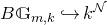 $B\mathbb{G}_{m,k}\hookrightarrow k^{\mathcal{N}}$
is given by
$B\mathbb{G}_{m,k}\hookrightarrow k^{\mathcal{N}}$
is given by $B\mathbb{G}_{m,k}\overset{v_-=0}{\hookrightarrow}(\mathbb{A}^1_-/\mathbb{G}_m)\otimes \mathbb{F}_p \overset{v_+=0}{\hookrightarrow}k^{\mathcal{N}}$
, viewed as a
$B\mathbb{G}_{m,k}\overset{v_-=0}{\hookrightarrow}(\mathbb{A}^1_-/\mathbb{G}_m)\otimes \mathbb{F}_p \overset{v_+=0}{\hookrightarrow}k^{\mathcal{N}}$
, viewed as a $\mathbb{Z}$
-graded object
$\mathbb{Z}$
-graded object $M^{\bullet}$
of
$M^{\bullet}$
of $\mathcal{D}_{qc}(k)$
, has weights
$\mathcal{D}_{qc}(k)$
, has weights $\geqslant 0$
, i.e.
$\geqslant 0$
, i.e. $M^i$
is acyclic for every
$M^i$
is acyclic for every $i<0$
. If
$i<0$
. If $\mathcal{F}$
is perfect, then the converse is true.
$\mathcal{F}$
is perfect, then the converse is true.
Lemma 2.16.
The embedding $e: \mathcal{D}_{qc,(-\infty,b]}(k^{\mathcal{N}}) \hookrightarrow \mathcal{D}_{qc}(k^{\mathcal{N}})$
admits a right adjoint functor
$e: \mathcal{D}_{qc,(-\infty,b]}(k^{\mathcal{N}}) \hookrightarrow \mathcal{D}_{qc}(k^{\mathcal{N}})$
admits a right adjoint functor $w_{\leqslant b}: \mathcal{D}_{qc}(k^{\mathcal{N}}) \to \mathcal{D}_{qc,(-\infty,b]}(k^{\mathcal{N}})$
.
$w_{\leqslant b}: \mathcal{D}_{qc}(k^{\mathcal{N}}) \to \mathcal{D}_{qc,(-\infty,b]}(k^{\mathcal{N}})$
.
Proof. We define $w_{\leqslant b}$
by sending an object
$w_{\leqslant b}$
by sending an object $(M^{\bullet},v_-,v_+)\in \mathcal{D}_{qc}(k^{\mathcal{N}})$
to the object
$(M^{\bullet},v_-,v_+)\in \mathcal{D}_{qc}(k^{\mathcal{N}})$
to the object $({M'}^{\bullet},v'_-,v'_+)\in \mathcal{D}_{qc,(-\infty,b]}(k^{\mathcal{N}})$
, where
$({M'}^{\bullet},v'_-,v'_+)\in \mathcal{D}_{qc,(-\infty,b]}(k^{\mathcal{N}})$
, where ${M'}^i=M^i$
for
${M'}^i=M^i$
for $i<b$
and
$i<b$
and ${M'}^i=M^b$
otherwise. Here
${M'}^i=M^b$
otherwise. Here $v'_+: {M'}^i\to {M'}^{i+1}$
is equal to
$v'_+: {M'}^i\to {M'}^{i+1}$
is equal to $v_+$
for
$v_+$
for $i<b$
and equal to
$i<b$
and equal to $\textrm{Id}$
otherwise; here
$\textrm{Id}$
otherwise; here $v'_-: {M'}^i\to {M'}^{i-1}$
is equal to
$v'_-: {M'}^i\to {M'}^{i-1}$
is equal to $v_-$
for
$v_-$
for $i\leqslant b$
and equal to
$i\leqslant b$
and equal to $p\cdot\textrm{Id}$
otherwise. Indeed, we have a canonical map
$p\cdot\textrm{Id}$
otherwise. Indeed, we have a canonical map $f(\bullet)$
sending
$f(\bullet)$
sending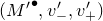 $({M'}^{\bullet},v'_-,v'_+)$
to
$({M'}^{\bullet},v'_-,v'_+)$
to $(M^{\bullet},v_-,v_+)$
given by
$(M^{\bullet},v_-,v_+)$
given by $f(i)=\textrm{Id}$
for
$f(i)=\textrm{Id}$
for $i\leqslant b$
and
$i\leqslant b$
and $f(i)=v_+^{i-b}$
otherwise. This defines a natural transformation of functors
$f(i)=v_+^{i-b}$
otherwise. This defines a natural transformation of functors $e\circ w_{\leqslant b}\to \textrm{Id}$
. On the other hand, we have an isomorphism
$e\circ w_{\leqslant b}\to \textrm{Id}$
. On the other hand, we have an isomorphism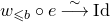 $w_{\leqslant b}\circ e\buildrel{\sim}\over{\longrightarrow} \textrm{Id}$
.
$w_{\leqslant b}\circ e\buildrel{\sim}\over{\longrightarrow} \textrm{Id}$
.
3 The fibre product
$k^{\mathcal{N}}\times_{W(k)^{\mathcal{N}}} \mathbb{A}^1_-/\mathbb{G}_m$

3.1 Drinfeld lemma
Recall from (2.14) that $A:=W(k)[v_+,v_-]/(v_+v_-=p)$
with a grading such that
$A:=W(k)[v_+,v_-]/(v_+v_-=p)$
with a grading such that $\deg v_+=1$
and
$\deg v_+=1$
and $\deg v_-=-1$
. Let
$\deg v_-=-1$
. Let $A^i$
be the subgroup of elements of degree i. Let
$A^i$
be the subgroup of elements of degree i. Let $B\subset A\otimes\mathrm{Frac}(W(k))$
be the W(k)-subalgebra generated by
$B\subset A\otimes\mathrm{Frac}(W(k))$
be the W(k)-subalgebra generated by $v_-$
and
$v_-$
and ${v_+^n}/{n!}$
for
${v_+^n}/{n!}$
for $n\geqslant 0$
. The grading on A induces a grading on B and we write
$n\geqslant 0$
. The grading on A induces a grading on B and we write $B=\bigoplus_iB^i$
.
$B=\bigoplus_iB^i$
.
Definition 3.1. For $n\in\mathbb{N}_{\gt 0}$
, its associated Mazur number is
$n\in\mathbb{N}_{\gt 0}$
, its associated Mazur number is $[n]:=\min_{m\geqslant n}\mathrm{ord}({p^m}/{m!})$
.
$[n]:=\min_{m\geqslant n}\mathrm{ord}({p^m}/{m!})$
.
Note that $[n]=n$
for
$[n]=n$
for $n<p$
, and
$n<p$
, and $[n+1]-[n]=1$
or 0 for every
$[n+1]-[n]=1$
or 0 for every $n\in\mathbb{N}_{\gt 0}$
. For every positive integer n, the ideal
$n\in\mathbb{N}_{\gt 0}$
. For every positive integer n, the ideal $(p^{[n]})\subset \mathbb{Z}_p$
is the nth divided power of the ideal (p).
$(p^{[n]})\subset \mathbb{Z}_p$
is the nth divided power of the ideal (p).
Lemma 3.2.
For every $i\geqslant 0$
,
$i\geqslant 0$
, $B^i$
is the free W(k)-module on
$B^i$
is the free W(k)-module on ${p^{[i]}v_+^i}/{p^i}$
. For every
${p^{[i]}v_+^i}/{p^i}$
. For every $i\leqslant 0$
,
$i\leqslant 0$
, $B^i$
is the free W(k)-module generated by
$B^i$
is the free W(k)-module generated by $v_-^i$
.
$v_-^i$
.
Corollary 3.3. The embedding $A\hookrightarrow B$
is an isomorphism in degrees
$A\hookrightarrow B$
is an isomorphism in degrees $<p$
. In particular, B as a graded
$<p$
. In particular, B as a graded $W(k)[v_-]$
-module is effective in the sense of Definition 2.3.
$W(k)[v_-]$
-module is effective in the sense of Definition 2.3.
Remark 3.4. Lemma 3.2 shows that B is the Rees algebra of the filtration on W(k) given by divided powers of the ideal $(p)\subset W(k)$
.
$(p)\subset W(k)$
.
Remark 3.5. Recall from [Reference BhattBha23, § 3.3] that the stable $\infty$
-category
$\infty$
-category $\mathcal{D}_{qc}(k^\mathcal{N})= \widehat{\mathcal{D}}_{gr}(A)$
of graded p-complete A-modules can be identified with the derived category of filtered p-complete modules over the filtered algebra W(k), where the latter is equipped with the filtration by powers of the ideal
$\mathcal{D}_{qc}(k^\mathcal{N})= \widehat{\mathcal{D}}_{gr}(A)$
of graded p-complete A-modules can be identified with the derived category of filtered p-complete modules over the filtered algebra W(k), where the latter is equipped with the filtration by powers of the ideal $(p)\subset W(k)$
. Likewise, the category
$(p)\subset W(k)$
. Likewise, the category $\widehat{\mathcal{D}}_{gr}(B)$
of graded p-complete B-modules can be identified with the derived category of filtered p-complete modules over the filtered algebra
$\widehat{\mathcal{D}}_{gr}(B)$
of graded p-complete B-modules can be identified with the derived category of filtered p-complete modules over the filtered algebra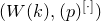 $(W(k), (p)^{[\cdot]})$
, where
$(W(k), (p)^{[\cdot]})$
, where $(p)^{[\cdot]}$
denotes the filtration by divided powers of the ideal (p).
$(p)^{[\cdot]}$
denotes the filtration by divided powers of the ideal (p).
Recall the maps $\mathfrak{p}_{\bar{\mathrm{dR}}}$
and
$\mathfrak{p}_{\bar{\mathrm{dR}}}$
and $ \mathfrak{p}_{\mathrm{cris}}$
from § 2.3. Consider the following diagram
$ \mathfrak{p}_{\mathrm{cris}}$
from § 2.3. Consider the following diagram

where a and t are induced by homomorphisms of graded W(k)-algebras: the map t is induced by the map $W(k)[v_-]\to A$
sending
$W(k)[v_-]\to A$
sending $v_-\mapsto v_-$
, and the map a is induced by the obvious embedding
$v_-\mapsto v_-$
, and the map a is induced by the obvious embedding $A\hookrightarrow B$
. Warning:
$A\hookrightarrow B$
. Warning: $ \mathfrak{p}_{\mathrm{cris}}\not\simeq \mathfrak{p}_{\bar{\mathrm{dR}}}\circ t$
.
$ \mathfrak{p}_{\mathrm{cris}}\not\simeq \mathfrak{p}_{\bar{\mathrm{dR}}}\circ t$
.
Theorem 1 (Drinfeld). There exists a unique isomorphism $\Psi_{\mathrm{Maz}}: \mathfrak{p}_{\mathrm{cris}}\circ a\simeq \mathfrak{p}_{\bar{\mathrm{dR}}}\circ t\circ a$
.
$\Psi_{\mathrm{Maz}}: \mathfrak{p}_{\mathrm{cris}}\circ a\simeq \mathfrak{p}_{\bar{\mathrm{dR}}}\circ t\circ a$
.
We need the following lemma in the proof of the theorem.
Lemma 3.6. The element $[v_+^p]$
in W(B) is uniquely divisible by p.
$[v_+^p]$
in W(B) is uniquely divisible by p.
Proof. Uniqueness is obvious because p is not a zero-divisor in B (hence, in W(B)). It is enough to show that $[v_{+}]^p$
is divisible by p in the ring of big Witt vectors. Recall that the additive group of the big Witt vectors is
$[v_{+}]^p$
is divisible by p in the ring of big Witt vectors. Recall that the additive group of the big Witt vectors is $(1+xB[[x]])^*$
and
$(1+xB[[x]])^*$
and $[v_{+}]^p$
corresponds to
$[v_{+}]^p$
corresponds to $1-v_{+}^p x$
and to show that it is divisible by p we need to show that there exists a series
$1-v_{+}^p x$
and to show that it is divisible by p we need to show that there exists a series $g \in (1+B[[x]])^*$
such that
$g \in (1+B[[x]])^*$
such that $g^p = 1-v_{+}^p x$
. Explicitly,
$g^p = 1-v_{+}^p x$
. Explicitly, $g=\exp(p^{-1} \log(1-v_{+}^p x))$
. However, we need to explain why this formula makes sense. Note that
$g=\exp(p^{-1} \log(1-v_{+}^p x))$
. However, we need to explain why this formula makes sense. Note that $\log(1-v_{+}^p x)=-\sum_{n \ge 1} ({v_{+}^{pn} x^n}/{n})$
makes sense since
$\log(1-v_{+}^p x)=-\sum_{n \ge 1} ({v_{+}^{pn} x^n}/{n})$
makes sense since $v_{+}^{pn}$
is divisible by
$v_{+}^{pn}$
is divisible by $(pn)!$
and, moreover, this series is divisible by p since all the summands are. To make sense of
$(pn)!$
and, moreover, this series is divisible by p since all the summands are. To make sense of $\exp(p^{-1} \log(1-v_{+}^p x))=\exp(-\sum_{n \ge 1} ({v_{+}^{pn} x^n}/{pn}))$
we need to explain why this element which a priori lives in
$\exp(p^{-1} \log(1-v_{+}^p x))=\exp(-\sum_{n \ge 1} ({v_{+}^{pn} x^n}/{pn}))$
we need to explain why this element which a priori lives in $(1+x\mathbb{Q}[[x]])^*$
actually lives in
$(1+x\mathbb{Q}[[x]])^*$
actually lives in $(1+xB[[x]])^*$
. That is, we need to explain why
$(1+xB[[x]])^*$
. That is, we need to explain why $\big(\sum_{n \ge 1} ({v_{+}^{pn} x^n}/{pn})\big)^m$
is divisible by
$\big(\sum_{n \ge 1} ({v_{+}^{pn} x^n}/{pn})\big)^m$
is divisible by $m!$
and it is enough to show that
$m!$
and it is enough to show that $({v_{+}^{pn} x^n}/{pn})^m= {v_{+}^{pnm} x^{nm}}/{(pn)^m}$
is divisible by
$({v_{+}^{pn} x^n}/{pn})^m= {v_{+}^{pnm} x^{nm}}/{(pn)^m}$
is divisible by $m!$
. Recall that
$m!$
. Recall that $v_{+}^{pnm}$
is divisible by
$v_{+}^{pnm}$
is divisible by $(pnm)!$
so we are reduced to show that
$(pnm)!$
so we are reduced to show that ${(pnm)!}/{(pn)^m m!}$
is a p-adic integer. This follows from a known fact that
${(pnm)!}/{(pn)^m m!}$
is a p-adic integer. This follows from a known fact that ${(nm)!}/{(n)^m m!} \in \mathbb{Z}$
.
${(nm)!}/{(n)^m m!} \in \mathbb{Z}$
.
Remark 3.7. Let us sketch another proof of Lemma 3.6. There exists a unique element $y' \in \mathbb{G}_a^\sharp(B)$
whose image in
$y' \in \mathbb{G}_a^\sharp(B)$
whose image in $\mathbb{G}_a(B)$
is
$\mathbb{G}_a(B)$
is $v_+$
. Let
$v_+$
. Let $y\in W^{(F)}(B)$
be the image of y’ under the isomorphism
$y\in W^{(F)}(B)$
be the image of y’ under the isomorphism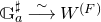 $\mathbb{G}_a^\sharp \buildrel{\sim}\over{\longrightarrow} W^{(F)}$
(see [Reference DrinfeldDri24, Lemma 3.2.6]). Then the first ghost coordinate of
$\mathbb{G}_a^\sharp \buildrel{\sim}\over{\longrightarrow} W^{(F)}$
(see [Reference DrinfeldDri24, Lemma 3.2.6]). Then the first ghost coordinate of $[v_+] -y$
is 0. Thus, there exists a unique
$[v_+] -y$
is 0. Thus, there exists a unique $z\in W(B)$
with
$z\in W(B)$
with $V(z)= [v_+] -y$
. We claim that
$V(z)= [v_+] -y$
. We claim that $p\cdot z = [v_+^p]$
. Indeed,
$p\cdot z = [v_+^p]$
. Indeed, $p\cdot z = FV(z)=F([v_+] -y)= [v_+^p]$
.
$p\cdot z = FV(z)=F([v_+] -y)= [v_+^p]$
.
Remark 3.8. The Witt vector ${[v_+^p]}/{p}\in W(B)$
determines a map
${[v_+^p]}/{p}\in W(B)$
determines a map $\operatorname{Spec} B \xrightarrow{d} W$
. We claim that the following diagram is commutative.
$\operatorname{Spec} B \xrightarrow{d} W$
. We claim that the following diagram is commutative.

Here the action $\alpha$
of
$\alpha$
of $\mathbb{G}_m$
on
$\mathbb{G}_m$
on $\operatorname{Spec} B$
is given by the grading and the action of
$\operatorname{Spec} B$
is given by the grading and the action of $\mathbb{G}_m$
on W is given by the formula
$\mathbb{G}_m$
on W is given by the formula $\beta(\lambda, w)=[\lambda^p] w$
, where
$\beta(\lambda, w)=[\lambda^p] w$
, where $\lambda \in \mathbb{G}_m, w \in W$
, and
$\lambda \in \mathbb{G}_m, w \in W$
, and $[\cdot]$
refers to the Teichmüller representative. Indeed, since
$[\cdot]$
refers to the Teichmüller representative. Indeed, since $\mathbb{G}_m\times \operatorname{Spec} B $
is flat over
$\mathbb{G}_m\times \operatorname{Spec} B $
is flat over $\mathbb{Z}_p$
it suffices to check that
$\mathbb{Z}_p$
it suffices to check that $ d \circ \alpha = \beta \circ (\textrm{Id}\times d)$
after post-composing with
$ d \circ \alpha = \beta \circ (\textrm{Id}\times d)$
after post-composing with $W\stackrel{p}{\longrightarrow}W$
which is clear.
$W\stackrel{p}{\longrightarrow}W$
which is clear.
Using (3.2) the map d descends to a map
 $$ \bar d: \operatorname{Spec} B/\mathbb{G}_m \to W/\mathbb{G}_m $$
of the quotient stacks.
Proof of Theorem 1. Fix an S-point $\mathcal{P}$
of
$\mathcal{P}$
of $\operatorname{Spf} B/\mathbb{G}_m$
. Using the morphism a, we have an S-point of
$\operatorname{Spf} B/\mathbb{G}_m$
. Using the morphism a, we have an S-point of $\operatorname{Spf} A/\mathbb{G}_m$
, i.e.
$\operatorname{Spf} A/\mathbb{G}_m$
, i.e. $\mathcal{O}_S\xrightarrow{v_+}L\xrightarrow{v_-}\mathcal{O}_S$
, where L is a line bundle over S and
$\mathcal{O}_S\xrightarrow{v_+}L\xrightarrow{v_-}\mathcal{O}_S$
, where L is a line bundle over S and $v_+v_-=p$
. Define a morphism of
$v_+v_-=p$
. Define a morphism of $W_S$
-modules
$W_S$
-modules $w:W_S\to \mathbf{V}(L)^{\sharp}\hookrightarrow [L]$
, where the invertible
$w:W_S\to \mathbf{V}(L)^{\sharp}\hookrightarrow [L]$
, where the invertible $W_S$
-module [L] is the Teichmüller lift of L (see [Reference DrinfeldDri24, 3.11]). By Lemma 3.6, the homomorphism
$W_S$
-module [L] is the Teichmüller lift of L (see [Reference DrinfeldDri24, 3.11]). By Lemma 3.6, the homomorphism $[v_+^p]: W_S\to [L^{\otimes p}]$
of
$[v_+^p]: W_S\to [L^{\otimes p}]$
of $W_S$
-modules is canonically divisible by p. Indeed, we first define
$W_S$
-modules is canonically divisible by p. Indeed, we first define
 \begin{equation} \frac{[v_+^p]}{p}: W_S\to [L^{\otimes p}]\end{equation}
locally on S assuming a lift $\tilde{ \mathcal{P}}: S\to \operatorname{Spf} B $
of
$\tilde{ \mathcal{P}}: S\to \operatorname{Spf} B $
of $\mathcal{P}$
. The choice of a lift trivializes L and [L]. Composing
$\mathcal{P}$
. The choice of a lift trivializes L and [L]. Composing $\tilde {\mathcal{P}}$
with
$\tilde {\mathcal{P}}$
with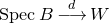 $\operatorname{Spec} B \stackrel{d}{\longrightarrow} W$
from Remark 3.8 we obtain a Witt vector
$\operatorname{Spec} B \stackrel{d}{\longrightarrow} W$
from Remark 3.8 we obtain a Witt vector ${[v_+^p]}/{p} \in W(S)$
. The multiplication by
${[v_+^p]}/{p} \in W(S)$
. The multiplication by ${[v_+^p]}/{p}$
defines the desired map
${[v_+^p]}/{p}$
defines the desired map ${[v_+^p]}/{p}: W_S\to W_S= [L^{\otimes p}]$
. Diagram (3.2) shows that (3.3) does not depend on the choice of a trivializationFootnote
21
and, thus, it is well-defined globally. Applying the Verschiebung, we obtain a homomorphism
${[v_+^p]}/{p}: W_S\to W_S= [L^{\otimes p}]$
. Diagram (3.2) shows that (3.3) does not depend on the choice of a trivializationFootnote
21
and, thus, it is well-defined globally. Applying the Verschiebung, we obtain a homomorphism $V({[v_+^p]}/{p}): W_S\to [L]$
of
$V({[v_+^p]}/{p}): W_S\to [L]$
of $W_S$
-modules. Set
$W_S$
-modules. Set $w:=[v_+]-V({[v_+^p]}/{p}): W_S\to [L]$
. We claim that w lands in
$w:=[v_+]-V({[v_+^p]}/{p}): W_S\to [L]$
. We claim that w lands in $\mathbf{V}(L)^{\sharp}$
. Indeed, the composition
$\mathbf{V}(L)^{\sharp}$
. Indeed, the composition $F\circ w: W_S\to [L^{\otimes p}]$
is zero.
$F\circ w: W_S\to [L^{\otimes p}]$
is zero.
We want to construct an isomorphism $ \mathfrak{p}_{\mathrm{cris}}\circ a(\mathcal{P})\simeq \mathfrak{p}_{\bar{\mathrm{dR}}}\circ t\circ a(\mathcal{P})$
. Define a morphism
$ \mathfrak{p}_{\mathrm{cris}}\circ a(\mathcal{P})\simeq \mathfrak{p}_{\bar{\mathrm{dR}}}\circ t\circ a(\mathcal{P})$
. Define a morphism $\Psi_{\mathrm{Maz}}:M_{\mathfrak{p}_{\mathrm{cris}},S}:=\textrm{coker}(\mathbb{G}_{a,S}^{\sharp}\xrightarrow{(v_+^{\sharp},-can)} \mathbf{V}(L)^{\sharp}\oplus W_S)\longrightarrow \mathbf{V}(L)^{\sharp}\oplus F_*W_S:=M_{\mathfrak{p}_{\bar{\mathrm{dR}},S}}$
as follows: let the map
$\Psi_{\mathrm{Maz}}:M_{\mathfrak{p}_{\mathrm{cris}},S}:=\textrm{coker}(\mathbb{G}_{a,S}^{\sharp}\xrightarrow{(v_+^{\sharp},-can)} \mathbf{V}(L)^{\sharp}\oplus W_S)\longrightarrow \mathbf{V}(L)^{\sharp}\oplus F_*W_S:=M_{\mathfrak{p}_{\bar{\mathrm{dR}},S}}$
as follows: let the map $\mathbf{V}(L)^{\sharp}\oplus W_S\to \mathbf{V}(L)^{\sharp}\oplus F_*W_S$
be given by the matrix
$\mathbf{V}(L)^{\sharp}\oplus W_S\to \mathbf{V}(L)^{\sharp}\oplus F_*W_S$
be given by the matrix $(\begin{smallmatrix} 1& w\\ 0& F\end{smallmatrix})$
. We claim that
$(\begin{smallmatrix} 1& w\\ 0& F\end{smallmatrix})$
. We claim that $\Psi_{\mathrm{Maz}}\circ(v_+^{\sharp},-can)$
is zero. Indeed,
$\Psi_{\mathrm{Maz}}\circ(v_+^{\sharp},-can)$
is zero. Indeed, $F\circ can$
is zero. We also have that
$F\circ can$
is zero. We also have that $v_+^{\sharp}-w\circ can:\mathbb{G}_{a,S}^{\sharp}\to \mathbf{V}(L)^{\sharp}$
is zero because
$v_+^{\sharp}-w\circ can:\mathbb{G}_{a,S}^{\sharp}\to \mathbf{V}(L)^{\sharp}$
is zero because $V({[v_+^p]}/{p})\circ can =0$
.Footnote
22
This defines
$V({[v_+^p]}/{p})\circ can =0$
.Footnote
22
This defines $\Psi_{\mathrm{Maz}}$
. The following commutative diagram shows that
$\Psi_{\mathrm{Maz}}$
. The following commutative diagram shows that $\Psi_{\mathrm{Maz}}$
is an isomorphism.
$\Psi_{\mathrm{Maz}}$
is an isomorphism.

Finally, one verifies that $\Psi_{\mathrm{Maz}}$
commutes with
$\Psi_{\mathrm{Maz}}$
commutes with $\xi$
given by (2.13) and (2.15). This proves the existence of the isomorphism in Theorem 1.
$\xi$
given by (2.13) and (2.15). This proves the existence of the isomorphism in Theorem 1.
For the uniqueness, it suffices to show that the point $\mathfrak{p}_{\bar{\mathrm{dR}}}\circ t\circ a: \operatorname{Spf} B/\mathbb{G}_m\to W(k)^{\mathcal{N}}$
has no nontrivial automorphisms. Since
$\mathfrak{p}_{\bar{\mathrm{dR}}}\circ t\circ a: \operatorname{Spf} B/\mathbb{G}_m\to W(k)^{\mathcal{N}}$
has no nontrivial automorphisms. Since $\operatorname{Spf} B\to \operatorname{Spf} B/\mathbb{G}_m$
is a faithfully flat cover, it suffices to show this for the corresponding point
$\operatorname{Spf} B\to \operatorname{Spf} B/\mathbb{G}_m$
is a faithfully flat cover, it suffices to show this for the corresponding point $s:\operatorname{Spf} B\to W(k)^{\mathcal{N}}$
. Explicitly, s is given by the morphism
$s:\operatorname{Spf} B\to W(k)^{\mathcal{N}}$
. Explicitly, s is given by the morphism $\mathbb{G}_a^{\sharp}\oplus F_*W_B\xrightarrow{(v_-,V)}W_B$
of
$\mathbb{G}_a^{\sharp}\oplus F_*W_B\xrightarrow{(v_-,V)}W_B$
of $W_B$
-modules. Using [Reference BhattBha23, Proposition 5.2.1], any automorphism
$W_B$
-modules. Using [Reference BhattBha23, Proposition 5.2.1], any automorphism $\alpha$
of
$\alpha$
of $W_B$
-module
$W_B$
-module  has the form $[\begin{smallmatrix}t & x \\0 & y\end{smallmatrix}]$
for
$[\begin{smallmatrix}t & x \\0 & y\end{smallmatrix}]$
for $t \in \mathbb{G}_a(B), x \in \ker(\mathbb{G}_a^{\sharp}(B) \to \mathbb{G}_a(B)) = 0, y \in F_* W(B)$
. The group of automorphisms of s consists of
$t \in \mathbb{G}_a(B), x \in \ker(\mathbb{G}_a^{\sharp}(B) \to \mathbb{G}_a(B)) = 0, y \in F_* W(B)$
. The group of automorphisms of s consists of $\alpha$
satisfying
$\alpha$
satisfying $(v_-, V) \circ \alpha = (v_-, V)$
. In particular, for any
$(v_-, V) \circ \alpha = (v_-, V)$
. In particular, for any $(a, b) \in \mathbb{G}_a^{\sharp}(B) \oplus F_* W(B),$
we must have
$(a, b) \in \mathbb{G}_a^{\sharp}(B) \oplus F_* W(B),$
we must have $v_{-} ta + V(by) = v_{-} a + V(b)$
. Substitutions
$v_{-} ta + V(by) = v_{-} a + V(b)$
. Substitutions $a = 0, b=1$
and
$a = 0, b=1$
and $a=[v_{+}], b=0$
give
$a=[v_{+}], b=0$
give $t=y=1$
i.e.
$t=y=1$
i.e. $\alpha=\textrm{Id}$
.
$\alpha=\textrm{Id}$
.
3.2 A description of
$k^{\mathcal{N}}\times_{W(k)^{\mathcal{N}}} \mathbb{A}^1_-/\mathbb{G}_m$

Consider the following Cartesian square.

Using Theorem 1, we have a morphism
 \begin{equation}(a,t\circ a):\operatorname{Spf} B/\mathbb{G}_m\to k^{\mathcal{N}}\times_{W(k)^{\mathcal{N}}}\mathbb{A}^1_-/\mathbb{G}_m:=\mathfrak{D}.\end{equation}
Note that the composition $\mathbb{A}^1_-/\mathbb{G}_m\stackrel{\mathfrak{p}_{\bar{\mathrm{dR}}}}{\longrightarrow}W(k)^{\mathcal{N}}\stackrel{t_{W(k)}}{\longrightarrow}\mathbb{A}^1_-/\mathbb{G}_m$
is the identity. Indeed, recall that
$\mathbb{A}^1_-/\mathbb{G}_m\stackrel{\mathfrak{p}_{\bar{\mathrm{dR}}}}{\longrightarrow}W(k)^{\mathcal{N}}\stackrel{t_{W(k)}}{\longrightarrow}\mathbb{A}^1_-/\mathbb{G}_m$
is the identity. Indeed, recall that $\mathfrak{p}_{\bar{\mathrm{dR}}}$
takes
$\mathfrak{p}_{\bar{\mathrm{dR}}}$
takes $x=(L, v_-) \in\mathbb{A}^1_{-}/\mathbb{G}_m(R)$
to an admissible module
$x=(L, v_-) \in\mathbb{A}^1_{-}/\mathbb{G}_m(R)$
to an admissible module $(v_{-}^{\sharp}, V): \mathbf{V}(L)^{\sharp} \oplus F_*W_R \to W_R$
as in (2.13). This gives rise to a morphism of admissible sequences (2.9) wherethe left vertical map is
$(v_{-}^{\sharp}, V): \mathbf{V}(L)^{\sharp} \oplus F_*W_R \to W_R$
as in (2.13). This gives rise to a morphism of admissible sequences (2.9) wherethe left vertical map is $v_{-}^{\sharp}: \mathbf{V}(L)^{\sharp} \to \mathbb{G}_{a, R}^{\sharp}$
. In particular, the Rees map sends
$v_{-}^{\sharp}: \mathbf{V}(L)^{\sharp} \to \mathbb{G}_{a, R}^{\sharp}$
. In particular, the Rees map sends $\mathfrak{p}_{\bar{\mathrm{dR}}}(x)$
to x. Now, giving an S-point of
$\mathfrak{p}_{\bar{\mathrm{dR}}}(x)$
to x. Now, giving an S-point of $\mathfrak{D}$
is equivalent to giving a
$\mathfrak{D}$
is equivalent to giving a $y \in \mathbb{A}^1_{-}/\mathbb{G}_m(S)$
and an
$y \in \mathbb{A}^1_{-}/\mathbb{G}_m(S)$
and an $x \in k^{\mathcal{N}}(S)$
together with
$x \in k^{\mathcal{N}}(S)$
together with $\mathfrak{p}_{\bar{\mathrm{dR}}}(y) \simeq \mathfrak{p}_{\mathrm{cris}}(x)$
. Applying
$\mathfrak{p}_{\bar{\mathrm{dR}}}(y) \simeq \mathfrak{p}_{\mathrm{cris}}(x)$
. Applying $t_{W(k)}$
to it we get
$t_{W(k)}$
to it we get $t(x) \simeq y$
. Thus, giving an S-point of
$t(x) \simeq y$
. Thus, giving an S-point of $\mathfrak{D}$
is equivalent to giving an S-point x of
$\mathfrak{D}$
is equivalent to giving an S-point x of $k^{\mathcal{N}}$
together with an isomorphism
$k^{\mathcal{N}}$
together with an isomorphism $\mathfrak{p}_{\bar{\mathrm{dR}}}\circ t(x)\simeq \mathfrak{p}_{\mathrm{cris}}(x)$
.
$\mathfrak{p}_{\bar{\mathrm{dR}}}\circ t(x)\simeq \mathfrak{p}_{\mathrm{cris}}(x)$
.
Let us define a closed substack of $\mathfrak{D}$
. Note that both
$\mathfrak{D}$
. Note that both $\mathfrak{p}_{\bar{\mathrm{dR}}}$
and
$\mathfrak{p}_{\bar{\mathrm{dR}}}$
and $\mathfrak{p}_{\mathrm{cris}}$
, precomposed with the structure map
$\mathfrak{p}_{\mathrm{cris}}$
, precomposed with the structure map $\pi: W(k)^{\mathcal{N}} \to W(k)^{\mathbb{\Delta}}$
, factor through the de Rham point
$\pi: W(k)^{\mathcal{N}} \to W(k)^{\mathbb{\Delta}}$
, factor through the de Rham point $\mathfrak{p}_{\mathrm{dR}}: \operatorname{Spf} W(k) \to W(k)^{\mathbb{\Delta}}$
, classifying the Cartier–Witt divisor given by
$\mathfrak{p}_{\mathrm{dR}}: \operatorname{Spf} W(k) \to W(k)^{\mathbb{\Delta}}$
, classifying the Cartier–Witt divisor given by $W \xrightarrow{\cdot p} W$
. This defines a map
$W \xrightarrow{\cdot p} W$
. This defines a map $\tilde{\pi}: \mathfrak{D} \to \operatorname{Spf} W(k) \times_{W(k)^{\mathbb{\Delta}}} \operatorname{Spf} W(k)$
. The stack on the right has a canonical point given by the diagonal map
$\tilde{\pi}: \mathfrak{D} \to \operatorname{Spf} W(k) \times_{W(k)^{\mathbb{\Delta}}} \operatorname{Spf} W(k)$
. The stack on the right has a canonical point given by the diagonal map $\operatorname{Spf} W(k)\to \operatorname{Spf} W(k) \times_{W(k)^{\mathbb{\Delta}}} \operatorname{Spf} W(k)$
. Consider the fibre over this point of the morphism
$\operatorname{Spf} W(k)\to \operatorname{Spf} W(k) \times_{W(k)^{\mathbb{\Delta}}} \operatorname{Spf} W(k)$
. Consider the fibre over this point of the morphism $\tilde{\pi}$
and denote it by
$\tilde{\pi}$
and denote it by $\mathfrak{D}_{0}$
.
$\mathfrak{D}_{0}$
.
The following remark will not be used in the remainder of the paper.
Remark 3.9. Drinfeld suggested to us another interpretation of $\mathfrak{D}$
as well as its substack
$\mathfrak{D}$
as well as its substack $\mathfrak{D}_{0}$
that makes use of the c-stack enhancement of
$\mathfrak{D}_{0}$
that makes use of the c-stack enhancement of $W(k)^{\mathcal{N}}$
introduced in [Reference DrinfeldDri24] and reviewed in § 2.3. For a scheme S, consider the category
$W(k)^{\mathcal{N}}$
introduced in [Reference DrinfeldDri24] and reviewed in § 2.3. For a scheme S, consider the category $\mathfrak{D'}(S)$
consisting of pairs (t, f), where
$\mathfrak{D'}(S)$
consisting of pairs (t, f), where $t: S \to \mathbb{A}_{-}^1/\mathbb{G}_m$
and
$t: S \to \mathbb{A}_{-}^1/\mathbb{G}_m$
and $f: p_+ \to \mathfrak{p}_{\bar{\mathrm{dR}}}(t)$
is a morphism in the category
$f: p_+ \to \mathfrak{p}_{\bar{\mathrm{dR}}}(t)$
is a morphism in the category $W(k)^{\mathcal{N}, c}(S)$
from § 2.3. Here
$W(k)^{\mathcal{N}, c}(S)$
from § 2.3. Here $p_+$
is defined as the composition
$p_+$
is defined as the composition $S \to k^{\mathcal{N}} \xrightarrow{\mathfrak{p}_{\mathrm{cris}}} W(k)^{\mathcal{N}}$
, where the first morphism is given by
$S \to k^{\mathcal{N}} \xrightarrow{\mathfrak{p}_{\mathrm{cris}}} W(k)^{\mathcal{N}}$
, where the first morphism is given by $A \to H^0 (S, \mathcal{O}_{S})$
sending
$A \to H^0 (S, \mathcal{O}_{S})$
sending $v_-$
to p and
$v_-$
to p and $v_+$
to 1. We claim that the underlying groupoid of this category is equivalent to
$v_+$
to 1. We claim that the underlying groupoid of this category is equivalent to $\mathfrak{D}(S)$
. This follows from the fact [Reference DrinfeldDri24, § 5.5.3] that the Rees maps
$\mathfrak{D}(S)$
. This follows from the fact [Reference DrinfeldDri24, § 5.5.3] that the Rees maps $t_{W(k)}: W(k)^{\mathcal{N}, c} \to (\mathbb{A}_{-}^1/\mathbb{G}_m)^c$
,
$t_{W(k)}: W(k)^{\mathcal{N}, c} \to (\mathbb{A}_{-}^1/\mathbb{G}_m)^c$
, $k^{\mathcal{N}, c} \to (\mathbb{A}_{-}^1/\mathbb{G}_m)^c $
are left fibrations of c-stacks. Indeed, since
$k^{\mathcal{N}, c} \to (\mathbb{A}_{-}^1/\mathbb{G}_m)^c $
are left fibrations of c-stacks. Indeed, since $W(k)^{\mathcal{N}, c} \to (\mathbb{A}^1_{-}/\mathbb{G}_m)^c$
is a left fibration, the category
$W(k)^{\mathcal{N}, c} \to (\mathbb{A}^1_{-}/\mathbb{G}_m)^c$
is a left fibration, the category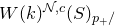 $W(k)^{\mathcal{N}, c}(S)_{p_+/}$
is identified with
$W(k)^{\mathcal{N}, c}(S)_{p_+/}$
is identified with $(\mathbb{A}^1_{-}/\mathbb{G}_m)^c(S)_{p/} \simeq k^{\mathcal{N}, c}(S)$
.Footnote
23
Under this identification, the natural functor
$(\mathbb{A}^1_{-}/\mathbb{G}_m)^c(S)_{p/} \simeq k^{\mathcal{N}, c}(S)$
.Footnote
23
Under this identification, the natural functor $W(k)^{\mathcal{N}, c}(S)_{p_+/} \to W(k)^{\mathcal{N}, c}$
is identified with
$W(k)^{\mathcal{N}, c}(S)_{p_+/} \to W(k)^{\mathcal{N}, c}$
is identified with $\mathfrak{p}_{\mathrm{cris}}$
. The category
$\mathfrak{p}_{\mathrm{cris}}$
. The category $\mathfrak{D}'(S)$
is, by definition, equivalent to
$\mathfrak{D}'(S)$
is, by definition, equivalent to $W(k)^{\mathcal{N}, c}(S)_{p_+/} \times_{W(k)^{\mathcal{N}, c}(S)} (\mathbb{A}^1_{-}/\mathbb{G}_m)^c(S)$
. Its underlying groupoid is
$W(k)^{\mathcal{N}, c}(S)_{p_+/} \times_{W(k)^{\mathcal{N}, c}(S)} (\mathbb{A}^1_{-}/\mathbb{G}_m)^c(S)$
. Its underlying groupoid is $\mathfrak{D}(S)$
by the definition of the latter (3.4). To describe the substack
$\mathfrak{D}(S)$
by the definition of the latter (3.4). To describe the substack $\mathfrak{D}_{0},$
note that any object (t, f) of this category provides us with a triangle in
$\mathfrak{D}_{0},$
note that any object (t, f) of this category provides us with a triangle in $W(S)^{\mathcal{N}, c}$

where $p_-$
is defined by
$p_-$
is defined by $A \to H^0 (S, \mathcal{O}_{S})$
,
$A \to H^0 (S, \mathcal{O}_{S})$
, $v_- \mapsto 1$
,
$v_- \mapsto 1$
, $v_+ \mapsto p$
, and the solid arrows are the canonical morphisms (constructed by observing that, for any S,
$v_+ \mapsto p$
, and the solid arrows are the canonical morphisms (constructed by observing that, for any S, $p_+$
[respectively,
$p_+$
[respectively, $p_-$
] is the initial [respectively, final] object of the category
$p_-$
] is the initial [respectively, final] object of the category $k^{\mathcal{N}, c}(S)$
and
$k^{\mathcal{N}, c}(S)$
and $p_-$
is the final object of
$p_-$
is the final object of $(\mathbb{A}_{-}^1/\mathbb{G}_m)^c(S)$
). The triangle is not commutative in general; points that correspond to commutative triangles are classified by a substack of
$(\mathbb{A}_{-}^1/\mathbb{G}_m)^c(S)$
). The triangle is not commutative in general; points that correspond to commutative triangles are classified by a substack of $\mathfrak{D}$
; this substack is equivalent to
$\mathfrak{D}$
; this substack is equivalent to $\mathfrak{D}_{0}$
.
$\mathfrak{D}_{0}$
.
Recall from [Reference DrinfeldDri24, § 1.8] that every effective gauge $\mathcal{F} \in \mathcal{D}_{qc, [0, +\infty]} (W(k)^{\mathcal{N}})$
gives rise to a complex of contravariant
$\mathcal{F} \in \mathcal{D}_{qc, [0, +\infty]} (W(k)^{\mathcal{N}})$
gives rise to a complex of contravariant $\mathcal{O}$
-modules on
$\mathcal{O}$
-modules on $W(k)^{\mathcal{N}, c}$
. In particular, for every S-point of
$W(k)^{\mathcal{N}, c}$
. In particular, for every S-point of $\mathfrak{D}_{0}$
the canonical morphism
$\mathfrak{D}_{0}$
the canonical morphism $\mathcal{F}|_{p_-} \to \mathcal{F}|_{p_+}$
factors through
$\mathcal{F}|_{p_-} \to \mathcal{F}|_{p_+}$
factors through $\mathcal{F}|_{\mathfrak{p}_{\bar{\mathrm{dR}}}(t)}$
. We also note that, for an effective F-gauge
$\mathcal{F}|_{\mathfrak{p}_{\bar{\mathrm{dR}}}(t)}$
. We also note that, for an effective F-gauge $\mathcal{F}$
, we have an isomorphism
$\mathcal{F}$
, we have an isomorphism $F^*(\mathcal{F}|_{p_+}) \simeq \mathcal{F}|_{p_-}$
whose composition with
$F^*(\mathcal{F}|_{p_+}) \simeq \mathcal{F}|_{p_-}$
whose composition with $\mathcal{F}|_{p_-} \to \mathcal{F}|_{p_+}$
is the crystalline Frobenius.
$\mathcal{F}|_{p_-} \to \mathcal{F}|_{p_+}$
is the crystalline Frobenius.
In this subsection, we give an explicit description of $\mathfrak{D}$
, which was explained to us by Drinfeld and Lurie. The authors of this paper are responsible for any possible mistakes in the exposition of their results.
$\mathfrak{D}$
, which was explained to us by Drinfeld and Lurie. The authors of this paper are responsible for any possible mistakes in the exposition of their results.
We endow W with the $\mathbb{G}_m$
-action given by the formula:
$\mathbb{G}_m$
-action given by the formula: $\lambda*w=[\lambda]w$
, where
$\lambda*w=[\lambda]w$
, where $[\cdot]$
refers to the Teichmüller representative. This gives an action of
$[\cdot]$
refers to the Teichmüller representative. This gives an action of $\mathbb{G}_m$
on
$\mathbb{G}_m$
on $\ker(W\xrightarrow{F}W)=:W^{(F)}\hookrightarrow W$
. We consider the fibre product
$\ker(W\xrightarrow{F}W)=:W^{(F)}\hookrightarrow W$
. We consider the fibre product $\operatorname{Spf} A\times_{\mathbb{A}^1_+}W^{(F)}= :\widetilde{\mathfrak{D}}'$
, where
$\operatorname{Spf} A\times_{\mathbb{A}^1_+}W^{(F)}= :\widetilde{\mathfrak{D}}'$
, where $\operatorname{Spf} A$
is viewed as a scheme over
$\operatorname{Spf} A$
is viewed as a scheme over $\mathbb{A}^1_+$
via the natural embedding
$\mathbb{A}^1_+$
via the natural embedding $W(k)[v_+]\hookrightarrow A$
, and
$W(k)[v_+]\hookrightarrow A$
, and $W^{(F)}\to\mathbb{A}^1_+$
is given by the first Witt vector coordinate.Footnote
24
We endow
$W^{(F)}\to\mathbb{A}^1_+$
is given by the first Witt vector coordinate.Footnote
24
We endow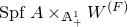 $\operatorname{Spf} A\times_{\mathbb{A}^1_+} W^{(F)}$
with the diagonal
$\operatorname{Spf} A\times_{\mathbb{A}^1_+} W^{(F)}$
with the diagonal $\mathbb{G}_m$
-action. Let
$\mathbb{G}_m$
-action. Let $\widetilde{\mathfrak{D}}'_0\hookrightarrow\operatorname{Spf} A\times_{\mathbb{A}^1_+}W^{(F)}$
be the closed subscheme given byFootnote
25
$\widetilde{\mathfrak{D}}'_0\hookrightarrow\operatorname{Spf} A\times_{\mathbb{A}^1_+}W^{(F)}$
be the closed subscheme given byFootnote
25
 \begin{equation}[v_-]w=p-V(1).\end{equation}
Recall from [Reference DrinfeldDri24, Lemma 3.2.6] the unique isomorphism $W^{(F)}\simeq \mathbb{G}_a^{\sharp}$
characterized by the commutative diagram
$W^{(F)}\simeq \mathbb{G}_a^{\sharp}$
characterized by the commutative diagram

where the vertical map is induced by the projection $W \to \mathbb{G}_a$
to the first coordinate. Thus, under the isomorphism
$W \to \mathbb{G}_a$
to the first coordinate. Thus, under the isomorphism $W^{(F)}(\mathbb{Z}_p)\simeq \mathbb{G}_a^{\sharp}(\mathbb{Z}_p)=p\mathbb{Z}_p\subset \mathbb{Z}_p$
, the element
$W^{(F)}(\mathbb{Z}_p)\simeq \mathbb{G}_a^{\sharp}(\mathbb{Z}_p)=p\mathbb{Z}_p\subset \mathbb{Z}_p$
, the element $p-V(1)$
is sent to the number p. Consequently, under the identification
$p-V(1)$
is sent to the number p. Consequently, under the identification $\operatorname{Spf} A\times_{\mathbb{A}^1_+} W^{(F)}\simeq \operatorname{Spf} A\times_{\mathbb{A}^1_+} \mathbb{G}_a^{\sharp}$
, Equation (3.7) has the form
$\operatorname{Spf} A\times_{\mathbb{A}^1_+} W^{(F)}\simeq \operatorname{Spf} A\times_{\mathbb{A}^1_+} \mathbb{G}_a^{\sharp}$
, Equation (3.7) has the form $v_-\cdot z=p$
, where z is a point of
$v_-\cdot z=p$
, where z is a point of $\mathbb{G}_a^{\sharp}$
, and the product on the left-hand side refers to the
$\mathbb{G}_a^{\sharp}$
, and the product on the left-hand side refers to the $\mathbb{G}_a$
-module structure on
$\mathbb{G}_a$
-module structure on $\mathbb{G}_a^{\sharp}$
. This yields a concrete description of
$\mathbb{G}_a^{\sharp}$
. This yields a concrete description of $\widetilde{\mathfrak{D}}'_0$
as the formal spectrum of the W(k)-algebra generated by
$\widetilde{\mathfrak{D}}'_0$
as the formal spectrum of the W(k)-algebra generated by $v_-$
and
$v_-$
and $\gamma_{p^n}(v_+)$
,
$\gamma_{p^n}(v_+)$
, $n\geqslant 0$
, subject to the following relations:
$n\geqslant 0$
, subject to the following relations:
 \begin{equation}\frac{p^n!}{(p^{n-1}!)^p} \gamma_{p^n}(v_+)= (\gamma_{p^{n-1}}(v_+))^p, \quad v_-^{p^n} \gamma_{p^n}(v_+)= \frac{p^{p^n}}{p^n!}.\end{equation}
Lemma 3.10.
-
(1) Let
$B^{\flat}$
be the PD-envelope of the ideal
$(v_+)$
in A, and let
$W(k)\langle v_+\rangle[v_-]$
be the PD-envelope of the ideal
$(v_+)\subset W(k)[v_+,v_-]$
. Then
$B^{\flat} \buildrel{\sim}\over{\longrightarrow} W(k)\langle v_+\rangle[v_-]/{(v_+v_- -p)}$
and
$\widetilde{\mathfrak{D}}' \xrightarrow{\sim} \operatorname{Spf} B^{\flat}$
. -
(2) Let
$B^{\dagger}$
be the PD-envelope of the ideal
$(v_+)$
in A relative to
$(\mathbb{Z}_p,(p))$
(see [Sta20, 07H7]). Then
$\widetilde{\mathfrak{D}}'_0 \xrightarrow{\sim} \operatorname{Spf} B^{\dagger}$
.







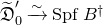
Proof. To prove the first part, set $\widetilde A^\sharp:= W(k)\langle v_+\rangle[v_-]$
,
$\widetilde A^\sharp:= W(k)\langle v_+\rangle[v_-]$
, $\widetilde A: = W(k)[v_+,v_-]$
, and let
$\widetilde A: = W(k)[v_+,v_-]$
, and let $J\subset \widetilde A^\sharp$
be the PD-ideal generated by
$J\subset \widetilde A^\sharp$
be the PD-ideal generated by ${v_+^n}/{n!}$
,
${v_+^n}/{n!}$
, $n\geqslant 1$
. Set
$n\geqslant 1$
. Set $I:= (v_-v_+ -p) \subset \widetilde A^\sharp$
. ThenFootnote
26
$I:= (v_-v_+ -p) \subset \widetilde A^\sharp$
. ThenFootnote
26 $I\cap J = I \cdot J $
. In particular,
$I\cap J = I \cdot J $
. In particular, $I\cap J\subset J$
is a sub-PD-ideal. Consequently, there exists a unique PD structure on the image
$I\cap J\subset J$
is a sub-PD-ideal. Consequently, there exists a unique PD structure on the image $\bar J$
of J under the projection
$\bar J$
of J under the projection $\widetilde A^\sharp \to \widetilde A^\sharp/I$
. We claim that the map
$\widetilde A^\sharp \to \widetilde A^\sharp/I$
. We claim that the map $(A, (v_+)) \to (\widetilde A^\sharp/I, \bar J)$
exhibits the right-hand side as the PD-envelope
$(A, (v_+)) \to (\widetilde A^\sharp/I, \bar J)$
exhibits the right-hand side as the PD-envelope $B^\flat$
of
$B^\flat$
of $(v_+)\subset A$
. Indeed, by the universal property we have a PD-homomorphism
$(v_+)\subset A$
. Indeed, by the universal property we have a PD-homomorphism $B^\flat \to \widetilde A^\sharp/I$
. On the other hand, the projection
$B^\flat \to \widetilde A^\sharp/I$
. On the other hand, the projection $\widetilde A \to A$
gives a PD map
$\widetilde A \to A$
gives a PD map $\widetilde A^\sharp \to B^\flat$
sending I to 0. By looking at generators, one readily checks that these are mutually inverse homomorphisms. Finally, we note that
$\widetilde A^\sharp \to B^\flat$
sending I to 0. By looking at generators, one readily checks that these are mutually inverse homomorphisms. Finally, we note that  . Using the isomorphism $\mathbb{G}_a^\sharp\xrightarrow{\sim} W^{(F)}$
, this implies the claim.To prove the second assertion, observe that
$\mathbb{G}_a^\sharp\xrightarrow{\sim} W^{(F)}$
, this implies the claim.To prove the second assertion, observe that $B^{\dagger}$
is identified with the tensor product
$B^{\dagger}$
is identified with the tensor product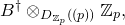 $B^{\dagger} \otimes_{D_{\mathbb{Z}_p}((p))} \mathbb{Z}_p,$
where
$B^{\dagger} \otimes_{D_{\mathbb{Z}_p}((p))} \mathbb{Z}_p,$
where $D_{\mathbb{Z}_p}((p))$
is the PD-envelope of
$D_{\mathbb{Z}_p}((p))$
is the PD-envelope of $(p)\subset \mathbb{Z}_p$
and the homomorphism
$(p)\subset \mathbb{Z}_p$
and the homomorphism $D_{\mathbb{Z}_p}((p)) \to \mathbb{Z}_p$
takes each
$D_{\mathbb{Z}_p}((p)) \to \mathbb{Z}_p$
takes each $\gamma_n(p) \in D_{\mathbb{Z}_p}((p))$
to
$\gamma_n(p) \in D_{\mathbb{Z}_p}((p))$
to ${p^n}/{n!}$
. Using (3.9), the claim follows.
${p^n}/{n!}$
. Using (3.9), the claim follows.
Proposition 3.11.
There is a $\mathbb{G}_m$
-equivariant isomorphism
$\mathbb{G}_m$
-equivariant isomorphism $\widetilde{\mathfrak{D}}:=\mathfrak{D}\times_{\mathbb{A}^1_-/\mathbb{G}_m}\mathbb{A}^1_- \xrightarrow{\sim} \widetilde{\mathfrak{D}}'$
that identifies the substack
$\widetilde{\mathfrak{D}}:=\mathfrak{D}\times_{\mathbb{A}^1_-/\mathbb{G}_m}\mathbb{A}^1_- \xrightarrow{\sim} \widetilde{\mathfrak{D}}'$
that identifies the substack $\widetilde{\mathfrak{D}}_{0} := \mathfrak{D}_{0}\times_{\mathbb{A}^1_-/\mathbb{G}_m}\mathbb{A}^1_-$
with
$\widetilde{\mathfrak{D}}_{0} := \mathfrak{D}_{0}\times_{\mathbb{A}^1_-/\mathbb{G}_m}\mathbb{A}^1_-$
with $\widetilde{\mathfrak{D}}'_0$
. Here the action of
$\widetilde{\mathfrak{D}}'_0$
. Here the action of $\mathbb{G}_m$
on
$\mathbb{G}_m$
on $\widetilde{\mathfrak{D}}$
comes from the
$\widetilde{\mathfrak{D}}$
comes from the $\mathbb{G}_m$
-action on
$\mathbb{G}_m$
-action on $\mathbb{A}^1_-$
.
$\mathbb{A}^1_-$
.
Proof. We start with a preliminary observation. The line bundle $\mathcal{O}_{\mathbb{A}^1_-/\mathbb{G}_m}(-1)$
determines via the Rees map
$\mathcal{O}_{\mathbb{A}^1_-/\mathbb{G}_m}(-1)$
determines via the Rees map $t_{W(k)}: W(k)^{\mathcal{N}} \to \mathbb{A}_{-}^1/\mathbb{G}_m$
a
$t_{W(k)}: W(k)^{\mathcal{N}} \to \mathbb{A}_{-}^1/\mathbb{G}_m$
a $\mathbb{G}_m$
-torsor
$\mathbb{G}_m$
-torsor $ {W(k)}^{\mathcal{N}, r} \to W(k)^{\mathcal{N}}$
. Thus, an S-point of
$ {W(k)}^{\mathcal{N}, r} \to W(k)^{\mathcal{N}}$
. Thus, an S-point of ${W(k)}^{\mathcal{N}, r}$
is a pair consisting of an S-point of
${W(k)}^{\mathcal{N}, r}$
is a pair consisting of an S-point of ${W(k)}^{\mathcal{N}}$
together with a trivialization of the pullback of
${W(k)}^{\mathcal{N}}$
together with a trivialization of the pullback of $\mathcal{O}_{\mathbb{A}^1_-/\mathbb{G}_m}(-1)$
to S. Observe
$\mathcal{O}_{\mathbb{A}^1_-/\mathbb{G}_m}(-1)$
to S. Observe $\mathbb{G}_m$
-equivariant isomorphisms
$\mathbb{G}_m$
-equivariant isomorphisms $ {W(k)}^{\mathcal{N}, r} \times_{{W(k)}^{\mathcal{N}}} k^\mathcal{N} \xrightarrow{\sim} \operatorname{Spf} A$
and
$ {W(k)}^{\mathcal{N}, r} \times_{{W(k)}^{\mathcal{N}}} k^\mathcal{N} \xrightarrow{\sim} \operatorname{Spf} A$
and $ {W(k)}^{\mathcal{N}, r} \times_{{W(k)}^{\mathcal{N}}} \mathbb{A}^1_-/\mathbb{G}_m \xrightarrow{\sim} \mathbb{A}^1_-$
. Consequently, we obtain an isomorphism
$ {W(k)}^{\mathcal{N}, r} \times_{{W(k)}^{\mathcal{N}}} \mathbb{A}^1_-/\mathbb{G}_m \xrightarrow{\sim} \mathbb{A}^1_-$
. Consequently, we obtain an isomorphism $\operatorname{Spf} A \times_{{W(k)}^{\mathcal{N}, r}} \mathbb{A}_{-}^{1} \xrightarrow{\sim} \widetilde{\mathfrak{D}}$
of
$\operatorname{Spf} A \times_{{W(k)}^{\mathcal{N}, r}} \mathbb{A}_{-}^{1} \xrightarrow{\sim} \widetilde{\mathfrak{D}}$
of $\mathbb{G}_m$
-torsors over
$\mathbb{G}_m$
-torsors over $\mathfrak{D}$
. In particular, we conclude that the projection
$\mathfrak{D}$
. In particular, we conclude that the projection $\mathfrak{D} \to \operatorname{Spf} A/\mathbb{G}_m$
lifts to a map
$\mathfrak{D} \to \operatorname{Spf} A/\mathbb{G}_m$
lifts to a map $\widetilde{\mathfrak{D}} \to \operatorname{Spf} A$
.
$\widetilde{\mathfrak{D}} \to \operatorname{Spf} A$
.
Now we prove the proposition. Let R be a p-nilpotent ring. Recall from (3.4) that a point in $\mathfrak{D}(R)$
consists of a point
$\mathfrak{D}(R)$
consists of a point $x \in k^{\mathcal{N}}(R)$
together with
$x \in k^{\mathcal{N}}(R)$
together with $\mathfrak{p}_{\mathrm{cris}}(x) \simeq \mathfrak{p}_{\bar{\mathrm{dR}}} \circ t(x)$
. Since
$\mathfrak{p}_{\mathrm{cris}}(x) \simeq \mathfrak{p}_{\bar{\mathrm{dR}}} \circ t(x)$
. Since $\widetilde{\mathfrak{D}} := \mathfrak{D} \times_{\mathbb{A}^1_{-}/\mathbb{G}_m} \mathbb{A}^1_{-}$
, we see that a point of
$\widetilde{\mathfrak{D}} := \mathfrak{D} \times_{\mathbb{A}^1_{-}/\mathbb{G}_m} \mathbb{A}^1_{-}$
, we see that a point of $\widetilde{\mathfrak{D}}(R)$
consists of a homomorphism
$\widetilde{\mathfrak{D}}(R)$
consists of a homomorphism $g:A\to R$
together with an isomorphism
$g:A\to R$
together with an isomorphism $\beta$
of
$\beta$
of $W_R$
-modules
$W_R$
-modules
 \begin{equation} \textrm{coker}(\mathbb{G}_{a,R}^{\sharp}\xrightarrow{(g(v_+),-\mathrm{can})} \mathbb{G}_{a,R}^{\sharp}\oplus W_R):=M_{\mathfrak{p}_{\mathrm{cris},R}}\underset{\simeq}{\xrightarrow{\beta}} M_{\mathfrak{p}_{\bar{\mathrm{dR}},R}}:=\mathbb{G}_{a,R}^{\sharp}\oplus F_*W_R\end{equation}
such that two diagrams commute


for some $\nu \in \operatorname{Hom}_{W_R}(W_R,W_R)= W(R)$
. Explicitly,
$\nu \in \operatorname{Hom}_{W_R}(W_R,W_R)= W(R)$
. Explicitly, $\beta': \mathbb{G}_{a,R}^{\sharp}\oplus W_R\to M_{\mathfrak{p}_{\mathrm{cris}, R}} \xrightarrow{\beta} \mathbb{G}_{a,R}^{\sharp}\oplus F_*W_R$
is given by
$\beta': \mathbb{G}_{a,R}^{\sharp}\oplus W_R\to M_{\mathfrak{p}_{\mathrm{cris}, R}} \xrightarrow{\beta} \mathbb{G}_{a,R}^{\sharp}\oplus F_*W_R$
is given by $(\begin{smallmatrix} 1 &w\\ 0&\nu \circ F\end{smallmatrix})$
, where
$(\begin{smallmatrix} 1 &w\\ 0&\nu \circ F\end{smallmatrix})$
, where $w=(w_1,w_2,\ldots)\in \operatorname{Hom}_{W_R}(W_R,\mathbb{G}_{a,R}^{\sharp})=W^{(F)}(R)$
is subject to the equation
$w=(w_1,w_2,\ldots)\in \operatorname{Hom}_{W_R}(W_R,\mathbb{G}_{a,R}^{\sharp})=W^{(F)}(R)$
is subject to the equation $w_1=g(v_+)$
and
$w_1=g(v_+)$
and $[g(v_-)]w=p-V(\nu)$
.
$[g(v_-)]w=p-V(\nu)$
.
Sending a point of $\widetilde{\mathfrak{D}}(R)$
to
$\widetilde{\mathfrak{D}}(R)$
to $(g\in (\operatorname{Spf} A)(R), w\in W^{(F)}(R))$
defines a functorial map
$(g\in (\operatorname{Spf} A)(R), w\in W^{(F)}(R))$
defines a functorial map
 \begin{equation}\widetilde{\mathfrak{D}}(R)\to (\operatorname{Spf} A\times_{\mathbb{A}^1_+} W^{(F)}) (R).\end{equation}
We next show that (3.13) is an isomorphism. To do this we construct its inverse.
Given a point $(g,w) \in (\operatorname{Spf} A\times_{\mathbb{A}^1_+} W^{(F)})(R)$
, observe that since
$(g,w) \in (\operatorname{Spf} A\times_{\mathbb{A}^1_+} W^{(F)})(R)$
, observe that since $w_1=g(v_+)$
the first coordinate of
$w_1=g(v_+)$
the first coordinate of $p-[g(v_-)]w$
is 0. Therefore, this element can be uniquely written as
$p-[g(v_-)]w$
is 0. Therefore, this element can be uniquely written as $V(\nu)$
, for some
$V(\nu)$
, for some $\nu \in W(R)$
. Then the matrix
$\nu \in W(R)$
. Then the matrix $(\begin{smallmatrix} 1&w\\ 0&\nu \circ F\end{smallmatrix})$
defines a homomorphism
$(\begin{smallmatrix} 1&w\\ 0&\nu \circ F\end{smallmatrix})$
defines a homomorphism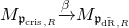 $M_{\mathfrak{p}_{\mathrm{cris},R}} {\xrightarrow{\beta}} M_{\mathfrak{p}_{\bar{\mathrm{dR}},R}}$
making the diagrams (3.11) and (3.12) commutative. It remains to check that
$M_{\mathfrak{p}_{\mathrm{cris},R}} {\xrightarrow{\beta}} M_{\mathfrak{p}_{\bar{\mathrm{dR}},R}}$
making the diagrams (3.11) and (3.12) commutative. It remains to check that $\beta$
is anisomorphism. Using the diagram (3.11) it is enough to check that
$\beta$
is anisomorphism. Using the diagram (3.11) it is enough to check that $\nu \in W(R)$
is invertible. Let
$\nu \in W(R)$
is invertible. Let $\nu_1$
be the first ghost coordinate of
$\nu_1$
be the first ghost coordinate of $\nu$
. If
$\nu$
. If $\nu$
is not invertible we can find a maximal ideal
$\nu$
is not invertible we can find a maximal ideal $\mathfrak{m} \subset R$
which contains
$\mathfrak{m} \subset R$
which contains $\nu_1$
. Since
$\nu_1$
. Since $W^{(F)}(R/\mathfrak{m})=0$
and
$W^{(F)}(R/\mathfrak{m})=0$
and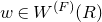 $w \in W^{(F)}(R)$
, we conclude from the equation
$w \in W^{(F)}(R)$
, we conclude from the equation $[g(v_{-})]w=p-V(\nu)$
that
$[g(v_{-})]w=p-V(\nu)$
that $\nu_1=1$
in
$\nu_1=1$
in $R/\mathfrak{m}$
, contradicting
$R/\mathfrak{m}$
, contradicting $\nu_1 \in \mathfrak{m}$
. Thus,
$\nu_1 \in \mathfrak{m}$
. Thus, $\beta$
is an isomorphism. This defines a functorial map
$\beta$
is an isomorphism. This defines a functorial map
 $$(\operatorname{Spf} A\times_{\mathbb{A}^1_+} W^{(F)}) (R) \to \widetilde{\mathfrak{D}}(R),$$
which is inverse to (3.13).
For the second part, note that $\beta = (\begin{smallmatrix} 1&w\\ 0&\nu \circ F\end{smallmatrix}) \in \widetilde{\mathfrak{D}}(R)$
lands in
$\beta = (\begin{smallmatrix} 1&w\\ 0&\nu \circ F\end{smallmatrix}) \in \widetilde{\mathfrak{D}}(R)$
lands in $\widetilde{\mathfrak{D}}_{0}$
if and only if
$\widetilde{\mathfrak{D}}_{0}$
if and only if $\nu =1$
and the result follows.
$\nu =1$
and the result follows.
Remark 3.12. Another way to compute the fibre product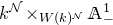 $k^{\mathcal{N}} \times_{W(k)^{\mathcal{N}}} \mathbb{A}^1_{-}$
relies on the computation of p-adically completed derived de Rham cohomology
$k^{\mathcal{N}} \times_{W(k)^{\mathcal{N}}} \mathbb{A}^1_{-}$
relies on the computation of p-adically completed derived de Rham cohomology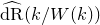 $\widehat{\mathrm{dR}}(k/W(k))$
by Bhatt [Reference BhattBha12, Proposition 8.5], namely
$\widehat{\mathrm{dR}}(k/W(k))$
by Bhatt [Reference BhattBha12, Proposition 8.5], namely $\widehat{\mathrm{dR}}(k/W(k)) = \widehat{W(k)\langle x \rangle} /(x-p)$
, where
$\widehat{\mathrm{dR}}(k/W(k)) = \widehat{W(k)\langle x \rangle} /(x-p)$
, where $\widehat{W(k)\langle x \rangle}$
stands for the p-completed PD-envelope of
$\widehat{W(k)\langle x \rangle}$
stands for the p-completed PD-envelope of $(x)\subset W(k)[x]$
. Moreover, he defines a descending filtration on
$(x)\subset W(k)[x]$
. Moreover, he defines a descending filtration on $\widehat{W(k)\langle x \rangle}$
whose nth term is topologically generated by elements of the form
$\widehat{W(k)\langle x \rangle}$
whose nth term is topologically generated by elements of the form $\gamma_i (x)$
with
$\gamma_i (x)$
with $i \ge n$
. The induced filtration
$i \ge n$
. The induced filtration $\textrm{Fil}^{\bullet}$
on
$\textrm{Fil}^{\bullet}$
on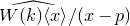 $\widehat{W(k)\langle x \rangle} /(x-p)$
matches the derived Hodge filtration
$\widehat{W(k)\langle x \rangle} /(x-p)$
matches the derived Hodge filtration $\textrm{Hod}^{\bullet}$
under this isomorphism. Using the above result we construct a
$\textrm{Hod}^{\bullet}$
under this isomorphism. Using the above result we construct a $\mathbb{G}_m$
-equivariant isomorphism between the derived fibre product
$\mathbb{G}_m$
-equivariant isomorphism between the derived fibre product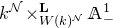 $k^{\mathcal{N}} \times_{W(k)^{\mathcal{N}}}^{\bf L} \mathbb{A}^1_{-}$
and the derived p-adic formal stack represented by the derived p-completion of
$k^{\mathcal{N}} \times_{W(k)^{\mathcal{N}}}^{\bf L} \mathbb{A}^1_{-}$
and the derived p-adic formal stack represented by the derived p-completion of $B^{\dagger}$
. Recall that, for any derived p-adic formal stack X over W(k), the Hodge filtered derived de Rham stack
$B^{\dagger}$
. Recall that, for any derived p-adic formal stack X over W(k), the Hodge filtered derived de Rham stack $(X/W(k))^{\mathrm{dR}, +}$
is identified with the fibre product
$(X/W(k))^{\mathrm{dR}, +}$
is identified with the fibre product $X^{\mathcal{N}} \times_{W(k)^{\mathcal{N}}}^{\bf L} \mathbb{A}^1_{-}/\mathbb{G}_m$
. We apply this to
$X^{\mathcal{N}} \times_{W(k)^{\mathcal{N}}}^{\bf L} \mathbb{A}^1_{-}/\mathbb{G}_m$
. We apply this to $X =\operatorname{Spec} k$
. To complete the proof observe that
$X =\operatorname{Spec} k$
. To complete the proof observe that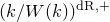 $(k/W(k))^{\mathrm{dR}, +}$
is affine over
$(k/W(k))^{\mathrm{dR}, +}$
is affine over $\mathbb{A}^1_{-}/\mathbb{G}_m$
in the sense of [Reference Bhatt and LurieBL22b, § 7.3] and, hence,
$\mathbb{A}^1_{-}/\mathbb{G}_m$
in the sense of [Reference Bhatt and LurieBL22b, § 7.3] and, hence, $(k/W(k))^{\mathrm{dR}, +} \times_{ \mathbb{A}^1_{-}/\mathbb{G}_m}^{\bf L} \mathbb{A}^1_{-}$
is represented by the algebra
$(k/W(k))^{\mathrm{dR}, +} \times_{ \mathbb{A}^1_{-}/\mathbb{G}_m}^{\bf L} \mathbb{A}^1_{-}$
is represented by the algebra $R\Gamma \big((k/W(k))^{\mathrm{dR}, +} \times_{ \mathbb{A}^1_{-}/\mathbb{G}_m}^{\bf L} \mathbb{A}^1_{-}, \mathcal{O}\big )$
. The latter is the derived p-completion of the Rees algebra
$R\Gamma \big((k/W(k))^{\mathrm{dR}, +} \times_{ \mathbb{A}^1_{-}/\mathbb{G}_m}^{\bf L} \mathbb{A}^1_{-}, \mathcal{O}\big )$
. The latter is the derived p-completion of the Rees algebra $\textrm{Rees}_{\textrm{Hod}^{\bullet}} \widehat{\mathrm{dR}}(k/W(k))$
which is identified with the derived p-completion of
$\textrm{Rees}_{\textrm{Hod}^{\bullet}} \widehat{\mathrm{dR}}(k/W(k))$
which is identified with the derived p-completion of $B^{\dagger}$
using Bhatt’s result explained previously.
$B^{\dagger}$
using Bhatt’s result explained previously.
Note that the derived p-completion of $B^{\dagger}$
is the quotient of the p-completion of
$B^{\dagger}$
is the quotient of the p-completion of $W(k)\langle v_+ \rangle [v_-]$
by the ideal
$W(k)\langle v_+ \rangle [v_-]$
by the ideal $(v_+v_- -p)$
. Using [Reference Bhatt, Morrow and ScholzeBMS18, Remark 6.16], it follows that this quotient is not p-adically separated and, in particular, it is not p-complete. Thus, the derived stack
$(v_+v_- -p)$
. Using [Reference Bhatt, Morrow and ScholzeBMS18, Remark 6.16], it follows that this quotient is not p-adically separated and, in particular, it is not p-complete. Thus, the derived stack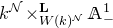 $k^{\mathcal{N}} \times_{W(k)^{\mathcal{N}}}^{\bf L} \mathbb{A}^1_{-}$
is not classical.
$k^{\mathcal{N}} \times_{W(k)^{\mathcal{N}}}^{\bf L} \mathbb{A}^1_{-}$
is not classical.
Remark 3.13. Proposition 3.11 gives another proof of Theorem 1. Indeed, since B is p-torsion-free and $v_+$
has divided powers in B, the embedding
$v_+$
has divided powers in B, the embedding $A\hookrightarrow B$
extends uniquely to a homomorphism of graded W(k)-algebras
$A\hookrightarrow B$
extends uniquely to a homomorphism of graded W(k)-algebras $B^{\dagger} \to B$
. This defines a
$B^{\dagger} \to B$
. This defines a $\mathbb{G}_m$
-equivariant map
$\mathbb{G}_m$
-equivariant map $\operatorname{Spf} B \to \widetilde{\mathfrak{D}}'_0 \buildrel{\sim}\over{\longrightarrow} \widetilde{\mathfrak{D}}_0$
. In particular, we obtain a morphism
$\operatorname{Spf} B \to \widetilde{\mathfrak{D}}'_0 \buildrel{\sim}\over{\longrightarrow} \widetilde{\mathfrak{D}}_0$
. In particular, we obtain a morphism $\operatorname{Spf} B/\mathbb{G}_m \to k^{\mathcal{N}}\times_{W(k)^{\mathcal{N}}} \mathbb{A}^1_-/\mathbb{G}_m$
whose composition with the projection to
$\operatorname{Spf} B/\mathbb{G}_m \to k^{\mathcal{N}}\times_{W(k)^{\mathcal{N}}} \mathbb{A}^1_-/\mathbb{G}_m$
whose composition with the projection to $ k^{\mathcal{N}}$
is given by
$ k^{\mathcal{N}}$
is given by $A\hookrightarrow B$
. This is equivalent to Theorem 1.
$A\hookrightarrow B$
. This is equivalent to Theorem 1.
Remark 3.14. Observe that the morphism
 \begin{equation} \mathfrak{D}=k^{\mathcal{N}}\times_{W(k)^{\mathcal{N}}}\mathbb{A}^1_-/\mathbb{G}_m \to k^{syn}\times_{W(k)^{syn}}\mathbb{A}^1_-/\mathbb{G}_m\end{equation}
induced by maps $k^{\mathcal{N}} \to k^{syn}$
and
$k^{\mathcal{N}} \to k^{syn}$
and $W(k)^{\mathcal{N}} \to W(k)^{syn}$
is an isomorphism. Indeed, since the maps
$W(k)^{\mathcal{N}} \to W(k)^{syn}$
is an isomorphism. Indeed, since the maps $k^{\mathcal{N}} \to k^{syn}$
,
$k^{\mathcal{N}} \to k^{syn}$
, $W(k)^{\mathcal{N}} \to W(k)^{syn}$
are étale, the morphism (3.14) is also étale. Thus, it suffices to check that (3.14) induces an equivalence on points with values in every algebraically closed field K of characteristic p. This follows from [Reference DrinfeldDri24, Propositions 5.16.5 and 8.10.4 (iv)] which assert that the maps
$W(k)^{\mathcal{N}} \to W(k)^{syn}$
are étale, the morphism (3.14) is also étale. Thus, it suffices to check that (3.14) induces an equivalence on points with values in every algebraically closed field K of characteristic p. This follows from [Reference DrinfeldDri24, Propositions 5.16.5 and 8.10.4 (iv)] which assert that the maps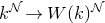 $k^\mathcal{N} \to W(k)^\mathcal{N}$
,
$k^\mathcal{N} \to W(k)^\mathcal{N}$
, $k^{syn} \to W(k)^{syn}$
induce equivalences on K-points.
$k^{syn} \to W(k)^{syn}$
induce equivalences on K-points.
4 Construction of the functor
$\mathcal{D}_{qc,[0,p-1]}(W(k)^{syn}) \to \mathscr{DMF}^{\mathrm{big}}_{[0,p-1]}(W(k))$

4.1 Corollary of Drinfeld’s lemma
The isomorphism $ \mathfrak{p}_{\mathrm{cris}}\circ a\simeq \mathfrak{p}_{\bar{\mathrm{dR}}}\circ t\circ a$
from Theorem 1 gives an isomorphism of functors
$ \mathfrak{p}_{\mathrm{cris}}\circ a\simeq \mathfrak{p}_{\bar{\mathrm{dR}}}\circ t\circ a$
from Theorem 1 gives an isomorphism of functors $\mathcal{D}_{qc}(W(k)^{\mathcal{N}})\to \mathcal{D}_{qc}(\operatorname{Spf} B/\mathbb{G}_m)$
 \begin{equation}a^*t^*\mathfrak{p}^*_{\bar{\mathrm{dR}}}\simeq a^* \mathfrak{p}_{\mathrm{cris}}^*.\end{equation}
We show that after restriction to $\mathcal{D}_{qc, [0,p-1]}(W(k)^{\mathcal{N}})$
, a stronger statement holds.
$\mathcal{D}_{qc, [0,p-1]}(W(k)^{\mathcal{N}})$
, a stronger statement holds.
Theorem 2. There exists a unique isomorphism $t^*\mathfrak{p}^*_{\bar{\mathrm{dR}}}\simeq \mathfrak{p}_{\mathrm{cris}}^*$
of functors
$t^*\mathfrak{p}^*_{\bar{\mathrm{dR}}}\simeq \mathfrak{p}_{\mathrm{cris}}^*$
of functors $\mathcal{D}_{qc, [0,p-1]}(W(k)^{\mathcal{N}})\to \mathcal{D}_{qc, [0,p-1]}(k^\mathcal{N})$
whose pullbacks recover (4.1).
$\mathcal{D}_{qc, [0,p-1]}(W(k)^{\mathcal{N}})\to \mathcal{D}_{qc, [0,p-1]}(k^\mathcal{N})$
whose pullbacks recover (4.1).
Proof. Observe that indeed the functors $t^*\mathfrak{p}^*_{\bar{\mathrm{dR}}}$
and
$t^*\mathfrak{p}^*_{\bar{\mathrm{dR}}}$
and $ \mathfrak{p}_{\mathrm{cris}}^*$
carry
$ \mathfrak{p}_{\mathrm{cris}}^*$
carry $\mathcal{D}_{qc, [0,p-1]}(W(k)^{\mathcal{N}})$
to the subcategory
$\mathcal{D}_{qc, [0,p-1]}(W(k)^{\mathcal{N}})$
to the subcategory $\mathcal{D}_{qc, [0,p-1]}(k^{\mathcal{N}})\subset \mathcal{D}_{qc}(k^{\mathcal{N}})$
: the assertion about
$\mathcal{D}_{qc, [0,p-1]}(k^{\mathcal{N}})\subset \mathcal{D}_{qc}(k^{\mathcal{N}})$
: the assertion about $t^*\mathfrak{p}^*_{\bar{\mathrm{dR}}}$
follows from Lemmas 2.13 and 2.14 combined with Remark 2.15; the assertion about
$t^*\mathfrak{p}^*_{\bar{\mathrm{dR}}}$
follows from Lemmas 2.13 and 2.14 combined with Remark 2.15; the assertion about $ \mathfrak{p}_{\mathrm{cris}}^*$
is true by definition of weights.
$ \mathfrak{p}_{\mathrm{cris}}^*$
is true by definition of weights.
We prove the theorem by showing that
 \begin{equation} a^*:\mathcal{D}_{qc, [0,p-1]}(k^\mathcal{N}) \to \mathcal{D}_{qc}(\operatorname{Spf} B/\mathbb{G}_m)\end{equation}
is fully faithful. We start with the following.
Lemma 4.1. Let
 be an effective object of $\mathcal{D}_{qc}(k^{\mathcal{N}})$
. Then the mapFootnote
27
$\mathcal{D}_{qc}(k^{\mathcal{N}})$
. Then the mapFootnote
27 $\mathcal{N}^i\to((\mathcal{N}^{\bullet}\overset{\mathbb{L}}{\otimes}_AB)^{\wedge})^i$
induced by the homomorphism of graded algebras
$\mathcal{N}^i\to((\mathcal{N}^{\bullet}\overset{\mathbb{L}}{\otimes}_AB)^{\wedge})^i$
induced by the homomorphism of graded algebras $A\to B$
is an isomorphism for
$A\to B$
is an isomorphism for $i<p$
.
$i<p$
.
Proof. Equivalently, it suffices to show that $((\mathcal{N}^{\bullet}\overset{\mathbb{L}}{\otimes}_A B/A)^{\wedge})^i$
is acyclic for
$((\mathcal{N}^{\bullet}\overset{\mathbb{L}}{\otimes}_A B/A)^{\wedge})^i$
is acyclic for $0\leqslant i\leqslant p-1$
. Moreover, by derived p-adic completeness, it suffices to prove that
$0\leqslant i\leqslant p-1$
. Moreover, by derived p-adic completeness, it suffices to prove that $(\mathcal{N}^{\bullet}\overset{\mathbb{L}}{\otimes}_A (B/A\overset{\mathbb{L}}{\otimes}_{W(k)}k))^i$
is acyclic for
$(\mathcal{N}^{\bullet}\overset{\mathbb{L}}{\otimes}_A (B/A\overset{\mathbb{L}}{\otimes}_{W(k)}k))^i$
is acyclic for $0\leqslant i\leqslant p-1$
. The complex
$0\leqslant i\leqslant p-1$
. The complex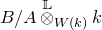 $B/A\overset{\mathbb{L}}{\otimes}_{W(k)}k$
is supported in two cohomological degrees: 0 and
$B/A\overset{\mathbb{L}}{\otimes}_{W(k)}k$
is supported in two cohomological degrees: 0 and $-1$
. Using Lemma 3.2, the
$-1$
. Using Lemma 3.2, the $A \otimes k$
-module
$A \otimes k$
-module $B/A\otimes_{W(k)}k$
has grading degrees greater than or equal to p and is supported at the origin, i.e. every element
$B/A\otimes_{W(k)}k$
has grading degrees greater than or equal to p and is supported at the origin, i.e. every element $x\in B/A \otimes k$
is killed by a power of the maximal ideal
$x\in B/A \otimes k$
is killed by a power of the maximal ideal $\mathfrak{m}\subset A \otimes k$
. Thus,
$\mathfrak{m}\subset A \otimes k$
. Thus, $B/A \otimes k$
admits an exhaustive filtration
$B/A \otimes k$
admits an exhaustive filtration $L_0 \subset L_1 \subset \cdots \subset B/A \otimes k$
by
$L_0 \subset L_1 \subset \cdots \subset B/A \otimes k$
by $A \otimes k$
-submodules with each
$A \otimes k$
-submodules with each $L_i/L_{i-1}$
of the form
$L_i/L_{i-1}$
of the form $k\{j\}$
with
$k\{j\}$
with $j\geqslant p$
. That
$j\geqslant p$
. That $\mathcal{N}^{\bullet}$
is effective implies, using Remark 2.15, that
$\mathcal{N}^{\bullet}$
is effective implies, using Remark 2.15, that $(\mathcal{N}^{\bullet}\overset{\mathbb{L}}{\otimes}_Ak)^i$
is acyclic for
$(\mathcal{N}^{\bullet}\overset{\mathbb{L}}{\otimes}_Ak)^i$
is acyclic for $i< 0$
. Equivalently,
$i< 0$
. Equivalently, $(\mathcal{N}\overset{\mathbb{L}}{\otimes}k\{j\})^i$
is acyclic for
$(\mathcal{N}\overset{\mathbb{L}}{\otimes}k\{j\})^i$
is acyclic for $i<j$
. Thus
$i<j$
. Thus $(\mathcal{N}^{\bullet}\overset{\mathbb{L}}{\otimes}_A (B/A \otimes _{W(k)}k))^i$
is acyclic for
$(\mathcal{N}^{\bullet}\overset{\mathbb{L}}{\otimes}_A (B/A \otimes _{W(k)}k))^i$
is acyclic for $i< p$
.
$i< p$
.
To compute $\textrm{Tor}_1^{W(k)}(B/A,k)=\ker(B/A\xrightarrow{p}B/A)$
: by Lemma 3.2 again, one has
$\textrm{Tor}_1^{W(k)}(B/A,k)=\ker(B/A\xrightarrow{p}B/A)$
: by Lemma 3.2 again, one has $\ker(B^i/A^i\xrightarrow{p}B^i/A^i)=({1}/{p})v_+^ik$
for
$\ker(B^i/A^i\xrightarrow{p}B^i/A^i)=({1}/{p})v_+^ik$
for  and 0 otherwise. Thus, $\textrm{Tor}_1^{W(k)}(B/A,k)= (A/(v_-))\{p\}$
as an A-module. We have that
$\textrm{Tor}_1^{W(k)}(B/A,k)= (A/(v_-))\{p\}$
as an A-module. We have that
 $$(\mathcal{N}^{\bullet}\overset{\mathbb{L}}{\otimes}_A\textrm{Tor}_1^{W(k)}(B/A,k))^i\xrightarrow{\sim} \operatorname{Cone}(\mathcal{N}^{i-p+1} \stackrel{v_-}{\longrightarrow} \mathcal{N}^{i-p}).$$
Using effectivity, the cone above is acyclic for $i<p$
.
$i<p$
.
Corollary 4.2.
For every $M\in \mathcal{D}_{qc,[0, +\infty]}(k^{\mathcal{N}})$
, the natural transformation
$M\in \mathcal{D}_{qc,[0, +\infty]}(k^{\mathcal{N}})$
, the natural transformation $\textrm{Id} \to a_*a^*$
induces an isomorphism
$\textrm{Id} \to a_*a^*$
induces an isomorphism $w_{\leqslant p-1} M\xrightarrow{\sim} w_{\leqslant p-1}a_*a^* M$
.
$w_{\leqslant p-1} M\xrightarrow{\sim} w_{\leqslant p-1}a_*a^* M$
.
Now we can prove that (4.2) is fully faithful. For any $M,M'\in \mathcal{D}_{qc,[0,p-1]}(k^{\mathcal{N}})$
,
$M,M'\in \mathcal{D}_{qc,[0,p-1]}(k^{\mathcal{N}})$
,
 \begin{align*}\mathrm{RHom}(M,M')&=\mathrm{RHom}(M,w_{\leqslant p-1}M')\simeq \mathrm{RHom}(M,w_{\leqslant p-1}a_*a^*M')\\&\simeq \mathrm{RHom}(M,a_*a^*M')\simeq \mathrm{RHom}(a^*M,a^*M'),\end{align*}
where the second and fourth isomorphisms follow by adjunction, and the third isomorphism follows by Corollary 4.2. This proves fully faithfulness and thus completes the proof of the theorem.
Let us record a generalization of Theorem 2.
Proposition 4.3.
There exists an isomorphism $w_{\leqslant p-1} t^*\mathfrak{p}^*_{\bar{\mathrm{dR}}}\simeq w_{\leqslant p-1} \mathfrak{p}_{\mathrm{cris}}^*$
of functors
$w_{\leqslant p-1} t^*\mathfrak{p}^*_{\bar{\mathrm{dR}}}\simeq w_{\leqslant p-1} \mathfrak{p}_{\mathrm{cris}}^*$
of functors $\mathcal{D}_{qc, [0, + \infty]}(W(k)^{\mathcal{N}})\to \mathcal{D}_{qc, [0, p-1]}(k^\mathcal{N})$
.
$\mathcal{D}_{qc, [0, + \infty]}(W(k)^{\mathcal{N}})\to \mathcal{D}_{qc, [0, p-1]}(k^\mathcal{N})$
.
Proof. Using Theorem 1, we have $a_*a^*t^*\mathfrak{p}^*_{\bar{\mathrm{dR}}}\mathcal{F}\simeq a_* a^* \mathfrak{p}_{\mathrm{cris}}^*\mathcal{F}$
. Applying
$a_*a^*t^*\mathfrak{p}^*_{\bar{\mathrm{dR}}}\mathcal{F}\simeq a_* a^* \mathfrak{p}_{\mathrm{cris}}^*\mathcal{F}$
. Applying $w_{\leqslant p-1}$
and using Corollary 4.2 we obtain the result.
$w_{\leqslant p-1}$
and using Corollary 4.2 we obtain the result.
Remark 4.4. In geometric context, i.e. for the prismatic gauge $\mathcal{H}_{\mathcal{N}}(X) \in \mathcal{D}_{qc}(W(k)^\mathcal{N})$
associated to a smooth p-adic formal scheme X over W(k), Equation (4.1) gives
$\mathcal{H}_{\mathcal{N}}(X) \in \mathcal{D}_{qc}(W(k)^\mathcal{N})$
associated to a smooth p-adic formal scheme X over W(k), Equation (4.1) gives
 \begin{equation}a^*t^*\mathfrak{p}^*_{\bar{\mathrm{dR}}} (\mathcal{H}_{\mathcal{N}}(X))\simeq a^* \mathfrak{p}_{\mathrm{cris}}^* (\mathcal{H}_{\mathcal{N}}(X)),\end{equation}
which expresses a relation between the Nygaard filtration on $R\Gamma_{\mathrm{cris}}(X_k)$
, where
$R\Gamma_{\mathrm{cris}}(X_k)$
, where $X_k:=X\times\operatorname{Spec} k$
, and the Hodge filtration on
$X_k:=X\times\operatorname{Spec} k$
, and the Hodge filtration on $R\Gamma_{\mathrm{dR}}(X)$
. In fact,
$R\Gamma_{\mathrm{dR}}(X)$
. In fact, $a^*t^*\mathfrak{p}^*_{\bar{{\mathrm{dR}}}} (\mathcal{H}_{\mathcal{N}}(X))$
, viewed as a complex of filtered modules over the filtered algebra
$a^*t^*\mathfrak{p}^*_{\bar{{\mathrm{dR}}}} (\mathcal{H}_{\mathcal{N}}(X))$
, viewed as a complex of filtered modules over the filtered algebra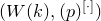 $(W(k), (p)^{[\cdot]})$
(see Remark 3.5), can be identified, using [Reference Berthelot and OgusBO78, Theorem 7.2] with the crystalline Hodge filtration on
$(W(k), (p)^{[\cdot]})$
(see Remark 3.5), can be identified, using [Reference Berthelot and OgusBO78, Theorem 7.2] with the crystalline Hodge filtration on $R\Gamma_{\mathrm{cris}}(X_k)$
. Thus, (4.3) says that the crystalline Hodge filtration can be obtained from the Nygaard filtration by ‘downgrading’ using the functor
$R\Gamma_{\mathrm{cris}}(X_k)$
. Thus, (4.3) says that the crystalline Hodge filtration can be obtained from the Nygaard filtration by ‘downgrading’ using the functor $a^*$
.
$a^*$
.
4.2 Construction of the functor
Define a functor
 \begin{equation} \Phi_{\mathrm{Maz}}:\mathcal{D}_{qc,[0,p-1]}(W(k)^{syn}) \to \mathscr{DMF}^{\mathrm{big}}_{[0,p-1]}(W(k))\end{equation}
as follows. Let $\mathcal{F}\in \mathcal{D}_{qc,[0,p-1]}(W(k)^{syn})$
be a prismatic F-gauge with Hodge–Tate weights in
$\mathcal{F}\in \mathcal{D}_{qc,[0,p-1]}(W(k)^{syn})$
be a prismatic F-gauge with Hodge–Tate weights in $[0,p-1]$
. We have the following diagram (see [Reference BhattBha23, Remark 1.4.2] or § 2.3)
$[0,p-1]$
. We have the following diagram (see [Reference BhattBha23, Remark 1.4.2] or § 2.3)

where $j_-$
(respectively,
$j_-$
(respectively, $j_+ \circ F^{-1}$
) is an open embedding onto the substack given by
$j_+ \circ F^{-1}$
) is an open embedding onto the substack given by $v_-\neq 0$
(respectively,
$v_-\neq 0$
(respectively, $v_+\neq 0$
),
$v_+\neq 0$
),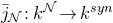 $\bar j_\mathcal{N}: k^{\mathcal{N}} \to k^{syn}$
exhibits the target as the coequalizer of
$\bar j_\mathcal{N}: k^{\mathcal{N}} \to k^{syn}$
exhibits the target as the coequalizer of
 (see [Reference BhattBha23, Definition 6.1.1]), and the square is commutative. The morphism $\operatorname{Spf} W(k) \xrightarrow{v_- = 1} \mathbb{A}^1_{-}/\mathbb{G}_m$
is isomorphic to
$\operatorname{Spf} W(k) \xrightarrow{v_- = 1} \mathbb{A}^1_{-}/\mathbb{G}_m$
is isomorphic to $t \circ j_-$
and
$t \circ j_-$
and $\operatorname{Spf} W(k) \xrightarrow{v_- = p} \mathbb{A}^1_{-}/\mathbb{G}_m$
is isomorphic to
$\operatorname{Spf} W(k) \xrightarrow{v_- = p} \mathbb{A}^1_{-}/\mathbb{G}_m$
is isomorphic to $t \circ j_{+} \circ F^{-1}$
; see the end of § 2.3. By the definition of
$t \circ j_{+} \circ F^{-1}$
; see the end of § 2.3. By the definition of $\bar j_\mathcal{N}$
 \begin{equation}\overline{j}_{\mathcal{N}}\circ j_+ \simeq \overline{j}_{\mathcal{N}}\circ j_-.\end{equation}
Let $\mathcal{M}:=\mathfrak{p}_{\bar{\mathrm{dR}}}^*\circ j_{\mathcal{N}}^*\mathcal{F}$
. Note that
$\mathcal{M}:=\mathfrak{p}_{\bar{\mathrm{dR}}}^*\circ j_{\mathcal{N}}^*\mathcal{F}$
. Note that $F^* (\mathcal{M}|_{v_-=p})\simeq j_+^*\circ t^*\mathcal{M}$
and
$F^* (\mathcal{M}|_{v_-=p})\simeq j_+^*\circ t^*\mathcal{M}$
and $\mathcal{M}|_{v_-=1}\simeq j_-^*\circ t^*\mathcal{M}$
. Then using Theorem 2, one has that
$\mathcal{M}|_{v_-=1}\simeq j_-^*\circ t^*\mathcal{M}$
. Then using Theorem 2, one has that $ \mathfrak{p}_{\mathrm{cris}}^*\circ j_{\mathcal{N}}^*\mathcal{F}\simeq t^*\mathcal{M}$
. Hence, we obtain
$ \mathfrak{p}_{\mathrm{cris}}^*\circ j_{\mathcal{N}}^*\mathcal{F}\simeq t^*\mathcal{M}$
. Hence, we obtain $F^*(\mathcal{M}|_{v_-=p})\simeq j_+^*\circ \mathfrak{p}_{\mathrm{cris}}^*\circ j_{\mathcal{N}}^*\mathcal{F}$
and
$F^*(\mathcal{M}|_{v_-=p})\simeq j_+^*\circ \mathfrak{p}_{\mathrm{cris}}^*\circ j_{\mathcal{N}}^*\mathcal{F}$
and $\mathcal{M}|_{v_-=1}\simeq j_-^*\circ \mathfrak{p}_{\mathrm{cris}}^*\circ j_{\mathcal{N}}^*\mathcal{F}$
. By (4.6), we get an isomorphism
$\mathcal{M}|_{v_-=1}\simeq j_-^*\circ \mathfrak{p}_{\mathrm{cris}}^*\circ j_{\mathcal{N}}^*\mathcal{F}$
. By (4.6), we get an isomorphism $F^*(\mathcal{M}_{v_-=p})\simeq \mathcal{M}_{v_-=1}$
, which we denote by
$F^*(\mathcal{M}_{v_-=p})\simeq \mathcal{M}_{v_-=1}$
, which we denote by $\varphi$
. Define the functor
$\varphi$
. Define the functor $\Phi_{\mathrm{Maz}}$
in (4.4) by sending
$\Phi_{\mathrm{Maz}}$
in (4.4) by sending $\mathcal{F}$
to
$\mathcal{F}$
to $(\mathcal{M}, \varphi )$
.
$(\mathcal{M}, \varphi )$
.
Remark 4.5. Observe that $\Psi_{\mathrm{Maz}}$
from Theorem 1 gives a functor
$\Psi_{\mathrm{Maz}}$
from Theorem 1 gives a functor
 \begin{equation} \mathcal{D}_{qc}(W(k)^{syn})\to \mathcal{D}_{qc}(k^{syn})\times_{\mathcal{D}_{qc}(\operatorname{Spf} B/\mathbb{G}_m)}\mathcal{D}_{qc}(\mathbb{A}^1_-/\mathbb{G}_m) \end{equation}
sending $\mathcal{D}_{qc,[a,b]}(W(k)^{syn})$
to
$\mathcal{D}_{qc,[a,b]}(W(k)^{syn})$
to $\mathcal{D}_{qc,[a,b]}(k^{syn})\times_{\mathcal{D}_{qc}(\operatorname{Spf} B/\mathbb{G}_m)}\mathcal{D}_{qc,[a,b]}(\mathbb{A}^1_-/\mathbb{G}_m)$
. We assert that there is a functor
$\mathcal{D}_{qc,[a,b]}(k^{syn})\times_{\mathcal{D}_{qc}(\operatorname{Spf} B/\mathbb{G}_m)}\mathcal{D}_{qc,[a,b]}(\mathbb{A}^1_-/\mathbb{G}_m)$
. We assert that there is a functor
 \begin{equation}\mathcal{D}_{qc,[0,p-1]}(k^{syn})\times_{\mathcal{D}_{qc}(\operatorname{Spf} B/\mathbb{G}_m)}\mathcal{D}_{qc,[0,p-1]}(\mathbb{A}^1_-/\mathbb{G}_m)\to \mathscr{DMF}_{[0,p-1]}^{\mathrm{big}}(W(k))\end{equation}
whose precomposition with (4.7) is $\Phi_{\mathrm{Maz}}$
. To see this, observe that the functor
$\Phi_{\mathrm{Maz}}$
. To see this, observe that the functor
 \begin{align*}&\mathcal{D}_{qc,[0,p-1]}(k^{syn})\underset{\mathcal{D}_{qc, [0,p-1]}(k^\mathcal{N})}{\times}\mathcal{D}_{qc,[0,p-1]}(\mathbb{A}^1_-/\mathbb{G}_m)\to \\&\mathcal{D}_{qc,[0,p-1]}(k^{syn})\underset{\mathcal{D}_{qc}(\operatorname{Spf} B/\mathbb{G}_m)}{\times}\mathcal{D}_{qc,[0,p-1]}(\mathbb{A}^1_-/\mathbb{G}_m)\end{align*}
induced by the fully faithful embedding (4.2) is an equivalence.Footnote 28 We define
 $$ \mathcal{D}_{qc,[0,p-1]}(k^{syn})\underset{\mathcal{D}_{qc, [0,p-1]}(k^\mathcal{N})}{\times}\mathcal{D}_{qc,[0,p-1]}(\mathbb{A}^1_-/\mathbb{G}_m)\to \mathscr{DMF}_{[0,p-1]}^{\mathrm{big}}(W(k))$$
sending an object $(\mathcal{F}_k,\mathcal{M}, \upsilon: \bar j^*_\mathcal{N} \mathcal{F}_k \buildrel{\sim}\over{\longrightarrow} t^* \mathcal{M} )$
of the fibre product to
$(\mathcal{F}_k,\mathcal{M}, \upsilon: \bar j^*_\mathcal{N} \mathcal{F}_k \buildrel{\sim}\over{\longrightarrow} t^* \mathcal{M} )$
of the fibre product to $(\mathcal{M}, \varphi )$
, where
$(\mathcal{M}, \varphi )$
, where $\varphi: F^*(\mathcal{M}_{v_-=p})\simeq \mathcal{M}_{v_-=1}$
is constructed from diagram (4.5) and Equation (4.6). This defines (4.8). The fact that its precomposition with (4.7) is
$\varphi: F^*(\mathcal{M}_{v_-=p})\simeq \mathcal{M}_{v_-=1}$
is constructed from diagram (4.5) and Equation (4.6). This defines (4.8). The fact that its precomposition with (4.7) is $\Phi_{\mathrm{Maz}}$
is straightforward.
$\Phi_{\mathrm{Maz}}$
is straightforward.
The following remarks are not used in the remainder of the paper. However, we believe that they are important in their own right.
Remark 4.6 (A refinement of the crystalline Frobenius). For every object $N\in \mathcal{D}_{qc,[0, +\infty]}(k^{\mathcal{N}}) \subset \widehat{\mathcal{D}}_{gr}(A)$
, we have a canonical morphism
$N\in \mathcal{D}_{qc,[0, +\infty]}(k^{\mathcal{N}}) \subset \widehat{\mathcal{D}}_{gr}(A)$
, we have a canonical morphism
 \begin{equation} N\to \pi ^* \circ (j_+\circ F^{-1})^* N, \end{equation}
where $\pi: k^{\mathcal{N}} \to \operatorname{Spf} W(k)$
is the structure map. One can define (4.9) by observing that
$\pi: k^{\mathcal{N}} \to \operatorname{Spf} W(k)$
is the structure map. One can define (4.9) by observing that $\pi^*$
is the right adjoint to
$\pi^*$
is the right adjoint to $(j_+\circ F^{-1})^*\colon \mathcal{D}_{qc,[0, +\infty]}(k^{\mathcal{N}}) \to \mathcal{D}_{qc}(\operatorname{Spf} W(k))$
. Alternatively, (4.9) can be constructed using Drinfeld’s observation that every effective gauge
$(j_+\circ F^{-1})^*\colon \mathcal{D}_{qc,[0, +\infty]}(k^{\mathcal{N}}) \to \mathcal{D}_{qc}(\operatorname{Spf} W(k))$
. Alternatively, (4.9) can be constructed using Drinfeld’s observation that every effective gauge $\mathcal{F}$
extends to a contravariant
$\mathcal{F}$
extends to a contravariant $\mathcal{O}$
-module on the c-stack
$\mathcal{O}$
-module on the c-stack $k^{\mathcal{N}, c}$
and that, for any scheme S, the category
$k^{\mathcal{N}, c}$
and that, for any scheme S, the category $k^{\mathcal{N}, c}(S)$
has initial object given by
$k^{\mathcal{N}, c}(S)$
has initial object given by $p_+$
(see Remark 3.9).
$p_+$
(see Remark 3.9).
Given an effective F-gauge $\mathcal{F}\in \mathcal{D}_{qc,[0, +\infty]}(W(k)^{syn})$
, we have functorial morphisms
$\mathcal{F}\in \mathcal{D}_{qc,[0, +\infty]}(W(k)^{syn})$
, we have functorial morphisms
 \begin{equation} a^*t^*{\mathfrak{p}}^*_{\bar{{\mathrm{dR}}}}(\mathcal{F}) \underset{\eqref{cor_of_Drinfeld-prop}}{\buildrel{\sim}\over{\longrightarrow}} a^* \mathfrak{p}_{\mathrm{cris}}^* (\mathcal{F}) \underset{\eqref{c-stack_map}}{\to} a^* \pi ^* (j_+\circ F^{-1})^* \mathfrak{p}_{\mathrm{cris}}^* (\mathcal{F}) \underset{\eqref{j+j-same-after-jbar-uptoF}}{\xrightarrow{\sim}} a^* \pi ^* F_* j^*_- \mathfrak{p}_{\mathrm{cris}}^* (\mathcal{F}).\end{equation}
To rewrite it more suggestively, let $F^{\bullet}= \oplus F^i\in \widehat {\mathcal{D}}_{gr}(W(k)[v_-])$
be the complex of graded
$F^{\bullet}= \oplus F^i\in \widehat {\mathcal{D}}_{gr}(W(k)[v_-])$
be the complex of graded $W(k)[v_-]$
-modules corresponding to
$W(k)[v_-]$
-modules corresponding to $\mathfrak{p}^*_{\bar{{\mathrm{dR}}}}(\mathcal{F})$
under the equivalence (2.1). Then the composition (4.10) yields a homomorphism in
$\mathfrak{p}^*_{\bar{{\mathrm{dR}}}}(\mathcal{F})$
under the equivalence (2.1). Then the composition (4.10) yields a homomorphism in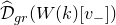 $\widehat {\mathcal{D}}_{gr}(W(k)[v_-])$
 \begin{equation} \varphi_{\bullet}: F^{\bullet} \to F_* M \otimes_{W(k)} B, \end{equation}
where $M:=F^0$
and the action of
$M:=F^0$
and the action of $W(k)[v_-]$
on
$W(k)[v_-]$
on $ F_* F^0 \otimes_{W(k)} B$
comes from the homomorphism
$ F_* F^0 \otimes_{W(k)} B$
comes from the homomorphism $W(k)[v_-] \hookrightarrow B$
. Explicitly, (4.11) amounts to specifying W(k)-linear maps
$W(k)[v_-] \hookrightarrow B$
. Explicitly, (4.11) amounts to specifying W(k)-linear maps $\varphi_i:F^i\to F_* M$
for each
$\varphi_i:F^i\to F_* M$
for each $i\geqslant 0$
such that
$i\geqslant 0$
such that $p^{[i+1]-[i]}\varphi_{i+1}=\varphi_iv_-$
(see Definition 3.1). We claim that
$p^{[i+1]-[i]}\varphi_{i+1}=\varphi_iv_-$
(see Definition 3.1). We claim that $\varphi_0: M \to F_* M$
coincides with the crystalline Frobenius. Indeed, taking
$\varphi_0: M \to F_* M$
coincides with the crystalline Frobenius. Indeed, taking $S=\operatorname{Spf} B/\mathbb{G}_m$
in Remark 3.9, the composition (4.10) is obtained by taking fibres of
$S=\operatorname{Spf} B/\mathbb{G}_m$
in Remark 3.9, the composition (4.10) is obtained by taking fibres of $\mathcal{F}$
along
$\mathcal{F}$
along $p_+ \to \mathfrak{p}_{\bar{\mathrm{dR}}}(t)$
and using (4.6). The map
$p_+ \to \mathfrak{p}_{\bar{\mathrm{dR}}}(t)$
and using (4.6). The map $\operatorname{Spf} B / \mathbb{G}_m \to \mathfrak{D}$
from (3.5) is induced by the natural map
$\operatorname{Spf} B / \mathbb{G}_m \to \mathfrak{D}$
from (3.5) is induced by the natural map $B^{\flat} \to B$
from the PD-envelope of
$B^{\flat} \to B$
from the PD-envelope of $(v_+)\subset A$
to B; see Lemma 3.10. Since B has no p-torsion, this map factors through the PD-envelope
$(v_+)\subset A$
to B; see Lemma 3.10. Since B has no p-torsion, this map factors through the PD-envelope $B^{\dagger}$
of
$B^{\dagger}$
of $(v_+)\subset A$
relative to
$(v_+)\subset A$
relative to $(\mathbb{Z}_p, (p))$
.Footnote
29
It follows that the map
$(\mathbb{Z}_p, (p))$
.Footnote
29
It follows that the map $\operatorname{Spf} B / \mathbb{G}_m \to \mathfrak{D}$
factors through the closed substack
$\operatorname{Spf} B / \mathbb{G}_m \to \mathfrak{D}$
factors through the closed substack $\mathfrak{D}_{0}$
. Now our claim follows from the commutativity of diagram (3.6).Footnote
30
$\mathfrak{D}_{0}$
. Now our claim follows from the commutativity of diagram (3.6).Footnote
30
Denote by $\mathrm{Mod}_{\mathrm{Maz}}(W(k))$
the
$\mathrm{Mod}_{\mathrm{Maz}}(W(k))$
the $\infty$
-category formed of pairs
$\infty$
-category formed of pairs $(F^{\bullet}, \varphi)$
, where
$(F^{\bullet}, \varphi)$
, where $F^{\bullet} \in \widehat {\mathcal{D}}_{gr}(W(k)[v_-])$
is effective and
$F^{\bullet} \in \widehat {\mathcal{D}}_{gr}(W(k)[v_-])$
is effective and $\varphi: F^{\bullet} \to F_* F^0 \otimes_{W(k)} B$
is a map in
$\varphi: F^{\bullet} \to F_* F^0 \otimes_{W(k)} B$
is a map in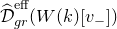 $\widehat {\mathcal{D}}_{gr}^{\text{eff}}(W(k)[v_-])$
. More formally, it is defined as the lax equalizer
$\widehat {\mathcal{D}}_{gr}^{\text{eff}}(W(k)[v_-])$
. More formally, it is defined as the lax equalizer $\textrm{LEq}(\textrm{Id}, F_*F^0 \otimes B)$
as in [Reference Nikolaus and ScholzeNS18, Definition II.1.4]. Here by
$\textrm{LEq}(\textrm{Id}, F_*F^0 \otimes B)$
as in [Reference Nikolaus and ScholzeNS18, Definition II.1.4]. Here by $F_*F^0 \otimes_{W(k)} B$
we mean the endo-functor of
$F_*F^0 \otimes_{W(k)} B$
we mean the endo-functor of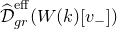 $\widehat{\mathcal{D}}_{gr}^{\text{eff}} (W(k)[v_{-}])$
taking
$\widehat{\mathcal{D}}_{gr}^{\text{eff}} (W(k)[v_{-}])$
taking $F^{\bullet}$
to
$F^{\bullet}$
to $F_* F^0 \otimes_{W(k)} B$
. We refer to objects of
$F_* F^0 \otimes_{W(k)} B$
. We refer to objects of $\mathrm{Mod}_{\mathrm{Maz}}(W(k))$
as Mazur modules. The above construction determines a functor
$\mathrm{Mod}_{\mathrm{Maz}}(W(k))$
as Mazur modules. The above construction determines a functor
 \begin{equation} \boldsymbol{\Phi}_{\mathrm{Maz}}: \mathcal{D}_{qc,[0, \infty]}(W(k)^{syn})\to \mathrm{Mod}_{\mathrm{Maz}}(W(k)), \quad \mathcal{F} \mapsto (\mathfrak{p}^*_{\bar{\mathrm{dR}}}(\mathcal{F}), \varphi_{\bullet}). \end{equation}
Next, we construct a functor
 \begin{equation} \mathscr{DMF}^{\mathrm{big}}_{[0, \infty]}(W(k)) \to \mathrm{Mod}_{\text{Maz}}(W(k)), \end{equation}
whose precomposition with (4.4) is isomorphic to (4.12). To do this, observe that the $\infty$
-category
$\infty$
-category $\mathcal{C}_1$
formed of pairs
$\mathcal{C}_1$
formed of pairs $(F^{\bullet}, \varphi ')$
, where
$(F^{\bullet}, \varphi ')$
, where $F^{\bullet} \in \widehat {\mathcal{D}}_{gr}^{\text{eff}}(W(k)[v_-])$
and
$F^{\bullet} \in \widehat {\mathcal{D}}_{gr}^{\text{eff}}(W(k)[v_-])$
and $\varphi': F^{\bullet} \to F_* F^0 \otimes_{W(k)} A$
is a map in
$\varphi': F^{\bullet} \to F_* F^0 \otimes_{W(k)} A$
is a map in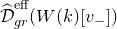 $\widehat {\mathcal{D}}_{gr}^{\text{eff}}(W(k)[v_-])$
, is equivalent to the lax equalizer
$\widehat {\mathcal{D}}_{gr}^{\text{eff}}(W(k)[v_-])$
, is equivalent to the lax equalizer

The latter category consists of $\mathcal{M}\in \mathcal{D}_{qc,[0, \infty]}(\mathbb{A}^1_{-}/\mathbb{G}_m)$
together with a morphism
$\mathcal{M}\in \mathcal{D}_{qc,[0, \infty]}(\mathbb{A}^1_{-}/\mathbb{G}_m)$
together with a morphism $\varphi': F^*(i^*_{p}\mathcal{M})\to i^*_{1}\mathcal{M}$
in
$\varphi': F^*(i^*_{p}\mathcal{M})\to i^*_{1}\mathcal{M}$
in $\mathcal{D}_{qc}(\operatorname{Spf} W(k))$
(cf. Definition 2.6). Note that, for every
$\mathcal{D}_{qc}(\operatorname{Spf} W(k))$
(cf. Definition 2.6). Note that, for every $\mathcal{M}\in \mathcal{D}_{qc,[0, \infty]}(\mathbb{A}^1_{-}/\mathbb{G}_m)$
, we have
$\mathcal{M}\in \mathcal{D}_{qc,[0, \infty]}(\mathbb{A}^1_{-}/\mathbb{G}_m)$
, we have
 $$ \operatorname{Hom} (F^* i^*_{p}\mathcal{M}, i^*_{1}\mathcal{M}) \buildrel{\sim}\over{\longrightarrow} \operatorname{Hom} (\mathcal{M}, i_{p\, *}F_* i^*_{1}\mathcal{M}) \buildrel{\sim}\over{\longrightarrow} \operatorname{Hom} (\mathcal{M}, w_{\geqslant 0} i_{p\, *}F_* i^*_{1}\mathcal{M}), $$
where $w_{\geqslant 0}$
is the right adjoint to the embedding
$w_{\geqslant 0}$
is the right adjoint to the embedding $ \mathcal{D}_{qc,[0, \infty]}(\mathbb{A}^1_{-}/\mathbb{G}_m)\hookrightarrow \mathcal{D}_{qc}(\mathbb{A}^1_{-}/\mathbb{G}_m)$
(cf. Lemma 2.16). The right-hand side of the above is naturally isomorphic to
$ \mathcal{D}_{qc,[0, \infty]}(\mathbb{A}^1_{-}/\mathbb{G}_m)\hookrightarrow \mathcal{D}_{qc}(\mathbb{A}^1_{-}/\mathbb{G}_m)$
(cf. Lemma 2.16). The right-hand side of the above is naturally isomorphic to $\operatorname{Hom}_{\widehat {\mathcal{D}}_{gr}^{\text{eff}}(W(k)[v_-])}(F^{\bullet}, F_* F^0 \otimes_{W(k)} A)$
, where
$\operatorname{Hom}_{\widehat {\mathcal{D}}_{gr}^{\text{eff}}(W(k)[v_-])}(F^{\bullet}, F_* F^0 \otimes_{W(k)} A)$
, where $F^{\bullet}$
is the graded module corresponding to
$F^{\bullet}$
is the graded module corresponding to $\mathcal{M}$
.Footnote
31
This gives
$\mathcal{M}$
.Footnote
31
This gives $\mathcal{C}_1 \buildrel{\sim}\over{\longrightarrow} \mathcal{C}_2$
.
$\mathcal{C}_1 \buildrel{\sim}\over{\longrightarrow} \mathcal{C}_2$
.
The category $\mathcal{C}_2$
receives an obvious functor
$\mathcal{C}_2$
receives an obvious functor $(\mathcal{M}, \varphi')\mapsto (\mathcal{M}, \varphi')$
from
$(\mathcal{M}, \varphi')\mapsto (\mathcal{M}, \varphi')$
from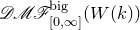 $\mathscr{DMF}^{\mathrm{big}}_{[0, \infty]}(W(k))$
; see Definition 2.6. This functor is fully faithful by [Reference Nikolaus and ScholzeNS18, Proposition II.1.5]. To complete the construction of (4.13), note that the morphism
$\mathscr{DMF}^{\mathrm{big}}_{[0, \infty]}(W(k))$
; see Definition 2.6. This functor is fully faithful by [Reference Nikolaus and ScholzeNS18, Proposition II.1.5]. To complete the construction of (4.13), note that the morphism $A \to B$
induces a functor
$A \to B$
induces a functor $\mathcal{C}_1 \to \mathrm{Mod}_{\text{Maz}}(W(k))$
sending
$\mathcal{C}_1 \to \mathrm{Mod}_{\text{Maz}}(W(k))$
sending $(F^\bullet, \varphi')$
to
$(F^\bullet, \varphi')$
to $(F^\bullet, \varphi)$
, where
$(F^\bullet, \varphi)$
, where $\varphi$
is the composition
$\varphi$
is the composition $ F^{\bullet} \xrightarrow{\varphi'} F_* F^0 \otimes A \to F_* F^0 \otimes B$
. Thus, in the notation of § 2.2,
$ F^{\bullet} \xrightarrow{\varphi'} F_* F^0 \otimes A \to F_* F^0 \otimes B$
. Thus, in the notation of § 2.2, $\varphi _i = p^{i-[i]}\varphi_i'$
.
$\varphi _i = p^{i-[i]}\varphi_i'$
.
Note that the restriction of (4.13) to $\mathscr{DMF}^{\mathrm{big}}_{[0, p-1]}(W(k)) \to \mathrm{Mod}_{\text{Maz}}(W(k))$
is fully faithful. Indeed, using [Reference Nikolaus and ScholzeNS18, Proposition II.1.5], it is enough to show that, for
$\mathscr{DMF}^{\mathrm{big}}_{[0, p-1]}(W(k)) \to \mathrm{Mod}_{\text{Maz}}(W(k))$
is fully faithful. Indeed, using [Reference Nikolaus and ScholzeNS18, Proposition II.1.5], it is enough to show that, for $M^{\bullet}, N^{\bullet} \in {\mathcal{D}_{qc, [0, p-1]}}(\mathbb{A}^1_{-}/\mathbb{G}_m)$
, the natural map
$M^{\bullet}, N^{\bullet} \in {\mathcal{D}_{qc, [0, p-1]}}(\mathbb{A}^1_{-}/\mathbb{G}_m)$
, the natural map $\operatorname{Hom}_{\widehat {\mathcal{D}}_{gr}^{\text{eff}}(W(k)[v_-])}(M^{\bullet}, F_*N_0 \otimes A) \to \operatorname{Hom}_{\widehat {\mathcal{D}}_{gr}^{\text{eff}}(W(k)[v_-])}(N^{\bullet}, F_*N_0 \otimes B)$
is an equivalence. This follows since
$\operatorname{Hom}_{\widehat {\mathcal{D}}_{gr}^{\text{eff}}(W(k)[v_-])}(M^{\bullet}, F_*N_0 \otimes A) \to \operatorname{Hom}_{\widehat {\mathcal{D}}_{gr}^{\text{eff}}(W(k)[v_-])}(N^{\bullet}, F_*N_0 \otimes B)$
is an equivalence. This follows since $\mathcal{D}_{qc, (-\infty, p-1]}(\mathbb{A}^1_{-}/\mathbb{G}_m) \hookrightarrow \mathcal{D}_{qc}(\mathbb{A}^1_{-}/\mathbb{G}_m)$
admits a right adjoint
$\mathcal{D}_{qc, (-\infty, p-1]}(\mathbb{A}^1_{-}/\mathbb{G}_m) \hookrightarrow \mathcal{D}_{qc}(\mathbb{A}^1_{-}/\mathbb{G}_m)$
admits a right adjoint $w_{\le p-1}$
(cf. Lemma 2.16) and
$w_{\le p-1}$
(cf. Lemma 2.16) and $F_*N^0 \otimes A \to F_*N^0 \otimes B$
is an equivalence after applying
$F_*N^0 \otimes A \to F_*N^0 \otimes B$
is an equivalence after applying $w_{\le p-1}$
; see Corollary 3.3.
$w_{\le p-1}$
; see Corollary 3.3.
Remark 4.7 (Relation to the Mazur–Ogus construction). In the geometric context, (4.11) encodes divisibility properties of the crystalline Frobenius discovered by Mazur. Namely, following the idea of Mazur [Reference MazurMaz73], we define a functor
 \begin{equation} \widetilde {\bf \Phi}_{\mathrm{Maz}}: \widehat{\mathrm{Sm}}_{W(k)}^{\textrm{op}}\to \mathrm{Mod}_{\mathrm{Maz}}(W(k)) \end{equation}
as follows. Let X be a smooth p-adic formal scheme over W(k). First, assume that there exists a closed embedding $X\hookrightarrow Y$
, where Y is a smooth p-adic formal scheme over W(k) equipped with a Frobenius lift
$X\hookrightarrow Y$
, where Y is a smooth p-adic formal scheme over W(k) equipped with a Frobenius lift $\tilde F_Y$
(that is not required to preserve X). Denote by
$\tilde F_Y$
(that is not required to preserve X). Denote by $\mathcal{D}_X(Y)$
the p-completed PD-hull of X in Y and by J the sheaf of ideals of the closed embedding
$\mathcal{D}_X(Y)$
the p-completed PD-hull of X in Y and by J the sheaf of ideals of the closed embedding $X \hookrightarrow \mathcal{D}_X(Y)$
. Note
$X \hookrightarrow \mathcal{D}_X(Y)$
. Note $\mathcal{D}_X(Y)$
can be also viewed as the p-completed PD-hull of
$\mathcal{D}_X(Y)$
can be also viewed as the p-completed PD-hull of $X_k$
in Y; in particular, it follows that
$X_k$
in Y; in particular, it follows that $\tilde F_Y$
extends uniquely to an endomorphism
$\tilde F_Y$
extends uniquely to an endomorphism $\mathcal{D}_X(Y)$
. Set
$\mathcal{D}_X(Y)$
. Set $\Omega_{\mathcal{D}_X(Y)}^j$
to be the tensor product
$\Omega_{\mathcal{D}_X(Y)}^j$
to be the tensor product $\mathcal{O}_{\mathcal{D}_X(Y)} \otimes_{\mathcal{O}_Y} \Omega_{Y}^j$
. For each i, define a subcomplex
$\mathcal{O}_{\mathcal{D}_X(Y)} \otimes_{\mathcal{O}_Y} \Omega_{Y}^j$
. For each i, define a subcomplex $\textrm{Fil}^i (\Omega_{\mathcal{D}_X(Y)}^\bullet, d_{\mathrm{dR}})$
of
$\textrm{Fil}^i (\Omega_{\mathcal{D}_X(Y)}^\bullet, d_{\mathrm{dR}})$
of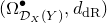 $ (\Omega_{\mathcal{D}_X(Y)}^\bullet, d_{\mathrm{dR}})$
to be
$ (\Omega_{\mathcal{D}_X(Y)}^\bullet, d_{\mathrm{dR}})$
to be
 $$ J^{[i]} \to J^{[i-1]}\Omega_{\mathcal{D}_X(Y)}^1 \to \cdots \to \Omega_{\mathcal{D}_X(Y)}^i \to \Omega_{\mathcal{D}_X(Y)}^{i+1} \to \cdots , $$
where $J^{[m]}$
stands for the mth divided power of J. The restriction map
$J^{[m]}$
stands for the mth divided power of J. The restriction map $(\Omega_{\mathcal{D}_X(Y)}^\bullet, d_{\mathrm{dR}}) \to (\Omega_X^\bullet, d_{\mathrm{dR}})$
extends to a map of filtered complexes
$(\Omega_{\mathcal{D}_X(Y)}^\bullet, d_{\mathrm{dR}}) \to (\Omega_X^\bullet, d_{\mathrm{dR}})$
extends to a map of filtered complexes
 \begin{equation} \textrm{Fil}^\cdot (\Omega_{\mathcal{D}_X(Y)}^\bullet, d_{\mathrm{dR}}) \to (\Omega_X^\bullet, d_{\mathrm{dR}})^{\geqslant \cdot} \end{equation}
and the filtered PD Poincaré lemma of Berthelot [Reference MazurMaz73, p. 61] asserts this is an isomorphism in the filtered derived category. A key observation [Reference MazurMaz73, p. 63] is that, for every i, the chain map $(\Omega_{\mathcal{D}_X(Y)}^\bullet, d_{\mathrm{dR}})\stackrel{\tilde F_Y^*}{\longrightarrow} (\Omega_{\mathcal{D}_X(Y)}^\bullet, d_{\mathrm{dR}})$
restricted to
$(\Omega_{\mathcal{D}_X(Y)}^\bullet, d_{\mathrm{dR}})\stackrel{\tilde F_Y^*}{\longrightarrow} (\Omega_{\mathcal{D}_X(Y)}^\bullet, d_{\mathrm{dR}})$
restricted to $\textrm{Fil}^i (\Omega_{\mathcal{D}_X(Y)}^\bullet, d_{\mathrm{dR}})$
is (uniquely) divisible by
$\textrm{Fil}^i (\Omega_{\mathcal{D}_X(Y)}^\bullet, d_{\mathrm{dR}})$
is (uniquely) divisible by $p^{[i]}$
. Combining this with (4.15), we obtain W(k)-linear maps
$p^{[i]}$
. Combining this with (4.15), we obtain W(k)-linear maps $\varphi_i: F^i R\Gamma_{\mathrm{dR}}(X) \to F_* R\Gamma_{\mathrm{dR}}(X)$
together with homotopies
$\varphi_i: F^i R\Gamma_{\mathrm{dR}}(X) \to F_* R\Gamma_{\mathrm{dR}}(X)$
together with homotopies $p^{[i+1]-[i]}\varphi_{i+1}\simeq \varphi_i v_-$
, where
$p^{[i+1]-[i]}\varphi_{i+1}\simeq \varphi_i v_-$
, where $v_-: F^{i+1} R\Gamma_{\mathrm{dR}}(X) \to F^i R\Gamma_{\mathrm{dR}}(X)$
denotes the usual ‘inclusion’ map. Note that, by construction, the map
$v_-: F^{i+1} R\Gamma_{\mathrm{dR}}(X) \to F^i R\Gamma_{\mathrm{dR}}(X)$
denotes the usual ‘inclusion’ map. Note that, by construction, the map $\varphi_{0}$
is the crystalline Frobenius.
$\varphi_{0}$
is the crystalline Frobenius.
The above construction determines a contravariant functor from the category $\mathcal{C}$
of tuples
$\mathcal{C}$
of tuples $(s: X \hookrightarrow Y, \tilde F_Y)$
to
$(s: X \hookrightarrow Y, \tilde F_Y)$
to $\mathrm{Mod}_{\mathrm{Maz}}(W(k))$
that carries every morphism in
$\mathrm{Mod}_{\mathrm{Maz}}(W(k))$
that carries every morphism in $\mathcal{C}$
, which is an isomorphism on X, to an isomorphism in
$\mathcal{C}$
, which is an isomorphism on X, to an isomorphism in $\mathrm{Mod}_{\mathrm{Maz}}(W(k))$
. A standard argument shows that
$\mathrm{Mod}_{\mathrm{Maz}}(W(k))$
. A standard argument shows that $\mathcal{C}^{\textrm{op}} \to \mathrm{Mod}_{\mathrm{Maz}}(W(k))$
descends uniquely to (4.14) (cf. [Reference Berthelot and OgusBO78, § 8, p. 23]).Footnote
32
$\mathcal{C}^{\textrm{op}} \to \mathrm{Mod}_{\mathrm{Maz}}(W(k))$
descends uniquely to (4.14) (cf. [Reference Berthelot and OgusBO78, § 8, p. 23]).Footnote
32
For the sake of completeness, let us remark that, for every $n<p$
, the maps
$n<p$
, the maps $\varphi_{i}$
, for
$\varphi_{i}$
, for $0\leqslant i \leqslant n$
, can be assembled to a morphism in the derived category of sheaves
$0\leqslant i \leqslant n$
, can be assembled to a morphism in the derived category of sheaves
 $$\frac{\varphi}{p^n}: (p^n\mathcal{O}_X \stackrel{d_{\mathrm{dR}}}{\longrightarrow} p^{n-1} \Omega_X^1 \stackrel{d_{\mathrm{dR}}}{\longrightarrow} \cdots \stackrel{d_{\mathrm{dR}}}{\longrightarrow} \Omega_X^n \stackrel{d_{\mathrm{dR}}}{\longrightarrow} \cdots) \stackrel{}{\longrightarrow} (\Omega_X^\bullet, d_{\mathrm{dR}}),$$
such that $p^n ({\varphi}/{p^n})$
is the crystalline Frobenius precomposed with the embedding of the source into
$p^n ({\varphi}/{p^n})$
is the crystalline Frobenius precomposed with the embedding of the source into $(\Omega_X^\bullet, d_{\mathrm{dR}})$
. In particular, we obtain the morphism (1.1). The above construction of (1.1) is due to Ogus: we refer the reader to [Reference OgusOgu23, Theorem 6.8] for a detailed exposition and a proof of the isomorphism property of (1.1).
$(\Omega_X^\bullet, d_{\mathrm{dR}})$
. In particular, we obtain the morphism (1.1). The above construction of (1.1) is due to Ogus: we refer the reader to [Reference OgusOgu23, Theorem 6.8] for a detailed exposition and a proof of the isomorphism property of (1.1).
We claim that
 \begin{equation} {\bf \widetilde \Phi}_{\mathrm{Maz}} \buildrel{\sim}\over{\longrightarrow} \boldsymbol{\Phi}_{\mathrm{Maz}} \circ \mathcal{H}_{syn}.\end{equation}
In fact, any functor $ \widehat{\mathrm{Sm}}_{W(k)}^{\textrm{op}}\to \mathrm{Mod}_{\mathrm{Maz}}(W(k))$
equipped with an isomorphism between its post-composition with the forgetful functor
$ \widehat{\mathrm{Sm}}_{W(k)}^{\textrm{op}}\to \mathrm{Mod}_{\mathrm{Maz}}(W(k))$
equipped with an isomorphism between its post-composition with the forgetful functor $\mathrm{Mod}_{\mathrm{Maz}}(W(k)) \to \widehat {\mathcal{D}}_{gr}(W(k)[v_-])$
and the Hodge filtered de Rham functor such that
$\mathrm{Mod}_{\mathrm{Maz}}(W(k)) \to \widehat {\mathcal{D}}_{gr}(W(k)[v_-])$
and the Hodge filtered de Rham functor such that $\varphi_0$
is homotopic to the crystalline Frobenius is isomorphic to
$\varphi_0$
is homotopic to the crystalline Frobenius is isomorphic to $\boldsymbol{\Phi}_{\mathrm{Maz}} \circ \mathcal{H}_{syn}$
. To see this, consider the functor
$\boldsymbol{\Phi}_{\mathrm{Maz}} \circ \mathcal{H}_{syn}$
. To see this, consider the functor $F^i: \widehat{\mathrm{Sm}}_{W(k)}^{\textrm{op}} \to \hat{\mathcal{D}}(W(k))$
sending a smooth p-adic formal scheme X to the ith term of the Hodge filtration on
$F^i: \widehat{\mathrm{Sm}}_{W(k)}^{\textrm{op}} \to \hat{\mathcal{D}}(W(k))$
sending a smooth p-adic formal scheme X to the ith term of the Hodge filtration on $\mathrm{R}\Gamma_{\mathrm{dR}}(X)$
. It suffices to show that, for every i, the space
$\mathrm{R}\Gamma_{\mathrm{dR}}(X)$
. It suffices to show that, for every i, the space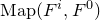 $\textrm{Map}(F^i, F^0)$
of morphisms between the functors is discrete,
$\textrm{Map}(F^i, F^0)$
of morphisms between the functors is discrete, $\pi_0 \textrm{Map}(F^i, F^0)$
is p-torsion-free, and the map
$\pi_0 \textrm{Map}(F^i, F^0)$
is p-torsion-free, and the map $\pi_0 \textrm{Map}(F^i, F^0)\to \pi_0 \textrm{Map}(F^{i+1}, F^0)$
induced by the canonical morphism
$\pi_0 \textrm{Map}(F^i, F^0)\to \pi_0 \textrm{Map}(F^{i+1}, F^0)$
induced by the canonical morphism $v_-: F^{i+1} \to F^i$
is injective. Using that
$v_-: F^{i+1} \to F^i$
is injective. Using that $F^i$
is a sheaf for the Zariski topology, the space
$F^i$
is a sheaf for the Zariski topology, the space $\textrm{Map}(F^i, F^0)$
does not change if
$\textrm{Map}(F^i, F^0)$
does not change if $\widehat{\mathrm{Sm}}_{W(k)}$
is replaced by the subcategory
$\widehat{\mathrm{Sm}}_{W(k)}$
is replaced by the subcategory $\widehat{\mathrm{SmAff}}_{W(k)}$
of smooth affine formal schemes. Let
$\widehat{\mathrm{SmAff}}_{W(k)}$
of smooth affine formal schemes. Let $\textrm{QSyn}_{W(k)}$
be the category of quasi-syntomic affine formal schemes over W(k), and let
$\textrm{QSyn}_{W(k)}$
be the category of quasi-syntomic affine formal schemes over W(k), and let $LF^i: \textrm{QSyn}_{W(k)}^{\textrm{op}} \to \hat{\mathcal{D}}(W(k))$
be the p-complete left Kan extension along the embedding
$LF^i: \textrm{QSyn}_{W(k)}^{\textrm{op}} \to \hat{\mathcal{D}}(W(k))$
be the p-complete left Kan extension along the embedding $\mathrm{SmAlg}_{W(k)}^{\textrm{op}} \hookrightarrow \textrm{QSyn}_{W(k)}^{\textrm{op}}$
. Then by the universal property of the left Kan extension, we have a homotopy equivalence
$\mathrm{SmAlg}_{W(k)}^{\textrm{op}} \hookrightarrow \textrm{QSyn}_{W(k)}^{\textrm{op}}$
. Then by the universal property of the left Kan extension, we have a homotopy equivalence $\textrm{Map}(F^i, F^0)\xrightarrow{\sim} \textrm{Map}(LF^i, LF^0)$
(see [Reference LurieLur09, Proposition 4.3.2.17.]). Our claim follows from the following facts:
$\textrm{Map}(F^i, F^0)\xrightarrow{\sim} \textrm{Map}(LF^i, LF^0)$
(see [Reference LurieLur09, Proposition 4.3.2.17.]). Our claim follows from the following facts: $LF^i$
is a sheaf for the quasi-syntomic topology on
$LF^i$
is a sheaf for the quasi-syntomic topology on $\textrm{QSyn}_{W(k)}$
(see [Reference Bhatt, Morrow and ScholzeBMS19, Theorem 3.1]); the inclusion
$\textrm{QSyn}_{W(k)}$
(see [Reference Bhatt, Morrow and ScholzeBMS19, Theorem 3.1]); the inclusion $\textrm{QRSPerf}_{W(k)} \hookrightarrow \textrm{QSyn}_{W(k)}$
of the category of quasi-regular semi-perfectoid affine formal schemes into the category of all quasi-syntomic affine formal schemes induces an equivalence between the corresponding categories of sheaves [Reference Bhatt, Morrow and ScholzeBMS19, Proposition 4.31]; for any
$\textrm{QRSPerf}_{W(k)} \hookrightarrow \textrm{QSyn}_{W(k)}$
of the category of quasi-regular semi-perfectoid affine formal schemes into the category of all quasi-syntomic affine formal schemes induces an equivalence between the corresponding categories of sheaves [Reference Bhatt, Morrow and ScholzeBMS19, Proposition 4.31]; for any $X \in \textrm{QRSPerf}_{W(k)}$
, the complex
$X \in \textrm{QRSPerf}_{W(k)}$
, the complex $F^i(X)$
is concentrated in degree zero,
$F^i(X)$
is concentrated in degree zero, $H^0(F^i(X))$
is p-torsion-free and the map
$H^0(F^i(X))$
is p-torsion-free and the map $v_-: H^0(F^{i+1}(X)) \to H^0(F^i(X))$
is injective [Reference Antieau, Mathew, Morrow and NikolausAMM+22, Construction 6.6].
$v_-: H^0(F^{i+1}(X)) \to H^0(F^i(X))$
is injective [Reference Antieau, Mathew, Morrow and NikolausAMM+22, Construction 6.6].
Using (4.13), the category $\mathscr{DMF}^{\mathrm{big}}_{[0,p-1]}(W(k))$
is a full subcategory of
$\mathscr{DMF}^{\mathrm{big}}_{[0,p-1]}(W(k))$
is a full subcategory of $\mathrm{Mod}_{\mathrm{Maz}}(W(k))$
. In particular, we derive from (4.16) that the functors
$\mathrm{Mod}_{\mathrm{Maz}}(W(k))$
. In particular, we derive from (4.16) that the functors
 $$\widetilde{\Phi}_{\mathrm{Maz}}, \Phi_{\mathrm{Maz}} \circ \mathcal{H}_{syn}: \widehat{\mathrm{Sm}}^{\le p-1}_{W(k)} \to \mathscr{DMF}^{\mathrm{big}}_{[0,p-1]}(W(k))$$
are isomorphic.
Remark 4.8 (A ‘non-abelian’ refinement of the crystalline Frobenius). Let X be a p-adic formal scheme over W(k). Let $X_k:=X\times_{\operatorname{Spf} W(k)} \operatorname{Spec} k$
be its special fibre. By Theorem 1, we obtain a canonical isomorphism
$X_k:=X\times_{\operatorname{Spf} W(k)} \operatorname{Spec} k$
be its special fibre. By Theorem 1, we obtain a canonical isomorphism
 \begin{equation}X_k^{\mathcal{N}}\times_{k^{\mathcal{N}}}\operatorname{Spf} B/\mathbb{G}_m\simeq X^{\mathcal{N}}\times_{W(k)^{\mathcal{N}}}\operatorname{Spf} B/\mathbb{G}_m\simeq X^{\mathrm{dR},+}\times_{\mathbb{A}^1_-/\mathbb{G}_m}\operatorname{Spf} B/\mathbb{G}_m\end{equation}
of stacks over $\operatorname{Spf} B/\mathbb{G}_m$
. Recall from [Reference BhattBha23, Remark 3.3.4] a canonical morphism of stacks over
$\operatorname{Spf} B/\mathbb{G}_m$
. Recall from [Reference BhattBha23, Remark 3.3.4] a canonical morphism of stacks over $k^{\mathcal{N}}$
:
$k^{\mathcal{N}}$
:
 \begin{equation}X_k^{\mathrm{cris}}\times k^{\mathcal{N}}=X^{\mathrm{dR}}\times k^{\mathcal{N}}\to X_k^{\mathcal{N}},\end{equation}
which is an isomorphism over the open substack  given by $v_+\neq 0$
. Likewise, we have a map of stacks over
$v_+\neq 0$
. Likewise, we have a map of stacks over $\mathbb{A}^1_-/\mathbb{G}_m$
 \begin{equation}X^{\mathrm{dR},+}\to X^{\mathrm{dR}}\times \mathbb{A}^1_-/\mathbb{G}_m,\end{equation}
which is an isomorphism for $v_-\neq 0$
. The map can be constructed by restricting the structure map
$v_-\neq 0$
. The map can be constructed by restricting the structure map $X^{\mathcal{N}} \to X^{{\mathbb{\Delta}}} \times W(k)^\mathcal{N}$
(see [Reference BhattBha23, Definition 5.3.10 (3)]) to
$X^{\mathcal{N}} \to X^{{\mathbb{\Delta}}} \times W(k)^\mathcal{N}$
(see [Reference BhattBha23, Definition 5.3.10 (3)]) to $\mathbb{A}^1_{-}/\mathbb{G}_m \stackrel{\mathfrak{p}_{\bar{\mathrm{dR}}}}{\longrightarrow} W(k)^\mathcal{N}$
. Composing (4.17) with (4.18), we obtain
$\mathbb{A}^1_{-}/\mathbb{G}_m \stackrel{\mathfrak{p}_{\bar{\mathrm{dR}}}}{\longrightarrow} W(k)^\mathcal{N}$
. Composing (4.17) with (4.18), we obtain
 \begin{equation}F_{\mathrm{ref}}: X^{\mathrm{dR}}\times\operatorname{Spf} B/\mathbb{G}_m\to X^{\mathrm{dR},+}\times_{\mathbb{A}^1_-/\mathbb{G}_m}\operatorname{Spf} B/\mathbb{G}_m,\end{equation}
whose postcomposition with the map (4.19), pulled back to $\operatorname{Spf} B/\mathbb{G}_m$
, is the crystalline Frobenius.
$\operatorname{Spf} B/\mathbb{G}_m$
, is the crystalline Frobenius.
Remark 4.9 (The category of Fontaine–Laffaille modules over a scheme). Let X be a smooth p-adic formal scheme over W(k). We shall explain how the refined Frobenius morphism $F_{\mathrm{ref}}$
in (4.20) can be used to define a certain stable
$F_{\mathrm{ref}}$
in (4.20) can be used to define a certain stable $\infty$
-category
$\infty$
-category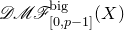 $\mathscr{DMF}^{\mathrm{big}}_{[0,p-1]}(X)$
. By definition, an object of
$\mathscr{DMF}^{\mathrm{big}}_{[0,p-1]}(X)$
. By definition, an object of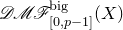 $\mathscr{DMF}^{\mathrm{big}}_{[0,p-1]}(X)$
is a pair
$\mathscr{DMF}^{\mathrm{big}}_{[0,p-1]}(X)$
is a pair $(\mathcal{M},\varphi)$
, where
$(\mathcal{M},\varphi)$
, where $\mathcal{M}\in\mathcal{D}_{qc,[0,p-1]}(X^{\mathrm{dR},+})$
and
$\mathcal{M}\in\mathcal{D}_{qc,[0,p-1]}(X^{\mathrm{dR},+})$
and $\varphi:(F_{\mathrm{ref}}^*c^*\mathcal{M}_{})^{p-1}\xrightarrow{\sim}\mathcal{M}_{v_-=1}$
is an isomorphism in
$\varphi:(F_{\mathrm{ref}}^*c^*\mathcal{M}_{})^{p-1}\xrightarrow{\sim}\mathcal{M}_{v_-=1}$
is an isomorphism in $\mathcal{D}_{qc}(X^{\mathrm{dR}})$
. Here
$\mathcal{D}_{qc}(X^{\mathrm{dR}})$
. Here $c: X^{\mathrm{dR},+}\times_{\mathbb{A}^1_-/\mathbb{G}_m}\operatorname{Spf} B/\mathbb{G}_m\to X^{\mathrm{dR},+}$
is the projection to the first component, and
$c: X^{\mathrm{dR},+}\times_{\mathbb{A}^1_-/\mathbb{G}_m}\operatorname{Spf} B/\mathbb{G}_m\to X^{\mathrm{dR},+}$
is the projection to the first component, and $F_{\mathrm{ref}}^*$
is the pullback along (4.20). The superscript
$F_{\mathrm{ref}}^*$
is the pullback along (4.20). The superscript $(\cdot)^i:\mathcal{M}\mapsto \mathcal{M}^i$
refers to the functor
$(\cdot)^i:\mathcal{M}\mapsto \mathcal{M}^i$
refers to the functor $\mathcal{D}_{qc}(X^{\mathrm{dR}}\times \operatorname{Spf} B/\mathbb{G}_m)\to \mathcal{D}_{qc}(X^{\mathrm{dR}})$
given by
$\mathcal{D}_{qc}(X^{\mathrm{dR}}\times \operatorname{Spf} B/\mathbb{G}_m)\to \mathcal{D}_{qc}(X^{\mathrm{dR}})$
given by $\mathcal{M}\mapsto \mathrm{pr}_{X^{\mathrm{dR}}*}(\mathcal{M}\otimes\mathcal{O}(i))$
, where
$\mathcal{M}\mapsto \mathrm{pr}_{X^{\mathrm{dR}}*}(\mathcal{M}\otimes\mathcal{O}(i))$
, where $\mathrm{pr}_{X^{\mathrm{dR}}}: X^{\mathrm{dR}}\times \operatorname{Spf} B/\mathbb{G}_m\to X^{\mathrm{dR}}$
.
$\mathrm{pr}_{X^{\mathrm{dR}}}: X^{\mathrm{dR}}\times \operatorname{Spf} B/\mathbb{G}_m\to X^{\mathrm{dR}}$
.
5 The equivalence
$\mathcal{D}_{qc,[0,p-2]}(W(k)^{syn}) \to \mathscr{DMF}^{\mathrm{big}}_{[0,p-2]}(W(k))$

5.1 The main result
Theorem 3. The functor (4.4) induces an equivalence of categories
 \begin{equation} \Phi_{\mathrm{Maz}}\colon \mathcal{D}_{qc,[0,p-2]}(W(k)^{syn}) \xrightarrow{\sim} \mathscr{DMF}^{\mathrm{big}}_{[0,p-2]}(W(k)). \end{equation}
Moreover, it restricts to an equivalence on perfect complexes
 \begin{equation} \operatorname{Perf}_{[0,p-2]}(W(k)^{syn}) \xrightarrow{\sim} \mathcal{D}^b(\mathscr{MF}_{[0,p-2]}(W(k))) \end{equation}
that identifies the subcategoriesFootnote
33 $\operatorname{Coh}_{[0,p-2]}(W(k)^{syn})\xrightarrow{\sim}\mathscr{MF}_{[0,p-2]}(W(k))$
.
$\operatorname{Coh}_{[0,p-2]}(W(k)^{syn})\xrightarrow{\sim}\mathscr{MF}_{[0,p-2]}(W(k))$
.
We now give the outline for the proof of Theorem 3.
Step 1. We reduce (5.1) to proving the equivalence
 \begin{equation} \Phi_{\mathrm{Maz}} \otimes \mathbb{F}_p:\mathcal{D}_{qc,[0,p-2]}(W(k)^{syn})\otimes\mathbb{F}_p \xrightarrow{\sim}\mathscr{DMF}^{\mathrm{big}}_{[0,p-2]}(W(k))\otimes\mathbb{F}_p. \end{equation}
We say that $\mathcal{F}\in\mathcal{D}_{qc}(W(k)^{syn}\otimes\mathbb{F}_p)$
has weights in [a,b] if and only if the pullbacks of
$\mathcal{F}\in\mathcal{D}_{qc}(W(k)^{syn}\otimes\mathbb{F}_p)$
has weights in [a,b] if and only if the pullbacks of $\mathcal{F}$
along both composites
$\mathcal{F}$
along both composites $\operatorname{Spec} k[v_{\pm}]/\mathbb{G}_{m,k}\to k^{\mathcal{N}}\otimes\mathbb{F}_p\to W(k)^{syn}\otimes\mathbb{F}_p$
lie in
$\operatorname{Spec} k[v_{\pm}]/\mathbb{G}_{m,k}\to k^{\mathcal{N}}\otimes\mathbb{F}_p\to W(k)^{syn}\otimes\mathbb{F}_p$
lie in $\mathcal{D}_{qc,[a,b]}((\mathbb{A}^1_{\pm}/\mathbb{G}_m)\otimes \mathbb{F}_p)$
in the sense of Definition 2.1.
$\mathcal{D}_{qc,[a,b]}((\mathbb{A}^1_{\pm}/\mathbb{G}_m)\otimes \mathbb{F}_p)$
in the sense of Definition 2.1.
We show that the restriction along $W(k)^{syn}\otimes\mathbb{F}_p\to W(k)^{syn}$
induces an equivalence
$W(k)^{syn}\otimes\mathbb{F}_p\to W(k)^{syn}$
induces an equivalence
 \begin{equation}\mathcal{D}_{qc,[0,p-2]}(W(k)^{syn})\otimes\mathbb{F}_p\simeq \mathcal{D}_{qc,[0,p-2]}(W(k)^{syn}\otimes\mathbb{F}_p).\end{equation}
Step 2. Let $W(k)^{syn}_{red}$
be the reduced locus of
$W(k)^{syn}_{red}$
be the reduced locus of $W(k)^{syn}\otimes\mathbb{F}_p$
. Let
$W(k)^{syn}\otimes\mathbb{F}_p$
. Let $\mathcal{D}_{qc,[a,b]}(W(k)^{syn}_{red})$
be the full subcategory of
$\mathcal{D}_{qc,[a,b]}(W(k)^{syn}_{red})$
be the full subcategory of $\mathcal{D}_{qc}(W(k)^{syn}_{red})$
consisting of objects with Hodge–Tate weights in [a,b] defined via the restriction along
$\mathcal{D}_{qc}(W(k)^{syn}_{red})$
consisting of objects with Hodge–Tate weights in [a,b] defined via the restriction along  as in Step 1. We show in Proposition 5.6 that the restriction functor
 \begin{equation}r_{[0,p-2]}:\mathcal{D}_{qc,[0,p-2]}(W(k)^{syn}\otimes\mathbb{F}_p)\to\mathcal{D}_{qc,[0,p-2]}(W(k)^{syn}_{red})\end{equation}
is an equivalence of categories.
Step 3. Use the description of $W(k)^{syn}_{red}$
from [Reference DrinfeldDri24, § 7] to complete the proof.
$W(k)^{syn}_{red}$
from [Reference DrinfeldDri24, § 7] to complete the proof.
Remark 5.1. We show in Step 3 that the functor $ \Phi_{\mathrm{Maz}}\otimes\mathbb{F}_p$
factors through the following reduced locus.
$ \Phi_{\mathrm{Maz}}\otimes\mathbb{F}_p$
factors through the following reduced locus.

Moreover, we construct an equivalence
 \begin{equation} \Phi_{\mathrm{DI}}: \mathcal{D}_{qc,[0,p-1]}(W(k)^{syn}_{red})\simeq\mathscr{D}\mathscr{MF}^{\mathrm{big}}_{[0,p-1]}(W(k))\otimes\mathbb{F}_p. \end{equation}
Thus, via (5.6), $ \Phi^{\mathrm{Maz}}_{red}$
can be viewed as an endo-functor on
$ \Phi^{\mathrm{Maz}}_{red}$
can be viewed as an endo-functor on $\mathscr{DMF}^{\mathrm{big}}_{[0,p-1]}(W(k))\otimes\mathbb{F}_p$
. We show that
$\mathscr{DMF}^{\mathrm{big}}_{[0,p-1]}(W(k))\otimes\mathbb{F}_p$
. We show that $\Phi^{\mathrm{Maz}}_{red}$
is not an equivalence of categories, but becomes an equivalence when restricted to
$\Phi^{\mathrm{Maz}}_{red}$
is not an equivalence of categories, but becomes an equivalence when restricted to $\mathscr{DMF}^{\mathrm{big}}_{[0,p-2]}(W(k))\otimes\mathbb{F}_p$
.
$\mathscr{DMF}^{\mathrm{big}}_{[0,p-2]}(W(k))\otimes\mathbb{F}_p$
.
5.2 Proof of the main theorem
We now prove Theorem 3.
Step 1. For a $\mathbb{Z}$
-linear presentable stable
$\mathbb{Z}$
-linear presentable stable $\infty$
-category
$\infty$
-category $\mathcal{C}$
and a commutative ring A, we denote by
$\mathcal{C}$
and a commutative ring A, we denote by $\mathcal{C} \otimes A$
the category
$\mathcal{C} \otimes A$
the category $\mathcal{C} \otimes_{\mathcal{D}(\mathbb{Z})} \mathcal{D}(A)$
defined via Lurie’s tensor product in
$\mathcal{C} \otimes_{\mathcal{D}(\mathbb{Z})} \mathcal{D}(A)$
defined via Lurie’s tensor product in $\Pr^L_{st}$
; see [Reference LurieLur17, 4.8]. Informally, an object of
$\Pr^L_{st}$
; see [Reference LurieLur17, 4.8]. Informally, an object of $\mathcal{C} \otimes_{\mathcal{D}(\mathbb{Z})} \mathcal{D}(A)$
is merely an A-module in
$\mathcal{C} \otimes_{\mathcal{D}(\mathbb{Z})} \mathcal{D}(A)$
is merely an A-module in $\mathcal{C}$
. We say that such
$\mathcal{C}$
. We say that such $\mathcal{C}$
is p-complete if the natural functor
$\mathcal{C}$
is p-complete if the natural functor $\mathcal{C} \to \lim \mathcal{C} \otimes \mathbb{Z}/p^n$
is an equivalence.
$\mathcal{C} \to \lim \mathcal{C} \otimes \mathbb{Z}/p^n$
is an equivalence.
Lemma 5.2. Let $f:\mathcal{C}_1 \rightarrow \mathcal{C}_2$
be a map between stable
$f:\mathcal{C}_1 \rightarrow \mathcal{C}_2$
be a map between stable $\mathbb{Z}$
-linear presentable p-complete
$\mathbb{Z}$
-linear presentable p-complete $\infty$
-categories. If the induced functor
$\infty$
-categories. If the induced functor $f\otimes\mathbb{F}_p:\mathcal{C}_1\otimes \mathbb{F}_p \to \mathcal{C}_2\otimes\mathbb{F}_p$
is an equivalence, then f is an equivalence.
$f\otimes\mathbb{F}_p:\mathcal{C}_1\otimes \mathbb{F}_p \to \mathcal{C}_2\otimes\mathbb{F}_p$
is an equivalence, then f is an equivalence.
Proof. Observe that, for any $X,Y\in \mathcal{C}_1$
, we have
$X,Y\in \mathcal{C}_1$
, we have
 \begin{equation} \operatorname{Hom}_{\mathcal{C}_1\otimes \mathbb{Z}/p^n} (X\otimes \mathbb{Z}/p^n, Y\otimes \mathbb{Z}/p^n)\buildrel{\sim}\over{\longrightarrow} \operatorname{Hom}_{\mathcal{C}_1} (X, Y\otimes \mathbb{Z}/p^n) \buildrel{\sim}\over{\longrightarrow} \operatorname{Hom}_{\mathcal{C}_1} (X, Y)\otimes \mathbb{Z}/p^n.\end{equation}
Indeed, each mapping spectrum in (5.7) is naturally identified with the cone of $\operatorname{Hom}_{\mathcal{C}_1} (X, Y)\stackrel{p^n}{\longrightarrow}\operatorname{Hom}_{\mathcal{C}_1} (X, Y)$
. In particular,
$\operatorname{Hom}_{\mathcal{C}_1} (X, Y)\stackrel{p^n}{\longrightarrow}\operatorname{Hom}_{\mathcal{C}_1} (X, Y)$
. In particular, $ \operatorname{Hom}_{\mathcal{C}_1} (X, Y) \buildrel{\sim}\over{\longrightarrow} \lim \operatorname{Hom}_{\mathcal{C}_1} (X, Y) \otimes \mathbb{Z}/p^n$
, i.e.
$ \operatorname{Hom}_{\mathcal{C}_1} (X, Y) \buildrel{\sim}\over{\longrightarrow} \lim \operatorname{Hom}_{\mathcal{C}_1} (X, Y) \otimes \mathbb{Z}/p^n$
, i.e. $\operatorname{Hom}_{\mathcal{C}_1} (X, Y)$
is p-complete. The same applies to
$\operatorname{Hom}_{\mathcal{C}_1} (X, Y)$
is p-complete. The same applies to $\operatorname{Hom}_{\mathcal{C}_2} (X', Y')$
, for
$\operatorname{Hom}_{\mathcal{C}_2} (X', Y')$
, for $X', Y' \in \mathcal{C}_2$
.
$X', Y' \in \mathcal{C}_2$
.
Let us check that f is fully faithful, i.e. the map $\operatorname{Hom}_{\mathcal{C}_1} (X, Y) \to \operatorname{Hom}_{\mathcal{C}_2} (f(X), f(Y))$
is an equivalence. By p-completeness, it suffices to check that
$\operatorname{Hom}_{\mathcal{C}_1} (X, Y) \to \operatorname{Hom}_{\mathcal{C}_2} (f(X), f(Y))$
is an equivalence. By p-completeness, it suffices to check that $\operatorname{Hom}_{\mathcal{C}_1} (X, Y)\otimes \mathbb{F}_p \to \operatorname{Hom}_{\mathcal{C}_2} (f(X), f(Y))\otimes \mathbb{F}_p$
is an equivalence. Using (5.7), this is equivalent to showing that
$\operatorname{Hom}_{\mathcal{C}_1} (X, Y)\otimes \mathbb{F}_p \to \operatorname{Hom}_{\mathcal{C}_2} (f(X), f(Y))\otimes \mathbb{F}_p$
is an equivalence. Using (5.7), this is equivalent to showing that $ \operatorname{Hom}_{\mathcal{C}_1\otimes \mathbb{F}_p} (X\otimes \mathbb{F}_p, Y\otimes \mathbb{F}_p) \buildrel{\sim}\over{\longrightarrow} \operatorname{Hom}_{\mathcal{C}_2\otimes \mathbb{F}_p} (f(X)\otimes \mathbb{F}_p, f(Y)\otimes \mathbb{F}_p)$
. Consequently, it suffices to show that, for any X in
$ \operatorname{Hom}_{\mathcal{C}_1\otimes \mathbb{F}_p} (X\otimes \mathbb{F}_p, Y\otimes \mathbb{F}_p) \buildrel{\sim}\over{\longrightarrow} \operatorname{Hom}_{\mathcal{C}_2\otimes \mathbb{F}_p} (f(X)\otimes \mathbb{F}_p, f(Y)\otimes \mathbb{F}_p)$
. Consequently, it suffices to show that, for any X in $\mathcal{C}_1$
the natural map
$\mathcal{C}_1$
the natural map $f(X) \otimes \mathbb{F}_p \to f_1(X \otimes \mathbb{F}_p)$
, where
$f(X) \otimes \mathbb{F}_p \to f_1(X \otimes \mathbb{F}_p)$
, where $f_n: =f\otimes\mathbb{Z}/p^n: \mathcal{C}_1 \otimes \mathbb{Z}/p^n \to \mathcal{C}_2\otimes\mathbb{Z}/p^n $
, is an equivalence in
$f_n: =f\otimes\mathbb{Z}/p^n: \mathcal{C}_1 \otimes \mathbb{Z}/p^n \to \mathcal{C}_2\otimes\mathbb{Z}/p^n $
, is an equivalence in $\mathcal{C}_2 \otimes \mathbb{F}_p$
. To this end, observe that the functor
$\mathcal{C}_2 \otimes \mathbb{F}_p$
. To this end, observe that the functor $\mathcal{C}_2 \otimes \mathbb{F}_p \to \mathcal{C}_2$
is conservative. Indeed,
$\mathcal{C}_2 \otimes \mathbb{F}_p \to \mathcal{C}_2$
is conservative. Indeed, $\mathcal{C}_2 \otimes \mathbb{F}_p$
is identified with the category
$\mathcal{C}_2 \otimes \mathbb{F}_p$
is identified with the category $\textrm{Fun}_{\textrm{Mod}_{\mathbb{Z}}(\Pr^L_{st})}(\mathcal{D}(\mathbb{F}_p), \mathcal{C}_2) \in \Pr^L_{st}$
of colimit-preserving
$\textrm{Fun}_{\textrm{Mod}_{\mathbb{Z}}(\Pr^L_{st})}(\mathcal{D}(\mathbb{F}_p), \mathcal{C}_2) \in \Pr^L_{st}$
of colimit-preserving $\mathbb{Z}$
-linear functors. This equivalence carries the functor
$\mathbb{Z}$
-linear functors. This equivalence carries the functor $\mathcal{C}_2 \otimes \mathbb{F}_p \to \mathcal{C}_2$
to the evaluation-at-
$\mathcal{C}_2 \otimes \mathbb{F}_p \to \mathcal{C}_2$
to the evaluation-at- $\mathbb{F}_p$
functor
$\mathbb{F}_p$
functor $\textrm{Fun}_{\textrm{Mod}_{\mathbb{Z}}(\Pr^L_{st})}(\mathcal{D}(\mathbb{F}_p), \mathcal{C}_2)\to \mathcal{C}_2$
. It remains to observe that
$\textrm{Fun}_{\textrm{Mod}_{\mathbb{Z}}(\Pr^L_{st})}(\mathcal{D}(\mathbb{F}_p), \mathcal{C}_2)\to \mathcal{C}_2$
. It remains to observe that $\mathcal{D}(\mathbb{F}_p)$
is generated by
$\mathcal{D}(\mathbb{F}_p)$
is generated by $\mathbb{F}_p$
under colimits and finite limits. By conservativity, it is enough to show that
$\mathbb{F}_p$
under colimits and finite limits. By conservativity, it is enough to show that $f(X) \otimes \mathbb{F}_p \to f_1(X \otimes \mathbb{F}_p)$
is an isomorphism in
$f(X) \otimes \mathbb{F}_p \to f_1(X \otimes \mathbb{F}_p)$
is an isomorphism in $\mathcal{C}_2$
. But this is clear: each side is naturally identified with the cone of
$\mathcal{C}_2$
. But this is clear: each side is naturally identified with the cone of $f(X)\stackrel{p}{\longrightarrow} f(X)$
.
$f(X)\stackrel{p}{\longrightarrow} f(X)$
.
We claim that $f_n$
is fully faithful, for every n: representing
$f_n$
is fully faithful, for every n: representing $\mathcal{C}_i \otimes \mathbb{Z}/p^n$
as the inner
$\mathcal{C}_i \otimes \mathbb{Z}/p^n$
as the inner $\operatorname{Hom}$
from
$\operatorname{Hom}$
from $\mathcal{D}(\mathbb{Z}/p^n)$
to
$\mathcal{D}(\mathbb{Z}/p^n)$
to $\mathcal{C}_i$
, the claim follows from a general fact that a fully faithful f induces a fully faithful functor on inner
$\mathcal{C}_i$
, the claim follows from a general fact that a fully faithful f induces a fully faithful functor on inner $\operatorname{Hom}$
; see [Reference LurieLur18a, TAG 04Q6].
$\operatorname{Hom}$
; see [Reference LurieLur18a, TAG 04Q6].
It remains to check that $f_n$
is essentially surjective. We check it by induction on n. For any
$f_n$
is essentially surjective. We check it by induction on n. For any $Z\in \mathcal{C}_2 \otimes \mathbb{Z}/p^n$
, we have a fibre sequence
$Z\in \mathcal{C}_2 \otimes \mathbb{Z}/p^n$
, we have a fibre sequence $Z \otimes_{\mathbb{Z}/p^n} \mathbb{Z}/p^{n-1} \to Z \to Z \otimes_{\mathbb{Z}/p^n} \mathbb{F}_p$
. By the induction assumption, the boundary terms are in the essential image. Since
$Z \otimes_{\mathbb{Z}/p^n} \mathbb{Z}/p^{n-1} \to Z \to Z \otimes_{\mathbb{Z}/p^n} \mathbb{F}_p$
. By the induction assumption, the boundary terms are in the essential image. Since $f_n$
is fully faithful, it follows that Z is in the essential image.
$f_n$
is fully faithful, it follows that Z is in the essential image.
In particular, the lemma reduces the proving equivalence (5.1) to proving equivalence (5.3).
Proposition 5.3.
The restriction along $W(k)^{syn}\otimes\mathbb{F}_p\to W(k)^{syn}$
induces an equivalence
$W(k)^{syn}\otimes\mathbb{F}_p\to W(k)^{syn}$
induces an equivalence $\mathcal{D}_{qc} (W(k)^{syn} \otimes \mathbb{F}_p) \simeq \mathcal{D}_{qc} (W(k)^{syn}) \otimes \mathbb{F}_p$
, where the right-hand side stands for the category of
$\mathcal{D}_{qc} (W(k)^{syn} \otimes \mathbb{F}_p) \simeq \mathcal{D}_{qc} (W(k)^{syn}) \otimes \mathbb{F}_p$
, where the right-hand side stands for the category of $\mathbb{F}_p$
-linear objects in
$\mathbb{F}_p$
-linear objects in $\mathcal{D}_{qc}(W(k)^{syn})$
. Moreover, this equivalence respects Hodge–Tate weights. Thus, it induces
$\mathcal{D}_{qc}(W(k)^{syn})$
. Moreover, this equivalence respects Hodge–Tate weights. Thus, it induces $\mathcal{D}_{qc, [0, p-2]} (W(k)^{syn} \otimes \mathbb{F}_p) \simeq \mathcal{D}_{qc, [0, p-2]} (W(k)^{syn}) \otimes \mathbb{F}_p$
.
$\mathcal{D}_{qc, [0, p-2]} (W(k)^{syn} \otimes \mathbb{F}_p) \simeq \mathcal{D}_{qc, [0, p-2]} (W(k)^{syn}) \otimes \mathbb{F}_p$
.
The proof of this proposition is given at the end of Step 1. We start with some preliminary results.
Lemma 5.4. Let A be a ring, $(p, f_1, \ldots, f_n)$
is a regular sequence in A,
$(p, f_1, \ldots, f_n)$
is a regular sequence in A, $I\subset A$
the ideal generated by this sequence, and let
$I\subset A$
the ideal generated by this sequence, and let $\bar{I}\subset A/p$
be its image. Assume that A is I-complete. Denote by
$\bar{I}\subset A/p$
be its image. Assume that A is I-complete. Denote by $\operatorname{Spf} A$
(respectively,
$\operatorname{Spf} A$
(respectively, $\operatorname{Spf} A/p$
) the I-adic (respectively,
$\operatorname{Spf} A/p$
) the I-adic (respectively, $\bar{I}$
-adic) formal scheme. Then the restriction along
$\bar{I}$
-adic) formal scheme. Then the restriction along $i: \operatorname{Spf}(A) \otimes \mathbb{F}_p \to \operatorname{Spf}(A)$
induces
$i: \operatorname{Spf}(A) \otimes \mathbb{F}_p \to \operatorname{Spf}(A)$
induces $\mathcal{D}_{qc}(\operatorname{Spf}(A)) \otimes \mathbb{F}_p \simeq \mathcal{D}_{qc}(\operatorname{Spf}(A/p))$
.
$\mathcal{D}_{qc}(\operatorname{Spf}(A)) \otimes \mathbb{F}_p \simeq \mathcal{D}_{qc}(\operatorname{Spf}(A/p))$
.
Proof. Identify $\mathcal{D}_{qc}(\operatorname{Spf}(A))$
with
$\mathcal{D}_{qc}(\operatorname{Spf}(A))$
with $\mathcal{D}_{I-comp}(A) \subset \mathcal{D}(A)$
and
$\mathcal{D}_{I-comp}(A) \subset \mathcal{D}(A)$
and $\mathcal{D}_{qc}(\operatorname{Spf}(A/p))$
with
$\mathcal{D}_{qc}(\operatorname{Spf}(A/p))$
with $\mathcal{D}_{\bar{I}-comp}(A/p) \subset \mathcal{D}(A/p)$
. Under this equivalence, the functor
$\mathcal{D}_{\bar{I}-comp}(A/p) \subset \mathcal{D}(A/p)$
. Under this equivalence, the functor $\Phi: \mathcal{D}_{qc}(\operatorname{Spf}(A)) \otimes \mathbb{F}_p \to \mathcal{D}_{qc}(\operatorname{Spf}(A/p))$
is compatible with the functor
$\Phi: \mathcal{D}_{qc}(\operatorname{Spf}(A)) \otimes \mathbb{F}_p \to \mathcal{D}_{qc}(\operatorname{Spf}(A/p))$
is compatible with the functor $\mathcal{D}(A) \otimes \mathbb{F}_p \to \mathcal{D}(A/p)$
induced by
$\mathcal{D}(A) \otimes \mathbb{F}_p \to \mathcal{D}(A/p)$
induced by $\operatorname{Spec}(A/p) \to \operatorname{Spec}(A),$
which is an equivalence by [Reference LurieLur17, Theorems 4.8.5.11 and 4.8.5.16]. Since
$\operatorname{Spec}(A/p) \to \operatorname{Spec}(A),$
which is an equivalence by [Reference LurieLur17, Theorems 4.8.5.11 and 4.8.5.16]. Since $- \otimes \mathcal{D}(\mathbb{F}_p) \simeq \textrm{Fun}_{\textrm{Mod}_{\mathbb{Z}}(\Pr^L_{st})}(\mathcal{D}(\mathbb{F}_p), -)$
as functors, and the latter preserves fully faithful embeddings, we see that
$- \otimes \mathcal{D}(\mathbb{F}_p) \simeq \textrm{Fun}_{\textrm{Mod}_{\mathbb{Z}}(\Pr^L_{st})}(\mathcal{D}(\mathbb{F}_p), -)$
as functors, and the latter preserves fully faithful embeddings, we see that $\Phi$
is fully faithful. Let us show that it is essentially surjective. Observe that
$\Phi$
is fully faithful. Let us show that it is essentially surjective. Observe that $A/p$
is in the image since
$A/p$
is in the image since $\Phi(A)=A/p$
. Thus, it suffices to check that
$\Phi(A)=A/p$
. Thus, it suffices to check that $A/p$
generates
$A/p$
generates $\mathcal{D}_{\bar{I}-comp}(A/p)$
. Note that the
$\mathcal{D}_{\bar{I}-comp}(A/p)$
. Note that the $\bar{I}$
-completion functor
$\bar{I}$
-completion functor $\mathcal{D}(A/p) \to \mathcal{D}_{\bar{I}-comp}(A/p)$
is essentially surjective and it commutes with colimits since it is left adjoint to the embedding. Since
$\mathcal{D}(A/p) \to \mathcal{D}_{\bar{I}-comp}(A/p)$
is essentially surjective and it commutes with colimits since it is left adjoint to the embedding. Since $A/p$
generates
$A/p$
generates $\mathcal{D}(A/p)$
, the claim follows.
$\mathcal{D}(A/p)$
, the claim follows.
Lemma 5.5. Let ${\mathfrak X}$
be a stack which admits a faithfully flat cover by an affine formal scheme
${\mathfrak X}$
be a stack which admits a faithfully flat cover by an affine formal scheme $\operatorname{Spf}(A)$
. Denote by
$\operatorname{Spf}(A)$
. Denote by $\operatorname{Spf}(A)^{\bullet/{\mathfrak X}}$
the Cech nerve of
$\operatorname{Spf}(A)^{\bullet/{\mathfrak X}}$
the Cech nerve of $\operatorname{Spf}(A) \to {\mathfrak X}$
and assume that
$\operatorname{Spf}(A) \to {\mathfrak X}$
and assume that $\operatorname{Spf}(A)^{\bullet/{\mathfrak X}}$
is represented by an
$\operatorname{Spf}(A)^{\bullet/{\mathfrak X}}$
is represented by an $I^\bullet$
-adic affine simplicial formal scheme
$I^\bullet$
-adic affine simplicial formal scheme $\operatorname{Spf}(A^{\bullet})$
with each
$\operatorname{Spf}(A^{\bullet})$
with each $I^\bullet \subset A^\bullet$
satisfying the assumption of Lemma 5.4. Then the natural map
$I^\bullet \subset A^\bullet$
satisfying the assumption of Lemma 5.4. Then the natural map $\mathcal{D}_{qc} ({\mathfrak X}) \otimes \mathbb{F}_p \to \mathcal{D}_{qc}({\mathfrak X} \otimes \mathbb{F}_p)$
is an equivalence.
$\mathcal{D}_{qc} ({\mathfrak X}) \otimes \mathbb{F}_p \to \mathcal{D}_{qc}({\mathfrak X} \otimes \mathbb{F}_p)$
is an equivalence.
Proof. The assumption implies that the functor $\mathcal{D}_{qc} ({\mathfrak X}) \to \lim \mathcal{D}_{qc} (\operatorname{Spf}(A^{\bullet}))$
is an equivalence. The natural map
$\mathcal{D}_{qc} ({\mathfrak X}) \to \lim \mathcal{D}_{qc} (\operatorname{Spf}(A^{\bullet}))$
is an equivalence. The natural map $\mathcal{X} \otimes \mathbb{F}_p \to \mathcal{X} \otimes^L \mathbb{F}_p$
is an isomorphism since A is flat over
$\mathcal{X} \otimes \mathbb{F}_p \to \mathcal{X} \otimes^L \mathbb{F}_p$
is an isomorphism since A is flat over $\mathbb{Z}_p$
and flatness is fpqc-local. Thus, by the base change stability of Cech nerves we get the following diagram.
$\mathbb{Z}_p$
and flatness is fpqc-local. Thus, by the base change stability of Cech nerves we get the following diagram.

Note that horizontal maps are equivalences by descent. The right vertical map is an equivalence by combining Lemma 5.4 with (self-)dualizability of $\mathcal{D}(\mathbb{F}_p)$
in
$\mathcal{D}(\mathbb{F}_p)$
in $\Pr^L_{st}$
(the latter implies that, for any diagram
$\Pr^L_{st}$
(the latter implies that, for any diagram $\mathcal{C}_i$
in
$\mathcal{C}_i$
in $\Pr^L_{st}$
, the natural map
$\Pr^L_{st}$
, the natural map $(\lim \mathcal{C}_i) \otimes \mathbb{F}_p \to \lim \mathcal{C}_i \otimes \mathbb{F}_p$
is an equivalence since, for every
$(\lim \mathcal{C}_i) \otimes \mathbb{F}_p \to \lim \mathcal{C}_i \otimes \mathbb{F}_p$
is an equivalence since, for every $\mathcal{C} \in \Pr^L_{st}$
, we have
$\mathcal{C} \in \Pr^L_{st}$
, we have $\mathcal{C} \otimes \mathbb{F}_p \buildrel{\sim}\over{\longrightarrow} \textrm{Fun}(\mathcal{D}(\mathbb{F}_p), \mathcal{C})$
). Thus, all maps in the diagram are equivalences.
$\mathcal{C} \otimes \mathbb{F}_p \buildrel{\sim}\over{\longrightarrow} \textrm{Fun}(\mathcal{D}(\mathbb{F}_p), \mathcal{C})$
). Thus, all maps in the diagram are equivalences.
Proof of Proposition 5.3. Denote by C the p-adic completion of an algebraic closure of $\operatorname{Frac} W(k)$
and by
$\operatorname{Frac} W(k)$
and by $\mathcal{O}_C\subset C$
the subring of integral elements. Then
$\mathcal{O}_C\subset C$
the subring of integral elements. Then $W(k) \to \mathcal{O}_C$
induces a faithfully flat cover
$W(k) \to \mathcal{O}_C$
induces a faithfully flat cover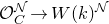 $\mathcal{O}_C^{\mathcal{N}} \to W(k)^{\mathcal{N}}$
by [Reference BhattBha23, Remark 6.6.12]. If
$\mathcal{O}_C^{\mathcal{N}} \to W(k)^{\mathcal{N}}$
by [Reference BhattBha23, Remark 6.6.12]. If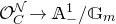 $\mathcal{O}_C^{\mathcal{N}} \to \mathbb{A}^1_-/\mathbb{G}_m$
is the Rees map, then
$\mathcal{O}_C^{\mathcal{N}} \to \mathbb{A}^1_-/\mathbb{G}_m$
is the Rees map, then $\mathcal{O}_C^{\mathcal{N}} \times_{\mathbb{A}^1_-/\mathbb{G}_m} \mathbb{A}^1_-$
is a formal affine scheme
$\mathcal{O}_C^{\mathcal{N}} \times_{\mathbb{A}^1_-/\mathbb{G}_m} \mathbb{A}^1_-$
is a formal affine scheme $\operatorname{Spf} A$
such that the Cech nerve
$\operatorname{Spf} A$
such that the Cech nerve $\operatorname{Spf}(A)^{\bullet/W(k)^{\mathcal{N}} }$
satisfies the assumption of Lemma 5.5; see [Reference BhattBha23, Corollary 5.5.11]. Thus, Lemma 5.5 gives
$\operatorname{Spf}(A)^{\bullet/W(k)^{\mathcal{N}} }$
satisfies the assumption of Lemma 5.5; see [Reference BhattBha23, Corollary 5.5.11]. Thus, Lemma 5.5 gives $\mathcal{D}_{qc}((W(k)^{\mathcal{N}}) \otimes \mathbb{F}_p \simeq \mathcal{D}_{qc} (W(k)^{\mathcal{N}} \otimes \mathbb{F}_p)$
. Similarly,
$\mathcal{D}_{qc}((W(k)^{\mathcal{N}}) \otimes \mathbb{F}_p \simeq \mathcal{D}_{qc} (W(k)^{\mathcal{N}} \otimes \mathbb{F}_p)$
. Similarly, $\mathcal{D}_{qc}((W(k)^{\mathbb{\Delta}}) \otimes \mathbb{F}_p \simeq \mathcal{D}_{qc} (W(k)^{\mathbb{\Delta}} \otimes \mathbb{F}_p)$
. This implies the first statement since
$\mathcal{D}_{qc}((W(k)^{\mathbb{\Delta}}) \otimes \mathbb{F}_p \simeq \mathcal{D}_{qc} (W(k)^{\mathbb{\Delta}} \otimes \mathbb{F}_p)$
. This implies the first statement since $\mathcal{D}(W(k)^{syn}) \simeq \textrm{Eq} (\mathcal{D}(W(k)^{\mathcal{N}}) \rightrightarrows \mathcal{D}(W(k)^{\mathbb{\Delta}})$
. To show that it preserves Hodge–Tate weights, it is enough to observe that the equivalence
$\mathcal{D}(W(k)^{syn}) \simeq \textrm{Eq} (\mathcal{D}(W(k)^{\mathcal{N}}) \rightrightarrows \mathcal{D}(W(k)^{\mathbb{\Delta}})$
. To show that it preserves Hodge–Tate weights, it is enough to observe that the equivalence $\mathcal{D}(\mathbb{A}^1_{-}/\mathbb{G}_m) \otimes \mathbb{F}_p \to \mathcal{D}(\mathbb{A}^1_{-}/\mathbb{G}_m \otimes \mathbb{F}_p)$
restricts to an equivalence
$\mathcal{D}(\mathbb{A}^1_{-}/\mathbb{G}_m) \otimes \mathbb{F}_p \to \mathcal{D}(\mathbb{A}^1_{-}/\mathbb{G}_m \otimes \mathbb{F}_p)$
restricts to an equivalence $\mathcal{D}_{qc, [a,b]} (\mathbb{A}^1_{-}/\mathbb{G}_m) \otimes \mathbb{F}_p \to \mathcal{D}_{qc, [a, b]} (\mathbb{A}^1_{-}/\mathbb{G}_m \otimes \mathbb{F}_p)$
, which is clear.
$\mathcal{D}_{qc, [a,b]} (\mathbb{A}^1_{-}/\mathbb{G}_m) \otimes \mathbb{F}_p \to \mathcal{D}_{qc, [a, b]} (\mathbb{A}^1_{-}/\mathbb{G}_m \otimes \mathbb{F}_p)$
, which is clear.
Step 2. Recall from [Reference DrinfeldDri24, § 5.10.8 and Proposition 8.11.2] that $W(k)^{syn}_{red}$
is a Cartier divisor of
$W(k)^{syn}_{red}$
is a Cartier divisor of $W(k)^{syn}\otimes\mathbb{F}_p$
, given by a nonzero section
$W(k)^{syn}\otimes\mathbb{F}_p$
, given by a nonzero section $v_1\in H^0(W(k)^{syn}\otimes\mathbb{F}_p,\mathcal{O}\{p-1\})$
. Let
$v_1\in H^0(W(k)^{syn}\otimes\mathbb{F}_p,\mathcal{O}\{p-1\})$
. Let $(W(k)^{syn}\otimes\mathbb{F}_p)_{v_1^i=0}$
denote the zero locus of
$(W(k)^{syn}\otimes\mathbb{F}_p)_{v_1^i=0}$
denote the zero locus of $v_1^i$
inside
$v_1^i$
inside $W(k)^{syn}\otimes\mathbb{F}_p$
.
$W(k)^{syn}\otimes\mathbb{F}_p$
.
Proposition 5.6.
For each $i \gt 1$
, the restriction map
$i \gt 1$
, the restriction map
 \begin{equation} \mathcal{D}_{qc,[0,p-2]}((W(k)^{syn}\otimes\mathbb{F}_p)_{v_1^i=0})\to\mathcal{D}_{qc,[0,p-2]}((W(k)^{syn}\otimes\mathbb{F}_p)_{v_1^{i-1}=0})\end{equation}
is an equivalence. In particular, the functor $r_{[0,p-2]}$
from (5.5) is an equivalence.
$r_{[0,p-2]}$
from (5.5) is an equivalence.
Proof. Observe that the closed embedding
 \begin{equation}\alpha_i: (W(k)^{syn}\otimes\mathbb{F}_p)_{v_1^{i-1}=0}\hookrightarrow (W(k)^{syn}\otimes\mathbb{F}_p)_{v_1^i=0}\end{equation}
is a square-zero extension with sheaf of ideals given by
 \begin{equation} \mathcal{J}_i=\mathcal{O}_{W(k)_{red}^{syn}}\{-(i-1)(p-1)\}.\end{equation}
We use the following generalization of a fact from [Reference BhattBha23, Example 6.5.13].
Lemma 5.7.
Let n be an arbitrary integer. For any $\mathcal{E}\in\mathcal{D}_{qc,[n,\infty]}(W(k)^{syn}_{red})$
and any
$\mathcal{E}\in\mathcal{D}_{qc,[n,\infty]}(W(k)^{syn}_{red})$
and any $\mathcal{E}'\in \mathcal{D}_{qc,(-\infty,n-1]}(W(k)^{syn}_{red})$
, we have
$\mathcal{E}'\in \mathcal{D}_{qc,(-\infty,n-1]}(W(k)^{syn}_{red})$
, we have $\mathrm{RHom}(\mathcal{E}',\mathcal{E})=0$
.
$\mathrm{RHom}(\mathcal{E}',\mathcal{E})=0$
.
Proof. Recall from [Reference DrinfeldDri24, § 7] and [Reference BhattBha23, § 6.2] the geometry of the reduced locus $W(k)^{\mathcal{N}}_{red}$
, which has two irreducible components given by the Hodge–Tate component
$W(k)^{\mathcal{N}}_{red}$
, which has two irreducible components given by the Hodge–Tate component $D_{\mathrm{HT}}$
and the de Rham component
$D_{\mathrm{HT}}$
and the de Rham component $D_{\mathrm{dR}}$
meeting transversely along the closed substack
$D_{\mathrm{dR}}$
meeting transversely along the closed substack $D_{Hod}$
. The Hodge–Tate component
$D_{Hod}$
. The Hodge–Tate component $D_{\mathrm{HT}}$
is identified with
$D_{\mathrm{HT}}$
is identified with $\mathbb{A}^{1,\mathrm{dR}}_+/\mathbb{G}_{m, k}\simeq \mathbb{G}_{a,k}/(\mathbb{G}_{a,k}^{\sharp}\rtimes\mathbb{G}_{m,k})$
. The de Rham component
$\mathbb{A}^{1,\mathrm{dR}}_+/\mathbb{G}_{m, k}\simeq \mathbb{G}_{a,k}/(\mathbb{G}_{a,k}^{\sharp}\rtimes\mathbb{G}_{m,k})$
. The de Rham component $D_{\mathrm{dR}}$
is identified with the classifying stack of a commutative group scheme
$D_{\mathrm{dR}}$
is identified with the classifying stack of a commutative group scheme $\mathcal{G}$
over
$\mathcal{G}$
over $(\mathbb{A}^1_-/\mathbb{G}_m)\otimes \mathbb{F}_p$
. The closed substack
$(\mathbb{A}^1_-/\mathbb{G}_m)\otimes \mathbb{F}_p$
. The closed substack $D_{Hod}=B(F_*\mathbb{G}_{a,k}^{\sharp}\rtimes \mathbb{G}_{m,k})$
is embedded into
$D_{Hod}=B(F_*\mathbb{G}_{a,k}^{\sharp}\rtimes \mathbb{G}_{m,k})$
is embedded into $D_{\mathrm{dR}}$
as the fibre over
$D_{\mathrm{dR}}$
as the fibre over $B\mathbb{G}_{m,k}\subset(\mathbb{A}^1_-/\mathbb{G}_m)\otimes \mathbb{F}_p$
, and it is embedded into
$B\mathbb{G}_{m,k}\subset(\mathbb{A}^1_-/\mathbb{G}_m)\otimes \mathbb{F}_p$
, and it is embedded into $D_{\mathrm{HT}}$
as
$D_{\mathrm{HT}}$
as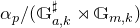 $\alpha_p/(\mathbb{G}_{a,k}^{\sharp}\rtimes\mathbb{G}_{m,k})$
. Consequently,
$\alpha_p/(\mathbb{G}_{a,k}^{\sharp}\rtimes\mathbb{G}_{m,k})$
. Consequently, $\mathcal{D}_{qc}(W(k)^{\mathcal{N}}_{red})$
is a full subcategory of the fibre product
$\mathcal{D}_{qc}(W(k)^{\mathcal{N}}_{red})$
is a full subcategory of the fibre product $\mathcal{D}_{qc}(D_{\mathrm{HT}})\times_{\mathcal{D}_{qc}(D_{Hod})}\mathcal{D}_{qc}(D_{\mathrm{dR}})$
. We refer the reader to [Reference LurieLur18b, Theorem 16.2.0.2] for a much more general result the above assertion follows from.
$\mathcal{D}_{qc}(D_{\mathrm{HT}})\times_{\mathcal{D}_{qc}(D_{Hod})}\mathcal{D}_{qc}(D_{\mathrm{dR}})$
. We refer the reader to [Reference LurieLur18b, Theorem 16.2.0.2] for a much more general result the above assertion follows from.
Set $D_{und}:=B\mathbb{G}_{m,k}^{\sharp}$
. The stack
$D_{und}:=B\mathbb{G}_{m,k}^{\sharp}$
. The stack $W(k)^{\mathcal{N}}_{red}$
contains two disjoint open substacks isomorphic to
$W(k)^{\mathcal{N}}_{red}$
contains two disjoint open substacks isomorphic to $D_{und}$
. The embedding of
$D_{und}$
. The embedding of $D_{und}\subset D_{\mathrm{HT}}=\mathbb{G}_{a,k}/(\mathbb{G}_{a,k}^{\sharp}\rtimes \mathbb{G}_{m,k})$
identifies
$D_{und}\subset D_{\mathrm{HT}}=\mathbb{G}_{a,k}/(\mathbb{G}_{a,k}^{\sharp}\rtimes \mathbb{G}_{m,k})$
identifies $D_{und}$
with
$D_{und}$
with $(\mathbb{G}_{a,k}\setminus\{0\})/(\mathbb{G}_{a,k}^{\sharp}\rtimes \mathbb{G}_{m,k})$
. The embedding of
$(\mathbb{G}_{a,k}\setminus\{0\})/(\mathbb{G}_{a,k}^{\sharp}\rtimes \mathbb{G}_{m,k})$
. The embedding of $D_{und}\subset D_{\mathrm{dR}}$
identifies
$D_{und}\subset D_{\mathrm{dR}}$
identifies $D_{und}$
with the complement to
$D_{und}$
with the complement to $D_{Hod}$
inside
$D_{Hod}$
inside $D_{\mathrm{dR}}$
. The stack
$D_{\mathrm{dR}}$
. The stack $W(k)^{syn}_{red}$
is obtained from
$W(k)^{syn}_{red}$
is obtained from $W(k)^{\mathcal{N}}_{red}$
by identifying the two copies of
$W(k)^{\mathcal{N}}_{red}$
by identifying the two copies of $D_{und}$
inside
$D_{und}$
inside $D_{\mathrm{HT}}$
and
$D_{\mathrm{HT}}$
and $D_{\mathrm{dR}}$
via the arithmetic Frobenius automorphism
$D_{\mathrm{dR}}$
via the arithmetic Frobenius automorphism $\textrm{Id} \times \mathrm{Frob}$
of
$\textrm{Id} \times \mathrm{Frob}$
of $B\mathbb{G}_{m,k}^{\sharp}= B\mathbb{G}^{\sharp}_{m,\mathbb{F}_p}\times\operatorname{Spec} k$
. In particular, by this pushout presentation of
$B\mathbb{G}_{m,k}^{\sharp}= B\mathbb{G}^{\sharp}_{m,\mathbb{F}_p}\times\operatorname{Spec} k$
. In particular, by this pushout presentation of $W(k)^{syn}_{red}$
, we have
$W(k)^{syn}_{red}$
, we have
 \begin{align}\begin{split}\mathrm{RHom}(\mathcal{E}',\mathcal{E})&=\mathrm{Fib}(\mathrm{RHom}(\mathcal{E}'|_{D_{\mathrm{HT}}},\mathcal{E}|_{D_{\mathrm{HT}}})\oplus \mathrm{RHom}(\mathcal{E}'|_{D_{\mathrm{dR}}},\mathcal{E}|_{D_{\mathrm{dR}}})\\&\quad\to \mathrm{RHom}(\mathcal{E}'|_{D_{und}},\mathcal{E}|_{D_{und}})\oplus \mathrm{RHom}(\mathcal{E}'|_{D_{Hod}},\mathcal{E}|_{D_{Hod}})).\end{split}\end{align}
Now we claim that, under our assumption on Hodge–Tate weights, the following hold:
-
(i)
$\mathrm{RHom}(\mathcal{E}'|_{D_{\mathrm{HT}}},\mathcal{E}|_{D_{\mathrm{HT}}})=0$
; -
(ii) the restriction map induces an isomorphism
$\mathrm{RHom}(\mathcal{E}'|_{D_{\mathrm{dR}}},\mathcal{E}|_{D_{\mathrm{dR}}})\xrightarrow{\sim}\mathrm{RHom}(\mathcal{E}'|_{D_{und}},\mathcal{E}|_{D_{und}})$
;Footnote
34
-
(iii)
$\mathrm{RHom}(\mathcal{E}'|_{D_{Hod}},\mathcal{E}|_{D_{Hod}})=0$
.



To prove part (i), note $\mathcal{D}_{qc}(D_{\mathrm{HT}})\simeq \mathcal{D}_{qc}(\mathbb{A}^{1,\mathrm{dR}}_+/\mathbb{G}_{m,k})$
is a full subcategory of the derived category
$\mathcal{D}_{qc}(D_{\mathrm{HT}})\simeq \mathcal{D}_{qc}(\mathbb{A}^{1,\mathrm{dR}}_+/\mathbb{G}_{m,k})$
is a full subcategory of the derived category $\mathcal{D}_{gr}(\mathcal{A}_1)$
of graded
$\mathcal{D}_{gr}(\mathcal{A}_1)$
of graded $\mathcal{A}_1$
-modules, where
$\mathcal{A}_1$
-modules, where $\mathcal{A}_1:=k\{v_+,D\}/(Dv_+-v_+D-1)$
is the algebra of differential operators on the affine line; see [Reference BhattBha23, § 6.5.4]. Let
$\mathcal{A}_1:=k\{v_+,D\}/(Dv_+-v_+D-1)$
is the algebra of differential operators on the affine line; see [Reference BhattBha23, § 6.5.4]. Let $G'= \bigoplus G'_i$
(respectively,
$G'= \bigoplus G'_i$
(respectively, $G=\bigoplus G_i$
) be the graded module corresponding to
$G=\bigoplus G_i$
) be the graded module corresponding to $\mathcal{E}'|_{D_{\mathrm{HT}}}$
(respectively,
$\mathcal{E}'|_{D_{\mathrm{HT}}}$
(respectively, $\mathcal{E}|_{D_{\mathrm{HT}}}$
) under the above inclusion. Using the assumption on weights and Remark 2.12, we conclude that
$\mathcal{E}|_{D_{\mathrm{HT}}}$
) under the above inclusion. Using the assumption on weights and Remark 2.12, we conclude that $G_i$
is acyclic for
$G_i$
is acyclic for $i\leqslant n-1$
and
$i\leqslant n-1$
and $G_i'\xrightarrow{v_+}G_{i+1}'$
is an isomorphism for
$G_i'\xrightarrow{v_+}G_{i+1}'$
is an isomorphism for $i+1\geqslant n$
.
$i+1\geqslant n$
.
We claim that $\mathrm{RHom}_{\mathcal{D}_{gr}(k[v_+])}(G',G(j))=0$
,
$\mathrm{RHom}_{\mathcal{D}_{gr}(k[v_+])}(G',G(j))=0$
, $j\leqslant 0$
, where
$j\leqslant 0$
, where $G(j)_i:=G_{i+j}$
. Indeed, let G” be the free graded
$G(j)_i:=G_{i+j}$
. Indeed, let G” be the free graded $k[v_+]$
-module on
$k[v_+]$
-module on $G'_{n-1}$
, i.e.
$G'_{n-1}$
, i.e. $G''_i=G'_i$
for
$G''_i=G'_i$
for $i\geqslant n-1$
and 0 otherwise. Then
$i\geqslant n-1$
and 0 otherwise. Then $\mathrm{RHom}_{\mathcal{D}_{gr}(k[v_+])}(G'',G(j))\xrightarrow{\sim}\mathrm{RHom}_{\mathcal{D}_{gr}(k)}(G'_{n-1},G_{n-1+j})$
, which is 0 for
$\mathrm{RHom}_{\mathcal{D}_{gr}(k[v_+])}(G'',G(j))\xrightarrow{\sim}\mathrm{RHom}_{\mathcal{D}_{gr}(k)}(G'_{n-1},G_{n-1+j})$
, which is 0 for $j\leqslant 0$
since
$j\leqslant 0$
since $G_{n-1+j}=0$
. It remains to check that for
$G_{n-1+j}=0$
. It remains to check that for $G''':=\mathrm{cone}(G'' \to G')$
, we have
$G''':=\mathrm{cone}(G'' \to G')$
, we have $\mathrm{RHom}_{\mathcal{D}_{gr}(k[v_+])}(G''',G(j))=0$
for
$\mathrm{RHom}_{\mathcal{D}_{gr}(k[v_+])}(G''',G(j))=0$
for $j\leqslant 0$
. Indeed,
$j\leqslant 0$
. Indeed, $G'''_i$
is acyclic for
$G'''_i$
is acyclic for $i \gt n-2$
. Then we have
$i \gt n-2$
. Then we have
 $$\mathrm{RHom}_{\mathcal{D}_{gr}(k[v_+])}(G''',G(j))= \mathrm{Fib}(\mathrm{RHom}_{\mathcal{D}_{gr}(k)}(G''',G(j)) \stackrel{\textrm{ad}_{v_+}}{\longrightarrow}\mathrm{RHom}_{\mathcal{D}_{gr}(k)}(G''',G(j+1))),$$
 \begin{equation}\mathrm{RHom}_{\mathcal{D}_{gr}(k)}(G''',G(j)) = \prod_i \mathrm{RHom}_k(G'''_i, G_{i+j})=0, \quad\text{for } j\leqslant 1,\end{equation}
since for every i, either $G'''_i$
or
$G'''_i$
or $G_{i+j}$
is acyclic (for
$G_{i+j}$
is acyclic (for $j\leqslant 1$
). Next, we have
$j\leqslant 1$
). Next, we have
 \begin{equation}\mathrm{RHom}_{\mathcal{D}_{gr}(\mathcal{A}_1)}(G',G)=\mathrm{Fib}(\mathrm{RHom}_{\mathcal{D}_{gr}(k[v_+])}(G',G) \stackrel{\textrm{ad}_D }{\longrightarrow}\mathrm{RHom}_{\mathcal{D}_{gr}(k[v_+])}(G',G(-1))).\end{equation}
By the vanishing of $\textit{RHom}_{\mathcal{D}_{gr}(k[v_+])}(G',G(j))=0$
for
$\textit{RHom}_{\mathcal{D}_{gr}(k[v_+])}(G',G(j))=0$
for $j=0, -1$
, we deduce vanishing of the left-hand side in (5.13). Thus,
$j=0, -1$
, we deduce vanishing of the left-hand side in (5.13). Thus, $\textit{RHom}(\mathcal{E}'|_{D_{\mathrm{HT}}},\mathcal{E}|_{D_{\mathrm{HT}}})=0$
and part (i) holds.
$\textit{RHom}(\mathcal{E}'|_{D_{\mathrm{HT}}},\mathcal{E}|_{D_{\mathrm{HT}}})=0$
and part (i) holds.
To prove part (ii), recall from [Reference BhattBha23, § 6.5.3] that $\mathcal{D}_{qc}(D_{\mathrm{dR}})$
can be viewed as a full subcategory of
$\mathcal{D}_{qc}(D_{\mathrm{dR}})$
can be viewed as a full subcategory of $\mathcal{D}_{gr}(k[v_-,\Theta])$
, where
$\mathcal{D}_{gr}(k[v_-,\Theta])$
, where $\deg(v_-)=-1$
and
$\deg(v_-)=-1$
and $\deg(\Theta)=-p$
. Denote by
$\deg(\Theta)=-p$
. Denote by $F'=\bigoplus {F'}^i$
(respectively,
$F'=\bigoplus {F'}^i$
(respectively, $F=\bigoplus F^i$
) the module corresponding to
$F=\bigoplus F^i$
) the module corresponding to $\mathcal{E}'$
(respectively,
$\mathcal{E}'$
(respectively, $\mathcal{E}$
). Using the assumption on weights and Remark 2.12, we have that
$\mathcal{E}$
). Using the assumption on weights and Remark 2.12, we have that ${F'}^i$
is acyclic for
${F'}^i$
is acyclic for $i\geqslant n$
, and
$i\geqslant n$
, and $F^i\xrightarrow{v_-}F^{i-1}$
is an isomorphism for
$F^i\xrightarrow{v_-}F^{i-1}$
is an isomorphism for $i\leqslant n$
.
$i\leqslant n$
.
Likewise, $\mathcal{D}_{qc}(D_{und})$
is a full subcategory of
$\mathcal{D}_{qc}(D_{und})$
is a full subcategory of $\mathcal{D}_{gr}(k[v_-,v_-^{-1},\Theta])=\mathcal{D}(k[\Theta])$
. Consider the embedding
$\mathcal{D}_{gr}(k[v_-,v_-^{-1},\Theta])=\mathcal{D}(k[\Theta])$
. Consider the embedding $j:D_{und}\hookrightarrow D_{\mathrm{dR}}$
lying over
$j:D_{und}\hookrightarrow D_{\mathrm{dR}}$
lying over $\overline{j}: (\mathbb{A}_-^1\setminus\{0\})/\mathbb{G}_m \otimes \mathbb{F}_p\hookrightarrow \mathbb{A}_-^1/\mathbb{G}_m \otimes \mathbb{F}_p$
. Under the identifications above, the pullback along j corresponds to the functor
$\overline{j}: (\mathbb{A}_-^1\setminus\{0\})/\mathbb{G}_m \otimes \mathbb{F}_p\hookrightarrow \mathbb{A}_-^1/\mathbb{G}_m \otimes \mathbb{F}_p$
. Under the identifications above, the pullback along j corresponds to the functor $j^*: \mathcal{D}_{gr}(k[v_-,\Theta]) \to \mathcal{D}_{gr}(k[v_-,v_-^{-1},\Theta])$
given by the tensor product with
$j^*: \mathcal{D}_{gr}(k[v_-,\Theta]) \to \mathcal{D}_{gr}(k[v_-,v_-^{-1},\Theta])$
given by the tensor product with $k[v_-,v_-^{-1},\Theta]$
over
$k[v_-,v_-^{-1},\Theta]$
over $k[v_-,\Theta]$
. We shall prove that under the above assumption on F and F’, the map
$k[v_-,\Theta]$
. We shall prove that under the above assumption on F and F’, the map
 \begin{equation}j^*: \mathrm{RHom}_{\mathcal{D}_{gr}(k[v_-,\Theta])}(F',F)\to \mathrm{RHom}_{\mathcal{D}_{gr}(k[v_-,v_-^{-1},\Theta])}(j^*F',j^*F)\end{equation}
is an isomorphism. The left-hand side of (5.14) can be computed as
 \begin{equation*} \mathrm{RHom}_{\mathcal{D}_{gr}(k[v_-,\Theta])}(F',F)=\mathrm{Fib}(\mathrm{RHom}_{\mathcal{D}_{gr}(k[v_-])}(F',F) \xrightarrow{\textrm{ad}_{\Theta}}\mathrm{RHom}_{\mathcal{D}_{gr}(k[v_-])}(F',F(-p))),\end{equation*}
and the right-hand side of (5.14) can be computed as
 \begin{align*}&\mathrm{RHom}_{\mathcal{D}_{gr}(k[v_-,v_-^{-1},\Theta])}(j^*F',j^*F)\\&\quad =\mathrm{Fib}(\mathrm{RHom}_{\mathcal{D}_{gr}(k[v_-,v_-^{-1}])}(j^*F',j^*F)\xrightarrow{\textrm{ad}_{\Theta}}\mathrm{RHom}_{\mathcal{D}_{gr}(k[v_-,v_-^{-1}])}(j^*F',j^*F(-p))).\end{align*}
We show the stronger statement that, for any $F'\in \mathcal{D}_{gr}(k[v_-])$
with
$F'\in \mathcal{D}_{gr}(k[v_-])$
with ${F'}^i$
being acyclic for
${F'}^i$
being acyclic for $i\geqslant n$
, and any
$i\geqslant n$
, and any $F\in \mathcal{D}_{gr}(k[v_-])$
with
$F\in \mathcal{D}_{gr}(k[v_-])$
with $F^i\xrightarrow{v_-}F^{i-1}$
being an isomorphism for
$F^i\xrightarrow{v_-}F^{i-1}$
being an isomorphism for $i\leqslant n-1$
, we have an isomorphism
$i\leqslant n-1$
, we have an isomorphism
 \begin{equation}\overline{j}^*: \textit{RHom}_{\mathcal{D}_{gr}(k[v_-])}(F',F)\xrightarrow{\sim} \textit{RHom}_{\mathcal{D}_{gr}(k[v_-,v_-^{-1}])}(\overline{j}^*F',\overline{j}^*F).\end{equation}
This will imply the desired isomorphism in (5.14).
Now, the functor $\overline{j}^*$
admits a right adjoint
$\overline{j}^*$
admits a right adjoint $\overline{j}_*$
given by the restriction along
$\overline{j}_*$
given by the restriction along $k[v_-]\hookrightarrow k[v_-,v_-^{-1}]$
. By adjunction,
$k[v_-]\hookrightarrow k[v_-,v_-^{-1}]$
. By adjunction, $\mathrm{RHom}_{\mathcal{D}_{gr}(k[v_-,v_-^{-1}])}(\overline{j}^*F',\overline{j}^*F)\simeq \mathrm{RHom}_{\mathcal{D}_{gr}(k[v_-])}(F',\overline{j}_*\overline{j}^*F)$
. Let
$\mathrm{RHom}_{\mathcal{D}_{gr}(k[v_-,v_-^{-1}])}(\overline{j}^*F',\overline{j}^*F)\simeq \mathrm{RHom}_{\mathcal{D}_{gr}(k[v_-])}(F',\overline{j}_*\overline{j}^*F)$
. Let $F'':=\mathrm{cone}(F\to \overline{j}_*\overline{j}^*F)$
. To prove (5.15), it suffices to show
$F'':=\mathrm{cone}(F\to \overline{j}_*\overline{j}^*F)$
. To prove (5.15), it suffices to show $\mathrm{RHom}(F',F'')=0$
. We have
$\mathrm{RHom}(F',F'')=0$
. We have ${F''}^i=0$
for
${F''}^i=0$
for $i< n$
. To show the desired vanishing, we use the equivalence
$i< n$
. To show the desired vanishing, we use the equivalence $\mathcal{D}_{gr}(k[v_-])\xrightarrow{\sim} \mathcal{D}_{gr}(k[v_+])$
given by
$\mathcal{D}_{gr}(k[v_-])\xrightarrow{\sim} \mathcal{D}_{gr}(k[v_+])$
given by $F\mapsto G$
with
$F\mapsto G$
with $G_i=F^{-i}$
. Now the vanishing of
$G_i=F^{-i}$
. Now the vanishing of $\mathrm{RHom}(F',F'')\simeq \mathrm{RHom}(G',G'')$
follows from (5.12).
$\mathrm{RHom}(F',F'')\simeq \mathrm{RHom}(G',G'')$
follows from (5.12).
To prove part (iii), recall from [Reference BhattBha23, § 6.5.2] that $\mathcal{D}_{qc}(D_{Hod})$
can be embedded as a full subcategory of
$\mathcal{D}_{qc}(D_{Hod})$
can be embedded as a full subcategory of $\mathcal{D}_{gr}(k[\Theta])$
. Denote by
$\mathcal{D}_{gr}(k[\Theta])$
. Denote by $V'=\bigoplus V'_i$
(respectively,
$V'=\bigoplus V'_i$
(respectively, $V=\bigoplus V_i$
) the corresponding graded modules for
$V=\bigoplus V_i$
) the corresponding graded modules for $\mathcal{E}'|_{D_{Hod}}$
(respectively,
$\mathcal{E}'|_{D_{Hod}}$
(respectively, $\mathcal{E}|_{D_{Hod}}$
). Observe that
$\mathcal{E}|_{D_{Hod}}$
). Observe that
 \begin{equation} \mathrm{RHom}_{\mathcal{D}_{gr}(k[\Theta])}(V',V)=\mathrm{Fib}(\mathrm{RHom}_{\mathcal{D}_{gr}(k)}(V',V)\xrightarrow{\textrm{ad}_{\Theta}}\mathrm{RHom}(V',V(-p))).\end{equation}
Using the assumption on weights, $V_i$
is acyclic for
$V_i$
is acyclic for $i<n$
and
$i<n$
and $V_i'$
is acyclic for
$V_i'$
is acyclic for $i\geqslant n$
. Thus, both the source and the target of
$i\geqslant n$
. Thus, both the source and the target of $\textrm{ad}_{\Theta}$
on the right-hand side of (5.16) are zero. Therefore,
$\textrm{ad}_{\Theta}$
on the right-hand side of (5.16) are zero. Therefore, $\mathrm{RHom}_{\mathcal{D}_{qc}(D_{Hod})}(\mathcal{E}'|_{D_{Hod}},\mathcal{E}|_{D_{Hod}})=\mathrm{RHom}_{\mathcal{D}_{gr}(k[\Theta])}(V',V)=0$
.
$\mathrm{RHom}_{\mathcal{D}_{qc}(D_{Hod})}(\mathcal{E}'|_{D_{Hod}},\mathcal{E}|_{D_{Hod}})=\mathrm{RHom}_{\mathcal{D}_{gr}(k[\Theta])}(V',V)=0$
.
We now check that (5.8) is fully faithful. Let $\mathcal{F}, \mathcal{F}'\in \mathcal{D}_{qc,[0,p-2]}\big((W(k)^{syn}\otimes\mathbb{F}_p)_{v_1^i=0}\big)$
. The morphism
$\mathcal{F}, \mathcal{F}'\in \mathcal{D}_{qc,[0,p-2]}\big((W(k)^{syn}\otimes\mathbb{F}_p)_{v_1^i=0}\big)$
. The morphism $\mathrm{RHom}(\mathcal{F},\mathcal{F}')\to \mathrm{RHom}(\alpha_i^*\mathcal{F},\alpha_i^*\mathcal{F}')\simeq \mathrm{RHom}(\mathcal{F},\alpha_{i*}\alpha_i^*\mathcal{F}')$
is induced by the map
$\mathrm{RHom}(\mathcal{F},\mathcal{F}')\to \mathrm{RHom}(\alpha_i^*\mathcal{F},\alpha_i^*\mathcal{F}')\simeq \mathrm{RHom}(\mathcal{F},\alpha_{i*}\alpha_i^*\mathcal{F}')$
is induced by the map $\mathcal{F}'\to\alpha_{i*}\alpha_i^*\mathcal{F}'$
. Let
$\mathcal{F}'\to\alpha_{i*}\alpha_i^*\mathcal{F}'$
. Let $\mathcal{G}$
be its fibre. By (5.10), we have
$\mathcal{G}$
be its fibre. By (5.10), we have $\mathcal{G}:=\mathcal{F}'\otimes\mathcal{J}_i=\mathcal{F}'\{-(i-1)(p-1)\}|_{W(k)^{syn}_{red}}$
. We need to show that
$\mathcal{G}:=\mathcal{F}'\otimes\mathcal{J}_i=\mathcal{F}'\{-(i-1)(p-1)\}|_{W(k)^{syn}_{red}}$
. We need to show that
 \[0=\mathrm{RHom}(\mathcal{F},\mathcal{G})=\mathrm{RHom}_{\mathcal{D}_{qc}(W(k)^{syn}_{red})}(\mathcal{F}|_{W(k)^{syn}_{red}},\ \mathcal{F}'\{-(i-1)(p-1)\}|_{W(k)^{syn}_{red}}).\]
Note that $\mathcal{F}|_{W(k)^{syn}_{red}}$
has weights
$\mathcal{F}|_{W(k)^{syn}_{red}}$
has weights $\leqslant p-2$
, and
$\leqslant p-2$
, and $\mathcal{F}'\{-(i-1)(p-1)\}|_{W(k)^{syn}_{red}}$
has weights
$\mathcal{F}'\{-(i-1)(p-1)\}|_{W(k)^{syn}_{red}}$
has weights $\geqslant (i-1)(p-1)$
. Thus, the desired vanishing follows by Lemma 5.7. This finishes the proof of fully faithfulness of functor (5.8).
$\geqslant (i-1)(p-1)$
. Thus, the desired vanishing follows by Lemma 5.7. This finishes the proof of fully faithfulness of functor (5.8).
To show that (5.8) is essentially surjective, we use the following result.
Lemma 5.8. Let $i:\mathcal{X}\hookrightarrow \mathcal{Y}$
be a square-zero extension of algebraic stacks over a field k. Let
$i:\mathcal{X}\hookrightarrow \mathcal{Y}$
be a square-zero extension of algebraic stacks over a field k. Let $\mathcal{I}$
be the corresponding sheaf of ideals. Let
$\mathcal{I}$
be the corresponding sheaf of ideals. Let $\mathcal{F}\in\mathcal{D}_{qc}(\mathcal{X})$
. Assume that
$\mathcal{F}\in\mathcal{D}_{qc}(\mathcal{X})$
. Assume that $\textrm{Ext}^2_{\mathcal{D}_{qc}(\mathcal{X})}(\mathcal{F},\mathcal{F}\otimes\mathcal{I})=0$
. Then there exists an
$\textrm{Ext}^2_{\mathcal{D}_{qc}(\mathcal{X})}(\mathcal{F},\mathcal{F}\otimes\mathcal{I})=0$
. Then there exists an $\widetilde{\mathcal{F}}\in\mathcal{D}_{qc}(\mathcal{Y})$
such that
$\widetilde{\mathcal{F}}\in\mathcal{D}_{qc}(\mathcal{Y})$
such that $\widetilde{\mathcal{F}}|_{\mathcal{X}}=\mathcal{F}$
.
$\widetilde{\mathcal{F}}|_{\mathcal{X}}=\mathcal{F}$
.
Proof. We first consider the case where $\mathcal{Y}$
is an affine scheme. Let R be any associative algebra over k, and
$\mathcal{Y}$
is an affine scheme. Let R be any associative algebra over k, and $I\subset R$
a two-sided ideal with
$I\subset R$
a two-sided ideal with $I^2=0$
. Set
$I^2=0$
. Set $\overline{R}:=R/I$
. Define an object
$\overline{R}:=R/I$
. Define an object $M\in \mathcal{D}(\overline{R}\otimes \overline{R}^{\textrm{op}})$
as follows:
$M\in \mathcal{D}(\overline{R}\otimes \overline{R}^{\textrm{op}})$
as follows: $M:=\tau_{\leqslant 1}(\overline{R}\overset{\mathbb{L}}{\otimes}_R \overline{R})$
. We have
$M:=\tau_{\leqslant 1}(\overline{R}\overset{\mathbb{L}}{\otimes}_R \overline{R})$
. We have $H_0(M)=\bar{R}$
,
$H_0(M)=\bar{R}$
, $H_1(M)=I$
and
$H_1(M)=I$
and $H_i(M)=0$
for all
$H_i(M)=0$
for all $i\neq 0,1$
. For the duration of this proof, we denote by
$i\neq 0,1$
. For the duration of this proof, we denote by $\Psi$
the functor
$\Psi$
the functor $\mathcal{D}(\bar{R})\to \mathcal{D}(\bar{R})$
given by
$\mathcal{D}(\bar{R})\to \mathcal{D}(\bar{R})$
given by $\Psi(N):=M\otimes_{\bar{R}} N$
. Then we have a fibre sequence of functors
$\Psi(N):=M\otimes_{\bar{R}} N$
. Then we have a fibre sequence of functors
 \begin{equation} I\otimes_{\bar{R}} N[1]\to \Psi(N)\to N\xrightarrow{\mathfrak{o}(N)} I\otimes_{\bar{R}} N[2]. \end{equation}
We refer to $\mathfrak{o}(N)$
as the obstruction class. A choice of a null-homotopy for
$\mathfrak{o}(N)$
as the obstruction class. A choice of a null-homotopy for $\mathfrak{o}(N)$
determines a map
$\mathfrak{o}(N)$
determines a map $\delta: \Psi(N)\to I\otimes_{\bar{R}} N[1]$
splitting the fibre sequence (5.17). Composing
$\delta: \Psi(N)\to I\otimes_{\bar{R}} N[1]$
splitting the fibre sequence (5.17). Composing $\delta$
with the map
$\delta$
with the map $\bar{R}\otimes_R N\simeq (\overline{R}\overset{\mathbb{L}}{\otimes}_R \overline{R})\otimes_{\bar{R}}N \to \Psi(N)$
, we obtain a map
$\bar{R}\otimes_R N\simeq (\overline{R}\overset{\mathbb{L}}{\otimes}_R \overline{R})\otimes_{\bar{R}}N \to \Psi(N)$
, we obtain a map $\bar{R}\otimes_R N\to I\otimes_{\bar{R}}N[1]$
, which yields a map
$\bar{R}\otimes_R N\to I\otimes_{\bar{R}}N[1]$
, which yields a map $\bar{\delta}: N\to I\otimes_{\bar{R}}N[1]$
in
$\bar{\delta}: N\to I\otimes_{\bar{R}}N[1]$
in $\mathcal{D}(R)$
. Let
$\mathcal{D}(R)$
. Let
 \begin{equation} \widetilde{N}:=\mathrm{Fib}(N\xrightarrow{\bar{\delta}}I\otimes_{\bar{R}}N[1])\in \mathcal{D}(R). \end{equation}
The morphism $\widetilde{N}\to N$
in
$\widetilde{N}\to N$
in $\mathcal{D}(R)$
induces a map in
$\mathcal{D}(R)$
induces a map in $\mathcal{D}(\bar{R})$
:
$\mathcal{D}(\bar{R})$
:
 \begin{equation}\bar{R}\otimes_R\widetilde{N}\to N.\end{equation}
We claim that the map (5.19) is an isomorphism. To see this, we compute the obstruction class $\mathfrak{o}(N)$
of N as follows. By [Reference DrinfeldDri04, B.3 Lemma] we can assume that N is represented by a semi-free complex
$\mathfrak{o}(N)$
of N as follows. By [Reference DrinfeldDri04, B.3 Lemma] we can assume that N is represented by a semi-free complex $(N^\cdot, d)$
of
$(N^\cdot, d)$
of $\bar{R}$
-modules, i.e. there exists an increasing exhaustive filtration
$\bar{R}$
-modules, i.e. there exists an increasing exhaustive filtration $0= F_{0} N^{\cdot} \subset F_{1} N^{\cdot}\subset \cdots \subset (N^\cdot, d)$
such that each quotient
$0= F_{0} N^{\cdot} \subset F_{1} N^{\cdot}\subset \cdots \subset (N^\cdot, d)$
such that each quotient $F_{i+1}N^\cdot/F_{i}N^\cdot$
is isomorphic to a direct sum of DG-modules of the form
$F_{i+1}N^\cdot/F_{i}N^\cdot$
is isomorphic to a direct sum of DG-modules of the form $\bar{R}[n]$
. For each i, pick a lift of the filtered
$\bar{R}[n]$
. For each i, pick a lift of the filtered $\bar {R}$
-module
$\bar {R}$
-module $F_{\bullet} N^{i}$
to a filtered R-module
$F_{\bullet} N^{i}$
to a filtered R-module $F_{\bullet} \widetilde N^{i}$
such that
$F_{\bullet} \widetilde N^{i}$
such that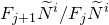 $F_{j+1}\widetilde N^{i}/F_{j}\widetilde N^{i}$
is a free R-module, for every j. We can lift d to a homomorphism of filtered R-modules
$F_{j+1}\widetilde N^{i}/F_{j}\widetilde N^{i}$
is a free R-module, for every j. We can lift d to a homomorphism of filtered R-modules $\widetilde d: \widetilde N^i \to \widetilde N^{i+1}$
such that
$\widetilde d: \widetilde N^i \to \widetilde N^{i+1}$
such that $\widetilde d$
takes
$\widetilde d$
takes $\widetilde{F}_{\bullet} \widetilde{N}^{\cdot}$
to
$\widetilde{F}_{\bullet} \widetilde{N}^{\cdot}$
to $\widetilde{F}_{\bullet-1} \widetilde{N}^{\cdot+1}$
. In general,
$\widetilde{F}_{\bullet-1} \widetilde{N}^{\cdot+1}$
. In general, $\widetilde d^2\ne 0$
. Note that
$\widetilde d^2\ne 0$
. Note that $\widetilde d^2$
factors through the projection
$\widetilde d^2$
factors through the projection $\widetilde N^i \to N^i$
and its image lies in
$\widetilde N^i \to N^i$
and its image lies in $I \otimes_{\bar{R}} N^{i+2}$
. Moreover, since
$I \otimes_{\bar{R}} N^{i+2}$
. Moreover, since $\widetilde d^2$
commutes with
$\widetilde d^2$
commutes with $\widetilde d$
, we get a morphism of complexes
$\widetilde d$
, we get a morphism of complexes $\widetilde d^2: (N^\cdot, d) \to I \otimes_{\bar{R}} (N^\cdot,d)[2]$
.
$\widetilde d^2: (N^\cdot, d) \to I \otimes_{\bar{R}} (N^\cdot,d)[2]$
.
Claim 5.9.
The above morphism $\widetilde{d}^2: N \to I \otimes_{\bar{R}} N[2]$
is equal to
$\widetilde{d}^2: N \to I \otimes_{\bar{R}} N[2]$
is equal to $\mathfrak{o}(N)$
.
$\mathfrak{o}(N)$
.
Proof. Consider the DG-algebra $\bar{R}^{dg} := (I \to R)$
coming from the resolution
$\bar{R}^{dg} := (I \to R)$
coming from the resolution $0 \to I \to R \to \bar{R} \to 0$
. Let us define a DG-
$0 \to I \to R \to \bar{R} \to 0$
. Let us define a DG- $\bar{R}^{dg}$
-module N’ whose underlying graded R-module is
$\bar{R}^{dg}$
-module N’ whose underlying graded R-module is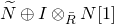 $\widetilde{N} \oplus I \otimes_{\bar{R}} N[1]$
and the differential in degree i is given by
$\widetilde{N} \oplus I \otimes_{\bar{R}} N[1]$
and the differential in degree i is given by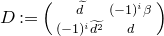 $D:= \Big(\begin{smallmatrix}\widetilde{d} & (-1)^{i} \beta \\(-1)^i \widetilde{d^2} & d\end{smallmatrix}\Big)$
, where
$D:= \Big(\begin{smallmatrix}\widetilde{d} & (-1)^{i} \beta \\(-1)^i \widetilde{d^2} & d\end{smallmatrix}\Big)$
, where $\beta: I \otimes_{\bar{R}} N^i \hookrightarrow \widetilde{N}^i$
is the kernel of
$\beta: I \otimes_{\bar{R}} N^i \hookrightarrow \widetilde{N}^i$
is the kernel of $\widetilde{N}^i \to N^i$
. The action I[1] on N’ is given by the lower triangular matrix whose only nonzero entry is given by
$\widetilde{N}^i \to N^i$
. The action I[1] on N’ is given by the lower triangular matrix whose only nonzero entry is given by $I[1] \otimes_{R} \widetilde{N} \simeq I \otimes_{\bar{R}} N[1]$
. Note that by construction N’ is semi-free over
$I[1] \otimes_{R} \widetilde{N} \simeq I \otimes_{\bar{R}} N[1]$
. Note that by construction N’ is semi-free over $\bar{R}^{dg}$
. Consider the map
$\bar{R}^{dg}$
. Consider the map $N' \to N$
, which takes
$N' \to N$
, which takes $(n, x) \in \widetilde{N}^i \oplus I \otimes_{\bar{R}} N^{i+1}$
to the image of n under the map
$(n, x) \in \widetilde{N}^i \oplus I \otimes_{\bar{R}} N^{i+1}$
to the image of n under the map $\widetilde{N}^i \to N^i$
. It is a map of DG-
$\widetilde{N}^i \to N^i$
. It is a map of DG- $\bar{R}^{dg}$
-modules and, moreover, it is a quasi-isomorphism. Under the equivalence
$\bar{R}^{dg}$
-modules and, moreover, it is a quasi-isomorphism. Under the equivalence $\mathcal{D}(\bar{R}) \simeq \mathcal{D}(\bar{R}^{dg})$
, the functor
$\mathcal{D}(\bar{R}) \simeq \mathcal{D}(\bar{R}^{dg})$
, the functor $\Psi: \mathcal{D}(\bar{R}) \to \mathcal{D}(\bar{R})$
corresponds to the functor
$\Psi: \mathcal{D}(\bar{R}) \to \mathcal{D}(\bar{R})$
corresponds to the functor $\Psi': \mathcal{D}(\bar{R}^{dg}) \to \mathcal{D}(\bar{R})$
given by
$\Psi': \mathcal{D}(\bar{R}^{dg}) \to \mathcal{D}(\bar{R})$
given by $\Psi'(N) = \tau_{\le 1} (\bar{R} \otimes_{R} \bar{R}^{dg}) \otimes^\mathbb{L}_{\bar{R}^{dg}} N$
. Note that the natural map
$\Psi'(N) = \tau_{\le 1} (\bar{R} \otimes_{R} \bar{R}^{dg}) \otimes^\mathbb{L}_{\bar{R}^{dg}} N$
. Note that the natural map $\tau_{\le 1} (\bar{R} \otimes^{\mathbb{L}}_{R} \bar{R}^{dg}) \to \tau_{\le 1} (\bar{R} \otimes_{R} \bar{R}^{dg})$
in
$\tau_{\le 1} (\bar{R} \otimes^{\mathbb{L}}_{R} \bar{R}^{dg}) \to \tau_{\le 1} (\bar{R} \otimes_{R} \bar{R}^{dg})$
in $\mathcal{D}(\bar{R} \otimes (\bar{R}^{dg})^{op})$
is an isomorphism, and
$\mathcal{D}(\bar{R} \otimes (\bar{R}^{dg})^{op})$
is an isomorphism, and $\tau_{\le 1} (\bar{R} \otimes_{R} \bar{R}^{dg})$
is represented by
$\tau_{\le 1} (\bar{R} \otimes_{R} \bar{R}^{dg})$
is represented by $\bar{R} \oplus I[1]$
with the zero differential. Observe that the right action of
$\bar{R} \oplus I[1]$
with the zero differential. Observe that the right action of $\bar{R}^{dg}$
has the property that
$\bar{R}^{dg}$
has the property that $\bar{R} \otimes_{R} (\bar{R}^{dg})^{-1} \to I$
is an isomorphism. Thus,
$\bar{R} \otimes_{R} (\bar{R}^{dg})^{-1} \to I$
is an isomorphism. Thus, $\Psi'(N)$
is identified with
$\Psi'(N)$
is identified with $C:= (N \oplus I\otimes_{\bar{R}} N[1], \bar{D})$
, where
$C:= (N \oplus I\otimes_{\bar{R}} N[1], \bar{D})$
, where $\bar{D}$
in degree i is given by
$\bar{D}$
in degree i is given by $(\begin{smallmatrix}d & 0 \\(-1)^i \widetilde{d^2} & d\end{smallmatrix})$
. Denote by
$(\begin{smallmatrix}d & 0 \\(-1)^i \widetilde{d^2} & d\end{smallmatrix})$
. Denote by $u: I \otimes_{\bar{R}} N[1] \to C$
the inclusion and by
$u: I \otimes_{\bar{R}} N[1] \to C$
the inclusion and by $\alpha: C \to N$
the projection. To complete the proof, it is enough to construct a quasi-isomorphism
$\alpha: C \to N$
the projection. To complete the proof, it is enough to construct a quasi-isomorphism $f: I \otimes_{\bar{R}} N[2] \to \operatorname{Cone}(\alpha)$
such that the two morphisms
$f: I \otimes_{\bar{R}} N[2] \to \operatorname{Cone}(\alpha)$
such that the two morphisms $\mathfrak{o}(N)$
and
$\mathfrak{o}(N)$
and $\widetilde{d^2} \circ f: N \to \operatorname{Cone}(\alpha)$
are equal. Consider the following diagram.
$\widetilde{d^2} \circ f: N \to \operatorname{Cone}(\alpha)$
are equal. Consider the following diagram.

The composition $\alpha[1] \circ u[1]: I \otimes_{\bar{R}} N[2] \to N[1]$
is zero. Thus, there exists a map
$\alpha[1] \circ u[1]: I \otimes_{\bar{R}} N[2] \to N[1]$
is zero. Thus, there exists a map $f: I \otimes_{\bar{R}} N[2] \to \operatorname{Cone}(\alpha)$
satisfying
$f: I \otimes_{\bar{R}} N[2] \to \operatorname{Cone}(\alpha)$
satisfying $f \circ \widetilde{d}^2 = \mathfrak{o}(N)$
. Moreover, f is a quasi-isomorphism.
$f \circ \widetilde{d}^2 = \mathfrak{o}(N)$
. Moreover, f is a quasi-isomorphism.
Let us now return to the proof of the isomorphism property of (5.19). Since $(N^{\cdot},d)$
is semi-free, the null-homotopy for
$(N^{\cdot},d)$
is semi-free, the null-homotopy for $\mathfrak{o}(N)$
determines a collection
$\mathfrak{o}(N)$
determines a collection $h: N^i \to I \otimes_{\bar{R}} N^{i+1}$
with
$h: N^i \to I \otimes_{\bar{R}} N^{i+1}$
with $h d +d h = \widetilde d^2$
. Setting
$h d +d h = \widetilde d^2$
. Setting $\widetilde d' = \widetilde d - h: \widetilde N^i \to \widetilde N^{i+1}$
we have that
$\widetilde d' = \widetilde d - h: \widetilde N^i \to \widetilde N^{i+1}$
we have that $(\widetilde d')^2=0$
. Then
$(\widetilde d')^2=0$
. Then $\widetilde{N}$
is represented by the complex
$\widetilde{N}$
is represented by the complex $(\widetilde N^\cdot, \widetilde d' )$
. The isomorphism property of (5.19) follows.
$(\widetilde N^\cdot, \widetilde d' )$
. The isomorphism property of (5.19) follows.
This implies the lemma in the affine case. Indeed, if $\textrm{Ext}^2_{\bar{R}}(N,N\otimes I)=0$
, then
$\textrm{Ext}^2_{\bar{R}}(N,N\otimes I)=0$
, then $\mathfrak{o}(N)$
is homotopic to zero. Therefore, there exists
$\mathfrak{o}(N)$
is homotopic to zero. Therefore, there exists $\widetilde{N}\in \mathcal{D}(R)$
together with a map (5.19) which is an isomorphism.
$\widetilde{N}\in \mathcal{D}(R)$
together with a map (5.19) which is an isomorphism.
For the general case, observe that $\mathcal{D}_{qc}(\mathcal{Y})=\lim \mathcal{D}_{qc}(R)$
where the limit is taken over all flat maps
$\mathcal{D}_{qc}(\mathcal{Y})=\lim \mathcal{D}_{qc}(R)$
where the limit is taken over all flat maps $\operatorname{Spec} R\to \mathcal{Y}$
. Thus applying the previous construction to each R, we obtain an obstruction class
$\operatorname{Spec} R\to \mathcal{Y}$
. Thus applying the previous construction to each R, we obtain an obstruction class $\mathfrak{o}(\mathcal{F}): \mathcal{F}\to\mathcal{F}\otimes\mathcal{I}[2]$
. Moreover, a choice of null-homotopy for
$\mathfrak{o}(\mathcal{F}): \mathcal{F}\to\mathcal{F}\otimes\mathcal{I}[2]$
. Moreover, a choice of null-homotopy for $\mathfrak{o}(\mathcal{F})$
determines an object
$\mathfrak{o}(\mathcal{F})$
determines an object $\widetilde{\mathcal{F}}\in\mathcal{D}_{qc}(\mathcal{Y})$
together with a map
$\widetilde{\mathcal{F}}\in\mathcal{D}_{qc}(\mathcal{Y})$
together with a map $\widetilde{\mathcal{F}}|_{\mathcal{X}}\to \mathcal{F}$
. By the local computations in the affine case, this map is an isomorphism. This completes the proof of the lemma.
$\widetilde{\mathcal{F}}|_{\mathcal{X}}\to \mathcal{F}$
. By the local computations in the affine case, this map is an isomorphism. This completes the proof of the lemma.
Let us check that (5.8) is essentially surjective. Applying Lemma 5.8 to $\alpha_i$
in (5.9), it suffices to verify that for every
$\alpha_i$
in (5.9), it suffices to verify that for every $\mathcal{F}\in\mathcal{D}_{qc,[0,p-2]}((W(k)^{syn}\otimes\mathbb{F}_p)_{v_1^{i-1}=0})$
, the group
$\mathcal{F}\in\mathcal{D}_{qc,[0,p-2]}((W(k)^{syn}\otimes\mathbb{F}_p)_{v_1^{i-1}=0})$
, the group $\textrm{Ext}^2(\mathcal{F},\mathcal{F}\otimes\mathcal{I}_i)=0$
. Using (5.10), we have that
$\textrm{Ext}^2(\mathcal{F},\mathcal{F}\otimes\mathcal{I}_i)=0$
. Using (5.10), we have that $\textrm{Ext}^2(\mathcal{F},\mathcal{F}\otimes\mathcal{I}_i)=\textrm{Ext}^2(\mathcal{F}|_{W(k)^{syn}_{red}},\mathcal{F}|_{W(k)^{syn}_{red}}\{-(i-1)(p-1)\})$
. Note that
$\textrm{Ext}^2(\mathcal{F},\mathcal{F}\otimes\mathcal{I}_i)=\textrm{Ext}^2(\mathcal{F}|_{W(k)^{syn}_{red}},\mathcal{F}|_{W(k)^{syn}_{red}}\{-(i-1)(p-1)\})$
. Note that $\mathcal{F}|_{W(k)^{syn}_{red}}$
has weights
$\mathcal{F}|_{W(k)^{syn}_{red}}$
has weights $\leqslant p-2$
, and
$\leqslant p-2$
, and $\mathcal{F}|_{W(k)^{syn}_{red}}\{-(i-1)(p-1)\}$
has weights
$\mathcal{F}|_{W(k)^{syn}_{red}}\{-(i-1)(p-1)\}$
has weights $\geqslant (i-1)(p-1)\geqslant p-1$
(since
$\geqslant (i-1)(p-1)\geqslant p-1$
(since $i-1\geqslant 1$
). Thus, the vanishing for
$i-1\geqslant 1$
). Thus, the vanishing for $\textrm{Ext}^2$
follows from Lemma 5.7.
$\textrm{Ext}^2$
follows from Lemma 5.7.
For the last assertion of the proposition, it suffices to observe that the functor
 \begin{equation} \mathcal{D}_{qc,[0,p-2]}(W(k)^{syn}\otimes\mathbb{F}_p)\to {\displaystyle\lim_{\longleftarrow}}\mathcal{D}_{qc,[0,p-2]}((W(k)^{syn}\otimes\mathbb{F}_p)_{v_1^{i}=0})\end{equation}
is an equivalence by the definition of reduced locus.
Step 3. We prove that the functor $(\Phi_{\mathrm{Maz}}\otimes \mathbb{F}_p) \circ r^{-1}_{[0,p-2]}:\mathcal{D}_{qc,[0,p-2]}(W(k)^{syn}_{red}) \to \mathscr{DMF}^{\mathrm{big}}_{[0,p-2]}(W(k))\otimes\mathbb{F}_p$
is an equivalence. Although this result does not hold with
$(\Phi_{\mathrm{Maz}}\otimes \mathbb{F}_p) \circ r^{-1}_{[0,p-2]}:\mathcal{D}_{qc,[0,p-2]}(W(k)^{syn}_{red}) \to \mathscr{DMF}^{\mathrm{big}}_{[0,p-2]}(W(k))\otimes\mathbb{F}_p$
is an equivalence. Although this result does not hold with $r_{[0,p-2]}$
replaced by
$r_{[0,p-2]}$
replaced by $r_{[0,p-1]}$
, some intermediate results hold in the larger range. Aimed at some geometric applications (see Remark 5.23), we explain the results in full generality.
$r_{[0,p-1]}$
, some intermediate results hold in the larger range. Aimed at some geometric applications (see Remark 5.23), we explain the results in full generality.
We start by showing that the functor $\Phi_{\mathrm{Maz}}\otimes\mathbb{F}_p:\mathcal{D}_{qc,[0,p-1]}(W(k)^{syn}\otimes\mathbb{F}_p)\to\mathscr{DMF}^{\mathrm{big}}_{[0,p-1]}(W(k))\otimes\mathbb{F}_p$
factors through the restriction
$\Phi_{\mathrm{Maz}}\otimes\mathbb{F}_p:\mathcal{D}_{qc,[0,p-1]}(W(k)^{syn}\otimes\mathbb{F}_p)\to\mathscr{DMF}^{\mathrm{big}}_{[0,p-1]}(W(k))\otimes\mathbb{F}_p$
factors through the restriction $r_{[0,p-1]}$
to the reduced locus
$r_{[0,p-1]}$
to the reduced locus $W(k)^{syn}_{red}$
.Footnote
35
Since
$W(k)^{syn}_{red}$
.Footnote
35
Since $k^{\mathcal{N}}\otimes\mathbb{F}_p$
(respectively,
$k^{\mathcal{N}}\otimes\mathbb{F}_p$
(respectively, $\mathbb{A}^1_-/\mathbb{G}_m \otimes \mathbb{F}_p$
) is reduced, the morphism
$\mathbb{A}^1_-/\mathbb{G}_m \otimes \mathbb{F}_p$
) is reduced, the morphism $ \mathfrak{p}_{\mathrm{cris}}: k^{\mathcal{N}}\otimes\mathbb{F}_p\to W(k)^{\mathcal{N}}\otimes\mathbb{F}_p$
(respectively,
$ \mathfrak{p}_{\mathrm{cris}}: k^{\mathcal{N}}\otimes\mathbb{F}_p\to W(k)^{\mathcal{N}}\otimes\mathbb{F}_p$
(respectively, $\mathfrak{p}_{\bar{\mathrm{dR}}} \otimes \mathbb{F}_p:\mathbb{A}^1_-/\mathbb{G}_m \otimes \mathbb{F}_p \to W(k)^{\mathcal{N}}\otimes\mathbb{F}_p$
) factors through
$\mathfrak{p}_{\bar{\mathrm{dR}}} \otimes \mathbb{F}_p:\mathbb{A}^1_-/\mathbb{G}_m \otimes \mathbb{F}_p \to W(k)^{\mathcal{N}}\otimes\mathbb{F}_p$
) factors through $W(k)^{\mathcal{N}}_{red}$
. Thus, we have the following diagram obtained from (3.1) by tensoring with
$W(k)^{\mathcal{N}}_{red}$
. Thus, we have the following diagram obtained from (3.1) by tensoring with $\mathbb{F}_p$
.
$\mathbb{F}_p$
.

By Theorem 1, we have an isomorphism $\Psi_{\mathrm{Maz}}\otimes\mathbb{F}_p: \mathfrak{p}_{\mathrm{cris}}\circ a\xrightarrow{\sim} \mathfrak{p}_{\bar{\mathrm{dR}}}\circ t\circ a$
in diagram (5.21). Consequently, this gives a functor
$\Psi_{\mathrm{Maz}}\otimes\mathbb{F}_p: \mathfrak{p}_{\mathrm{cris}}\circ a\xrightarrow{\sim} \mathfrak{p}_{\bar{\mathrm{dR}}}\circ t\circ a$
in diagram (5.21). Consequently, this gives a functor
 \[ \mathcal{D}_{qc}(W(k)^{syn}_{red})\to \mathcal{D}_{qc}(k^{syn}\otimes\mathbb{F}_p)\times_{\mathcal{D}_{qc}(\operatorname{Spec} (B\otimes\mathbb{F}_p)/\mathbb{G}_{m, k})}\mathcal{D}_{qc}((\mathbb{A}^1_-/\mathbb{G}_m)\otimes\mathbb{F}_p)\]
sending $\mathcal{D}_{qc,[0,p-1]}(W(k)^{syn}_{red})$
to the corresponding subcategory of the right-hand side (as in Remark 4.5). Combining this with (4.8), we obtain
$\mathcal{D}_{qc,[0,p-1]}(W(k)^{syn}_{red})$
to the corresponding subcategory of the right-hand side (as in Remark 4.5). Combining this with (4.8), we obtain
 \begin{equation}\Phi^{\mathrm{Maz}}_{red}: \mathcal{D}_{qc,[0,p-1]}(W(k)^{syn}_{red})\to\mathscr{D}\mathscr{MF}^{\mathrm{big}}_{[0,p-1]}(W(k))\otimes\mathbb{F}_p\end{equation}
together with an isomorphism $\Phi_{\mathrm{Maz}}\otimes\mathbb{F}_p\simeq \Phi^{\mathrm{Maz}}_{red}\circ r_{[0,p-1]}$
. Eventually in this step, we prove that
$\Phi_{\mathrm{Maz}}\otimes\mathbb{F}_p\simeq \Phi^{\mathrm{Maz}}_{red}\circ r_{[0,p-1]}$
. Eventually in this step, we prove that $\Phi_{red}^{\mathrm{Maz}}$
is an equivalence in the range
$\Phi_{red}^{\mathrm{Maz}}$
is an equivalence in the range $[0,p-2]$
.
$[0,p-2]$
.
Note that the construction of $\Phi^{\mathrm{Maz}}_{red}$
makes use of a particular choice of an isomorphism
$\Phi^{\mathrm{Maz}}_{red}$
makes use of a particular choice of an isomorphism $ \mathfrak{p}_{\mathrm{cris}}\circ a\simeq \mathfrak{p}_{\bar{\mathrm{dR}}}\circ t\circ a$
provided by
$ \mathfrak{p}_{\mathrm{cris}}\circ a\simeq \mathfrak{p}_{\bar{\mathrm{dR}}}\circ t\circ a$
provided by $\Psi_{\mathrm{Maz}}\otimes\mathbb{F}_p$
. We make use of another isomorphism
$\Psi_{\mathrm{Maz}}\otimes\mathbb{F}_p$
. We make use of another isomorphism $\Psi_{\mathrm{DI}}: \mathfrak{p}_{\mathrm{cris}}\circ a\xrightarrow{\sim} \mathfrak{p}_{\bar{\mathrm{dR}}}\circ t\circ a$
constructed as follows.Footnote
36
Let
$\Psi_{\mathrm{DI}}: \mathfrak{p}_{\mathrm{cris}}\circ a\xrightarrow{\sim} \mathfrak{p}_{\bar{\mathrm{dR}}}\circ t\circ a$
constructed as follows.Footnote
36
Let $C_2$
be the spectrum of the subalgebra of
$C_2$
be the spectrum of the subalgebra of $k[v_+,v_-]/(v_+v_-)$
generated by
$k[v_+,v_-]/(v_+v_-)$
generated by $v_+^p$
and
$v_+^p$
and $v_-$
, i.e.
$v_-$
, i.e. $C_2:=\operatorname{Spec} k[v_+^p,v_-]/(v_+^pv_-)$
. We endow the affine curve
$C_2:=\operatorname{Spec} k[v_+^p,v_-]/(v_+^pv_-)$
. We endow the affine curve $C_2$
with a natural action of
$C_2$
with a natural action of $\mathbb{G}_{m,k}$
given by
$\mathbb{G}_{m,k}$
given by $\deg v_+^p=p$
and
$\deg v_+^p=p$
and $\deg v_-=-1$
. Recall from [Reference DrinfeldDri24, § 5.16.10] the morphism
$\deg v_-=-1$
. Recall from [Reference DrinfeldDri24, § 5.16.10] the morphism $C_2/\mathbb{G}_{m,k}\to W(k)^{\mathcal{N}}_{red}$
, whose precomposition with
$C_2/\mathbb{G}_{m,k}\to W(k)^{\mathcal{N}}_{red}$
, whose precomposition with $ k^{\mathcal{N}}\otimes\mathbb{F}_p\to C_2/\mathbb{G}_{m,k}$
is
$ k^{\mathcal{N}}\otimes\mathbb{F}_p\to C_2/\mathbb{G}_{m,k}$
is $ \mathfrak{p}_{\mathrm{cris}}\otimes\mathbb{F}_p$
(see also (2.17)). Let us recall how the map
$ \mathfrak{p}_{\mathrm{cris}}\otimes\mathbb{F}_p$
(see also (2.17)). Let us recall how the map $C_2/\mathbb{G}_{m,k} \to W(k)_{red}^{\mathcal{N}}$
is constructed. Note
$C_2/\mathbb{G}_{m,k} \to W(k)_{red}^{\mathcal{N}}$
is constructed. Note $C_2/\mathbb{G}_{m,k}(R)$
is the groupoid of diagrams
$C_2/\mathbb{G}_{m,k}(R)$
is the groupoid of diagrams
 \begin{equation} L \xrightarrow{v_{-}} R \xrightarrow{v_+^p} L^{\otimes p}, \end{equation}
where L is an invertible R-module and $v_+^pv_{-}=0$
. To any such diagram we associate an admissible Cartier–Witt divisor
$v_+^pv_{-}=0$
. To any such diagram we associate an admissible Cartier–Witt divisor $M \to W$
over R. Here M is defined to be the fibre product of
$M \to W$
over R. Here M is defined to be the fibre product of $F_* W_R \xrightarrow{F_* [v_+^p]} F_* [L^{\otimes p}]$
, where
$F_* W_R \xrightarrow{F_* [v_+^p]} F_* [L^{\otimes p}]$
, where $[L] \in \textrm{Pic}(W(R))$
is the Teichmüller representative of L as in [Reference DrinfeldDri24, § 3.11], and the Frobenius
$[L] \in \textrm{Pic}(W(R))$
is the Teichmüller representative of L as in [Reference DrinfeldDri24, § 3.11], and the Frobenius $[L] \to F_* [L^{\otimes p}]$
. The map
$[L] \to F_* [L^{\otimes p}]$
. The map $M \to W$
is the restriction of
$M \to W$
is the restriction of $[L] \times_{R} F_* W_R \xrightarrow{([v_-], V)} W_R$
. We have the following commutative diagram (the commutativity data are explained in the following).
$[L] \times_{R} F_* W_R \xrightarrow{([v_-], V)} W_R$
. We have the following commutative diagram (the commutativity data are explained in the following).

The map $\widetilde{\mathfrak{p}}_{\mathrm{cris}}$
is given by the embedding
$\widetilde{\mathfrak{p}}_{\mathrm{cris}}$
is given by the embedding $k[v_+^p,v_-]/(v_+^pv_-)\hookrightarrow k[v_+,v_-]/(v_+v_-)$
, and the map
$k[v_+^p,v_-]/(v_+^pv_-)\hookrightarrow k[v_+,v_-]/(v_+v_-)$
, and the map $\widetilde{\mathfrak{p}}_{\bar{\mathrm{dR}}}$
is given by the map
$\widetilde{\mathfrak{p}}_{\bar{\mathrm{dR}}}$
is given by the map $k[v_+^p,v_-]/(v_+^pv_-)\to k[v_-]$
. Since
$k[v_+^p,v_-]/(v_+^pv_-)\to k[v_-]$
. Since $v_+^p=p\cdot {v_+^p}/{p}$
is zero in
$v_+^p=p\cdot {v_+^p}/{p}$
is zero in $B\otimes\mathbb{F}_p$
, we obtain an isomorphism
$B\otimes\mathbb{F}_p$
, we obtain an isomorphism $\widetilde{\mathfrak{p}}_{\mathrm{cris}}\circ a\simeq \widetilde{\mathfrak{p}}_{\bar{\mathrm{dR}}}\circ t\circ a$
. To see the commutativity of the bottom right triangle, note
$\widetilde{\mathfrak{p}}_{\mathrm{cris}}\circ a\simeq \widetilde{\mathfrak{p}}_{\bar{\mathrm{dR}}}\circ t\circ a$
. To see the commutativity of the bottom right triangle, note $\tilde{\mathfrak{p}}_{\bar{\mathrm{dR}}}: ((\mathbb{A}^1_{-}/\mathbb{G}_m)\otimes\mathbb{F}_p) (R) \to (C_2/\mathbb{G}_{m,k})(R)$
is given by taking
$\tilde{\mathfrak{p}}_{\bar{\mathrm{dR}}}: ((\mathbb{A}^1_{-}/\mathbb{G}_m)\otimes\mathbb{F}_p) (R) \to (C_2/\mathbb{G}_{m,k})(R)$
is given by taking $(L, v_-: L \to R) \in ((\mathbb{A}^1_{-}/\mathbb{G}_m) \otimes\mathbb{F}_p)(R)$
to a diagram
$(L, v_-: L \to R) \in ((\mathbb{A}^1_{-}/\mathbb{G}_m) \otimes\mathbb{F}_p)(R)$
to a diagram $L \xrightarrow{v_-} R \xrightarrow{0} L^{\otimes p}$
. Using the commutativity datum for the lower left triangle in (5.24) from [Reference DrinfeldDri24, § 7.8] (which gives rise to a commutativity datum of the lower right triangle), we obtain an isomorphism
$L \xrightarrow{v_-} R \xrightarrow{0} L^{\otimes p}$
. Using the commutativity datum for the lower left triangle in (5.24) from [Reference DrinfeldDri24, § 7.8] (which gives rise to a commutativity datum of the lower right triangle), we obtain an isomorphism $\Psi_{\mathrm{DI}}: \mathfrak{p}_{\mathrm{cris}}\circ a\xrightarrow{\sim} \mathfrak{p}_{\bar{\mathrm{dR}}}\circ t\circ a$
.
$\Psi_{\mathrm{DI}}: \mathfrak{p}_{\mathrm{cris}}\circ a\xrightarrow{\sim} \mathfrak{p}_{\bar{\mathrm{dR}}}\circ t\circ a$
.
The composition $\psi:=\Psi_{\mathrm{DI}}\circ(\Psi_{\mathrm{Maz}}\otimes\mathbb{F}_p)^{-1}$
is an automorphism of the point
$\psi:=\Psi_{\mathrm{DI}}\circ(\Psi_{\mathrm{Maz}}\otimes\mathbb{F}_p)^{-1}$
is an automorphism of the point $\mathfrak{p}_{\bar{\mathrm{dR}}}\circ t\circ a$
. We now describe it explicitly. Recall that the composition of
$\mathfrak{p}_{\bar{\mathrm{dR}}}\circ t\circ a$
. We now describe it explicitly. Recall that the composition of $\mathfrak{p}_{\bar{\mathrm{dR}}}\circ t\circ a$
with the projection
$\mathfrak{p}_{\bar{\mathrm{dR}}}\circ t\circ a$
with the projection $\operatorname{Spec} (B\otimes\mathbb{F}_p)\to \operatorname{Spec} (B\otimes\mathbb{F}_p)/\mathbb{G}_{m,k}$
is given by the morphism
$\operatorname{Spec} (B\otimes\mathbb{F}_p)\to \operatorname{Spec} (B\otimes\mathbb{F}_p)/\mathbb{G}_{m,k}$
is given by the morphism $W_{B\otimes\mathbb{F}_p}^{(F)}\oplus F_*W_{B\otimes\mathbb{F}_p}\xrightarrow{(v_-,V)}W_{B\otimes\mathbb{F}_p}$
of admissible
$W_{B\otimes\mathbb{F}_p}^{(F)}\oplus F_*W_{B\otimes\mathbb{F}_p}\xrightarrow{(v_-,V)}W_{B\otimes\mathbb{F}_p}$
of admissible $W_B$
-modules. Recall from [Reference BhattBha23, Proposition 5.2.1 (2)] an isomorphism
$W_B$
-modules. Recall from [Reference BhattBha23, Proposition 5.2.1 (2)] an isomorphism
 \begin{equation}\operatorname{Hom}_{W_{B\otimes\mathbb{F}_p}}(F_*W_{B\otimes\mathbb{F}_p},W_{B\otimes\mathbb{F}_p}^{(F)})\xrightarrow{\sim}\ker(W^{(F)}(B\otimes\mathbb{F}_p)\xrightarrow{w_1} B\otimes\mathbb{F}_p),\end{equation}
where the map $w_1$
is the first Witt coordinate
$w_1$
is the first Witt coordinate $w_1: W\to \mathbb{G}_a$
. The map in (5.25) is the precomposition with Frobenius
$w_1: W\to \mathbb{G}_a$
. The map in (5.25) is the precomposition with Frobenius $F: W\to F_*W$
, i.e.
$F: W\to F_*W$
, i.e.
 \[\operatorname{Hom}_{W_{B\otimes\mathbb{F}_p}}(F_*W_{B\otimes\mathbb{F}_p},W_{B\otimes\mathbb{F}_p}^{(F)})\xrightarrow{-\circ F} \operatorname{Hom}_{W_{B\otimes\mathbb{F}_p}}(W_{B\otimes\mathbb{F}_p},W_{B\otimes\mathbb{F}_p}^{(F)})=W^{(F)}(B\otimes\mathbb{F}_p).\]
Let $\{{[v_+^p]}/{p}\}$
be the image of
$\{{[v_+^p]}/{p}\}$
be the image of ${[v_+^p]}/{p}\in W(B)$
inside
${[v_+^p]}/{p}\in W(B)$
inside $W(B\otimes\mathbb{F}_p)$
. Recall that by Lemma 3.6, the element
$W(B\otimes\mathbb{F}_p)$
. Recall that by Lemma 3.6, the element $[v_+^p]$
is indeed divisible by p inside W(B).
$[v_+^p]$
is indeed divisible by p inside W(B).
Lemma 5.10.
The map $\psi$
, viewed as an automorphism of
$\psi$
, viewed as an automorphism of $W_{B\otimes\mathbb{F}_p}^{(F)}\oplus F_*W_{B\otimes\mathbb{F}_p}$
, is given by the matrix
$W_{B\otimes\mathbb{F}_p}^{(F)}\oplus F_*W_{B\otimes\mathbb{F}_p}$
, is given by the matrix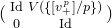 $(\begin{smallmatrix} \textrm{Id}&V(\{{[v_+^p]}/{p}\})\\ 0& \textrm{Id}\end{smallmatrix})$
, where the entry
$(\begin{smallmatrix} \textrm{Id}&V(\{{[v_+^p]}/{p}\})\\ 0& \textrm{Id}\end{smallmatrix})$
, where the entry $V(\{{[v_+^p]}/{p}\})$
in the matrix is viewed as an element of
$V(\{{[v_+^p]}/{p}\})$
in the matrix is viewed as an element of $\operatorname{Hom}_{W_{B\otimes\mathbb{F}_p}}(F_*W_{B\otimes\mathbb{F}_p},W_{B\otimes\mathbb{F}_p}^{(F)})$
via the isomorphism (5.25).
$\operatorname{Hom}_{W_{B\otimes\mathbb{F}_p}}(F_*W_{B\otimes\mathbb{F}_p},W_{B\otimes\mathbb{F}_p}^{(F)})$
via the isomorphism (5.25).
Proof. Recall from (2.19) that the isomorphism $\Psi_{\mathrm{DI}}$
:
$\Psi_{\mathrm{DI}}$
:
 \[\textrm{coker}(W_{B\otimes\mathbb{F}_p}^{(F)}\to W_{B\otimes\mathbb{F}_p}^{(F)}\oplus W_{B\otimes\mathbb{F}_p})\xrightarrow{\sim} W_{B\otimes\mathbb{F}_p}\underset{F_*W_{B\otimes\mathbb{F}_p}}{\times}F_*W_{B\otimes\mathbb{F}_p}=W_{B\otimes\mathbb{F}_p}^{(F)}\oplus F_*W_{B\otimes\mathbb{F}_p}\]
is given by the matrix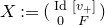 $X:=(\begin{smallmatrix} \textrm{Id} & [v_+]\\ 0& F\end{smallmatrix})$
. Recall from the proof of Theorem 1 that
$X:=(\begin{smallmatrix} \textrm{Id} & [v_+]\\ 0& F\end{smallmatrix})$
. Recall from the proof of Theorem 1 that $\Psi_{\mathrm{Maz}}\otimes\mathbb{F}_p$
is given by
$\Psi_{\mathrm{Maz}}\otimes\mathbb{F}_p$
is given by $Y:=(\begin{smallmatrix} 1& f\\ 0&F\end{smallmatrix})$
, where
$Y:=(\begin{smallmatrix} 1& f\\ 0&F\end{smallmatrix})$
, where $f:=[v_+]-V(\{{[v_+^p]}/{p}\})$
. Our desired lemma amounts to the statement that
$f:=[v_+]-V(\{{[v_+^p]}/{p}\})$
. Our desired lemma amounts to the statement that $\psi Y=X$
. This is immediate from our construction of the isomorphism (5.25).
$\psi Y=X$
. This is immediate from our construction of the isomorphism (5.25).
Corollary 5.11.
The restrictions of $\Psi_{\mathrm{DI}}$
and
$\Psi_{\mathrm{DI}}$
and $\Psi_{\mathrm{Maz}}\otimes\mathbb{F}_p$
to the closed subscheme
$\Psi_{\mathrm{Maz}}\otimes\mathbb{F}_p$
to the closed subscheme $(\operatorname{Spec} k[v_+,v_-]/(v_+^{p-1},v_+v_-))/\mathbb{G}_{m,k}\hookrightarrow (\operatorname{Spec} B\otimes\mathbb{F}_p)/\mathbb{G}_{m,k}$
are equal.
$(\operatorname{Spec} k[v_+,v_-]/(v_+^{p-1},v_+v_-))/\mathbb{G}_{m,k}\hookrightarrow (\operatorname{Spec} B\otimes\mathbb{F}_p)/\mathbb{G}_{m,k}$
are equal.
Proof. This follows from the fact that the image of ${[v_+^p]}/{p}\in W(B)$
inside
${[v_+^p]}/{p}\in W(B)$
inside $W(k[v_+,v_-]/(v_+^{p-1},v_+v_-))$
is zero.
$W(k[v_+,v_-]/(v_+^{p-1},v_+v_-))$
is zero.
Using the construction from Remark 4.5 once again, we obtain a functor
 \begin{equation} \Phi_{\mathrm{DI}}: \mathcal{D}_{qc,[0,p-1]}(W(k)^{syn}_{red})\to\mathscr{D}\mathscr{MF}^{\mathrm{big}}_{[0,p-1]}(W(k))\otimes\mathbb{F}_p.\end{equation}
Corollary 5.12.
The restrictions of $\Phi^{\mathrm{Maz}}_{red}$
and
$\Phi^{\mathrm{Maz}}_{red}$
and $\Phi_{\mathrm{DI}}$
to the subcategory
$\Phi_{\mathrm{DI}}$
to the subcategory $\mathcal{D}_{qc,[0,p-2]}(W(k)^{syn}_{red})$
are isomorphic.
$\mathcal{D}_{qc,[0,p-2]}(W(k)^{syn}_{red})$
are isomorphic.
The following proposition completes the proof of Theorem 3.
Proposition 5.13.
The functor $\Phi_{\mathrm{DI}}$
is an equivalence of categories.
$\Phi_{\mathrm{DI}}$
is an equivalence of categories.
Proof. Let us first outline the argument. Recall from the proof of Lemma 5.7 a fully faithful embedding
 $$\mathcal{D}_{qc} (W(k)^{syn}_{red}) \hookrightarrow \mathcal{D}_{qc}(D_{\mathrm{HT}})\underset{\mathcal{D}_{qc}(D_{und})\times \mathcal{D}_{qc}(D_{Hod})}{\times}\mathcal{D}_{qc}(D_{\mathrm{dR}}).$$
The first part of the proof consists of showing that the restriction $\mathcal{D}_{qc, [0, p-1]} (D_{\mathrm{HT}}) \to \mathcal{D}_{qc, [0, p-1]} (D_{Hod})$
is an equivalence (see Corollary 5.17). This yields a fully faithful embedding
$\mathcal{D}_{qc, [0, p-1]} (D_{\mathrm{HT}}) \to \mathcal{D}_{qc, [0, p-1]} (D_{Hod})$
is an equivalence (see Corollary 5.17). This yields a fully faithful embedding

where $\widetilde{i}_1^*$
is the restriction and T is the composition
$\widetilde{i}_1^*$
is the restriction and T is the composition $B\mathbb{G}_{m, \mathbb{F}_p}^{\sharp} \otimes k \xrightarrow{\textrm{id} \times \textrm{Frob}} B\mathbb{G}_{m, \mathbb{F}_p}^{\sharp} \otimes k \to B\mathbb{G}_{m, k} \to (\mathbb{A}^1_{-}/\mathbb{G}_m) \otimes \mathbb{F}_p$
. Next, we show that pullbacks along
$B\mathbb{G}_{m, \mathbb{F}_p}^{\sharp} \otimes k \xrightarrow{\textrm{id} \times \textrm{Frob}} B\mathbb{G}_{m, \mathbb{F}_p}^{\sharp} \otimes k \to B\mathbb{G}_{m, k} \to (\mathbb{A}^1_{-}/\mathbb{G}_m) \otimes \mathbb{F}_p$
. Next, we show that pullbacks along $\mathfrak{p}_{\bar{\mathrm{dR}}}$
and the inclusion
$\mathfrak{p}_{\bar{\mathrm{dR}}}$
and the inclusion $D_{und} \hookrightarrow D_{\mathrm{dR}}$
induce an equivalence
$D_{und} \hookrightarrow D_{\mathrm{dR}}$
induce an equivalence $\mathcal{D}_{qc, [0, p-1]} (D_{\mathrm{dR}}) \buildrel{\sim}\over{\longrightarrow} \mathcal{D}_{qc, [0, p-1]} ((\mathbb{A}^1_{-}/\mathbb{G}_m) \otimes \mathbb{F}_p) \times_{\mathcal{D}(k)} \mathcal{D}_{qc} (D_{und})$
; see Lemma 5.18. This, together with a category theory result, Lemma 5.19, identifies (5.27) with
$\mathcal{D}_{qc, [0, p-1]} (D_{\mathrm{dR}}) \buildrel{\sim}\over{\longrightarrow} \mathcal{D}_{qc, [0, p-1]} ((\mathbb{A}^1_{-}/\mathbb{G}_m) \otimes \mathbb{F}_p) \times_{\mathcal{D}(k)} \mathcal{D}_{qc} (D_{und})$
; see Lemma 5.18. This, together with a category theory result, Lemma 5.19, identifies (5.27) with

The functor $\Phi_{\mathrm{DI}}$
is isomorphic to (5.28). This proves fully faithfulness of
$\Phi_{\mathrm{DI}}$
is isomorphic to (5.28). This proves fully faithfulness of $\Phi_{\mathrm{DI}}$
. For the essential surjectivity, we use Lemma 2.10.
$\Phi_{\mathrm{DI}}$
. For the essential surjectivity, we use Lemma 2.10.
Let us explain the details. Consider the maps $ (C_2)_{v_-=0}/\mathbb{G}_{m,k}\overset{f'}{\twoheadrightarrow} D_{\mathrm{HT}}=(\mathbb{A}^{1,\mathrm{dR}}_+/\mathbb{G}_m)\otimes\mathbb{F}_p\xrightarrow{f} B\mathbb{G}_{m, k}$
and a section
$ (C_2)_{v_-=0}/\mathbb{G}_{m,k}\overset{f'}{\twoheadrightarrow} D_{\mathrm{HT}}=(\mathbb{A}^{1,\mathrm{dR}}_+/\mathbb{G}_m)\otimes\mathbb{F}_p\xrightarrow{f} B\mathbb{G}_{m, k}$
and a section $B\mathbb{G}_{m, k}=(C_2)_{v_+^p=v_-=0}/\mathbb{G}_{m,k}\overset{g}{\hookrightarrow} (C_2)_{v_-=0}/\mathbb{G}_{m,k}$
. We first show the following.
$B\mathbb{G}_{m, k}=(C_2)_{v_+^p=v_-=0}/\mathbb{G}_{m,k}\overset{g}{\hookrightarrow} (C_2)_{v_-=0}/\mathbb{G}_{m,k}$
. We first show the following.
Lemma 5.14. The pullback functors along f and f’ induce equivalencesFootnote 37
 $$\mathcal{D}_{qc,[0,p-1]}(B\mathbb{G}_{m, k})\xrightarrow{\sim} \mathcal{D}_{qc,[0,p-1]}(D_{\mathrm{HT}})\xrightarrow{\sim} \mathcal{D}_{qc,[0,p-1]}((C_2)_{v_-=0}/\mathbb{G}_{m,k}).$$
The inverse to the composite is given by $g^*$
.
$g^*$
.
Proof. Since $f\circ f' \circ g=\textrm{Id}$
, we have that
$f\circ f' \circ g=\textrm{Id}$
, we have that $g^*\circ {f'}^*\circ f^*\simeq \textrm{Id}$
. Thus, it suffices to check that
$g^*\circ {f'}^*\circ f^*\simeq \textrm{Id}$
. Thus, it suffices to check that $f^*$
and
$f^*$
and ${f'}^* \circ f^*$
are equivalences.
${f'}^* \circ f^*$
are equivalences.
Let us show that $f^*$
is fully faithful. Let us recall from [Reference Bhatt and LurieBL22b, § 6.5.4] that the category
$f^*$
is fully faithful. Let us recall from [Reference Bhatt and LurieBL22b, § 6.5.4] that the category $\mathcal{D}_{qc}(D_{\mathrm{HT}})=\mathcal{D}_{qc}(\mathbb{G}_a^{\mathrm{dR}}/\mathbb{G}_{m,k})$
is identified with the full subcategory
$\mathcal{D}_{qc}(D_{\mathrm{HT}})=\mathcal{D}_{qc}(\mathbb{G}_a^{\mathrm{dR}}/\mathbb{G}_{m,k})$
is identified with the full subcategory $\mathcal{D}_{gr,D^p\text{-nilp}}(k[D^p,v_+^p])$
of the derived category
$\mathcal{D}_{gr,D^p\text{-nilp}}(k[D^p,v_+^p])$
of the derived category $\mathcal{D}_{gr}(k[D^p, v_+^p])$
of graded modules over the polynomial algebra
$\mathcal{D}_{gr}(k[D^p, v_+^p])$
of graded modules over the polynomial algebra $k[D^p,v_+^p]$
with
$k[D^p,v_+^p]$
with $\deg v_+^p=-\deg D^p=p$
. Objects of
$\deg v_+^p=-\deg D^p=p$
. Objects of $\mathcal{D}_{gr,D^p\text{-nilp}}(k[D^p,v_+^p])$
consist of complexes
$\mathcal{D}_{gr,D^p\text{-nilp}}(k[D^p,v_+^p])$
consist of complexes $\mathcal{M}$
such that the action of
$\mathcal{M}$
such that the action of $D^p$
on
$D^p$
on $\bigoplus_iH^i(\mathcal{M})$
is locally nilpotent. The natural map
$\bigoplus_iH^i(\mathcal{M})$
is locally nilpotent. The natural map $\mathbb{G}_a^{\mathrm{dR}} := \mathbb{G}_{a, k}/\mathbb{G}_{a, k}^{\sharp} \to \mathbb{G}_{a, k}/\alpha_p = F_* \mathbb{G}_{a, k}$
coming from the factorization
$\mathbb{G}_a^{\mathrm{dR}} := \mathbb{G}_{a, k}/\mathbb{G}_{a, k}^{\sharp} \to \mathbb{G}_{a, k}/\alpha_p = F_* \mathbb{G}_{a, k}$
coming from the factorization $\mathbb{G}_{a, k}^{\sharp} \to \alpha_p \to \mathbb{G}_{a, k}$
exhibits the source as the
$\mathbb{G}_{a, k}^{\sharp} \to \alpha_p \to \mathbb{G}_{a, k}$
exhibits the source as the $BF_* \mathbb{G}_{a, k}^{\sharp}$
-torsor over the target. A flat lift of
$BF_* \mathbb{G}_{a, k}^{\sharp}$
-torsor over the target. A flat lift of $\mathbb{G}_{a, k}$
to W(k) together with a lift of the Frobenius splits the torsor [Reference Bhatt and LurieBL22b, Remark 5.13]. The standard choice of the Frobenius lift gives a
$\mathbb{G}_{a, k}$
to W(k) together with a lift of the Frobenius splits the torsor [Reference Bhatt and LurieBL22b, Remark 5.13]. The standard choice of the Frobenius lift gives a $\mathbb{G}_{m, k}$
-equivariant equivalence
$\mathbb{G}_{m, k}$
-equivariant equivalence $\mathbb{G}_a^{\mathrm{dR}} \simeq F_*\mathbb{G}_{a, k} \oplus BF_*\mathbb{G}_{a, k}^{\sharp}$
and
$\mathbb{G}_a^{\mathrm{dR}} \simeq F_*\mathbb{G}_{a, k} \oplus BF_*\mathbb{G}_{a, k}^{\sharp}$
and $\mathcal{D}_{qc}((F_*\mathbb{G}_{a, k} \oplus BF_*\mathbb{G}_{a, k}^{\sharp})/\mathbb{G}_{m, k}) \simeq \mathcal{D}_{gr,D^p\text{-nilp}}(k[D^p,v_+^p])$
. Under the equivalence above,
$\mathcal{D}_{qc}((F_*\mathbb{G}_{a, k} \oplus BF_*\mathbb{G}_{a, k}^{\sharp})/\mathbb{G}_{m, k}) \simeq \mathcal{D}_{gr,D^p\text{-nilp}}(k[D^p,v_+^p])$
. Under the equivalence above, $\mathcal{D}_{qc,[0,p-1]}(D_{\mathrm{HT}})$
is identified with the subcategory
$\mathcal{D}_{qc,[0,p-1]}(D_{\mathrm{HT}})$
is identified with the subcategory $\mathcal{D}_{gr,[0,p-1]}(k[v_+^p,D^p])$
of
$\mathcal{D}_{gr,[0,p-1]}(k[v_+^p,D^p])$
of $\mathcal{D}_{gr,D^p\text{-nilp}}(k[D^p,v_+^p])$
that consists of objects
$\mathcal{D}_{gr,D^p\text{-nilp}}(k[D^p,v_+^p])$
that consists of objects $\mathcal{M}=\bigoplus_i\mathcal{M}_i$
with
$\mathcal{M}=\bigoplus_i\mathcal{M}_i$
with $\mathcal{M}_i$
acyclic for
$\mathcal{M}_i$
acyclic for $i\leqslant 0$
and
$i\leqslant 0$
and $\mathrm{cone}(\mathcal{M}_{i-p}\xrightarrow{v_+^p}\mathcal{M}_i)$
acyclic for
$\mathrm{cone}(\mathcal{M}_{i-p}\xrightarrow{v_+^p}\mathcal{M}_i)$
acyclic for $i\geqslant p$
.
$i\geqslant p$
.
The category $\mathcal{D}_{qc,[0,p-1]}(B\mathbb{G}_{m, k})$
is identified with the full subcategory of the derived category
$\mathcal{D}_{qc,[0,p-1]}(B\mathbb{G}_{m, k})$
is identified with the full subcategory of the derived category $\mathcal{D}_{gr}(k)$
of graded complexes
$\mathcal{D}_{gr}(k)$
of graded complexes $C_{\bullet}=\bigoplus_iC_i$
such that for any
$C_{\bullet}=\bigoplus_iC_i$
such that for any $i\notin[0,p-1]$
, the grading degree i component
$i\notin[0,p-1]$
, the grading degree i component $C_i$
is acyclic. Under the above identifications, the functor
$C_i$
is acyclic. Under the above identifications, the functor $f^*$
sends
$f^*$
sends $C_i$
to
$C_i$
to $C_i[v_+^p]:= C_i \otimes_k k[v_{+}^p]$
with the trivial action of
$C_i[v_+^p]:= C_i \otimes_k k[v_{+}^p]$
with the trivial action of $D^p$
. The complex
$D^p$
. The complex $\mathrm{RHom}_{\mathcal{D}_{gr}(k[D^p,v_+^p])}(C_i[v_+^p],C'_j[v_+^p])$
is computed by
$\mathrm{RHom}_{\mathcal{D}_{gr}(k[D^p,v_+^p])}(C_i[v_+^p],C'_j[v_+^p])$
is computed by
 \begin{equation}\mathrm{Fib}(\mathrm{RHom}_{\mathcal{D}_{gr}(k[v_+^p])}(C_i[v_+^p],C'_j[v_+^p])\xrightarrow{\textrm{ad}_{D^p}}\mathrm{RHom}_{\mathcal{D}_{gr}(k[v_+^p])}(C_i[v_+^p],C'_j[v_+^p](-p))),\end{equation}
where $(-p)$
stands for the degree shift, i.e.
$(-p)$
stands for the degree shift, i.e. $\mathcal{M}(-p)_i=\mathcal{M}_{i-p}$
.
$\mathcal{M}(-p)_i=\mathcal{M}_{i-p}$
.
If $i,j\in [0,p-1]$
, then
$i,j\in [0,p-1]$
, then $\mathrm{RHom}_{\mathcal{D}_{gr}(k[v_+^p])}(C_i[v_+^p],C'_j[v_+^p](-p))=0$
, and therefore by (5.29) we get
$\mathrm{RHom}_{\mathcal{D}_{gr}(k[v_+^p])}(C_i[v_+^p],C'_j[v_+^p](-p))=0$
, and therefore by (5.29) we get
 \begin{equation}\mathrm{RHom}_{\mathcal{D}_{gr}(k)}(C_i,C'_j)\xrightarrow{\sim} \mathrm{RHom}_{\mathcal{D}_{gr}(k[v_+^p])}(C_i[v_+^p],C'_j[v_+^p]).\end{equation}
This proves fully faithfulness of $f^*$
. Formula (5.30) shows fully faithfulness of
$f^*$
. Formula (5.30) shows fully faithfulness of ${f'}^* \circ f^*$
.
${f'}^* \circ f^*$
.
Now we show essential surjectivity. It is enough to show that, for every $i\in [0,p-1]$
and
$i\in [0,p-1]$
and $\mathcal{M}\in \mathcal{D}_{gr,[0,p-1]}(k[D^p,v_+^p])$
such that the grading degree i’ part
$\mathcal{M}\in \mathcal{D}_{gr,[0,p-1]}(k[D^p,v_+^p])$
such that the grading degree i’ part $\mathcal{M}_{i'}\in \mathcal{D}(k)$
of
$\mathcal{M}_{i'}\in \mathcal{D}(k)$
of $\mathcal{M}$
is acyclic for
$\mathcal{M}$
is acyclic for $i'\not\equiv i\mod p$
,
$i'\not\equiv i\mod p$
, $\mathcal{M}$
is quasi-isomorphic to
$\mathcal{M}$
is quasi-isomorphic to $\mathcal{M}_i[v_+^p]$
. Let
$\mathcal{M}_i[v_+^p]$
. Let $\tilde{\mathcal{M}}$
be a graded complex of
$\tilde{\mathcal{M}}$
be a graded complex of $k[D^p,v_+^p])$
-modules, representing
$k[D^p,v_+^p])$
-modules, representing $\mathcal{M}$
, such that each term
$\mathcal{M}$
, such that each term $\tilde{\mathcal{M}}^j$
of
$\tilde{\mathcal{M}}^j$
of $\tilde{\mathcal{M}}$
(we use cohomological notation) is a free graded module over
$\tilde{\mathcal{M}}$
(we use cohomological notation) is a free graded module over $k[D^p,v_+^p]$
and the grading degree i’ part
$k[D^p,v_+^p]$
and the grading degree i’ part $\tilde{\mathcal{M}}_{i'}^j\in \mathcal{D}(k)$
of
$\tilde{\mathcal{M}}_{i'}^j\in \mathcal{D}(k)$
of $\tilde{\mathcal{M}}_j$
vanishes for
$\tilde{\mathcal{M}}_j$
vanishes for $i'\not\equiv i\mod p$
.Footnote
38
In particular, the map
$i'\not\equiv i\mod p$
.Footnote
38
In particular, the map $v_+^p:\tilde{\mathcal{M}}_j\to \tilde{\mathcal{M}}_{j+p}$
is a term-wise injective morphism of complexes. Let
$v_+^p:\tilde{\mathcal{M}}_j\to \tilde{\mathcal{M}}_{j+p}$
is a term-wise injective morphism of complexes. Let $\tilde{\mathcal{M}}'$
be a graded complex of
$\tilde{\mathcal{M}}'$
be a graded complex of $k[D^p,v_+^p])$
-modules defined as follows: in each cohomological degree, the graded
$k[D^p,v_+^p])$
-modules defined as follows: in each cohomological degree, the graded $k[D^p,v_+^p]$
-module
$k[D^p,v_+^p]$
-module $\tilde {\mathcal{M}}^{\prime n}$
is a quotient of
$\tilde {\mathcal{M}}^{\prime n}$
is a quotient of $\tilde{\mathcal{M}}^n$
by the submodule generated by
$\tilde{\mathcal{M}}^n$
by the submodule generated by $\tilde{\mathcal{M}}^n_j$
for
$\tilde{\mathcal{M}}^n_j$
for $j\leqslant 0$
. Then the canonical map
$j\leqslant 0$
. Then the canonical map $\tilde{\mathcal{M}}\to \tilde{\mathcal{M}}'$
is a quasi-isomorphism. Since
$\tilde{\mathcal{M}}\to \tilde{\mathcal{M}}'$
is a quasi-isomorphism. Since $\tilde{\mathcal{M}}'_j$
is a term-wise zero complex for
$\tilde{\mathcal{M}}'_j$
is a term-wise zero complex for $i\geqslant j$
, the operator
$i\geqslant j$
, the operator $D^p$
acts trivially on
$D^p$
acts trivially on $\tilde{\mathcal{M}}'_i$
. Hence, there exists a unique morphism of graded complexes of
$\tilde{\mathcal{M}}'_i$
. Hence, there exists a unique morphism of graded complexes of $k[D^p,v_+^p]$
-modules
$k[D^p,v_+^p]$
-modules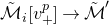 $\tilde{\mathcal{M}}_i[v_+^p]\to \tilde{\mathcal{M}}'$
, which is the canonical projection
$\tilde{\mathcal{M}}_i[v_+^p]\to \tilde{\mathcal{M}}'$
, which is the canonical projection $\tilde{\mathcal{M}}_i\to \tilde{\mathcal{M}}_i/v_+^p\tilde{\mathcal{M}}_{i-p}=\tilde{\mathcal{M}}'_i$
in degree i. By the weight assumption on
$\tilde{\mathcal{M}}_i\to \tilde{\mathcal{M}}_i/v_+^p\tilde{\mathcal{M}}_{i-p}=\tilde{\mathcal{M}}'_i$
in degree i. By the weight assumption on $\mathcal{M}$
, this morphism is a quasi-isomorphism. Thus, we have essential surjectivity of
$\mathcal{M}$
, this morphism is a quasi-isomorphism. Thus, we have essential surjectivity of $f^*$
.
$f^*$
.
Since the map $f': (C_2)_{v_-=0}/\mathbb{G}_{m,k} \to D_{\mathrm{HT}}= B H|_{(C_2)_{v_-=0}/\mathbb{G}_{m,k}}$
has a left inverseFootnote
39
f”, i.e.
$f': (C_2)_{v_-=0}/\mathbb{G}_{m,k} \to D_{\mathrm{HT}}= B H|_{(C_2)_{v_-=0}/\mathbb{G}_{m,k}}$
has a left inverseFootnote
39
f”, i.e. $f'' \circ f' =\textrm{Id}$
, we have the essential surjectivity of
$f'' \circ f' =\textrm{Id}$
, we have the essential surjectivity of $f'^*$
as desired. Since
$f'^*$
as desired. Since $f^*$
is an equivalence and
$f^*$
is an equivalence and $f'^* \circ f^*$
is fully faithful, it implies that
$f'^* \circ f^*$
is fully faithful, it implies that $f'^* \circ f^*$
is an equivalence.
$f'^* \circ f^*$
is an equivalence.
Corollary 5.15.
The pullback along the projection $t:C_2/\mathbb{G}_{m,k}\to \mathbb{A}^1_-/\mathbb{G}_m\otimes\mathbb{F}_p$
induces an equivalence
$t:C_2/\mathbb{G}_{m,k}\to \mathbb{A}^1_-/\mathbb{G}_m\otimes\mathbb{F}_p$
induces an equivalence $t^*: \mathcal{D}_{qc,[0,p-1]}(\mathbb{A}^1_-/\mathbb{G}_m\otimes\mathbb{F}_p)\xrightarrow{\sim} \mathcal{D}_{qc,[0,p-1]}(C_2/\mathbb{G}_{m,k})$
.
$t^*: \mathcal{D}_{qc,[0,p-1]}(\mathbb{A}^1_-/\mathbb{G}_m\otimes\mathbb{F}_p)\xrightarrow{\sim} \mathcal{D}_{qc,[0,p-1]}(C_2/\mathbb{G}_{m,k})$
.
Proof. Using [Reference LurieLur18b, Theorem 16.2.0.2], the category $\mathcal{D}_{qc,[0,p-1]}(C_2/\mathbb{G}_{m,k})$
is a full subcategory of the fibre product
$\mathcal{D}_{qc,[0,p-1]}(C_2/\mathbb{G}_{m,k})$
is a full subcategory of the fibre product
 \[\mathcal{D}_{qc,[0,p-1]}((C_2)_{v_-=0}/\mathbb{G}_{m,k}){\times}_{{\mathcal{D}_{qc,[0,p-1]}((C_2)_{v_+^p=v_-=0}/\mathbb{G}_{m,k})}}\mathcal{D}_{qc,[0,p-1]}((C_2)_{v_+^p=0}/\mathbb{G}_{m,k}).\]
By Lemma 5.14, composition of $t^*$
with the above embedding is an equivalence.
$t^*$
with the above embedding is an equivalence.
Lemma 5.16. The pullback along the composition $D_{Hod}\hookrightarrow D_{\mathrm{HT}}\to B\mathbb{G}_{m, k}$
induces an equivalence of categories
$D_{Hod}\hookrightarrow D_{\mathrm{HT}}\to B\mathbb{G}_{m, k}$
induces an equivalence of categories $\mathcal{D}_{qc,[0,p-1]}(B\mathbb{G}_{m, k})\xrightarrow{\sim} \mathcal{D}_{qc,[0,p-1]}(D_{Hod})$
.
$\mathcal{D}_{qc,[0,p-1]}(B\mathbb{G}_{m, k})\xrightarrow{\sim} \mathcal{D}_{qc,[0,p-1]}(D_{Hod})$
.
Proof. Recall from [Reference BhattBha23, § 6.5] that $\mathcal{D}_{qc}(D_{Hod})$
is identified with the full subcategory
$\mathcal{D}_{qc}(D_{Hod})$
is identified with the full subcategory $\mathcal{D}_{gr,\Theta\text{-nilp}}(k[\Theta])$
of
$\mathcal{D}_{gr,\Theta\text{-nilp}}(k[\Theta])$
of $\mathcal{D}_{gr}(k[\Theta])$
that consists of objects
$\mathcal{D}_{gr}(k[\Theta])$
that consists of objects $\mathcal{M}$
such that the action of
$\mathcal{M}$
such that the action of $\Theta$
on
$\Theta$
on $\bigoplus_i H^i(\mathcal{M})$
is locally nilpotent. Under this identification, the pullback functor
$\bigoplus_i H^i(\mathcal{M})$
is locally nilpotent. Under this identification, the pullback functor $\mathcal{D}_{qc}(B\mathbb{G}_{m, k})\to \mathcal{D}_{qc}(D_{Hod})$
sends the graded complex
$\mathcal{D}_{qc}(B\mathbb{G}_{m, k})\to \mathcal{D}_{qc}(D_{Hod})$
sends the graded complex $C_{\cdot}=\oplus C_i$
to
$C_{\cdot}=\oplus C_i$
to $C_{\cdot}$
with a trivial action of
$C_{\cdot}$
with a trivial action of $\Theta$
. The rest is straightforward.
$\Theta$
. The rest is straightforward.
To see fully faithfulness, we have
 \[\mathrm{RHom}_{\mathcal{D}_{gr}(k[\Theta])}(C_i,C_j)=\mathrm{Fib}(\mathrm{RHom}_{\mathcal{D}_{gr}(k)}(C_i,C_j)\xrightarrow{\textrm{ad}_{\Theta}=0} \mathrm{RHom}_{\mathcal{D}_{gr}(k)}(C_i,C_j(-p))).\]
For $i,j\in [0,p-1]$
, we have
$i,j\in [0,p-1]$
, we have $\mathrm{RHom}_{\mathcal{D}_{gr}(k)}(C_i,C_j(-p))=0$
. Fully faithfulness follows.
$\mathrm{RHom}_{\mathcal{D}_{gr}(k)}(C_i,C_j(-p))=0$
. Fully faithfulness follows.
To see essential surjectivity, observe that every $\mathcal{M}\in\mathcal{D}_{qc,[0,p-1]}(D_{Hod})$
can be represented by a complex of graded
$\mathcal{M}\in\mathcal{D}_{qc,[0,p-1]}(D_{Hod})$
can be represented by a complex of graded $k[\Theta]$
-modules with the trivial action of
$k[\Theta]$
-modules with the trivial action of $\Theta$
.
$\Theta$
.
Combining the previous two lemmas, we obtain the following.
Corollary 5.17. The pullback along the closed embedding $D_{Hod}\hookrightarrow D_{\mathrm{HT}}$
induces an equivalence
$D_{Hod}\hookrightarrow D_{\mathrm{HT}}$
induces an equivalence $\mathcal{D}_{qc,[0,p-1]}(D_{\mathrm{HT}})\xrightarrow{\sim}\mathcal{D}_{qc,[0,p-1]}(D_{Hod})$
. The restriction to the open substack
$\mathcal{D}_{qc,[0,p-1]}(D_{\mathrm{HT}})\xrightarrow{\sim}\mathcal{D}_{qc,[0,p-1]}(D_{Hod})$
. The restriction to the open substack $\mathcal{D}_{qc,[0,p-1]}(D_{\mathrm{HT}})\to \mathcal{D}_{qc}(D_{und})$
is isomorphic to the composition
$\mathcal{D}_{qc,[0,p-1]}(D_{\mathrm{HT}})\to \mathcal{D}_{qc}(D_{und})$
is isomorphic to the composition
 \[\mathcal{D}_{qc,[0,p-1]}(D_{\mathrm{HT}})\to\mathcal{D}_{qc}(D_{Hod})\to\mathcal{D}_{qc}(B\mathbb{G}_{m, k})\to \mathcal{D}_{qc}(D_{und}),\]
which is induced by pullback along $D_{und}=B\mathbb{G}_{m, k}^{\sharp}\to B\mathbb{G}_{m, k}\to D_{Hod}\hookrightarrow D_{\mathrm{HT}}$
.Footnote
40
$D_{und}=B\mathbb{G}_{m, k}^{\sharp}\to B\mathbb{G}_{m, k}\to D_{Hod}\hookrightarrow D_{\mathrm{HT}}$
.Footnote
40
Proof. We just need to explain the second assertion. Note that the post-composition of $D_{und} \to B\mathbb{G}_{m, k} \to D_{Hod} \hookrightarrow D_{\mathrm{HT}}$
with
$D_{und} \to B\mathbb{G}_{m, k} \to D_{Hod} \hookrightarrow D_{\mathrm{HT}}$
with $D_{\mathrm{HT}} \to B\mathbb{G}_{m, k}$
is isomorphic to the standard map
$D_{\mathrm{HT}} \to B\mathbb{G}_{m, k}$
is isomorphic to the standard map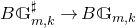 $B\mathbb{G}_{m, k}^{\sharp} \to B\mathbb{G}_{m, k}$
. The same is true for the open immersion
$B\mathbb{G}_{m, k}^{\sharp} \to B\mathbb{G}_{m, k}$
. The same is true for the open immersion $D_{und} \to D_{\mathrm{HT}}$
. This is enough since
$D_{und} \to D_{\mathrm{HT}}$
. This is enough since $f^*: \mathcal{D}_{qc, [0, p-1]}(B\mathbb{G}_{m, k}) \to \mathcal{D}_{qc, [0, p-1]}(D_{\mathrm{HT}})$
is an equivalence by Lemma 5.14.
$f^*: \mathcal{D}_{qc, [0, p-1]}(B\mathbb{G}_{m, k}) \to \mathcal{D}_{qc, [0, p-1]}(D_{\mathrm{HT}})$
is an equivalence by Lemma 5.14.
Lemma 5.18. The commutative diagram of stacks

induces an equivalence of categories
 \begin{equation} \mathcal{L}: \mathcal{D}_{qc,[0,p-1]}(D_{\mathrm{dR}})\xrightarrow{\sim}\mathcal{D}_{qc,[0,p-1]}((\mathbb{A}^1_-/\mathbb{G}_m) \otimes \mathbb{F}_p) \times_{\mathcal{D}(k)}\mathcal{D}_{qc}(D_{und}), \end{equation}
where $\mathcal{D}(k)$
is identified with
$\mathcal{D}(k)$
is identified with $\mathcal{D}_{qc}(((\mathbb{A}^1_-\setminus \{0\})/\mathbb{G}_m) \otimes \mathbb{F}_p)$
.
$\mathcal{D}_{qc}(((\mathbb{A}^1_-\setminus \{0\})/\mathbb{G}_m) \otimes \mathbb{F}_p)$
.
Proof. To show fully faithfulness of the functor (5.32), we use the embedding $\mathcal{D}_{qc}(D_{\mathrm{dR}})\hookrightarrow\mathcal{D}_{gr}(k[v_-,\Theta])$
as in the proof of Lemma 5.7 and the references therein. For
$\mathcal{D}_{qc}(D_{\mathrm{dR}})\hookrightarrow\mathcal{D}_{gr}(k[v_-,\Theta])$
as in the proof of Lemma 5.7 and the references therein. For $\mathcal{F},\mathcal{F}'\in \mathcal{D}_{qc,[0,p-1]}(D_{\mathrm{dR}})$
, let
$\mathcal{F},\mathcal{F}'\in \mathcal{D}_{qc,[0,p-1]}(D_{\mathrm{dR}})$
, let $F,F'\in\mathcal{D}_{gr,[0,p-1]}(k[v_-,\Theta])$
be the corresponding graded modules. We have
$F,F'\in\mathcal{D}_{gr,[0,p-1]}(k[v_-,\Theta])$
be the corresponding graded modules. We have
 \[\mathrm{RHom}(F',F)=\mathrm{Fib}(\mathrm{RHom}_{\mathcal{D}_{gr}(k[v_-])}(F',F)\xrightarrow{\textrm{ad}_{\Theta}}\mathrm{RHom}_{\mathcal{D}_{gr}(k[v_-])}(F',F(-p))).\]
On the other hand,
 \[\mathrm{RHom}(\mathcal{L}F',\mathcal{L}F)=\mathrm{Fib}(\mathrm{RHom}_{\mathcal{D}_{gr}(k[v_-])}(F',F)\xrightarrow{\textrm{ad}_{\Theta}}\mathrm{RHom}_{\mathcal{D}_{gr}(k[v_-])}(\overline{j}^*F',\overline{j}^*F(-p))).\]
Using (5.15) and the assumption on weights, the morphism
 $$\overline{j}^*:\mathrm{RHom}_{\mathcal{D}_{gr}(k[v_-])}(F',F(-p)) \to \mathrm{RHom}_{\mathcal{D}_{gr}(k[v_-])}(\overline{j}^*F',\overline{j}^*F(-p))$$
is an isomorphism. This proves fully faithfulness of $\mathcal{L}$
.
$\mathcal{L}$
.
To show essential surjectivity, observe that any object of the right-hand side of (5.32) can be represented by a complex $F=\bigoplus F^i$
of graded
$F=\bigoplus F^i$
of graded $k[v_-]$
-modules, where
$k[v_-]$
-modules, where $F^i$
is term-wise zero for
$F^i$
is term-wise zero for $i\geqslant p$
, and the map
$i\geqslant p$
, and the map $v_-: F^i\to F^{i-1}$
is a term-wise isomorphism for
$v_-: F^i\to F^{i-1}$
is a term-wise isomorphism for $i\leqslant 0$
, together with a
$i\leqslant 0$
, together with a $\theta: F^0\to F^0$
. Then there exists a unique
$\theta: F^0\to F^0$
. Then there exists a unique $\Theta:F^{\bullet}\to F^{\bullet-p}$
that commutes with
$\Theta:F^{\bullet}\to F^{\bullet-p}$
that commutes with $v_-$
and such that
$v_-$
and such that $\Theta:F^0\to F^{-p}$
is precisely
$\Theta:F^0\to F^{-p}$
is precisely $v_-^p\theta$
. This proves essential surjectivity as desired.
$v_-^p\theta$
. This proves essential surjectivity as desired.
Let us return to the proof of the proposition. Consider the following maps.

The equalizer in the first row is precisely the category $\mathscr{DMF}^{\mathrm{big}}_{[0,p-1]}(W(k))\otimes\mathbb{F}_p$
from Definition 2.6. The two horizontal arrows in the second row are given by the restriction to the point
$\mathscr{DMF}^{\mathrm{big}}_{[0,p-1]}(W(k))\otimes\mathbb{F}_p$
from Definition 2.6. The two horizontal arrows in the second row are given by the restriction to the point $(v_+^p=0, v_-=1)$
, and the restriction to the point
$(v_+^p=0, v_-=1)$
, and the restriction to the point $(v_+^p=1,v_-=0)$
post-composed with the Frobenius. The downward arrows induce an equivalence of equalizers by Corollary 5.15. The equalizer at the bottom arrow is
$(v_+^p=1,v_-=0)$
post-composed with the Frobenius. The downward arrows induce an equivalence of equalizers by Corollary 5.15. The equalizer at the bottom arrow is $\mathcal{D}_{qc,[0,p-1]}(W(k)^{syn}_{red})$
. The functor
$\mathcal{D}_{qc,[0,p-1]}(W(k)^{syn}_{red})$
. The functor $\Phi_{\mathrm{DI}}$
can be interpreted as the composition of the upward map on equalizers composed with the inverse of the downward equivalence on equalizers. Thus, it remains to check that the upward map on equalizers is an equivalence.Recall (cf. Lemma 2.9) that the category
$\Phi_{\mathrm{DI}}$
can be interpreted as the composition of the upward map on equalizers composed with the inverse of the downward equivalence on equalizers. Thus, it remains to check that the upward map on equalizers is an equivalence.Recall (cf. Lemma 2.9) that the category $\mathcal{D}_{qc,[0,p-1]}(W(k)^{syn}_{red})$
is a full subcategory of the fibre product
$\mathcal{D}_{qc,[0,p-1]}(W(k)^{syn}_{red})$
is a full subcategory of the fibre product
 \begin{equation}\mathcal{C}:= \mathcal{D}_{qc,[0,p-1]}(D_{\mathrm{HT}})\underset{\mathcal{D}_{qc}(D_{und})\times \mathcal{D}_{qc}(D_{Hod})}{\times}\mathcal{D}_{qc,[0,p-1]}(D_{\mathrm{dR}}),\end{equation}
where the functors $\mathcal{D}_{qc}(D_{\mathrm{HT}}),\; \mathcal{D}_{qc}(D_{\mathrm{dR}}) \to \mathcal{D}_{qc}(D_{Hod})$
and
$\mathcal{D}_{qc}(D_{\mathrm{HT}}),\; \mathcal{D}_{qc}(D_{\mathrm{dR}}) \to \mathcal{D}_{qc}(D_{Hod})$
and $\mathcal{D}_{qc}(D_{\mathrm{dR}})\to \mathcal{D}_{qc}(D_{und})$
are given by the W(k)-linear embeddings of underlying stacks; the functor
$\mathcal{D}_{qc}(D_{\mathrm{dR}})\to \mathcal{D}_{qc}(D_{und})$
are given by the W(k)-linear embeddings of underlying stacks; the functor $\mathcal{D}_{qc}(D_{\mathrm{HT}})\to \mathcal{D}_{qc}(D_{und})$
is the pullback along the morphism (cf. the end of § 2.3)
$\mathcal{D}_{qc}(D_{\mathrm{HT}})\to \mathcal{D}_{qc}(D_{und})$
is the pullback along the morphism (cf. the end of § 2.3)
 $$ D_{und}= B\mathbb{G}_{m, \mathbb{F}_p}^{\sharp} \otimes k \xrightarrow{\textrm{id} \times \textrm{Frob}}B\mathbb{G}_{m, \mathbb{F}_p}^{\sharp}\otimes k= D_{und}\hookrightarrow D_{\mathrm{HT}}. $$
In Corollary 5.17, we showed that the restriction functor $\mathcal{D}_{qc, [0, p-1]}(D_{\mathrm{HT}})\to \mathcal{D}_{qc, [0, p-1]}(D_{Hod})$
is an equivalence and described explicitly its inverse composed with the other restriction
$\mathcal{D}_{qc, [0, p-1]}(D_{\mathrm{HT}})\to \mathcal{D}_{qc, [0, p-1]}(D_{Hod})$
is an equivalence and described explicitly its inverse composed with the other restriction $\mathcal{D}_{qc, [0, p-1]}(D_{\mathrm{HT}})\to \mathcal{D}_{qc, [0, p-1]}(D_{und})$
. Using this result, we obtain the following description of
$\mathcal{D}_{qc, [0, p-1]}(D_{\mathrm{HT}})\to \mathcal{D}_{qc, [0, p-1]}(D_{und})$
. Using this result, we obtain the following description of $\mathcal{C}$
:
$\mathcal{C}$
:

Here $\widetilde{i}_1^*$
is the restriction along the open embedding
$\widetilde{i}_1^*$
is the restriction along the open embedding $\widetilde{i}_1: D_{und}\hookrightarrow D_{\mathrm{dR}}$
, and
$\widetilde{i}_1: D_{und}\hookrightarrow D_{\mathrm{dR}}$
, and $\mathfrak{p}_{\bar{\mathrm{dR}}}^*$
is the pullback along
$\mathfrak{p}_{\bar{\mathrm{dR}}}^*$
is the pullback along $ \mathfrak{p}_{\bar{\mathrm{dR}}}:(\mathbb{A}^1_-/\mathbb{G}_m)\otimes\mathbb{F}_p\hookrightarrow D_{\mathrm{dR}}$
, and
$ \mathfrak{p}_{\bar{\mathrm{dR}}}:(\mathbb{A}^1_-/\mathbb{G}_m)\otimes\mathbb{F}_p\hookrightarrow D_{\mathrm{dR}}$
, and $T^*$
is the pullback along the composition
$T^*$
is the pullback along the composition $T: B\mathbb{G}_{m, \mathbb{F}_p}^{\sharp} \otimes k \xrightarrow{\textrm{id} \times \textrm{Frob}}B\mathbb{G}_{m,\mathbb{F}_p}^{\sharp} \otimes k \to B\mathbb{G}_{m,k}\to (\mathbb{A}^1_-/\mathbb{G}_m)\otimes\mathbb{F}_p$
.
$T: B\mathbb{G}_{m, \mathbb{F}_p}^{\sharp} \otimes k \xrightarrow{\textrm{id} \times \textrm{Frob}}B\mathbb{G}_{m,\mathbb{F}_p}^{\sharp} \otimes k \to B\mathbb{G}_{m,k}\to (\mathbb{A}^1_-/\mathbb{G}_m)\otimes\mathbb{F}_p$
.
The functor $\Phi_{\mathrm{DI}}$
factors through (5.35) and the pullback functor
$\Phi_{\mathrm{DI}}$
factors through (5.35) and the pullback functor

induced by $\mathfrak{p}_{\bar{\mathrm{dR}}}$
and
$\mathfrak{p}_{\bar{\mathrm{dR}}}$
and $q: \operatorname{Spec} k\to B\mathbb{G}_{m, k}^{\sharp}$
is the map classifying the trivial
$q: \operatorname{Spec} k\to B\mathbb{G}_{m, k}^{\sharp}$
is the map classifying the trivial $\mathbb{G}_{m, k}^\sharp$
-torsor. Note that
$\mathbb{G}_{m, k}^\sharp$
-torsor. Note that $T \circ q = i_0 \circ F$
and, thus, the equalizer on the right-hand side of (5.36) is precisely the category
$T \circ q = i_0 \circ F$
and, thus, the equalizer on the right-hand side of (5.36) is precisely the category $\mathscr{DMF}^{\mathrm{big}}_{[0,p-1]}(W(k))\otimes\mathbb{F}_p$
. Lemma 5.18, together with the following easy Lemma 5.19, shows that the functor (5.36) is an equivalence.
$\mathscr{DMF}^{\mathrm{big}}_{[0,p-1]}(W(k))\otimes\mathbb{F}_p$
. Lemma 5.18, together with the following easy Lemma 5.19, shows that the functor (5.36) is an equivalence.
Lemma 5.19. Let the following

be a pullback square of $\infty$
-categories, and let
$\infty$
-categories, and let $F:\mathcal{C}_1\to \mathcal{C}_2$
be a functor (not necessarily commuting with
$F:\mathcal{C}_1\to \mathcal{C}_2$
be a functor (not necessarily commuting with $p_1$
and
$p_1$
and $p_2$
). Then the equalizers are equivalent:
$p_2$
). Then the equalizers are equivalent:

The functor from left to right is given by sending
 . The functor from right to left is given by sending
 .
.
Proof. This is immediate.
Combining (5.35) and equivalence (5.36), we conclude that $\Phi_{\mathrm{DI}}$
is the composition of a fully faithful embedding into the fibre product category and an equivalence:
$\Phi_{\mathrm{DI}}$
is the composition of a fully faithful embedding into the fibre product category and an equivalence:
 \begin{equation} \mathcal{D}_{qc,[0,p-1]}(W(k)^{syn}_{red})\hookrightarrow \mathcal{C} \buildrel{\sim}\over{\longrightarrow} \mathscr{DMF}^{\mathrm{big}}_{[0,p-1]}(W(k))\otimes\mathbb{F}_p.\end{equation}
It remains to prove that the composition is essentially surjective. Given any $(\mathcal{M}, \varphi) \in \mathscr{DMF}^{\mathrm{big}}_{[0,p-1]}(W(k))\otimes\mathbb{F}_p$
, let
$(\mathcal{M}, \varphi) \in \mathscr{DMF}^{\mathrm{big}}_{[0,p-1]}(W(k))\otimes\mathbb{F}_p$
, let $\mathcal{F}$
be the corresponding object of
$\mathcal{F}$
be the corresponding object of $\mathcal{C}$
. By Lemma 2.10, it is enough to check that the pullback of
$\mathcal{C}$
. By Lemma 2.10, it is enough to check that the pullback of $\mathcal{F}$
to
$\mathcal{F}$
to $\mathcal{D}_{qc}((C_2)_{v_-=0}/\mathbb{G}_m){\times}_{\mathcal{D}_{qc}((C_2)_{v_+^p=v_-=0}/\mathbb{G}_m)}\mathcal{D}_{qc}((C_2)_{v_+^p=0}/\mathbb{G}_m)$
lies in
$\mathcal{D}_{qc}((C_2)_{v_-=0}/\mathbb{G}_m){\times}_{\mathcal{D}_{qc}((C_2)_{v_+^p=v_-=0}/\mathbb{G}_m)}\mathcal{D}_{qc}((C_2)_{v_+^p=0}/\mathbb{G}_m)$
lies in $\mathcal{D}_{qc}(C_2/\mathbb{G}_m)$
. But by diagram (5.33), the pullback of
$\mathcal{D}_{qc}(C_2/\mathbb{G}_m)$
. But by diagram (5.33), the pullback of $\mathcal{F}$
is isomorphic to
$\mathcal{F}$
is isomorphic to $t^* \mathcal{M} \in \mathcal{D}_{qc}(C_2/\mathbb{G}_m)$
. This completes the proof of Proposition 5.13 as well as the proof of equivalence (5.1).
$t^* \mathcal{M} \in \mathcal{D}_{qc}(C_2/\mathbb{G}_m)$
. This completes the proof of Proposition 5.13 as well as the proof of equivalence (5.1).
Remark 5.20. Note that in Step 3, the only result that uses the fact that weights are in $[0, p-2]$
and not merely in
$[0, p-2]$
and not merely in $[0, p-1]$
, is Corollary 5.12. Moreover, the corollary is not true without this assumption on weights; see Remark 5.23 for an explanation. We also note that this assumption is essential for (5.8), i.e. to show that the restriction
$[0, p-1]$
, is Corollary 5.12. Moreover, the corollary is not true without this assumption on weights; see Remark 5.23 for an explanation. We also note that this assumption is essential for (5.8), i.e. to show that the restriction $\mathcal{D}_{qc, [0, p-2]}(W(k)^{syn} \otimes \mathbb{F}_p) \to \mathcal{D}_{qc, [0, p-2]} (W(k)^{syn}_{red})$
is an equivalence. However, it is only needed in the first step of the deformation argument, i.e. to deform from
$\mathcal{D}_{qc, [0, p-2]}(W(k)^{syn} \otimes \mathbb{F}_p) \to \mathcal{D}_{qc, [0, p-2]} (W(k)^{syn}_{red})$
is an equivalence. However, it is only needed in the first step of the deformation argument, i.e. to deform from $W(k)_{red}^{syn}$
to
$W(k)_{red}^{syn}$
to $(W(k)^{syn} \otimes \mathbb{F}_p)_{v_{1}^2 =0}$
. In particular, the restriction
$(W(k)^{syn} \otimes \mathbb{F}_p)_{v_{1}^2 =0}$
. In particular, the restriction $\mathcal{D}_{qc, [0, p-1]} ((W(k)^{syn} \otimes \mathbb{F}_p)_{v_1^3 = 0}) \to \mathcal{D}_{qc, [0, p-1]} ((W(k)^{syn} \otimes \mathbb{F}_p)_{v_1^2 = 0})$
is an equivalence.
$\mathcal{D}_{qc, [0, p-1]} ((W(k)^{syn} \otimes \mathbb{F}_p)_{v_1^3 = 0}) \to \mathcal{D}_{qc, [0, p-1]} ((W(k)^{syn} \otimes \mathbb{F}_p)_{v_1^2 = 0})$
is an equivalence.
End of proof of Theorem 3. Since perfectness is preserved under pullbacks, the functor $\Phi_{\mathrm{Maz}}$
restricts to
$\Phi_{\mathrm{Maz}}$
restricts to
 $$\operatorname{Perf}_{[0,p-1]}(W(k)^{syn}) \to \mathcal{D}^b(\mathscr{MF}_{[0,p-1]}(W(k))).$$
To prove (5.2) we have to show that, for every $\mathcal{F} \in \operatorname{Perf}_{[0,p-2]}(W(k)^{syn})$
, the object
$\mathcal{F} \in \operatorname{Perf}_{[0,p-2]}(W(k)^{syn})$
, the object $\mathcal{M}:= \Phi_{\mathrm{Maz}}(\mathcal{F})\in \mathcal{D}^b(\mathscr{MF}_{[0,p-2]}(W(k)))$
is perfect. It suffices to check that the pullback of
$\mathcal{M}:= \Phi_{\mathrm{Maz}}(\mathcal{F})\in \mathcal{D}^b(\mathscr{MF}_{[0,p-2]}(W(k)))$
is perfect. It suffices to check that the pullback of $\Phi_{\mathrm{Maz}}(\mathcal{F})$
to
$\Phi_{\mathrm{Maz}}(\mathcal{F})$
to $W(k)^{\mathcal{N}}_{red}$
is perfect. Moreover, since the map
$W(k)^{\mathcal{N}}_{red}$
is perfect. Moreover, since the map $C_2/\mathbb{G}_{m,k} \to W(k)^{\mathcal{N}}_{red}$
is faithfully flat (see [Reference DrinfeldDri24, 7.7.1]), it suffices to check that the pullback of
$C_2/\mathbb{G}_{m,k} \to W(k)^{\mathcal{N}}_{red}$
is faithfully flat (see [Reference DrinfeldDri24, 7.7.1]), it suffices to check that the pullback of $\Phi_{\mathrm{Maz}}(\mathcal{F})$
to
$\Phi_{\mathrm{Maz}}(\mathcal{F})$
to $C_2/\mathbb{G}_{m, k}$
is perfect. But the latter is isomorphic to the pullback of
$C_2/\mathbb{G}_{m, k}$
is perfect. But the latter is isomorphic to the pullback of $\mathcal{M}$
along the composition
$\mathcal{M}$
along the composition $C_2/\mathbb{G}_{m,k} \to \mathbb{A}_-^1/\mathbb{G}_m \otimes \mathbb{F}_p \hookrightarrow \mathbb{A}_-^1/\mathbb{G}_m$
. Indeed, both these maps
$C_2/\mathbb{G}_{m,k} \to \mathbb{A}_-^1/\mathbb{G}_m \otimes \mathbb{F}_p \hookrightarrow \mathbb{A}_-^1/\mathbb{G}_m$
. Indeed, both these maps $C_2/\mathbb{G}_{m,k} \to \mathbb{A}^1_{-}/\mathbb{G}_m$
send a triple
$C_2/\mathbb{G}_{m,k} \to \mathbb{A}^1_{-}/\mathbb{G}_m$
send a triple $(L, v_{-}: L \to R, u: R \to L^{\otimes p}) \in C_2/\mathbb{G}_{m,k}(R)$
as in (5.23) to
$(L, v_{-}: L \to R, u: R \to L^{\otimes p}) \in C_2/\mathbb{G}_{m,k}(R)$
as in (5.23) to $(v_{-}: L \to R) \in \mathbb{A}^1_{-}/\mathbb{G}_m(R)$
. This proves (5.2).
$(v_{-}: L \to R) \in \mathbb{A}^1_{-}/\mathbb{G}_m(R)$
. This proves (5.2).
Let us prove the last assertion of Theorem 3. Recall from [Reference BhattBha23] that every coherent sheaf on $W(k)^{syn}$
is perfect. In particular,
$W(k)^{syn}$
is perfect. In particular, $\Phi_{\mathrm{Maz}}$
carries
$\Phi_{\mathrm{Maz}}$
carries $ \operatorname{Coh}_{[0,p-1]}(W(k)^{syn}) $
into
$ \operatorname{Coh}_{[0,p-1]}(W(k)^{syn}) $
into $\mathcal{D}^b(\mathscr{MF}_{[0,p-1]}(W(k)))$
. Let
$\mathcal{D}^b(\mathscr{MF}_{[0,p-1]}(W(k)))$
. Let $\mathcal{M} \in \mathscr{MF}_{[0,p-2]}(W(k))$
with
$\mathcal{M} \in \mathscr{MF}_{[0,p-2]}(W(k))$
with $p \mathcal{M}=0$
. We claim that
$p \mathcal{M}=0$
. We claim that $E:=\Phi_{\mathrm{Maz}}^{-1}(\mathcal{M})$
is a vector bundle over
$E:=\Phi_{\mathrm{Maz}}^{-1}(\mathcal{M})$
is a vector bundle over $W(k)^{syn}\otimes \mathbb{F}_p$
. Since
$W(k)^{syn}\otimes \mathbb{F}_p$
. Since $W(k)^{\mathcal{N}}\otimes \mathbb{F}_p \to W(k)^{syn}\otimes \mathbb{F}_p$
is an étale cover it suffices to verify that the pullback of E to
$W(k)^{\mathcal{N}}\otimes \mathbb{F}_p \to W(k)^{syn}\otimes \mathbb{F}_p$
is an étale cover it suffices to verify that the pullback of E to $W(k)^{\mathcal{N}}\otimes \mathbb{F}_p$
is a vector bundle. An object of
$W(k)^{\mathcal{N}}\otimes \mathbb{F}_p$
is a vector bundle. An object of $\mathcal{D}_{qc}(W(k)^{\mathcal{N}}\otimes \mathbb{F}_p)$
is a vector bundle if and only if its pullback to
$\mathcal{D}_{qc}(W(k)^{\mathcal{N}}\otimes \mathbb{F}_p)$
is a vector bundle if and only if its pullback to $W(k)^{\mathcal{N}}_{red}$
is a vector bundle. Since the morphism
$W(k)^{\mathcal{N}}_{red}$
is a vector bundle. Since the morphism $C_2/\mathbb{G}_m \to W(k)^{\mathcal{N}}_{red}$
is faithfully flat, it is enough to show the assertion for the pullback of E to
$C_2/\mathbb{G}_m \to W(k)^{\mathcal{N}}_{red}$
is faithfully flat, it is enough to show the assertion for the pullback of E to $C_2/\mathbb{G}_m$
. But the latter is the pullback
$C_2/\mathbb{G}_m$
. But the latter is the pullback $\mathcal{M}$
under
$\mathcal{M}$
under $C_2/\mathbb{G}_m \to \mathbb{A}_-^1/\mathbb{G}_m \otimes \mathbb{F}_p$
. Now the claim follows from Proposition 2.7(2).
$C_2/\mathbb{G}_m \to \mathbb{A}_-^1/\mathbb{G}_m \otimes \mathbb{F}_p$
. Now the claim follows from Proposition 2.7(2).
By dévissage, we infer that $\Phi_{\mathrm{Maz}}^{-1}(\mathcal{M})\in \operatorname{Coh}_{[0,p-2]}(W(k)^{syn})$
for every
$\Phi_{\mathrm{Maz}}^{-1}(\mathcal{M})\in \operatorname{Coh}_{[0,p-2]}(W(k)^{syn})$
for every $\mathcal{M} \in \mathscr{MF}_{[0,p-2]}(W(k))$
. Thus, the functor
$\mathcal{M} \in \mathscr{MF}_{[0,p-2]}(W(k))$
. Thus, the functor $\Phi_{\mathrm{Maz}}^{-1}:\mathcal{D}^b(\mathscr{MF}_{[0,p-2]}(W(k))) \to\mathcal{D}_{qc}(W(k)^{syn})$
is t-exact. Moreover, as we just observed, its essential image contains
$\Phi_{\mathrm{Maz}}^{-1}:\mathcal{D}^b(\mathscr{MF}_{[0,p-2]}(W(k))) \to\mathcal{D}_{qc}(W(k)^{syn})$
is t-exact. Moreover, as we just observed, its essential image contains $ \operatorname{Coh}_{[0,p-2]}(W(k)^{syn})$
. This completes the proof.
$ \operatorname{Coh}_{[0,p-2]}(W(k)^{syn})$
. This completes the proof.
Remark 5.21. The functor $\Phi_{\mathrm{Maz}}$
is not an equivalence. Indeed, there exists a nonzero morphism
$\Phi_{\mathrm{Maz}}$
is not an equivalence. Indeed, there exists a nonzero morphism $v_1: \mathcal{O}_{W(k)^{syn}}\otimes\mathbb{F}_p \to \mathcal{O}_{W(k)^{syn}}\{p-1\}\otimes\mathbb{F}_p$
whose restriction to
$v_1: \mathcal{O}_{W(k)^{syn}}\otimes\mathbb{F}_p \to \mathcal{O}_{W(k)^{syn}}\{p-1\}\otimes\mathbb{F}_p$
whose restriction to $W(k)^{syn}_{red}$
is equal to 0. Since the functor
$W(k)^{syn}_{red}$
is equal to 0. Since the functor $\Phi_{\mathrm{Maz}}\otimes\mathbb{F}_p$
factors through the restriction to the reduced locus (see (5.22)) we conclude that
$\Phi_{\mathrm{Maz}}\otimes\mathbb{F}_p$
factors through the restriction to the reduced locus (see (5.22)) we conclude that $\Phi_{\mathrm{Maz}}(v_1)=0$
.
$\Phi_{\mathrm{Maz}}(v_1)=0$
.
Remark 5.22. The last part of the proof of Theorem 3 shows that every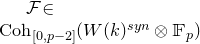 $\mathcal{F} \in \operatorname{Coh}_{[0,p-2]}(W(k)^{syn}\otimes \mathbb{F}_p)$
is a vector bundle over
$\mathcal{F} \in \operatorname{Coh}_{[0,p-2]}(W(k)^{syn}\otimes \mathbb{F}_p)$
is a vector bundle over $W(k)^{syn}\otimes \mathbb{F}_p$
. Consequently, every p-torsion-free
$W(k)^{syn}\otimes \mathbb{F}_p$
. Consequently, every p-torsion-free $\mathcal{G} \in \operatorname{Coh}_{[0,p-2]}(W(k)^{syn})$
is a vector bundle overFootnote
41
$\mathcal{G} \in \operatorname{Coh}_{[0,p-2]}(W(k)^{syn})$
is a vector bundle overFootnote
41 $W(k)^{syn}$
. The assumption on Hodge–Tate weights cannot be weakened: for example, the sheaf
$W(k)^{syn}$
. The assumption on Hodge–Tate weights cannot be weakened: for example, the sheaf $\mathcal{O}_{W(k)^{syn}_{red}}\{p-1\} = \textrm{Coker} ( \mathcal{O}_{W(k)^{syn}}\otimes\mathbb{F}_p\stackrel{v_1}{\longrightarrow} \mathcal{O}_{W(k)^{syn}}\{p-1\}\otimes\mathbb{F}_p)$
has Hodge–Tate weights 0 and
$\mathcal{O}_{W(k)^{syn}_{red}}\{p-1\} = \textrm{Coker} ( \mathcal{O}_{W(k)^{syn}}\otimes\mathbb{F}_p\stackrel{v_1}{\longrightarrow} \mathcal{O}_{W(k)^{syn}}\{p-1\}\otimes\mathbb{F}_p)$
has Hodge–Tate weights 0 and $p-1$
, and it is not a vector bundle over
$p-1$
, and it is not a vector bundle over $W(k)^{syn}\otimes \mathbb{F}_p$
. In addition, we have
$W(k)^{syn}\otimes \mathbb{F}_p$
. In addition, we have
 \begin{align*} \Phi_{\mathrm{Maz}}( \mathcal{O}_{W(k)^{syn}_{red}}\{p-1\} ) &\xrightarrow{\sim} \Phi_{\mathrm{Maz}}(\mathcal{O}_{W(k)^{syn}}\otimes\mathbb{F}_p)[1] \oplus \Phi_{\mathrm{Maz}}(\mathcal{O}_{W(k)^{syn}}\{p-1\}\otimes\mathbb{F}_p) \\ &\xrightarrow{\sim} k[1] \oplus k(p-1). \end{align*}
In particular, $\Phi_{\mathrm{Maz}}(\mathcal{O}_{W(k)^{syn}_{red}}\{p-1\})$
is not concentrated in cohomological degree zero. Thus, the Hodge–Tate weight assumption in the last assertion of Theorem 3 cannot be weakened.
$\Phi_{\mathrm{Maz}}(\mathcal{O}_{W(k)^{syn}_{red}}\{p-1\})$
is not concentrated in cohomological degree zero. Thus, the Hodge–Tate weight assumption in the last assertion of Theorem 3 cannot be weakened.
Remark 5.23 (The Mazur versus Deligne–Illusie decompositions). Recall from the proof of Theorem 3 the functors
 \[\Phi_{\mathrm{DI}}, \Phi^{\mathrm{Maz}}_{red} : \mathcal{D}_{qc,[0,p-1]}(W(k)^{syn}_{red})\to\mathscr{D}\mathscr{MF}^{\mathrm{big}}_{[0,p-1]}(W(k))\otimes\mathbb{F}_p.\]
By Proposition 5.13, $\Phi_{\mathrm{DI}}$
is an equivalence of categories. Consequently, we can consider
$\Phi_{\mathrm{DI}}$
is an equivalence of categories. Consequently, we can consider
 \begin{equation}\Phi^{\mathrm{Maz}}_{red} \circ \Phi_{\mathrm{DI}}^{-1}: \mathscr{D}\mathscr{MF}^{\mathrm{big}}_{[0,p-1]}(W(k))\otimes\mathbb{F}_p \to \mathscr{D}\mathscr{MF}^{\mathrm{big}}_{[0,p-1]}(W(k))\otimes\mathbb{F}_p.\end{equation}
By Corollary 5.12 the restriction of this endo-functor to the subcategory $\mathscr{D}\mathscr{MF}^{\mathrm{big}}_{[0,p-2]}(W(k))\otimes\mathbb{F}_p$
is isomorphic to
$\mathscr{D}\mathscr{MF}^{\mathrm{big}}_{[0,p-2]}(W(k))\otimes\mathbb{F}_p$
is isomorphic to $\textrm{Id}$
. However, the functor (5.39) is not even an auto-equivalence. In fact, using Lemma 5.10 one can describe
$\textrm{Id}$
. However, the functor (5.39) is not even an auto-equivalence. In fact, using Lemma 5.10 one can describe $\Phi^{\mathrm{Maz}}_{red} \circ \Phi_{\mathrm{DI}}^{-1}$
explicitly. We shall just state the answer. Recall that an object of
$\Phi^{\mathrm{Maz}}_{red} \circ \Phi_{\mathrm{DI}}^{-1}$
explicitly. We shall just state the answer. Recall that an object of $\mathscr{D}\mathscr{MF}^{\mathrm{big}}_{[0,p-1]}(W(k))\otimes\mathbb{F}_p$
consists of an effective object
$\mathscr{D}\mathscr{MF}^{\mathrm{big}}_{[0,p-1]}(W(k))\otimes\mathbb{F}_p$
consists of an effective object $F^\bullet \in \mathcal{D}_{gr}(k[v_-])$
with
$F^\bullet \in \mathcal{D}_{gr}(k[v_-])$
with $F^p=0$
together with a homotopy equivalence
$F^p=0$
together with a homotopy equivalence
 $$\varphi: \bigoplus_{i=0}^{p-1} F^* \textrm{Gr} ^i_F F^{-\infty} \buildrel{\sim}\over{\longrightarrow} F^{-\infty}.$$
Consider the endomorphism
 $$\Theta'= \sum _{i=0}^{p-1} (- i)\textrm{Id}_{F^* \textrm{Gr} ^i_F F^{-\infty}}$$
of the left-hand side and let $\Theta= \varphi \circ \Theta' \circ \varphi ^{-1}$
be the corresponding endomorphism of
$\Theta= \varphi \circ \Theta' \circ \varphi ^{-1}$
be the corresponding endomorphism of $F^{-\infty}$
. The endomorphism
$F^{-\infty}$
. The endomorphism $\Theta$
is called the Sen operator (see [Reference BhattBha23, § 6.5]). Consider the composition
$\Theta$
is called the Sen operator (see [Reference BhattBha23, § 6.5]). Consider the composition $\bar \Theta$
 \begin{equation} F^{p-1} \stackrel{v_-^{p-1}}{\longrightarrow} F^0\buildrel{\sim}\over{\longrightarrow} F^{-\infty} \stackrel{\Theta}{\longrightarrow} F^{-\infty} \buildrel{\sim}\over{\longrightarrow} F^0 \to F^{0}/F^1.\end{equation}
Here we use that the canonical map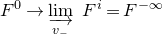 $F^0 \to \underset{v_-}{\varinjlim}\,\ F^i = F^{-\infty}$
is an equivalence, which follows from the effectivity of
$F^0 \to \underset{v_-}{\varinjlim}\,\ F^i = F^{-\infty}$
is an equivalence, which follows from the effectivity of $F^\bullet$
. Define a nilpotent endomorphism
$F^\bullet$
. Define a nilpotent endomorphism $\alpha$
of
$\alpha$
of $\bigoplus_{i=0}^{p-1} F^* \textrm{Gr} ^i_F F^{-\infty}$
to be zero on all
$\bigoplus_{i=0}^{p-1} F^* \textrm{Gr} ^i_F F^{-\infty}$
to be zero on all $F^* \textrm{Gr} ^i_F F^{-\infty}$
, with
$F^* \textrm{Gr} ^i_F F^{-\infty}$
, with $i\ne p-1$
, and
$i\ne p-1$
, and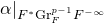 $\alpha|_{F^* \textrm{Gr} ^{p-1}_F F^{-\infty}}$
being the composition
$\alpha|_{F^* \textrm{Gr} ^{p-1}_F F^{-\infty}}$
being the composition
 $$F^* \textrm{Gr} ^{p-1}_F F^{-\infty}\buildrel{\sim}\over{\longrightarrow} F^* F^{p-1}\stackrel{F^* \bar \Theta}{\longrightarrow} F^* \textrm{Gr} ^{0}_F F^{-\infty} \hookrightarrow \bigoplus_{i=0}^{p-1} F^* \textrm{Gr} ^i_F F^{-\infty}.$$
We claim that the functor (5.39) carries each $(F^\bullet, \varphi)$
to
$(F^\bullet, \varphi)$
to $(F^\bullet, \varphi \circ (\textrm{Id} - \alpha))$
.
$(F^\bullet, \varphi \circ (\textrm{Id} - \alpha))$
.
For example, if $(F^\bullet, \varphi) \in \mathscr{MF}(\mathbb{Z}_p)$
is a p-torsion Fontaine–Laffaille module, which is an extension of
$(F^\bullet, \varphi) \in \mathscr{MF}(\mathbb{Z}_p)$
is a p-torsion Fontaine–Laffaille module, which is an extension of $\mathbb{F}_p(1-p)$
by
$\mathbb{F}_p(1-p)$
by $\mathbb{F}_p$
, then the functor (5.39) carries
$\mathbb{F}_p$
, then the functor (5.39) carries $(F^\bullet, \varphi)$
to
$(F^\bullet, \varphi)$
to $\mathbb{F}_p(1-p) \oplus \mathbb{F}_p$
, that is, the endomorphism of
$\mathbb{F}_p(1-p) \oplus \mathbb{F}_p$
, that is, the endomorphism of $\textrm{Ext}^1_{\mathscr{MF}(\mathbb{Z}_p)\otimes \mathbb{F}_p}(\mathbb{F}_p(1-p), \mathbb{F}_p)\buildrel{\sim}\over{\longrightarrow} \mathbb{F}_p$
induced by (5.39) is equal to 0.
$\textrm{Ext}^1_{\mathscr{MF}(\mathbb{Z}_p)\otimes \mathbb{F}_p}(\mathbb{F}_p(1-p), \mathbb{F}_p)\buildrel{\sim}\over{\longrightarrow} \mathbb{F}_p$
induced by (5.39) is equal to 0.
Let X be a smooth p-adic formal scheme over W(k) of dimension $\leqslant p-1$
. By Remark 4.7, we have
$\leqslant p-1$
. By Remark 4.7, we have $\widetilde{\Phi}_{\mathrm{Maz}}(X) \buildrel{\sim}\over{\longrightarrow} \Phi_{\mathrm{Maz}} \circ \mathcal{H}_{syn}(X)$
. On the other hand, by [Reference Li and MondalLM22, Theorem 5.10] the p-torsion Fontaine–Laffaille module
$\widetilde{\Phi}_{\mathrm{Maz}}(X) \buildrel{\sim}\over{\longrightarrow} \Phi_{\mathrm{Maz}} \circ \mathcal{H}_{syn}(X)$
. On the other hand, by [Reference Li and MondalLM22, Theorem 5.10] the p-torsion Fontaine–Laffaille module $\Phi_{\mathrm{DI}} ( \mathcal{H}_{syn}(X)|_{W(k)^{syn}_{red}})$
is given by the Deligne–Illusie decomposition [Reference Deligne and IllusieDI87]. Thus, in the geometric context, the above formula for
$\Phi_{\mathrm{DI}} ( \mathcal{H}_{syn}(X)|_{W(k)^{syn}_{red}})$
is given by the Deligne–Illusie decomposition [Reference Deligne and IllusieDI87]. Thus, in the geometric context, the above formula for $\Phi^{\mathrm{Maz}}_{red} \circ \Phi_{\mathrm{DI}}^{-1}$
describes the relation between the modulo p reduction of (1.1) and the Deligne–Illusie decomposition. For
$\Phi^{\mathrm{Maz}}_{red} \circ \Phi_{\mathrm{DI}}^{-1}$
describes the relation between the modulo p reduction of (1.1) and the Deligne–Illusie decomposition. For $\dim X <p-1$
the two decompositions coincide, but in dimension
$\dim X <p-1$
the two decompositions coincide, but in dimension $p-1$
they are different. For example, if X is an elliptic curve over
$p-1$
they are different. For example, if X is an elliptic curve over $\mathbb{Z}_2$
with ordinary reduction, then Fontaine–Laffaille module
$\mathbb{Z}_2$
with ordinary reduction, then Fontaine–Laffaille module $H^1_{\mathrm{dR}}(X)\otimes \mathbb{F}_2$
constructed using (1.1) (i.e.
$H^1_{\mathrm{dR}}(X)\otimes \mathbb{F}_2$
constructed using (1.1) (i.e. $H^1(\Phi_{\mathrm{Maz}} \circ \mathcal{H}_{syn}(X)) \otimes \mathbb{F}_2$
) is isomorphic to
$H^1(\Phi_{\mathrm{Maz}} \circ \mathcal{H}_{syn}(X)) \otimes \mathbb{F}_2$
) is isomorphic to $\mathbb{F}_2 \oplus \mathbb{F}_2(-1)$
whereas the Fontaine–Laffaille structure on
$\mathbb{F}_2 \oplus \mathbb{F}_2(-1)$
whereas the Fontaine–Laffaille structure on $H^1_{\mathrm{dR}}(X)\otimes \mathbb{F}_2$
induced by the Deligne–Illusie decomposition is a nonsplit extension of
$H^1_{\mathrm{dR}}(X)\otimes \mathbb{F}_2$
induced by the Deligne–Illusie decomposition is a nonsplit extension of $\mathbb{F}_2(-1)$
by
$\mathbb{F}_2(-1)$
by $\mathbb{F}_2$
unless
$\mathbb{F}_2$
unless $X\times \operatorname{Spec} \mathbb{Z}/4$
is the canonical lift of the ordinary elliptic curve
$X\times \operatorname{Spec} \mathbb{Z}/4$
is the canonical lift of the ordinary elliptic curve $X \times \operatorname{Spec} \mathbb{F}_2$
.
$X \times \operatorname{Spec} \mathbb{F}_2$
.
Remark 5.24 (Syntomic cohomology in small weights). Given an F-gauge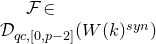 $\mathcal{F} \in\mathcal{D}_{qc,[0,p-2]} (W(k)^{syn})$
one can use Theorem 3 to compute the syntomic cohomology
$\mathcal{F} \in\mathcal{D}_{qc,[0,p-2]} (W(k)^{syn})$
one can use Theorem 3 to compute the syntomic cohomology $R\Gamma(W(k)^{syn}, \mathcal{F}\{i\})$
, for
$R\Gamma(W(k)^{syn}, \mathcal{F}\{i\})$
, for $i\leqslant p-2$
. Let us briefly explain how, using the functor
$i\leqslant p-2$
. Let us briefly explain how, using the functor
 \begin{equation} \boldsymbol{\Phi}_{\mathrm{Maz}}: \mathcal{D}_{qc,[0, +\infty]}(W(k)^{syn})\to \mathrm{Mod}_{\mathrm{Maz}}(W(k)), \quad \mathcal{F} \mapsto (\mathfrak{p}^*_{\bar{\mathrm{dR}}}(\mathcal{F}), \varphi_{\bullet}) \end{equation}
constructed in Remark 4.6, the computation can be generalized to all effective F-gauges. Let $\mathcal{F} \in \mathcal{D}_{qc,[0, \infty]}(W(k)^{syn})$
be an effective F-gauge,
$\mathcal{F} \in \mathcal{D}_{qc,[0, \infty]}(W(k)^{syn})$
be an effective F-gauge, $\boldsymbol{\Phi}_{\mathrm{Maz}}(\mathcal{F})= (F^\bullet, \varphi_{\bullet})$
. We claim that, for
$\boldsymbol{\Phi}_{\mathrm{Maz}}(\mathcal{F})= (F^\bullet, \varphi_{\bullet})$
. We claim that, for $i\leqslant p-2$
, the functor
$i\leqslant p-2$
, the functor $\boldsymbol{\Phi}_{\mathrm{Maz}}$
induces equivalences
$\boldsymbol{\Phi}_{\mathrm{Maz}}$
induces equivalences

To see the last isomorphism, note that by [Reference Nikolaus and ScholzeNS18, Proposition II.1.5], the mapping spectrum $\operatorname{Hom}_{\textrm{Mod}_{\text{Maz}}(W(k))} (W(k)(-i), F^{\bullet})$
is identified with the fibre of
$\operatorname{Hom}_{\textrm{Mod}_{\text{Maz}}(W(k))} (W(k)(-i), F^{\bullet})$
is identified with the fibre of $\operatorname{Hom}(W(k)(-i), F^{\bullet}) \xrightarrow{t} \operatorname{Hom}(W(k)(-i), F_* F^0 \otimes B)$
, where mapping spectra are computed in
$\operatorname{Hom}(W(k)(-i), F^{\bullet}) \xrightarrow{t} \operatorname{Hom}(W(k)(-i), F_* F^0 \otimes B)$
, where mapping spectra are computed in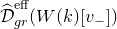 $\widehat{\mathcal{D}}_{gr}^{\text{eff}}(W(k)[v_{-}])$
and t takes
$\widehat{\mathcal{D}}_{gr}^{\text{eff}}(W(k)[v_{-}])$
and t takes $f: W(k)(-i) \to F^{\bullet}$
to the difference
$f: W(k)(-i) \to F^{\bullet}$
to the difference $\varphi_{\bullet} \circ f - f \circ \varphi_{\bullet}$
. Note that the source of t can be identified with
$\varphi_{\bullet} \circ f - f \circ \varphi_{\bullet}$
. Note that the source of t can be identified with $F^i$
and the target with
$F^i$
and the target with $F^0$
. Under this identification one always has
$F^0$
. Under this identification one always has $\varphi_{\bullet} \circ f = \varphi_i(f)$
and, provided
$\varphi_{\bullet} \circ f = \varphi_i(f)$
and, provided $i<p$
, one has
$i<p$
, one has $f \circ \varphi_{\bullet} = v_{-}^i(f)$
. For a proof, it suffices to check that the map is an equivalence after reducing modulo p. The proof of the mod p statement is explainedFootnote
42
in [Reference BhattBha23, Remark 6.5.15].
$f \circ \varphi_{\bullet} = v_{-}^i(f)$
. For a proof, it suffices to check that the map is an equivalence after reducing modulo p. The proof of the mod p statement is explainedFootnote
42
in [Reference BhattBha23, Remark 6.5.15].
For $\mathcal{F}$
of the form
$\mathcal{F}$
of the form $\mathcal{H}_{syn}(X)$
, the formula (5.42) recovers [Reference Antieau, Mathew, Morrow and NikolausAMM+22, Theorem F (2)].
$\mathcal{H}_{syn}(X)$
, the formula (5.42) recovers [Reference Antieau, Mathew, Morrow and NikolausAMM+22, Theorem F (2)].
Remark 5.25 (Lattices in crystalline representations). Let $\mathscr{MF}_{[0,p-2]}^f(W(k))\subset \mathscr{MF}_{[0,p-2]} (W(k))$
be the full subcategory, whose objects are p-torsion-free Fontaine–Laffaille modules. In ([Reference Fontaine and LaffailleFL82, § 7.14]), Fontaine and Laffaille constructed an exact fully faithful functor
$\mathscr{MF}_{[0,p-2]}^f(W(k))\subset \mathscr{MF}_{[0,p-2]} (W(k))$
be the full subcategory, whose objects are p-torsion-free Fontaine–Laffaille modules. In ([Reference Fontaine and LaffailleFL82, § 7.14]), Fontaine and Laffaille constructed an exact fully faithful functor
 \begin{equation} \mathcal{T}_\text{ét}^{FL}: \mathscr{MF}_{[0,p-2]}^f(W(k)) \hookrightarrow \mathrm{Rep}_{G_K}(\mathbb{Z}_p)\end{equation}
to the category of continuous $\mathbb{Z}_p$
-linear representations of the absolute Galois group
$\mathbb{Z}_p$
-linear representations of the absolute Galois group $G_K$
of
$G_K$
of $K:=\operatorname{Frac} (W(k))$
. Moreover, Breuil identified, in [Reference BreuilBre99, Proposition 3], the essential image of (5.43) with the full subcategory
$K:=\operatorname{Frac} (W(k))$
. Moreover, Breuil identified, in [Reference BreuilBre99, Proposition 3], the essential image of (5.43) with the full subcategory $\mathrm{Rep}_{G_K, [0,p-2]}^{crys,f}(\mathbb{Z}_p)\subset \mathrm{Rep}_{G_K}(\mathbb{Z}_p)$
, formed by all
$\mathrm{Rep}_{G_K, [0,p-2]}^{crys,f}(\mathbb{Z}_p)\subset \mathrm{Rep}_{G_K}(\mathbb{Z}_p)$
, formed by all $\Lambda\in \mathrm{Rep}_{G_K}(\mathbb{Z}_p) $
, such that
$\Lambda\in \mathrm{Rep}_{G_K}(\mathbb{Z}_p) $
, such that $\Lambda$
is finite-free as a
$\Lambda$
is finite-free as a $\mathbb{Z}_p$
-module and
$\mathbb{Z}_p$
-module and $\Lambda \otimes \mathbb{Q}_p$
is a crystalline representation with Hodge–Tate weights lying in
$\Lambda \otimes \mathbb{Q}_p$
is a crystalline representation with Hodge–Tate weights lying in $[0,p-2]$
.
$[0,p-2]$
.
On the other hand, using results from [Reference Bhatt and ScholzeBS23], Bhatt and Lurie established in [Reference BhattBha23, Theorem 6.6.13] an equivalence of categories
 $$\mathcal{T}_\text{ét}^{BL}: \operatorname{Coh}^{\text{refl}}(W(k)^{syn}) \buildrel{\sim}\over{\longrightarrow} \mathrm{Rep}_{G_K}^{crys,f}(\mathbb{Z}_p)$$
between the category of reflexive coherent sheaves on $W(k)^{syn}$
and the category of lattices in crystalline representations of
$W(k)^{syn}$
and the category of lattices in crystalline representations of $G_K$
with arbitrary Hodge–Tate weights.
$G_K$
with arbitrary Hodge–Tate weights.
By Remark 5.22 the functor (5.2) restricts to an equivalence of categories
 \begin{equation} \Phi_{\mathrm{Maz}}: \textrm{Vect}_{[0,p-2]}(W(k)^{syn}) \buildrel{\sim}\over{\longrightarrow} \mathscr{MF}_{[0,p-2]}^f(W(k))\end{equation}
between the subcategory $\textrm{Vect}_{[0,p-2]}(W(k)^{syn})\subset \operatorname{Coh}_{[0,p-2]}(W(k)^{syn})$
of vector bundles and the subcategory
$\textrm{Vect}_{[0,p-2]}(W(k)^{syn})\subset \operatorname{Coh}_{[0,p-2]}(W(k)^{syn})$
of vector bundles and the subcategory $\mathscr{MF}_{[0,p-2]}^f(W(k))\subset \mathscr{MF}_{[0,p-2]}(W(k))$
of p-torsion-free Fontaine–Laffaille modules.
$\mathscr{MF}_{[0,p-2]}^f(W(k))\subset \mathscr{MF}_{[0,p-2]}(W(k))$
of p-torsion-free Fontaine–Laffaille modules.
We claim that
 \begin{equation} \mathcal{T}_\text{ét}^{FL} \buildrel{\sim}\over{\longrightarrow} \mathcal{T}_\text{ét}^{BL} \circ \Phi_{\mathrm{Maz}}^{-1}: \mathscr{MF}_{[0,p-2]}^f(W(k)) \to \mathrm{Rep}_{G_K, [0, p-2]}^{crys,f}(\mathbb{Z}_p).\end{equation}
The following argument was communicated to us by Akhil Mathew. Recall from [Reference BhattBha23, Construction 6.3.1 and Corollary 6.6.5] and [Reference Bhatt and ScholzeBS23, Theorem 5.2] that, for any vector bundle $E\in \textrm{Vect}_{(-\infty, 0]}(W(k)^{syn})$
with non-positive weights, the corresponding Galois representation is computed by the formula
$E\in \textrm{Vect}_{(-\infty, 0]}(W(k)^{syn})$
with non-positive weights, the corresponding Galois representation is computed by the formula
 \begin{align} \mathcal{T}_\text{ét}^{BL}(E)= H^0(\mathcal{O}_C^{syn}, f^*_{syn}E) \simeq H^0(W(k)^{syn}, f_{syn \, *} f^*_{syn}E ) \end{align}
 \begin{align} \simeq H^0(W(k)^{syn}, E \otimes f_{syn\, *}\mathcal{O}_{ \mathcal{O}_C^{syn}}),\end{align}
where $\mathcal{O}_C$
stands for the ring of integers of completed algebraic closure of K and
$\mathcal{O}_C$
stands for the ring of integers of completed algebraic closure of K and $f_{syn}: \mathcal{O}_C^{syn} \to W(k)^{syn}$
is induced by
$f_{syn}: \mathcal{O}_C^{syn} \to W(k)^{syn}$
is induced by $\operatorname{Spf} \mathcal{O}_C \to \operatorname{Spf} W(k)$
. Note that
$\operatorname{Spf} \mathcal{O}_C \to \operatorname{Spf} W(k)$
. Note that $f_{syn\, *}\mathcal{O}_{ \mathcal{O}_C^{syn}}$
is an effective F-gauge,
$f_{syn\, *}\mathcal{O}_{ \mathcal{O}_C^{syn}}$
is an effective F-gauge, $f_{syn\, *}\mathcal{O}_{ \mathcal{O}_C^{syn}}\in \mathcal{D}_{qc, [0, \infty ]}(W(k)^{syn})$
. Thus, if
$f_{syn\, *}\mathcal{O}_{ \mathcal{O}_C^{syn}}\in \mathcal{D}_{qc, [0, \infty ]}(W(k)^{syn})$
. Thus, if $E\in \textrm{Vect}_{[2-p, 0]}(W(k)^{syn})$
, we have
$E\in \textrm{Vect}_{[2-p, 0]}(W(k)^{syn})$
, we have $E \otimes f_{syn\, *}\mathcal{O}_{ \mathcal{O}_C^{syn}} \in \mathcal{D}_{qc, [2-p, \infty ]}(W(k)^{syn})$
. Consequently, (5.47) can be computed using formula (5.42). Note that by [Reference BhattBha12, Proposition 9.9] the p-completed derived de Rham cohomology of
$E \otimes f_{syn\, *}\mathcal{O}_{ \mathcal{O}_C^{syn}} \in \mathcal{D}_{qc, [2-p, \infty ]}(W(k)^{syn})$
. Consequently, (5.47) can be computed using formula (5.42). Note that by [Reference BhattBha12, Proposition 9.9] the p-completed derived de Rham cohomology of $\operatorname{Spf} \mathcal{O}_C$
is identified with Fontaine’s period ring
$\operatorname{Spf} \mathcal{O}_C$
is identified with Fontaine’s period ring $A_{crys}$
matching the Hodge filtration on the derived de Rham cohomology and the filtration by divided powers of
$A_{crys}$
matching the Hodge filtration on the derived de Rham cohomology and the filtration by divided powers of $I:=\ker(A_{crys} \twoheadrightarrow \mathcal{O}_C)$
. Now, let
$I:=\ker(A_{crys} \twoheadrightarrow \mathcal{O}_C)$
. Now, let $(\mathcal{M}, \varphi)\in \mathscr{MF}_{[0,p-2]}^f(W(k))$
and let
$(\mathcal{M}, \varphi)\in \mathscr{MF}_{[0,p-2]}^f(W(k))$
and let $M:= \mathcal{M}_{v_-=1}$
be the associated W(k)-module equipped with the Hodge filtration (see (2.2)). We apply the above computation to
$M:= \mathcal{M}_{v_-=1}$
be the associated W(k)-module equipped with the Hodge filtration (see (2.2)). We apply the above computation to $E = \big(\Phi_{\mathrm{Maz}}^{-1}(\mathcal{M},\varphi)\big)^*$
. By the construction of
$E = \big(\Phi_{\mathrm{Maz}}^{-1}(\mathcal{M},\varphi)\big)^*$
. By the construction of $\Phi_{\mathrm{Maz}}$
, the de Rham realization
$\Phi_{\mathrm{Maz}}$
, the de Rham realization $\mathfrak{p}_{\bar{\mathrm{dR}}}(E)$
, regarded as a filtered W(k)-module, is
$\mathfrak{p}_{\bar{\mathrm{dR}}}(E)$
, regarded as a filtered W(k)-module, is $M^*$
with its Hodge filtration. Using (5.42), we have
$M^*$
with its Hodge filtration. Using (5.42), we have
 $$\mathcal{T}_\text{ét}^{BL}(\Phi_{\mathrm{Maz}}^{-1}(\mathcal{M},\varphi)) \buildrel{\sim}\over{\longrightarrow} (\mathcal{T}_\text{ét}^{BL}(E))^* \buildrel{\sim}\over{\longrightarrow}(\ker(F^0(M^* \otimes A_{crys}) \stackrel{\varphi -\textrm{Id}}{\longrightarrow} M^* \otimes A_{crys})) ^*.$$
Here $M^* \otimes A_{crys}$
is equipped with the tensor product filtration,
$M^* \otimes A_{crys}$
is equipped with the tensor product filtration, $F^0(M^* \otimes A_{crys})=\sum_{i\geqslant 0} F^{-i}M^* \otimes I^{[i]}$
, and
$F^0(M^* \otimes A_{crys})=\sum_{i\geqslant 0} F^{-i}M^* \otimes I^{[i]}$
, and $\varphi = \varphi_{M^*} \otimes \varphi_{ A_{crys}}$
. The right-hand side of the above formula is
$\varphi = \varphi_{M^*} \otimes \varphi_{ A_{crys}}$
. The right-hand side of the above formula is $ \mathcal{T}_\text{ét}^{FL}(\mathcal{M}, \varphi)$
. This proves (5.45).
$ \mathcal{T}_\text{ét}^{FL}(\mathcal{M}, \varphi)$
. This proves (5.45).
As a consequence of (5.45), we conclude that the Bhatt–Lurie equivalence carries every object of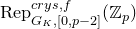 $\mathrm{Rep}_{G_K, [0, p-2]}^{crys,f}(\mathbb{Z}_p)$
to a vector bundle over
$\mathrm{Rep}_{G_K, [0, p-2]}^{crys,f}(\mathbb{Z}_p)$
to a vector bundle over $W(k)^{syn}$
.
$W(k)^{syn}$
.
Acknowledgements
This paper owes its existence to Bhargav Bhatt and Vladimir Drinfeld. Bhatt suggested to us that the restriction functor (1.16) is an equivalence and gave us numerous hints during the initial stage of the project. Drinfeld explained to us his description of the fibre product $\mathfrak{D}$
in (1.13), which was a key input in this work, and we thank him for allowing us to include his result in this paper (see §§ 3.1 and 3.2). We would also like to thank Akhil Mathew, Jacob Lurie, Arthur Ogus, and Alexander Petrov for their interest in our work and numerous discussions. In particular, Lurie shared with us his perspective on Theorem 1.3. He also suggested an alternative description of
$\mathfrak{D}$
in (1.13), which was a key input in this work, and we thank him for allowing us to include his result in this paper (see §§ 3.1 and 3.2). We would also like to thank Akhil Mathew, Jacob Lurie, Arthur Ogus, and Alexander Petrov for their interest in our work and numerous discussions. In particular, Lurie shared with us his perspective on Theorem 1.3. He also suggested an alternative description of $\mathfrak{D}$
explained in § 3.2. Mathew supplied a proof of a key assertion in Remark 5.25. Finally, our deep thanks go to the anonymous referee for their truly generous help in turning a raw draft into an article.
$\mathfrak{D}$
explained in § 3.2. Mathew supplied a proof of a key assertion in Remark 5.25. Finally, our deep thanks go to the anonymous referee for their truly generous help in turning a raw draft into an article.
Conflicts of interest
None.
Financial support
GT was supported by NSF Grant DMS No. 1801689. VV was supported by a Simons Foundation Investigator Grant No. 622511 through Bhargav Bhatt. VV would like to thank the University of Chicago and Princeton University where the work has been done. YX was supported by the US National Science Foundation under Award No. 2202677.
Journal information
Compositio Mathematica is owned by the Foundation Compositio Mathematica and published by the London Mathematical Society in partnership with Cambridge University Press. All surplus income from the publication of Compositio Mathematica is returned to mathematics and higher education through the charitable activities of the Foundation, the London Mathematical Society and Cambridge University Press.












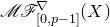












































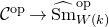














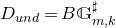
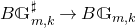












 Open access

