





Crossref Citations

This article has been cited by the following publications. This list is generated based on data provided by Crossref.
Backholm, M.
Kasper, A. K. S.
Schulman, R. D.
Ryu, W. S.
and
Dalnoki-Veress, K.
2015.
The effects of viscosity on the undulatory swimming dynamics of C. elegans
.
Physics of Fluids,
Vol. 27,
Issue. 9,
Datt, Charu
Zhu, Lailai
Elfring, Gwynn J.
and
Pak, On Shun
2015.
Squirming through shear-thinning fluids.
Journal of Fluid Mechanics,
Vol. 784,
Issue. ,
Elfring, Gwynn J.
and
Goyal, Gaurav
2016.
The effect of gait on swimming in viscoelastic fluids.
Journal of Non-Newtonian Fluid Mechanics,
Vol. 234,
Issue. ,
p.
8.
Nganguia, Herve
Pietrzyk, Kyle
and
Pak, On Shun
2017.
Swimming efficiency in a shear-thinning fluid.
Physical Review E,
Vol. 96,
Issue. 6,
Ives, Thomas R.
and
Morozov, Alexander
2017.
The mechanism of propulsion of a model microswimmer in a viscoelastic fluid next to a solid boundary.
Physics of Fluids,
Vol. 29,
Issue. 12,
Aubret, A.
Ramananarivo, S.
and
Palacci, J.
2017.
Eppur si muove, and yet it moves: Patchy (phoretic) swimmers.
Current Opinion in Colloid & Interface Science,
Vol. 30,
Issue. ,
p.
81.
Ouyang, Zhenyu
Lin, Jianzhong
and
Ku, Xiaoke
2018.
The hydrodynamic behavior of a squirmer swimming in power-law fluid.
Physics of Fluids,
Vol. 30,
Issue. 8,
Ouyang, Zhenyu
Lin, Jianzhong
and
Ku, Xiaoke
2019.
Hydrodynamic interaction between a pair of swimmers in power-law fluid.
International Journal of Non-Linear Mechanics,
Vol. 108,
Issue. ,
p.
72.
Pietrzyk, Kyle
Nganguia, Herve
Datt, Charu
Zhu, Lailai
Elfring, Gwynn J.
and
Pak, On Shun
2019.
Flow around a squirmer in a shear-thinning fluid.
Journal of Non-Newtonian Fluid Mechanics,
Vol. 268,
Issue. ,
p.
101.
Demir, Ebru
Lordi, Noah
Ding, Yang
and
Pak, On Shun
2020.
Nonlocal shear-thinning effects substantially enhance helical propulsion.
Physical Review Fluids,
Vol. 5,
Issue. 11,
Ouyang, Zhenyu
and
Phan-Thien, Nhan
2021.
Inertial swimming in a channel filled with a power-law fluid.
Physics of Fluids,
Vol. 33,
Issue. 11,
van Gogh, Brandon
Demir, Ebru
Palaniappan, D.
and
Pak, On Shun
2022.
The effect of particle geometry on squirming through a shear-thinning fluid.
Journal of Fluid Mechanics,
Vol. 938,
Issue. ,
Ouyang, Zhenyu
Liu, Chen
Qi, Tingting
Lin, Jianzhong
and
Ku, Xiaoke
2023.
Locomotion of a micro-swimmer towing load through shear-dependent non-Newtonian fluids.
Physics of Fluids,
Vol. 35,
Issue. 1,
1. Introduction
At some point in our lives, we invariably end up making a fool of ourselves by performing the following stunt. A child asks us to demonstrate how to swim properly. Since the question will be asked when we are not at the pool but in our living room, we lie down to support our weight and proceed to demonstrate how to swim like an Olympian. But whereas the motion feels natural in water, pretend swimming in air feels oddly off, and one is often not able to coordinate legs and arms properly. When we are used to one specific environment (water), swimming under different conditions (air) does not feel quite right.
Encountering changes in the mechanical properties of one’s environment occurs very frequently for small organisms swimming at low Reynolds numbers (Lighthill Reference Lighthill1975). Three ubiquitous examples can be given: during infection, bacteria have to self-propel through multi-layered viscoelastic host tissues (Madigan et al. Reference Madigan, Martinko, Stahl and Clark2010); in open water, planktonic micro-organisms are surrounded by chemically inhomogeneous particle suspensions (Guasto, Rusconi & Stocker Reference Guasto, Rusconi and Stocker2012); and along their journey to the ovum, mammalian spermatozoa have to progress through different types of mucus with large variations in viscosity and relaxation times (Suarez & Pacey Reference Suarez and Pacey2006).
Understanding locomotion in complex media is therefore a problem of genuine biological importance. Furthermore, from a biophysical point of view, changes in the environment can allow one to gain insight into the force generation mechanisms at the heart of biological behaviour. A famous example is that devised by Chen & Berg (Reference Chen and Berg2000), who linked bacterial flagella to external beads in fluids of varying viscosity. The resulting change in the mechanical resistance to rotation then allowed them to determine the torque–speed relationship of the bacterial rotary motor (Berg Reference Berg2003).
Driven by a combination of new experimental techniques, affordable high-frame-rate cameras and sophisticated numerical algorithms, a number of groups have recently investigated various aspects of small-scale locomotion in complex fluids. Most work has focused on model elastic fluids with constant viscosities (termed Boger fluids). Asymptotic studies suggest that swimmers driven by small-amplitude waving undergo a systematic decrease in their swimming speed (Lauga Reference Lauga2007), confirmed by experiments with C. elegans (Shen & Arratia Reference Shen and Arratia2011). For larger waving amplitudes, a transition can take place to a swimming enhancement (Teran, Fauci & Shelley Reference Teran, Fauci and Shelley2010; Liu, Powers & Breuer Reference Liu, Powers and Breuer2011; Spagnolie, Liu & Powers Reference Spagnolie, Liu and Powers2013), although small-amplitude enhancement is also possible (Lauga Reference Lauga2014). Other biomimetic experiments show that adding elasticity always allows the swimmer to move faster (Dasgupta et al. Reference Dasgupta, Liu, Fu, Berhanu, Breuer, Powers and Kudrolli2013; Espinosa-Garcia, Lauga & Zenit Reference Espinosa-Garcia, Lauga and Zenit2013).
Less attention has been paid to another class of fluids, namely inelastic fluids, whose material properties depend nonlinearly on the rate of deformation. A theoretical study at small amplitude showed that the impact of shear-dependent rheology should be effectively, if not exactly, zero (Vélez-Cordero & Lauga Reference Vélez-Cordero and Lauga2013). In contrast, self-propelled waving sheets showed a very systematic decrease of propulsion for shear-thinning fluids (Dasgupta et al. Reference Dasgupta, Liu, Fu, Berhanu, Breuer, Powers and Kudrolli2013), while numerics for a two-dimensional model spermatozoon cell with a head and increasing waving amplitude shows faster locomotion (Montenegro-Johnson, Smith & Loghin Reference Montenegro-Johnson, Smith and Loghin2013).
This is the context in which the new experimental study by Gagnon, Keim & Arratia (Reference Gagnon, Keim and Arratia2014) appears, and it attempts to answer a simple but fundamental question: How would a real biological organism behave in a shear-thinning fluid?
2. Overview
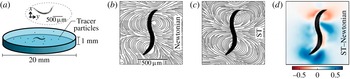
Gagnon et al. (Reference Gagnon, Keim and Arratia2014) consider the locomotion of the millimetre-sized nematode C. elegans in a variety of shear-thinning fluids (figure 1 a). They measure the locomotion kinematics and the fluid mechanisms around the organism using tracer particles for two kinds of fluids: (a) solutions of the rod-like polymer xanthan gum, which show rheological data consistent with a Carreau fluid with power indices $n$
ranging from 0.3 to 0.9 (i.e. at large shear rates
$n$
ranging from 0.3 to 0.9 (i.e. at large shear rates $\dot{{\it\gamma}}$
, the viscosity
$\dot{{\it\gamma}}$
, the viscosity ${\it\mu}$
varies as
${\it\mu}$
varies as ${\it\mu}\sim \dot{{\it\gamma}}^{n-1}$
, with
${\it\mu}\sim \dot{{\it\gamma}}^{n-1}$
, with $n<1$
indicating shear-thinning behaviour); and (b) Newtonian fluids with a large range of viscosities (from that of water to a few hundred times above). In all cases, the Reynolds numbers characterizing the flow were well below unity.
$n<1$
indicating shear-thinning behaviour); and (b) Newtonian fluids with a large range of viscosities (from that of water to a few hundred times above). In all cases, the Reynolds numbers characterizing the flow were well below unity.
(a) Sketch of the experiment studied by Gagnon et al. (Reference Gagnon, Keim and Arratia2014). (b) Streamlines around the swimming worm in a Newtonian fluid. (c) Streamlines in a shear-thinning fluid. (d) Difference between the normalized velocities in the shear-thinning and Newtonian flows, showing flow decrease near the head and increase near the tail of the swimmer.
The experimental investigation obtained two main results. First, despite such a large change in the fluid rheology, the cells behave in exactly the same way in a complex fluid and in a Newtonian one. The authors found no measurable change in the worm waving amplitude, the speed of the waves, the waving frequency and the swimming speed. These results are consistent with the asymptotic study of Vélez-Cordero & Lauga (Reference Vélez-Cordero and Lauga2013) on the small-amplitude waving locomotion of an inextensible sheet, but not with the numerical results of Montenegro-Johnson et al. (Reference Montenegro-Johnson, Smith and Loghin2013). However, that study focused on swimming spermatozoa-like waveforms with a head and increasing head-to-tail amplitude, whereas the waving motion of the head-less C. elegans has actually a decreasing amplitude.
The second main result is that, despite undergoing no change in their swimming kinematics, the organisms generate flows that display a number of important differences. To characterize the flows, the authors employ velocimetry with small tracer particles seeding the fluids. In the Newtonian case, the instantaneous flow streamlines around the organism are shown in figure 1(b) at the moment in the beating cycle where the instantaneous shear rates are the largest. In contrast, the flow induced in the shear-thinning fluid is displayed in figure 1(c) at the same instant in the waving motion. The main difference between the two is the displacement of the head and tail vortices, which have moved towards the head and display stronger flow gradients. Using measurements of the vorticity field, the authors further confirm that the head vortex increases in both size and magnitude in the non-Newtonian fluid.
In order to further contrast the two flows, the authors compute the difference between the velocity magnitudes (normalized by their maximum values) in the shear-thinning fluid and in the Newtonian one. These results are shown in figure 1(d), and as is quantified in more detail in the paper, show that non-Newtonian stresses impact the swimmer in an asymmetric way. The fluid velocities undergo a decrease near the head of the swimmer and an increase near the tail. Furthermore, this asymmetry in the velocity profile is seen to increase with the amount of shear thinning in the fluid until the typical rate of deformation is of the same order as the critical shear rate at which the shear viscosity displays a transition from Newtonian to non-Newtonian.
3. Future
Like many thought-provoking experiments, the study by Gagnon et al. (Reference Gagnon, Keim and Arratia2014) leads to more questions than answers. The worms are self-propelled, and it is the balance between waving propulsion and drag that leads to their swimming speed (Lauga & Powers Reference Lauga and Powers2009). For the speed to remain unchanged, the stresses leading to both drag and thrust would need to change in exactly the same manner with changes in the rheology. How this is possible while at the same time undergoing significant changes in the flow structure is not clear. Using headless synthetic swimmers with constant-amplitude waveforms, Dasgupta et al. (Reference Dasgupta, Liu, Fu, Berhanu, Breuer, Powers and Kudrolli2013) found a systematic decrease of the swimming speed in shear-thinning fluids. Why such a different answer?
Biologically, how do the results of this study extend to much smaller organisms, such as flagellated algae or bacteria? One key difference lies perhaps in the flexibility of the organisms. The nematode C. elegans is large and uses muscular contractions to generate waving, and has bending rigidities $B$
in the range
$B$
in the range $B\approx 10^{-16}{-}10^{-13}\ \text{N}\ \text{m}^{2}$
(Backholm, Ryu & Dalnoki-Veress Reference Backholm, Ryu and Dalnoki-Veress2013). In contrast, eukaryotic flagella are orders of magnitude softer, with
$B\approx 10^{-16}{-}10^{-13}\ \text{N}\ \text{m}^{2}$
(Backholm, Ryu & Dalnoki-Veress Reference Backholm, Ryu and Dalnoki-Veress2013). In contrast, eukaryotic flagella are orders of magnitude softer, with $B\approx 10^{-23}{-}10^{-21}\ \text{N}\ \text{m}^{2}$
(Hines & Blum Reference Hines and Blum1983). The waving motion of small cells is therefore likely to be impacted by changes in the fluid rheology, leading to an additional feedback mechanism for the fluid rheology to affect locomotion. These small cells might find so much gooeyness to be unbearable.
$B\approx 10^{-23}{-}10^{-21}\ \text{N}\ \text{m}^{2}$
(Hines & Blum Reference Hines and Blum1983). The waving motion of small cells is therefore likely to be impacted by changes in the fluid rheology, leading to an additional feedback mechanism for the fluid rheology to affect locomotion. These small cells might find so much gooeyness to be unbearable.