

Introduction
In this brief contribution, I consider two aspects of the late antique Aramaic incantation bowls: their use of both implicit and explicit illocutionary acts, and the complicated relations that their written spells instantiate between orality and textuality. The texts of the incantation bowls were inscribed upon domestic surfaces (simple Sasanian household ware, the kind used for food) and represent the striking deployment of writing within domestic spaces. Designed to protect the owners of the bowls from demons and other malevolent forces, the bowls were buried upside-down beneath the floors of people's homes.Footnote 2 Once interred, their continuing efficacy as apotropaia was presumably guaranteed by the stability and permanence of the written word. Charles Häberl (Reference Häberl and Rubanovich2015) has recently argued from the use of performative utterances in the bowl texts that an oral ceremony lay behind the production of the bowls, and that the writing of the bowls was thus of secondary importance. Pace Häberl, this contribution argues that writing and writtenness were central to bowl praxis as a whole. Illocution is simply a feature of language-in-use (whether spoken or written) and I suggest that the bowls represent a move towards a popular or vernacular conception of writing as a performative act.Footnote 3 Even though the texts of the bowls could not have been read (in the normal sense of the word) by the bowls’ presumably illiterate owners,Footnote 4 I argue that bowl praxis shows a growing understanding of writing as performative in itself, and that the use of illocutionary utterances in the bowls reflect the (gradual and ongoing) transfer of performativity from speech to writing in Sasanian Mesopotamia. I argue that these illocutionary acts – especially such acts of “word magic” in the bowls as oaths and curses – are more likely to represent “transitional” language or a kind of “oral residue” than the verbatim representation of speech or spoken acts.
Background
Composed during the late Sasanian and early Islamic period and inscribed upon unglazed earthenware bowls in several contemporary dialects of Aramaic,Footnote 5 the Aramaic incantation bowls are located right at the interface between orality and textuality.Footnote 6 As written media, many of their texts demonstrate the persistence of oral compositional processes, as well as the significant role played by memory in their production.Footnote 7 Many bowls also include (figurative) artwork and geometric designs,Footnote 8 and we further encounter a variety of different inscriptional practices and manipulations of graphic signs across the corpus as a whole.Footnote 9 The bowls thus reflect various interdependencies of oral–scribal dynamics, as well as countless combinatory possibilities of text and image.Footnote 10 These complex oral, textual, visual, and memorial interactions suggest a fluid social and semantic environment where media interfaces, transits, and tensions were the rule.
Writing, writtenness, and written performatives
Scholarship in recent decades has challenged the so-called great divide between orality and textuality, speech and writing. It has shown that, despite its brute explicative potential, the articulative power of this divide is inherently limited. Further evidence that the utility of this model has passed is to be found in a complex recent study of the incantation bowls by Charles Häberl (Reference Häberl and Rubanovich2015). Häberl's study analyses the illocutionary act in the incantation bowls, and adduces the use of both implicit and explicit performatives in the bowls to suggest that the bowl texts were actually transcriptions of ritual utterances that represent the direct speech of the magical practitioner.Footnote 11 Häberl hypothesizes a ritual situation (including whispered incantations, the construction of a magical circle, and the inscription and burial of the bowl) where the text written on the bowl was simultaneously spoken out loud and transcribed before an audience. This hypothesis represents the first coherent attempt to theorize both the (re)production of spell formulae and the ritual processes that may have accompanied the production of the bowls. It also emphasizes to great effect the illocutionary nature of many bowl formulae. However, Häberl's focus on performativity and the oral transmission of bowl formulae leads him to conclude that the writing of the incantation bowls, “which was a reflection of the oral composition … was quite possibly of secondary importance” (p. 396). In what follows, I will argue that the bowl formulae were not “primarily oral compositions” that just “happened to be written down” (Häberl Reference Häberl and Rubanovich2015: 369), but that writing and writtenness were key to beliefs about the efficacy of the bowls as apotropaic objects.
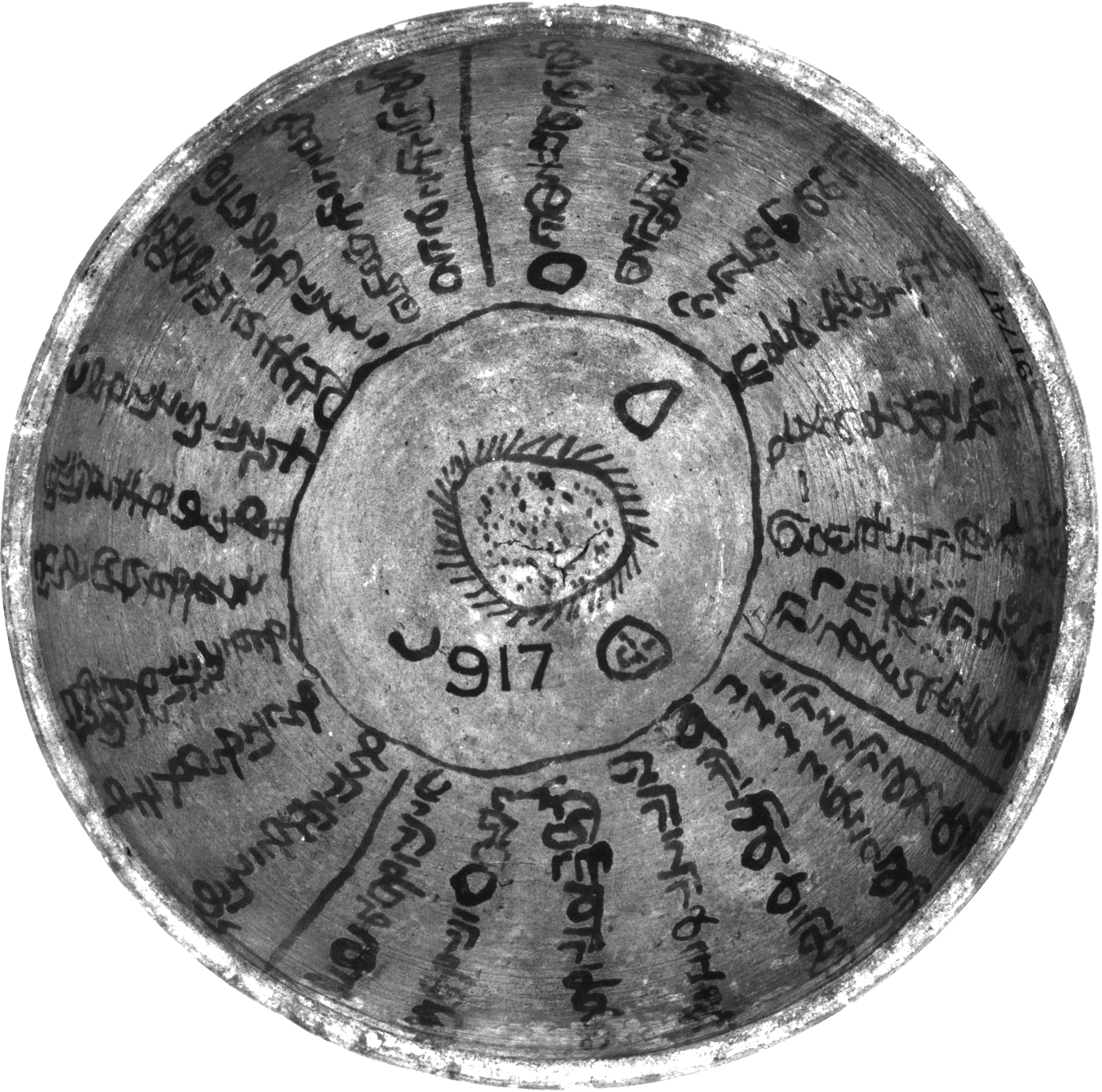
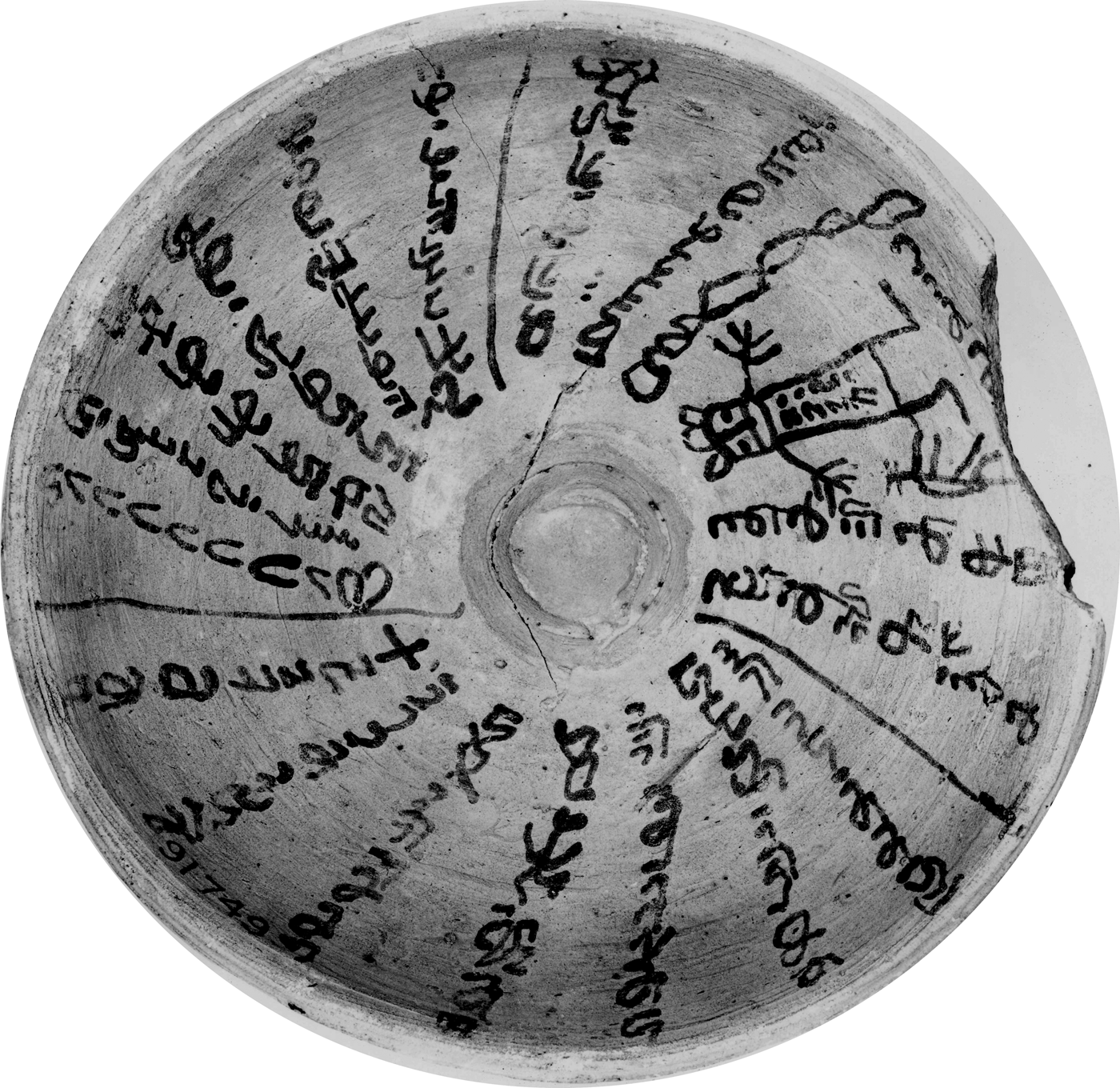
Despite the role of oral and memorial processes in the transmission and composition of bowl formulae, the bowls as inscribed media reflect the centrality of writing to bowl praxis. Stability and continuity inheres in the visual trace, and writing has the power to make visible and enduring what is otherwise fleeting and ephemeral (namely, the spoken word). Inscription grants a kind of permanence (and materiality) to ritual elements,Footnote 12 and this aspect of permanency is key to bowl praxis. From the inscription and burial of the bowls to the apotropaic and exorcistic goals reflected in their texts, the bowls plainly reflect a concern that constant communication and communion be achieved with their transmundane interlocutors. Once inscribed, the bowl as a written object was clearly intended to function as an autonomous communication that could be maintained independent of the magical practitioner in the client's home. Further overwhelming evidence for the centrality of writing to bowl praxis is also to be found in the so-called ‘pseudo-script’ bowls, which instantiate a variety of inscriptional practices and manipulations of graphic signs.Footnote 13 These range from invented signs and ostentatious displays of non-writing to imitation scripts that closely resemble the forms of known alphabets. (See Figures 1 and 2, which show two bowls produced by the same bowl practitioner. Though inscribed with a series of invented signs, these bowls nevertheless reflect an elaborate repertoire of repeated and sometimes quite intricate signs.) Such “texts” may represent many things, from the work of illiterate charlatans to deliberate attempts to strip written language of all semiotic convention and instantiate a writing system better suited to communications with angels and demons.Footnote 14 The value and purpose attributed to the pseudo-script bowls (especially in light of the variety of graphic behaviours they instantiate) undoubtedly varied from practitioner to practitioner and client to client. But regardless of how individual pseudo-script bowls were perceived, their authority was plainly derived from the status of writing and the prestige of true literacy elsewhere in society.Footnote 15 Bowl praxis emerged against a common Near Eastern background where writing and script played a generative role in shaping conceptions about the power of words,Footnote 16 and the bowls reflect the development of an extensive magical practice built on the instrumentalization of writing.Footnote 17 They reflect a wider surge in the use of writing (in particular as a technology for communicating with transmundane powers) across the ancient world,Footnote 18 and it is against this background that I suggest we read the illocutionary act in the incantation bowls as reflective of the transfer of performativity from speech to writing.
BM 91747. One of several bowls inscribed by the same hand. The inscription consists of an invented script which reflects a fairly developed repertoire of repeated and sometimes quite intricate signs.
BM 91749. One of several bowls inscribed by the same hand. The inscription consists of an invented script which reflects a fairly developed repertoire of repeated and sometimes quite intricate signs.
The transfer of performativity from speech to writing is common in periods when writing is becoming institutionalized.Footnote 19 The Sasanian period in particular may be characterized by a spreading awareness of the contrast between oral and written traditions, as well as a widespread reliance in Babylonia and the Middle East on written documents (Shaked et al. Reference Shaked, Ford and Bhayro2013: 3–7). People made constant use of writing, from deeds of sale to deeds of divorce.Footnote 20 The bowls may thus be characterized as “product[s] of an environment steeped in literacy” (Häberl Reference Häberl and Rubanovich2015: 369).Footnote 21 As written objects, the bowls were also embedded in an environment populated by human and transmundane agents engaged in complex social interactions.Footnote 22 The inscription, inversion, and interment of the bowls transformed them into agents of measurable power within this environment. As objects imbued with “social agency”, the bowls worked to constitute new social relationships between their owners and the demons that troubled them.Footnote 23 In speech act terms, the bowl texts were acts of writing that effected a change in the world,Footnote 24 that compelled demons (the cause of various illnesses and other woes in the bowl texts) to desist from their activities and/or adjust their behaviours in relation to the owners of the bowls.
Writing acts. It can make things happen, and the writing (as well as overturning and burying) of the bowls represented a performative act. Performativity is simply a feature of language-in-use – whether spoken or written – which may be expressed in constitutive ritual events, and I suggest that the bowls reflect a growing view of writing as constitutive of social action, rather than a view of writing as a verbatim record of speech or oral actions. If we take utterance as a neutral term, a verbal sequence irrespective of written or spoken medium, we can better appreciate the existence of written documents that contain utterances which are not to be read or interpreted as speech (Kittay Reference Kittay1988). To read them as deriving their authority from speech is to misread them. Written texts are material phenomena, and because writing renders utterances permanent, it originates a class of utterances that should be understood primarily in terms of their writtenness (even if these utterances were transmitted orally and reproduced from mental templates).Footnote 25 The change in the world that the bowl texts were designed to bring about was guaranteed by their permanence in writing. Writing is what constituted the bowls as both autonomous communications and autonomous apotropaic objects. In many literate and pre-literate societies, both spoken and written constitutive acts are treated as (legally) binding, and it is the writtenness of the language in the bowls that presumably rendered their oaths, adjurations, curses, and other legal formulae both permanent and indissoluble.Footnote 26 In short, the bowl texts represent the popular investment of authority in written documents and reflect a growing view of writing in itself as constitutive of action.Footnote 27 An excellent example of this, and evidence of the growing popular deployment of writing's performative potential, is the adaptation of the geṭ to bowl praxis.Footnote 28 The use of such legal formulae, as well as the deployment of oaths, curses and other types of “oral residue” in the bowls, was undoubtedly a means to enhance the performative potential of these objects as autonomous communicative acts. I suggest that the bowl – the material support for the inscription – also added to the felicity of these constitutive acts. As simple Sasanian kitchenware, the finished bowl both derived from and slotted back into the gestural world of the household. As Frankfurter (Reference Frankfurter2015) points out, the inscribed bowl simultaneously calls attention to its origin in day-to-day domestic life and to its transformation into a site of exorcistic power. The performativity of the bowls was thus intimately related not just to the materiality of their inscription, but to the materiality of the bowl itself (as more than just a writing surface).
Conclusion
In concluding, I note that the incantation bowls are a genre of magical texts that emerged from and were shaped by – and shaped in return – the interface between seeing, reading, and speaking. They reveal the rapidly developing scribality of late antique magic, as well as the mainstreaming of writing within domestic spaces. This brief contribution has noted the oral transmission of bowl formulae, and the persistence of oral and memorial compositional structures in the written texts of the bowls. It has attempted further to complicate our characterization of such processes within the bowls. We can only speculate about the potential recitation of the bowl texts, and I have suggested that the performative act in the bowls was inherent to the written object itself, rather than any potential oral ceremony. In fact, the bowls appear to represent a popular experiment with the performative potential of writing, while some of the pseudo-script bowls may even represent the work of “laymen, who affected to write their own prescriptions” (Montgomery Reference Montgomery1913: 28).
Given the heterogeneous social contexts of the bowls, however, no argument should be taken to apply to the corpus as a whole; the value and function attributed to the bowls undoubtedly varied. Nonetheless, the weight of concrete evidence shows that while many bowl formulae were undoubtedly transmitted orally and reproduced from mental templates, the texts of the bowls were not so much organized in conformity with the phenomenology of sound but of sight. Writing is a visual media, and the texts and pseudo-texts of the bowls were patterned and encoded according to diverse visual strategies, from hectic spirals to radial registers and concentric circles. Writing is also a way of extending cognition into the environment, and the unusual inscriptional practices in the bowls open up a cognitive space in the perception of the structure of writing where transmundane or counter-intuitive beings are themselves made more “legible” (such that the bowls may even have been “read” by their (presumably) illiterate owners, even as the bowls’ demonic interlocutors were bamboozled by and trapped within the spiralling maze of their texts). Conditioned in depth by chirographic proclivities, inscribed upon cheap domestic surfaces, and deployed within domestic spaces, the bowls reflect the popular institutionalization of writing in Sasanian Mesopotamia. As a visual and material means of communication and mediation, they demonstrate the power of writing and the rhetorical reach of writtenness, and suggest the transfer of performative or constitutive acts from speech to writing.


 Open access

