


Deterrence is often a collective endeavor. After World War I, those victors committed to the status quo sought to deter German revanchism and Japanese moves into China. After World War II, a more splintered winning coalition engaged in collective efforts to deter Soviet, Korean (North and South), and Chinese (Communist and Nationalist) revisions of the status quo. In the 1990s, the United States, the United Kingdom, and Turkey led an effort to deter Iraq from invading its neighbors and using chemical weapons on its citizens, while NATO tried to deter continued ethnic cleansing at points during the Yugoslav Civil Wars. In the twenty-first century, other coalitions hope to deter China from invading Taiwan or carving out private control over the South and East China Seas and to prevent Russia from reconstituting its empire in Eastern Europe and the Caucasus. Some of these efforts have succeeded. Others have failed, leading to revision or destructive conflict. Why?
Despite the prevalence of collective deterrence—to say nothing of the bloody consequences of its failure—theoretical models tend to focus on two players,Footnote 1 patrons moving only after single, sometimes nonstrategic, protégés,Footnote 2 or, in less formal settings, conjectures about balancing and buck-passing.Footnote 3 Nodding to Olson,Footnote 4 the latter often recognize that collective action problems can lead to underprovided balancing efforts,Footnote 5 but they’re mostly silent on how, why, and the conditions under which collective deterrence succeeds. MorganFootnote 6 recognizes this gap, noting that “collective actors” behave differently than unitary players, not only because obstacles to cooperation lead them to “violate best practices on how to conduct deterrence” but also because they’re often led by great powers defending particular visions of international order.Footnote 7 Finally, WagnerFootnote 8 attributes the failure of collective deterrence before the World Wars to uncertainty over the makeup of potential balancing coalitions, which influences both revisionists and ostensible balancers.Footnote 9 But like the others he doesn’t address variation in the credibility of collective threats.
We study collective deterrence with a model in which a potential attacker considers challenging a status quo nominally defended by a coalition of arbitrary size. The model embodies three features of collective deterrence: cooperation, uncertainty, and hierarchy. First, the status quo is a public good for its nominal defenders, which defines the cooperation problem. Military contributions are substitutes in the probability of victory, which encourages free riding, but complements in the costs of fighting, which facilitates burden-sharing. Second, defenders’ war costs are private information, which encourages them to misrepresent their willingness to fight to the attacker and to each other. Therefore, attacker and defenders alike are uncertain over the consequences of challenging the status quo. Third, among the defenders is an anchoring great power whose military capabilities and war costs are drawn from different distributions than those of its putative partners, allowing us to explore hierarchical relationships as an oft-used response to both collective action and information problems.
In equilibrium, the attacker tolerates the status quo when defenders can make a sufficiently credible and capable collective threat of war. This depends on the great power’s intra-coalition dominance, an equilibrium quantity derived from both power and beliefs that increases in the great power’s expected contribution to the chances of victory. We show first that dominance both (1) determines whether free riding or uncertainty over others’ contributions poses the main obstacle to cooperation and (2) conditions the effects of the exogenous parameters. Second, the effects of both coalition size and latent capabilities depend on the great power’s dominance yet move in opposite directions from one another. Adding partners or bolstering their latent capabilities can increase or decrease deterrence, but not at the same time. Third, any observable increase in individual components of the great power’s war payoffs, like capabilities or average war costs, increases deterrence despite attendant increases in free riding, because it encourages the great power to substitute for reduced partner efforts. The same factor that encourages partners to free ride—that is, a great power’s dominance, which makes it a predictable substitute for reduced partner efforts—also increases deterrence.
Next, increasing uncertainty over the great power’s deterrent commitment can increase or decrease deterrence, depending on the strength of its commitment before the increase in uncertainty. When a strong commitment becomes less certain, deterrence may be compromised as uncertainty prevents partners from effectively substituting for reduced great power effort. Increasing uncertainty around an erstwhile weak commitment can also increase deterrence, due not to a change in material incentives but to changing beliefs: partners increase their confidence that the great power fights, which raises both their own and the great power’s willingness to fight. When commitments are already uncertain, however, increasing uncertainty changes little in the calculus of deterrence but shifts the great power’s priorities from discouraging free riding to reassuring partners about its willingness to fight. Finally, we illustrate the model’s mechanisms by tracing the divergent responses of American coalition partners in Europe and East Asia to the first Trump administration, the former bolstering their own incentives to fight and the latter changing little yet receiving more concerted reassurances.
Defining Collective Deterrence
Collective deterrence entails several states threatening cooperative force against a target in response to some proscribed action.Footnote 10 The simplest case is extended deterrence, where one state commits to defend another. But collective deterrence also entails larger groups confronting a wider range of transgressions, like overturning peace settlements, disrupting freedom of the seas, seizing common areas and resources, or taking actions inside their borders that cause refugee flows, humanitarian catastrophes, or disruptions to foreign investment and supply chains. Our definition is close to but distinct from Morgan’s “collective-actor deterrence,” where multiple states threaten force “to uphold the common good of the global or a regional international system.”Footnote 11 It’s also prior to both formal alliancesFootnote 12 and “collective security,” whereby commitments to confront aggressors are “regulated” by an institution.Footnote 13 Collective deterrence is the very stuff of maintaining the balance of power and reorganizing the international system. Yet no single treatment represents cooperation, uncertainty, and hierarchy.
The status quo generates externalities for all states, in the form of policies—the location of borders and movements of people, goods, and capital across them, who commands and who defers, whose domestic unrest merits intervention and whose doesn’t, etc.—and, in peaceful orders, the surplus from avoiding war’s destruction, disruption, and displacement. As such, “protecting the status quo … often calls for balancing against a disturber.”Footnote 14 Yet states that wish to defend the status quo have incentives to shift the burden of fighting onto each other. Asymmetric endowments of power or authority may mitigate free riding, especially when greater efforts yield a larger share of spoils,Footnote 15 but this often requires one or more states, like great powers, to shoulder a disproportionate peacetime burden.Footnote 16 Other work explores collective action problems in fighting efforts after deterrence breaks down,Footnote 17 but like burden-sharing models it abstracts away from how collective action shapes challenges to the status quo in the first place.
Collective action problems undermine cooperation under complete information, but incentives to shirk also encourage lying to coalition partners. Changes in leadership,Footnote 18 partisanship,Footnote 19 political institutions,Footnote 20 and military capabilitiesFootnote 21 can all introduce uncertainty over a state’s willingness to defend the status quo, encouraging it to overstate a privately known willingness to fight in hopes of encouraging others to make greater efforts.Footnote 22 Deterrence succeeds despite incentives to bluff when threats are both credible and capable, which for collective deterrence means that enough defenders will fight to make challenging the status quo intolerably painful. An attacker’s beliefs in a threat’s credibility may be bolstered by observable factors like treaty terms,Footnote 23 shared interests,Footnote 24 the promise of spoilsFootnote 25 or private benefits,Footnote 26 as well as the costs of breaking promises.Footnote 27 But defenders must also possess sufficient capabilities to impose prospectively unacceptable costs on attackers. Capability and credibility are often analytically separated, the former shaped by power and the latter by beliefs about a defender’s private values. But in our model, credibility and capability are jointly determined by whatever solves or exacerbates (1) collective action problems and (2) defenders’ incentives to misrepresent.
States often use hierarchical relationships to address the cooperation and information problems associated with collective deterrence. Great powers may facilitate cooperation by structuring coordination or shouldering a disproportionate share of the burden in return for deference, privilege, or concessions.Footnote 28 Hierarchs protect trade routes, provide the currency of international exchange, reduce trade barriers, stem negative externalities like nuclear proliferation,Footnote 29 maintain peace among subordinate states,Footnote 30 and bear the brunt of peacetime and wartime defense spendingFootnote 31 and coordinate military efforts once deterrence fails.Footnote 32 They may solve collective action problems unilaterally, as Germany did when it took over Austria–Hungary’s war effort against Serbia and Russia in 1915,Footnote 33 or by compelling other states to cooperate.Footnote 34 For example, by refraining from fighting one another or by joining coalitions against enemies outside or deviants inside the hierarchy.Footnote 35 Therefore, other states’ decisions to fight may hinge on beliefs about a great power’s commitment to do the same.
A useful model of collective deterrence should represent cooperation, uncertainty, and hierarchy in the standard attack–defend sequence of deterrence models. Yet “Perfect Deterrence” models abstract away from distinctions between the public or private nature of the stakes,Footnote 36 and though extended deterrence models often include a public-goods component,Footnote 37 only one state has a final choice over fighting or abandoning its protégé. Other accounts expand the number of defenders once deterrence breaks down, typically associating collective action with watered-down threats.Footnote 38 But this is at variance with other models—for example, extended deterrence—in which adding players can make threats to fight more credible than they would be with fewer players.Footnote 39 Finally, extended deterrence models can represent hierarchical relationships, with a powerful state coming to a weaker target’s defense. But by having defenders move sequentially they’re silent on collective action problems under uncertainty. Collective deterrence, by contrast, entails multiple defenders, some of them great powers, choosing to fight or pass in response to a transgression while uncertain over each other’s choice. As such, our model represents an arbitrary number of responders choosing simultaneously whether to fight in response to a transgression of the status quo. To highlight the collective action problem, we focus on public goods; to highlight the information problem, we give defenders private information over their war costs; and to highlight hierarchical relationships, we introduce heterogeneity in both power and information between partners and a hierarch.
Model
Suppose that a potential attacker A may challenge a status quo with a coalition $C=\{J,G\}$
of defenders, made up of
$C=\{J,G\}$
of defenders, made up of $n\geq2$
partners denoted
$n\geq2$
partners denoted $j\in J$
and one great power G. A receives 0 at the status quo, and C receives 1. The disputed issue is public, generating a positive externality for defenders whether or not they fight in its defense, including protection from shared threats, control over common areas like sea lanes, limiting the size of ongoing conflicts, or domestic policies that spawn refugee flows, normative outrage, and trade disruptions. We abstract away from other goods, like the mix of public and private outputs in “joint product” models,Footnote
40
to explore collective action in the absence of such private incentives. A challenge may entail a direct military attack, but it may also involve actions short of war that benefit A but impose negative externalities on the status quo’s defenders. For consistency with standard language, however, we describe deterrence in attack/defend terms.
$j\in J$
and one great power G. A receives 0 at the status quo, and C receives 1. The disputed issue is public, generating a positive externality for defenders whether or not they fight in its defense, including protection from shared threats, control over common areas like sea lanes, limiting the size of ongoing conflicts, or domestic policies that spawn refugee flows, normative outrage, and trade disruptions. We abstract away from other goods, like the mix of public and private outputs in “joint product” models,Footnote
40
to explore collective action in the absence of such private incentives. A challenge may entail a direct military attack, but it may also involve actions short of war that benefit A but impose negative externalities on the status quo’s defenders. For consistency with standard language, however, we describe deterrence in attack/defend terms.
Nature begins by privately informing defenders of their war costs $c_j,c_G \gt 0$
, or type, drawn from commonly known uniform distributions
$c_j,c_G \gt 0$
, or type, drawn from commonly known uniform distributions
 $${c_j}\sim{\rm{U}}(0,1)\quad {\rm{and}}\quad {c_G}\sim{\rm{U}}(\gamma - \epsilon ,\gamma + \epsilon ),$$
where $0 \lt \epsilon \lt \gamma\leq1-\epsilon$
. We fix j’s type distribution, abstracting away from degrees of uncertainty over its war costs, but we parameterize both the mean (
$0 \lt \epsilon \lt \gamma\leq1-\epsilon$
. We fix j’s type distribution, abstracting away from degrees of uncertainty over its war costs, but we parameterize both the mean ( $\gamma$
) and spread (
$\gamma$
) and spread ( $\varepsilon$
) of G’s type distribution. The mean (
$\varepsilon$
) of G’s type distribution. The mean ( $\gamma$
) is inversely proportional to the strength of G’s deterrent commitment; when
$\gamma$
) is inversely proportional to the strength of G’s deterrent commitment; when $\gamma$
is low, G’s commitment is strong, and when
$\gamma$
is low, G’s commitment is strong, and when $\gamma$
is high, G’s commitment is weak. The spread (
$\gamma$
is high, G’s commitment is weak. The spread ( $\varepsilon$
) represents other players’ uncertainty around that average, with the range of possible player types widening around
$\varepsilon$
) represents other players’ uncertainty around that average, with the range of possible player types widening around $\gamma$
as
$\gamma$
as $\varepsilon$
increases and narrowing as
$\varepsilon$
increases and narrowing as $\varepsilon$
decreases. Therefore, all defenders are uncertain over each others’ war costs, and A is uncertain over all defenders’ war costs. All other parameters are common knowledge.
$\varepsilon$
decreases. Therefore, all defenders are uncertain over each others’ war costs, and A is uncertain over all defenders’ war costs. All other parameters are common knowledge.
After defenders learn their types, A attacks or passes. The status quo prevails if A passes, yielding
 $${u_i}({\rm{status\ quo}}) = \left\{ {\matrix{ 0 \hfill & {{\rm{if}}\,i{\rm{ = }}A} \hfill \cr 1 \hfill & {{\rm{if}}\,i = j} \hfill \cr 1 \hfill & {{\rm{if}}\,i = G.} \hfill \cr } } \right.$$
If A attacks, all defenders $C=\{J,G\}$
choose simultaneously to fight or pass. If all pass (
$C=\{J,G\}$
choose simultaneously to fight or pass. If all pass ( $\omega=0$
), A successfully revises the status quo, gaining 1 while all defenders receive 0. If at least one defender fights (
$\omega=0$
), A successfully revises the status quo, gaining 1 while all defenders receive 0. If at least one defender fights ( $\omega=1$
), a costly war ensues that allows the winning side to set its preferred policy, yielding 1 for the victor(s) and 0 for the loser(s). Defenders in the real world don’t always move simultaneously when collective deterrence breaks down. Significant time passed between Japan’s 1931 and 1937 invasions of China and Germany’s 1939 invasion of Poland before the formation of balancing coalitions. Yet uncertainty over the makeup of those balancing coalitions animated attacker and defender calculations in each case, and simultaneous moves allow us to represent our strategic problem and maintain a distinction with extended deterrence models in a simple game form.Footnote
41
$\omega=1$
), a costly war ensues that allows the winning side to set its preferred policy, yielding 1 for the victor(s) and 0 for the loser(s). Defenders in the real world don’t always move simultaneously when collective deterrence breaks down. Significant time passed between Japan’s 1931 and 1937 invasions of China and Germany’s 1939 invasion of Poland before the formation of balancing coalitions. Yet uncertainty over the makeup of those balancing coalitions animated attacker and defender calculations in each case, and simultaneous moves allow us to represent our strategic problem and maintain a distinction with extended deterrence models in a simple game form.Footnote
41
War outcomes are an inverse polynomial function of military contributions, which depend on the number and identity of fighting defenders. A wins a war with probability
 $${p_A} = {1 \over {1 + m{k \over n} + g\Gamma }},$$
and C wins with probability $1-p_A$
, where
$1-p_A$
, where $m \gt 0$
is the total, or latent, military strength of all partners,
$m \gt 0$
is the total, or latent, military strength of all partners, $k\in[0,n]$
is the number fighting partners,
$k\in[0,n]$
is the number fighting partners, $g \gt 0$
is G’s military strength, and
$g \gt 0$
is G’s military strength, and $\Gamma=\{0,1\}$
indicates whether G fights. A wins with certainty (
$\Gamma=\{0,1\}$
indicates whether G fights. A wins with certainty ( $p_A=1$
) if
$p_A=1$
) if $k=0$
and
$k=0$
and $\Gamma=0$
such that no defenders fight (
$\Gamma=0$
such that no defenders fight ( $\omega=0$
), and with probability
$\omega=0$
), and with probability $p_A=1/(1+m+g)$
if
$p_A=1/(1+m+g)$
if $k=n$
and
$k=n$
and $\Gamma=1$
such that all defenders fight. Military contributions
$\Gamma=1$
such that all defenders fight. Military contributions $h=\{m,g\}$
also exhibit diminishing returns, or
$h=\{m,g\}$
also exhibit diminishing returns, or $\partial_hp_A\lt 0$
and
$\partial_hp_A\lt 0$
and $\partial_{hh}p_A \gt 0$
, with the effect of each diminishing as the other increases, or
$\partial_{hh}p_A \gt 0$
, with the effect of each diminishing as the other increases, or $\partial_{mg}p_A=\partial_{gm}p_A \gt 0$
. Decisions to fight are substitutes, encouraging free riding in the face of others’ contributions.Footnote
42
$\partial_{mg}p_A=\partial_{gm}p_A \gt 0$
. Decisions to fight are substitutes, encouraging free riding in the face of others’ contributions.Footnote
42
We abstract away from A’s capabilities to focus on the coalition, but this is without loss of generality. Equation (1) is equivalent to a ratio contest success function where A’s capabilities are normalized such that $a=1$
.Footnote
43
Therefore,
$a=1$
.Footnote
43
Therefore, $m+g$
is proportional to defenders’ total latent military strength, or the extent to which full cooperation reduces A’s chances of victory, given A’s capabilities. Attacker and coalition are equal in strength when
$m+g$
is proportional to defenders’ total latent military strength, or the extent to which full cooperation reduces A’s chances of victory, given A’s capabilities. Attacker and coalition are equal in strength when $g+m=1$
, attacker and great power are equal when
$g+m=1$
, attacker and great power are equal when $g=1$
, and so on. Finally, this war outcome function has a natural representation of intra-coalition power: as g increases relative to m, G is relatively powerful inside the coalition, while increases in m decrease G’s relative power.Footnote
44
As we discuss further later, relative power informs but doesn’t determine G’s intra-coalition dominance in equilibrium.
$g=1$
, and so on. Finally, this war outcome function has a natural representation of intra-coalition power: as g increases relative to m, G is relatively powerful inside the coalition, while increases in m decrease G’s relative power.Footnote
44
As we discuss further later, relative power informs but doesn’t determine G’s intra-coalition dominance in equilibrium.
War is also costly. A pays $c_A \gt 0$
if at least one defender fights, while defenders’ war costs decrease in others’ military contributions, such that j and G pay
$c_A \gt 0$
if at least one defender fights, while defenders’ war costs decrease in others’ military contributions, such that j and G pay
 $${{{c_j}} \over {1 + m{{k - 1} \over n} + g\Gamma }} \gt 0\quad {\rm{and}}\quad {{{c_G}} \over {1 + m{k \over n}}} \gt 0,$$
respectively, where $c_j,c_G \gt 0$
.Footnote
45
Defender contributions are substitutes in defeating A but complements in the cost of fighting: the more capabilities other players contribute to defeating A, the less costly is any additional contribution, due to (1) economies of scale in mobilization, shared knowledge, and political legitimacy or (2) sharing in fixed costs combat exposure or common basing and staging areas.Footnote
46
$c_j,c_G \gt 0$
.Footnote
45
Defender contributions are substitutes in defeating A but complements in the cost of fighting: the more capabilities other players contribute to defeating A, the less costly is any additional contribution, due to (1) economies of scale in mobilization, shared knowledge, and political legitimacy or (2) sharing in fixed costs combat exposure or common basing and staging areas.Footnote
46
Following an attack, A’s payoffs depend on which and how many defenders fight,
 $${u_A}({\rm{attack}}) = \left( {{1 \over {1 + m{k \over n} + g\Gamma }}} \right) - {c_A}\omega ,$$
where $\omega=\{0,1\}$
again indicates whether at least one defender fights. If no defender fights, then
$\omega=\{0,1\}$
again indicates whether at least one defender fights. If no defender fights, then $u_{j,G}(\text{pass})=0$
. G’s post-challenge payoffs are
$u_{j,G}(\text{pass})=0$
. G’s post-challenge payoffs are
 $${u_G}({\rm{fight}}) = \left( {1 - {1 \over {1 + m{k \over n} + g}}} \right) - {{{c_G}} \over {1 + m{k \over n}}}\quad {\rm{and}}\,\ {u_G}({\rm{pass}}) = \left( {1 - {1 \over {1 + m{k \over n}}}} \right),$$
and defender j’s are
 $${u_j}({\rm{fight}}) = \left( {1 - {1 \over {1 + m{k \over n} + g\Gamma }}} \right) - {{{c_j}} \over {1 + m{{k - 1} \over n} + g\Gamma }}$$
and
 $${u_j}({\rm{pass}}) = \left( {1 - {1 \over {1 + {{m(k - 1)} \over n} + g\Gamma }}} \right),$$
where defender j deviates from k fighters at right.
Other models explore similar strategic problems but don’t represent collective deterrence. Models of extended deterrence,Footnote 47 intervention,Footnote 48 and coalition buildingFootnote 49 usually distinguish between a target and a potential coalition member that joins only after observing the target’s decision. Fang, Johnson, and Leeds have allies paying private costs for disagreement once general deterrence breaks down, but we distinguish between the great powers that anchor coalitions and the partners that join them.Footnote 50 Phillips and WolfordFootnote 51 study situations in which two players hope to deter a third, but the goods in dispute are private; likewise, Krainin and WisemanFootnote 52 consider whether coalitions can deter declining states from launching preventive wars over private goods.Footnote 53 SmithFootnote 54 studies policy externalities, but like Yuen’s model only a potential partner has private information.Footnote 55 Quackenbush gives both target and potential partner private information, but they move sequentially after the first mover chooses which state to attack; we require a firmer distinction between states on different sides of an issue.Footnote 56 Eguia analyzes multilateral intervention in (and defense of) a target state whose policies impose externalities on others, but partners have heterogeneous ideal policies, and the game occurs under complete information.Footnote 57 In the model closest to ours, Kenkel and RamsayFootnote 58 allow endogenous efforts by heterogeneous coalition partners after failed negotiations, but victory in war produces effort-weighted individual shares of a private good and partners make effort decisions under complete information.Footnote 59 War occurs in their model because a first mover overestimates a representative coalition member’s peace payoff, but in our model, uncertainty over collective military contributions can weaken cooperation and deterrence simultaneously. Finally, we explicitly separate the extensive and intensive margins of military cooperation, allowing us to analyze two different dimensions of intra-coalition relative power: the number and total realized strength of G’s fellow defenders.
Equilibrium
Our solution concept is Perfect Bayesian Equilibrium (PBE), which requires that strategies be sequentially rational and consistent with beliefs updated according to Bayes’ Rule where possible. We focus on two semi-separating PBE, one at which A challenges and another at which it passes, and at both of which j and G fight with positive probability. A PBE describes (1) A’s challenge/pass decision; (2) monotone strategies for j and G where types below cutpoints $\hat{c}_J$
and
$\hat{c}_J$
and $\hat{c}_G$
fight; and (3) uninformed players’ beliefs about fight decisions based on those cutpoints, summarized in fighting probabilities
$\hat{c}_G$
fight; and (3) uninformed players’ beliefs about fight decisions based on those cutpoints, summarized in fighting probabilities $F_J(\hat{c}_J)\equiv F_J$
and
$F_J(\hat{c}_J)\equiv F_J$
and $F_G(\hat{c}_G)\equiv F_G$
. Proposition 1 describes our PBE of interest in reduced form, which is sufficient to establish cutpoints’ existence and feasibility. We save the closed-form solution for the appendix, but note that the right sides of Equations (3) to (5) imply
$F_G(\hat{c}_G)\equiv F_G$
. Proposition 1 describes our PBE of interest in reduced form, which is sufficient to establish cutpoints’ existence and feasibility. We save the closed-form solution for the appendix, but note that the right sides of Equations (3) to (5) imply $\hat{c}_j,\hat{c}_G,\hat{c}_A\in(0,1)$
for all permissible parameter values and any fighting probabilities
$\hat{c}_j,\hat{c}_G,\hat{c}_A\in(0,1)$
for all permissible parameter values and any fighting probabilities $F_J,F_G\in[0,1]$
. We then need only
$F_J,F_G\in[0,1]$
. We then need only $\gamma-\varepsilon \lt\hat{c}_G \lt\gamma+\varepsilon$
to ensure an interior cutpoint for G.
$\gamma-\varepsilon \lt\hat{c}_G \lt\gamma+\varepsilon$
to ensure an interior cutpoint for G.
Proposition 1 When
 $${c_A} \lt {1 \over {1 + m{F_J} + g{F_G}}} = {\hat c_A},$$
there exists a PBE at which A challenges and at which j and G fight iff
 $${c_j} \lt {{m/n} \over {1 + {m \over n}(1 + (n - 1){F_J}) + g{F_G}}} = {\hat c_J}$$
and
 $${c_G} \lt {g \over {1 + m{F_J} + g}} = {\hat c_G},$$
respectively. When $c_A\geq\hat{c}_A$
, there exists a PBE at which A passes, j fights iff
$c_A\geq\hat{c}_A$
, there exists a PBE at which A passes, j fights iff $c_j \lt \hat{c}_j$
, and G fights iff
$c_j \lt \hat{c}_j$
, and G fights iff $c_G \lt \hat{c}_G$
.
$c_G \lt \hat{c}_G$
.
Deterrence turns on the credibility and capability of defenders’ collective threat of war, so we begin at j’s and G’s choices over fighting or passing. The chances of military success and the costs of war each depend on the number and identity of other fighting defenders. Defenders would like to fight only when their marginal influence over the outcome outweighs the costs, preferring to free ride otherwise. Defenders fight if war costs are low enough, $c_j \lt \hat{c}_J$
or
$c_j \lt \hat{c}_J$
or $c_G \lt \hat{c}_G$
, and pass otherwise. Uniform type distributions imply fighting probabilities
$c_G \lt \hat{c}_G$
, and pass otherwise. Uniform type distributions imply fighting probabilities
 $${F_J} = {{{{\hat c}_J}} \over 1}\quad {\rm{and}}\,\,\,\,{F_G} = {{{{\hat c}_G} - \gamma + \epsilon } \over {2\epsilon }},$$
and the associated cutpoints solve a system of equations that equalize the costs and benefits of fighting. Equations (4) and (5) set the direct costs of fighting ( $c_j$
,
$c_j$
, $c_G$
) equal to the expected benefits, which weighs a defender’s marginal impact on the chances of victory (
$c_G$
) equal to the expected benefits, which weighs a defender’s marginal impact on the chances of victory ( $m/n$
, g) against total expected contributions. Defender strategies also render A uncertain over the consequences of challenging. If at least one defender fights (
$m/n$
, g) against total expected contributions. Defender strategies also render A uncertain over the consequences of challenging. If at least one defender fights ( $\omega=1$
), war occurs. If no defender fights (
$\omega=1$
), war occurs. If no defender fights ( $\omega=0$
), A freely revises the status quo; and if it were sure that no defender would fight, A would challenge. Therefore, A passes (deterrence succeeds) when
$\omega=0$
), A freely revises the status quo; and if it were sure that no defender would fight, A would challenge. Therefore, A passes (deterrence succeeds) when $c_A\geq\hat{c}_A$
. A challenges (deterrence fails) when
$c_A\geq\hat{c}_A$
. A challenges (deterrence fails) when $c_A \lt \hat{c}_A$
, or when war costs are smaller than expected benefits, which decrease in the total capabilities A expects to be arrayed against it—that is, when a collective deterrent threat is sufficiently capable and credible.
$c_A \lt \hat{c}_A$
, or when war costs are smaller than expected benefits, which decrease in the total capabilities A expects to be arrayed against it—that is, when a collective deterrent threat is sufficiently capable and credible.
To ensure closed-form solutions, we use a mean-field approximation of the number of fighting defenders. For example, rather than taking the expectation of j’s payoff over a binomial distribution k of fighting partners, with $(n-1)$
draws at success probability
$(n-1)$
draws at success probability $F_J(\hat{c}_J)$
, we evaluate J’s payoff at the expected number of other fighting partners,
$F_J(\hat{c}_J)$
, we evaluate J’s payoff at the expected number of other fighting partners, $(n-1)F_J(\hat{c}_J)$
.Footnote
60
Payoffs are nonlinear in the number of fighting partners, so Jensen’s inequality—which compares expectations of functions (in this case, binomial) to functions of expectations (the expected number of successes)—implies a bias of order
$(n-1)F_J(\hat{c}_J)$
.Footnote
60
Payoffs are nonlinear in the number of fighting partners, so Jensen’s inequality—which compares expectations of functions (in this case, binomial) to functions of expectations (the expected number of successes)—implies a bias of order $1/n$
that vanishes as
$1/n$
that vanishes as $n\rightarrow\infty$
. Therefore, our results are stronger for larger groups of defender states, which is consistent with the idea that large coalitions nominally hope to deter broad challenges to the international order.
$n\rightarrow\infty$
. Therefore, our results are stronger for larger groups of defender states, which is consistent with the idea that large coalitions nominally hope to deter broad challenges to the international order.
Equilibrium reasoning echoes standard deterrence models, yet Proposition 1’s reduced forms mask a set of indirect feedback effects. All players are uncertain over which and how many defenders will fight. Partner j’s decision depends on beliefs about both G’s and all other partners’ decisions, which themselves depend on defender beliefs about j’s decision. For its part, G weighs its own contribution to the chances of victory against both potential free riding and how its own uncertain choice shapes partner decisions. At times, G and its partners’ decisions are substitutes, encouraging free riding, and at others, the same decisions are complements, such that the whole coalition moves together in response to changing beliefs about each others’ willingness to fight. Finally, A’s decision to pass or challenge depends on beliefs about the same quantities, which determine which and how many defenders it expects to fight. Next, we trace the effects of exogenous parameters on military cooperation and, ultimately, the success or failure of deterrence.
Analysis
What shapes the success of collective deterrence? We show first that the answer depends on strategic feedback between great power and partner decisions. When G is dominant inside the coalition, making a large marginal contribution to the chances of victory in equilibrium, partner, and great power efforts are substitutes, which encourages free riding. When G is less dominant, partner and great power efforts track up or down together as complements, pointing to collective failures due not to free riding but to uncertainty over others’ willingness to fight. We also show how increases in G’s capabilities (g) enhance deterrence while increases in its war costs ( $\gamma$
) decrease deterrence. G’s dominance also determines whether coalition size (n) and capabilities (m), whose effects move in opposite directions, increase or decrease deterrence. Finally, increasing uncertainty (
$\gamma$
) decrease deterrence. G’s dominance also determines whether coalition size (n) and capabilities (m), whose effects move in opposite directions, increase or decrease deterrence. Finally, increasing uncertainty ( $\varepsilon$
) over G’s war costs can increase or decrease deterrence, depending on the prior strength of G’s commitment.
$\varepsilon$
) over G’s war costs can increase or decrease deterrence, depending on the prior strength of G’s commitment.
We present a combination of analytical comparative statics and numerical simulations, as the former can get intractable. The partner cutpoint $\hat{c}_J$
solves a cubic polynomial, so we use the Implicit Function Theorem to pin down its comparative statics, which sometimes imposes parameter restrictions in our simulations. To give a straightforward interpretation of comparative statics and simulations, we treat A’s war costs as a uniform random variable,
$\hat{c}_J$
solves a cubic polynomial, so we use the Implicit Function Theorem to pin down its comparative statics, which sometimes imposes parameter restrictions in our simulations. To give a straightforward interpretation of comparative statics and simulations, we treat A’s war costs as a uniform random variable, $c_A\sim\text{U}(0,1)$
. Therefore, A attacks when
$c_A\sim\text{U}(0,1)$
. Therefore, A attacks when
 $${c_A} \lt {1 \over M} = {\hat c_A},$$
where the denominator
 $$M=1+m \,F_J+gF_G$$
increases in expected defender military contributions. We can then write the probability of an attack as $F_A(\hat{c}_A)=\hat{c}_A\equiv F_A$
, such that changes in
$F_A(\hat{c}_A)=\hat{c}_A\equiv F_A$
, such that changes in $\hat{c}_A$
represent changes in the probability that A attacks. This is consistent with the idea that war costs are unobservable to the analyst, who observes play as if A chooses its own monotone cutpoint strategy. As
$\hat{c}_A$
represent changes in the probability that A attacks. This is consistent with the idea that war costs are unobservable to the analyst, who observes play as if A chooses its own monotone cutpoint strategy. As $\hat{c}_A$
falls, deterrence is more likely to succeed because fewer types find attack profitable, and as
$\hat{c}_A$
falls, deterrence is more likely to succeed because fewer types find attack profitable, and as $\hat{c}_A$
rises, deterrence is more likely to fail because more of A’s types find attack profitable.
$\hat{c}_A$
rises, deterrence is more likely to fail because more of A’s types find attack profitable.
Great Powers and Coalition Politics
Collective deterrence depends on the aggregation of individual decisions to fight and the interaction of great power and partner decisions in equilibrium. For parameter $x=\{g,n,m,\gamma,\varepsilon\}$
, comparative statics over the probability of attack have a common structure,
$x=\{g,n,m,\gamma,\varepsilon\}$
, comparative statics over the probability of attack have a common structure,
 $${{\partial {F_A}} \over {\partial x}} = - \ {{1 \over {{M^2}}}}\ \left( \underbrace {g{1 \over {2\epsilon }} \times {\mathbb{G}} (x)}_{{\rm{great\ power}}} + \underbrace {m{{\partial {{\hat c}_J}} \over {\partial x}} \times (1 - \delta (x))}_{{\rm{coalition}}} \right),$$
where x’s marginal influence on expected contributions is the sum of a great power channel, which isolates x’s direct effect on G’s cutpoint, and a coalition channel, which combines x’s effect on partners’ cutpoints and strategic feedback between G and its partners. When the sum of these channels is positive, $F_A$
falls and deterrence increases in x. When that sum is negative,
$F_A$
falls and deterrence increases in x. When that sum is negative, $F_A$
rises and deterrence decreases in x.
$F_A$
rises and deterrence decreases in x.
The great power channel weighs G’s capabilities (g) by the PDF of its type distribution ( $1/(2\epsilon)$
), which flattens as uncertainty around G’s war costs increases, and
$1/(2\epsilon)$
), which flattens as uncertainty around G’s war costs increases, and $\mathbb{G}(x)\in\mathbb{R}$
, which summarizes the existence, sign, and magnitude of x’s direct effect on how many of G’s types fight. Abusing notation to let
$\mathbb{G}(x)\in\mathbb{R}$
, which summarizes the existence, sign, and magnitude of x’s direct effect on how many of G’s types fight. Abusing notation to let $\mathbb{G}(x)\equiv\mathbb{G}$
, G’s cutpoint increases in x when
$\mathbb{G}(x)\equiv\mathbb{G}$
, G’s cutpoint increases in x when $\mathbb{G} \gt 0$
, it decreases in x when
$\mathbb{G} \gt 0$
, it decreases in x when $\mathbb{G}\lt 0$
, and x has no direct effect when
$\mathbb{G}\lt 0$
, and x has no direct effect when $\mathbb{G}=0$
. Whatever
$\mathbb{G}=0$
. Whatever $\mathbb{G}$
’s sign, x’s effect attenuates as
$\mathbb{G}$
’s sign, x’s effect attenuates as $\varepsilon$
grows such that uncertainty around G’s type increases, and x’s effect magnifies as g increases such that G’s capabilities have a larger marginal impact on the probability of victory.
$\varepsilon$
grows such that uncertainty around G’s type increases, and x’s effect magnifies as g increases such that G’s capabilities have a larger marginal impact on the probability of victory.
Next, the coalition channel scales latent partner capabilities (m) by two quantities. First, $\partial_x\hat{c}_J$
is x’s effect on individual partner j’s cutpoint, where
$\partial_x\hat{c}_J$
is x’s effect on individual partner j’s cutpoint, where $\partial_x\hat{c}_J\lt 0$
indicates that x reduces the number of fighting types and
$\partial_x\hat{c}_J\lt 0$
indicates that x reduces the number of fighting types and $\partial_x\hat{c}_J \gt 0$
indicates that x increases the number of fighting types. Second, the endogenous term
$\partial_x\hat{c}_J \gt 0$
indicates that x increases the number of fighting types. Second, the endogenous term
 $$\delta (x) = {1 \over {2\epsilon }}\left( {{{{g^2}} \over {H{{(x)}^2}}}} \right),$$
where
 $$H(x)=1+m\hat{c}_J(x)+g,$$
determines whether G’s and j’s cutpoints move in the same or in opposite directions. Let $\delta(x)$
define G’s intra-coalition dominance, which increases in its marginal impact on the probability of victory (
$\delta(x)$
define G’s intra-coalition dominance, which increases in its marginal impact on the probability of victory ( $g^2/H(x)^2$
) and decreases in uncertainty over its type (
$g^2/H(x)^2$
) and decreases in uncertainty over its type ( $\epsilon$
). When
$\epsilon$
). When $\delta(x) \gt 1$
such that G is dominant, G’s response to changes in J’s cutpoint flips the sign of the coalition channel, making up for partner shortfalls or, as partners become more likely to fight, dialing back to save its own war costs. But when
$\delta(x) \gt 1$
such that G is dominant, G’s response to changes in J’s cutpoint flips the sign of the coalition channel, making up for partner shortfalls or, as partners become more likely to fight, dialing back to save its own war costs. But when $\delta(x)\lt 1$
such that G is less dominant, its marginal impact on victory depends more on partner efforts, so G and J’s cutpoints move together, rising or falling along with beliefs in each other’s probability of fighting. When G is dominant, free riding is the primary obstacle to cooperation between G and its partners, and when G is less dominant, the issue is uncertainty over each other’s willingness to fight. Note that
$\delta(x)\lt 1$
such that G is less dominant, its marginal impact on victory depends more on partner efforts, so G and J’s cutpoints move together, rising or falling along with beliefs in each other’s probability of fighting. When G is dominant, free riding is the primary obstacle to cooperation between G and its partners, and when G is less dominant, the issue is uncertainty over each other’s willingness to fight. Note that $\delta(x)$
measures G’s dominance in equilibrium. It’s determined partially by exogenous capabilities (g) and uncertainty (
$\delta(x)$
measures G’s dominance in equilibrium. It’s determined partially by exogenous capabilities (g) and uncertainty ( $\varepsilon$
) but also by equilibrium choices via H(x), which then influences G’s response and the effectiveness of collective deterrence. We sometimes abuse notation by writing
$\varepsilon$
) but also by equilibrium choices via H(x), which then influences G’s response and the effectiveness of collective deterrence. We sometimes abuse notation by writing $\delta(x)\equiv\delta$
and
$\delta(x)\equiv\delta$
and $H(x)\equiv H$
.
$H(x)\equiv H$
.
Finally, G’s equilibrium dominance has no direct effect on the probability of attack, working through some combination of power and beliefs about the strength of its commitment. It is, however, more clearly associated with the nature of the cooperative problems that dominate coalition politics. When something renders the great power less dominant, G becomes more worried about reassurance, about partner confidence in its commitment and preventing a downward spiral of beliefs that weakens deterrence by undermining all partners’ willingness to fight. This is consistent with evidence that the United States’ probability of sending reassurance signals to its allies increases when it’s involved in other wars or when the economy is struggling.Footnote 61 When great powers are more dominant inside the coalition, however, they have incentives not to reassure but to reduce their partners’ free riding.Footnote 62 We show next, however, that the very predictability of a great power’s dominance makes free riding difficult to eliminate at the same time that it enhances deterrence.
Power
Our first set of comparative statics explores the effect of observable sources of coalition power on deterrence: G’s capabilities (g), the number of partners (n), and latent partner capabilities (m). We use the format established by Equation (7) to trace parameter effects through the great power and coalition channels in reduced form, illustrating fully structural relationships graphically via simulations.
Proposition 2
Deterrence increases in g provided $\partial_g\hat{c}_J$
is not too negative; and it holds for all
$\partial_g\hat{c}_J$
is not too negative; and it holds for all $\partial_g\hat{c}_J\lt 0$
when
$\partial_g\hat{c}_J\lt 0$
when $\delta(g) \gt 1$
.
$\delta(g) \gt 1$
.
The first partial with respect to g is
 $${{\partial {F_A}} \over {\partial g}} = - \left( {{1 \over {{M^2}}}} \right)\left({\mkern 1mu} {\mkern 1mu} \underbrace {g{1 \over {2\epsilon }} \times \left( {{{1 + m{{\hat c}_J}} \over {{H^2}}} + {F_G}{{2\epsilon } \over g}} \right)}_{{\rm{great\ power}}} + \underbrace {m{{\partial {{\hat c}_J}} \over {\partial g}} \times (1 - \delta (g))}_{{\rm{coalition}}}{\mkern 1mu} {\mkern 1mu} \right)$$
where $\mathbb{G} \gt 0$
makes the great power channel positive. An increase in g directly increases
$\mathbb{G} \gt 0$
makes the great power channel positive. An increase in g directly increases $\hat{c}_G$
because it makes G’s contribution to victory marginally more decisive. Now turn to the coalition channel. As long as g is sufficiently powerful,
$\hat{c}_G$
because it makes G’s contribution to victory marginally more decisive. Now turn to the coalition channel. As long as g is sufficiently powerful, $\hat{c}_J$
decreases in g, which complements the direct positive effect of g on
$\hat{c}_J$
decreases in g, which complements the direct positive effect of g on $\delta(g)$
, such that G’s contribution increasingly substitutes for J’s. Figure 1 shows that, as G becomes more powerful, partner contributions become less decisive—and thus less likely—leading to greater free riding on G’s efforts. But the same increase in dominance accelerates the rate at which G substitutes for declining partner efforts. As long as partners don’t dial back their efforts too far, that is, as long as
$\delta(g)$
, such that G’s contribution increasingly substitutes for J’s. Figure 1 shows that, as G becomes more powerful, partner contributions become less decisive—and thus less likely—leading to greater free riding on G’s efforts. But the same increase in dominance accelerates the rate at which G substitutes for declining partner efforts. As long as partners don’t dial back their efforts too far, that is, as long as $\partial_g\hat{c}_J$
isn’t too negative when G isn’t dominant (
$\partial_g\hat{c}_J$
isn’t too negative when G isn’t dominant ( $\delta(g)\lt 1$
), the net effect is to increase deterrence; but once G is dominant, then substitution overwhelms free riding for any
$\delta(g)\lt 1$
), the net effect is to increase deterrence; but once G is dominant, then substitution overwhelms free riding for any $\partial_g\hat{c}_J\lt 0$
. Figure 1 reflects this constraint on
$\partial_g\hat{c}_J\lt 0$
. Figure 1 reflects this constraint on $\partial_g\hat{c}_J$
at plausible parameter values, where the probability of a challenge falls monotonically in g. Note that G becomes dominant around
$\partial_g\hat{c}_J$
at plausible parameter values, where the probability of a challenge falls monotonically in g. Note that G becomes dominant around $g=3$
, where its own strength equals latent partner strength. Finally, the converse is also true: a decline in G’s capabilities decreases deterrence, weakening G’s role as a substitute for uncertain partner efforts that don’t, in equilibrium, compensate for G’s reduced contribution. Partners become more confident in each other’s contributions, but that reduction in free riding is tragic because expected fighting capabilities fall in the aggregate and A nonetheless becomes more likely to attack.
$g=3$
, where its own strength equals latent partner strength. Finally, the converse is also true: a decline in G’s capabilities decreases deterrence, weakening G’s role as a substitute for uncertain partner efforts that don’t, in equilibrium, compensate for G’s reduced contribution. Partners become more confident in each other’s contributions, but that reduction in free riding is tragic because expected fighting capabilities fall in the aggregate and A nonetheless becomes more likely to attack.
Attack ( $F_A$
), dominance (
$F_A$
), dominance ( $\delta$
), and Fight (
$\delta$
), and Fight ( $F_{G,J}$
) by G’s capabilities
$F_{G,J}$
) by G’s capabilities $g \sim (1,6)$
, where
$g \sim (1,6)$
, where $n=10$
,
$n=10$
, $m=3$
,
$m=3$
, $\gamma=0.6$
, and
$\gamma=0.6$
, and $\varepsilon=0.25$

Propositions 3 and 4 show that while coalition size (n) and latent capabilities (m) have divergent effects on deterrence, their signs depend on G’s dominance ( $\delta$
).
$\delta$
).
Proposition 3
Deterrence decreases in n when $\delta(n)\lt 1$
but increases in n when
$\delta(n)\lt 1$
but increases in n when $\delta(n) \gt 1$
.
$\delta(n) \gt 1$
.
Beginning with coalition size (n), the first partial is
 $${{\partial {F_A}} \over {\partial n}} = - \left( {{1 \over {{M^2}}}} \right)\left({\mkern 1mu} {\mkern 1mu} \underbrace {m{{\partial {{\hat c}_J}} \over {\partial n}} \times (1 - \delta (n))}_{{\rm{coalition}}}{\mkern 1mu} {\mkern 1mu} \right),$$
where $\mathbb{G}=0$
because n has no direct effect on G’s decision. Size works only through the coalition channel, where as we show in the appendix
$\mathbb{G}=0$
because n has no direct effect on G’s decision. Size works only through the coalition channel, where as we show in the appendix $\partial_n\hat{c}_J\lt 0$
. Adding partners reduces the probability that any one partner fights because its contribution is less critical at the extensive margin. The total effect of increasing coalition size on deterrence, however, depends on G’s dominance.
$\partial_n\hat{c}_J\lt 0$
. Adding partners reduces the probability that any one partner fights because its contribution is less critical at the extensive margin. The total effect of increasing coalition size on deterrence, however, depends on G’s dominance.
Each panel of Figure 2 plots the probability of attack ( $F_A$
) on the left vertical axis and G’s dominance (
$F_A$
) on the left vertical axis and G’s dominance ( $\delta$
) on the right vertical axis, as a function of coalition size (n) in the left panel and latent strength (m) at right. Recall that when
$\delta$
) on the right vertical axis, as a function of coalition size (n) in the left panel and latent strength (m) at right. Recall that when $\delta \gt 1$
, G is dominant enough that it compensates for reduced partner efforts; but when
$\delta \gt 1$
, G is dominant enough that it compensates for reduced partner efforts; but when $\delta\lt 1$
, G no longer compensates for partners’ free riding. Begin with the left panel. As n increases, partner j’s marginal contribution shrinks. This makes individual partners less willing to fight, driving down H(n), which increases G’s probability of fighting and makes it more dominant in equilibrium. As n increases through low values, where uncertainty over G’s contribution is also greatest, adding partners reduces total contributions more than G raises its fighting probability, which decreases deterrence. In contrast to models of “pure public deterrence” under complete information, the addition of more uncertain contributions can drag down total efforts and weaken deterrence.Footnote
63
A smaller coalition, on the other hand, would deter more effectively because larger marginal contributions (
$\delta\lt 1$
, G no longer compensates for partners’ free riding. Begin with the left panel. As n increases, partner j’s marginal contribution shrinks. This makes individual partners less willing to fight, driving down H(n), which increases G’s probability of fighting and makes it more dominant in equilibrium. As n increases through low values, where uncertainty over G’s contribution is also greatest, adding partners reduces total contributions more than G raises its fighting probability, which decreases deterrence. In contrast to models of “pure public deterrence” under complete information, the addition of more uncertain contributions can drag down total efforts and weaken deterrence.Footnote
63
A smaller coalition, on the other hand, would deter more effectively because larger marginal contributions ( $m/n$
) discourage free riding. However, once n increases such that
$m/n$
) discourage free riding. However, once n increases such that $\delta(n) \gt 1$
, the probability of a challenge decreases as the coalition grows because G becomes more dominant and therefore more likely to contribute in the face of more extensive—and more predictable—free riding. Figure 2 makes this clear, where
$\delta(n) \gt 1$
, the probability of a challenge decreases as the coalition grows because G becomes more dominant and therefore more likely to contribute in the face of more extensive—and more predictable—free riding. Figure 2 makes this clear, where $F_A$
peaks before declining when
$F_A$
peaks before declining when $\delta(n)=1$
. Therefore, increasing coalition size can enhance deterrence even as it encourages individual free riding, but only when a great power is dominant enough to substitute for reduced partner efforts.
$\delta(n)=1$
. Therefore, increasing coalition size can enhance deterrence even as it encourages individual free riding, but only when a great power is dominant enough to substitute for reduced partner efforts.
Attack ( $F_A$
) and dominance (
$F_A$
) and dominance ( $\delta$
) by (left)
$\delta$
) by (left) $n \in (2,11)$
, where
$n \in (2,11)$
, where $m=3$
,
$m=3$
, $g=3.5$
,
$g=3.5$
, $\gamma=0.6$
, and
$\gamma=0.6$
, and $\varepsilon=0.25$
; and (right)
$\varepsilon=0.25$
; and (right) $m \in (0, 5)$
, where
$m \in (0, 5)$
, where $n=6$
,
$n=6$
, $g=3.5$
,
$g=3.5$
, $\gamma=0.6$
, and
$\gamma=0.6$
, and $\varepsilon=0.25$

Proposition 4
When $\hat{c}_G$
is sufficiently high, deterrence increases in m when
$\hat{c}_G$
is sufficiently high, deterrence increases in m when $\delta(m)\lt 1$
but decreases in m when
$\delta(m)\lt 1$
but decreases in m when $\delta(m) \gt 1$
.
$\delta(m) \gt 1$
.
Moving to latent capabilities (m), the first partial is
 $${{\partial {F_A}} \over {\partial m}} = - \left( {{1 \over {{M^2}}}} \right)\left({\mkern 1mu} {\mkern 1mu} \underbrace {g{1 \over {2\epsilon }}{{\hat c}_J}\left( {{{2\varepsilon } \over g} - {g \over {{H^2}}}} \right)}_{{\rm{great\ power}}} + \underbrace {m{{\partial {{\hat c}_J}} \over {\partial m}} \times (1 - \delta (m))}_{{\rm{coalition}}}{\mkern 1mu} {\mkern 1mu} \right)$$
where $\mathbb{G}=\hat{c}_J(2\varepsilon/g-g/H^2)$
. Partners’ marginal contributions (
$\mathbb{G}=\hat{c}_J(2\varepsilon/g-g/H^2)$
. Partners’ marginal contributions ( $m/n$
) increase on the intensive margin, and we show in the appendix that
$m/n$
) increase on the intensive margin, and we show in the appendix that $\partial_m\hat{c}_J \gt 0$
as long as G is likely enough to fight (that is,
$\partial_m\hat{c}_J \gt 0$
as long as G is likely enough to fight (that is, $\hat{c}_G$
not too low). Therefore, the great power and coalition channels are identically signed:
$\hat{c}_G$
not too low). Therefore, the great power and coalition channels are identically signed: $\delta(m)\lt 1$
when
$\delta(m)\lt 1$
when $2\varepsilon/g-g/H^2\lt 0$
, rendering both channels positive, and
$2\varepsilon/g-g/H^2\lt 0$
, rendering both channels positive, and $\delta(m) \gt 1$
when
$\delta(m) \gt 1$
when $2\varepsilon/g-g/H^2 \gt0$
, rendering both channels negative.
$2\varepsilon/g-g/H^2 \gt0$
, rendering both channels negative.
Partner j’s marginal contribution increases in m, encouraging it to fight. This drives up H(m), making G less dominant and decreasing its probability of fighting. Figure 2’s right panel shows that, as m increases through low values where $\delta(m) \gt 1$
, larger marginal contributions outweigh uncertainty over others’ willingness to fight, yet this is offset—with the consequence of decreasing deterrence—as a dominant G becomes less likely to fight in response. Therefore, increasing latent partner strength can weaken deterrence when a dominant great power tries to save the costs of war. However, once m rises enough that G is less dominant, deterrence increases in m because deterrent power is effectively redistributed from G to its partners. As with n, the inflection point comes as G’s dominance, this time decreasing, passes through
$\delta(m) \gt 1$
, larger marginal contributions outweigh uncertainty over others’ willingness to fight, yet this is offset—with the consequence of decreasing deterrence—as a dominant G becomes less likely to fight in response. Therefore, increasing latent partner strength can weaken deterrence when a dominant great power tries to save the costs of war. However, once m rises enough that G is less dominant, deterrence increases in m because deterrent power is effectively redistributed from G to its partners. As with n, the inflection point comes as G’s dominance, this time decreasing, passes through $\delta(m)=1$
. Increasing confidence in each other’s contributions raises partners’ fighting probabilities enough to overcome the decline in a now less-dominant G’s contribution, reducing the probability of a challenge. Further, when m falls in this range—when the coalition grows weaker—deterrence decreases due not to free riding but to increasing doubts over whether others will fight.
$\delta(m)=1$
. Increasing confidence in each other’s contributions raises partners’ fighting probabilities enough to overcome the decline in a now less-dominant G’s contribution, reducing the probability of a challenge. Further, when m falls in this range—when the coalition grows weaker—deterrence decreases due not to free riding but to increasing doubts over whether others will fight.
Finally, note that the deterrent benefits of increasing coalition size and latent capabilities emerge under mutually exclusive conditions. Adding partners bolsters deterrence when G is dominant, increasing the rate at which G substitutes for partners’ free riding. Yet increasing total capabilities improves deterrence when G’s contribution is less decisive, with partners free riding less often, which raises G’s own marginal contribution and renders it more willing to fight as well. Therefore, for a fixed $\delta$
, increasing partner capabilities on the extensive (n) and intensive (m) margins have countervailing effects on deterrence, implying a tradeoff between coalition size and total strength. Other work identifies tradeoffs in coalition size and capabilities imposed by the need to share private goods, but we show that (1) something like Riker’s size principle can emerge even when the stakes are purely public and (2) a coalition’s optimal deterrent size may be inconsistent with its optimal capabilities, and vice versa.Footnote
64
$\delta$
, increasing partner capabilities on the extensive (n) and intensive (m) margins have countervailing effects on deterrence, implying a tradeoff between coalition size and total strength. Other work identifies tradeoffs in coalition size and capabilities imposed by the need to share private goods, but we show that (1) something like Riker’s size principle can emerge even when the stakes are purely public and (2) a coalition’s optimal deterrent size may be inconsistent with its optimal capabilities, and vice versa.Footnote
64
Beliefs
We turn now to others’ beliefs about G’s threat to fight, summarized with the mean ( $\gamma$
) and spread (
$\gamma$
) and spread ( $\varepsilon$
) of its type distribution. Capabilities tend to change slowly—even adding alliance partners takes timeFootnote
65
—but beliefs about a great power’s commitment to the status quo can change more rapidly, in response to recent crisis behavior,Footnote
66
as well as changes in leadership,Footnote
67
advisors and regime insiders,Footnote
68
or partisan control of government.Footnote
69
It’s therefore natural to think of changes in either parameter as a shock whose effects Propositions 5 and 6 trace through the equilibrium system and, in the next section, through parts of the American alliance network in 2017.
$\varepsilon$
) of its type distribution. Capabilities tend to change slowly—even adding alliance partners takes timeFootnote
65
—but beliefs about a great power’s commitment to the status quo can change more rapidly, in response to recent crisis behavior,Footnote
66
as well as changes in leadership,Footnote
67
advisors and regime insiders,Footnote
68
or partisan control of government.Footnote
69
It’s therefore natural to think of changes in either parameter as a shock whose effects Propositions 5 and 6 trace through the equilibrium system and, in the next section, through parts of the American alliance network in 2017.
Proposition 5
Deterrence decreases in $\gamma$
provided
$\gamma$
provided $\partial_\gamma\hat{c}_J$
is not too large; and it holds for all
$\partial_\gamma\hat{c}_J$
is not too large; and it holds for all $\partial_\gamma\hat{c}_J \gt 0$
when
$\partial_\gamma\hat{c}_J \gt 0$
when $\delta(\gamma) \gt 1$
.
$\delta(\gamma) \gt 1$
.
Suppose first that, holding the spread constant, G’s average war costs have increased, whether due to a distaste for the status quo or policy differences with other status quo states.Footnote 70 The first partial is
 $${{\partial {F_A}} \over {\partial \gamma }} = - \left( {{1 \over {{M^2}}}} \right)\left(\underbrace { - g{1 \over {2\epsilon }}}_{{\rm{great\ power}}} + \underbrace {m{{\partial {{\hat c}_J}} \over {\partial \gamma }} \times (1 - \delta (\gamma ))}_{{\rm{coalition}}}\right)$$
where $\mathbb{G}=-1$
, such that increasing G’s war costs directly decreases
$\mathbb{G}=-1$
, such that increasing G’s war costs directly decreases $F_G$
. This indirectly boosts each partner’s marginal contribution and thus its fight probability
$F_G$
. This indirectly boosts each partner’s marginal contribution and thus its fight probability $F_J$
, or
$F_J$
, or $\partial_\gamma\hat{c}_J \gt 0$
. G becomes still less dominant, with
$\partial_\gamma\hat{c}_J \gt 0$
. G becomes still less dominant, with $\delta$
falling until the coalition channel becomes positive when
$\delta$
falling until the coalition channel becomes positive when $\delta(\gamma)\lt 1$
. However, this increase in the coalition channel is insufficient to compensate for the decline in
$\delta(\gamma)\lt 1$
. However, this increase in the coalition channel is insufficient to compensate for the decline in $F_G$
via the great power channel—unless
$F_G$
via the great power channel—unless $\partial_\gamma\hat{c}_J \gt 0$
is so large that almost no other parameters than
$\partial_\gamma\hat{c}_J \gt 0$
is so large that almost no other parameters than $\gamma$
matter—leading to an overall decrease in deterrence, as evidenced by Figure 3’s monotonic increase in
$\gamma$
matter—leading to an overall decrease in deterrence, as evidenced by Figure 3’s monotonic increase in $F_A$
. On the other hand, a decrease in
$F_A$
. On the other hand, a decrease in $\gamma$
, due to the accession of leadership either more hawkish or more committed to the status quo, simultaneously induces partners to free ride but also encourages G to compensate enough to increase deterrence.
$\gamma$
, due to the accession of leadership either more hawkish or more committed to the status quo, simultaneously induces partners to free ride but also encourages G to compensate enough to increase deterrence.
Attack ( $F_A$
), dominance (
$F_A$
), dominance ( $\delta$
), and Fight (
$\delta$
), and Fight ( $F_{G,J}$
) by G’s war costs
$F_{G,J}$
) by G’s war costs $\gamma\in(0.55,0.75)$
, where
$\gamma\in(0.55,0.75)$
, where $n=10$
,
$n=10$
, $m=4$
,
$m=4$
, $g=3.5$
, and
$g=3.5$
, and $\varepsilon=0.25$

Combining the insights from Propositions 2 and 5, any direct boost to the great power’s war payoff—an increase in g or a decrease in $\gamma$
—increases deterrence. The key is that increasing G’s war payoffs also increases its intra-coalition dominance, ensuring that as partner fighting probabilities fall, G raises its own to compensate. Therefore, increasing the great power’s war payoffs has the seemingly paradoxical effect of increasing both free riding and deterrence.
$\gamma$
—increases deterrence. The key is that increasing G’s war payoffs also increases its intra-coalition dominance, ensuring that as partner fighting probabilities fall, G raises its own to compensate. Therefore, increasing the great power’s war payoffs has the seemingly paradoxical effect of increasing both free riding and deterrence.
Proposition 6
When $\gamma \lt \hat{c}_G$
, deterrence decreases in
$\gamma \lt \hat{c}_G$
, deterrence decreases in $\varepsilon$
. When
$\varepsilon$
. When $\gamma \gt \hat{c}_G$
, deterrence increases in
$\gamma \gt \hat{c}_G$
, deterrence increases in $\varepsilon$
.
$\varepsilon$
.
Now suppose that, holding $\gamma$
fixed, the strength of G’s commitment has become less certain via new leadership or political institutionsFootnote
71
or even recent changes in military capabilities.Footnote
72
The first partial with respect to
$\gamma$
fixed, the strength of G’s commitment has become less certain via new leadership or political institutionsFootnote
71
or even recent changes in military capabilities.Footnote
72
The first partial with respect to $\varepsilon$
is
$\varepsilon$
is
 $${{\partial {{\hat c}_A}} \over {\partial \varepsilon }} = - \left( {{1 \over {{M^2}}}} \right)\left(\underbrace {g{1 \over {2\epsilon }}\left( {{{\gamma - g/H} \over \epsilon }} \right)}_{{\rm{great power}}} + \underbrace {m{{\partial {{\hat c}_J}} \over {\partial \epsilon }} \times (1 - \delta (\varepsilon ))}_{{\rm{coalition}}} \right)$$
where $\mathbb{G}=(\gamma-g/H)/\varepsilon$
, such that increasing uncertainty can raise or lower G’s fighting probability, depending on the relative size of its average war costs (
$\mathbb{G}=(\gamma-g/H)/\varepsilon$
, such that increasing uncertainty can raise or lower G’s fighting probability, depending on the relative size of its average war costs ( $\gamma$
) and marginal contribution to victory (
$\gamma$
) and marginal contribution to victory ( $g/H=\hat{c}_G$
)—that is, whether G’s commitment is strong or weak before the shock to
$g/H=\hat{c}_G$
)—that is, whether G’s commitment is strong or weak before the shock to $\epsilon$
. When
$\epsilon$
. When $\gamma \gt \hat{c}_G$
, the great power channel rises in
$\gamma \gt \hat{c}_G$
, the great power channel rises in $\varepsilon$
, and it falls in
$\varepsilon$
, and it falls in $\varepsilon$
when
$\varepsilon$
when $\gamma \lt \hat{c}_G$
. Moving to the coalition channel, the sign of
$\gamma \lt \hat{c}_G$
. Moving to the coalition channel, the sign of $\partial_\epsilon\hat{c}_J$
depends on the same quantity but moves in the opposite direction: when
$\partial_\epsilon\hat{c}_J$
depends on the same quantity but moves in the opposite direction: when $\gamma \gt \hat{c}_G$
,
$\gamma \gt \hat{c}_G$
, $\hat{c}_J$
falls in
$\hat{c}_J$
falls in $\epsilon$
, and when
$\epsilon$
, and when $\gamma \lt \hat{c}_G$
,
$\gamma \lt \hat{c}_G$
, $\hat{c}_J$
rises in
$\hat{c}_J$
rises in $\epsilon$
. Therefore J’s and G’s fighting probabilities move in opposite directions as
$\epsilon$
. Therefore J’s and G’s fighting probabilities move in opposite directions as $\varepsilon$
changes.
$\varepsilon$
changes.
The sign of $\gamma-\hat{c}_G$
defines two cases, which appear in the left and right panels of Figure 4. When
$\gamma-\hat{c}_G$
defines two cases, which appear in the left and right panels of Figure 4. When $\gamma\lt\hat{c}_G$
, G’s commitment is strong before the shock, which means that increasing
$\gamma\lt\hat{c}_G$
, G’s commitment is strong before the shock, which means that increasing $\varepsilon$
lowers G’s fighting probability by increasing the range of types above
$\varepsilon$
lowers G’s fighting probability by increasing the range of types above $\hat{c}_G$
, for which fighting is unprofitable. This also tends to make G less dominant, reflected in decreasing
$\hat{c}_G$
, for which fighting is unprofitable. This also tends to make G less dominant, reflected in decreasing $\delta(\epsilon)$
, and therefore less predictable. Partner fighting probabilities rise in response. However, uncertainty over whether others will fight ensures that partners can’t fully offset G’s reduced contribution. We can see this in the left panel of Figure 4, where the sharpest increase in the probability of a challenge occurs at left when
$\delta(\epsilon)$
, and therefore less predictable. Partner fighting probabilities rise in response. However, uncertainty over whether others will fight ensures that partners can’t fully offset G’s reduced contribution. We can see this in the left panel of Figure 4, where the sharpest increase in the probability of a challenge occurs at left when $\delta(\epsilon) \gt1$
. At higher
$\delta(\epsilon) \gt1$
. At higher $\epsilon$
, where G is less dominant to begin with, increases in
$\epsilon$
, where G is less dominant to begin with, increases in $\varepsilon$
have a smaller impact on defender fighting probabilities and deterrence.
$\varepsilon$
have a smaller impact on defender fighting probabilities and deterrence.
Attack ( $F_A$
), dominance (
$F_A$
), dominance ( $\delta$
), and Fight (
$\delta$
), and Fight ( $F_{G,J}$
) by
$F_{G,J}$
) by $\gamma=0.5$
(left) and
$\gamma=0.5$
(left) and $\gamma=0.615$
(right) and
$\gamma=0.615$
(right) and $\varepsilon\in(0.1, 0.25)$
, where
$\varepsilon\in(0.1, 0.25)$
, where $n=7$
,
$n=7$
, $m=4$
, and
$m=4$
, and $g=2.25$

Next, when $\gamma \gt \hat{c}_G$
, G’s commitment is weak before the shock. Yet while increasing
$\gamma \gt \hat{c}_G$
, G’s commitment is weak before the shock. Yet while increasing $\varepsilon$
makes G less dominant, partners become more optimistic that G might now be a type that finds fighting profitable. The great power channel’s increase leads partner fighting probabilities to decrease, yet the anticipatory increase in G’s fighting probability increases deterrence overall. Therefore, a great power aware of an already weak and newly uncertain commitment becomes more likely to fight, bolstering deterrence in the aggregate—not in response to a direct change in payoffs but to optimism among coalition partners that, in contrast to the time before the shock to
$\varepsilon$
makes G less dominant, partners become more optimistic that G might now be a type that finds fighting profitable. The great power channel’s increase leads partner fighting probabilities to decrease, yet the anticipatory increase in G’s fighting probability increases deterrence overall. Therefore, a great power aware of an already weak and newly uncertain commitment becomes more likely to fight, bolstering deterrence in the aggregate—not in response to a direct change in payoffs but to optimism among coalition partners that, in contrast to the time before the shock to $\epsilon$
, G is now more likely to be a type that fights. Therefore, an increase in the plausible range of G’s types can generate partner optimism that becomes a self-fulfilling prophecy, enhancing deterrence by encouraging G to raise its fighting probability when its direct incentives would indicate dialing back.
$\epsilon$
, G is now more likely to be a type that fights. Therefore, an increase in the plausible range of G’s types can generate partner optimism that becomes a self-fulfilling prophecy, enhancing deterrence by encouraging G to raise its fighting probability when its direct incentives would indicate dialing back.
Finally, the occurrence of these belief spirals, whatever their direction, depend on G’s commitment being sufficiently strong or weak on average before the shock to $\epsilon$
. But as shown in Figure 4, increasing uncertainty has a diminishing effect as
$\epsilon$
. But as shown in Figure 4, increasing uncertainty has a diminishing effect as $\epsilon$
increases, which makes G’s decision less predictable. We can also see this formally in the great power channel’s direct effect, where
$\epsilon$
increases, which makes G’s decision less predictable. We can also see this formally in the great power channel’s direct effect, where $\mathbb{G}$
approaches zero as
$\mathbb{G}$
approaches zero as $\lvert\gamma-\hat{c}_G\rvert$
decreases; as
$\lvert\gamma-\hat{c}_G\rvert$
decreases; as $\gamma\rightarrow \hat{c}_G$
, G’s observable war costs equal its marginal gain from fighting, such that roughly equal numbers of types fight and pass. Therefore, increased uncertainty has its greatest effect on collective deterrence when G’s commitment was already viewed as strong or weak. Its effects are muted, approaching zero, when G’s commitment to defending the status quo was already in question. When an already uncertain commitment is made more so, we see little change in expected fighting probabilities on average, even if the variance in possible outcomes increases. Yet even as fighting and challenge probabilities flatten as
$\gamma\rightarrow \hat{c}_G$
, G’s observable war costs equal its marginal gain from fighting, such that roughly equal numbers of types fight and pass. Therefore, increased uncertainty has its greatest effect on collective deterrence when G’s commitment was already viewed as strong or weak. Its effects are muted, approaching zero, when G’s commitment to defending the status quo was already in question. When an already uncertain commitment is made more so, we see little change in expected fighting probabilities on average, even if the variance in possible outcomes increases. Yet even as fighting and challenge probabilities flatten as $\varepsilon$
increases,
$\varepsilon$
increases, $\delta(\varepsilon)$
falls much more quickly, indicating that G and its partners worry less about free riding and more about whether each will fight. As uncertainty increases over G’s war willingness to fight, the issues that dominate coalition politics change, from arguments over burden sharing to efforts at reassurance, even as observable behaviors, like fighting and challenge probabilities, remain largely stable.
$\delta(\varepsilon)$
falls much more quickly, indicating that G and its partners worry less about free riding and more about whether each will fight. As uncertainty increases over G’s war willingness to fight, the issues that dominate coalition politics change, from arguments over burden sharing to efforts at reassurance, even as observable behaviors, like fighting and challenge probabilities, remain largely stable.
The “Trump Shock” and Collective Deterrence
The postwar era has seen the United States lead coalitions aimed at deterring challenges to the status quo, both territorial and maritime, in Europe and East Asia. Yet while European partners responded to Donald Trump’s first presidency in 2017 by bolstering their individual willingness to fight, East Asian partners changed little about their collective deterrence postures. Why? We argue that what Japan called the “Trump Shock” was just that: an unanticipated increase in $\varepsilon$
.Footnote
73
We trace its effects on coalition politics by establishing first that Trump’s election was a surprise and that its initial effect was to increase uncertainty over the strength of American commitments. For each region, we (1) show that the model represents the relevant players, as well as their preferences, goals, and beliefs; (2) identify plausible parameter values, arguing that American commitments to Europe were believed stronger before 2017 than those to East Asia, which were also less certain; and (3) trace the Trump Shock through our equilibrium, where the effect of increasing uncertainty depends on the pre-shock strength of deterrent commitments.Footnote
74
$\varepsilon$
.Footnote
73
We trace its effects on coalition politics by establishing first that Trump’s election was a surprise and that its initial effect was to increase uncertainty over the strength of American commitments. For each region, we (1) show that the model represents the relevant players, as well as their preferences, goals, and beliefs; (2) identify plausible parameter values, arguing that American commitments to Europe were believed stronger before 2017 than those to East Asia, which were also less certain; and (3) trace the Trump Shock through our equilibrium, where the effect of increasing uncertainty depends on the pre-shock strength of deterrent commitments.Footnote
74
First, the model represents important aspects of deterrence in the cases. The United States led deterrent coalitions in each region, bound by treaty or by legislation to partners’ defense. Each coalition faced a great power as its primary rival, Russia in Europe and China in East Asia, each of which was dissatisfied with parts of the postwar status quo.Footnote 75 We focus here on two dimensions of the status quo: partners’ territorial integrity and freedom of the seas. Both were active concerns in 2017, with Russia seizing Crimea from and supporting separatists elsewhere in Ukraine in 2014 and China informally contesting control over the South China Sea and maintaining a threat to invade Taiwan in the event of moves toward independence. The status quo generated public goods for defender states, including the physical security and freedom of the seas on which collective prosperity depends. As our predictions concern beliefs about what would happen in the event of an overt challenge, we focus narrowly on expected responses to a military attack that would activate American defense commitments.Footnote 76 In such an event, each set of allies expected that the United States would shoulder a large portion of the military, logistical, and political effort required to coordinate collective war efforts. The defense of Taiwan, for example, would require coordination with other allies like Japan and Australia, even if the United States did the bulk of the fighting.Footnote 77 In other words, the United States was dominant inside each coalition, even as other states’ beliefs about the strength of its deterrent commitments varied by region.
Second, we can understand Trump’s election as a positive shock to $\varepsilon$
, increasing the range of types around the mean of G’s war costs. In the months preceding the election, Trump questioned or criticized key American commitments to the postwar order, including obligations to defend allies—NATO members,Footnote
78
Japan, and South KoreaFootnote
79
—nuclear nonproliferation,Footnote
80
and the global trade regime.Footnote
81
Trump was skeptical of alliances, rhetorically friendly to Russia yet hostile to China, and willing to claim that unpredictability was a virtue in foreign policy.Footnote
82
Yet it wasn’t clear whether and how much public opinion, advisors,Footnote
83
and the rest of the American political system would follow, restrain, or influence his preferences.Footnote
84
For observers in early 2017, it was possible (1) that Trump valued the political independence of NATO and East Asian partners less than his predecessors; (2) that an “America First” vision of primacy increased the value of some commitments and reduced the value of others; and (3) that his rhetoric was a means of extracting concessions or transfers in return for maintaining the same, or possibly greater, levels of commitment. In other words, Trump might’ve strengthened or weakened inherited commitments; partners and rival states simply didn’t know. What matters for our analysis is not Trump’s true preferences but what other states believed about them. And we show later that “uncertainty” characterized reactions in both Europe and East Asia.
$\varepsilon$
, increasing the range of types around the mean of G’s war costs. In the months preceding the election, Trump questioned or criticized key American commitments to the postwar order, including obligations to defend allies—NATO members,Footnote
78
Japan, and South KoreaFootnote
79
—nuclear nonproliferation,Footnote
80
and the global trade regime.Footnote
81
Trump was skeptical of alliances, rhetorically friendly to Russia yet hostile to China, and willing to claim that unpredictability was a virtue in foreign policy.Footnote
82
Yet it wasn’t clear whether and how much public opinion, advisors,Footnote
83
and the rest of the American political system would follow, restrain, or influence his preferences.Footnote
84
For observers in early 2017, it was possible (1) that Trump valued the political independence of NATO and East Asian partners less than his predecessors; (2) that an “America First” vision of primacy increased the value of some commitments and reduced the value of others; and (3) that his rhetoric was a means of extracting concessions or transfers in return for maintaining the same, or possibly greater, levels of commitment. In other words, Trump might’ve strengthened or weakened inherited commitments; partners and rival states simply didn’t know. What matters for our analysis is not Trump’s true preferences but what other states believed about them. And we show later that “uncertainty” characterized reactions in both Europe and East Asia.
Finally, the outcome of the 2016 presidential election was a surprise both to world leadersFootnote 85 and to the winning candidate, which is inferentially useful.Footnote 86 First, observer surprise ensures that countries were unlikely to have adjusted their policies beforehand in anticipation of a Trump victory, which would have attenuated an observed causal relationship between the election and behavioral responses.Footnote 87 Second, Trump’s own surprise at the outcome indicates that campaign rhetoric may not have been chosen with any expectation that the implied foreign policies would eventually be carried out. To the extent that observers were aware of this—and reporting in mainstream media outlets implies that they likely were—this only bolsters the claim that Trump represented an exogenous increase in uncertainty. Therefore, American deterrence commitments became less certain in 2017 than they had been before, and partner responses we observe are likely to be free of severe strategic censoring.
Europe
Before 2017, the United States maintained a long-standing commitment to preserving the territorial integrity and political independence of Western and Central European states. Originally intended to deter Soviet expansionism, the North Atlantic Treaty Organization (NATO) retained its core goals with respect to Europe after the Cold War and into the era of Russian revanchism.Footnote 88 The United States’ 1995 National Security Strategy stated that NATO “has been a guarantor of European democracy and a force for European stability. That is why its mission endures even though the Cold War has receded into the past.”Footnote 89 Subsequent administrations made similar commitments to European security and political stability,Footnote 90 identifying NATO as the primary deterrent against Russian territorial revisionism or political interference in neighboring states.Footnote 91 And even when pushing NATO members to increase their defense spending, President Barack Obama reaffirmed NATO as “the cornerstone of our security.”Footnote 92 As the dominant power in the coalition, the United States had maintained pre-positioned troops and equipment in Europe for decades. Finally, NATO militaries enjoyed a high degree of coordination, interoperability, and integrated command, which lowered the costs of fighting still further and, consistent with our model, bolstered the credibility of collective deterrent threats.
If the American commitment to Europe was generally viewed as strong through the Obama administration, Trump’s election in November 2016 rendered European leaders uncertain over the future of the alliance.Footnote 93 Following the election, Donald Tusk, president of the European Council, and Jean-Claude Juncker, president of the European Commission, invited Trump to a summit “at your earliest convenience” to seek reassurance on American foreign policy positions. French President François Hollande stated that Trump’s victory “opens up a period of uncertainty … [that] must be faced with lucidity and clarity.” German Foreign Minister Frank-Walter Steinmeier was more blunt: “I think we have to prepare for the fact that American foreign policy will be less predictable for us in the future.”Footnote 94 Debate arose in Germany between those who argued that Trump’s election reflected long-term trends in American politics and those who blamed Trump himself, even as both camps accepted that American commitments were in doubt going forward.Footnote 95 Finally, perception of a strong personal connection notwithstanding, French President (from May 2017) Emmanuel Macron openly criticized Trump’s apparent lack of commitment to NATO,Footnote 96 warning against relying on the United States for defense.Footnote 97
Proposition 6 implies that, if G’s commitment is strong, an increase in $\varepsilon$
should increase the range of types for which fighting is not profitable, leading to increased partner skepticism about G’s probability of fighting in response to a challenge. Indeed, European leaders embraced the possibility of bolstering their ability to resist Russian encroachment, raising their own willingness to fight in the face of a less reliable but still dominant great power.Footnote
98
French and German officials pushed in 2017 for faster implementation of the European Union Global Strategy to increase European cooperation and reduce reliance on the United States.Footnote
99
Governments in Eastern Europe, such as Romania,Footnote
100
Poland,Footnote
101
and Latvia,Footnote
102
re-emphasized their reliance on, and commitment to, NATO security arrangements. Defense policies developed and published during the Trump administration share similar themes, including the maintenance of close ties with the United States and the most powerful EU states, enhancing cooperation with regional partners, and bolstering military capabilities, in part to signal commitment to those non-American partners. Finally, consistent with the logic of substitution that characterizes intra-coalition politics with a dominant G, Trump leavened a public reaffirmation of commitment to NATO’s Article V with refusals to join European efforts to enhance NATO capabilities.Footnote
103
Trump demanded increases in allies’ defense spending beyond the shared target of 2 percent GDP,Footnote
104
and the United States cut its own contribution to NATO’s budget in 2019.Footnote
105
Therefore, intra-coalition politics appear consistent with our model’s implications for increased uncertainty around an erstwhile strong great power commitment; partners take steps to increase their own deterrent efforts, while the great power is happy to accept substitution for its own reduced efforts.
$\varepsilon$
should increase the range of types for which fighting is not profitable, leading to increased partner skepticism about G’s probability of fighting in response to a challenge. Indeed, European leaders embraced the possibility of bolstering their ability to resist Russian encroachment, raising their own willingness to fight in the face of a less reliable but still dominant great power.Footnote
98
French and German officials pushed in 2017 for faster implementation of the European Union Global Strategy to increase European cooperation and reduce reliance on the United States.Footnote
99
Governments in Eastern Europe, such as Romania,Footnote
100
Poland,Footnote
101
and Latvia,Footnote
102
re-emphasized their reliance on, and commitment to, NATO security arrangements. Defense policies developed and published during the Trump administration share similar themes, including the maintenance of close ties with the United States and the most powerful EU states, enhancing cooperation with regional partners, and bolstering military capabilities, in part to signal commitment to those non-American partners. Finally, consistent with the logic of substitution that characterizes intra-coalition politics with a dominant G, Trump leavened a public reaffirmation of commitment to NATO’s Article V with refusals to join European efforts to enhance NATO capabilities.Footnote
103
Trump demanded increases in allies’ defense spending beyond the shared target of 2 percent GDP,Footnote
104
and the United States cut its own contribution to NATO’s budget in 2019.Footnote
105
Therefore, intra-coalition politics appear consistent with our model’s implications for increased uncertainty around an erstwhile strong great power commitment; partners take steps to increase their own deterrent efforts, while the great power is happy to accept substitution for its own reduced efforts.
East Asia
In contrast to Europe, American military commitments to East Asia were less certain heading into 2017. In model terms, $\lvert\gamma-\hat{c}_G\rvert$
was close to zero, to some degree by design. The United States established a hub-and-spoke system of bilateral alliances in the region, isolating its commitments to one partner from those made to others despite shared goals of containing the Soviets and then China.Footnote
106
Defense commitments were also less strict than NATO’s.Footnote
107
For example, the commitment to defend Taiwan has long been characterized by “strategic ambiguity,” intended to create uncertainty over US willingness to fight.Footnote
108
Questions about the strength of the American commitment are long-standing, with Japan wondering in the 1990s whether the United States would defend Hokkaido.Footnote
109
Further, the Pacific Ocean and the geographic spread of potential defenders, to say nothing of suppressed rivalries between partners like South Korea and Japan,Footnote
110
increased the costs of fighting for both the United States and coalition partners.Footnote
111
The Obama administration attempted to signal commitment to the region via the “pivot to Asia,”Footnote
112
but partners remained skeptical as the United States retained its focus on counterinsurgency in the Middle East and reducing its nuclear arsenal.Footnote
113
And in stark contrast to military integration with Europe, observers noted that the East Asian coalition had been slower in translating “increasingly dense political and technical consultations … into credible security commitments,”Footnote
114
even arguing explicitly that some guarantees, like the ANZUS treaty, were simply not as strong as NATO.Footnote
115
$\lvert\gamma-\hat{c}_G\rvert$
was close to zero, to some degree by design. The United States established a hub-and-spoke system of bilateral alliances in the region, isolating its commitments to one partner from those made to others despite shared goals of containing the Soviets and then China.Footnote
106
Defense commitments were also less strict than NATO’s.Footnote
107
For example, the commitment to defend Taiwan has long been characterized by “strategic ambiguity,” intended to create uncertainty over US willingness to fight.Footnote
108
Questions about the strength of the American commitment are long-standing, with Japan wondering in the 1990s whether the United States would defend Hokkaido.Footnote
109
Further, the Pacific Ocean and the geographic spread of potential defenders, to say nothing of suppressed rivalries between partners like South Korea and Japan,Footnote
110
increased the costs of fighting for both the United States and coalition partners.Footnote
111
The Obama administration attempted to signal commitment to the region via the “pivot to Asia,”Footnote
112
but partners remained skeptical as the United States retained its focus on counterinsurgency in the Middle East and reducing its nuclear arsenal.Footnote
113
And in stark contrast to military integration with Europe, observers noted that the East Asian coalition had been slower in translating “increasingly dense political and technical consultations … into credible security commitments,”Footnote
114
even arguing explicitly that some guarantees, like the ANZUS treaty, were simply not as strong as NATO.Footnote
115
Like Europe, East Asia experienced the Trump Shock as increasing uncertainty over the strength of American deterrent commitments. Japanese leaders questioned American reliability in view of Trump’s complaints about the peacetime cost of alliances and withdrawal from the Trans-Pacific Partnership, which would have strengthened economic ties between defender states.Footnote 116 Trump assured South Korean leaders that the alliance with the United States was “ironclad” early in his presidency, yet concerns remained as he quickly demanded a renegotiation of trade terms and payment for US-provided missile defense while escalating tensions with North Korea.Footnote 117 Australia’s 2017 Foreign Policy White Paper directly questioned American willingness to pay the costs of regional economic and security leadership, including over freedom of the seas.Footnote 118 The Trump administration retained aspects of the existing framework of security cooperation in East Asia and the Indo-Pacific,Footnote 119 but a preference for bilateral, often highly transactional, arrangements left partners uncertain over American commitments in the long term.Footnote 120 Yet candidate Trump also signaled a willingness to confront China, repeatedly accusing it of unfair or illegal economic practices and threatening to impose punitive tariffs upon taking office.Footnote 121 Finally, in the days after the election, president-elect Trump received a congratulatory phone call from Taiwanese president Tsai Ing-wen, angering Beijing.Footnote 122 After criticism from mainland leadership over the call, Trump publicly accused China of currency manipulation and militarizing the South China Sea.Footnote 123
Proposition 6 implies that, if G’s commitment is already uncertain, that is, $\gamma\rightarrow \hat{c}_G$
, an increase in
$\gamma\rightarrow \hat{c}_G$
, an increase in $\varepsilon$
should increase the variance in partner beliefs but result in little if any change in observed behavior. Indeed, partner responses were mostly muted and largely consistent with pre-2017 trends. Following reassurances that Trump’s campaign rhetoric, some of which rehashed anti-Japanese themes from the 1980s, was not a guide to American policy, “Tokyo and Washington appear[ed] to be settling back into business as usual.”Footnote
124
The Ministry of Foreign Affairs 2018 Bluebook, for example, emphasized continuity, labeling the Japan–US alliance the “cornerstone” of Japan’s security and affirming the “Free and Open Indo-Pacific Strategy.”Footnote
125
Likewise, South Korea’s 2018 Diplomatic White Paper highlighted the necessity of improving economic and diplomatic relations with China,Footnote
126
but this—as well as disagreements with the United States over how to deal with North Korea—was nothing new.Footnote
127
And despite some symbolic nods to Chinese concerns over the 2016 decision (taken during the Obama administration) to deploy American Theater High-Altitude Air Defense (THAAD) missiles, South Korea implemented “Defense Reform 2.0,” President Moon Jae-In’s already-planned program of increased military spendingFootnote
128
and ultimately went ahead with THAAD deployment, over Chinese objections.Footnote
129
Likewise, Tsai Ing-Wen’s congratulatory call to President-elect Trump in 2016 might’ve been motivated by uncertainty,Footnote
130
but after some initial bluster Trump reaffirmed his commitment to the American interpretation of the “One China” policy.Footnote
131
$\varepsilon$
should increase the variance in partner beliefs but result in little if any change in observed behavior. Indeed, partner responses were mostly muted and largely consistent with pre-2017 trends. Following reassurances that Trump’s campaign rhetoric, some of which rehashed anti-Japanese themes from the 1980s, was not a guide to American policy, “Tokyo and Washington appear[ed] to be settling back into business as usual.”Footnote
124
The Ministry of Foreign Affairs 2018 Bluebook, for example, emphasized continuity, labeling the Japan–US alliance the “cornerstone” of Japan’s security and affirming the “Free and Open Indo-Pacific Strategy.”Footnote
125
Likewise, South Korea’s 2018 Diplomatic White Paper highlighted the necessity of improving economic and diplomatic relations with China,Footnote
126
but this—as well as disagreements with the United States over how to deal with North Korea—was nothing new.Footnote
127
And despite some symbolic nods to Chinese concerns over the 2016 decision (taken during the Obama administration) to deploy American Theater High-Altitude Air Defense (THAAD) missiles, South Korea implemented “Defense Reform 2.0,” President Moon Jae-In’s already-planned program of increased military spendingFootnote
128
and ultimately went ahead with THAAD deployment, over Chinese objections.Footnote
129
Likewise, Tsai Ing-Wen’s congratulatory call to President-elect Trump in 2016 might’ve been motivated by uncertainty,Footnote
130
but after some initial bluster Trump reaffirmed his commitment to the American interpretation of the “One China” policy.Footnote
131
Finally, while fighting and challenge probabilities are mostly flat in Figure 4 when uncertainty is greatest, $\delta$
declines more rapidly. Therefore, increasing
$\delta$
declines more rapidly. Therefore, increasing $\varepsilon$
changes the nature of the cooperation problem between G and its partners from free riding to uncertainty over each other’s willingness to fight, increasing the need for intra-allied reassurance. Indeed, post-inauguration American behavior is consistent with a great power whose dominance has receded enough that it must reassure its allies about its willingness to fight. After months of uncertainty, the 2017 Shangri-La Dialogue in Singapore saw Secretary of State Rex Tillerson publicly reaffirm American defense commitments and combine with Japan and Australia to criticize China’s increasing militarization of the South China Sea.Footnote
132
Continued Freedom of Navigation Operations in the South China Sea were “signals both to China and to American allies in the region that the change in US leadership did not mean a total break with past engagement in the region,”Footnote
133
and new Congressional legislation aimed at reassuring Taiwan included proposals to regularize arms sales and defense cooperation, like regular port calls and joint military exercises.Footnote
134
$\varepsilon$
changes the nature of the cooperation problem between G and its partners from free riding to uncertainty over each other’s willingness to fight, increasing the need for intra-allied reassurance. Indeed, post-inauguration American behavior is consistent with a great power whose dominance has receded enough that it must reassure its allies about its willingness to fight. After months of uncertainty, the 2017 Shangri-La Dialogue in Singapore saw Secretary of State Rex Tillerson publicly reaffirm American defense commitments and combine with Japan and Australia to criticize China’s increasing militarization of the South China Sea.Footnote
132
Continued Freedom of Navigation Operations in the South China Sea were “signals both to China and to American allies in the region that the change in US leadership did not mean a total break with past engagement in the region,”Footnote
133
and new Congressional legislation aimed at reassuring Taiwan included proposals to regularize arms sales and defense cooperation, like regular port calls and joint military exercises.Footnote
134
Conclusion
Collective deterrence may fail due to free riding or to uncertainty over whether other partners will fight, and both processes are shaped by a great power’s dominance inside the coalition. Dominance allows great powers to worry about free riding, even as it makes the problem more difficult to solve, while reduced dominance makes intra-coalition reassurance their primary concern. A more capable great power with a strong commitment to fight increases deterrence. However, the extent of its dominance determines whether a larger or more capable coalition enhances or weakens deterrence and ensures that size and strength work in opposite directions. Finally, uncertainty around the great power’s commitment can decrease or, under some conditions, increase deterrence. When a firm great power commitment becomes less certain, partners pick up the slack but tragically fail to offset it in equilibrium. But when a weak commitment becomes less certain, partners’ willingness to compensate works back to raise the great power’s own fighting probability, with optimistic beliefs and action reinforcing one another in a cycle that bolsters deterrence without any material change in incentives. We trace the responses of American allies following the election of Donald Trump in 2016, which diverged in ways consistent with the model. European partners became more pessimistic and took steps to substitute for American commitments, while East Asian partner estimates of already questionable commitments grew less certain, necessitating American reassurance that was absent in Europe.
In hegemonic provision our model represents one common solution to collective action problems, but it abstracts away from others. There are, for example, no alliances to make passing costly, which might stabilize commitments through the changes in capabilities and preferences, especially changes in leadership, that can weaken deterrence over time. Further, few military coalitions are made up exclusively of allied states.Footnote 135 Future work might explore this kind of heterogeneity, by which allied partners have systematically lower net war costs than others, particularly if one set of predictably committed partners can induce higher levels of free riding among others. Our model also lacks a regulatory central institution, to which accounts of collective security attribute an information provision function that may bolster cooperation.Footnote 136 States won’t reveal private information when they have incentives to free ride,Footnote 137 but institutions with some enforcement power may work like alliances, creating interesting patterns of contributions and free riding.Footnote 138 A straightforward extension of our model could explore how different institutional features can help or hinder collective deterrence.
Our focus is collective deterrence, but the model can speak to additional outcomes of interest, including the probability of war and the durability of peace settlements, the size and strength of balancing coalitions, and the stability of the international system. Peace settlements that rest on collective deterrence, for example, should last longest when those coalitions are anchored by powerful, predictably committed great powers,Footnote 139 but fragility can emerge quickly following shocks to the informational environment that make great power commitments weaker in expectation. Next, the balancing literature explores whether and when states cooperate against shared threats, with diplomatic isolation and the appeasability of the threat,Footnote 140 military inefficiencies and the accumulation of gains,Footnote 141 and the polarity of the system all encouraging states to either stand aside or even bandwagon.Footnote 142 To that list we can add the capabilities, resolve, and dominance of a balancing coalition’s anchoring great power. Increasing capabilities encourage balancing even as they encourage free riding, and resolve—here, the average strength of the great power’s commitment—determines whether and why increasing uncertainty can encourage or discourage balancing. The great power’s dominance also conditions the effects of coalition size and strength on partners’ willingness to fight. Notably, these results don’t depend on the strength of the potential attacker, the quality of military cooperation, or the polarity of the international system. And our results over spirals of optimism in Proposition 6 show that the deterrent value of balancing coalitions depends as much on beliefs as on indicators of material capabilities.
Next, the model can represent multiple definitions of stability, from those in which no challenges occur to those in which any such revisions are peaceful, which Niou and Ordeshook respectively call “resource” and “system” stability.Footnote 143 Our deterrence results speak most directly to resource stability, which is maximized under different conditions for different levels of great power dominance. Coalitions with a dominant great power deter most effectively when they add partners, improving deterrence on the extensive margin by increasing the number of partners that might contribute, free riding notwithstanding. This is consistent with most accounts of “pure public deterrence,”Footnote 144 where free riding is the typical source of cooperative failures and places no real limit on the size of a deterrent coalition. Coalitions with a less-dominant great power, by contrast, face the problem of ensuring that partners are confident enough that others will fight. As such, they gain more from increasing total capabilities, increasing each partner’s marginal effectiveness in a way that reduces uncertainty over which and how many other players will fight. In each case, however, collective deterrence is most directly helped—and most directly harmed—by changes in the observable bases of a great power’s commitment to anchor a military coalition with its own costly contribution.
Finally, the ongoing Russo–Ukrainian War raises a question. If the election of Joe Biden bolstered deterrence in Europe, as we’d expect from a narrowing of beliefs around a stronger commitment, why did Russia invade Ukraine in 2022 and not, say, 2019? Our model would predict that Russia increased its estimate of the strength of the American commitment to NATO, of which Ukraine wasn’t a member, following Biden’s 2021 inauguration. But in 2022, the prospect of Ukraine turning West,Footnote 145 combined with the promise of a quick victory, was sufficient to prompt invasion, even if Russia could anticipate tightened Western sanctions and collective military aid to Ukraine.Footnote 146 The expected response fell short of the war that would follow invading a NATO member, and given its main incentive of preserving coercive influence over Ukraine, Russia wasn’t deterred. But the key to Trump–Biden transition in this case was not increased resolve to defend a non-NATO member but a greater willingness to embrace Ukraine as it turned West, integrating with the European Union and eventually joining NATO. The 2021 US-Ukraine Strategic Defense Framework, for example, reiterated “continued support for Ukraine’s right to decide its own future foreign policy course … including with respect to Ukraine’s NATO aspirations” and promised further assistance with military reorganization and training, which would accelerate the timeline for Russia’s loss of influence over its former imperial possession.Footnote 147 To the extent we observe collective deterrence in action with respect to the Russo–Ukrainian War, it likely has more to do with Russia’s decision not to interdict supplies flowing to Ukraine across borders with NATO members, suggesting an additional role for our model in explaining why some wars expand and others remain localized.
Acknowledgments
Thanks to Jeff Carter, Jesse Johnson, and Pat McDonald for helpful comments and suggestions, as well as Gollem’s Proeflokaal and O’Donnell’s Pub in Amsterdam; Crown and Anchor Pub, Easy Tiger, Lazarus Brewing, Pinthouse Pizza, Spokesman Coffee, Thrive Craft House (may it rest in peace), and Workhorse Bar in Austin; FIRST Craft Beer, KEG Sörmüvház, Madhouse Bistro, and Shakesbeer Sörözö in Budapest; Beerhive Pub, Bewilder Brewing, and Squatter’s Pub in Salt Lake City; as well as Hit Cat Brewing, Jup Jup Bikini Bar and Café, Learn Bar, and Zhang Men Brewing in Taipei for inspiring work environments.
Appendix
Proof of Proposition 1. We ensure belief-strategy consistency by deriving fighting probabilities from player-type CDFs evaluated at $\hat{c}_j$
and
$\hat{c}_j$
and $\hat{c}_G$
, such that
$\hat{c}_G$
, such that
 $${F_J}({\hat c_J}) = {{{{\hat c}_J}} \over 1}\quad {\rm{and}}\,\,\,{F_G}({\hat c_G}) = {{{{\hat c}_G} - (\gamma - \epsilon )} \over {(\gamma + \epsilon ) - (\gamma - \epsilon )}}.$$
We then solve for cutpoints $\hat{c}_A(\hat{c}_J)$
,
$\hat{c}_A(\hat{c}_J)$
, $\hat{c}_G(\hat{c}_J)$
, and
$\hat{c}_G(\hat{c}_J)$
, and $\hat{c}_J$
based on those beliefs, where the latter is the unique real-valued root in (0,1) of a cubic polynomial. We focus on proving the existence of a closed-form solution here, then substitute that root into A’s and G’s cutpoints for numerical simulations in the comparative statics.
$\hat{c}_J$
based on those beliefs, where the latter is the unique real-valued root in (0,1) of a cubic polynomial. We focus on proving the existence of a closed-form solution here, then substitute that root into A’s and G’s cutpoints for numerical simulations in the comparative statics.
Turning to players’ cut-points, recall that our mean-field approximation lets us write $(m/n)\times nF_J(\hat{c}_J)=mF_J(\hat{c}_J)$
. Then, A challenges iff
$(m/n)\times nF_J(\hat{c}_J)=mF_J(\hat{c}_J)$
. Then, A challenges iff $u_A(\text{challenge})\geq {\it u_A}(\text{pass})$
, or
$u_A(\text{challenge})\geq {\it u_A}(\text{pass})$
, or
 $${c_A} \lt {1 \over {1 + m{F_J}({{\hat c}_J}) + g{F_G}({{\hat c}_G})}} = {\hat c_A},$$
dividing equilibria with failed and successful deterrence.
Next, G’s cutpoint $\hat{c}_G$
satisfies
$\hat{c}_G$
satisfies $u_G\ (\text{fight}\mid{\it \hat{c}_G})={ \it u_G}(\text{pass}\mid \it \hat{c}_G)$
such that
$u_G\ (\text{fight}\mid{\it \hat{c}_G})={ \it u_G}(\text{pass}\mid \it \hat{c}_G)$
such that
 $$1 - {1 \over {1 + m{F_J}({{\hat c}_J}) + g}} - {{{{\hat c}_G}} \over {1 + m{F_J}({{\hat c}_J})}} = 1 - {1 \over {1 + m{F_J}({{\hat c}_J})}}$$
or, after rearrangement,
 $${\hat c_G} = {g \over {1 + m{F_J}({{\hat c}_J}) + g}}.$$
Finally, j’s cutpoint $\hat{c}_J$
satisfies
$\hat{c}_J$
satisfies $u_j(\text{fight}\mid{ \it \hat{c}_J})={ \it u_j}(\text{pass}\mid{ \it \hat{c}_J})$
. Letting
$u_j(\text{fight}\mid{ \it \hat{c}_J})={ \it u_j}(\text{pass}\mid{ \it \hat{c}_J})$
. Letting
 $$A = 1 + {m \over n}(n - 1){F_J}({\hat c_J}) + g{F_G}({\hat c_G}),$$
we have
 $$1 - {1 \over {m/n + A}} - {{{{\hat c}_J}} \over A} = 1 - {1 \over A} \Leftrightarrow {\rm{A}} - {{m\left( {1 - {{\hat c}_J}} \right)} \over {n{{\hat c}_J}}} = 0.$$
Expansion yields
 $$P({\hat c_J}) = 1 + {g \over 2} + m{\hat c_J} + {m \over n} - {m \over {n{{\hat c}_J}}} - {{m{{\hat c}_J}} \over n} + {{{g^2}} \over {2\epsilon (1 + m{{\hat c}_J} + g)}} - {{g\gamma } \over {2\epsilon }} = 0$$
which after substitution and rearrangement gives us the cubic polynomial
 $$P(\hat{c}_J)=a_3\hat{c}_J^3+a_2\hat{c}_J^2+a_1\hat{c}_J+a_0=0,$$
with coefficients
 $$\eqalign{ & {a_3} = 2\epsilon {m^2}(n - 1) \cr & {a_2} = - gmn\gamma - 2m\epsilon - 2gm\epsilon + 2{m^2}\epsilon + 4mn\epsilon + 3gmn\epsilon \cr & {a_1} = {g^2}n - gn\gamma - {g^2}n\gamma + 2m\epsilon + 2gm\epsilon - 2{m^2}\epsilon + 2n\epsilon + 3gn\epsilon + {g^2}n\epsilon \cr & {a_0} = - 2m\epsilon (1 + g). \cr} $$
We solve the cubic using Cardano’s method. The first and cubic invariants, respectively, are
 $$\Delta_0=a_2^2-3a_3a_1\quad \text{and}\quad \Delta_1=2{\it a}_2^3-9{\it a}_3{\it a}_2{\it a}_1+27{\it a}_3^2{\it a}_0.$$
These inform the cubic discriminant, $D=\Delta_1^2-4\Delta_0^3$
, in the Cardano radical,
$D=\Delta_1^2-4\Delta_0^3$
, in the Cardano radical,
 $$C = {\left( {{{{\Delta _1} + \sqrt {\Delta _1^2 - 4\Delta _0^3} } \over 2}} \right)^{{1 \over 3}}},$$
whose cube is
 $${\hat c_J} = - {1 \over {3{a_3}}}\left( {{a_2} + C + {{{\Delta _0}} \over C}} \right),$$
or the principal Cardano root. When $D \gt 0$
, the cubic increases monotonically, and
$D \gt 0$
, the cubic increases monotonically, and $\hat{c}_J$
is the only real-valued root. (There may be other real-valued roots when
$\hat{c}_J$
is the only real-valued root. (There may be other real-valued roots when $D\leq0$
, but monotonicity isn’t guaranteed.) Therefore, we need check only that (a)
$D\leq0$
, but monotonicity isn’t guaranteed.) Therefore, we need check only that (a) $D \gt 0$
and (b), by the Intermediate Value Theorem,
$D \gt 0$
and (b), by the Intermediate Value Theorem, $P(0)\lt 0 \lt P(1)$
, to ensure that
$P(0)\lt 0 \lt P(1)$
, to ensure that $\hat{c}_J\in(0,1)$
. A sufficient condition for
$\hat{c}_J\in(0,1)$
. A sufficient condition for $D \gt 0$
is
$D \gt 0$
is $\Delta_0\lt 0$
, or
$\Delta_0\lt 0$
, or
 $$a_2^2 - 3{a_3}{a_1} \lt 0 \Leftrightarrow {{\rm{a}}_3} \gt {{a_2^2} \over {3{a_1}}},$$
such that $P(\hat{c}_J)$
’s leading coefficient is large enough. We ensure that all simulations satisfy Equation (A5). Finally, we prove the existence of a single crossing by noting first that
$P(\hat{c}_J)$
’s leading coefficient is large enough. We ensure that all simulations satisfy Equation (A5). Finally, we prove the existence of a single crossing by noting first that $P(0)\lt 0$
is guaranteed by
$P(0)\lt 0$
is guaranteed by $P(0)=a_0=-2m\varepsilon(1+g)\lt 0$
. Next, we establish
$P(0)=a_0=-2m\varepsilon(1+g)\lt 0$
. Next, we establish $P(1) \gt 0$
by noting that P(1) is a quadratic in g, or
$P(1) \gt 0$
by noting that P(1) is a quadratic in g, or $P(1)=a g^2+bg+c$
, where
$P(1)=a g^2+bg+c$
, where
 $$\eqalign{ & a = n(1 - \gamma + \epsilon ) \cr & b = - 2m\epsilon - (1 + m)n(\gamma - 3\epsilon ) \cr & c = 2\epsilon (1 + m)(m(n - 1) + n). \cr} $$
P(1) is positive when g is sufficiently large, or when
 $$g \gt \max \left\{ {{{ - b + \sqrt {{{({b^2} - 4ac)}_ + }} } \over {2a}},0} \right\}$$
where $(b^2-4ac)_{+}=\max\{b^2-4ac,0\}$
, such that when the discriminant is negative, the square root vanishes. The right-hand side then becomes
$(b^2-4ac)_{+}=\max\{b^2-4ac,0\}$
, such that when the discriminant is negative, the square root vanishes. The right-hand side then becomes $-b/(2a)$
, which always satisfies
$-b/(2a)$
, which always satisfies $g \gt 0$
. Parameter values for our simulations are consistent with Equations (A5) and (A6), ensuring that we study the unique, feasible root at
$g \gt 0$
. Parameter values for our simulations are consistent with Equations (A5) and (A6), ensuring that we study the unique, feasible root at $\hat{c}_J$
. We’ve also solved for all three roots, two of which aren’t real-valued, but the Cardano radical is less cumbersome to present; this alternate statement of
$\hat{c}_J$
. We’ve also solved for all three roots, two of which aren’t real-valued, but the Cardano radical is less cumbersome to present; this alternate statement of $\hat{c}_J$
is available on request.
$\hat{c}_J$
is available on request.
We complete the proof noting that substitution of $\hat{c}_J$
from Equation (A4) into Equation (A1), which express
$\hat{c}_J$
from Equation (A4) into Equation (A1), which express $\hat{c}_A$
and
$\hat{c}_A$
and $\hat{c}_G$
in terms of
$\hat{c}_G$
in terms of $\hat{c}_J$
, and (A2) complete the closed-form solution whose existence we establish in Proposition 1’s reduced forms.
$\hat{c}_J$
, and (A2) complete the closed-form solution whose existence we establish in Proposition 1’s reduced forms.
Proof of Proposition 2. Recall that $M=1+m\hat{c}_J+gF_G$
, such that
$M=1+m\hat{c}_J+gF_G$
, such that $\hat{c}_A=1/M$
, and
$\hat{c}_A=1/M$
, and $H=1+m\hat{c}_J+g$
, such that
$H=1+m\hat{c}_J+g$
, such that $\hat{c}_G=g/H$
. First, we establish that
$\hat{c}_G=g/H$
. First, we establish that $\partial_g\hat{c}_J\lt 0$
when g is sufficiently large. Using
$\partial_g\hat{c}_J\lt 0$
when g is sufficiently large. Using $P(\hat{c}_J)=0$
from Equation (A3), the Implicit Function Theorem gives us
$P(\hat{c}_J)=0$
from Equation (A3), the Implicit Function Theorem gives us
 $${{\partial {{\hat c}_J}} \over {\partial g}} = - {{{\partial _g}P({{\hat c}_J},g)} \over {{\partial _{{{\hat c}_J}}}P({{\hat c}_J},g)}},$$
and since we established above that $P(\hat{c}_J)$
is monotone increasing, we need only find the sign of the numerator,
$P(\hat{c}_J)$
is monotone increasing, we need only find the sign of the numerator,
 $${\partial _g}P({\hat c_J},g) = {1 \over 2}\left( {1 - {{{g^2}} \over {\epsilon {H^2}}} - {\gamma \over \epsilon } + {{2g} \over {\epsilon H}}} \right),$$
which is positive, ensuring $\partial_g\hat{c}_J\lt 0$
when
$\partial_g\hat{c}_J\lt 0$
when
 $$g \gt (1 + m{\hat c_J})\left( {{1 \over {\sqrt {1 - \gamma + \varepsilon } }} - 1} \right).$$
Second, $\partial_gH=1+m\partial_g\hat{c}_J$
implies
$\partial_gH=1+m\partial_g\hat{c}_J$
implies
 $${{\partial {{\hat c}_G}} \over {\partial g}} = {{1 + m{{\hat c}_J} - gm{\partial _g}{{\hat c}_J}} \over {{H^2}}},$$
and therefore $\partial_gF_G=(\partial_g\hat{c}_G)/(2\epsilon)$
. Next,
$\partial_gF_G=(\partial_g\hat{c}_G)/(2\epsilon)$
. Next,
 $${{\partial {{\hat c}_A}} \over {\partial g}} = - {1 \over {{M^2}}}\left( {{F_G} + g{\partial _g}{F_G} + m{\partial _g}{{\hat c}_J}} \right),$$
which after substituting for $\partial_gF_G$
and rearranging yields
$\partial_gF_G$
and rearranging yields
 $$ - \left( {{1 \over {{M^2}}}} \right)\left( {g{1 \over {2\epsilon }}\left( {{{1 + m{{\hat c}_J}} \over {{H^2}}} + {F_G}{{2\epsilon } \over g}} \right) + m{{\partial {{\hat c}_J}} \over {\partial g}}(1 - \delta (g))} \right)$$
as given by Equation (9). Finally, given $\partial_g\hat{c}_J\lt 0$
, Equation (9) is negative when
$\partial_g\hat{c}_J\lt 0$
, Equation (9) is negative when
 $${{\partial {{\hat c}_J}} \over {\partial g}}(1 - \delta (g)) \gt - {g \over {m2\epsilon }}\left( {{{1 + m{{\hat c}_J}} \over {{H^2}}} + {F_G}{{2\epsilon } \over g}} \right)$$
or when either $\delta(g) \gt 1$ $\forall\partial_g\hat{c}_J\lt 0$
or when
$\forall\partial_g\hat{c}_J\lt 0$
or when $\partial_g\hat{c}_J$
for
$\partial_g\hat{c}_J$
for $\partial_g\hat{c}_J$
not too negative.□
$\partial_g\hat{c}_J$
not too negative.□
Proof of Proposition 3. First, we establish that $\partial_n\hat{c}_J\lt 0$
, using the same argument from the IFT. Differentiating Equation (A3) yields
$\partial_n\hat{c}_J\lt 0$
, using the same argument from the IFT. Differentiating Equation (A3) yields
 $${\partial _n}P({\hat c_J},n) = {m \over {{n^2}}}\left( {{1 \over {{{\hat c}_J}}} + {{\hat c}_J} - 1} \right),$$
which is positive given $0 \lt \hat{c}_J\lt 1$
. And since that enters filtered through the IFT, we can say that
$0 \lt \hat{c}_J\lt 1$
. And since that enters filtered through the IFT, we can say that $\partial_n\hat{c}_J\lt 0$
. Second,
$\partial_n\hat{c}_J\lt 0$
. Second, ${\it {\partial}}_nH=m\partial_n\hat{c}_J$
implies
${\it {\partial}}_nH=m\partial_n\hat{c}_J$
implies
 $${{\partial {{\hat c}_G}} \over {\partial n}} = - {{mg} \over {{H^2}}}{\partial _n}{\hat c_J}$$
and therefore $\partial_nF_G=(\partial_n\hat{c}_G)/(2\epsilon)$
. Next,
$\partial_nF_G=(\partial_n\hat{c}_G)/(2\epsilon)$
. Next,
 $${{\partial {{\hat c}_A}} \over {\partial n}} = - {1 \over {{M^2}}}\left( {m{\partial _n}{{\hat c}_J} + g{\partial _n}{F_G}} \right),$$
which after substituting for $\partial_nF_G$
and rearranging yields
$\partial_nF_G$
and rearranging yields
 $${{\partial {{\hat c}_A}} \over {\partial n}} = - \left( {{1 \over {{M^2}}}} \right)\left( {m{{\partial {{\hat c}_J}} \over {\partial n}} \times (1 - \delta (n))} \right),$$
as given by Equation (10). And given $\partial_n\hat{c}_J\lt 0$
, the partial is positive when
$\partial_n\hat{c}_J\lt 0$
, the partial is positive when $\delta(n)\lt 1$
and negative when
$\delta(n)\lt 1$
and negative when $\delta(n) \gt 1$
.□
$\delta(n) \gt 1$
.□
Proof of Proposition 4. First, establish conditions under which $\partial_m\hat{c}_J \gt 0$
. Once again using the numerator of the IFT, we have
$\partial_m\hat{c}_J \gt 0$
. Once again using the numerator of the IFT, we have
 $${\partial _m}P({\hat c_J},m) = {\hat c_J} + {1 \over n} - {1 \over {n{{\hat c}_J}}} - {{{{\hat c}_J}} \over n} - {{{g^2}{{\hat c}_J}} \over {2\epsilon {H^2}}},$$
which after substititing $\hat{c}_G=g/H$
is negative when
$\hat{c}_G=g/H$
is negative when
 $$(n - 1){\hat c_J} + {\hat c_J} - 1 \lt {{n\hat c_J^2\hat c_H^2} \over {2\epsilon }},$$
or when G is likely enough to fight. Second, $\partial_mH=\hat{c}_J+m\partial_m\hat{c}_J$
implies
$\partial_mH=\hat{c}_J+m\partial_m\hat{c}_J$
implies
 $${{\partial {{\hat c}_G}} \over {\partial m}} = - {{g\left( {{{\hat c}_J} + m{\partial _m}{{\hat c}_J}} \right)} \over {{H^2}}},$$
and therefore $\partial_mF_G=(\partial_m\hat{c}_G)/(2\epsilon)$
. Next,
$\partial_mF_G=(\partial_m\hat{c}_G)/(2\epsilon)$
. Next,
 $${{\partial {{\hat c}_A}} \over {\partial m}} = - {1 \over {{M^2}}}\left( {{{\hat c}_J} + m{\partial _m}{{\hat c}_J} + g{\partial _m}{F_G}} \right),$$
which after substituting for $\partial_nF_G$
and rearranging yields
$\partial_nF_G$
and rearranging yields
 $${{\partial {{\hat c}_A}} \over {\partial m}} = - \left( {{1 \over {{M^2}}}} \right)\left( {{g \over {2\varepsilon }}{{\hat c}_J}\left( {{{2\varepsilon } \over g} - {g \over {{H^2}}}} \right) + m{{\partial {{\hat c}_J}} \over {\partial m}} \times (1 - \delta (m))} \right)$$
as given by Equation (11). Finally, given $g\hat{c}_J/(2\varepsilon) \gt 0$
and
$g\hat{c}_J/(2\varepsilon) \gt 0$
and $\partial_m\hat{c}_J \gt 0$
, the sign of the deriative is determined by
$\partial_m\hat{c}_J \gt 0$
, the sign of the deriative is determined by $\delta(m)$
;
$\delta(m)$
; $\delta(m)\lt 1$
implies
$\delta(m)\lt 1$
implies $2\epsilon/g-g/H^2\lt 0$
, rendering great power and coalition channels positive, and
$2\epsilon/g-g/H^2\lt 0$
, rendering great power and coalition channels positive, and $\delta(m) \gt 1$
imlpies
$\delta(m) \gt 1$
imlpies $2\varepsilon/g-g/H^2 \gt0$
, rendering both channels negative.□
$2\varepsilon/g-g/H^2 \gt0$
, rendering both channels negative.□
Proof of Proposition 5. First, we establish that $\partial_\gamma\hat{c}_J \gt 0$
. Again using the numerator of the IFT, it’s sufficient to show
$\partial_\gamma\hat{c}_J \gt 0$
. Again using the numerator of the IFT, it’s sufficient to show
 $${\partial _\gamma }P({\hat c_J},\gamma ) = - {g \over {2\epsilon }} \lt 0,$$
ensuring that $\partial_\gamma\hat{c}_J \gt 0$
. Second,
$\partial_\gamma\hat{c}_J \gt 0$
. Second, $\partial_\gamma H=m\partial_\gamma \hat{c}_J$
implies
$\partial_\gamma H=m\partial_\gamma \hat{c}_J$
implies
 $${{\partial {{\hat c}_G}} \over {\partial \gamma }} = - {{mg{\partial _\gamma }{{\hat c}_J}} \over {{H^2}}},$$
and therefore
 $${{\partial {F_G}} \over {\partial \gamma }} = - {1 \over {2\epsilon }} - {{mg{\partial _\gamma }{{\hat c}_J}} \over {2\epsilon {H^2}}}.$$
Next,
 $${{\partial {{\hat c}_A}} \over {\partial \gamma }} = - {1 \over {{M^2}}}\left( {m{\partial _\gamma }{{\hat c}_J} + g{\partial _\gamma }{F_G}} \right),$$
which after substituting for $\partial_\gamma F_G$
and rearranging yields
$\partial_\gamma F_G$
and rearranging yields
 $${{\partial {{\hat c}_A}} \over {\partial \gamma }} = - \left( {{1 \over {{M^2}}}} \right)\left( { - {g \over {2\epsilon }} + m{{\partial {{\hat c}_J}} \over {\partial \gamma }}(1 - \delta (\gamma ))} \right)$$
as given by Equation (12). This partial is positive when the sum of the great power and coalition channels is negative, or
 $${\partial _\gamma }{\hat c_J}(1 - \delta (\gamma )) \lt {g \over {2\epsilon m}},$$
which is true for all $\partial_\gamma\hat{c}_J \gt 0$
when
$\partial_\gamma\hat{c}_J \gt 0$
when $\delta(\gamma) \gt 1$
and for
$\delta(\gamma) \gt 1$
and for $\partial_\gamma\hat{c}_J \gt 0$
not too large when
$\partial_\gamma\hat{c}_J \gt 0$
not too large when $\delta(\gamma)\lt 1$
.□
$\delta(\gamma)\lt 1$
.□
Proof of Proposition 6. First, we establish that the sign of $\partial_\varepsilon\hat{c}_J$
depends on the sign of
$\partial_\varepsilon\hat{c}_J$
depends on the sign of $\gamma-\hat{c}_G$
. Once again using Equation (A3) as the numerator of the IFT,
$\gamma-\hat{c}_G$
. Once again using Equation (A3) as the numerator of the IFT,
 $${\partial _\varepsilon }P({\hat c_J},\varepsilon ) = {g \over {2{\epsilon ^2}}}(\gamma - {\hat c_G}),$$
where $\hat{c_G}=g/H$
, such that
$\hat{c_G}=g/H$
, such that $\partial_\epsilon\hat{c}_J \gt 0$
when
$\partial_\epsilon\hat{c}_J \gt 0$
when $\gamma \gt \hat{c}_G$
and
$\gamma \gt \hat{c}_G$
and $\partial_\varepsilon\hat{c}_J\lt 0$
when
$\partial_\varepsilon\hat{c}_J\lt 0$
when $\gamma \lt \hat{c}_G$
. Then, using
$\gamma \lt \hat{c}_G$
. Then, using $\partial_\epsilon\hat{c}_G$
, we have
$\partial_\epsilon\hat{c}_G$
, we have
 $${{\partial {F_G}} \over {\partial \epsilon }} = {\gamma \over {2{\epsilon ^2}}} - {g \over {2{\epsilon ^2}H}}\left( {1 + {{m\varepsilon } \over H}{\partial _\varepsilon }{{\hat c}_J}} \right).$$
Next,
 $${{\partial {{\hat c}_A}} \over {\partial \epsilon }} = - {1 \over {{M^2}}}\left( {m{\partial _\epsilon }{{\hat c}_J} + g{\partial _\epsilon }{F_G}} \right),$$
which after substituting for $\partial_\epsilon F_G$
and rearranging yields
$\partial_\epsilon F_G$
and rearranging yields
 $${{\partial {{\hat c}_A}} \over {\partial \epsilon }} = - \left( {{1 \over {{M^2}}}} \right)\left( {{g \over {2{\epsilon ^2}}}(\gamma - {{\hat c}_G}) + m{{\partial {{\hat c}_J}} \over {\partial \epsilon }}(1 - \delta (\epsilon ))} \right)$$
as given by Equation (13). Note that the sign of each channel is determined by the same inequality: when $\gamma\gt \hat{c}_G$
, both channels are positive (making the overall partial negative), and when
$\gamma\gt \hat{c}_G$
, both channels are positive (making the overall partial negative), and when $\gamma\lt \hat{c}_G$
, both channels are negative (making the overall partial positive).□
$\gamma\lt \hat{c}_G$
, both channels are negative (making the overall partial positive).□


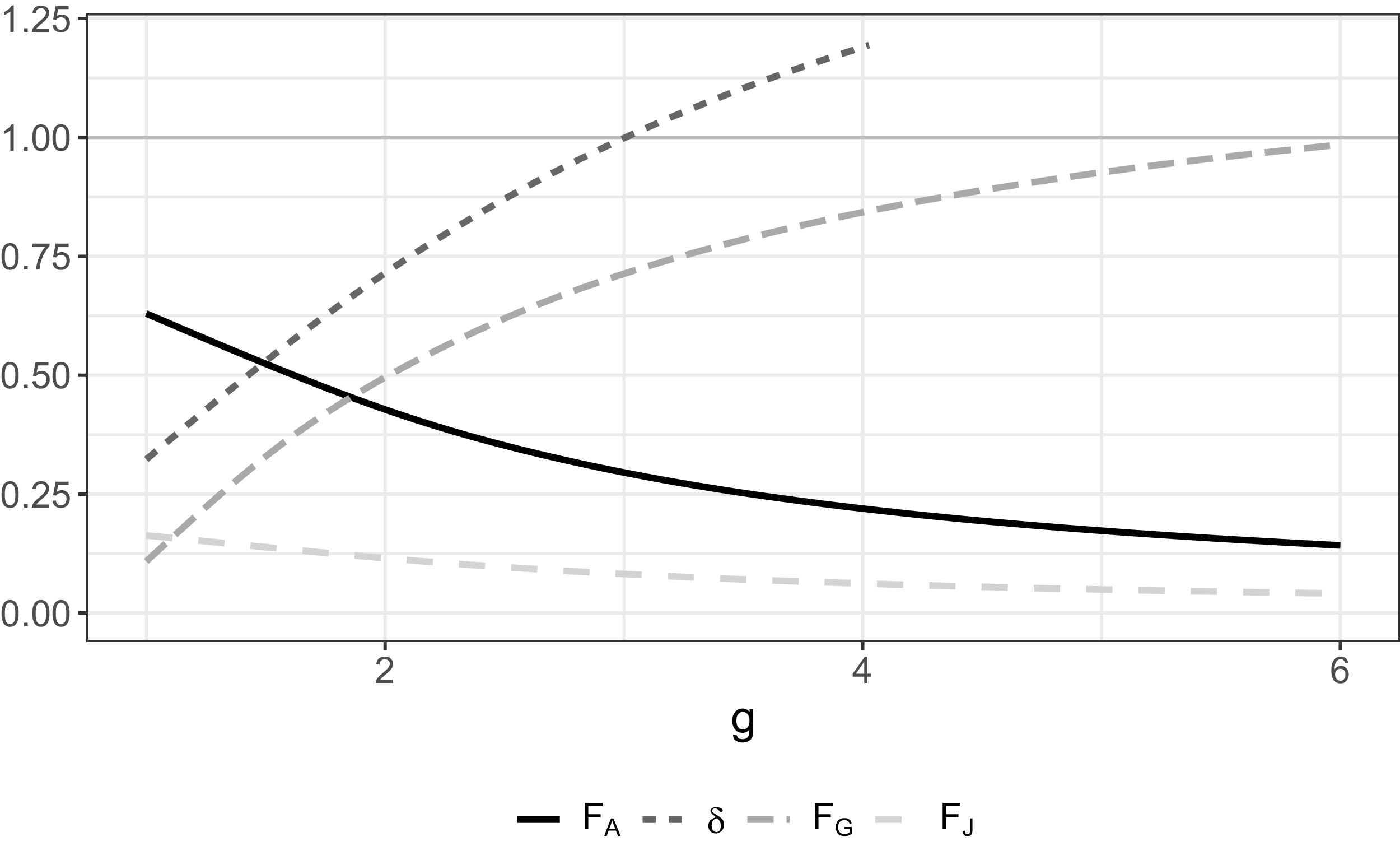
 FA
FA δ
δ FG,J
FG,J g∼(1,6)
 n=10
n=10 m=3
m=3 γ=0.6
γ=0.6 ε=0.25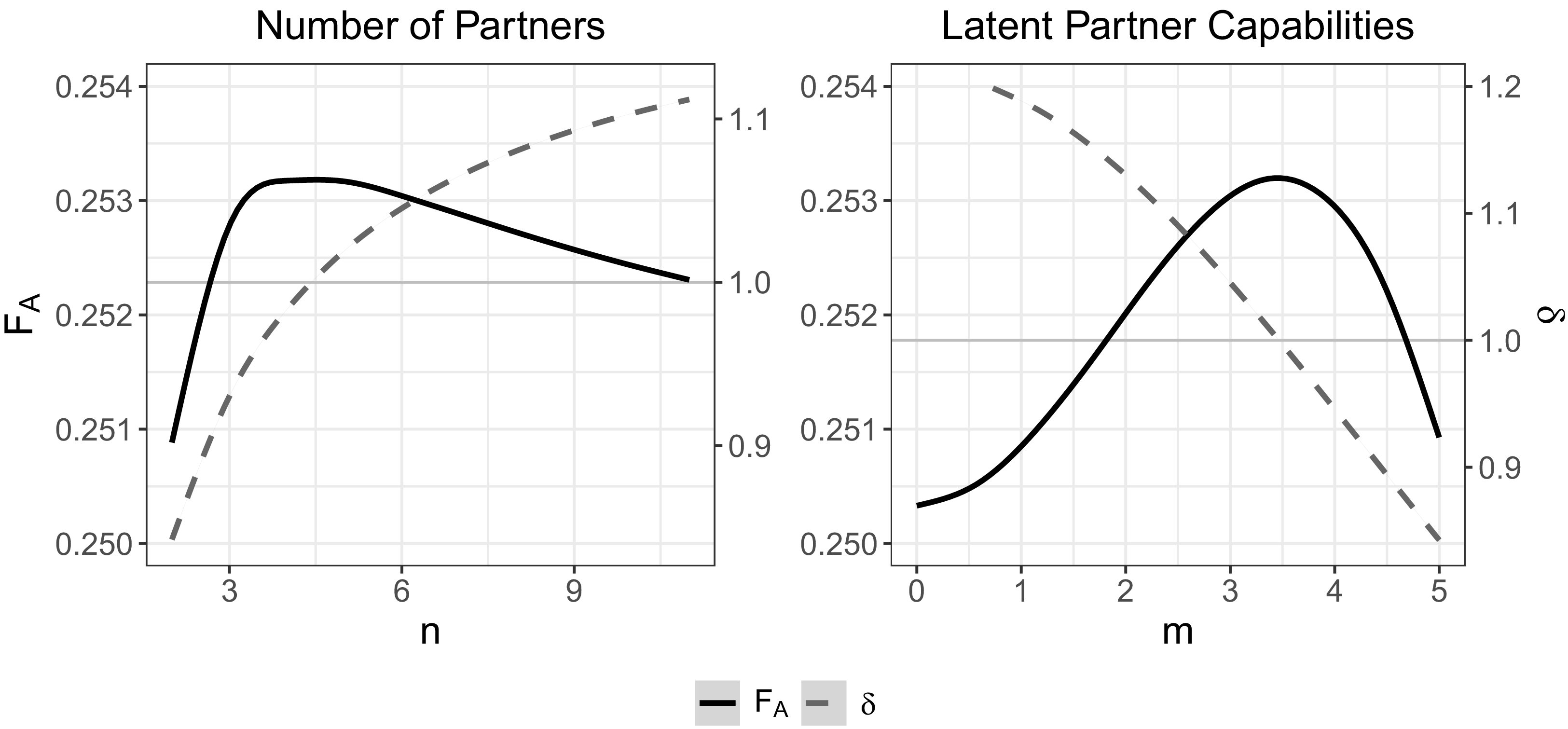
 FA
FA δ
δ n∈(2,11)
 m=3
m=3 g=3.5
g=3.5 γ=0.6
γ=0.6 ε=0.25
 m∈(0,5)
 n=6
n=6 g=3.5
g=3.5 γ=0.6
γ=0.6 ε=0.25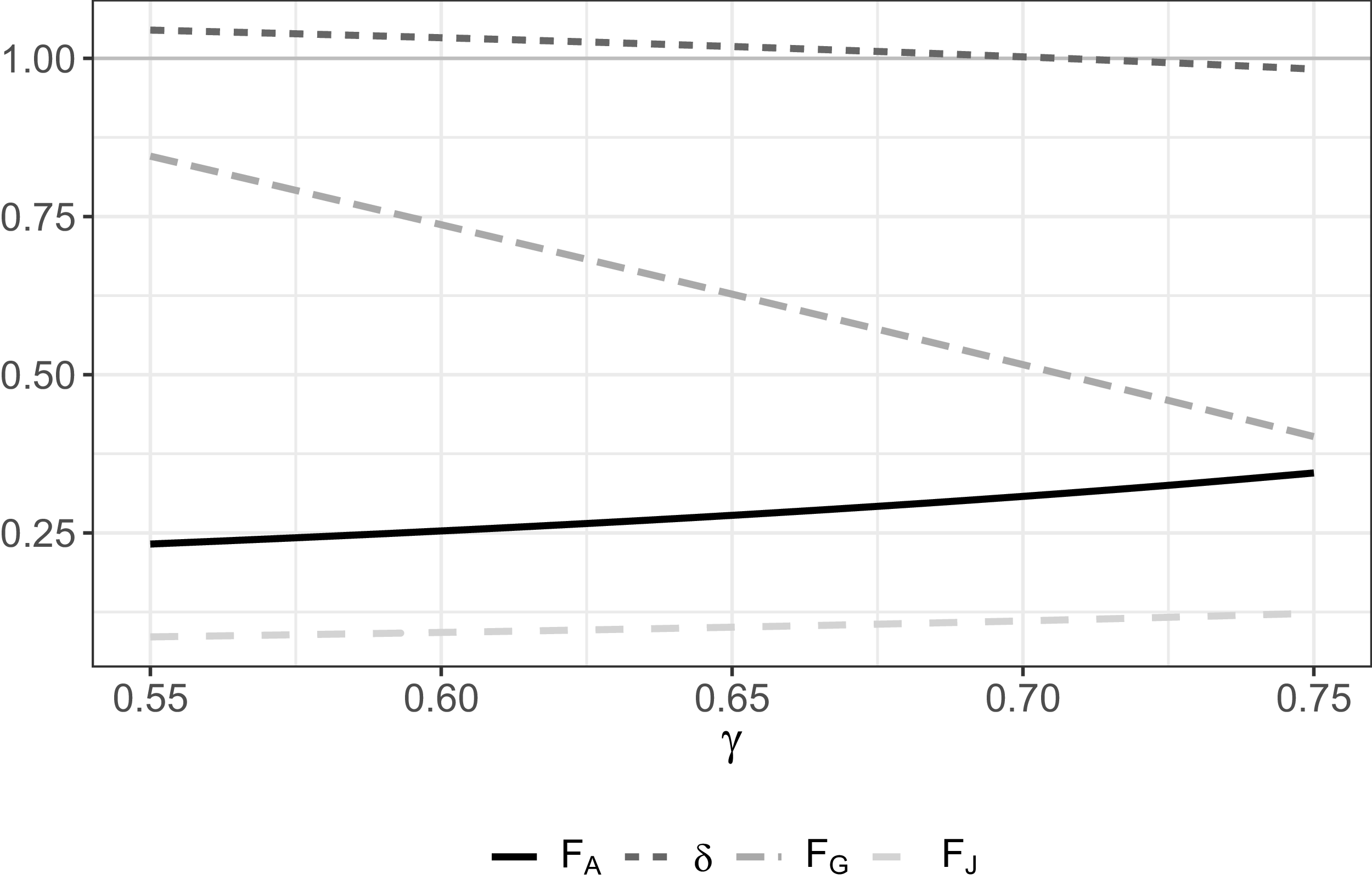
 FA
FA δ
δ FG,J
FG,J γ∈(0.55,0.75)
 n=10
n=10 m=4
m=4 g=3.5
g=3.5 ε=0.25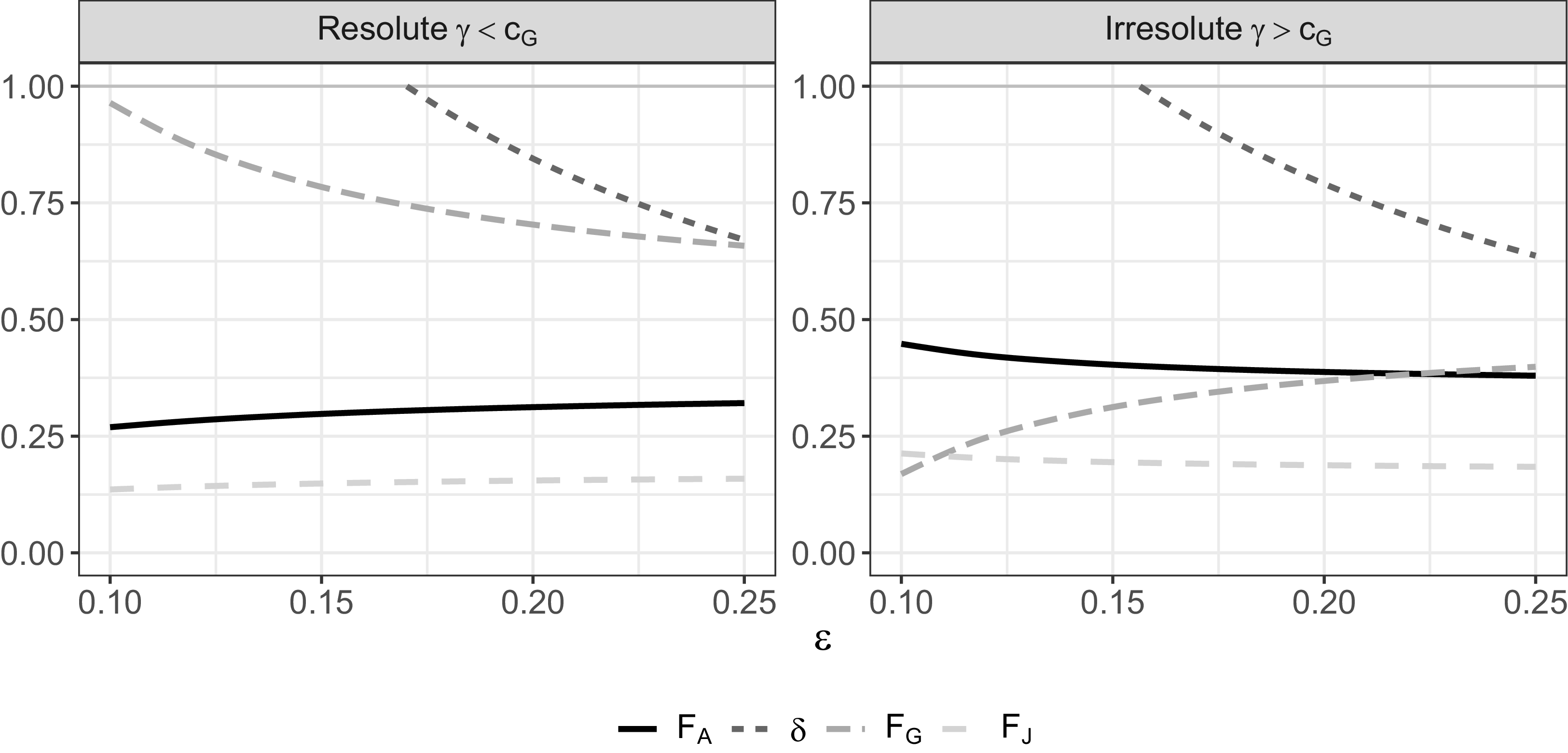
 FA
FA δ
δ FG,J
FG,J γ=0.5
γ=0.5 γ=0.615
 ε∈(0.1,0.25)
 n=7
n=7 m=4
m=4 g=2.25
 Open access

