




Introduction
The emergence of alternative heritage categories
Recently, new heritage categories have emerged within the cultural heritage discourse. Concepts such as informal,Footnote 1 everyday,Footnote 2 or mundane heritageFootnote 3 are gaining traction in the academic sphere, with adjectives designating types of heritage “on the margins,” occupying a subsidiary position in relation to more official and well-defined categories. These classifications represent a form of heritage increasingly independent of statutory heritage lists or traditional preservation measures. For instance, informal heritage includes all those heritages that are “not included in an institutional process of definition, delimitation, and legitimation.”Footnote 4 BarrèreFootnote 5 notes that these heritages may become institutionalized, remain informal, or represent informal aspects of official heritages. Similarly, Chen defines informal heritages as “urban spaces possessing heritage value yet lacking formal recognition as architectural or urban heritage.”Footnote 6 The concept aligns with Harrison’s unofficial heritages, referring to “practices framed in the language of heritage but not recognised by formal legislation.”Footnote 7 Alongside these examples, numerous other terms – everyday,Footnote 8 ordinary,Footnote 9 mundane,Footnote 10 and neglected Footnote 11 – describe a similar type of heritage, not listed yet significant.Footnote 12 These heritages occupy a marginal position, but not because of their association with traumatic past events, as with dissonant, difficult, or contested heritage.Footnote 13 Instead, they align with the concept of vernacular heritage.Footnote 14 While traditionally associated with built heritage, vernacular heritage also encompasses entire environments, including spaces, their perceptions and uses, and the traditions associated with them.Footnote 15 Vernacular heritage is therefore characterized by inherent informality, where functionality does not diminish cultural significance.
Hence, the marginalization of the categories under analysis arises from their ordinariness, which generates limited institutional or public interest and precludes traditional preservation practices. Marginality involves different constituents and dimensions, which are not within the scope of this paper but are addressed elsewhere.Footnote 16 As noted in earlier scholarship, “marginality is very much contextual, and the combinations of its constituents are space and time-bounded.”Footnote 17 In this study, marginality is not understood as an intrinsic feature of the practices we analyze but as a positional outcome of heritage-making processes. It arises through expert-driven evaluative regimes, operated via listings, inventories, and regulatory designations that privilege criteria such as authenticity, architectural merit, or rarity. These criteria, upheld by professional institutions and often detached from the perspectives of nonexperts and everyday users, systematically foreground exceptional sites while relegating ordinary and socially embedded practices to the margins. In other words, practices become marginalized when they fall outside the evaluative regimes, expert framings, and scalar priorities that structure the so-called authorised heritage discourseFootnote 18. This framing aligns with perspectives that conceptualize heritage as a selective and negotiated process rather than a neutral identification of pre-existing significanceFootnote 19. In this sense, we use “marginal” to designate those practices which, within Anglophone and Eurocentric heritage systems, remain beyond institutional processes of definition, delimitation, and legitimation – such as many local traditions, everyday routines, and forms of situated know-how.Footnote 20
Our preliminary review revealed unclear meanings and relationships between the analyzed categories in academic discourse. Furthermore, no study has interpreted their rise as a broader phenomenon linked to the process of rethinking some theoretical foundations of the concept of cultural heritage.Footnote 21 As an example, while framing the notion of everyday heritage, Ireland and colleagues called for a comprehensive review that “could cast a much wider net across a broader array of disciplines and allied approaches.”Footnote 22 This paper developed as the first attempt to systematically compare these newly emerging terminologies in the cultural heritage domain, with the scope of exploring what the declared marginality of these categories reveals about contemporary official heritage discourse, contributing to a reflection on current practices. Without setting disciplinary limits, this study asks: (1) How is each heritage category defined? (2) How do authors attribute values to each heritage category? By addressing these questions, shared tendencies and topics were identified. Analyzing these categories as a broader phenomenon can yield valuable insights and perspectives on contemporary issues in the field of cultural heritage. These investigations may expand the concept of cultural heritage and propose new directions for policy and practice, following the reframing turn initiated by the 2003 Convention on Intangible Heritage.
Heritage new conceptualizations and reframing processes: The holistic turn
As mentioned, our paper is framed within discussions about the new conceptualizations and reframing processes of heritage within Anglophone and Eurocentric discourse, understood as a particular epistemic community or heritage domain,Footnote 23 with its own classificatory logics, conservation priorities, and historically sedimented value regimes. By focusing on this domain, we are not suggesting that it represents a universal or neutral vantage point. Instead, we treat it as one influential knowledge system whose internal tensions and blind spots merit scrutiny. In particular, the emergence of categories such as everyday, ordinary, or informal heritage reflects a growing unease within this epistemic community about the limits of its own authorized assumptions. It is precisely because these categories arise within a tradition that has long privileged Western epistemologies that their conceptual evolution warrants systematic examination. At the same time, we recognize that the global prominence of Anglophone frameworks is inseparable from wider histories of power and that non-Western ontologies, such as Indigenous or postcolonial understandings of materiality, temporality, and inheritance, often stand in stark contrast to Western models. Ethnographic research has repeatedly shown how these dominant regimes fail to account for locally situated meanings and practices: As Brumann and BerlinerFootnote 24 demonstrate, World Heritage interventions are frequently reinterpreted, contested, or reshaped on the ground in ways that reveal the misalignments between global heritage logics and the lived ontologies of the communities they affect. These dynamics exceed the scope of this study but remain crucial for contextualizing our findings. The trends we identify should therefore be read as mapping the internal self-critique of a particular heritage regime rather than offering a comprehensive account of global heritage thinking.
Against this backdrop, it becomes important to trace how this epistemic community has sought to redefine its own principles over time. A crucial document in this discourse was “Forward Planning: The Functions of Cultural Heritage in a Changing Europe,”Footnote 25 which inaugurated a series of reflections on some foundational principles of traditional interpretations of cultural heritage, revealing “a movement towards wider definitions and a much wider role of heritage in society.”Footnote 26 From the 2000s, cultural heritage began to be recognized as a social product to which people attributed value, and new participatory management approaches encouraged a shift from exclusively expert evaluation to more inclusive heritage assessments.Footnote 27 These conceptual shifts were consolidated by the adoption of two key texts in 2005: the Convention on the Protection and Promotion of the Diversity of Cultural Expressions by the United Nations Educational, Scientific and Cultural Organization (UNESCO), and the Council of Europe’s Framework Convention on the Value of Cultural Heritage for Society, known as the Faro Convention.Footnote 28 Focusing not on “how to protect heritage but why,”Footnote 29 the Faro Convention approached cultural heritage as a tool for inclusion, broadening its definition to encompass the ordinary and arguing that heritage is ubiquitous and intimately tied to everyday life.Footnote 30 However, the 2003 Convention for the Safeguarding of the Intangible Cultural Heritage was the first institutional document formalizing this “shift in valuation from grand, monumental architectural objects to the entirety of historic landscapes, encompassing intangible components.”Footnote 31 Although the compartmentalization of heritage has gradually been replaced by an increasingly holistic view,Footnote 32 the introduction of intangible heritage reflects an extensive and complex process of rethinking the idea of heritage as a whole. Indeed, as Bortolotto states, the introduction of intangible cultural heritage “does not rest on the intangibility of cultural expression, but rather on its support of the idea that they are to be understood in terms of time (as an evolving process) and usage (not just for aesthetic contemplation).”Footnote 33 In the 2003 convention, cultural heritage starts acquiring a living dimension and “ceases to be just an object but becomes associated with whatever fulfils the function of cultural heritage.”Footnote 34 In other words, the inclusive approach to cultural heritage, encompassing both the properties considered as heritage and their evaluation processes, is based on two fundamental ideas that have challenged traditional limits: the introduction of its temporal and utilitarian dimensions.
The power of naming: The relevance of terminology for cultural heritage
The introduction of intangible heritage exemplifies how the emergence of new categories within cultural heritage discourse stems from a broader re-evaluation of the concept of heritage itself and its theoretical underpinnings. Changes in the understanding of cultural heritage are also linked to a process of terminological differentiation, as seen in the distinction between tangible and intangible heritage.Footnote 35 In preparation for the 2003 Convention for the Safeguarding of Intangible Cultural Heritage, UNESCO convened an international meeting of experts in Rio de Janeiro on “Intangible Cultural Heritage: Priority Domains for an International Convention.” During this meeting, experts highlighted the urgent need for a standardized glossary to support the field of intangible cultural heritage.Footnote 36
Beyond intangible heritage, Moitinho De Almeida et al.Footnote 37 emphasize the importance of interdisciplinary dialogue to achieve a shared understanding of terminologies and categories employed in the cultural heritage field. As LearyFootnote 38 noted, naming is a fundamental means of knowing, a critical step in making sense of the world. This process often relies on metaphorical or analogical modes of perception: when encountering the unfamiliar, we draw upon existing concepts to comprehend it. McGarty elaborates that “we understand the world and explain it to ourselves, and to those around us, by working out how, why, and when things are the same as, and different from, other things.”Footnote 39
In the cultural heritage sector, naming and categorization are deeply embedded in the concept of heritage itself. Heritage results from a selection process in which specific qualities of objects are recognized and distinguished from their surrounding environment. Terminology also serves as a preservation tool, understood not only as safeguarding practice but also as an accessibility strategy to cultural heritage.Footnote 40 For instance, introducing the concept of intangible heritage facilitated a broader reconsideration of heritage and spurred debates on effective management strategies for its safeguarding.Footnote 41 Similarly, the introduction of cultural landscapesFootnote 42 was a strategic response to acknowledge sites as “the combined works of nature and man.”Footnote 43 This terminology became the first international legal instrument for recognizing this heritage category, described by FowlerFootnote 44 as a mechanism to present “one of the world’s saner ideas … recognising humanity’s near all-pervasive environmental influence.”Footnote 45
In summary, the emergence of new categories within Anglophone and Eurocentric cultural heritage discourse is rooted in a broader re-evaluation of the concept of heritage itself. This process highlights the necessity of reflecting on appropriate terminology to ensure recognition, preservation, and accessibility of heritage for diverse groups. Building on these reflections, our research clarifies alternative heritage categories that are gaining prominence in academic discussions. Our study pursues two main objectives. First, we aim to examine these alternative categories and explore their interrelations. This process represents a crucial first step toward facilitating a more comprehensive rethinking of heritage. Indeed, the increasingly dynamic and holistic perspective on heritage has raised unresolved issues, particularly regarding the evolving concepts of heritage function, authenticity, and its relationship to continuity. Moreover, despite the revolutionary scope of the 2003 Convention, its approach continues to marginalize vernacular perspectives and practices in the safeguarding of intangible cultural heritage.Footnote 46
In summary, this paper represents the first attempt to systematically compare newly emerging terminologies in the cultural heritage domain as well as to explore what their marginality reveals about contemporary official heritage discourse. Additionally, based on emerging shared tendencies and topics in our database, and to facilitate future reflections on the issues raised by our SLR, we propose an umbrella term to encompass the reviewed terminologies. The aim is to enhance their accessibility and representation for broader audiences, while also reflecting on their role within the heritage ecosystem. In this regard, the concluding sections employ the concept of liminality as a conceptual lens to encourage a reflection on the potential and positioning of these emergent categories in the heritage ecosystem.
Methodology
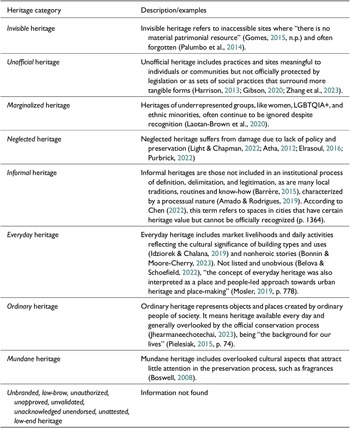
This research adopts a systematic literature review (hereinafter SLR) methodology to map the terms and discourse surrounding alternative heritage categories. The SLR provides a comprehensive understanding of the breadth and depth of existing research, also pinpointing areas for future investigation.Footnote 47 Following the guidelines outlined in the Preferred Reporting Items for Systematic Reviews and Meta-Analyses (PRISMA), we established a systematic protocol for analysis and inclusion criteria. The identification of search terms began with a preliminary review centered on informal heritages, defined as those “not included in an institutional process of definition, delimitation, and legitimation.”Footnote 48 Subsequently, we identified a broad spectrum of synonyms describing related categories and included them in our preliminary review. This phase involved gathering information on the definitions of each category to ensure alignment with the scope and objectives of the analysis (Table 1).
Description/examples of each heritage category in our search string
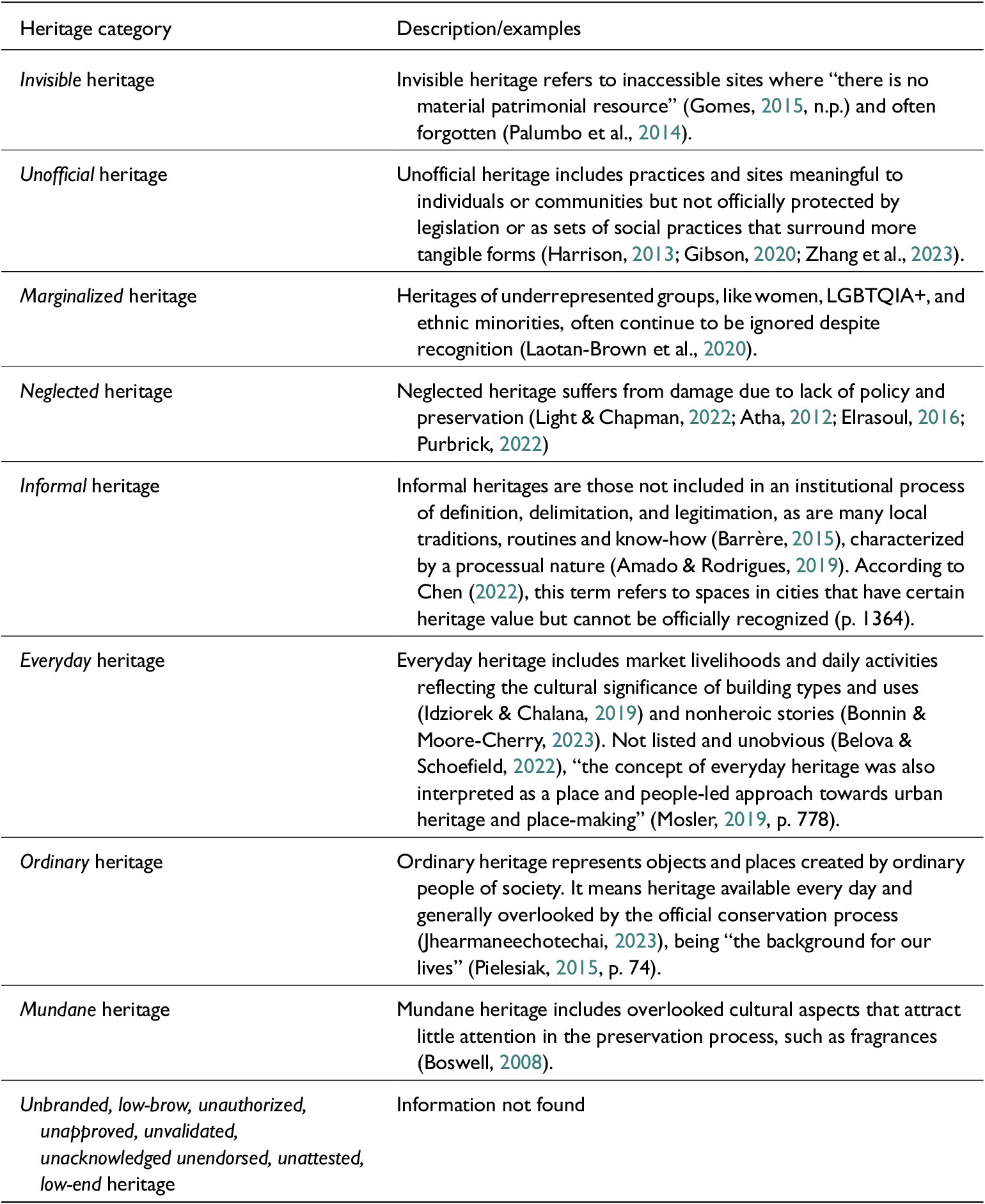
Table 1. Long description
From the top row, the left column lists heritage categories: invisible, unofficial, marginalized, neglected, informal, everyday, ordinary, mundane, and unbranded types. The right column provides descriptions or examples. Invisible heritage refers to inaccessible sites with no material patrimonial resource and often forgotten. Unofficial heritage includes practices and sites meaningful to individuals or communities but not officially protected, or social practices surrounding tangible forms. Marginalized heritage covers underrepresented groups such as women, L G B T Q I A plus, and ethnic minorities, often ignored despite recognition. Neglected heritage suffers damage due to lack of policy and preservation. Informal heritage is not included in institutional processes, often local traditions, routines, and know-how, characterized by processual nature and spaces in cities with heritage value but not officially recognized. Everyday heritage includes market livelihoods, daily activities, nonheroic stories, and is interpreted as a place and people-led approach to urban heritage and place-making. Ordinary heritage represents objects and places created by ordinary people, available every day and generally overlooked by official conservation, serving as the background for lives. Mundane heritage includes overlooked cultural aspects such as fragrances that attract little attention in preservation. The unbranded, low-brow, unauthorized, unapproved, unvalidated, unacknowledged, unendorsed, unattested, low-end heritage category has no information found.
The search string used was as follows: (“invisible heritage” OR “unofficial heritage” OR “marginal* heritage” OR “neglected heritage” OR “informal heritage” OR “everyday heritage” OR “ordinary heritage” OR “unbranded heritage” OR “low-brow heritage” OR “unauthorised heritage” OR “unapproved heritage” OR “unvalidated heritage” OR “unacknowledged heritage” OR “unendorsed heritage” OR “unattested heritage” OR “low-end heritage” OR “mundane heritage”). Considering the conceptual framing of vernacular heritage as established in the 1999 International Council on Monuments and Sites (ICOMOS) Charter, the term was excluded from our search string, as our focus was on marginalized and undefined categories. However, as outlined in the introduction, given the alignment between our categories and the concept of vernacular heritage, the term has been consistently acknowledged and incorporated within our broader analytical framework.
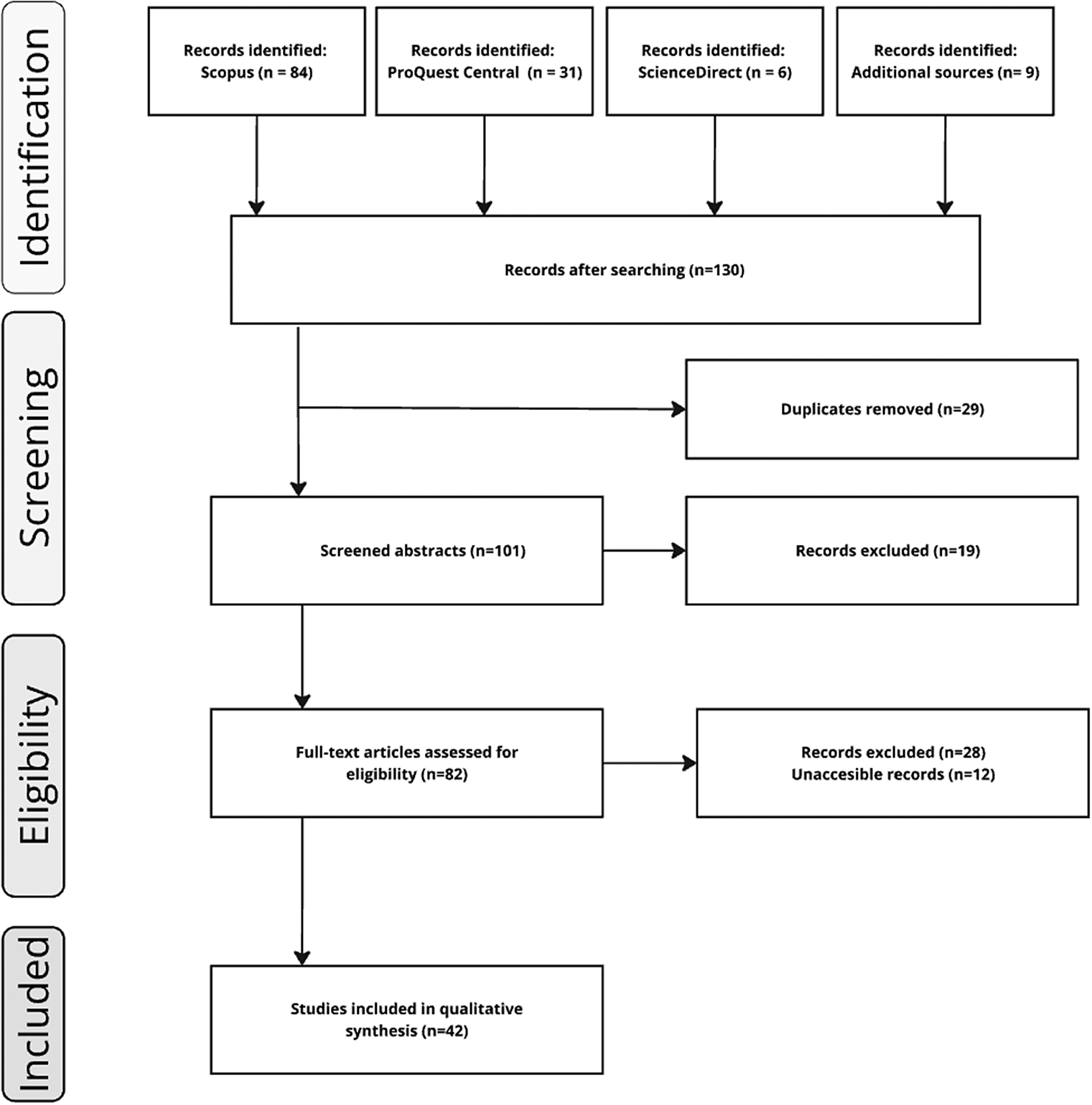
Searches were conducted in Scopus, ProQuest Central, and ScienceDirect, targeting titles, abstracts, and keywords without restrictions on publication date or discipline. A protocol was pre-established to systematically document the analysis method and inclusion criteria for the final database. To ensure high-quality sources, we included book chapters and short surveys in English, beyond peer-reviewed articles in final publication status. The last search was conducted on 1 February 2024. The paper selection process is summarized in Figure 1. Finally, we acknowledge the limitation of excluding non-English sources (e.g., the notion of modest art as defined by RosaFootnote 49 or Alltagskultur in German culture). The decision to apply a language filter was based on the widespread use of English in academic discourse. Despite this, we believe our research provides a foundation for future studies incorporating non-English sources.
Flowchart of study selection process.
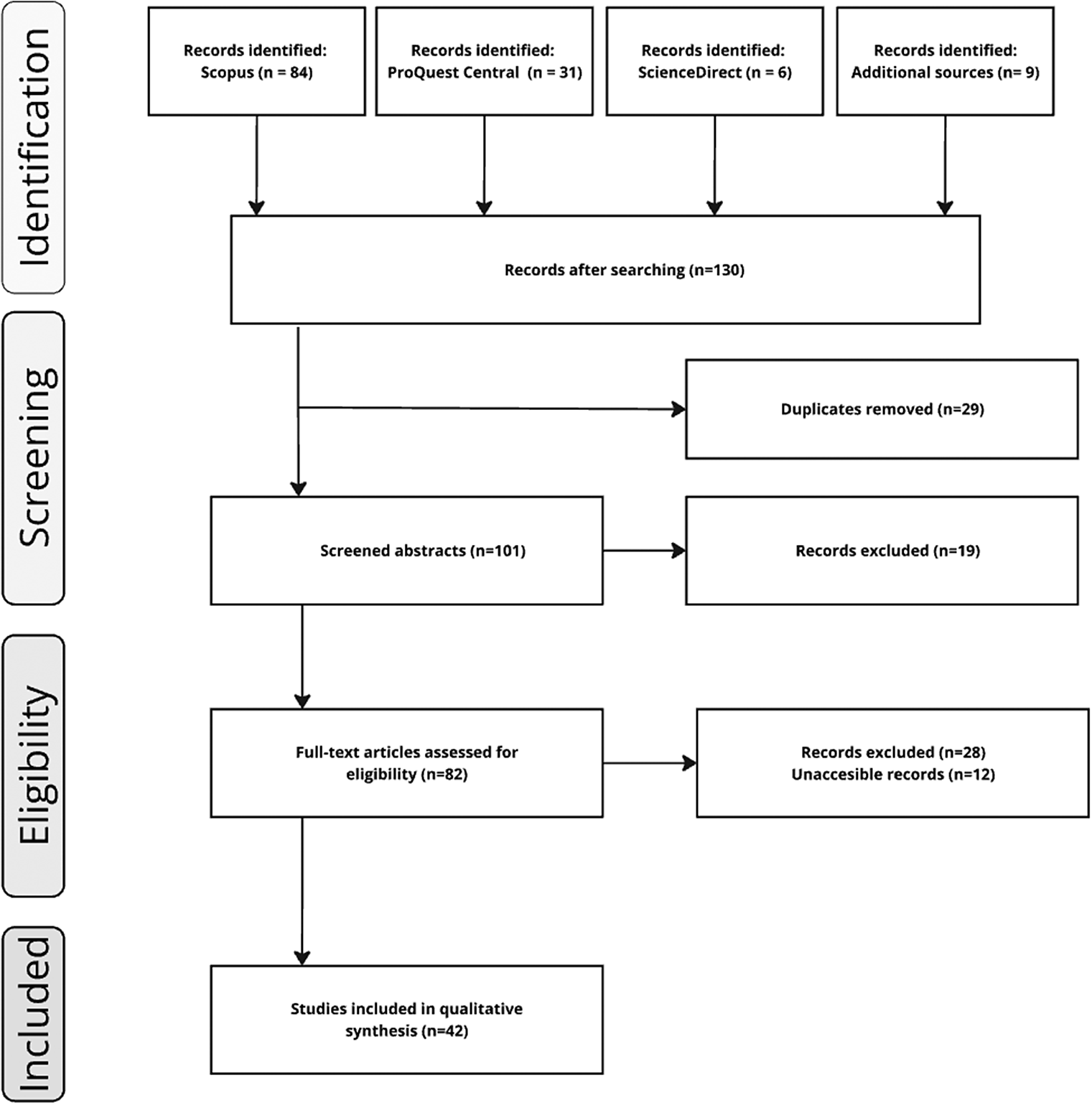
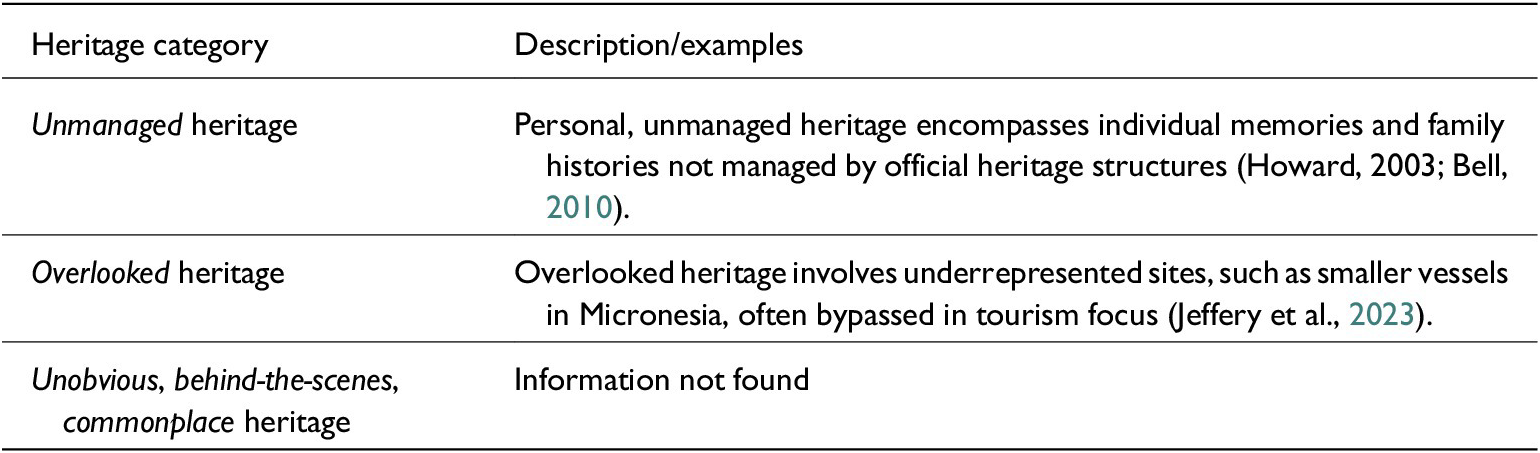
The paper selection involved a two-phase screening process. The first screening phase began with a sequential assessment of the titles and abstracts of our database, and an Excel table was created to record the following data: author(s), title, document type, year, source title, volume, issue, citations number, DOI, abstract, keywords, source. We conducted an abstract pertinence check of each paper to exclude all those texts in which the adjectives included among the search terms didn’t refer to the term “heritage.”Footnote 50 A total of 82 papers were passed through to the second screening phase, which involved a full-text review. The criteria for inclusion in this second screening phase encompassed papers providing insights into the meaning of the specific heritage category under consideration and the values attributed to them. As the second screening phase led to the identification of additional synonyms relevant to our research (Table 2), we decided to incorporate these terms into our analysis by running a second search to make it as comprehensive as possible. Specifically, we identified additional papers addressing the following concepts: unobvious heritage,Footnote 51 unmanaged and behind-the-scenes heritage,Footnote 52 commonplace heritage,Footnote 53 and overlooked heritage.Footnote 54 To this end, we designed a new string (TITLE-ABS-KEY “unobvious heritage” OR “unmanaged heritage” OR “behind-the-scenes heritage” OR “commonplace heritage” OR “overlooked heritage”) and performed the search in the same databases applying the same review protocol and methods as the first search.
Description/examples of each heritage category in our second search string
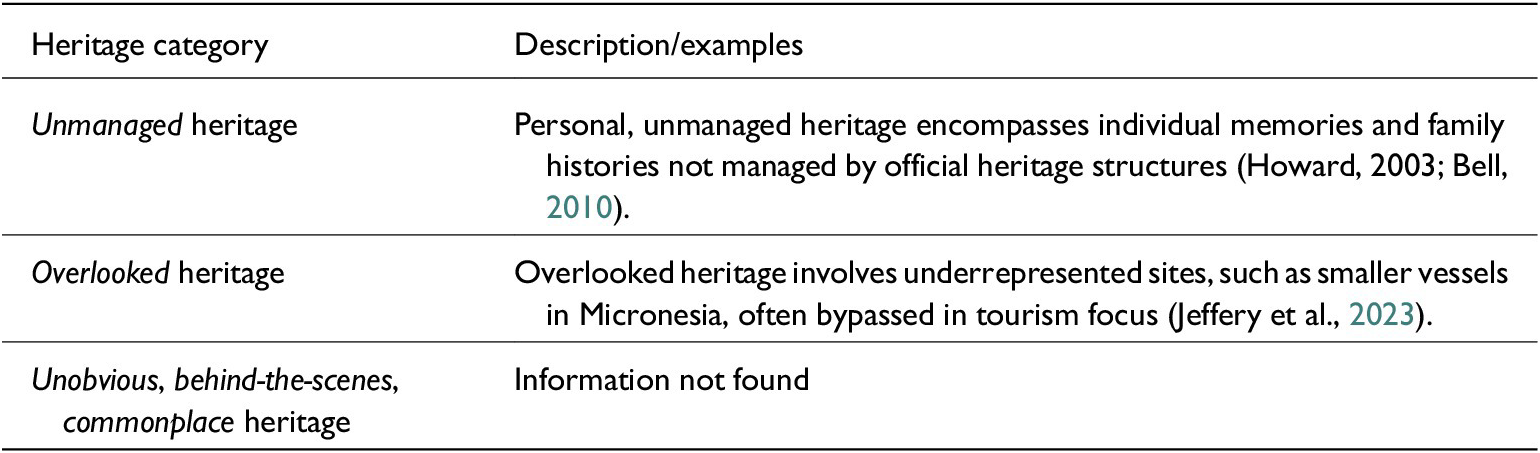
Table 2. Long description
From the top row, the left column is labeled Heritage category and the right column is labeled Description/examples. The first row lists Unmanaged heritage, described as personal, unmanaged heritage encompassing individual memories and family histories not managed by official heritage structures, referencing Howard, 2003 and Bell, 2010. The second row lists Overlooked heritage, described as underrepresented sites such as smaller vessels in Micronesia, often bypassed in tourism focus, referencing Jeffery et al., 2023. The third row lists Unobvious, behind-the-scenes, commonplace heritage, with the description field stating Information not found.
We obtained 4 papers on Scopus, 3 on ProQuest Central, and 0 on ScienceDirect. After eliminating duplicates (4), performing abstract screening, and full-text screening, we added 2 papers to the previous database of 42, for a total of 44.
Data analysis addressed two research questions. First, it aimed to frame the most common features of the concerned heritage categories. To achieve this, a thematic analysis of the final database was conducted using ATLAS.ti. Thematic analysis is a method for identifying patterns (or themes) within a dataset,Footnote 55 enabling us to move from fragments of text to preliminary codes, which were then translated into themes. In detail, relevant textual excerpts were identified based on their relevance to the research focus, specifically their capacity to elucidate the defining features of the heritage categories under investigation, and were systematically organized into an Excel table, which specified the discussed category and the reference. We used ATLAS.ti to facilitate the coding process of the selected fragments from our database. After obtaining our code set, we incorporate related codes into themes manually. The analysis predominantly adopted an inductive approach, with open coding focused on identifying meanings that emerged directly from the data. However, as ByrneFootnote 56 acknowledges, coding and analysis seldom adhere strictly to a single approach. Instead, they often involve a dynamic interplay between inductive and deductive strategies. Hence, a degree of deductive reasoning was also applied to ensure that the resulting themes remained closely aligned with the research questions and that the insights generated were relevant to the study’s objectives.
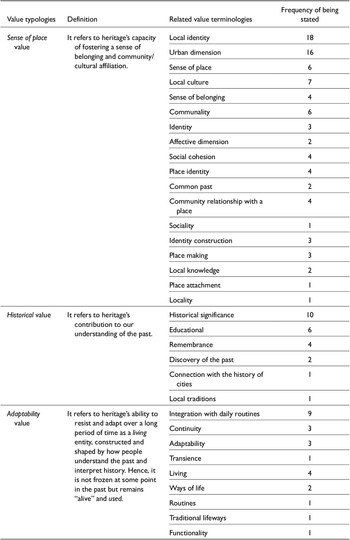
As a second step of our data analysis, we analyzed the values attributed to the heritage categories. The value analysis was operationalized using the methodology of Sahraiyanjahromi and Türker.Footnote 57 In this study, the literature was reviewed to derive a set of value typologies, defined as preconceived criteria that break significance into constituents that are easy to detect and express.Footnote 58 To identify the most common typologies of heritage values in our database, we employed a two-stage research procedure to explore the emerging terminology of heritage values and categorize them into different typologies. In the first stage, each paper was thoroughly re-examined to identify value terminologies associated with its heritage category. This analysis was documented in an Excel spreadsheet, recording the terminologies articulated by each author. In the second phase, the most frequent value terminologies were merged with those of similar meanings and converted into value typologies. We acknowledge the inherent risks of establishing uniform criteria for value assessment.Footnote 59 However, this approach was framed as a strategy to examine categories through value typologies, recognizing value as the intrinsic driver of heritage recognition.Footnote 60 Moreover, this second phase of analysis was intended to complement the initial thematic analysis, which was inherently more interpretative. In the thematic analysis, we primarily employed an inductive approach, though a degree of deductive reasoning was applied to ensure that the open coding generated themes aligned with the research focus. In contrast, the value terminology analysis focused on identifying semantic codes, capturing only the explicit content articulated by the authors (summarized in Table 3). By integrating these two coding strategies, the dual-phase analysis aimed to balance the authors’ expressed meanings with our interpretive engagement, thus enabling a more comprehensive understanding of the dataset.
Designed value typologies
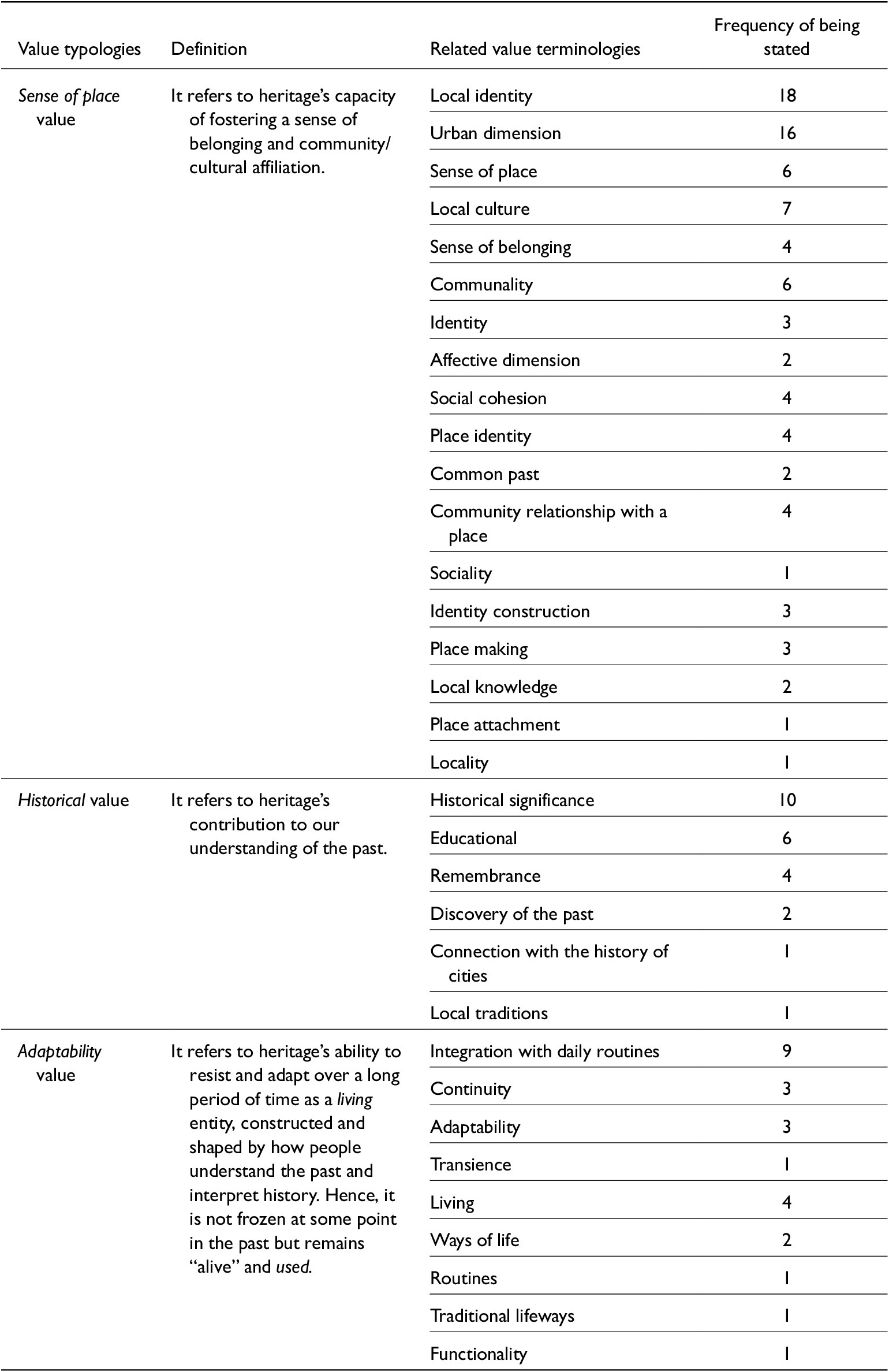
Table 3. Long description
Starting from the top, the first typology is sense of place value, defined as heritage’s capacity to foster belonging and community or cultural affiliation. Related terminologies listed vertically include local identity (18), urban dimension (16), sense of place (6), local culture (7), sense of belonging (4), communality (6), identity (3), affective dimension (2), social cohesion (4), place identity (4), common past (2), community relationship with a place (4), sociality (1), identity construction (3), place making (3), local knowledge (2), place attachment (1), and locality (1). The next typology is historical value, defined as heritage’s contribution to understanding the past. Related terms are historical significance (10), educational (6), remembrance (4), discovery of the past (2), connection with the history of cities (1), and local traditions (1). The final typology is adaptability value, defined as heritage’s ability to resist and adapt over time as a living entity shaped by people’s interpretation of history. Related terms are integration with daily routines (9), continuity (3), adaptability (3), transience (1), living (4), ways of life (2), routines (1), traditional lifeways (1), and functionality (1). Each typology’s definition and related terms are grouped in columns, with frequencies listed in the rightmost column.
Our hypothesis posited that connections could be identified between the categories under consideration and that this approach could contribute to a broader reflection on current practices defined as official, suggesting new directions for future policy and practice. As an example, given the informal and processual nature of these categories (as highlighted in our preliminary review), this approach could yield insights into the interpretation of functionality and alteration, namely, how the papers addressed the theme of change and whether this was critically examined in the literature.
Results and discussion
In this section, the findings from our two distinct analytical phases intersect to complement each other. Indeed, the results of these two distinct phases of analysis were mutually complementary. Also, this combined approach balanced the explicit content conveyed by the documents in the database with our interpretive engagement, capturing key topics through both semantic and latent coding. As previously noted, the value typologies presented in Table 3 were derived from semantic codes, reflecting the authors’ explicit language. In contrast, the thematic analysis enabled a deeper interpretive engagement by the researchers. Thus, results are structured around four thematic axes that emerged from the findings from both the thematic analysis and the analysis of value terminologies. The first axis, (i) the dominance of the local scale, emphasizes the valuation of the concerned heritage on a local scale, stressing its role in fostering belonging, social cohesion, and sense of place. Second, (ii) from grand narratives to recent history reframes the temporal scale of heritage and the centrality of our recent past. The third axis, (iii) the utilitarian dimension of heritage, centralizes heritage’s adaptability and functionality, offering new perspectives also on the issue of continuity in heritage studies. Finally, (iv) rethinking heritage as rethinking authenticity critiques traditional notions of authenticity in heritage studies, advocating for an inclusive perspective that embraces transformation, decay, and adaptation. However, before delving into each thematic axis, a preliminary section provides an overview of the studies in our database.
Overview of the studies
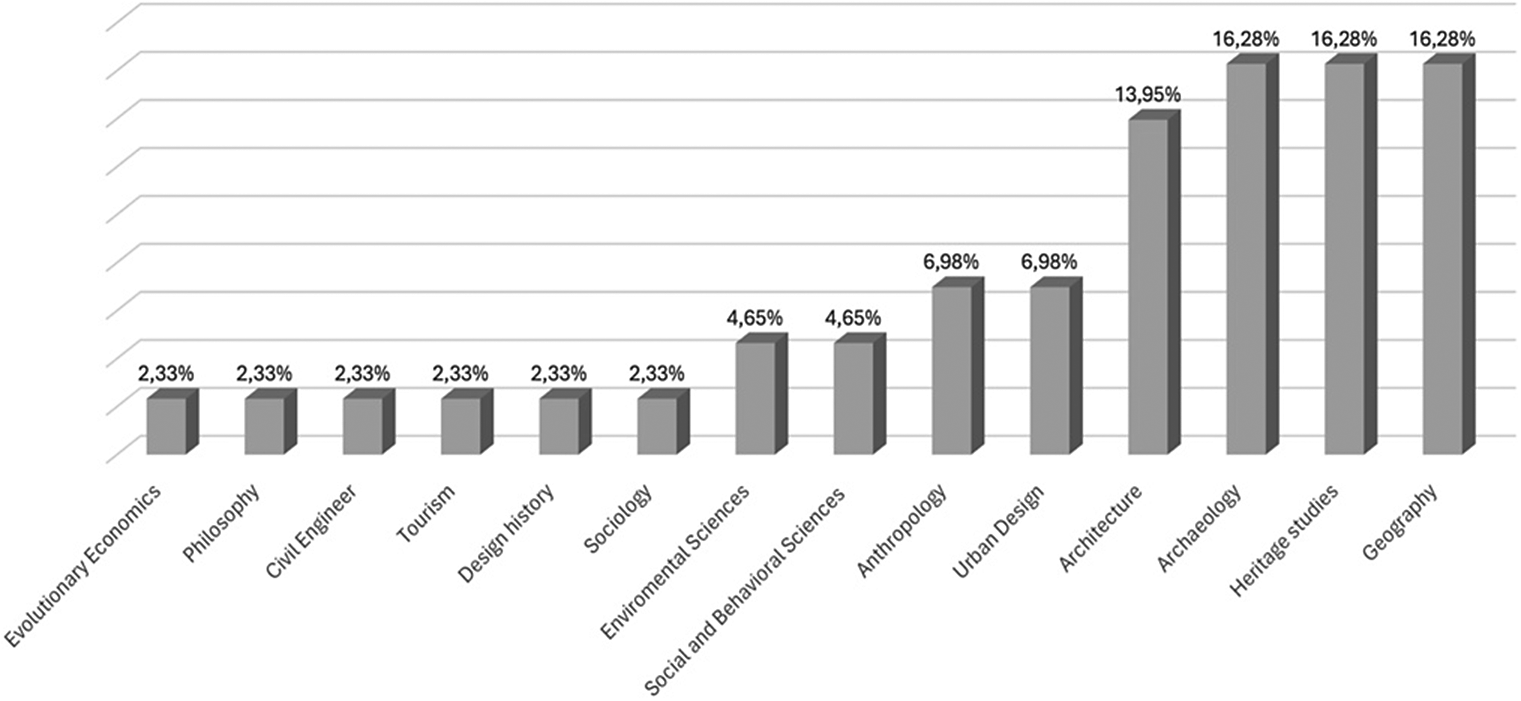
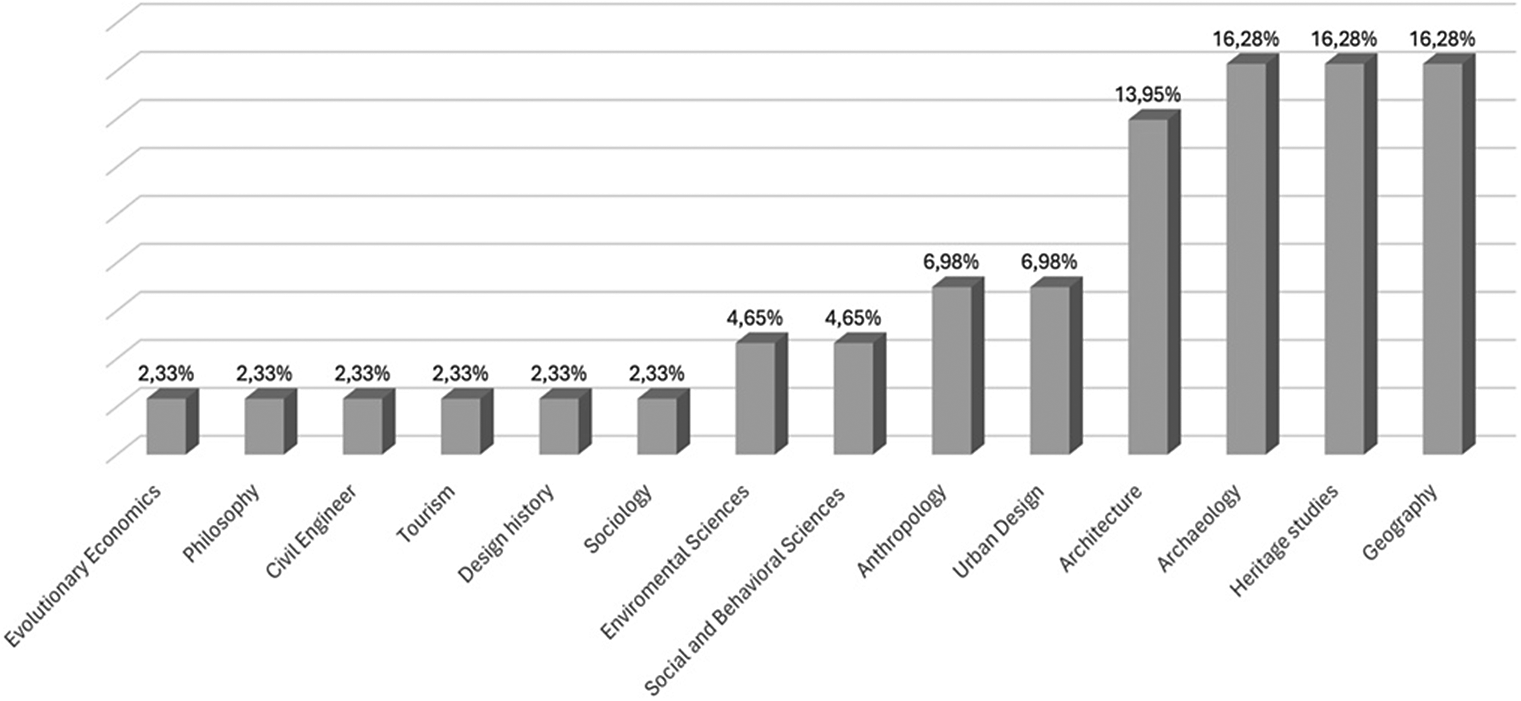
The 44 studies in our database were published from 2005 to 2024 across 14 different disciplines (Figure 2). Dominant fields include geography, heritage studies, archaeology, architecture, urban design, and anthropology. When unspecified, the first author’s discipline was declared. These findings highlight the interdisciplinary significance of the topic, supporting the need for a harmonization of terms to offer researchers from diverse fields a solid foundation for future collaboration and exploration. Notably, disciplines such as cultural management and economics are absent from the database. This gap may be due to the topic’s relatively recent emergence and lack of a clear definition, as well as the preference for other terminologies. However, it may also launch a reflection on the fact that “the dominant economic analysis of heritages is still strictly linked to public policies regarding official heritages.”Footnote 61
Disciplines of the papers.
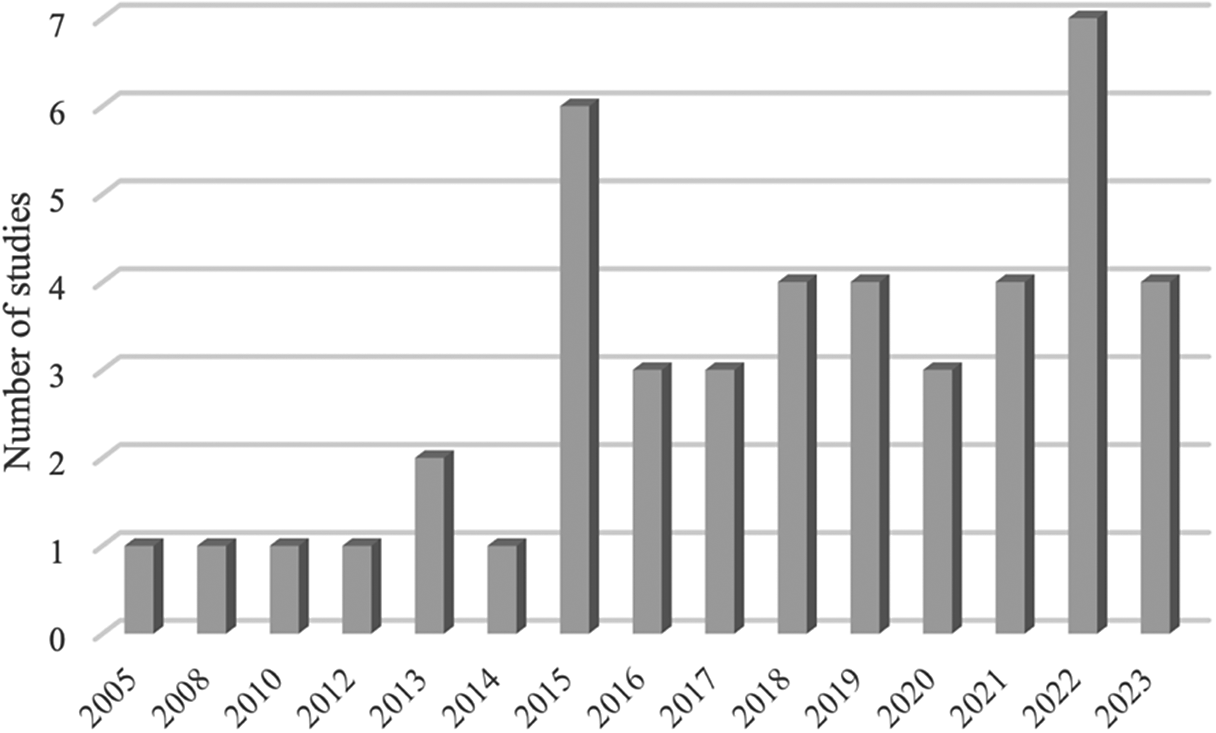
Papers referencing these categories appeared in the early 2000s, coinciding with the publication of key policy documents such as the 2003 Convention for the Safeguarding of the Intangible Cultural Heritage (2003), the Convention on the Protection and Promotion of the Diversity of Cultural Expressions (2005), and the Faro Convention (2005). This suggests a relationship between the emerging directions of institutional discourse and growing academic interest in these new terminologies. However, the analysis also reveals an evolution in the usage of these categories over time. More specifically, a relevant shift occurred from 2015 onward (Figure 3).
Studies per year.
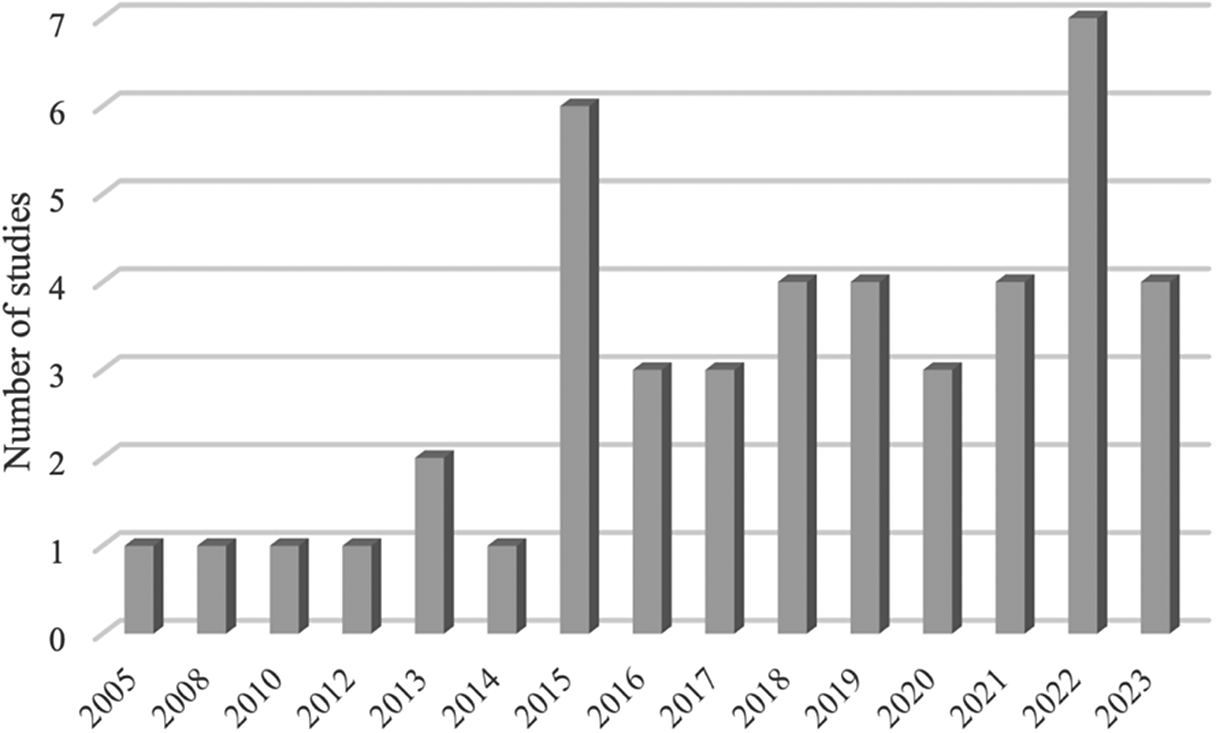
This increase could be linked to a period of growing interest in an integrated approach that combines sustainable development with active community participation in heritage management, exemplified by the concept of “heritage from below”Footnote 62 and centralized by reports such as the Policy Document on the Integration of a Sustainable Development Perspective into the Processes of the World Heritage Convention. Footnote 63
The geographic distributions of the locations where the studies were conducted showed that the topic is of interest in 19 countries. In the United Kingdom, the topic attracted the most attention as it was examined in 12 out of 44 papers (27%). This predominance might reaffirm the relationship between the advent of these categories and a participatory shift in the field of heritage studies, as the idea of heritage as an instrument to empower local communities through remembrance (Robertson, Reference Robertson2012) gained traction in the United Kingdom. It is noteworthy that our database also includes multiple studies from non-Western countries, such as China (8%), Thailand (6%), Egypt (6%), and South Africa (4%). As a result, the findings also capture alternative perspectives that challenge Eurocentric positions traditionally.
In terms of the most popular categories, everyday heritage predominates, featuring in 10 out of 44 papers (22%). This concept refers to a type of heritage that plays a crucial role in shaping the spatiality of everyday life.Footnote 64 It manifests itself in multiple ways, from the eclectic mix of building types and usesFootnote 65 to commemoration practices.Footnote 66 Beyond the case of everyday heritage, the most prominent categories within the database are neglected (15%), informal (13%), and ordinary heritage (13%).
Finally, we examined the types of heritage discussed in each included study. We are aware that any classification is, by definition, artificial: Tangible heritage always carries intangible dimensions (and vice versa), and most papers engage several dimensions at once. To preserve analytical clarity, we therefore coded each publication by the dimension foregrounded as primary. Following this reasoning, built and intangible heritage dominate the dataset, with built heritage appearing in 22 out of 44 papers (50%) and intangible heritage in 7 (15.9%) (see Appendix 1). The popularity of the built heritage typology may be explained by the dominance of disciplines such as geography and architecture. Additionally, the prominence of these disciplines underscores the identification of the first value typology as the sense of place value (Table 3), highlighting heritage’s capacity to foster belonging and community affiliation.
Beginning with this first typology, the following sections are structured around four thematic axes through which the identified value typologies are examined, in conjunction with findings from the thematic analysis.
The dominance of the local scale: Valuing the local
The first value typology relates to the spatial scale of cultural heritage. As stated by Lähdesmäki, “certain layers of heritage meanings are activated in certain discourses, policies and practices at different scales. Thus, the same heritage practice, object or site can have several scalar meanings and be used to foster and promote several scalar identities or feelings of belonging to different scalarly organised communities.”Footnote 67 Drawing on this conceptualization, the processes examined in our database can be understood as expressing predominantly local scalar meanings. In this context, the notion of sense of place underscores the relevance of the identified categories at the local scale.
These observations align with a process of rescaling,Footnote 68 wherein the crisis of the national containerFootnote 69 shifts focus to the local scale of heritage. While the traditional scale in discussions of cultural heritage is that of the nation,Footnote 70 the urban and local scales have gained prominence in academic and institutional discourse,Footnote 71 a shift that gained momentum within the institutional framework with the Faro Convention (2005) and that is reflected in the reviewed terms. In our database, the terms transnational or global values are not mentioned in any of the entries, while references to the national significance of heritage appear only twice. Furthermore, as detailed in Appendix 1 under the column “Geographical coverage,” only 2 out of the 44 papers examine heritage at the national scale. In contrast, local and urban values are frequently emphasized, reflecting a pronounced focus on specific localities, as also evidenced by the geographical distribution of the studies presented in Appendix 1. Indeed, heritage is often presented as a resource for local distinctiveness, coexisting with urban areas and people, and supporting stories, memories, and identities that are valuable to residents.Footnote 72 Whether architectural structures,Footnote 73 market streets,Footnote 74 or practices and routines,Footnote 75 many authors emphasize the value of these overlooked elements – often tied to the urban fabric – in promoting a sense of place. This notion refers to “the customary ways in which a place makes itself felt – its specific manner of being as perceived, encountered, known, and remembered by the human beings engaging with that place.”Footnote 76 This “environmental ambience,”Footnote 77 which heritage generates, “can evoke both positive and negative qualities – for example, a sense of serenity, pleasure, pride, or vitality, on one hand; or, on the other hand, a sense of unsettledness, discomfort, fear, or sterility.”Footnote 78 Here, the sense of place value refers to heritage’s ability to foster individuals’ sense of belonging to a specific location and within communities inhabiting it. Bonnin and Moore-CherryFootnote 79 stressed how marketplaces in Dublin were not just shopping locations but played a significant role in Dubliners’ daily lives. They observed that these marketplaces stimulate personal and familial memories, contributing to their sense of place through the creation of strong emotional connections. In our database, heritage is interpreted as a resource for residents to articulate an autobiographical insideness through which they form relationships with a place.Footnote 80 Beyond intertwining with personal narratives, the value of the types of heritage discussed also intersects with the theme of social cohesion. Chen presented the case of the “Wedding Card Street” in Wan Chai, Hong Kong, explaining that “the street was regarded by local people as the basis for ‘[a] close interpersonal relationship network’ and ‘[a] mutually supportive neighbourhood [that] developed from [a] low-capital economy’ as well as the basis of ‘Wan Chai people’s identity.’”Footnote 81
Overall, the first thematic axis highlights the correlation between the inclusive turn in the discourse on cultural heritage and the examined categories. Specifically, the revitalization of heritage as dynamic, integrated into everyday practices, and functional mirrors the shift launched by intangible cultural heritage. Moreover, the emphasis on heritage local-scale assessment echoes the centrality of locality and ordinary life as articulated in the Faro Convention. However, drawing on practical examples from the literature, the analysis also illustrates how the localized and informal nature of this heritage generates challenges for its management. These issues will be addressed in the following sections.
From grand narratives to recent history: Reframing the temporal scale of heritage
The ways in which history and cultural heritage intersect and influence each other have been explored in various studies.Footnote 82 Without delving into their broader relationship, this section focuses on the second predominant value typology in our database: the historical value, understood as heritage’s contribution to understanding the past. However, if the historical value is a foundational element for identifying heritage significance, what can be considered history? While the previous section discussed how the sources focus on the local scale of heritage, this section examines how authors emphasize the historical value of particular local practices, sites, and buildings, as well as the relevance of our recent past. PurbrickFootnote 83 references the Silvertown Explosion, a relatively minor event in the national World War I history but significant to East London’s community. This destructive event is remembered locally as both a humanitarian and a community heritage event.Footnote 84 Idziorek and Chalana attribute similar historical relevance to the U District in Seattle, a case of “everyday heritage present in the eclectic mix of building types and uses that reflects the district’s diverse population and its relationship to the university.”Footnote 85 An emerging theme from the analysis is the problematic nature of traditional criteria used to identify the historical value of this type of heritage, such as age and rarity. For example, MoslerFootnote 86 reflects on how a site’s historical significance is assessed in relation to its universality. However, “most urban landscapes are not designated as part of a World Heritage Site … but are still part of the historical fabric and ensemble that people are attached to as places, that create their own symbols and meanings apart from their outstanding historical value.”Footnote 87 From a policy perspective, Light and ChapmanFootnote 88 criticize conventional heritage criteria, which may exclude valuable sites from recognition and protection because they do not meet traditional age criteria. They explain that “matters of age and rarity dominate conceptions of heritage in England,”Footnote 89 and buildings erected before 1850 are considered rare enough to warrant listing. Therefore, buildings constructed after 1850 have a weaker claim to protection or heritage status, falling “beneath the radar of statutory protection and consideration as ‘heritage’.”Footnote 90 The historical value of the heritages in our database converges around what LynchFootnote 91 defined as micro-history, contrasting with grand narratives that move “people only momentarily, at a point remote from their vital concerns.”Footnote 92 Instead, he advocates for preserving “the near and middle past, the past with which we have real ties.”Footnote 93 This contemporary past Footnote 94 encompasses places whose creation remains within living memory, influenced by our daily lives.Footnote 95
While the concept of locality aligns with themes central to official discourse and conventions, the focus on recent pasts diverges from this alignment, calling for a reframing of the temporal scale of heritage. In particular, the analysis emphasizes how the rigidity of certain age-related criteria complicates the recognition of heritage properties.Footnote 96 In other words, the second thematic axis, related to the problematic nature of traditional age criteria for identifying cultural heritage, introduces a central issue: the incompatibility between an increasingly informal, living dimension of heritage and outdated management practices.
The utilitarian dimension of heritage: Continuity as adaptation
The term living heritage gained traction with the 2005 UNESCO Convention on the Protection and Promotion of the Diversity of Cultural Expressions, representing places continuing to perform their original purposeFootnote 97 and constituting an inseparable part of the life of a present community.Footnote 98 Initially framed as a distinct category,Footnote 99 the attribute living has extended to all heritage manifestations, going beyond built heritage.Footnote 100 In our database, heritage “ceases to be just an object but becomes associated with whatever fulfils the function of cultural heritage,”Footnote 101 integrated into daily life, and evolving to remain relevant. Hence, our last typology, the adaptability value, introduces the temporal dimension of heritage, where a static view is replaced by an unsettled, temporally dynamic status. Several authorsFootnote 102 stress how heritage maintains a strong connection with the present thanks to its usage and the meanings attributed to it by people.Footnote 103 Light and Chapman explain how seaside holiday heritage remains “alive” because “many of the iconic buildings […] are still used for the purpose for which they were constructed.”Footnote 104 Idziorek and Chalana similarly describe heritage as “woven into patterns of living,”Footnote 105 integrated into everyday practices, and allowing local communities to connect with the present.Footnote 106
Our analysis centralized the functional and temporal nature of heritage, a concept already mentioned in various theorizations on the living dimension of heritage.Footnote 107 However, differences emerged. The living dimension of heritage “aims at proving the possible simultaneous coexistence of both preservation and development, where the preservation is not considered as a frozen moment but as a mechanism of continuity.”Footnote 108 This mechanism relies on the continuity of use (or function) of heritage, where the perpetuation of its original use ensures its survival.”Footnote 109 In our database, beyond structural transformation inherent to the concept of living heritage, we also observed the evolution of its original function. Jhearmaneechotechai’s study examines ordinary restaurants and everyday foods in Bangrak, applying the “principle of continuity of everyday heritage”Footnote 110 by assessing heritage’s presence today. However, urbanization has strongly affected Bangrak’s heritage: Small alleys, originally providing access to houses and orchards, were later enlarged into public roads, transitioning from individual to more collective use.Footnote 111 In the case of Boro Bazaar, Podder et al.Footnote 112 describe how the complex shared ownership of the area has led to the replacement of the original periodic market system, known as the haut. This system, characterized by shared, temporary use of space with minimal or no rental costs, no longer remains the sole form of market activity today.Footnote 113 However, “although not recognised in the conventional definition of heritage, this value was significant to Boro Bazaar and the livelihoods of its inhabitants.”Footnote 114 Indeed, the current architecture continues to reflect an underlying strategy of collective subsistence, shaped by the socio-economic dynamics of the area.Footnote 115 Belova and Schofield also emphasize how heritage is in a constant state of becoming, where “new layers [are] added to old, creating an increasingly complex urban palimpsest.”Footnote 116 This dynamism also affects its usage. Consequently, our analysis highlights that the notion of continuity does not necessarily entail the preservation of the original function. Instead, its continuity could be better interpreted through the lens of adaptation, which “can be understood as the process and ability of cultural heritage continuously adapting to its environment.”Footnote 117
This reinterpretation may also be connected to evolving perspectives on the concept of heritage use, which has been extensively explored in academic literature, encompassing varied interpretations. Loulanski interprets the functionality of cultural heritage from a socio-economic perspective, where heritage is considered a resource “capable of generating revenue to pay for its preservation.”Footnote 118 SmithFootnote 119 discusses heritage as a powerful instrument that validates identities and discourses on a national scale. A notable distinction in the discourse is proposed by Fredheim and Khalaf,Footnote 120 who differentiate between the benefits derived from the use of heritage (i.e., educational, economic, sensory) and the functional aspects of value, namely the direct practical role of heritage, which constitutes part of its contemporary value. To these two different interpretations of the concept of the functionality of heritage, one could add what Ugwuanyi calls the utilitarian life of heritage, describing it as “utility for self, nature and culture through the stages of birth, life, death, and rebirth.”Footnote 121 Based on the analysis carried out, we believe that this direction may be the most compatible for interpreting functionality in our database. Whether represented by an urban market, seaside holiday structures, or daily interactions centered around maintaining a wagon road, each case presents a heritage at a utilitarian stage,Footnote 122 forming the “background of our lives”Footnote 123 and manipulated by those living it daily. This perspective frames heritage as integral to everyday practice, where its function is to serve everyday life and to “actively claim the present.”Footnote 124
Rethinking heritage as rethinking authenticity
Our analysis highlighted how the functionality of heritage is inherently linked to change and transformation. Indeed, “though this past is not frozen … , these practices, representations, skills are constantly adjusting to the new context – it is the continuity that is in focus.”Footnote 125 This calls for a reconsideration of certain theoretical foundations in cultural heritage, particularly the notion of authenticity.
As an example, some papers from our SLRFootnote 126 challenge contemporary interpretations of authenticity that equate it with an unaltered state, the “integrity of the bond between the present state of the object and its origin.”Footnote 127 Light and Chapman stress how many seaside holiday structures, constantly undergoing adaptations due to damage over time, “may lack the apparent ‘authenticity’ necessary to justify statutory protection.”Footnote 128 Similarly, BoswellFootnote 129 points out that existing heritage risks removal from the World Heritage List if altered in ways not approved by the World Heritage Committee. In heritage conservation, the concept of authenticity is often closely associated with that of integrity,Footnote 130 understood as “a measure of the wholeness and integrity of the natural and/or cultural heritage and its attributes.” In other words, “an authentic historic object or building is thus one that is true to its origins in terms of date, material, form, authorship, workmanship and, in many cases, context and primary use.”Footnote 132 These positions have begun to be questioned by the advent of an increasingly living dimension of our heritage.Footnote 133 Although the Nara document on authenticity (1994) sought to influence this perspective, the proposed criteria for measuring authenticity remain rooted in a materialistic interpretation,Footnote 134 and subsequent efforts have not progressed toward practical application.Footnote 135 Moreover, it has been observed that “the Nara Document is rarely discussed and cited by professionals.”Footnote 136 Consequently, the discourse on contemporary authenticity Footnote 137 and its relation to the notion of integrity has become more urgent than ever, and it has taken various directions. In a world where climate and social crises lead to increasingly unpredictable changes, the discourse on cultural heritage is beginning to explore alternative ways of experiencing pastness, where structural disintegration does not necessarily result in a loss of cultural meaning.Footnote 138 Jones advocates for a shift from our emphasis on “material fossilisation” to be more attentive to the processes through which objects “grow, change, rejuvenate, collapse and decay.”Footnote 139 This possibility of performing “remembrance through transience”Footnote 140 can be traced back to the entry into a historical period in which climate change has less controllable results and unruly accumulation is being called into question.Footnote 141 In response to these crises, alteration and decay are not only authorized but also interpreted as an opportunity. In this regard, DeSilvey introduces the concept of ruderal heritage, where accepting change releases all the energies suppressed by processes of material preservation.Footnote 142 Moreover, conserving forms of heritage in their living context and embracing their processual nature allows them to survive longer before death.Footnote 143 Such practices of post-preservation imply that “the disintegration of structural integrity does not necessarily lead to the evacuation of meaning”Footnote 144 and that processes of decay can be culturally significant. For instance, in her case study on the life preserver from MS Estonia, Colliander demonstrates how “museum professionals and visitors suggest that the deterioration might even add to the story of the object,”Footnote 145 stressing the affective capacity of objects in a degrading state. These reflections concentrate on the material transformation of the object, which impacts its structural integrity.
In the case of heritage with a more intangible nature, where material control is unattainable, this integrity is often redefined as the preservation of its original function. Regarding the aforementioned living heritage, the acceptance of change and its evolutionary character is, for instance, balanced by the regulation of its continuity of use. Footnote 146 However, this necessity of always implying continuity in any cultural heritage object once again raises questions that foreground the potentialities arising from alteration and decay. As an example, Poddubnykh asserts that the value of certain sites “was reinforced by their modification that was the result of the adjustment to its context.”Footnote 147 Moving back to our database, the case of ordinary restaurants and everyday foods in the historic center of Bangkok presents ordinary heritage as “the heritage of ordinary people and everyday life, which embraces changes and transformations as part of the conservation process.”Footnote 148 Also, in their paper examining the significant role of fragrances in the identity construction processes of Zanzibar islanders, BoswellFootnote 149 frames the concept of embracing change as an essential element in the process of heritage creation and conservation within the context of mundane heritage management and recognition. In conclusion, since the manipulability of authenticity “carries a potential to legitimate/delegitimate,”Footnote 150 reflecting on its recent developments is essential for adopting a more inclusive vision of heritage. Specifically, a conservation model rooted in the integrity of heritage stands at odds with the growing recognition of a living, informal heritage which embraces “an account of temporality and change.”Footnote 151
Conclusions: Toward a conceptualization of liminal heritages
This SLR examines the emergence of alternative heritage categories within the Anglophone and Eurocentric heritage discourse. It also provides a comprehensive overview of these categories across various disciplines and approaches. The analysis underscores a correlation between the inclusive turn in cultural heritage discourse and the proliferation of new heritage categories in academic discussions. This trend aligns temporally with policy developments, particularly the Faro Convention, which emphasizes heritage assessment at local scales and recognizes the value of everyday life and locality. Despite these advancements, the study identifies critical challenges in managing such heritages, contributing to a reflection on current practices defined as official. Indeed, based on the outcomes of this study, the categories under consideration are characterized by the following factors:
-
1. Absence from statutory heritage registers: This reflects a lack of alignment with the formal stabilization process conferred by inscription on official heritage registers. Nevertheless, inclusion on nonstatutory lists, such as local inventories, remains possible.
-
2. Local significance: This denotes strong relevance at the local level, engaging communities that actively interact with and derive benefit from these heritages.
-
3. Historical proximity: This highlights the importance of our contemporary past, underscoring that dominant historical narratives are not the only ones that matter. It reflects a shifting conceptualization of history, wherein the temporal divide between the historic and the contemporary is increasingly regarded as obsolete. Consequently, “younger” heritage is progressively being integrated into historical discourse.
-
4. High use value: Heritage is positioned as part of the background of our lives, actively shaped by those who engage with it daily rather than passively consumed. Its contemporary value lies in its practical function and service to everyday life.
-
5. High adaptability: This captures heritage’s capacity to evolve and respond to change. Adaptability can be assessed through two indicators: the frequency of structural adaptations – how its material form adjusts to a changing environment – and its resilience in accommodating new uses.
-
6. Low integrity: As with adaptability, integrity is assessed in both material and functional terms, acknowledging that present-day forms and uses may diverge significantly from the original configurations.
As mentioned before, the emergence of new terminologies within the Anglophone and Eurocentric heritage regime, along with the ability to name them, is rooted in a broader re-evaluation of the concept of heritage itself. For instance, introducing the concept of intangible heritage facilitated a wider reconsideration of heritage and spurred debates on effective management strategies for its safeguarding. Our analysis demonstrates how the emergence of the analyzed categories within the Anglophone and Eurocentric heritage regime critiques prevailing notions of what constitutes the “official,” opening new and potentially fruitful directions for contemporary heritage debates. These trends should therefore be understood as charting an internal process of self-critique within the Anglophone and Eurocentric regime, in which new terminologies expose the limits of inherited assumptions and signal the search for alternative conceptual foundations.
To facilitate future reflections on the issues raised by our SLR, we propose an umbrella term – liminal heritage – to encompass the reviewed terminologies, aiming to enhance their accessibility and representation for broader audiences, as well as to inspire future research. Indeed, we observed that the collected definitions lacked a key dimension revealed by our database analysis: the transformative and innovative potential inherent in the practices under review.
However, before delving into this specific terminology, it is necessary to offer a critical premise. We recognize the inherent risk in reducing complex cultural phenomena to a single classificatory category. For example, it has been observed that, despite its expressed concern for the living and evolving nature of practices and communities, the 2003 Convention for the Safeguarding of the Intangible Cultural Heritage led to the objectification, reification, and stabilization of both, “thereby inadvertently curtail[ing] the dynamic that keeps such expression alive and evolving.”Footnote 152 Accordingly, the categories discussed in this study are not readily compatible with positivist heritage management frameworks, such as rigid taxonomies or hierarchical classification systems. Therefore, rather than proposing them as a distinct typology, we advocate for considering them as integral elements of the expanded heritage ecosystem. In other words, our intention is not to legitimize a hierarchical interpretation of heritage by distinguishing between what is deemed official and what is not, given how strongly these two forms are interconnected. Instead, we advocate for a horizontal perspective that connects heritage’s informal manifestations and management practices with more official ones. In doing so, liminal heritage aligns with heritage’s conceptualization as an expanded field of interconnected domains or fields of practice united by a shared concern with caring for multiple possible futures.Footnote 153 Thus, the concept of liminal heritage refers to the ensemble of all these domains that, despite outside mainstream definitions of natural and cultural heritage, “are concerned with different categories of being and different ways of assembling futures.”Footnote 154
However, in this paper, we also stressed that, when acknowledged, these forms have the potential to critically inform and reconfigure the conventional domains of natural and cultural heritage by participating in the heritage assemblage. Footnote 155 Thus, building on Barrère’s conceptualization of informal heritages, defined as all “those not included in an institutional process of definition, delimitation, and legitimation, such as many local traditions, routines, and know-how,”Footnote 156 we introduce the notion of liminal heritage to foreground not only the marginal position of such practices (already evident in Barrère’s definition and framed previously as a positional outcome) but also their transformative potential. Indeed, the adjective liminal carries a dual connotation. On the one hand, it refers to a position at the threshold of sensory perception – something barely visible, almost imperceptible, yet capable of eliciting a response. On the other hand, it also denotes an intermediate phase, a transitional or ambiguous condition that exists in between, often signaling the onset of a broader process of transformation or emergence.Footnote 157 As explained by Stevens, heritage scholars employ liminality (1) spatially, relating to architectural features; (2) in delimiting the identity of marginalized groups or individuals as liminal; or (3) experientially, referring to the transformational experience of visiting a museum or heritage site.Footnote 158 In their study, they reconfigure the relationship between heritage and liminality by referring to “heritage that takes on characteristics of its transitional-liminal context.”Footnote 159 Thus, they focus on the interplay between transition and heritage, with a particular emphasis on the impact of political transitions on heritage. Here, we use the concept of liminality to reclaim the marginal status of these practices while simultaneously emphasizing their capacity to serve as a fertile ground for critical and future-oriented heritage imaginaries.
In conclusion, the way we interpret liminal heritage aims to highlight how significant change can arise from those phenomena situated at the margins, encouraging the development of what Holtorf defined as future literacy, which is “the ability to imagine and anticipate multiple possible futures that differ from the present.”Footnote 160 To ensure clarity, rather than using liminal heritage as a technocratic label, we propose “to think with liminal heritages” to foreground the analytical and imaginative possibilities that these heterogeneous heritages may open within the epistemic community we examined.
Thinking with liminal heritages: Future directions and implications
Building on the premises of the previous section, the present section opens a reflection on the policy implications of thinking with liminal heritages, drawing on the findings of our analysis. While deriving concrete policy recommendations remains premature at this stage, the evidence gathered indicates that thinking with liminal heritages can inform more inclusive future policies and practices, ranging from supranational to local and neighborhood levels. For instance, our findings emphasize how strict age thresholds can exclude more recent cultural expressions from heritage recognition. Through the lens of our conclusions, historical proximity could also be acknowledged as a valid criterion, reflecting the evolving nature of cultural heritage. Furthermore, the documentation and recognition of local narratives and minor historical events should also be encouraged and supported. Thinking with liminal heritages also involves the valorization of sites and objects whose original settings or functions have been transformed. Here, the concept of continuity, rather than being understood exclusively as material or functional continuity, can also be interpreted through the lens of adaptation. In this perspective, the continuity of heritage is understood as its ability to remain relevant to everyday life, a process that often involves material adaptation or a transformation of its function. Thinking with liminal heritages, therefore, suggests a more flexible operationalization of continuity within policy frameworks. Finally, although it has been observed that “the Nara Document is rarely discussed and cited by professionals,”Footnote 161 our review indicates that its principles, particularly the broader conceptualization of authenticity beyond material preservation, have been variably operationalized within specific heritage discourses over time. In alignment with these principles, liminal heritages involve a decoupling of authenticity from material or functional integrity in favor of a renewed acceptance of change and alteration, where structural disintegration does not necessarily equate to a loss of cultural meaning. On the contrary, as demonstrated by the example of the life preserver from MS Estonia, objects in a state of degradation may possess an even stronger affective capacityFootnote 162. Thus, by emphasizing the transformative potential of thinking with liminal heritages in the expanded field of heritage, we aim to encourage future research on how different forms of heritage making can become engines of transformation for more stabilized domains.
Our analysis set out to examine more closely the proliferation of “marginal” and alternative categories within Anglophone and European heritage regimes, demonstrating that their diffusion forms part of a broader rethinking of the theoretical foundations of cultural heritage. Building on our findings, the invitation to think with liminal heritages is intended to provoke further, more contextually grounded debate and engagement with this notion, to address the implications raised by our study and test the scholarly and political potential of approaching heritage through liminality. For instance, our results prompt a reflection on the boundary between transformations that preserve and enhance heritage and those that compromise its authenticity—for instance, when is transformation considered destruction? The concept of authenticity also warrants further investigation, particularly in relation to material and functional alterations. In this context, adopting a contextual approach would be especially relevant, offering a contrast to essentialist perspectives that define authenticity in terms of the intrinsic characteristics of a given property. Equally important is the question of how institutions might foster modes of thought attuned to liminal heritages. In summary, the critical force of the approach here proposed ultimately depends on how it is mobilized: It may either open pathways toward more responsive and situated forms of governance, or it may be absorbed as yet another descriptive label within existing epistemic structures, thereby neutralizing its transformative potential.
Acknowledgments
This article is an outcome of the research project “MOOVA – Making Old Objects Valuable Again. The Cultural, Economic Challenges and Sustainability Opportunities of Antiques in the 21st Century.” We gratefully acknowledge the support of the European Research Council (ERC) and the Université Libre de Bruxelles. We also extend our thanks to the scholars who contributed to the development of this paper through their insightful discussions at the AIMAC Conference 2024, the Rethinking Culture and Creativity 4th International Workshop, and the ICOMOS Scientific Symposium 2024. Additionally, we deeply appreciate the valuable input from MOOVA’s advisory board. Finally, we are grateful to the two anonymous reviewers for their constructive critique.
Declaration interest statement
No potential conflict of interest was reported by the author(s).
Funding
This research was funded by the European Research Council (ERC Starting Grant 2022, reference number: 101075828) and hosted by the Université libre de Bruxelles.
List of included sources

Appendix I. Long description
Beginning at the top row, the table headers are Title, Author(s), Year, Source type, Geographical coverage, and Type of heritage. Each subsequent row presents a publication. For example, the first row lists ‘A heritage-based method to urban regeneration in developing countries: The case study of Luanda’ by Amado, M. and Rodrigues, E., published in 2019 as an academic paper, covering Luanda, and classified as Built heritage. The second row is ‘Ordinary heritage, participation, and social cohesion: The suburbs of Paris’ by Auclair, E., from 2015, a book chapter, covering Paris, and also Built heritage. The third row, ‘A neglected heritage: Towards a fuller appreciation of the landscapes and lifeways of Hong Kong’s rice farming ast’ by Atha, M., from 2012, is an academic paper, covering Hong Kong, and classified as Landscape heritage. Some entries have ‘NA’ for geographical coverage or heritage type, such as ‘Cultural heritages: From official to informal’ by Barrère, C., 2015. Rows continue in this format, including works by various authors, years, and types, with heritage types such as Built, Landscape, Intangible, Tangible (movable), Tangible (immovable), or NA. The table includes locations like Luanda, Paris, Hong Kong, Krasnoyarsk, Wales, Zanzibar, Dublin, Egypt, Seattle, Chuuk, Bangrak, Rattanakosin, London, Cairo, Bjørnevatn, and others. The final row lists ‘Urban built heritage protection and realistic dilemmas: The development process, protection system, and critical thinking of historic districts in Dalian’ by Zhang, H., Wang, F., Guo, F., Cai, J., and Dong, J., from 2023, as an academic paper, covering Dalian, and classified as Built heritage.


 Open access

