


Introduction
Current research on maritime archaeology in the Middle East and North Africa is at a key juncture. Alongside interdisciplinary theoretical research on maritime networks and connectivity (Leidwanger & Knappett Reference Leidwanger and Knappett2018; El Safadi & Sturt Reference El Safadi and Sturt2019), scholars are increasingly asking more diverse questions, particularly in relation to climate change (e.g. Van de Noort Reference Van de Noort2013; Fatoric & Seekamp Reference Fatoric and Seekamp2017), past sea-level change and palaeo-landscape reconstruction (Benjamin et al. Reference Benjamin2017; Sturt et al. Reference Sturt, Flemming, Carabias, Jöns and Adams2018), rapid, cost-effective and accurate methods of recording vulnerable sites (Andreou Reference Andreou2018; Pourkerman et al. Reference Pourkerman2018), remote monitoring of areas currently inaccessible to archaeologists (Westley et al. Reference Westley, Carayon, Breen and Blue2018), as well as building local capacity for the study and preservation of maritime cultural heritage (Blue & Breen Reference Blue and Breen2019).
This brings into focus the far-reaching impact of climate change and human adaptive strategies on coastal landscapes. Given this context and the importance accorded to the maritime environment in human history as a driving force for human dispersal and interaction (Knappett Reference Knappett2011; Bailey et al. Reference Bailey2012), it is now more than ever crucial to document maritime archaeological sites and evaluate the threats endangering them, in order to ensure their sustainable management.
The MarEA Project
The ‘Maritime Endangered Archaeology’ (MarEA) project is a five-year programme (2019–2024) supported by the Arcadia Fund. The MarEA project is a joint effort between the Universities of Southampton and Ulster, working in partnership with the ‘Endangered Archaeology of the Middle East and North Africa’ (EAMENA) project in Oxford. The programme's central aim is to document and assess threats to the maritime archaeology of the Middle East and North Africa region. It also endeavours to establish professional networks and reinforce existing partnerships with governments, universities and NGOs from the Middle East and North Africa region. More broadly, the MarEA project aims to form global collaborations for the sustainable management of endangered maritime heritage (Figure 1).
Coverage of the MarEA project (produced by Crystal el Safadi on ArcGIS using ESRI DigitalGlobe 2019).

The programme focuses on recording the dynamic and exceptionally vulnerable maritime landscape (coastal and submerged) using established methodologies for remote recording and assessment of endangered sites, as introduced by EAMENA (Rayne et al. Reference Rayne, Bradbury, Mattingly, Philip, Bewley and Wilson2017; Zerbini Reference Zerbini2018), and data storing and management within the EAMENA database (database.eamena.org). The MarEA project also considers long-standing research on the use of geospatial datasets in heritage monitoring (e.g. Castrianni et al. Reference Castrianni, di Giacomo, Ditaranto and Scardozzi2010; Hritz Reference Hritz2014; Casana & Jakoby Laugier Reference Casana and Laugier2017; Danti et al. Reference Danti, Branting and Penacho2017).
Documentation is based primarily on the assessment of high-resolution satellite imagery for site identification, condition assessment and landscape characterisation, supplemented by marine geophysical data, extant grey and peer-reviewed literature and in situ visits where and when available (Figure 2). Recording these observations enables the development of coastal vulnerability models, which in turn assist local heritage professionals to formulate and prioritise management strategies (e.g. monitoring, field assessment) (Figure 3).
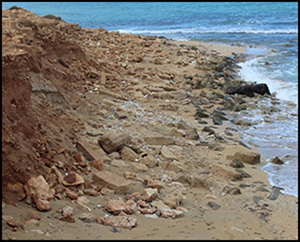
Wave and storm impacts resulting in coastal erosion and damage to buildings of the Classical city of Tocra, Libya (photograph and assessment by Saleh Alaurfi).

Basic first pass coastal vulnerability index model produced for the Jordanian part of Gulf of Aqaba, incorporating data on natural processes and features (wind fetch, elevation, slope and coastal geomorphology) (produced by Kieran Westley on ArcGIS).

Additional examination relies on comparative diachronic analysis of spatial datasets to map shoreline change and quantify erosion and accretion rates. This is further complemented by the documentation of human impacts including conflict, land reclamation, shoreline modification (Figures 4–5), urban expansion and agricultural intensification. These observations will enable researchers and heritage practitioners to identify maritime sites, and rapidly and consistently record characteristics that are necessary to develop interdisciplinary and more holistic narratives surrounding the maritime landscape.
Aerial photograph and satellite imagery analysis in Mokha, Yemen, a key location for international coffee trade between the sixteenth and eighteenth centuries AD (produced by Harmen Otto Huigens on ArcGIS).

Satellite image assessment of al-Bateen shipyard in 2007 (top) and 2019 (bottom). Al-Bateen has undergone major transformation (landfill, dredging and building development) since 2007, with the construction of a modern marina and luxury buildings that gradually displaced shipyards and shipping communities (produced by Rodrigo Ortiz-Vazquez on ArcGIS).

Work in progress
To date, recording has focused on the coastal zones of Tunisia, Libya, Egypt, Lebanon, Syria, Sudan, Yemen, Oman, the UAE, Bahrain and Kuwait. The MarEA project is collaborating with EAMENA to incorporate new maritime-specific terminologies, along with expanding documentation to include geoarchaeological and palaeoenvironmental information. This allows for more accurate identification and assessment of maritime sites and improved contextualisation of their topographic and (palaeo)environmental setting.
The MarEA project is also working on developing heritage-management tools suited to the needs of local practitioners and professionals, such as coastal vulnerability indices, a regional coastal and maritime heritage guide to expand capacity in underwater cultural heritage for archaeological practice in the region.
Preliminary findings indicate that natural coastal processes present the greatest threat to maritime archaeological sites, while recent intensive development is also placing considerable stress on coastal sites and cultural landscapes.
Acknowledgements
We would like to thank the EAMENA team (Oxford, Durham and Leicester Universities) for their collaboration, and we also acknowledge support from antiquities departments, archaeologists and scholars from the Middle East and North Africa region.
Funding statement
We are grateful to Arcadia, a charitable fund of Lisbet Rausing and Peter Baldwin, for generously funding our project.



