




Introduction
Stories and storytelling—between friends and family as well as in the mass media—are one significant way in which we position ourselves, and our lives, in relation to other people and wider social forces (Toolan Reference Toolan2001; Bamberg, De Fina, & Schiffrin Reference Bamberg, De Fina and Schiffrin2007; Ganuza & Rydell Reference Ganuza and Rydell2023). Indeed, Winston (Reference Winston1998:15) argues that narrative is ‘a natural form for the human mind to apprehend reality as lived experience’; or, as Cobley (Reference Cobley2001:2) puts it, ‘Wherever there are humans there appear to be stories’.
Political narratives, recounting real-world and fictional events, possess a particular ability both to encapsulate and engender political/ideological aims (Seargeant Reference Seargeant2020)—even narratives that advocate violence (Hurt & Grant Reference Hurt and Grant2019; Graek, da Silva, & Lemay-Hebert Reference Graek, da Silva and Lemay-Hebert2020). The power that extreme-right political narratives are assumed to possess is such that governments, policy practitioners, and NGOs have responded by developing counter narratives—that is, discourse intended to demystify, deconstruct, or delegitimise extremist narratives (see Bamberg & Andrews Reference Bamberg and Andrews2004; Omand Reference Omand2005). Leaders and opinion formers within the reactionary right are also aware of the pedagogic potential of fiction, with individuals and organisations regularly recommending that readers study works of fiction as part of their political and strategic ‘education’. For example, on 5 May 2020, ‘alt-right’ writers Milo Yiannopoulos and Michelle Malkin shared an ‘America First!’ reading list to the right-wing social network Gab, stating: ‘The purpose of this list is to help you build a library that will give you a firm basis in history, politics, religion and theology’. This list contained forty-nine works of fiction out of 198 texts.
Extreme-right fictional narratives are Manichean, brutal, and often catastrophic, but readers on forums such as 8kun (previously called 8chan), Gab, and Stormfront applaud them for offering important insights into contemporary events.Footnote 1 Extreme-right novels are discussed and recommended on social media and discussion boards, forming part of the ‘cultic milieu’ of the extreme-right (Campbell Reference Campbell1972; Kaplan & Lööw Reference Kaplan and Lööw2002)—a counterculture where unusual, non-standard ideas, arguments, and practices flourish. There are also some examples of readers sharing reviews of extreme-right, neo-Nazi, and Satanist fiction on GoodReads—a mainstream website, that describes itself as ‘the world’s largest site for readers and book recommendations’. For example, at time of writing, the Neo-Nazi Satanist novel Iron Gates, which presents a post-apocalyptic narrative ‘detailing a bleak view of the spiritual horrors of the world-to-come’, has been rated forty times and reviewed twelve times.Footnote 2 Not all of these reviews are positive of course (one-star reviews state that the book is ‘fascist torture erotica’, ‘Snuff porn’, and ‘reading the last chapter makes me want to vomit’), but its inclusion on the site (plus three others by the same authors) speaks to resonance of such narratives.
The threat posed by extreme-right fictional narratives is far from hypothetical. William Pierce’s first novel, The Turner Diaries, has been enormously important to extreme-right and white supremacist activists in the United States, because it provides an example of how a small number of people might overthrow a democratic government. Timothy McVeigh—a terrorist who murdered 168 people in the Oklahoma City bombing, on 19 April 1995—was inspired by The Turner Diaries, as were Germany’s National Socialist Underground (NSU), who murdered ten people in a lengthy terror campaign, mostly against German-Turkish citizens. More generally, fictional narratives relate, dialectically, to political discourse. The world imagined in the novel The Camp of the Saints (1973) is, essentially, an early iteration of the ‘Great Replacement’ conspiracy theory, endorsed by Italian Prime Minister Giorgia Meloni (amongst other political actors). This dialectic between fictional and material worlds also moves in the opposite direction. The neo-Nazi Joseph Paul Franklin, who targeted Jews and mixed-race couples in the late 1970s, killing up to twenty men, women, and children, provided inspiration for William Pierce’s second novel Hunter—which is dedicated to Franklin.
This article offers a narrative analysis of a short story, selected from a collection of stories written and published by a US neo-Nazi organisation called Tempel ov Blood (ToB). ToB adopt a syncretic extremist worldview, combining Satanic and esoteric Hindu religious beliefs—drawing, in particular, on more violent/destructive Hindu gods/avatars—with an ‘accelerationist’ approach to neo-Nazism. ‘Accelerationism’ is founded on the belief that Western governments are irrevocably corrupt, and Western society is irredeemably debased (Colin Reference Colin2024). In response, the demise of Western society needs to be cultivated by sowing chaos, through political violence, ultimately causing a total system collapse. In its place, they hope to establish a white-dominated society. In their view, no transgression or crime is beyond the pale, as long as it moves Western societies towards system collapse—indeed the more extreme the better, leading them to advocate violence, even sexual violence, against children. In the UK, the recent arrest and conviction of several people dedicated to this ‘accelerationist’ approach to neo-Nazism were linked to possession and distribution of their stories. I have personally been involved in case work for counter-terrorist police departments, analysing ‘esoteric’ materials found in the possession of suspects in preparation for trial. In each case, the suspects possessed Satanic fiction, suggesting that these materials are in wide circulation amongst the extreme-right.Footnote 3
My analysis focuses on two aspects of the story and their inter-relations. First, modal tokens (Labov & Waletsky Reference Labov, Waletzky and Helm1967) are words or phrases relevant to evaluative function of the narrative; here I focus on nomination and predication strategies in the text and the ways that they work up the characters in the story as ‘figures of personhood’ (Agha Reference Agha2007). Second, I analyse what I refer to as narrative action processes—the transitive and intransitive actions of characters, which drive narrative change. Specifically, this article aims to address two research questions:
(i) How do the formal aspects of the story—the modal tokens and the narrative action processes—communicate the ideological views of its writer (and the wider neo-Nazi organisation)?
(ii) How does this particular fictional story function as a form of extreme-right political activism?
I also orientate to a list of questions, included at the end of the story, intended to probe the readers’ understanding of the connoted meanings and symbolism of the text. Plotting and analysing this ideological narrative reveals how it connects events in a meaningful way and appraises the social and political meaning of these changing events. In so doing, this article offers an original insight into the contribution that fictional narrative plays in terrorist radicalisation, through textualising the deplorable in the readers’ imaginations (Hurt & Grant Reference Hurt and Grant2019).
Literature review
Hinchman & Hinchman (Reference Hinchman and Hinchman1997:xvi) describe narratives as ‘discourses with a clear sequential order that connect events in a meaningful way for a definite audience and thus offer insights about the world and/or people’s experiences of it’. This definition contains three key features of stories in general. First, they have a chronological dimension; they describe processes, and changing experiences or perceptions, rather than static situations. Second, they communicate the meaning of these changing experiences—these events—through appraisal. Third, there is an important social dimension to stories: they are told in particular contexts, by particular storytellers, and for particular reasons (Elliott Reference Elliot2005; Lampropoulou Reference Lampropoulou2011).
In their highly influential chapter, Labov & Waletzky (Reference Labov, Waletzky and Helm1967) suggest that fully formed narratives have six separate elements: ‘the abstract’, which summarises the story; ‘the orientation’, which describes some or all of the time, place, situation, and participants; ‘the complicating action’, which shifts us from one situation to another; implicit or explicit ‘evaluation’, where the meaning and significance of the action is communicated; ‘the resolution’; and finally ‘the coda’, which returns us to the present. These elements are presented visually in Figure 1 below.
Narrative structure.

Labov & Waletzky’s (Reference Labov, Waletzky and Helm1967) approach combines the formal and functional approaches to narrative analysis, outlined by Hinchman & Hinchman (Reference Hinchman and Hinchman1997), detailing ‘recurrent patterns characteristic of narrative from the clause level to the complete simple narrative’ (1997:12) from a perspective where narrative is ‘considered as one verbal technique for recapitulating experience’ (1997:13). Narrative as a recapitulation of experience is a vital insight, since it draws together the chronological structure of a story (and its complicating action, in particular) with the evaluation of this structure. They state that ‘a narrative which contains an orientation, complicating action and result is not a complete narrative’ (Labov & Waletzky Reference Labov, Waletzky and Helm1967:33), since ‘the evaluative element is arguably what transforms a simple chronicle of events into a fully formed narrative’ (Elliott Reference Elliot2005:43).
The material in the closed brackets of Figure 1 constitutes the core of the narrative—an account of something occurring (which brings about a change of circumstances), an evaluation of why this is significant (why you need to know about it) and an appraisal of it (its causal logic; whether it is good or bad, moral or immoral, and so on). Because the action is appraised, the change in orientation is also appraised, though this sometimes occurs implicitly. More complex narratives, such as what we experience in novels or movies, feature repeat iterations of this orientation–action–new-orientation sequence—a process I refer to as narrative action processes. Examining the evaluative elements within stories rests on the identification of modal tokens in the discourse—in other words, instances of judgment and predication in the narrative, indicating ‘attitude towards, or opinion about, the truth of a proposition expressed by a sentence. It also extends to their attitude towards the situation or event described by a sentence’ (Simpson Reference Simpson1993:47).
Narrative affordances and politics
The power of storytelling to connect with audiences through ‘examining important social, cultural and political themes by entertaining and persuading them, is well established’ (Djonov & Tseng Reference Djonov and Tseng2021:351; see also Hinchman & Hinchman Reference Hinchman and Hinchman1997; Elliott Reference Elliot2005; Polletta & Redman Reference Polletta and Redman2020; Seargeant Reference Seargeant2020). De Fina & Johnstone (Reference De Fina, Johnstone, Schiffrin, Tannen and Hamilton2015:161) suggest that research has paid ‘increasing attention to the political effects of narrative, seeing storytelling not only as a way of creating community but also as a resource for dominating others, for expressing solidarity, and for resistance and conflict’ (see also Souto-Manning Reference Souto-Manning2014). There is some indication that fictional narratives which convey moral knowledge are more effective in persuading people to take action than overt argumentation (Winston Reference Winston1998; Green, Strange, & Brock Reference Green, Jeffrey and Brock2002; Shrum Reference Shrum2012). Toolan (Reference Toolan2001:8) placed this pedagogic function at the centre of his definition of narrative, arguing that a narrative is a ‘perceived sequence of non-randomly connected events’, from which ‘we humans can “learn”’ (see also Forchtner, Engelken-Jorge, & Eder Reference Forchtner, Engelken-Jorge and Eder2020). More specifically—and following Gilligan’s (Reference Gilligan1982) influential book—a range of writers have ‘concluded that it is through the narrative mode of thought that the moral life can be broached, understood and explained; and that it is through stories that our ethical propensities develop’ (Winston Reference Winston1998:8; see also Tappen Reference Tappan1991; Freeman Reference Freeman1993). We do well to remember that such ethical propensities, and the virtues on which they are based, are not always benevolent. As Winston (Reference Winston1998:15) points out, ‘we may all agree that courage is a virtue; but what characterizes it and how it will be expressed in different circumstances and contexts will vary’, not least according to someone’s politics.
Narrative contributes to the development of these ethical propensities through various imaginative modalities (see also Wodak Reference Wodak2009, Reference Wodak2010). As Simoniti (Reference Simoniti2021:560) argues, fictional works of art, ‘just like systematic discourse, can provide thought experiments, can offer examples of virtue and vice, can encourage inductive reasoning from examples to general conclusions’. Booth’s very influential (Reference Booth1983) book provides a great deal of instruction on how an author can use rhetoric ‘to impose his [sic] fictional world upon the reader’ (1983:xiii). Fictional narratives can employ argumentative devices, providing reasons for an agent’s actions or causal explanations for the relation between two states (Phelan Reference Phelan1996). Some narrative forms—for example, the parable, fable, and didactic literature—present arguments as stories (Fisher Reference Fisher1987). Narratives also provide ways to negotiate and ‘solve’ social or political problems. As Ochs, Smith, & Taylor (Reference Ochs, Smith, Taylor and Briggs1996:95) put it, ‘Every day, many problem-solving narratives happen and delineate roles, relationships, values, and worldviews’. Such an insight seems particularly significant to bear in mind when considering the narratives of the extreme-right, the particular ‘problems’ they invoke, and the specific ‘solutions’ that they offer.
Published research on extreme-right fictional narrative has tended to identify antisemitic, anti-feminist, and white supremacist characters and tropes in the stories and argue for their correspondence with extremist (e.g. neo-Nazi) ideology in general (Ball & Dagger Reference Ball and Dagger1997; Wilson Reference Wilson, Feldman and Jackson2014; Heffernan Reference Heffernan2015) or to the politics of their authors more specifically (Michael Reference Michael2014; Jackson Reference Jackson, Copsey and Richardson2015). In a wide-ranging review, Mason (Reference Mason2018:4) argues that the ‘massive print culture’ of the right-wing in the US ‘can be divided into divisions of the secular right, religious right, and the xenophobic right’ which, though they differ in style and readership, do share particular topical concerns, including the family, sex/gender roles, religion (especially Christianity), race, and the ‘future of the West’. She points out, for example, that Pierce’s two notorious books (The Turner Diaries and Hunter) ‘offered readers a macho action-hero protagonist, the likes of which could be found in other fiction written by conservatives of the late 1970s through the 1990s’ (Mason Reference Mason2018:14).
Although clearly important, much of this analysis essentially approaches fiction in a similar way to any genre of political propaganda. Extreme-right fiction undoubtedly is political propaganda. However, examining it in the same way we analyse a political speech, for example, misses an engagement with the medium of fictional writing and its specific affordances (Keen Reference Keen2003)—particularly the irrealis mood (which indicates an act, or state of being, is not real). A notable exception to this trend is Gardell (Reference Gardell2021) who, echoing what Theweleit (Reference Theweleit1989) found in the Freikorps literature that he analysed, orientates precisely to the tenor of language used in fascist fiction.
When fascists write of the everyday, their relations to themselves, their work, or their sensibilities, their language is meaningless, voided, aborted; when their writing is associated with violence in pursuit with world-historic missions, political foes and inferior races, depraved beasts and white sisters, their language is animated, intense, alive. (Gardell Reference Gardell2021:180–81)
Gardell notes (Reference Gardell2021:183–84) that, in the fascist noir crime stories he analysed, ‘white beautiful blond Swedish women are recurrently raped and violated by racialized others’, so establishing a narrative context that gives the reader ‘ample opportunities to vicariously enjoy the pleasures of being a real man; a fascist man who comes to the rescue of the helpless woman in a blazing explosion of excessive violence’.
Across a range of publications, Bernhard Forchtner has significantly advanced understandings of narrative discourse and its central importance to social life (see Forchtner & Kølvraa Reference Forchtner, Kølvraa, Reading and Katriel2015; Wodak & Forchtner Reference Wodak, Forchtner, Wodak and Forchtner2018; Forchtner Reference Forchtner2021a). With a particular focus on (modes of) emplotment, his analysis shows the significance of narrative genres (romance, comedy, tragedy, and irony) in working up epistemological and political positions (Forchtner Reference Forchtner2016, Reference Forchtner2021b; Forchtner et al. Reference Forchtner, Engelken-Jorge and Eder2020). His analysis of far-right narratives is particularly relevant, showing the ways that far-right political actors utilise narratives in a variety of genres—in political speeches and interviews based on fact-based climate discourse (Lubarda & Forchtner Reference Lubarda and Forchtner2023), in fictional literature (Feldman & Forchtner Reference Feldman and Forchtner2026), and in more ambivalent texts. In one unusual case, he (co)analysed a comic-style book called Sagas from Vienna, produced and distributed in 2010 by the Austrian Freedom Party (FPÖ), as part of their election campaigning (Wodak & Forchtner Reference Wodak and Forchtner2014). They show the ways that, through a combination of visuals and linguistic materials, the comic blended past and present—specifically combining the personas of Prince Eugene (who relieved Vienna from siege by the Turks in 1683) and H-C Strache, the then-leader of the FPÖ—in order to appeal to ‘chauvinistic identity politics’ (Wodak & Forchtner Reference Wodak and Forchtner2014:249).
In the first monograph dedicated to analysing a wide range of far-right fictional discourses,Footnote 4 Kølvraa & Forchtner (Reference Kølvraa and Forchtner2025:2) analyse novels, short stories, and movie reviews written by far-right actors to examine how ‘far-right fictionality’ (and specifically the imagined ‘alternative worlds and forms of society, in which desires and hatreds can be cultivated’) becomes ‘a powerful vehicle for ideological “seduction”’. Examining literary fantasies of the extreme-right allows us to consider and analyse both the real and the imagined, and recognizes ‘that our reality, our cultural reality, is made up of the interlocking of both’ (Highmore Reference Highmore2016:77). Cultural historians have started to make some significant progress in this area, considering the constitutive role of fantasies to political projects. For example, Confino (Reference Confino2005:297) has analysed the cultural assumptions underpinning the Holocaust, arguing
We cannot understand why the Nazis persecuted and exterminated the Jews unless we are ready to explore … Nazi fantasies, hallucinations and imagination. The campaign against the Jews was based on and motivated by fantasies about the Jew as the eternal and mortal enemy of humanity.
Slightly earlier, Stone (Reference Stone2003:164) presented a similar view, arguing that the Holocaust should be approached through a lens of redemptive fantasies and specifically the role played by a fantasy of ‘redemption through murder’.
By analysing the role of the far-right in producing alternative literary worlds, and appropriating meanings of movies by re-narrating ‘what they actually mean’ (Kølvraa & Forchtner Reference Kølvraa and Forchtner2025:6), Kølvraa & Forchtner not only identify four cultural imaginaries of the far-right in action, they expose their ‘ideological force and attractiveness’ (Reference Kølvraa and Forchtner2025:9). They argue that it is through fiction’s engagement with imaginary worlds ‘that the far-right most nakedly and elaborately articulates its fantasies about ‘real’ alternative worlds’ (Kølvraa & Forchtner Reference Kølvraa and Forchtner2025:180)—that is, their fantasies about the societies that we, and they, inhabit.
The remainder of this article examines the significance of Kølvraa & Forchtner’s (Reference Kølvraa and Forchtner2025) observations regarding fictionality and the seductive power of extreme-right fantasy. Specifically, how are the ideology and political aims of the neo-Nazi Satanic organisation Tempel ov Blood (ToB) facilitated through fictional writing? The point I wish to draw out of my analysis is the political work that the fictional text attempts to achieve through working up fantasies; in other words, the political project that this text contributes to, and how the text uses fictional narrative, and extremist fantasies in particular, as a vehicle for that political work.
Methodology
Context: Neo-Nazi Satanism
Whitsel (Reference Whitsel2001:93) shows how, ‘From the mid-1970s through the mid-1980s, a number of new neo-Nazi organizations … infused the neo-Nazi subculture with a wide array of occultic, mystical, and countercultural beliefs’ (see also Kaplan Reference Kaplan2001; Goodrick-Clarke Reference Goodrick-Clarke2002). These movements included the esoteric Aryan-Nordic traditions of Julius Evola, James Madole’s adoption of Theosophy, writings from Savitri Devi (a French-born Nazi and Hindu convert) who described Hitler as an avatar of Vishnu, ‘dark lodges’, neo-völkisch groups, and others (Gardell Reference Gardell, Lewis and Peterson2005). Wrapping up neo-Nazism with religious discourse provides the exclusionary, and genocidal, drive of Nazism a transcendent quality: the political goals, of white supremacy and genocide, become a spiritual (as well as a political) quest, performed in service of a higher power or a higher calling (Bhatt Reference Bhatt2021). As the homepage of the Odinist white supremacist organisation Wotansvolk puts it: ‘The belief that one serves the will of whatever higher power the “Gods” represent is a motivational force that has inspired both men and women to perform acts above and beyond the ordinary. … We shall find it necessary to use the vehicle of religion to expound our message of racial survival’.Footnote 5
Goodrick-Clarke (Reference Goodrick-Clarke2002:231) suggests that ‘Nazi Satanism is surely the most extreme example of the cultic revival of fascism’, combining ‘satanic rituals and magical invocations with Hitler worship and Nazi ideology’. The rhetoric of neo-Nazi Satanism revolves around ‘the idea that if you weren’t a Satanist, you weren’t anything, but if you were a Satanist you were everything—or, at least, among the awakened, enlightened and (spiritually) powerful few’ (van Leeuwen Reference van Leeuwen2008:ix). Tempel ov Blood (TOB) are an occult group based mainly in the US who are inspired by, and affiliated to, a Satanic neo-Nazi movement called Order of Nine Angles (ONA). The ONA has been described as ‘a loose, decentralized, and leaderless network of like-minded neo-Nazi Satanist adherents around the world’ (Koch Reference Koch2024:1172), who ‘advocate for a violent armed revolution and promote terrorism, sexual violence [and] social collapse’ (Koch Reference Koch2024:1173; see also Alessio & Wallis Reference Alessio and Wallis2020). The foundational metaphysical belief of the ONA relates to ‘causal’ and ‘acasual’ entities. Causal entities, and the causal realm, relate to the world that we see, hear, and feel everyday—that is, the material world. ‘Acausal’ entities, and the acausal realm more broadly, instead relate to (in layman’s terms) the spiritual, the supernatural, or metaphysical. There are ‘light’ and ‘dark’ acausal forces, relating broadly to ‘good’ and ‘evil’, and believers acting in particular (ritualised) ways can summon, and so benefit from, dark forces or entities including demons (Shah, Cooper, & Newcombe Reference Shah, Cooper and Newcombe2023).
The ultimate aim of the ToB, like that of its parent organisation the ONA, is to use ‘sinister acts’ (including, but not limited, to crime, terrorism, and Satanic rituals) in order to overthrow ‘mundane’ democratic Western civilisation, and thus to establish an Aryan ‘warrior’ culture upon Earth (Colin Reference Colin2024). The ToB believe that Western society is hindered by the influence of Jewish and Christian values, usually referred to as ‘Magian’ or ‘Nazarene’ values, which, they argue, have produced a ‘tyranny of the weak’. They state that they are working toward ‘bringing about of a new DARK AGE … in which DARKNESS reigns supreme—when the weak, effeminate characteristics of Magian-infested civilization shall be immolated and turned to ash. … In the coming SATANIC AGE there shall be PROPER HONOR given to HONORABLE VIOLENCE’ (Tempel ov Blood 2018:224). They suggest that any organization with ‘sinister potential’ should be manipulated and utilized, and non-Satanic human beings are a resource to be used, even sacrificed, in service of this aim. The ONA, and its affiliated organisations and acolytes, have been linked to a number of serious crimes in the UK and other countries. In one particularly notorious case, two sisters were murdered in a London park by a man who had made a blood pact with a demon; he was later found to have been an active member of an online Satanist forum.
Narrative and narrative analysis
The short story ‘Azanigin: A Tale of the Blood’ was included in a collection entitled Tales of Sinister Influence, published by ToB in 2006. This story is, arguably, the most important one included in the collection: it is the longest (eighteen pages, structured in three sections of unequal length), but it is also the story with the most developed narrative, including changes of location and perspective and several sub-plots.
My analysis is presented as follows: following a story synopsis, I first analyse how the characters of the story are represented through referential/nomination and predicational strategies (Reisigl & Wodak Reference Reisigl and Wodak2001; Richardson & Wodak Reference Richardson, Wodak, Demata, Zorzi and Zottola2022), and the ways that these discursive strategies categorise and appraise characters as ‘socially perceivable and recognizable personae’ (Ganuza & Rydell Reference Ganuza and Rydell2023:97). A discursive strategy refers to a more or less intentional plan of practices adopted to achieve particular social, political, or semiotic goals. Through referential strategies, people, events, and all other things (concrete and abstract) are named. Nomination can be achieved through individualisation, collectivisations (of diverse types), and a variety of categorization devices, including metaphor, metonymy, and synecdoche. Predicational strategies perform ‘the very basic process and result of linguistically assigning qualities to persons, animals, objects, events, actions and social phenomena’ (Reisigl & Wodak Reference Reisigl and Wodak2001:54). Predicational strategies may, for example, be realized as evaluative attributions of negative and positive traits in the linguistic form of implicit or explicit predicates, or through more socio-culturally situated signifiers. In practice, reference and predication tend to occur simultaneously, given the ways that membership categorisation frequently carries connotations, and as such they are analysed together.
I show that one significant aspect of the ways that Satanic and non-Satanic characters are constructed as ‘figures of personhood’ (Agha Reference Agha2007) relates to their agency—an insight which leads to the second focus of my analysis: narrative action processes. The core of narrative action—an account of a process being performed, which brings about a change of circumstances—is a reflection of character-in-setting (Propp Reference Propp and Scott1968). I analyse different forms of narrative action processes, drawing out the ways that (particularly Satanist) characters act, using transitive and intransitive processes, to elicit change of various kinds.
Fantasies suffuse this fictional world—fantasies about who neo-Nazi Satanists are, what they look like, how they dress, speak, and especially how they act. Specifically, I show that this story presented instantiations of three extremist fantasies—of racist violence; of individual agency and control over other people; and spiritual, or metaphysical, significance. The questions included at the end of the story encourage readers to think about possible paths for action—to transform these fantasies into reality—so attempting to incite readers to act in accordance with the extremist politics of the ToB.
Story synopsis
‘Azanigin Pt. 1 Dark Night of the Soul’ (pp. 24–28)
A man is in a secure mental facility, with only partial memories of how he got there. He recalls an event in his life, when he met three sinister individuals—the Master, the Mistress, and an unnamed man. The Mistress unexpectedly had sex with him, during which she chanted the name Azanigin; he was forced to drink the blood of the unnamed man, after which his memories are vague, but involved military exercises and further Satanic rites. His perception returns to the present, where alarm bells are sounding along the corridor outside his room; a dark figure of the Master materialises in his room and helps him escape.
‘Azanigin Pt. 2 The Devil’s Highway’ (pp. 29–30)
Deep in the forest in North Carolina, a Satanic congregation is gathered around a fire. The congregation is led by a seven-year-old boy, who has a vision of a man in the boot of a car, crossing the Canada-US border; he is on the run after escaping a secure facility. The patient/man remembers that he had broken into a Canadian Intelligence Agency building; during questioning, he had explained his Satanic aims and was institutionalised. The boy senses that their sinister plans are coming to fruition. They strap a naked woman to a wooden wheel and, as it turns, the boy proceeds to flagellate her. The rest of the congregation chant and dance.
‘Azanigin Pt. 3 A Clandestine Burning’ (pp. 31–40)
The aims of the Satanic congregation are now revealed: to start a ‘race war’, which will generate acausal energy and move the world nearer to destruction. They burn down a Black church in Meridian, Mississippi; this, in turn, incenses a Black man, Peter, who decides to kill some white people in revenge. The church burning also provokes an equality group (identified as a front for a Communist organisation) to march, protesting against racism. A white racist man—angered by the murder of a twelve-year-old girl (presumably by Peter) and adversely affected by Sinister energy generated by the Satanist rituals—decides to shoot the marchers. His murder of a Black woman provokes widespread rioting. The Church burning is blamed on a local Klan group; a policeman, influenced by his Satanist wife, calls in the FBI to assault their headquarters, causing a violent confrontation. Another Satanist, undercover as an FBI agent, encourages the assault on the Klan headquarters to escalate.
The story ends with the Satanic group celebrating in the woods. The man (now identified as Stephens), who has finally arrived from Canada, speaks with another man, who reveals that ‘the mother of demons’ (Azanigin) has been evoked in physical form.
The story is followed by a list of seven questions, which probe the readers’ understanding of key characters, scenes, and symbols in the narrative. These questions, very similar to questions we might pose in teaching seminars, work to reposition the story as a didactic communicative event.
Modal tokens
Overview
The story advocates an extreme-right, neo-Nazi political ideology, which is signalled throughout the text in both explicit and more coded ways. Throughout, characters use racist terms of abuse, both in conversation and internal monologues; the N word, in particular, is used five times and other racist epithets are used a further three times. The story is also misogynistic, with all female characters fitting into two groups: attractive and sexually objectified, or an ‘ancient hag’ (Tempel ov Blood 2006:30). The Mistress—one of the three leaders of the group—has sudden and inexplicable sex with the character Stephens; the character Kathleen is described masturbating with an inverted cross; a naked woman is forcibly strapped to a wheel and flagellated (all three of these acts are Satanic rituals); and the story ends with ‘Voluptuous, naked females’ (no men) dancing in firelight. The one exception to this sex/hag binary is an eight-year-old girl, who is a mysterious unspeaking companion of the seven-year-old boy in the woods.
The story is told by an omniscient narrator, who describes the characters and their actions in the third person. This very traditional narrative device allows the narrator to ‘head-hop’ between the different characters, revealing their thoughts and motivations. In part two of the story, for example, the narrator shows the perspective of the seven-year-old Satanist leader, blurring the division between the narrative voice and that of the boy:
The boy’s smile grew wider. All was beginning to come together. The Sinister seeds which had been planted years ago were now beginning to bear their fearsome fruit. Elsewhere in the world, civil war, terrorism, plague, and famine were turning the earth towards it’s [sic] terminal stage. (Tempel ov Blood 2006:29)
The presupposition that the world will enter a terminal stage, and that the list of conflict and social problems auger that conclusion (a list very close to the Biblical ‘four horsemen of the apocalypse’), are foundational beliefs of accelerationist neo-Nazism. Later, in part three of the story, the narrator accomplishes a similar rhetorical nod to neo-Nazism, when describing the musical choice of a covert Satanist:
Shivley took off in his beautiful BMW mini cooper. BURZUM’S ‘Hvis Lyset Tar Oss’ blared through his state-of-the-art speakers. (Tempel ov Blood 2006:38)
BURZUM was a Norwegian Black Metal band founded by Kristian ‘Varg’ Vikernes in 1991. Vikernes was later imprisoned for fifteen years for burning down three churches and the murder of another member of the Black Metal scene. And although he is no longer in prison, his political views are still extreme-right. Referencing this particular band acts to characterise Shivley through predication and signals an allegiance with Vikernes’ politics and, perhaps, with his actions.
Dramatis personae, named/predicated
The characterisation of Shivley through his musical taste allows a transition to consider reference and predication in greater detail. Throughout, the story valorises the Satanist characters and depreciates all other characters through adopting three predicational strategies: through describing their physical appearance, through cultural signifiers, and through binding together ideas of knowledge and agency (what characters know and what they do). First, there are references to physical appearance generally and somatisation (racialisation) specifically; the Satanists are described in flattering ways, whilst non-Satanists—or what the ToB would refer to as ‘mundane’ people—are ugly and disagreeable. The descriptive accounts predicating the non-Satanists as repulsive are also far more numerous than those of the Satanists, as shown in Table 1 below.
Predication.

The two ‘Jewish doctors’ in part 1 of the story are in positions of power over Stephens, drugging and attempting to control him, so implicitly indexing an antisemitic conspiracy trope (Reisigl & Wodak Reference Reisigl and Wodak2001; Richardson Reference Richardson2017; Richardson & Wodak Reference Richardson, Wodak, Demata, Zorzi and Zottola2022). Several of the predicates for non-Satanist characters are racist terms (quadroon, ape[s], greasy), voiced by both characters and the narrator. On one occasion, the narrator uses a very specific body fragmentation device to highlight a physical difference between two characters: Kathleen, wife of a Police Officer and covert Satanist, is described tying ‘her luxurious mane into a quick ponytail’ and, in the very next paragraph, ‘Peter Saunders … known to his friends as ‘P.Ugly’, roughly scraped his scalp, sending nappy little black springs showering down’ (Tempel ov Blood 2006:32). The vigour of their respective heads of hair functions as synecdoche for their lives: the white (Satanist) women is vital and thriving; the Black man (who we later find out is also a drug addict) is degenerating. Needless to say, these discursive strategies are evidence of the racist ideology of the writer and the ToB.
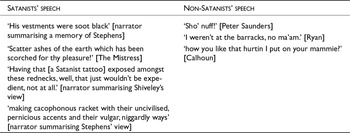
Second, characters are predicated through reference to cultural signifiers, which act to classify Satanists as refined and non-Satanists as vulgar. This operates through two semiotic systems: through speech, as a form of cultural capital; and possessions, as a form of symbolic capital. Non-Satanists’ accents and speech patterns are either explicitly labelled uncivilised or are written with grammatical errors and vernacular idioms. Being a white character is no protection against being disparaged in this way—the words of white characters ‘old man Calhoun’ and Kathleen’s husband ‘Ryan’ are written to make it clear that they are part of the inferior, non-Satanist out-group. In contrast, the words of Satanist characters (both spoken and reported, via the narrator) are precise, formally correct, and often use slightly archaic forms, which communicate prestige (see Table 2).
Predicating speech.

The possessions of Satanist characters are always described as new, top of the range, and expensive, whereas those of non-Satanists are old, run-down, and cheap. As well as implying wealth, predicating characters through their possessions also functions to indicate taste—refined and cultivated, in the case of Satanists, and coarse or tasteless for non-Satanists. Again, the vulgar taste and actions of Kathleen’s white husband Ryan are specifically referenced. This sense of taste/lessness is reinforced through reference to the music that certain characters enjoy listening to (see Table 3).
Predicating taste.

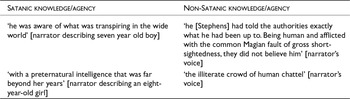
Finally, for the vast majority of the story, all of the neo-Nazi Satanist characters appear fully in control of their destiny. They act with intent and foresight, based upon an understanding of the world that is almost prescient. In stark contrast, non-Satanist characters are ignorant, reactive, and unaware that they are being manipulated. The non-Satanist characters are set on a course charted by others, who are not only more knowledgeable about the direction of travel, they also have the guile to conceal their machinations. The actions of non-Satanist characters, whilst appearing agentic, amount to reactions to the provocations, manipulation, and rituals/spells of the Satanist characters; they are essentially pawns being moved around a board, where they perform functions that are determined by the neo-Nazi Satanists, according to their plan (see Table 4).
Knowledge/agency.

It is only at the start of the story, where Stephens is incarcerated at the medical/mental facility, that a Satanist character lacks freedom and agency. In that opening scene, his lack of agency is also expressed as, and thoroughly associated with, his inability to remember ‘how, when or why he ended up [there]’, with his memory consisting only ‘of brief snippets of persons and events’ (Tempel ov Blood 2006:25).
So, in sum, ‘mundane’ characters in the story are variously ugly, uncultured, ignorant, and manipulated; in contrast, neo-Nazi Satanists are attractive, refined, clever, and in control. ‘Mundane’ people are devalued to the point of dehumanisation—reduced to ‘human chattel’—with the racist murder of a Black woman on the anti-racist march being described in such a graphic and matter of fact way, that suggests it is being celebrated.
Narrative action processes
Since Propp (Reference Propp and Scott1968), a tradition in narrative analysis has examined plot as a function of character: characters can be defined by their ‘spheres of action’ and the role they play in the progression of the story. Given that Satanists are represented as in control, for almost the entirety of the story, we would expect them to be the drivers of narrative change—and that is exactly what we see.
The ToB’s foundational beliefs in acausal entities and generating (good and evil) acausal energy through actions are incorporated into the narrative structures of the story. Specifically, there are four ways in which the actions of Satanic characters generate narrative effects—what I refer to as narrative action processes. Narrative action processes represent the event core of a story, as identified by Labov & Waletzky (Reference Labov, Waletzky and Helm1967): a complicating action and a new orientation (combined with modal tokens, to appraise the processes). Each of the narrative action processes analysed (starting from Figure 2, below) move the story from one state to another, ultimately contributing to the acausal conclusion of the story, where the demon Azanigin has apparently taken ‘physical form upon the earth’ (Tempel ov Blood 2006: 40).
Narrative action process 1.

In this first narrative action process, which represents the most significant material action of the story, the Satanists burn down the Black church. This causal action provokes an angry causal reaction from Peter Saunders, who goes on to kill five white people in revenge (only one victim is named, the others are summarised). Their hate crime also provides a political cause for the communist front organisation to use to foment protest, which increases the social tension. The ritualistic—acausal—dimension of terrorist action is signalled in the text by a short speech delivered by the Mistress, who declares ‘this Nazarene church … has been immolated for Our Dark Prince!’ (Tempel ov Blood 2006:31). So, in addition to generating causal reaction, their terrorism also generates acausal energies which add to acausal reaction (see Figure 3).
Narrative action process 2.

The second narrative action process involves Satanists working undercover to manipulate people and so achieve specific goals; there are three examples of this process in the story. ONA literature would refer to these characters performing ‘insight roles’, where the follower is expected to work undercover in a role ‘engaged in practical action against The System with the purpose of destroying it and challenging its ideas’.Footnote 6 Examples of such ‘insight roles’ suggested in ONA documents include ‘Undertake the role of extreme political activist and so champion heretical views’ and ‘Join the Police Force’. As ‘sinister’ acts, these insight roles are believed to generate acausal energies.
In the first of these ‘insight role’ narrative action processes, Kathleen manipulates her husband, cultivating his initial suspicion that the Church was burned down by the KKK (hiding her own direct involvement) and, later, encourages him to call the FBI and inform them of the whereabouts of the Klan meeting hall. Inside the Klan headquarters, Walter Shivley, in his feigned role as leader, delivers a fiery speech, encouraging his audience to respond with deadly violence to any assault by law enforcement. And finally, Special Agent Anderson, a Satanist working undercover for the FBI, phones FBI Quantico to report that ‘we’ve got a lunatic screaming from a megaphone that they have women and children as hostages’. In response, his handler at the FBI declares ‘this is going to be worse than Waco’, to which Anderson ‘grinned like a kid in a candy store’ (Tempel ov Blood 2006:39).
The significance of these three characters to the progression of the story is implied by one of the questions listed at the end. Question 6 instructs the reader to ‘Make a list of extremist political groups and religious groups (right-wing, left-wing, or otherwise) … pick three of them and write an essay on what potential those groups could have’ if they were infiltrated and ‘controlled by Noctulians’ (a term that ToB/ONA uses to refer to themselves).
In addition to these first two ways that Satanists advance the narrative—which amount to transitive action processes, acting, in various physical ways, upon other characters—they also perform intransitive action processes—rituals—which bring about both causal and acausal reactions (see Figure 4).
Narrative action process 3.

So, for example, the Satanist cult in the North Carolina woods perform rituals to invoke acausal energies and, through that, influence a geographical area in a different US state. In Part 2 of the story, they torture a teenager and, in a later scene, recite a chant titled ‘Diabolus’, above a map of Mississippi where the town of Meridian is marked. Immediately after this second ritual, the focus of the narrative shifts to Meridian; the white racist Calhoun is positioned on top of a building with his sniper rifle, which he uses to murder a Black woman taking part in a protest march; the incensed crowd then happen upon a pile of bricks, left by ‘one of those crazy black metal kids from the suburbs’ (Tempel ov Blood 2006:39). In such cases, the acausal energy created by the Satanic rituals is presented as generating casual reactions in characters several states away—most clearly in Calhoun and the ‘black metal’ kid, but arguably also the protesting (later rioting) crowd. And, in case the reader doesn’t discern this connection between ritual and reaction, two of the questions at the end of the story specifically draw our attention to it: Question 3 asks ‘What sort of techniques could be used to esoterically influence a geographical area with acausal energies’—a question which implies that such techniques featured in the story; and Question 5 asks ‘Which character in this story was the most adversely affected by the Sinister forces which were being unleashed by the Satanists?’—a question which entails not only more than one character was thus affected by Sinister acausal forces, but that different characters were affected to different degrees.
A final category of narrative action process is the purely ritualistic, as shown in Figure 5 below.
Narrative action process 4.

Here, neo-Nazi Satanic characters perform actions whilst chanting the name of a demon in order to generate acausal energies (and so acausal reactions): the Mistress chants whilst she has sex with Stephens and, later, Kathleen chants whilst masturbating with an inverted cross. There isn’t any effect on other characters implied or entailed in the narrative. However, the demon invoked at the end of the story is the same one whose name that is chanted in these scenes, which suggests a causal link: that they performed these actions in order to generate acausal energies and, subsequently, accomplish this astonishing acausal reaction.
Discussion: Extreme-right fantasies and paths to action
Drawing these two analytic sections together: I argue that narrative action processes and modal tokens represent ‘the warp and woof’ of narrative analysis. My analytic approach therefore has relevance and application beyond this story and beyond the niche (sub)genres of extreme-right fiction. We read the events of narrative action processes and how, as sub-plots, they contribute to the overall narrative arc of the story, whilst modal tokens provide directions for how we are meant to appraise these narrative developments.
In each of the four action processes from this particular story that I just outlined, we have the classic structure of orientation, complicating action, and result, whilst the modal tokens—nominalisations, predications, and process representation strategies, for Satanist and non-Satanist characters—provide the evaluative element. Combining narrative action processes with modal tokens in this way, we can see that the story presented instantiations of three extremist fantasies (Kølvraa & Forchtner Reference Kølvraa and Forchtner2025). First, and most obviously, the hate crimes depicted in the story—burning down a Black church; the murder of a Black protestor—are celebrated by the characters, exulted by the omniscient narrator, and occur without negative consequences for the Satanists. There are white people killed in the story, but these take place away from the narrative action, and are only summarised, rather than described in detail. The racist terror is presented, not only as righteous, but normative—as reflecting the proper order of things. These, therefore, represent a fantasy of unrestrained racist violence.
Second, three narrative actions show the work of Satanists in ‘insight roles’, manipulating people in order to advance their political cause. The three characters are all supremely confident, and utterly flawless in how they work, resulting in complete control over the actions of other characters—Kathleen subtly directing her husband, Shivley canalising the anger and hate of Klan members, and Anderson convincing his FBI handler to escalate the violence at the Klan headquarters. These narrative actions therefore represent fantasies of agency, power, and inter-personal control.
Third, the intransitive narrative action processes work to demonstrate acausal consequence. The rituals that the neo-Nazi Satanists performed were consequential, in that they invoked a demon. Whilst this may seem to overlap with a fantasy of control (it is another way of intervening to engender change), here it takes on a more metaphysical dimension. This is a fantasy of recognition, a fantasy that prayers are not only listened to, but can also be answered; it is a fantasy that what people do on/in the world has significance and resonates beyond our immediate lives and circumstances. Referring back to the literature on the extremist occult, clothing neo-Nazi beliefs in religious discourse grants them a transcendent quality. To be recognised by the universe (and by ‘acausal entities’ in particular) reflects a fantasy that members of the extreme-right have cosmic significance, and that actions they perform—even small actions—resonate as energies.
Taken together, these fantasies represent part of the extreme-right imaginary of the author and of the ToB and, as such, they both express and contribute to their political project. The questions included at the end ask the reader to consider the methods utilised in the story in relation to their own lives. And so, the story is also encouraging readers to think about possible paths for action, acting out these fantasies. Specifically, the three fantasies in the story can be thought of as expressions of three classes, or levels, of desired political action. The first (and most demanding) is violence. And although burning down a church is clearly an extreme and fanatical thing to do, it has been done before—the story alludes to the famous case of Kristian Vikernes, through referencing his band BURZUM; and in 2019, three African American Baptist churches were set ablaze, crimes that were later revealed to be linked to ONA, in FBI records released on 24 October 2024.Footnote 7 The second suggested path to action is the ‘insight role’, which is encouraged in ONA/ToB literature as part of destabilising ‘the Magian System’. However, that may also be too challenging for most people, so there is the third path to action—performing rituals. Rituals synthesise the spiritual and political beliefs of ToB, in that adherents perform ceremonial rites in the hope that acausal entities will intercede and help them achieve political (often violent) goals. The story provides an imagined instance of this being successfully achieved.
Conclusion
This article has examined a neo-Nazi Satanist narrative and provided an insight into the contribution that fictional narrative can play in inciting political (terrorist) activities. I analysed a short story, written and distributed by the Tempel ov Blood, focusing on the structural and evaluative dimensions of the narrative—two dimensions that Labov & Waletzky (Reference Labov, Waletzky and Helm1967:33) argue are integral to a fully formed narrative. I chose to analyse literature produced and distributed by this neo-Nazi Satanist organisation due to it being repeatedly found in the possession of neo-Nazi terrorists in the UK, and the role it seems to have played in their terrorist activities. I specifically chose this short story to allow me to present a complete analysis of its narrative form and content as well as the political work that the text attempts.
Throughout the story, Satanic characters are valorised, imbued with symbolic and cultural capital; their violence is celebrated and occurs without negative consequence; they are fully in control of themselves and others; and their rituals are shown to be effective. I argued that these ideas represent three extremist fantasies—of racist violence, of interpersonal dominance, and of cosmic personal significance. My approach in this article has been qualitative, specifically idiographic, and focused on providing an analysis of the meanings embedded in this specific text. Qualitative analysis does not aim for generalisability, but for detailed, contextualised accounts of how specific social objects (in this case, a story) can be interpreted, understood, experienced, and used. However, it is not unreasonable to assume that some of these extremist fantasies are also present in, and motivate, other narratives circulating in the extreme-right, neo-Nazi cultural milieu. As Gardell (Reference Gardell2021) observed, retributivist, racist violence is a common feature of fascist literature, conveying the fantasy that the (white) protagonist has a right to punish ‘the guilty’.
Given my idiographic approach, I do not present this particular story as a metonym for all extreme-right discourses. There is a wide diversity of extreme-right narratives, which connect in complex (and sometimes contradictory) ways with other more mainstreamed right-wing discourses (see Mondon Reference Mondon2016; Krzyżanowski & Ekström Reference Krzyżanowski and Ekström2022; Brown, Mondon, & Winter Reference Brown, Mondon and Winter2023). Whilst Mason (Reference Mason2018:1) finds ‘points of affinity as well as contention’ when analysing fiction written by conservative politicians and pundits, right-wing agitators, the Reaganite New Right, Christian conservatives, and white supremacists, it is in the fictional fantasies of the extreme-right that political strategies and violent tactics are ‘dramatized and theorized’ (2018:14). In neo-Nazi Satanist fictions more specifically (such as the story analysed in this article), this theorisation and dramatization of violence is afforded transcendental properties due to the additional occult belief system.
Finally, we do well to remember that the neo-Nazi fantasies in this story do more than simply entextualise the deplorable in narrative form. Fictional narratives can motivate action through various imaginative modalities which provide ways to negotiate and ‘solve’ social or political problems, and they can be more effective in motivating people to act than argumentation. As Ringmar (Reference Ringmar1996:66) argued, ‘it is through stories that we make sense of ourselves and our world, and it is on the basis of these stories that we act’. Fiction shows readers a world of what is possible, mediating and shaping moral experience. Neo-Nazi fictional narratives, such as the one analysed in this article, function to develop extreme desires and fantasies (Kallis Reference Kallis2009) and so ‘give licence to hold extreme views, which, at the very least, help to make violent action appear morally desirable and even justified’ (Jackson Reference Jackson, Copsey and Richardson2015:87). The questions included at the end of the text analysed ask the reader to consider the methods utilised in the story in relation to their own lives. And so, the story also encourages readers to think about possible paths for action, making extremist fantasies a reality, through performing their own sinister deeds.
Acknowledgements
An early version of this article was presented at CADAAD (Poznan, 2024), and I’d like to thank those who attended for their questions and comments. I’d also like to thank Bernhard Forchtner for giving comments on the first full draft and Sofia Lampropoulou for her encouragement. All errors remain my own.







 Open access

