

Bardi is the northernmost language of the Nyulnyulan family, a non-Pama-Nyungan family of the Western Kimberley region of northwestern Australia. Currently about five people speak the language fluently, but approximately 1,000 people identify as Bardi. The region was settled by Europeans in the 1880s and two missions were founded in Bardi country in the 1890s. Use of the language began declining in the 1930s. Many Bardi people were moved several times between 1940 and 1970, both to other missions dominated by speakers of other Indigenous languages and to local towns such as Derby. This community disruption accelerated the decline of language use in the community and first language acquisition. Bardi is the name of the language variety spoken at One Arm Point. There are two other named mutually intelligible varieties apart from Bardi: Baard and Jawi. The extent of dialect diversity within Bardi is unknown, but does not seem to have been particularly high compared to that between named varieties. The ISO-639 language code is [bcj].
This study is based on field materials collected by the first author since 1999, building on the recordings and field notes of previous researches on the language, especially Aklif (Reference Aklif1994) and Metcalfe (Reference Metcalfe1975). Recordings of narratives, wordlists, and elicitation total about 220 hours. While there is no formal standard language in the Bardi speech community, the speakers who provided illustrations are unanimously regarded as excellent speakers who are appropriately qualified to work with linguists in making a record of the language. They have been working on language documentation since 1990. Except where otherwise noted, illustrations come from two speakers.Footnote 1 One was 70 years old and the other about 82 years old at the time of recording of a wordlist of phonemic contrasts of 250 items in 2008; these wordlist recordings provide most of the illustrative examples for this article. There are no younger speakers of the language.
Syllable structure and word structure
Bardi has extensive inflectional morphology, particularly on verbs, which take prefixes, suffixes and additional clitics. Nouns, pronouns and adjectives are inflected for case and a subset of nouns take possession markers (by either prefix or suffix). Many prefixes are a single consonant; suffixes tend to be a single CVC or VC syllable.
Nouns, verbs, and coverbs can be reduplicated. Reduplication is to some extent lexically determined (that is, it is not fully productive). There are several patterns attested in the language. Monosyllabic words are fully reduplicated (sometimes with an epenthetic vowel); disyllabic nouns and coverbs are also fully reduplicated, while disyllabic verbs also exhibit partial reduplication. These are illustrated in (1).
(1)


The syllable template for Bardi is presented in (2).
(2) (C) V (V) (l) (C)
No consonant clusters are permissible in the syllable onset. Open monosyllables are rare as independent words (though they do occur frequently as clitics); examples include bo /po/ ‘daughter’ and joo /cu/ ‘second person singular pronoun’. Words may begin with a vowel (e.g. aamba /aːmpa/ ‘man’) but all word-internal syllables contain onsets.
The possibilities for coda clusters are limited. Apart from the clusters which arise through the deletion of word-final vowels, the only permitted coda clusters are a lateral followed by a peripheral (that is, labial or velar) homorganic nasal–stop cluster, as in almban /almban/ ‘westerly wind’. Otherwise consonant clusters only appear across syllable boundaries, and possibilities here are also restricted. The most common clusters are lateral–stop (or trill–stop) and nasal–stop clusters. Liquid–glide clusters are also attested, for example in the words gaalwa /kaːlwa/ ‘mangrove double raft’ and marrya /marja/ ‘smoke signal’. There are tautomorphemic heterorganic nasal–nasal clusters (e.g. biinmal /biːnmal/ ‘weak’) and stop–stop clusters (gaardga /kaːʈka/ ‘bloodwood tree (Eucalyptus polycarpa)’). There are no geminates and where geminates would arise in morphology they are simplified to a singleton consonant. Examples are provided in Table 1.
Examples of heterorganic and homorganic nasal–stop and nasal–nasal sequences.

The analysis of consonant clusters is complicated by a process of word-final vowel deletion; this is conditioned predominantly by word-external sandhi and speaker's dialect. Vowel-final words frequently appear without a final vowel if the following word begins with a vowel (for example, gorna inggidinirr /koɳa/ /iŋkitinir/ ‘good still’ is realized as [kɔɳ ɪŋgɪdɪnɪr]). This rule applies even if a word-final cluster would otherwise result. For example, the temporal enclitic=jamba /=campa/ ‘when’ has two variants: [camba] and [camb]. When further clitics are added to the word, surface violations of the template given in (2) result; an example is given in (3g) below.
Bardi contrasts homorganic and heterorganic nasal–stop clusters, both within morphemes and across morpheme boundaries, e.g. aanyjoo /aːɲcu/ ‘yam’ vs. aanja /aːnca/ ‘return’. An example across a morpheme boundary is i-n-joogool-ij /i-n-cukul-ic/ ‘he broke it’ vs. i-ny-joogool-ij /i-ɲ-cukul-ic/ ‘it broke’.
Word-initially, there is no distinction between alveolar and retroflex consonants; all initial apical consonants are retroflex.Footnote 2 There are no words beginning with trills or the palatal lateral. Words beginning with /w/ and /j/ are rare due to a historical sound change where these were lost word-initially (the words that show these in Bardi are all loans from Nyulnyul (e.g. wiirri /wiːri/ ‘rib’), Worrorra (e.g. walbiri /walpiɻi/ ‘loincloth’) or English (e.g. wajim irrmanyjin /wacimirmaɲcin/ ‘they're washing themselves’).
The majority of simple roots in Bardi are of two or three syllables, but due to the large amount of verb morphology it is not uncommon to find much longer words. Examples are given in (3). A key to abbreviations is given at the end of the article.
(3)

Consonants


Bardi has 17 consonant phonemes, 12 which are sonorants. There are no fricatives; the five obstruents are stops. Bardi has five place of articulation contrasts: alveolar, retroflex, palatal, bilabial, and velar; the latter two are referred to in the literature as ‘peripherals’ (see e.g. Dixon Reference Dixon2002). As there is no voicing contrast in stops, we represent the stops as voiceless.Footnote 3 We discuss stop voicing alternations in the ‘Lenition’ section below.
The phonemic system follows a typical pattern found among Australian languages, where stops have a corresponding nasal contrast at each place of articulation, as illustrated in the Consonant Table above.
Laterals contrast at the three coronal (including palatal) places of articulation; there are no peripheral lateral contrasts. Thus, there are five liquid contrasts, an apical and retroflex series of laterals and rhotics, and a palatal lateral. The words listed above illustrate the Bardi consonantal phonemes in intervocalic position.
More than half the phonemes are represented by digraphs in the orthography. Velar and palatal nasals and the palatal lateral are represented by the digraphs ng /ŋ/, ny /ɲ/ and ly /ʎ/, respectively. The nasal–stop digraphs (cf. anggaba /aŋkapa/ ‘who’) are distinct from the heterosyllabic nasal–stop sequences such as nk in inkan /inkan/ ‘tiger snake (Notechis scutatus)’ and the velar nasal, as in angan /aŋan/ ‘closeby’. A discussion of consonant clusters appears in section ‘Syllable structure and word structure’ above.
Retroflex sounds are represented by the digraphs rd /ʈ/, rn /ɳ/, rl /ɭ/, but the graph r for the retroflex rhotic /ɻ/. The apical lateral and rhotic are written as rr and l. Thus, the five liquid consonants are written as rr /r/, r /ɻ/, l /l/, rl /ɭ/ and ly /ʎ/. The orthography of Bardi uses voiced symbols to represent the stops b /p/, d /t/, rd /ʈ/, and g /k/, though, as noted, no phonemic voicing contrast exists in the language.
Plosives
Stop contrasts occur at five places of articulation, as indicated in the Consonant Table above. Voicing is not contrastive in stops, though voiced and voiceless stops occur in the language as allophonic variants through lenition and voicing (see ‘Lenition’ section below). Stops can occur in initial position, intervocalically, in heterosyllabic nasal–stop and stop–stop clusters (see section ‘Syllable structure and word structure’ above), and in word final position. A process of word final devoicing affects all segments regardless of type; this is particularly found at phrasal boundaries and so is frequent in the elicited wordlist. Stops thus remain voiceless word-finally. Intervocalically, stops exhibit considerable variation and are often lenited. Examples appear below.
Figure 1 is a token of gaarra /kɑːrɑ/ [kɑ:ɾɑ] ‘uncle (mother's brother)’ spoken by a female speaker reciting a wordlist. In this token, the initial /k/ is voiceless and has a VOT of about 50 ms, classifying this as an aspirated reflex of the /k/ phoneme, an unaspirated voiceless stop. However, this sound lacks the plosive (puff of air) quality common to aspirated stops; it sounds like an unaspirated /k/, as we transcribe it. This pattern is common throughout our data. Another example is found with the token of inkan /inkɑn/ (Figure 3b below), where a release burst appears to be present halfway through the intervocalic stop. As in the present example, there is no puff-of-air quality to this stop; it sounds like an unaspirated voiceless stop. We attribute this to a general lack of vocal tract constriction (versus occlusion) that we find to be a characteristic of Bardi speech. There is little evidence in our data for any airflow turbulence, which is needed in the production of frication. We suggest that this pattern also appears in the tendency of stops to lenite to more approximant-type articulations, without producing the constriction needed to produce turbulence. We suggest that this may be causally linked to the lack of fricatives in the phonemic inventory as a kind of featural structure constraint, though the nature of this dependency is open to investigation.
A spectrogram and waveform of gaarra /kɑːrɑ/ [kɑːɾɑ] ‘uncle’, illustrating the initial voiceless stop /k/, with a 50 ms VOT.

Lenition
There are two lenition processes in Bardi: synchronic and historical. The synchronic process lenites the phonemically voiceless stops to a more sonorous reflex. In this process, the voicing of the preceding segment is continued through the stop. It is an audible property of Bardi speech which can give the stops a near approximant-like quality. Lenition in Bardi as a synchronic process is to some extent speaker-dependent and subject to stylistic factors which it is beyond the scope of this paper to discuss. Figures 2, 3b and 4 provide illustrations. In Figures 2 and 4 the stop is lenited to a voiced reflex in a nasal–stop cluster, aankoo /ɑ:nku/ [ʔɑ:ngu] ‘for a while’, and between two vowels, ardan /ɑʈɑn/ [ʔɑɖɑn] ‘cloud’. In Figure 4 is an illustration of an unlenited voiceless stop in a nasal-stop cluster: inkan /inkɑn/ [ʔinkɑn] ‘tigersnake’.
A spectrogram and waveform of a hetero-organic nasal–stop cluster /nk/ in aankoo /ɑːnku/ [ʔɑːngu] ‘for a while’. A phonetic transcription is provided.

The historical lenition is a sound change whereby historical stops become glides (or are lost) in Bardi. This results in morphological alternations in, for example, the allomorphy of verb roots. For example, the root -gama- /kama/ ‘laugh, mock’ has present (intransitive) /i-jama/ but present (transitive) /i-n-kama/, and plural transitive /i-ŋ-arr-ama/. See further Bowern (Reference Bowern2012) for details of this set of changes and the morphological alternations it has conditioned.
Voicing
As mentioned above, stops are phonetically voiceless in initial and final positions and variable elsewhere. This example, ilaj /ilɑc/ [ʔilɑj] ‘clamshell’, exemplifies a stop in final position in a word (see Figure 3a). In this example, the stop is a lenited reflex of the palatal stop /c/. The frequency range of this spectrogram is 0–10 kHz. The 10 ms window shows the waveform at the end of the vowel and into the stop. Note the lack of any clear stop closure, as the vowel formants continue into the final segment. There is slightly more energy in the higher frequencies of this sound at around 5 kHz, in comparison to the intervocalic approximant /l/, where the energy is below 4 kHz. This pattern may indicate some oral constriction, though it is a very approximant-like sound. (An illustration of an initial voiceless stop was given in (1) above.)
A spectrogram and waveform of a lenited reflex of the palatal stop /c/ in final position in a word: ilaj [ilɑc] [ʔilɑᶨc] ‘clamshell’.

Stops tend to be voiced in nasal–stop clusters, but there are exceptions. Illustrations are given below. Figures 3b and 3c are examples of voiced and voiceless stops in nasal stop clusters. The velar stop /k/ is voiceless, the stop closure period is indicated in a 10ms window below the spectrogram. Note also the presence of a release-like articulation midway through the sound. However, the audible percept is a clear unaspirated velar stop.
A spectrogram and waveform of the word inkan /inkɑn/ [ʔinkɑn] ‘tigersnake Notechis scutatus’ demonstrating the heterorganic nasal–stop sequence /nk/. The stop is voiceless.

A spectrogram and waveform of inyjab /iɲcɑp/ [ʔiɲɟɑp] ‘cousin’, an example of a homorganic nasal–stop sequence. The palatal stop is voiced.

Figure 3d is a spectrogram and waveform of the sequence /kɑ:ʈka/ [kɑ:ɖka] from the phrase gaardga jina /kɑ:ʈkacinɑ/ ‘the bloodwood's (Eucalyptus polycarpa)’, exemplifying the articulation and voicing of a heterorganic and heterosyllabic stop–stop cluster. The transcription is phonemic. The first stop in the cluster, the retroflex /ʈ/, appears as the voiced reflex [ɖ]. This sound is followed by an unaspirated voiceless velar stop [k]. Both stops exhibit clear indications of oral closure and release, making segmentation straightforward. Note the initial /k/ has a VOT of about 30 ms. Figure 3e is a 10 ms window around the respective stops contrasting the voicing variations.Footnote 4
A heterosyllabic and heterorganic stop–stop cluster /rdg/ in gaardga /kaːʈka/ [kɑːʈka] ‘bloodwood (Eucalyptus polycarpa)’.

A 10 ms window of waveforms illustrating the voicing variation found in stops in nasal–stop clusters. Clusters: /nk/ (top) and /ɲj/ (bottom).

Although the great majority of stops are unaspirated, with near zero VOTs, the voiceless realizations of stop consonants are sometimes weakly aspirated. This is very variable, but found particularly with /k/ and /c/ reflecting a near universal tendency for stops posterior to the coronal region to have longer VOTs (Ladefoged & Maddieson Reference Ladefoged and Maddieson1996). Figure 3b provides an illustration.
Retroflection
Retroflex consonants in the language are rd /ʈ/, rl /ɭ/, r /ɻ/ and rn /ɳ/. The cues for retroflection include a lowering of F3 in a preceding vowel and often resulting in an audibly rhotacized vowel preceding the retroflex consonant. Examples are found in Figures 4 and 3d. Figure 4 is a spectrogram and waveform of ardan /ɑʈɑn/ [ʔɑɖɑn] ‘cloud’. This is an example of an intervocalic retroflex stop /ʈ/, this token is voiced throughout its duration.
A spectrogram and waveform of ardan /ɑʈɑn/ [ʔɑɖɑn] ‘cloud’, an example of an intervocalic voiced retroflex stop /ʈ/.

The retroflex consonants are apical. They appear to maintain a stable position during the stop articulation, visible in the formant structure of F3 as it drops to meet F2 into and out of the stop segment. The retroflex consonants are apical. They appear to maintain a stable position during the stop articulation, visible in the formant structure in which the F3 target into and out of the stop segment is approximately the same.
There are constraints on clusters with alveolar and retroflex segments. There are no recorded clusters with both retroflex and alveolar members; clusters of the type ɳ d or nɖ are not found in this language (orthographic rnd is [ɳɖ]). There is a small amount of evidence for apical dissimilation across syllables in both laterals and nasals (apical stops are sufficiently rare that the relevant environment for alternations does not arise); F3 appears to dip with repeated alveolar laterals, and in a sequence of heterosyllabic lateral followed by nasal or lateral followed by lateral, the second lateral often has a lowered F3. In tokens of the word ngalal /ŋalal/ ‘dry coral’, for example, the lateral in C3 has an F3 of approximately 300 Hz lower than the lateral in C2 position, even though it is phonemically apico-alveolar, not retroflex. (See Tabain Reference Tabain2009 for discussion of variable retroflex pronunciation in the Pama-Nyungan language Arrernte.)
Sonorants
The sonorants are phonologically and phonetically stable segments. Since they comprise a large part of the phoneme inventory, and the stops tend to lenite, the speech stream is primarily comprised of sonorant sounds uninterrupted by obstruent constriction.
Nasals occur at places of articulation that correspond to the stops, resulting in contrasts at five places of articulation. Nasals may appear in syllable-initial and syllable-final position. In medial position, heterorganic nasal–nasal clusters are not uncommon (see Figure 5) and appear in both derived and underived words. Examples include binymarr /piɲmar/ ‘louse egg’, anyngarr /aɲŋar/ ‘in vain, without anything happening in return’, and nanmoorroo /nanmuru/ ‘thigh’. In underived contexts, the first member of the pair must be non-peripheral (/n/, /ɲ/ or /ɳ/), and the second must be peripheral (/m/ or /ŋ/). In derived environments there are no limits on such clusters.
A spectrogram and waveform of ngoonngoon /ŋunŋun/ [ŋunŋun] ‘bark (of dog)’, illustrating a heterorganic nasal–nasal cluster. The arrows indicate the nasal cluster.

Vowels
The table below gives the Bardi vowel phonemes, along with their orthographic representation (in italics). Vowel length is phonemic and minimal and near-minimal pairs are presented below the table. The mid back vowel /o/ is the single mid vowel in the system; it is historically a contraction and coalescence of /aku/ and /awu/. This vowel is often phonetically long, as befits its historical origin, but does not contrast in length.
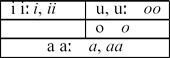

The most common vowel in the data set is overwhelmingly the low vowel /a/. In the wordlist of 250 items, there were 624 tokens of /a/; the next most frequent vowel was /i/, with 397 tokens (both in all positions in the word). The other short vowel /u/ had 274 tokens. Long vowels were much rarer, with 83 tokens of /aː/, 40 of /iː/ and 34 of /uː/. There were 64 tokens of /o/. These relative frequencies are reproducible from the Bardi dictionary; see further Bowern (Reference Bowern2012: 90–97) for discussion of segment distributions. Part of the large disparity in token numbers results from long vowels being disproportionately rare outside initial stressed syllables. Diphthongs may occur as variants of vowels. An example is milgin /milkin/ [milg n] ‘walking stick’.
A vowel chart is presented in Figure 6a. The chart illustrates the F1 and F2 vowel means and 1 standard deviation (StD) from the mean. The measurements were taken from the midpoint of each vowel using Praat (Boersma & Weenink Reference Boersma and Weenink2010) and plotted using NORM (Thomas & Kendall Reference Thomas and Kendall2007). The short vowels are slightly more centralized than the long vowels, but the quality of long and short vowels does not differ markedly; this can be seen in Figure 6a and also in Figure 6b, which compares vowels in stressed (1) and unstressed (2) syllables.
Mean values and 1 StD for vowel phonemes.

Bardi stressed (1) vs. unstressed (2) syllables.

Prosodic features
Two important aspects of Bardi prosody are a stress system consisting of independent primary and secondary stress assignments, and an intonational system. The intonation system consists of boundary tones and pitch accents that interact with the stress system. We discuss each separately below.
Stress
Bardi is analyzed as having a stress system. By stress we mean relative syllable prominence. Bardi stress is not a lexical pitch accent system. Primary stress is regular and appears consistently on the initial syllable of the word. Stressed vowels are characterized by increased duration compared to unstressed vowels (see Katsika Reference Katsika2008), though there is also a phonemic distinction in length in both stressed and unstressed syllables. In stressed syllables there are also increases in intensity and, in some cases, pitch, likely related to the intonational system. Unstressed vowels are somewhat more centralized than stressed vowels (see Figure 6b).
While primary stress is predictable and regular, the rules for secondary stress are complex and are sensitive to morphological structure and syllable weight. A light syllable is an open syllable with a short vowel; syllables with codas and long vowels are heavy. With respect to morphology, there is a split between nouns and verbs: verbs carry stress on the first syllable of the root, while prefixed nouns do not receive a comparable root stress. Some morphemes with closed syllables receive a secondary stress: for instance, case markers such as the ergative -nim and allative -ngan, monosyllabic clitics such as the third person singular possessive marker =jin, and the sentence connective =min; these are all heavy syllables. Agreement clitics also carry stress. Speakers differ as to whether they produce consecutive stressed syllables where clitics follow case markers; some stress both, as in (4a), while others stress only the last, as in (4b), or the first, as in (4c).
(4)

For morphologically simple words, the generalizations are as follows. In disyllabic and underlyingly trisyllabic words, there is a single primary stress on the initial syllable.Footnote 5 In trisyllabic words derived from tetrasyllabic words with a deleted final vowel, there is secondary stress on the third syllable (which is always heavy). In tetrasyllabic words, the secondary stress is on the third syllable if the fourth is light, and the fourth if it is heavy. These patterns are illustrated in (5) below. Subsequent secondary stresses are assigned in the same way; on final heavy syllables, or otherwise to the penult, then left to right alternating stress, though examples with underived words are rare. The alternation pattern may be broken by morphologically assigned stress (i.e. verb roots and some affixes and clitics with heavy syllables), sometimes resulting in stress clash, as noted above.
(5)

Intonation
As no previous studies of Bardi intonation have been conducted, we offer a sketch of the intonational system based on observations made across three speakers from a corpus of casual speech and storytelling. It has been claimed (Fletcher, Evans & Ross Reference Fletcher, Evans and Round2002) that Australian languages tend not to show a variety of tune types or contours associated with pragmatic and/or discourse functions, though exceptions such as Kayardild have been noted. The Bardi system may be considered primarily a demarcative system, though we stress that work is preliminary and a detailed study of the interaction between intonation, clause types, and pragmatic structure has not yet been undertaken. Our remarks are based on observations of the contours found in the corpus, intended to give a broad overview of the intonational system for purposes of comparison to patterns found in other related and unrelated Australian languages, and as a foundation for further analyses.
The basic contour consists of at least one peak (H*) followed by a fall to the end of the utterance. This peak is generally aligned to the primary stressed syllable of the first content word in the utterance; the alignment tends to be early in the syllable. The contour also commonly allows pitch accents on other primary stressed syllables in the utterance, in which case these are marked by downstepped H* (!H*), resulting in a tiered contour, characteristic of the data. Figure 7 demonstrates this pattern. The first pitch accent (H*) typically occurs on the first syllable of the first content word in the utterance, in this example, not on the initial word, a negation marker. A downstepped tone (!H*) appears early in the last word of the utterance followed by a fall to the boundary tone (L%). We mark an initial reset boundary tone (R%) here to demonstrate that the utterances begin near the top of the speaker's pitch range.
A typical statement contour in the data set. The first pitch accent (H*) typically occurs on the first syllable of first content word in the utterance. The initial reset (R%) demonstrates that the utterance begins near the top of the speaker's pitch range.

In some cases secondarily stressed syllables within a word may also carry a pitch accent, also realized as a small rise to a peak early in the syllable; these tend not to be downstepped. In some utterances, the highest peak occurs later in the utterance, associated with a focus on that word; this peak is an expanded peak, which we label L+H* to indicate an upstepped H*. Examples are found in Figures 8 and 9 below. With this exception, H* is the single pitch accent in the data.
The opening phrases of the story in this text, including a stylized intermediate phrase ‘Boy-child’; L+H* represents an upstepped H. LH- is a rising medial boundary tone. The utterance-final H% is a continuation boundary tone.

Continuation of the utterance in Figure 8a, with M- phrase tone followed by a pitch reset, an H* pitch accent, a downstepped pitch accent and final low boundary tone.

A substained contour with initial H* pitch accent and with L+H* (upstepped H) prominence marking on a verb, followed by a low boundary tone.

We have found evidence for two phrases: an utterance-level or intonational phrase (IP) and an intermediate or accentual phrase (AP) boundaries. As in Fletcher et al.'s (Reference Fletcher, Evans and Ross2004) study of Dalabon (Gunwinyguan) intonation and phrasing, the Bardi accentual phrase is followed by a pitch reset. Given that the system is primarily demarcative, we suggest that a reset boundary tone (R%) marks the left edge of AP and IP phrases. The R% indicates a reset at the upper edge of the speaker's pitch range. Right edge IP events are marked by H% and L% tonal events. The L% occurs after the last pitch accent in the phrase and is marked by a fall to the end of the utterance. The H% is local to the edge of the utterance and is marked by a rapid rise (Figures 8a and 8b).
We annotate the focus phrase (‘a BOY-child’) in Figure 8a with a medial boundary tone LH- which rises from a low tone. As noted, this is a somewhat stylized utterance and is uncommon in the data. Otherwise, we propose two intermediate tones H-, and M-, with the caveat that we are using the M- to indicate a flat contour that is followed by a pitch reset. The H- is a list intonation/continuation marked by its extended range, above the initial reset. Although the existence of an intermediate phrasal boundary in auto-segmental metrical theory (Ladd Reference Ladd2008) may indicate a bitonal IP phrase, we forgo this for the sake of simplicity. There is no evidence in the data of any factorial combinations of boundary tones as indicated by a bitonal analysis. As noted, the inventory of intonational tones, pitch accents and contours is restricted.
We suggest that one potential difference between primary (initial) and secondary word stress is the alignment of an intonational event, an H* pitch accent, to initial syllables of content words. An initial syllable with an H* pitch accent will carry an additional cue to prominence in the pitch excursion that a secondarily stressed syllable without the pitch accent lacks.
Transcription of connected speech
The following story is an extract of a longer text of a telling of a ‘frog story’ (see Bavin Reference Bavin, Strömqvist and Verhoeven2004, Wilkins Reference Wilkins2004). The wordless picture-book series illustrated by Mercer Meyer is commonly used in language documentation (Bowern Reference Bowern2008: 116).Footnote 6 The transcription is broad phonetic, with practical orthography and interlinear gloss.
(i)
(ii)
(iii)
(iv)
(v)
(vi)
(vii)
(viii)
(ix)
(x)
(xi)
(xii)
(xiii)
(xiv)




Abbreviations
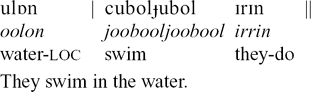
Abbreviations used in example glosses are as follows: cont = continuous aspect; DO = direct object; erg = ergative; foc = focus; loc = locative; pl = plural; poss = possessive; pst = (remote) past; rec.pst = recent past; redup = reduplication; sg = singular; trans = transitive.
Acknowledgements
Many thanks to the people of One Arm Point for their hospitality, particularly Jessie Sampi, Bessie Ejai, †Nancy Isaac, †Lena Stumpagee and †Maggie Davey. Funding for field research was provided by the National Science Foundation (BCS-0910936), the Endangered Language Fund, and the Australian Institute of Aboriginal and Torres Strait Islander Studies.



