




The COVID-19 pandemic
As a consequence of the worldwide COVID-19 pandemic, the World Health Organization (WHO) recommended social distancing measures to minimise cases and avoid overburdening health services.Reference Vieira, Garcia and Maciel1 However, for women in abusive relationships, staying at home was not safe, and may have increased the risk of domestic violence alongside reducing access to support networks.
Social distancing during the pandemic has probably increased the domestic work of many women, including caring for children and the elderly. Consequently, men perceived to have less power in the domestic environment, which may be one of the causes for violent behaviour; in addition, the aggressor spent more time with the victim at home.Reference Wenham, Smith, Davies, Feng, Grépin and Harman2,Reference Hunnicutt3
Risk factors for domestic violence
The most common risk factors for domestic violence are economic condition, education, age, unwanted pregnancy, stressful experiences, history of depression, exposure to violence during childhood, marital status, lack of social support, and alcohol and drug consumption.Reference James, Brody and Hamilton4,Reference Audi, Segall-Corrêa, Santiago, Andrade and Pèrez-Escamila5 The prevalence of domestic violence increased during the pandemic in some countries, and the magnitude of the problem may be even greater since the number of cases is widely underestimated, particularly in underprivileged countries. Moreover, the prevalence of domestic violence may continue to increase even after the pandemic, because of unemployment and financial instability, with the loss of income making victims more dependent on the abuser.Reference Naghizadeh, Mirghafourvand and Mohammadirad6
Prenatal care is a window of opportunity to assess violence, since the victim regularly attends health services.Reference Van Parys7 However, limited access to antenatal care has become a reality during the pandemic, particularly for vulnerable women who live in rural areas or precarious settlements. Negative consequences, such as maternal and neonatal mortality and the risk of unwanted pregnancies, have increased during the pandemic.Reference Thorne, Buitendyk, Wawuda, Lewis, Bernard and Spitzer8,Reference Yakubovich, Stöckl, Murray, Melendez-Torres, Steinert and Glavin9
This study aimed to assess the factors associated with domestic violence in Brazilian pregnant women during the COVID-19 pandemic.
Method
This cross-sectional study, carried out from February 2021 to August 2022, investigated the factors associated with domestic violence in 400 Brazilian pregnant women during the COVID-19 pandemic. The study is part of an ongoing large, prospective epidemiological study, the Araraquara Cohort study.
The pregnant women were selected by trained interviewers at the 34 health units in Araraquara City, São Paulo, Brazil, and were included in the study if they had a gestational age of ≤26 weeks. The participants answered a questionnaire previously tested in pregnant women,Reference Rondó, Ferreira, Nogueira, Ribeiro, Lobert and Artes10 which consisted of demographic and socioeconomic (age, race, marital status and educational level), lifestyle (smoking and alcohol consumption), obstetric (gestational age and parity) and morbidity characteristics. The women attended the municipal maternity of Araraquara for ultrasound measurements before 20 weeks’ gestation, to confirm their gestational age. The participants were asked about violence and mental health changes, using standardised questionnaires.
The study was conducted in accordance with the guidelines of the Declaration of Helsinki for research involving human participants, and was approved by the Ethics Committee on Human Research of the Faculty of Medicine, University of São Paulo (protocol number 59787216.2.0000.5421). Written informed consent was obtained from all participants before data collection.
Before starting a conversation about violence, the interviewer was instructed to ask the participant if it were safe to speak and if she could simply answer ‘yes’ or ‘no’. If the women felt unsafe, the interviewer suggested a better time for the interview. In addition, the interviewer asked the participant if she was alone, to ensure that the perpetrator was not in the same room. At the end of the interviews, the pregnant women received information and contacts of women's protection services, including free psychological care in Araraquara city. The coping strategies were reinforced and the information was shared to help other women in the same situation.
Questionnaires for assessing violence
World Health Organization Violence Against Women questionnaire
The World Health Organization Violence Against Women questionnaire (WHO-VAW)Reference Garcia-Moreno, Jansen, Ellsberg, Heise and Watts11 consists of 13 items that assess spousal violence (mental, physical and sexual) in the past 12 months, and has been used in several international and national studies, including a study of pregnant women in Brazil.Reference Ribeiro, Da Silva, De Britto, Alves, Batista and Ribeiro12,Reference Ribeiro, De Britto, Alves, Batista, Ribeiro and Schraiber13
Abuse Assessment Screen
The Abuse Assessment Screen (ASS)Reference McFarlane and Parker Barbara14 contains five questions designed to identify the frequency and severity of events, the locations of the injuries suffered and the profile of the perpetrator. The questions assess lifetime experiences of abuse, physical violence in the past year, physical violence during pregnancy, sexual abuse in the past 12 months and fear of a current partner or someone close to the woman. The AAS has been applied to Brazilian pregnant women to assess violence during pregnancy.Reference Reichenheim, Moraes and Hasselmann15
Questionnaires for assessing mental health
General Health Questionnaire
The General Health Questionnaire (GHQ)Reference Goldenberg and Williams16 version used in this study included 12 questions and the GHQ score was classified as low (0–3) and high (≥4). The GHQ examines changes in psychological well-being in the adult population, including pregnant women,Reference Rondó, Souza, Moraes and Nogueira17 and has been validated in Brazil.Reference De Jesus Mari and Williams18
Patient Health Questionnaire-9
The Patient Health Questionnaire-9 (PHQ-9)Reference Kroenke, Spitzer and Williams19 consists of nine symptoms and aims to measure the risk of major depression. The frequency of each symptom in the past 2 weeks is rated on a Likert scale from 0 to 3. The total score ranges from 0 to 27, and a score ≥10 is defined as risk of depression. The instrument has been validated for Brazilian adults,Reference Santos, Tavares, Munhoz, de Almeida, da Silva and Tams20 and also applied to Brazilian pregnant women.Reference Faisal-Cury, Levy, Azeredo and Matijasevich21
Statistical analysis
Descriptive analysis was performed to obtain the frequency and percentage of the variables. The chi-squared test was used to evaluate the associations of any lifetime violence and psychological violence with maternal age, race, marital status, education, per capita income, head of household, alcohol consumption, smoking, use of illicit drugs, parity, gestational age and mental health. Variables showing statistically significant associations were included in two multivariable logistic regression models that considered any lifetime violence and psychological violence in the past 12 months as dependent variables. Results were expressed as odds ratios and 95% confidence intervals. Statistical analysis was performed with the SPSS for Windows version 20.0 software (SPSS, Chicago, USA), and a P-value <0.05 was adopted as statistically significant.
Results
A total of 471 pregnant women were invited to participate in the study; 71 (15.1%) of them declined to participate for two main reasons: 29 (6.2%) had no interest and 42 (8.9%) had a lack of time (due to work and caring for children). Therefore, 400 women were included in the study.
It was necessary to reschedule the interview for three pregnant women, in view that they did not felt safe to speak or were not alone at home.
The demographic, socioeconomic, obstetric and lifestyle characteristics, violence exposure, and mental health of the pregnant women are shown in Table 1. Most of the women were aged 20–30 years (87%), non-White (52%), married or cohabiting (87.5%), had ≤12 years of schooling (81%) and had a per capita income of 0.5–1 Brazilian minimum wage (where 1 is equal to US$267.00) (56.3%). Approximately 41% of the women had an intimate partner as the head of the household. The majority of the women did not consume alcohol (86.7%), did not smoke (93.5%) and did not use illicit drugs (98%) during pregnancy. Almost 43% of the women were primiparous and 78.7% were between 14 and 26 weeks of gestation.
Demographic, socioeconomic, obstetric and lifestyle characteristics, violence and mental health of the pregnant women

AAS, Assessment Abuse Screen; WHO-VAW, World Health Organization Violence Against Women; GHQ, General Health Questionnaire; PHQ-9, Patient Health Questionnaire-9.
a. Minimum Brazilian wage of 1 is equal to US$267.
Violence experienced at any time in their lives was reported by 52.2% of the pregnant women, and psychological violence in the past 12 months was the most prevalent type of domestic violence (19.5%). According to the GHQ and PHQ-9 scores, 42.7 and 59.7% of pregnant women exhibited mental health changes, respectively.
As can be seen in Table 2, experiencing any lifetime violence was associated with mental health changes (P < 0.001), psychological violence (P < 0.001), physical violence (P < 0.001), sexual violence (P = 0.009), age (P = 0.03), marital status (P = 0.001) and parity (P = 0.01). According to Table 3, psychological violence in the past 12 months was associated with mental health changes (P < 0.001), any lifetime violence (P < 0.001), physical violence (P < 0.001), sexual violence (P < 0.001), marital status (P < 0.001) and illicit drug use (P = 0.028).
Associations of any lifetime violence with demographic, socioeconomic, obstetric and lifestyle characteristics, types of violence in the past 12 months and mental health of the pregnant women
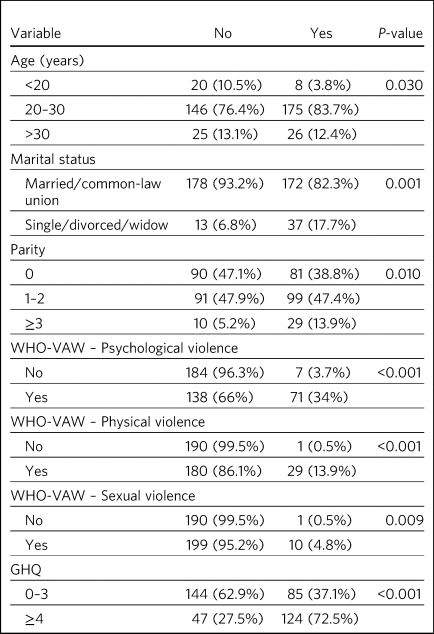
WHO-VAW, World Health Organization Violence Against Women; GHQ, General Health Questionnaire.
Associations of psychological violence in the past 12 months with demographic, socioeconomic, obstetric and lifestyle characteristics, physical and sexual violence in the past 12 months, any lifetime violence and mental health changes of the pregnant women
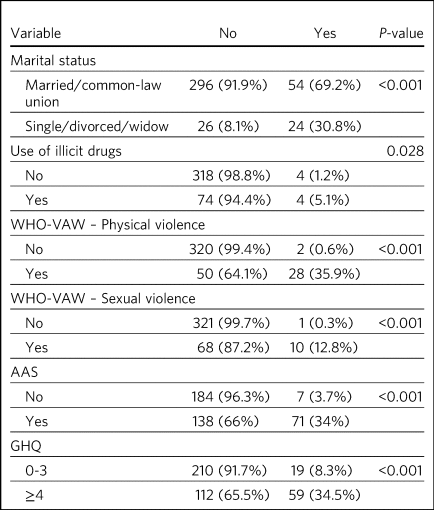
WHO-VAW, World Health Organization Violence Against Women; AAS, Assessment Abuse Screen; GHQ, General Health Questionnaire.
Table 4 shows two multivariable logistic regression models. Any lifetime violence was the dependent variable in the first model, and psychological violence in the past 12 months was the dependent variable in the second model. In model 1, any lifetime violence was positively associated with being single (P = 0.005). The risk of a single woman experiencing violence was 2.95 times higher than that of a married woman. Regarding parity, no pregnancy or three or more pregnancies were positively associated with any lifetime violence (P < 0.001). Pregnant women who had experienced any lifetime violence were more likely to have mental health changes (odds ratio 4.67) compared with pregnant women with no history of violence (P < 0.01). In model 2, psychological violence in the past 12 months was also associated with being single. Women with a history of psychological violence were 5.93 times more likely to have mental health changes than pregnant women with no reported violence in the past 12 months.
Associations of any lifetime violence and psychological violence in the past 12 months with the factors investigated: multivariable logistic regression models
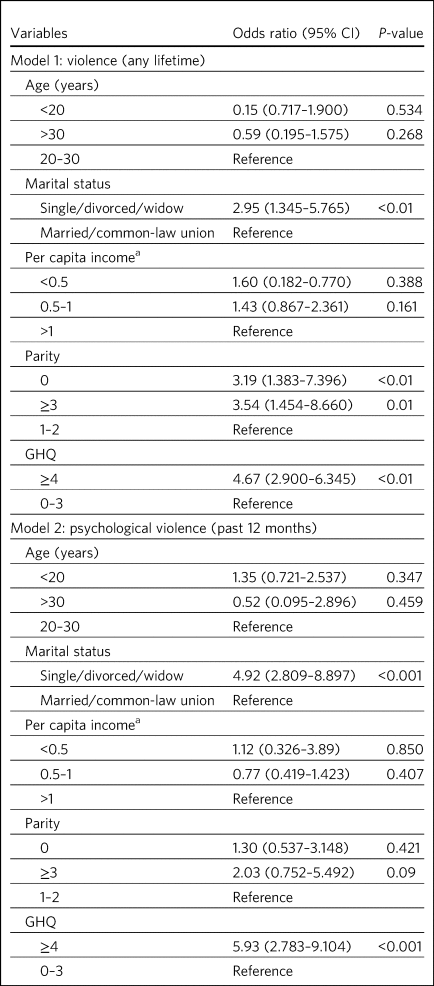
GHQ, General Health Questionnaire.
a. Minimum Brazilian wage of 1 is equal to US$267.00.
Discussion
In this study, more than half of the pregnant women experienced violence at any time in their lives, and psychological violence was the most prevalent type (19.5%). A similar prevalence of psychological violence (22.2%) was reported in a study conducted in south-western Ethiopia on 590 pregnant women.Reference Fetene, Alie, Girma and Negesse22 Another study carried out in Jordan during the COVID-19 pandemic, involving 215 pregnant women, showed a prevalence of psychological violence of 50.2% among all types of violence.Reference Abujilban, Mrayan, Hamaideh, Obeisat and Damra23 In a systematic review with meta-analysis of studies conducted during the COVID-19 pandemic, the combined prevalence of violence was 22% (95% CI 4–40%), with psychological, physical and sexual violence accounting for 24, 14 and 6%, respectively. The authors concluded that the prevalence of violence against pregnant women was higher during the pandemic than before this period.Reference Huldani, Abdelbasset, Jasim, Suksatan, Jalil and Thangavelu24 Psychological violence was also the most prevalent type (92.9%) in a study carried out on 830 Iranian pregnant women;Reference Maharlouei, Roozmeh, Zahed Roozegar, Shahraki, Bazrafshan and Moradi-Alamdarloo25 along with sexual violence (11.0%), these types of violence showed the largest increase compared with the periods before pregnancy and before the COVID-19 pandemic.
To our knowledge, this is the first Brazilian study that investigated the prevalence of violence against pregnant women and its associated factors during the pandemic. The results of multivariable logistic regression analysis showed that any lifetime violence and psychological violence in the past 12 months were associated with being single. The findings are consistent with the meta-analysis conducted by James et alReference James, Brody and Hamilton4 involving 140 287 women, in which being single during pregnancy had an odds ratio of 1.73 for domestic violence. A study of 379 Brazilian pregnant women carried out before the COVID-19 pandemic showed that unstable unions, single women and women as household head were risk factors for violence.Reference Audi, Segall-Corrêa, Santiago, Andrade and Pèrez-Escamila5
Both types of violence investigated in this study – any lifetime violence and psychological violence in the past 12 months – were associated with mental health changes as measured by the GHQ. Mental health changes have been associated with a higher risk of exposure to domestic violence.Reference Howard, Oram, Galley, Trevillion and Feder26 Pregnant women who experience domestic violence tend to start antenatal care later and be at higher risk of depression, anxiety, and suicide ideation and attempt.Reference James, Brody and Hamilton4 The COVID-19 pandemic has demonstrated an effect on mental health. Pregnant women screened during the COVID-19 pandemic exhibited more distress (symptoms of anxiety and depression) and other psychiatric symptoms than those screened before the pandemic.Reference Berthelot, Lemieux, Garon-Bissonnette, Drouin-Maziade, Martel and Maziade27 A recent meta-analysis showed that the COVID-19 pandemic increased the risk of anxiety among women during pregnancy and during the perinatal period.Reference Hessami, Romanelli, Chiurazzi and Cozzolino28 In China, domestic violence raised the risk of prenatal anxiety and depression among pregnant women, and women who experienced mental violence were 3.55 times more likely to have a risk of depression.Reference Wu, Zhou, Chen, Lin, Liu and Huang29
This study showed that maternal age was neither associated with any lifetime violence nor with psychological violence in the past 12 months. The finding was surprising, given that other studies conducted before the pandemic indicated that younger women are more vulnerable to psychological violence in the past 12 months.Reference Audi, Segall-Corrêa, Santiago, Andrade and Pèrez-Escamila5,Reference de Vasconcelos, de Andrade, Gomes, Pinto and Malta30 This difference may be explained by the fact that the prevalence of young women was only 7.5% in our study, compared with 23.5% and 16.8% in the studies by Audi et alReference Audi, Segall-Corrêa, Santiago, Andrade and Pèrez-Escamila5 and Vasconcelos et al,Reference de Vasconcelos, de Andrade, Gomes, Pinto and Malta30 respectively.
Pandemic-induced economic recessions were found to be a predictor of violence against 590 pregnant women in a cross-sectional study carried out during the pandemic in south-western Ethiopia.Reference Fetene, Alie, Girma and Negesse22 On the other hand, a study with 830 Iranian pregnant women showed that high socioeconomic status was a risk factor for general violence.Reference Maharlouei, Roozmeh, Zahed Roozegar, Shahraki, Bazrafshan and Moradi-Alamdarloo25 According to a review by Hunnicut,Reference Hunnicutt3 gender equality is measured based on socioeconomic indicators. If gender equality increases, the woman can either experience less violence as her status improves or more violence as a result of being victimised by the aggressor. In our study, socioeconomic status of the pregnant women was not associated with violence. This finding can be explained by the fact that almost all women were of low socioeconomic status, with the population being highly homogenous.
A strength of our study was that we screened for mental health and violence throughout the period of the pandemic. Another highlight was the training of the interviewers, who throughout the process were attentive to safety and created strategies when the participants were unable to answer the questions, including suggesting another time for the interview, ensuring that the aggressor was not with the participant and applying safety procedures according to individual reality. However, the cross-sectional design was a limitation of the study. Furthermore, because of the COVID-19 pandemic, we were unable to follow up on the pregnant women included in the study.
Moreover, it is important to note that violence during pregnancy may be underreported,Reference Wu, Zhou, Chen, Lin, Liu and Huang29 since the data are obtained by self-report. Many pregnant women may avoid talking about their experience with violence. Guilt may be one of the reasons responsible for the inability to talk or even think about the event, which tends to manifest as mental and physical suffering. According to the WHO, ethics and safety in violence research is important for the participants and interviewers involved.31 In some cases, women only disclose violence when they feel safe and trust the interviewer.Reference Jansen, Watts, Ellsberg, Heise and García-Moreno32 Moreover, the questionnaires depend on the memory of pregnant women, who may have forgotten or ignored violent events; this is especially true for psychological violence, which is characterised by invisibility, trivialisation and naturalisation in contemporary culture.Reference Hunnicutt3
In conclusion, several measures can be used to prevent domestic violence, especially training health professionals involved in prenatal care in the early detection of single women and women with mental health changes, who presented with a three to six times higher risk of experiencing violence. In addition, the study also detected other risk factors for domestic violence, such as no parity or having three or more parities, with risks 3–3.5 times higher for these women. It is also important to emphasise that more than half of the pregnant women had experienced violence at some point in their lives, and most of them had mental health changes. There is, therefore, an urgent need to address the issue of domestic violence during antenatal care and probably after childbirth, considering that domestic violence may also affect the health of offspring.
About the authors
Leonardo Domingos Biagio is a Master's student at the School of Public Health, University of São Paulo, Brazil. Delanjathan Devakumar is Professor of Global Child Health at University College London, UK. Leticia Falcão de Carvalho is a PhD student at the School of Public Health, University of São Paulo, Brazil. Natália Pinheiro de Castro is a post-doctoral researcher at the School of Public Health, University of São Paulo, Brazil. Rossana Verónica Mendoza López is a researcher at the Centre for Translational Oncology Research at the São Paulo State Cancer Institute (ICESP), Brazil. Liania Alves Luzia is a researcher at the School of Public Health, University of São Paulo, Brazil. Perla Pizzi Argentato is a post-doctoral researcher at the School of Public Health, University of São Paulo, Brazil. Patrícia Helen Carvalho Rondó is a professor at the School of Public Health, University of São Paulo, Brazil.
Data availability
Electronic copies of survey data are available from the corresponding author, P.H.C.R., on reasonable request.
Acknowledgements
We would like to acknowledge Professor Walter Manso Figueiredo and Professor Angela Aparecida Costa for assistance in data collection, and the Health Secretary of Araraquara for allowing us to carry out the research in the city.
Author contributions
P.H.C.R. and D.D. designed the study protocol, secured funding and facilitated data collection. L.D.B., L.F.C. and N.P.C. collected the data. P.H.C.R. and L.A.L. coordinated the fieldwork. P.H.C.R., R.V.M.L. and L.D.B. were responsible for data management and statistical analysis. P.H.C.R., D.D., P.P.A., R.V.M.L., D.D. and L.D.B. interpreted the data. L.D.B., P.H.C.R., D.D., P.P.A. and R.V.M.L. revised each draft for important intellectual content. All authors read and approved the final manuscript.
Funding
This study was supported by the São Paulo Research Foundation (FAPESP) (grant 2015/03333-6), Brazil, and the Medical Research Council, UK. L.D.B. and L.F.C. received MPH and PhD scholarships, respectively, from the Coordination for the Improvement of Higher Education Personnel (CAPES). N.P.C. received a post-doctoral scholarship from FAPESP (grant 2020/15365-8).
Declaration of interest
None.


 Open access


eLetters
No eLetters have been published for this article.