




1 Introduction
In his 2000 On Writing: A Memoir of the Craft, the prolific best-selling author Stephen King adamantly states:
Some writers try to evade the no-adverb rule [that is, not using a phrase such as ‘she shouted menacingly’] by shooting the attribution verb full of steroids. The result is familiar to any reader of pulp fiction or paperback originals:
“Put down the gun, Utterson!” Jekyll grated.
“Never stop kissing me!” Shayna gasped.
“You damned tease!” Bill jerked out.
Don’t do these things. Please oh please. (King Reference King2000: 126–7)
Similar criticism of certain kinds of verbs that signal the representation of what someone has said (in real life or in a fictional world) is voiced by many other contemporary writers and literary critics (e.g. Page Reference Page1988: 27; cf. Mandala Reference Mandala2010: 16–17). Yet, despite these prohibitions, some writers continue to use them, and, as research on these verbs shows (section 2), they are used in various genres and appear to have been used across the history of English (depending on type of verb). However, we have a limited sense of how and why these verbs developed and how they were used over time and for what purposes.
Focusing on the Late Modern English period, this article fills in part of the picture by charting the use of what Caldas-Coulthard (Reference Caldas-Coulthard and Coulthard1987: 162–5) labels paralinguistic verbs. An example is given in (1), where sobbed signals that speech was delivered at the same time as the speaker cried.

Some of these verbs have been studied (usually in conjunction with other types of speech representation verbs) for particular authors and texts historically, but we lack a more general picture of these verbs’ development and use, with an extensive set of verbs considered together. I therefore explore a broad range of paralinguistic verbs in over 100 works of narrative fiction drawn from the Corpus of Late Modern English Texts, version 3.0 (CLMET3.0), covering the period 1710–1920. My research is guided by the following specific questions:
-
(i) How do paralinguistic speech representation verbs develop over time (in terms of both tokens and types, as well as dispersion across texts and authors)?
-
(ii) How is the use over time correlated with particular speech representation categories (e.g. Indirect speech and Direct speech)?
-
(iii) How may the verbs’ functions as literary devices of stance influence their use, variation and development?
More generally, the study aims to contribute to our understanding of the dynamics of variation and change in speech representation mechanisms in the history of English, highlighting how aspects of literary usage can help account for experimentation with such resources. Although concerned with contextualized use, with this focus on verb usage rather than on text or author, the study does not attempt to chart in detail the stylistic choices of particular texts or authors, which deserve separate dedicated studies (e.g. Ruano San Segundo Reference Ruano San Segundo2016, Reference Ruano San Segundo2017).
Beyond this introduction, the article gives a scholarly backdrop to the topic in section 2, followed by a discussion of material and method in section 3. The results section (4) gives an overview of the developments over time in section 4.1, and then focuses on more fine-grained patterns for specific verbs and verb types in section 4.2, speech representation categories in section 4.3 and textual functions in section 4.4. The conclusion (section 5) offers a summary and broader implications of the findings.
2 Background
Speech representation Footnote 1 is a vibrant research area within a number of subfields of linguistics, including cognitive linguistics (e.g. Vandelanotte Reference Vandelanotte2023), corpus-based descriptive linguistics (e.g. Bevitori Reference Bevitori, Flowerdew and Gotti2006), sociolinguistics (e.g. D’Arcy Reference D’Arcy2017), stylistics (e.g. Semino & Short Reference Semino and Short2004) and historical linguistics (e.g. Grund & Walker Reference Grund and Walker2020a). The focus of study has ranged widely, covering issues of syntactic structure, modes of representation, and sociopragmatic and textual implications (see Grund & Walker Reference Grund and Walker2020b). A feature of particular interest has been the speech representation expression, also called speech tag, inquit clause, quotative and the like, and especially the verbs in such expressions. These verbs can be divided into a number of different categories (e.g. Caldas-Coulthard Reference Caldas-Coulthard and Coulthard1987; Levin Reference Levin1993; Urban & Ruppenhoffer Reference Urban and Ruppenhofer2001); they have different syntactic characteristics (e.g. Zwicky Reference Zwicky1971; Mufwene Reference Mufwene, Farkas, Jacobsen and Todrys1978); and they are used variably across genres and contexts (e.g. Semino & Short Reference Semino and Short2004; Bevitori Reference Bevitori, Flowerdew and Gotti2006).
The history of speech representation verbs has received some attention, but the picture remains fragmented. Research has documented the presence of numerous verbs throughout the history of English, ranging from ‘neutral’ verbs such as say Footnote 2 to speech act-related and descriptive verbs, such as order, yell and whimper (e.g. Moore Reference Moore2011; Aijmer Reference Aijmer2015; Walker & Grund Reference Walker, Grund, Jonsson and Larsson2020; Hauff Reference Hauff2021). These verbs have waxed and waned over time. Perhaps most obviously, cweþan/quethen (usually found in the forms quoth and quod) has become obsolete, other than in archaizing contexts (e.g. Moore Reference Moore2015; Cichosz Reference Cichosz2019; Hauff Reference Hauff2021). The use of quotative be like, by contrast, has risen substantially, especially in spoken language (e.g. D’Arcy Reference D’Arcy2017). Over time, more and more verbs have been recruited into speech representation usage often through processes of metaphor and metonymy (Rudzka-Ostyn Reference Rudzka-Ostyn and Rudzka-Ostyn1988; Goossens Reference Goossens1990), including expressions related to physiological processes (e.g. vomit), labor (e.g. drill) and food preparation (e.g. mince) (Rudzka-Ostyn Reference Rudzka-Ostyn and Rudzka-Ostyn1988: 550).
Speech representation is a key aspect of literary texts, especially narrative fiction, and as such has received considerable scholarly attention (among many others, Fludernik Reference Fludernik1993; Semino & Short Reference Semino and Short2004; McIntyre & Walker Reference McIntyre and Walker2011; Mahlberg Reference Mahlberg2012; Bray Reference Bray2018; Mahlberg et al. Reference Mahlberg, Wiegand, Stockwell and Hennessey2019; Busse Reference Busse2020). Indeed, it is likely unsurprising that literary texts appear to be particularly rich in creative uses of speech representation verbs as they can be exploited for a variety of purposes beyond the indication of speech (Caldas-Coulthard Reference Caldas-Coulthard and Coulthard1987; Semino & Short Reference Semino and Short2004: 96; Mahlberg et al. Reference Mahlberg, Smith and Preston2013: 50–3; see also Brown Reference Brown1990: 112–43; Jobert Reference Jobert, Stockwell and Whiteley2014: 243). Although the dynamics in literary texts remain to be explored systematically, we find comments and part of a broader narrative in the existing literature. Page (Reference Page1988: 27) notes that ‘many writers [of the novel] seek to relieve the monotony of constant “he-saids” by resorting to elegant variation, though the variations, when not simply a novelistic habit, are in themselves expressive’. Indeed, Page (Reference Page1988: 28) suggests that it may be productive to look at choices by different writers and what such differences may mean. A similar call for study is made by Lambert (Reference Lambert1981: 16). Somewhat arbitrarily, he restricts the interest to ‘high-frequency’ verbs, while verbs such as snarl, grasp, mumble and growl are excluded as being ‘highly conspicuous, precious, and even writer’s-workshop-vivid choices’ (Lambert Reference Lambert1981: 14), mirroring some of King’s (Reference King2000) sentiments (section 1).
That these verbs go beyond simply ‘elegant variation’ and the ‘precious’ has been shown by Ruano San Segundo (Reference Ruano San Segundo2016, Reference Ruano San Segundo2017, Reference Ruano San Segundo2018; see also Mahlberg et al. Reference Mahlberg, Smith and Preston2013: 50–3). He demonstrates the significant characterization functions that these verbs carry in the works of Charles Dickens. Beyond studies of Dickens’s novels, however, we find less systematic attention. Toner (Reference Toner2012), for example, shows that Jane Austen was aware of and manipulated the use of speech representation verbs, especially in terms of whether to use them or leave them out.
More broadly, Caldas-Coulthard (Reference Caldas-Coulthard and Coulthard1987: 149) devises ‘a tentative taxonomy’ to capture the variation in speech representation verbs especially in literary works. She proposes the categories of ‘neutral’ (e.g. say), ‘structuring’ (e.g. ask, reply), ‘metapropositional’ (e.g. urge, accuse), ‘metalinguistic’ (e.g. narrate, quote), ‘prosodic’ (e.g. scream), ‘paralinguistic’ (e.g. murmur, giggle) and ‘signalling discourse’ (e.g. echo, pursue). This taxonomy, she argues, can help demonstrate how ‘different authors handle their fictional dialogues and pick up interesting stylistic variation’ (Caldas-Coulthard Reference Caldas-Coulthard and Coulthard1987: 149–50).
My study takes its cue from this existing research. Studies have concentrated on the use by particular authors or in particular texts (e.g. Mahlberg et al. Reference Mahlberg, Smith and Preston2013; Ruano San Segundo Reference Ruano San Segundo2016, Reference Ruano San Segundo2017; Eberhardt Reference Eberhardt2017; for a broader approach, see Busse Reference Busse2020: 168–71). I take a different, complementary perspective, putting the spotlight on the development of the verbs over the Late Modern English period in a large number of fictional works (127) (see section 3). With this approach and focus, including all speech representation verbs in one study is not feasible; there are many hundreds of such verbs.Footnote 3 As part of a larger project charting speech verbs in the history of English, I focus in this instance on paralinguistic verbs and their use across time. Paralinguistic verbs are usually the ones singled out for commentary by present-day critics and writers (in addition to Lambert (Reference Lambert1981) and King (Reference King2000), see also Bromley (Reference Bromley2023) or Kahn (Reference Kahn2022)). This category has also received some attention in stylistic studies, which point to the potential for these verbs to describe also aspects beyond speech, such as character traits (e.g. Ruano San Segundo Reference Ruano San Segundo2016, Reference Ruano San Segundo2017, Reference Ruano San Segundo2018; Eberhardt Reference Eberhardt2017). Studying these verbs over time in a large dataset can reveal new dynamics such as how widespread these verbs are, their pathways of change, and functional aspects that can complement and inform our understanding of uses by particular authors and texts and the current debates about these verbs.
3 Material and method
My data comes from the CLMET3.0 corpus (created by Hendrik De Smet, Hans-Jürgen Diller and Jukka Tyrkkö), which includes 127 works of narrative fiction (c. 16 million words). It covers the period 1710–1920, i.e. the very end of Early Modern English and especially Late Modern English where the large majority of the corpus texts are situated. CLMET3.0 includes works by now well-known authors such as Jane Austen, Anne, Charlotte and Emily Brontë, and Charles Dickens, as well as currently less well-known, but at the time prolific and famed authors such as Maria Edgeworth, Thomas Hughes and Matthew Lewis. The choice of material was influenced by Busse (Reference Busse2020), Cichosz (Reference Cichosz2019) and Ruano San Segundo (Reference Ruano San Segundo2016), who show Late Modern English and fiction to be important sites of expansion and experimentation with speech representation verbs.
CLMET3.0 contains a number of different types of narrative fiction, including novels, fictional diaries, fictional letters, Gothic novels, short stories and children’s literature. These types are not coded consistently and systematically in the corpus, and it is beyond the scope of this study to consider these types in detail. The focus here is on broader patterns of development for these verbs, but possible text-category variation may be important to consider in the future (see section 4.2; see also Busse Reference Busse2020: 60).Footnote 4
As indicated in section 2, I explore what Caldas-Coulthard (Reference Caldas-Coulthard and Coulthard1987: 162–4) calls paralinguistic verbs. In characterizing this group, Caldas-Coulthard (Reference Caldas-Coulthard and Coulthard1987: 162) adopts the definition of paralinguistic from Crystal (1969), who refers to ‘vocal effects which are primarily the result of physiological mechanisms other than the vocal cords such as the direct result of the workings of the pharyngeal, oral or nasal cavities’ (as quoted from Crystal (1969: 128) in Caldas-Coulthard Reference Caldas-Coulthard and Coulthard1987: 162). In other words, paralinguistic verbs signal some kind of modification of the voice and delivery of speech, involving various speech production organs. Caldas-Coulthard (Reference Caldas-Coulthard and Coulthard1987: 162–3) distinguishes two subgroups – voice qualifier and voice qualification – and exemplifies the former with the verbs murmur, mutter and whisper, and the latter with the verbs laugh, giggle, sob, gasp, groan and sigh. The voice qualifier category is, according to Caldas-Coulthard (Reference Caldas-Coulthard and Coulthard1987: 162), closely connected to the manner of speech delivery whereas the voice qualification category is said to be attitudinal. The distinction between the two groups remains unclear, as the uses in the first group can certainly be attitudinal as well. Indeed, the attitudinal aspect of paralinguistic verbs generally has been shown in Ruano San Segundo (Reference Ruano San Segundo2017: 120–2); it will also play a significant role in this investigation (see section 4.4).
Since Caldas-Coulthard (Reference Caldas-Coulthard and Coulthard1987: 162–4) lists only nine verbs, identifying an extensive set of paralinguistic verbs in a corpus is methodologically challenging. An automatic retrieval process that focuses on particular structures, such as speech verb + that or speech verb + quotation mark, is not possible. Not only would such retrieval yield a vast data set that would have to be paired down manually (considering the number of speech verbs possible in general), but it would also crucially miss speech representation that does not adhere to such structures. Key here is to consider the full speech representation scale. I use Semino & Short’s (Reference Semino and Short2004: 10) foundational model of speech representation, which recognizes a number of constructions as representing speech along a scale of ‘amount of “involvement” of (i) the original speaker in the anterior discourse and (ii) the person in the posterior discourse presenting what was said in the anterior discourse’. In a Direct speech representation, as in (2), the speech represented is purportedly close to what the original speaker said. In what Semino & Short (Reference Semino and Short2004: 10) call a Narrator’s representation of speech acts, as in (3), and a Narrator’s representation of voice, as in (4), by contrast, there is more ‘involvement’ by the speech reporter, who gives little access to the previous speech other than indicating what speech act was performed or simply that speech took place. The speech representation verbs admittedly function differently in these speech representation modes: in direct speech, for example, the verb introduces the speech (and is outside the represented speech), while in the other two structures, the verb is ‘fused’ with the represented speech itself. With a focus on verb development, all speech representation contexts and constructions must be considered to provide a comprehensive view of the verbs in speech representation use. As we shall see in section 4.3, inclusion of all speech representation categories proved crucial.

This approach presents challenges, of course, as it relies on finding particular verbs and identifying their potential use in speech representation contexts. A corpus-driven approach is unfeasible considering the size of the corpus, and, to my knowledge, there is no comprehensive listing of verbs that would fit the paralinguistic mold. I therefore determined to collect a set of verbs that can be construed as paralinguistic, working from previous studies on speech representation verbs (e.g. Zwicky Reference Zwicky1971: Levin Reference Levin1993; Urban & Ruppenhoffer Reference Urban and Ruppenhofer2001; Semino & Short Reference Semino and Short2004; Busse Reference Busse2020: 170–1). I also consulted the OED Historical Thesaurus and VerbNet 3.3.Footnote 5 Based on these sources, I included the verbs listed below. It is unlikely that this is a comprehensive list, but the 101 verbs considered, which is the most extensive list that I have seen, include a number of core verbs and aspects of delivery (including various animal noise/communication verbs, bodily function verbs, etc.; cf. Snell-Hornby Reference Snell-Hornby1983: 170–88) and thus give us a robust sense of developments in the line-up and characteristics of these verbs.
bark, bawl, belch, bellow, blare, bleat, blubber, boom, bray, breathe, burble, burp, buzz, cackle, chirp, chirrup, chuckle, cluck, coo, cough, croak, croon, crow, drawl, drone, gasp, giggle, grate, groan, growl, grunt, guffaw, gurgle, hem, hiccough/hiccup, hiss, hoot, howl, hum, keen, laugh, lilt, lisp,Footnote 6 low, mew, mewl, moan, moo, mumble, murmur, mutter, neigh, pant, peep, puff, purr, quack, quaver, rasp, roar, rumble, screech, shriek, sibilate, sigh, snap, snarl, snicker, sniff, snigger, snivel, snort, snuffle, sob, splutter, squall, squawk, squeak, squeal, stammer, stutter, thunder, tisk/tsk, titter, trill, twang, twitter, wail, warble, weep, wheeze, whimper, whine, whinny, whisper, whoop, yammer, yap, yawn, yelp, yodel
I extracted relevant verbs with the help of a word list capturing spelling variation (such as sighed and sigh’d, or laughed, laugh’d and laught) and variation in verb form (base form, -s form, -ed form, -ing form). I concentrate in this study on the -ed forms, which almost exclusively cover past tense forms, as illustrated in (5). For most verbs, the -ed forms are by far the most common form, especially in speech representation contexts (cf. Ruano San Segundo Reference Ruano San Segundo2016: 117–18).

Most of these verbs are multivalent, with various non-speech uses and uncertain cases, both of which were excluded from the study. In (6), for example, the sighing appears to be parenthetical, interrupting the speech rather than introducing it, especially since there is already a said in the same context. Ambiguity can also arise as to whether speech is intended. In (7), it is not clear whether ‘she’ (Blanche) shrieked Help! or whether the shriek in itself was intended to communicate that she needed help; if the former interpretation is correct, the example is relevant for the study; in the latter interpretation, the example would not be relevant as it does not involve actual speech. Example (7) and instances like it were excluded.

All the instances of the -ed forms were manually inspected (c. 9000 instances). A number of the verbs did not yield any clear examples of speech representation use, including belch, blare, burble, burp, cluck, guffaw, hem, hoot, keen, lilt, low, mew, mewl, moo, neigh, peep, quack, rumble, sibilate, snicker, snivel, snuffle, squall, squawk, tisk/tsk, twang, whinny, whoop, yammer, yelp and yodel. Some of these verbs (such as burble, mew, mewl, whinny) are recorded in the OED with speech representation uses, often after the period covered by CLMET3.0. The absence of these verbs from speech representation contexts is a finding in itself and requires separate attention. In this study, I focus on the seventy verbs that had at least one instance of speech representation usage, which yielded 4266 examples.
4 Results
4.1 Overall results and temporal overview
Table 1 gives the temporal distribution of the speech representation verbs across the three periods given in the CLMET3.0 corpus.
Overview of temporal development (per 100,000 words; raw figures in parentheses)

The normalized frequency of the verbs increases drastically across the three subperiods of the corpus, from 4.9 per 100,000 words in period 1 to 43.8 in period 3. This trend could reflect a larger dynamic in which speech representation as a whole becomes a more prominent feature of fiction writing over time. After all, as Page (Reference Page1988: 3) puts it, ‘[i]n the creation of illusion [i.e. of mirroring real life] in a work of fiction, the presentation of speech has a distinctive role, for it is in this element that the closest “imitation of reality” is likely to appear to take place …’. However, arguably, the trend in table 1 cannot simply and straightforwardly reflect an increase in speech representation in general: importantly, we see not only an increase in the frequency of specific verbs (tokens), but also the addition of a number of new paralinguistic verbs (or types) over time (see section 4.2).
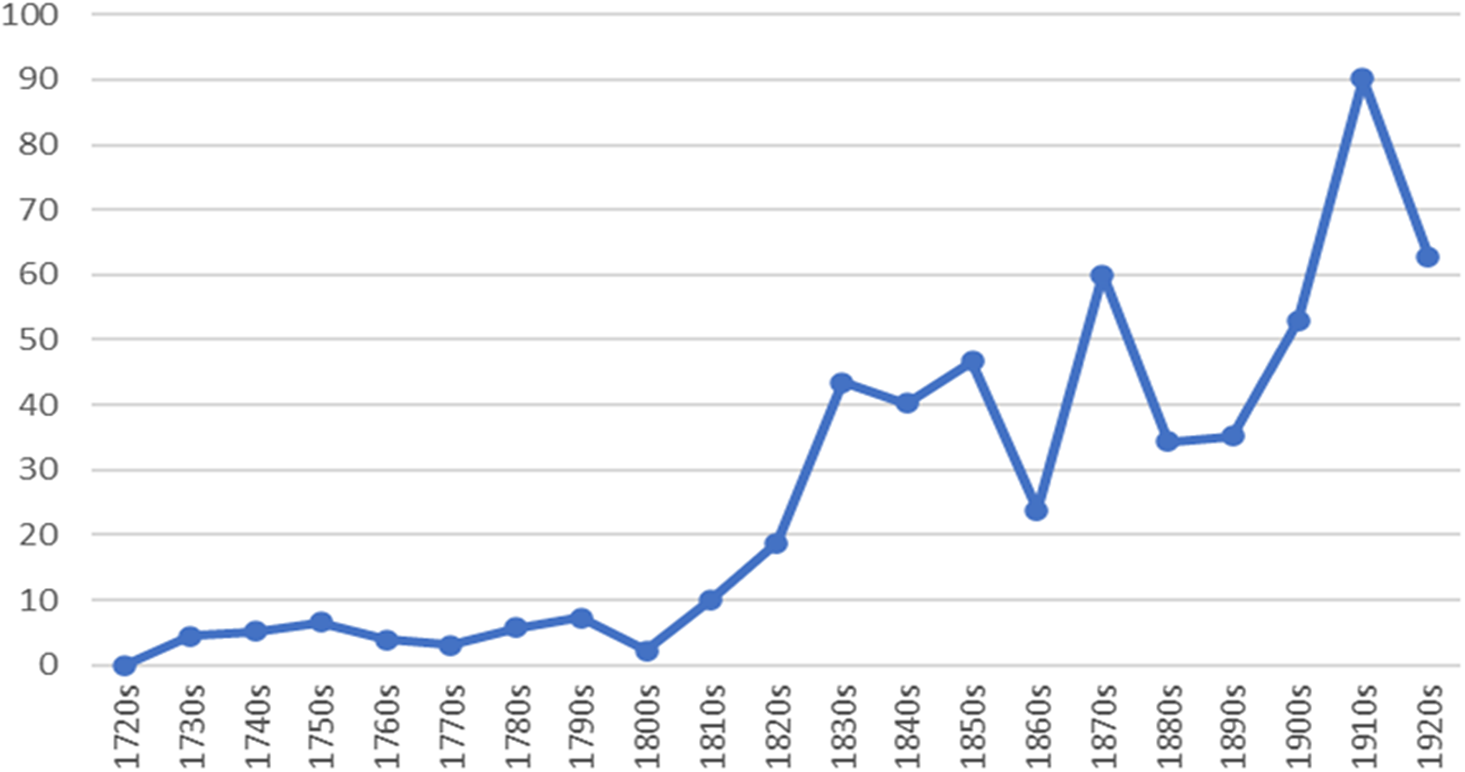
A more fine-grained picture emerges from a classification of the texts according to decade based on the publication date listed in CLMET3.0.Footnote 7 Figure 1 shows that, as in the overall periodization, there is a steady, though not entirely linear upward trend. We see especially a jump in the 1800s, with a noticeable increase between the 1820s and 1830s. This is of course the prime time of the development of the novel, discussed further in section 4.2. Though the 1920s is represented by only one text and thus possibly just a reflection of a stylistic dispreference for the verbs, the decline jibes with Jobert’s (Reference Jobert, Stockwell and Whiteley2014: 237) note that ‘paralinguistic encoding seems to peak at the turn of the nineteenth century’ (though it should also be noted that Jobert (Reference Jobert, Stockwell and Whiteley2014) references a broader set of paralinguistic features and authors from different geolinguistic contexts).
Development across decades (per 100,000 words)

Several factors likely affect the fluctuations over time evident in figure 1. Some decades are well represented by multiple texts, such as the 1830s and 1840s, while other periods are represented by just one or two texts, as in the 1800s and the 1920s (as noted above). That a low number of texts may have an impact on the picture is suggested by the nature of the two texts from the first decade of the 1800s. The texts – Adventures of Ulysses and Tales from Shakespeare – are both (co-)authored by Charles Lamb, and they present retellings of Homer’s Odyssey and selected plays by William Shakespeare adapted for children, respectively (for the issue of text categories, see section 3). Speech representation is frequent, especially in the Tales from Shakespeare, but the speech verbs are primarily of the neutral (said) or structuring (replied) kind perhaps to keep the dialogue straightforward for younger readers. In other words, the authorship of texts as well as their intention may impact the usage (see also section 4.4).
4.2 Verbs and verb types
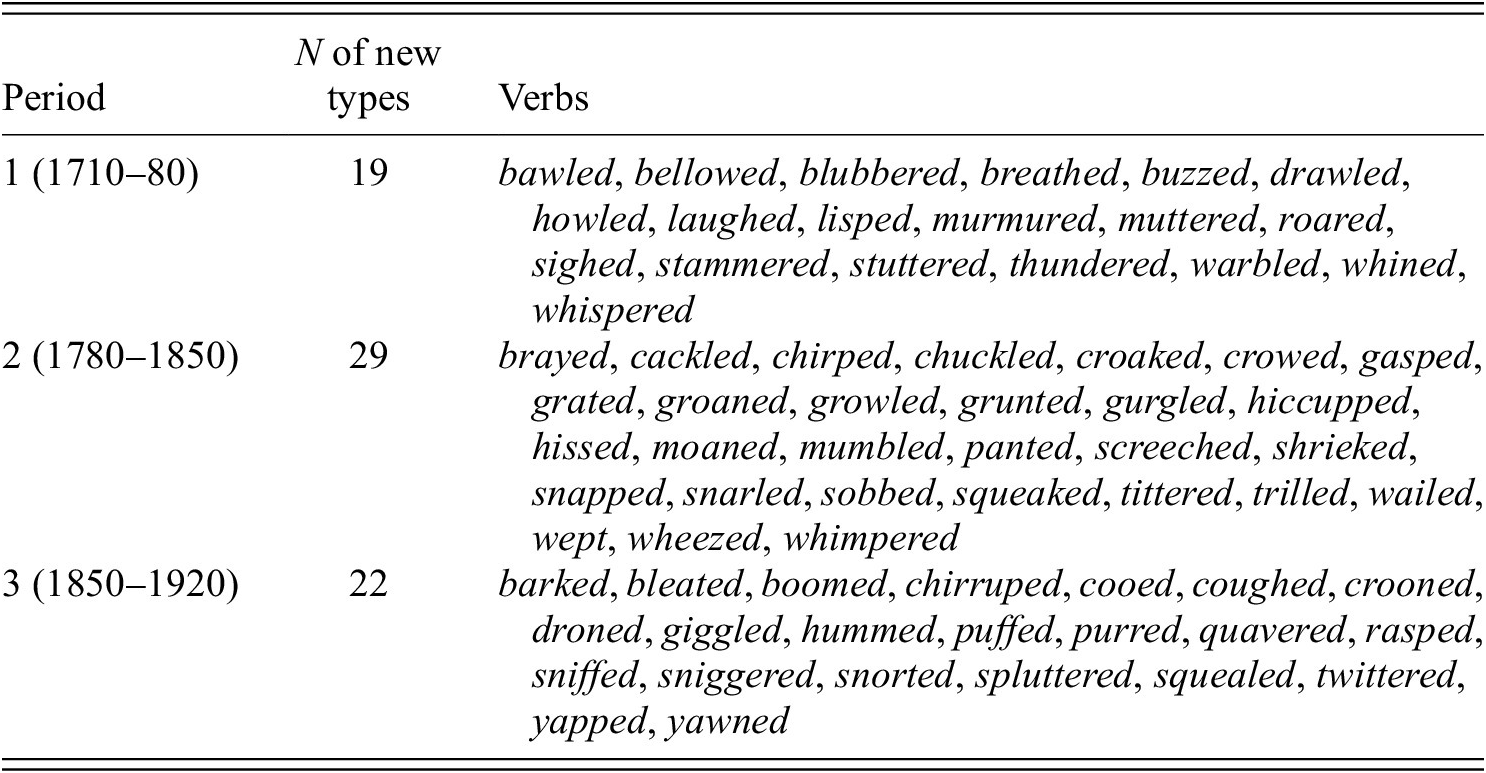
A similar picture of the experimentation and temporal development emerges by looking at the type of verb. Table 2 illustrates when different verbs first appear with speech representation function in the CLMET3.0 texts.
Types of paralinguistic speech representation verbs and period of appearance

Period 2 (1780–1850) is the most productive period for the appearance of ‘new’ types (even when we take the size of the different subperiods into consideration); the vast majority of the verbs stem from the 1820s through the 1840s. This is the period of some of the most prominent users and developers of the Victorian novel, such as Charles Dickens, Anne, Emily and Charlotte Brontë, William Thackeray and Elizabeth Gaskell. Vandelanotte (Reference Vandelanotte2020: 132) argues that ‘the growth of the novel as a genre [in the nineteenth century] initiated a period of creative instability, with authors tweaking different formal parameters in providing access to the speech (and, more generally, the minds) of characters’. Vandelanotte (Reference Vandelanotte2020) is concerned especially with the gradual solidification of Free indirect speech as a mode of speech representation. This process entailed a great deal of experimentation with forms and graphic representation by nineteenth-century novelists like Elizabeth Gaskell, Walter Scott and Jane Austen. A similar picture of experimentation is revealed by Bouso & Ruano San Segundo (Reference Bouso and Segundo2021: 218–19), who study the speech representation phenomenon of the reaction object construction (as in They shouted their appreciation). This feature shows a spike in the 1830s–50s in the narrative fiction texts of CLMET3.0 used by Bouso & Ruano San Segundo (Reference Bouso and Segundo2021). The use of paralinguistic verbs thus seems to fit into a broader process of creative instability (Vandelanotte Reference Vandelanotte2020: 132): authors were adapting their tools to provide more access to not only characters’ (and narrators’) speech, but also their minds, motivations and purposes (see section 4.4).
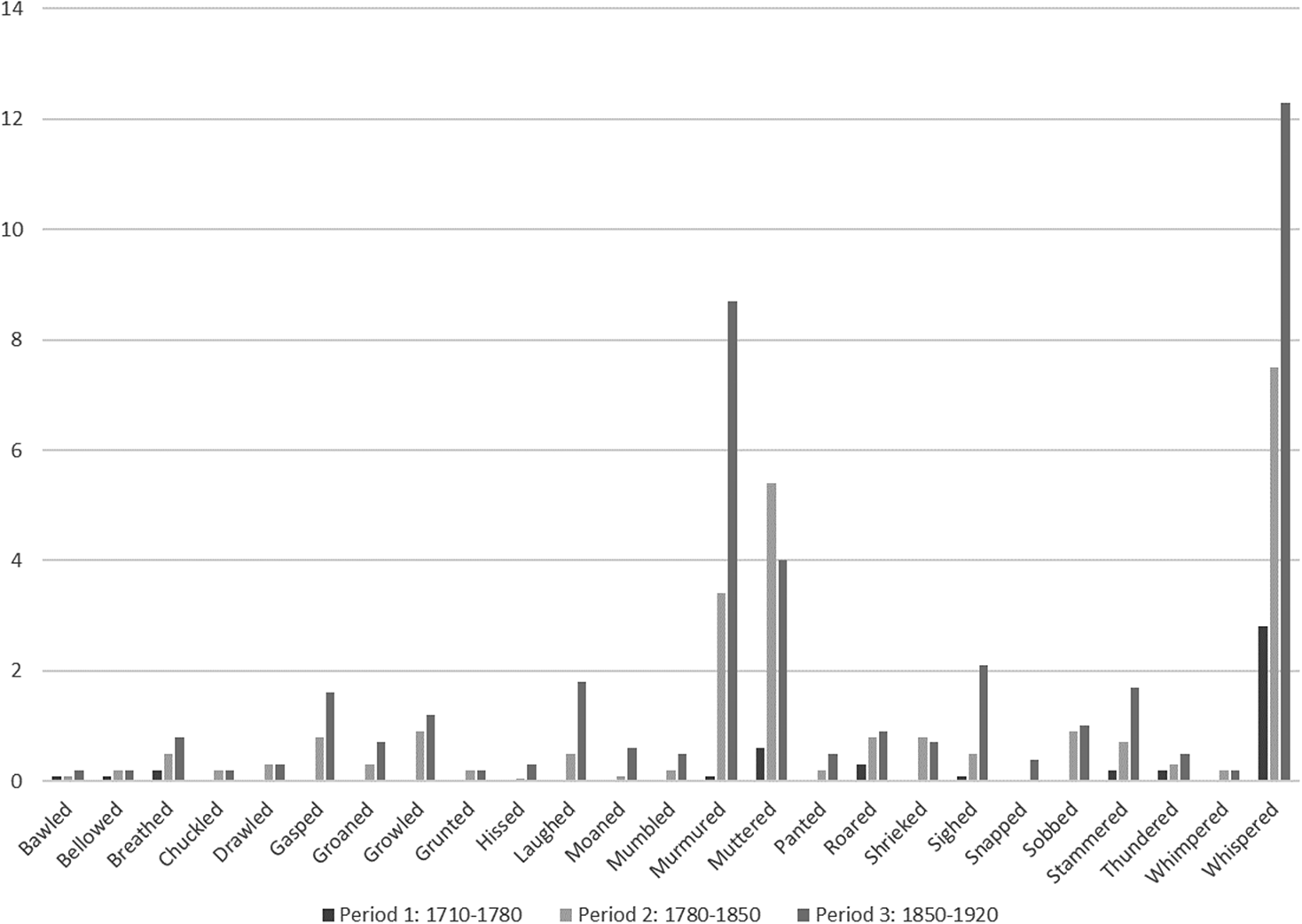
To increase the granularity, figure 2 shows the frequency over time for individual verbs, focusing on the verbs with more than twenty raw instances across the three periods. As can be seen in figure 2, most verbs follow the overall trend of increasing frequency over time. (Muttered, shrieked and whimpered show a higher frequency in period 2 than in period 3, while for bellowed and drawled the normalized frequency is basically stable across periods 2 and 3.) What also stands out is the overall frequencies of three verbs: muttered, murmured and whispered. These are the verbs that Caldas-Coulthard (Reference Caldas-Coulthard and Coulthard1987: 162–4) identifies as the subgroup of voice qualifiers.
Frequency of individual verbs with 20+ instances over time (per 100,000 words)

There are distinctions between these three verbs and many of the other verbs: they are inherently connected to speech or speech-like behavior, and they are attested in speech use from the Old or Middle English periods, as the OED (s.vv. mutter, murmur, whisper) illustrates. Many of the other verbs, by contrast, were recruited into speech representation functions from other contexts, for the most part presumably through processes of metaphorical extension (see Rudzka-Ostyn Reference Rudzka-Ostyn and Rudzka-Ostyn1988): animal vocalization, such as bellowed, expressions of bodily functions, such as hiccupped, or sounds that are originally not connected with verbalized communication, such as grunted. Some of these verbs appear much later in speech contexts, some in Late Modern English, even in these texts, for the first time: for example, hiccup is first attested in 1788 in a speech context (OED, s.v. hiccup). The differing frequencies may thus partly be because of the unequal time of use in speech representation contexts. But it may also be (relatedly) because muttered, murmured and whispered designate fundamental human speech processes, while the other verbs signal speech behaviors that are less frequent and more constrained in terms of context and implication.
A complementary perspective emerges from charting the textual dispersion of the verbs, as shown in table 3.
Verbs and textual dispersion

* One instance of relisped occurs in Disraeli’s Vivian Grey, which also uses lisped.
As can be seen from the table, no verb occurs in all of the 119 CLMET3.0 texts that use one or more of the paralinguistic verbs; whispered comes closest at 104. Although the table cut-offs are somewhat arbitrary, the most common verbs overall (whispered, muttered, murmured) are also, distinctly, the ones that are distributed most widely across texts. The largest category, by contrast, is made up of those verbs found in fewer than ten texts. Again, these are verbs that are for the most part specialized in terms of the kind of vocalization they try to capture.
4.3 Verbs and speech representation categories
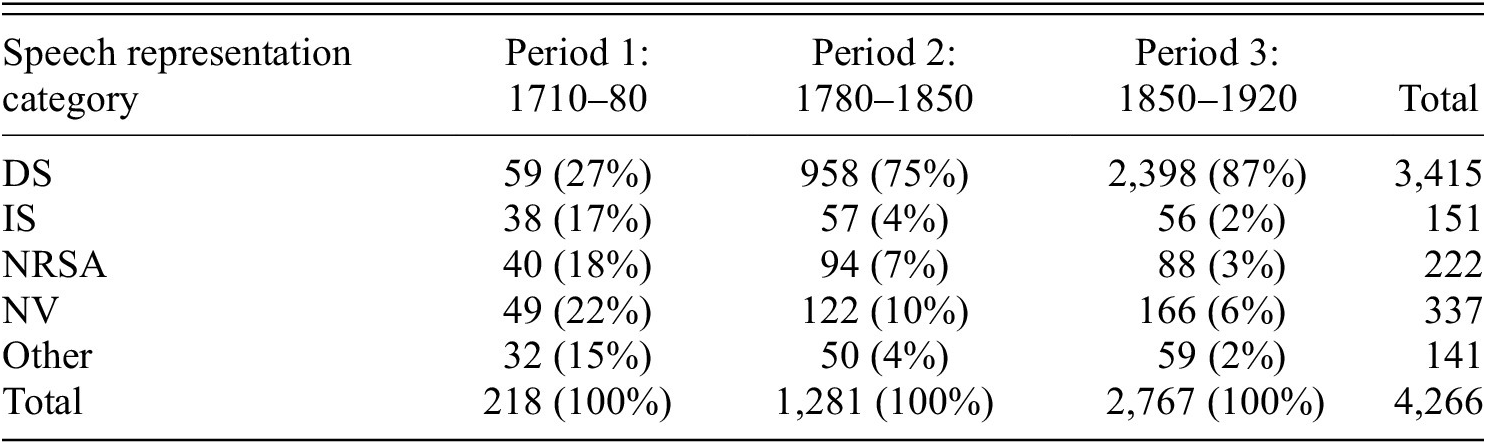
Research on speech representation verbs usually focuses on one or both of what are seen as the main speech representation categories: direct and/or indirect speech (e.g. Caldas Coulthard Reference Caldas-Coulthard and Coulthard1987; Ruano San Segundo Reference Ruano San Segundo2016, Reference Ruano San Segundo2017, Reference Ruano San Segundo2018; Eberhardt Reference Eberhardt2017; Cichosz Reference Cichosz2019). However, as Semino & Short (Reference Semino and Short2004), among others, have demonstrated, speakers and writers make use of a broader set of constructions to signal previous speech. Capturing the range of options is crucial for understanding the development of paralinguistic speech representation verbs (cf. Busse Reference Busse2020: 168–72). As indicated in section 3, I employ Semino & Short’s (Reference Semino and Short2004) taxonomy, illustrated in (8)–(12). I leave out the categories of Free direct speech and Free indirect speech, which are both (usually) characterized by the absence of speech representation expressions and are therefore not directly relevant to my study (Page Reference Page1988: 36; Semino & Short Reference Semino and Short2004: 83, 92). Semino & Short (Reference Semino and Short2004) also include a number of subclassifications, which I have folded into the main categories.

In direct speech (DS), as in (8), we find a separate speech representation clause, here wheezed the hangman; the represented speech is given within quotes; and the form is purported to be that of the original speaker (in the fictional world). Indirect speech (IS), on the other hand, involves more reformulation from the speech reporter, giving the gist of what was said, and the speech representation clause usually involves the speaker + a verb + a that-clause, as in (9). Narrator’s representation of speech acts (NRSA) and narrator’s representation of voice (NV) involve even more backgrounding of the original voice, in terms of formulation and content. The reporter (usually the narrator) gives simply a sense of what speech act was involved or that speech took place, as in (10) and (11); in both NRSA and NV, the speech verb is incorporated in the representation itself. Finally, there are cases where one or two of the major modes are merged, as in (12). Here we see the hallmarks of direct speech representation in the use of quotation marks, but we see a that-clause with a past tense verb instead of present tense. These are kept as Other, which also includes unclear cases.
The significance of charting the correlation of paralinguistic verb and speech representation category is demonstrated in table 4. Several patterns in the table stand out. Mirroring the overall trend of increasing use over time for paralinguistic verbs, the raw figures between periods 1 and 3 go up for all representation categories, although there is a slight dip between periods 1 and period 3 for IS and NRSA (the picture is the same when we normalize the figures, which I don’t present here). Overall, the distribution is statistically significant at the 0.0001 level (χ2 514.98; df. 8).
Paralinguistic speech representation verbs and speech representation category over time

An even more consistent temporal trend is revealed by the row percentages. The proportion of DS representation increases substantially, from 27 percent of the instances in period 1 to 87 percent in period 3, with a significant jump, as we have seen for the overall development of the verbs, in period 2. All the other categories show a declining proportion over time. This may be part of a longer trajectory of change. In Walker & Grund’s (Reference Walker, Grund, Jonsson and Larsson2020: 72) study of early modern fiction texts (up to 1679), there are no uses of paralinguistic verbs in DS (or IS).
The present study’s overall figures hide two separate trends in the data. For the high-frequency verbs murmured, muttered and whispered as well as for some other verbs that occur from period 1 onward, such as bawled, bellowed, breathed, howled, lisped, roared, sighed, stammered, thundered and whined, early uses include and are usually more common with NV and NRSA. Later on, there is an increased proportion of DS. A similar trend is found for some verbs that first appear with speech representation functions in period 2 texts (e.g. cackled, groaned, growled and shrieked). In other words, we see a trend where (relatively) ‘established’ speech representation verbs are used more over time, but when they are used more, they are primarily used in DS.
A different pattern occurs for other verbs that first appear in speech representation contexts in periods 2 or 3. These occur first in DS and only later, if at all, show examples of other modes. As many as 36 of the 70 verbs found in this study belong to this category, including barked, bleated, gurgled, hissed, hiccupped, laughed, puffed, snapped, snarled, wept, wheezed, whimpered and yawned. The OED shows that some of these verbs were used with other speech representation categories prior to their use with DS in the CLMET3.0 corpus, often as early as the Early Modern English period (e.g. purr, snarl, squeak), and it is thus notable that such uses do not occur in the CLMET3.0 corpus.
The extent to which the texts in CLMET3.0 are innovative in their usage is difficult to fully gauge. While some entries for these paralinguistic verbs have been updated for OED3, most have not, and the OED information thus cannot be used systematically to trace the usage. The updated entries show more attention to speech representation uses compared to older entries. There is even indirect attention to speech representation categories in the division of senses, where transitive uses usually cover IS and DS examples (but sometimes also NRSA), while intransitive uses cover NRSA and NV (see, e.g., OED, s.vv. purr, twitter). Further work using the OED entries (when updated fully) and other corpora is necessary for a more detailed view of this usage.
The increasing proportion of DS and the fact that some of the verbs only occur with DS examples is likely connected to broader dynamics of speech representation in narrative fiction. Busse (Reference Busse2020: 83, 87, 112) shows that DS (together with the related free direct speech) was the predominant representation mode in nineteenth-century narrative fiction (as it still is in fiction; Semino & Short Reference Semino and Short2004: 67–8). We may remember here Page’s (Reference Page1988: 3) point (cited in section 4.1) that speech is especially important in reflecting ‘real life’, a supposed aim of many novel writers. And what provides a better sense of ‘real life’ than DS, which gives the impression of capturing faithfully the voices and words of speakers (whether true or not)? The increased focus on DS may thus fall in line with these broader fictional and especially novelistic goals. And if DS became increasingly acceptable for and useful with speech verbs that had been around for some time, this use may have licensed or paved the way for new verbs to be used with DS.
4.4 Textual functions
I have suggested that the use and development of paralinguistic speech representation verbs in narrative fiction reflect the creative instability that Vandelanotte (Reference Vandelanotte2020) posits, as writers saw the need for and experimented with providing enhanced access to characters’ speech (and minds). As they describe aspects of voice and delivery, these verbs, on one level, contribute to conveying the realism or ‘true-to-life’ aspects that many novelists sought (Page Reference Page1988: 3; Chapman Reference Chapman1994: 6): they bring greater and vivid detail to the description of a speech event. At the same time, as noted by Caldas-Coulthard (Reference Caldas-Coulthard and Coulthard1987: 162–3), paralinguistic verbs do more than simply indicate speech representation; they ‘mark the attitude of the speaker in relation to what is being said’ (see also Brown Reference Brown1990: 112–43). Such use in turn can send broader signals about the speaker and the context of the represented speech, conveying who the speaker is, what they are like, and how to understand their actions and feelings in a particular fictional context (cf. Page Reference Page1988: 16–17). In other words, they provide an economical way of indicating speech at the same time as they project narrator (and possibly writer) attitude and hence guide and influence reader interpretation (Busse Reference Busse2020: 177–84; Grund Reference Grund, Kytö and Smitterberg2020a, Reference Grund2020b). Indeed, paralinguistic verbs seem to be a perfect fit for experimentation within the process of creative instability, as they provide access to speakers’ (and narrators’) speech and minds at the same time.
While (to my knowledge) the attitudinal nature of paralinguistic verbs has not been connected with their expansion and temporal development, the use has been demonstrated synchronically, for instance, for Charles Dickens’s novels by Ruano San Segundo (Reference Ruano San Segundo2016, Reference Ruano San Segundo2017, Reference Ruano San Segundo2018) and for J. K. Rowling’s Harry Potter series by Eberhardt (Reference Eberhardt2017). My study shows that this usage extends far beyond Dickens in the Late Modern period, as it is shared by a broad swath of narrative fiction texts. The use is illustrated in (13), where stammered details the manner of speech delivery but also hints at Samuel’s (the speaker) state of mind and shock at finding Mrs. Povey dead, and perhaps sending narrator signals about the kind of person that Samuel is.

Seeing these verbs as part of a broader system of stance, or the expression of ‘personal feelings, attitudes, value judgments, or assessments’ (Biber et al. Reference Biber, Johansson, Leech, Conrad and Finegan1999: 966), helps us understand some of the dynamics involved in the variation and change of these verbs, but it also adds complexity. Stance can be expressed by a broad range of resources, present-day as well as historically (e.g. Thompson & Hunston Reference Thompson, Hunston, Hunston and Thompson2000: 13–26; Grund Reference Grund2021). This means that while some narrators (and authors) may use speech representation verbs as their vehicles to express stance, others may prefer other means, such as evaluative adjectives and adverbs (cf. Grund Reference Grund2020b: 126–7). To fully explore this possibility goes beyond the scope of this study. But an illustrative example can be given, from Mary Augusta Ward’s Marcella (1894). Despite its late date and its length (c. 250,000 words), the text uses paralinguistic verbs sparingly (x21), with single and double instances of, e.g., shrieked, breathed and laughed; only whispered is used more than twice (x7). And all verbs are attested earlier in other works. But while not an innovative or frequent user of paralinguistic verbs, Marcella uses another stance feature frequently and creatively: speech descriptors, or modifications of speech representation verbs, as in (14).

As I have shown, Marcella uses these features considerably more than other novels included in my earlier studies (Grund Reference Grund, Kytö and Smitterberg2020a,Reference Grundb). Most of these speech descriptors cannot be seen as straightforward alternatives for the modulations of voice that represent the basic meaning of paralinguistic speech verbs (such as whispered vs. said in a whisper). But they do convey stance aspects that can be conveyed by the verbs. In (14), a verb such as wailed, sobbed or wept would have conveyed Marcella’s sadness (though with, perhaps, different intensity). Indeed, Jobert (Reference Jobert, Stockwell and Whiteley2014) includes both paralinguistic verbs and what I call speech descriptors in a larger category of paralinguistic vocal features. The consistent upward trend of usage of paralinguistic verbs attests to the widespread adoption of these verbs as convenient speech representation tools. Nonetheless, the preference for varying stance resources may be a contributing factor to some of the variation in verb use we see across texts and periods. Some writers find particular utility in the paralinguistic verbs, perhaps because of their possibility to mark speech and to express stance at the same time. Texts like Marcella, by contrast, draw more on complementary tools within the larger system of stance.Footnote 8
With this broader backdrop of creative instability and of variation in stance resources, it is not surprising to find rich dynamics of use and development across texts, where functional choices in particular texts influence the overall frequency of a particular verb or the ‘introduction’ of a verb in the corpus (which has already been hinted at in table 3, section 4.2). I cannot do full justice to all verbs, texts and authors here of course, but I point to some illustrative trends and examples of these dynamics.
Some texts prefer particular verbs and may use them frequently. This is the case with Percy Brebner’s Brown Mask (1910), where laughed is used 25 times in representing the speech of a few different speakers, or The Human Chord (1910) and The Extra Day (1915), both by Algernon Blackwood, which are the only texts to use boomed as a speech representation verb (four and three instances respectively). In some ways, these uses may reflect stylistic ‘tics’ or attempts at consciously participating in the experimentation and pushing the boundaries of the usage.
Frequent use, especially when applied to one speaker, can play a role in characterization, as has been explored in detail by Ruano San Segundo’s (Reference Ruano San Segundo2016, Reference Ruano San Segundo2017, Reference Ruano San Segundo2018) studies of Dickens’s novels. This dynamic is present across texts in my study, but there is reason to suggest that, in most cases, thinking of these speech verbs as simply playing a role in characterization (in addition to signaling representation of speech) is too limiting. Often, what appears to be characterized is not the persona of the character (even when the verb is frequently or exclusively applied to one person), but how to understand them and their reactions in a particular situational context. An instructive example comes from works by Edward Bulwer-Lytton, which are the first to use grunted as a speech verb in CLMET3.0 (period 2); and it is used relatively often in two texts (twelve of twelve instances in period 2 overall). The verb is only used for the speech of the Corporal and Sporus, as illustrated in (15) and (16).

These verbs do not seem to define these characters or their speech, as they and their speech are framed in various other ways in other contexts. Instead, they appear to have more local functions: to show the characters’ situational response and feelings. In the case of the Corporal in Eugene Aram, his speech is introduced by seventeen different speech representation verbs (based on a search of Corporal and Bunting [the Corporal’s name]). The most common are said (x36) and quoth (x13). At nine instances, grunted is the (tied) third most common verb, after said, quoth and cried (x9). The use of grunted could certainly be interpreted as reinforcing the Corporal’s general manner of speech and demeanor, which is outlined at the beginning of the narrative, as seen in (17).

The grunting could simply be seen as characteristic of his short, abrupt style. At the same time, the instances of grunted speech, which are dispersed throughout the text, are used in contexts where the Corporal is clearly upset and reacts with displeasure to a topic. This is indicated by the larger context of the conversation and by particular features in the represented speech indicating his situational feelings (or stance) about the topic, as illustrated in (18).

Here, the ‘landlord’ is clearly goading the Corporal, who responds with indignation, indicated by his exclamations and pragmatic features such as augh and bother in (18). Similar markers are found in other examples, including baugh (x2), augh, waugh, eh and ’tis the devil!, emphasizing the Corporal’s emotional response in speech introduced by grunted. The textual spread of this usage may of course ‘help to create a cumulative effect that results in a powerful device for shaping [the character’s] identity’ (Ruano San Segundo Reference Ruano San Segundo2017: 121). But what we are undoubtedly also seeing is that the speech representation verb helps depict the local context. The verbs are thus a convenient vehicle for signaling stance dynamics of shifting relationships and conversational roles. The varying types of characters and their attitudinal responses in different texts may thus influence patterns of speech verbs across texts.
If we consider what authors first use certain paralinguistic speech representation verbs, the impression is underscored that there was widespread experimentation with these verbs but also that some authors were more experimental than others (although early usage in the CLMET3.0 corpus does not necessarily mean that they innovate the usage, as noted in section 4.2). Of the 119 CLMET3.0 texts with paralinguistic verbs, as many as thirty-three different texts (about a third of the total) use a paralinguistic verb for the first time in the corpus.
No text ‘introduces’ more than six verbs, and only six texts present more than four new uses: six in Henry Fielding’s History of Tom Jones [period 1] and in Benjamin Disraeli’s Vivian Grey [period 2]; five in Emily Brontë’s Wuthering Heights [period 2], William Thackeray’s Vanity Fair [period 2] and Rudyard Kipling’s Jungle Book [period 3]; and four in Samuel Richardson’s Clarissa [period 1]. Why these texts would be at the forefront of developing these verbs is not always easy to gauge with certainty, and the reason may be connected to broader strategies of handling speech as well as issues of stance, influenced by the particular content or themes of the text. In other words, the broader process of creative instability manifests itself differently and is driven by different, though overlapping concerns in the texts.
The use in Clarissa, for example, could be an extension of Richardson’s larger stylistic goals. Clarissa is an epistolary novel, but it is also written as drama, with dramatic dialogue folded into or even structuring the letters themselves (Page Reference Page1988: 50–2). Though not used frequently, these speech representation verbs may add to the sense of the drama emphasizing the emotional or stance-related aspects of the text, functioning almost as ‘stage directions’, a term Caldas-Coulthard (Reference Caldas-Coulthard and Coulthard1987: 164) employs to describe the use of paralinguistic verbs in general.
In Emily Brontë’s Wuthering Heights, by contrast, the paralinguistic verbs may be part of broader experimentation with the representation of voices. In the novel, Brontë presents what Page (Reference Page1988: 70) calls ‘an unusually bold attempt at fidelity’ in terms of representing a northern English dialect in direct speech. This representation involves a ‘substantial effort’ to mimic ‘the sound-quality of broad Yorkshire speech through spelling variants’ (Page Reference Page1988: 70). The use of paralinguistic speech verbs may be another indication of Brontë’s concern with vivid and real-life speech representation.
Finally, in Rudyard Kipling’s Jungle Book, the use of paralinguistic verbs extends from larger thematic concerns. This book stands out in that animals ‘speak’ (at least their vocalization is presented and characterized as speech, whether actual or figurative), and, indeed, the five verbs first found in speech representation contexts in this book in CLMET3.0 are animal vocalization verbs: for example, the panther Bagheera purrs, Kotick (a seal) barks and Vixen (a small dog) yaps their respective speech. At the same time, these verbs are deployed strategically rather than systematically and stereotypically. For Bagheera’s speech, purred only occurs twice (separated by thirty-three pages of text). One of the uses comes as Bagheera speaks for the first time, as shown in (19).

Here it may serve to introduce and accentuate his ‘cattishness’, as well as mark him as an outsider in the assembly of wolves that he is addressing. Subsequently, Bagheera’s speech (based on a search of Bagheera in the text) is overwhelmingly introduced by said (x31), with only a sprinkling of other (decidedly human-like) verbs (x7; e.g. whispered, cried, gasped). The second instance of purred, which appears at the very end of the Mowgli story (which is usually taken as the main story of the collection that makes up The Jungle Book), seems less a narrator reminder of who Bagheera is and his animality, and more, as also hinted in the first instance, a marker of his ‘other’ status and his positioning of himself as ‘other’. Bagheera again speaks in front of the assembled wolves, expressing his scorn of their current state of ‘lawlessness’. In some ways, the two speeches bookend Mowgli’s story, and both times Bagheera speaks with distancing authority. As before, the paralinguistic verb is not simply connected to the ‘persona’ of the character, but to textual and situational dynamics.
5 Conclusion
With the golden (though not undisputed) rule in current creative writing of ‘showing, not telling’ (e.g. Lim Reference Lim2015: 338–9), features that describe speech, such as paralinguistic verbs, are clearly out of fashion, at least in the eyes of some writers as we saw in the quote from Stephen King in section 1. In the early stages of the development of the novel, however, the experimentation with descriptive features of speech was clearly in vogue, and a broad range of lauded practitioners of the novel was involved in the experimentation. This is evidenced by the variable use of paralinguistic verbs by Henry Fielding, Samuel Richardson, Emily Brontë, William Thackeray, Benjamin Disraeli and many others. Indeed, we see broad dissemination of the use and perhaps even innovation of the paralinguistic verbs among especially nineteenth-century writers.
It is not clear whether the steep increase of these verbs in my data is due to an overall upward trend of speech representation in general or whether it is inherent in these verbs. However, the introduction of new verb types of a paralinguistic nature suggests that the experimentation with these verbs does not simply mirror a possible general increase in speech representation. What we see in the CLMET3.0 texts appears to be a number of interrelated developments: (a) paralinguistic speech representation verbs that were previously used with other speech representation constructions are deployed increasingly in direct speech over time; (b) ‘new’ paralinguistic speech representation verbs are first introduced in direct speech representation contexts perhaps in analogy with already well-established verbs; and (c) there is an increasing exploitation and conventionalization of speech representation verbs as part of textual tools to express stance. Indeed, the variable use of paralinguistic speech representation verbs is arguably part of a broader process of innovation and dissemination of new features of speech representation connected to the creative instability suggested by Vandelanotte (Reference Vandelanotte2020: 132), as the novel format develops and grows in importance. Other features of speech representation point in the same direction, such as the development of the free indirect speech mode (Vandelanotte Reference Vandelanotte2020), the object-reaction construction (Bouso & Ruano San Segundo Reference Bouso and Segundo2021) and descriptors modifying speech verbs, such as said menacingly (Grund Reference Grund, Kytö and Smitterberg2020a,Reference Grundb).
The results of course raise a number of questions that require follow-up studies: how does the development of paralinguistic verbs relate to that of other groups of speech representation verbs? As hinted at in Busse (Reference Busse2020: 169–71), paralinguistic verbs are significantly more infrequent than other speech representation verbs (such as ‘neutral’ verbs, esp. say, or structuring verbs, e.g. ask, reply): do the dynamics differ for different groupings of verbs? Also, how do the patterns of the paralinguistic verbs in narrative fiction in the Late Modern English period extend (or not) to other periods and text categories? How do these developments reinforce or complicate the notion of creative instability in literary texts of the nineteenth century?
The language of literary text is, as Jucker (Reference Jucker2015: 63) suggests, ‘often artificial, perhaps even contrived’. At the same time, it is exactly that artificiality and the special demands on writers (and narrators) to communicate speech to the audience that make literary texts significant to explore in terms of the use and development of speech representation mechanisms. Page (Reference Page1988: 9) puts it succinctly: ‘the novelist, although [they] may well desire to create a sense of the here and now by means of [their] dialogue, has no shared context available which [they] can take for granted, but must produce it verbally within the text of the novel’. In other words, not being able to rely on shared contexts, writers need features that allow them to communicate fictional speech and the context of that speech to the audience clearly and succinctly and in a way that serves their literary aims. That need spurs creativity and dynamic exploitation of speech representation mechanisms and functions. That includes the paralinguistic verbs studied here, which provide an economical way of both structuring dialogue and signaling a range of situational dynamics and stance. With a complex sociopragmatic and textual phenomenon such as speech representation, we clearly need to understand the local communicative concerns of writers and genres in order to understand more general questions of variation and change.



 Open access

