


Introduction
Understanding people's attitudes and perceptions and the factors that could influence them is crucial for the conservation of species whose coexistence with people leads to conflicts, such as in the case of large carnivores preying on domestic animals (Ripple et al., Reference Ripple, Estes, Beschta, Wilmers, Ritchie and Hebblewhite2014). Castaño-Uribe et al. (Reference Castaño-uribe, Lasso, Hoogesteijn and Payán-Garrido2017) highlight the extent and complexity of human–felid conflicts in Latin America, where the jaguar Panthera onca, categorized as Near Threatened on the IUCN Red List (Quigley et al., Reference Quigley, Foster, Petracca, Payan, Salom and Harmsen2017), provides a poignant example of this conservation challenge (Botero-Cruz et al., Reference Botero-Cruz, Rodríguez-Castellanos, Martínez-Callejas, Trujillo, Mosquera-Guerra, Castaño-Uribe, Lasso, Hoogesteijn and Payán-Garrido2017; Caruso et al., Reference Caruso, Perovic, Altrichter, Castaño-Uribe, Lasso, Hoogesteijn and Payán-Garrido2017; Marchini et al., Reference Marchini, Esterci Ramalho, Del Toro-Orozco, Ferraz, Castaño-Uribe, Lasso, Hoogesteijn and Payán-Garrido2017).
The largest reduction (95%) of the species' range has occurred in Argentina, where remaining populations are confined to small and probably disconnected areas in the Yungas, the Chaco and the Atlantic Forest. For these reasons, the species is categorized nationally as Critically Endangered (Perovic & Herrán, Reference Perovic and Herrán1998; Altrichter et al., Reference Altrichter, Boaglio and Perovic2006; Aprile et al., Reference Aprile, Cuyckens, De Angelo, Di Bitetti, Lucherini, Muzzachiodi, Ojeda, Chillo and Díaz Isenrath2012; Di Bitetti et al., Reference Di Bitetti, De Ángelo, Quiroga, Altrichter, Paviolo, Cuyckens, Medellín, De La Torre, Zerda, Chávez and Ceballos2016). The species' current range in Argentina is c. 90,500 km2, 4.4–5.1% of its historical range in the country (Di Bitetti et al., Reference Di Bitetti, De Ángelo, Quiroga, Altrichter, Paviolo, Cuyckens, Medellín, De La Torre, Zerda, Chávez and Ceballos2016). This range contraction is a result of conversion of natural habitats to livestock pasture and farmland, habitat fragmentation, reduction of natural prey and illegal hunting (De Ángelo, Reference De Ángelo2009; Perovic et al., Reference Perovic, De Bustos, Rivera, Arguedas Mora and Lizárraga2015; Di Bitetti et al., Reference Di Bitetti, De Ángelo, Quiroga, Altrichter, Paviolo, Cuyckens, Medellín, De La Torre, Zerda, Chávez and Ceballos2016). Hunting was formerly practiced for pelt commercialization, but the species continues to be persecuted because of predation on livestock and because it is perceived as a threat to human life (Perovic, Reference Perovic, Medellin, Rabinowitz, Taber and Redford2002; Altrichter, Reference Altrichter2006; Altrichter et al., Reference Altrichter, Boaglio and Perovic2006; Perovic et al., Reference Perovic, De Bustos, Rivera, Arguedas Mora and Lizárraga2015).
Large carnivores such as the jaguar have cascading effects on ecological communities and ecosystem functioning (Ripple et al., Reference Ripple, Estes, Beschta, Wilmers, Ritchie and Hebblewhite2014). The jaguar's requirement for extensive and continuous habitat and its dependence on large prey species often result in overlap with local farmers and settlers, which increases the potential for conflicts (Conforti & De Azevedo, Reference Conforti and De Azevedo2003; De Azevedo, Reference De Azevedo2008) and the risk of persecution and eradication (Paviolo, Reference Paviolo2010). Jaguar conservation could be facilitated by taking into account its role in ecosystems and the need to generate a change in people's attitudes and actions (Ripple et al., Reference Ripple, Estes, Beschta, Wilmers, Ritchie and Hebblewhite2014).
Understanding how people perceive the jaguar and which factors influence attitudes will help shape conservation to protect the remaining populations. Perceptions are understood as a hierarchy of knowledge that ranges from the basic knowledge of an individual about an object, in this case the jaguar, to cognitive properties as beliefs (Dickman et al., Reference Dickman, Marchini, Manfredo, Macdonald and Willis2013). An attitude is a person's favourable or unfavourable evaluation of an object (e.g. a species, a management action). Attitudes have both cognitive and evaluative elements; i.e. a combination of beliefs and negative and/or positive views about an object (Pierce et al., Reference Pierce, Manfredo, Vaske, Daniel, Brown and Siemer2001).
Perceptions of and attitudes towards large carnivores are not solely determined by direct costs associated with living alongside them, such as a livestock predation (Treves & Bruskotter, Reference Treves and Bruskotter2014), but rather they are ‘the product of a dynamic and complex net of social factors such as age, educational level, main economic occupation of the people, and cultural factors’ (Dickman et al., Reference Dickman, Marchini, Manfredo, Macdonald and Willis2013, p. 111). For example, perceptions and attitudes towards large carnivores tend to be more positive among young people (Williams et al., Reference Williams, Ericsson and Heberlein2002) and those with higher levels of formal education (Consorte-McCrea et al., Reference Consorte-Mccrea, Nigbur and Bath2017). Hostile attitudes, on the other hand, are more frequently found among people whose primary occupation is livestock husbandry (Porfirio et al., Reference Porfirio, Sarmento, Leal and Fonseca2016).
Socio-cultural factors, such as popular beliefs, also affect attitudes towards carnivores; thus social attitudes are closely connected to individual lifestyles and, once established, become deep-rooted (Naughton-Treves et al., Reference Naughton-Treves, Grossberg and Treves2003). Jaguars tend to generate multiple emotions, ranging from admiration to irrational terror (Hoogesteijn et al., Reference Hoogesteijn, Hoogesteijn, Tortaro, Rampin, Vilas Boas-Concone, May-Junior, Payán Garrido, Lasso and Castaño-Uribe2016). For some people the presence of large carnivores may produce positive feelings such as joy, whereas for others it may evoke negative feelings such as fear (Altrichter et al., Reference Altrichter, Boaglio and Perovic2006; Johansson & Karlsson, Reference Johansson and Karlsson2011; Jacobs et al., Reference Jacobs, Vaske, Dubois and FEHRES2014). Wildlife knowledge can influence attitudes towards large felids, and reduce fear and conflict (Marchini & Macdonald, Reference Marchini and Macdonald2012; Porfirio et al., Reference Porfirio, Sarmento, Leal and Fonseca2016; Engel et al., Reference Engel, Vaske, Marchini and Bath2017). Previous research has also shown that people with more formal education express greater appreciation of and/or concern for protection of species than those with less formal education (Kellert et al., Reference Kellert, Black, Rush and Bath1996; Luksenburg & Parsons, Reference Luksenburg and Parsons2014).
In Argentina little is known about the socio-economic factors that influence people's perceptions of and attitudes towards jaguars. For example, in Misiones and Corrientes the species is culturally important and is valued positively, even though it disappeared in Corrientes 50 years ago (Paviolo, Reference Paviolo2010; Caruso & Jiménez Pérez, Reference Caruso and Jiménez Pérez2013), whereas in the Chaco it is considered dangerous and is perceived in negative terms (Altrichter et al., Reference Altrichter, Boaglio and Perovic2006). Thus perceptions and attitudes are context-specific (Caruso et al., Reference Caruso, Perovic, Altrichter, Castaño-Uribe, Lasso, Hoogesteijn and Payán-Garrido2017). The attitudes and perceptions of local people towards jaguars have not been studied in the northern region of Argentina, hindering the promotion of coexistence between people and jaguars.
In this context our objective was to identify which socioeconomic factors (level of education, age, and occupation) could explain the level of knowledge, perceptions and attitudes regarding jaguars in northern Argentina. As attitudes towards wildlife may be influenced by past and present interactions (Kellert et al., Reference Kellert, Black, Rush and Bath1996), we hypothesized that (1) negative perceptions and attitudes towards jaguars would more likely be found among older people and, based on previous studies, we also expected that (2) negative perceptions would be found among livestock farmers and those with lower educational levels.
Study area
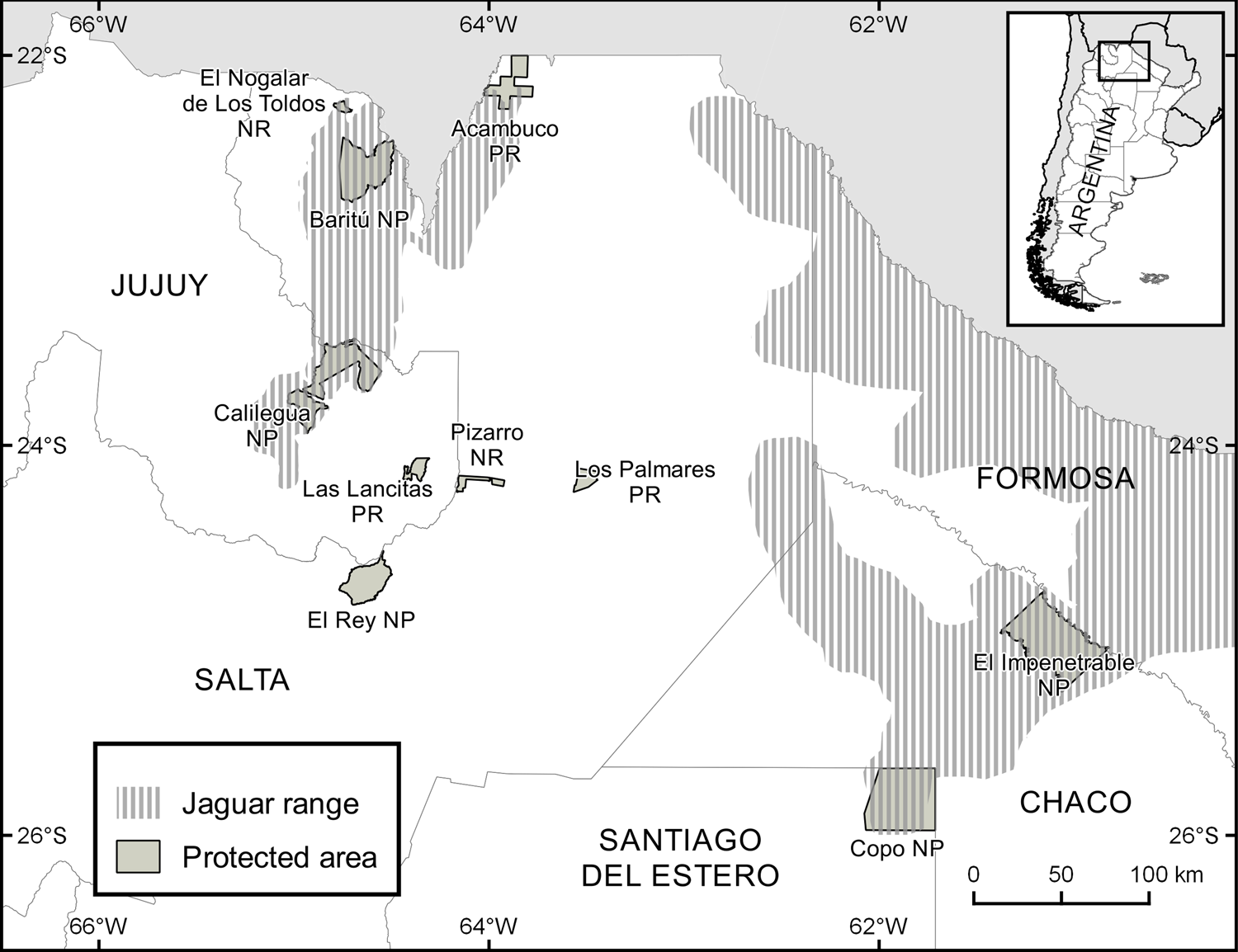
The study was carried out in and around 10 Protected Areas in the Yungas and Chaco ecoregions of Jujuy, Salta, Santiago del Estero and Chaco provinces (Table 1). Their selection was driven by the importance of these areas for the remaining jaguars of northern Argentina (Perovic et al., Reference Perovic, De Bustos, Rivera, Arguedas Mora and Lizárraga2015; Palacios, Reference Palacios2016; Ramadori et al., Reference Ramadori, D'angelo, Aued and Giaccardi2016; Fig. 1).
Study area, protected areas (NP, National Park; NR, National Reserve; PR, Provincial Reserve; Table 1) and the current range of the jaguar Panthera onca in the Yungas (Perovic et al., Reference Perovic, De Bustos, Rivera, Arguedas Mora and Lizárraga2015) and Chaco (Quiroga et al., Reference Quiroga, Boaglio, Noss and Di Bitetti2014) in north-west Argentina.
Protected areas included in this study, by Province, with ecoregion, area and category, whether the jaguar Panthera onca has been recorded and settlers are present, and the number of interviews that we conducted. Priority areas for the conservation of the jaguar in Argentina are indicated with *.

Lying along the eastern slopes of the Andes from Venezuela to north-west Argentina (Cabrera & Willink, Reference Cabrera, Willink and Chesneau1980), the Yungas is a fragile and threatened ecoregion comprising 52,000 km2 in Argentina, of which 4.8% is protected (Brown et al., Reference Brown, Grau, Lomáscolo and Gasparri2002). Annual rainfall is 900–1,000 mm, concentrated in the summer rains during December–April. During the cold months, rainfall ceases and condensation from the mists that characterize these cloud forests is important for water uptake (Burkart et al., Reference Burkart, Bárbaro, Sánchez and Gómez1999). The mean seasonal temperature varies from 5 °C in winter to 23 °C in summer (Ibisch et al., Reference Ibisch, Beck, Gerkmann, Carretero, Ibisch and Mérida2003). The main economic activities are extensive livestock farming, small-scale agriculture, extensive tobacco and sugar farming, selective logging, and fossil fuel extraction. Nature-based tourism is an emerging activity (Perovic et al., Reference Perovic, De Bustos, Rivera, Arguedas Mora and Lizárraga2015). Illegal hunting of jaguars and their prey is common throughout the region (Perovic, Reference Perovic, Medellin, Rabinowitz, Taber and Redford2002; Chalukian et al., Reference Chalukian, de Bustos, Lizárraga, Varela, Paviolo and Ouse2009). Until c. 1950, the jaguar occurred throughout the Yungas ecoregion (Perovic et al., Reference Perovic, De Bustos, Rivera, Arguedas Mora and Lizárraga2015), but its current distribution is restricted to an area of 1,160 km2 in Jujuy and Salta provinces, c. 22% of its original range. The species has a high probability of survival in 73% of this area as a result of the geo-environmental heterogeneity and remoteness from human activities (Perovic et al., Reference Perovic, De Bustos, Rivera, Arguedas Mora and Lizárraga2015).
The semi-arid Chaco is located in the central Chaco ecoregion, which extends over 1.2 million km2, covering parts of Argentina, Paraguay and Bolivia, with c. 660,000 km2 in Argentina (Dinerstein et al., Reference Dinerstein, Olson, Graham, Webster, Pimm and Bookbinder1995). The climate is markedly seasonal, with a mean annual temperature of 24 °C and annual rainfall of 400–800 mm concentrated in October–April (Caziani et al., Reference Caziani, Trucco, Perovic, Tálamo, Derlindati and Adámoli2003). Three rivers cross the semi-arid Argentine Chaco from north-west to south-east, but large parts of the region lack permanent water sources other than artificial ponds constructed for livestock (Caziani et al., Reference Caziani, Trucco, Perovic, Tálamo, Derlindati and Adámoli2003). The main economic activities are agriculture and extensive cattle husbandry and logging (Fahrig, Reference Fahrig2003), which have resulted in habitat fragmentation and other alterations of the natural environment (Periago et al., Reference Periago, Chillo and Ojeda2015). Subsistence hunting is commonly practiced by rural settlers (Altrichter, Reference Altrichter2006). As a result of these anthropogenic impacts, the jaguar population of the semi-arid Argentine Chaco is the most threatened in the country (Quiroga, Reference Quiroga2013); the species' potential range in this area is c. 520 km2 (Quiroga, Reference Quiroga, Boaglio, Noss and Di Bitetti2014).
Methods
During 2014–2016 we interviewed 20% of the people living in and around (< 25 km) the 10 protected areas, using convenience sampling, a non-random method used to create samples according to ease of access and people's availability to be part of the sample (Kothari, Reference Kothari2004). We conducted a pilot test to help design an effective and efficient questionnaire, during which we interviewed 127 people of different socio-economic and educational profiles, to obtain a representative and balanced sample. We first explained the project's objectives to potential interviewees and only conducted an interview if the person consented verbally. We coded and analysed the responses to determine if the definition of the problem was adequate and to limit the profile of the desired sample by defining key variables such as age, place of residence, time living in the region, occupation and level of education. The pilot test also helped us to refine the type, format and wording of the questions, to avoid ambiguity. We were also guided by our own experience in the region and our familiarity with the local culture, as well as the results of our previous research projects.
After the pilot test was completed, we interviewed 387 women and 423 men who had lived in the area for at least 5 years, using a structured questionnaire, in Spanish, with open and closed questions in four sections: (1) profile of the interviewee (age, place of residence, time living in the region, occupation and level of education), (2) attitudes towards jaguars, (3) perceptions of jaguars, and (4) knowledge of the ecological role of jaguars.
The independent variables were: (1) education, coded according to the highest level of formal education reached by the interviewees (no school; elementary, 1st–7th grade; secondary, 8th–12th grade; college; (2) age (young, 13–20 years; adult, 21–50; older, 51–92 years); and (3) occupation, coded according to how the interviewees passed most of their time and/or their main source of income (farming and cattle ranching; college or school student; tourism; other). The category other (42% of the interviewees) included homekeepers, teachers and government employees.
To determine attitudes towards jaguars we asked: Do you support jaguar conservation in the region? For perceptions towards jaguars, we asked two questions: How would you feel if the jaguar became extinct in the region, and what would you feel if you came across a jaguar in the forest? To determine knowledge about jaguars, we asked: Could you describe the ecological role that the jaguar plays in the ecosystem? For this last question we evaluated each response of the interviewees and considered correct those that mentioned concepts related to jaguars as top predators affecting the functioning of the ecosystem.
Data analysis
The response variables were: (1) support for jaguar conservation (support, no support, undecided); (2) identification of the ecological role that the jaguar plays in the ecosystem (correct identification, incorrect identification); (3) feelings about jaguar extinction (sad, happy, indifferent), and (4) feelings about an encounter with a jaguar (fear, joy, indifference). To test our two hypotheses and identify factors (level of education, age classes, occupation) that could potentially explain the response variables, we built a series of multinomial logistic regression models for response variables with more than two categories, and a logistic regression model for binary responses. The Akaike information criterion (AIC; Akaike, Reference Akaike1974) was used to evaluate the best model. The R (R Core Team, 2017) package nnet was used for building multinomial logistic regression models, package MuMIn for model selection (Kuznetsova et al., Reference Kuznetsova, Brockhoff and Christensen2015), and the glm function with a binominal family for logistic regression.
Results
We found that level of education, age and occupation were all predictors of the four response variables (Table 2).
Multinomial logistic regression models for responses to four questions regarding the jaguar. Models are ranked according to their ΔAIC and weighting.

1Akaike information criterion corrected for small sample sizes.
2Difference in AICc between best model and each individual model.
3Model Akaike weight.
Support for jaguar conservation
More (68%) support for jaguar conservation was found among people with elementary education (Fig. 2a). The odds that interviewees would be in favour of conservation were higher among interviewees with elementary and secondary education in comparison with those with no education (odds_ratioelementary = 2.04, P = 0.003; odds_ratiosecondary = 2.47, P = 0.005), but interviewees with a college degree did not have higher odds of supporting conservation (odds_ratio = 1.16, P = 0.67). Older interviewees (71%) tended to support the protection of jaguars (Fig. 2b), with the odds of being in favour of jaguar conservation higher for adults and older people than for younger people (odds_ratioadult = 6.18, P = 0.013; odds_ratioolder = 29.80, P < 0.001). Occupation also influenced the level of support, with people engaged in tourism (100%) tending to support the protection of jaguars (Fig. 2c). If the person was a student or tourism worker the odds of being in favour of the protection of the species were higher compared to farmers and cattle ranchers (odds_ratiofarmers and cattle ranchers = 11.10, P = 0.001; odds_ratiotourism = 1,542,323, P = 0.939; Supplementary Table 1).
Relationships between the responses variables Support for jaguar conservation (a–c), Identification of the ecological role that the jaguar plays in the ecosystem (d–f), Feelings about jaguar extinction (g–i), and Feelings about an encounter with a jaguar (j–l), and the independent variables education, age class and occupation.

Identification of the jaguar's ecological role
A higher proportion of interviewees who recognized the ecological role of the species had elementary (52%) and college education (35%; Fig. 2d). The odds that people with college education recognized the ecological role of the jaguar were higher than for people without education (odds_ratio = 2.4, P = 0.002). The odds that people with secondary education recognized the ecological role of the species tended to be lower compared to people without education (odds_ratio = 0.57, P = 0.06). Most adults (76%) and elders (77%) did not recognize the ecological role of the species, whereas the majority of young people (80%) did recognize this (Fig. 2e). However, only the odds of the elders tended to be lower than the odds of the young (odds_ratioadult = −0.64, P = 0.47; odds_ratioelders = −1.55, P = 0.07). Knowledge also varied according to occupation. Most students (82%) recognized the ecological role of the species (Fig. 2f), with the odds of recognizing the ecological role of the jaguar higher for students compared to people engaged in farming and cattle ranching (odds_ratio = 15.7, P < 0.0001; Supplementary Table 2).
Feelings about jaguar extinction
The majority of interviewees who completed secondary (85%) and elementary school (75%) felt sadness at the possible extinction of the jaguar (Fig. 2g). The odds that the person would feel sad if the jaguar were to go extinct were greater for those with elementary (odds_ratio = 4.93, P = 0.001) or secondary education (odds_ratio = 2.10, P = 0.009) compared to people without education. Most young (68%) interviewees felt sadness at the possible extinction of the jaguar (Fig. 2h), and for adults or elders the odds of feeling sad were lower compared to younger people (odds_ratioadult = 0.03, P = 0.016; odds_ratioolder = 0.02, P = 0.013). Most people engaged in tourism (74%) felt sadness at the possible extinction of the jaguar (Fig. 2i), with the odds that an interviewee would feel sad about the possible extinction of the jaguar considerably higher if the person was a tourism worker (odds_ratio = 15.59, P < 0.0001) compared to farmers and cattle ranchers (Supplementary Table 3).
Feelings about an encounter with a jaguar
Regardless of level of education, age and occupation, most interviewees indicated they would feel fear in any potential encounter with a jaguar (Fig. 2); this was least amongst farmers and cattle ranchers (63%; Fig. 2l). Interviewees with a college education had the highest percentage (35%) of indifference to a possible encounter with a jaguar (Fig. 2j), with this the only education category that had a high proportion of indifference compared to the category no formal education(odds_ratio = 1.67, P = 0.052). Most young (78%), adult (75%) and older people (74%) expressed fear in relation to a possible encounter with the species (Fig. 2k). The odds that the person would feel joy in encountering a jaguar were lower for adults or elders compared to young people (odds_ratioadult = 0.02, P < 0.0001; odds_ratioolder = 0.05, P = 0.001). If the person was a student the odds of feeling joy at an encounter were lower compared to farmers and cattle ranchers (odds_ratio = 0.03, P < 0.0001; Supplementary Table 4).
Discussion
We sought to address the socio-economic factors that influence people's perceptions of jaguars in the southernmost area of its distribution. In general, we found that positive perceptions and attitudes towards jaguars seem to be strongly influenced by people's occupation. This could be related to the economic benefits that people receive from the presence of jaguars (in this case, tourism). Thus, to gain more social support, jaguar conservation initiatives could consider promotion of economic alternatives such as tourism for people living within the species' range. Charismatic large felids tend to appeal to a wide audience and are therefore valuable to nature-based tourism, although the chance of spotting an individual in the wild is limited (Skibins et al., Reference Skibins, Powell and Hallo2013). In northern Argentina nature-based tourism is a relatively recent endeavour, taking place primarily on private land and in a few protected areas (Perovic et al., Reference Perovic, De Bustos, Rivera, Arguedas Mora and Lizárraga2015). All interviewees engaged in tourism-related activities supported jaguar conservation, which was similar in Corrientes, where the majority of local people agreed to a reintroduction plan for jaguars, identifying a potential income source (Caruso & Jiménez Pérez, Reference Caruso and Jiménez Pérez2013). However, we found that people engaged in tourism did not understand the ecological role of the species; i.e. they were interested in jaguars mainly as a generator of income. This indicates the need to foster greater awareness in the local emerging tourism industry, and a need for education that emphasizes values associated with the existence of jaguars beyond their economic value.
Jaguars are considered the sole or principal cause of livestock loss in the Argentine Yungas (Perovic, Reference Perovic, Medellin, Rabinowitz, Taber and Redford2002), and thus as long as the current land use and farming system continues, negative attitudes towards jaguars are likely to persist. However, we found that support for jaguar conservation among cattle ranchers was relatively high (55%), a finding that could be explained by the ranchers' repeated comments on compensation or other economic benefits of livestock losses. Given that ranchers pose a direct threat to jaguars through retaliatory killings (Perovic et al., Reference Perovic, De Bustos, Rivera, Arguedas Mora and Lizárraga2015), interventions that seek to make them more interested in jaguar conservation could positively impact the status of this species in the southern fringes of its distribution.
Fear for personal safety and a lack of knowledge of a predator's ecological importance can generate negative social perceptions and, hence, the persecution and death of jaguars (Soto-Shoender & Main, Reference Soto-Shoender and Main2013). Our findings do not support our two hypotheses: we found that the majority of people with secondary education and young people were afraid of encountering a jaguar in the forest, and were convinced they could be attacked, whereas few ranchers expressed fear of an encounter. However, ranchers were also convinced that jaguars could attack people. Fear is an emotion that can be learned or is innate (i.e. a consequence of biological evolution; Jacobs, Reference Jacobs2009). Fear for personal safety amongst people with secondary education and amongst young people could be a result of lack of knowledge about the jaguar and of attitudes associated with familiar and popular beliefs; i.e. without having had direct experience with the species (McGovern & Kretser, Reference McGovern and Kretser2015). It is possible that the lower proportion of ranchers expressing fear is based on their experiences of encounters with jaguars (in most cases, when a rancher encounters a jaguar the animal is killed; Perovic, Reference Perovic, Medellin, Rabinowitz, Taber and Redford2002). These findings accord with a study in the tropical lowlands of Guatemala, where 79% of interviewees believed that jaguars were a threat to people (Soto-Shoender & Main, Reference Soto-Shoender and Main2013). Hoogesteijn et al. (Reference Hoogesteijn, Hoogesteijn, Tortaro, Rampin, Vilas Boas-Concone, May-Junior, Payán Garrido, Lasso and Castaño-Uribe2016) found that jaguars do not pose a danger to people's physical integrity; of 184 jaguar sightings reviewed, only a single attack on humans was reported, which involved a mock attack by a male guarding a female in heat.
Fear of jaguars varies depending on people's knowledge (Cavalcanti et al., Reference Cavalcanti, Marchini, Zimmermann, Gese, Macdonald, Macdonald and Loveridge2010), with some correlation between formal education and support for conservation (Williams et al., Reference Williams, Ericsson and Heberlein2002). Few of our interviewees, however, had an understanding of the ecological importance of jaguars in maintaining the integrity of natural ecosystems, and we found there was no clear relationship between people's knowledge about the ecological role of the species and their level of formal education. This suggests that formal education is insufficient on its own; education about conservation should be locally-based and planned, inside and outside of schooling.
Promoting greater tolerance towards wildlife and thus reducing the killing of jaguars also depends on people's willingness to live with wildlife (Ripple et al., Reference Ripple, Estes, Beschta, Wilmers, Ritchie and Hebblewhite2014). Improving the level of understanding of jaguar biology and ecology among the people that share the space with the species will probably reduce fear, increase tolerance and reduce hunting (Marchini & Macdonald, Reference Marchini and Macdonald2012; Porfirio et al., Reference Porfirio, Sarmento, Leal and Fonseca2016). In further support of this idea, Slagle et al. (Reference Slagle, Zajac, Bruskotter, Wilson and Prange2013) highlighted the importance of information (i.e. the value of the species) in increasing acceptance of the American black bear Ursus americanus (Slagle et al., Reference Slagle, Zajac, Bruskotter, Wilson and Prange2013). Factors explaining attitudes and perceptions are context-specific (Paviolo, Reference Paviolo2010; Caruso & Jiménez Pérez, Reference Caruso and Jiménez Pérez2013). Our study showed that factors explaining attitudes and perceptions vary mostly in relation to people's occupation, and can determine the level of tolerance towards jaguars. These findings corroborate earlier research (Caruso et al., Reference Caruso, Perovic, Altrichter, Castaño-Uribe, Lasso, Hoogesteijn and Payán-Garrido2017; Tortato et al., Reference Tortato, Izzo, Hoogesteijn and Peres2017), showing that the benefits of tourism greatly exceed the losses caused by predation, and increased the acceptance of jaguars.
Considering attitudes and social factors is essential for understanding and elucidating ways to mitigate conflicts, design educational programmes and implement conservation projects. In Argentina, promoting tourism could be an economic alternative compatible with jaguar conservation and could increase the level of appreciation of the existence of the species, thus fostering positive attitudes.
Acknowledgements
We thank the Consejo Nacional de Investigaciones Científicas y Tecnológicas (CONICET) and Administración de Parques Nacionales for providing institutional support, and Fondation Segré, The Rufford Foundation, IdeaWild and WildCRU for financial support. We are grateful to the volunteers who helped with fieldwork, Mauricio Núñez Regueiro for advice on data analysis, Leonidas Lizarraga for GIS support, María Schulze and Ximena Uriburu for translation, and the anonymous reviewers whose critiques improved the text.
Author contributions
Planning and research design: FC, PP, MA; fieldwork: FC; data analysis: FC, AT, DS; writing: all authors.
Conflict of interest
None.
Ethical standards
This article derives from research carried out as part of FC's doctoral thesis. The National University of Salta and the thesis Committee reviewed the research proposal and provided ethical approval. This research abided by the Oryx guidelines on ethical standards.



