

The essence of ultimate decision remains impenetrable to the observer – often, indeed, to the decider himself … There will always be the dark and tangled stretches in the decision-making process – mysterious even to those who may be most intimately involved.
People make decisions in an effort to achieve a desired outcome and there is hardly an aspect of human endeavor that does not include some form of decision making. In some cases, our decisions require our deliberate and close attention. In other cases, our decisions seem automatic. Decision theory overlaps with several other fields – cognitive psychology, probability, economics, data science, management science, artificial intelligence, philosophy, ethics, game theory, investing, social choice theory, and others.
Decision theory is the study of how people make decisions and as such is a subfield of cognitive psychology. Decision theory examines what a person takes into consideration when they make a decision, how people weigh gains and losses, how people process probabilities, how people balance the present versus the future, and other psychological aspects of how people arrive at a decision.
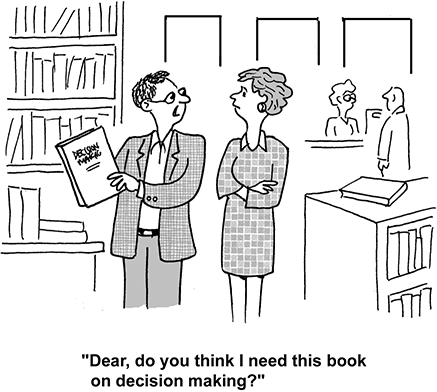
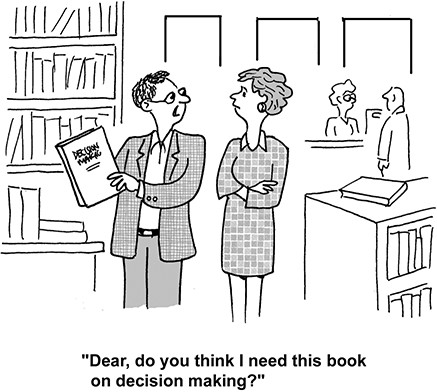
Making a decision about making a decision.
In terms of psychology, decision theory can be divided into two subfields – descriptive and normative. Descriptive decision theory seeks to explain how people make decisions and why they make the choices they do. Researchers involved in descriptive decision theory conduct psychological experiments and ask people what decisions they would make and what choices they would prefer under specific circumstances. With the results of their experiments, researchers develop descriptive models that predict human decision making and human behavior and how people will actually make decisions and act.
Descriptive models of decision making can be contrasted with normative models. Normative decision theory explains the conceptual approach people should take when they make decisions. While descriptive models describe how people do behave, normative models describe how they should behave to reach a stated goal.
Normative decision theory often overlaps with the field of operations research (aka management science), which develops mathematical models used to calculate optimal solutions to clearly defined questions. Operations research provides prescriptive models and actionable solutions that can be used to address real-world problems.
Descriptive decision theory and normative decision theory can be thought of respectively as how do and how to. Descriptive decision theory tells us how do people make decisions. Normative decision theory tells us how to or how should people consider decisions to be made. Prescriptive models provide mathematical solutions to decisions that can be put in quantifiable form. In the following pages, Chapters 2, 3, and 4 will provide prescriptive models and strategies for how to calculate optimal solutions. The remaining chapters will discuss how do and other specific decision-related topics.
1.1 Successful versus Unsuccessful, and Good versus Bad Decisions
It is important to make a distinction between successful versus unsuccessful decisions, and good versus bad decisions. A decision is considered successful if it results in an outcome that is at least as satisfying an outcome as would have been produced by any other action. A decision is considered unsuccessful if it results in outcomes less satisfying than would have been produced by any other action.
A good decision is one which has been thoroughly researched, is made by an informed and reasonable decision maker, and takes into account the full context of the decision, what is at stake, known risks, and all possible outcomes. A bad decision is one which has not been thoroughly researched, is made by a decision maker who is not fully informed or rational, or which does not take into account the full context of the decision, known risks, and all possible outcomes. It is possible to make a good decision, which has been properly researched, but still have an unsuccessful outcome. It is also possible to make a bad decision, which has not been thoroughly researched or considered, but still have a successful outcome.
A decision will be categorized as successful or unsuccessful based on the outcome – which can only be known after the fact. But a decision can be categorized as good or bad based on how thoroughly the decision has been researched and if it is made with a full awareness of what all the possible outcomes could be. In some cases, a decision maker will be aware of the potential dangers associated with a decision and will make a good decision, knowingly accepting the risks, only to have an outcome that is unsuccessful.
For example, consider the case of the person who purchases a new mobile phone and as part of the sale they are asked if they would also like to purchase a one-year loss-protection policy, whereby the phone can be tracked, and if it is not recovered, a new phone will be provided at no cost. The person weighs the cost of the loss-protection policy and also estimates the likelihood they will lose the phone during the year, as well as the cost of the replacement. After considering these details, they pay the additional fee and purchase the one-year loss-protection policy. The year goes by, and they have not misplaced or lost their phone, keeping it safely with them at all times. Was this a good or a bad decision? Was it successful or unsuccessful?
This was a good decision. They made the decision knowing exactly what the cost of the policy would be and what the cost of a replacement would be. They realized they could end up paying the premium for the loss-protection policy and never use it, but they were comfortable with this potential outcome and accepted the possibility. They were willing to pay for the peace of mind to know they would not have to pay for another phone – even if they lost the phone they purchased.
Was this a successful decision? No, it was unsuccessful. They paid for the loss-protection policy but never needed it. Their decision and course of action was unsuccessful because the resulting outcome was less satisfying than would have been produced by saving the cost of the loss-protection policy. If they had lost the phone during the one-year period, their decision to purchase the policy could have been categorized as successful.
For another example, consider the case of the parent who has saved for their child’s college education, but by the time their child graduates from high school, they have only $20,000, which is half the amount that would be needed. In an effort to obtain the full amount needed to pay for their child’s college education, the parent makes the decision to purchase 20,000 lottery tickets at the cost of $1 each. Was this a good decision or a bad one? Was it successful or unsuccessful?
Because the probability of winning the lottery is very small, this is a bad decision. The odds of achieving the desired goal are stacked against this well-meaning parent. The decision should have been more thoroughly researched and with a full understanding of the possible outcomes and their likelihoods. Other courses of action should have been explored, including scholarships, part-time work during college, student loans, finding a more affordable college, and so on. There is a high likelihood that the $20,000 – set aside over the years – will be lost on this lottery gamble, producing an outcome which would be less satisfying than would have been produced by another course of action. Retaining the $20,000 and not gambling on the lottery would have been a better decision.
But what if that very-small-probability event had occurred and one of the 20,000 tickets had been the lottery winner? Would it then have been a successful decision? Yes, it would have been. The outcome would have been successful, even if it had been a bad decision in the first place.
1.2 Acts, Events, Outcomes
The making of a decision and the implementation of that decision will always follow a sequence of steps. Although we think of the process as beginning with the decision, decisions themselves, in the absence of any concrete action or commitment, can always be changed. A decision maker may decide to carry an umbrella in anticipation of rain on a particular day, or plant a crop in anticipation of the next growing season, or accept a job offer in anticipation of a satisfying career. However, until they take some action – actually taking the umbrella with them, or purchasing the seeds for the crop, or signing the job contract – the decision can be changed. In Chapter 2, we will see how to determine probabilities of events. In Chapter 3, we will see how to conceptualize and sketch the decision-making process, and the first step will always be the act. Of course, before any act, the decision must be made to act, so this first step can be thought of as having two components – the decision and the act. The decision to act must come first, but the process is not completed until action is taken to implement the decision.
The next step is the event – sometimes referred to as the state or state of nature. Once the decision is made and the action is taken, the decision maker will wait for the event to occur. The event may come a fraction of a second following the act or it may develop over decades. The decision maker who chooses to carry an umbrella will see if it rains that day. The farmer who planted the crop in the spring will see if it produces a good crop at harvest time. The jobseeker will start work and see if it leads to a satisfying career.
The final step in the process is the outcome. The outcome will be the result of the interaction between the action the decision maker took and the event that followed. The outcome could be that the decision maker stayed dry under their umbrella despite the rain, or it could be that they carried the umbrella all day unnecessarily. The outcome for the farmer could be a profitable crop that sells well at the market, or it could be a poor crop that loses money. The outcome for the jobseeker could be employment that leads to a satisfying career or not. Figure 1.2 shows this act-event-outcome sequence.
The act-event-outcome sequence.

To summarize, the act – which implements the decision – always comes first. Once the action has been taken the decision maker will wait for the event. The outcome will be the result of the action that the decision maker has taken and the event that follows. Depending on the situation, once the outcome has occurred, the decision maker may have the opportunity to assess the situation and make any new decision that may be needed. Chapter 3 will provide a more detailed and comprehensive discussion of the act-event-outcome sequence, decision trees, the incorporation of probabilities, and the calculation of expected values.
1.3 Decision Environments: Certainty, Risk, Uncertainty, and Ignorance
Decisions will be made in decision environments where the decision maker has varying levels of information on which to base their decision.
Under certainty, the decision maker needs only to make a selection from known alternatives, with complete certainty that they will get whatever they select. If a person is making a decision about which pair of their shoes to put on that day, they need only to make the selection. There is no lottery or chance involved. The shoes are in front of them in plain sight. They simply make a selection, put those shoes on, and have what they selected.
In everyday conversation the term risk, when used as a noun, is usually understood to mean a dangerous situation or a loss “That investment was a risk.” When used as a verb, it is understood to mean an exposure to danger or a loss – “He risked his investment.” But in decision theory, the term is primarily thought of as a noun, meaning a situation where possible outcomes and their probabilities are known. The outcomes could be desirable or undesirable, but if the probabilities of the outcomes are known, this is referred to as a decision made under risk.
The terms risk and uncertainty are sometimes thought of as meaning almost the same thing. They are not the same. Within decision theory – and especially within this book – these are distinct. This distinction may have first been made by Professor Frank H. Knight of the University of Chicago, in his Reference Knight1921 book Risk, Uncertainty, and Profit when he wrote:
The practical difference between the two categories, risk and uncertainty, is that in the former, the distribution of the outcome in a group of instances is known (either through calculation a priori or from statistics of past experience), while in the case of uncertainty this is not true, the reason being in general that it is impossible to form a group of instances, because the situation dealt with is in a high degree unique. The best example of uncertainty is in connection with the exercise of judgment of the formation of those opinions as to the future course of events, which opinions (and not scientific knowledge) actually guide most of our conduct.
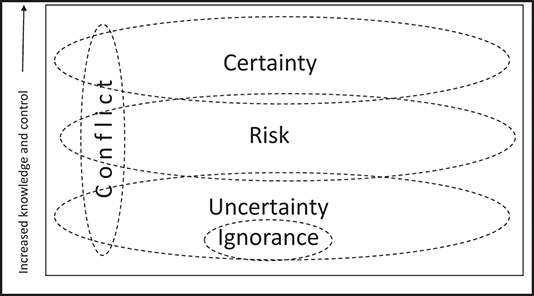
Or put a bit more succinctly, under risk, the possible outcomes are known, and the probability of each outcome is known, while under uncertainty, the possible outcomes and their probabilities are not known. This is illustrated in Figure 1.3.
The decision environments of Certainty, Risk, Uncertainty, and Ignorance. These environments can exist in the normal course of any decision making, but can also exist during a conflict, where a decision maker is opposing an adversary.
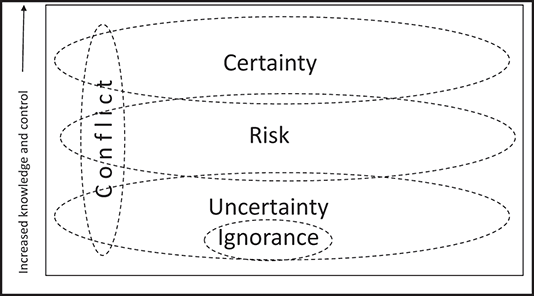
Figure 1.3 Long description
Three overlapping horizontal ovals, one on top of the other, labelled from top to bottom 1. Certainty; 2. Risk; 3. Uncertainty including ignorance. A vertical oval labelled conflict overlaps on the left side of the three horizontal ovals. An upward arrow along the left is labelled ‘Increased knowledge and control’.
As shown in Figure 1.3, at the top of the space is the decision environment of certainty. This is characterized by complete knowledge of the details of the decision and what outcome the decision will produce.
Below certainty is risk. Note the dashed lines and overlaps between certainty and risk, as well as the dashed lines between other decision environments. This is to indicate that there are no distinct boundaries between the environments, but instead there are conditions where there will be some ambiguity as to which environment the decision maker is in. Under risk, the possible outcomes are known, and the probability of each outcome is known. However, there may be situations where the decision maker is almost certain of what the outcome of each alternative course of action will be. In such a case, the decision maker will be near the top of the risk environment, but not quite into certainty where the outcomes are known for sure.
When the possible outcomes are clear and their probabilities are known, the decision maker is operating in the risk environment. In this environment, the decision maker can choose their course of action, but they will not know at the time they make their decision what the result of that course of action will be. They know the probabilities of the outcomes for each course of action, but they will not know until after their decision has been implemented, and after an event has occurred, what the actual outcome is.
There can be situations where the probabilities are unclear or perhaps cannot be accurately determined. What will the weather be like on a particular day two months from now? Who will be victorious in an upcoming election? What will the price of grain be next year? It can be difficult to assign reliable probabilities to such outcomes.
Within the environment of risk, if the situation is becoming unclear, the first thing to erode will be knowledge of the probabilities and the second thing will be knowledge of the possible outcomes. It is not possible to know the probability if there is no associated outcome. As the decision maker slips down through the risk environment, the probabilities will fade first, followed by an awareness of what the possible outcomes are.
In the environment of uncertainty, there can be an absence of knowledge as to what the possible outcomes could be. Could a competitor invent a new approach that would make our existing product obsolete? Is it possible that a particular decision could result in a lawsuit? There can be unknowns but there can also be “unknown unknowns” as the US Secretary of Defense, Donald Rumsfeld, once called them:
Reports that say that something hasn’t happened are always interesting to me, because as we know, there are known knowns; there are things we know we know. We also know there are known unknowns; that is to say we know there are some things we do not know. But there are also unknown unknowns – the ones we don’t know we don’t know. And if one looks throughout the history of our country and other free countries, it is the latter category that tends to be the difficult ones.
There may be some things you know you don’t know, and others that you are not at all aware of and you don’t even know that you don’t know. If you aren’t aware of what the possible unknowns are, these are the unknown unknowns. This decision environment where a person does not know the possible outcomes and does not even know the unknown unknowns, is the environment of ignorance. Ignorance is the lowest level of uncertainty.
Figure 1.3 also includes the environment of conflict, which can overlap with the other environments. In the absence of conflict, the environments are benign in the sense that outcomes are left to chance – probabilities which are known under risk but unknown under uncertainty. What differentiates conflict is that in conflict, there is an adversary who will seek to keep your knowledge and awareness as low as possible and exploit any vulnerability you may have. The outcome is not left to chance, but instead will be controlled to the extent possible by your adversary – who will use your lack of knowledge to seek the worst possible outcome for you and the best possible outcome for themselves. Of course, in the environment of conflict, you are also trying to keep your adversary unaware of what your plans and actions are, and seek the outcome that is the best for you and the worst for them.
The decision maker is always trying to move up to the next level in Figure 1.3. If they are in ignorance and unaware of the possible outcomes, they will attempt to research what is possible and identify the possible outcomes. Once the decision maker has identified the possible outcomes, they will attempt to determine the probabilities of each and move firmly into the realm of risk, where they can make their decision based on known probabilities. Once they have moved up into risk they will try to get to the level of certainty where they can simply select the action that will lead to the desired outcome – and know with confidence that the chosen outcome will occur.
1.4 Utility
The concept of utility is used in economics and decision theory to refer to the subjective value something has to an individual. Utility is a theoretical concept that is used to represent how much happiness or satisfaction or benefit an individual will have as a result of a particular outcome. Because utility is subjective, it is not possible to calculate a precise measure of utility to correspond to a given amount of money or any other concrete resource. An individual should be able to compare outcomes and express preferences on an ordinal scale using utility. They may indicate they have a greater utility for a job with flexible time off than they have for a high-paying job. They may indicate they have a greater utility for a specific automobile than they have for the amount of money needed to purchase that automobile. When we discuss decision making and people’s preferences, we often use the concept of utility to compare the subjective worth of one outcome over another.
1.5 Concluding Thoughts
Descriptive decision theory is the field of behavioral research where scientists conduct experiments to explain and predict how people will behave and how they will make decisions. Normative decision theory provides models for how people should make decisions to achieve the optimum outcome.
In some cases, decision makers will find themselves in an environment of certainty, where they select a course of action knowing what the outcome will be. In other cases, decisions must be made in an environment of risk, where the probabilities of outcomes are known, but the decision maker will not know the final outcome until after the decision has been made and after an event has occurred. Finally, there are times when the decision maker does not know what the possible outcomes may be, and in these situations must make the decision in environments of uncertainty or ignorance.
The decision process will always follow a sequence. First the decision maker will make a decision and act. Following that act will be the occurrence of an event. Finally, the outcome will be the result of the interaction between the act and the event. Depending on the situation, once the outcome has occurred, the decision maker may start the cycle again, with another act, followed by another event, resulting in another outcome.
People are constantly making decisions. Some decisions require little deliberate attention, while others require close analysis and attention. In the remaining chapters of this book, we will examine prescriptive models that provide solutions to decision problems when inputs are known, normative models that describe how people should consider decisions to achieve optimal results, and we will review descriptive models to understand from a psychological perspective how people make decisions. We will also explore selected topics within decision theory and decision making.
Questions for Reflection and Consideration
Go to www.makingoptimaldecisions.net for answers.
1. What differentiates descriptive, normative, and prescriptive models of decision theory?
2. What are the definitions of successful versus unsuccessful decisions? Is the differentiation based on outcome or process?
3. How do we define good and bad decisions? Is the differentiation based on outcome or process?
4. Discuss the sequence of acts, events, and outcomes. What can the decision maker control and what must be left to chance?
5. Compare and contrast the decision environments of certainty, risk, and uncertainty. What differentiates them?