


Introduction
Democracy has been variously described as hollowed out, disfigured, in permanent crisis, or sliding toward neo-authoritarianism (Mair, Reference Mair2013; Streeck, Reference Streeck2014; Urbinati, Reference Urbinati2014). Multiple fault lines intersect and intertwine: political parties lose relevance, authoritarian discourses undermine checks and balances among state institutions, and international organizations appear increasingly ineffective in addressing systemic threats. Among the forces reshaping democratic governance, technocracy stands out not merely as an exception, but as a particularly resilient and adaptive form of power expanding through crises and institutional incrementation, and proving remarkably resistant to shifting political conditions.
The term “technocracy” remains shrouded in considerable ambiguity, often reduced – in common sense – to a pejorative shorthand for unelected experts whose prestigious careers span national, European, and international institutions, and who impose unpopular measures often beyond electoral accountability or circumventing elected officials. More conventionally, technocracy refers – at its most basic level – to the rule of experts who are expected to remain independent from political parties (Meynaud, Reference Meynaud1969; Putnam, Reference Putnam1977; Fischer, Reference Fischer1990; Centeno, Reference Centeno1993; Dargent, Reference Dargent2015; Esmark, Reference Esmark2020). Technocratic power, in abstract terms, is autonomous from democratic institutions and processes of accountability, and is grounded in a model of representation whereby experts, by virtue of their technical knowledge and/or professional experience, are entrusted with identifying the “common good” (Bickerton and Accetti, Reference Bickerton and Accetti2017; Caramani, Reference Caramani2017). From this follows that – ideally – technocracy and democracy exist in a relation marked by tension and outright opposition. Technocracy strives for governance through rationality, efficiency and pragmatism, explicitly rejecting ideological divides. Democracy, conversely, flourishes on ideological pluralism, ideologies and political conflict.
Yet, while in theory they are mutually exclusive, reality is markedly different and significantly more blurred. A consistent scholarship, for instance, documents a steady increase in the number of technocratic ministers across democratic regimes, particularly since the early 2000s (Costa Pinto et al., Reference Costa, António and Tavares de Almeida2018; Castaldo and Verzichelli, Reference Castaldo and Verzichelli2025). Vittori et al. (Reference Vittori, Pilet, Rojon and Paulis2023) report that the average share of technocratic ministers in European cabinets rose from 9.5% to 14.2% over the last two decades – a trend that extends well beyond the economic and finance portfolios, encompassing a wide range of ministerial domains. From this perspective, especially junctures of crisis seem to play a significant role in this process: not only as enabling conditions for the formation of technocratic cabinets (McDonnell and Valbruzzi, Reference McDonnell and Valbruzzi2014; Wratil and Pastorella, Reference Wratil and Pastorella2018; Brunclík and Parízek, Reference Brunclík and Parízek2019), but also in enhancing the agency of technocrats within economic ministries. In particular, the appointment of independent experts seems to be driven less by technocratic expertise per se and more by their commitment to implement politically costly reforms – such as austerity measures – in contexts where financial markets favour technocrats over partisan politicians, rewarding their appointment with reduced borrowing costs (Alexiadou and Gunaydin, Reference Alexiadou and Günaydin2019; also Alexiadou et al., Reference Alexiadou, Spaniel and Günaydin2022).
This growing body of scholarship reveals two key insights. First, scholarly understanding of technocracy within democratic regimes has expanded considerably, both empirically and conceptually (Dargent and Lotta, Reference Dargent and Spanghero Lotta2025). Second, technocratic actors and technocratic authority more broadly have become increasingly relevant for understanding transformations in representative democracy, positioning technocracy – alongside other macro-dynamics – as a critical driver of state reconfiguration (Cozzolino, Reference Cozzolino2021). Nonetheless, such research often remains fragmented, limited to specific institutional arrangements or crisis episodes. As a result, the broader theoretical and empirical articulation of how technocratic and democratic logics interact – across time, space, and institutional configurations – remains underdeveloped. Yet, within the long-term processes of state transformation and democratic restructuring, technocracy and democracy do not operate as isolated logics: they intersect, overlap, hybridize.
In this direction, the primary objective of the article is to provide a theoretical framing and empirical assessment of the hybridization between technocracy and democracy. Building on a critical engagement with the existing literature, the article does not aim to offer a comprehensive explanatory account of democratic transformation. Rather, it develops an analytical and classificatory framework that brings together several strands of scholarship and clarifies how technocratic and democratic logics intersect within contemporary democratic governance. Through this critical review and conceptual elaboration, the article advances a typological tool that is intended to be empirically applicable and analytically generative. Its contribution thus lies in offering a structured framework that can be used in comparative research to investigate the forms, intensity, and trajectories through which technocracy and democracy become intertwined over time, rather than in providing causal explanations of these processes.
The concept of hybridization lies at the core of the article’s theoretical and empirical contribution. Here, hybridization is not understood in terms of single “hybrid regimes” (e.g., Levitsky and Way, Reference Levitsky and Way2010; Cassani, Reference Cassani2014), but as a heuristic tool to capture changes in the governance of democratic regimes undergoing structural transformation. It allows us to move beyond both the dichotomous framing of technocracy and democracy as mutually exclusive logics of governance, and the “externalist” perspective, which conceives technocracy as an exogenous force acting upon democratic institutions. We conceive hybridization as a dynamic process through which technocratic and democratic logics intersect, co-evolve, and become structurally embedded within contemporary democratic governance systems. To capture this complexity, we develop an analytical framework that is systemic, relational, internal, and processual. It is systemic because it analyzes how technocracy becomes embedded within institutional structures and decision-making processes. It is relational in its attention to the interplay and mutual conditioning of expert-based and democratic logics. It is internal, insofar as technocracy is treated not as an imposition from outside democracy, but as an endogenous product of its institutional and ideological evolution. Finally, it is processual, since it foregrounds temporal variation, tracing how hybrid configurations evolve over time and across crises.
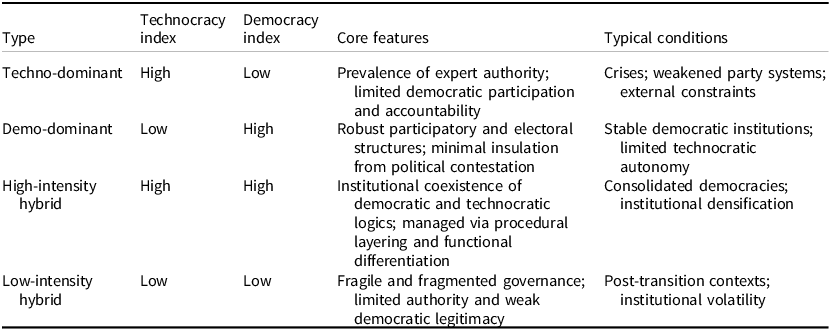
On the basis of this analytical perspective and research strategy (more below), we elaborate a typology of four ideal-type configurations that reflect distinct patterns in the process of hybridization of technocracy and democracy: techno-dominant regimes, in which expert authority prevails over democratic input, often under crisis conditions or in contexts of weakened party systems; demo-dominant regimes, where participatory and electoral infrastructures remain robust and technocratic insulation is limited; high-intensity hybrids, characterized by the institutionalized coexistence of technocratic and democratic logics, managed through procedural layering and functional differentiation; and low-intensity hybrids, marked by fragility on both fronts and a fragmented, often unstable, governance structure. These configurations provide a heuristic framework and a viable map to assess the evolving forms of hybrid governance across time and space.
In terms of research strategy and methodology, our study develops a novel framework to analyze how the hybridization of technocracy and democracy unfolds across time and space. Relying on original composite indices of technocracy and democracy, constructed from selected V-Dem variables, the study covers all EU member states and the United Kingdom between 1989 and 2024. By combining these indices, we classify country-year observations into four ideal-type configurations – techno-dominant, demo-dominant, high-intensity hybrid, and low-intensity hybrid – which enable us to trace how hybridization unfolds across different institutional settings and critical junctures, and assess their evolution across major crises and institutional transformations. This allows us to capture not only the extent, but also the direction and density of hybridization. The results reveal substantial variation across regions and historical phases: while Northern and Central-Western Europe exhibit stable high-intensity hybrids, Eastern Europe is marked by persistently weak institutionalization, and Southern Europe shows more volatile patterns, with surges of technocratic dominance especially in crisis periods. Crucially, we find that crises do not uniformly displace democracy in favor of technocracy, but can instead foster institutional densification – though the COVID-19 pandemic may have triggered a shift in favor of technocratic authority. Thus, in the context of our main objective – the theory and analysis of the hybridization between technocracy and democracy – the paper makes two specific contributions: theoretically, it advances a dynamic understanding of the technocracy – democracy nexus by conceptualizing hybridization as a process of mutual adaptation rather than binary opposition. Empirically, it operationalizes this insight through two original composite indices – of technocracy and democracy – covering all EU member states and the United Kingdom (1989–2024).
The paper is organized as follows. The next section outlines the theoretical framework, conceptualizing hybridization as a systemic, relational, internal, and processual dynamic, and introducing the four ideal-type configurations that structure our empirical analysis. The third section presents the methodological design, detailing the construction of the composite indices for technocracy and democracy, and explaining the logic of case classification across countries and time. The fourth section offers the empirical analysis, mapping the trajectories of hybridization across EU member states and the United Kingdom between 1989 and 2024. The final section discusses the broader implications of our findings for the study of democratic transformation and technocratic governance.
Technocracy–democracy nexus: conceptual framework and typologies of hybrid governance
Recent scholarship has explored the evolving role of technocracy within European governance, focusing on supranational architectures, expert-led cabinets, and citizens’ attitudes toward expert authority (Majone, Reference Majone1996; McDonnell and Valbruzzi, Reference McDonnell and Valbruzzi2014; Vittori et al., Reference Vittori, Pilet, Rojon and Paulis2023; Bertsou et al., Reference Bertsou, Caramani and Koedam2025). Since the 1990s, the consolidation of a post-ideological paradigm – centred on efficiency, stability, and market credibility – has favoured the expansion of executive authority and the diffusion of non-majoritarian institutions. Within the EU, these include the European Central Bank, regulatory agencies, and fiscal councils, all characterised by varying degrees of insulation from direct electoral accountability. This institutional evolution reflects a broader technocratic rationality, one that displaces political contestation from democratic arenas into expert-driven, rule-based settings (Radaelli, Reference Radaelli1999; Scicluna and Auer, Reference Scicluna and Auer2019; Schmidt, Reference Schmidt2020). Yet technocracy’s entrenchment is not limited to the supranational level. National systems have undergone parallel transformations, with a steady proliferation of non-majoritarian institutions, independent agencies and an incremental integration of expert personnel into the executive. Beyond exceptional technocratic cabinets, a long-term trend has emerged in which professionals independent from party politics are appointed to key ministerial roles, especially in sensitive domains such as finance, health, and foreign affairs (Vittori et al., Reference Vittori, Pilet, Rojon and Paulis2023). This process signals a more structural embedding of technocratic logics within representative institutions.
While the growing body of scholarship on technocratic governance has generated valuable insights into its institutional, epistemic, and political features, it has also tended to reinforce fragmented and narrowly focused perspectives. In many cases, technocracy and democracy continue to be treated as analytically distinct and externally interacting domains, often framed in opposition to one another. This dualistic lens risks obscuring the more nuanced and dynamic forms of interaction between such logics of rule. Against this backdrop, a more integrated approach allows us to grasp not only the tensions between technocracy and democracy, but also the ways in which they coexist, interpenetrate, and evolve together.
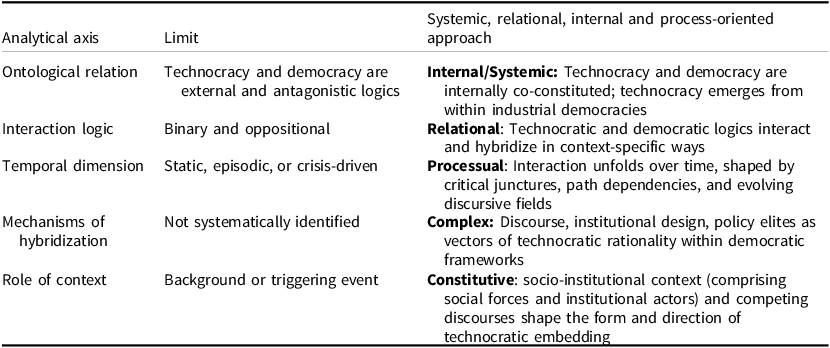
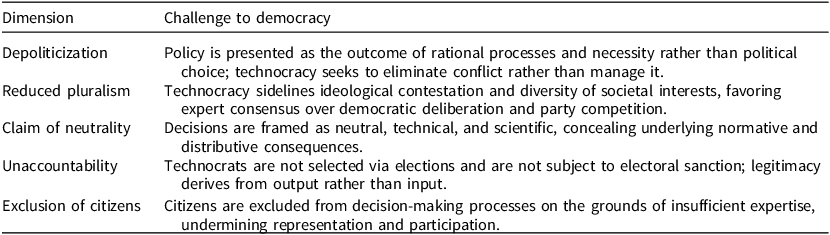
In current research, one of the most comprehensive reflections on the challenge that technocracy poses to democracy is developed by Caramani (Reference Caramani, Bertsou and Caramani2020). Starting from the specific ways in which technocracy challenges democratic politics, Caramani examines the relationship between the two and the possible combinations of these distinct forms of politics. Broadly, the challenges that technocracy poses to democracy can be grouped into five key dimensions: depoliticization; the reduction of pluralism; the claim to neutrality; lack of accountability and exclusion; and institutional independence/autonomy from other democratic bodies (Table 1). Ideally, in a purely technocratic state, these features would amount to an authoritarian political form, fundamentally opposed to the principles of representative democracy. In practice, however, technocratic power operates along a continuum – that is, its democratic implications vary not only according to the analytical dimension in focus (such as ideology or institutions), but more crucially by the degree, context and process through which technocratic authority is embedded within democratic settings.
The technocratic challenge to democracy

Sources: Authors’ elaboration based on Caramani, Reference Caramani, Bertsou and Caramani2020, pp. 6–11.
Building on these insights, our theoretical approach advances the conceptual framework by recognizing the complex structural entanglement between technocratic and democratic logics of rule. While technocracy poses a structural challenge to democratic politics – particularly in terms of depoliticization, accountability, and legitimacy – we argue that technocratic governance does not operate as an external imposition on democratic systems. Rather, it emerges endogenously, shaped by institutional configurations, elite dynamics, and ideational change within those systems. Yet, this study does not stop at just identifying this tension. Instead, it first moves beyond static or dichotomous understandings and conceptualizes hybridization as a dynamic, context-dependent, and multidimensional process. Then, second, building on the research outcomes, the paper develops four typologies that capture the specific patterns and features of hybridization. Theoretical and empirical dimensions thus advance together, contributing to a dynamic analytical framework of hybridization.
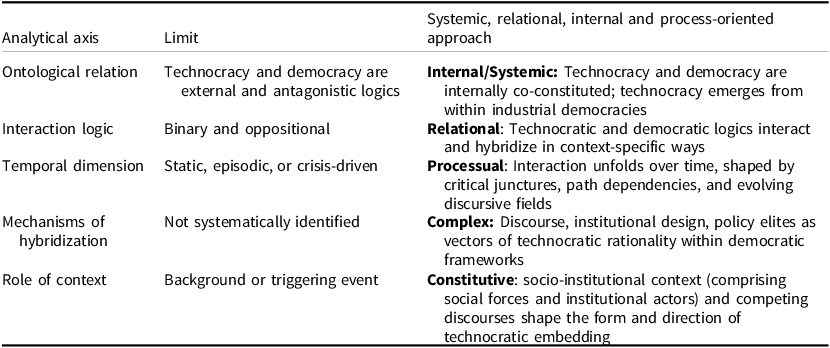
Our approach departs from existing contributions in two ways. First, while Caramani (Reference Caramani, Bertsou and Caramani2020) offers fundamental conceptual insights into the tensions between technocracy and democracy, his framework remains primarily normative (Table 1). Second, unlike typologies focused on regime type (Lijphart, Reference Lijphart1999) or unidimensional indices of democracy or technocracy (e.g., Freedom House; Polity IV), our operationalization tries to capture the coexistence and interplay of competing logics of legitimacy, and assesses it empirically. It bridges distinct strands of scholarship – i.e., on technocratic governance (Bertsou and Caramani, Reference Bertsou and Caramani2020a) and democratic theory (Mair, Reference Mair2009; Urbinati, Reference Urbinati2014) – through a continuous, relational, and multidimensional perspective. This enables a more granular and temporally sensitive mapping of governance variation across countries and historical phases. On this basis, our theoretical perspective conceptualizes the technocracy – democracy nexus as a systemic, relational, and endogenous process, unfolding through dynamic interactions between institutions, actors, and ideas. Specifically, it is systemic as it investigates how technocratic rationality becomes structurally embedded within democratic regimes, influencing institutional design, decision-making procedures, and normative frameworks. It is relational as it rejects a binary opposition between technocracy and democracy, treating them instead as interacting and co-constitutive logics continuously reshaping one another across contexts. It is internal, insofar as technocracy is not conceptualized as an exogenous force encroaching upon democracy, but as an endogenous development that arises from within industrial democracies – driven by conditions such as increasing policy complexity, supranational integration, the delegitimation of traditional party politics and ideologies, new institutional arrangements, and the resort to experts in times of recurring crises. Finally, it is processual as the technocracy – democracy relationship evolves over time, shaped by shifting contextual and political factors.
This approach yields two key analytical implications. First, while technocracy and democracy are frequently treated in ideal-typical terms as mutually exclusive logics – one privileging expertise and depoliticization, the other grounded in participation and contestation – empirically they coexist in hybrid and historically contingent formations. These hybrid configurations reflect concrete socio-institutional arrangements and exhibit varying possible combinations: their coexistence does not erase the tensions between expert-led politics and democratic representation, but rather renders those tensions productive of distinctive institutional, procedural, and ideational outcomes. In consequence, attention must be paid to the specific mechanisms and processes through which technocratic modes of reasoning and rule are embedded within democratic structures. In other words, it is a matter of features, intensity and outcomes of hybridization processes.
Second, our framework foregrounds temporality as a constitutive dimension of technocratic – democratic hybridization. Rather than viewing the technocracy – democracy relation as static or episodic, we understand it as a processual configuration, unfolding through critical junctures, institutional path dependencies, and ideational realignments. This temporality is also shaped by broader political developments – such as the rise/consolidation of populist discourses in the aftermath of the global financial crisis – which may either contest or reinforce technocratic governance logics. Time, in this sense, is not a neutral background variable but an active structuring force that shapes the trajectories, institutional durability, and normative implications of hybrid arrangements. Table 2 offers a detailed description of the main elements of our approach.
Theoretical elements of the technocracy–democracy hybridization
Source: Authors’ elaboration.
With these reflections in place, we move to a more applied dimension of our analytical framework. As outlined above, hybridization is conceptualized along several interrelated dimensions (systemic, relational, internal, and processual). This conceptual step is the cornerstone of our research: it provides the theoretical lens through which technocratic and democratic logics can be empirically identified, traced, and compared.
Building on this foundation, the empirical analytical strategy explores the entanglement between the two, which subsequently inform the construction of four ideal-type configurations (Table 3). Broadly, a typology is warranted because much of the current scholarship has successfully documented the rise of specific elements within contemporary democracies, such as non-partisan/technocratic ministers, crisis-driven expert empowerment, independent agencies or techno-populist forms of representation, yet it has often examined them as separate phenomena or within single institutional sites. As a result, the literature has been less equipped to capture how these components combine and stabilize into broader and recurring configurations of governance over time. The analytical payoff of a typology is precisely to move from “isolated phenomena” of technocratic expansion to patterned and comparable configurations that reflect the joint presence, balance, and interaction of technocratic and democratic logics. These configurations are not an end in themselves but function as heuristic devices, allowing us to capture the variety of hybrid arrangements and to enable systematic cross-country and cross-regional comparison.
Typology of Hybridization

Source: Authors’ elaboration.
Based, therefore, on our empirical research strategy and results (detailed in next paragraph), we develop four ideal-type configurations of technocracy – democracy hybridization: (i) techno-dominant regimes; (ii) demo-dominant regimes; (iii) high-intensity hybrids; and (iv) low-intensity hybrids. Techno-dominant regimes are marked by the predominance of expert authority, often arising in contexts of crisis or weakened party systems. Demo-dominant regimes, by contrast, preserve strong participatory infrastructures with limited insulation from political contestation. High-intensity hybrids combine democratic responsiveness with institutionalized expertise, managing tensions through procedural layering and functional differentiation. Low-intensity hybrids, finally, lack robust foundations on both fronts, resulting in fragmented and unstable governance. Table 3 provides a synthetic overview of the proposed typology by systematizing the four ideal-type configurations along the two analytical dimensions of technocracy and democracy. In doing so, it explicitly foregrounds the defining institutional features and the typical contextual conditions associated with each configuration, also clarifying the analytical rationale and comparative potential of the framework.
This typology, therefore, aspires to provide a heuristic device for analyzing how technocracy and democracy co-evolve and intertwine across different institutional and political contexts. It represents the outcome of a twofold process: grounded in the theoretical framework outlined above and informed by the empirical analysis – and results – developed through our research strategy. The next section details this strategy and its outcomes, clarifying how the empirical investigation allows us to identify and systematize the patterns of hybridization that underpin the construction of the typologies.
Bridging theory, analysis and typology-building: research strategy and rationale
Having outlined the perspective underpinning our theoretical framework, we clarify how this concretely feeds into the research strategy and, in turn, how this will lead to the construction of the typologies. The aim, at this stage, is to explore in practice how such hybridization unfolds. Proceeding with the analysis requires translating the theoretical dimensions of technocracy and democracy into empirically observable indicators, which can then be systematically traced to identify the patterns of hybridization and then build the typology.
The research strategy unfolds in several steps. First, we draw on data from the Varieties of Democracy dataset (V-Dem 15) (Coppedge et al., Reference Coppedge, Gerring, Knutsen, Lindberg, Teorell and Altman2025), which offers one of the most comprehensive and granular resources for the analysis of democratic and institutional features across the world. In line with the “quality of democracy” tradition (Diamond and Morlino, Reference Diamond and Morlino2005), this approach captures both procedural and substantive dimensions of democratic governance, allowing us to operationalize democracy as a continuous and multidimensional construct. V-Dem distinguishes itself from other democracy indices (e.g., Freedom House, Polity)Footnote 1 by adopting a highly disaggregated structure based on expert-coded variables that cover electoral, liberal, participatory, deliberative, and egalitarian dimensions of democracy. Its broad temporal and geographical coverage (from 1789 to 2024) and its detailed conceptualization of political institutions make it particularly suitable for examining complex and hybrid governance configurations.
Second, in terms of comparative analysis, we focus on all 27 European Union countries plus the United Kingdom, covering the period 1989–2024. This selection is justified by the fact that European polities – especially in the post-Cold War period – offer fertile ground for observing the tensions and synergies between technocratic and democratic components. Following the fall of the Berlin Wall, Eastern European countries underwent profound institutional transformations, while Western democracies experienced increasing pressures of depoliticization, European integration, and global economic interdependence. The inclusion of the UK enables further analytical leverage by incorporating a major European case outside the post-Brexit EU architecture. The temporal frame also allows us to cover pivotal historical events such as the post-communist transitions, the Great Recession, the Eurozone crisis, the COVID-19 pandemic, and the post-pandemic restructuring phase, all of which have intensified the interplay between technocratic governance and democratic accountability.
Third, building on the theoretical distinction between technocracy and democracy as contrasting yet coexisting ideal-types, we operationalize each dimension through composite indices derived from selected V-Dem indicators. Rather than treating these two forms of politics as mutually exclusive, we adopt a continuum-based perspective that allows for empirical exploration of hybrid configurations. This approach aligns with recent scholarship that seeks to transcend dichotomous frameworks in favor of more dynamic and nuanced typologies of governance and political discourse (e.g., Bickerton and Accetti, Reference Bickerton and Accetti2021; Cozzolino et al., Reference Cozzolino, Caterina and Giannone2025). Finally, to render our framework operational, we construct a hybridization index by combining two composite indices – Technocracy and Democracy – each capturing a multidimensional conception of its corresponding governance logic. These indices are based on a selection of V-Dem variables that, both theoretically and methodologically, reflect key components of each political form (Coppedge et al., Reference Coppedge, Gerring, Knutsen, Lindberg, Teorell and Altman2025; see also van der Veer and Meibauer, Reference van der Veer and Meibauer2024). We included variables that measure dimensions such as impartiality, autonomy, capacity, accountability, deliberation, and participation – each grounded in distinct but interrelated traditions of democratic and technocratic theory (e.g., Dahl, Reference Dahl1989; Scharpf, Reference Scharpf1999). Since these variables are measured on different scales and formats (ordinal, interval, binary), we standardized all components before aggregation to ensure comparability and avoid scale-driven distortions. This methodological step was crucial to generate internally coherent indicesFootnote 2 that can be meaningfully interpreted both individually and in combination as expressions of institutional hybridization.
Finally, and specifically to typology-building, our empirical strategy is also specifically designed to enable this step. By constructing two continuous composite indices – Technocracy and Democracy – from disaggregated V-Dem indicators, we preserve cross-national and longitudinal variation while avoiding an a priori dichotomy between expertise and representation. This move is analytically justified for several reasons. First, it captures direction (whether governance tilts towards technocratic authority or democratic anchoring) without collapsing the relationship into a single scale. Second, it captures density/intensity: hybridization is not only a matter of which logic prevails, but also of how strongly both are institutionalized (high–high vs low–low). Third, the quadrant-based mapping is empirically meaningful in our data: country-year observations cluster around these configurations and remain robust to alternative thresholds, suggesting that the typology identifies recurring patterns rather than imposing arbitrary categories.
Technocracy index
In order to provide for an index measuring technocracy, we aggregated nine standardized variables designed to capture both the procedural and functional (Scharpf, Reference Scharpf1999) dimensions of technocratic governance. The selected indicators of our Technocracy Index thus reflect core features such as institutional independence, procedural rationality, and non-partisan legitimacy. Procedural aspects are operationalized through variables like the autonomy (v2elembaut) and professional capacity (v2elembcap) of electoral management bodies, the compliance of the executive with judicial decisions (v2jucomp) and constitutional constraints (v2exrescon), as well as the modes of executive selection and approval (v2exaphogp, v2expathhg, v2x_elecoff). Crucially, all of these reflect the extent of formal insulation from partisan pressures and strict adherence to rule-based authority (Majone, Reference Majone1996; Mair, Reference Mair2009).
Functional elements, on the other hand, are captured through indicators such as public administration impartiality (v2clrspct), which reflects the meritocratic and neutral character of bureaucratic structures (Peters and Pierre, Reference Peters and Pierre2004), and a binary variable identifying technocratic heads of state without party affiliation (v2exparhos), used as a proxy for “apolitical” leadership (Alexiadou and Gunaydin, Reference Alexiadou and Günaydin2019). Overall, the emphasis on electoral administration and legal compliance highlights the institutionalization of expertise and depoliticized governance (Grimmelikhuijsen and Meijer, Reference Grimmelikhuijsen and Meijer2014), while executive selection mechanisms underscore the degree of political insulation of governing elites, a key marker of non-majoritarian governance (Mair, Reference Mair2009). Together, these indicators provide a comprehensive account of technocracy as both a normative ideal and an institutional practice. The index is then calculated as the arithmetic mean of the standardized components: $Technocracy\;Inde{x_{it}} = {1 \over n}\sum\limits_{j = 1}^n Z \;\left( {{X_{jit}}} \right)$
where $Z\left( {{X_{jit}}} \right)$
is the standardized score of variable j for country i in year t, and n is the number of components (here, 9).
$Z\left( {{X_{jit}}} \right)$
is the standardized score of variable j for country i in year t, and n is the number of components (here, 9).
To validate the unidimensionality and internal coherence of the Technocracy Index, we conducted an Exploratory Factor Analysis (EFA). The results confirm a strong single factor solution, with the first factor explaining over 90% of the variance. All variables load strongly and positively on the first factor (See online Appendices 2 and 3), with particularly high coefficients for public administration impartiality (0.88), judicial compliance (0.85), and EMB capacity (0.81). The weakest loadings were found for the dummy on technocratic heads of state and HOG selection modality, which were retained for theoretical completeness.
To further assess the robustness of the index, we compared it with the factor scores derived from the first factor, showing a very high correlation (0.9299), thereby confirming that the constructed Technocracy Index closely reflects the latent structure identified in the EFA, and thus justifying its use as a composite measure in the subsequent analyses. Details on the operationalization of the Technocracy Index, factor structure, and robustness checks are reported in Appendices A1 – A4.
Democracy index
The Democracy Index is similarly built by averaging eight variables that reflect electoral integrity, participatory quality, and political liberties. The index comprises eight standardized variables, selected to reflect key aspects of democratic quality including electoral integrity, citizen participation, institutional accountability, freedom of expression, and deliberative inclusivity.
At the core of the index are indicators of electoral contestation and fairness, such as v2x_polyarchy and v2xel_frefair, which operationalize Dahl’s (Reference Dahl1989) concept of polyarchy as a minimal condition for democratic rule. To incorporate participatory elements, we include v2x_partip and v2x_cspart, measuring both electoral turnout and associational life, in line with pluralist and participatory democratic theories that emphasize active civic engagement (Pateman, Reference Pateman1970).
Further, v2x_freexp captures freedom of expression, a foundational element of the deliberative public sphere (Habermas, Reference Habermas1996), while v2x_accountability and v2x_veracc represent mechanisms of vertical and horizontal accountability, respectively, ensuring that power is subject to democratic oversight and responsive to citizen demands (Schedler, Reference Schedler, Schedler, Diamond and Plattner1999; Diamond and Morlino, Reference Diamond and Morlino2005; Lührmann et al., Reference Lührmann, Tannenberg and Lindberg2020). Finally, v2xdl_delib assesses the quality of public deliberation, emphasizing discursive inclusion and justification in political decision-making, in line with deliberative democratic principles (Dryzek, Reference Dryzek2000).
By combining these indicators, the index provides a nuanced measure of democratic performance, capturing both the institutional procedures and the participatory substance that underpin resilient democratic systems.
These variables capture the procedural and substantive foundations of democratic governance, from the integrity of elections to the vibrancy of civil society and the public sphere. Unlike minimalist conceptions of democracy, our index aims to incorporate deliberative and participatory dimensions (cf. Tilly, Reference Tilly2007; Coppedge et al., Reference Coppedge, Gerring, Knutsen, Lindberg, Teorell and Altman2025). As with the Technocracy Index, we standardized all components and computed their mean: $Democracy\;Inde{x_{it}} = {1 \over m}\sum\limits_{k = 1}^n Z \;\left( {{Y_{kit}}} \right)$
where
$Z\left( {{Y_{kit}}} \right)$
 is the standardized score of democratic variable k for country i in year t, and m is the number of dimensions (here, 8).
This composite reflects not only the electoral core of democracy but also its deliberative, participatory, and liberal components. Descriptive statistics for the individual components of the Technocracy and Democracy Indices are reported in Appendices A2 and A5. Table 4 presents summary statistics for the Technocracy and Democracy Indices across the EU+UK sample (1989–2024).
Technocracy and democracy indices – descriptive statistics (1989–2024)

Source: Authors’ elaboration; data: V-Dem v15.
On average, democracy scores are higher than technocracy ones (mean values: 1.71 vs. 1.16), with comparable levels of dispersion (SD ≈ 0.3). This indicates substantial but structured cross-national and temporal variation, consistent with the presence of multiple hybrid configurations rather than a single dominant governance pattern.
Measuring hybrid governance
Since our key research objective concerns the intertwining of technocratic and democratic institutional structures, we develop three derived indicators that reflect distinct logics of hybridization. The first is a directional index, designed to assess the prevailing institutional orientation by computing the difference between a country’s standardized technocracy and democracy scores in a given year. This Technocracy Minus Democracy Index is expressed as: $Difference = Technocracy \; Index - Democracy \; Index$
Positive values indicate a technocratic tilt, while negative values signal a stronger democratic anchoring.
The second indicator is the Hybrid Index (mean), which captures the overall density or intensity of institutionalization, independent of which logic prevails. It is calculated as the arithmetic mean of the two standardized indices: $Hybrid \; Index = (Technocracy \; Index + Democracy \; Index)/2$
This measure is particularly suited to identifying regimes that are structurally consolidated – be they predominantly democratic, technocratic, or a balanced blend of both.
Finally, to complement these perspectives, we constructed a Hybrid Ratio, defined as the ratio between technocracy and democracy scores: $Ratio = Technocracy \; Index/Democracy \; Index$
Although more sensitive to outliers, this measure served as a robustness check to confirm broader trends in the relationship between governance principles.
In addition to the composite indices, we introduced two binary control variables to account for structural shocks during critical junctures: post-crisis (coded 1 for years after 2008) and post-COVID (coded 1 for years after 2019). These variables capture the potential impact of major exogenous disruptions – namely, the global financial crisis and the COVID-19 pandemic – on the balance between technocratic and democratic governance. This approach aligns with previous research highlighting the role of crises in shifting institutional preferences and expanding executive authority (Morlino and Raniolo, Reference Morlino and Raniolo2018; Wratil and Pastorella, Reference Wratil and Pastorella2018; Esmark, Reference Esmark2023).
To assess whether mean differences in technocracy and democracy scores before and after these turning points are statistically significant, we conducted independent-samples t-tests on the respective indices. This simple inferential technique is widely used in comparative politics to evaluate structural discontinuities in institutional indicators (see e.g., Esaiasson et al., Reference Esaiasson, Persson, Gilljam and Lindholm2019), also when the focus is on macro-level, temporally defined breaks.
Based on the first two measures (difference and mean), we then classified each country-year observation into one of four theoretically defined categories. The classification is based on whether the technocracy and democracy scores fall above or below their respective sample medians:
-
– Techno-dominant: High technocracy and low democracy – reflects governance driven more by expertise and institutional autonomy than participatory legitimacy.
-
– Demo-dominant: Low technocracy and high democracy – suggests representative systems with limited reliance on depoliticized or expert-based structures.
-
– High-intensity hybrid: High levels of both technocracy and democracy – indicative of dense institutional environments balancing efficiency and accountability.
-
– Low-intensity hybrid: Low levels of both – typically associated with weakly institutionalized or transitional systems.
To address potential concerns about measurement and classification, it should be noted that the labels “high-intensity” and “low-intensity” are analytical constructs derived from the combination of standardized technocracy and democracy scores relative to their sample medians. The underlying indices remain continuous and are used as such in all descriptive and graphical analyses. The typology therefore serves a classificatory and interpretive purpose, consistent with comparative approaches that employ ideal-type mapping to translate continuous empirical dimensions into analytically meaningful categories (e.g., Lijphart, Reference Lijphart1999; Levitsky and Way, Reference Levitsky and Way2010).
To ensure that this classification does not artificially discretize continuous variation, we conducted additional visual and robustness checks reported in Appendices A8, A8.1 and A9. The bivariate distributions confirm that country-year observations cluster naturally around the four quadrants, while the stability test using alternative thresholds (±0.25) shows that the resulting patterns remain unchanged. In this respect, the typology captures genuine patterns of hybridization while avoiding what Sartori (Reference Sartori1970, p. 1038) termed gradismo – the uncritical tendency to dissolve categorical distinctions into arbitrary continua.
Each observation in our dataset corresponds to a country in a specific year (i.e., a “country-year”), which is the unit of analysis for the hybrid typology. These were then grouped by European region – Southern, Northern, Central-Western, and Eastern Europe – to allow for the detection of regional patterns and long-term transformations in governance logics. Across the dataset (EU27+UK, 1989–2024), the Technocracy Index ranges (rescaled to a 0–1 score for descriptive and graphical purposes) from 0.12 to 0.87 (mean = 0.49, SD = 0.18), and the Democracy Index ranges from 0.45 to 0.92 (mean = 0.71, SD = 0.13). Applying the hybrid governance typology yields four categories: 23 techno-dominant, 18 demo-dominant, 27 low-intensity, and 25 high-intensity cases.
Table 5 presents descriptive statistics for each hybrid governance type over the full period (1989–2024). High- and low-intensity hybrids together account for nearly 70% of all observations, highlighting the prevalence of mixed configurations across Europe. The two polarized types – techno-dominant and demo-dominant – are equally distributed, each representing 15.8% of the sample. As expected, techno-dominant cases exhibit relatively high levels of technocracy (M = 1.27, SD = 0.09) and lower democracy scores (M = 1.71), while demo-dominant cases show the opposite pattern. High-intensity hybrids display elevated levels on both dimensions, whereas low-intensity hybrids are characterized by lower average scores and wider internal variation – especially in democracy (SD = 0.41). These descriptive patterns confirm the internal validity of the typology and support its usefulness in capturing structural variation in democratic – technocratic balance across space and time.
Descriptive statistics of hybrid governance types

Source: Authors’ elaboration; data: V-Dem v15. Note: The table reports average values (mean and standard deviation) of the Technocracy Index, Democracy Index, and Hybrid Index for each ideal type of hybrid governance. The Hybrid Index is calculated as the average of the two components but was not used to construct the typology, which is based on a median split of each dimension.
These regional distributions are used descriptively in the subsequent section to identify temporal and geographical trends in hybrid governance configurations. These configurations are analytically useful to trace long-term structural shifts and to distinguish region-specific trajectories in democratic-technocratic interplay.
Discussion
The empirical results offer important insights into the hybrid evolution of governance across the EU and the UK over the 1989–2024 period. The classification of country-years into four ideal types of hybridization – techno-dominant, demo-dominant, high-intensity hybrid, and low-intensity hybrid – reveals both regional differentiation and temporal shifts in the balance between technocratic and democratic components.
While the main text focuses on the overall structure of the typology, the regional distribution of hybrid governance configurations is reported in Appendix A7. As shown in the typological breakdown by region, Eastern Europe emerges as the area with the highest number of low-intensity hybrid observations (260 out of 427), suggesting persistent challenges in institutional consolidation. The low average levels of both technocracy and democracy indicate fragile or partially institutionalized regimes, often characteristic of post-transition systems.
Conversely, Central-Western Europe is dominated by high-intensity hybrids (88 out of 142 observations), representing a structurally dense configuration where robust democratic mechanisms coexist with technocratic elements. This suggests an advanced stage of institutional co-evolution, where performance-oriented and participatory logics are not mutually exclusive.
Northern Europe stands out for its concentration of demo-dominant observations (51), reflecting strong traditions of representative democracy and limited reliance on technocratic insulation. In contrast, Southern Europe displays a more mixed pattern, with significant presence of both techno-dominant (43) and high-intensity hybrid (110) configurations. This points to a region where executive empowerment and democratic accountability fluctuate in response to economic and political pressures, thus confirming what has already been suggested in the literature.
To explore further how major exogenous shocks shape the balance between technocratic and democratic governance, we conducted t-tests (see Table 6) comparing institutional indices before and after two critical junctures: the 2008 global financial crisis and the onset of the COVID-19 pandemic in 2020.
Mean differences in technocracy, democracy, and hybrid indices before and after crises (t-tests)

Source: Authors’ elaboration; data: V-Dem v15. Note: The table reports mean values for each index before and after the 2008 financial crisis and the 2020 COVID-19 pandemic. P-values refer to two-sample t-tests with equal variances. Significant results (p < 0.05) indicate statistically meaningful differences between pre- and post-periods.
In the post-crisis period, both the Technocracy and Democracy Indices increase significantly (p = 0.0309 and p = 0.0418, respectively), suggesting a generalized intensification of institutional features. Interestingly, the balance between them remains unchanged, as shown by the stability of the Technocracy-minus-Democracy Index (p = 0.9900). This indicates that technocratic expansion did not come at the expense of democratic quality, but rather in tandem – a pattern further supported by the significant rise in the Hybrid Index (p = 0.0273), reflecting densification rather than substitution.
The post-COVID period reveals a different dynamic. While technocracy remains relatively stable (p = 0.5010), democracy shows a slight decline that approaches statistical significance (p = 0.0881). Crucially, the technocracy-minus-democracy gap narrows significantly (p = 0.0001), indicating a relative strengthening of technocratic over democratic dimensions. However, the overall hybrid intensity remains unchanged (p = 0.5605), suggesting that while the balance between the two shifted, the structural density of governance institutions did not.
Taken together, these findings support the notion that crises act both as catalysts for change (Morlino and Raniolo, Reference Morlino and Raniolo2018) and as inflection points in the hybridization of governance. While the financial crisis fostered parallel institutional reinforcement, the COVID-19 pandemic may have triggered a more asymmetric recalibration in favour of technocratic authority. Simultaneously, these findings resonate with previous literature that interprets crises as windows of opportunity for institutional strengthening – especially through technocratic expansion – but also emphasise that, at least in the European context, democracy was not necessarily eroded as a consequence (Papadopoulos, Reference Papadopoulos, Featherstone and Papadimitriou2013; Schmidt, Reference Schmidt2020).
Visualizing hybrid governance dynamics
The graphical evidence offers a compelling visual narrative of how technocratic and democratic principles have evolved and interacted across Europe over the past three decades. Together, the four figures trace a pattern of institutional development that is neither linear nor dichotomous, but hybrid and adaptive.
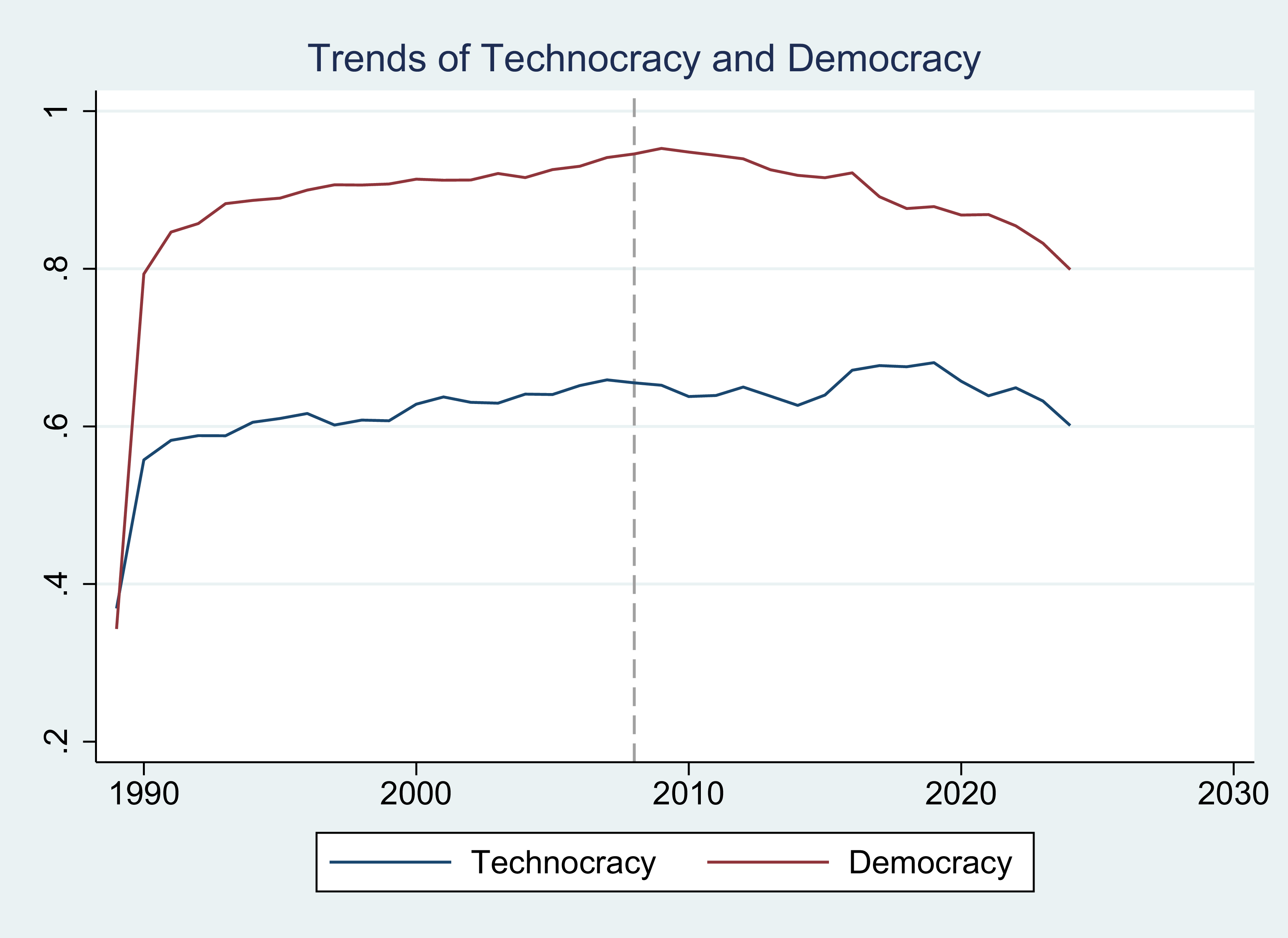
The first figure shows annual trends in the Technocracy and Democracy Indices from 1989 to 2024. Both curves follow a broadly upward trajectory, suggesting that institutional density has generally increased across the EU and the UK. Democracy remains consistently higher in absolute terms, but technocracy displays a notable acceleration after 2008, pointing to a phase of reinforcement likely associated with post-crisis governance restructuring. In recent years, the narrowing gap between the two lines suggests that many systems have integrated technocratic elements without significantly compromising democratic structures.
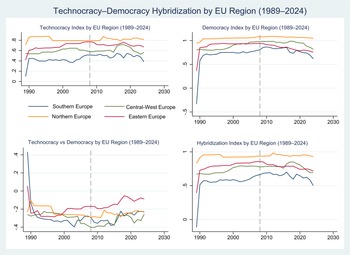
The four-panel Figure 2 depicting regional trends provides a deeper understanding of how the balance between technocratic and democratic governance has evolved unevenly across Europe. In terms of technocratic institutionalization, Northern and Central-Western Europe consistently exhibit the highest levels, maintaining scores between 0.7 and 0.8 from the early 2000s onward. By contrast, Eastern Europe begins the period at markedly lower levels (∼0.2) and stabilizes around 0.5, reflecting a persistent gap in administrative capacity and institutional autonomy.
Temporal trends in technocracy and democracy indices (1989–2024).
Source: Authors’ elaboration; data: V-Dem v15. Note: The graph shows the evolving average values of the composite indices for technocracy and democracy across all country-year observations in the EU and the UK. Both indices are based on standardized V-Dem variables and are reported here on a 0–1 scale for descriptive and graphical purposes. Shaded area corresponds to the post-2008 period.

Temporal dynamics of technocracy, democracy, and hybrid governance in Europe (1989–2024).
Source: Authors’ elaboration; data: V-Dem v15.

Southern Europe follows a distinctive trajectory: it experiences a rise in technocratic features until the late 2000s but then shows a visible decline post-2010, suggesting a possible retreat from insulated governance mechanisms. To better understand this result, we can look at the difference between technocracy and democracy scores, displayed in the bottom-left panel, which provides insight into the relative weight of each governance logic. Most regions oscillate near the zero line, indicating a long-term balance. However, Southern Europe consistently exhibits negative values (between –0.2 and –0.3), denoting the predominance of democratic structures over technocratic onesFootnote 3 . This can be explained as follows. First, one element concerns the timeframe of our analysis. As noted in footnote 1, while a long-term perspective reveals a demo-dominant pattern, a closer look at the post-2008 phase highlights a growing technocratic component – therefore, a long-term tendency towards the increase of the technocratic factor. Crucially, this aligns with a body of literature that, while emphasizing the populist backlash against EU-driven technocratic austerity (Kriesi and Pappas, Reference Kriesi and Pappas2015; Schmidt, Reference Schmidt2020), also points to the coexistence of technocracy and populism as two modes of politics emerging against the backdrop of the crisis of representative democracy (Caramani, Reference Caramani2017). Therefore, the increasing structural presence of technocratic elements within government and, more broadly, within the state appears compatible with the parallel rise of populist forces (e.g., Bickerton and Accetti, Reference Bickerton and Accetti2021).
The Democracy Index tells a slightly different story. All regions converge toward relatively high scores in the early 2000s, but regional differences persist. Northern Europe maintains levels above 0.9, reflecting strong and stable democratic traditions. Eastern Europe, after a rapid post-transition climb, reaches a plateau around 0.7, without further consolidation. Southern and Central-Western Europe show similarly high levels prior to 2010, but both register a modest decline after 2020, potentially linked to the democratic strains exposed during the pandemic.
The final panel, showing the hybrid index as the average of the two components, captures overall governance density. Northern and Central-Western Europe stand out with consistently high levels (∼0.8), representing mature hybrid systems. Eastern Europe remains structurally weaker, with scores plateauing around 0.6. Southern Europe again shows a dynamic pattern: institutional density increases up to the financial crisis, but then declines significantly in the post-2010 period, mirroring broader patterns of political volatility and executive reconfiguration.
Together, these regional patterns reveal that while hybrid governance is a common feature across European democracies, it takes structurally differentiated forms. Regions like Northern and Central-Western Europe appear to sustain a stable and dense hybrid equilibrium, whereas Eastern and Southern Europe show greater volatility, asymmetry, and in some cases, signs of institutional regression.
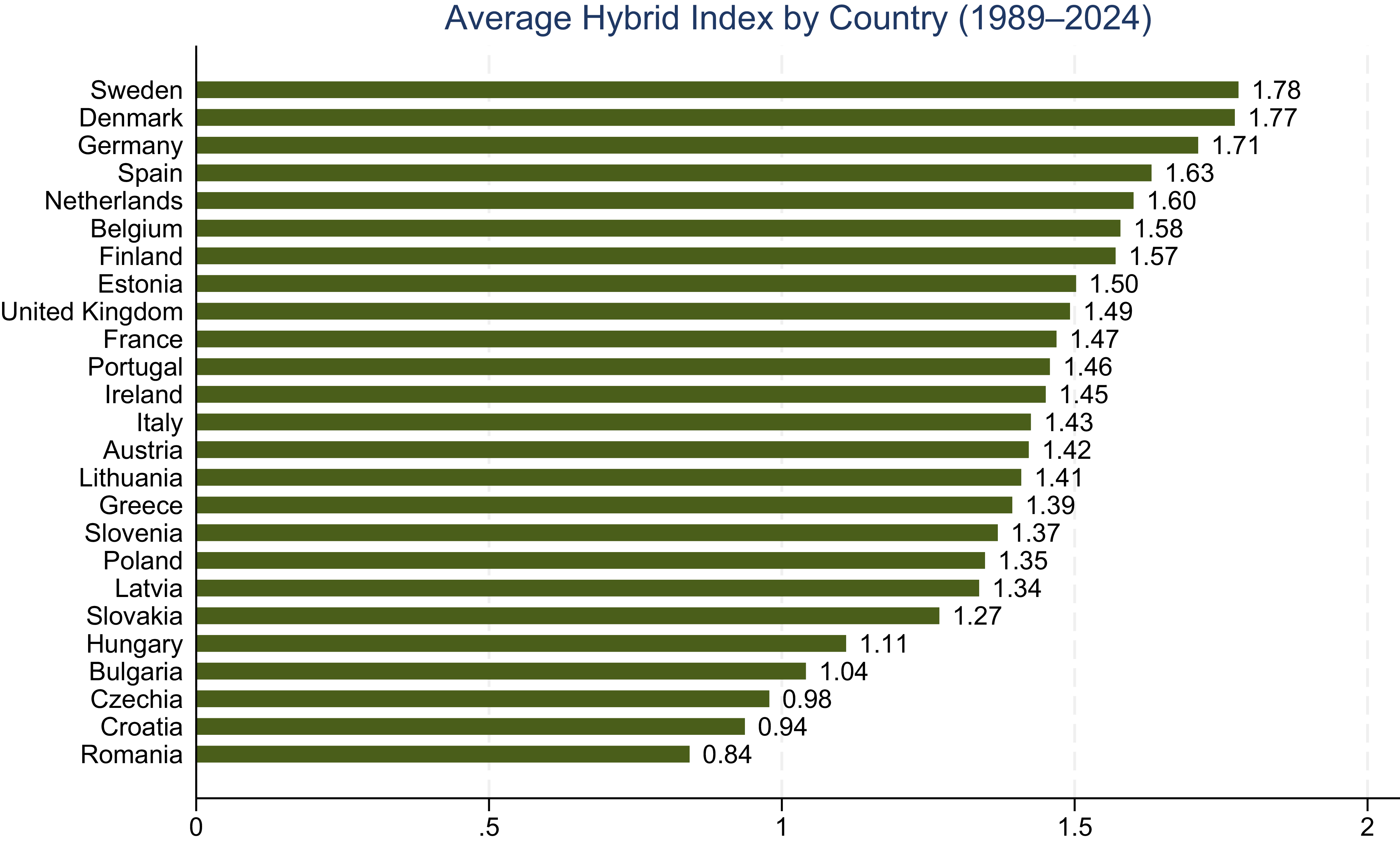
Figure 3 shifts the focus to the cross-national level, offering a comparative view of average hybrid index scores by country. Here, clear regional patterns emerge: Northern and Central-Western European countries exhibit higher average levels of hybridization, reflecting robust institutional systems that integrate both democratic and technocratic features. In contrast, Eastern European countries show consistently lower scores, indicating weaker or less balanced institutional configurations. Southern Europe reveals a more mixed picture, with countries oscillating between more technocratic and more democratic phases – suggesting greater internal volatility or experimentation.
Cross-national variation in hybrid governance intensity (1989–2024).
Source: Authors’ elaboration; data: V-Dem v15. Note: The graph presents the country-level average of the hybrid governance index, computed as the mean of the technocracy and democracy indices. Higher values reflect denser institutional configurations integrating both governance logics. Countries with incomplete data coverage over the 1989–2024 period (e.g. Malta, Cyprus, Luxembourg) are not displayed.

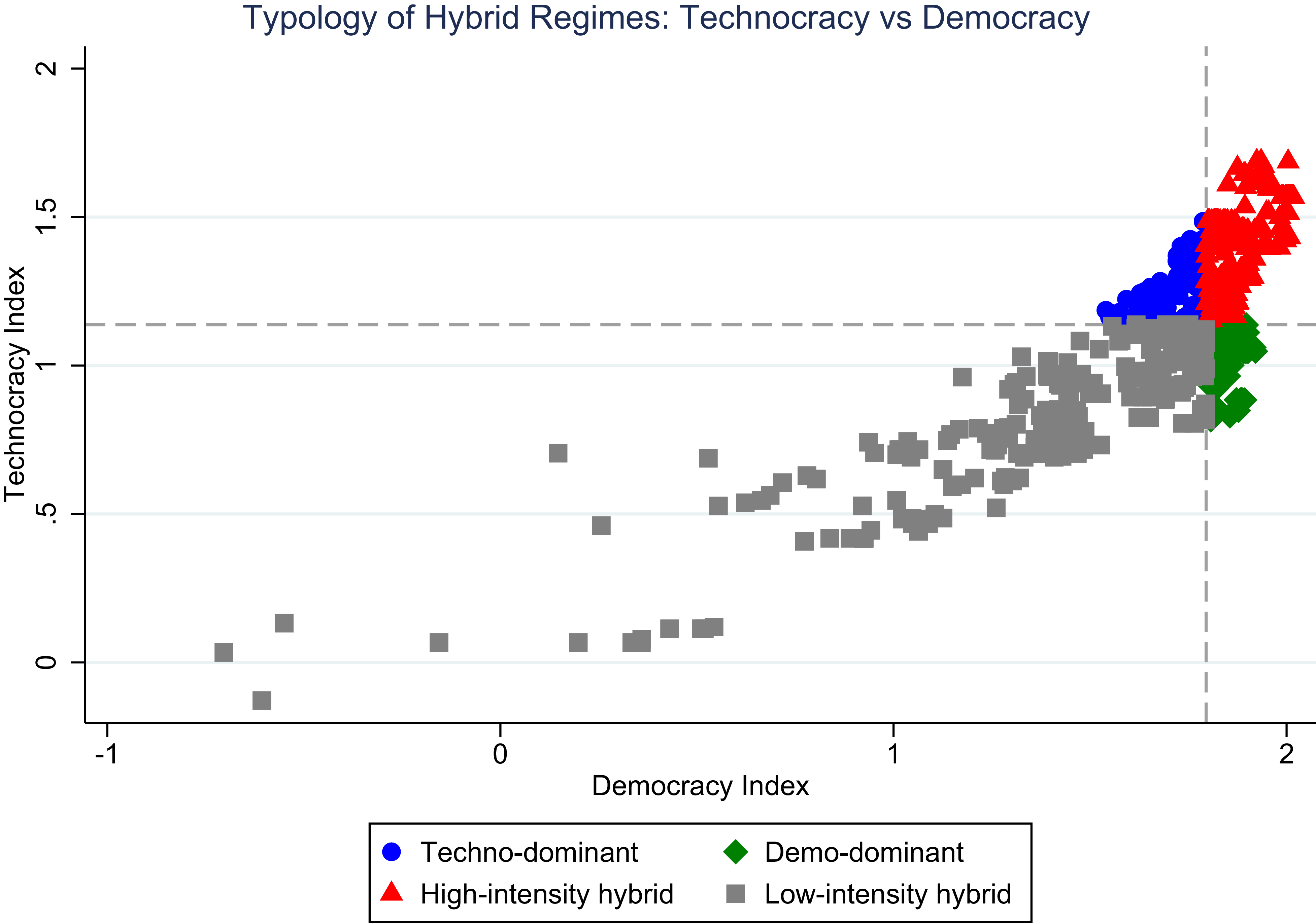
Finally, the fourth figure maps the distribution of country-years across the four ideal types of hybrid governance. What emerges is a dense core of high-intensity hybrids, surrounded by pockets of demo- and techno-dominant regimes. Low-intensity hybrids are heavily concentrated in Eastern Europe, reflecting persistent issues of institutional fragility. Southern Europe shows a relatively high number of techno-dominant cases, while demo-dominant configurations are more prevalent in Northern Europe. Importantly, the scatterplot reveals that countries do not remain fixed in one category but shift over time – sometimes gradually, sometimes abruptly – suggesting a dynamic process of recalibration between performance-based legitimacy and democratic responsiveness.
In this sense, the distribution displayed in Figure 4 constitutes a useful analytical starting point for future research, as it enables the study of trajectories, transitions, and critical shifts across hybrid governance configurations, thereby overcoming a purely cross-sectional reading. From such a perspective, the mapped distribution points to a plurality of hybrid governance trajectories across Europe. Rather than converging toward a single model, European states appear to follow distinct paths within a shared hybrid space, continuously negotiating the balance between expertise and representation, efficiency and accountability.
Distribution of country-year observations by ideal type of hybrid governance.
Source: Authors’ elaboration; data: V-Dem v15. Note: Each dot represents a country-year, classified according to whether its technocracy and democracy scores fall above or below the sample medians. The four quadrants correspond to: techno-dominant (high T, low D), demo-dominant (low T, high D), high-intensity hybrid (high T and D), and low-intensity hybrid (low T and D).

As discussed in the introduction, our approach departs from typologies based solely on regime type (Lijphart, Reference Lijphart1999; Levitsky and Way, Reference Levitsky and Way2010) or unidimensional democracy indices (e.g., Freedom House; Polity IV). Rather than treating technocracy as external to democracy, our operationalization captures the interplay of multiple, and at times competing, logics of legitimacy. While earlier efforts have developed technocracy-specific indices – such as Bertsou and Caramani’s (Reference Bertsou, Caramani, Bertsou and Caramani2020b) expert-based measures or Esmark’s (Reference Esmark2023) crisis-responsive analysis – these often rely on static or one-dimensional models. The result of our research strategy is a continuous and relational measure, able to trace the structural entanglement of democratic and technocratic components over time. This allows for a more nuanced and dynamic mapping of governance variation across cases and historical phases.
Conclusion
This article does not aim to offer definitive findings on the causal dynamics of democratic transformation or on the growing role of technocratic logics within democratic forms and processes. Rather, its contribution lies in advancing a theoretical and analytical framework designed to support future research on the evolving relationship between technocracy and democracy. The core conceptual standpoint is that of hybridization between technocracy and democracy. Adopting a dynamic, time-sensitive (processual), relational, and systemic approach, the article conceptualizes hybridization not as a crystallized regime type, but as an ongoing process through which patterns associated with two distinct forms of politics increasingly intersect and overlap. Instead of offering deterministic, dichotomous, or linear explanations, the framework proposed here seeks to capture how technocratic and democratic logics co-evolve within existing institutional structures – and how their entanglement reshapes not only the architecture of governance, but also the very terms of democratic quality.
On this basis, and drawing on the empirical research strategy developed in the article, we construct a typology of hybrid governance based on four possible configurations. This typology enables the systematic mapping of how technocratic and democratic logics combine across countries and over time. In this respect, high-intensity hybrids in Northern and Central-Western Europe point to a relatively stable co-evolution of democratic and technocratic logics, supported by robust administrative capacities and long-standing traditions of accountable governance (Castaldo and Verzichelli, Reference Castaldo and Verzichelli2025; Cozzolino et al., Reference Cozzolino, Caterina and Giannone2025). By contrast, Eastern Europe is characterised by a concentration of low-intensity hybrids, reflecting incomplete democratic consolidation and a weaker institutional anchoring of both governance logics (Morlino and Raniolo, Reference Morlino and Raniolo2018). Southern Europe displays a more volatile configuration, in which technocratic surges often coincide with exogenous shocks, financial instability, or external constraints (Papadopoulos, Reference Papadopoulos, Featherstone and Papadimitriou2013; McDonnell and Valbruzzi, Reference McDonnell and Valbruzzi2014). Taken together, these patterns underline the importance of accounting for regional variation and institutional context when analysing processes of hybridization.
At the same time, these patterns should be interpreted with caution. While the empirical strategy adopted offers valuable cross-country and longitudinal comparability, it also entails limitations. In particular, the indices do not explicitly capture differences in regime architecture – such as presidential, semi-presidential, or parliamentary systems – which may shape the balance between technocratic insulation and democratic accountability (Lührmann et al., Reference Lührmann, Tannenberg and Lindberg2020). Although most countries in the sample are parliamentary democracies, and the indicators employed indirectly reflect institutional variation, future research could benefit from a more fine-grained integration of regime-type characteristics. More broadly, the framework maps and classifies patterns of hybridization but does not provide a full causal account of why and how these configurations emerge and evolve. Addressing this limitation requires integrating additional explanatory variables – such as party system dynamics, institutional trust, elite strategies, and media framing (Daoust and Nadeau, Reference Daoust and Nadeau2021) – and adopting research designs capable of capturing the mechanisms underlying hybrid trajectories over time. This agenda resonates with existing scholarship on the hollowing of representative democracy and the erosion of participatory legitimacy (Mair, Reference Mair2013; Papadopoulos, Reference Papadopoulos, Featherstone and Papadimitriou2013; Bickerton and Accetti, Reference Bickerton and Accetti2017).
More generally, the analysis suggests that technocracy may operate not only as a response to democratic weaknesses, but also as a factor contributing to their reproduction. Hybridization, in this sense, is not a neutral process: it incorporates governing logics that may conflict with democratic principles of accountability, pluralism, and participation. Technocracy tends not to thrive in contexts of democratic consolidation, but rather under conditions of persistent democratic strain – conditions to which, as parts of the literature suggest, technocratic governance may itself contribute. Rather than witnessing a democratization of technocracy, contemporary democracies may therefore also be experiencing a parallel technocratization of democracy. This observation underscores the need to continue the investigation along two complementary fronts. Analytically, future research should further unpack the multiple dimensions of hybridization, including discursive, institutional, procedural, and elite-based dynamics. Interpretatively, the challenge is to assess the long-term trajectories that contemporary democracies are following as hybrid governance becomes increasingly normalized.
From this perspective, the typology developed in this study – together with its underlying theoretical and empirical rationale – should be understood not as an endpoint, but as a heuristic tool from which further empirical and theoretical work can build. By mapping different configurations of technocratic–democratic hybridization across countries and over time, the framework provides a structured comparative space to situate phenomena that have already been widely documented in the literature but rarely analyzed as part of broader governance configurations. Moreover, by operationalizing hybridization as a continuous and evolving process rather than as a static attribute or regime type, the approach complements existing indices of democracy (e.g., Teorell et al., Reference Teorell, Coppedge, Lindberg and Skaaning2019; Coppedge et al., Reference Coppedge, Gerring, Knutsen, Lindberg, Teorell and Altman2025) and technocracy (e.g., Bertsou and Caramani, Reference Bertsou and Caramani2022), thereby bridging normative debates and measurement efforts. In doing so, it invites scholars to explore how competing logics of legitimacy are institutionalized and reshaped within contemporary political systems.
The typology thus opens several promising avenues for future research. First, it can be employed to investigate the selection and composition of governing elites, by examining how different hybrid configurations relate to the recruitment of non-partisan ministers, the role of experts within executive institutions, and the interaction between technocratic authority and partisan politics. Second, it offers a basis for analyzing variation in governmental dynamics, allowing scholars to explore whether and how different hybrid arrangements are associated with policy cycles, crisis management capacity, democratic responsiveness, or public trust. By making these priorities explicit, the article positions its contribution as a structured point of departure for cumulative and comparative research on hybrid patterns of governance in contemporary democracies.
Supplementary material
The supplementary material for this article can be https://doi.org/10.1017/S1755773926100514.
Data availability statement
The data used in this study are derived from the publicly available V-Dem dataset (Version 15). All data and code necessary to replicate the analyses are available from the authors upon request.
Acknowledgements
The author(s) made use of ChatGPT (GPT-5, OpenAI) to assist in the revision of this article. The AI system was accessed via the OpenAI platform and used without further modification. It was employed in January 2026 to support language refinement, improve clarity of expression, and assist in restructuring parts of the manuscript. All analytical decisions, interpretations, and the final version of the text remain the sole responsibility of the author(s).
Author contributions
The authors contributed equally to the conception, development, and writing of this article. Authorship is listed in alphabetical order and does not imply any hierarchy of contribution.
Financial support
This research received no specific grant from any funding agency in the public, commercial, or not-for-profit sectors.
Competing interests
The authors declare no conflicts of interest.
Ethics standards
This study does not involve human participants, and therefore ethical approval was not required.





 Open access

