




1. Introduction
The Odes 詩經, the earliest collection of metrical and often rhyming literature in Chinese, already presented formidable challenges of interpretation by the time of the first transmitted commentaries on the text. The language of the Odes was ancient by the late centuries bce. Someone learning the Odes during the Warring States (453–221 bce) or Han (206 bce–220 ce) period would have struggled to make sense of their unfamiliar diction without the support of a tradition of interpretation. The early commentaries that survive are the Mao tradition (Mao zhuan 毛傳), of obscure Western Han-period authorship, and the commentary by Zheng Xuan 鄭玄 (127–200 ce), about whom we know more. The two commentaries served to establish the linguistic text of the Odes through glosses and paraphrases. Later readers have been entirely dependent on them to make sense of the Odes.
Not only was the language challenging, the circumstances of the composition and transmission of the Odes were also obscure to Han-period observers. Many odes in the Ya 雅 and Song 頌 sections have a natural interpretation as commemorative hymns of the ruling families of the early to mid-first millennium bce, but the process by which they were dispersed to enjoy wider currency is largely undocumented. Other odes, particularly those in the Guo feng 國風 section, lack this natural contextualization, and so we find commentaries and other received literature actively constructing historical circumstances and ethical motivations for the creation and compilation of the Odes, circumstances which usually have no reflection in the surface text of the Odes.
Bamboo manuscripts from the Warring States period, acquired through documented excavations and the purchase of material from looting of tombs, have transformed our understanding of early Chinese literature, its script and language, and how it was used and transmitted. Manuscripts like the Zi yi 緇依 (Black Robe) from the c. 300 bce tomb at Guodian,Footnote 1 the approximately contemporary Kong zi shi lun 孔子詩論 (Confucius’ Discussions of the Odes) manuscript purchased by the Shanghai Museum,Footnote 2 and the Tsinghua Qi ye 耆夜 manuscriptFootnote 3 allow us to see lines from familiar odes in the orthography that was current in the southern state of Chu 楚 before the Qin–Han script standard was imposed on all of transmitted literature. These manuscripts also provide insights into interpretive approaches to the Odes which were current in the fourth century bce. The newly published manuscript purchased by Anhui University (“Anda” subsequently), contains 60 of the Guo feng odes found in the received text. A Warring States manuscript excavated in 2014–15 from a tomb at Xiajiatai 夏家臺, Jingzhou, is reported to contain a version of the Bei feng 邶風 odes.Footnote 4 Preliminary publications are now available of the early Han Odes manuscript from the tomb of the Marquis of Haihun 海昏侯, which, after the badly damaged Odes text from the Fuyang 阜陽 tomb, is now the second archaeologically recovered Han manuscript of the Odes.Footnote 5
This material permits an unprecedented loosening of our dependency on received commentaries for a knowledge of the text and history of the Odes. In this paper, we present an analysis of the new Anda Odes manuscript from the point of view of its material aspects, the internal organization of the sequence of odes, and its textual relationship to the received Mao Odes. The manuscript provides compelling new evidence for the stability of the Odes by the fourth century bce, the role of writing in their transmission, and the way in which learners of the Odes approached their task.
Several articles on the new Anda manuscript see it as resolving the long-held, mutually opposed positions of Martin Kern and Edward L. Shaughnessy regarding an oral versus written mechanism for pre-Qin Odes transmission decisively in favour of the latter.Footnote 6 We argue that neither of these positions fully explains the evidence we see in the Anda manuscript. Neither do they adequately capture the roles that orality, memorization, and writing played in the creation of the manuscript, and in early Odes transmission more generally. On the one hand, we agree with Kern's position that in the fourth century bce the Odes were thought of essentially as something to be performed aloud, either complete in musical form, or else through quotation embedded in persuasive court speeches. On the other hand, the evidence of the Anda manuscript shows that the text of individual odes and the organization of the collection was fixed by this time, and existed in written form.
The Odes’ textual stability was supported by manuscripts. In the case of Anda, an apparatus of strip numberings, sectional divisions, and counts of odes per section supported this stability. We argue that the extent to which the Anda manuscript reveals a linguistically fixed Odes text, very close to the received Mao version has, if anything, been underestimated by early studies, which have tended to focus on variation with respect to Mao. As we will show, most of this variation between Anda and Mao turns out to be orthographic in nature. Although writing played an important role in the fourth-century bce maintenance and dispersal of a stable Odes text, we do not believe the Anda manuscript was produced by visual copying. The evidence for it being a copy of another manuscript is equivocal at best.Footnote 7 Instead, many of the features of the manuscript which we discuss point to a reliance on memory in its production.
These observations and the detailed supporting evidence that we present in this paper are best explained by seeing the Anda manuscript as a tool for supporting the memorization of the Odes. What was important was committing the text of the Odes to memory, and only secondarily the possession of a written reference copy of the text. Learning the Odes likely involved memorizing the text and its interpretation through rehearsal with a teacher, with other learners, and alone. This extended to reading and writing the Odes using the conventions of the locally current orthography, but only as a crutch for the main task of internalizing the text. We suggest that the Anda manuscript is best explained as a product of this kind of learning environment. It was produced not by visually copying another exemplar of the text, but by a moderately accomplished learner of the Odes reproducing from memory (perhaps with the help of written or spoken cues) several well-defined subsections of the text that had been previously studied.
Conventions
Old Chinese reconstructions are given according to the system and notation of Baxter and Sagart, Old Chinese: A New Reconstruction.Footnote 8 We also adopt their understanding of the system of syllabic spellings in the early script.Footnote 9 We use a capitalized notation to refer to the types of syllabic values that can be written with a phonetic speller. So, for example, we would say that 旨 spells syllables of the type *KIJ. These include shi < *s-kij 蓍 “milfoil”, zhi < *kij 脂 “fat”, shi < *gij-s “enjoy”, qi < *grij “old”, etc.
Odes are referred to by the name traditionally assigned to them (without any assumption about the antiquity of that name), followed by the Mao number and the Anda strip number. Since the Anda Odes are linguistically very close to the Mao Odes, it is almost always possible to refer unambiguously to a passage in the Anda version using the more easily typable orthography of the received Mao version. Except when we are specifically concerned with issues of orthography or linguistic variation between the two, we adopt this as a convention (again without any assumption that the passage in question is linguistically identical). This allows us to reconstruct missing graphs or identify swapped verses without the additional burden of transcribing the orthography of the Anda manuscript.
The Anhui University bamboo manuscripts
The Anda Odes is one of several bamboo manuscripts acquired by Anhui University in 2015, and the first to be published. The publication maintains the very high standard of recent Chinese publications of excavated texts with large clear photographs of the manuscript, technically precise transcriptions, and informative annotations.
The other manuscripts awaiting publication include the following texts:Footnote 10
• approximately 450 strips related to historical events in the state of Chu 楚;
• philosophical texts on 376 strips including sayings attributed to Confucius with parallels in the Lun yu 論語, and a parallel of the Shanghai Museum manuscript Cao Mo zhi zhen 曹沫之陳;
• material similar to the Chu ci 楚辭, in two groups of 24 and 27 strips each;
• writings on physiognomy on 22 strips;
• a text on 11 strips devoted to oneiromancy.
Neither the 2019 full publication of the Odes manuscript, nor Huang Dekuan's 2017 overview of the Anhui University manuscript collection reveal anything of the history of ownership prior to 2015, the nature of the transaction that brought it to Anhui University, or the official decision making that led to what was presumably a purchase of some kind. We are not aware of any attempt to expose publicly these facts or to draw attention to their absence. The situation is similar to the lack of information about other important acquisitions of bamboo strip manuscript collections in the previous decade by, among others, the Shanghai Museum, Tsinghua University, Yuelu Academy, and Peking University.Footnote 11
The Anda Odes is a physically damaged but otherwise very well-preserved bamboo-strip manuscript, written in a script that appears to be that of the Chu region in the fourth century bce. This makes it likely that the Anda Odes were obtained after the looting of a fourth-century bce tomb in Hubei, followed by the illegal sale of the tomb contents. Several scholars outside China have expressed ethical concerns, not just about the looting of tombs and illegal traffic in antiquities, but also about the study of unprovenanced bamboo-strip manuscripts, even after they have been removed from the market and private hands and have entered a permanent public collection in their country of origin.Footnote 12 Their concerns are threefold: that scholarly publications which refer to looted manuscripts promote looting and related criminality; that unprovenanced manuscripts might be fake, and scholarship based on them spurious; and that the scientific value of a real but unprovenanced text is diminished without a recorded archeological context. We agree, with some reservations, with all three of these propositions, and are concerned when institutions and individuals participate in a market in recently looted antiquities without any meaningful public scrutiny.
We are similarly disappointed by the evidence in support of the dating of the Anda manuscripts. Huang Dekuan's overview of the Anda collection goes on to summarize briefly the radiocarbon dating of the manuscripts which placed them in the fourth century bce. The samples for dating were taken only from uninscribed strips, pieces of a bamboo basket, and pieces of lacquer.Footnote 13 Although this is not specifically stated, the implication is that these were acquired together with the inscribed strips. As far as we are aware, the lab reports are unpublished.
Nevertheless, we resist the conclusion that the study of unprovenanced early Chinese manuscripts in public collections in China is unethical or otherwise to be avoided. All scholarly or popular publications, exhibitions and other activities that promote enthusiasm for antiquities or works of art will tend to increase the commercial value attached to those items. Whether a manuscript is fake or not is an empirical question that can be decisively answered on the basis of evidence and expert argument.Footnote 14 We do not think it is helpful to promote a generalized theoretical scepticism regarding the authenticity of unprovenanced manuscripts without a committed case-by-case engagement with the evidence-based criteria for determining authenticity. Although information is unquestionably lost when the archaeological context of an early manuscript goes unrecorded, ignoring manuscripts such as those from the Tsinghua University or Anhui University collections would result in a still greater impoverishment of knowledge. A policy of not studying unprovenanced early Chinese manuscripts, even after they have been fully published by the public institutions which permanently house them in their nation of origin, would be an ethical constraint for which we can find no precedent in any of the comparable scholarly fields that study the ancient world, and which contend with the problem of looted antiquities.Footnote 15
2. Preservation, properties, and reconstruction of the manuscript
Much of the Anda Odes is physically missing. Many strips are missing altogether, while others are incomplete, typically due to breaks at either end.
The strips were all serially numbered by the scribe, up to 117. Only 20 of the original 117 strips are described as “intact” by the editors.Footnote 16 The lengths of these 20 intact strips, distributed throughout the manuscript, all fall within 0.3 cm of a mean of 48.1 cm. This can be assumed to have been the original length of all the missing or damaged strips, consistent throughout the manuscript. From the figures given in the same table by the editors, we calculate that approximately 28% of the original total strip length was lost by the time of publication.Footnote 17
The fate of the missing strips and fragments is unknown, and the publication is silent on the topic. Much of this loss seems to have resulted from the way in which the strips were unearthed and subsequently handled, since it is mostly distributed in a random way throughout the manuscript and involves damage of a kind not normally seen in bamboo strip manuscripts archaeologically excavated from tombs. With properly excavated bamboo strip manuscripts, extensive loss of material typically occurs when preservation is poor. Good preservation typically means that manuscripts and individual strips are largely complete (as we see at Guodian, for example). The Anda strips are unusual in combining substantial loss of material (28%) with excellent preservation of the remainder.
Writing styles
Throughout the paper, we refer to “the scribe” to indicate the person whose brush put the ink on the strips. We suspect that the scribe was also the owner and user of the finished document. Throughout the manuscript there is noticeable inconsistency in the writing of structurally identical graphs (Tables 1 and 2).
Varying forms for wo 我 “I, we”

Varying forms for ma 馬

In other excavated documents, this kind of variation coincides with alternating scribes.Footnote 18 Here, however, the distribution of stylistically different graphs for the same word does not reflect any pattern that might suggest alternation of scribes. Rather, these graphs alternate within the same ode, sometimes on the same strip, with no obvious pattern. This suggests one person at work, using an inconsistent writing style. This is not unprecedented, and in other manuscripts has been thought to indicate a scribe's exposure to more than one orthographic tradition.Footnote 19
Knife cuts on the reverse of the manuscript
Knife-cut incisions (kehua xian 刻劃綫) appear on the back of the strips. These have been noted on other manuscripts and have been taken to be indications of the order of the strips.Footnote 20 Figure 1 shows an approximation of the position of the knife-cut incisions on the reverse of the Anda manuscript, based on the images and description of the strips published as an appendix to the publication,Footnote 21 taking each Guo feng section as a unit, and showing the scribe's strip numbering.
Knife cuts on verso side

For the first four Guo feng sections, the incisions appear to begin and end with the section. One continuous cut appears to run from the Yong section into the beginning of the Wei section. Given that each strip is numbered, the presence of these cuts on the reverse seems redundant. Presumably the cuts were made during the preparation of the strips, without knowledge of the text that would be written on them, as a way to guarantee that the binding process would occur correctly.Footnote 22
Much of the missing 28% of the manuscript can be reconstructed with confidence, even when there is a run of 2 or 3 consecutive missing strips. The biggest missing section of the manuscript is a run of 12 strips, 60–71 in the scribe's numbering. This is harder to reconstruct, but we provide some guesses as to its content below. The rhyme and meter of the Odes, the similarity of the text to the Mao Odes, and the original serial numbering of the Anda strips help with this reconstruction. Permutations of verse order (with respect to the Mao Odes) and of ode sequence within Guo feng sections present challenges. The systematic use of repeated graph (chongwen 重文) notation in the manuscript and a variable count of graphs per strip also need to be accommodated.
The results of our reconstruction are summarized in Figure 2. Each bar corresponds with one strip, ordered according to the scribe's numbering. The vertical axis represents numbers of graphs on each strip (not the physical length of the strip). Grey sections correspond to the surviving graph count. Black sections represent lost graphs where we are confident how the text would have read, based on regularities of rhyme and meter, repetition from verse to verse, and comparison with the Mao Odes.Footnote 23 Bars with no black sections, then, are strips from which no graphs have been lost. The short bars (on strips 20, 41, 83, 99, 117) correspond to the strips at the end of each Guo feng section, which the scribe regularly left blank after the section label, before starting the next section on a fresh strip. Missing bars correspond to lost sections of manuscript where we believe no secure reconstruction is possible.
Reconstruction of missing sections of manuscript

It is apparent from Figure 2 that the graphs per strip vary throughout the manuscript, beginning with fewer than 30 graphs per strip, before rising to a peak of about 40 around strip 80, then declining slightly.
To introduce the methodology for our reconstruction, and to get a sense of what reading the manuscript alongside the Mao version entails, consider the seven strips numbered 37–43. The average graphs per strip in this section is 35. The first and last of these seven strips are intact, but the other five in the middle have been damaged with loss of graphs. Nevertheless, the text can be reconstructed, and shows interesting divergences from Mao. The odes on 37–43 are the last four of the Shao nan 召南 section and the first of the Qin feng 秦風 section, which in the Anda manuscript directly follows Shao nan.
Since our interest at this point is merely in understanding which bits of which strips correspond to which odes, we represent the Anda text in the tables below using the Mao orthography where possible. We mark up the Mao text with any deletions or insertions needed to transform it into the Anda text, using notation like <-其> and <+于>. The Anda manuscript uses repeated graph notations systematically. We write the second occurrence of any repeated graph in the Mao as e.g. <=脫>. Missing but reconstructed sections of the text are put in curly braces, e.g. {何彼}.
We start from strip 37 and proceed in sequence. Strip 37 is intact, with 35 graphs. It carries the end of “Jiang you si” 江有汜 (Mao 22) and the beginning of “Ye you si jun” 野有死麕 (Mao 23). Deletions and insertions of grammatical particles (qi 其; yu 于) and a permutation of the second and third verse of “Jiang you si” are needed to transform Mao into Anda. There are also some repeated graphs. To help the reader follow the reconstruction, we reproduce the corresponding Mao odes on the right in the tables below, marking in bold the graphs which correspond to our reconstruction of the strip.

Two fragments of strip 38 survive, with 14 graphs. If we assume that the strip originally had 35 graphs, it would have accommodated all the rest of the Mao text of “Ye you si jun”, but for the final graph.

Strip 39 is missing a short section at the top. Our reconstruction of strip 38 requires that three graphs – the final graph 吠 of “Ye you si jun” and the first two of “He bi nong yi” 何彼襛矣 (Mao 24) – belong to this missing section of strip 39, resulting in 34 graphs in total. Changes in orthography aside, the Mao text and the Anda text for “He bi nong yi” align syllable-for-syllable.

On strip 40, 29 graphs survive. The three graphs broken from the top are easily recovered by comparison with the end of strip 39. The strip has the end of “He bi nong yi” and the beginning of “Zou yu” 騶虞 (Mao 25). Apart from a deletion of hu 乎, the Anda and Mao texts are metrically identical.

Only a small fragment of strip 41 is preserved, with five graphs from “Zou yu”. It is clear from the rhyming, meter, and repetition of “Zou yu” that the Anda ode had one more verse than the Mao version. We can also reconstruct the Guo feng section label that we know must have been on the original strip 41 (see below).

Strip 42 begins the Qin feng section, and so the first three characters of “Che lin” 車鄰 (Mao 126), missing from the top of the strip, are easy to reconstruct, giving an original graph-count of 32. The only complication with this and the following strip is the permutation of the second and third verses in “Che lin”.
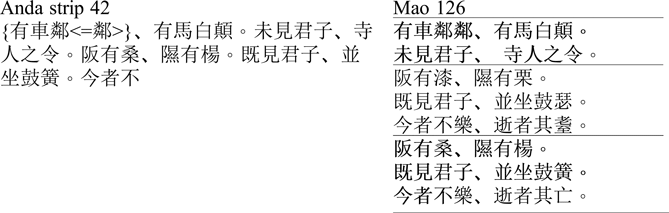
With strip 43, we again have an intact strip of 32 graphs that needs no reconstruction, and which matches the remainder of Mao “Che lin” and the beginning of “Si tie” 駟驖 (Mao 127) metrically.

We applied the same method and logic to all 117 strips of the manuscript, to reach the results summarized in Figure 1 and described below.
3. The selection, sequence, and organization of the Anda Odes
The tradition of Guo feng regional classifications
The Mao Odes groups the first 160 odes under regional or political labels (Zhou nan 周南, Shao nan 召男, Bei 邶, etc.). Although the Anda manuscript does not use the terms feng 風 or Guo feng 國風 (or bang feng 邦風), for convenience we follow the usage of the received tradition and refer to these regionally labelled groups as “Guo feng sections”. The Mao prefaces often interpret individual odes as relating to historical figures, events or circumstances connected with the regional label, and later tradition has tended to follow these readings. For example, the Mao interpretation of “Xi shuai” 蟋蟀 (Mao 114) as a critique of the excessive parsimony of a ninth-century bce Lord of Jin 晉, aligns with the Mao classification of “Xi shuai” under the Tang feng 唐風, since Tang and Jin both refer to what is now southern Shanxi.
Only on rare occasions does an ode make clear references to events or personalities which might support these regionally specific interpretations in the received tradition. One such example is the Qin feng 秦風 ode “Huang niao 黃鳥” (Mao 131), which seems to describe three brothers sacrificed to accompany the burial of the seventh-century bce Qin Mu Gong 秦穆公.Footnote 24 The Zuo zhuan 左傳 also refers to this event as the circumstance of the composition of the ode.Footnote 25 Classifying this ode under the Qin feng seems therefore naturally motivated.
More typically, nothing about the text of an ode supports either the general regional association implied by its inclusion in a particular Guo feng section, or the more specific interpretation in terms of events or personalities associated with that region. For instance, the wording of “Xi shuai” offers no support for the Mao preface account of its creation, and we are not aware of any assertions of it in literature from the Western Han or earlier.Footnote 26 Although it is present in the Mao preface, the interlinear Mao commentary does not enforce the interpretation in any way. There is, then, no compelling reason to think that the framing narrative of a frugal ninth-century Lord of Jin had any currency prior to the first century ce, and there is no need to defend this traditional view in the face of conflicting testimony.
Indeed, a completely different and contradictory framing narrative for “Xi shuai” is provided by the c. 300 bce Tsinghua manuscript Qi ye 耆夜. It describes a scene of beer drinking and the composition of odes by Zhou Wu Wang 周武王 and his courtiers after the defeat of the minor state of Qi 耆 in the eleventh century bce. The last of the four odes, which closes the Qi ye manuscript and which the manuscript puts into the mouth of Zhou Gong 周公, shares its title and much of its content with the Mao and Anda “Xi shuai”.Footnote 27
In the Qi ye, all the odes are introduced as if composed in the moment by the story's protagonists with the phrase zuo ge yi zhong 作歌一終 (composed a song).Footnote 28 The only other instance in early literature of the exact phrase is found in the Lüshi chunqiu 呂氏春秋 (about 240 bce), in a narrative about the composition of an ode titled Yan yan wang fei 燕燕往飛.Footnote 29 The title is a close match for the first line of the received “Yan yan” 燕燕 (Mao 28), which begins with “Yan yan yu fei 燕燕于飛” (swapping 往 *ɢʷaŋʔ for 于 *ɢʷa).
As with “Xi shuai”, the Mao preface supplies a framing narrative of its own for “Yan yan”.Footnote 30 An eighth-century bce queen of Wei 衛 bids farewell to the birth mother of the prince, whom she had adopted and who has been murdered, as she departs Wei and returns to her home state of Chen 陳.Footnote 31 As usual, the text of the received ode does nothing to dictate or even encourage this interpretation. Arguably, it is a better fit than a song of farewell to a swallow whose magical egg will impregnate one of the singers with the founder of the Shang Dynasty, as the Lüshi chunqiu has it. But with some tweaking within the range of textual variation that we know to exist in early Chinese literature, a connection could be established. For example, the two female protagonists, the lamented departure without return, and the abnormal parentage shared between the two framing narratives seem to be structural similarities.
Whether the Lüshi chunqiu anecdote refers to precisely the same ode as the Mao “Swallows” or not, it still makes the point that Warring States compositions construct fictional narratives to explain how individual odes came to be. It is hard to know whether these assertions regarding origin and authorship were made with the sincere conviction with which they have been treated by later readers, as factual assertions, or whether they were made with more performative literary or social goals in mind. We suspect the latter.Footnote 32 We believe this is clearly so in the case of Qi ye. Nothing in the text of the Qi ye supports the idea that it is anything other than such a fictional composition, roughly if not precisely contemporary with the physical manuscript. The goal of the composition was a literary one: an exercise in embedding odes into a frame narrative.Footnote 33
This invites the suspicion that the system of Guo feng classifications may be an idealization, an artificial creation reflecting something other than the regional provenance of odes. This open question of when and why odes, or the Odes, began to be organized and sequenced according to purported regional affiliations, is important for understanding their history as a collection. It is also relevant to the question of when the Chu region began to be interested in northern literary tradition. To a remarkable degree, literary texts from Warring States southern tombs are dominated by texts composed or narratively set in the major centres of culture to the north. Similarly, the 15 regions that give their names to the Guo feng sections of the Mao Odes are all northern. From Qin in the north-west to Qi in the north-east, none falls south of today's Henan–Hubei border, an additional reminder to anyone in Chu in the fourth century bce, including the original owner of the Anda manuscript, that the Odes were not just antique but also foreign.
The evidence of newly discovered manuscripts shows that the system of Guo feng groupings was important for the way in which it could impose memorizable order on 160 odes (whatever their regional origins may actually have been). We argue also that learners of the Odes mastered selections according to the Guo feng sections. That is why the Anda manuscript is organized around essentially complete Guo feng sections (and why the Xiajiatai Odes manuscript consists, according to preliminary reports, of the single section Bei feng).
The Guo feng sections in the Anda manuscript
The 93 surviving strips of the original 117 numbered strips preserve 57 odes in whole or in part. Although now entirely missing, the original presence of three further odes can be confidently reconstructed by aligning gaps in the serial numbering (i.e. lost strips) with expected odes in the received sequence. These are:
-
Mao 10, “Ru fen” 汝墳 in the Zhou nan 周南 section, on lost strips 18–19.
-
Mao 51, “Di dong” 蝃蝀 in the Yong feng 鄘風 section, on lost strips 95–97.
-
Mao 52, “Xiang shu” 相鼠 in the Yong feng section, on lost strips 95–97.
These 60 odes, which we can confidently identify as having been on the 117 strips, represent about a third of the odes in the Mao Guo feng. There is a major break in the sequence of strips from strip 60 to strip 71. We speculate about its contents in the next section. Each of the 60 surviving odes in the manuscript has an obvious counterpart in the Guo feng of the Mao Odes. Despite differences in orthography, most of those 60 odes are linguistically almost identical to their counterparts in the received Mao Odes. Furthermore, no odes are present in the Anda collection which are not known in the Mao version.
Like the Mao Odes, the Anda manuscript groups odes into Guo feng sections. Although there are interesting differences, the names of these sections, their relative sequence, each section's complement of odes, and the sequence of odes within each section are clearly related to those of the Mao Odes. In other words, it is not just the text of the individual odes that the Anda version shares with the Mao version, but also to a substantial degree the organization of the Odes into labelled groups and sequences.
The manuscript begins the first ode in each of these sections on a new strip. Each section ends with a label recording the Guo feng section name, after the last ode in the section, together with a count of the number of odes in the section. In some cases, the title for the first ode in the section is also given. So, for example, strip 117, the last in the manuscript, bears the last characters of the ode “Bao yu” 鴇羽 (Mao 121) followed by a black square end-of-ode marker and a blank space, then the Guo feng section title and ode count (Wei, jiu 魏九, “section Wei, nine odes”), then the title of the first ode in the section (“Ge ju” 葛屨).Footnote 34 In this case the count is out by one, as the editors point out.Footnote 35
The Guo feng section sequences
Let us look at the sequence in more detail. The sequence of odes and Guo feng groups in the Mao Odes is not the only sequence known in received literature. The Anda editors remind us that the Zuo zhuan 左傳 and Zheng Xuan's Mao shi pu 毛詩譜 both arrange the sequence of states differently from the received Odes.Footnote 36 The Zuo zhuan sequence is particularly interesting, being earlier in date than Zheng Xuan and probably Mao, and it is narratively contextualized by the story of Ji Zha 季札 of Wu 吳 requesting to hear the “music of Zhou 周” while visiting the Lu 魯 court in 544 bce.Footnote 37 According to the story, the performance Ji Zha witnessed ran through the entire Odes, from Guo feng through to the Song 頌 hymns, while Ji Zha made brief but thoughtful comments. As Table 3 shows, the Zuo zhuan and Zheng Xuan substantially agree with Mao about the names and sequence of Guo feng sections. The Zuo zhuan elevates Bin 豳 and Qin 秦 in the sequence, while Zheng Xuan elevates Gui 檜 and pushes Wang cheng 王城 to the bottom, while both leave the rest of the sequence unchanged. These sources tell us nothing about the sequence of odes within each Guo feng section.
Sequence and contents of Guo feng sections according to Mao, Zuo zhuan, Zheng Xuan's Shi pu, and the Anda manuscript
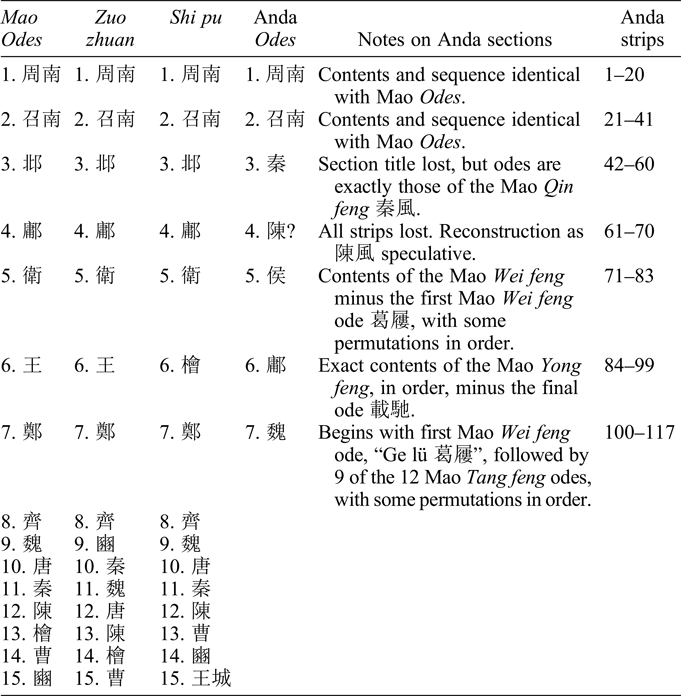
The situation with the Anda sequence is more complicated and requires some untangling. We will describe the differences between the Mao and Anda Guo feng sequences in terms of the changes needed to rearrange the familiar Mao sequence into the less familiar Anda sequence, without prejudging the question of priority.
Zhou nan 周南, Shao nan 召南, and Qin 秦
The Anda Zhou nan and Shao nan sections are identical to Mao, in terms of the presence or absence of specific odes, and in their order. The Qin feng odes have been elevated in the Anda sequence but comprise exactly the same odes as the Mao Qin feng, with only one permutation in their order: the ode “Wei yang 渭陽”, Mao 134, penultimate in the Qin feng, is bumped up two places in the Anda sequence (Table 4). Anda strip 60 has been lost, and with it the last few characters which include the Guo feng section label. Thus, it is not completely certain that the Anda manuscript called this section Qin. However, since the section contains exactly the same odes as the Mao Qin feng, it seems probable that the label would have been the same. The relocation of the Qin feng and the movement of the “Wei yang” ode (with respect to the Mao sequence) have no obvious motivation. We suggest that these and similar unmotivated shifts are reflections of idiosyncratic learning and memorization of the Odes, and of imperfect recall during the production of the manuscript.
Anda Qin feng sequence, with Mao sequence for comparison

Hou 侯
The missing strip 60 is the first of a run of twelve lost strips (60–71). After the lost strips, the surviving manuscript resumes on strip 72, halfway through “Fen ju ru” 汾沮洳 ode (Mao 108), the second ode in the Mao Wei 魏 section. We count 38 graphs missing from this ode before “…gong xing 公行” where the ode resumes. Since 38 is the average number of graphs per strip in this section of the manuscript, it is likely that the beginning of lost strip 71 coincided with the beginning of ode “Fen ju ru”. The manuscript places “Ge ju 葛屨”, the first ode from the Mao Wei section, together with the odes from the Mao Tang section (see below). Otherwise, all the odes from the Mao Wei section appear together on strips 72–83. So, it is clear that strips 71–83 were intended to be a complete Guo feng section. The sequence of odes within this section is close to the Mao Odes, as shown in Table 5.
Anda Hou and Wei sequence, with Mao sequence for comparison
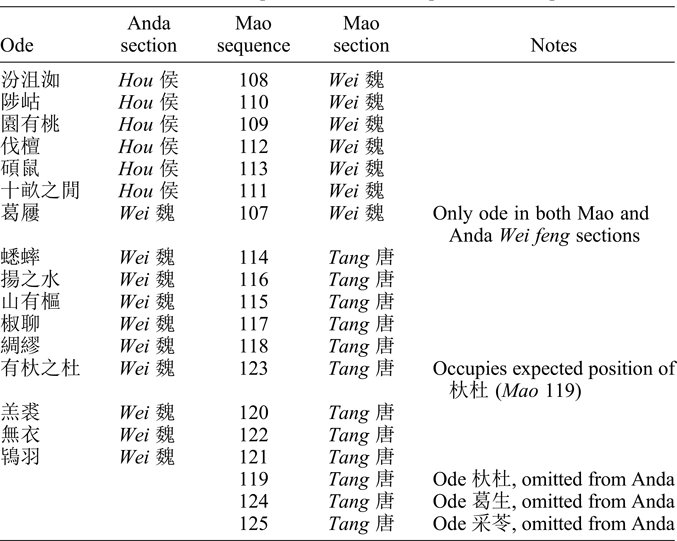
Since the section contains six of the seven odes from the Mao Wei section, and no odes from other sections, we would expect the manuscript to call this section Wei. Instead, this section is labelled on strip 81 as Hou 侯. Hou does not match any Guo feng section in the Mao Odes, nor does it match the name of any early Chinese state or region. Since Hou makes no sense in this context, we think it must be an error. As we will see below, the Anda manuscript has, in effect, swapped the Mao Tang and Wei sections. This use of Hou as a section title is surely connected in some way. A copyist may have misread a writing for Tang 唐 (usually spelled with 昜 in Chu manuscripts, but with 庚 in received orthography) as 侯.Footnote 38 For the time being we cannot see any better account of the peculiar appearance of Hou 侯 as section title here.
Yong 鄘
Seven of the ten Mao Yong feng odes are preserved in whole or in part in the manuscript, in the same order as Mao. Three missing strips (95–97) coincide with the position in the Mao sequence of “Di dong 蝃蝀” (Mao 51) and “Xiang shu 相鼠” (Mao 52) and would have contained versions of these odes. That leaves Yong complete except for the final ode in the Mao sequence, “Zai chi 載馳” (Mao 54), which is not part of the manuscript. Again, we suggest that this unmotivated omission of a single ode reflects memorization and imperfect recall.
Wei 魏
The section labelled Wei 魏 is the last in the manuscript, on strips 100–117. It begins with the first of the Mao Wei feng odes, “Ge ju 葛屨”. However, this is followed by 9 of the 12 odes from the Mao Tang feng (Table 3). These are largely in the same order: “Yang zhi shui 揚之水” and “Wu yi 無衣” have each been bumped up a slot, and the last three odes in the sequence omitted. The only ode that has moved by more than one slot in the sequence is “You di zhi du 有杕之杜”, which has moved up three slots. No other ode anywhere in the manuscript has moved more than two slots within a Guo feng section vis-à-vis the Mao sequence. This exceptional movement is clearly a failure of memory: “You di zhi du 有杕之杜” has replaced the other Wei feng ode with an identical first line, “Di du 杕杜”. Presumably opening lines were an important cue to prompt the reproduction of the Odes from memory. Here, the first line was correctly recalled, but cued the reproduction of the wrong ode. The two odes that follow “You di zhi du” in the Mao version have been omitted.
To summarize: the Anda manuscript substantially preserves the Mao Wei and Tang feng, but swaps their contents except for the first Wei ode “Ge ju 葛屨”, and replaces the label Tang 唐 with Hou 侯. As the editors note, the count of odes for the Anda Wei section that appears on strip 117 is short by one (it reads “nine”, when there are in fact ten odes present).Footnote 39
The missing Guo feng section
The six Guo feng sections in the preserved portion of the Anda manuscript are Zhou nan, Shao nan, Qin, Hou, Yong and Wei. Lost strips 60–71 happen to align well with Guo feng section boundaries: lost strip 60 would have been the last strip in Qin, and lost strip 71 seems to have been the first strip in the Hou section beginning with the ode “Fen ju ru”. This means that the ten strips 61–70 are likely to have contained another section present in the Mao Odes. The average number of graphs per strip in this middle section of the manuscript is about 38. Accordingly, the lost section on 61–70 had about 350–80 graphs. If we assume that lost strips (like the rest of the manuscript) can only be filled with largely complete Guo feng sections matching those in the Mao Odes, the only likely possibilities would be the Mao Chen feng 陳風 (which also follows Qin in the Mao sequence), or the Gui feng 檜風 and Cao feng 曹風 sections together. Each of these would require the omission of a couple of odes to fit in ten strips, but as we have seen, this occurs in the other sections of the manuscript. The character count of all other Guo feng sections of the Mao Odes is much larger than 380 graphs.
Implications of the Anda Guo feng sections
Synthesizing the observations presented above, we find the following picture. The Anda manuscript is an excerpt of about one third of a collection comparable to the Mao Guo feng, which already existed as a stable closed collection by the fourth century bce. The collection was organized into sections with the same sequences as the received text. There is not a single ode in the manuscript that does not have an easily identifiable counterpart in the Mao Odes. Apart from organizational apparatus (strip numbering, counts of odes, Guo feng section labels), some difficult-to-interpret material on strips 59 and 83, and one added verse in “Zou yu” 騶虞 (Mao 25), no content appears in the Anda manuscript that is not also present in the Mao Odes. The organization of the odes into Guo feng sections is close to identical: if one ode from a section is included in the manuscript, then all the odes in the section are included with at most minor omissions. The order of odes within sections shows only slight deviations from Mao.
Differences between the Anda and Mao sections – the swapping of the contents of the Wei and Tang sections, the swapping of odes with identical first lines, minor permutations in sequence – suggest imperfect recall from memorized cues, rather than creative reworking of material or the existence of a very different lineage of transmission from the Mao version. The Anda Odes does not appear to be a carefully edited or authoritative manuscript, but rather a personal copy produced by someone in the process of acquiring a partial mastery of the Odes.
Inserted material
The only sections of the manuscript that do not correspond to the received Mao Odes are two obscure insertions of material on strips 59 and 83. These appear to be annotations made by the scribe. They are not found in the Mao Odes or any other received source we can identify, nor are they extensions of the odes which precede them (like the extra verse in “Zou yu” which we discuss below).
The first insertion follows the end of “Wu yi” 無衣 (Mao 133) but before the usual black square that regularly marks the end of an ode. In normalized orthography, it reads something like: Zengzi yi zu ming yue jiang shi 曾子以組明月將逝. The editors transcribe and punctuate this as though it were part of the “Wu yi” ode,Footnote 40 but this is unlikely to be the case. Although most of “Wu yi” was on strips 57 and 58, which are now lost, the missing material may be fully reconstructed using the method described above. It originally had three verses, like the Mao version, but with the order of verses permuted so that the second Mao verse (with rhymes in *-ak) appears third in the manuscript (on the preserved strip 59). The eight graphs of inserted material do not fit the rhyme, meter, or content of “Wu yi” or the following ode, and so must be a comment of some sort, inserted between odes, rather than part of an alternate version of “Wu yi”.
The second insertion is at the end of the Hou section, after the section label. Two strings of text are separated by the squared dot that normally signals the end of an ode:
Zuo yu si si 作魚寺寺
Yu zhe suo ren jian zhui xin hui zhi shu zhe hui zhi 魚者索人見隹心虫之黍者虫之
None of this text is easily interpreted or obviously associated with the text of odes in either the manuscript or the Mao Odes. Although it is clearly not a string of unrelated graphs, and syntactic patterns are visible (魚者…虫之 / 黍者虫之), the language does not obviously resemble that of any part of the Odes, nor that of Warring States literary texts. The graphs beginning yu zhe 魚者 are noticeably more crushed together than the rest of the manuscript and seem carelessly written. The editors suggest that this may be writing practice, but this seems out of keeping with the otherwise clean state of the manuscript.Footnote 41 They also note that the only instance of si si 寺寺 elsewhere in the manuscript occurs in a line from the ode “Si tie” 駟驖 (Mao 127; strips 43–44), in a passage that contains an error in the use of duplication marks (chongwen hao 重文號). The line in question reads feng shi chen mu, chen mu kong shuo 奉時辰牡、辰牡孔碩 in the Mao orthography. The duplication marks should be applied to chen 辰 and du 牡, but instead the manuscript adds them to si 寺 (writing shi 時) and chen 辰. This is grounds to suggest tentatively that the purpose of this insertion is to identify errors in the manuscript, though the insertion and the error in this case are at widely separated points in the manuscript.
4. Linguistic stability between the Anda and Mao Odes texts
We have already remarked that each ode in the Anda manuscript can be identified without ambiguity with an ode in the Mao Odes. In fact, this understates the degree of linguistic similarity between each Anda ode and its Mao counterpart. Their orthography – the visual structure of the graphs used to represent the language of the text – differs very substantially, but once that orthographic layer is peeled back, the text underneath is linguistically almost identical for most odes.
For example, the 80 syllables of “Guan ju 關雎” are, as far as can be determined, linguistically identical: the same morphemes in the same sequence, without additions or deletions, but clothed in a different orthographic representation.Footnote 42 One graph in the manuscript is difficult to discern, corresponding to the mao 芼 of the received version. The editors transcribe it as jiao 教, which would imply a lexical variant. However, it is not obvious from the photograph that this graph resembles jiao 教 as normally written in Chu manuscripts, and mao 芼 is in any case an obscure usage. One can only keep an open mind in the case of this one graph, but certainly there is no positive argument to be made that two different words are written in the Mao and the manuscript versions of this ode. This pattern of linguistic stability between the two versions of individual odes holds generally throughout, with only a small number of exceptions.
Against this overall background of textual stability, differences from the Mao Odes nevertheless appear throughout the manuscript. The survey below is by no means exhaustive, but we identify the following categories: the appearance of an extra verse in the Anda version; errors (most often in the Anda manuscript); the addition or removal of unstressed grammatical particles; permutations of the order of verses within an ode; and resyllabification in phonological spellings. Identifying these differences between the versions is a text-critical measure to establish which divergent features are more likely to reflect earlier states of the text, and which are later, secondary developments. The errors which we see in the Anda manuscript appear to be relatively recent slips and oversights, probably by the scribe, rather than the results of longstanding features of a tradition of transmission, or deliberate acts of creativity.
Extra verse in Anda “Zou yu 騶虞”
The only significant addition of odes text not found in the Mao version occurs in “Zou yu 騶虞” (Mao 25). In addition to the first and second verses with *-a and *-ong rhymes respectively, the Anda version had a third verse with the *-ij rhyme. One of the two rhyme-words is mi < *mrij 麋 “deer”, (a quarry species, as one would expect from the context). The other seems to be a plant, spelled with zhi 旨, probably shi < *s-kij 蓍 “milfoil”.
It is overwhelmingly clear that the first two verses of the Anda and Mao versions must have been inherited from a version of the text that was ancestral to both: they are linguistically identical. The third verse in the manuscript was also linguistically identical to the previous two except for the two new rhyming words. We see no strong evidence to decide whether the third verse reflects an omission in the Mao tradition, or an innovative insertion in the Odes transmission lineage leading to the Anda manuscript. All the same, since faithful reproduction of a received text appears to have been the aim of fourth-century bce Odes learning, we think it unlikely that this third verse would have been an insertion by the Anda scribe or a recent addition at the time he produced the manuscript.
Mao zhi 只 vs. Anda ye 也
The phrase le zhi jun zi 樂只君子 occurs in each of the three verses of the Mao ode “Jiu Mu” 樛木 (Mao 4).Footnote 43 Le 樂 “to be happy” and jun zi 君子 “noble man” are straightforward, but it is harder to feel confident about this usage of zhi 只. The graph zhi 只 occurs 29 times in the Mao Odes,Footnote 44 and 19 of those occurrences are in the exact phrase le zhi jun zi 樂只君子. This phrase is also found in three Odes citations in the Zuo zhuan.Footnote 45 Clearly, this was some kind of “frozen” expression. Zhi 只 in the Mao Odes is likely writing a grammatical particle, without referential semantics, but the limited set of occurrences make it difficult to determine its exact function from context alone.
Palaeographic studies by Zhao Ping'an and Li Jiahao published before the Anda manuscript came to light had argued that these puzzling instances of zhi 只 in the Odes are exceptional writings for the commonplace particle ye 也.Footnote 46 The new Anda manuscript provides what seems like remarkable confirmation of this: all three instances of the phrase le zhi jun zi 樂只君子 in “Jiu mu” appear unmistakably as le ye jun zi 樂也君子. Here, the challenge is to go beyond the mere observation of variation at this point in the text, and to explain what has happened in the process of transmission of this ode.
Impressively, Zhao and Li both, in effect, predicted the alternation we find in “Jiu mu” between the Anda ye 也 and Mao zhi 只. Some details of their accounts differ. Li argues that both graphs have a common origin and that their associated pronunciations were related, whereas according to Zhao:
ye 也 and zhi 只 were not originally the same character but became confused because of their similar form. The origin of the particle zhi 只 lay in a miswriting of ye 也, after which people mistakenly thought that there was a particle zhi 只 in the language, and not only quoted and copied it, but used other characters (zhi 咫, zhi 軹) to write it phonetically.Footnote 47
If, as Zhao claims, a copyist saw a writing for the common particle ye 也 and wrote zhi 只 instead, thinking that some word other than ye 也 was intended, and all subsequent traditions followed him, that would indeed be a remarkable situation. If this error happened 29 times in the received text of the Mao Odes it would be all the more astonishing. This would be conceivable only at an extreme bottleneck in the transmission of the text, when knowledge of its reading had been forgotten and was being re-established by an error-prone copyist from a single written exemplar in an unfamiliar orthography, or some similarly fragile basis. Although this is a hypothesis worth pursuing in situations like these, it is very unlikely in this case, and the evidence points in other directions.
In c. 300 bce Chu manuscripts, the graphs ye 也 (the usual writing for the high-frequency particle) and zhi 只 (the phonetic speller in 枳 zhi “limb, branch”) are visually similar in some hands, as Zhou and Li pointed out. However, their forms, though close, are non-overlapping in all manuscripts we are aware of, and only in a minority of hands could they be said to be mistakably similar (Table 6). A copyist relying purely on sight, with no contextually derived expectations about what word was intended, might miscopy one as the other, but when copying a more familiar text (the sound and meaning of which was known), or writing out a text in dictation, such an error would be less likely. Also, miscopying the very common ye 也 as the relatively obscure zhi 只 is inherently unlikely. To misread the unusual zhi 只 as the commonplace ye 也 would be more probable. This makes Zhao's proposal unlikely.
Ye 也 (top row) and zhi 只 (zhi 枳, bottom row)
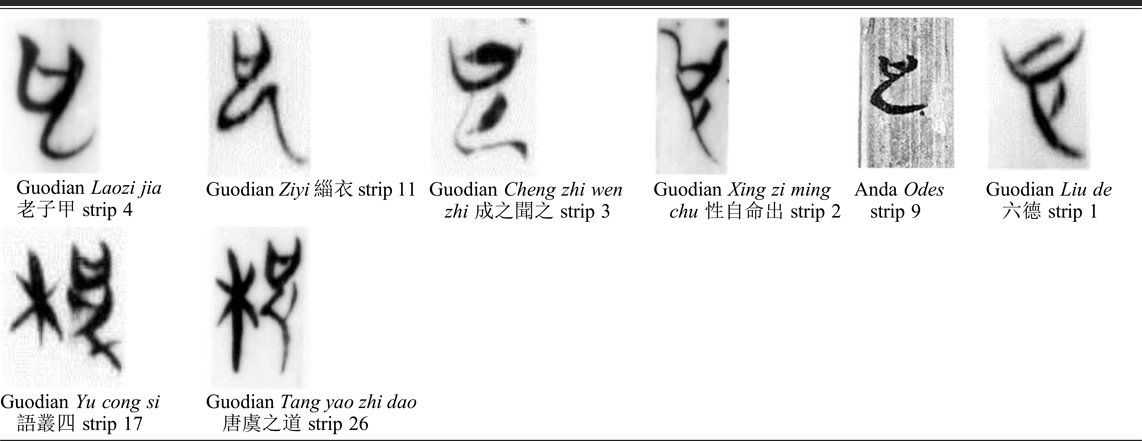
The OC phonology of the word zhi < tsye < *ke 支 ~ 枝 ~ 枳 ~ 胑 “limb, branch” is straightforward to reconstruct. Zhi 只 appears to be the usual phonetic spelling for this word in Warring States period manuscripts. We therefore assume that it regularly spells syllables of the type *KE.Footnote 48 The OC phonological value of ye 也 is admittedly difficult to reconstruct.Footnote 49 Nevertheless, there is no sign that it ever shared the velar stop initial of words spelled with zhi 只. Therefore, rather than seeing the zhi 只 of the Mao Odes as an error for ye 也, it is better to understand the two as writing distinct words, contrasting in this text. Further support for this includes the following observations:
• The graph shi 氏 is known to spell words with velar (or velar cluster) onset and main vowel *e.Footnote 50 Where “Bo zhou” 柏舟 (Mao 45) has zhi 只, the Anda ode has shi 氏.Footnote 51
• 只 *KE would be a regular spelling for 兮 xi < hej < *gˤe, and this probably accounts for most of the sentence-final instances in the Odes and other early received texts.Footnote 52
• In some editions of the Zuo zhuan which quote the phrase le zhi jun zi 樂只君子, the phrase appears as 樂旨君子.Footnote 53 Although their expected syllable types are not identical (Baxter and Sagart reconstruct zhi < *kijʔ 旨 “fine-tasting”Footnote 54), 旨 and 只 both indicate a *K- initial.
• Zheng Xuan asserts unambiguously that the zhi 只 in le zhi jun zi is writing the word shi 是 “this”.Footnote 55 He understands the phrase as “celebrate this noble man”.Footnote 56 Although the demonstrative pronoun shi 是 “this” is often reconstructed with an alveolar stop initial *d- because it spells other words with alveolar stop initials in received texts, the graphs 氏 and 是 are known to alternate in early excavated texts, in writing both shi “clan” and shi (demonstrative pronoun).Footnote 57 It is therefore likely that shi 是 “this” also had some kind of velar or velar-cluster onset, and could be spelled with 只 *KE.Footnote 58
• Making confident acceptability judgements for OC syntax is never easy, especially for the language of the Odes. That said, we can find no examples with ye 也 to match the syntax which would result from reading this line as le ye jun zi, as it appears in the manuscript. Ye 也 is used to expose or topicalize nouns or nominalized phrases, not verbs or verbal predicates.Footnote 59
Taken together, this evidence indicates that the graphic contrast found in the Mao Odes between ye and zhi marks a real linguistic contrast, between the familiar high-frequency particle ye 也 for which there is no evidence of an initial *K-, and one or more other words (likely including xi 兮 and shi 是) which can be regularly spelled with zhi 只 *KE.
The ye 也 in the Anda manuscript in the phrase le ye jun zi is consequently best understood as an error, and likely represents a visual miswriting or miscopying of an original zhi 只. The miswriting could have been introduced either by the hand responsible for the Anda manuscript, or by a hand earlier in the lineage(s) of transmission that led to the Anda version. This is an instance where the Mao Odes preserves better than the Anda manuscript features of a text that was ancestral to both.
Mao zhong gou zhi yan vs. Anda zhong lu zhi yan Footnote 60
The third quadrisyllable of each verse of the received “Qiang you ci” 牆有茨 (Mao 46), zhong gou zhi yan 中冓之言, has produced diverse interpretations.Footnote 61 All agree that this phrase refers to “words” (yan 言) that are somehow too shameful or private to be broadcast. The Mao preface to “Qiang you ci” provides a contextualizing narrative of incestuous relations between a prince of Wei 衛 and his stepmother. Zheng Xuan asserts that the “words” are those spoken by the pair. The difficulty is understanding what is meant by gou 冓. The Mao commentary and Zheng Xuan's imply that zhong gou refers to the interior of the palace, but they fail to clarify the word gou.Footnote 62
The phrase zhong gou zhi yan (or zhong gou zhi shi 中冓之事) became a frozen expression referring to transgressive sexual relationships. Zheng Xuan mentions its use in the context of lawsuits between couples. It appears in a memorial from the end of the Western Han aimed at dissuading the emperor from taking action in a case of incestuous scandal.
是故帝王之意,不窺人閨門之私,聽聞中冓之言。Footnote 63
Therefore, the emperor should not involve himself in spying on people's private matters of the bedroom, listening to any zhong gou zhi yan.
Yan Shigu's 顏師古 (581–645) commentary on the memorial above repeats approvingly the claim by Ying Shao 應劭 (140–206) that zhong gou zhi yan are words uttered by the couple inside some kind of timber construction (cai gou zai tang zhi zhong ye 材構在堂之中也). “Words in the middle of a timber structure” seems exceedingly forced, and its only point of appeal is the identification of gou 冓 with an attested item of vocabulary (gou 構, “timber frame”). The early currency of this strange interpretation indicates the unresolved obscurity of the line. More recent interpretations include “words in the midst of filth [gou 垢, or “shame” gou 詬]”, and “words in the middle of copulation [gou媾]”. Although these fit with a sternly moralistic or sexually explicit reading of the ode, they lack the support of any early commentarial traditions or glosses.Footnote 64
The best-supported reading of gou 冓, in terms of a diverse spread of assertions in its favour by early medieval commentators, is as a word meaning “night”, hence “words in the middle of the night”. The Han 韓 tradition of Odes exegesis, as reported by Lu Deming, glossed zhong gou as zhong ye 中夜.Footnote 65 So too did the Lu 魯 tradition, according to the comment on the edict above by Jin Zhuo 晉灼 (265–316 ce).Footnote 66 The difficulty is that no word pronounced gou and meaning “night” is attested anywhere.
The Anda manuscript provides remarkable new evidence in support of this reading, which in turn raises questions about the transmission of the Odes. In place of the three instances of the graph gou 冓, the Anda “Qiang you ci” has a graph written with xi 夕 over lu 彔.
Almost two decades before the appearance of the Anda manuscript, Huang Tianshu 黃天樹 had identified a word written with a compound of xi 夕 and lu 彔 and meaning “night” in the divination records from Anyang.Footnote 67 That word also typically occurs in collocation with zhong 中, meaning “in the middle of the night”. The Anda editors interpret the manuscript graph xi 夕over lu 彔 with reference to Huang's identification.Footnote 68 Although the gap between the Anyang inscriptions and the Anda manuscript is about seven centuries, and no other instances of this zhong lu “middle of the night” are known from the interim, this does appear to be the best approach to understanding the graph in the Anda manuscript.Footnote 69
Several questions arise about this identification which have implications for our broader enquiry into the transmission of the Odes. Is the gou 冓 of the Mao version writing the same word or a different one, or is it an error of some kind? Which of the two might we expect to find in an earlier version of the ode ancestral to both Mao and Anda?
We can assume that the xi 夕 in the Anda graph is a semantic determinative (shared with other writings for “night” words, like ye 夜 and su 夙) and that lu 彔 is a phonetic speller. Note that exactly the same graph is used to write lu 祿 “salary” in the Guodian Duke Mu of Lu asked Zisi 魯穆公問子思 manuscript (see Table 7). The unmotivated and previously unexplained presence of xi 夕 in the Guodian graph is presumably due to “salary” being spelled with the graph for “night”. This is strong evidence that the phonetic spelling with 彔 of the “night” word in the Anda manuscript is regular. That would indicate a syllable type *ROK, but since we have no Middle Chinese readings for this “night” word it is difficult to narrow down further. Gou 冓 spells syllables of the type *KO. The Anda editors state, with what we feel is misplaced confidence, that “the old sounds of characters with the spellers 冓 and 彔 were close”.Footnote 70 Without some kind of special pleading, spelling a *ROK syllable with a *KO speller would obviously not be regular.
“Night” written 夕-over-彔.

If there were a “night” word spelled as *rˤoks > *rˤos > luwH > lou, then the irregular spelling with *kˤros > kuwH > gòu 冓 could perhaps be explained by resyllabification of zhong-lou < *truŋ-rˤos as zhong-gou < *truŋ-kˤros.Footnote 71 Considering other known examples of resyllabification, and the early commentarial assertions that a word meaning “night” is intended here, we think that this is currently the most satisfactory way of accounting for both the Mao and Anda evidence. If so, the Anda version is in this case more conservative, better representing a meaningful syllabification of the text, while the Mao appears to be an aurally motivated respelling of an obsolete and obscure lexical item.
Broken rhyme patterns in the Anda “Huang niao” 黃鳥
The ode “Huang niao” 黃鳥 (Mao 131) is one of the few to include narrative content supporting the Mao account of its origin. The Zuo zhuan contains an explicit account of the circumstances of its composition in the sixth year of Duke Mu of Qin's 秦穆公 reign (749 bce):
秦伯任好卒,以子車氏之三子奄息、仲行、鍼虎為殉,皆秦之良也。國人哀之,為之賦《黃鳥》。 Footnote 72
When the Elder of Qin, Renhao [Qin Mu Gong], died, they took Yanxi, Zhonghang, and Qianhu, the three sons of the Ziche clan, and buried them with him. They were all good men from Qin. The people of Qin mourned them and composed for them the ode “Huang Niao”.Footnote 73
All three of the Ziche sons’ names appear in the ode, one in each verse. The first name appears as Ziche Yanxi 子車奄息 in Mao 113 and the Zuo zhuan, but as Ziche Yansi 子車奄思 in the Anda manuscript.Footnote 74 As is usual with the Mao Odes and Anda manuscript, the two versions of “Huang niao” are orthographically different but linguistically identical apart from this alternation between xi 息and si 思 (and a permutation of the order of the verses, which we discuss below). The graphs are visually similar in Chu manuscripts (Table 8). Their OC pronunciation is similar: *sək and *sə. Although their forms and the words they write are distinct, one could be mistaken for the other in a sight-copying error, and also as a miswriting when composing a text or writing from memory.
Si 思 and xi 息

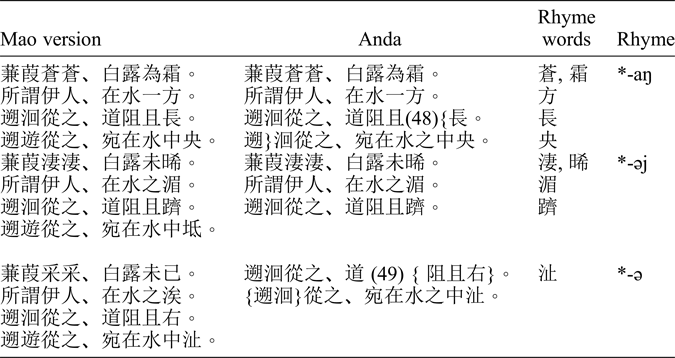
“Jian Jia”
In this case we can say with confidence that the xi 息 of the Mao version is original and that the Anda si 思 an error, almost certainly introduced during the production of the Anda manuscript itself. This is clear from the way in which it breaks the regular rhyme scheme. The second syllable of each of the three sons’ names rhymes with a plant and a martial attribute in a metrical and rhyming scheme which is repeated strictly in each verse. Zhonghang 仲行 rhymes as *-aŋ, with sang 桑 “mulberry” and fang 防 “protection”. Qianhu 鍼虎 rhymes as *-a, with chu 楚 “thorn bushes” and yu 禦 “repel”. Yanxi 奄息, spelled correctly, rhymes as *-ək, with ji 棘 “thorn bush” and te 特 “singular, unique”.
The scribe that produced the Anda manuscript would have been aware that there was a metrically strict rhyme scheme to be followed and that the pronunciation of the common word si 思 “think” did not fit that rhyme. It seems clear, then, that the scribe's linguistic memory of the name Yanxi was correct: he intended to write the xi < *sək of the Mao version, but his graphical memory failed and he substituted the visually and phonically proximate high-frequency graph si < *sə 思 in its place.
Broken rhyme pattern in “Bao yu 鴇羽”
Another error, visible in the way in which it disrupts the rhyme scheme, occurs in the third verse of the Anda “Bao Yu” 鴇羽 (Mao 121).Footnote 75 Each verse has a regular five-word rhyme sequence, shangsheng *-aʔ for the first verse, pingsheng *-aŋ for the second, and *-ək for the third. Most of the language repeats from verse to verse, with only the rhyming words changing. The ode complains that because of the “king's affairs” (wang shi 王事) “it is not possible to plant grain” (bu neng yi ji shu 不能蓺稷黍). In the first verse, shu < *s-tʰaʔ 黍 “millet” rhymes regularly as *-aʔ. In the second verse, this becomes bu neng yi dao liang 不能蓺稻粱 with liang < *raŋ “sorghum (?)” matching the *-aŋ rhyme for the verse.Footnote 76 To maintain the *-ək rhyme for the third verse, a third version of this line ending in *-ək is required. The Mao version does this with bu neng yi shu ji 不能蓺黍稷 (ji < *tsək 稷 “millet”). The manuscript instead just repeats the line from the first verse without inverting ji 稷 and shu 黍,Footnote 77 breaking the rhyme scheme. This, again, must be an error introduced during the production of the Anda manuscript. Errors like this, affecting the rhyme in an obvious and easily corrected way, are inherently unlikely to be transmitted.
Missing content in “Jian jia 蒹葭”
The ode “Jian jia 蒹葭” (Mao 129) is another example where variation between the Anda manuscript and the Mao Odes is evidently due to an error by the Anda scribe (rather than, e.g., a long-standing divergence of Odes traditions, or deliberate modification of material). The error involves the omission of a section of the ode almost as long as an entire verse. The scribe skipped from the middle of verse two to the middle of verse three, confused by the recurrence of a line that repeats in each of the verses. As with “Huang niao” just discussed, this must be an error because it disrupts the rigidly observed rhyme and meter in an ode that is otherwise almost linguistically identical to its Mao counterpart.
The Mao “Jian jia” uses first su hui cong zhi 遡洄從之 and then su you cong zhi 遡遊從之 in each verse, both meaning “Going against the current I follow him”, whereas the manuscript simply repeats the first version of this phrase twice in each verse (Table 11). This repeating phrase appears to be the stumbling block that led the scribe to skip a large segment of the text, 25 written characters and 26 syllables. This results in three lines in a row beginning su hui cong zhi 遡洄從之 instead of two, and a verse that begins with rhymes in *-əj and ends with an *-ə rhyme. The Mao version is completely regular: 5 pingsheng *-aŋ rhymes in the first verse, 5 pingsheng *-əj rhymes in the second, and 5 shangsheng *-ə rhymes in the last.Footnote 78
The ode “Jian jia” is on strips 48–50 of the manuscript. In this section, the average number of graphs per strip is consistently in the high 30s. Nowhere in the manuscript does the count of graphs per strip drop as low as 25 (except where blank space is left at the end of a Guo feng section). Thus, the 25 graphs missing from “Jian jia” are not due to a strip being omitted from the manuscript before the serial numbering and binding. Conceivably, the scribe skipped a strip while mechanically sight-copying from another manuscript with 25 graphs per strip. However, we think that the scribe was distracted by the repetitiveness of su hui cong zhi 遡洄從之 so as to make the skip during recall of the text from memory. Whichever is the case, the mistake would not have survived careful proofreading.
Resyllabification of “Zouyu 騶虞”
There are several instances where the Anda manuscript divides syllables differently from the received version of the text. We have already suggested that this is the case with zhong gou 中冓 in Mao 46 (above). This can involve one syllable being written as though it were two, or vice versa. In other cases, we find transference of a segment or a phonological feature in one direction or another between the coda of one syllable and the initial of the syllable which follows it. Although it might conceivably have affected the understanding of an ode, in the tradition represented by either Mao or the Anda manuscript, it arises through differing orthographic solutions to the problem of how to spell the same linguistic sequence. Such cases should be handled differently from genuine examples of lexical variation between the two versions, and should be set aside when assessing the degree to which two versions of an ode can be said to be distinct compositions.
The Mao tradition tells us that the zou yu 騶虞, which appears in each verse of the ode of the same name (Mao 25), is a “righteous animal” (yi shou 義獸), something which is not at all self-evident from the text of the ode itself.Footnote 79 The Anda manuscript does not support or contradict this puzzling identification, but it does present an example of resyllabification in its writing of this word. The first graph in the Anda writing is 從, which most often writes cong < *dzoŋ “to follow”, but which could regularly spell any syllable of the type *TSONG. The second graph is 虎-over-口, which in Chu manuscripts usually writes the particle 乎 hu < *ɢˤa. The word as it appears in the Mao orthography is zou yu < *tsˤro-ŋʷa 騶虞. It is clear from the reconstructions that this is an orthographic difference in syllabification, with the *-ŋ being treated as the coda of one syllable in the Anda spelling, and the initial of the second syllable in Mao.Footnote 80
Resyllabification in Mao of fu de 弗得 as bu de 不得
Where the Mao “Guan ju” has qiu zhi bu de 求之不得 “does not find her”, the manuscript writes fu 弗 in place of bu 不. This is best understood as an instance of orthographic variation, with the manuscript using a different writing for the same underlying linguistic expression, arguably a “better” and more linguistically transparent one. The Anda fu de is writing the contraction of a negated verb phrase in which the third person object pronoun has been preposed, that is, a contraction of the form *pә-tә-tˤәk 不之得 to *pәt-tˤәk 弗得. Taken at face value, the Mao writing for this phrase appears to have omitted the preposed pronoun, writing *pә-tˤәk 不得 “does not find”. However, we can understand this as an example of varying syllabic spelling, in which the *t- initial of the second syllable does double duty for the *-t final of the first.
Alternation of yan 言 and wo 我
On several occasions in the Mao Odes, Zheng Xuan glosses the graph yan 言 as wo 我, and paraphrases as though the first person pronoun were intended. One of those occasions is in the first verse of “Xiao rong 小戎” (Mao 128), where the Mao text reads yan nian jun zi 言念君子. Zheng's annotation is explicit: “yan, wo ye 言,我也”.Footnote 81 The Anda “Xiao rong” has the graph wo 我 for each of the three repetitions of this phrase. Resyllabification may have played a role here. The Anda manuscript syllabifies as *ŋˤajʔ-nˤims 我念 “I think of”, while the Mao text may have resyllabified, writing an *-n coda on the first syllable as well as the *n- initial on the second: *ŋan-nˤims 言念.
Another possibility is the use of yan 言 to write a particle meaning something like “and so” or “and then”, similar to yan 焉 or yuan 爰. Several other examples of this particle written with yan 言 appear in the Mao Odes.
Telling these two apart is made additionally complicated by a reversal in the opposite direction in the ode “Yuan you tao 園有桃” (Mao 109).Footnote 82 Mao reads wo ge < *ŋˤajʔ-kaj 我歌 “I sing” while the manuscript reads yan ge < *ŋan-kaj 言歌 “and so [I] sing”.Footnote 83 Here there seems no possibility of this variation being due to spellings crossing a syllable boundary, and some other account is necessary. There is good evidence for a generalized merger of the rhymes *-an and *-aj in the Qi 齊 (i.e. modern Shandong) region.Footnote 84 This may indicate that for some learners of the Odes, yan 言 and wo 我 were not perceived as writing distinct phonetic values.
Fusions with he 何
A simpler and obvious case of orthographic resyllabification occurs in “Shan you shu 山有樞” (Mao 115). The three verses follow a strictly recurring meter and rhyme pattern with only one blemish: the line he bu ri gu se 何不日鼓瑟 “why not daily strike your zither?” in the third verse has five orthographic syllables where the scheme followed in the previous verses demands four. As is well known, he bu *gˤaj-pә 何不 “why not” also exists as the contraction he *gˤap 盍, which is what we find in the manuscript, restoring metrical regularity. In fact, the line should probably be thought of as linguistically (and therefore metrically) identical in the two versions, and the variation merely a matter of orthography.
The roles of Mao and the manuscript are exactly reversed in “You di zhi du 有杕之杜” (Mao 123). The meter of the Mao version is regularly tetrasyllabic for all of its 12 lines, including the line he yin shi zhi 曷飲食之 “how shall I give him food and drink?”, which occurs twice. The manuscript writes both occurrences as he yi yin shi zhi 何以飲食之, with he yi < *gˤaj-ləʔ 何以 in place of the contracted he < *gˤat 曷.
Ci 茨 vs. ji li 蒺藜 “Tribulus”
A final candidate for linguistic or orthographic resyllabification is the plant in the title and first line of “Qiang you ci 牆有茨” (Mao 46). The Mao version writes ci < *dzij 茨, which the Mao commentary glosses as jili < *dzit-rˤij 蒺藜 “tribulus terrestris, puncture vine”. The Anda manuscript has these two orthographic syllables in place of the one in Mao: qiang you ji li 牆有蒺藜, with the onset of the first syllable *dz- matching the onset of the Mao syllable, and the rhyme of the second syllable *-ij matching the rhyme of the Mao syllable.Footnote 85 The phonological similarity between the monosyllabic and bisyllabic forms makes it especially likely that these forms are of common origin, and that the difference between the manuscript and Mao arose through orthographic resyllabification of a syllable that was undergoing dimidiation.Footnote 86 It is interesting to observe the appearance of what might be expected to be the less conservative writing (with two orthographic syllables) in the Anda manuscript, contrasting with the more conservative writing in the supposedly later received Odes. Clearly, datable manuscripts provide important evidence for tracking the history and geography of this and other linguistic changes. However, for our purposes here it is sufficient to note that behind the very different orthography of Mao and Anda lies a single lexical item: the text is fundamentally linguistically stable between the two versions.
Changes in grammaticalized particles
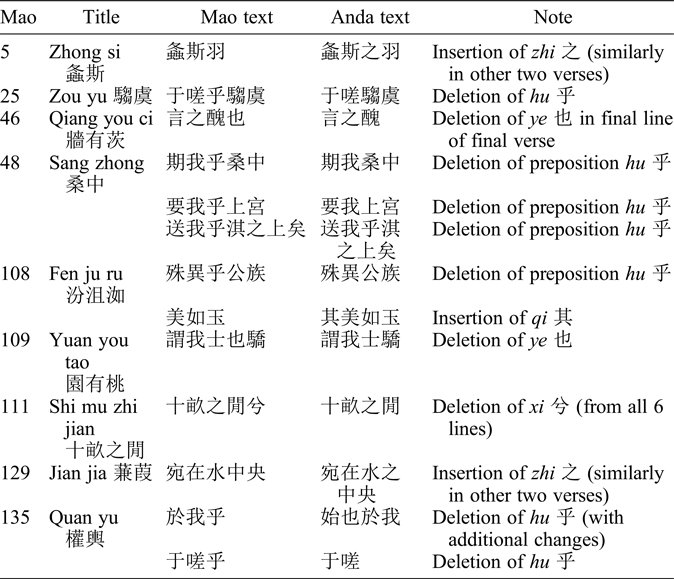
The biggest source of variation between the Mao and manuscript versions of odes, on the level of individual words, is the addition, removal or substitution of grammatical particles. These changes take place with a much greater degree of freedom than changes in semantically referring lexical items. This probably reflects several things, such as the absence of metrical stress on these particles, and their greater variation in the dialects of Odes learners at different times and places compared with semantically full lexical items. Although the addition or removal of particles changes the count of orthographic syllables per line, we suspect that the count of stressed syllables, and therefore the meter of an ode, was unchanged. From the point of view of linguistic stability of the Odes text, variation in grammaticalized particles is of minor importance, and arguably a largely orthographic phenomenon.
In Table 10 we provide a non-exhaustive list of odes affected by changes in grammaticalized particles. A number of tendencies emerge. The most obvious is the systematic deletion of hu 乎: all instances, of both the preposition and the phrase-final particle, are deleted in the Anda version, and no new ones are introduced.
Changes in grammaticalized particles.
Permutation of verses
Given the low degree of linguistic variation between the Anda manuscript and the Mao Odes, and the fidelity in the grouping and ordering of odes within Guo feng sections, it is remarkable how often verses are permuted with respect to the received versions. There are 16 odes with permuted verses, a quarter of the number in the Anda manuscript (Table 11).Footnote 87
Verse-order permutations

Permutation in verse order is not confined to the Anda Odes. The version of the “Xi shuai” ode in the manuscript Qi ye 耆夜 in the Tsinghua collection has three verses in a sequence distinct from both Mao and Anda. A recent publication of the tables of contents from the Haihun Hou Odes displays the same pattern.Footnote 88 It remains an open question whether this variation in verse order reflected different transmission lineages, or whether variation was tolerated within some of these traditions. That is to say, we cannot tell whether the specific verse order found in the Anda version was unique to that manuscript, or whether it was common to all copies (or recitations) of the Odes in the same transmission lineage.
Nevertheless, we suspect that the particular verse order permutations in Table 11 are unique to the Anda manuscript and reflect idiosyncratic recall from memory by the scribe. One characteristic of the Guo feng division of the Odes is the absence of narrative (of the kind that is found in many of the Zhou ancestral hymns elsewhere in the collection) or any other kind of sequential development across verses.Footnote 89 The verse permutations in Table 11 have no significant effect on the expository or aesthetic impact of those odes. This also means that these odes have few built-in cues to help with memorizing and recalling the verse sequence. Repetitive meter and rhyme bind the linguistic content within a verse in a rigid framework, accidental departures from which would tend to be self-evident and self-correcting. This would support the linguistic stability we observe between the Anda and Mao versions even if the Anda manuscript was – as we have suggested – produced substantially from memory. The order of the verses, by contrast, is not constrained in the same way, and so shows greater fluidity during recall.
Another “cricket” with consequences
The ode “Xi shuai 蟋蟀” (Mao 114) is remarkable as the only Guo feng ode for which we have two Warring States manuscript versions to compare with the received Mao text: the Qi ye manuscript at Tsinghua University and the Anda manuscript. In terms of syllable-for-syllable similarity, the Anda version and the Mao version are close, and the “Xi shuai” embedded in the Qi ye manuscript more of an outlier. Comparison of these three versions is inevitably pivotal for any discussion of the nature of the Odes and the circumstances of their transmission.
Martin Kern has adopted a distinctive position regarding the composition of “Xi shuai” in his study comparing the Qi ye and Mao versions, a position that dissolves altogether the notion of a single “Xi shuai” ode with multiple varying exemplars.
[T]here is no single poem; there are various realizations of poetic material under the title “Cricket” that took shape as multiple parallel, mutually independent texts, allowing for multiple hermeneutic possibilities. The title “Xi shuai” does not signify a single poem; it signifies a multiplicity of poetic expressions or, more precisely, a poetic discourse from which multiple different expressions could be generated.Footnote 90
We are sympathetic with this statement as an assertion of the high degree of variation between the Qi ye and Mao “Xi shuai” exemplars, against the background of textual fluidity in other early Chinese texts.Footnote 91 However, without a clear specification of what a Warring States period manuscript ode would have to look like in order to be, with its Mao parallel, “a single poem”, this claim is unfalsifiable. We are also sceptical of the idea that textual variation between the three “Xi shuai” versions is best explained as “a multiplicity of poetic expressions”. Rather than belletristic creativity, we find more probable sources for variation between the three exemplars in the same factors that we have drawn attention to throughout this paper, namely errors in memory and performance, imperfect acquaintance with a difficult and already ancient text, varying standards of orthography, and fluidity in areas where fluidity was expected (like verse order and the notation of extra-metrical grammatical particles). We find creativity in the ways in which learners of the Odes exploited them in speeches and writing, and ingenuity on the part of commentators trying to make sense of them, but evidence for creative literary innovations in the text itself during the Warring States period seems slight.
As with the other odes represented in the Anda manuscript, the current evidence points to an essentially stable “Xi shuai” text that was already old in the north, and widely learned, written, performed, and interpreted by 300 bce in Chu. Here we examine the particular differences with the Mao text found in the Anda manuscript. A three-way comparison including the Qi ye version would be desirable, but is for now beyond our scope.
The three verses of the Mao “Xi shuai” are almost exact repetitions of each other, save for the rhyming words every eighth syllable, shown with X in the schema below. The only departure from this verse-to-verse repetition is in the fifth and sixth syllable of the last verse, where we find yi che 役車 “the laborers’ wagons” in place of the lexically and phonologically unrelated sui yu 歲聿 “the year (particle)”.
-
Line 1 蟋蟀在堂、歲聿其X。
-
Line 2 今我不樂、日月其X。
-
Line 3 無已大康、職思其X。
-
Line 4 好樂無荒、良士XX。
The rhymes for each verse appear to be regular: qusheng *-a in the first verse,Footnote 92 qu/rusheng *-ats in the second, and pingsheng *-u in the last. The tang 堂, kang 康, and huang 荒 at the ends of the half-lines could be understood as forming a secondary rhyme in *-ang, but they do not change from verse to verse.
Turning to the Anda manuscript, in the 27 syllables of the thrice-repeated verse schema, we can find only two syllables that could be argued to be lexical differences, and neither has implications for the expressive or aesthetic impact of the ode. The Mao jin wo bu le 今我不樂 “If now we do not celebrate”, appears in the manuscript as jin zhe bu le 今者不樂. This is more than an orthographic difference. However, the presence of the same jin zhe bu le 今者不樂 twice in an ode on the same topic – “if we do not celebrate now, the years will pass (shi 逝) us by” (Mao 126, “Che lin 車鄰”) – earlier in the manuscript indicates that the distinction between zhe and wo here was likely not a memorable contrast.
The only other lexical difference in the verse schema is where Anda has 猷, presumably you < *ɢu 猶 “still, yet”, and Mao has zhi < *tәk 職, which Zheng Xuan and the Mao commentary ask us to understand as “primarily” (zhu 主). Similarly, the impact of “Xi shuai” is not greatly affected by this change.
All other variation is, we think, orthographic only. Two instances are irregular writings, and we point these out only to clarify that they are not meaningful differences in the underlying text of the two versions. Writing da 大 as nei 内 in the first verse is clearly a simple slip of the brush on the part of the Anda scribe. Writing wu huang < *ma m̥ˤaŋ 無荒 “without abandon” as 母無 in all three verses is also a spelling error by the scribe, but requires more elucidation.
As is well known, the existential negative wu < *ma which we are used to seeing written 無 in received orthography, is usually written 亡 in Warring States Chu manuscripts, and consistently so in the late second millennium divination records from Anyang. Since 亡 spells syllables of type *MANG and 無 (in origin the “dance” 舞 pictogram) spells syllables of type *MA, we have an irregular spelling relationship. The neatest account of this irregularity is to think of the negative existential wu < *ma as derived from the full verb wang < *mang “lose (etc.)” through a process of grammaticalization and phonological reduction involving the irregular loss of final *-ng. That irregular change must have begun for some speakers in the early first millennium bce, since there are a few examples of the “dance” pictogram writing the negative existential verb at that date.Footnote 93 It left users of the script with, in effect, a choice: retain a conservative irregular spelling with 亡, adopt a now-regular but historically “incorrect” spelling with 無, or enforce a conservative pronunciation of the existential negative when reading from texts where it is spelled with 亡. Different choices were probably made in different contexts, depending on the speakers and the kinds of texts involved. The choice to spell the existential negative with 無 eventually won out, but Warring States manuscripts precede this resolution. Both the received Odes and the manuscript versions show the orthographic legacy of all three solutions having been tried.Footnote 94 A different but similar question of syllabic spellings is involved in the alternation of the phonetic spellers 母 and 無.Footnote 95 All learners of the Odes who were working with a written copy would have confronted this and other similar questions.
Returning to the problem of “Xi shuai”, we think that the scribe or a predecessor in his lineage of transmission was writing wu huang 無荒 “without abandon”, but confused the syllabic values of the spellers 無 and 亡. Spelling huang < *m̥ˤaŋ “abandon” as *MA is really a back-formation from the known use of *MANG to spell the existential negative wu < *ma. Conceivably, this would have led to a reinterpretation of the meaning of this line within a local tradition of Odes learning, but we think it unlikely given that the Qi ye manuscript – close in date and geography – spells the syllable with 亡.Footnote 96
The 27 syllables of the verse schema of the Anda and Mao “Xi shuai” are almost linguistically identical. Mao and Anda both modify the schema for one verse in the same way with yi che 役車 “laborers’ wagons”. The same, broadly, is true of the rhyming words. Anda uses exactly the same rhymes, *-a, *-ats and *-u, although the order of the verses is permuted relative to Mao (as with other Odes, Table 9). Of the 12 rhyming words, only one can confidently be said to be linguistically distinct in the two versions. For two others we should probably remain open-minded, since we are hampered by our imperfect knowledge of the lexical items in question. For example, how confident are we really that the “good man” in liang shi jue-jue 良士蹶蹶 was “actively diligent in his duties” as Zheng Xuan asserts? The reduplicated jue-jue 蹶蹶 is not attested elsewhere in this sense. When the Anda scribe gets to this point in the manuscript, he writes 歲歲. The two writings could spell identical syllables within the system of Baxter and Sagart, but it is ultimately impossible to know whether we are dealing with one obscure word or two obscure words with similar pronunciation.Footnote 97
A similar situation holds with the rhyme word written with 居. Zheng Xuan understands this as writing (as it usually does) ju “abode”, which makes passable sense in context. If that is the word intended by the Anda scribe, his choice of phonetic spelling is strange: 瞿. Although the syllable type is close (*KWA vs. *KA) it would involve the use of a rarer and more complicated graph to spell a word that is routinely written 居 in Chu manuscripts. However, the temptation to see this as a genuine instance of lexical variation is lessened by the presence of exactly the same phonetic speller 瞿 in the rhyme word of the next line (in the reduplicated ju-ju 瞿瞿 “anxious(?)”), in both Mao and in the Anda manuscript. We think it likely that the Anda scribe, in anticipation of the final line, has written 瞿 one line too early.Footnote 98
The only rhyme word that must be judged a lexical variant (if it were not a wild guess by a fallible scribe) is the reduplicated fu-fu < *bu-bu 浮浮, which appears in place of the Mao xiu-xiu < *qʰu- qʰu 休休. It is, however, unclear what this *bu-bu means when describing the “good man” of the “Xi shuai” ode. Elsewhere it describes the motion of rivers, steam or rain.
5. Conclusion
Given the extent and nature of the variation between the Anda Odes and the received Mao text, we are confident that the text of the Odes was fundamentally stable by the fourth century bce.Footnote 99 The orthography of the two versions differs dramatically, as we have learned to expect from Warring States manuscripts with transmitted counterparts. The Anda version is certainly an imperfect text, containing obvious errors. These vary from simple slips of the brush to more substantial failures of competence on the part of the scribe. Once we recognize the role of orthography and scribal competence in producing variation, it becomes clearer that most odes are close to being linguistically identical.
The fallibility of the scribe indicates that the manuscript was produced relying substantially on memory. It reflects the scribe's current state of partial mastery of the Odes, presumably acquired by learning with or emulating someone whose expertise exceeded his own. At least for the Guo feng sections, knowledge of the Odes was acquired Guo feng by Guo feng.Footnote 100 Memorization of the sequence of odes within a Guo feng section was important, since sequences are a way of avoiding omissions. We think it likely that learners of the Odes reproduced the text from standard lists of ode titles which they memorized. These titles, usually based on words from the opening line, were well established by the fourth century bce, and are common to the Anda manuscript, the Mao Odes, and citations in other texts. Meter, rhyme, and patterns of repetition from verse to verse ensured that the text within each verse was reliably established. Other features that were not controlled by memorized cues, such as the sequence of verses within an ode, were more free to vary during recall.
This textual stability and emphasis on memorization make it unlikely that the text of the Odes was subject to any kind of creative reworking. At this date and subsequently, creative approaches to the Odes were confined to interpretation of an essentially fixed text, and imagining the source and motivation for its original composition, and did not extend to modifications of its language.
The presence of written copies that served to maintain the stability of the Odes coexisted with a tradition of memorization and oral performance of the Odes.Footnote 101 We know from Warring States literature that citation of odes in extempore court speech was a prized skill. It was expected that a known repertoire of odes would be quoted and recognized in courtly speech and in prose compositions allied with that tradition of courtly persuasion and argument.Footnote 102 The Anda manuscript demonstrates the use of writing and documentary conventions to establish linguistic and organizational stability in a large text. A written manuscript was an indispensable tool to support the Odes learner's task of memorization, and perhaps a way of demonstrating that the task had been achieved.


 Open access

