



High consumption of sugar-sweetened beverages (SSB) is an important public health problem in Mexico. SSB have been recognized as a major driver of long-term weight gain, increased risk of type 2 diabetes and increase in cardiometabolic risk factors( Reference Hu 1 – Reference Malik, Popkin and Bray 5 ). The association between SSB and weight gain is due, at least partly, to the incomplete compensatory reduction in energy intake following consumption of caloric beverages and their high sugar content that affects secretion of hormones, especially insulin( Reference Malik, Popkin and Bray 5 – Reference Lana, Rodriguez-Artalejo and Lopez-Garcia 9 ). Moreover, SSB may increase risk of type 2 diabetes independently of adiposity due to their high glycaemic load that leads to insulin resistance and impaired pancreatic β-cell function( Reference Malik, Popkin and Bray 5 , Reference Teshima, Shimo and Miyazawa 8 – Reference Imamura, O’Connor and Ye 10 ).
Mexico has one of the highest prevalences of excess body weight in the world, with 34·4 % of school-aged children, 34·9 % of adolescents and 71·3 % of adults presenting overweight or obesity( Reference Barquera, Campos-Nonato and Hernandez-Barrera 11 , Reference Hernandez-Cordero, Cuevas-Nasu and Morales-Ruan 12 ). Excess body weight has increased significantly during the last two decades. For school-aged children, overweight and obesity prevalence went from 26·8 to 34·4 % in a span of 13 years, increasing by 0·6 percentage points (pp) on average per year. Likewise, energy intake from beverages increased significantly from 1999 to 2012( Reference Stern, Piernas and Barquera 13 ). In 2012, SSB contributed 9·8 % of total daily energy intake( Reference Aburto, Pedraza and Sanchez-Pimienta 14 ) and were the main source of added sugars( Reference Sanchez-Pimienta, Batis and Lutter 15 ). Consequently, reducing intake of SSB has been the target of several policy measures in Mexico( Reference Barquera, Campos and Rivera 16 ). In 2008, the Mexican Health Ministry summoned an expert panel to develop recommendations on beverage intake for a healthy life( Reference Rivera, Munoz-Hernandez and Rosas-Peralta 17 ). In 2010, sale of sodas and other packaged SSB were banned from elementary schools( Reference Barquera, Campos and Rivera 16 ). And in 2014, an excise tax of 1 peso per litre (10 % price increase approximately) on manufactured non-dairy and non-alcoholic beverages with added sugar and an 8 % tax on non-basic energy-dense foods were implemented( Reference Colchero, Popkin and Rivera 18 , Reference Batis, Rivera and Popkin 19 ). Analysis of the impact of the SSB tax showed a decrease in purchases of taxed SSB, especially among low-income households( Reference Colchero, Popkin and Rivera 18 ).
Previous analyses of SSB intake prior to tax implementation and its trends over time have focused on mean intake( Reference Stern, Piernas and Barquera 13 , Reference Barquera, Campirano and Bonvecchio 20 , Reference Barquera, Hernandez-Barrera and Tolentino 21 ); however, analysis at the mean might miss the potentially widening distribution of intake( Reference Mendez, Sotres-Alvarez and Miles 22 ). This is highly relevant considering that negative health effects of SSB are expected to be higher among high consumers( Reference Yang, Zhang and Gregg 23 ). Moreover, increases in SSB intake observed from 1999 to 2012 could have occurred differently across population subgroups. Mean intake could increase by increasing the proportion of consumers, by increasing amounts consumed, or both. And importantly, significant increases could have occurred among high consumers. Therefore, the purpose of the present study was to describe trends across the intake distribution of total SSB, manufactured SSB (potentially taxed) and homemade SSB (potentially untaxed) from 1999 to 2012, focusing on high SSB consumers and on changes by socio-economic status (SES) subgroup.
Methods
Design and sample
The 1999 Mexican National Nutrition Survey (ENN-99 (its acronym in Spanish)) and the 2012 Mexican National Health and Nutrition Survey (ENSANUT 2012 (its acronym in Spanish)) are probabilistic population-based surveys with a multistage, stratified sampling design, representative at the national and regional levels and for rural and urban areas. Detailed sampling procedures for both surveys are described elsewhere( Reference Resano-Perez, Mendez-Ramirez and Shamah-Levy 24 , Reference Romero-Martinez, Shamah-Levy and Franco-Nunez 25 ). Briefly, the ENN-99 was conducted between October 1998 and March 1999. It collected information from 21 503 Mexican households, with a response rate of 82·3 %. Due to budget restrictions, it included only pre-school and school-aged children (aged 1–11 years) and adolescent and adult women in reproductive age (aged 12–49 years)( Reference Resano-Perez, Mendez-Ramirez and Shamah-Levy 24 ). The ENSANUT 2012 was conducted between October 2011 and May 2012, and collected information from 50 528 households with a household response rate of 87·0 %( Reference Romero-Martinez, Shamah-Levy and Franco-Nunez 25 ). Detailed dietary information was obtained for a sub-sample in both surveys using a single 24 h recall.
For trend analyses, we restricted samples from ENN-99 and ENSANUT 2012 to population subgroups included in both surveys: school-aged children (5–11 years) from both sexes and women (20–49 years) with complete dietary and socio-economic data (n 7718). On the other hand, for SSB intake prior to tax implementation, we used all age–sex subgroups from ENSANUT 2012, which consisted of pre-school children 1 year or older who were not being breast-fed (1–4 years), school-aged children (5–11 years), adolescent (12–19 years) and adult (≥20 years) males and non-pregnant, non-lactating adolescent and adult females with plausible dietary intake and complete socio-economic information (n 10 096)( Reference Lopez-Olmedo, Carriquiry and Rodriguez-Ramirez 26 ).
Dietary assessment
The 24 h recall was collected in person by trained interviewers. Participants were asked to report foods and beverages consumed the previous day at home and away from home, as well as the amount consumed (pieces, household measures, grams or millilitres). In the ENSANUT 2012 an automated five-step multiple-pass method was used( Reference Lopez-Olmedo, Carriquiry and Rodriguez-Ramirez 26 ), while the methodology for the ENN-99 was a traditional printed questionnaire with similar probes to the multiple-pass method. Participants could report their intake as individual foods or beverages (e.g. chips or soda) or mixed dishes/beverages (e.g. soup or smoothie). Mixed dishes/beverages could be then disaggregated to their ingredients if the participant knew the amounts of each ingredient used in their preparation; or could be recorded as a standard preparation if the participant consumed the dish/beverage away from home or if she/he did not know the recipe. Additionally, participants were asked about foods and beverages consumed between principal meals. Interviewers were trained in techniques to assist participants avoid omissions and were provided with a food scale, measuring cups and serving spoons to help with the estimation of portion sizes. For children younger than 12 years, the person responsible for food preparation was interviewed, with information completed by the child for food consumed away from home. The 24 h recall in ENSANUT 2012 was collected between Monday and Sunday, while in ENN-99 it was collected on weekdays only.
Beverage classification
For the present analysis, we defined SSB as any non-dairy beverage with sugar added either during industrial production or during preparation at home. Commercially prepared and packaged soft drinks, fruit juice beverages, vegetable juice beverages, flavoured waters (ready-to-drink and prepared from syrup or powder), iced teas, soya drinks, and sports and energy drinks were classified as manufactured SSB. ‘Aguas frescas’ (traditional Mexican beverages usually prepared with water, fruit and sugar), ‘atole’ (cornmeal beverage prepared with water and sugar) and homemade coffee or tea with sugar were considered homemade SSB. Energy content of beverages was estimated based on the millilitres reported and using the 2012 food composition table compiled by the National Institute of Public Health (Nutrient Database, Compilation of the Mexican National Institute of Public Health, unpublished material, 2012) for both surveys to maintain comparability between the two samples. Those who consumed ≥21 kJ (≥5 kcal) from manufactured SSB or homemade SSB on the recall day were classified as consumers of manufactured SSB or consumers of homemade SSB, respectively. Consumers of SSB were defined as those who consumed ≥21 kJ (≥5 kcal) from manufactured and/or homemade SSB on the recall day.
Sociodemographic information
For both surveys, geographic region was classified as North, Central or South (states by region: North=Baja California, Baja California Sur, Coahuila, Chihuahua, Durango, Nuevo Leon, Sonora and Tamaulipas; Central=Aguascalientes, Colima, Estado de Mexico, Guanajuato, Jalisco, Mexico City, Michoacan, Morelos, Nayarit, Queretaro, San Luis Potosi, Sinaloa and Zacatecas; South=Campeche, Chiapas, Guerrero, Hidalgo, Oaxaca, Puebla, Quintana Roo, Tabasco, Tlaxcala, Veracruz and Yucatan). Urbanicity was dichotomized into rural and urban areas. Locations with fewer than 2500 inhabitants were classified as rural and otherwise classified as urban. SES was assessed using principal components factor analysis based on household characteristics and assets; households were then categorized in tertiles. Educational level of adults was classified into four groups: lower than elementary school; finished elementary school; finished middle school; and finished high school or higher (including normal and technical high school).
Statistical analysis
Analyses were conducted using the statistical software package Stata version 14 and were weighted to be nationally representative and to account for the complex survey design. First, we estimated trends in per-capita and per-consumer SSB energy intake distribution (kcal/d) from 1999 to 2012 for school-aged children and women (20–49 years) and the three categories of SSB (total, manufactured and homemade) using pooled data from both surveys and quantile regression models at the 50th, 75th and 90th percentiles( Reference Cade and Noon 27 , Reference Koenker and Hallock 28 ). Models for school-aged children were adjusted by SES, age in years and squared age, sex, geographical region, urbanicity and weekend. Interactions between survey year and SES were included to test whether changes in per-capita intake were significantly different by SES. Models for women were adjusted by SES, age (modelled as restricted cubic splines with four knots), educational level, geographical region, urbanicity and weekend, with the same pooling and year interaction terms. To determine the best functional form for age, we fitted a linear regression model for each age group with the variable modelled as linear, quadratic, restricted cubic spline and categorical. The selection of the most appropriate functional form was based on the model that minimized the Akaike information criterion and for which predicted values fitted the Lowess plot better. To test the significance of differences in changes in SSB energy intake between 1999 and 2012, we predicted energy intakes using Stata’s margins command with the dydx option. Bootstrapped se were calculated with 100 replications to account for the complex survey design and a P value of 0·05 with Bonferroni’s correction for multiple comparison was used to define statistical significance.
Second, we described per-capita and per-consumer SSB energy intake distribution from 2012 for the three categories of SSB. For each category we conducted quantile regression models at the 50th, 75th and 90th percentiles of energy intake. Analyses were stratified by age group and, for adolescents and adults, also by sex. Quantile regression models were adjusted by sex (for pre-school and school-aged children), geographical region, urbanicity, SES, educational level (only for adults) and weekend days (Friday through Sunday). Predicted energy intake estimates were obtained from the quantile regression models and bootstrapped se were calculated with 100 replications to account for the complex survey design.
Informed consent was obtained for participants aged 18 years or older, and from the parent or guardian of participants younger than 18 years. Assent was obtained for children and adolescents from 5 to 17 years. The survey was approved by the Research, Biosafety, and Ethics Committees at the National Public Health Institute in Cuernavaca, Mexico.
Results
Sociodemographic characteristics of the ENN-99 and ENSANUT 2012 samples are presented in Table 1. The ENN-99 sample and the restricted sample from ENSANUT 2012 include only school-aged children and women aged 20–49 years, thus proportions by age groups and sex reflect selection criteria. Both surveys had a similar proportion of participants by region and urbanicity. An increase in educational level from 1999 to 2012 (restricted sample) was observed among women aged 20–49 years. Since SES was categorized in tertiles for each survey, the proportions were also similar between surveys. The complete sample from ENSANUT 2012 included all age groups and a similar proportion of males and females, with a higher proportion of participants living in urban v. rural areas and in the Central region v. other geographic regions.
Sociodemographic characteristics of participants by analysis inclusion from ENN-99 and ENSANUT 2012

ENN-99, 1999 Mexican National Nutrition Survey; ENSANUT 2012, 2012 Mexican National Health and Nutrition Survey.
† ‘ENSANUT 2012: sample used for trend analysis’ presents characteristics for school-aged children (5–11 years) and women aged 20–49 years.
‡ Values are unweighted sample size and weighted percentages.
§ Educational level is only from adults (≥20 years).
Trends in sugar-sweetened beverage intake distribution
From 1999 to 2012, the proportion of consumers of total SSB increased by 5·7 pp, from 70·2 to 75·9 % (Table 2). While the proportion of homemade SSB consumers remained similar between years (43·3 % in 1999 and 46·3 % in 2012), the proportion of consumers of manufactured SSB increased from 38·6 % in 1999 to 49·3 % in 2012, an increase of 10·7 pp. The highest increases in the proportion of consumers of manufactured SSB were in rural areas, from 26·6 to 41·3 %, and in the low-SES group, from 24·4 to 43·1 %, an increase of 14·7 and 18·7 pp, respectively.
Proportion of consumers of sugar-sweetened beverages (SSB) by type of SSB, survey year and sociodemographic characteristics for school-aged children and women from ENN-99 and ENSANUT 2012

ENN-99, 1999 Mexican National Nutrition Survey; ENSANUT 2012, 2012 Mexican National Health and Nutrition Survey.
*P < 0·05 for comparison between ENN-99 v. ENSANUT 2012 consumers, with Bonferroni’s correction for multiple comparisons.
† ‘ENSANUT 2012: sample used for trend analysis’ presents characteristics for school-aged children (5–11 years) and women aged 20–49 years.
‡ Consumers of total SSB includes consumers of either manufactured or homemade SSB. Manufactured SSB include: soft drinks, packaged fruit juice beverages, packaged vegetable juice beverages, flavoured waters (ready-to-drink and prepared from syrup or powder), iced teas, soya drinks, and sports and energy drinks. Homemade SSB include: ‘aguas frescas’ (beverages prepared with water, fruit and sugar), ‘atole’ (cornmeal beverage) and homemade coffee or tea with sugar.
§ Values are weighted percentages.
║ Educational level is only from adults (≥20 years).
Increases in per-capita and per-consumer SSB energy intake were observed from 1999 to 2012 among school-aged children and women (Table 3). Significant increases in energy intake from total SSB were estimated at the 50th, 75th and 90th percentiles for both age groups, with larger increases towards the high end of the distributions. Among school-aged children, per-capita energy intake from SSB increased by 142 kJ/d (34 kcal/d) at the median (P < 0·001), 247 kJ/d (59 kcal/d) at the 75th percentile (P < 0·001) and 397 kJ/d (95 kcal/d) at the 90th percentile (P < 0·001). Similar increases were estimated among consumers (142, 230 and 406 kJ/d (34, 55 and 97 kcal/d) at the 50th, 75th and 90th percentile, respectively). Among women, estimated per-capita increases were 155 kJ/d (37 kcal/d) at the median (P < 0·05), 331 kJ/d (79 kcal/d) at the 75th percentile (P < 0·001) and 465 kJ/d (109 kcal/d) at the 90th percentile (P < 0·001); with similar increases among consumers (180, 310 and 628 kJ/d (43, 74 and 150 kcal/d) at the 50th, 75th and 90th percentile, respectively). Per-capita and per-consumer increases of manufactured and homemade SSB were also statistically significant at the 75th and 90th percentiles for school-aged children.
Trends in estimated per-capita and per-consumer energy intake (kcal/d) at the 50th, 75th and 90th percentiles from total, manufactured and homemade sugar-sweetened beverages (SSB)Footnote † for school-aged children and women from ENN-99 and ENSANUT 2012

ENN-99, 1999 Mexican National Nutrition Survey; ENSANUT 2012, 2012 Mexican National Health and Nutrition Survey; Est., estimate; SES, socio-economic status.
† Total SSB include manufactured and homemade SSB. Manufactured SSB include: soft drinks, packaged fruit juice beverages, packaged vegetable juice beverages, flavoured waters (ready-to-drink and prepared from syrup or powder), iced teas, soya drinks, and sports and energy drinks. Homemade SSB include: ‘aguas frescas’ (beverages prepared with water, fruit and sugar), ‘atole’ (cornmeal beverage) and homemade coffee or tea with sugar.
‡ Values are estimates from quantile regression at the 50th, 75th and 90th percentile obtained with Stata’s margins command. se for the quantile regressions were obtained through bootstrapping with 100 replications. To convert to kJ/d, multiply kcal/d values by 4·184.
§ School-aged children 5–11 years (n 4758). Adjusted by SES, age in years and squared age, sex, geographical region and urbanicity.
║ Women aged 20–49 years (n 2960). Adjusted by SES, age (modelled with four splines), education, geographical region and urbanicity.
Trends in sugar-sweetened beverage intake distribution by socio-economic status
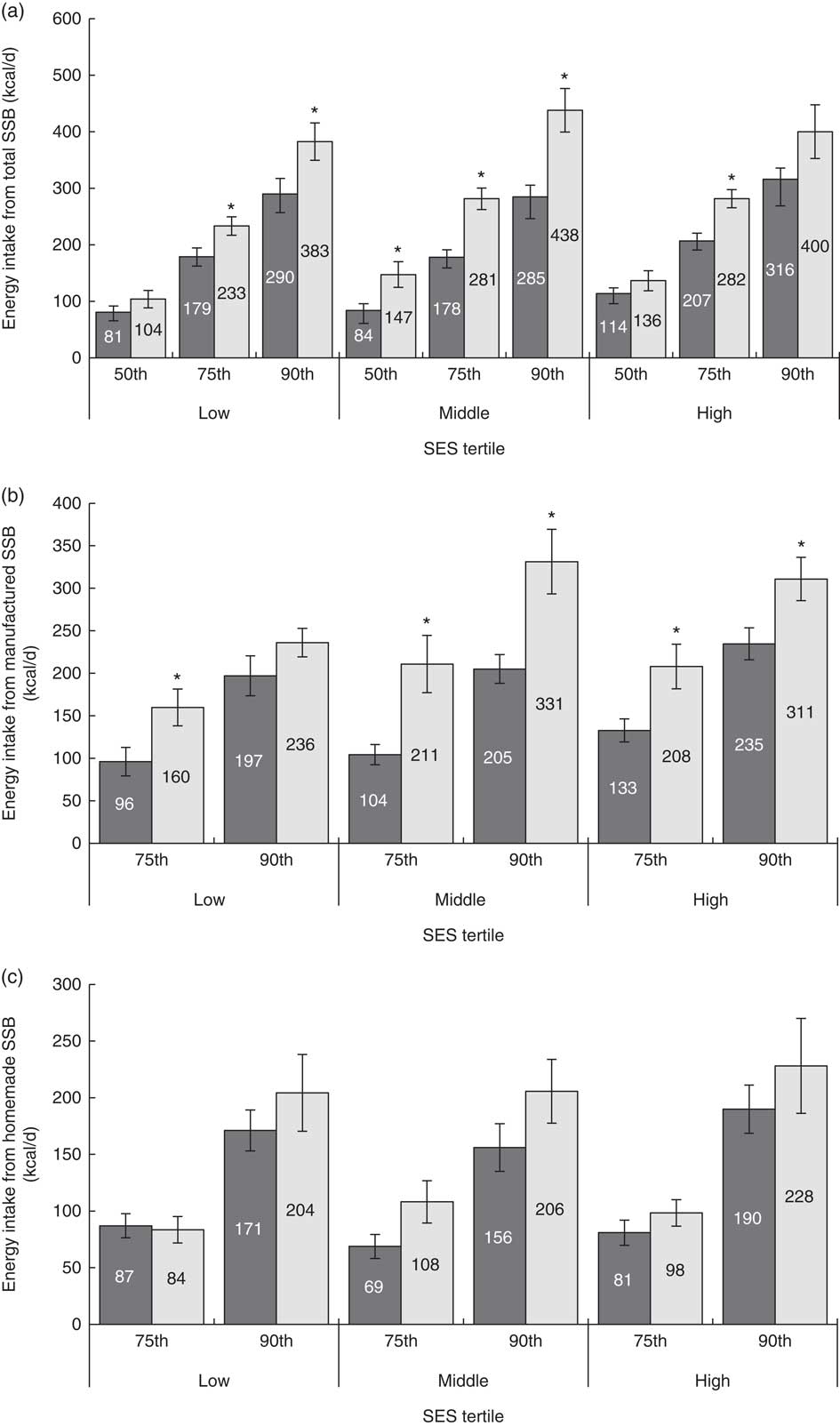
Among school-aged children, per-capita increases in total SSB intake from 1999 to 2012 were statistically significant at the 50th, 75th and 90th percentiles for low- and middle-SES groups, but not among high-SES children (Fig. 1). Similarly, for manufactured SSB, increases were significant for low and middle SES, whereas for high SES, intake at the 75th and 90th percentile remained similar over time. Increases for homemade SSB were also significant among low-SES children at the 75th and 90th percentile, and among middle-SES children at the 90th percentile. Among low- and middle-SES children, intake increases for manufactured SSB were higher than for homemade SSB.
Estimated per-capita energy intake (kcal/d) of (a) total, (b) manufactured and (c) homemade sugar-sweetened beverages (SSB) among school-aged children aged 5–11 years (n 4758) by survey year ( , 1999;
  , 2012) and socio-economic status (SES) tertile. Data are from the 1999 Mexican National Nutrition Survey (ENN-99) and the 2012 Mexican National Health and Nutrition Survey (ENSANUT 2012). Total SSB include manufactured and homemade SSB. Manufactured SSB include: soft drinks, manufactured fruit juice beverages, manufactured vegetable juice beverages, flavoured waters (ready-to-drink and prepared from syrup or powder), iced teas, soya drinks, and sports and energy drinks. Homemade SSB include: ‘aguas frescas’ (beverages prepared with water, fruit and sugar), ‘atole’ (cornmeal beverage) and homemade coffee or tea with sugar. Values are estimates, with their se represented by vertical bars, from quantile regression at the 50th, 75th and 90th percentile obtained with Stata’s margins command. se for the quantile regressions were obtained through bootstrapping with 100 replications. To convert to kJ/d, multiply kcal/d values by 4·184. Adjusted by SES, age in years and squared age, sex, geographical region and urbanicity. *P<0·05 for comparison between ENN-99 v. ENSANUT 2012, with Bonferroni’s correction for multiple comparisons

Among women, intake of total SSB increased significantly for at least one of the estimated percentiles for all SES groups (Fig. 2). These increases were higher among middle-SES women, compared with low- and high-SES women. Similarly, increases for manufactured SSB were higher among middle-SES, compared with low- and high-SES women. Slight increases were observed for homemade SSB intake, although results did not reach statistical significance, and no important differences were observed between SES groups.
Estimated per-capita energy intake (kcal/d) of (a) total, (b) manufactured and (c) homemade sugar-sweetened beverages (SSB) among women aged 20–49 years (n 2960) by survey year (, 1999; , 2012) and socio-economic status (SES) tertile. Data are from the 1999 Mexican National Nutrition Survey (ENN-99) and the 2012 Mexican National Health and Nutrition Survey (ENSANUT 2012). Total SSB include manufactured and homemade SSB. Manufactured SSB include: soft drinks, manufactured fruit juice beverages, manufactured vegetable juice beverages, flavoured waters (ready-to-drink and prepared from syrup or powder), iced teas, soya drinks, and sports and energy drinks. Homemade SSB include: ‘aguas frescas’ (beverages prepared with water, fruit and sugar), ‘atole’ (corn meal beverage) and homemade coffee or tea with sugar. Values are estimates with their se represented by vertical bars, from quantile regression at the 50th, 75th and 90th percentile obtained with Stata’s margins command. se for the quantile regressions were obtained through bootstrapping with 100 replications. To convert to kJ/d, multiply kcal/d values by 4·184. Adjusted by SES, age (modelled with four splines), education, geographical region and urbanicity. *P<0·05 for comparison between ENN-99 v. ENSANUT 2012, with Bonferroni’s correction for multiple comparisons
Sugar-sweetened beverage intake distribution in 2012
Considering all age groups from 2012, an estimated 76·3 % of the population consumed either manufactured or homemade SSB on one given day (see online supplementary material, Supplemental Table 1). Overall, a higher proportion consumed manufactured SSB compared with homemade SSB (51·2 v. 45·0 %). Per-capita intake of SSB was particularly high among adolescents and adults, with energy intakes of 2117 kJ/d (506 kcal/d) for adolescent males, 1678 kJ/d (401 kcal/d) for adolescent females, 2017 kJ/d (482 kcal/d) for adult males and 1494 kJ/d (357 kcal/d) for adult females at the 90th percentile (Supplemental Table 2), which correspond to ≈22 % of total daily energy intake. Similarly, the highest per-capita intake of manufactured SSB was observed in adolescent and adult males (90th percentile: 1728 and 1494 kJ/d (413 and 357 kcal/d), respectively; representing a contribution of ≈17 % to total daily energy intake). Per-capita and per-consumer energy intake of manufactured SSB was higher than of homemade SSB at the three explored percentiles and among all age groups (Supplemental Table 3). Per-capita energy intake by type of SSB and sample characteristics is presented by age group in Supplemental Tables 4–7.
Discussion
The present analysis of nationally representative dietary intake data builds on previous studies of SSB intake in the Mexican population by focusing on trends occurring from 1999 to 2012 at the high end of the intake distribution. Results showed an increase in the proportion of consumers of total and manufactured SSB, with markedly high increases in subgroups living in rural areas and from low SES. Likewise, there were statistically significant increases in per-capita and per-consumer SSB energy intake, with larger increases towards the high end of the distribution.
For both school-aged children and women, there were significant increases at the 50th, 75th and 90th percentiles in per-capita and per-consumer intake of total SSB over the 1999–2012 period. Our findings show that increases in mean intake of SSB previously estimated( Reference Stern, Piernas and Barquera 13 ) were driven both by a small increase in the proportion of consumers of 5·7 pp overall for total SSB and an increase in the amounts consumed among consumers (142, 230 and 406 kJ/d (34, 55 and 97 kcal/d) for school-aged children and 180, 310 and 628 kJ/d (43, 74 and 150 kcal/d) for women at the 50th, 75th and 90th percentile, respectively), revealing that increases over time were greater for high consumers. For manufactured SSB, there was a considerable increase in the proportion of consumers in the study period (10·7 pp), in addition to increases in per-consumer intakes; reflecting in large increases in per-capita intake at the 75th and 90th percentiles of 184 and 234 kJ/d (44 and 56 kcal/d) in school-aged children and 343 and 347 kJ/d (82 and 83 kcal/d) in women, respectively. Our results confirm findings from previous analysis of significant increases in mean per-capita and per-consumer energy intake for ‘agua frescas’ and caloric soda over the 1999–2012 period among school-aged children and women( Reference Stern, Piernas and Barquera 13 ). We additionally found that for manufactured SSB, increases were higher for per-capita intake, while for homemade SSB, increases were higher for per-consumer energy intake; meaning that increases for homemade SSB were mainly among high consumers, while for manufactured SSB increases were in the complete per-capita distribution (by increases in the proportion of consumers and amounts consumed).
Moreover, results showed that per-capita intake of total and manufactured SSB over the 1999–2012 period increased sharply among low-SES children, while remaining the same among high-SES children. These observed trends in SSB intake were mirrored with more pronounced increases in overweight and obesity among children from the lowest SES level( Reference Hernandez-Cordero, Cuevas-Nasu and Morales-Ruan 12 ). The above-mentioned trends observed in school-aged children are a clear example of the nutrition transition experienced in Mexico; where a shift from traditional diets based on legumes, coarse grains and vegetables to processed foods high in fat and sugar has occurred. This shift tends to affect the high-SES population first, with the low-SES population rapidly catching up( Reference Rivera, Barquera and Campirano 29 – Reference Monteiro, Moura and Conde 34 ). However, this trend was not observed in adult women, where increases in the intake distribution of total and manufactured SSB were observed for all SES subgroups, with higher increases among middle-SES women. These trends were also mirrored by the obesity prevalence in women, with significant increases in the prevalence for the three SES subgroups over the 1999–2012 period and with the highest prevalence in middle-SES women living in urban areas( Reference Perez Ferrer 35 ).
In 2012, prior to implementation of the SSB tax, we found very high consumption of SSB at the 90th percentile (2117 kJ/d (506 kcal/d) for adolescent males, 1678 kJ/d (401 kcal/d) for adolescent females, 2017 kJ/d (482 kcal/d) for adult males and 1494 kJ/d (357 kcal/d) for adult females; corresponding to ≈22 % of total daily energy intake). In other words, on any given day in 2012, 10 % of adolescents and adults consumed at least 22 % of their total daily energy intake from SSB. Still, heavy consumption of SSB is lower than in the USA where, in 2007–2008, 16 % of adolescents and 20 % of young adults (aged 20–34 years) consumed 2092 kJ/d (500 kcal/d) or more from SSB( Reference Han and Powell 36 ).
A recently published study on individual intakes and household purchases of foods and beverages in the Mexican population from urban areas concluded that SES was not associated with mean intake of less healthy beverages, which included SSB, plus sweetened milk and sweetened dairy beverages( Reference Lopez-Olmedo, Popkin and Taillie 37 ). Nevertheless, low-SES households had higher purchases of less healthy beverages compared with high-SES households. This discrepancy was hypothesized to be due at least partially to higher intake of homemade SSB by high-SES individuals( Reference Lopez-Olmedo, Popkin and Taillie 37 ). However, in the present analyses, there were no important differences by SES in per-capita energy intake for homemade SSB at the 50th, 75th or 90th percentile. The above could be due to loss of precision given the stratifications by age and sex subgroups in the present analysis.
In this context of high SSB intake, especially of manufactured SSB, the effect of the excise tax of one peso per litre on manufactured non-dairy and non-alcoholic SSB is encouraging, particularly as the greatest reductions in SSB purchases were found in low-income households( Reference Colchero, Popkin and Rivera 18 , Reference Colchero, Molina and Guerrero-Lopez 38 ). Additionally, low-income households had the greatest increases in water purchases( Reference Colchero, Molina and Guerrero-Lopez 38 ). Considering that substitution of SSB by water or other low-calorie beverages has been associated with healthier dietary intake, lower energy intake, lower weight gain and lower body fatness( Reference Rodriguez-Ramirez, Gonzalez de Cosio and Mendez 39 – Reference Wang, Ludwig and Sonneville 42 ), in an ideal scenario purchased water is being consumed as plain water. However, this water could also be used to prepare homemade SSB. Thus, it will be important in the 2018–19 National Health and Nutrition Survey to learn if the amount and proportion of SSB from homemade SSB have increased. Analysis of purchases of non-basic taxed foods by Mexican households showed that the proportion of purchases of taxed foods declined more in high consumers compared with low consumers( Reference Taillie, Rivera and Popkin 43 ). Although this type of analysis has not been conducted for taxed beverages, given the very high intakes of SSB among high consumers, it would be informative to estimate a similar effect on SSB with larger relative declines among high consumers.
There are several limitations in the present study. We estimated intake distribution from a single 24 h dietary recall, which may be insufficient to capture usual intake. Although for the 2012 survey a sub-sample of ≈10 % had a second 24 h recall that could be used to estimate usual intake, the ENN-99 collected only one day of dietary intake. The intra-individual variance for 2012 could be used to estimate also usual intake for 1999; however, given the important changes in intake in this period, we considered that variance probably changed as well. Moreover, this could be more difficult for episodically consumed foods, although a significant proportion of the population consumed SSB on one given day. Therefore, we decided to use a single 24 h recall for both surveys to ensure comparability. Also, methodological changes in dietary assessment, including the use of printed v. automated five-step multiple-pass probing and the inclusion of weekend days, may limit the accuracy of the absolute energy intake changes between surveys; however, the resulting measurement error is likely similar for all sub-populations and food groups, so we focus on differences in trends for different SSB types and by SES subgroup. Still, similar trends were documented using sales data from Euromonitor International( Reference Stern, Piernas and Barquera 13 ). Energy content was estimated using the 2012 food composition table compiled by the National Institute of Public Health for both surveys to maintain comparability. However, reformulation and changes in food manufacturing could have occurred between 1999 and 2012, thus the energy intake estimation from 1999 might be under- or overestimated if significant changes occurred. As with any data that rely on self-report, estimates may be affected by measurement error. Misreporting could be differential between surveys if the perception of SSB being unhealthy changed from one survey to the other, since there is evidence that foods perceived as unhealthy tend to be under-reported( Reference Mendez, Wynter and Wilks 44 ). Despite these limitations, the present study provides valuable information on total SSB intake distribution and by type of SSB, and their trends, in a nationally representative sample. Moreover, even with a skewed distribution of SSB intake, quantile regression is an appropriate approach given that is robust to outliers and avoids assumptions about the parametric distribution of the errors. An additional strength is that our study provides baseline description of SSB consumption in the Mexican population before the implementation of the SSB tax in 2014.
In summary, the present study showed a significant increasing trend at the high end of the distribution of SSB intake in the 1999–2012 period, with increases in the proportion of consumers and amounts consumed for total and manufactured SSB, along with very high consumption of SSB at the high end of the distribution of intake prior to the SSB tax implementation, particularly of manufactured SSB. Policies to discourage high intake of SSB should continue in Mexico. At the same time, policies to encourage replacement of manufactured SSB with water and other low-calorie beverages are needed to avoid replacement by homemade SSB. Future studies should continue monitoring SSB intake distribution by type of SSB to better understand long-term changes associated with the tax implementation.
Acknowledgements
Acknowledgements: The authors would like to thank Phil Bardsley and Donna Miles for assistance with data management and programming, Denise Ammons for exceptional graphic support, and Frances L. Darcy and Emily Yoon for administrative assistance. Financial support: This work was funded primarily by Bloomberg Philanthropies (grants to the University of North Carolina at Chapel Hill and Centro de Investigacion en Nutricion y Salud), with support from the National Institutes of Health (NIH; grant number R01DK108148) and the Carolina Population Center and its NIH Center grant (grant number P2C HD050924). T.C.A. is supported by a Mexican National Council for Science and Technology (CONACyT) scholarship. Funders had no role in the design, analysis or writing of this article. Conflict of interest: None. Authorship: T.C.A., J.M.P. and B.M.P. designed the research, interpreted results and edited the manuscript. T.C.A. analysed the data and drafted the manuscript. All authors read and approved the final manuscript. Ethics of human subject participation: The surveys were conducted according to the guidelines laid down in the Declaration of Helsinki and all procedures involving human subjects were approved by the Research, Biosafety, and Ethics Committees at the National Public Health Institute in Cuernavaca, Mexico. Informed consent was obtained for participants aged 18 years or older, and from the parent or guardian of participants younger than 18 years. Assent was obtained for children and adolescents from 5 to 17 years.
Supplementary material
To view supplementary material for this article, please visit https://doi.org/10.1017/S1368980018002677



