




From the late eighteenth century, the primary red of trichromacy of colour mixtures, a modification theory of colour, was identified with the magenta-like hue of carmine – a pigment made mostly with American cochineal – and with the magenta hue at the centre of the inverted spectrum. This was a rather radical shift from earlier opinions about trichromatic primary red. Natural philosophers supporting this colour theory, whom I will call here trichromatists, argued, in a very Aristotelian fashion, that primary red resulted from the conflation of light/whiteness and black/darkness and placed this colour at the centre of a diagram, next to white and yellow on one side and blue and black on the other. Sometimes they also exemplified the primary red colour with the pigment cinnabar/vermilion, deeming the deep red hue of this pigment to be representative of simple red because it allegedly did not lean towards blue or yellow.
Cinnabar is mercury sulphide and recipes to produce its artificial form, vermilion, appeared in Europe around the eighth century. The alchemical process for manufacturing vermilion was at the foundation of the alchemical sulphur–mercury theory, in which these two elements were believed to be able to artificially create gold and the philosophers’ stone. Vermilion was thus the quintessence of alchemy.
In this paper, I argue that the first identification of simple red with vermilion was partly indebted to alchemy and to the colour sequence highlighted in some recipes for making vermilion through alchemy. Moreover, this essay will also attempt to explain the reasons for the primary-red shift from the intense vermilion red to the purplish carmine in the second half of the eighteenth century.
Trichromacy of colour mixtures and primary red
The neuroscientist John Dixon Mollon has explained that trichromacy is ‘the most fundamental property of human color vision’.Footnote 1 As normal human colour vision is based on three colours, the notion of trichromacy of colour mixture, hereafter abbreviated to trichromacy, emerged during the Renaissance. At this time, trichromacy was recognized in a simplified form and understood not as a physiological property of things, but as a physical one.Footnote 2 This theory was widely accepted and discussed in several books on optics as an unorthodox version of the Aristotelian colour theory.Footnote 3
In De Sensu et Sensato, Aristotle (384–322 BC) explained the origin of colours as mixtures of bright light or white colour shining through a dark surface or seen through a dark or black medium. He then identified five middle colours that arose according to a specific ratio of blackness and whiteness, establishing a sort of linear scale of seven colours, within which black/dark and white/light constituted the two extreme generative colours and five further colours (xanthon, phoinikoun, halourgon, prasinon and kyanoun) were placed among them.Footnote 4 In trichromacy, Aristotle's middle colours were reduced from five to three: red (phoinikoun), yellow (xanthon) and blue (kyanoun). According to trichromatists, the linear scale was thus made up of solely five colours, which could generate all others but could not be mixed from others. During the evolution of the theory in the seventeenth and eighteenth centuries, the role of black and white transitioned from colour generators to colour moderators, clearing the field for just three chromatic colours: red, yellow and blue.Footnote 5
Trichromacy was first discussed by the Venetian nobleman and Bishop of Nicosia Filippo Mocenigo (1524–86) in 1581 in a large philosophical work entitled Universales institutiones ad hominum perfectionem.Footnote 6 The theory later surfaced in numerous early modern works, including many optical treatises and some art theory books. The Flemish physician Anselm de Boodt (1550–1632) suggested a trichromatic system for the study and classification of gems and stones entitled Gemmarum et lapidum historia (1609). Here De Boodt discussed mixtures of pigments, while associating the origin of colour in stones with their property of yielding pigments.Footnote 7 In 1613, Flemish Jesuit Francis Aguilón (1566–1617) represented for the first time trichromacy with a diagram in Proposition 39, entitled ‘Quinque sunt simplicium colorum species, ac tre compositae’, of his Opticorum libri sex. He placed along the white and black axis the three main colours, which according to trichromatists were also displayed by the rainbow: yellow, red and blue (Figure 1). Other scholars, such as Athanasius Kircher (1602–80), Zacharias Traber (1611–79) and Johannes Zahn (1641–1707), adopted, slightly modified and popularized this diagram in their books.Footnote 8 In the seventeenth century, trichromacy was briefly supported in few publications on art theory, including Graphice, id est, de arte pingendi (1669) by the German mathematician Johann Gerhard Scheffer (1621–79), in Entretiens sur les vies et sur les ouvrages des plus excellens peintres anciens et modernes (1679) by the French architect and historiographer André Félibien (1619–95), and in De groote waereld in ’t kleen geschildert (1692) by the Dutch painter Willem Beurs (1656–92/1713).Footnote 9
Unknown draftsperson, colour-mixing diagram, in Francis Aguilón, Opticorum libri sex (1613), p. 40. Getty Research Institute, Special Collections, ID 3017-697. Public Domain Mark 1.0. Source: https://archive.org/details/francisciaguilon00agui.

Although not many painters confirmed this theory with their writings, trichromatists often supported the validity of their colour-mixing theory citing the word of some unnamed painters and other colour artisans, confirming thereby that these five were primary colours also in the painterly practice, and not only according to some philosophers.Footnote 10 Mocenigo, for instance, stated, ‘Indeed some painters say that nor red, nor blue, nor yellow, nor white or black can be mixed out of other colours.’Footnote 11 Likewise, Robert Boyle (1627–91) maintained in the seventeenth century that artisans and artists ‘need imploy any more than White, and Black, and Red, and Blew, and Yellow’ to produce all ‘numberless differing Colours that are to be met with in the Works of Nature, and of Art’.Footnote 12 Aguilón surely experimented at first hand with some colourants and discussed colour theory with painters in Antwerp, including perhaps Pieter Paul Rubens (1577–1640), who designed the frontispiece for Opticorum libri sex.Footnote 13 Indeed, Aguilón concluded his colour theory text by stating that ‘nobody knows these things so precisely as painters’.Footnote 14 Despite the alleged claim that artists and painters supported this theory, however, actual pigment-mixing experiments to corroborate trichromacy were not commonly attempted until the eighteenth century. The colour-mixing rules of trichromacy were mostly exemplified by overlapping coloured glass plates or simply supported with the number of colours seen in the rainbow and in refracted light through prisms or water containers.
Aguilón's colour scheme may look utterly unfounded if one thinks of white and black as pigments, as no colour arises out of the mixture of black and white. However, it is necessary to stress here that seventeenth-century trichromatists such as Aguilón explained the formation of apparent colours and real colours as Aristotle did, namely as mixtures of white/light and black/darkness in different ratios. Light and darkness when mixed could engender both real colours – that is, those visible on the surfaces of bodies, including pigments – and apparent colours – that is, those of rainbows, halos and the feathers of a peacock's tail and a pigeon's neck.Footnote 15 Hence, partly on Aristotelian colour theory and partly also on what painters seemed to confirm, trichromatists established the number of colours arising from the mixture of white and black to be just three and developed their own way of ordering colours, with yellow, red and blue permanently organized according to their lightness degree and not according to their arrangement in the regular spectrum.Footnote 16
The order, number and hues of spectral colours were still a matter of debate in the early modern period, but their refraction through a prism had already been described by many scholars, including Gerolamo Cardano (1501–76), Guido Antonio Scarmiglioni (1555?–1620), René Descartes (1596–1650) and Johannes Marcus Marci (1595–1667),Footnote 17 while a few rudimentary images of the phenomenon had been published by Giambattista della Porta (1535–1615) and Kircher (Figure 2).Footnote 18 In these two representations are visible just three main prismatic colours, red, yellow and blue. Yet, notably, red in these observations is never the central colour, since it always appears at one end of the spectrum.
Unknown draftsperson, refraction of light through prism, in Athanasius Kircher, Ars magna lucis et umbrae (1646), p. 75. ETH-Bibliothek Zurich, Rar 8883. Public Domain Mark 1.0. Source: https://doi.org/10.3931/e-rara-548.

Trichromatic red
Monika Mansfeld has shown that English medieval commentators on Aristotle's colour theory noticed that the Greek philosopher left unclear what was the middle colour par excellence in his linear scale. In one of these commentaries, however, red was identified as the middle tone between white and black.Footnote 19 Interestingly, in the third book of Meteorologica, the Greek philosopher discussed the origin of prismatic red and stated, ‘white colour on a black surface or seen through a black medium gives red’.Footnote 20 This sentence was possibly interpreted by some early modern readers as the clue for deeming red to be the middle colour in Aristotle's scale.
Interestingly, Sir Kenelm Digby (1603–65) linked this observation with the formation of spectral red forming between a white and a black surface as in edge or boundary spectra.Footnote 21 Boundary spectra appear when a white–black area is observed through the glass prism. Usually, the two spectra appear at the edges of two black areas separated by a white one. On one side, it appears as a red–yellow edge and on the other a dark or light blue edge. Red and dark blue border the black area, while yellow and light blue border the white area. The order is inverted if the black and white areas are inverted, as Johann Wolfgang von Goethe (1749–1832) did with his light experiments.Footnote 22 Boundary spectra are discussed in the writings of the architect Louis Savot (1579–1640), Scarmiglioni and Digby, but we do not know whether Aristotle was able to observe this phenomenon.Footnote 23 The two boundary spectra show altogether only four colours, or rather just three: red, yellow and light and dark blue. Perhaps we can speculate that this observation also led trichromatists to reduce the intermediate colours in Aristotle's scale to just three. It is, however, unlikely that Aguilón drew his colour theory from prismatic experiments, given that in Proposition 39 apparent colours play little to no role. Yet, interestingly, in other works supporting the trichromatic theory, spectral red (which is the same as that appearing in the boundary spectra) is always praised for its intensity. Kircher, for instance, described it as ‘the most intense red’, while English physician Francis Glisson (1597?–1677) depicted it as ‘fierce’.Footnote 24
More importantly, in the eighteenth century the German mineralogist Abraham Gottlob Werner (1749–1817) paralleled spectral red, which he had observed first-hand through prismatic experiments, with the hue displayed by cinnabar.Footnote 25 The hue of cinnabar was likewise identified as the ideal red in trichromacy by at least two trichromatists. Aguilón looked for ‘simple redness’ (simplicem ruborem), namely what he called rubeus in his diagram, among common colourants (coloribus concretis). According to him vermilion (cinnabaris) displayed a middle tone and ‘an exquisite redness’.Footnote 26 Glisson, too, compared the primary red of this colour-mixing theory with the pigment vermilion (cinnabaris).Footnote 27 Both scholars excluded red lakes (lacca) and red lead (cerussa ustulata/minium) because they verged toward blue or toward yellow.Footnote 28 The decision to place red at the centre of this revised Aristotelian colour scale was possibly also influenced by the authority of some painters and art theorists, who already in the sixteenth century accepted Aristotle's sevenfold chromatic scale as well as the centrality of red. In particular, Ludovico Dolce (1508–68) rendered Aristotle's red as vermilion (vermiglio).Footnote 29
Alchemical vermilion
Although not mentioned in any of the treatises supporting this theory, alchemy may have played a role in the identification of the trichromatic primary red with vermilion. The chromatic arrangement proposed by Aguilón and especially the centrality of red between white/light and black/darkness seem to be connected to the alchemical description for manufacturing vermilion.
Natural cinnabar, usually called cinnabaris nativa in Latin, is mercury sulphide (HgS) in mineral form. When ground, it gives a red powder used as a pigment.Footnote 30 The naturalist and physician Pietro Andrea Mattioli (1501–77) saw this mineral in the quicksilver mines of Idrija (present day Slovenia). He stated that the red-coloured stone was similar to haematite but heavier and so full of quicksilver that sometimes it copiously dripped the liquid metal.Footnote 31 In reality, natural cinnabar is rather dark, and it gets redder and redder with grinding. This characteristic of cinnabar is due to the high light-absorbing properties of the mercury sulphide.Footnote 32
Artificial cinnabar was called cinnabaris factitia and even vermiculus or vermeliones in Latin texts, from which words originated the term ‘vermilion’.Footnote 33 It was manufactured by sublimation of mercury and sulphur. The process was described as ‘synthesis’ by the philosopher Albertus Magnus (c.1200–80) and as ‘alchemy’ by the painter Cennino Cennini (b. c.1370).Footnote 34 This early manufacturing method is known as the dry process.Footnote 35 The recipes often required practitioners to pour different ratios of mercury and sulphur into a glass or a jar with a long neck, seal its opening, slowly heat the glass at a low temperature, and observe the fumes coming out of it. Usually, the recipes argued that when the smoke became red, vermilion was ready.
Among artists’ paints, vermilion was considered the inorganic red par excellence from the Middle Ages to modern times.Footnote 36 It produced an intense red hue that was moreover rather stable in oil and miniature painting, and indeed is indicated as the first red pigment in the anonymous De arte illuminandi (c. fourteenth century).Footnote 37 The bookseller and publisher Willem Goeree (1635–1711) maintained that ‘among red paints, none is so beautiful as cinnabar, or vermilion’.Footnote 38 The same opinion was given – almost verbatim – in A. v. d. Boogert's Klaer lightende spiegel der verfkonst (1692), a handwritten manual on watercolour painting.Footnote 39 The clockmaker and writer John Smith (fl. 1673–80) described vermilion as ‘the most delicate of all light Reds, being of it self a perfect Scarlet Colour’.Footnote 40 Moreover, some trichromatists, such as Scheffer and Beurs, recognized the supremacy of vermilion by listing it as the first among many other red paints.Footnote 41
Vermilion, mixed with lead white and ochre, was the basic ingredient used to paint flesh colours: among the most complex ones to achieve in painting according to art theorists. The painter and art theorist Karel van Mander (1548–1606) deemed it able to make painted skin glow.Footnote 42 Likewise, Mattioli described artificial vermilion as having a ‘glowing and intense colour’.Footnote 43
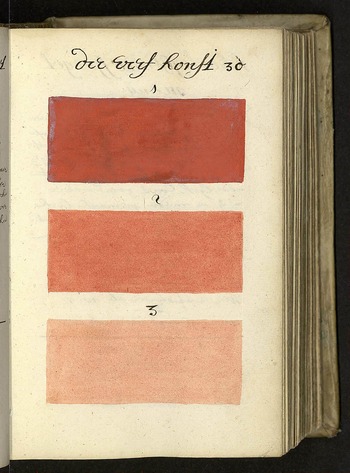
The hue of vermilion (cinnabaris) is compared with those of other common red pigments available in the seventeenth century in Richard Waller's (c.1650–1715) Tabula Colorum Physiologica (1686). Its painted sample displays a deep saturated red. Waller explained that ‘the factitious Cinnabar is that which we now use; and is made by a sublimation of Mercury and Sulphur’.Footnote 44 The beauty of this red pigment is similarly displayed in three samples painted in Boogert's manual (Figure 3).
A. v. d. Boogert, three samples of vermilion, in A. v. d. Boogert, Klaer lightende Spiegel der Verfkonst (1692), Bibliothèque Méjanes, Aix-en-Province, Ms.1389 (1228), fol. 30r. Public Domain Mark 1.0. Source: https://bibliotheque-numerique.citedulivre-aix.com/idurl/1/35315.

The hue of cinnabar/vermilion was often compared to the colour of blood, possibly because in ancient sources such as Dioscorides’ (c.40–90) De materia medica and Pliny's (23/4–79) Naturalis historia, kinnabari/cinnabaris referred to the exotic resin later known as dragon's blood, which was believed to be dried blood of dragons.Footnote 45 Because dragon's blood had medicinal applications and was similarly used as a pigment, while the mineral cinnabar was toxic and should not be administered to patients, early modern physicians, like the aforementioned Mattioli, finally discriminated the two substances.Footnote 46 Despite this discrimination, however, cinnabar/vermilion was deemed by Venetian painters to be the perfect imitation of the colour of blood, as explained by the historian Christoph Entzelt (1517–83).Footnote 47
Cinnabar was also mistaken for other ancient substances such as minium (lead tetroxide, today known as red lead) and sandaraca (orange-red sulphide of arsenic, today known as orpiment). Georg Bauer, better known as Agricola (1494–1555), discussed this in his Bermannus, sive de re metallica (1530), noting that Theophrastus (c.371–c.287 BC) called cinnabar minium. In the sixteenth century, it had been replaced by chemists with a compound whose ‘beautiful red’ (pulcherrimum illum ruborem) was made of quicksilver and sulphur and which was called facticium Cinnabarim. Agricola maintained that in Venice this product was often sold for much money under different names, such as sanguinem draconis, alterum rubens, sandaraca or minium.Footnote 48
The manufacturing of vermilion was such a widespread practice in medieval and early modern Europe that the pigment was available ready for use at many apothecary shops and for this reason many writers suggested that readers buy it there.Footnote 49 Nonetheless, several recipes for manufacturing vermilion were also written down. The earliest European recipes were culled in the eighth century from a Greek or Byzantine original.Footnote 50 Greek seems likewise to be the origin of the alchemical sulphur–mercury theory which attempted to explain the metallogenesis. Indeed, Aristotle had postulated in both Meteorologica and De generatione et corruptione that the origins of minerals and stones were underground, with them being caused by two subterranean exhalations or vapours: one dry and smoky, the other wet and steamy.Footnote 51 Likely inspired by Aristotle's idea of two underground vapours, Jābir ibn-Hayyān, also known as Geber, a group of Arab authors writing under this name, introduced the sulphur–mercury theory in the ninth century.Footnote 52 This theory claimed that various proportions and degrees of purity of two basic components or principles – sulphur and mercury, namely the same used to manufacture vermilion – could produce all metals in the depths of the earth.Footnote 53
The sulphur–mercury theory led to the alchemical belief that the composition of these two elements could be used to artificially create the philosophers’ stone, sometimes called ‘the red elixir’, and even to produce gold.Footnote 54 In this theory, however, mercury and sulphur are to be understood as umbrella terms and not as our modern chemical elements.Footnote 55 Arabic scholars indeed knew that mercury and sulphur combined give vermilion: in the Jābirian corpus, for example, can be found a recipe for making this pigment, which is described as ‘a hard red stone of the colour of blood … which men of science call cinnabar’.Footnote 56 The temporal sequence of the appearance of the first recipe to make vermilion in the eighth century and the introduction of the sulphur–mercury theory roughly one century later is evidence for the artisanal practice being the source of the alchemical theory. Pamela H. Smith has indeed argued that the sulphur–mercury theory ‘arose from the practice of making vermilion and, in other words, from the work of craftspeople and their practices’.Footnote 57 It was likely for this reason that vermilion, more than any other artificially manufactured pigment, was heavily associated with alchemy.Footnote 58 Vermilion was manufactured with the same – ideal – ingredient of the sulphur–mercury theory and red was the colour that appeared in the final stage of the alchemical process for making the philosophers’ stone, whose product was regarded as capable of transmuting base metals into noble metals, such as gold.
Very likely, the alchemical belief that gold could be obtained from red was also rooted in some painters’ and craftspeoples’ practices, in which they made a range of synthetic gold-coloured pigments from vermilion or from the basic ingredients of vermilion.Footnote 59 For instance, Cennini maintained that mosaic gold was made with sulphur and mercury, adding tin and sal ammoniac, all ingredients described in recipes for vermilion.Footnote 60 Glassmakers, on the other hand, competed with the alleged ability of alchemists to make the red philosophers’ stone by manufacturing gold ruby glass.Footnote 61 This particular red colour was obtained with a solution of gold in nitro-hydrochloric acid, to which tin was added. As Sven Dupré has compellingly explained, the alchemist, glassmaker and apothecary Johannes Kunckel (1637?–1703) ‘clearly considered gold ruby glass to be as valuable as the Philosophers’ Stone’.Footnote 62
Alchemists also bestowed such importance upon vermilion because the colour changes it underwent during its manufacturing process reminded one of the colour sequence often described in alchemical texts.Footnote 63 Indeed, alchemists described the sulphur–mercury theory with a specified sequence of colours and associated colour change with a deep transformation in the matter.Footnote 64 The principal colours of alchemical transmutation were regarded as four in number in ancient writings: black, white, yellow and purple.Footnote 65 From the fifteenth century, however, the colour scheme was reduced to a triad of black, white and red (instead of purple), while ‘yellowing was variously conflated with the final reddening stage (an approach that treats red as an intensified form of yellow)’, as has been explained by Jennifer M. Rampling.Footnote 66 The final rubedo stage was described by the forged figure of the alchemist Salomon Trismosin, the alleged author of Aureum Vellus, oder Güldin Schatz der Kunstkammer (1598–9), as ‘such a beautiful red colour as no scarlet can compare with, and such a treasure as words cannot tell’.Footnote 67 In this three-part colour sequence red was equated with gold.Footnote 68
Arie Wallert has suggested that the reduction of the colour stages from four to three may have originated from the observation of the manufacturing stages of vermilion. Wallert has explained this colour choice by relating the black colour to that of metacinnabar (HgS), the white colour to the fumes that first came off during the process, and the red colour to the resulting vermilion.Footnote 69 Another possibility is that metacinnabar was converted to red vermilion by heating it in a solution of ammonium or potassium sulphide, both white in colour, a process which was discovered only in the mid-seventeenth century, however, and known as the wet process.Footnote 70 In both cases, the sequence started with black, continued with white and ended with red. Yet only rarely did recipes mention black metacinnabar (for instance in De secreti di donno Alessio Piemontese by Girolamo Ruscelli (1518–66)) and never do they mention white fumes, as I will show. Instead, red constantly appeared at the end of the recipes for manufacturing vermilion, either in the description of the colour of vermilion itself or, more often, as the colour of the smoke indicating the conclusion of the process.
In the Bolognese manuscript (c. fifteenth century), the author maintained that ‘the matter rises to the neck of the flask and is very red’.Footnote 71 Red matter gushing out of the glass jar is likewise described in a Flemish manuscript entitled Diversche Verven te maken (c. sixteenth century).Footnote 72 In Compositiones lucenses (c. eighth century) the anonymous author signalled that, towards the end of the process, the smoke turned to the colour of cinnabar.Footnote 73 Similar indications of red smoke were given by the authors of De coloribus (c. thirteenth century) and of O livro de como se fazem as cores (c. fifteenth century).Footnote 74 In the Illuminier Buch, wie man allerley Farben bereitte, mischen, schattieren vnnd vfftragen soll (1549), Valentin Boltz (d. 1560) stated likewise that when the burning was completed, the compound exhaled a red-blood smoke.Footnote 75
Other colours were sometimes involved in the process, providing further technical clues for the reader. For instance, the colours of sulphur and mercury or of other substances, too, were described as well as those of the fumes evaporating from the burning compound. In the Sélestat Manuscript (c. ninth–tenth century, one of the witnesses of Mappae clavicula), the author maintained that the smoke comes out first the colour of straw, then yellow and finally red like vermilion.Footnote 76 In De coloribus et mixtionibus (c. twelfth century) three different smoke colours are described: at first blue (blauum), then yellow (crocei coloris) and finally one nearly as red as vermilion (Rubeus quasi ut est vermiculum).Footnote 77 Identical information is given in the recipes for vermilion of the Liber de coloribus faciendis (after 1431, a copy of an older text) and of Liber de coloribus illuminatorum siue pictorum (c. fourteenth century).Footnote 78 The Diversche Verven te maken likewise provides a recipe to make vermilion in which a mixture of quicksilver and sulphur, when heated, will issue at first a blue smoke (blauwen rooc), then a yellow one (geluwen rooc) and, at last, a red smoke (rooden rooc) and simultaneously vermilion itself.Footnote 79 Agricola, meanwhile, described the same smoke colours in the process of how to make vermilion in his De natura fossilium (1546) but in a different order. Agricola wrote that chemists, likely alchemists, discovered vermilion in their attempt to manufacture gold or silver from burning mercury and sulphur. Like Boltz, Agricola explained that vermilion was ready when red (ruber) smoke emanated from the glass bottle or jar in which the two components were mixed and heated. He then further clarified that the smoke was in the first stage yellow (luteum), then blue (coeruleus) and finally red (ruber).Footnote 80 In the Pekstok Papers (1650–71) the only colours that are described in the manufacturing process of vermilion are those of the flames and fire, which are blueish (blauwen), dry red (drooghroot), brown (bruijnen) and those of the smoke, which is black (swarten roock).Footnote 81
White or yellow sulphur (albi aut crocei) is described as one of the ingredients for making vermilion in De coloribus et mixtionibus, in Liber de coloribus faciendis and in the Bolognese manuscript.Footnote 82 Three sorts of sulphur – white, black and yellow (album nigrum et croceum) – are instead listed in Theophilus Presbyter's (fl. c.1070–1125) Schedula diversarum artium (c. twelfth century) and in De coloribus ffaciendis (1436). In these recipes all three are deemed good for manufacturing vermilion.Footnote 83 In the fifth book, ‘On the death of natural things’, of Metamorphosis/De natura rerum (1571), attributed to Theophrastus Bombast of Hohenheim, called Paracelsus (1493/4–1541), there is a short paragraph about the death of quicksilver to manufacture vermilion (Zinober). The author writes that quicksilver should be melted with yellow sulphur and salt, then reduced into a black powdery matter, and finally sublimated into a sealed alembic. The resulting substance, whose colour is not mentioned, would adhere to the lid like haematite (blütstein).Footnote 84 Likewise, Ruscelli recommended using yellow sulphur (zolfo citrino) for making vermilion, then explained that the compound of sulphur and mercury slowly heated in the pot became a ‘dirty black mixture’ (mistura negraccia), namely metacinnabar. Metacinnabar, then, had to be ground and heated again until it reddened (rubificarsi).Footnote 85 The recipe in De coloribus included a ‘very white salt’ (salis albissimi), likely sal ammoniac, which was also recommended in other recipes for vermilion, including one by Albertus Magnus and the one allegedly by Paracelsus.Footnote 86 Hence, to summarize, the colours that usually appear in the recipes for making vermilion are white, as one sort of sulphur and as a salt added to the compound; yellow, as a sort of sulphur and as an intermediary smoke exhaled by the burning compound; blue, as another sort of intermediary smoke; black, as an unnamed mixture, very likely metacinnabar; and finally red, either as the smoke exhaled at the end of the process or as the final result. Furthermore, it is interesting to note that the colour of quicksilver is never discussed and that in just one case it appears as a brown smoke. The latter information, however, does not stem from an alchemical recipe, but from the very technical workshop book of the Pekstok family, who manufactured many pigments and other painters’ supplies in Amsterdam during the seventeenth century.
Marc Clarke has convincingly argued that many of the recipes for vermilion could not be used as instructions to manufacture this red pigment; they were in fact impossible recipes. The ratio of the two ingredients, for example, is not the one necessary to obtain vermilion and so it is unlikely that they were used by craftspeople.Footnote 87 Sole exceptions are the recipes in O livro de como se fazem as cores and in the Pekstok papers.Footnote 88 This means that the range of colours described in the impossible recipes had, most likely, only an alchemical value. Interestingly, precisely the colours described in the alchemical process match the primary colours in the emerging colour theory of trichromacy and thus made vermilion not only the alchemical red par excellence but also the perfect primary red in trichromacy.
Trichromacy and alchemical vermilion
To conclude this article, I will attempt to draw connections between the colour sequence described in the alchemical process to obtain vermilion and the primary colours identified in trichromacy.
The alchemical colour sequence that was likely culled from the manufacturing of vermilion is easily visible in the allegorical depiction of ‘the white rose’ (die weisse roß, Figure 4) from Hieronymus Reusner's (b. 1558) manuscript Pandora: Das Buoch genant die Kostlichest Gab Gottes (c. late sixteenth century).Footnote 89
‘The white rose’ (die weisse roß) in Hieronymus Reusner, Pandora: Das Buoch genant die Kostlichest Gab Gottes (c. late sixteenth century), Basel, Universitätsbibliothek, Alchimistische Sammlung, MS L IV I, p. 66. Public Domain Mark 1.0. Source: www.e-manuscripta.ch/bau/content/zoom/742389.

Here, the White Queen – that is, silver – serves as a prelude to the perfection of the Red King – that is, gold. In the image, the queen emerges from a three-coloured substance within a glass flask. The substance is white on the left, black on the right and red in the middle. A similar image showing the three colour stages of the alchemical transmutation was printed in the third volume of Aureum Vellus, oder Güldin Schatz der Kunstkammer (1599). The image, commonly referred to as ‘Jupiter, the three birds,’ shows three birds in a glass jar each painted in a different colour: the black one is on the left, the white one on the right, while the red one holds the central position inside the bottle (Figure 5).Footnote 90
‘Jupiter, the three birds’. Salomon Trismosin, Aureum Vellus, oder Güldin Schatz der Kunstkammer (1599), Munich, Bayerische Staatsbibliothek, Res/4 Alch. 91-3. - Mit 1 Beibd., p. 32. Public Domain Mark 1.0. Source: www.digitale-sammlungen.de/de/view/bsb00016633?page=36.

In these illustrations, neither yellow nor blue makes an appearance. They are indeed described only in few recipes and were thus not officially part of the colour sequence to manufacture vermilion. Yet a green colour is used for the flask in which the queen is rising in the ‘white rose’ illustration and for the greenery that rests below the bottle in the image of ‘Jupiter, the three birds’. Green is, according to trichromatists, the mixture of yellow and blue, so we can suggest that both images comprise five colours described in the recipes, whereby yellow and blue are tacitly represented with their mixture.
The same five main colours were later recognized as the primaries in trichromacy, which were for the first time represented in a schematic diagram in a book on optics authored by Aguilón. Exactly as in Aguilón's trichromatic colour-mixing scheme, in the alchemical illustrations red holds a central position, while black and white are represented either on the right or on the left.
That Aguilón was particularly interested not only in the philosophical colour theory postulated by Aristotle, but also in the matter of colour itself, is evident in his textual sources and in the content of Proposition 39 of his book. Aguilón cited here De sensu et sensato twice and De coloribus three times, but Meteorologica not even once.Footnote 91 De coloribus (fourth century/beginning of the third century BC) is not a major work of the Corpus Aristotelicum. During the Middle Ages it was regarded as a genuine work by Aristotle, while today it is considered the output of a pupil generally known as Pseudo-Aristotle.Footnote 92 Lisa Devriese has recently demonstrated that this work had a restricted reception in the Middle Ages and in later centuries, very likely for its empirical character and for some technical aspects of colour manufacturing contained in it.Footnote 93 In this book, the colours of bodies are described as being the result of a mixture or blending of white rays and dark things. Furthermore, the nature of primary colours is linked to that of the four main elements, namely air, water and earth with white, and fire with yellow. The author also expounded that earth changed its white colour through dyeing, and that ‘black is the proper colour of the elements in process of transmutation’.Footnote 94 The author concluded that ‘dusky black mixed with light gives crimson. For observation teaches us that black mixed with sunlight or firelight always turns crimson, and that black objects heated in the fire all change to a crimson colour’.Footnote 95 This treatise thus added another level to Aristotle's understanding of the genesis of red, which is not only optical but also chemical through combustion. More importantly, the description of black objects becoming red when heated applies very well to the manufacturing of vermilion with the dry process, which was at Aguilón's time the only known method.
The manufacturing of vermilion is not discussed in De coloribus, but Aguilón referenced this book when explaining his understanding of ‘simple colours’ (simplice colores). Aguilón argued that simple colours are ‘those that are produced by the convergence of primary qualities’.Footnote 96 Subsequently, Aguilón claimed that this was precisely the way in which Aristotle used colours in the first book of De coloribus, ‘for that consideration of colours is part of the natural sciences’.Footnote 97 Aguilón argued that it was indeed up to the natural philosopher to explain why woodsmoke is black, antimony is white and quicksilver mixed with sulphur is red, and why white ceruse when burned turns red.Footnote 98
De coloribus is a book with a strong interest in the origin of colour mixtures, yet Pseudo-Aristotle prefaced that ‘we must not proceed in this inquiry by blending pigments as painters do, but rather by comparing the rays reflected from the aforesaid known colours’.Footnote 99 Likewise, Aguilón explained that his colour theory did not deal with pigments and dyestuffs ‘that painters put onto their paintings’.Footnote 100 Yet the Jesuit used the whole final paragraph of Proposition 39 to discuss the qualities of many red colourants in order to explain what had to be understood with his simple colours. It is in this paragraph that Aguilón highlighted vermilion as the pigment displaying ‘an exquisite redness’ approaching what he deemed to be simple red.
It is possible that Aguilón's opinion about vermilion was influenced by Rubens, who drew the title page of Opticorum libri sex. The brilliant red of artificial vermilion was indeed Rubens's favourite red pigment: unlike other red colourants, it was found in the majority of pigment analysis done on his masterpieces although often scumbled over with red lakes.Footnote 101 Moreover, Rubens notoriously dwelled in alchemical circles and was an avid reader of alchemical and hermetic books. In his private library, Rubens had books by Paracelsus and his interest in Paracelsian alchemy is also evident in some pages of his Theoretical Notebook, where Rubens wrote down that the human body consisted of three primary principles: mercury, sulphur and salt. Notably, these are the same principles used to manufacture vermilion.Footnote 102 Rubens furthermore firmly believed he had found the lapidem philosophicum in his brush.Footnote 103 However, if Rubens played a role in the election of vermilion as primary red in Aguilón's theory, it was merely from a theoretical point of view.
Two main reds and the decline of vermilion
The belief that vermilion was the perfect primary red was largely based on merely theoretical observation. First, vermilion was a good choice because it embodied the essence of alchemy and, second, its primacy was based on comparison with other red colourants but never ascertained with mixing experiments. Aguilón clearly never attempted to yield orange and purple by mixing vermilion with the other two primaries. Or if he did, he certainly did not deem it important to stress that what he considered a good example of simple redness could not equally produce secondary colours in practice. Indeed, he was aware that red lake and red lead had to be taken for the composition of purple and orange respectively. He also knew that these two red colourants could approximate the perfect redness of vermilion when mixed.Footnote 104 However, Aguilón did not discuss that vermilion, when mixed with a blue colourant, cannot yield nice violet and purple colours because, like red lead, it has a slight orange undertone.
The existence of two red hues necessary for yielding good secondary hues was well known to painters. De Boodt, who was an amateur miniaturist, made this point very clear in his book on gemstones. He distinguished between ruber and miniatus. The latter, for its name and for the explanation given by De Boodt, is clearly identifiable with red lead, thus a yellowish kind of red; ruber could instead be a kind of red verging to blue, as interpreted by Charles Parkhurst. Indeed, the mixture of ruber with blue (ceruleo) produced violet, according to De Boodt.Footnote 105
Although vermilion as the primary red in trichromacy was sometimes accepted also in the eighteenth century, its supremacy was finally questioned and slowly replaced by carmine.Footnote 106 The transition from vermilion to carmine as primary trichromatic red was stimulated by many factors, two in particular can be emphasized. First, there is Isaac Newton's (1642–1726) rejection of all modification theories, trichromacy included. Newton notably distinguished seven spectral primaries and presented his theory with a colour-mixing scheme which he illustrated with ground pigments, thereby suggesting that it could be read as a universal theory both for colours of light and for bodies, and hence presenting it as in direct opposition to trichromacy. Trichromatists kept claiming that the main spectral colours were just three, but in reaction to this, they finally engaged in pigment-mixing experiments to demonstrate the truthfulness of this theory. Although the hue of vermilion was observed in the spectrum, with pigment-mixing experiments trichromatists soon realized that vermilion could not be the primary red. In the early eighteenth century, for instance, Jacob Christoph Le Blon (1667–1741) implemented for the first time the trichromatic theory for manufacturing coloured prints. Le Blon's red was not vermilion alone, but a transparent mixture of carmine and brazilwood, sometimes corrected with vermilion.Footnote 107 Likewise, the anonymous author of Traité de Peinture au Pastel (1708), in which the first coloured trichromatic diagram was published, subdivided red into two rouges primitives: vermilion and carmine, which produced ‘true red’ (vrai rouge) when mixed.Footnote 108
In 1772, meanwhile, the astronomer Johann Heinrich Lambert (1728–77) was the first to realize, with the help of the Berlin court painter Benjamin Calau (1724–85), that carmine alone was the best available red on the market to implement trichromacy.Footnote 109 Carmine, a lake pigment extracted from cochineal, displays a strikingly magenta colour, which, unlike vermilion, could produce satisfactory secondary colours when mixed with yellow and blue. The use of carmine as primary trichromatic red is evident not only in Lambert's pyramid, but also in the trichromatic colour schemes of the naturalist James Sowerby (1757–1822) and of the court painter Matthias Klotz (1748–1821), as well as in Goethe's plates to Zur Farbenlehre (1810).Footnote 110
The second factor in the decline of vermilion was the first observation of this magenta hue in optical experiments. While spectral red was sometimes compared to the hue of vermilion, a magenta hue is located at the centre of the inverted spectrum. This spectrum can be obtained by inverting the black-and-white area on which the boundary spectra appear. Not coincidentally, this phenomenon was discussed for the first time at the beginning of the nineteenth century by Sowerby, Goethe and Klotz, namely by those who used carmine as the primary red to illustrate their colour theory.
Conclusion
To conclude, although vermilion was replaced as the trichromatic primary around the second half of the eighteenth century by carmine, its centrality in early trichromacy remained unsurpassed for more than a century. Contrary to the two other primaries, yellow and blue, there was a general agreement among scholars upon the identification of the hue of vermilion as the main red in this theory. The selection of the trichromatic triad in the late fifteenth century was possibly supported by painters’ opinion but likely found, during the seventeenth century, a confirmation in alchemical recipes for fabricating vermilion. Vermilion is artificially made with sulphur and mercury, and the craftspeoples’ knowledge for manufacturing it contributed to the development of the sulphur–mercury theory in alchemical texts. The similarities observed between the colour sequence in many recipes to make this pigment (white, yellow, black, blue and red) and the selected trichromatic triad (yellow, red, blue) originating from white/light and black/darkness allowed for vermilion to be pinpointed as the simple redness of this theory. Its deep red hue was at the centre of the first trichromatic schemes; however, as colourant-mixing experiments were introduced into the equation in the eighteenth century in order to demonstrate the validity of trichromacy, its supremacy was discredited.
Acknowledgements
This publication was made possible thanks to the Colour Orders, Colourants and Colour Terminology/Farbordnungen, Farbmittel und Farbterminologie research project based at the Technische Universität Berlin (2021–5) which is part of the Dimensions of techne in the Fine Arts/Dimensionen der techne in den Künsten research group. The project has received funding from the German Research Foundation (DFG).
Competing interests
The author declares none.




 Open access

