




Introduction
This research aims to provide comparative data to improve our understanding of the value and meaning of foreign coins and their design—specifically the Roman aurei—in Early Historic (c. 500 BC–AD 500) India. It focuses on putalis—Venetian ducats and their Indian imitations, which serve as religious amulets, representing local deities. The investigation is based on ethnographic data collected by the author in Nashik (Figure 1), as well as on documentary and narrative sources regarding other parts of India.
Places mentioned in the text (mapping by E. Smagur).

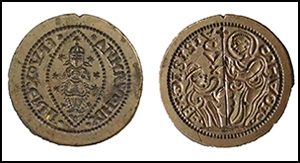
Soon after their arrival to the Subcontinent, aurei started to be imitated in India. Several examples of such imitations provide evidence of infiltration of Indian elements into their iconography. An astonishing example comes from the British Museum collection. Its obverse copies a coin of Antoninus Pius, but its reverse design has no direct prototype in Roman coinage and is thus a local development (Figure 2). The ‘Indianisation’ of a Western motif is also a notable feature of much later Indian imitations of Venetian ducats, which came into India via long-distance trade during the medieval and modern periods. Those imitations used as ornaments gradually became part of Indian culture (Figure 2). Ethnographic research on putalis allows us to examine the process of reinterpretation and appropriation of foreign coin design in a new cultural environment. The study can also contribute to a better understanding of the agency of imported objects.
a) Indian imitation of aureus (BM number 1988,0808.11; © The Trustees of the British Museum); b) its prototype (Antoninus Pius, RIC III 367; © Classical Numismatic Group, LLC, www.cngcoins.com); c) ducat of Tommaso Mocenigo (1413–1423) (© Classical Numismatic Group, LLC); d) Indian putali (K.K. Maheshwari's private collection, photograph by E. Smagur).

The 2019 fieldwork
The traditional use of putalis is still practiced in Maharashtra and provides a unique opportunity to study their value and meaning within contemporary communities. Information on their production and use was collected through participant observation and informal interviews with goldsmiths and jewellers from Nashik, since the city is known for its gold jewellery that has been manufactured and sold there for over 300 years. The Saraf Baazar (the market where gold and silver items are bought and sold) houses over 250 showrooms. Discussions with local inhabitants and investigation of putali necklaces and dies supplemented the work.
Results
Production
Putali haars—traditional necklaces made by threading together putalis and a middle pendant with a silk cord (Figure 3)—are still being produced in Nashik. Many goldsmiths (sonars) have old putali dies that belonged to or were made by their fathers or grandfathers. They create putalis in a traditional way, by placing a blank piece of metal between two dies and then striking the upper die with a hammer (Figure 4). The ring mount is then soldered to its top edge. Others produce putalis using a manual press and machine-made dies imported from other Maharashtra cities such as Jalgaon, Dhule or Tarapur (Figure 5). After preparing putalis, the haar is made by a person belonging to the Jangam caste or by the shop owner (Figure 6). The final products are sold in the saraf shops.
Indian woman wearing putali haar (© Indian Numismatic, Historical and Cultural Research Foundation, Nashik, India).

Top) hand-made dies; bottom) the striking of putali (photographs by E. Smagur).

Top) machine-made dies; bottom) a press (photographs by E. Smagur).

Making a haar (photographs by E. Smagur).

Design
The popularity of Venetian coins and their imitations in Maharashtra and other parts of India derives from their iconography. Although, in the early twentieth century, Syrian Christian women in Travancore prized necklaces of putalis bearing the effigy of St Mark as religious medals (Aravamuthan Reference Aravamuthan1999: 4), most Indians utilised the canons and norms of Hindu art for the interpretation of their design. According to informants, the tradition of wearing putali haars began in Maharashtra when Chhatrapati Shivaji (1630–1680) offered a multi-strand putali haar to the goddess Tulja Bhavani, whose image is enshrined in the temple of Tuljapur. This necklace of genuine Venetian ducats is still kept in the temple's treasury, together with other ornaments that are said to have been donated by Shivaji (Bankar Reference Bankar2010: 37–38). Nevertheless, none of the informants was aware that the form of modern putalis is derived from Venetian ducats. Currently, the most popular pair depicted on the obverse of putali is Rama and Sita, or Radha and Krishna, while the reverse usually depict Lakshmi, Vitobha or Krishna.
The process of reinterpreting Venetian ducat design in India is confirmed by folk narratives. It is also reflected in the variations of names, which differ according to region. The word putali (a statue) is the common term applied to Venetian coin and coin-like jewellery in Marathi, Konkani and Kannada, indicating the special meaning of their iconography depicting human figures. In Nashik, the representations on the obverses are most often interpreted as depictions of Radha and Krishna dancing garba dance, and on some of the dies they are identified by an inscription.
In the Mangalore and Malabar regions, the figures are considered to be Sita and Rama, with a coconut tree between them, and the necklace is called a Sita-Ram putali (Jambulingam Reference Jambulingam2008: 67). In South India, putalis are called sanar kasu. Here, the figure of the Doge is interpreted as a representation of sanar (a toddy—or palm wine—drawer) preparing to climb the palmyra (palm) tree (Aravamuthan Reference Aravamuthan1999: 6–8). According to another interpretation, the name sanar kasu refers to the fact that, while drinking toddy, the person often sits on his haunches next to the tapper, who is pouring toddy into the bowl, which the drinker holds aloft. This position strongly resembled the figures of St Mark and the kneeling Doge (Bakar & Bhandare Reference Bankar and Bhandare2009: 26).
Similarly, some Indians interpreted the Christ mandorla as a villu (a bow) and called them villu kasu (Sarojini Amma Reference Sarojini Amma2005: 91). In Kerala, another name given to ducats and their imitations is amada—after Amada, the consort of Bhagavati, who was offered a toddy by a sanar. It is believed that they depict Amada, the sanar and the tree (Thurston Reference Thurston1909: 268). According to another interpretation, this name derives from the fact that the mandorla resembles the wooden box used for storing jewels, known as amadapetty (Sarjoini Amma Reference Sarojini Amma2005: 91).
Conclusions
The value and meaning of objects depend on the cultural background of their users. The first impression that the individual experiences during contact with a coin is physical. From there, the impression passes through a cultural filter, before being interpreted and transformed into recognition (Kemmers & Myrberg Reference Kemmers and Myrberg2011: 94). In the case of putalis, their makers did not change the personality of the depicted characters intentionally. Their original meaning was not understood, while the new interpretation resulted from the Indian reading of depicted scenes, which may have varied depending on the region. The design of the imitations eventually evolved, and their makers began to introduce Indian elements into the original Western design. Currently, the original meaning of the representation is lost, but the tradition of using the ducat design continues.
The phenomenon of using putalis in India provides an exciting example of the reinterpretation of an object design in a new cultural context. Therefore, the possibility that, in some cases, the iconography of aurei was regarded in India as a new way of depicting local deities should be taken into account.
Acknowledgements
I would like to thank K.K. Maheshwari, Chetan Rajapurkar, Lakshmikant Varma, and the Indian Numismatic, Historical and Cultural Research Foundation
Funding statement
This research was funded by the University of Warsaw.


 Open access

