





Highlights
-
• Language switching is often assumed to engage executive functions (EFs).
-
• Three groups of early and late high- and low-proficiency bilinguals performed a cued naming-switching task and Simon task online.
-
• An association between language-switching performance and EFs was found for the low-proficiency bilinguals, but not for the other groups.
-
• Results indicate that lifelong bilingual experience may diminish EF-language switching associations.
-
• Results do not support the hypothesis that bilinguals always engage in EF for language switching.
1. Introduction
Bilingualism research has largely presumed that bilingual speakers engage domain-general control mechanisms in language control (Bialystok, Reference Bialystok2017; Bialystok & Craik, Reference Bialystok and Craik2022; Green, Reference Green1998; Green & Abutalebi, Reference Green and Abutalebi2013), called the “domain-generality account.” According to this account, general executive control mechanisms play an important role in bilingual behaviors such as language switching. This assumption is also fundamental for the claim that bilinguals might train executive functions (EFs) by means of language switching.
A predominant model that assumes domain-general control processes for language switching is the inhibitory control (IC) model (Green, Reference Green1998). Under this model, both languages are co-activated at all times, and the speaker needs to inhibit the non-target language to produce a word in the desired language. For example, in unbalanced bilinguals, such as L2 speakers for whom the L1 is the dominant language, L1 needs to be strongly inhibited during the production of L2. Closely connected to this model is the adaptive control hypothesis (ACH) (Green & Abutalebi, Reference Green and Abutalebi2013), which takes into account the role of the speaker’s interactional context in terms of which cognitive processes might be needed for using the appropriate language. The ACH identifies three interactional contexts: a single-language context, a dual-language context and a dense code-switching context. In the single-language context, each language is often used in distinct environments, for instance, work or home, but the two languages are not usually used simultaneously. In the dual-language context, two languages may be used within the same environment, but often with different interlocutors. An example is bilinguals who grow up speaking two languages at home, but consistently one with each parent or caregiver. In the dense code-switching context, both languages can be present in the same environment and can be used with the same interlocutor, who often is a bilingual as well. The ACH poses eight different control processes that may be involved in these contexts: goal maintenance, conflict monitoring, interference suppression, salient cue detection, selective response inhibition, task disengagement, task engagement and opportunistic planning. However, the different contexts do not engage the processes in the same way. The dual-language context is considered to be the most cognitively demanding one for the speaker, as it requires more constant awareness of the context in selecting the right language with the right speaker – a situation in which almost all of these control processes are presumably engaged.
The relationship between bilingual language use and domain-general cognitive control or EFs has been a central topic in cognitive research on bilingualism. Domain-general accounts presume such an association (Bialystok, Reference Bialystok2017; Bialystok & Craik, Reference Bialystok and Craik2022; Green, Reference Green1998; Green & Abutalebi, Reference Green and Abutalebi2013) and have further explored whether bilingual language use, such as language switching, could train EFs (Bialystok, Reference Bialystok2009; Bialystok & Viswanathan, Reference Bialystok and Viswanathan2009). Another domain-general view is that bilingual experience leads to broad neurocognitive adaptations where bilingual benefits would be seen in general abilities underlying different domains and tasks, such as attention, especially in tasks with higher demands for this ability (Bialystok, Reference Bialystok2017; Reference Bialystok2024). Despite the abundance of studies reporting bilingual advantages, this phenomenon has also been questioned, for example, by systematic investigations and meta-analyses focusing on EFs (e.g., de Bruin et al., Reference de Bruin, Treccani and Della Sala2015; Donnelly et al., Reference Donnelly, Brooks and Homer2019; Gunnerud et al., Reference Gunnerud, Ten Braak, Reikeras, Donolato and Melby–Lervag2020; Lehtonen et al., Reference Lehtonen, Soveri, Laine, Järvenpää, de Bruin and Antfolk2018; Lowe et al., Reference Lowe, Cho, Goldsmith and Morton2021; Monnier et al., Reference Monnier, Boiché, Armandon, Baudoin and Bellocchi2022; Paap, Reference Paap2018; Paap & Greenberg, Reference Paap and Greenberg2013). One might then ask whether the more fundamental assumption of bilingual language use engaging EFs holds.
While several studies suggest that language switching in bilinguals engages EFs due to the associations found between language switching and EF tasks in the lab (Declerck et al., Reference Declerck, Grainger, Koch and Philipp2017; Li et al., Reference Li, Botezatu, Zhang and Guo2021; Linck et al., Reference Linck, Schwieter and Sunderman2012), a number of studies have also failed to find such associations (Calabria et al., Reference Calabria, Hernandez, Branzi and Costa2012, Reference Calabria, Branzi, Marne, Hernández and Costa2015, Maguezi et al., 2012; see Lehtonen et al., Reference Lehtonen, Fyndanis and Jylkkä2023, for a review). Because the domain-generality hypothesis assumes EF-language control associations across bilingual speakers in dual-language contexts, the inconsistency in these results raises the important question as to whether, and under which circumstances, bilinguals may engage domain-general control mechanisms. If associations are not consistently found, extrapolating the potential training of EFs through bilingual language use might misinform our understanding of this issue.
Recent accounts have proposed alternative hypotheses as to why the research on bilingualism and EFs might show inconsistent results. The skill-learning, or task-specificity, hypothesis (Chein & Schneider, Reference Chein and Schneider2012; Jylkkä et al., Reference Jylkkä, Laine and Lehtonen2021; Lehtonen et al., Reference Lehtonen, Fyndanis and Jylkkä2023; see also Paap, Reference Paap2018, for a related idea) puts forward the idea that behaviors become more automatic as practice and experience increase and rely on EFs to a lesser extent than newly acquired skills. According to this view, accumulating experience leads to increased automatization, and processing gradually becomes task-specific once the performance is sufficiently practiced. This idea, as suggested by Chein and Schneider (Reference Chein and Schneider2012), is not specific to bilingualism, but this hypothesis has been applied recently in bilingualism research (Jylkkä et al., Reference Jylkkä, Laine and Lehtonen2021; Lehtonen et al., Reference Lehtonen, Fyndanis and Jylkkä2023). The skill-learning account makes specific predictions about the conditions in which associations between EFs and language switching may be seen (Lehtonen et al., Reference Lehtonen, Fyndanis and Jylkkä2023). First, speakers who are more experienced bilinguals and have, for example, developed higher proficiency should be less likely to engage EFs in language switching than those who are less experienced bilinguals. By extension, adult bilinguals who have had longer experience in the use and management of two languages should be less likely to engage EFs in language control than children, whose cognition and language knowledge are still developing (but see García González et al., Reference García González, Jylkkä and Lehtonen2024). Moreover, one should expect stronger associations between tasks of a similar structure and in novel tasks for which routines or skills have not yet been formed. In contrast to the traditional domain-generality views (e.g., Green, Reference Green1998) or more recent adaptation accounts (e.g., Bialystok, Reference Bialystok2024), the skill-learning (or task-specificity) view assumes that practice and experience in a task lead to automatization of performance via the built-up of task-specific skills, meaning specialization of task performance, and not to increased efficiency in domain-general, shared functions.
In practice, language-switching performance can be measured in the lab using cued picture-naming tasks that can be assumed to simulate a dual-language context. In cued naming (CN) tasks, the participant is to name a picture as quickly and correctly as possible in the language determined by a cue, such as a flag. After one or several trials, the cue changes, prompting a switch in the naming language, and this kind of language switch often elicits a processing cost. Thus, the participant is switching between languages based on an external cue that in real life would correspond, for example, to an interlocutor whom one knows to speak one language. In addition to these mixed-language blocks, there are typically also single-language blocks where only one language is used. This task allows researchers to obtain two measures for language switching: switching and mixing costs. Switching costs are obtained by comparing the difference in reaction times (RTs) between switch and repetition trials in a mixed block. They have often been interpreted to reflect reactive language control and are assumed to involve processes related to trial-by-trial inhibition or activation of the languages in the mixed block. Mixing costs, in turn, measure the difference between repetition trials in mixed blocks and single trials in single blocks. One way to explain them would be to assume they reflect sustained language control processes, such as monitoring or preparedness to switch in mixed blocks, whereas such demands are lower in single-block trials. However, it is an empirical question as to whether switch costs and mixing costs reflect domain-general EF processes. The idea of skill learning is that switching between particular languages based on external cues is a behavior that one becomes familiar with over time, such that it does not require as much domain-general cognitive control as in the beginning when starting to learn and use a language.
Cognitive tasks tapping into different components of executive control have been used to study whether bilingual language control engages EFs. Inhibition tasks, such as the Simon (Simon & Rudell, Reference Simon and Rudell1967) or Flanker (Eriksen & Eriksen, Reference Eriksen and Eriksen1974) tasks, provide a measure for executive control. For instance, in a Simon task, the participant is asked to categorize the color of the stimulus (blue or red) using the right or left key, respectively, in a keyboard or response box. In congruent trials, the blue color appears on the right and the red color appears on the left. In incongruent trials, the colors appear in the reverse order. The Simon effect, which is used to index IC, is obtained by comparing participants’ performance in incongruent versus congruent trials, with a smaller Simon effect indicating better performance.
1.1. Previous research
While the domain-generality account has been very influential (e.g., Green, Reference Green1998; Green & Abutalebi, Reference Green and Abutalebi2013), studies investigating the reliance of language switching on domain-general EFs have not consistently supported the predictions of the domain-generality hypothesis.
For example, Jylkkä et al. (Reference Jylkkä, Lehtonen, Lindholm, Kuusakoski and Laine2018) examined the role of EFs and language switching in a group of unbalanced bilinguals who had started learning the L2 after the age of 9 years but who had developed high proficiency in the language. The authors found results partly challenging the IC model. In a later study, Jylkkä et al. (Reference Jylkkä, Laine and Lehtonen2021) investigated bilingual language control and domain-general cognitive control in a similar population. In this case, the authors found slightly more consistent EF and language control associations in mixing costs than switching costs.
Studies including highly proficient bilinguals do not appear to show consistent associations between switching costs and EF performance. For instance, Branzi et al. (Reference Branzi, Calabria, Boscarino and Costa2016) found that for bilinguals with high proficiency in L2 and medium proficiency in L3, trilingual language switching was not predicted by a nonverbal switching task. Similar results were found for bilinguals with a lot of experience in the L2 in a study by Magezi et al. (Reference Magezi, Khateb, Mouthon, Spierer and Annoni2012), where, again, no associations were found between language switching and nonlinguistic shifting ability. Moreover, Calabria et al. (Reference Calabria, Hernandez, Branzi and Costa2012) reported that language control was not dependent on domain-general executive control. Overall, these results could be taken to suggest that language control is somewhat independent from general executive control, at least for speakers with significant language experience in the L2.
In a study exploring the effects of training on language switching, Timmer et al. (Reference Timmer, Calabria and Costa2019) found that training had effects on nonlinguistic task switching in switch cost measures. This finding could be interpreted to reflect involvement and training of domain-general set-shifting capacity via language switching, in line with the domain-generality account. However, as the task-switching task was structurally very similar to the trained language-switching task, the finding can also reflect the acquisition of task-specific skills during the training, which can also be applied in the other structurally similar switching task, in line with the skill-learning account.
The studies described above suggest that bilingual language control might not be associated with domain-general EFs in bilinguals with significant amounts of experience using the two languages. However, they were not specifically designed to test whether higher proficiency is related to smaller associations between language switching and EFs, and there are, thus far, very few studies that have addressed these associations in low-proficiency bilinguals. An exception is a recent study by Wang et al. (Reference Wang, Wu, Ji, Yan and Wu2022). Their study explored whether an association between language switching and IC, measured by using a Simon task, could be modulated by language proficiency in Chinese L2 speakers of English. Their results showed that Simon task performance predicted switching costs in the low-proficiency group only, not in the high-proficiency group. This could be interpreted to support the skill-learning account, where the high-proficiency participants’ language switching is relatively automatized and no longer relies on EFs, whereas for the low-proficiency group, language control is more effortful and still engages EFs. The authors interpreted this result as evidence that highly proficient bilinguals rely on domain-general control for language control less than speakers with lower L2 proficiency, a process that is representative of the development of a second language in bilinguals. In contrast, the Simon task predicted mixing costs in the high-proficiency group. In their review, Lehtonen et al. (Reference Lehtonen, Fyndanis and Jylkkä2023) concluded that while associations between EFs and switching costs are not consistently found for proficient and balanced bilinguals, associations between EFs and mixing costs are more commonly found even for relatively experienced bilinguals (see, e.g., Prior & Gollan, Reference Prior and Gollan2013; Stasenko et al., Reference Stasenko, Matt and Gollan2017). According to the review (Lehtonen et al., Reference Lehtonen, Fyndanis and Jylkkä2023), these steadier associations might suggest that language monitoring is less likely to become an automatized process than switching.
1.2. The present study
The domain-generality account, a prominent account in bilingualism research, assumes that language switching constantly engages EFs in dual-language contexts (Green & Abutalebi, Reference Green and Abutalebi2013). The skill-learning or task-specificity hypothesis, instead, assumes that EFs might not be engaged in language switching if the speaker is experienced enough in this task, and hence, this process is automatized (e.g., Lehtonen et al., Reference Lehtonen, Fyndanis and Jylkkä2023). This would be the case for bilinguals with lifelong experience in using and switching between these languages and those with high proficiency in the languages, whereas a greater degree of EF engagement would be expected for speakers with lower proficiency in the second language (Lehtonen et al., Reference Lehtonen, Fyndanis and Jylkkä2023).
We tested this prediction of the skill-learning hypothesis by applying a CN task with language switching and a Simon task in an online experiment in native speakers of Finnish with varying levels of proficiency and background in the Swedish language. We expected that the association between language-switching costs and performance in this IC task would be modulated by participants’ language proficiency (Lehtonen et al., Reference Lehtonen, Fyndanis and Jylkkä2023) and possibly by their age of acquisition (AoA) of the other language. We collected data from a population in which some were early bilinguals with high proficiency, for whom one would expect the greatest amount of automatization to have taken place, and in which some were late bilinguals with varying proficiency levels. We expected to find (1) a positive association between CN switching performance and EF performance in late bilinguals with relatively low language proficiency and limited experience with language switching between Finnish and Swedish and (2) no or weaker associations in bilingual participants with higher proficiency in the two languages and possibly earlier AoA of the other language, who are also more experienced language switchers between Finnish and Swedish. Based on the conclusions in the review by Lehtonen et al. (Reference Lehtonen, Fyndanis and Jylkkä2023), we expected that proficiency would affect the EF associations for switching costs more than for mixing costs, for which associations could be observed even in high-proficiency bilinguals.
2. Method
2.1. Participants
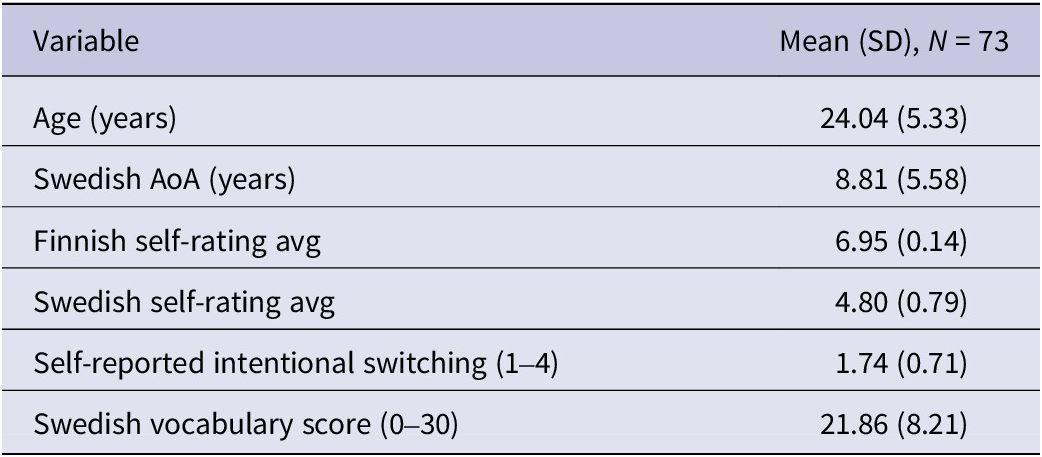
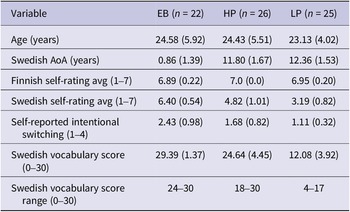
The participants (N = 73; mean age, 24.0; SD, 5.3; 70 women) were Finnish speakers with varying Swedish proficiency and background (see Table 1). All participants were university students. Before the experiment, participants signed a consent form and thereby declared they had normal hearing and vision and had no neurological or language disorder diagnoses, such as attention deficit hyperactivity disorder or dyslexia. Our main goal was to study the effect of language proficiency on EF engagement in language switching in a sample of bilinguals with varying levels of language competence. Although our secondary aim was to study the effect of AoA, the final sample size did not allow us to examine the role of this factor optimally. Therefore, the assessment of the subgroup results should be treated as exploratory. For the purpose of these more exploratory analyses, the participants were divided into three groups based on their AoA and language proficiency. The first group consisted of early Finnish–Swedish bilinguals (n = 22) who had learned or been exposed to Swedish since birth or early childhoodFootnote 1, before the age of 7 years. We used this age as a threshold since it is the age at which children begin school in Finland, which could influence their language experience if they started receiving Swedish language instruction in school. Many participants of the early bilingual group were recruited from the Åbo Akademi University, a Swedish-speaking university in Turku, Finland. The second group included highly proficient native speakers of Finnish who had acquired Swedish primarily as part of the obligatory school curriculum (n = 26; mean AoA: 11.97; SD: 1.45). The third group comprised low-proficient native Finnish speakers who also had started to learn Swedish later, primarily as part of the school curriculum (n = 25; mean AoA: 12.48; SD: 1.67) but had lower Swedish skills (see Table 2 for detailed information on the three groups). Swedish is an obligatory subject for Finnish native speakers in the national school system. Most of the participants in the high- and low-proficiency groups were following higher education at the Finnish-speaking University of Turku, Finland.
Characteristics of the whole group of participants

Characteristics of the three proficiency groups: mean (SD)

Abbreviations: EB, early bilinguals; HP, high-proficiency late bilinguals; LP, low-proficiency late bilinguals.
The participants’ Swedish proficiency was determined by a vocabulary test (see Section 2.2), which was highly and positively correlated with their self-reported proficiency (r = 0.87; p < 0.001). Assessing a person’s vocabulary knowledge has been shown to give a good insight into language proficiency for both comprehension and communicative ability (Staehr, Reference Staehr2008), correlating strongly with reading comprehension (Laufer & Ravenhorst-Kalovski, Reference Laufer and Ravenhorst-Kalovski2010) and with the six levels of the Common European Framework of Reference for languages (Milton, Reference Milton, Bartning, Martin and Vedder2010). Moreover, we collected self-reported intentional switching data (see Table 2) to gain an understanding of the participants’ experience with switching between Finnish and Swedish. This was done by asking the participants: “How often do you switch intentionally between Finnish and Swedish in your speech on a normal day?” The scale ranged from 1 to 4, indicating 0–2 times/day (rarely or never); 3–10 times/day (occasionally); 10–20 times/day (quite often); more than 20 times/day (very often). We used this crude measure to get an idea about the relationship between proficiency and language use in these participants. We assumed that participants with higher proficiency tended to switch more between the two languages in their everyday lives than those with lower proficiency. As expected, this self-reported intentional switching measure was positively correlated with the Swedish vocabulary score (r = 0.59; p < 0.001). Because the validity of even more comprehensive retrospective language-switching questionnaires has been questioned (e.g., Jylkkä et al., Reference Jylkkä, Soveri, Laine and Lehtonen2019), it was not our goal to use this variable in the main data analysis.
All participants in the present study also knew other languages, such as English. We excluded participants who were not neurologically healthy or reported having hearing or developmental language difficulties. The participants were recruited directly through university channels, including students who were required to participate in research as part of their coursework in psychology, via email announcements and through Swedish teachers at the University of Turku. If the participant completed all phases of the experiment, they were asked to provide their email to be sent a 10-euro gift voucher (unless they were students on participation duty).
2.2. Procedure and materials
The study was approved by the Ethics Committee for Human Sciences at the University of Turku. Participants provided digital consent before starting the experiment, which was collected online in the Gorilla Experiment Builder (www.gorilla.sc) (Anwyl-Irvine et al., Reference Anwyl-Irvine, Massonnié, Flitton, Kirkham and Evershed2020). Data were collected between November 29, 2022, and February 22, 2023.
The experiment could be completed over a 1-h session, including breaks, or longer if the participant required longer breaks. The experiment consisted of a Simon task, a cued picture-naming language-switching task, a Swedish vocabulary test and a language background questionnaire. The vocabulary test was a short version of the Swedish Levels Test (SweLT 1.0; Bokander, Reference Bokander2016) that was designed to challenge even advanced learners. Within the experiment, participants were randomly directed into one of four groups so that the order of the naming task and the Simon task was counterbalanced. The vocabulary test and the background information questionnaire were always completed after the other two tasks.
For the secondary, more exploratory analyses, the early bilingual group was formed from those participants who had acquired both Finnish and Swedish before the age of 7 years (cf. Section 2.1), although most participants had acquired both languages clearly before this age limit (cf. Table 2). In forming the high- and low-proficiency groups in the late-learner participants, we followed Wang et al. (Reference Wang, Wu, Ji, Yan and Wu2022) and used the median score in the Swedish proficiency test that had a maximum score of 30. According to this criterion, participants scoring ≥18 were included in the high-proficiency group, while those scoring <18 were included in the low-proficiency group. Differences in proficiency across the three groups were analyzed with a one-way analysis of variance, which showed a statistically significant effect of group (F(2,73) = 257.3, p < 0.001). A further independent-samples t-test confirmed that the early bilingual and high-proficiency groups did not differ in their proficiency scores, but the low-proficiency group did (p < 0.001) (cf. Table 2 for more information on means and standard deviations for all groups).
The instructions for the experiment were given in Finnish. Throughout the experiment, a memoji acting as “experimenter” accompanied the participant through video and text explanations. In the instructions of the experiment, participants were encouraged to sit in a quiet room and wear a headset to ensure the quality of oral responses. The settings of the experiment were such that participants were only allowed to sign in from a computer or a laptop, not from phones or other devices.
2.2.1. Cued picture naming
We designed a nonvoluntary cued picture-naming task (CN) according to previous literature (Jylkkä et al., Reference Jylkkä, Lehtonen, Lindholm, Kuusakoski and Laine2018, Reference Jylkkä, Laine and Lehtonen2021) to test the participants’ language-switching performance. The task consisted of seven blocks presented in a sandwich design, including two single blocks, three mixed blocks and two single blocks. The order in which the languages were presented was counterbalanced. Participants named pictures aloud in Finnish or Swedish, according to a visual cue of a flag. The single blocks consisted of 20 experimental items, whereas the mixed blocks presented the same pictures repeated twice (40). Each picture was repeated 10 times throughout the task in between single and mixed blocks (five times in each language). Practice blocks were given before the single blocks and the first.
The order of the trials was randomized in the single blocks and pseudorandomized in the mixed blocks. The task consisted of a total of 200 trials: 80 in the single blocks and 120 in the mixed blocks. We created four lists for the mixed blocks to control for order effects and to assure a sufficient number of switch trials (48; 24 to each language) and repetition trials (69). The first trial did not count as either a switch or a repetition. We chose a proportion of 40% switches to 60% repetition trials to avoid the predictability of the switches. We assured there were no more than four consecutive trials of the same type. The participants completed five practice trials for each of the single-language blocks and 16 practice trials before the mixed-language block. The oral responses were recorded to analyze reaction times (RTs). Following Jylkkä et al. (Reference Jylkkä, Lehtonen, Lindholm, Kuusakoski and Laine2018, Reference Jylkkä, Laine and Lehtonen2020), RTs were obtained by using a MATLABTM script that determined word production speed by setting the threshold for volume (percent of maximum volume in a specific audio file). We assessed different sound thresholds of the automatic script and compared them to manual word-onset timings performed by two persons on data from four individuals. This procedure showed that 0.4× the maximum amplitude was the most reliable threshold (with a correlation of 0.928 with manual timings) and was hence used in the determination of RTs.
The pictures were selected from the MultiPic Project (Duñabeitia et al., Reference Duñabeitia, Crepaldi, Meyer, New, Pliatsikas, Smolka and Brysbaert2018). The words were matched across languages for mean frequency (based on the following newspaper corpora: Turun Sanomat for Finnish and Göteborg-Posten for Swedish, Laine & Virtanen, Reference Laine and Virtanen1999) and number of alternative names. Cognates were avoided. A picture appeared in the middle of a white screen. The cue appeared slightly to the left and above the target picture. A visual cue of a flag was given in all blocks to help participants identify the target language. The cues were pseudorandomized so that there were a maximum of four consecutive same-language trials. Each trial lasted for a maximum of 3 s. A trial began with a white screen and a fixation cross of 1500 ms, and then the picture appeared simultaneously with a visual cue (flag denoting language). Both the cue and the picture remained on the screen for 1500 ms, regardless of when the response was produced (see Jylkkä et al., Reference Jylkkä, Lehtonen, Lindholm, Kuusakoski and Laine2018, Reference Jylkkä, Laine and Lehtonen2021). There was a 100-ms interval between trials. At the beginning of the task, participants watched an introduction video with audio where the “experimenter” explained what participants would do in the task, and that breaks would be possible throughout the task. While the breaks were governed by the experiment, the participant could choose the length of each break. Participants were shown a second demonstration video to display how to allow Gorilla Experiment Builder to access their microphone, and they were given the opportunity to test the quality of the recording before starting the tasks. A familiarization phase preceded the task. Participants saw all pictures (one at a time) with both Finnish and Swedish names, followed by a reminder screen where all pictures were shown in one screen with their names in the two languages. This was particularly important for the lower proficiency speakers, who likely benefited from additional exposure to the words in Swedish. All instructions were given in Finnish regardless of the language block.
2.2.2. Simon task
A Simon task was used to measure the participants’ IC ability (Simon & Rudell, Reference Simon and Rudell1967). Participants were asked to respond based on the color of the stimulus (red or blue) by pressing F or J, respectively, on the keyboard. The task consisted of 10 practice trials (with feedback) and 100 experimental trials. The stimuli were balanced to appear pseudorandomized at the right or left of a fixation cross. On congruent trials, the stimulus was on the same side as the response button (e.g., the blue stimulus on the right, where J is the correct response). On incongruent trials, the stimulus was on the opposite side of the response button (e.g., the blue stimulus was on the left, opposite side to the correct key, J).
Each trial began with a fixation cross of 1000 ms. After that, the cue remained on the screen for 1000 ms or until a response was given. The task provided RTs that were used to calculate the Simon effect, which is the difference between incongruent and congruent trials. The smaller the effect, the better the performance.
2.2.3. Statistical analyses
All analyses were performed in R using linear mixed effects models (lmer, package lme4, Bates et al., Reference Bates, Mächler, Bolker and Walker2015). For all models, log-transformed RTs were the dependent variable. In addition, we z-transformed (centered) all predictors of interest, specifically the Simon effect measured in RTs and participants’ Swedish vocabulary scores. For all models, trial number was always included as a covariate, and subject and item were included as random effects. Before fitting the statistical models, incorrect RTs were removed from the CN task and the Simon task. Correct trials that deviated ±3 SD from the participant’s overall mean were also excluded. A total of 113 correct trials (0.63% of total trials) were removed from the CN task. The same exclusion criteria were used for the Simon task, where 232 correct trials (2.55% of total trials) were removed. In addition, participants with an accuracy below 50% in the CN task and below 20% in the Simon task were excluded from the final analysis. In the sections below, the estimates and standard errors are reported exponentiated. First, we focused on the whole sample to study whether the association between language switching and inhibition performance is modified by participants’ proficiency. Second, we studied the associations separately in the three groups that differed with respect to the participants’ AoA and/or proficiency.
3. Results
3.1. Language control and executive control associations for the full sample
The first model assessed a three-way interaction of condition, Simon effect, and Swedish proficiency score in the full sample of participants. Figure 1 shows how, in participants with a lower vocabulary score (left panel), a larger Simon effect appears to be associated with a larger switch cost. Participants with a higher vocabulary score (right panel) do not show such an effect, and the participants in the middle show a weaker association between Simon and the switch cost measure than those with a lower vocabulary score. This model revealed a significant three-way interaction for switching costs (E = −0.001, SE = 0.0006, t = −2.21, p = 0.027) but the three-way interaction for mixing costs was not significant (E = −0.001, SE = 0.0005, t = −1.86, p = 0.063) (exponentiated coefficients of estimates and confidence intervals can be seen in Table 3). The model also revealed a main effect of trial number (E = −0.0002, SE = 0.00003, t = −6.27, p < 0.001), which indicates that participants became faster in naming throughout the task. Furthermore, the model revealed a significant two-way interaction for switching costs and Simon effect (E = 0.04, SE = 0.01, t = 2.90, p =0.004) and for mixing costs and Simon effect (E = 0.02, SE = 0.01, t = 2.08, p = 0.038). This suggests that an increasing Simon effect generally increases switching costs but decreases mixing costs. Lastly, the model showed a two-way interaction for switching costs and Swedish vocabulary score (E = −0.002, SE = 0.0006, t = −4.46, p < 0.001): the magnitude of switching costs increased with decreasing proficiency.Footnote 2
Associations between cued naming (CN) condition, Simon task and Swedish proficiency.
Note: RTs are log-transformed and the Swedish vocabulary score (“swedish_rawscore”) is centered (z-transformed). N = 73.
Please note that the three panels are created mechanistically based on vocabulary score by the regression model and do not directly correspond to the three language profile subgroups of the present study.

Model analyzing cued naming condition * Simon effect * Swedish proficiency (“swedish_rawscore”) for the full sample N = 73

Note: The baseline level for the predictor condition was repetition.
3.2. Language control and executive control associations for different proficiency groups
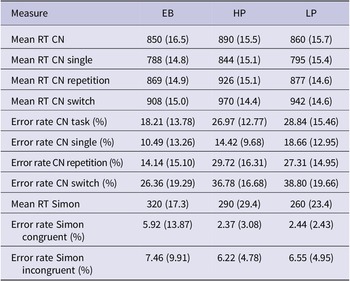
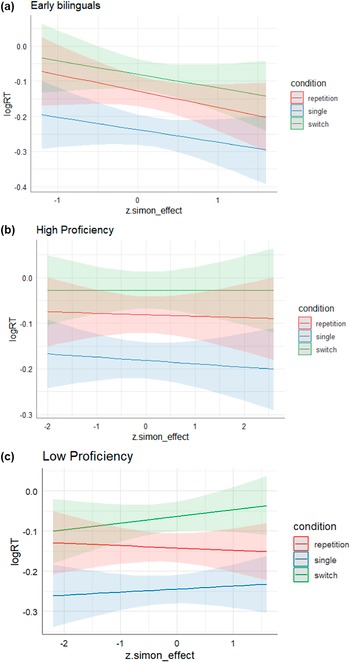
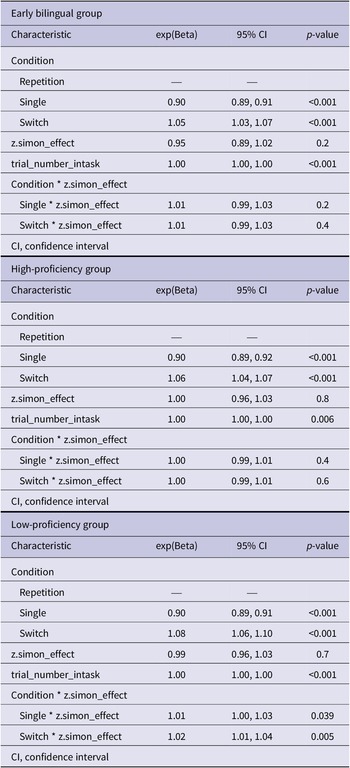
Given the results reported in Section 3.1, we ran exploratory analyses to study the associations in the three groups separately (see Sections 2.1 and 2.2 for group descriptions and criteria for division): early bilinguals, late bilinguals with higher proficiency and late bilinguals with lower proficiency. The grouping was theoretically motivated, but we advise the reader to interpret these results with caution, as the subgroup analysis may be underpowered, as opposed to the full sample analysis. The mean RTs and error rates for the CN and Simon tasks are reported in Table 4. Even though the three-way interaction for mixing costs was not significant, we kept the three-level condition (i.e., also including the single trials) in the model for consistency. In the early bilingual group, the model assessing the Simon effect on CN did not reveal a significant association for switching costs (E = 0.008, SE = 0.01, t = 0.76, p = 0.400) or for mixing costs (E = 0.01, SE = 0.009, t = 1.19, p = 0.200). Similar to the first full-sample model, this model revealed a main effect of trial number (E = −0.0002, SE = 0.00004, t = −3.41, p < 0.001), indicating that participants became faster throughout the task. For the high-proficiency late bilinguals, the model did not reveal significant associations between Simon and switching (E = 0.003, SE = 0.006, t = 0.53, p = 0.600) or mixing costs (E = −0.004, SE = 0.005, t = −0.86, p = 0.400), but there was again a main effect of trial number (E = −0.0001, SE = 0.00004, t = −2.75, p = 0.006). However, for the low-proficiency group, the model exploring CN associations with the Simon task revealed a significant positive association for switching costs (E = 0.02, SE = 0.008, t = 2.82, p = 0.005) and a negative one for mixing costs (E = 0.01, SD = 0.006, t = 2.07, p = 0.039). As in the previous models, there was a main effect of trial number (E = −0.0002, SE = 0.00005, t = −4.59, p < 0.001) (Figure 2 and Table 5).
Mean RTs in ms (SD in parenthesis) of correct trials for the cued naming (CN) and Simon tasks for each group, and error rates per condition and group for the CN and Simon tasks

Abbreviations: CN, cued naming; EB, early bilinguals; HP, high-proficiency late bilinguals; LP, low-proficiency late bilinguals.
CN and Simon effect associations for the different language profile groups.
Note. CN, cued naming; EB, early bilinguals; HP, high-proficiency late bilinguals; LP, low-proficiency late bilinguals.

Results for the subgroup analyses (cued naming condition * Simon effect)

Note: The baseline level for the predictor condition was repetition.
4. Discussion
In the current study, we tested predictions of the skill-learning, or task-specificity, hypothesis (Lehtonen et al., Reference Lehtonen, Fyndanis and Jylkkä2023) and studied whether language-switching performance is associated with domain-general EFs in participants who differ with respect to their assumed automatization of the two languages. We predicted that the association between Simon performance and the CN switching costs, but not mixing costs, is moderated by language proficiency, such that stronger associations were expected for the lower-proficiency than for higher-proficiency participants.
The main regression model assessing the role of proficiency in associations between the Simon effect and CN performance showed, as predicted, that associations for switching costs were significantly modulated by participants’ Swedish proficiency. This finding is in line with the skill-learning account’s predictions (Lehtonen et al., Reference Lehtonen, Fyndanis and Jylkkä2023) but not with the domain-generality account, which assumes involvement of EFs irrespective of participants’ proficiency or language background. Following this overall result, the more specific but exploratory subgroup analysis, focusing on both AoA and proficiency, revealed that switch costs were not significantly associated with Simon performance in early bilinguals or high-proficiency late bilinguals. For the low-proficiency group, in turn, the Simon effect positively predicted switching costs in CN. These findings are consistent with the skill-learning account, as longer experience and higher reached proficiency in a language have assumedly led to a higher degree of automatization of language switching.
As for the mixing costs, we expected that this measure would be associated with Simon performance irrespective of language proficiency (see Lehtonen et al., Reference Lehtonen, Fyndanis and Jylkkä2023). The main regression model indeed showed that the association between mixing costs and Simon did not depend on proficiency. Language monitoring, or proactive language control, that CN mixing costs are assumed to reflect, might be less susceptible to automatization than other aspects of language switching (Lehtonen et al., Reference Lehtonen, Fyndanis and Jylkkä2023). In the present analysis, the two-way association between mixing costs and Simon was significant, but the association was negative. Negative associations between mixing costs and EF measures have sometimes been observed (see, e.g., Jylkkä et al., Reference Jylkkä, Lehtonen, Lindholm, Kuusakoski and Laine2018), but they are findings not easy to explain by any framework.Footnote 3
This study is one of the very few investigations directly assessing the role of L2 proficiency in the association between EFs and language control (for an exception, see Wang et al., Reference Wang, Wu, Ji, Yan and Wu2022) and, to our knowledge, the only study exploring this relationship directly in connection to the skill-learning account. A challenge for the currently predominant domain-generality account is the multitude of results showing no associations between EFs and language switching (e.g., Branzi et al., Reference Branzi, Calabria, Boscarino and Costa2016; Calabria et al., Reference Calabria, Hernandez, Branzi and Costa2012; Magezi et al., Reference Magezi, Khateb, Mouthon, Spierer and Annoni2012), including the results observed in the present study for early and high-proficiency late bilinguals. The skill-learning account seems to better explain these patterns. In the present study, bilingual speakers with different proficiency levels showed different results with respect to the associations between CN switch costs and the used EF measure. While we predicted that substantial bilingual experience should, at best, lead to very weak associations between EF and CN switching, the exact quantity or quality of language experience necessary for EF involvement to diminish is not currently specified in the skill-learning account, nor was it in our predictions. The data in our study are also insufficient to determine the exact degree of language experience or level of proficiency required for speakers to no longer engage EFs.
Our results nevertheless revealed noteworthy findings with respect to the more proficient speakers, that is, the early bilingual and the high-proficiency groups, in both of which we found no associations in switching costs. In our study, the late high-proficiency group was quite similar to the early bilinguals in terms of Swedish proficiency based on the vocabulary test, with AoA being the most apparent difference between these two groups. In view of this result, while AoA might be an important indicator of a bilingual’s cumulative length of exposure to their languages, it does not seem to be the only factor that can influence the extent to which speakers are able to automatize language behaviors such as language switching. However, given that the present subgroup analyses were based on a relatively small number of participants, future studies will need to confirm this finding.
There are some key aspects with respect to the background differences and similarities across groups. First, the early bilingual and the high-proficiency late bilingual groups are very similar with respect to the assessed proficiency; also, the latter group scores quite high in the Swedish vocabulary test. Second, the AoA for the high-proficiency late bilingual group is later than for the early bilingual group. However, the speakers in the high-proficiency group still started acquiring Swedish at a fairly young age (mean AoA = 11.8 for the high-proficiency group; mean AoA = 12.4 for the low-proficiency group), providing them with over a decade of bilingual experience by the time of the testing. This again taps into the question of how rapidly cognitive behaviors can become automatized, especially if acquired during a life period with still significant cognitive maturation, such as in adolescence. Third, the low-proficiency group started acquiring Swedish around the same time as the late high-proficiency group; yet, they show strikingly different results compared to the high-proficiency group. Based on this finding, the AoA and its length could be inferred to be less relevant factors compared to language proficiency.
Length of exposure and/or reached proficiency have also been considered in neurocognitive models, such as the dynamic restructuring model (Pliatsikas, Reference Pliatsikas2020), the bilingual anterior to posterior and subcortical shift model (Grundy et al., Reference Grundy, Anderson and Bialystok2017) and the unified bilingual experience trajectory model (DeLuca et al., Reference DeLuca, Segaert, Mazaheri and Krott2020, Reference DeLuca, Voits, Ni, Carter, Rahman, Mazaheri, Krott and Segaert2024). They propose that these variables give rise to neural adaptations that are related to increased efficiency of language/cognitive control. The skill-learning view also assumes that observed changes at the brain level may be due to decreased control demands for performing practiced tasks and/or acquisition of task-specific subroutines. However, whether this increasing efficiency seen in one task can be utilized for other cognitive tasks is where the skill-learning account differs from some of the other models. The skill-learning framework assumes task-specificity with increasing automatization, meaning broad benefits in structurally different tasks cannot be seen.
The presently used Simon task can be considered to be structurally quite different from the CN task, an aspect that is central to comparing the two frameworks (Lehtonen et al., Reference Lehtonen, Fyndanis and Jylkkä2023). The domain-generality framework assumes that cued language switching engages IC, as does the Simon task, and they should therefore show associations with each other even in high-proficiency bilinguals. The skill-learning view, instead, assumes that task performance becomes specialized with experience, and only tasks of similar structure can utilize the same developed skills and show associations with one another if individuals are experienced in the task. The present design was therefore able to provide direct evidence in support of the skill-learning framework. This framework predicts that stronger associations would be seen in high-proficiency bilinguals if the CN task was paired with a structurally similar EF task, such as an externally cued color-shape switching task (Rubin & Meiran, Reference Rubin and Meiran2005). Previous studies that have found language switching – EF associations in high-proficiency bilinguals have, in fact, often used structurally similar tasks (see, e.g., Declerck & Grainger, Reference Declerck and Grainger2017; Segal et al., Reference Segal, Stasenko and Gollan2019). As pointed out, such associations would also be expected by the skill-learning framework.
The current study also presents some limitations, such as the extent to which these different groups diverge or converge in their daily use of Swedish and how this may play a role in the engagement of EFs. While we have some information about the current daily use of these languages and the degree to which the participants switch in their day-to-day life, we lack information regarding potential changes in these behaviors across the lifespan, and how that might influence their cumulative exposure. The inferences from the separate group analyses also need to be taken with caution, as the sample size for the individual groups is not as well-powered as for the whole sample. An additional potential limitation is the online nature of the experiment used for data collection, and whether the data retain the same degree of reliability as lab-collected data. However, in a recent study, Uittenhove et al. (Reference Uittenhove, Jeanneret and Vergauwe2023) showed that the modality of testing has little impact on data quality. They additionally highlighted that the participant pool one might have access to through recruitment platforms, such as Prolific or MTurk, may limit researchers’ access to variability in the sample that is sufficiently representative of the population of interest. In our study, however, participants were recruited directly through university channels and Swedish-speaking environments, in the same way one would recruit participants for lab testing. Therefore, we do not consider this aspect to be a major concern in our study.
It should also be noted that some studies have challenged the reliability of switching costs in language-switching tasks, suggesting that mixing costs may be a more reliable measure for language control (Segal et al., Reference Segal, Prior and Gollan2021). Switching costs are nevertheless the measures most commonly reported as an index of language control in bilinguals with different ages and linguistic profiles (see Section 1.1).
This investigation is one of the first to assess the role of L2 proficiency in the relationship between EFs and language control and to test the skill-learning hypothesis. Further research is needed to understand the extent to which L2 proficiency influences the relationship between EFs and bilingual language control, especially with respect to mixing cost measures, as well as the specific quantity of L2 experience necessary for automatization to take place in switching. Nevertheless, the current results can be taken to challenge the widely established assumption that EFs are always involved in language switching in a dual-language context. These results may then cast doubt on the cognitive training hypothesis as well. If the engagement of EFs for language control is limited to a specific group of speakers, the idea that all bilingualism could broadly train domain-general cognitive processes needs to be reconsidered.
5. Conclusion
We explored associations between performance in a cued picture-naming task with language switching and a Simon task in a sample of Finnish–Swedish bilinguals and language learners in Finland with different proficiency levels. Our results indicate that the reached proficiency level is an important factor in determining the extent to which the speaker engages EFs in their bilingual language control. For high-proficiency bilinguals, the substantial experience they have gathered in language switching and use might have led them to develop specialized subroutines or skills for language switching that no longer rely on EFs. Instead, for L2 speakers in the early stages of learning who have less bilingual experience or who have not yet reached high proficiency, language switching is not likely to have yet become an automatized cognitive process. This study thereby provides evidence supporting the skill-learning (task-specificity) hypothesis (Lehtonen et al., Reference Lehtonen, Fyndanis and Jylkkä2023).
In addition to theory development, these results may contribute to the bilingual advantage debate, as they challenge the domain-generality view, which assumes that executive control is necessary for language switching in dual-language contexts, and by extension, the cognitive training hypothesis. If EF engagement is limited to a restricted proportion of bilingual speakers, it is unlikely that language switching can have long-term training effects on EFs.
Supplementary material
The supplementary material for this article can be found at http://doi.org/10.1017/S1366728925100199.
Data availability statement
The data and materials for this study are available on the Open Science Framework: https://osf.io/ga5j6/
Acknowledgments
The authors thank Lars Bokander for sharing the short version of the SweLT vocabulary test and Aino Mäntysaari for her help in data coding. The authors are thankful to Jussi Jylkkä for sharing resources for data analysis, Ali Moazami Goodarzi for statistical consultation and Teemu Laine for his help with the MATLAB script.
Competing interests
The authors declare none.




 Open access

