


Introduction
The consumption of snakes is important in many Southeast and East Asian cultures, and continues to be a part of contemporary life for subsistence and medicinal purposes (Klemens & Thorbjarnarson, Reference Klemens and Thorbjarnarson1995; Alves et al., Reference Alves, Vieira, Santana, Vieira, Montenegro, Alves and Rosa2013). With snake harvesting driving a decline of many species (Klemens & Thorbjarnarson, Reference Klemens and Thorbjarnarson1995; Gibbons et al., Reference Gibbons, Scott, Ryan, Buhlmann, Tuberville and Metts2000), monitoring of the global snake trade is increasingly important (Hierink et al., Reference Hierink, Bolon, Durso, de Castañeda, Zambrana-Torrelio, Eskew and Ray2020). Some snake species are regulated in the international trade through their listing in the CITES Appendices (CITES, 2021). Yet many species used in traditional medicine or for meat are not CITES-listed, and their wild populations are not adequately assessed (Alves et al., Reference Alves, Vieira, Santana, Vieira, Montenegro, Alves and Rosa2013; Marshall et al., Reference Marshall, Strine and Hughes2020).
In Cantonese culture, the consumption and trade of snakes has a long tradition. The snake trade has a long history particularly in South China, and the city of Guangzhou used to hold one of the largest snake markets globally (Pope, Reference Pope1961, cited in Klemens & Thorbjarnarson, Reference Klemens and Thorbjarnarson1995). In the Hong Kong Special Administrative Region, the consumption of snake soup (蛇羹) remains common, especially during colder months (Cheung, Reference Cheung2013). Based on visual inspection of live individuals, Wong et al. (Reference Wong, Fung, Lam, Lam, Kam and Simpson2009) identified species native to Hong Kong in four snake soup shops: the Chinese cobra Naja atra, many-banded krait Bungarus multicinctus, king cobra Ophiophagus hannah, red-necked keelback Rhabdophis subminiatus and radiated rat snake Coelognathus radiatus. They also recorded one non-native species, the monocled cobra Naja kaouthia, which occurs in South and Southeast Asia. Of these, only N. atra, N. kaouthia and O. hannah are CITES-listed. Potential source locations for these snakes include Thailand, Malaysia and Indonesia, and local markets in Hong Kong (Wong et al., Reference Wong, Fung, Lam, Lam, Kam and Simpson2009; Cheung, Reference Cheung2013), although the origin, number and diversity of species consumed in soup is largely unknown.
Partially driven by demand for and commercial trade in snake meat, Hong Kong is a major global importer of live snakes, and the top importer of live, venomous snakes, with mainland China and Indonesia being the main export sources (Hierink et al., Reference Hierink, Bolon, Durso, de Castañeda, Zambrana-Torrelio, Eskew and Ray2020). Although these data suggest that the majority of snakes consumed in Hong Kong are of Chinese or Indonesian origin, shops also import snakes as non-live meat, potentially from other countries. Snake farms are common in China and Indonesia, and when managed ethically, can be a reliable and sustainable source of snake meat, curbing the harvest of wild individuals (Natusch & Lyons, Reference Natusch and Lyons2014; Aust et al., Reference Aust, Van Tri, Natusch and Alexander2017). However, there are also reports of wild-caught snakes being exported as captive-bred either directly (Nijman, Reference Nijman2014), or by way of laundering through snake farms (Lyons & Natusch, Reference Lyons and Natusch2011; Natusch & Lyons, Reference Natusch and Lyons2014), to bypass laws and regulations limiting trade.
We aimed to understand the implications of snake soup consumption in Hong Kong on the snake trade and wild populations of traded species. We interviewed owners and employees of snake soup shops in the region to assess their knowledge of and perspectives on this practice and industry. We collected snake meat samples from shops to genetically identify species consumed and compared these with species identified as common in trade based on interviews. We thus sought to determine (1) the species consumed, (2) geographical origins of consumed snakes, and (3) shopkeepers’ views on the future of Hong Kong's snake soup industry. Through this complementary approach, we aimed to gain insights on the ecological and social implications of snake soup consumption, to guide management efforts towards sustainable consumption while respecting this cultural tradition.
Study area
Shops specializing in snake soup exist throughout Hong Kong's three main regions: Kowloon, Hong Kong Island and The New Territories. We visited 14 shops, more than half of all shops estimated to exist in Hong Kong, during February 2019–January 2020, and one in June 2020. The shops had been operating for a mean of 44 years (range 4–130 years).
Methods
Interviews
We visited shops between 10.00 and 17.00, during typical operation hours. We interviewed one person per shop: either an owner (71%, n = 10), or an employee (29%, n = 4) if no owner was available. Participant numbers were limited by the number of shops we could visit because of the potential co-dependency of interview responses from participants from the same shop. Interviews lasted 15–30 min, were conducted in Cantonese, and consisted of closed and open-ended questions (Supplementary Material 1; Landry Yuan et al., Reference Landry Yuan, Ballullaya, Roshnath, Bonebrake and Sinu2020). Before interviews, we discussed with participants the cultural value of snake soup, and the context within which we aimed to ask questions regarding the shop's business. Although we cannot interpret the information we obtained from interview questions as factually robust statements, we took this approach to gain an understanding of the attitudes and knowledge regarding the snake soup industry from the perspective of those whose livelihoods depend on it (Landry Yuan et al., Reference Landry Yuan, Ballullaya, Roshnath, Bonebrake and Sinu2020).
Snake meat DNA extractions and species identification
We obtained snake tissue samples from the shops where we conducted interviews, with each shop providing one or two samples. Twelve samples were raw (fresh or frozen), three were cooked and one cooked in soup. As controls (Supplementary Table 1), we used 17 voucher specimens of snake species native to Hong Kong provided by Kadoorie Farm and Botanic Garden. These were swabs and tail clippings taken from snakes that arrived at the Garden from across Hong Kong via the Wild Snake Rescue Project. These were mostly live, although some individuals were dead on arrival or euthanized. We also collected six dead specimens opportunistically throughout Hong Kong.
We extracted DNA from samples using a QIAGEN DNeasy Blood & Tissue Kit (QIAGEN, Hilden, Germany) according to the manufacturer's protocols. We measured DNA yields using a Nanodrop One Microvolume UV-Vis Spectrophotometer (Thermo Fisher Scientific, Wilmington, USA). We amplified a 355 bp region of Cytochrome B (Cyt B) using primers H15149B (5’-CCCCTCAGAATGATATTTGTCTCA-3’) and L14841 (5’-ATCCAACATCTCAGCATGATGAAA-3; Kocher et al., Reference Kocher, Thomas, Meyer, Edwards, Pääbo, Villablanca and Wilson1989; Wong et al., Reference Wong, Wang, But and Shaw2004). We performed PCR in 20 μl reactions containing 1 ng DNA, 1 × Biotechrabbit Lyo Hot Start PCR Master Mix (Biotechrabbit, Berlin, Germany) and 1 mM of each of the primers. We programmed initial template denaturation at 95 °C for 2 min followed by 30 cycles of 95 °C for 30 s; 50 °C for 20 s and 72 °C for 45 s, and then a final elongation step at 72 °C for 5 min. We visually confirmed PCR amplifications on a 2% agarose gel using 5 μl PCR product. We purified PCR products using a QIAGEN QIAquick PCR purification kit (QIAGEN, Hilden, Germany) and submitted purified reactions to The Centre for PanorOmic Sciences at the Li Ka Shing Faculty of Medicine, The University of Hong Kong, for sequencing.
We visually assessed sequence chromatograms, generated consensus sequences for tissue samples and used the global alignment algorithm to align consensus sequences in Geneious 10.0.2 (Kearse et al., Reference Kearse, Moir, Wilson, Stones-Havas, Cheung and Sturrock2012; Biomatters Ltd., Auckland, New Zealand). We compared consensus sequences with Cyt B sequence entries in the GenBank database (Sayers et al., Reference Sayers, Cavanaugh, Clark, Pruitt, Schoch, Sherry and Karsch-Mizrachi2021) for species identification using the Basic Local Alignment Search Tool and obtained pairwise percentage values. We constructed a phylogenetic tree including sample sequences from snake soup shops and control sequences of putative species native to Hong Kong using the neighbour-joining method (Saitou & Nei, Reference Saitou and Nei1987; Dantas et al., Reference Dantas, Weckstein, Bates, Oliveira, Catanach and Aleixo2021). We generated a consensus tree inferred from 1,000 replicates (Felsenstein, Reference Felsenstein1985) using the maximum likelihood method together with the Tamura 3-parameter model (Tamura, Reference Tamura1992) to obtain bootstrap values above a 70% cut-off as support for the tree. We used Smutsia gigantea as the outgroup and conducted all phylogenetic analyses in MEGA X (Kumar et al., Reference Kumar, Stecher, Li, Knyaz and Tamura2018). During this study, we genetically identified six putative Bungarus multicinctus voucher specimens as Bungarus wanghaotingi; the first known record of this species in Hong Kong. We thus follow this taxonomy in the phylogenetic tree according to Chen et al. (Reference Chen, Shi, Vogel, Ding and Shi2021) and Landry Yuan et al. (Reference Landry Yuan, Prigge, Sung, Dingle and Bonebrake2022).
Results
Snake species served in soup according to interviews
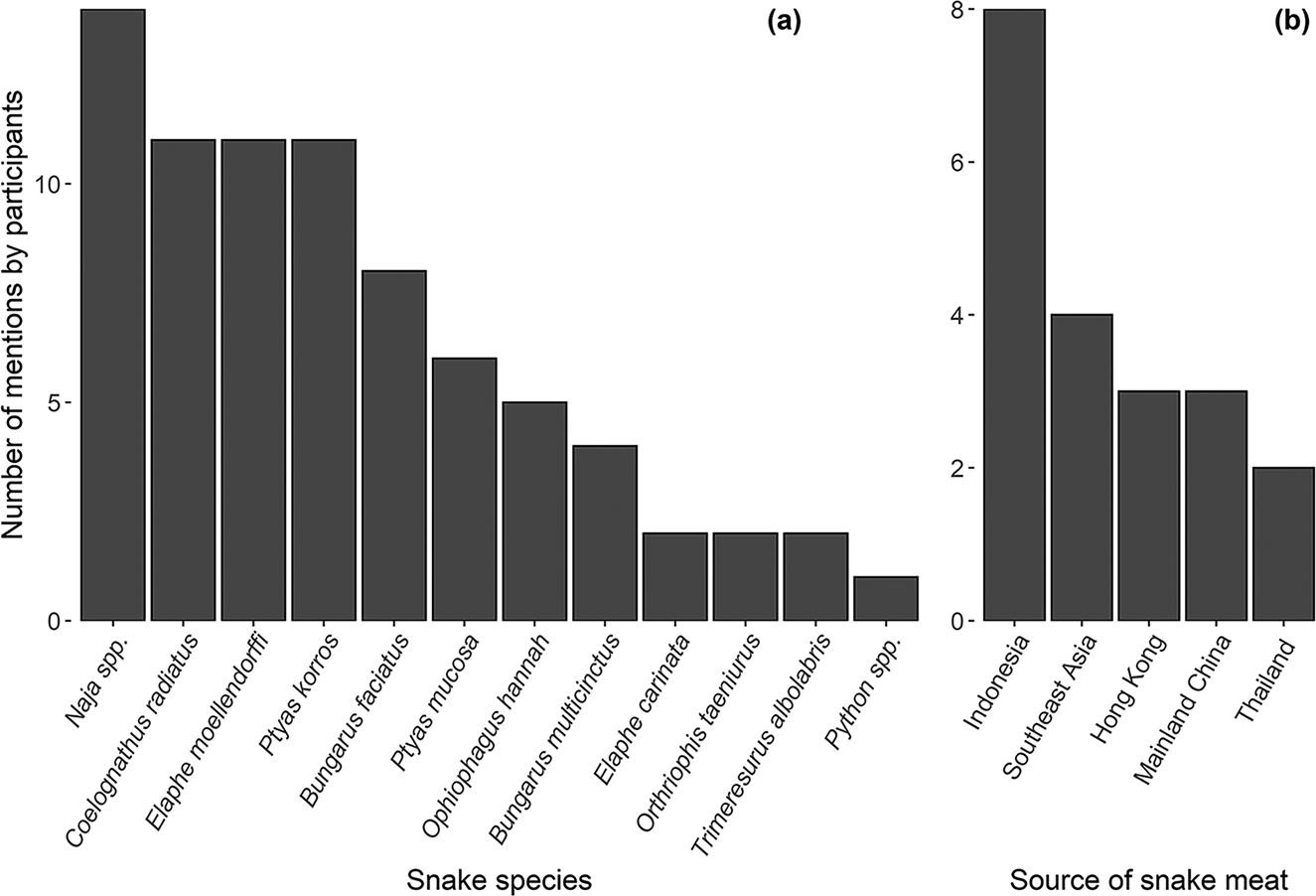
Of the participants in shops keeping live snakes on display (57%, n = 8), six said they served these snakes in soup, and two said they did not. Participants stated importing snakes as live individuals (86%, n = 12), frozen (86%, n = 12) and fresh meat (64%, n = 9). Most commonly identified as species consumed were cobras Naja spp. (Fig. 1; 100%, n = 14), followed by the red-headed rat snake Elaphe moellendorffi, radiated rat snake C. radiatus, and Indo-Chinese rat snake Ptyas korros (each consumed in 79% of shops, n = 11). Also consumed were the banded krait Bungarus fasciatus (57%, n = 8), common rat snake Ptyas mucosa (43%, n = 6), king cobra (36%, n = 5) and many-banded krait B. multicinctus (29%, n = 4). The bamboo pit viper Trimeresurus albolabris, beauty rat snake Orthriophis taeniurus and king rat snake Elaphe carinata were each mentioned by two shops (14%), and pythons Python spp. were mentioned only once (7%). Although many of these species are native to Hong Kong, their conservation status in China and globally varies (Table 1).
(a) Snake species stated to be served and (b) geographical regions mentioned as sources of snake meat in the 14 snake soup shops we visited in Hong Kong, according to interview participants.
Native distribution ranges and conservation status of snake species used in the snake soup industry in Hong Kong, as mentioned in interviews and detected through genetic analyses.

Genetic identification of snake meat samples
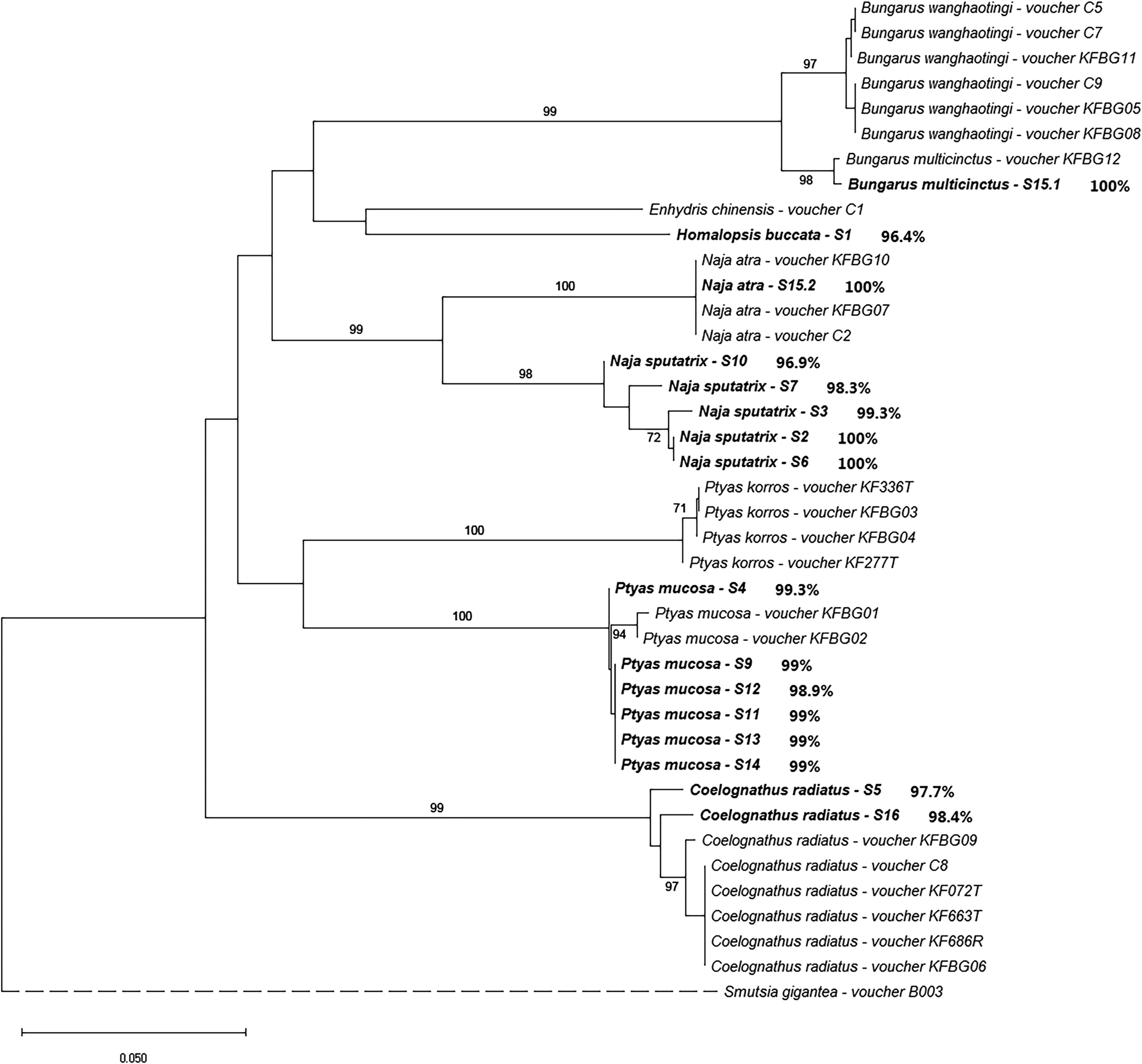
We obtained 16 snake meat samples from shops for genetic identification, all of which were closely related to voucher specimens, and none remained unidentified. We identified P. mucosa as the most common species (n = 6), with those samples grouping with P. mucosa voucher specimens, and none grouping with P. korros (Fig. 2). The second most common species was the Javan spitting cobra Naja sputatrix (n = 5). We also identified C. radiatus (n = 2), N. atra (n = 1), B. multicinctus (n = 1), and Homalopsis buccata (n = 1). Samples identified as B. multicinctus, C. radiatus and N. atra grouped with their respective voucher specimens. Homalopsis buccata was the only species that was identified genetically but was not mentioned in interviews (Table 1).
Phylogenetic tree generated with the neighbour-joining method for tissue samples from snake soup shops (bold, with percentage of match with identified species shown), and voucher specimens of species native to Hong Kong. Numbers at nodes are bootstrap values above a 70% cut-off value and obtained from the maximum likelihood consensus tree. Smutsia gigantea was used as the outgroup (dashed line), and the scale represents branch length as the number of base differences per site.
Source of snakes according to interviews
Participants most often mentioned Indonesia (57%, n = 8) as a main source of snakes served in their shops (Fig. 1), followed by Southeast Asia (29%, n = 4), mainland China (21%, n = 3) and Thailand (14%, n = 2). Hong Kong was stated to be the sole source of snakes for one shop (7%), and mentioned as an occasional source for two other shops (14%). All participants stated snakes were mostly if not all wild-caught. One participant specified that snakes from China were mostly ‘wild-caught and then reared in a farm for a period of time’. This was because ‘wild-caught snakes are usually small, so snake farmers inject hormones into snakes to boost growth rates, raising selling prices’.
Snake soup shops appeared to have become less dependent on mainland China for snake meat over time. Half of the shops (n = 7) relied on mainland sources for snakes in the past, but did not at the time of our study. Two additional shops (14%) still obtained snakes from China but relied more on Southeast Asian sources. Of these nine shops, the most commonly cited reason for this trend was insufficient snake meat to supply Hong Kong because of the rising popularity and affordability of snake soup in mainland China itself (89%, n = 8). In a statement echoed by two other participants, one shop owner explained that ‘snake meat used to be imported from mainland China in the past, but because of the rapid economic development there, snake meat has become affordable to many people. Most of it is therefore consumed in China, with the amount of snake meat exports having decreased. In response, Hong Kong snake soup restaurants seek alternative importers.’ Another shop owner specified that they had shifted their importing source from China to Southeast Asia ‘because the rise in demand for snake meat in China has caused the quantity of exports to decrease and the exporting price to increase. Accordingly, snake soup shops import snake meat from Southeast Asia at a lower price.’ One shop said they could no longer obtain snakes from China since the 2002–2003 epidemic of severe acute respiratory syndrome (SARS).
Trends in the snake soup industry
According to interviews, most shops (64%, n = 9) received 1–3 shipments of snake meat per year, with frequency of shipments depending on demand according to five participants (36%). The three participants specifying the amount of snake meat they received mentioned 2,000–6,000 kg, 6,000 kg and 10,000 kg annually, respectively.
Perceived trends in snake soup popularity varied amongst participants. Two participants stated there had been no change over time, with snake soup remaining popular, but another believed snake soup to be getting ‘more popular with the middle-aged and elderly, but less popular with young people’. Six participants (43%) believed snake soup popularity was increasing. Reasons for the increase included that ‘many people do not make their own snake soup at home now, so they go out and eat it at the shop’, or that ‘more young people have been eating snake soup now as they know it is good for health’. In contrast, five participants (36%) believed snake soup popularity was decreasing. One shop owner cited the SARS outbreak as a main cause for a growing aversion towards snake soup. Another mentioned rising average temperatures in Hong Kong causing a decrease in snake soup popularity, as it is typically consumed in colder weather.
With respect to the snake soup industry's future, most participants (64%, n = 9) expressed a pessimistic view. The depletion of wild snake populations was mentioned as a cause for this by three participants (21%), and a rising awareness of wildlife conservation issues was mentioned by two (14%). The lasting impact of SARS following the 2002–2003 outbreak was mentioned again in this part of the interviews. Two participants (14%) stated that people often avoid snake soup for fear of contamination. One reiterated that snake meat cannot be obtained from China.
Discussion
We genetically identified P. mucosa and N. sputatrix as the most common species among meat samples from snake soup shops in Hong Kong. This is consistent with the fact that cobras were mentioned as being consumed in all shops, and P. mucosa in nearly half of our interviews. As P. mucosa occurs in Hong Kong, mainland China and Southeast Asia, and N. sputatrix is limited to Indonesia (Table 1), our findings suggest that Southeast Asia, particularly Indonesia, and mainland China are major sources of snake meat imports. Interviews also revealed a shift from dependency on snakes sourced from mainland China towards cheaper Southeast Asian alternatives. The participants’ outlook on the future of the snake soup industry was unfavourable, with a SARS-related aversion to snake meat among the reasons cited.
The predominance of Indonesia and China as snake meat sources reflects CITES reports showing both regions as main exporters of live snakes to Hong Kong (nearly 1 million during 1975–2018), mainly for commercial purposes (Hierink et al., Reference Hierink, Bolon, Durso, de Castañeda, Zambrana-Torrelio, Eskew and Ray2020). According to interviews, these imports probably include many wild-caught snakes. Ptyas mucosa has a history of overexploitation: the accelerating harvest of this species for its meat and skin in the 1990s led Indonesia to enact a ban on its exports during 1993–2005 (Auliya, Reference Auliya2010), and China suspending its trade in 1995 (Jiang et al., Reference Jiang, Zhou, Meng, Meng, Li and Ping2013). Harvesting of N. sputatrix is not similarly controlled by law, although it has been the most exported CITES-listed venomous snake species in recent decades, with Indonesia and Malaysia being the most common sources and Hong Kong a major destination (Hierink et al., Reference Hierink, Bolon, Durso, de Castañeda, Zambrana-Torrelio, Eskew and Ray2020).
Indonesia is the world-leading exporter of both wild-caught venomous snakes and snakes overall (Hierink et al., Reference Hierink, Bolon, Durso, de Castañeda, Zambrana-Torrelio, Eskew and Ray2020), whereas China has shifted from net exporter to importer of snakes in recent years (Zhou & Jiang, Reference Zhou and Jiang2004). As most shops we interviewed had reportedly become less dependent on China and were sourcing more snake meat from Indonesia, pressures on wild snake populations could be rising in Indonesia. However, complex landscape changes may affect populations of snakes in Indonesia and other Southeast Asian countries. Species such as cobras and rat snakes benefit from oil palm plantations by feeding on rodent pests within them (Dislich et al., Reference Dislich, Keyel, Salecker, Kisel, Meyer and Auliya2017). These snake populations may thus be increasing and additional harvesting could be of little conservation concern. These observations highlight the need for robust data on population trends of native snakes, to assess the impact of harvesting on commonly traded species.
Although stricter regulations of the snake trade could mitigate negative impacts on wild populations (Marshall et al., Reference Marshall, Strine and Hughes2020), focusing on ethical, closed-cycle snake farming could also be effective (Aust et al., Reference Aust, Van Tri, Natusch and Alexander2017). Properly managed snake farms could not only satisfy market demands, but are also potentially more ecologically sustainable than other meat industries (Aust et al., Reference Aust, Van Tri, Natusch and Alexander2017; Rizzolo, Reference Rizzolo2020). However, although snake farming is relatively affordable and feasible (Aust et al., Reference Aust, Van Tri, Natusch and Alexander2017), licensing and legally sourcing snakes to initiate farming can complicate the process (Jiang et al., Reference Jiang, Zhou, Meng, Meng, Li and Ping2013). Opportunistic harvest of wild snakes as a secondary income, to supplement income from cash crop farming, is thus often perceived to be more economically viable (Auliya, Reference Auliya2010), undermining sustainable farming practices. There is also evidence from China (Zhou & Jiang, Reference Zhou and Jiang2004; Jiang et al., Reference Jiang, Zhou, Meng, Meng, Li and Ping2013) and Indonesia (Lyons & Natusch, Reference Lyons and Natusch2011; Natusch & Lyons, Reference Natusch and Lyons2014) that wild-caught snakes are temporarily kept in snake farms before sale. Further long-term ecological studies of wild snake harvesting are required to understand its extent and sustainability (Natusch et al., Reference Natusch, Lyons, Riyanto, Khadiejah and Shine2019).
Because of potential impacts of unregulated trade on wild P. mucosa and N. sputatrix populations, we recommend their trade should continue to be monitored, through CITES and other means, to track export patterns in Indonesia, other Southeast Asian countries and China. Monitoring trade volumes is more difficult for other species involved in the snake soup trade that are not currently CITES-listed (Table 1), as information regarding their export and import is scarce. We identified both C. radiatus and B. multicinctus in interviews and genetic sequencing, neither of which is CITES-listed despite being categorized as Endangered according to China's Red List (Table 1; Jiang et al., Reference Jiang, Jiang, Wang, Zhang, Zhang and Li2016). Monitoring trade, population status and trends across their respective ranges is necessary for assessing the impacts of snake consumption on these species, and could reveal patterns indiscernible by examination of CITES reports alone.
Commercial demand for snake meat in Hong Kong could be declining according to interviews, reflecting a global decline in the live snake trade since the early 2000s (Hierink et al., Reference Hierink, Bolon, Durso, de Castañeda, Zambrana-Torrelio, Eskew and Ray2020). Shopkeepers mentioned many reasons for their pessimistic outlook on the future of the snake soup industry, including issues related to conservation awareness and ecological trends. A lasting stigma associated with the 2002–2003 SARS outbreak was also mentioned as a reason why interest in snake soup may have declined, an observation that is particularly relevant given the ongoing global COVID-19 pandemic. This led to public perceptions of snake meat as a source of disease, despite a lack of empirical evidence to justify this. Such fears have probably been fuelled by the association of SARS with wild animals sold at a Guangzhou food market, even though snakes do not host the disease (Yang et al., Reference Yang, Dai, Deng, Lu and Jiang2007; Zhang et al., Reference Zhang, Hua and Sun2008). Following SARS, public awareness and caution towards consumption of wild meat, including snakes, increased in China (Yang et al., Reference Yang, Dai, Deng, Lu and Jiang2007; Zhang et al., Reference Zhang, Hua and Sun2008). This directly affected Hong Kong's snake meat supply according to one interview participant, who at the time of the interview stated they were still unable to source snake meat from mainland China because of SARS.
Early in the COVID-19 pandemic, evidence emerged suggesting snakes, specifically B. multicinctus and N. atra, could act as intermediate hosts for the disease (Ji et al., Reference Ji, Wang, Zhao, Zai and Li2020), but this was quickly refuted (Boni et al., Reference Boni, Lemey, Jiang, Lam, Perry and Castoe2020; Zhang et al., Reference Zhang, Zheng, Huang, Bell, Zhou and Zhang2020). Snakes nonetheless remain included in China's newly enacted temporary ban on domestic wildlife trade (Koh et al., Reference Koh, Li and Lee2021). This ban could reduce pressures on threatened species but potential drawbacks include fuelling the unregulated market and negative financial impacts on the livelihoods of communities depending on snake farming (Roe & Lee, Reference Roe and Lee2021). Moreover, despite the ban's acclaim in international media, caution is needed to avoid overlooking further socio-economic implications or discrediting recently shifting attitudes on the medicinal properties of wild meat in contemporary China (Pagani-Núñez, Reference Pagani-Núñez2020; Xie et al., Reference Xie, Huang, Li and Zhu2020; Roe & Lee, Reference Roe and Lee2021). The ban could generate increasingly negative attitudes towards the consumption of wild meat in China, particularly among younger generations, following the COVID-19 pandemic (Xie et al., Reference Xie, Huang, Li and Zhu2020), possibly hastening the decline of the snake soup industry. If snake soup continues to be popular in Hong Kong, however, we expect sourcing snake meat from China will become increasingly difficult, and the demand for Southeast Asian alternatives will increase. Depending on the level of enforcement in China, the continuing consumption of snake meat despite the ban prohibiting the operation of local snake farms could further exacerbate pressures on wild populations in Southeast Asia. We recommend that conservation efforts regarding the snake trade pre-emptively focus on balancing socio-economic equity and support of ethical snake farming with the monitoring and sustainability of wild snake populations in Indonesia and other Southeast Asian countries.
Acknowledgements
We thank Kadoorie Farm and Botanic Garden for providing tissue samples of snake species native to Hong Kong; John Allcock and the Oakley family for opportunistically collecting samples; and the snake soup shops we visited for providing snake meat samples.
Author contributions
Study design: FLY, PCD, CD, Y-HS, TCB; interviews: CTY; genetic sequencing: T-LP; data analysis and writing: FLY.
Conflicts of interest
None.
Ethical standards
This research abided by the Oryx guidelines on ethical standards. We obtained written consent from all participants prior to interviews and conducted this work with approval from The University of Hong Kong's Human Research Ethics Committee (EA1902021).


 Open access

