





Introduction
Education is widely recognised as a key driver of socio-economic development and social mobility, particularly in developing countries. In Morocco, expanding access to schooling has long been a central policy priority, with sustained efforts to reduce gender and socio-economic disparities in educational outcomes. Despite these advances, significant inequalities in both school access and educational attainment persist, reflecting deep-rooted structural constraints.
Beyond its socio-economic role, educational inequality also shapes unequal access to environmental knowledge and sustainability competencies. From an environmental education perspective, unequal access to schooling may constrain the development of sustainability-related competencies. This is particularly critical in contexts where vulnerable populations are also more exposed to environmental risks. In contexts such as Morocco, where exposure to climate risks is increasing, unequal schooling trajectories may translate into disparities in environmental awareness and adaptive capacity. From an Education for Sustainable Development (ESD) perspective, education is a key channel through which individuals acquire the knowledge, values and skills necessary to engage with environmental challenges (UNESCO, 2017; UNESCO, 2020). As such, persistent inequalities in schooling may reinforce both social and environmental vulnerabilities, particularly among rural and low-income populations.
This paper adopts an inequality of opportunity framework (Roemer, Reference Roemer1998), which distinguishes between circumstances beyond individual control – such as gender, place of residence, parental education and household wealth – and effort-based outcomes. This perspective is complemented by the capabilities approach (Sen, Reference Sen1999), which conceptualises education as a means of expanding individuals’ freedoms, and by Bourdieu’s theory of social reproduction (Bourdieu, Reference Bourdieu and Richardson1986), which emphasises the intergenerational transmission of disadvantage. Together, these frameworks provide a structural lens through which educational inequalities can be understood, including their implications for sustainability-related capabilities.
Since independence, Morocco has implemented a series of reforms aimed at improving access to education and promoting equity, notably the National Charter for Education and Training (1999), the Emergency Programme (2009–2012) and the Strategic Vision 2015–2030. While these reforms have contributed to near-universal primary enrolment, significant challenges remain in terms of retention and equitable progression, particularly at the secondary level. Inequalities linked to gender, place of residence and socio-economic background continue to shape educational outcomes.
Empirical evidence consistently highlights the role of household resources, parental education, gender and residence in determining schooling outcomes, both in Morocco and internationally (e.g., Assaad et al., Reference Assaad, Hendy and Salehi-Isfahani2019; Connelly & Zheng, Reference Connelly and Zheng2003; Psacharopoulos & Arriagada, Reference Psacharopoulos and Arriagada1987). In Morocco specifically, studies confirm the importance of socio-economic background and school conditions in shaping educational performance (Ibourk, Reference Ibourk2013; Liouaeddine et al., Reference Liouaeddine, Bijou and Naji2017; Mourji & Abbaia, Reference Mourji and Abbaia2013). These factors reflect persistent inequalities of opportunity that influence children’s educational trajectories over time.
Against this backdrop, this study analyses the evolution of inequality of opportunity in education in Morocco between 1998 and 2014 using nationally representative microdata (ENNVM 1998–1999 and RGPH 2014). It examines how individual and household characteristics affect both school enrolment and educational attainment and how these inequalities have evolved over time.
Although the primary focus of this study is educational inequality, its implications extend directly to environmental education and ESD. In contexts where access to schooling is unequal, opportunities to acquire environmental literacy, sustainability competencies and climate-related knowledge are also unevenly distributed. Consequently, disadvantaged populations may face a dual constraint: limited access to education and reduced capacity to engage with environmental challenges. This study therefore contributes to understanding the structural roots of unequal participation in sustainability learning, particularly in developing countries such as Morocco.
This paper contributes in three main ways. First, it provides a long-run comparative assessment (1998–2014) of inequality of opportunity in education using harmonised microdata. Second, it applies probit and right-censored ordered probit models to jointly analyse school access and educational attainment, offering a comprehensive perspective on educational trajectories. Third, it extends the analysis beyond traditional socio-economic determinants by linking educational inequalities to unequal opportunities in environmental and sustainability-related learning, thereby contributing to the literature on Education for Sustainable Development.
The remainder of the paper is organised as follows. Section Access to education and educational attainment: a brief literature review reviews the literature on the determinants of schooling and educational attainment. Section Overview of the Moroccan school system presents the Moroccan education system. Section Methodology outlines the econometric methodology. Section Data and explanatory variables describes the data. Section Descriptive statistics presents descriptive statistics. Section Empirical results discusses the empirical results, and Section Conclusion concludes.
Access to education and educational attainment: a brief literature review
Determinants of schooling and educational attainment
The literature on the determinants of schooling and educational attainment overwhelmingly emphasises the central role of individual and family circumstances in shaping educational outcomes. Research conducted in Morocco confirms this pattern, showing that pupils’ characteristics, household living conditions, and school environments are decisive factors influencing performance and progression (Ibourk, Reference Ibourk2013; Liouaeddine et al., Reference Liouaeddine, Bijou and Naji2017; Mourji & Abbaia, Reference Mourji and Abbaia2013). International studies provide consistent evidence that household economic resources are strongly associated with both school enrolment and the eventual level of education attained (Connelly & Zheng, Reference Connelly and Zheng2003; Glewwe & Jacoby, Reference Glewwe and Jacoby1994; Maitra, Reference Maitra2003; Psacharopoulos & Arriagada, Reference Psacharopoulos and Arriagada1987).
Numerous contributions also highlight persistent gender disparities, although findings remain mixed. While poverty tends to constrain girls’ schooling more severely, improvements in household welfare frequently exert stronger positive effects on girls than on boys (Burney & Irfan, Reference Burney and Irfan1995; Dreze & Kingdon, Reference Dreze and Kingdon2003; Glick & Sahn, Reference Glick and Sahn2000; Handa, Reference Handa2002; Lincove, Reference Lincove2009). Birth order has also been identified as an important determinant, with earlier-born children often receiving fewer educational investments in poorer households (Booth & Kee, Reference Booth and Kee2009). The child’s place of residence similarly constitutes a structural factor of inequality, with rural children – particularly girls – consistently disadvantaged relative to their urban counterparts (Dreze & Kingdon, Reference Dreze and Kingdon2003; Handa, Reference Handa2002).
Parental education emerges as one of the most robust predictors of children’s schooling, operating as a key mechanism for the intergenerational transmission of socio-economic status (Glick & Sahn, Reference Glick and Sahn2000; Haveman & Wolfe, Reference Haveman and Wolfe1995; Tansel, Reference Tansel1997). Most studies find a strong positive association between parents’ education and both enrolment and attainment, although the Moroccan case reveals some nuances, notably weaker effects of mothers’ education in certain contexts.
Broadly speaking, a large body of national and international research underscores the importance of factors such as gender, residence, household income, parental education and school infrastructure in shaping access to schooling and educational attainment. These predetermined circumstances generate persistent inequalities of opportunity that affect children’s educational trajectories over time (UNICEF, 2017).
Theoretical perspectives on educational inequality
From a theoretical perspective, these empirical findings can be interpreted within the framework of inequality of opportunity (Roemer, Reference Roemer1998), which distinguishes between circumstances beyond individual control – such as family background, gender and location – and outcomes partly shaped by individual effort. Within this framework, educational inequalities are not merely the result of individual choices but reflect structural constraints that limit opportunities from the outset.
This perspective is closely related to the capabilities approach developed by Sen (Reference Sen1999), which conceptualises education not only as an investment in human capital but also as a fundamental means of expanding individuals’ capabilities and freedoms. In this view, unequal access to education implies unequal opportunities to develop essential capabilities, including the ability to participate fully in social, economic and civic life.
Similarly, Bourdieu’s theory of social reproduction (Bourdieu, Reference Bourdieu and Richardson1986) highlights the role of cultural capital and intergenerational transmission mechanisms in perpetuating educational inequalities. Differences in family resources – economic, social and cultural – shape children’s aspirations, learning conditions and academic success, thereby reinforcing existing social hierarchies across generations.
Taken together, these complementary frameworks provide a robust conceptual foundation for understanding how structural inequalities in initial conditions translate into unequal educational trajectories and outcomes over time.
Education, inequality and sustainability capabilities
In parallel to the literature on educational inequality, a growing body of research highlights the central role of education in fostering ESD. According to UNESCO (2017), inclusive and quality education is a fundamental condition for achieving sustainability goals, as it enables individuals to acquire the knowledge, skills, values and attitudes necessary to address environmental challenges. This perspective is reinforced by Sustainable Development Goal 4.7, which emphasises the importance of equipping all learners with competencies related to sustainable development, environmental protection and climate action.
The literature on ESD further emphasises that equitable access to quality education is a fundamental condition for developing sustainability competencies. Without inclusive educational systems, the distribution of environmental knowledge and adaptive capacities remains uneven, reinforcing existing social and environmental inequalities.
Several studies underline that education is a key driver of environmental awareness and pro-environmental behaviour. For instance, Filho et al. (Reference Filho, Shiel and Paço2018) show that access to education significantly enhances individuals’ capacity to understand and respond to environmental issues, particularly in developing countries. Similarly, Jucker (Reference Jucker2011) argues that education systems play a crucial role in shaping sustainability-oriented values and behaviours, while Wals (Reference Wals2015) highlights the transformative potential of education in promoting critical thinking and sustainable lifestyles. Sterling (Reference Sterling2001) further emphasises that education is not only a means of knowledge transmission but also a critical lever for societal transformation toward sustainability.
From a capabilities perspective, education expands individuals’ ability to understand environmental risks, engage in sustainable practices and participate in environmental decision-making. However, inequalities in access to education may translate into unequal environmental capabilities. Disadvantaged populations – particularly those in rural or low-income contexts – often face a double constraint: limited access to formal education and reduced exposure to environmental learning opportunities (UNESCO, 2020). In such contexts, unequal educational opportunities may reinforce environmental vulnerabilities and limit individuals’ capacity to respond effectively to climate-related challenges.
Despite this growing body of literature, empirical studies rarely integrate structural inequality frameworks with environmental education outcomes, particularly in the context of developing countries. While the determinants of educational inequality are well documented and the role of education in sustainability is increasingly recognised, the link between inequality of opportunity in education and unequal access to sustainability-related capabilities remains underexplored.
This study seeks to address this gap by combining an inequality of opportunity framework with an Education for Sustainable Development perspective. By doing so, it provides a more comprehensive understanding of how structural inequalities in education may translate into unequal participation in sustainability-oriented learning.
Overview of the Moroccan school system
Education has long been regarded as a central pillar of Morocco’s economic and social development strategy, and successive governments have prioritised expanding access to schooling. Since independence, the country has implemented successive reforms – including the 1999 National Charter for Education and Training, the 2009–2012 Emergency Plan and the Strategic Vision for Education 2015–2030 – aimed at universalising basic education, improving quality and promoting equity. Measures such as the Tayssir conditional cash transfer programme and targeted initiatives to develop pre-schooling, rural education and girls’ schooling have contributed to substantial gains in enrolment at both primary and secondary levels.
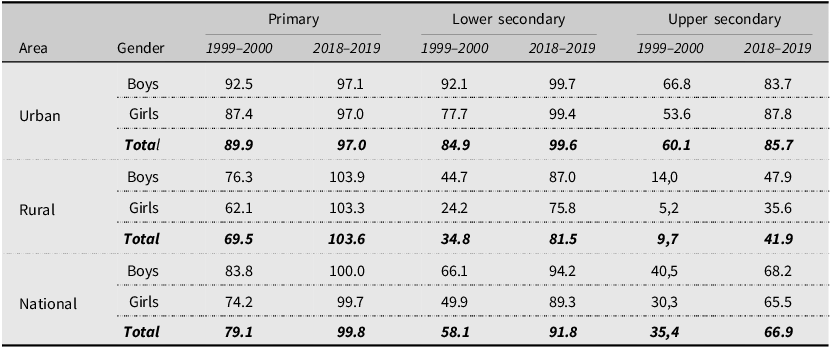
The current education system consists of pre-school and primary education, lower and upper secondary schooling and higher education. Primary enrolment is now nearly universal, with particularly strong progress in rural areas. Secondary education has also witnessed marked improvements, although urban–rural disparities persist (Table 1).
Specific schooling rates (%) by level, area and gender1

Table 1. Long description
The table presents schooling rates by level, area, and gender for the years 1999-2000 and 2018-2019. It is divided into three main sections: Primary, Lower Secondary, and Upper Secondary. Each section is further divided by area (Urban and Rural) and gender (Boys and Girls). The table includes totals for each category. Notable trends include significant increases in schooling rates over the 19-year period, particularly in rural areas and for girls. For example, in urban areas, the primary schooling rate for girls increased from 87.4 percentage to 97 percentage, while in rural areas, the primary schooling rate for girls increased from 62.1 percentage to 103.3 percentage. The table highlights improvements in educational access and attainment across different levels, areas, and genders.
1Percentage of the population of a specific age enrolled, whatever the educational attainment.
Despite these advances, the system continues to face structural challenges. Dropout remains a major concern, especially at the secondary level, and significant gender and spatial inequalities endure.
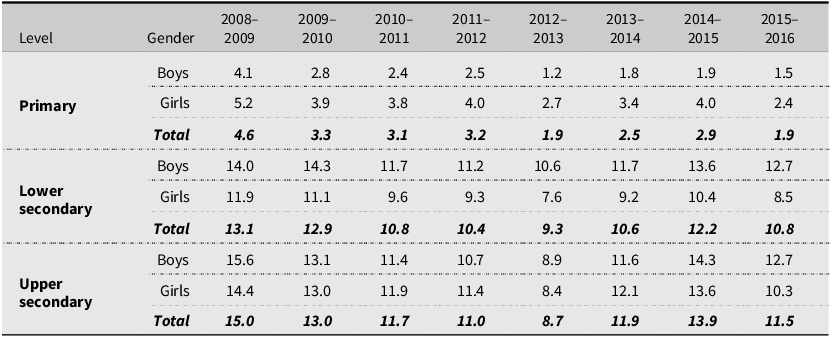
Overall, while reforms have expanded access and strengthened the institutional framework, school dropout continues to impede educational progress (Table 2). Understanding the underlying determinants of these persistent disparities – particularly those linked to individual and family characteristics – remains essential for designing more effective education policies.
School dropout rate (%) by level and gender

Table 2. Long description
The table presents school dropout rates by level and gender from 2008 to 2016. It includes data for primary, lower secondary, and upper secondary levels, with separate columns for boys, girls, and total dropout rates. The table has seven rows and nine columns. Row 1: Level, Gender, 2008-2009, 2009-2010, 2010-2011, 2011-2012, 2012-2013, 2013-2014, 2014-2015, 2015-2016. Row 2: Primary, Boys, 4.1, 2.8, 2.4, 2.5, 1.2, 1.8, 1.9, 1.5. Row 3: Primary, Girls, 5.2, 3.9, 3.8, 4.0, 2.7, 3.4, 4.0, 2.4. Row 4: Primary, Total, 4.6, 3.3, 3.1, 3.2, 1.9, 2.5, 2.9, 1.9. Row 5: Lower secondary, Boys, 14.0, 14.3, 11.7, 11.2, 10.6, 11.7, 13.6, 12.7. Row 6: Lower secondary, Girls, 11.9, 11.1, 9.6, 9.3, 7.6, 9.2, 10.4, 8.5. Row 7: Lower secondary, Total, 13.1, 12.9, 10.8, 10.4, 9.3, 10.6, 12.2, 10.8. Row 8: Upper secondary, Boys, 15.6, 13.1, 11.4, 10.7, 8.9, 11.6, 14.3, 12.7. Row 9: Upper secondary, Girls, 14.4, 13.0, 11.9, 11.4, 8.4, 12.1, 13.6, 10.3. Row 10: Upper secondary, Total, 15.0, 13.0, 11.7, 11.0, 8.7, 11.9, 13.9, 11.5. Notable trends include a general decrease in dropout rates across all levels and genders over the years, with upper secondary levels showing the highest dropout rates overall.
Methodology
This study examines two key aspects of education in Morocco: school access and dropout rates. To investigate these outcomes, two variables were defined. The first is a binary indicator of school access, analysed using a Probit model. The second captures the highest educational level attained and is treated as an ordered categorical variable. Given that some children remain enrolled at the time of the survey, a Censored Ordered Probit (COP) model, following King et al., (Reference King, Lillard and Lee1987), is employed to account for censoring. This approach is consistent with econometric studies dealing with incomplete educational trajectories, where the final level of attainment is not fully observed at the time of data collection, as also highlighted in previous empirical work (Assaad et al., Reference Assaad, Hendy and Salehi-Isfahani2019; Hisarciklilar, Reference Hisarciklilar2002).
Formally, let each child i have an unobservable (latent) continuous variable ${S}_{i}^{*}$
representing the desired level of schooling. This latent variable is determined by a vector of explanatory variables S
i
, as follows:
${S}_{i}^{*}$
representing the desired level of schooling. This latent variable is determined by a vector of explanatory variables S
i
, as follows: ${S}_{i}^{*}={X}_{i}^{ \prime}\beta +\varepsilon _{i},$
where β is an unknown parameter vector and ϵ i is a random error term assumed to follow a normal distribution.
The observed schooling level ${S}_{i}^{*}$
corresponds to the realised category of education for each child, depending on whether the child has completed or is still attending school, with currently enrolled children treated as censored observations. The empirical analysis was conducted on a subsample of individuals aged 12–19, for whom the highest level of education attained was upper secondary school.
${S}_{i}^{*}$
corresponds to the realised category of education for each child, depending on whether the child has completed or is still attending school, with currently enrolled children treated as censored observations. The empirical analysis was conducted on a subsample of individuals aged 12–19, for whom the highest level of education attained was upper secondary school.
For this population, the categorical variable S i takes four possible values:

The relationship between the latent variable ${S}_{i}^{*}$
and the observed categories S
i
can then be defined by a series of threshold parameters μj
:
${S}_{i}^{*}$
and the observed categories S
i
can then be defined by a series of threshold parameters μj
:

The thresholds μ 0 , μ 1 , μ 2 mark the transition points between successive education levels, with μ j + 1>μ j .
Assuming a normal distribution for the error term ϵi, the log-likelihood function can be written as:

where c i is a binary indicator equal to 1 if the observation is censored (child still in school) and 0 otherwise. The indicator S ik = 1 if S i =k, and S ik = 0 otherwise, for k = 0,…,3. The parameters β and thresholds μ 0 , μ 1 , μ 2 , μ 3 are estimated by maximum likelihood.
Once the parameters are estimated, the predicted probabilities of attaining each educational level can be derived as follows: $ \widehat{P}_{r}\left(S=0\right)=\phi \left(\widehat{\mu }_{0}-\widehat{\beta }X\right)$ $ \widehat{P}_{r}\left(S=1\right)=\phi \left(\widehat{\mu }_{1}-\widehat{\beta }X\right)-\phi \left(\widehat{\mu }_{0}-\widehat{\beta }X\right)$ $ \widehat{P}_{r}\left(S=2\right)=\phi \left(\widehat{\mu }_{2}-\widehat{\beta }X\right)-\phi \left(\widehat{\mu }_{1}-\widehat{\beta }X\right)$ ${{\widehat P}_r}\left( {S = 3} \right) = \;1 - \phi \left( {{{\widehat \mu }_2} - \widehat \beta {{X}}} \right)$
These estimated probabilities are then used to identify the most advantaged and the least advantaged children and to characterise educational inequalities according to individual and household-level determinants.
Data and explanatory variables
Data
This study utilises two datasets – the 1998–1999 National Survey of Household Living Standards (ENNVM) and the 2014 General Population and Housing Census (RGPH) – to examine the evolution of educational inequality in Morocco over a 15-year period of reforms and public programmes.
The analysis focuses on two outcomes: access to education and the highest level of education attained, specifically upper secondary. The subsample comprises individuals aged 12–19 whose highest completed or attainable education is upper secondary, and only children of the household head are included to maintain consistency between individual and household characteristics.
Based on these selection criteria, table 3 summarises the sizes and the distribution of the samples by gender and residence for both years.
Sample sizes and distribution (%) by gender and place of residence (in 1998 and 2014)

Explanatory variables
The models are estimated using a set of explanatory variables reflecting individual, household and parental characteristics, selected on the basis of theoretical insights, previous empirical research and data availability. At the individual level, three variables are included: sex (binary, with males as the reference), age (treated as categorical due to the narrow 12–19 age range) and birth order, constructed following Booth and Joo Kee’s (Reference Booth and Kee2009) adjusted method.
Household characteristics comprise place of residence (urban as the reference), region (harmonised into seven macro-regions for 1998 and twelve economic regions for 2014), wealth level (measured using expenditure per capita deciles in 1998–1999 and an MCA-based wealth index decile structure in 2014) and household size, defined as the number of sons and daughters of the household head to capture sibship effects relevant to schooling investments.
Parental characteristics are directly observed for 1998–1999 but proxied by the attributes of the household head and spouse in 2014, as parental links cannot be identified in the census. Two variables are constructed: combined parental education (four categories, with both parents uneducated as the reference) and father’s employment status (wage earner as the reference, versus employer or self-employed). Mothers’ employment is excluded due to persistently low female labour force participation.
Descriptive statistics
This section provides a descriptive analysis of Morocco’s schooling outcomes, focusing on two key dependent variables: access to education and educational attainment, for the 12–19 age group in 1999 and 2014. By comparing the plausible age for completing each educational level with these variables, the analysis highlights substantial improvements over the period while revealing persistent inequalities.
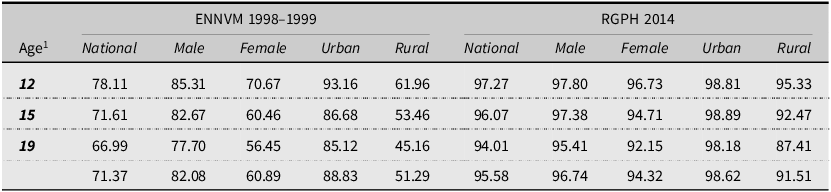
National enrolment rates increased markedly from 71.37% in 1998 to 95.58% in 2014. Gender disparities in access have largely disappeared: by 2014, enrolment was nearly equal for boys (96.74%) and girls (94.32%). Gains were particularly pronounced in rural areas, where access rose from 51.29% to 91.51%, demonstrating the effectiveness of education-support measures. By age, near-universal enrolment was observed among 12-year-olds, regardless of gender or residence (Table 4).
Distribution (%) by age, sex, localisation and school access (in 1998 and 2014)

Table 4. Long description
The table presents distribution percentages by age, sex, location, and school access for the years 1998 and 2014. It includes data for ages 12, 15, and 19, with separate columns for national, male, female, urban, and rural categories. For age 12, the national percentage in 1998 was 78.11, with males at 85.31 and females at 70.67. Urban areas had 93.16 percent, while rural areas had 61.96 percent. In 2014, the national percentage increased to 97.27, with males at 97.80 and females at 96.73. Urban areas had 98.81 percent, and rural areas had 95.33 percent. For age 15, the national percentage in 1998 was 71.61, with males at 82.67 and females at 60.46. Urban areas had 86.68 percent, while rural areas had 53.46 percent. In 2014, the national percentage increased to 96.07, with males at 97.38 and females at 94.71. Urban areas had 98.89 percent, and rural areas had 92.47 percent. For age 19, the national percentage in 1998 was 66.99, with males at 77.70 and females at 56.45. Urban areas had 85.12 percent, while rural areas had 45.16 percent. In 2014, the national percentage increased to 94.01, with males at 95.41 and females at 92.15. Urban areas had 98.18 percent, and rural areas had 87.41 percent. The overall trend shows significant improvements in school access across all categories from 1998 to 2014.
1I used only plausible transition ages from one level to another.
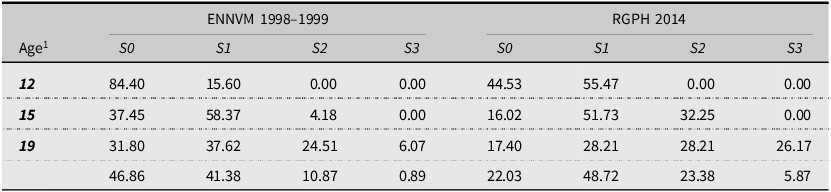
Educational attainment also improved substantially. In 1998, 46.86% of 12–19-year-olds had left school without a certificate, compared to 22.03% in 2014. Primary completion rose from 16% to 56%, while lower secondary completion among 15-year-olds remained limited at approximately 33% in 2014, indicating persistent dropout between primary and lower secondary levels, particularly in rural areas. Upper secondary completion for 18–19-year-olds increased from 6% in 1998 to 25% in 2014, though rural completion rates remained below 11%. Notably, girls outperformed boys at this level (33.77% versus 20.59%), reflecting improved persistence among female students (Table 5).
Distribution (%) by age and educational attainment (in 1998 and 2014)

Table 5. Long description
The table presents the distribution of educational attainment by age for the years 1998-1999 and 2014. It includes data for ages 12, 15, and 19, with percentages for four educational levels labeled S0, S1, S2, and S3. For age 12 in 1998-1999, 84.40% are in S0, 15.60% in S1, and 0.00% in S2 and S3. In 2014, 44.53% are in S0, 55.47% in S1, and 0.00% in S2 and S3. For age 15 in 1998-1999, 37.45% are in S0, 58.37% in S1, 4.18% in S2, and 0.00% in S3. In 2014, 16.02% are in S0, 51.73% in S1, 32.25% in S2, and 0.00% in S3. For age 19 in 1998-1999, 31.80% are in S0, 37.62% in S1, 24.51% in S2, and 6.07% in S3. In 2014, 17.40% are in S0, 28.21% in S1, 28.21% in S2, and 26.17% in S3. The table highlights changes in educational attainment over time, with notable shifts in the distribution across different age groups and educational levels.
1I used only plausible transition ages from one level to another.
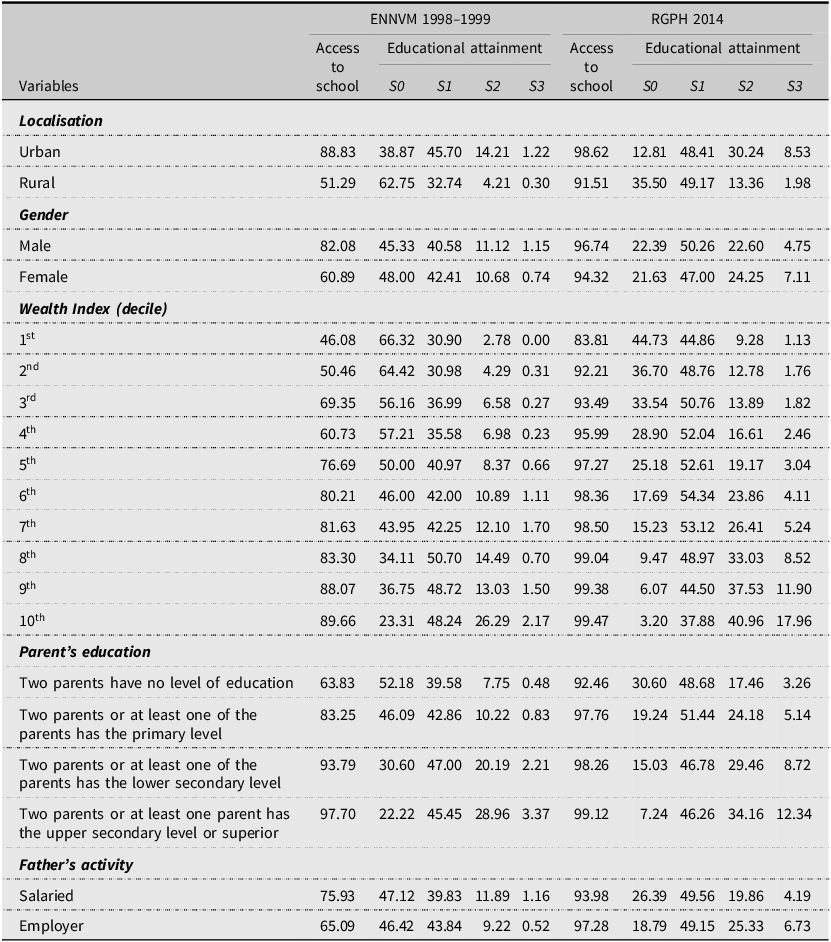
Furthermore, household wealth exhibits a strong positive association with schooling outcomes (Table 6). In 1998, only 46.08% of children from the poorest decile were enrolled, rising to 83.81% in 2014, while enrolment among the wealthiest decile approached universality. School dropout and upper secondary completion remain strongly stratified by wealth: in 2014, dropout among the poorest was 44.73% versus 3.20% among the richest, and upper secondary completion was eighteen times higher among the wealthiest (17.96% versus 1.13%). Parental education also plays a critical role: children with at least one parent educated to secondary or higher level were almost universally enrolled, while 92.46% of children with illiterate parents were not. Conversely, father’s occupational status shows no consistent relationship with schooling outcomes.
Distribution (%) by educational attainment and individual characteristics (in 1999 and 2014)
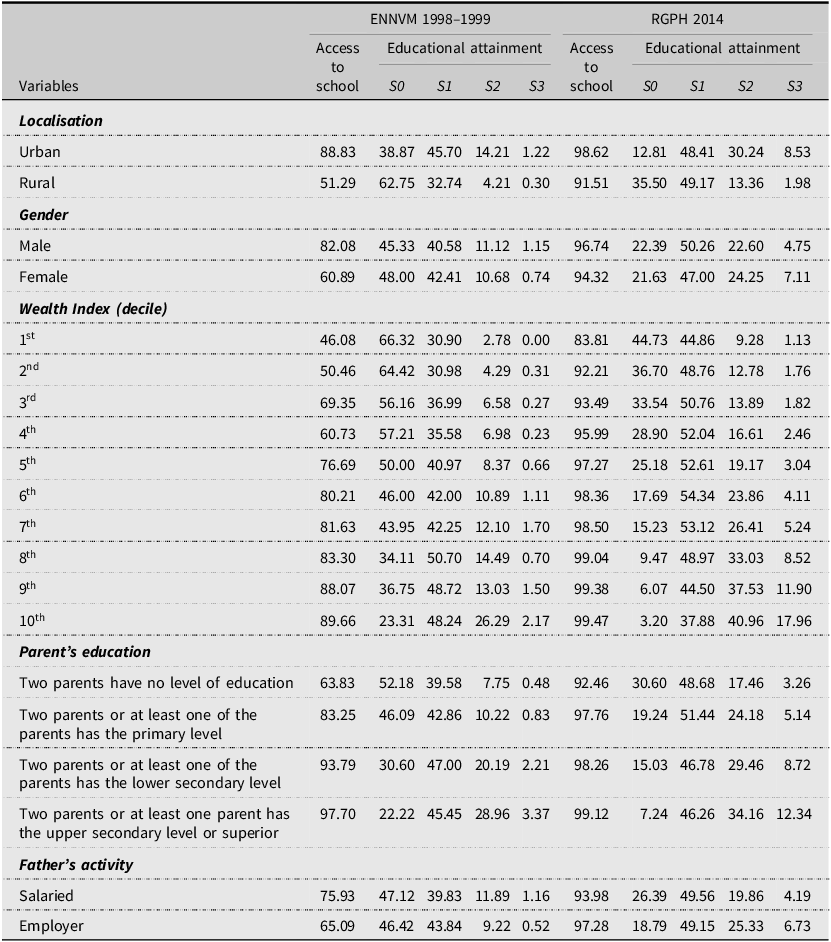
Table 6. Long description
The table presents data on the distribution of educational attainment and individual characteristics for the years 1999 and 2014. It includes variables such as localization, gender, wealth index, parent’s education, and father’s activity. The table has 30 rows and 12 columns, with columns for access to school and educational attainment levels S0, S1, S2, and S3. Key trends include higher access to school and educational attainment in urban areas compared to rural areas, differences in educational attainment between males and females, and a strong positive association between household wealth and schooling outcomes. Parental education also significantly impacts schooling outcomes, while the father’s activity shows no consistent relationship with schooling outcomes.
Chi-square tests of independence confirmed that all considered explanatory variables – gender, residence, household wealth, parental education and others – are significantly associated with schooling outcomes. These findings support the inclusion of these variables in subsequent econometric analyses to formally quantify their effects on educational access and attainment.
Empirical results
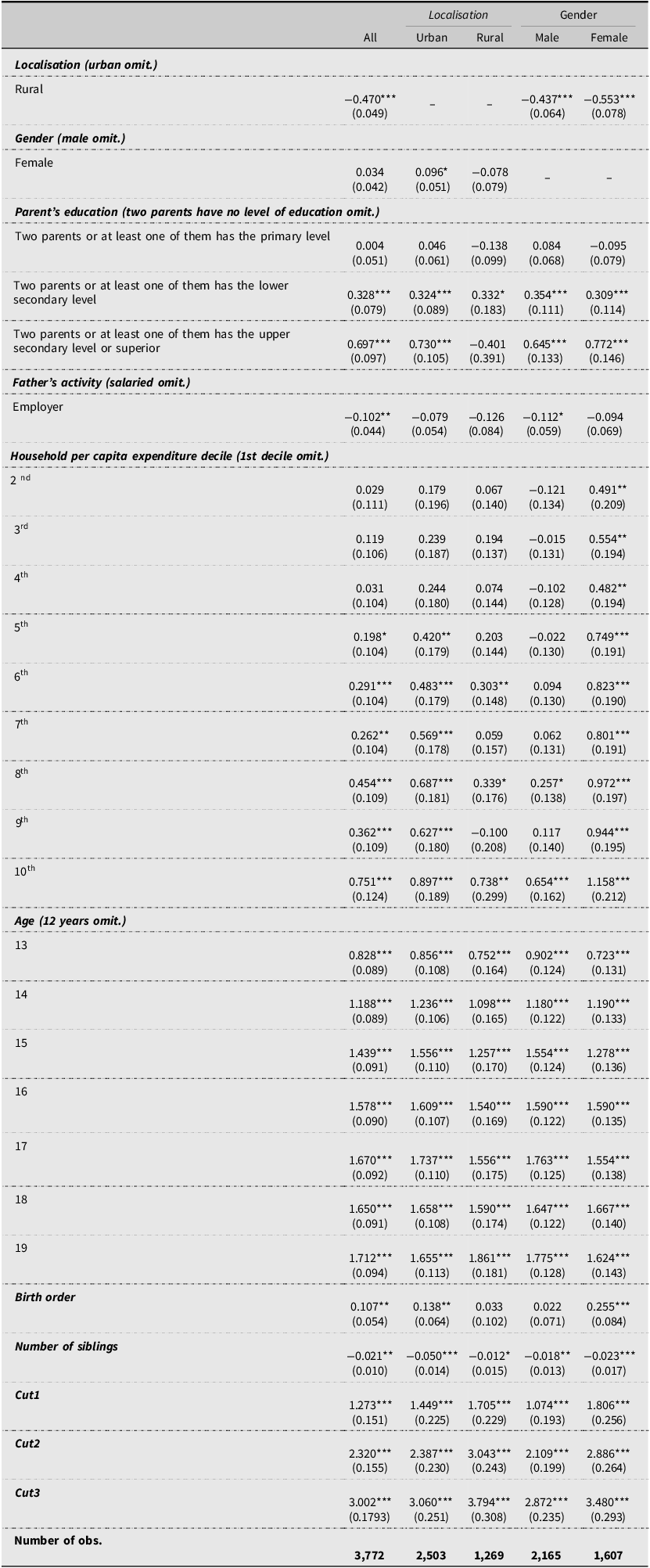
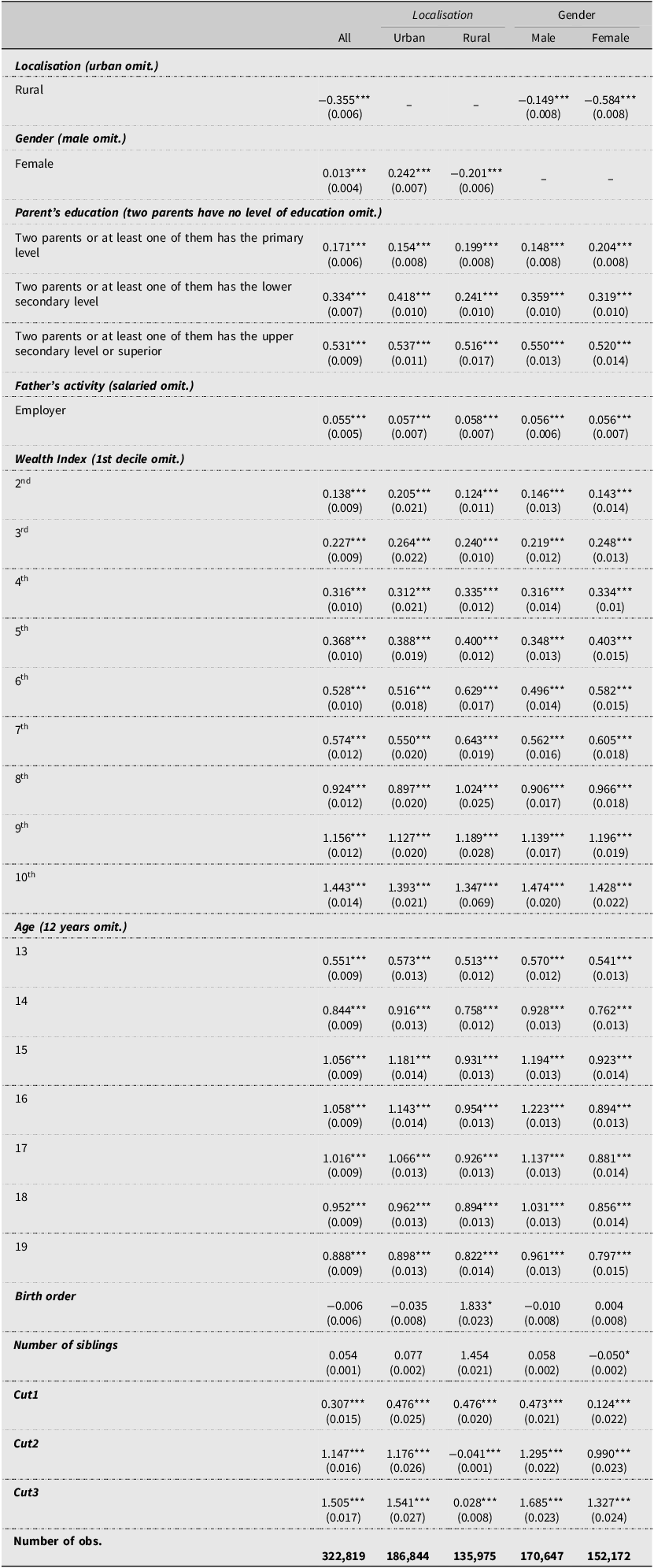
This section presents and interprets the empirical findings from two models: a simple probit model for school access and a censored ordered probit model for educational attainment. Explanatory variables were first analysed individually and then jointly, enabling the identification of the most and least advantaged children in terms of educational opportunities. The discussion draws on both the 1998 and 2014 datasets, highlighting consistent patterns and the evolution of inequalities over the 15-year period (Tables 7–10).
Binary probit estimates of access to school (1998–1999)

Table 7. Long description
The table presents binary probit estimates of access to school for the years 1998-1999. It includes columns for localization (urban and rural), gender (male and female), and various factors such as parent’s education, father’s activity, household per capita expenditure decile, age, birth order, and number of siblings. The table has 19 rows and 10 columns, with each cell containing numerical estimates and standard errors. Notable trends include the negative impact of rural localization and the positive impact of higher parental education levels on school access. The estimates vary significantly across different deciles of household expenditure and age groups.
Note: *, ** and *** denote statistical signicicance at the 10%, 5% and 1% levels, respectively, based on p-values.
Binary probit estimates of access to school (2014)

Table 8. Long description
The table presents binary probit estimates of access to school in 2014, categorized by various factors. It includes columns for all, urban, rural, male, and female, with rows detailing the impact of localization, gender, parents’ education, father’s activity, wealth index, age, birth order, and number of siblings. Key trends include significant positive impacts of higher parental education and wealth index on school access, with notable differences between urban and rural areas, as well as between males and females. The table also highlights the varying effects of age and birth order on school access.
Note: *, ** and *** denote statistical signicicance at the 10%, 5% and 1% levels, respectively, based on p-values.
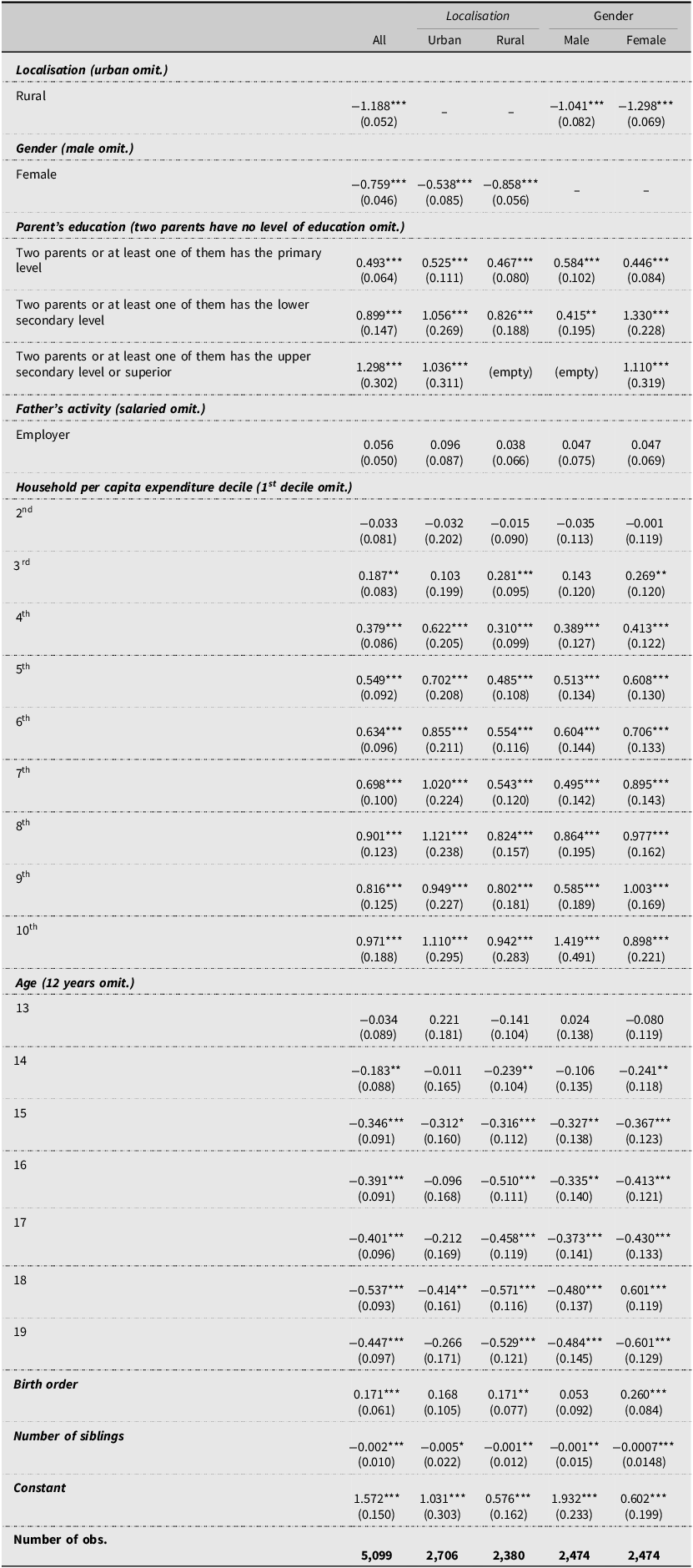
Censored ordered probit estimates of educational attainment (1998–1999)

Table 9. Long description
The table presents censored ordered probit estimates of educational attainment for the years 1998 and 1999. It includes data on localization, gender, parents’ education, father’s activity, household per capita expenditure decile, age, birth order, and number of siblings. The table has 25 columns and 30 rows, with each row representing different variables and their corresponding estimates. Notable trends include significant variations in educational attainment based on parents’ education levels, household expenditure, and age. The estimates are provided with standard errors in parentheses.
Note: *, ** and *** denote statistical signicicance at the 10%, 5% and 1% levels, respectively, based on p-values.
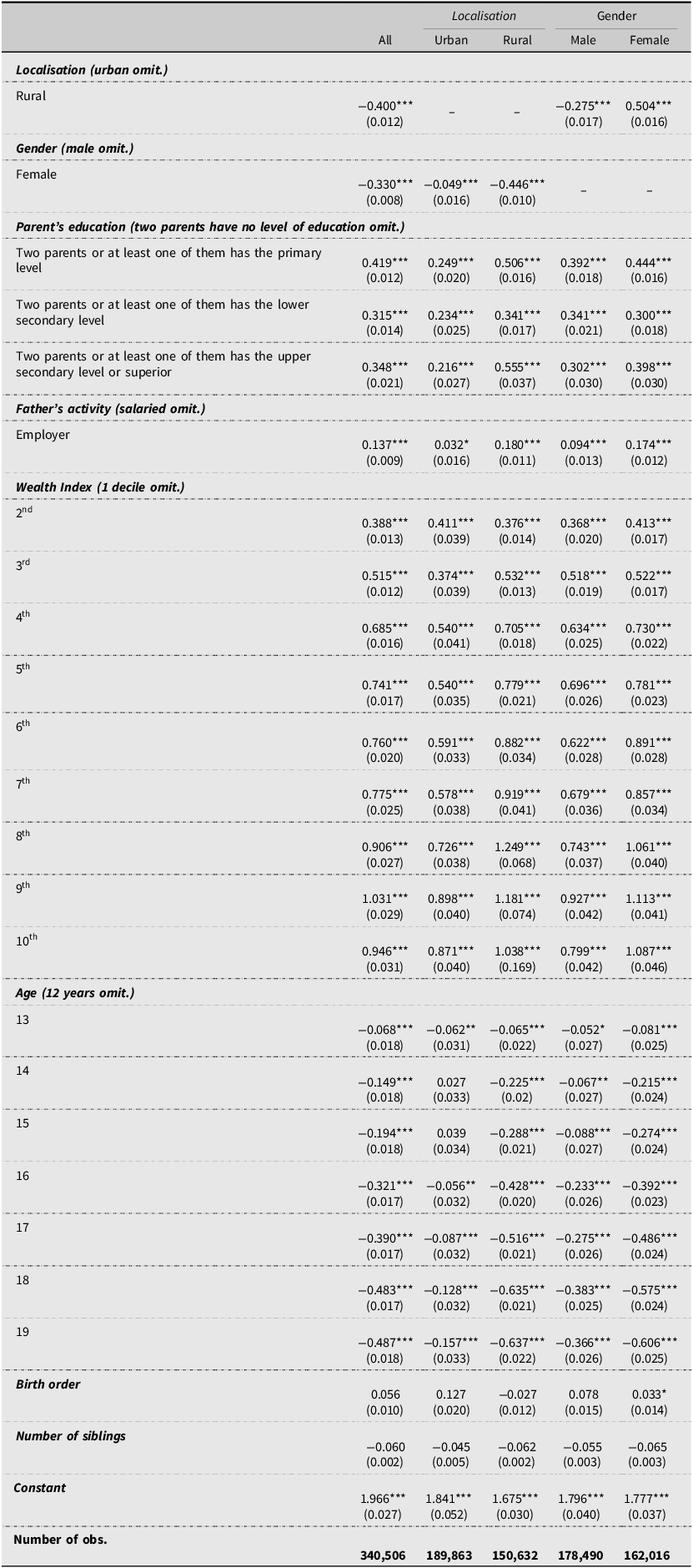
Censored ordered probit estimates of educational attainment (2014)

Table 10. Long description
The table presents empirical findings from two models: a simple probit model for school access and a censored ordered probit model for educational attainment. It includes data on various factors such as localization, gender, parents’ education, father’s activity, wealth index, age, birth order, and number of siblings. The table has 27 rows and 8 columns, with column headers including All, Localisation (Urban and Rural), and Gender (Male and Female). Notable trends include the positive impact of higher parental education levels on educational attainment and the significant differences between urban and rural areas. The wealth index also shows a strong correlation with educational outcomes, with higher deciles associated with better educational attainment.
Note: *, ** and *** denote statistical signicicance at the 10%, 5% and 1% levels, respectively, based on p-values.
Model estimates
Gender and place of residence
Gender remains a significant determinant of schooling outcomes. In both years, girls generally exhibit lower probabilities of school attendance, particularly in rural areas, reflecting barriers such as early marriage, household responsibilities and limited access to secondary schools. However, in urban areas, girls demonstrate higher likelihoods of progressing to advanced educational levels once enrolled, indicating greater persistence and completion relative to boys. Boys, conversely, are more prone to early dropout, often drawn into informal labour or migration.
Rural residence has a consistently negative effect on school attendance and attainment, and regional analyses reveal substantial spatial disparities across Morocco, highlighting enduring structural inequalities despite educational reforms. These spatial inequalities may also reflect a broader form of vulnerability: rural populations, while often more exposed to environmental risks, tend to have more limited access to educational opportunities, which may restrict their ability to acquire the knowledge and skills needed to understand and respond to environmental challenges. This reflects a form of double vulnerability, where educational disadvantage combines with greater exposure to environmental risks.
Household wealth and living standards
Household wealth is a key determinant of schooling outcomes. In 1998, its effect was stronger for girls. Wealth effects were minimal in rural areas, where local educational infrastructure and cultural norms constrained schooling opportunities even among wealthier households. By 2014, wealth became a robust predictor of both enrolment and attainment across all groups, reflecting persistent inequalities, as indicated by the high Gini index of schooling 0.55 (Conseil supérieur de l’éducation, de la formation et de la recherche scientifique, 2017). These disparities extend beyond education, contributing to unequal access to environmental knowledge and sustainability-related competencies and limiting the capacity of disadvantaged populations to engage with environmental challenges.
Parental characteristics
Parental education strongly increases both school access and attainment, for boys and girls alike. Children with educated parents are significantly more likely to enrol and progress, while those with illiterate parents face clear disadvantages. In contrast, father’s occupation shows no significant effect, indicating that broader structural factors play a more decisive role.
Family structure
Family structure influenced schooling outcomes in 1998, with higher birth order and larger household size reducing attendance and attainment, especially for rural girls. By 2014, these effects had largely disappeared, reflecting demographic shifts and improved access to education.
Profiles of the most and least advantaged
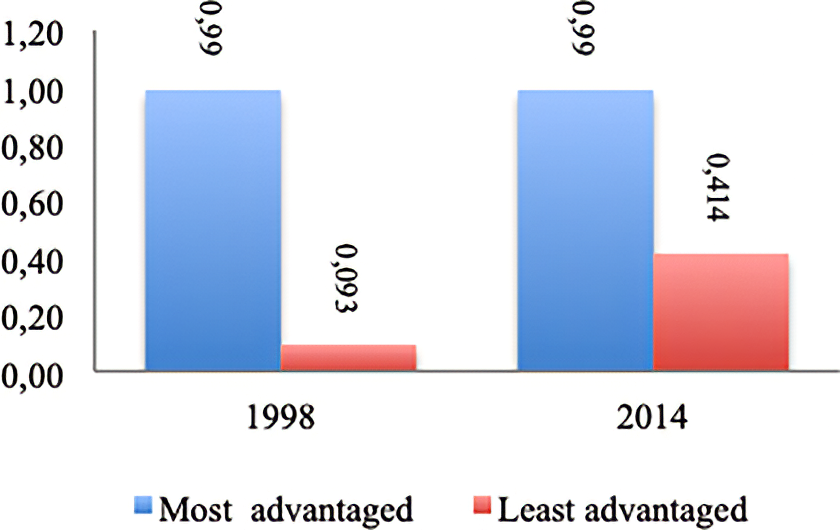
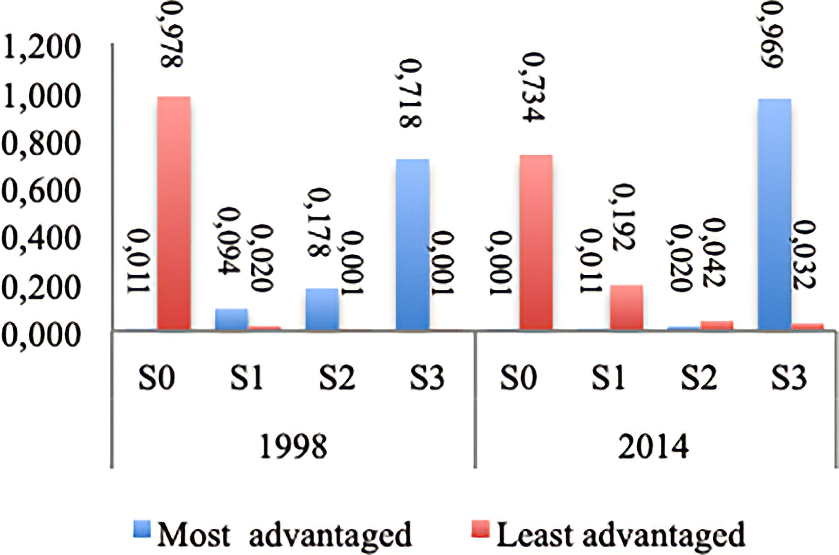
Joint analysis of all explanatory variables allows the identification of extreme profiles of advantage and disadvantage (Figures 1 and 2). In 1998, the most advantaged child – a male urban resident from the wealthiest household decile, an only child, with at least one parent educated to upper secondary or higher – had nearly 100% probability of school attendance and a 72% chance of completing upper secondary education. The least advantaged child – a female rural resident from the poorest decile, eldest of 16 children, with illiterate parents – had a 9.3% probability of attending school and a 0,1% chance of reaching upper secondary.
Probabilities of access to school for the most and least advantaged individuals in 1998 and 2014.

Figure 1. Long description
The bar graph compares the probabilities of access to school for the most and least advantaged individuals in 1998 and 2014. The x-axis represents the years 1998 and 2014, while the y-axis represents the probability values ranging from 0.00 to 1.20. There are two sets of vertical bars for each year, one for the most advantaged and one for the least advantaged. In 1998, the probability for the most advantaged is approximately 0.669, while for the least advantaged, it is approximately 0.093. In 2014, the probability for the most advantaged remains approximately 0.669, but for the least advantaged, it increases to approximately 0.414. The most advantaged group is represented by blue bars, and the least advantaged group is represented by red bars. All values are approximated.
Probabilities of reaching specific educational levels for the most and least advantaged individuals in 1998 and 2014.

Figure 2. Long description
The bar graph compares the probabilities of reaching specific educational levels for the most and least advantaged individuals in 1998 and 2014. The x-axis represents educational levels (S0, S1, S2, S3) and the y-axis represents probabilities ranging from 0 to 1200. The graph features vertical bars divided into two colors: blue for the most advantaged and red for the least advantaged. In 1998, the probabilities for the most advantaged are 0.011 for S0, 0.094 for S1, 0.020 for S2, and 0.718 for S3. For the least advantaged, the probabilities are 0.001 for S0, 0.020 for S1, 0.001 for S2, and 0.978 for S3. In 2014, the probabilities for the most advantaged are 0.001 for S0, 0.011 for S1, 0.042 for S2, and 0.969 for S3. For the least advantaged, the probabilities are 0.001 for S0, 0.192 for S1, 0.020 for S2, and 0.734 for S3. The graph highlights significant disparities in educational attainment between the most and least advantaged individuals over the two time periods. All values are approximated.
By 2014, improvements were observed for the disadvantaged profile (41.4% probability of school attendance), yet gaps remain pronounced, particularly for higher education levels (3.2% compared to 97% for advantaged children). Interestingly, while boys have higher initial enrolment probabilities, the most advantaged profiles to continue their studies are often female, highlighting girls’ higher persistence once enrolled. Rural children consistently remain structurally disadvantaged.
Between 1998 and 2014, Morocco witnessed substantial improvements in both access to education and educational attainment, reflecting the impact of reforms and social programmes. Nevertheless, persistent inequalities continue to be shaped by gender, household wealth, parental education, place of residence and family structure. These findings underscore the importance of policies addressing both supply-side constraints, such as school availability and infrastructure, and demand-side determinants, including poverty, gender norms and household responsibilities. Targeted interventions aimed at the most disadvantaged groups are essential for achieving genuine equality of educational opportunity.
These results not only highlight persistent educational inequalities but also point to broader disparities in the distribution of sustainability-related capabilities. Unequal access to education may limit individuals’ opportunities to acquire the knowledge and skills needed to understand environmental risks, engage in sustainable practices and participate in climate adaptation processes. From this perspective, educational inequality can be interpreted as a structural driver of inequality in environmental and sustainability-related capabilities. Disparities observed across rural areas and socio-economic groups further suggest the existence of a double constraint: disadvantaged populations often face both restricted access to education and reduced capacity to respond effectively to environmental challenges. This underscores the importance of integrating equity considerations into environmental education policies, as reducing educational inequalities is not only a matter of social justice but also a key condition for fostering inclusive and effective sustainability transitions.
Conclusion
This paper has analysed the evolution of inequalities of opportunity in education in Morocco between 1998 and 2014, with a particular focus on school access and educational attainment. Using probit and right-censored ordered probit models applied to the ENNVM 1998–1999 and RGPH 2014 datasets, the results show that individual and household characteristics – especially gender, place of residence, household wealth and parental education – remain key determinants of educational outcomes.
The findings reveal persistent and structurally rooted disparities. Children from advantaged socio-economic backgrounds are consistently more likely to enrol in school and progress through the educational system, whereas those from disadvantaged households – particularly in rural areas, from poorer families or with less educated parents – face significantly higher risks of non-enrolment and early dropout. Although inequalities have declined over time, they remain substantial, indicating that unequal circumstances continue to strongly shape educational trajectories in Morocco. These findings largely confirm well-established patterns documented in the international literature on educational inequality, while highlighting their persistence and specific implications in the Moroccan context.
The results suggest that educational policy should move beyond the expansion of supply and more directly address demand-side constraints. Poverty, gender norms and household conditions continue to play a decisive role in limiting educational access and progression. Targeted interventions aimed at disadvantaged populations are therefore essential to promote equity and enhance educational mobility.
Importantly, the findings also point to broader implications that extend beyond the education sector. Educational inequality can be understood as a structural constraint on the development of sustainability-related capabilities. Unequal access to schooling may limit individuals’ ability to acquire environmental knowledge, develop critical awareness of ecological challenges and engage in sustainable practices. From this perspective, disparities in educational opportunities are likely to translate into unequal capacities to respond to environmental and climate-related risks.
This issue is particularly salient in the Moroccan context, where rural and socio-economically disadvantaged populations often face a form of double vulnerability: greater exposure to environmental risks combined with more limited access to quality education and environmental learning opportunities. As a result, educational inequalities may reinforce existing environmental vulnerabilities and constrain participation in sustainability transitions.
Strengthening educational inclusion is therefore not only a matter of social justice but also a key lever for fostering inclusive and effective responses to environmental challenges. Integrating equity considerations into environmental and sustainability education policies is essential to ensure that all individuals – not only the most advantaged – can develop the knowledge, skills and capabilities required to engage in sustainable development.
In this regard, policies targeting disadvantaged populations can serve as strategic entry points for simultaneously reducing educational inequalities and expanding access to sustainability-oriented learning. By linking educational equity with environmental capability development, this study highlights the need for more integrated policy approaches that connect education, social inclusion and sustainability in developing country contexts.
Acknowledgements
The author would like to thank Dr Ragui Assaad of the Humphrey School and Dr Touhami Abderrahmane Abdelkhalek of INSEA for their valuable support and guidance. The author also gratefully acknowledges the editors and anonymous reviewers for their constructive comments and suggestions.
Ethical statement
Nothing to note.
Financial support
This research received no specific grant from any funding agency, commercial or not-for-profit sectors.
Author Biography
Fouzia Ejjanoui is an Associate Professor. Her research focuses on development economics, labour market economics, education, gender, poverty, inequality and rural and agricultural economics in the Middle East and North Africa. She holds a PhD in Economics from the Faculty of Legal, Economic and Social Sciences (FSJES) at Mohammed V University, Rabat, Morocco and an Advanced Graduate Diploma (DESA) in Economic Analysis and Development from the Faculty of Legal, Economic and Social Sciences (FSJES) at Cadi Ayyad University, Marrakech, Morocco.


 Open access

