




1. Introduction
In Danish, the prosodic phenomenon called stød is realized with non-modal, often creaky phonation (Peña Reference Peña2022:34).Footnote 1 The distributional pattern of stød is related to the location of the stressed syllable. Studies have pointed out the relationship between ultimate stress and stød, and penultimate stress and non-stød in monomorphemic words (Hansen Reference Hansen1943, Andersen Reference Andersen1958, Jacobsen Reference Jacobsen1985,Footnote 2 Basbøll Reference Basbøll2005, Ito & Mester Reference Ito and Mester2015, Goldshtein Reference Goldshtein2023). As Goldshtein points out:
The preference for stød on stressed ultimate syllables and non-stød on penultimate stressed syllables has long been seen as the main explanandum for the phonological theories of stød, because such words make up the main bulk of the native Germanic vocabulary in Danish. (Goldshtein Reference Goldshtein2023:113–114)
In Basbøll’s (Reference Basbøll2005) and Goldshtein’s (Reference Goldshtein2023) frameworks, stød is considered the default in words with stress on the antepenultimate syllable. However, not all of the above-mentioned accounts include antepenultimate-stressed words as a part of the phonological theory.Footnote 3
This article presents a study that seeks to reveal how Danish speakers apply generalizations for the distribution of stød in monomorphemic words.
In Standard Danish, stød may only occur in syllables under stress (primary or secondary), with either a long vowel or a short vowel followed by a sonorant consonant. This restriction is called stød basis (Hansen Reference Hansen1943, Goldshtein Reference Goldshtein2023). However, stød basis in a syllable is not sufficient to predict stød on that syllable, for example in penultimate syllables.
There are many exceptions to the broad generalizations. For example, stød is not predictable in words with ultimate stress with a short vowel followed by a single sonorant (or semivowel), e.g. løn [ˈlœnˀ]Footnote 4 ‘salary’, søn [ˈsœn] ‘son’, hal [ˈhælˀ] ‘hall’, tal [ˈtsæl] ‘number’. Of the monosyllabic words in this group, 596 exhibit stød and 100 do not, according to the count made in Grønnum (Reference Grønnum2005:225). According to Grønnum, non-stød in this group is lexically specified.
Stød is also not fully predictable in words with penultimate stress ending in -en, -el, or -er. Words with penultimate stress generally do not have stød, but 395 of the 644 words with penultimate stress ending in -en, -el, or -er do have stød, e.g. våben [ˈvɔːˀpən] ‘weapon’, sabel [ˈsæːˀpəl] ‘saber’, and feber [ˈfeːˀpɐ] ‘fever’, whereas the remaining 249 do not, e.g. figen [ˈfiːən] ‘fig’, vabel [ˈvæːpəl] ‘blister’, and peber [ˈpʰeʊɐ] ‘pepper’ (Grønnum Reference Grønnum2005:227).
Another exception to the general pattern is words with ultimate stress with a short vowel followed by /r/ and an obstruent. These words usually do not have stød, even though they have ultimate stress, e.g. vært [ˈvæɐt] ‘host’ (Grønnum Reference Grønnum2005:221).
Moreover, recent loans from English are generally not pronounced with stød, e.g. link [ˈleŋk], team [ˈtsiːm], spray [ˈspɹɛj], and drink [ˈtʁæŋk].Footnote 5
Basbøll (Reference Basbøll2005:380) summarizes the distribution of stød in morphologically simple words (Basbøll’s ‘min-words’) in the following way: ‘the penultimate syllable is stød-less, other syllables with primary or secondary stress have stød if their sound structure allows it’. He calls this the Non-Stød Principle. In the formulation of this principle, stød is taken as the default, whereas the context where stød does not occur is what should be explained. In this lies the assumption that all exceptions to the principle are lexically marked.Footnote 6
Basbøll illustrates the Non-Stød Principle with an example of how Latin used to be pronounced in Danish schools: ‘insula, insulae, insularum’ (‘island’, sg.nom, sg.gen/dat or pl.nom/acc, pl.gen) [ˈenˀsula], [ˈenˀsuˌlɛːˀ], [ensuˈlɑːʁom] (Basbøll Reference Basbøll2005:380).Footnote 7 The purpose of this example is to show the distribution of stød in a novel context, ‘when the purely phonological mechanism is isolated’ (Basbøll Reference Basbøll2005:266).
Another way of isolating the phonological mechanism is by using nonce words. Testing with nonce words can be used to investigate whether an alternation is productive and psychologically real (Kawahara Reference Kawahara2016). This has been the theoretical point of departure in several studies on different phonological alternations or rules (e.g. Sanders Reference Sanders2003, Gouskova & Becker Reference Gouskova and Becker2013, Turcsan & Herment Reference Turcsan, Herment, Mompean and Fouz-González2015, Ahn Reference Ahn2016, Bennett & Braver Reference Bennett and Braver2020).
Only one previous study has investigated the distribution of stød with nonce words. In Grønnum et al. (Reference Grønnum, Pharao and Basbøll2020), speakers pronounced compounds constructed with an existing word in combination with a nonce word. The aim was to investigate whether observed unexpected occurrences of stød would replicate in a nonce word experiment, ‘particularly in disyllabic nouns in the final position in two-word compounds, nouns which in isolation do not have stød’ (Grønnum et al. Reference Grønnum, Pharao and Basbøll2020:28). The distribution in monomorphemic words, on the other hand, has never been tested experimentally.
The aim of this study is to investigate the relationship between the occurrence of stød and the position of the stressed syllable in monomorphemic words. Basbøll’s Non-Stød Principle is formulated so as to combine the distribution of stød in all three stressable positions into a single generalization (antepenultimate, penultimate or ultimate syllables). If this generalization is indeed psychologically real and productive it should replicate in speakers’ pronunciation of nonce words.
Three predictions can be formulated based on the part of the Non-Stød Principle with relevance to monomorphemic words.
-
(i) Nonce words with stress on the ultimate syllable will have stød.
-
(ii) Nonce words with stress on the antepenultimate syllable will have stød.
-
(iii) Nonce words with stress on the penultimate syllable will not have stød.
Speakers’ pronunciation of nonce words will be analyzed in relation to the three predictions. Only nonce words with stød basis are relevant in this study.
2. Method
A production study with nonce words was carried out to test participants’ assignment of stød in relation to stress location. Participants were presented with written nonce words with ultimate, penultimate, or antepenultimate stress, and asked to pronounce the nonce words as if they were Danish words they had not heard before.
2.1 Stimuli
Nonce words were created separately for each prediction, i.e. for nonce words with stress on the ultimate syllable (hereafter ult-NWs), nonce words with stress on the penultimate syllable (hereafter penult-NWs), and nonce words with stress on the antepenultimate syllable (hereafter antepenult-NWs). Extraneous variables such as vowel quality,Footnote 8 coda structure (different sonorants,Footnote 9 sonorant followed by one additional consonant or no coda), and the occurrence of a pre-tonic syllableFootnote 10 were balanced in order to avoid having one kind of structure or one vowel dominating in a stress pattern group, and thus maybe affecting the result. For penult-NWs, the structure of the post-tonic syllables was balanced as well, containing either a schwa, a schwa followed by an additional consonant,Footnote 11 or a full vowel with or without an additional consonant.Footnote 12 Thus, the number of nonce words in each stress pattern group was determined by the number of possible combinations of the extraneous variables.
As a result, the stimuli consisted of a list of 336 nonce words, with 112 ult-NWs (which is the number of possible combinations of 4 vowels × 14 codas × 2 number of syllables), 160 penult-NWs (which is the number of possible combinations of 4 vowels × 8 codas × 3 post-tonic syllables and 4 vowels × 8 codas × 2 post-tonic syllables), and 64 antepenult-NWs (which is the number of possible combinations of 4 vowels × 8 codas (32 combinations) × 2 of each). Two items were selected for each combination in the antepenult-NW group, in order to increase the number of antepenult-NWs. The nonce words can be seen in the results section (Figures 7–9).
To generate the nonce words, a code to give all possible combinations of a predefined set of possible onsets, nuclei, and codas was written in Python. An orthographic representation was selected for each phoneme or phoneme combination in the set of possible onsets, nuclei, or codas. All possible elements in the different positions can be seen in the Python code in the supplementary materials.
A list containing one randomized nonce word for each of the mentioned combinations was manually checked in order to remove existing words, homophones, and unwanted combinations, such as the same consonant before and after the vowel (e.g. krirk) or the same onset two times in a row (e.g. flefliv).
The nonce words should be potential Danish words. They were therefore constructed following the phonotactic rules of Danish (see Grønnum Reference Grønnum2007, Schachtenhaufen Reference Schachtenhaufen2022). Nevertheless, the nonce words do not necessarily look like typical Danish words. Native words in Danish are typically monosyllabic, or disyllabic with a stressed syllable followed by an unstressed syllable not containing a full vowel, mostly schwa (Basbøll Reference Basbøll2005:400). However, only testing nonce words with a prototypical structure would be limiting and would make it impossible to test nonce words with antepenultimate stress, or nonce words with vowels other than schwa in the unstressed syllable. Also, as pointed out by an anonymous reviewer, Danes are used to structures other than that of native words. Thus, some of the nonce words might be perceived as less Danish-looking than others. This was compensated for by examining how Danish the nonce words were perceived to be in an online survey, and comparing it to the results (see Sections 2.5 and 3.4).
2.2 Participants and recording
Ten native speakers of Danish from the greater Copenhagen area participated in the study. They were all high school students and ranged in age between 18 and 20 years. In order to avoid variation caused by dialectal differences, only speakers who had lived in the greater Copenhagen area their whole life were recruited. Another criterion was that the speakers should not have any reading difficulties. The participants received a gift card for their participation.
The recordings were made using Zoom. The participants were instructed to sit in a quiet room without background noise. They used their own microphone, and the audio files were recorded in m4a format and converted to wav format. Recording with less control over the audio quality is not ideal for phonetic analysis or measurements, but the audio quality was sufficient for the purpose of this study.
2.3 Procedure
The participants were told to imagine they were reading a book or playing a game in an imaginary world, and that the test words would be the names of items one could buy in this world. This was done in order to have the participants think of all the nonce words as belonging to the same part of speech (nouns in this case).
The participants were informed that they would be presented with nonce words, which they had to read aloud at their own pace. The stimuli were presented with PsychoPy (version 2022.2.4, Peirce et al. Reference Peirce, Gray, Simpson, MacAskill, Sogo, Kastman and Lindeløv2019). The nonce words appeared at the center of the screen and the participants were instructed to click on the screen to proceed to the next item.Footnote 13
The 336 nonce words were presented in four blocks with 84 trials in each. The order of the nonce words was randomized, and the presentation order of the blocks varied from participant to participant. On average, it took approximately five minutes for the participants to read each block. After each block, the participants were offered a short break.
In order to get the participants to pronounce the intended syllables with stress, the target syllables were shown with capital letters to indicate stress (as in Braver Reference Braver2014). In order to make sure the participants were able to move the stress to different syllables, they were shown three examples with real minimal pairs where the stressed syllable was indicated with capital letters (FORmel – forMEL, TEKniker – tekNIKker, staTIStiker – statiSTIKer), followed by two examples with real words but not real minimal pairs (CARdigan – carDIgan, KAmera – kaMEra). This was followed by a practice trial with ten nonce words.
2.4 Coding of responses
The responses were analyzed auditorily by the author (a native speaker of Danish).Footnote 14 The responses were coded as having stød or not having stød, whether the pronunciation was consistent with the prediction or not, and whether there was a reason to exclude the response from the analysis. If a speaker read the word more than once, the first (not excluded) pronunciation was selected for analysis.
A total of 852 (25%) responses were excluded from the analysis. Responses were excluded based on the following criteria (number of excluded datapoints in square brackets after each category): pronunciations with stress on a non-target syllable (both if another syllable was stressed or if two syllables were stressed) [460], pronunciations with hesitation or a pause between syllables [52], pronunciations without stød basis [33], audio files with glitches or sound problems (a minor glitch in non-target syllable was accepted) [30], reading errors (defined as a pronunciation that is not possible in Danish based on the spelling) [62], and pronunciations with stød on the post-tonic syllable [211] (where primary stress is on the target syllable; whether these syllables had secondary stress or not is difficult to determine and outside the scope of this study). In four cases, a datapoint was missing due to a speaker skipping the nonce word [4].
An inter-rater reliability test was carried out by letting another native speaker of Danish code a subset of the data. The subset of the data was arbitrarily taken from the valid responses and consisted of 299 nonce words. The test gave a percent agreement of 94% and
 $$\kappa \;$$
= 0.88Footnote
15
(Cohen’s kappa; McHugh Reference McHugh2012, Loewen & Plonsky Reference Loewen and Plonsky2016:28). Cohen’s kappa takes account of false agreement caused by guessing or not being sure and is thus a more conservative measure than percent agreement (McHugh Reference McHugh2012:278). Since both coders are trained linguists, it is reasonable to assume that the amount of guessing is low, making percent agreement a reliable measure.
$$\kappa \;$$
= 0.88Footnote
15
(Cohen’s kappa; McHugh Reference McHugh2012, Loewen & Plonsky Reference Loewen and Plonsky2016:28). Cohen’s kappa takes account of false agreement caused by guessing or not being sure and is thus a more conservative measure than percent agreement (McHugh Reference McHugh2012:278). Since both coders are trained linguists, it is reasonable to assume that the amount of guessing is low, making percent agreement a reliable measure.
2.5 Danishness survey
An online survey with wordlikeness judgments was created in PsyToolkit (Version 3.4.4, Stoet Reference Stoet2010, Reference Stoet2017). This was done to test how Danish the nonce words were perceived to be by Danish speakers, since the nonce words were not necessarily prototypical, and might be considered less Danish.
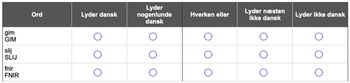
Participants were asked to rate how Danish they thought a nonce word was on a five-point scale, from sounds Danish to does not sound Danish. The stimuli were presented in written form, but the participants were asked to judge how Danish the word sounded, an approach also used by Bailey & Hahn (Reference Bailey and Hahn2001). The nonce words were presented with the stressed syllable in both lowercase and capitals (Figure 1).
Example from the Danishness survey with the ratings ‘Sounds Danish’, ‘Sounds fairly Danish’, ‘Neither or’, ‘Hardly sounds Danish’, and ‘Does not sound Danish’.
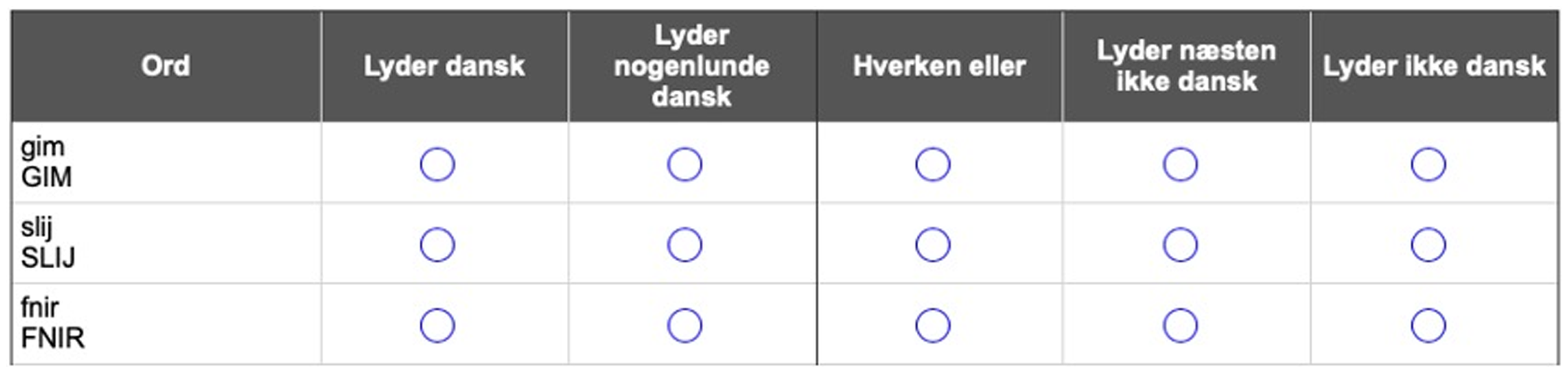
Figure 1 Long description
The table presents the ratings of Danish words based on their phonation patterns. It includes five columns: 'Ord' for the words, 'Lyder dansk' for words that sound Danish, 'Lyder nogenlunde dansk' for words that sound fairly Danish, 'Hverken eller' for words that neither sound Danish nor not Danish, 'Lyder næsten ikke dansk' for words that hardly sound Danish, and 'Lyder ikke dansk' for words that do not sound Danish. The rows list specific words in both lowercase and uppercase forms. Each cell contains a radio button indicating the rating category for the corresponding word. The table aims to illustrate the distributional pattern of the prosodic phenomenon std in Danish words, highlighting the relationship between stress location and phonation type.
To make the survey as short as possible, it was split into four parts, with 84 nonce words in each. Thus, each participant had to rate 84 nonce words. In total, 147 anonymous participants filled out the survey, ranging in age between 19 and 80, mean age 45. Participants who answered Does not sound Danish for every nonce word, or to all but two nonce words, were removed (7 in total). 31 participants responded to the first block of nonce words, 36 responded to the second, 31 to the third, and 40 to the fourth.
The mean Danishness rating was calculated for each nonce word and compared to the results for each prediction. This part of the study was done post hoc.
3. Results
The predictions for the occurrence of stød in relation to the location of the stressed syllable was that ult-NWs and antepenult-NWs would have stød and penult-NWs would not have stød. In this section, the results are reported in terms of how often a response was consistent with the prediction, rather than how often it was pronounced with or without stød. For ult-NWs and antepenult-NWs, consistent with the prediction means ‘pronounced with stød’. For penult-NWs, consistent with the prediction means ‘pronounced without stød’.
Results are presented separately for each stress pattern group, first pooled together across all speakers and nonce words (Section 3.1), thereafter for each individual speaker (Section 3.2) and for each nonce word (Section 3.3). Finally, the results for the nonce words are presented in relation to the Danishness ratings obtained in the online survey (Section 3.4).
3.1 Stød in the stress pattern groups
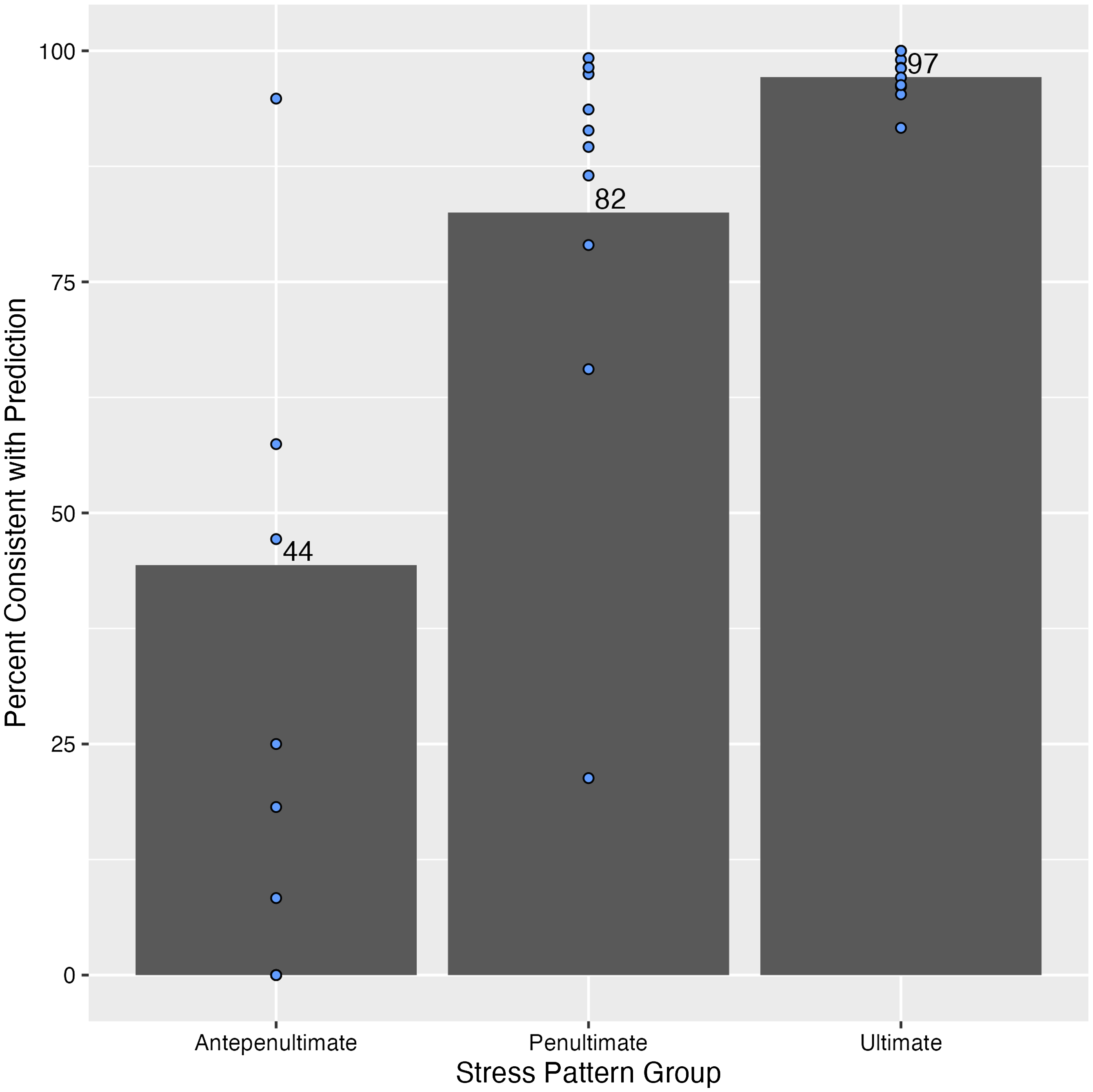
The result for each stress pattern group is shown in Figure 2. As seen, the number of responses that are consistent with the prediction differs considerably between the stress pattern groups, with ult-NWs having the highest proportion of prediction-consistent responses and antepenult-NWs having the lowest proportion.
Percentage of prediction-consistent responses for each stress pattern group. The staples show the percentage of responses that were consistent with the prediction for each stress pattern group. The dots indicate percentage of prediction-consistent answers for each speaker.
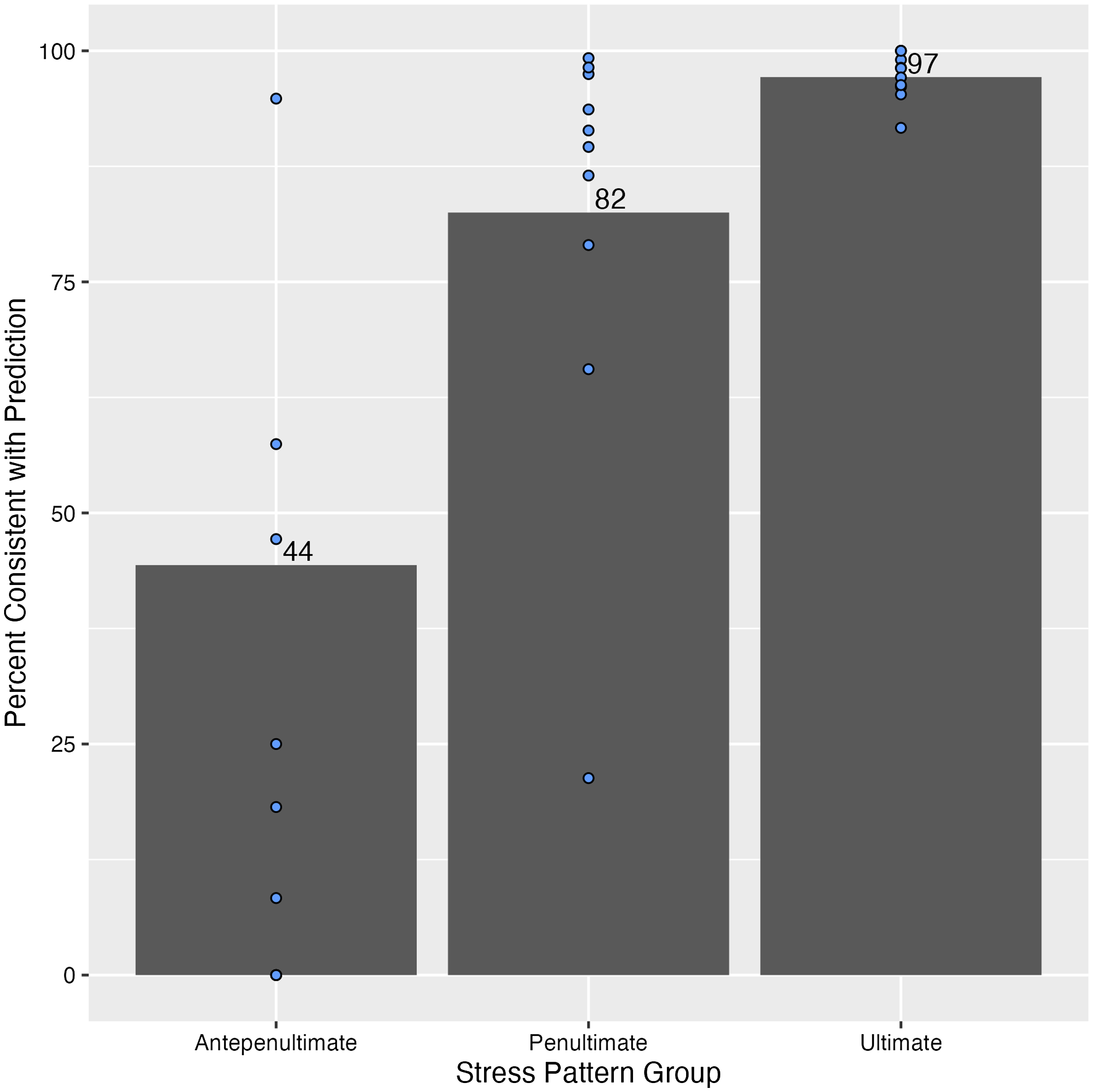
Figure 2 Long description
The bar graph compares the percentage of prediction-consistent responses across three stress pattern groups: Antepenultimate, Penultimate, and Ultimate. The x-axis represents the stress pattern groups, while the y-axis indicates the percentage consistent with prediction, ranging from 0 to 100. There are three vertical bars, each representing a different stress pattern group. The Antepenultimate group has a bar reaching approximately 44 percent, the Penultimate group has a bar reaching approximately 82 percent, and the Ultimate group has a bar reaching approximately 97 percent. Each bar includes individual data points marked by blue dots, indicating the percentage of prediction-consistent answers for each speaker. The bars are colored in dark gray. The graph highlights that the Ultimate stress pattern group has the highest percentage of prediction-consistent responses, followed by the Penultimate group, and the Antepenultimate group has the lowest. All values are approximated.
Across all speakers, 97% of the ult-NWs were pronounced with stød, meaning they were consistent with the prediction. The remaining 3% might be due to random error (Bhandari Reference Bhandari2023). There is little variation between the speakers in this stress pattern group, with a standard deviation of 3%. This indicates a stable pattern within the group.
For the antepenult-NWs, 44% of the responses were consistent with the prediction, i.e. with stød. Thus, more than half of the nonce words in this group were not consistent with the prediction. However, there are big differences between the speakers, with a standard deviation of 33%, which indicates that this is not a robust pattern.
Penult-NWs are shown in the middle staple in Figure 2. Here, 82% of the responses were prediction-consistent (no stød). Thus, the majority of penult-NWs were pronounced as predicted. However, this pattern is not as clear as for the ult-NWs. There is more variation between the speakers in the penult-NWs, with a standard deviation of 24%.
3.2 Prediction-consistent responses by speaker
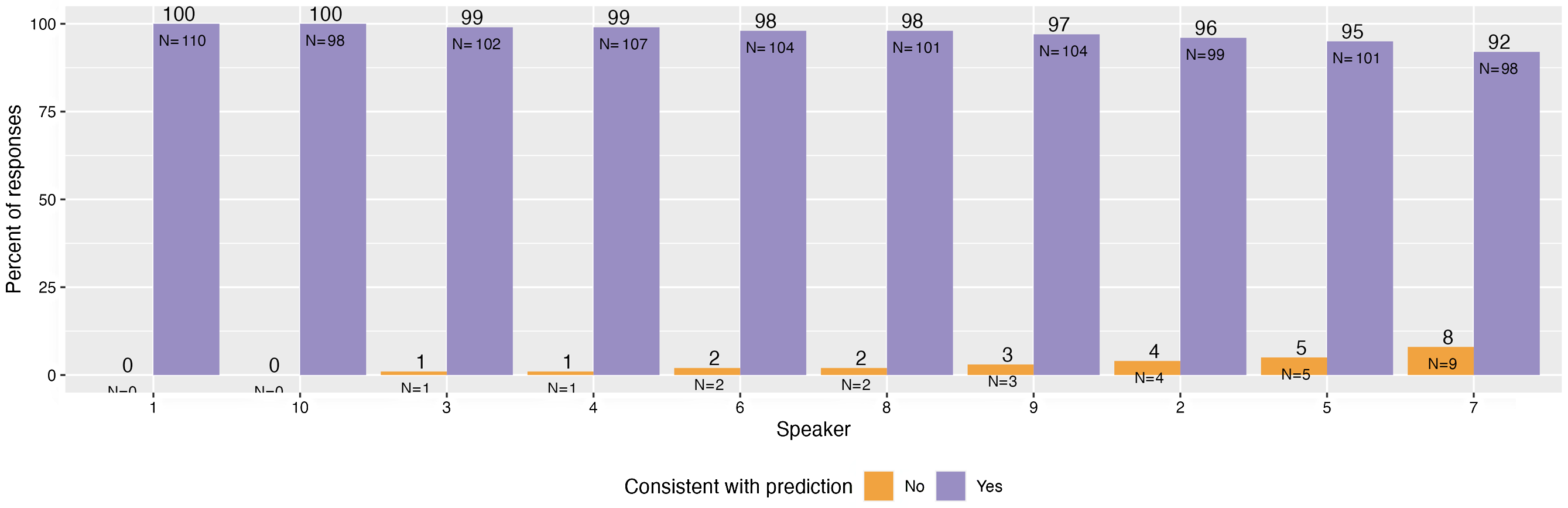
The percentage of prediction-consistent responses for the ult-NWs ranged from 92% to 100%. Thus, some speakers pronounced all ult-NWs with stød. These results are shown in Figure 3.
Percentage of prediction-consistent responses for ult-NWs by speaker, ordered from highest to lowest percentage of prediction-consistent responses. N indicates the number of valid responses from each speaker, with the highest number possible being 112.
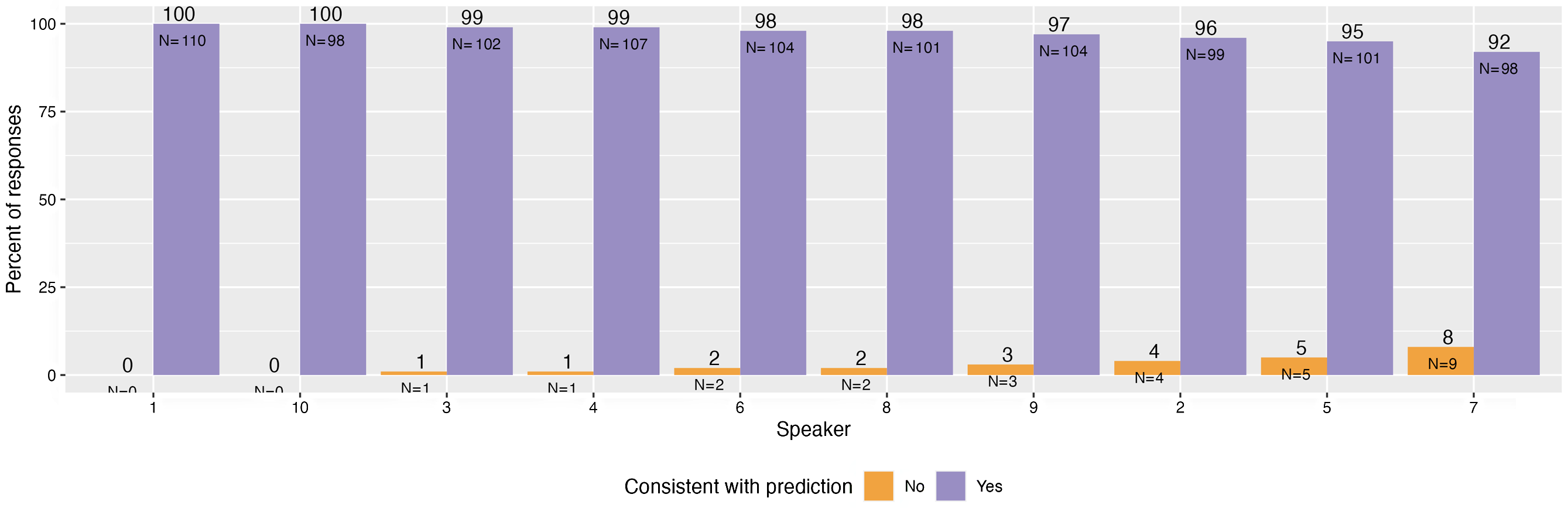
Figure 3 Long description
The bar graph compares the percentage of prediction-consistent responses for ultimate stressed non-words by different speakers. The x-axis represents the speakers, labeled from 1 to 10, while the y-axis represents the percentage of responses, ranging from 0 to 100. There are 10 vertical bars, each representing a different speaker. The bars are color-coded: purple for 'Yes' and orange for 'No'. Each bar has a label at the top indicating the percentage of prediction-consistent responses and the number of valid responses (N) for each speaker. The highest percentage of prediction-consistent responses is 100, and the lowest is 92. The number of valid responses (N) varies between 98 and 110. The graph shows that most speakers have a high percentage of prediction-consistent responses, with only a few responses being inconsistent. The color scheme effectively differentiates between consistent and inconsistent responses. The dataset represents the distribution of std (stød) in Danish words based on stress patterns. All values are approximated.
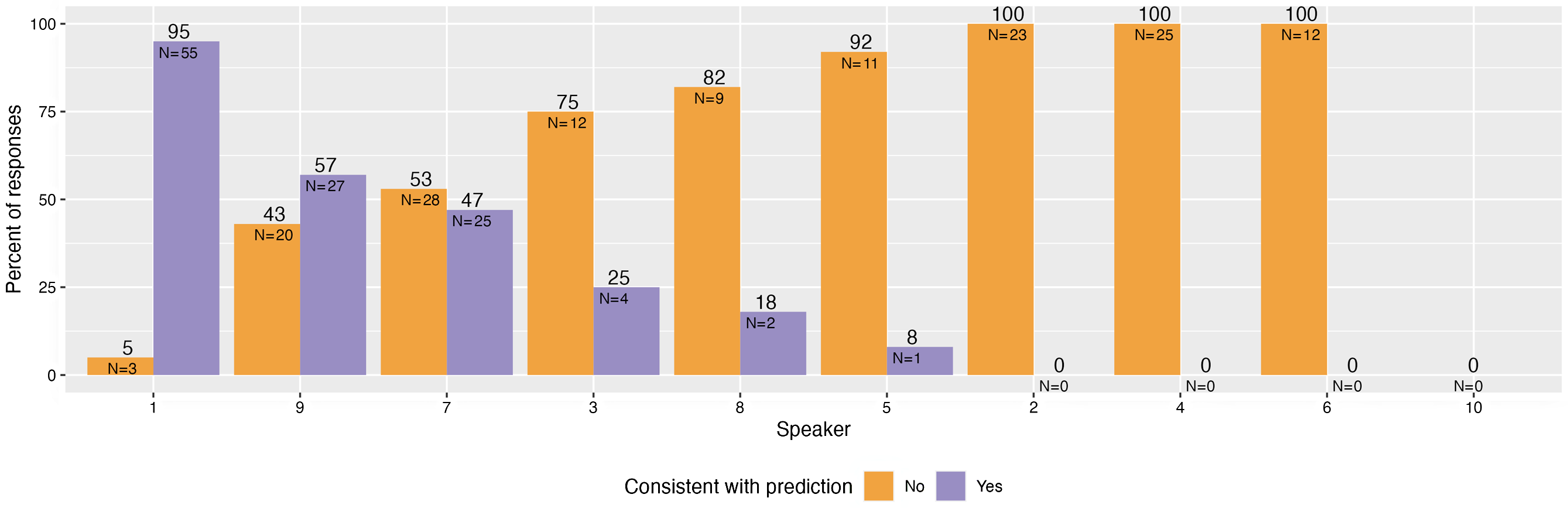
The differences between the speakers in the antepenult-NWs were considerably larger than in the ult-NWs. Prediction-consistent responses are shown in Figure 4. The percentage of antepenult-NWs with stød, and thus consistent with the prediction, ranged from 0% to 95%.
Percentage of prediction-consistent responses for antepenult-NWs by speaker, ordered from highest to lowest percentage of prediction-consistent responses. N indicates the number of valid responses from each speaker, with the highest number possible being 64.
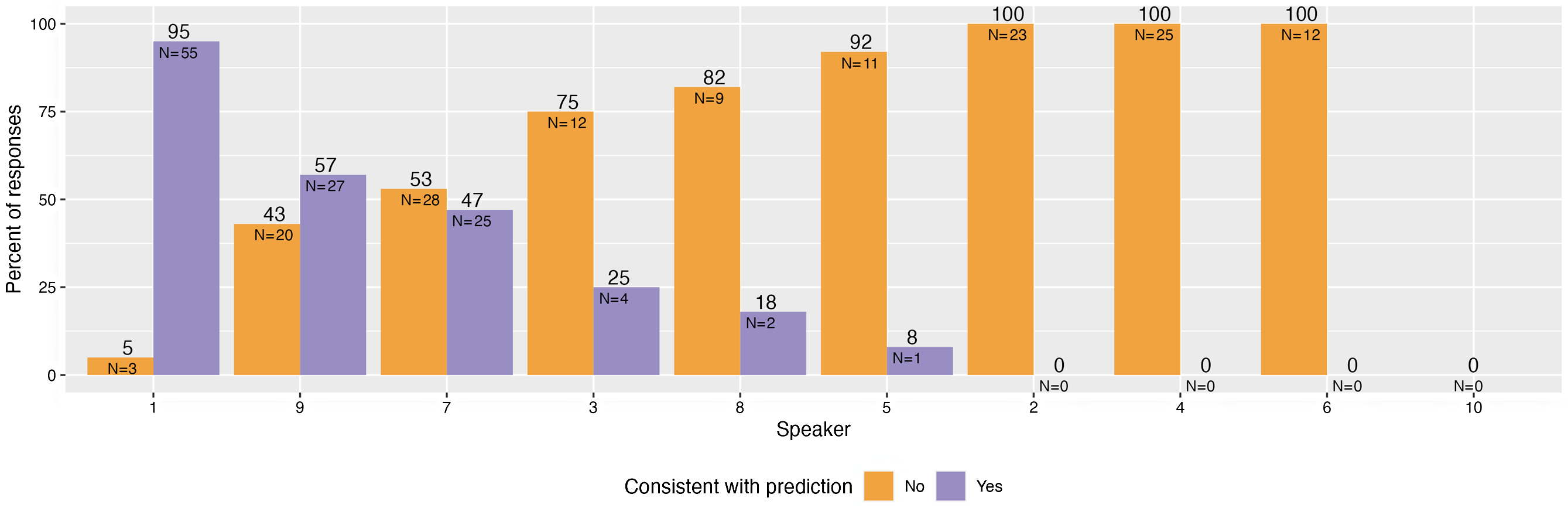
Figure 4 Long description
The bar graph compares the percentage of prediction-consistent responses for antepenult-NWs by different speakers, ordered from highest to lowest percentage. The x-axis represents the speakers labeled as 1, 9, 7, 3, 8, 5, 2, 4, and 6. The y-axis represents the percentage of responses, ranging from 0 to 100. Each speaker has two bars: one orange representing 'No' and one purple representing 'Yes'. The number of valid responses from each speaker is indicated by 'N'. Speaker 1 has 55 responses with 95 percentage 'Yes' and 5 percentage 'No'. Speaker 9 has 27 responses with 57 percentage 'Yes' and 43 percentage 'No'. Speaker 7 has 28 responses with 53 percentage 'Yes' and 47 percentage 'No'. Speaker 3 has 12 responses with 75 percentage 'Yes' and 25 percentage 'No'. Speaker 8 has 9 responses with 82 percentage 'Yes' and 18 percentage 'No'. Speaker 5 has 11 responses with 92 percentage 'Yes' and 8 percentage 'No'. Speakers 2, 4, and 6 each have 0 percentage 'Yes' and 100 percentage 'No' with 23, 25, and 12 responses respectively. All values are approximated.
The number of valid responses also varied considerably. More than half of the responses were invalid for several of the speakers. The speakers with the fewest valid responses also had the lowest percentage of prediction-consistent responses. Notice also that speaker 10 did not have any valid responses in this group of nonce words.
The only speaker with many prediction-consistent responses for the antepenult-NWs was speaker 1, who also has many prediction-inconsistent responses in the penult-NWs (see Figure 5). This speaker seems to have a tendency to pronounce all stressed syllables with stød, yielding a high number of prediction-consistent responses in the ult-NWs and antepenult-NWs, and a low number of prediction-consistent responses in penult-NWs. Thus, the high number of prediction-consistent responses from speaker 1 in antepenult-NWs would be due to this tendency, rather than the speaker behaving according to the prediction.
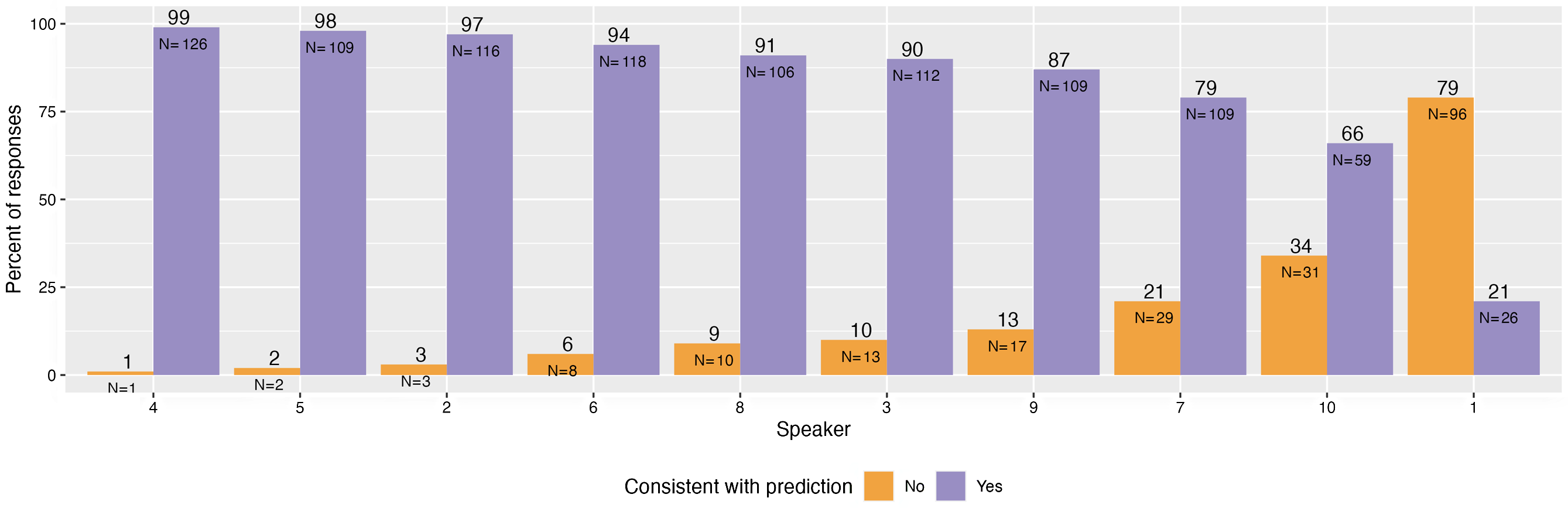
Percentage of prediction-consistent responses for penult-NWs by speaker, ordered from highest to lowest percentage of prediction-consistent responses. N indicates the number of valid responses from each speaker, with the highest number possible being 160.
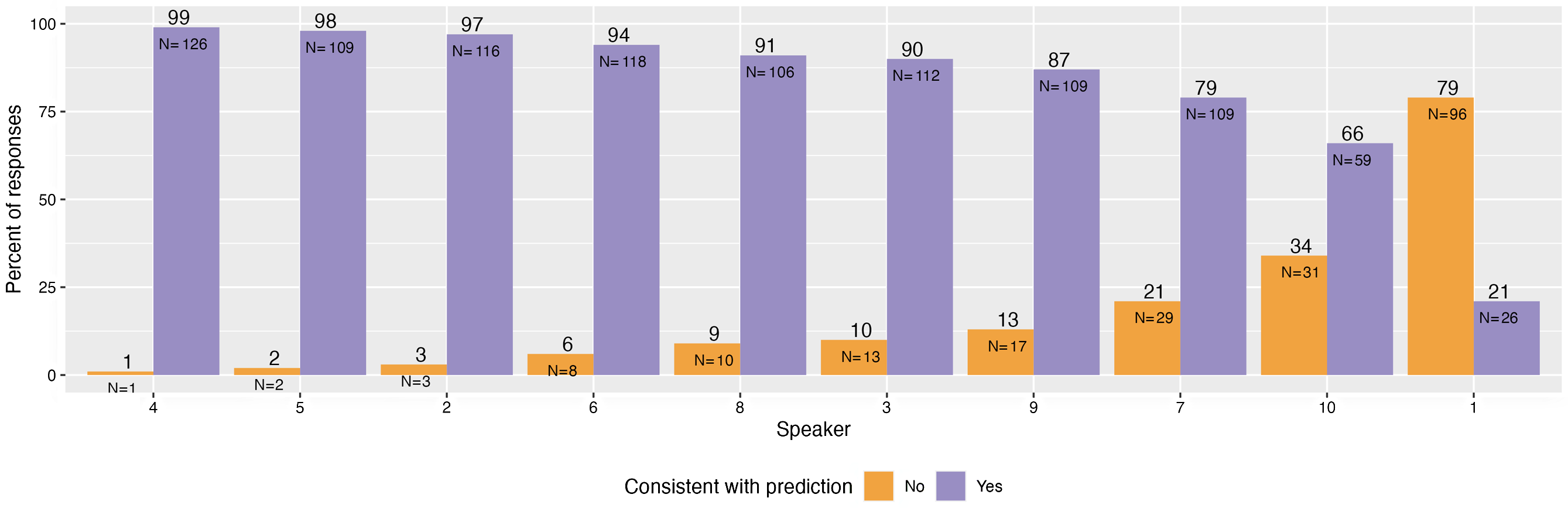
Figure 5 Long description
The bar graph compares the percentage of prediction-consistent responses for penult-NWs by speaker, ordered from highest to lowest percentage. The x-axis represents the speakers labeled from 1 to 10, while the y-axis represents the percentage of responses ranging from 0 to 100. There are ten vertical bars, each representing a different speaker. The bars are grouped into two categories: consistent with prediction (Yes) in purple and not consistent with prediction (No) in orange. Each bar has a label indicating the number of valid responses (N) from each speaker, with the highest number possible being 160. The data shows that speakers 4, 5, 2, 6, 8, 3, 9, 7, 10, and 1 have varying percentages of prediction-consistent responses. Speakers 4, 5, 2, and 6 have the highest percentages of prediction-consistent responses, while speakers 10 and 1 have the lowest. The color scheme uses purple for consistent responses and orange for inconsistent responses. All values are approximated.
The result for the penult-NWs by speaker can be seen in Figure 5. The percentage of prediction-consistent responses ranged from 21% to 99%.
One speaker had many prediction-inconsistent responses in this stress pattern group (speaker 1). As mentioned, this speaker tends to apply stød to all stressed syllables. If speaker 1 is excluded, the difference between the speakers is reduced to the range 66–99% of prediction-consistent responses.
Speaker 10, too, had many prediction-inconsistent responses, as well as many invalid responses, which might disrupt the picture. However, most of the speaker’s responses were still consistent with the prediction, meaning that this speaker probably did not have the same tendency to pronounce stressed syllables with stød.Footnote 16
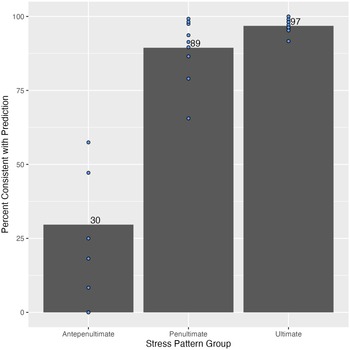
Since speaker 1 tends to pronounce all stressed syllables with stød, and differs considerably from the rest of the speakers for the antepenult-NWs and penult-NWs, it would be relevant to see how this affects the overall result. In Figure 6, the result is shown with speaker 1 removed from the data.
Percentage of prediction-consistent responses for each stress pattern group, with speaker 1 removed from the data. The staples show the average percentage of responses that are consistent with the prediction for each stress pattern group. The dots indicate percentage of prediction-consistent answers for each speaker.
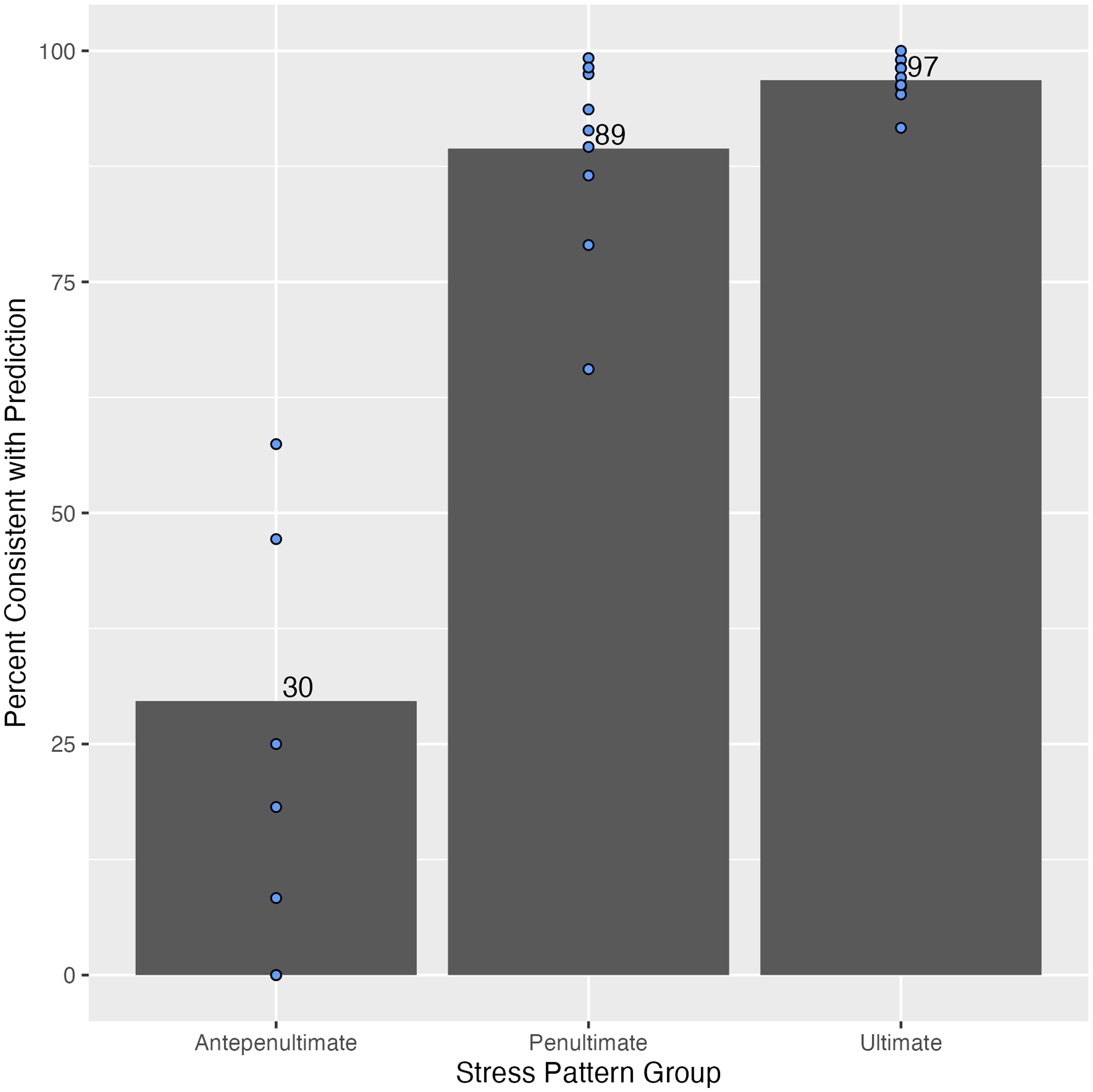
Figure 6 Long description
The bar graph compares the percentage of prediction-consistent responses for three stress pattern groups: Antepenultimate, Penultimate, and Ultimate. The bars are vertical and grouped. The x-axis is labeled 'Stress Pattern Group' and the y-axis is labeled 'Percent Consistent with Prediction'. The Antepenultimate group has an average percentage of 30, the Penultimate group has an average percentage of 89, and the Ultimate group has an average percentage of 97. Each bar has individual data points marked by blue dots, indicating the percentage of prediction-consistent answers for each speaker. The bars are colored in gray. All values are approximated.
Removing speaker 1 decreases the percentage of prediction-consistent responses for the antepenult-NWs from 44% to 30%, and decreases the standard deviation from 33% to 22%. For the penult-NWs, on the other hand, prediction-consistent responses increase from 82% to 89%, and the standard deviation decreases from 24% to 11%.
3.3 Prediction-consistent responses by nonce word
Since speaker 1 affected the overall result, they would have an effect on the result for the individual nonce words and probably disrupt the picture. For example, speaker 1 would be the only one to pronounce several of the antepenult-NWs and penult-NWs with stød. Due to this, the results in this section are reported with speaker 1 removed from the data.
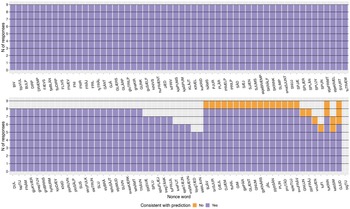
Ult-NWs were predicted to be pronounced with stød. The number of prediction-consistent and prediction-inconsistent responses for each ult-NW are shown in Figure 7. Most of the ult-NWs, 88 of 112, only had prediction-consistent responses, meaning they were pronounced with stød every time. 20 nonce words only had a single response without stød. For the remaining four nonce words, two, fuKRIN and kebSIM, had two responses without stød, and one, GJUD, had three responses without stød. The nonce word bigTU did not have any valid responses. The speakers either pronounced it with stress on the first syllable, or with a short /u/, i.e. without stød basis.
Number of prediction-consistent and prediction-inconsistent responses for ult-NWs, ordered from highest to lowest number of responses consistent with the prediction.
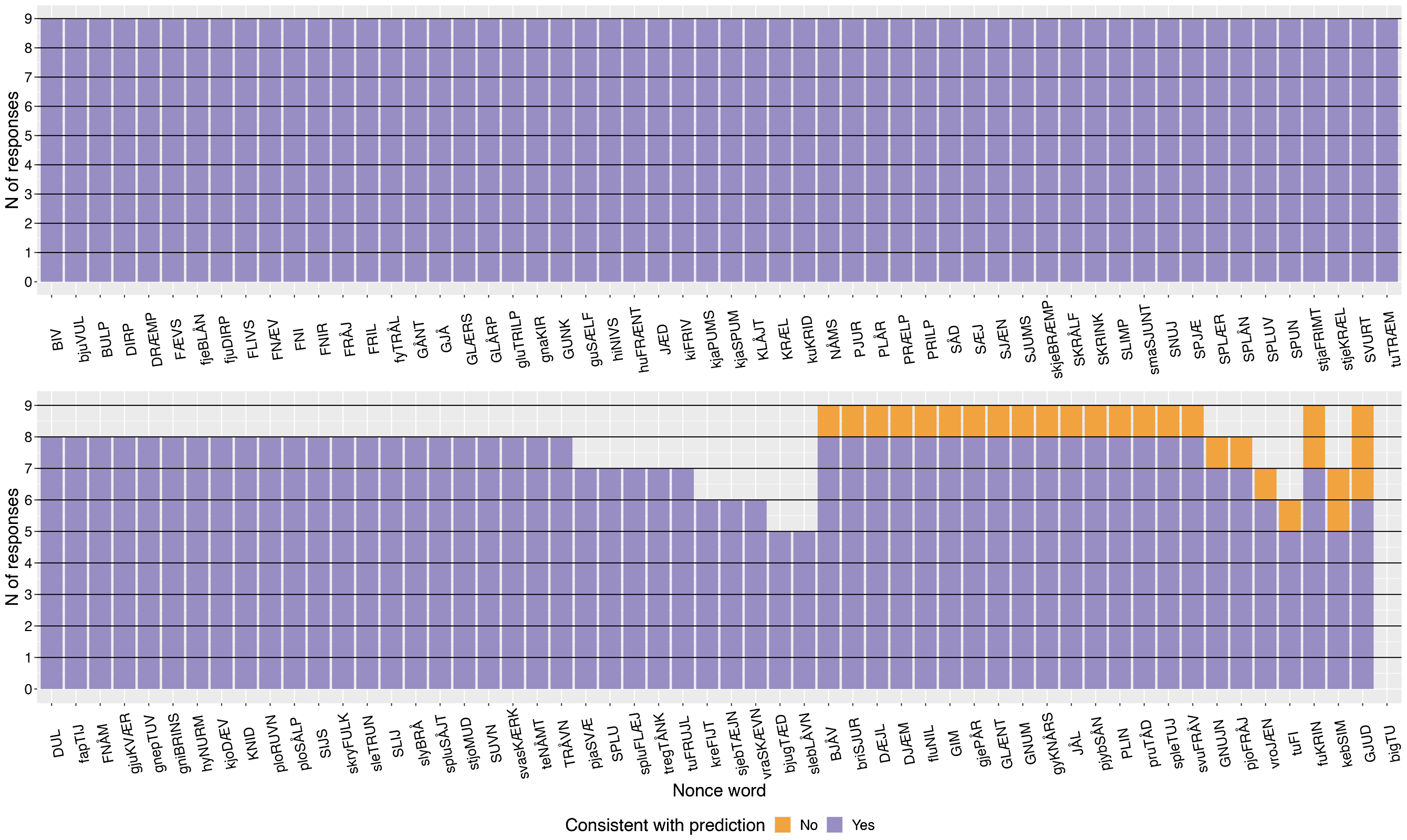
Figure 7 Long description
A heat map displays the number of prediction-consistent and prediction-inconsistent responses for ult-NWs, penult-NWs, and antepenult-NWs. The heat map is divided into two sections, each representing a different set of nonce words. The x-axis lists various nonce words, while the y-axis indicates the number of responses. The color scale ranges from purple to orange, with purple indicating prediction-consistent responses and orange indicating prediction-inconsistent responses. The top section shows a uniform distribution of purple cells, indicating that all responses for these nonce words are consistent with the prediction. The bottom section shows a mix of purple and orange cells, indicating a variation in the consistency of responses with the prediction. Notable patterns include clusters of orange cells towards the right side of the bottom section, suggesting a higher number of prediction-inconsistent responses for those nonce words.
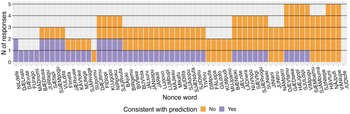
Number of prediction-consistent and prediction-inconsistent responses for antepenult-NWs, ordered from lowest to highest number of responses not consistent with the prediction.
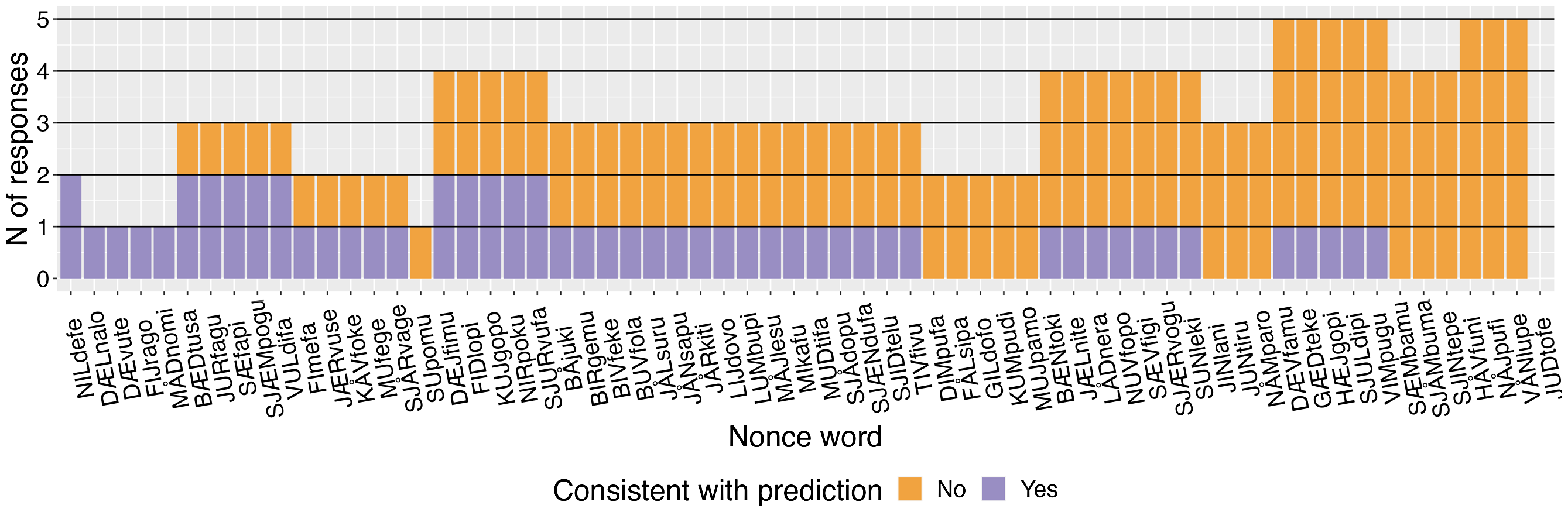
Figure 8 Long description
A bar graph compares the number of prediction-consistent and prediction-inconsistent responses for antepenult-NWs. The x-axis lists various nonce words, while the y-axis indicates the number of responses. There are 50 horizontal bars, each representing a different nonce word. The bars are grouped in pairs, with one bar in each pair colored orange to indicate 'No' and the other colored purple to indicate 'Yes'. The graph shows a range of responses, with some nonce words having more consistent responses and others having more inconsistent ones. The color scheme helps differentiate between consistent and inconsistent responses. All values are approximated.
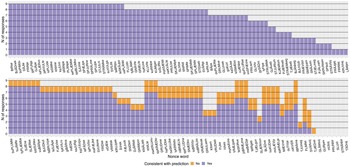
Number of prediction-consistent and prediction-inconsistent responses for penult-NWs, ordered from lowest to highest number of responses consistent with the prediction.
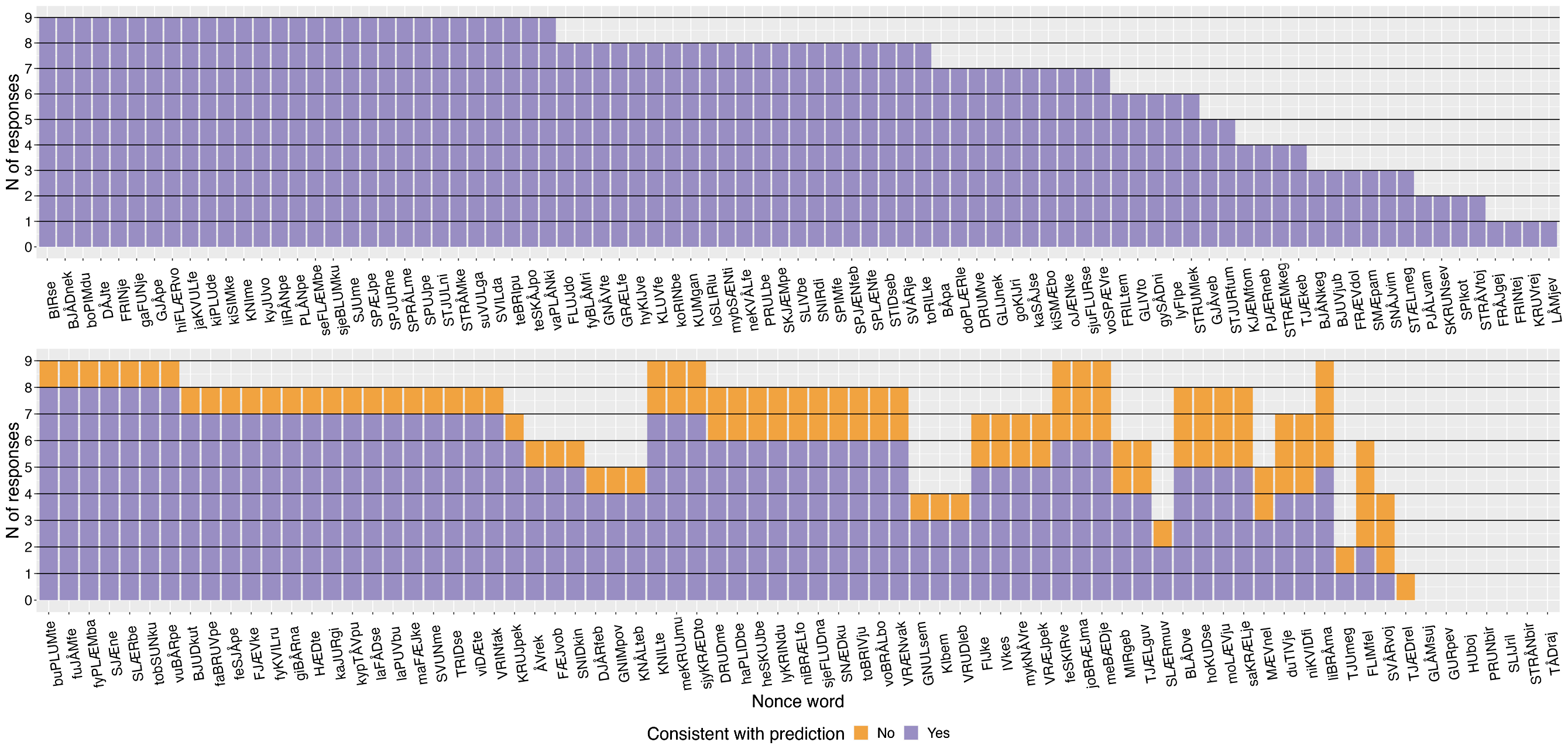
Figure 9 Long description
A heat map displays the number of prediction-consistent and prediction-inconsistent responses for penult-NWs, ordered from the lowest to the highest number of responses consistent with the prediction. The heat map features a grid layout with rows and columns representing different penult-NWs. The x-axis lists various penult-NWs, while the y-axis indicates the number of responses, ranging from 0 to 9. The color scale uses shades of purple and orange, where purple indicates prediction-consistent responses and orange indicates prediction-inconsistent responses. Higher values of responses are represented by darker shades, while lower values are represented by lighter shades. Notable patterns include clusters of consistent responses in the middle of the grid and inconsistent responses towards the edges. The heat map provides a visual representation of the distribution and frequency of prediction-consistent and inconsistent responses for penult-NWs.
Antepenult-NWs were also predicted to be pronounced with stød. This was not the case for many of the responses, with only 30% of the responses being prediction-consistent (44% if speaker 1 is included). The number of prediction-consistent and prediction-inconsistent responses for each antepenult-NW are shown in Figure 8.
Some antepenult-NWs had many responses without stød (SÆMbamu, SJÅMbuma, SJINtepe, HÅVfuni, NÅJpufi, and VÅNlupe). In total, 15 of the nonce words were always pronounced without stød. Only five nonce words were always pronounced with stød, but these only had one or two valid responses. There is no obvious pattern as to which nonce words were pronounced with or without stød in this group.
An interesting observation is that the nonce words with most valid responses (five) only had a single response or no responses with stød. A larger number of responses does not seem to increase the number of prediction-consistent responses for an antepenult-NW.
The distribution of prediction-consistent and prediction-inconsistent responses for penult-NWs are shown in Figure 9. Approximately half of the nonce words in this group (85) were always prediction-consistent, i.e. pronounced without stød. These nonce words are all displayed in the top of Figure 9.
As with the ult-NWs, some of the penult-NWs only had a single response that was not consistent with the prediction (36 of 160). Again, this might be due to random error. Thus, most of the penult-NWs were always, or with a single exception, pronounced without stød. However, 32 of the penult-NWs had two or more prediction-inconsistent responses (compared to only four prediction-inconsistent responses for the ult-NWs).
Three of the penult-NWs ended in -el. These are all in the bottom right of the figure, where fewer of the responses are consistent with the prediction.
3.4 Comparing prediction-consistent responses to Danishness ratings
In this section, the number of prediction-consistent responses for the nonce words will be compared with the Danishness ratings received in the online survey. A logistic regression model, with (prediction-consistent or prediction-inconsistent) response as the dependent variable and mean Danishness rating as the independent variable, was fitted to see if there was an effect of Danishness rating, and if the probability of a response being prediction-consistent was higher when the Danishness rating was higher.
The nonce words were rated from does not sound Danish to sounds Danish on a five-point scale. A score of 1 corresponds to the lowest rating of Danishness and a score of 5 corresponds to the highest rating of Danishness.
Generally, the nonce words received low Danishness ratings. The mean rating was 2.8 (min 1.4, max 4.6) for ult-NWs, 1.9 for antepenult-NWs (min 1.2, max 2.8), and 2.5 for penult-NWs (min 1.3, max 4.6).
The ult-NWs that had the highest number of prediction-inconsistent responses were fuKRIN, kemSIM, and GJUD. Of these, kemSIM received a mean Danishness rating of 1.6, fuKRIN received a mean rating of 2.5, and GJUD received a mean rating of 3.2. This shows that at least some of the nonce words with a higher number of prediction-inconsistent responses also had low Danishness ratings. However, some ult-NWs with only prediction-consistent responses also had low Danishness ratings, for example fapTIJ, with a mean rating of 1.4, and bjuVUL, with a mean rating of 1.8. Thus, there does not seem to be a clear relationship between the percentage of prediction-consistent responses and the Danishness ratings for ult-NWs. In order to see whether Danishness rating did have an effect on the probability for a response to be prediction-consistent, a logistic regression model predicting the probability of a response from Danishness rating was fitted. There was a reliable (significant) effect of Danishness rating (logit coefficient: +0.59, SE = 0.2550, z = 2.307, p = 0.02107). In this model, the predicted probability of a response being consistent with the prediction if the Danishness rating is 1 (Does not sound Danish), is 91%. If the Danishness rating is 5 (Sounds Danish), the predicted probability of a response being consistent with the prediction is 99%. This shows that even ult-NWs with low Danishness ratings have a high probability of receiving prediction-consistent responses.
Antepenult-NWs had the lowest percentage of prediction-consistent responses, as well as the lowest Danishness ratings. The nonce words with many prediction-inconsistent responses had both Danishness ratings above and below the mean: SJÅMbuma (mean rating 1.6), SJINtepe (mean rating 1.7), NÅJpufi (mean rating 1.8), SÆMbamu (mean rating 1.9), HÅVfuni (mean rating 2.0), and VÅNlupe (mean rating 2.2). Thus, antepenult-NWs with a low number of prediction-consistent responses also have low Danishness ratings. On the other hand, all the antepenult-NWs had low Danishness ratings.
Again, a logistic regression model predicting the probability of a response being prediction-consistent from Danishness rating was fitted. There was no significant and thus no reliable effect of Danishness rating for antepenult-NWs (logit coefficient: +0.42, SE = 0.4917, z = 0.849, p = 0.3961).
The penult-NWs with the highest number of prediction-inconsistent responses were FLIMfel and liBRÅma. FLIMfel had a mean Danishness rating of 3.3, which is higher than the average for penult-NWs, and liBRÅma had a mean Danishness rating of 2.1, which is lower than the average. When fitting a logistic regression model for penult-NWs, the effect of Danishness rating was not significant (logit coefficient: +0.2, SE = 0.1407, z = 1.395, p = 0.163).
In sum, how Danish-sounding the nonce words were rated did not seem to affect how often they were pronounced with or without stød, except for a small effect for ult-NWs.
4. Discussion
The aim of this study was to investigate the relationship between the occurrence of stød and the position of the stressed syllable in monomorphemic words. The results show that for ult-NWs and penult-NWs, there was a relationship between the occurrence of stød and the position of the stressed syllable, with ult-NWs having stød and penult-NWs not having stød. For the antepenult-NWs, however, the result did not show a relationship between stress and stød. Thus, what is described in phonological theories of stød (Hansen Reference Hansen1943, Andersen Reference Andersen1958, Basbøll Reference Basbøll2005, Ito & Mester Reference Ito and Mester2015, Goldshtein Reference Goldshtein2023) replicates in ult-NWs and penult-NWs, but not in antepenult-NWs. In the following, the results will be discussed for each type of nonce word.
4.1 Nonce words with stress on the ultimate syllable
Of the responses without stød for ult-NWs, some might be due to random error. This can be suspected especially with single deviant responses.
Only one ult-NW, GJUD, exhibited a pattern of non-stød responses that could be interpreted as having to do with the nonce word itself. The pronunciations of GJUD without stød might be due to analogy with the word gud ‘god’ [ˈkuð] which also does not have stød. If that is the case, it is surprising that many of the speakers pronounced this nonce word with stød, despite the strong similarity to the word gud.
Even though the study was not designed to test other factors than stress location, it was surprising that frequent exceptions to the pattern in the vocabulary did not affect the responses for ult-NWs. For example, most words in Danish where the coda is /r/ followed by an obstruent do not have stød. Therefore, nonce words with /r/ followed by an obstruent could be expected to be pronounced without stød. Six nonce words in the study had this structure, but only a single response of one of these nonce words was without stød. However, these six nonce words were not included to test this specifically.Footnote 17 A more systematic study with nonce words designed to test if patterns in the syllable structure affect speakers’ assignment of stød would be needed.
4.2 Nonce words with stress on the penultimate syllable
Of the responses with stød for penult-NWs, some might be due to random error. Again, this can be suspected especially with single deviant responses.
Other responses with stød might be caused by the structure of the post-tonic syllable. According to Grønnum (Reference Grønnum2005:227), 86% of words with penultimate stress ending in -el have stød. Three of the penult-NWs in the present study ended in -el: TJÆDrel, FLIMfel, and MÆVnel. TJÆDrel only had one valid response, making it difficult to say anything about that case. FLIMfel had six valid responses, of which four were with stød, and MÆVnel had five valid responses, of which two were with stød.
The fact that the nonce words ending in -el were often pronounced with stød could indicate that the structure of the post-tonic syllable plays a role in the assignment of stød in penult-NWs. However, since the nonce words were not designed to test this specifically, this would need further testing. For example, one cannot be sure if it is the structure of the post-tonic syllable, or the first syllable, that made the speakers pronounce these nonce words with stød. Thus, this result cannot be taken as evidence that the structure of the post-tonic syllable affects the occurrence of stød, but it could be a hypothesis for a future study.
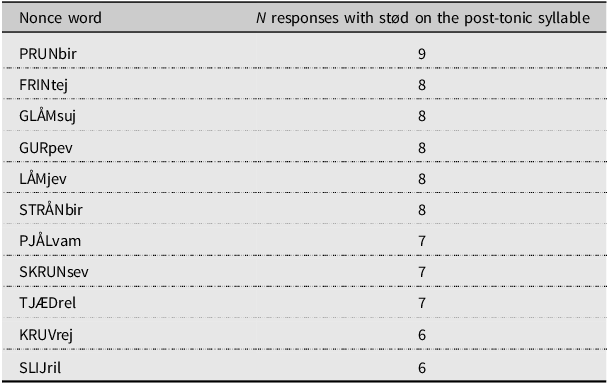
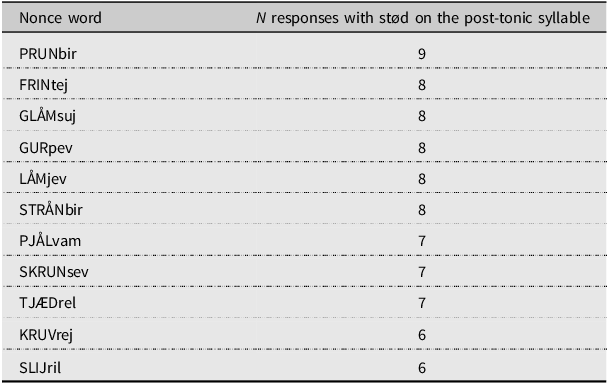
Another interesting observation with regard to post-tonic syllables is that some of the penult-NWs had many invalid responses due to stød on the post-tonic syllable. There was a clear primary stress on the first syllable, but it was not obvious if the post-tonic syllable had secondary stress. This means that these syllables might not fulfill the stress restriction of stød basis. The nonce words with six or more responses with stød on the post-tonic syllable are reported in Table 1.
Nonce words with six or more responses with stød on the post-tonic syllable. Max N = 9. For easier comparison, speaker 1 is excluded from these numbers, as they were in Figure 9
The existence of secondary stress as a phonological entity in Danish, when not being a reduced primary stress, is debated (e.g. Grønnum Reference Grønnum2005:249, Schachtenhaufen Reference Schachtenhaufen2022:121). But even when not taking a standpoint on whether these syllables have secondary stress, the question of why the speakers pronounce the post-tonic syllable with stød remains.
As an anonymous reviewer points out, stød in these syllables might be due to word-finality rather than post-tonicity. For example, none of the antepenult-NWs had stød on the post-tonic (penultimate) syllable. Another reviewer points out that these nonce words could have been interpreted as compounds. Generally, a monosyllabic member of a compound loses stød except when word-final (Grønnum et al. Reference Grønnum, Vazquez-Larruscaín and Basbøll2013:76, Goldshtein Reference Goldshtein2023:126). A hypothesis could also be that some segmental property of these post-tonic syllables favors stød. Further research is needed to better understand why these syllables were pronounced with stød.
4.3 Nonce words with stress on the antepenultimate syllable
For the antepenult-NWs, the result did not show a relationship between stress and stød. The antepenult-NWs were both pronounced with and without stød, with a tendency towards no stød. This goes against what is suggested by Basbøll (Reference Basbøll2005) in his Non-Stød Principle, as well as what is suggested by Goldshtein (Reference Goldshtein2023): stød does not seem to be the default for antepenultimate syllables with stress. Two possible explanations for this result will be discussed in the following.
One possible explanation is that there is too much noise in the data, which can obscure the real pattern. An anonymous reviewer points out that a source for noise (or variation in the data) could be that test subjects variably interpreted the trisyllabic stimuli as compounds, or even phrases. All responses with more than one stress were removed from the data, but some responses with a secondary stress on one of the following syllables might have been counted as valid responses, due to the difficulty in determining if a syllable has secondary stress. A more reliable way to test, or measure, if a nonce word is interpreted as a compound, independently of whether it is pronounced with stød, is needed to determine if this is the case.
The study also included fewer nonce words in this stress pattern group (64 compared to 112 ult-NWs and 160 penult-NWs). As a consequence of the many invalid responses, the dataset for this group contained only 139 valid responses (of 576 possible).Footnote 18 Generally, the high number of invalid datapoints for antepenult-NWs indicate that Danish speakers have a poor intuition for words with antepenultimate stress.
The low number of datapoints could be the reason why we do not see a relationship between stress on the antepenultimate syllable and stød. It makes the result more sensitive to random error (Bhandari Reference Bhandari2023), and, as Bod (Reference Bod, Bod, Hay and Jannedy2003:14) points out, ‘the relative frequency of an event converges to its true probability as the number of experiments increases’. This means that a higher number of datapoints would yield a more reliable result.
Interestingly, two of the speakers (speaker 7 and speaker 9) had more valid responses than the restFootnote 19 (47 respectively 53 of 64). These two speakers’ responses were close to half being with stød and half being without stød, which can be interpreted as a random production. According to Turcsan & Herment (Reference Turcsan, Herment, Mompean and Fouz-González2015), random production supports a lexical approach where speakers would have to guess when there is no lexical information. It could be hypothesized that the pattern we see for speaker 7 and speaker 9 reflects how speakers assign stød in antepenult-NWs, with a random distribution when there is no lexical information.
The other possible explanation for the result, then, is that there simply is no relationship between stress on the antepenultimate syllable and stød. The result can be interpreted as an indication that stød in words with antepenultimate stress is memorized, i.e. lexicalized, and not part of the phonological knowledge (see Kawahara Reference Kawahara2016). In the Danish vocabulary, most antepenultimate stressed words with stød basis have stød (91 with stød, 14 without, not counting proper names).Footnote 20 Based on the distribution in the vocabulary, it is reasonable to expect that stød is the default in words with antepenultimate stress.
However, another fact for words with antepenultimate stress is that there are few of them (133,Footnote 21 not counting proper names), they have low frequency,Footnote 22 and they are mostly borrowings (e.g. maraton [ˈmaːˀatsɒn] ‘marathon’, habitus [ˈhæːˀpitsus] ‘habitus’, and tunika [ˈtsuːˀnikʰæ] ‘tunic’).Footnote 23 Still, words do not have to be part of the native vocabulary to constitute a pattern in the lexicon, which can then be the basis for a grammatical principle (Coetzee Reference Coetzee2014). As Coetzee (Reference Coetzee2014:694) points out, ‘Not all patterns in the lexicon of some language necessarily become grammaticalized and influence language users’ linguistic performance.’ The lexical pattern with stød on antepenultimate syllables is evident in the Danish vocabulary, but this does not necessarily mean that the pattern results in a productive generalization.
Considering that antepenultimate stressed words make up a small and infrequent part of the vocabulary, it is reasonable to assume that it is easier to memorize them all instead of having a phonological rule for them. Also, the fact that the speakers often pronounced these nonce words with stress on another syllable than instructed, often the penultimate syllable, implies how unintuitive it is for Danish speakers to stress the antepenultimate syllable in a simplex form.
Given the low number of datapoints, however, it is problematic to draw any conclusions about the phonological status of stød on antepenultimate syllables, or the productivity thereof. Stød in antepenult-NWs should be investigated in a bigger dataset in order to obtain a more robust and reliable result. Nevertheless, the result gives cause to question whether stød is the default for antepenultimate syllables with stress. Rather, the impression is that there is no default for syllables with antepenultimate stress.
5. Conclusion
To conclude, this study has contributed empirical knowledge regarding the distribution of stød in monomorphemic words when there is no lexical information. The results show that, for ult-NWs, stød is the default. For penult-NWs, non-stød is the default, but other factors such as the structure of the post-tonic syllable might contribute to a pronunciation with stød.
Thus, the results show that the relationship between ultimate stress and stød, and penultimate stress and no stød replicates nonce words. However, this only shows that it is a productive pattern. It does not provide any information about how this is represented in the grammar. Assessing phonological representations, such as Goldshtein’s (Reference Goldshtein2023) foot-based OT analysis of stød, would be a natural next step for future research.
For antepenult-NWs, the distribution appears to be random rather than related to syllable count, which implies that stød is not the default in antepenultimate stressed syllables. It raises the question of how stød on antepenultimate stressed syllables should be treated in phonological theories of stød. Information about stød might be stored in the lexicon for words with stress on the antepenultimate syllable.
Supplementary material
To view supplementary material for this article, please visit https://doi.org/10.1017/S0332586524000155
Acknowledgements
I thank Carl Hedman for helping with the Python code for generating the nonce words, Christophe Zerakitsky Vies for coding a subset of the data for the inter-rater reliability test, Kirstine Boas for proofreading and commenting on the Danishness survey, and Yonatan Goldshtein for valuable comments and discussion. Lastly, I want to thank the three anonymous NJL reviewers for valuable comments.
Competing interests
The author declares none.




 Open access

