

Introduction
The Fountain of Health (FoH) is a Canadian initiative in applied “positive psychiatry,” a newer branch of psychiatry dedicated to the science of mental health and well-being as outlined in Dr. Dilip Jeste's seminal book Positive Psychiatry (Jeste and Palmer, Reference Jeste and Palmer2015). Founded in 2010 at Dalhousie University, FoH is a national non-profit organization to promote well-being across the lifespan. The FoH leadership team includes partners from academia, clinical medicine, and key organizations like the Canadian Mental Health Association, Canadian Coalition for Seniors Mental Health, and Canadian Medical Association. Funded through government sources and a Canadian Centre for Aging and Brain Health Innovation grant, FoH offers evidence-based knowledge transfer (KT) mechanisms (Malone et al., Reference Malone2002; Bosma et al., Reference Bosma, Cassidy, Le Clair, Helsdingen and Devichand2011) to engage clinicians and the public to adopt lifestyle changes that can delay and prevent disease. FoH aligns with national (e.g. Dudgeon, Reference Dudgeon2010; MacCourt et al., Reference MacCourt, Wilson and Tourigny-Rivard2011) and international guidelines urging mental health promotion in aging populations. The World Health Organization's (WHO) Global Age-Friendly Cities initiative (WHO, 2007) and Global Action Plan on the Public Health Response to dementia (WHO, 2017) emphasize a need for preventative approaches to dementia delay and prevention through lifestyle interventions.
FoH focuses on five evidence-based modifiable protective factors that promote mental well-being and resilience (Cassidy and Cassidy, Reference Cassidy, Cassidy, Fountoulakis and Javed2018): outlook on aging (Rasmussen et al., Reference Rasmussen, Scheier and Greenhouse2009), physical activity (Thorp et al., Reference Thorp2011), social connection (Gilmour, Reference Gilmour2012), cognitive activity (Jeste et al., Reference Jeste, Depp and Vahia2010), and mental healthcare (Jeste et al., Reference Jeste2013; Moreno-Peral et al., Reference Moreno-Peral2017). Positive attitudes on aging, for example, are associated with increased health behaviors even in the face of physical illness (Wurm et al., Reference Wurm, Thomasik and Tesch-Romer2010), and with improved health outcomes including longevity (Levy et al., Reference Levy, Slade, Kunkel and Kasl2002a, Reference Levy, Slade and Kasl2002b), while negative attitudes are associated with worse health outcomes and reduced longevity (Wurm et al., Reference Wurm, Warner, Ziegelmann, Wolff and Schüz2013). FoH resources, including educational videos, a speakers’ bureau, and self-guided educational tools and measures (e.g. healthy aging questionnaire and goal-setting) are accessible to both healthcare providers and general public online at www.fountainofhealth.ca.
Two distinct KT methods in FoH are those delivered by (1) frontline care clinicians to individual patients (Thoo et al., Reference Thoo, Freer and Cassidy2015) and by (2) lay leaders to participants in community-based groups (Gough and Cassidy, Reference Gough and Cassidy2017). Both FoH KT methods appear promising: Thoo et al. (Reference Thoo, Freer and Cassidy2015) reported highly significant differences in pre- and post-intervention scores of individual patients’ knowledge and application of FoH. Similarly, Gough and Cassidy (Reference Gough and Cassidy2017) found significant differences in pre- and post-scores on measures of knowledge and outlook, and confidence in goal-setting among participants in group settings. FoH publications to date are among the first in applied positive psychiatry interventions in older adults to demonstrate improvements in health behaviors and well-being measures.
The present study substantially contributes to positive psychiatry literature, as well as to KT literature. To our knowledge, the present study is the first in geriatric positive psychiatry to compare effectiveness of two KT methods (individualized vs. group) for mental wellness promotion. Meanwhile, KT literature across medicine on the impact of KT on clinicians’ translation into practice is lacking, and studies on KT impact on patient attitudes and behaviors are even more scarce. A review of KT resources within medicine demonstrated that only 20 (4%) of 492 resources identified were relevant to seniors’ mental health (Harris and Lusk, Reference Harris and Lusk2009).
The present study reports on the comparative effectiveness of two FoH interventions: (1) individual patients delivered by primary care clinicians and (2) community-based group participants delivered by lay leaders. The primary hypothesis was that individual and group-based KT interventions would both produce positive changes in patients’ pre- to post-intervention knowledge, attitudes toward aging, and goal-setting for health promotion. Secondary hypotheses were that (1) individualized attention and tracking between clinical visits would be relatively more effective for activating health-promoting goals and goal-attainment, and (2) community-based groups would be relatively more effective for improving participant attitudes toward aging and well-being.
Methods
In both individual and group-based FoH KT interventions, common outcomes of health knowledge, goal-setting, goal-attainment, and changes to health outlook scores were compared. The two KT interventions were delivered as follows.
Individual intervention
Primary care clinicians delivered FoH education to patients in the course of routine care. Clinicians were recruited through professional contacts of project team members, expression of interest on the FoH website, and at Continuing Medical Education events. With no exclusion criteria or specific number of clinicians targeted but aiming for a total of 60 patients, clinicians were asked to offer FoH education to 5–10 cognitively intact patients over age 50 years who might benefit from lifestyle counseling. In the context of this quality assurance research and protecting patient confidentiality, no patient demographics were gathered.
To standardize the individual intervention, the project manager trained clinicians to use FoH materials through an in-person instruction, a 13-min role-play video, and a “how-to” guide. The project manager supported clinicians throughout the process with check-ins by email or phone. Additional support materials (e.g. educational resources and clinical tools) were available to clinicians and patients on the FoH website. Feasibility of delivery in a primary care practice was a prime consideration in determining the intervention dose; the minimum contact required for clinicians to effectively introduce FoH content and support patients to set and meet health goals was selected. During the course of usual care, an initial 30-min appointment introduced the patient to FoH, established a baseline, and allowed for “S.M.A.R.T.” (i.e. specific, measurable, achievable, realistic, and time-limited) goal-setting (see Table 1). Two 10–15 min follow-up appointments were provided between one and three months’ time to assess goal-attainment in evidence-based domains of positive psychiatry and to reassess patient behaviors and outlook.
S.M.A.R.T. goal-setting worksheet used with pilot project participants

Group intervention
Lay leaders delivered FoH education in a six-week group series to participants in the community. Lay leaders were recruited through online- and paper-based advertisements in senior-serving agencies, clubs, and public libraries. Potential lay leaders were invited to contact the project coordinator by email or telephone to sign-up. Groups of 6–10 participants over age 50 years were recruited using the same approach as above, and no exclusion criteria were applied.
In an effort to standardize group content delivery, lay leaders received a half-day orientation from the project manager, all necessary materials (i.e. PowerPoint slides, facilitator guide, and relevant handouts), and were supported by the project manager throughout. Each group series consisted of six-weekly 1.5-h educational sessions. The dose selection of six 1.5-h sessions was pragmatic, allowing for one introductory session on FoH and S.M.A.R.T. goal-setting, five sessions on each of the five FoH topics (social, physical, cognitive activity, mental health self-care, and positive outlook), and sufficient time for both content delivery and group discussion.
Outcome measures
The main outcome measure in both KT interventions was a quality assurance self-report questionnaire assessing health knowledge, attitudes, and behaviors pre- and post-intervention (see Table 2). Goal-attainment was assessed using a Likert scale on degree of goal-attainment post-intervention. The Levy et al. (Reference Levy, Slade, Kunkel and Kasl2002a) self-perception of aging score used is based on the Attitudes Toward Own Aging subscale (Liang and Bollen, Reference Liang and Bollen1983), originally adapted from the Philadelphia Geriatric Center Morale Scale (Lawton, Reference Lawton1975). This five-item score provides a brief series of questions on self-perceptions of aging, and has been shown to correlate positively with increased longevity (Levy et al., Reference Levy, Slade, Kunkel and Kasl2002a; Table 3). The five items are summed to produce a total score out of five, with higher scores corresponding to more positive self-perceptions of aging.
Questionnaire for participants (select items)
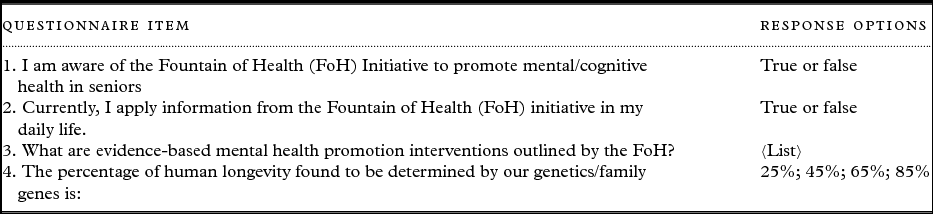
Note: Additional items were included in each of the individual and group formats; only those questions that were asked in both settings and demonstrated positive improvements are highlighted in this paper.
Questions on self-perceptions of aging (Levy et al., Reference Levy, Slade and Kasl2002b)
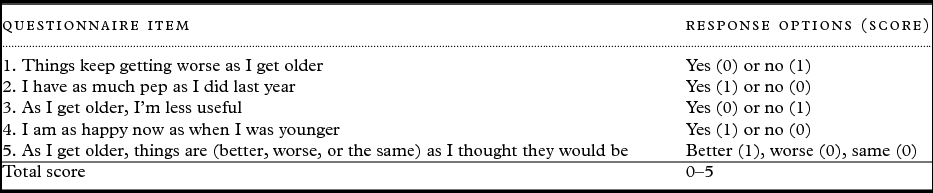
Note: For item 5, options “worse” or “same” were both scored as zero, to make the question a dichotomous variable. Participant scores ranged from 0 to 5, with 5 corresponding to more positive self-perception of aging. In Levy et al. (Reference Levy, Slade and Kasl2002b), scores 3.67 and above at baseline were linked with a median survival 7.5 years longer compared with scores below this level.
Ethics
The Research Ethics Board at Dalhousie University reviewed the FoH quality assurance methods for individual and group KT approaches, and approved the project as quality assurance research given that the clinical intervention was health promotion education and occurred in routine care, neither KT format involved control groups, and no identifying patient or participant information was collected.
Data analysis plan
Changes in pre- and post-intervention questionnaire responses were analyzed using a two by two mixed analysis of variance. The within-group factor was assessment period (pre-intervention and post-intervention) and the between-groups factor was setting type (individual and group). Due to varying degrees of missing data and participant attrition at follow-up, changes in each of the six questionnaire items were examined separately. Alpha was set to 0.05 for all analyses. In addition, partial eta-squared (η p2) effect sizes were also reported. Based on the effect size guidelines of Cohen (Reference Cohen1988), η p2 values of 0.01, 0.06, and 0.14 correspond to small, medium, and large effect sizes, respectively.
Results
Participants
A total of 92 participants received FoH KT. Five lay leaders delivered five community-based FoH group series, reaching 51 participants. Six primary care clinicians provided individual KT to 41 patients. In the group setting, the majority of participants were females in both pre- (N = 39; 76.5%) and post- (N = 20; 74.1%) surveys. Group participants ranged from age 50 to 100 years, with only one participant (age 46 years) outside the target age group. Within the setting of this quality assurance study, no specific demographic data were collected on patients.
Awareness of FoH
This analysis was performed with 42 participants with complete data (71% individual and 29% group). The main effect of assessment period was significant, F(1, 40) = 57.52, p < 0.001, η p2 = 0.590. Participants as a group had greater awareness of FoH in the post-intervention period (M = 0.94, SE = 0.04) compared to the pre-intervention period (M = 0.26, SE = 0.08). The main effect of setting was also significant, F(1, 40) = 5.96, p = 0.019, η p2 = 0.130. Overall, participants in the individual setting (M = 0.70, SE = 0.04) had greater degree of FoH awareness compared to the group setting participants (M = 0.50, SE = 0.07). No significant interaction effect was observed (p = 0.104).
Application of FoH
Analysis of FoH application was conducted with 36 participants with complete data (67% individual and 33% group). Only the main effect of assessment period was significant, F(1, 34) = 87.43, p < 0.001, η p2 = 0.720. Compared to the pre-intervention period (M = 0.25, SE = 0.08), participants had significantly greater levels of application of FoH in the post-intervention period (M = 1.00, SE = 0.00). No main effect of setting (p = 0.306) or interaction effect (p = 0.306) was found.
Goal-attainment
In total, 41 participants set 53 S.M.A.R.T. goals (some patients setting multiple goals). Of 53 goals, over half (n = 31; 58.5%) were completely reached (n = 20; 37.7%) or exceeded (n = 11; 20.8%). Broad categories of goals included physical activity, social activity, changing thoughts about aging, mental health self-care, and learning new things. The majority of goals set (n = 30; 56.6%) were about physical activity (e.g. walk for 20 min thrice weekly for one week and participate in yoga for 60 min twice weekly over two months).
Knowledge on evidence-based mental health promotion interventions
This analysis was performed with 30 participants with complete data (77% individual and 23% group). A main effect of assessment period was found, F(1, 28) = 35.64, p < 0.001, η p2 = 0.560. The group-based participants had greater knowledge of evidence-based mental health promotion interventions post-intervention (M = 3.18, SE = 0.32) compared to pre-intervention (M = 0.86, SE = 0.31). The main effect of setting was also significant, F(1, 28) = 7.78, p = 0.009, η p2 = 0.217. Independent of assessment period, participants in the group setting (M = 2.71, SE = 0.44) had greater overall knowledge relative to participants in the individual setting (M = 1.33, SE = 0.24). No significant interaction effect was observed (p = 0.178).
Knowledge on the epigenetics of aging
Knowledge of the epigenetics of aging was evaluated with 32 participants with complete data (84% individual and 16% group). Results indicated a main effect of assessment period, F(1, 30) = 40.88, p < 0.001, η p2 = 0.577, but no significant effect of setting (p = 0.871). However, this finding was outweighed by a significant interaction, F(1, 30) = 7.11, p = 0.012, η p2 = 0.191. Examination of the marginal means suggests that although knowledge increased among participants in the individual setting from pre-intervention (M = 1.67, SE = 0.19) to post-intervention (M = 2.41, SE = 0.15), participants in the group setting had greater gains in knowledge from pre-intervention (M = 1.20, SE = 0.44) to post-intervention (M = 3.00, SE = 0.35).
Self-perceptions of aging
This analysis was evaluated with 44 participants with complete data (73% individual; 27% group). Only the main effect of assessment period was significant, F(1, 42) = 9.82, p = 0.003, η p2 = 0.189. Self-perceptions of aging in the post-intervention period (M = 3.45, SE = 0.26) were greater relative to the pre-intervention period (M = 2.84, SE = 0.26). A marginal main effect of setting, F(1, 42) = 3.37, p = 0.074, η p2 = 0.074, suggesting greater self-perceptions in the group setting (M = 3.58, SE = 0.41) compared to the individual setting (M = 2.70, SE = 0.25). Likewise, a marginal interaction effect emerged, F(1, 42) = 4.03, p = 0.051, η p2 = 0.088, pointing to a potential increase in self-perceptions for the group setting participants (pre-intervention M = 3.08, SE = 0.44; post-intervention M = 4.08, SE = 0.44) but no such change in the individual setting participants (pre-intervention M = 2.59, SE = 0.27; post-intervention M = 2.81, SE = 0.27).
Confidence in goal-setting
Last, confidence in goal-setting was examined with 37 participants with complete data (81% individual; 19% group). Neither main effects of assessment period (p = 0.378) or setting (p = 0.440) nor interaction effects (p = 0.156) were observed.
Discussion
The present study on the effectiveness of FoH positive psychiatry KT found both individual and group-based formats to be effective. Significant improvements were found in participants’ self-reported: (1) awareness of FoH, (2) application of FoH information into daily life, (3) knowledge of FoH and evidence-based health promotion factors, (4) knowledge about epigenetic factors in longevity, (5) confidence in health behavior goal-setting, and (6) self-perceptions of aging. FoH is the first initiative in applied positive psychiatry to demonstrate improvements in measures of well-being in older adults. FoH utilizes key approaches for successful KT: a supportive environment; content that is practice-based, high quality, and relevant to recipients; and effective facilitation appropriate to recipients (Malone et al., Reference Malone2002; Bosma et al., Reference Bosma, Cassidy, Le Clair, Helsdingen and Devichand2011; Thoo et al., Reference Thoo, Freer and Cassidy2015). Present findings are consistent with the demonstration by Thoo et al. (Reference Thoo, Freer and Cassidy2015) of highly significant differences in individual patients’ knowledge and application of FoH in setting health goals as delivered by clinicians supported by a provincial KT network.
As hypothesized, differential and complementary benefits of two KT methods were found: individual KT delivered by a clinician resulted in enhanced goal-attainment, while attitudes were shifted more through peer-group interventions. For example, data on goal-achievement from the individual setting revealed that over half of patient goals were either completely reached or exceeded, suggesting effective KT to action in this setting. This finding is in accordance with prior reviews, suggesting that brief advice from a trusted care-provider significantly promotes health behavior change in patients (Stead et al., Reference Stead, Bergson and Lancaster2008). Of interest, response rates to the survey question on goal-attainment were lower in the group setting relative to the individual setting. Reasons for this are unclear but might reflect a lack of participant clarity about setting or meeting health goals, or insufficient individualized attention on or “diffused responsibility” for these tasks within a group context. Further investigation on goal-attainment in both individual and group formats is needed.
In keeping with the study hypothesis, self-perceptions of aging improved in both individual and group settings but reached marginal statistical significance in the group format. This finding is notable given the association between higher self-perceptions of aging scores and increased longevity (Levy et al., Reference Levy, Slade, Kunkel and Kasl2002a), and also because they suggest that self-perceptions of aging are modifiable using a relatively brief KT intervention delivered by laypersons in the community. Beyond individual-level benefits, improving self-perceptions of aging within communities is also consistent with the WHO's Global Age-Friendly Cities project (WHO, 2007), a strategy that aims to support psychosocial and physical health and improve quality of life in communities (Jeste et al., Reference Jeste2016; Gough and Cassidy, Reference Gough and Cassidy2017).
In terms of explaining the differential impacts of the two KT methods, the fact that self-perceptions of aging scores increased toward marginal significance in the group but not the individual setting may be attributable to therapeutic factors specific to groups such as universality, instillation of hope, and role modeling (Yalom and Leszcz, Reference Yalom and Leszcz2008). The group setting also offered a higher “dose” of KT sessions (i.e. weekly sessions for six weeks vs. the individual KT via two to three clinician visits over a few months), which might have been beneficial in shifting outlook on aging. Knowledge improvements were also greater in the group setting, which might be attributable to the peer-learning format as well increased time to absorb information. It will be important to see whether these findings can be replicated in future FoH KT studies using controlled design and larger sample sizes.
Of note, the feasibility of the two KT approaches differed both in terms of human resource and cost-efficiency: reaching patients individually in formal healthcare settings via healthcare professionals required more resources than does a community, group-based intervention provided by lay leaders. One approach is not necessarily ‘“better” than the other but rather synergistic to support behavior change in older adults. For example, patients might be introduced to FoH domains by their primary care clinicians, and then become inspired by peers in a community-based group to join a local gym.
There are clear limitations of these findings, as they are based on short-term self-reported quality assurance data with no control group. Regarding participants, selection bias exists in both contexts: at the individual level, participants were selected by clinicians based on potential benefit from health promotion education, and community group participants were self-selected volunteers. In the individual quality assurance intervention, patient demographics were not controlled for. In the group setting, there were generally lower response rates from pre- to post-KT intervention. Results were tracked by patients/group participants receiving the KT but not controlled for the individual clinicians and lay leaders delivering the KT.
To address these limitations in future studies, results would be strengthened in a randomized controlled design comparing the two interventions directly across multiple settings, and using objective outcome measures in addition to self-report. Future outcome measures could include quality of life, resilience, and objective behavior change. Additional control variables could include the following: demographic variables; age groups; participants’ characteristics, including overall health status; and characteristics of or variation in results by an individual KT facilitator. Longer follow-up would allow for assessment of sustained behavior change over time and related impact on longer term health outcomes. Future studies could explore reasons for lower response rates seen in the group setting, and/or modify interventions to improve efficiency and outcomes. For example, modifying groups to enhance accountability for goal-setting and attainment, or modifying individual interventions to involve more reflection opportunities to shift attitudes, could be explored. One FoH project currently underway to improve efficiency involves a shorter 10-min intervention in primary care settings, with promising preliminary results suggesting the potential for positive impacts from even briefer interventions in routine care. FoH is actively pursuing partnerships with several key national healthcare organizations to promote national KT of FoH and mental and physical health of Canada's seniors.
In the context of an aging world population and an international call to promote healthy aging, the positive psychiatry movement offers a shift in medicine from reactive pathology-focused treatment to inclusion of proactive health promotion in routine care. FoH offers tools for applied positive psychiatry using evidence-based techniques to promote mental wellness at the individual and community levels. The present analysis indicates that FoH tools promote positive health outlook and behavior and can be effectively delivered in both individual clinical care and community-based groups. FoH's pragmatic and efficient mental health promotion KT tools invite a culture shift across healthcare and community through inclusion of resilience and mental wellness promotion. This work is novel in assessing impacts of KT on health outlooks and behaviors and identifies many topics of interest for further exploration in the young body of research on KT applications for seniors’ mental health.
Conclusion
In conclusion, the current study found that FoH educational interventions produced significantly positive changes using evidence-based health promotion tools in both individual and community-group formats. The effectiveness of both KT approaches was significant, but it also revealed differential and complementary benefits.
FoH demonstrates promise for modifying psychosocial factors associated with healthy aging and improved longevity, including positive self-perceptions of aging and promoting health behavior activation. Additional research is needed to assess the potential for enhanced resilience and behavior change in a larger sample and across time and settings in order to more fully assess the impact of FoH in supporting positive aging, fostering mental wellness in later life and in delaying or preventing illness. All of the FoH information and resources are publically accessible through the website www.fountainofhealth.ca.
Conflict of interest
None.
Description of authors’ roles
Dr. A. Gough performed data analysis and contributed substantially to writing and produced the first draft of the paper. Dr. B. Cassidy, Dr. K. Rabheru, and Dr. D. Conn are the core members of the Fountain of Health national leadership team who contributed substantially to the writing and editing. Mr. D. D. Canales advised and assisted with the statistical methods, analyses, and reporting. Dr. K.-L. Cassidy, who is the founder of the Fountain of Health, conceptualized the study, supervised data analysis, and contributed substantially to writing and editing.
Acknowledgments
The Nova Scotia Department of Health and Wellness and Department of Seniors are acknowledged for their grants supporting the FoH's KT projects.



