


Introduction
Season-long weed interference can cause significant yield loss in rice (Smith Reference Smith1988). Red rice (Oryza sativa L.) is difficult to control due to herbicide resistance and can cause up to 82% yield loss as well as reductions in quality (Diarra et al. Reference Diarra, Smith and Talbert1985). In response to a lack of effective red rice control options, imidazolinone-resistant (IR) rice was released in 2002. After its release, IR rice increased to 68% of total rice hectares in Arkansas in 2011; since then, herbicide resistance has resulted in a reduction to < 50% of planted hectares in recent years (Hardke Reference Hardke2016; Hardke and Wilson Reference Hardke and Wilson2013).
Since the discovery of IR rice in 1993, injury has been observed in some cultivars following application of acetolactate synthase (ALS)–inhibiting herbicides (Croughan Reference Croughan1994; Levy et al. Reference Levy, Bond, Webster, Griffin, Zhang and Linscombe2006). Imazethapyr, an ALS-inhibiting herbicide labeled for use in IR rice, can cause crop injury following treatment, especially when applied to hybrid rice. Injury levels from 26% to 37% have been observed when imazethapyr was applied early POST at 70 g ai ha−1 to some cultivars (Levy et al. Reference Levy, Bond, Webster, Griffin, Zhang and Linscombe2006; Ottis et al. Reference Ottis, Chandler and McCauley2003; Webster and Masson Reference Webster and Masson2001). However, other cultivars and different application timings have resulted in < 12% injury. The inbred IR cultivar ‘CL121’ treated with imazethapyr at 70 g ha−1 at the one- to two-leaf stage had 37% injury 2 wk after treatment (WAT) and only 12% injury when treated at the three- to four-leaf stage. ‘CL161’, an inbred cultivar, had 6% and 5% injury when treated with imazethapyr at the one- to two-leaf and three- to four-leaf stages, respectively (Levy et al. Reference Levy, Bond, Webster, Griffin, Zhang and Linscombe2006).
Substantial differences in sensitivity to imazethapyr exist among cultivars. Cultivars developed from the PWC-16 IR germplasm are more resistant to imazethapyr than cultivars developed from the original IR germplasm of 93-AS-3510 (Levy et al. Reference Levy, Bond, Webster, Griffin, Zhang and Linscombe2006). Also with the development of hybrid IR rice cultivars, the level of resistance to imidazolinone herbicides appears to be less than that exhibited by inbred cultivars. The hybrid IR cultivars have only one copy of the resistance gene from the male parent (Anonymous 2008). Likewise, hybrid IR cultivars have a narrower application window for imazamox, another common herbicide used in IR rice (Anonymous 2016). Imazamox can be applied to inbred IR cultivars up to green ring (internode elongation) plus 14 d, whereas hybrid IR cultivars can only be treated with imazamox up to green ring—another indication of differences in sensitivity (Anonymous 2016).
Differences in tolerance to other ALS-inhibiting herbicides among rice cultivars exist. Since the introduction of bispyribac, rice injury, which can differ among cultivars, has been one of the major concerns with the use of this herbicide (Braverman and Jordan Reference Braverman and Jordan1996; Zhang et al. Reference Zhang, Webster and Leon2005). Zhang et al. (Reference Zhang, Webster and Leon2005) reported little to no injury in some cultivars and up to 33% injury in others following bispyribac applied to two- to three-leaf rice. Applications of bispyribac applied at 20 and 40 g ai ha−1 also resulted in decreased root and shoot growth in the cultivar ‘Bengal’ when applied at the two- to three-leaf growth stage. When applications were delayed until the three- to four-leaf growth stage there was no reduction in root or shoot weight compared to nontreated plants (Zhang and Webster Reference Zhang and Webster2002).
The combined use of insecticides and herbicides on crops has resulted in conflicting results in terms of crop injury. Rice tolerance to certain herbicides can be altered through the use of insecticides (Bowling and Hudgins Reference Bowling and Hudgins1966). Mixes of propanil with carbamate or organophosphate insecticides, known inhibitors of aryl acylamidase (the enzyme responsible for metabolizing propanil) can cause increased injury to rice (Frear and Still Reference Frear and Still1968). Later research in cotton (Gossypium hirsutum L.) showed the opposite effect of herbicide interactions with insecticides. Clomazone, an herbicide that can severely injure cotton, was found to be safe to the crop when used in conjunction with phorate or disulfoton insecticides in-furrow (York et al. Reference York, Jordan and Frans1991; York and Jordan Reference York and Jordan1992). A similar positive benefit of an insecticide seed treatment on safening rice against herbicide drift was recently observed (Scott et al. Reference Scott, Lorenz, Hardke, Davis and Dickson2014; Miller et al. Reference Miller, Scott, Lorenz, Hardke and Norsworthy2016). In this research, thiamethoxam reduced injury to rice from simulated drift rates of imazethapyr applied at the one- to three-leaf growth stage. Injury was reduced from 63% without the use of thiamethoxam to 6% with thiamethoxam 42 d after applying imazethapyr at 8.75 g ha−1 (Miller et al. Reference Miller, Scott, Lorenz, Hardke and Norsworthy2016).
Previous research indicates that injury to IR rice can occur from both labeled rates of imazethapyr and bispyribac, especially when applied from the one- to three-leaf growth stage (Braverman and Jordan Reference Braverman and Jordan1996; Zhang et al. Reference Zhang, Webster and Leon2005). Research also suggests that the use of insecticides with some herbicides could reduce herbicidal injury (Bowling and Hudgins Reference Bowling and Hudgins1966). Therefore, the objective of this research was to determine if an insecticide seed treatment (thiamethoxam) could reduce injury to inbred and hybrid rice caused by imazethapyr and bispyribac.
Materials and methods
Field experiments were conducted in 2014 and 2015 at the Rice Research and Extension Center (RREC) near Stuttgart, AR (34.27.888°N, 91.24.195°W), and the University of Arkansas Pine Bluff farm near Lonoke, AR (34.50.935°N, 91.52.943°W). Studies at Stuttgart were conducted on a Dewitt silt loam soil (Fine, smectitic, thermic Typic Albaqualfs), and studies at Lonoke were conducted on a Calhoun silt loam soil (Fine-silty, mixed, active, thermic Typic Glossaqualfs). Plot sizes at Stuttgart and Lonoke were 1.9 by 5.2 m and 1.9 by 7.6 m, respectively. Each plot contained 10 drill rows spaced 19 cm apart. Plots were fertilized according to the University of Arkansas recommendations for both locations (Hardke Reference Hardke2012). Plots were maintained weed free throughout the growing season using conventional rice herbicides. Clomazone (Command® 3 ME; FMC Corp., Philadelphia, PA) at 340 g ai ha−1 plus quinclorac (Facet® L; BASF Corp., Research Triangle Park, NC) at 280 g ai ha−1 were applied at planting at both locations. A POST application of fenoxaprop (Ricestar HT®; Bayer CropScience, Research Triangle Park, NC) at 123 g ai ha−1 plus halosulfuron (Permit®; Gowan Co., Yuma, AZ) at 40 g ai ha−1 was applied to control grasses and sedges at both locations. Additional POST herbicides applied in 2015 at the one-leaf growth stage to control broadleaf weeds were 2,4-D at 560 g ae ha−1 and saflufenacil at 18.5 g ai ha−1 at Stuttgart, and acifluorfen at 140 g ai ha−1 applied at the five- to six-leaf growth stage at Lonoke.
In each year at each location, the experimental design was a randomized complete block with a three-factor factorial treatment arrangement with four replications. The three factors were cultivar, herbicide program, and seed treatment. Rice cultivars were the inbred CL152 (84 kg ha−1) and the hybrid CLXL745 (28 kg ha−1). Herbicide programs consisted of two applications of imazethapyr (Newpath®; BASF Corp., Research Triangle Park, NC) at 105 g ha−1, two applications of bispyribac (Regiment; Valent USA Corp., Walnut Creek, CA) at 37.5 g ha−1, two applications of imazethapyr plus bispyribac (referred to as “combined treatment”) at the previously mentioned rates, and a nontreated check (referred to as “None”). Treatments containing bispyribac also included an oil-based adjuvant (Dyne-A-Pak; Helena Chemical Co., Collierville, TN) at 2.5% v/v; a separate nonionic surfactant (Induce; Helena Chemical Co., Collierville, TN) at 0.5% v/v was added to all imazethapyr-containing treatments. The first application was applied at the two- to three-leaf (V2 toV3) growth stage of rice, and the sequential application was applied at the five- to six-leaf (one- to two-tiller) growth stage (Counce et al. Reference Counce, Keisling and Mitchell2000). Seed treatments consisted of an insecticide seed treatment or no insecticide. All insecticide-treated seed contained thiamethoxam (Syngenta Crop Protection, Greensboro, NC) at 1.405 mg g−1 of seed (referred to as “treated seed”). All seeds, including the insecticide-treated seeds, were treated with the fungicides azoxystrobin (Syngenta Crop Protection, Greensboro, NC) at 0.071 mg g−1 of seed, mefenoxam (Syngenta Crop Protection, Greensboro, NC) at 0.088 mg g−1 of seed, and fludioxonil (Syngenta Crop Protection, Greensboro, NC) at 0.015 mg g−1 of seed. Dates for planting, herbicide treatments, and harvest are provided in Table 1.
Planting dates and herbicide application dates for ALS herbicide safening study
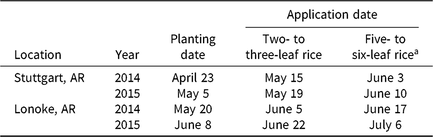
a Applied immediately prior to establishing the flood.
Herbicide programs were applied using a CO2-pressurized backpack sprayer calibrated to deliver 140 L ha−1 using a six-nozzle, 2.5-m spray boom, with AIXR 110015 (Teejet Technologies, Glendale Heights, IL) nozzles.
Visible estimates of injury were recorded 2 and 4 wk after the final herbicide application (WAFT) on a scale of 0 to 100% compared to the nontreated check for the same seed treatment and cultivar, with 0% being no injury and 100% being plant death. Rice groundcover was estimated using Sigma Scan Pro® (Systat Software, Inc., 501 Canal Blvd. Suite E, Point Richmond, CA) to determine the percentage of green pixels in photographs of each plot. Photographs of each plot were taken 3 WAFT using a 1.8-m monopod (Purcell Reference Purcell2000). Canopy height was also determined 3 WAFT for each treatment. Plots were harvested at maturity using a small-plot combine, and rough rice yields were recorded and adjusted to 12% moisture. Data on rice water weevil (Lissorhoptrus oryzophilus Kuschel) density were not collected in this study. However, previous research indicates that there was little insect pressure from rice water weevil, because no difference in yield was seen between plots treated with an insecticide and plots without an insecticide (Plummer et al. Reference Plummer, Lorenz, Taillon, Thrash, Fortner and Colwell2012).
All data were analyzed in JMP Pro 12 (SAS Institute Inc., Cary, NC) using the MIXED procedure. Site-year and replication nested within site-year were included in the model as random effects. Means were separated using Fisher’s protected LSD test at α = 0.05. P values from ANOVA for all evaluations are included in Table 2.
P values from ANOVA for all evaluations from the ALS herbicide safening study

a Abbreviation: WAFT, weeks after final treatment.
Results and discussion
Injury
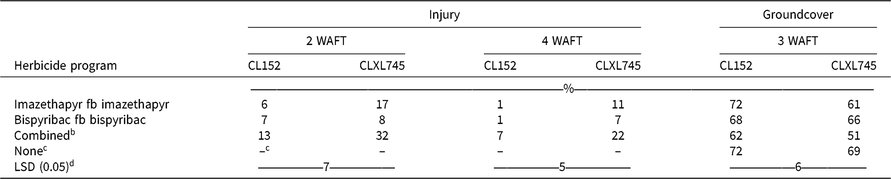
For both evaluations after final treatment, the two-way interaction of cultivar and herbicide program along with the main effect of seed treatment were significant for visible estimates of injury to rice. By 2 WAFT, injury symptoms began to occur in all plots receiving an herbicide treatment. Injury symptoms consisted of chlorosis around the leaf tips and margins. At 2 WAFT, injuries from the imazethapyr and bispyribac treatments were <10% for CL152 when averaged across seed treatments (Table 3). For CLXL745, only the bispyribac treatment caused <10% injury. Imazethapyr alone caused 17% injury 2 WAFT in CLXL745. With the combined treatment, injury increased to 32% for CLXL745. By 4 WAFT, rice plants had begun to recover from the herbicide applications; however, injury was still higher for the CLXL745 than for the CL152 cultivar.
Interaction of herbicide program and rice cultivar on visible estimates of injury 2 and 4 wk after final treatment (WAFT) and groundcover 3 WAFT, averaged across seed treatments and site-yearsa
a Abbreviation: fb, followed by.
b Imazethapyr plus bispyribac applied to two- to three-leaf rice and subsequently to five- to six-leaf rice.
c Injury data for the ‘None’ herbicide program was not included in the analysis 2 or 4 WAFT.
d Fisher’s protected LSD is for comparing means within injury ratings or groundcover.
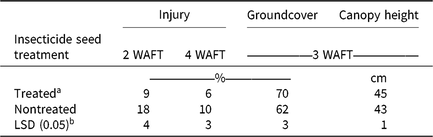
When averaged across cultivar and herbicide programs, seed treatment had an effect on rice injury. Rice injury for the treated seed was nearly half that of the nontreated seed at both 2 and 4 WAFT, evidence of the safening associated with the insecticide seed treatment (Table 4). Based on previous cytochrome P450 gene expression research with thiamethoxam in the Asian honey bee (Apis cerana cerana) (Ming et al. Reference Ming, Zhang, Feng, Xiaobo, Li and Baohua2016), it is speculated that safening of rice may be a result of upregulation of stress genes caused by the insecticide seed treatment, in turn resulting in a greater rate of metabolism of the ALS-inhibiting herbicides.
Main effect of seed treatment on visible estimates of rice injury 2 and 4 wk after final treatment (WAFT) along with groundcover and canopy height 3 WAFT, averaged across cultivar, herbicide program, and site-years
a The insecticide thiamethoxam was applied to ‘treated’ seed prior to planting.
b Fisher’s protected LSD is for comparing means within a column.
When considering only visible injury, CLXL745 was more prone to injury from imazethapyr alone and the combined treatment compared to CL152 (Table 3). Cultivar differences such as those seen here have also been noted previously for injury to rice in response to bispyribac (Braverman and Jordan Reference Braverman and Jordan1996; Zhang et al. Reference Zhang, Webster and Leon2005).
Canopy height
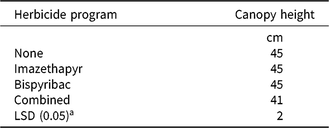
There were no interactions for canopy height, and only the main effects were significant. At 3 WAFT, canopy height, averaged over cultivars and herbicides, was 2 cm greater in plots with an insecticide seed treatment and followed the same trend as injury, with the treated plants being slightly healthier (Table 4). Additionally, when averaged over seed treatments and herbicides, CLXL745 was 45 cm tall at 3 WAFT whereas CL152 was only 43 cm tall (data not shown). These height differences between cultivars were expected, because previous research has shown that CLXL745 is 10 cm taller than CL152 at maturity (Sater et al. Reference Sater, Moldenhauer, Sha, Berger, Hardke, Scott, Wilson, Norman, Ahrent, Blocker, McCarty, Boyett, Frizzell, Bulloch, Kelsey, Belmer and Castaneda-Gonsalez2014). When herbicide programs were compared for effect on height, the imazethapyr alone and bispyribac alone treatments were equal to the “none” treatment (Table 5). However, the combined program of imazethapyr plus bispyribac did reduce canopy height by 4 cm.
Main effect of herbicide program on rice canopy height 3 wk after final treatment, averaged across cultivar, seed treatment, and site-years
a Fisher’s protected LSD is for comparing means within a column.
Groundcover
There was a significant two-way interaction between rice cultivar and herbicide program for groundcover at 3 WAFT (Table 3), which may have been due to the lower seeding rate of the hybrid compared to the inbred cultivar. Likewise, the main effect of seed treatment was significant (Table 3).
Rice groundcover 3 WAFT followed some of the same trends observed in rice injury. There was a reduction in groundcover of both imazethapyr-containing treatments applied to the hybrid cultivar, whereas the inbred cultivar had reduced groundcover only when treated twice with imazethapyr plus bispyribac (Table 3). This trial was conducted under weed-free conditions; however, in a commercial field it is possible that the delay in groundcover (i.e., canopy formation) caused by the ALS-inhibiting herbicides could contribute to greater opportunity for weed growth and interference with the rice crop, especially those weeds tolerant to the herbicides applied.
Additionally, plants from insecticide-treated seed showed more groundcover at 3 WAFT than nontreated seed (Table 4). There was an 8% increase in groundcover when an insecticide seed treatment was used, further evidence that the seed treatment resulted in a more robust rice plant. As noted earlier, rice water weevil populations were not determined in this research, but depending upon their presence and density during the four site-years, this improvement in crop growth may be partially a result of the insecticide, because all other factors would be comparable between treated and nontreated seed. In an adjacent but separate experiment at both locations each year, the insecticide seed treatment did reduce rice water weevil numbers (G. Lorenz, nonpublished data).
Yield
Neither the use of an insecticide seed treatment nor the use of differing herbicide programs had any effect on rough rice yield. The only significant main effect was rice cultivar, with the hybrid IR cultivar CLXL745 producing an average rough rice yield of 11,570 kg ha−1 and the inbred IR cultivar CL152 averaging 8,080 kg ha−1 (data not shown). Although injury was observed from the use of ALS-inhibiting herbicides on IR rice, the injury did not result in any yield loss as observed in other research (Ottis et al. Reference Ottis, O’Barr, McCauley and Chandler2004).
Practical implications
Growing a healthy rice crop is paramount to reducing weed interference and maximizing yield potential. Pest control (insects, diseases, and weeds) is vital to minimizing variability in crop yields among fields and across years. Troublesome weeds such as barnyardgrass [Echinochloa crus-galli (L.) Beauv.] and red rice lead many growers to choose to plant IR rice, enabling greater use of ALS-inhibiting herbicides (Masson et al. Reference Masson, Webster and Williams2001; Ottis et al. Reference Ottis, Chandler and McCauley2003, Reference Ottis, O’Barr, McCauley and Chandler2004). However, it should be noted that even then some ALS-inhibiting herbicides can still cause severe injury to the crop (Levy et al. Reference Levy, Bond, Webster, Griffin, Zhang and Linscombe2006; Ottis et al. Reference Ottis, Chandler and McCauley2003; Webster and Masson Reference Webster and Masson2001). Today, approximately 75% of Arkansas rice hectares are treated with an insecticide seed treatment—thiamethoxam being the most common (G. Lorenz, nonpublished data). Although insect control will remain one of the major reasons for applying an insecticide seed treatment, this research shows that use of thiamethoxam provided increased crop growth or less damage associated with multiple applications of ALS-inhibiting herbicides, especially in fields where hybrid rice is grown.
Author ORCIDs
Steven M. Martin https://orcid.org/0000-0002-6838-3808
Acknowledgments
Funding for this research was provided by the Arkansas Rice Promotion Board. No conflicts of interest have been declared for this research.


 Open access

