

Previous research has established that, in the United States, the political environment can shape the religious landscape. Specifically, a number of studies have shown, in various ways, that backlash to the Religious Right is partially—perhaps even primarily—responsible for the rise in religious non-affiliation within the U.S. population over the past three decades (Campbell et al., Reference Campbell, Layman, Green and Sumaktoyo2018; Campbell et al., Reference Campbell, Layman and Green2021; Djupe et al., Reference Djupe, Neiheisel and Conger2018; Hout and Fischer, Reference Hout and Fischer2002, Reference Hout and Fischer2014). This special issue has focused on various aspects of a religious–secular cleavage. In this case, religious backlash has deepened the religious–secularity political divide in the United States, as it demonstrates that, increasingly, people’s political views shape their religious identity (Margolis, Reference Margolis2022; Patrikios, Reference Patrikios2008, Reference Patrikios2013). While, in the United States, religion may have promoted civic cooperation in the past (Putnam and Campbell, Reference Putnam and Campbell2012; Wuthnow, Reference Wuthnow2021), today it is more likely to be a source of political conflict.
This article builds on that foundation, expanding the analysis of the backlash effect in multiple ways. First, it examines a different trigger for backlash. Rather than a negative reaction to the longstanding influence of the movement known as the Religious Right within the Republican Party, we focus specifically on the visibility of a virulent form of Christian nationalism during the January 6, 2021 insurrection at the U.S. Capitol. Second, it asks whether religious backlash is limited to Democrats or can also be experienced by Republicans. Third, in addition to religious backlash, this article tests whether the display of Christian nationalism on January 6th triggered a partisan backlash—leading some people to cease identifying with the Republican Party.
In brief, using a two-wave panel survey from 2017 to 2021, we find that January 6th led to a religious backlash, concentrated among Republicans, as manifested by a decline in their overall religious commitment. Furthermore, there was also a partisan backlash. People who associated January 6th with Christian nationalism became less favorable to Donald Trump specifically and Republicans generally, while some Republicans shed their partisan affiliation in favor of identifying as an Independent or even a Democrat.
Religious backlash and American politics
The concept of religious backlash dates to the seminal 2002 American Sociological Review article by Hout and Fischer, “Why More Americans Have No Religious Preference: Politics and Generations.” In that article, they sought to explain why the previous decade had seen a dramatic rise in the share of Americans who identify with a religious affiliation (the “Nones”). After considering and discarding a number of standard explanations—such as generational replacement and a changing family structure—they proposed what was, at the time, a novel reason for the “rise of the Nones.” Perhaps, they suggested, Americans were turning away from religion because they associated it with conservative politics. If religion meant conservatism, and the Republican Party specifically, then people who are not conservatives would turn away from religion. In other words, they experienced religious backlash. In the years since Hout and Fischer first introduced this concept, a number of studies have confirmed the backlash effect—with cross-sectional surveys (Djupe et al., Reference Djupe, Neiheisel and Conger2018), panel data (Campbell et al., Reference Campbell, Layman, Green and Sumaktoyo2018; Hout and Fischer, Reference Hout and Fischer2014; Patrikios, Reference Patrikios2008), survey experiments (Campbell et al., Reference Campbell, Layman and Green2021), and analysis of congregation-level exit (Djupe et al., Reference Djupe, Neiheisel and Sokhey2018).
With widespread acceptance of backlash to the Religious Right as an explanation for religious disaffiliation, other scholars have broadened the scope for understanding the many ways that religion and politics can affect one another. For example, Djupe et al. (Reference Djupe, Neiheisel and Sokhey2018b) suggest that backlash to the Religious Right can take different forms, including leaving one’s local congregation. Braunstein (Reference Braunstein2022) has theorized about other forms of religious backlash. She notes that the existing literature has generally started with the observation that religious non-affiliation has risen and then sought a cause—that is, scholars have focused on an explanation for a change in the dependent variable. But another way to think about backlash is to start with the independent variable, specifically the role of religion in partisan politics, and then ask what its potential effects might be. She “encourages religion scholars to connect the dots between trends that have not been fully understood as related to each other or to the radicalization of the Religious Right, deepening our understanding of the interactive and relational nature of religious change” (316). In the same spirit, Margolis (Reference Margolis2018) has shown that the political-religious environment in someone’s youth—the impressionable years—has a long-term effect on their religious identity over their life’s course. Still other research finds that while one response to the “religious brand” of the Republican Party is backlash among Democrats, another is a greater embrace of religiosity among Republicans (Patrikios, Reference Patrikios2008). The through line in all of this literature is the fundamental finding that political preferences can and often do drive religious orientations. In the words of Margolis:
The standard narrative, both in political science and in the popular press, is that religion shapes how citizens engage in politics. Deep-seated religious beliefs about morality and salvation drive citizens’ party loyalties and opinions of candidates. New research, however, turns this narrative on its head. It finds that while religion does affect politics, politics—including partisanship and ideology—also exerts influence over how people engage with religion. (Reference Margolis2022, 261)
Most of the extant research on the interplay between politics and religion in the United States has focused on reactions to the Religious Right. Recent years have seen parts of the Religious Right evolve into Christian nationalism, a movement that views America as having a uniquely Christian identity and purpose and that combines fervent patriotism with a traditionalist perspective on Christianity. Among social scientists there is a robust and rapidly growing literature on both the measurement and consequences of Christian nationalism.Footnote 1 However it is measured, Christian nationalist attitudes have been shown to correlate with a variety of outcomes, including lower support for democratic norms and an endorsement of blind patriotism (Djupe et al., Reference Djupe, Lewis and Sokhey2023a; Gorski and Perry, Reference Gorski and Perry2022; McDaniel et al., Reference McDaniel, Nooruddin and Shortle2022). Related research has examined the link between Christian nationalism and support for Donald Trump (Baker et al., Reference Baker, Perry and Whitehead2020; Stroope et al., Reference Stroope, Froese, Rackin and Delehanty2021), a race-centered vision of American national identity (Perry et al., Reference Perry, McElroy, Schnabel and Grubbs2022, Reference Perry, Schleifer, Whitehead and Frantz40), and diminished support for civil liberties (Dahab and Omori, Reference Dahab and Omori2019; Perry and Grubbs, Reference Perry and Grubbs2025). Many scholars have raised the alarm about the danger posed by Christian nationalism. As just one case of many, Gorski and Perry (Reference Gorski and Perry2022, 8) argue that “white Christian nationalism has become a serious threat to American democracy, perhaps the most serious threat it now faces.” Nor is the concern over the negative relationship between Christian nationalism and lower support for democratic values limited to scholars, as public discourse also includes warnings about the threats posed by Christian nationalism. As an illustrative example, in a column reflecting on January 6th, 2021, Jeffrey Salkin of the Religion News Service writes that Christian nationalism poses a “threat to America, to Jews and other religious minorities, and to Christianity itself.”Footnote 2
Given the heightened salience of and concern over Christian nationalism, this article focuses on the potential backlash to the event that, for many Americans, made Christian nationalism especially salient: the insurrection at the U.S. Capitol on January 6, 2021. The mob was rife with Christian imagery, including crosses and pictures of Christ, while many insurrectionists held signs with slogans like “Jesus is my Savior, Trump is my President” or with Bible verses. Some of the rioters who invaded the Capitol building itself offered Christian prayers (Dias and Graham, Reference Dias and Graham2021). Anyone watching the events unfold live and/or saw news coverage following the attack was very likely to have seen the most sacred iconography of Christianity employed to express a malicious form of nationalism, not to mention the defense of violence that caused the death of five people on January 6th and injuries to many more (Healy, Reference Healy2021).
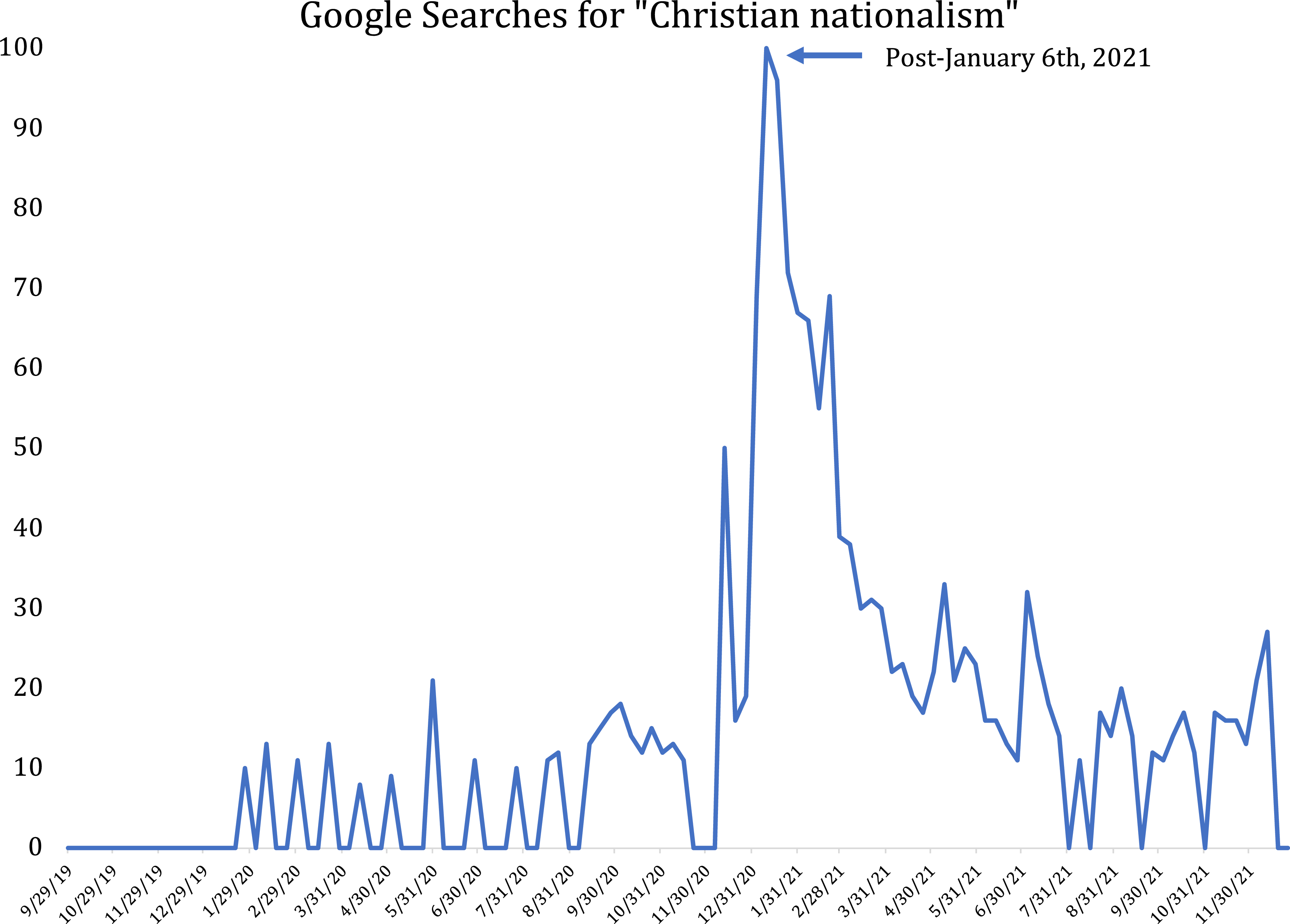
As evidence that January 6th drew heightened attention to Christian nationalism, Figure 1 displays the Google Trends for searches that include “Christian nationalism” from September 29, 2019 to December 19, 2021. While there are fluctuations over this period, notice the spike in the immediate wake of the January 6th attack on the Capitol.
According to the Google Trends website: Numbers represent search interest relative to the highest point on the chart for the given region and time. A value of 100 is the peak popularity for the term. A value of 50 means that the term is half as popular. A score of 0 means there was not enough data for this term.

While politicians, pundits, activists, and clergy associated with the Religious Right may espouse many of the same views expressed by members of the January 6th mob, there is a qualitative difference between the Religious Right activism of the past and the Christian nationalism on display at the insurrection. Previously, the Religious Right movement was engaged in conventional politics—running candidates, giving speeches, engaging in debates, broadcasting ads, and organizing peaceful rallies (Layman, Reference Layman2001; Wilcox and Robinson, Reference Wilcox and Robinson2010). January 6th was something different. At the risk of understatement, it was highly unconventional. Here was a violent attack on the Capitol, meant to prevent the peaceful transfer of power, instigated by the sitting president—all broadcast to the world in real time. If the relatively staid politicking of the Religious Right was enough to trigger a backlash, it seems plausible—even likely—that the Christian nationalism of January 6th would do likewise, perhaps to an even greater degree.
It seems reasonable to expect January 6th to trigger a backlash, but that nonetheless leaves the question of what form the backlash should take. The existing literature suggests that it could lead to religious disaffiliation, particularly among Democrats. On the other hand, it is also possible that the process of disaffiliation through backlash has run its course. Perhaps those Democrats and political liberals who are turned off from religion because of its partisan connotations have already shed their affiliation. Meanwhile, those liberals and Democrats who have already reconciled their own religious identity with its Republican overtones may no longer be moved by current events.
If backlash is broadened to include both other reactions and other people, there are further possibilities. Instead of the binary distinction between having or not having a religious affiliation, it could also be that people reacted to the Christian nationalism of January 6th with decreased religious commitment, such as reporting less personal guidance from religion, less frequent religious attendance, and a weakened belief in God. In other words, instead of a phase change in religious identity, there could be movement along a spectrum of religious commitment.Footnote 3
Social scientists who study religion often employ a framework known as the “three Bs:” belonging, behaving, and believing (Kellstedt et al., Reference Kellstedt, Green, Guth, Smidt, Green, Guth, Smidt and Kellstedt1996; Smidt et al., Reference Smidt, Kellstedt and Guth2009; Steensland et al., Reference Steensland, Park, Regnerus, Robinson, Wilcox and Woodberry2000). Drawing on that literature suggests that religious backlash can be extended beyond belonging to potentially include behavior and beliefs. It is also possible that any backlash is not limited to Democrats. Although Republican identifiers have softened in their negative reactions to January 6th in the years since the insurrection, most Republicans strongly disapproved in the days and weeks immediately following the attack (Salvanto, Reference Salvanto2024); the second wave of our panel survey was conducted early in 2021. Some Republicans may have been distressed enough by the violent expression of religious extremism within their own partisan base for their own religious commitments to grow weaker. While Republicans may not have gone so far as to stop identifying with a religion, they may nonetheless have expressed greater ambivalence about their own degree of religious commitment. Specifically, we hypothesize that some Republicans became less religious as a reaction to the Christian nationalist imagery associated with the January 6th riot. The same may have been true for Independents. As an analog to our study, Djupe et al. (Reference Djupe, Neiheisel and Sokhey2018b) have found that some churchgoers—including Republicans—leave their congregation because of backlash to their perception of their co-parishioners’ support for the Religious Right.
Unexplored to this point is the possibility of a different form of backlash—partisan rather than religious. Instead of shedding a religious identity, perhaps some people react to the mixture of religion and partisanship by changing their party. To understand how this might be the case, consider the theoretical mechanism underpinning religious backlash. Campbell et al. (Reference Campbell, Layman and Green2021) draw on classic cognitive dissonance theory to explain why Democrats disclaim a religious affiliation when religion is associated with the Republican Party. When faced with the dissonance between their partisan and religious identification, some resolve the dissonance in favor of their party—they cease identifying with a religion. Other people, however, may resolve the dissonance by changing their partisan identity. In this case, some Republican identifiers may have found the violent display of Christian nationalism on January 6th, 2021, to be sufficiently appalling to cease thinking of themselves as Republicans. Even more Republicans may have weakened their identification with the party and their support for its leaders.
Partisan backlash is, of course, not a given. Decades of research have portrayed party identification as a highly stable characteristic that is largely immune to short-term political influences (Campbell et al., Reference Campbell, Converse, Miller and Stokes1960; Green and Platzman, Reference Green and Platzman2024; Green et al., Reference Green, Palmquist and Schickler2002). Numerous explanations for that have been offered. Party identification’s original conceptualization described it as a deep-seated psychological orientation, akin to religion (Campbell et al., Reference Campbell, Converse, Miller and Stokes1960). More recent renderings contend that partisanship is based in social identity—in perceptions of the groups that comprise the two parties’ coalitions and identification with and feelings about those groups (Green et al., Reference Green, Palmquist and Schickler2002; Kane et al., Reference Kane, Mason and Wronski2021; Miller et al., Reference Miller, Wlezien and Hildreth1991)—or is perhaps a social identity itself (Greene, Reference Greene2004; Huddy et al., Reference Huddy, Mason and Aarøe2015). And like other deep-seated group attachments and identities, partisan social identity is largely resistant to change. Finally, attitudinal perspectives view party identification as a strong, highly crystallized predisposition that is more likely to shape than to be shaped by less-crystallized attitudes about policy issues or political events (Goren and Chapp, Reference Goren and Chapp2017; Tesler, Reference Tesler2015).
These reasons for party identification’s stability, however, suggest circumstances in which it might change. One is when party identification is confronted by attitudes that are nearly as “strong” or crystallized—based in early-life socialization, core values, or key components of social identity—as it is. Recent work has focused on views about abortion and other “culture wars” issues as being the sort of strong, crystallized attitudes that have the potential to shape partisanship and other key political predispositions (Goren and Chapp, Reference Goren and Chapp2017, Reference Goren and Chapp2024; Achen and Bartels, Reference Achen and Bartels2016). This research finds that, under some conditions, individuals change their party loyalties to match their attitudes on culture war issues (Achen and Bartels, Reference Achen and Bartels2016; Erikson, Reference Erikson2024; Goren and Chapp, Reference Goren and Chapp2024).
Another circumstance is when individuals’ perceptions of the social group composition of the parties’ coalitions change. If party identification is based in the connection of individuals’ own social identities to their understanding of the social group profile of the parties, then a change in that understanding may also lead to a change in partisanship (Green et al., Reference Green, Palmquist and Schickler2002).
These conditions for partisan change may help us understand the degree to which the mixture of religion and partisan politics produces partisan backlash. The Religious Right and its connection to the Republican Party are, of course, associated with the culture war issues that have produced strong, crystallized attitudes for many Americans—and these attitudes have spurred changes in partisanship for many citizens. However, abortion and most other culture war issues have had a long run on America’s political stage. Most instances of individuals altering their party ties to fit with their culture war attitudes have probably already occurred. Relatedly, the Religious Right and its constituency of evangelicals and other conservative Christians have been an integral part of the Republican Party’s coalition for at least a generation. Political reminders of the Republican partnership with the Religious Right should not alter many citizens’ perceptions of the social group composition of the Republican coalition, and thus should not have much effect on party identification. In short, perceptions about Religious Right influence on the GOP may have produced partisan movement for many Americans, but that movement should have been greater in the past than it is today.
The same is not necessarily true for Christian nationalism and its manifestation in the January 6th insurrection. For many Americans, views about democratic elections, political violence, and the peaceful transfer of power may be based in early-life socialization and core identities, potentially making them strong, crystallized attitudes that could exert pressure on party loyalties if they come into conflict—as they may have for many Republicans after January 6th. Moreover, many people potentially perceive the emerging influence of Christian nationalism and its adherents within the Republican Party as an important alteration to the social composition of the Republican coalition. That perceived change could loosen the connection that some Republican identifiers see between their own social identity and the party, perhaps weakening their Republican ties. On the other hand, it is possible that many Republicans saw January 6th as a legitimate protest and its religious imagery as consistent with past Religious Right activity within the party. In that case, there would be little change in individuals’ perceptions of the social profile of the GOP and thus little change in Republican identification.
Hypotheses
Given that previous research has found that a negative reaction to the Religious Right has fueled the turn away from religious affiliation primarily among Democrats, we hypothesize that the perception of Religious Right influence on the Republican Party will lead to a higher rate of religious non-affiliation among Democrats.
We also hypothesize that recall of Christian nationalist imagery on January 6th will lead to lower religious commitment among Democrats, Independents, and Republicans.
In addition to religious backlash, we further hypothesize that January 6th Christian nationalism will lead to two forms of partisan backlash.
-
a. A general partisan backlash, as evidenced by a lower regard for Donald Trump in particular and Republicans in general among all respondents (that is, including Democrats and Independents).
-
b. A specific partisan backlash among Republicans as they shed their GOP identity.
Data and analysis
Determining whether January 6th triggered either religious or partisan backlash requires data collected before and after the events of that day. The analysis thus employs the Secular America Panel Study, a two-wave panel survey administered by the research firm YouGov, with interviews conducted online in the spring of 2017 and spring of 2021. The 2017 survey had a total N of 3,000 cases; the 2021 follow-up wave has 1,008, for a reinterview rate of 34 percent. Analysis of panel attrition indicates that the second wave is demographically similar to the first, although any discrepancies are accounted for with the use of a weight variable to ensure that wave 2 closely resembles wave 1, which in turn reflects the national population. See the Supplementary Information for details on panel attrition.
We measure religious non-affiliation with a standard religious identity question. Anyone who selects that they have no religious affiliation is coded as 1; everyone else is coded as zero. We operationalize religious commitment with an index that includes frequency of religious attendance, religious guidance, frequency of reading the Bible, frequency of prayer, and strength of belief in God. As expected, these items correlate highly with one another, as they have a Cronbach’s alpha of .89 (as measured in the 2021 wave). The scale has been coded so that a higher value means greater religiosity. Thus, in the models we display, a negative coefficient means that variable predicts a turn away from religiosity.Footnote 4
To measure perceptions of Christian nationalism on January 6th, we construct an index of three items asked in the 2021 wave of the survey. Respondents were presented with the following three statements “about the riot that occurred at the U.S. Capitol on January 6, 2021,” to which they responded with a five-point Likert scale ranging from strongly disagree to strongly agree. “Neither agree nor disagree” is the midpoint.
-
• Many of the rioters carried Christian religious symbols, like crosses.
-
• Many rioters believed they were following God’s will.
-
• Many rioters believed white Christians should have a privileged role in American society.
Importantly, these statements are phrased neutrally, as respondents were not asked whether they personally agree with the rioters, nor whether they hold any Christian nationalist views themselves. Rather, these questions ask about their perception of January 6th. These items are combined into the January 6 th Index (Cronbach’s alpha of .73). A higher score means more agreement with the statements, and thus a greater perception of Christian nationalism at the insurrection.
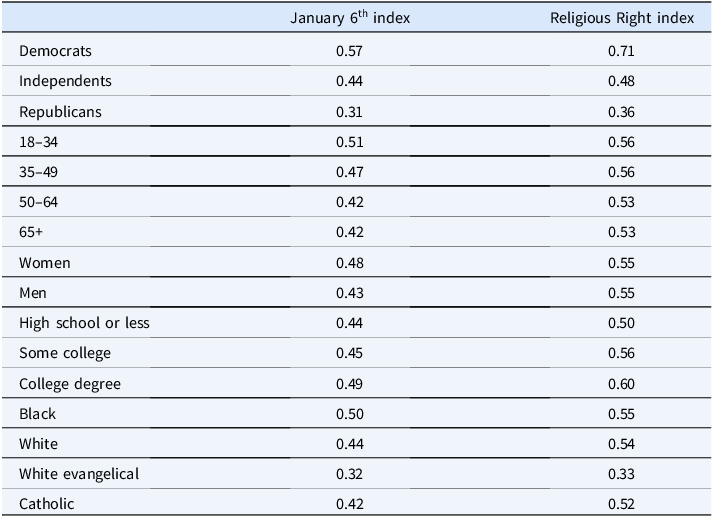
The fact that this is a measure of perception and not a normative judgment leaves open the possibility that people who recall the religious imagery on January 6th were untroubled by it. That is undoubtedly true for some people, but other evidence suggests that the perception of Christian nationalism during the Capitol riot is generally viewed negatively. For example, Table 1 displays the mean score on the January 6 th Index for people in a variety of demographic categories (recall that the index is coded 0–1). Across party identification, age, gender, education, race, and religious affiliation, the group with the highest score—most likely to recall Christian nationalism on display—are Democrats. Likewise, the difference between Republicans (0.31) and Democrats (0.57) is greater than the gap between any other demographic groups (Independents are in the middle at 0.41). It stands to reason that Democrats are not only more likely to recall the religious displays on January 6th than Republicans and Independents, but that they are more inclined to condemn them. On the other hand, the Republicans’ mean score of 0.31 indicates that some within the GOP perceived the Christian nationalism on January 6th. It seems plausible that a subset of those Republicans were upset by what they saw.
Descriptive statistics, January 6th and religiosity indices

Table 1. Long description
A table with two columns and sixteen rows. The columns are labeled January 6th index and Religious right index. The rows are labeled with different demographic groups: Democrats, Independents, Republicans, age groups 18-34, 35-49, 50-64, 65+, gender groups Women and Men, education levels High school or less, Some college, College degree, and racial and religious groups Black, White, White evangelical, and Catholic. Each row contains numerical values representing the indices for each demographic group. Notable trends include Democrats having the highest January 6th index and Religious right index, while Republicans have the lowest January 6th index. The indices vary across different age groups, genders, education levels, and racial and religious affiliations.
Each index is coded 0–1.
To measure attitudes about Religious Right influence on the Republican Party, we draw on two questions asked in the 2017 wave of the survey. Respondents were given the following statements and asked to respond using a five-point Likert scale.
-
• Republican Party leaders spend too much time talking about their religious beliefs.
-
• Religious conservatives have too much control over the Republican Party.
While both statements are about religion and the GOP, the first centers on party officials while the second is about activists, thus covering both the leadership and grassroots. Together they form the Religious Right Index (Cronbach’s alpha = .89), coded so that a higher value means a greater perception of Religious Right influence on the Republican Party.
The Religious Right Index is measured in 2017, which has the advantage of avoiding reverse causation. Clearly, a decline in religiosity (or any other change) measured in 2021 could not have caused attitudes in 2017. Why, though, would attitudes about the Religious Right measured in 2017 lead to a decline in religiosity in 2021? Our theoretical assumption is that people who perceive the influence of the Religious Right in the Republican Party are experiencing an erosion of their religious commitment that may have begun prior to 2017 and could continue past 2021. The two waves of the survey capture respondents’ religiosity in the midst of a process that is unfolding over a longer span of time. The effect of January 6th, however, is different. We obviously could not have asked about events in January of 2021 in 2017. And while it is theoretically possible for a decrease in religiosity or change in party identification to affect a person’s perception of January 6th, our results suggest that this is unlikely. As we will see, Republicans—not Democrats—experience both religious and partisan backlash. And it is Republicans who are the least likely to perceive the presence of Christian nationalism during the insurrection. If the causal arrow were reversed and a change in religiosity and/or partisanship explains a person’s perception of January 6th, we would expect to see the biggest effect on the partisan group most likely to associate January 6th with Christian nationalism—that is, Democrats, not Republicans.
To include both the January 6 th Index and Religious Right Index in a single equation requires that they not be highly correlated, or else the model will suffer from multicollinearity. Are they merely two ways to measure the same thing? They have a correlation of 0.56 (p < .001), which is relatively high but nonetheless far from a perfect relationship. By way of comparison, this is lower than the correlation in the same survey between party identification and ideology (0.61). Furthermore, as detailed in the Supplementary Information principal factor analysis shows that the items in each index load most strongly on two separate factors. Thus, while they are related to one another, the two indices are distinct enough that they are not capturing the same attitudes. The fact that they have a relatively strong correlation with each other only raises the bar for finding an effect for either one. That is, if we find evidence of backlash from the January 6 th Index, we can be confident that it is not conflated with the respondents’ preexisting attitudes about the Religious Right’s influence within the Republican Party. Nor do we need to worry that having both the Religious Right Index and the January 6 th Index in the same model produces misleading results because of a “suppression effect” (Djupe et al., Reference Djupe, Friesen, Lewis, Sokhey, Neiheisel, Broeren and Burge2025). The results for both are substantively the same whether the other is included or not.
To test for religious backlash, we estimate either a logit or ordinary least squares regression model in which Religious Non-affiliation (logit) or Religiosity (OLS) is the dependent variable, measured in 2021, while also controlling for Religious Non-affiliation or Religiosity in 2017 measured in precisely the same way (lagged dependent variable). The other coefficients, therefore, reflect the impact of that variable on Non-affiliation/Religiosity in 2021, relative to the level in 2017. For Non-affiliation, a negative/positive coefficient means that, controlling for Non-affiliation in 2017, the variable predicts a higher/lower probability of not identifying with a religion in 2021. For Religiosity, a negative/positive coefficient means that—again, controlling for baseline Religiosity in 2017—a variable predicts a lower/higher level of religious commitment in 2021. The key independent variables are the Religious Right Index and January 6 th Index. The model also includes other demographic control variables: age, gender (female), race (Black), evangelical and Catholic religious affiliation, as well as dummy variables for partisanship (Republican and Independent, with Democrat as the omitted category).Footnote 5 All variables, both independent and dependent, are coded on a 0-to-1 scale, enabling the comparison of their magnitudes.
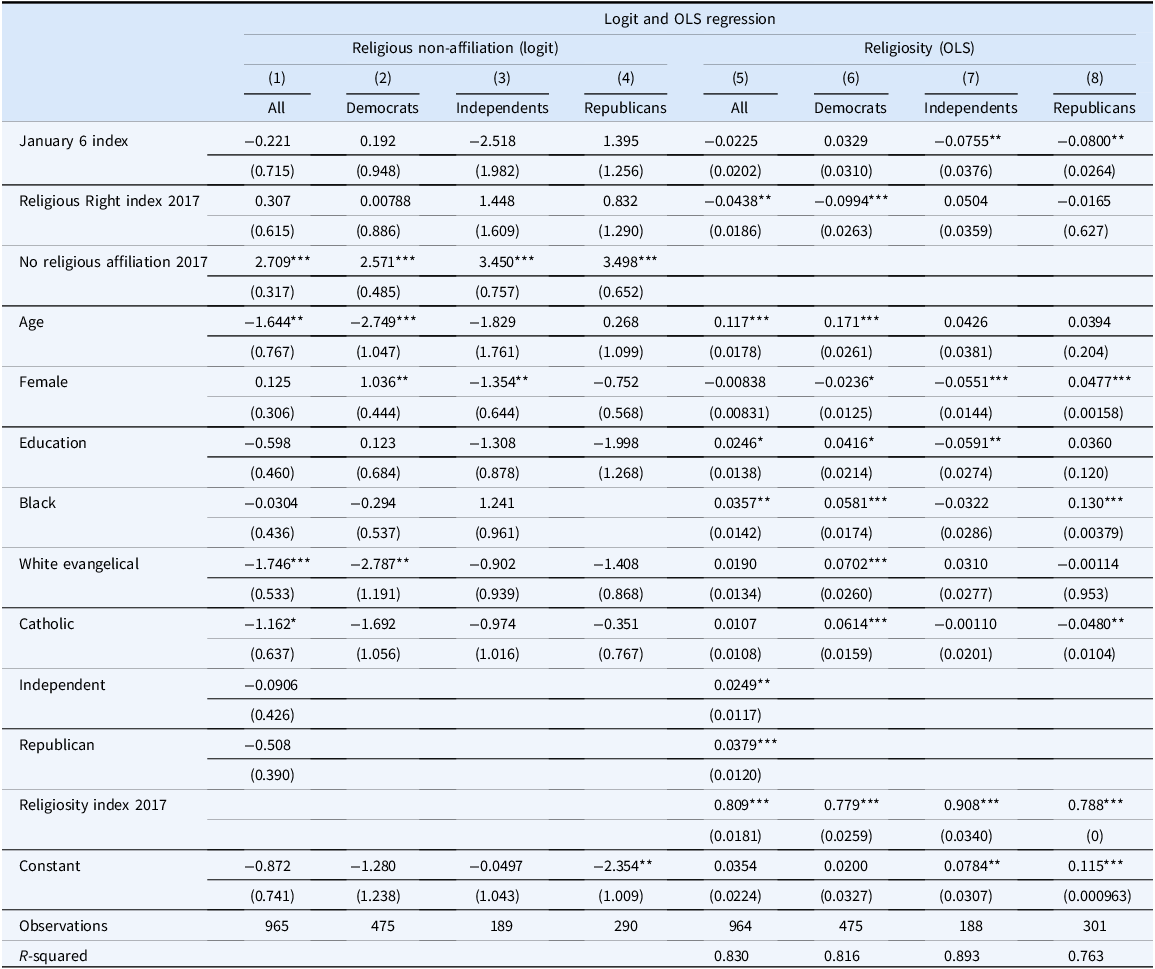
Columns 1–4 of Table 2 display the effects on Religious Non-affiliation for all respondents (column 1) and then Democrats, Independents, and Republicans respectively (columns 2–4). Across the board, neither the January 6 th nor Religious Right indices have a relationship with religious non-affiliation. This finding is in contrast to the aforementioned work on backlash to the Religious Right and suggests that—at least between 2017 and 2021—the departure from a religious affiliation because of a negative reaction to the Religious Right’s association with the Republican Party has run its course. In short, we do not find evidence for our first hypothesis.
Religious non-affiliation and religiosity in 2021

Table 2. Long description
The table presents data on religious non-affiliation and religiosity for the year 2021, segmented by political affiliations: All, Democrats, Independents, and Republicans. It includes two main sections: Religious non-affiliation (logit) and Religiosity (OLS). Each section has multiple columns corresponding to different political groups. The table has 18 rows and 8 columns. Row 1: January 6 index, Row 2: Religious right index 2017, Row 3: No religious affiliation 2017, Row 4: Age, Row 5: Female, Row 6: Education, Row 7: Black, Row 8: White evangelical, Row 9: Catholic, Row 10: Independent, Row 11: Republican, Row 12: Religiosity index 2017, Row 13: Constant, Row 14: Observations, Row 15: R-squared. Each row contains values for the respective variables across the different political groups.
Standard errors in parentheses.
***p < .01, **p < .05, *p < .1.
The story is different, however, for Religiosity (columns 5–8). The overall results in column 5 indicate that both the January 6 th and Religious Right indices have a negative relationship with Religiosity—evidence of religious backlash. However, only the Religious Right Index is statistically significant (p < .05). If left here, this would suggest that Christian nationalism, as manifested on January 6th, does not engender any more backlash than negative reaction to the Religious Right’s association with the Republican Party. Recall, however, that the original religious backlash hypothesis is that Democrats specifically will turn away from religion because of its partisan association. What happens when instead of controlling for party identification, we estimate separate models for Democrats, Independents, and Republicans? Those results are displayed in columns 6–8 of Table 2. The first thing to note is that negative perceptions of the Religious Right lead Democrats to weaker religious commitment (negative coefficient for the Religious Right Index, p < .01).
Also, as expected, the Religious Right Index has no impact on religiosity for Republicans. The results further show that Independents resemble Republicans, as perceptions of the Religious Right also have no effect on their religiosity. Our second hypothesis is confirmed, and, in so doing, we find support for a form of religious backlash.Footnote 6
What, though, about the perception of Christian nationalism on January 6th? While the January 6 th Index does not have a significant relationship with Religiosity for the population as a whole, it does among Republicans. As we hypothesized, Republicans reacted to the Christian imagery on display at the Capitol insurrection with weakened religious commitment. Interestingly, Independents once more mimic Republicans, as perceptions of Christian nationalism on January 6th also correspond to a decrease in their religiosity. In other words, January 6th elicited religious backlash from both Republicans and Independents.
Contrary to our hypothesis, we do not see a significant coefficient for the January 6 th Index among Democrats, meaning that the religious symbols associated with the insurrection do not engender backlash. Although we do not have an explanation for the absence of an effect for January 6th, we speculate that Democrats’ reaction to January 6th was so uniformly negative that perceptions of Christian nationalism had no effect. Recall that we do not have an explicit measure of whether respondents viewed the religious symbolism during the riot negatively. We do know, though, that Democrats were the most likely to perceive the religious imagery, suggesting that they also have the most uniform objection to it. However, in the absence of more data, we cannot say for certain why there is no effect among Democrats.
Overall, our hypotheses for religious backlash find considerable support. While there is no effect for religious non-affiliation, examining religiosity more broadly demonstrates that Democrats experience backlash when they see the GOP as in thrall to the Religious Right movement. This is best described as an extension of the existing literature. We have also shown results consistent with—but contributing to—extant scholarship, namely the conclusion that Christian nationalism on January 6th also led to religious backlash, but only among Republicans and Independents.
In other words, religious backlash is not only found in response to the Religious Right and not only for Democrats.
Partisan backlash
The next question is whether backlash is limited to religion. What about a partisan backlash? Did the Christian nationalism on January 6th change people’s opinions about, and even identification with, the Republican Party? To find out, we employ a model very similar to the one for religious backlash. Again, we have a lagged dependent variable and include both the Religious Right Index and January 6 th Index, as well as the same control variables. We now include Religiosity (measured in 2017) as a control variable too.
We test for a partisan backlash in three ways: attitudes toward Donald Trump, attitudes toward Republicans, and party identification. Of these three, it seems most likely that we would see an effect for January 6th on people’s perception of Trump. Obviously, the insurrection was meant to prevent the peaceful transfer of presidential power from Trump to Joe Biden, motivated by Trump’s baseless claims of fraud in the 2020 election. Trump was also central to the events of January 6th, as he spoke at the rally preceding the insurrection, saying, “We fight like hell. And if you don’t fight like hell, you’re not going to have a country anymore” (Naylor, Reference Naylor2021).
Less clear is whether the perception of Christian nationalism on January 6th changed people’s attitudes about Republicans in general. On the one hand, it is plausible that the insurrection sullied the public image of the party as a whole, including the GOP’s supporters. On the other hand, it is also possible that Americans in general do not hold rank-and-file Republicans responsible for January 6th and that attitudes toward the party’s supporters were unaffected.
An even higher hurdle is for change in party identification itself. It is one thing for attitudes toward a president or party to move but quite another to see change in people’s identification with a party. Given the general stability of party ID, to find any movement in reaction to January 6th, or anything else, underscores the negative reaction to the insurrection, including the religious symbolism that was on display.
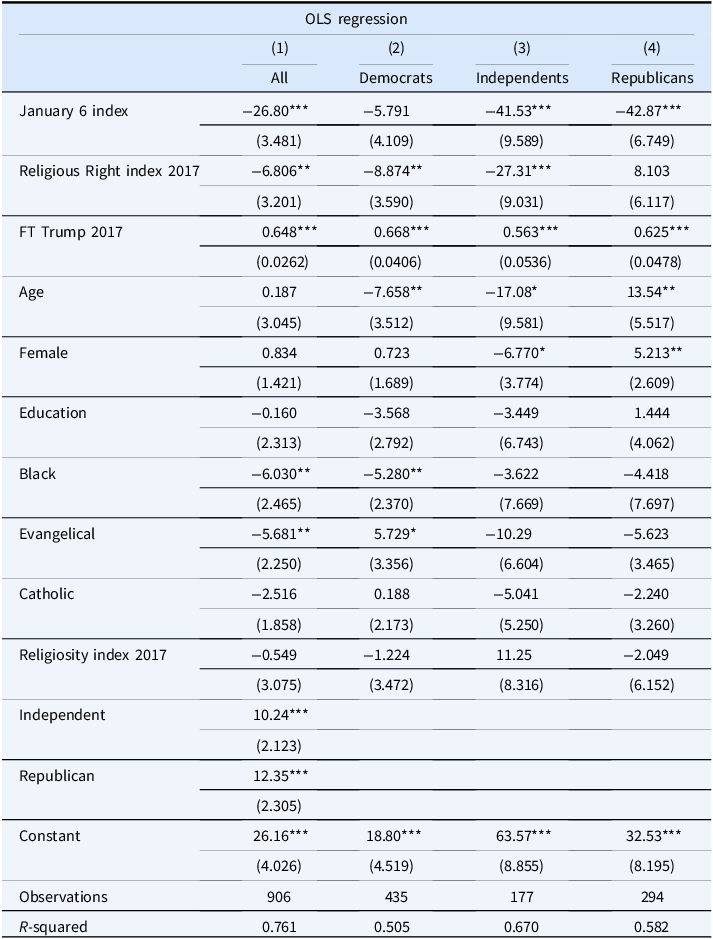
Our analysis of partisan backlash begins with attitudes toward Donald Trump, measured with a 0–100 feeling thermometer (recoded, as before, to range from zero to one). As displayed in Table 3, an OLS regression model reveals that there is a large effect for the January 6 th Index, as it leads to a drop of 26.8 points on the feeling thermometer (p < .01), dwarfing any other coefficient in the model. There is also a significant negative effect for the Religious Right Index (p < .05), but it is much smaller, only 6.8 points on the scale.
Feeling thermometer: Donald Trump

Table 3. Long description
A table titled OLS regression with four columns and multiple rows. The columns are labeled (1) All, (2) Democrats, (3) Independents, and (4) Republicans. The rows include various indices and demographic factors such as January 6 index, Religious right index 2017, FT Trump 2017, Age, Female, Education, Black, Evangelical, Catholic, Religiosity index 2017, Independent, Republican, and Constant. Each cell contains numerical values representing the regression coefficients and standard errors. The table also includes the number of observations and R-squared values for each column. Notable trends include significant negative effects for the January 6 index and Religious right index 2017 across different political affiliations, with varying impacts on the feeling thermometer scores for Donald Trump.
Standard errors in parentheses.
***p < .01, **p < .05, *p < .1.
While we observe this negative effect on perceptions of Trump with a control for party ID, that still leaves the question of whether Trump’s support fell among Republicans specifically or if the backlash was limited to Democrats and perhaps Independents. To find out, Table 3 also displays the same model, but for Democrats, Independents, and Republicans separately. Interestingly, the results for Democrats mirror those for religious backlash. Among Democrats, the January 6 th Index does not have a significant relationship to Trump’s feeling thermometer score (p = .16), while there is a significant effect for the Religious Right Index (p < .01). As with religious backlash, we suspect that the null result for January 6th owes to the nearly universal disapproval of the insurrection among Democrats.Footnote 7
The results differ for Republicans and Independents. For both, the January 6 th Index has a massive negative effect on Trump’s feeling thermometer score—42.9 points for Republicans and 41.5 points for Independents (both p < .01). As for the Religious Right Index, it is only significant (p < .01) for Independents, with a magnitude of −27.3 points.
We thus see the first evidence for partisan backlash, as perceptions of Christian nationalism on January 6th led to a lower perception of Donald Trump, but just for Republicans and Independents. There was also partisan backlash because of the Religious Right, but this was much smaller in magnitude and observed for Democrats and Independents.
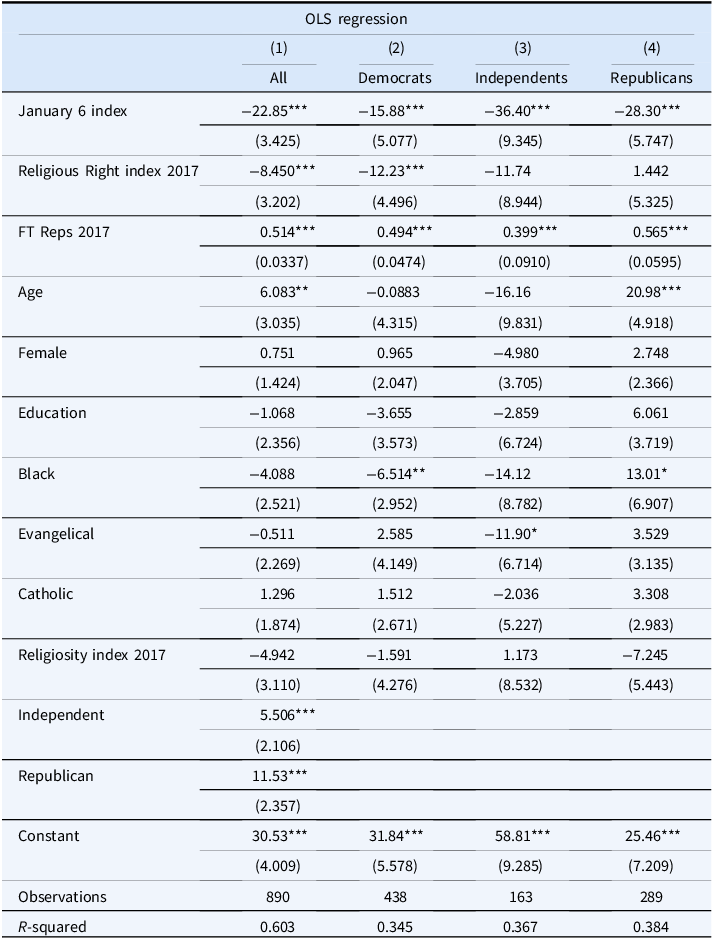
The results for perceptions of Republicans are similar but not identical to those for Donald Trump (see Table 4).Footnote 8 Again using an OLS model, in this case the January 6 th Index has a negative effect (p < .01) for everyone as a whole (column 1) and each of the three partisan groups separately. The biggest effect is among Independents (−36.4 points), followed by Republicans (−28.3 points). In comparison, the effect for Democrats is −15.9 points—perhaps a smaller magnitude because they started at a much lower level, and feeling thermometer scores have a natural floor of zero. While the Religious Right Index is statistically significant in the model for the whole population, the effect is really only among Democrats but, as with perceptions of Trump, is much smaller than January 6th.
Feeling thermometer: Republicans

Table 4. Long description
The table presents OLS regression results for various political groups, including All, Democrats, Independents, and Republicans. It has 15 rows and 5 columns. The columns are labeled as (1) All, (2) Democrats, (3) Independents, and (4) Republicans. The rows include variables such as January 6 index, Religious right index 2017, FT reps 2017, Age, Female, Education, Black, Evangelical, Catholic, Religiosity index 2017, Independent, Republican, Constant, Observations, and R-squared. Each cell contains regression coefficients with standard errors in parentheses. Notable trends include significant negative effects of the January 6 index across all groups, with the largest effect among Independents. The Religious right index shows a significant effect among Democrats but not among other groups. The FT reps 2017 variable has a positive effect across all groups. Age shows a significant positive effect among Republicans and a negative effect among Independents. The Female variable does not show significant effects across groups. Education has varying effects, with a positive effect among Republicans and negative effects among Democrats and Independents. The Black variable shows a significant negative effect among Democrats and a positive effect among Republicans. The Evangelical variable shows a significant negative effect among Independents. The Catholic variable does not show significant effects. The Religiosity index 2017 shows a significant negative effect among Republicans. The Independent variable shows a significant positive effect across all groups. The Republican variable shows a significant positive effect. The Constant variable shows varying effects across groups. The number of observations and R-squared values are provided for each group.
Standard errors in parentheses.
***p < .01, **p < .05, *p < .1.
In summary, feeling thermometers for Donald Trump and Republicans in general demonstrate a partisan backlash to January 6th, which is strongest among Republicans and Independents. Perceptions of the Religious Right also elicit partisan backlash, but the effects are found mostly among Democrats and are much smaller than for January 6th.
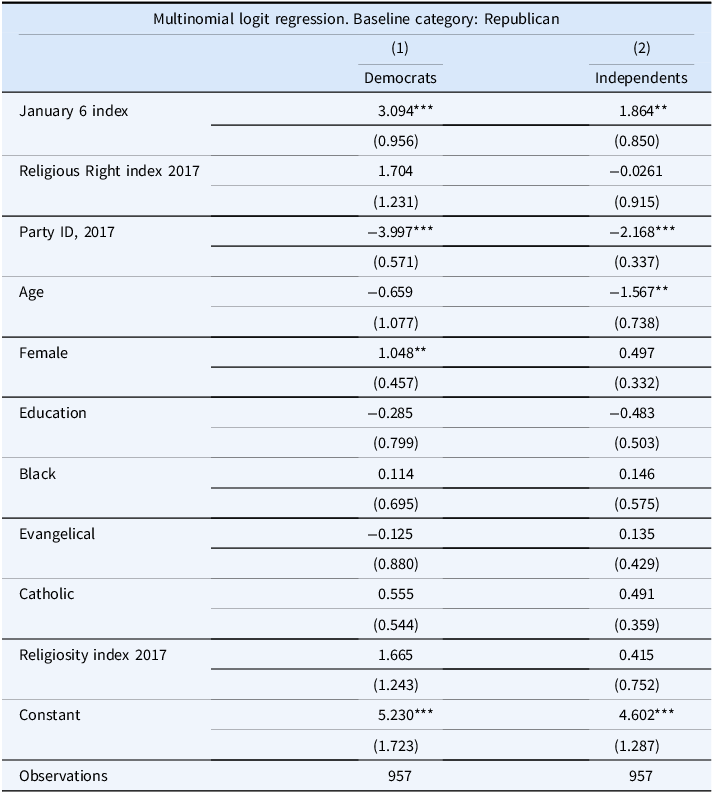
What about party identification, the toughest test of partisan backlash? To find out, we once again use a lagged dependent variable to model party identification. Party ID is coded as a three-point scale, meaning that any movement on the scale is a step change from one partisan category to another and thus represents substantial movement. Because the dependent variable has three discrete but non-ordinal categories, the estimator is multinominal logit instead of OLS. The base outcome is Republican, meaning that the coefficients are interpreted as the effect of that variable on identifying as either a Democrat (column 1) or an Independent (column 2), compared to self-description as a Republican.
The results are clear; January 6th led to partisan backlash. The January 6 th Index—that is, perceptions of Christian nationalism among the insurrectionists—has a positive and statistically significant effect on identifying as either a Democrat (p < .01) or an Independent (p < .05), relative to describing oneself as a Republican and, recall, controlling for party identification in 2017.
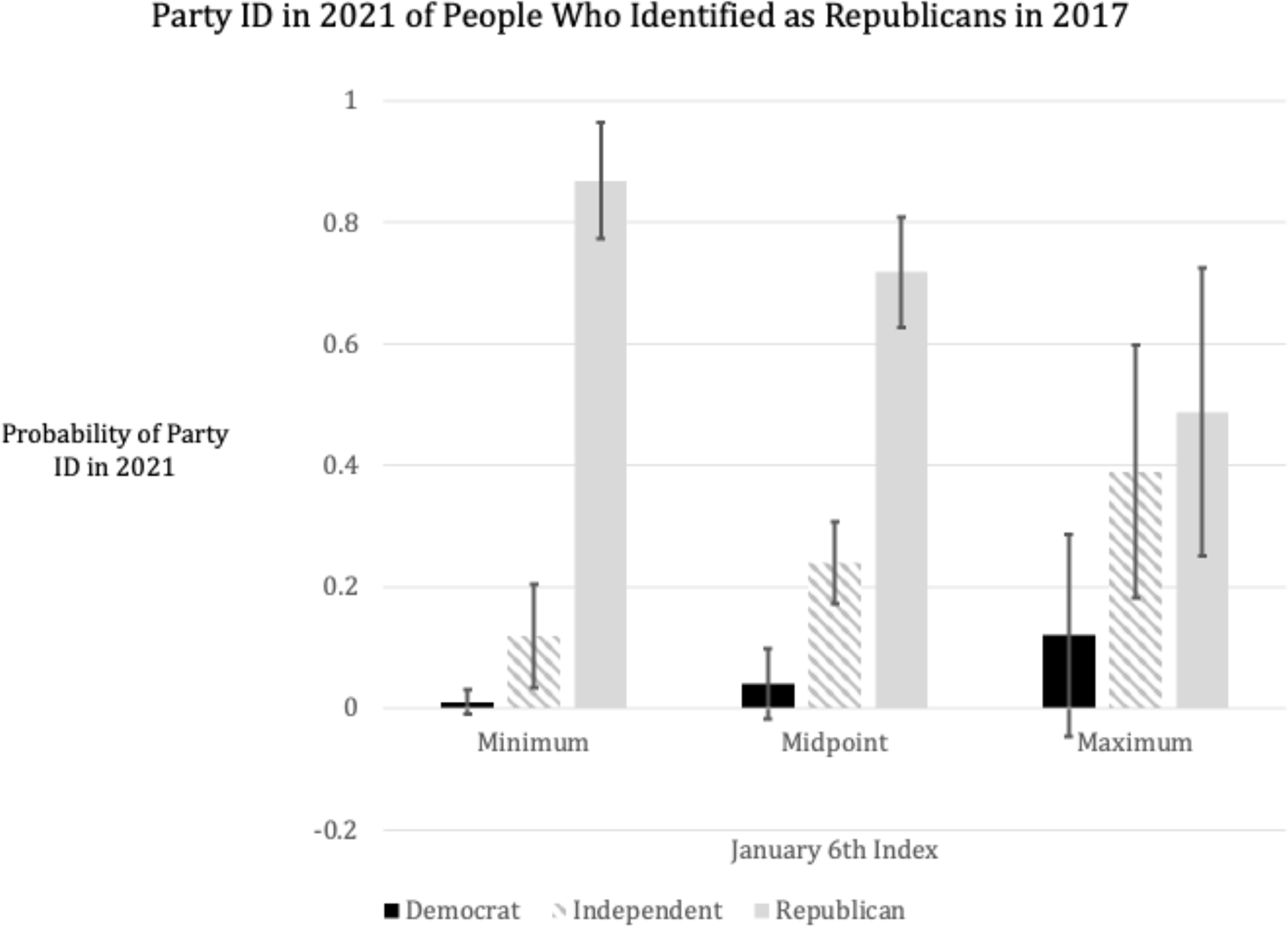
Because multinomial logit coefficients do not lend themselves to an intuitive interpretation of their magnitude, Figure 2 displays the predicted probabilities of party identification, generated from the model in Table 5. The graph shows the party identification in 2021 of respondents who indicated that they were Republicans in 2017, with all control variables set to their observed values. The gray bars display the probability of a 2017 Republican maintaining that partisan identification in 2021. The cross-hatched bars are 2017 Republicans who, in 2021, now describe themselves as Independents. The bars in black represent people who went from identifying as a Republican to a Democrat. For 2017, Republicans at the minimum value of the January 6 th Index, there is very little change in 2021. Their probability of identifying as a Republican in 2021 is .87. Of those who switched their party ID, nearly all became Independents (probability .12). At the maximum value of the January 6 th Index, there is a lot of flux. Converting the probabilities into percentages, among 2017 Republicans, only 49 percent maintained their Republican Party ID in 2021. Of those who changed their party identification, the bulk shifted to Independent (39 percent). Even the degree of partisan change among 2017 Republicans at the midpoint of the January 6 th Index is considerable. Roughly 28 percent dropped their Republican identity (24 percent became Independents). Given the general stability of party identification, these are substantial shifts and thus strong evidence that January 6th engendered a partisan backlash.
Probabilities are estimated from the multinomial logit model in Table 5. Bars represent 95 percent confidence intervals.

Party identification

Table 5. Long description
The table presents multinomial logit regression results for party identification, comparing Democrats and Independents. It has 13 rows and 4 columns. The columns are labeled as Democrats and Independents, with sub-columns for values and standard errors. The rows are labeled with different factors: January 6 index, Religious right index 2017, Party ID 2017, Age, Female, Education, Black, Evangelical, Catholic, Religiosity index 2017, Constant, and Observations. Each row provides values and standard errors for both Democrats and Independents. For example, the January 6 index for Democrats is 3.094 with a standard error of 0.956, while for Independents it is 1.864 with a standard error of 0.850. The table shows various factors influencing party identification, with notable values and their corresponding standard errors.
Coefficients predict identification as Democrat or Independent in 2021 for respondents who identified as Republicans in 2017.
Robust standard errors in parentheses.
***p < .01, **p < .05, *p < .1.
Robustness test
In all of the analyses we have presented, attitudes toward the Religious Right have been measured in 2017, on the logic that these views could not have been affected by events in 2021. For the perception of January 6th, of course we have no choice but to measure it in the second wave (2021). As a robustness test, we have also substituted a variable measuring the change in the Religious Right Index between 2017 and 2021. It is possible that some (perhaps much) of this change was driven by the perception of January 6th, which raises the statistical bar for isolating the impact of the January 6 th Index. With only one exception, all of our substantive results remain the same in models with the variable reflecting the change in perceptions of the Religious Right. The single exception is that, in the model of religiosity (Table 2), we no longer find that, among Independents, there is a relationship between the January 6 th Index and a decrease in religiosity—the coefficient is in the same direction but is not statistically significant. Across all of the remaining models, results are unchanged. We display the full results of each model in the Supplementary Information.
Summary of findings
To recap, we have largely found support for our expectations. First, as we would predict from the religious backlash literature, the perception of the Religious Right’s association with the GOP leads to weakened religious commitment among Democrats, but not Republicans or Independents. We see no effect on religious non-affiliation.
We have also seen evidence for lower religiosity among people who perceived the presence of Christian nationalism on January 6th, but in this case only for Republicans and independents. The fact that we do not observe weaker religious commitment among Democrats who perceive a high degree of Christian nationalism on January 6th is contrary to our hypothesis. While we suspect this is because there is too little variation among Democrats in their reaction to January 6th to predict change in their religiosity, we leave a definitive explanation to future research.
Our analysis also provides evidence for partisan backlash. The Religious Right’s influence in the Republican Party leads to slightly more negative feelings about both Donald Trump and Republicans in general, but only among Democrats (rating of both Trump and Republicans) and Independents (Trump rating only). There is a far larger effect for perceptions of Christian nationalism, as both Republicans and Independents who score high on the January 6 th Index evince much lower feeling thermometer ratings for both Trump and Republicans. However, arguably the most notable finding is that Christian nationalism on January 6th led Republicans to change their party identification. Most switched to an Independent label, but some even became Democrats.
Conclusion
Because our data end in 2021, we do not know whether religious and partisan backlashes have endured. At the time of our 2021 survey, the memory of the January 6th insurrection was still fresh and widely condemned by Republicans and Democrats alike. Since then, however, there has been a revision of how January 6th is remembered among many Republicans. Instead of a brazen and violent attack on the seat of government that threatened the fundamental democratic principle of the peaceful transfer of power, many on the political right now either portray it as a minor incident involving a few rogue protesters or a false flag event instigated by leftists and/or the FBI. Upon his reelection as president, Donald Trump even issued a blanket pardon to all of the insurrectionists convicted of crimes on January 6th. Similarly, in the time since January 6th, Republicans have become ever more loyal to Trump as the embodiment of their party. It could thus be that the reaction to January 6th we have observed here was a short-term effect from a particular moment in time. Perhaps some of the 2017 Republicans who defected from their partisan identity subsequently “came home” and began identifying with the GOP again. At a minimum, it seems likely that the Republican exodus has not continued. Similarly, Christian nationalist rhetoric has become even more common among Republicans. Perhaps its prevalence within the GOP means that it no longer elicits a backlash from those who identify with the Republican Party.
Even if either the religious or partisan backlash observed in this article has not continued, our analysis is far from being a purely historical exercise. It has contributed to the theoretical understanding of how religion and politics interact in the contemporary United States.
Our findings, however, are only a beginning. We encourage future research into other manifestations of religious and political backlash. For example, are there other developments that might trigger backlash, such as the use of religious rhetoric to further a policy goal, like ending abortion rights? We might expect unique dynamics among American Catholics, as the ideological cross-pressures within the Catholic hierarchy could provide reasons for both conservative and liberal Catholics to experience backlash, perhaps even to the point of shedding their Catholic identity. Similarly, backlash could be experienced differently within other religious subcultures, such as Latter-day Saints. In light of Margolis’s work on political socialization in different eras, it could be fruitful to examine backlash at various points in time and/or within today’s youth population.
The study of backlash could be broadened further by examining other countries. While, to date, the backlash literature has focused on the Religious Right in the United States, a similar process could occur in different political contexts. For example, backlash could be observed in other nations where religious activists feature in partisan politics, such as Brazil, Hungary, or Israel.
In conclusion, this article has hopefully made two contributions. First, it demonstrates that the events of January 6th—specifically the display of Christian nationalism during the melee—led to both religious and partisan backlash. Second, it also contributes to the general understanding of how religion and politics are both dynamic and can affect one another. Far from being static and separate, religiosity and partisanship are dynamically inter-related, often in surprising ways. This, in turn, adds to our understanding of the religious–secular divide in American politics and potentially other nations as well.
Supplementary material
The supplementary material for this article can be found at https://doi.org/10.1017/S175504832610042X.
Data availability statement
The data employed in this article have been archived at the Harvard Dataverse, along with accompanying documentation.
Financial support
The research was funded by the Carnegie Foundation (through a Carnegie Fellowship awarded to David Campbell) and the University of Notre Dame.
Competing interests
The authors declare no competing interests.
David E. Campbell is the Packey J. Dee Professor of American Democracy at the University of Notre Dame.
Geoffrey C. Layman is the Joseph and Elizabeth Robbie Professor of Political Science, also at Notre Dame. Along with John Green, they are co-authors of Secular Surge: A New Fault Line in American Politics.


 Open access

