




Introduction
With a rise in the aging population (World Health Organization, 2022), researchers, health providers, and policy makers need to focus on how to support the physical and psychological well-being of older adults. There is a robust body of literature suggesting that chronic stress exposure over the life course accelerates the aging process and increases the risk for poor health outcomes in later adulthood, such as cardiovascular disease (Lakatta & Levy, Reference Lakatta and Levy2003), cognitive impairment, and neurodegenerative disease (Hou et al., Reference Hou, Dan, Babbar, Wei, Hasselbalch, Croteau and Bohr2019). The association between chronic stress and increased health risks in later adulthood may result from the wear and tear of interconnected biological systems that stem from the activation of stress-sensitive systems over the lifespan (Lazarus & Folkman, Reference Lazarus and Folkman1984). However, it is important to acknowledge that stress is a multidimensional construct, including inputs (i.e., the stressors), processes (i.e., individual difference factors), and outputs (i.e., physiological, physical, emotional, and cognitive responses). The Transactional Model of Stress (TMS), developed by Richard Lazarus, posits that stress is a process involving an interaction between an individual and their environment, emphasizing the subjective nature of stress. In this model, stress results from the individual’s appraisal of a situation (i.e., processes), rather than the situation itself (i.e., inputs). Lazarus identified two key processes in this appraisal: (1) primary appraisal, where the individual assesses whether an event is a threat, harm, challenge, or benign positive; and (2) secondary appraisal, where the individual evaluates their ability to cope with the stressor (Lazarus & Folkman, Reference Lazarus and Folkman1984). The model highlights that stress arises from the person’s perception of their ability to manage demands placed upon them, thus suggesting that stress responses can vary widely depending on individual perceptions and resources. Lazarus’s work revolutionized how we understand stress, focusing on cognitive and behavioral processes rather than solely on external stressors or physiological reactions. Accordingly, whether stress is experienced is largely dependent on available mitigating resources.
The extant literature has identified factors that contribute to the mitigation of perceived stress and stress-related health outcomes in later life, including physical activity (Rueggeberg et al., Reference Rueggeberg, Wrosch and Miller2012), sufficient sleep (Heffner et al., Reference Heffner, NG, Suhr, France, Marshall, Pigeon and Moynihan2012), adaptive coping strategies (Nowlan et al., Reference Nowlan, Wuthrich and Rapee2015), and traits of resilience, including cognitive hardiness (Sharpley & Yardley, Reference Sharpley and Yardley1999). Aligned with the TMS, these behavioral and cognitive factors are critical targets in psychosocial interventions to help mitigate the negative impact that perceived stress may have on the individual (Beckie, Reference Beckie2012; Hazlett-Stevens et al., Reference Hazlett-Stevens, Singer and Chong2019).
Despite a shift in the distribution of the global population toward older ages, the tools available to assess stress and stress-mitigating factors in later adulthood are lacking (Agarwal et al., Reference Agarwal, Pirrie, Angeles, Marzanek and Parascandalo2019). Not only is this problematic given the growing distribution of older adults, but older adults are also particularly sensitive to the effects of stress due to normal age-related changes in interconnected biological systems (Sapolsky, Reference Sapolsky1999) and are at increased risk of health complications (Kivimäki et al., Reference Kivimäki, Bartolomucci and Kawachi2023). One inventory that may be of value is the SAI (Nowack, Reference Nowack1990), which offers a comprehensive self-report measure of stress and stress-mitigating resources.
The SAI was originally developed as a comprehensive measure of stress in employees within organizational health promotion programs (Nowack, Reference Nowack1990). Although initially assessed in an occupational cohort, the scaled questions are not specific to work or occupational stress and coping and may be generalized to factors outside of the occupational domain. The SAI is aligned with the TMS such that it measures perceptions of stressors and factors that mitigate the effects of perceived stress (Nowack, Reference Nowack1990). More specifically, the SAI measures cognitive (e.g., appraisal and resilience), behavioral (e.g., diet and exercise), and environmental (e.g., social support) factors that may mitigate or contribute to the experience of stress and subsequent health ailments. The SAI was made commercially available by Western Psychological Services as the ‘Stress Profile’ (Nowack, Reference Nowack1999) and as the ‘StressScan’ (Nowack, Reference Nowack and Passmore2008). The instrument was validated 30 years ago and continues to be used to assess organizational stress and stress-related outcomes in younger to middle-aged adults. Its widespread use has served to assess the relationship between stress and stress management for professional well-being, psychological predictors of health, and factors that help individuals cope with stressors (e.g., Fusilier & Manning, Reference Fusilier and Manning2005; Pozos-Radillo et al., Reference Pozos-Radillo, Preciado-Serrano, Plascencia-Campos, Morales-Fernández and Valdez-López2021; Pozos-Radillo et al., Reference Pozos-Radillo, Preciado-Serrano, Plascencia-Campos and Aguilera-Velasco2024; Fowler, Reference Fowler2006).
As a comprehensive measure of stress, the SAI can be a useful tool for older adults who are relatively vulnerable to the deleterious effects of stress on health and well-being. However, validation of the SAI in older adults is warranted. Furthermore, the SAI is four times longer than the recommended length of questionnaires, which contributes to respondent burden and fatigue and lower response rates (Sharma, Reference Sharma2022). Given the paucity of tools that comprehensively measure stress in older adults and the potential utility of the SAI, despite its methodological shortcomings, the objective of the current study was to assess the validity of the SAI in community-dwelling older adults.
Materials and methods
Participants
Participants included 294 physically and cognitively healthy older men and women aged 60–95 years living in the Greater Toronto Area, Canada. Please see Table 1 for further details on the sample. Based on sample size criteria for conducting a factor analysis, the sample size for the present analysis is considered ‘fair’ to ‘good’ (Comrey & Lee, Reference Comrey and Lee1992).
Participant characteristics

Notes: Stress Assessment Inventory (SAI) means and standard deviations are based on the original responses, before item reduction. Retirement data were not collected for Study 2.
Measures
Data were collected from two studies that examined cognitive functioning and well-being in older adults living independently in the community: 201 participants from Study 1 (see D’Amico et al., Reference D’Amico, Huang and Fiocco2021) and 93 participants from Study 2 (see Fiocco & Mallya, Reference Fiocco and Mallya2015). Both samples were recruited through community flyers and the Toronto Metropolitan University Senior Participant Pool. All participants completed the SAI, the Perceived Stress Scale (PSS), and the Quality of Life Scale (QOLS). The PSS and QOLS were selected in the current study to assess the validity of the SAI in older adults due to their measurement of similar constructs and well-established use for psychological research in older adults (Burckhardt et al., Reference Burckhardt, Woods, Schultz and Ziebarth1989; Cohen et al., Reference Cohen, Kamarch and Mermelstein1983). The Psychological Well-being Scale of the SAI was also used to assess validity, as it was originally designed for validity testing. Both studies were approved by the Research Ethics Board at Toronto Metropolitan University (REB#2014–164, REB#2012–192).
The stress assessment inventory
The SAI measures cognitive and behavioral moderators of the stress–illness relationship, specifically physical and mental challenges that may arise from and perpetuate chronic activation of the stress response (Nowack, Reference Nowack1990). It comprised 123 items; 5 of those items are a ‘reliability check’ to assess response bias, and the remainder of the items are organized into seven scales.
The 6-item Stress Scale measures the occurrence of hassles from six distinct sources (health, work, personal finances, family, social obligations, and environmental concerns) over the last 3 months. Responses are given on a 5-point Likert scale from 1 = Never to 5 = Always, with higher scores indicating greater stress.
The 25-item Global Health Habits Practices Scale measures engagement in healthy lifestyle habits over the last 3 months. It has four subscales: Exercise, Sleep/Relaxation, Preventative Health Practices, and Nutrition/Eating. Each item is rated on a 5-point Likert scale from 1 = Never to 5 = Always, with higher scores indicating greater engagement in protective health practices.
The 15-item Social Support Network Scale comprises three items related to satisfaction with five distinct social support networks: immediate boss or supervisor; other people at work; spouse, lover, or significant other; family members/relatives; and friends. Satisfaction is rated on a 6-point Likert scale from 1 = Not at all satisfied to 5 = Extremely satisfied, or 6 = Not applicable.
The 10-item Type A Behavior Scale measures the frequency of being hard-driven, impatient, and competitive in response to daily life challenges. Each item is rated on a 5-point Likert scale from 1 = None of the time to 5 = All of the time, with higher scores indicating greater propensity toward Type A Behaviors.
The 30-item Cognitive Hardiness Scale measures one’s propensity to commit to one’s work, self, and hobbies, perceived control over significant life outcomes, and viewing life’s changes as challenges rather than threats (Sharpley & Yardley, Reference Sharpley and Yardley1999). Items are rated on a 5-point Likert scale from 1 = Strongly agree to 5 = Strongly disagree, with higher scores indicating greater cognitive hardiness.
The 20-item Coping Style Scale assesses emotion-focused and problem-focused coping strategies. It comprises four subscales: Positive Appraisal, Negative Appraisal, Problem-Focused Coping, and Threat Minimization. Respondents indicate the degree to which they engage the strategy on a 5-point Likert scale from 1 = Never to 5 = Always, with the higher scores indicating greater use of the strategy.
The 12-item Psychological Well-being Scale is intended as the inventory’s outcome measure, predicted by the other scales and subscales of the SAI for validity testing (Nowack, Reference Nowack1990). The degree to which psychological well-being is experienced is rated on a 5-point Likert scale from 1 = Never to 5 = Always, with higher scores indicating greater psychological well-being.
In a sample of younger and middle-aged adults (Nowack, Reference Nowack1990), the underlying structure of the inventory was proposed to contain three factors: Component 1 – Global Health Practices, Eating/Nutrition, Preventative Hygiene, Sleep/Relaxation, and Exercise; Component 2 – Positive Appraisal, Threat Minimization, Problem-Focused Coping, Cognitive Hardiness, and Social Support; and Component 3 – Intrusive Negative Thoughts, Type A Behavior, and Stress (Nowack, Reference Nowack1990). Internal consistency of the SAI scales was mostly good (α = .82–.83), except the Stress Scale was acceptable (α = .67) and the Psychological Well-being Scale was excellent (α = .93). The subscales had acceptable internal consistency (α = .69–.79).
The perceived stress scale
The 10-item PSS measures one’s perception of stress during the last month (Cohen et al., Reference Cohen, Kamarch and Mermelstein1983). Respondents rate items on a 5-point Likert scale from 0 = Never to 4 = Very often, with higher scores indicating greater perceived stress. The PSS is widely used in older adult samples and has demonstrated good internal consistency (α = .81–.82; Ezzati et al., Reference Ezzati, Jiang, Katz, Sliwinski, Zimmerman and Lipton2014).
The quality of life scale
The 16-item QOLS measures current satisfaction across six domains: material and physical well-being; relationships; social, civic, and community activities; personal development and fulfilment; recreation; and independence. Items are rated on a 7-point Likert scale from 1 = Terrible to 7 = Delighted, with higher scores indicating greater satisfaction. The QOLS has been validated in older adults and has good internal consistency (α = .87–.89; Burckhardt et al., Reference Burckhardt, Woods, Schultz and Ziebarth1989).
Statistical analysis
Twenty-four (.06%) data points were missing from the total dataset. Since <1% of the data was missing, complete-case analyses were conducted (Jakobsen et al., Reference Jakobsen, Gluud, Wetterslev and Winkel2017), resulting in a final sample size of 294. All items from the SAI were first subjected to a theoretically driven item-reduction process to assess their relevancy and applicability to healthy older adults.
Consistent with classical test theory, the SAI was evaluated on its dimensionality, reliability, and validity (Nunnally, Reference Nunnally and Wolman1978). Dimensionality was evaluated using very simple structure (VSS), parallel analysis, and exploratory factor analysis (EFA; Revelle & Rocklin, Reference Revelle and Rocklin1979; Horn, Reference Horn1965). First, each scale within the SAI was evaluated on its dimensionality using polychoric correlations as recommended for categorical data (Jöreskog, Reference Jöreskog1990). Items that performed poorly in the EFA were removed. Then, sum scores were calculated for each unidimensional scale and subscale to evaluate the dimensionality of the overall SAI using Pearson’s correlations. The Psychological Well-Being Scale was not included in the EFA of the SAI as it is an outcome measure for validity testing. All EFA models were estimated using unweighted least squares and oblique rotations to improve factor loadings.
Reliability was assessed by internal consistency measured by McDonald’s Omega for all scales within the SAI and for the SAI overall. Validity was assessed using three linear regression models regressing the SAI scales, subscales, and covariates (age, sex, and education) on PSS, QOLS, and Psychological Well-being Scale.
All analyses of dimensionality and reliability were conducted with R version 4.2.1 (R Core Team, 2022) using the Psych package (for VSS, parallel analysis, EFA, and McDonald’s Omega; Revelle, Reference Revelle2023) and EFA.dimensions package (for calculating polychoric correlation matrices; O’Connor, Reference O’Connor2000). Validity testing was conducted using IBM SPSS 29.0.10. For additional details on model evaluation, model selection, and item retention, please refer to the Supplemental Materials (S1. Supplemental Statistical Analysis).
Results
Bartlett’s test was statistically significant (p < .001), and the Kaiser–Meyer–Olkin (KMO) value was .82 for the current dataset, exceeding the recommended KMO value of .70 (Dziuban & Shirkey, Reference Dziuban and Shirkey1974), supporting the decision to conduct a factor analysis.
Theoretically driven item reduction
Items that queried work-related habits were removed, given the sample’s demographic (M age =68.73); the average retirement age in Canada is 65 years (Statistics Canada, n.d.). Items that noted work and other relevant activity were retained (e.g., missed a large proportion of, or an entire night of sleep, because of work projects, travel schedule, social activities, shift work, family problems, etc.). One item was removed due to potential ambiguity and misinterpretation; specifically, the frequency of practicing safe sex over the past 3 months may prompt a different response depending on whether one considers abstinence or unprotected sex with a long-term partner as always practicing safe sex or never practicing safe sex. A total of 27 items (22%) met the criteria for removal. See Supplemental Material for the list of removed items (S2. Theoretically Driven Item Reduction).
Factor structure
The best-fitting factor structure of each scale within the SAI is reported below. See Supplemental Material for all factor structure iterations and their corresponding correlation matrix, model fit statistics, factor loadings, and communalities (S3. Factor Structure Iterations).
Stress scale
A one-factor model was selected, containing five items pertaining to five different daily hassles one can experience (health, personal finances, family, social obligations, and environmental concerns). The one-factor model accounted for 39% of the variance, and the standardized root mean square of the residual (SRMSR) = .02.
Global health scale
A three-factor model was selected, and based on the items within each factor, the proposed subscales within the Global Health Scale and their proportion of variance explained were Exercise (21%; three items), Sleep/Rest (13%; three items), and Eating/Nutrition (17%; four items). The cumulative variance explained by the Global Health Scale was 52%, and the SRMSR was .03. All items within the original Preventative Hygiene and Risk subscale were dropped due to not meeting the item retention criteria.
Social support scale
As the Social Support Scale included a ‘Not applicable’ response option with a value of 6, all ‘Not applicable’ responses were treated as missing data, which led to 13.75% missing data for the scale. Deletion and imputation attempts were made based on recommendations (Jakobsen et al., Reference Jakobsen, Gluud, Wetterslev and Winkel2017). Despite attempts, the model fit for the Social Support Scale was unacceptable (see S3.3 Social Support Scale). As such, the Social Support Scale was not included in the final EFA of the overall SAI.
Type A behavior scale
A one-factor model was selected for the Type A Scale, with all four items loading onto a single factor. The Type A Behavior Scale accounted for 30% of the variance, and the SRMSR was .05.
Cognitive hardiness scale
A three-factor model was selected. Based on the cluster of items within each factor, the subscales within the Cognitive Hardiness Scale, comprising of the three components of hardiness, and their proportion of variance explained were Control (19%; six items), Challenge (15%; four items), and Commitment (11%; four items). The cumulative variance explained by the overall scale was 45%, and the SRMSR was .04.
Coping scale
A three-factor model was selected. Based on the cluster of items within each factor, the proposed subscales and their proportion of variance explained were Negative Appraisal (20%; five items), Positive Appraisal (16%; four items), and Problem-focused Coping (15%; five items). The variance explained was 52%, and the SRMSR was .03.
Psychological well-being scale
A one-factor model best fits the Psychological Well-being Scale. Nine items were retained, explaining 75% of the variance, and the SRMSR was .03.
EFA of the revised subscales
The factor analysis of each scale within the SAI reduced the original inventory from 123 items to 65 items, comprising 7 scales and 12 subscales. Based on the analyses, the following new scales and subscales are proposed:
The Stress Scale, The Global Health Scale (Subscales: (i) Eating/Nutrition, (ii) Sleep/Rest, and (iii) Exercise), The Type A Behavior Scale, The Cognitive Hardiness Scale (Subscales: (i) Control, (ii) Challenge, and (iii) Commitment), The Coping Scale (Subscales: (i) Positive Appraisal, (ii) Negative Appraisal, and (iii) Problem-focused Coping), The Psychological Well-Being Scale.
A three-factor model was selected for the overall inventory based on its interpretability, strength of factor loadings, and communalities. The final model had an SRMSR of .04 and accounted for 42% of the cumulative variance, with factors 1–3 accounting for 21%, 13%, and 8% of the variance, respectively. Please see Supplemental Table 8 for factor loadings and communalities. For a detailed summary of model fit statistics for all evaluated scales and the overall SAI, please see Supplemental Tables (S4. Supplemental Tables).
Factor 1 captures Adaptive Cognitive Resources, given that its primary factor loadings consist of three subscales from the Cognitive Hardiness Scale comprising the following: (a) Control, challenge, and commitment; (b) Positive-Appraisal Subscale; and (c) Problem-focused Coping Subscale. Factor 2 represents Maladaptive Behavioral and Cognitive Habits, with primary loadings on the Stress Scale, the Sleep Subscale (inverse relationship), the Negative Appraisal Subscale, and the Type A Behavior Scale. Factor 3 was labeled Adaptive Health Habits, consisting of the Eating/Nutrition Subscale and the Exercise Subscale.
Internal consistency
Scales within the SAI ranged from poor (ω = .63–.67; Type A Behavior Scale, Sleep subscale, and Eating Subscale) to excellent reliability (ω = .95; Psychological Well-being scale). The overall inventory also had good reliability (ω = .84). See Supplemental Materials for McDonald’s Omega values for each scale and subscale.
Criterion validity
Perceived stress scale
The adjusted regression model (controlling for age, sex, and education) was statistically significant, with SAI explaining ~45% of the variance in PSS scores – F(14, 274) = 17.18, p < .001, adj. R 2 = .45. Stress, sleep, and the control subscale of the cognitive hardiness scale were significantly associated with predictors of PSS scores with small effect sizes ranging from β = −.17 to −.23. See Table 2 for more details.
Regression models assessing criterion validity of SAI scales and subscales
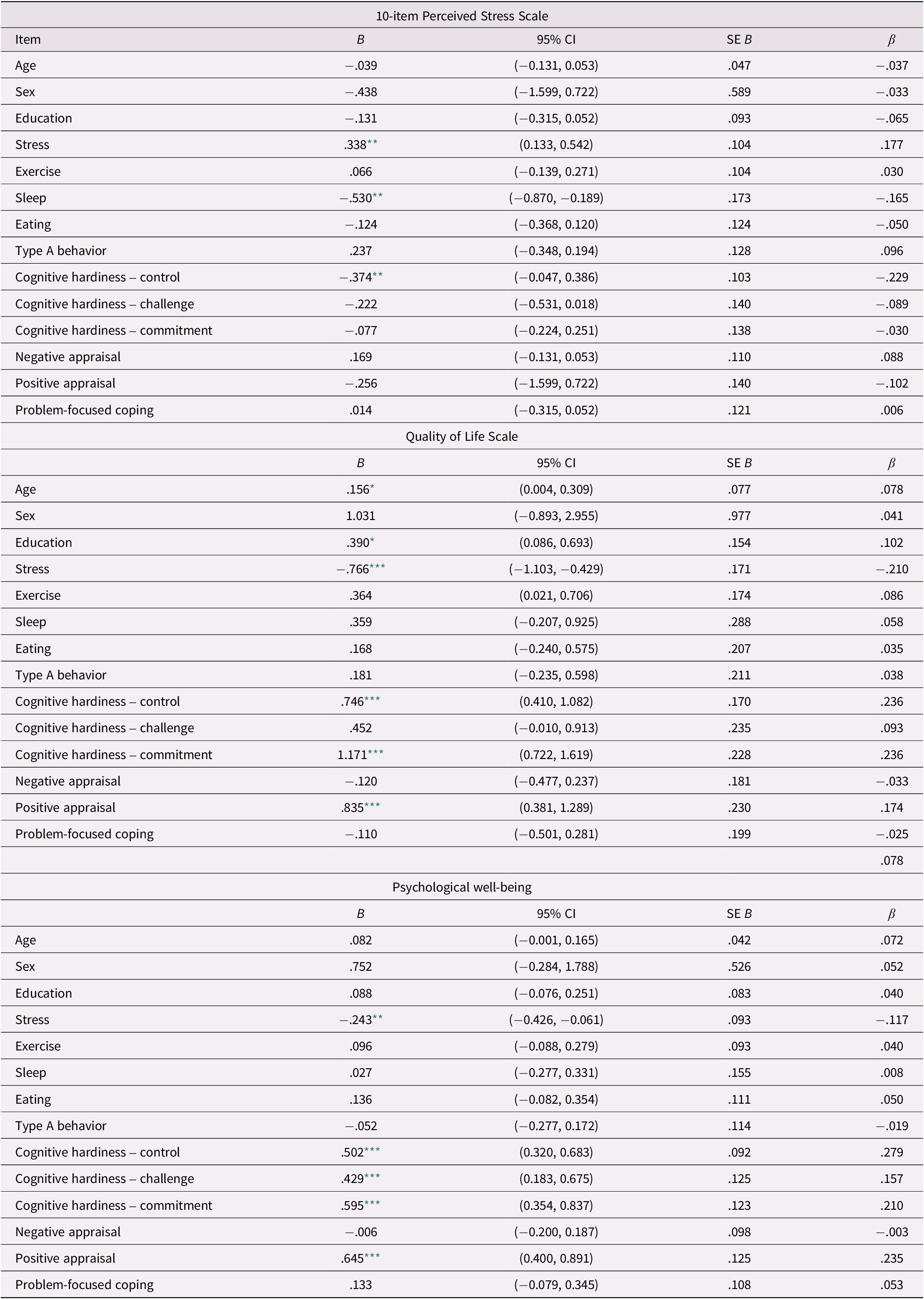
Notes: B, unstandardized regression coefficient; SE B, standardized error; β, standardized coefficient.
* p < .05.
** p < .01.
*** p < .001.
Quality of life scale
The adjusted regression model was statistically significant, with SAI explaining 60% of the variance in QOLS scores – F(14, 269) = 30.76, p < .001, adj. R 2 = .60. Age, stress, education, exercise, two components of cognitive hardiness (control and challenge), and positive appraisal were significantly associated with QOLS scores, with small effect sizes ranging from β = .078–.236. See Table 2 for regression coefficients and standard errors.
Psychological well-being scale
The adjusted regression model was statistically significant, with SAI explaining ~64% of the variance in Psychological Well-being Scale scores – F(14, 274) = 36.817, p < .001, adj. R 2 = .64. Stress, all three components of cognitive hardiness (control, challenge, and commitment), and positive appraisal were significantly associated with Psychological Well-being Scale scores, with small to medium effect sizes ranging from β = −12 to .28. See Table 2 for regression coefficients and standard errors.
Discussion
Driven by the need for a brief, comprehensive assessment tool of stress and coping for older adults, this study evaluated the utility of Nowack’s (Reference Nowack1990) SAI. The SAI was originally validated and developed to capture the variables that moderate the health consequences of experiencing work and life stress in younger and middle-aged adults. Following a theoretically driven item-reduction process and assessment of the dimensionality, internal consistency, and criterion validity of the SAI, the current study suggests that the Revised SAI can be a valuable, comprehensive assessment of stress for community-dwelling older adults.
Guidance for use and value of the revised SAI
The value of the Revised SAI lies in its capacity to robustly examine chronic stress and relevant mitigating factors in older adults in a relatively brief format that is estimated to take respondents 25 min to complete. Aligned with the TMS, the Revised SAI is able to capture the appraisal of stressors and available resources that may mitigate stress. The availability of an assessment tool for older adults is necessary in the context of population aging and the need to assess stress and potential mitigating factors in later adulthood.
Close to half of the SAI items were dropped while retaining validity and internal consistency. Validation of the Revised SAI demonstrated a factor structure that distinctly captures stress and factors associated with stress: protective cognitive coping, protective behavioral habits, and daily hassles with maladaptive cognitive and behavioral habits.
The Revised SAI, in its current form, may be used in cross-sectional, longitudinal, and intervention research in older adults to measure chronic and life stress comprehensively. The Revised SAI is particularly beneficial for longitudinal and intervention-based studies as its balance of thoroughness and brevity allows researchers to track stress and coping over time with minimal respondent burden. This contrasts with the need for multiple questionnaires to capture constructs in the Revised SAI, including perceived stress, coping, lifestyle behaviors, and personality.
Modifications and limitations of the revised SAI
Theoretically driven item reduction and EFA of the original scales and subscales resulted in notable scale modifications. First, the original 123-item scale was reduced to 56 items while retaining most of the scales and subscales.
The Social Support scale was removed because a proportionally high number of participants selected ‘not applicable’ for scale items, suggesting low applicability of scale items in this population, contributing to poor psychometric performance. As research has shown, the buffering effect of social support on stress in older adults (Dehghankar et al., Reference Dehghankar, Valinezhad, Amerzadeh, Zarabadi Poor, Hosseinkhani and Motalebi2024) exclusion of the scale was likely due to the scale properties rather than social support being of low importance for moderating the relationship between stress and poor health in older adults. The Social Support scale queries respondents’ satisfaction with the support they receive ‘at work and in personal life’ from five distinct social support networks, including romantic partners, friends/community members, and family members. As a significant portion (at least n = 122) of participants were retired, many respondents may have felt this question did not apply to them due to explicit mention of work. Furthermore, having ‘never’ and ‘not applicable’ response options when measuring the frequency of receiving social support may have been a source of confusion. If a participant does not have a given support network (e.g., no romantic partner) or does not tend to seek social support listed from a given social support network (e.g., does not seek work-related social support from family members), it can be unclear which would be the most appropriate response option.
All items within the Preventative Hygiene subscale were removed due to poor performance, suggesting a lack of applicability or sensitivity in the current sample. The health of older adults has improved in recent decades, evidenced by a longer life expectancy, and in part attributed to decreased smoking rates and attention to blood pressure, implying an overall improvement in personal health literacy and self-care (Statistics Canada, 2015). The preventative hygiene items of the SAI may not be appropriate or sensitive enough to assess risk in older adult populations, and a focus on mitigating physical health stressors, including hearing healthcare, frequency of vaccinations, or hazard-proofing one’s home if there is a risk of falls, may be of greater relevance.
The Threat Minimization subscale was removed due to poor performance, likely due to the disconnect between included items and the psychological construct. Literature suggests that avoidance, or threat minimization, is a maladaptive strategy for younger and older adults (Birditt et al., Reference Birditt, Polenick, Luong, Charles and Fingerman2020). Interestingly, in Nowack’s (Reference Nowack1990) study, the Threat Minimization subscale clustered with other adaptive coping mechanisms, which contradicts the current literature (Ayers et al., Reference Ayers, Petkus, Liu, Patterson and Wetherell2010). This suggests that the scale may not have accurately captured the construct.
Scales and subscales of the revised SAI demonstrated acceptable internal consistency, except for the Type A Behavior Scale, the Exercise Subscale, and the Sleep/Rest. Poor internal consistency of the Type A Behavior Scale may be attributed to removing over half of the items due to explicit mention of work, and low correlations between the remaining items. Reliability of the Type A Behavior Scale may be strengthened with items that accurately and cohesively capture this personality construct, beyond employment. Furthermore, Type A is not a singular construct. Indeed, research suggests that it is the toxic core of Type A, namely the aggression-hostility component, that is associated with poor physical and psychological well-being (Birks & Roger, Reference Birks and Roger2000). Similarly, poor internal consistency of the subscales may be accounted for by the relatively fewer items within the subscales. As such, it is recommended that these scales be interpreted with caution.
Findings for the overall factor structure of the revised SAI scale and subscales revealed a three-factor solution comprising (1) Adaptive Cognitive Resources, (2) Maladaptive Behavioral and Cognitive Habits, and (3) Global Health Practices. This aligns with the initial three-component solution in younger and middle-aged adults (Nowack, Reference Nowack1990). Interestingly, unlike the original validation study, the Sleep Subscale did not load onto the Global Health Practices factor and instead loaded negatively onto the Maladaptive Behavioral and Cognitive Habits factor. This may be attributed to the nature of the items inquiring about a lack of sleep. The Sleep Subscale can be further improved by adding items that assess sleep and rest more robustly as an overall health practice.
The SAI displayed good criterion validity with validated measures of stress and well-being, as well as the Psychological Well-being Scale of the SAI. Across all outcome measures, the Stress Scale and Cognitive Hardiness-Control were significant predictors in the model. However, subscale items of Eating, Negative Appraisal, Type A Behavior, and Problem-focused Coping did not significantly contribute to the variance across outcome scores. Although Type A Behavior may not represent the toxic core and, therefore, may not be an appropriate assessment of the risk profile of Type A, the interpretation of null associations for the remaining items may be attributed to the analytical sample. Interestingly, the Type A subscale of the SAI has been one of the strongest predictors of self-reported health outcomes in younger and middle-aged adults (Pozos-Radillo et al., Reference Pozos-Radillo, Preciado-Serrano, Plascencia-Campos and Aguilera-Velasco2024). As such, further research may be needed to explore Type A behavior as a predictor of health in older adults.
Overall, the analytical sample was relatively healthy, and it is important to recognize that a self-selected bias may have occurred, which may underestimate the magnitude of the associations. Accordingly, replication in a larger, more diverse sample is required.
Future directions
The Revised SAI is valid and reliable in its current form. However, further adaptations to the inventory are suggested for future research. First, it is recommended that the statements be modified to better reflect the lived experience of this large, heterogeneous population. For example, ‘trouble with aging parents’ may be revised to ‘trouble caring for a loved one’, referring to stress associated with the family caregiver role. While items that referenced work were removed in the current study, items that list work-related contexts (e.g., I feel hurried and pressured for time, i.e., not having enough time to get everything done at work or home) may be modified to be more relevant to retired older adult respondents. Second, major revisions to the Social Support scale, which was excluded in the final iteration of the inventory due to poor psychometric performance, are recommended before use in this population. Namely, simplifying item responses and modifying the questions to address social support more broadly.
To date, studies supporting the ability of the SAI to predict stress-related illness have yielded mixed results (Huerta-Franco et al., Reference Huerta-Franco, Vargas-Luna, Somoza, Delgadillo-Holtfort, Balleza-Ordaz and Kashina2019; Pozos-Radillo et al., Reference Pozos-Radillo, Preciado-Serrano, Plascencia-Campos and Aguilera-Velasco2024). To further validate the Revised SAI’s ability to predict stress-related illness in older adults, it is recommended that the predictive validity of the SAI for objective health outcomes, such as the number of medical visits or symptoms of illness, be explored. As chronic stress is associated with poorer health outcomes, this further validation would support the application of the SAI as a screener for stress and coping by physicians that can inform targeted patient care (Prior et al., Reference Prior, Fenger-Grøn, Larsen, Larsen, Robinson, Nielsen, Christensen, Mercer and Vestergaard2016; Stubbs et al., Reference Stubbs, Vancampfort, Veronese, Schofield, Lin, Tseng, Solmi, Thompson, Carvalho and Koyanagi2018).
Considering the study findings and recommendations, study limitations must be addressed. First, while the sample size was adequate for the present analysis, data collection from a larger sample would offer a more accurate representation of the true underlying factor structure (Mundfrom et al., Reference Mundfrom, Shaw and Ke2009). Second, the sample of participants was predominantly white, young, healthy, and highly educated, scoring relatively high on the QOLS (Burckhardt et al., Reference Burckhardt, Woods, Schultz and Ziebarth1989) and low on the PSS (Cohen et al., Reference Cohen, Kamarch and Mermelstein1983). Additional validation should be conducted in a more diverse and representative sample of older adults in North America.
Conclusions
The Revised SAI is a valuable assessment tool for evaluating stressors and strategies used to manage daily stress that may moderate the stress–illness relationship. With recommended modifications and further validation, the Revised SAI may be a valuable assessment tool for stress researchers, specifically for psychosocial intervention-based and longitudinal research. Given the complex relationship between psychosocial stress, physical health, and cognitive function, comprehensive measures, such as the SAI, that provide a clear pathway for behavioral change are highly valuable. Given the rapidly aging population, constructing such measures specific to older adults is crucial for facilitating lifestyle changes that may protect against avoidable age-related decline. Further modifications are recommended, including adding relevant items to scales with low internal consistency and criterion validity, aligning scales and subscales with up-to-date empirical findings and theoretical frameworks relevant to older adults, and addressing measurement issues. Examining the predictive validity of the Revised SAI for stress-related illness would increase the strength of the measurement tool, which could be used by medical professionals screening for and treating stress in older adults.
Supplementary material
The supplementary material for this article can be found at http://doi.org/10.1017/S0714980825100159.
Acknowledgments
The authors would like to thank Dr. Kenneth Nowack for his guidance on the use of the Stress Assessment Inventory.


 Open access

