

Hostname: page-component-6766d58669-r8qmj Total loading time: 0 Render date: 2026-05-15T03:03:28.347Z Has data issue: false hasContentIssue false

Lagrangian dynamics and regularity of the spin Euler equation

Published online by Cambridge University Press:  24 April 2024

Zhaoyuan Meng
Affiliation:
State Key Laboratory for Turbulence and Complex Systems, College of Engineering, Peking University, Beijing 100871, PR China
Yue Yang*
Affiliation:
State Key Laboratory for Turbulence and Complex Systems, College of Engineering, Peking University, Beijing 100871, PR China HEDPS-CAPT, Peking University, Beijing 100871, PR China
*
Email address for correspondence: yyg@pku.edu.cn

Abstract

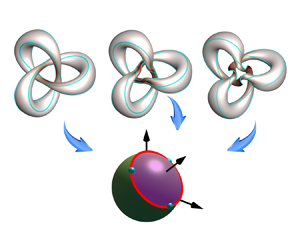
We derive the spin Euler equation for ideal flows by applying the spherical Clebsch mapping. This equation is based on the spin vector, a unit vector field encoding vortex lines, instead of the velocity. The spin Euler equation enables a feasible Lagrangian study of fluid dynamics, as the isosurface of a spin-vector component is a vortex surface and material surface in ideal flows. We establish a non-blowup criterion for the spin Euler equation, suggesting that the Laplacian of the spin vector must diverge if the solution forms a singularity at some finite time. The direct numerical simulations (DNS) of three ideal flows – the vortex knot, the vortex link and the modified Taylor–Green flow – are conducted by solving the spin Euler equation. The evolution of the Lagrangian vortex surface illustrates that the regions with large vorticity are rapidly stretched into spiral sheets. The DNS result exhibits a pronounced double-exponential growth of the maximum norm of Laplacian of the spin vector, showing no evidence of the finite-time singularity formation if the double-exponential growth holds at later times. Moreover, the present criterion with Lagrangian nature appears to be more sensitive than the Beale–Kato–Majda criterion in detecting the flows that are incapable of producing finite-time singularities.

Information

Type
JFM Papers
Copyright
© The Author(s), 2024. Published by Cambridge University Press

Access options

Get access to the full version of this content by using one of the access options below. (Log in options will check for institutional or personal access. Content may require purchase if you do not have access.)

Article purchase

Temporarily unavailable