




Growing Armenian Americans
As the story goes, legends of large produce—grapes the size of eggs, 10-pound eggplants, and watermelons as big as boats—helped attract Armenians from the Ottoman empire to Fresno in 1883.Footnote 1 So it was perhaps overdetermined how the community celebrated their first baby born in California. They hollowed out a gargantuan watermelon, placed little Jon Sinanian in the cucurbit husk, and then set him afloat on one of the many canals bringing irrigated agriculture to the San Joaquin Valley, a late-nineteenth-century Moses in an engineered Eden.Footnote 2 Watermelons as big as boats, indeed. Within the confines of United States history, placing a child in a watermelon may well seem a quirky practice, or a possibly apocryphal part of immigrant lore. But from the Ottoman world and modern Turkey, it is evident that young Sinanian’s ride aboard the watermelon was probably representative of something else: long-distance connections nurtured by the bonds of melon culture. In fact, south-eastern Turkey’s Diyarbakır region is so proud of its watermelons (and its children) that it was a common practice to place the latter inside of the former, an occasion for somewhat embarrassing photographs, arresting LED displays at Istanbul grocers (see Figure 1), and, briefly, even a statue commemorating the practice near Diyarbakır airport.Footnote 3 Tracing this history beyond the borders of the United States throws light on the way an American story of race interacted with a more-than-American history of crops.
LED display of child peeking out of a watermelon husk. Kurtuluş, Istanbul, autumn 2013. Photo by the author.

To follow a path from Eden far to the west challenges prevailing accounts of United States environmental history and historicizes the oft-repeated use of ‘Mediterranean’ with respect to California. Perhaps the most paradigmatic vision with respect to the environmental history of settler colonialism is Alfred Crosby’s notion of neo-Europes, which describes the settler colonies of the world’s temperate zones remade by European empires and the plants, diseases, and animals that accompanied them.Footnote 4 The argument has resonance in environmental history even four decades later.Footnote 5 Yet this narrative does not quite encapsulate California. To call the state’s landscape Mediterranean moves closer to accuracy. But the appellation at times appears to function free of any moorings in the actual Mediterranean world. Indeed, one of the most important works to push California and its agriculture beyond the boundaries of US history brought Australia and California together on the basis of their shared ‘Mediterranean climate’, leaving the actual place of the Mediterranean itself outside of this analytic frame.Footnote 6 For his part, Mike Davis acerbically likened California’s ‘Mediterranean metaphor’ to ‘a cheap perfume over hundreds of instant subdivisions, creating a faux landscape celebrating a fictional history from which original Indian and Mexican ancestors have been expunged’.Footnote 7
Probably so, yet it was also in no small part the ‘cropscape’ and the people of the Mediterranean—first from Spain and later from the Ottoman empire—that made California Mediterranean.Footnote 8 Whether Mediterranean or ‘horn of plenty’, as one American consul put it, California’s status derived not simply from precipitation levels or temperatures alone but also from human migration.Footnote 9 Among the factors that might appear far away from melons, figs, or raisins of the San Joaquin Valley was the mass violence at the end of the Ottoman empire that set in motion successive migrations of Ottoman Armenians to the United States and, particularly, to the Golden State. Ironically enough, the people expelled from the Ottoman empire ended up cultivating plants from their homelands, and even competing favourably with the produce from their erstwhile country, as happened elsewhere at the time.Footnote 10 Indeed, a significant portion of the raisins, figs, and melons growing in the twentieth-century United States had origins in the Ottoman empire, particularly the fertile Izmir region.Footnote 11 Unlike other groups who ended up working crops in the United States that they had first known elsewhere, many Ottoman Armenians did not have a background in farming as a profession.Footnote 12 It seems the plants and seeds arrived primarily via large landholders or nurseries, although in some cases Armenian agricultural experts—part of an emerging Ottoman agronomical apparatus—played a key role, too.Footnote 13 In any case, the produce made California strangely familiar. As Sivas-native Albert Kamian recalled in an oral history interview, he came to Fresno because his relatives there told him, ‘You pick figs in the backyard and you pick grapes in the backyard’.Footnote 14 Then, to explain the choice to his interviewer, he stated, ‘And you know how Armenians are.’
The nature of agricultural labour has obscured these dynamics. It is not only the continued struggles to see beyond national borders, or the difficulty of emerging from the shadows cast by later figures in the firmament of California social history, whether Dust Bowl refugees or United Farm Workers. It is also the sheer mundaneness of the raisins, figs, and melons. As Stacy Fahrenthold has written of Syrian Americans and garment labour, ‘the work was so common, it was unremarkable’, which is not to say unimportant but rather unspoken of.Footnote 15 So, too, with Armenians and farm work. For the most part, it stands as part of a list of peculiar ethnic achievements, the raisin farmers of Fresno beside the wire factory workers of Worcester or Waukegan, all offering laudable contributions to a story of hard work, assimilation, and perseverant sense of Armenian identity.Footnote 16
But agriculture is not simply another job among many. It played a functional role in settler colonialism, and a constitutive role in racial formation.Footnote 17 Agriculture also had tremendous symbolic power. Thomas Jefferson’s Notes on the State of Virginia—famous as shorthand for the notion of the virtuous white yeoman farmer—considered ‘transplanted’ non-humans and people alike to conceive of race and the environment.Footnote 18 Embedded in a world of settler colonialism and enslavement, the ideology attributed to Jefferson would subsequently have resonance with different immigrant groups.Footnote 19 Agrarian language has even shaped some of the classic works of United States migration history, with titles like The Uprooted and The Transplanted despite little attention to agriculture as a real force in immigrant life.Footnote 20
In fact, immigrant agricultural production invited opposition and anxiety. It was a particular kind of whiteness that organizations like the 4-H clubs undergirded through photos of perfect corncobs beside perfectly postured adolescents, and it was a particular kind of anxiety about race and agriculture that produced The Grapes of Wrath as well as a plethora of novels on the topic of farmers and migration in the late nineteenth and early twentieth centuries.Footnote 21 Opposition to immigration even became articulated in terms of agriculture. When the eugenicist Harry Laughlin testified in Congress in 1924 regarding racial fitness and immigration, he declared that ‘no man who breeds pedigreed plants and animals can afford to neglect this thing, as you know’.Footnote 22 The symbolic power of cultivation in relation to whiteness persists to this day.Footnote 23 From this vantage point, the roots of vines or the tangle of a melon patch or the branches of a fig tree can offer insight into the racial formation of Armenian Americans amidst agrarian settler colonialism.Footnote 24 They were simultaneously survivors of and settlers amidst a global landscape of what Helen Makhdoumian has described as ‘forced removal, land expropriation, resettlement, and their catastrophic impacts’.Footnote 25 They assimilated in part through the master narrative of making the California desert bloom.
But their hold on whiteness was tenuous, and their origins in West Asia loomed as a threat. When they arrived, beginning in the 1880s, they were not alone. The late-nineteenth and early-twentieth-century Central Valley was home to many people from faraway places trying to make a living, not only a large contingent of migrants from the United States South but also those from China, Germany, India, Italy, Japan, Mexico, the Philippines (occupied by the United States after 1898), Portugal, Russia, and beyond. As farmer and writer David Masumoto observes, some ‘planted their family farm traditions from their homelands’ as with German and Portuguese dairies, or Italian vineyards.Footnote 26 Others found themselves growing crops of which they had no prior experience. Armenians found themselves somewhat in between, newly working to grow fruits that they had known very intimately in their previous homes.
They were eventually able to secure white privilege through grower culture, leaving behind their Asian origins in a way distinct from, for example, the Japanese.Footnote 27 Court rulings helped. In In re Halladjian et al. (1909), the US Circuit Court declared that though hailing from Asia, Armenians ought to be considered white. Among other reasons, Judge Lowell’s opinion noted their skin was ‘lighter than that of many south Italians’ and cited passages from Shakespeare’s Richard II underscoring Turkish ‘blackness’. In the wake of the 1924 Johnson-Reed Act which restricted immigration through quotas, US v. Cartozian (1925) reaffirmed previous rulings. As a result, Armenians in the United States were at a precarious conjuncture of global capitalism. Since 1899 formal restrictions had existed on land sales to Armenians—and especially those with US citizenship—in the eastern provinces of the Ottoman empire.Footnote 28 At the same time, their ambiguous whiteness allowed them to acquire land in the United States, and court rulings protected them from the threat of deportation or dispossession by way of the Alien Land Laws of 1913 and 1920. Between the large landholders—mostly Anglo—and migrant labourers—mostly Asian until the 1930s—they became some of the few small landholders in the valley.Footnote 29 If, as Iyko Day has suggested, ‘Asians represented an alien labour force that mixed with Indigenous land to transform it into white property and capital’, Armenians occupied both positions.Footnote 30 The horrific violence of the Armenian genocide also played a role in consolidating notions of Armenian whiteness. Like Syrians in the United States, then, Armenians, too, became ‘part of a larger story of … disassociation from Asia’.Footnote 31 Some Anglicized their names, with Bedros turned into Peter, and so on. Yet their status was nevertheless precarious. Fresno housing covenants as late as 1939 banned sale or rental to ‘Asiatics, Mongolians, Hindus, Negroes, Armenians’, and, as if to prevent any ambiguity, ‘any natives or descendants of the Turkish Empire’.Footnote 32 Seventeen years after the demise of the Ottoman empire, it lived on as a spectre in the San Joaquin Valley of California.Footnote 33
As the borders of national citizenship and whiteness narrowed, the borders of agrarian bounty opened up, and plants from all around the world began to grow in the San Joaquin Valley. Along with them, from humble roots in Merzifon, Harput, and Bitlis, a few Armenians reached the heights of fruit royalty. In the old country, they may have struggled—as many Ottomans did—under Abdülhamid II’s authoritarian rule. They may have suffered too—as many Christians did—under the slur of gavur, or infidel. But in the San Joaquin Valley, they could be kings. In doing so, they joined other immigrants with pretensions of royalty.Footnote 34 Theirs was a royalty not with a claim to sovereignty, but rather rooted in bountiful harvests, some based on seeds from their former homeland of the Ottoman empire. From their family networks and fruits, they were able to gain some measure of privilege and agency. Henry Markarian was ‘the fig king of Fresno’. Haig Berberian was the ‘walnut king of the valley’. Krikor Arakelian was ‘the melon king of America’. Yet this was not all. On their farms grew grapes, melons, and figs originally from the Ottoman empire, yes, but also seeds of literature, transnational solidarity, and institutions of knowledge production in the form of William Saroyan, aid to genocide survivors, and the Fresno State Armenian Studies programme.
And amidst all these roots was race, with the tenuous whiteness of Armenians grounded in a hierarchy of agrarian settler colonialism. It sometimes positioned Armenians as black Turks or Fresno Indians threatened by the ‘Raisin Ku Klux Klan’ with burnt crosses at night, and sometimes positioned them alternatively as victims of Muhammadan Apaches, the pilgrim redeemers of a once arid desert land, or those who would overcome hard times by joining a raisin cooperative scheme that utilized the imagery of lynching in its promotional materials. In these worlds of culture and labour, the grapes, melons, and figs continued to grow. Only by looking beyond the borders of the United States can the global roots of this history of people, plants, and race come into focus, first with a history of Armenians and crops of the Ottoman empire in California and second with an account of the racial politics of this agricultural community.
‘An agricultural empire at the very center of California’
California has a rather simple geography: in the words of Linda Nash, ‘a very big valley surrounded by mountains’.Footnote 35 Referred to as the Central Valley generally, its northern portions are the Sacramento Valley, and its southern portions—around Fresno—the San Joaquin Valley, home of ‘the most productive and the most industrialized of America’s rural landscapes’. It is a land made fertile through human labour, but also concrete bedded irrigation canals and pesticides. The massive transformation took place in a few short decades in the late nineteenth century in a way largely distinct from family-owned farms of the Midwest and West. What existed, instead, prompted the journalist Carey McWilliams (later editor of The Nation) to declare in 1935 ‘today ‘farming’ in its accepted sense can hardly be said to exist in the state’, as agriculture was so mechanized and alienated as to be ‘essentially industrial in character’.Footnote 36
Before all of this, a violent form of carceral agriculture played a role in the dispossession of Native Americans such as the Yokut nation in the Central Valley.Footnote 37 The effect was that the land was seen as empty, and that its transformation with the emergence of irrigation and the expansion of the railroad in the 1870s was monumental. Leland Stanford called Fresno ‘an oasis in the desert’.Footnote 38 Marx requested something ‘good (meaty)’ on California from a comrade in 1880, as ‘nowhere else has the upheaval most shamelessly caused by capitalist centralization taken place with such speed’.Footnote 39 And more transformation was in store in the 1880s and 1890s, as capital shifted from extensive wheat and cattle production to intensive fruit production. With the new crops, the old agricultural estates remained in place, but they required a new amount of skilled, mobile labour, or what McWilliams called ‘nomadic herds of farm hands’.Footnote 40
Against this backdrop of change arrived Armenians, some having previously lived for years on the East Coast, and others more recently having departed the Ottoman empire, most notably Congregationalists from the north-central Anatolian town of Merzifon. They had been expecting a ‘Garden of Eden’ after receiving letters from Jacob Seropian and Stephen Shahamirian, ‘a place where things grow without cultivation’.Footnote 41 But when they heard ‘Fresno’ called, the train of newcomers were in disbelief that the ‘dusty village of livery stables, saloons and dirt streets’ was their destination. As several who arrived at the time recalled, ‘You could see the heat rise from the ground. There were no trees or crops.’ Not all the early arrivals became farmers, and over the years work as merchants or in the professions became seen as preferable to that of agricultural labour.Footnote 42 Those who did tend the land, however, became emplotted in a narrative of environmental transformation with little choice.
In the late nineteenth-century Ottoman empire, Armenians were a significant minority community. In the commercial entrepôts of Istanbul and Izmir, they had important merchant and working-class communities. In the so-called six provinces of south-eastern Anatolia—Van, Erzurum, Mamuretülaziz, Bitlis, Diyarbekir, and Sivas—they were largely rural. Whatever their location, Armenians were integrated beyond their own ethnic communities, and often spoke Turkish, Kurdish, or Arabic ‘along with’, as Ronald Suny has put it, ‘or rather than Armenian’.Footnote 43 Yet they also found themselves under new pressures in the second half of the nineteenth century as the empire struggled to integrate hundreds of thousands of Muslim refugees fleeing the borderlands of the Russian empire and receiving land grants from the central government, often in places near minority communities or those otherwise perceived as unruly.Footnote 44 As of 1878 and the Treaty of Berlin, the Armenian question formally became a concern of the Great Powers of Europe, who ostensibly hoped to protect their fellow Christians but also happily seized any opportunity to expand influence in the Ottoman domains. Armenians were both present at high levels of the state and targets of cataclysmic violence, particularly from the 1890s onward with the Hamidian massacres, the 1909 Adana massacre, and the Armenian genocide of the First World War. In some provinces, they were banned from acquiring property.Footnote 45 Against oppression, Armenians organized, with the Armenian Revolutionary Federation and the Hunchakian Party both forming and expanding in this period. In conjunction with these specific pressures and also in response to a current of migration from the Eastern Mediterranean more broadly, Armenians increasingly sought fortunes elsewhere.Footnote 46 Many looked to America, sometimes abetted by relationships with missionaries, their English-language schools, and their transoceanic connections.Footnote 47 By one estimate 65,000 headed for the United States between 1885 and 1915.Footnote 48 By 1906, there were 2,326 Armenians in Fresno out of a city population of 22,000 total, with the majority of the Armenians hailing from Harput, Bitlis, and Erzerum.Footnote 49 By 1920, Fresno County was home to 8,783 Armenians, about half of whom lived in the city itself.Footnote 50
As Armenians left the domains of the sultan for Fresno, they found themselves beholden to another power-broker: the sultana. Grape culture took root in Fresno in the vineyards of Francis T. Eisen in 1872.Footnote 51 By 1892, California’s raisin production equalled that of Spain, and in the span of two more decades Fresno alone was producing double that of Spain.Footnote 52 At the centre of production was Thompson’s Seedless, which, in the words of one grape expert, ‘became the single most popular grape planted in California and probably in the world in the twentieth century’.Footnote 53 The raisin was known the globe over as named after William Thompson of Yuba City, the ‘accidental hero’ who brought the unknown sample to the Marysville Fair in 1875.Footnote 54 But the fruit was in reality the ‘sultana’, also referred to as the ‘sultanina’ and, though many in California ascribed to it Persian origins, it was actually widely grown in the Ottoman empire but especially around the western Anatolian port city of Izmir.Footnote 55 They quickly took root in Fresno, and one nearby town eventually took Sultana as its name. New Armenian arrivals from Arabgir and Harput likewise quickly took up the vines.Footnote 56 Armenians had left the Ottoman empire, but they found themselves in what Eisen called ‘an agricultural empire in the very center of California’, growing crops that were the same as those in their erstwhile homeland.Footnote 57
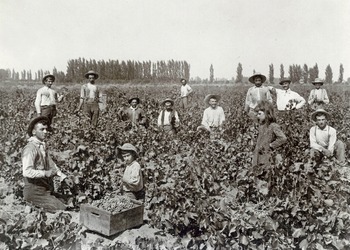
But times were not always good for this emergent empire. After the depression of 1893, a glut of raisins meant that their price dropped from 5 cents a pound on the vine to 3/4 of a cent a pound, and in some years growers sold them as feed for hogs and horses, or dug up their vines to replace with alfalfa.Footnote 58 It was a financial panic that accounted for the losses, but local press also blamed farmers hoping to make it big in the boom years, people who the newspapers claimed ‘hardly knew whether alfalfa grew on grape vines or grapes on alfalfa trees’.Footnote 59 Though few Armenians had been primarily grape growers in the Ottoman empire, a strikingly similar dynamic occurred with respect to property and viticulture in the faraway places. Much of the uncultivated land around Fresno had been acquired by M. Theodore Kearney, who then sold it with little money down to people on the condition that they improve the land with grapevines (the English settler’s tendencies were detailed in a publication entitled, appropriately enough, The Wasp).Footnote 60 When small holders could not pay their mortgages during busts such as in 1893, Kearney easily snapped up the properties again, this time with the land improved (Figure 2). (Upon his death without an heir in 1906, the estate of the ‘raisin king of America’ went to University of California, hence the Kearney Agricultural Research & Extension Center in Davis.) In the Ottoman empire, French protectionist policies as well as the vine louse phylloxera led to similar dispossession of raisin farmers by large landholders including Sultan Abdülhamid II.Footnote 61
Armenian workers in the vineyards of Kearney Ranch. Courtesy of Fresno Historical Society.

As Armenian growers gained prominence in the raisin industry, marketers attempted to unclog the system by which the commodities circulated. To expand markets, boosters planned a Raisin Day so that the public might better know the wonders of ‘the most delicious and the most healthful fruit bestowed upon mankind’.Footnote 62 Amidst regular articles on the ‘laxative effect’ of raisins, the Southern Pacific Rail company agreed to have raisins served in all of their dining cars on Raisin Day, and trade publications shared recipes (a sample: ‘one cup celery … 1/2 cup walnuts … 1/2 cup chopped raisins’ served with mayonnaise on lettuce).Footnote 63 The local Armenian press for its part began to regularly feature articles on what it called ‘raisinology’ (chʻamchʻabanutʻiwn).Footnote 64 With extensive Armenian involvement in Ottoman agronomy, it also reported on the comings and goings of experts such as Hovhannes Tashchean who brought knowledge of advanced drying methods with him when he arrived in Fresno from Izmir in 1913.Footnote 65 That same year newspapers claimed that Armenians controlled nearly a quarter of the raisin business.Footnote 66 By 1915 at the San Francisco World’s Fair in celebration of the completion of the Panama Canal, the California Raisin Company had begun the distinctive marketing campaigns from which it would later derive its name. Serpoohi Hagopian was one of many who played the role of the ‘Sun Maid Raisin girl with a bonnet’.Footnote 67
With figs, there was little ambiguity about their roots elsewhere, and Armenian involvement in their commerce invited both assimilation and denigration. The Seropian brothers quickly became involved in shipping figs. At first they were largely the White Adriatic variety, which were nearly perfect, gushed the industry press, although not as good as the fruit associated with the Ottoman empire’s region of Smyrna (also referred to as Izmir).Footnote 68 The brothers also sold dried figs, and stuffed them with walnuts, calling them fig dolma.Footnote 69 But getting the product to market was another issue. In 1894, the Seropians—protesting exorbitant shipping rates of the South Pacific Railway—ostentatiously shipped their bounty of figs and raisins not via the iron horse but rather via ‘two heavily laden freight wagons drawn by mules … slowly lumbering northward’.Footnote 70 It was, in the words of the San Francisco Examiner, ‘reminiscent of the days of ’49, long before the railroad came’. In this way the Armenian immigrants reenacted a previous episode of history to which they had not been party to, further embedding themselves in settler colonial narratives of place. At the same time, they played with notions of the exotic. As Wilson Wallis observed, ‘these long pack trains … must have had somewhat the appearance of donkey caravans one meets in Palestine’.Footnote 71 The stunt was enough of a success to help instigate a new railway line to compete with the Southern Pacific. While the Seropians’ cleverness expanded fruit markets, others blamed Armenians for their role in the fruit trade. A letter signed ‘one who has Fresno’s interest at heart’ in 1895 suggested that fig prices would fall like those of raisins because ‘a crowd of foreigners, partly Armenians … took exclusive control of the industry’ and allegedly improperly packed the fruits.Footnote 72 The only path to prosperity in the view of this writer was to keep fruit in the hands of presumably white packers.
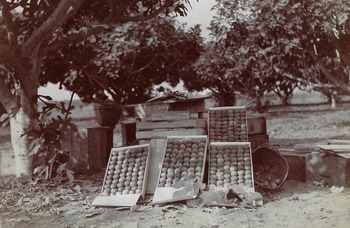
There were fewer anxieties about the fruits transplanted in the United States, and their production even invited a kind of economic nativism. The German George Roeding had been involved in Fresno irrigation politics for decades, and he had also long aimed to recreate the agriculture of western Anatolia in California.Footnote 73 In fact, many people were similarly motivated, and they journeyed inland of Izmir to the fig-growing heartland of the Menderes Valley near Aydın. There, in the realm of another fig king—Izmir-based Aram Hamparzum—people felt ‘anxiety’ as they saw foreigners ‘circling our fig trees, picking the best figs, examining them with a magnifying glass, smelling them, feeling them, sucking them’, and then, worst of all, ‘pulling out a notebook and taking notes’.Footnote 74 Having previously tried and failed to establish the vaunted Smyrna fig in California, Roeding learnt that the fruits never ripened because they required wasps from the Capri fig tree to pollinate and ripen the Smyrna fig. With the help of an Izmir Armenian named B. J. Agadjanian, Roeding finally succeeded in bringing the fig wasp to California in 1899.Footnote 75 By 1902, there were 750 acres of Smyrna figs growing in the vicinity of Fresno, and the Markarian family owned some 160 of those acres. Roeding insisted on another name for the fig that brought together Smyrna and California: and so it was the portmanteau Calimyrna, the most successful fig in the twentieth century United States (Figure 3).Footnote 76 By 1909, agronomists in the United States boasted that they had begun to displace some of the fig imports from the Ottoman empire.Footnote 77 Some understood the newly rooted trees in nationalist terms, claiming, with relief, that it was only a matter of time before ‘the million dollars annually paid to the Turks will be paid to the California grower’. In this regard, the story of Ottoman roots departs from that of Jeannie Shinozuka’s account of Japanese people and plants in the United States, both targeted by a co-constitutive form of ‘biological nativism’ in the same period.Footnote 78 By 1918, Henry Markarian was the head of the California Fig Growers’ Association, which the local Armenian press considered an honour to Armenians given that ‘foreigners’ had confidence in him.Footnote 79 Many felt bullish about the future. As one writer noted, ‘I desire to serve notice upon Spain, Portugal, Greece, Italy, and Smyrna that the citizens of the State of California are not going to quit … the people of California have just begun’.Footnote 80 Yet of course the clear battle lines of California versus the world were somewhat undermined by the fact that California’s agricultural bounty relied on, as Courtney Fullilove has written, ‘global nature as a reservoir’.Footnote 81
Calimyrna figs on George Roeding’s ranch. Roeding Collection, California Nursery Historical Park (Math/Science Nucleus).

The melon king of America
Melon cultivation—referring generally to the distinct fruits of cantaloupe, honeydew, and watermelon—took place on a less broad but nevertheless still significant basis. The Seropian brothers had claimed a ‘volunteer melon’ popped up on their land near the church ditch shortly after they settled there, an immaculate conception they attributed to ‘the fertility of the virgin soil and available water’.Footnote 82 But despite the Seropians’ early success, no one was associated with melon cultivation more than Krikor Arakelian (Figure 4). He had arrived in Fresno in September of 1883 with many others. After returning to Merzifon to study for college, he found himself imprisoned during the Armenian massacres of the 1890s, accused of having played a role in the assassination of another Armenian, his American passport having made him doubly suspect. After some diplomatic pressure, he was released, and left the Ottoman empire again.Footnote 83 His first act upon return to California was planting a 40-acre plot of watermelons. By 1909, he controlled around 80 per cent of the local crop.Footnote 84 One Fresno Armenian recalled the benevolence of Arakelian towards his compatriots: ‘he never forgot the many friends who come to America from Marsovan, Turkey. He gave them a chance to work for him somewhere in his packinghouse, packing shed or farm’.Footnote 85 With reports of ‘melons moving’, Arakelian had to employ two bookkeepers to track his doings.Footnote 86 His US Census entry from 1910 quite rightly listed him as a ‘melon merchant’.Footnote 87
Krikor Arakelian squatting beside Frank Markarian. Courtesy of Friends of the Fresno Fair, Armenian Exhibit.

Arakelian’s success—along with that of his brother, Harutune—rested on the knitting together of faraway places, both in terms of markets and seeds. To be sure, the San Joaquin Valley was a special place for such alchemical botany. One grower wrote to the Fresno Herald in 1912 about a 28-pound ‘fruit freak’ that seemed a cross between a muskmelon, casaba, and pumpkin that he wished help with (in lieu of a certain name, he dubbed it muskasabakin).Footnote 88 As the Fresno Herald reported in the early days of the First World War, ‘Fresnans have for some [time] been eating muskmelons and Casaba melons produced in only two places in the world—Fresno and the Euphrates river in Western Asia’.Footnote 89 The long-distance linkages enabled by seeds brought from the ‘fatherland’ rested on geographical similarities, including the ‘black and sandy loam’ as well as ‘dry and warm’ climates of the Euphrates and San Joaquin Valleys. Farmers allowed that the melons were bigger on the Euphrates, but agreed that ‘cantaloupes as big as ordinary watermelons’ ought to be considered a triumph. Their melon success also invited confusion in terminology. They were ‘Turkish melons’, wrote the Herald, but ‘more properly called Armenian melons, here’.
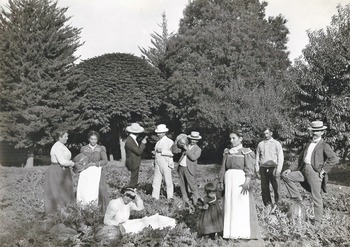
Whatever the melons were called—yellow watermelon, Kasaba melon, Diarbekir melon, the Turkish melon, the Persian melon were just a few additional names—they made Arakelian rich, and inflected the way his family put down roots (Figure 5).Footnote 90 With his label of Mission Bell, he grounded his distinctive product in the colonial imagery of California’s Spanish heritage (but also perhaps subtly gestured to the politics of bells in his hometown of Merzifon). Crowned the ‘melon king’, he also elected to change his crop of choice, acquiring vineyards, before eventually going into the wine business, and, as many California stories are wont to go, even having a dalliance with a healer in Palm Springs. But before all of this, the Arakelian family left a relic that stayed true to its roots. In one Arakelian family photo album held at the Bancroft Library at Berkeley, almost all of the images showed jaunty picnics and leisurely trips to the beaches of Southern California aside from one, a work of collage that replaced the family-brand Mission Bell cantaloupes on a vine with the faces of some of the women in the family with the caption of ‘Mission Belles’ (Figure 6).
Arakelian family with watermelons. Courtesy of Friends of the Fresno Fair, Armenian Exhibit.

‘Mission Belles’. Arakelian Family Album: An Armenian Family in Fresno, Calif., University Archives, BANC PIC 1998.039—ffALB, The Bancroft Library, University of California, Berkeley.

The kings may have received most attention, but it was ordinary people and back-breaking labour that made their power possible. In the agricultural sector, Armenians were known for attempting to acquire land as soon as possible.Footnote 91 But for those who did not own their own land or rent it, they typically worked for less than $2 a day as labourers on farms or in packing houses.Footnote 92 Excluded by the racism of many Anglo farmers, they frequently worked on Armenian-owned farms. Women engaged in the labour of farmwork, too, alongside domestic tasks, which included, of course, preparing foods such as stuffed grape leaves. Women also found work in packing houses and canneries, often alongside children, who made money while moving with the fruit harvest from the south to the north.Footnote 93 At times, there were tensions between smaller growers and the more prominent ones, particularly when it came to the question of contracts.Footnote 94
From a distance, Ottoman officials watched, and worried. Consular reports spoke of anxieties about an Armenian union (Haykakan miut’iwn) formed in California with an aim of placing revolutionaries disguised as Muslims in eastern Anatolia (of their language skills, one informant called their Turkish ‘pretty good’, their Kurdish even better).Footnote 95 Yet intercepted Armenian-language letters conveyed a different message. ‘We eat things like meatballs (köfte), stuffed vegetables (dolma), tomatoes, and beans here … the city of Fresno has turned into Turkey’, read one letter from Fresno to the Ottoman empire that elicited enough concern to be translated into Ottoman.Footnote 96 The Arakelian family photo perhaps pointed to a similar dynamic, and the resonance of fruit agriculture for this trajectory. If watermelons could stand in for boats in Fresno, cantaloupes could apparently stand in for people, newly rooted in place.
Turkish Armenians and Fresno Indians
Left out of many of the celebratory accounts of the local Armenian community is the role that race played in shaping labour relations in Fresno’s expanding fruit cultures. When Armenians arrived in Fresno in 1883, they did so in the shadow of the Chinese Exclusion Act of 1882, which exhibited a ‘twisted agrarian rhetoric’ resting on the dream of white agricultural labour.Footnote 97 Chinese migrant labour remained present into the late 1880s particularly in the larger vineyards. But as Gustav Eisen put it with choice language in 1890, ‘the country now swarms with pickers of all nationalities—Germans, Armenians, Chinese, Americans, Scandinavians, etc’.Footnote 98 Others took a more interventionist approach. Given that every so often ‘a howl goes up against employing Chinese labor’ in grape picking, one writer in the San Francisco Chronicle wondered whether growers might rely on a ‘colony of Armenians’ seeing as they were ‘industrious, intelligent workers’.Footnote 99 In an emphasis revealing of the place of Armenians within racial hierarchies, the writer insisted, however, that any long-term solution required securing ‘Eastern help to come to California’ so as to preserve ‘white labour’. In 1893, these policies took the form of violent attacks on Chinese labourers during the raisin harvest near Fresno, and the recruitment of Japanese labourers increased.Footnote 100
As Armenians sank roots, they positioned themselves as part of the broader settler vision of transforming an arid land into a bountiful one. Perhaps the starkest example of this dynamic was the fruit of a plan by some Armenian community leaders to form a town in the foothills of the Sierra Nevada south-east of Fresno. They considered a few names, among them Cilicia, Marash, Ararat, Massis, and Adana, all referring to places with a particular Armenian resonance in the Ottoman empire.Footnote 101 But by 1905 they settled on something else: Yettem, Armenian for Eden. After initially focusing on tobacco cultivation, they shifted to Thompson’s seedless grapes in the early twentieth century.Footnote 102 As Ani Mnatsakanyan has suggested, this was ‘transplanted heritage’ for ‘uprooted communities’.Footnote 103 While few Armenians remain in the small town, St Mary’s Apostolic Church does, its distinctive steeple reaching out of the pomegranate and lime trees now growing there. Armenians all around the world celebrate the Blessing of the Grapes festival in August, and St Mary’s continues to uphold the tradition in Yettem.Footnote 104
While implanting themselves among one of the most resonant settler discourses, Armenians also grappled with an ambiguous whiteness. In the early years of settlement, Armenian school children were taunted as Turks.Footnote 105 When the American missionary Miss Peabody learnt of this treatment, she endeavoured, during a trip to California, to disabuse locals of this misconception, suggesting, in choice language, that ‘the Armenians … were as different a people from the Turks as the Americans were different from the Indians’.Footnote 106 This phrasing might have had particular resonance. Less than half a century from a Central Valley in which Native Americans represented the majority of the population, Yettem-native Charles Davidian recalled being asked if he was an Indian, and, after he replied affirmatively that he was from the ‘Fresno branch’, was asked if ‘they eat grape leaves like you’.Footnote 107 The historian Richard Hovannisian—for whom the Hovannisian Endowed Chair of Modern Armenian History at UCLA took its name, and father of the first foreign minister of Armenia—recalled the description of Fresno Indians and, though unclear on its precise origin, he remembered that he did all he could to ‘become as white as possible’ and ‘disassociate myself from being a Fresno Armenian’.Footnote 108 In addition to being likened to Indians, Armenians also received slurs commonly directed at Italians and African Americans.Footnote 109 As Bedros Torosian has suggested, the emerging Armenian American community attempted to consolidate their sense of belonging in this context through assimilation to whiteness. Fresno’s Armenian-language newspaper Asparez underscored this commitment, going so far as to advise the community to avoid foods like garlic and onions as well as beasts of burden like the donkey, a ‘symbol of sluggishness’ that had no place in modern American agriculture.Footnote 110
With the First World War and the horrors of the Armenian genocide, representations of Armenian suffering were refracted through the prism of American settler colonialism. The sometimes contradictory set of symbols generally brought Armenians closer to whiteness. When the Ottoman interior minister Talat Pasha told the US ambassador Henry Morgenthau of his party’s plans to deport Armenians to the deserts of Dayr al-Zur, he boasted of treating the Armenians like Americans treated ‘the negroes’.Footnote 111 Morgenthau wrote in his journal, ‘I think he means like the Indians.’ If the violence was inspired in some ways by American example, others interpreted it according to a different civilizational hierarchy. Arnold Toynbee—who would go on to become one of the most celebrated historians of the twentieth century—wrote as part of his job in British intelligence that the massacres of Armenians were all the worse because Armenians ‘were not savages, like the Red Indians who retired before the White Man across the American continent … they were people living the same life as ourselves’.Footnote 112 Meanwhile, in the wake of the war, Woodrow Wilson referred to Turks as ‘the Mohammedan Apache’, and the American ambassador to Germany called for them to live on reservations as were used for Native Americans.Footnote 113 While the symbols shifted, they attested to a clear sense of the violence as an outrage against a nascent vision of humanitarianism nurtured by, as Keith Watenpaugh has suggested, notions of whiteness rooted in the differential sympathy of missionary Christianity.Footnote 114
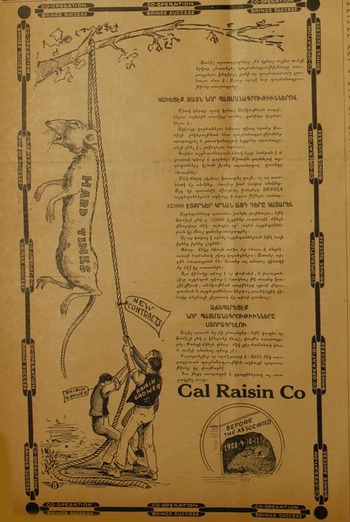
Significantly, these symbols all shared the grammar of American settler colonial violence and racial capitalism. During the First World War, conflicts between growers and packers led to a particularly potent articulation of this relationship. An ad taken out in the Armenian-language Fresno newspaper Asparez by the California Raisin Co. (later Sun Maid) brought together the symbolism of racial violence and agricultural productivity. Asparez had been founded in Fresno in 1908, and in its first years was ‘the most widely read Armenian newspaper in the country’.Footnote 115 In the image, men identified as raisin growers lynch a rodent of unusual size labelled as ‘hard times’ on what might be a leafy plane tree branch with the help of a rope representing ‘new contracts’ (Figure 7).Footnote 116 The direct aim of the ad was to encourage raisin producers to sign a new contract. But the symbolism also reoriented Armenian growers into a particular position with respect to the premier mechanism of racial violence in post–Civil War America. If, as Claire Jean Kim has suggested, the racial logic of the United States placed ‘all nonwhites into a borderlands between human and animal’, the lynching of an agricultural pest by raisin growers strikingly redrew borders to present Armenians as white, human, and agriculturally productive.Footnote 117 This process overlapped with a broader settler narrative of environmental transformation, evident, for example, in Paul Vandor’s 1919 History of Fresno County, which described how ‘no people of modern times have been so persecuted in their native country as the Armenians’ but luckily the United States was ‘a haven of refuge as in the earlier days of its colonial history when the Pilgrim Fathers sought a home beyond the sea’.Footnote 118
Asparez, 28 December 1917.

If the violence of the genocide occasioned a shift in racial hierarchies, the interwar period also made Armenians invisible in relation to agriculture and race in California. At this time, xenophobia clustered around those from East Asia more than those from West Asia. Anxieties dated back decades, but the Japanese community, in particular, was targeted by the 1913 Alien Land Law, which prohibited land ownership or rental by non-citizens.Footnote 119 Perhaps the most striking example of the sudden absence of Armenians was the California governor’s letter to US Secretary of State that accompanied the State Board of Control’s report California and the Oriental. William Stephens wrote of the Pacific and his perception of the state’s immigration problems: ‘We stand today at this point of western contact with the Orient, just as the Greeks who settled in Asia Minor three thousand years ago stood at its eastern point’.Footnote 120 In other words, Stephens suggested that he and others were hardy representatives of Western culture in Asia Minor to justify anti-Asian racism. At the same time, he likely ate produce from the actual Asia Minor by way of the San Joaquin from land owned, rented, or worked by actual people born in Asia Minor. This is how unnoticed Armenians were both as a threat and as a success.
Black Turks and the Raisin Ku Klux Klan
In the midst and the wake of the genocide, Armenians went to the San Joaquin Valley and tried to channel its fruits toward help. As early as November of 1915, the Armenians of Fresno raised some $25,000 (the melon king Krikor Arakelian donated $2,500).Footnote 121 At the same time, many Armenians came to the valley and took up grape production. Their efforts were supported by a robust wartime raisin market. Stephen Barooshian had ended up in an orphanage after losing his family during the Hamidian massacres.Footnote 122 He eventually made it to the San Joaquin Valley, where he remembered the click of backgammon played by farmers during his first summer in the vineyards and saw the benefit of the ‘clean dry air of the farm’.Footnote 123 Staying in a tool shed in the vineyard, he tied the Thompson vines to the posts and did the hard work of hoeing the grass around the vines.Footnote 124 Around the same time, he recalled hearing news of the genocide on the radio.Footnote 125 As grower Charles Bonner put it in agricultural terms, the ‘“seed” population’ of Armenians already in Fresno attracted more in the wake of the genocide.Footnote 126 In an oral history, he described how the ‘Armenian population from Turkey … had been subjected to a terrible ordeal over there and they came here in droves’, bringing their ‘expert labor’.Footnote 127
But with booms also came busts, and the raisin bust of 1922 greatly restructured the nature of San Joaquin Valley raisin production even as some racial symbols remained potent. One of the foremost figures in this regard was Arpaxat Setrakian. Better known in raisin circles as Sox, he was born in Bitlis in 1885, and his father was killed in the Hamidian massacres in 1895.Footnote 128 His whole family moved to Izmir, and by 1905 they were in California. Setrakian first worked as a street car cleaner in San Francisco but, when the street car cleaners struck, he found himself drifting ‘to the watermelon business’.Footnote 129 Eventually he became a lawyer (famous for both his ability to make a jury cry and his own lachrymose tendencies), but he also acquired extensive landholdings in vineyards.Footnote 130 In 1922 the land market collapsed.Footnote 131 As he recalled in a story he told at his retirement dinner in 1972, Setrakian received a call at a hotel from the head of the California Associated Raisin Company instructing him to return to Fresno.Footnote 132 Dating to the early twentieth century, there had been periodic efforts by packers to consolidate control of the raisin market so as to negotiate better prices for the raisin crops. Armenians had often been seen as resistant to these efforts at cooperation. A 1920 US government suit against the Raisin Company even charged that the organization pressured ‘imperfectly Americanized’ growers—largely Armenians—into signing contracts (though many Armenian growers objected to this claim).Footnote 133 It was as part of this history that the bosses were calling on Setrakian, hoping he might convince his compatriots. They were to have a meeting the next day in a park. Setrakian described it as ‘one of the beautiful Fresno nights’. While waiting for the festivities to begin, ‘a couple of fellows passed by with a big rope in their hands, and one said to the other, “You know,” he said, “It’s a hell of a good night to hang an Armenian.”’ When Setrakian relayed these words to his corporate colleagues, they assured him, ‘Don’t get frightened. They won’t do it to you.’ Apparently not reassured, when Setrakian took the stage, he grabbed an American flag and cloaked himself in it, and warned that if ‘anyone … doesn’t sign this contract, there is a place reserved for him in a bottomless hell’.Footnote 134 It is of course difficult to trust the account of such a florid orator half a century after the events, one perhaps fuelled by the menu of prime rib and brandied raisin jubilee no less. Yet the threat of lynching nevertheless resonates, with repeated references to it amidst the tangled racial politics of the San Joaquin Valley. It was not only that just a few years before a cartoon depicting the lynching of a rat had encouraged raisin growers to sign a new contract. It was also that only a few years later, in May of 1929, a Syrian grocery store owner named Nola Romey—another immigrant with a tenuous hold on whiteness—was lynched in Lake City, Florida.Footnote 135
In yet another instance of complicated integration, the raisins of the San Joaquin Valley grown by Armenians who had survived the genocide were sent back to the former Ottoman lands as donations for orphans. A total of 26 tons of raisins were donated by ‘Fresno Armenians’ in 1923 to the Near East Relief organization.Footnote 136 Umut Yıldırım has described the remnants of mulberry trees along the banks of the Tigris near Diyarbakır (Digranakert) and the Armenian silk worlds they pointed to as ‘mulberry affects’, constituting ‘literal and affective roots resisting’ the seemingly settled nature of history.Footnote 137 The grapes of Fresno were a variation on this theme. Yet they functioned not only in an archival sense, with roots as a record of what once was. They also functioned in a real material sense as succour for those suffering in the wake of the genocide. Raisins that seemed quite like the sultanas of Izmir cared for by migrants from the Ottoman empire in California came to nourish survivors of imperial violence.
No one appreciated the rise of fruit (and saw through the hype) better than the walrus-moustachioed bard of Fresno himself, William Saroyan. As Aram Ghoogasian has argued, the single ‘most recognizable Armenian name in twentieth-century American letters’ has long suffered, being either dismissed as unserious, pigeonholed into ethnic literature, or appropriated for nationalist ends.Footnote 138 Yet Saroyan’s work, in Ghoogasian’s words, ‘has the potential to unsettle and disorient notions of home and geography’. One realm in which this is the case is the landscape of agricultural production and capitalist speculation, as fruit rooted Armenians but also exposed them to the destabilizing forces of the market—what George Henderson has described as the volatile ‘alchemy’ of nature and capital.Footnote 139 In this sense, Saroyan is not only an Armenian American writer but also a California writer. In his short story ‘Raisins’, Saroyan presents history from the view of the dried grapes and the people whose labour produced them. He would know; like many, his father left behind his trade in the old country to take up grape cultivation in Fresno.Footnote 140 Saroyan uses a stark distinction between desert and sown, drawing on biblical imagery of wilderness and production as well as Lockean notions of improvement, namely the idea that the labour of cultivation justified property. ‘A man could walk four or five miles in any direction from the heart of our city and see our streets dwindle to land and weeds. In many places the land would be vineyard and orchard land, but in most places it would be desert land’, Saroyan declared of Fresno.Footnote 141 The descriptions of course resonated with many narratives of settler colonial environmental transformation. But this was not only an American story. Saroyan may have known this, and his father and mother Armenak and Takuhi—natives of Bitlis in the Ottoman empire—would have well known what such weedy, untilled forgotten lands were called in the Ottoman legal lexicon: dead (mevat) lands referred to those uncultivated lands that were either (1) a fifteen minute walk from the closest settlement, (2) the distance at which one could no longer hear a shout, or (3) a mile away. Someone could obtain title to such lands on the condition that they revived it through planting crops and working the land for several years. The Ottoman notion of securing property rights through fruit tree cultivation may well have infused Armenian growers’ vision of what they had accomplished. Indeed, for Saroyan, the notion of the desert as ‘dead’ land seemed very clear. In ‘the quietness of deserts’, one could easily see, he wrote in the voice of the community itself, that ‘we had come to this dry area that was without history’. And yet it was precisely a history of settler colonial agrarianism that shaped this equation of aridity with the absence of history.
Even after Setrakian’s performance of wrapping himself in the flag, raisin supply chains invited racial animosity. Well into the 1920s, the Sun Maid corporation’s recruitment drew a colour line, as had been the case in its vivid advertisement encouraging Armenian growers to lynch the rat of bad times by ratifying a contract, and as had been the case with Setrakian. Although the corporation’s own history blithely declares ‘Sun-Maid’s grower membership has always consisted of a variety of ethnic groups’, it omits the degree of violence involved in this process.Footnote 142 Anooshavan Der Mugrdechian had been a revolutionary in the Ottoman empire, serving as a captain in a Ramgavar regiment.Footnote 143 In California, he struggled with raisin cultivation, but when twenty men from Sun Maid attempted to force him to join the association, Der Mugrdechian knew what to do: ‘having been harassed, beaten, shot at and imprisoned by Tashnags and Turks … Anooshavan rushed out of the house, fired a shot from his Lueger into the air, and shouted, “The next shot is for the man who comes one step closer. Get off my land”’.Footnote 144 Another grower threatened the Sun Maid men with ‘a huge wooden grape stake’.Footnote 145 At a time of a resurgent Ku Klux Klan that boasted no shortage of members among the Fresno police, the ‘night riders’ of Sun Maid revealed a similar racial logic, as their nocturnal visits to Japanese and Armenian farms left behind burned grapevines.Footnote 146 One grower called them the ‘Raisin Ku Klux Klan’.Footnote 147 In 1923, some 75–100 men visited the farm rented by the Der Torosian family and, surrounding the house, called out ‘Come out, you black Turks.’ The Der Torosians responded with gunfire.Footnote 148 Another intimidation tactic that travelled from the American South was the burning cross, which appeared throughout California’s agrarian landscape in the 1930s.Footnote 149 Thus even as Armenians secured legal claims to whiteness in the 1925 court decision in US v. Cartozian, elements of racial precarity nevertheless remained amidst the vines and fruit trees that had made their new home quite like their old homes. The threat of racial violence pressured the smallholding Armenian outfits—a relative anomaly in California agriculture—to channel their produce via broader cooperative organizations. Notably, these organizations often included larger Armenian growers among their trustees, underscoring how the colour line was drawn according to economic power as much as ethnic background itself.Footnote 150
Leaving aside the racial lines of fruit production, there was also the precarity of any large-scale commodity production. Saroyan adeptly captured suspicion of these dynamics. Of the visionary leader of the Sun-Maid Raisin Association, Saroyan wrote how he promised that people the world over would eat Fresno raisins, and Fresno’s farmers would taste prosperity. ‘We were not lost in the wilderness’, wrote Saroyan with sarcasm and ecological consideration, ‘because the name of our city was printed in the Saturday Evening Post’.Footnote 151 As in this line, so too in others, Saroyan revealed a distinct tone of melancholy, a sense that for all of the transformation, Fresno was ‘small and almost pathetic’ (a status that would later make it a target of the 1980s parody of Dallas entitled ‘Fresno’). Saroyan sensed doubt amidst fantastic schemes such as, for example, trying to open up a market for raisins in China. And when the market turned—an allusion to 1922—Saroyan suggested that in fact no transformation of the desert had occurred; that, in fact, the town and its Armenians remained very much ‘contemporaries of jack-rabbits’. Saroyan closed with an image redolent of the dark humour attached to the rise and fall of Fresno’s raisin market. ‘People couldn’t eat raisins because they were a luxury, and we had to eat raisins because they were a luxury.’ While many stayed and endured the financial upheavals, others left.
Drying and packing memory
‘It is not only America’s, but the whole world’s most famous fruit city’, declared the Turkish journalist and writer Hikmet Feridun Es upon visiting Fresno in 1948.Footnote 152 He exaggerated, but not entirely. After all, in the 1920s one of the most popular colours in London fashion circles was ‘Fresno raisin’.Footnote 153 And for decades, the Turkish agronomical press had worried about the rise of ‘Izmir figs’ or grapes in California.Footnote 154 Es, for his part, told a story that went beyond macroeconomics. He went to the city with nervousness, fearing that genocide survivors—or, in his view, dangerous revolutionaries—might seek revenge.Footnote 155 Instead, they offered him Turkish coffee, asked in Turkish how Istanbul was.Footnote 156 Es described Fresno as a ‘more comfortable Kumkapı’—an Armenian neighbourhood in Istanbul—in America.Footnote 157 But it was not until he was at the home of a Yozgat Armenian named Nazlı Hanım that he wrote, ‘I admit that in the unofficial centre of the Tashnak’—the Armenian Revolutionary Federation—‘the hospitality was to such an extent that it put us to shame’.Footnote 158 Nazlı gave him pomegranates and nuts that she had seeded and shelled herself. She even offered him some Turkish rozaki grapes. She added, ‘Fresno is famous for the Sultan grapes’, better known as Thompson’s seedless. Meanwhile, Es observed that ‘the Fresno Armenians’ treated ‘the matter of figs with as much importance as a Tashnak issue. Now everyone in the Mecca of Armenians is mobilized to grow a fig more delicious than Izmir.’ Even the University of California was helping.
As the observations of the Turkish journalist underscored, if California was the centre of American fruit and vegetable production, it was so in part thanks to the bounty of the Ottoman empire. Seeds for grapes, figs, and melons all made their way to the United States, and so too did Armenians, who found a place as smallholders between marginalized migrant labourers and large landholders. Some turned their fruit production into fortunes and claims to royalty—the melon king of America, the fig king of Fresno, etc.—but others found a more precarious position amidst agricultural settler colonialism and its cultural signifiers. Armenians were called black Turks, Fresno Indians, and threatened with night riders of the Raisin Ku Klux Klan. At the same time, the violence of the genocide was described as all the worse since they were not ‘backward’ Indigenous populations but were in fact threatened by Muhammadan Apaches, and moreover encouraged to lynch the rat of hard times by joining the raisin cooperatives. Whether being presented as white or not, they struggled to hold on. The market brought profits, but also the danger of going bust.
As the region transformed in the twentieth century, some turned the produce of the San Joaquin Valley into something else: the material backing for commemoration and knowledge production. Even as large-scale agribusiness expanded, the majority of fruit packers outside of Sun Maid were Armenian American. No shortage of Fresno families with money in fruit—as well as Sun-Maid Growers of California—donated to the Armenian genocide memorial on the campus of Fresno State University. The university’s endowed chair in Armenian Studies was established in 1988 thanks to the generosity of Arnold and Dianne Gazarian in honour of Haig and Isabel Berberian—the former a Harput-native, and recognized as the ‘walnut king’ of California. Richard Hovannisian—whose own mother, Siranoush, explained her family going to Fresno because ‘raisins went sky high’—recalled, ‘people think … the grapes just grow and they turn into raisins, but not so’.Footnote 159 It was ‘backbreaking labour’ and as a result he ‘never liked the farm’ that his family acquired outside of Tulare, and he worked hard to assimilate and get out. And yet he also came back. Among his bequeathments to the world is an extensive collection of oral histories of genocide survivors and community members collected by students in his classes at UCLA, and held at USC’s Shoah Foundation. Some of them take place amidst the grape fields of Fresno.Footnote 160
The story is an Armenian one, to be sure, but the rich soils and social worlds of the San Joaquin Valley ensured that it could never be only Armenian. David Masumoto recalled attending the annual Armenian blessing of the grapes as a child in the 1960s. He asked his father if there was a Japanese equivalent. His father told him they didn’t grow grapes in Japan and young Masumoto said, ‘I guess we need to rely on the Armenians to help bless our raisins’.Footnote 161 Long before the revolutionary Monte Melkonian (1957-93) became known for an internationalist politics that saw him, among other things, training with the Palestine Liberation Organization in Beirut as part of the Armenian Secret Army for the Liberation of Armenia, he was born in Visalia, the grandson of raisin farmers and agricultural labourers, one of whom—Yemima—had arrived in Fresno from Merzifon in 1883. When people were racist towards him it was not as a ‘Fresno Indian’, but rather because he was mistaken for being Chicano.Footnote 162 Charles Garry (1909–91)—born Garabed Garabedian—learnt to challenge racism on the schoolyard and in the canneries of Sanger, California, where he was taunted as a ‘goddamned Armenian’ and witnessed the denigration of Japanese and Mexican workers.Footnote 163 He went on to work as lawyer for the Black Panther Party. In these experiences, a kind of solidarity could emerge, even as the landscape changed (the site of the first fig trees of the Markarian family is now a mall parking lot beside a Chipotle).Footnote 164
But as some trees have come down, other structures have emerged. In 2013, third-generation family farmer Dennis Simonian constructed the ‘Soul Consoling Tower’ near his fields, a wooden obelisk built from the remains of the internment camp at Poston, Arizona, where thousands of Japanese Americans—some of them from Fresno—were incarcerated during the Second World War.Footnote 165 Simonian dedicated the monument to the Japanese American families from whom he learnt to care for fruit. That it was an Armenian American—who had lived in the shadow of the internal deportations and genocide of 1915—who chose to commemorate the internal deportation and incarceration of Japanese Americans was no accident. Nor was it one that it was built in the San Joaquin Valley of California, a place where fruit culture brought Ottoman, American, and many other worlds together.
Acknowledgements
Barlow Der Mugrdechian graciously welcomed me to Fresno in September of 2023, and guided my research with generosity. Jason and Jeff Ahronian kindly showed me around the wonderful Agriculture Exhibit at the Big Fresno Fair, and answered many questions about some of the photos displayed with this article. The work was greatly helped by archivists, librarians, and workers at a number of institutions, including Tricia Totherow at the Fresno State University Viticulture and Enology Library, Suzanne López at the Fresno State University Library Special Collections, Melissa Scroggins at the Heritage Center of the Fresno County Public Library, and Jennine Scarboro at UC Berkeley. Aram Ghoogasian provided exceptional assistance with Armenian sources, and was an incisive reader. Jennifer Manoukian helpfully sent along copies of the Hikmet Feridun Es articles. Deanna Cachoian-Schanz, Can Gümüş-İspir, Marianna Hovanissian, and David Kazanjian encouraged my questions about people, place, and plants. In draft form, the paper benefitted from the collective wisdom of the Ottoman History Workshop at the Robert Penn Warren Center for the Humanities at Vanderbilt, particularly Julia Phillips Cohen, Alex Dubilet, Eric Moses Gurevitch, Leor Halevi, Helen Makhdoumian, Andrew Patrick, Ruth Rogaski, Mark Sanchez, and Samira Sheikh. Önder Eren Akgül, Ella Fratantuono, Paul Kramer, Michelle Tusan, Arianne Sedef Urus, Patrick Whitmarsh, and Duygu Yıldırım also provided helpful feedback. And the smart students of Vanderbilt University’s History 3000W: Environmental History patiently read some of my first attempts at an introduction. Finally, I am grateful to the reviewers of the article for their astute observations. All mistakes are my own.
Financial support
The author relied on research funding from Vanderbilt University.
Competing Interests
The author declares none.
Samuel Dolbee is an assistant professor of history at Vanderbilt University. His first book, Locusts of Power: Borders, Empire, and Environment in the Modern Middle East, was published in 2023 by Cambridge University Press.




 Open access

