1. Introduction
Turbulence is the chaotic state of a fluid sustained by nonlinear interactions that transfer the injected energy over a large range of scales. As nicely unified by Galtier (Reference Galtier2022) in a single book, two very different regimes of turbulence exist, depending on the strength of the underlying nonlinear interactions: the strong ‘eddy’ turbulence and the weak ‘wave’ turbulence. The former is the most well known, starting with its seminal description in terms of the Kolmogorov cascade. But wave turbulence is actually equally relevant in nature, and has been a continuous subject of scientific interest since its first theoretical developments in the 1960s. Note that weak turbulence and strong turbulence do not live apart: they can coexist and compete, and one can emerge from the other.
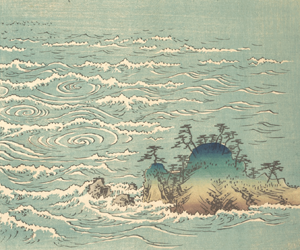
As an illustration, let us think of the ocean surface (see also figure 1): wave turbulence corresponds to small-amplitude surface waves in the open sea, initially excited by winds and with energy and action redistributed over various scales by weak nonlinear interactions; while eddy turbulence corresponds to strong currents, vortices and breaking waves in regions of intense activity, e.g. close to a shore or in the vicinity of a bathymetric feature. Beyond the ocean surface, wave turbulence generically exists in all dispersive wave-sustaining systems. Of obvious relevance to geophysical and astrophysical flows, these include conducting fluids with magnetohydrodynamic waves (e.g. Galtier et al. Reference Galtier, Nazarenko, Newell and Pouquet2000), stably stratified fluids with internal gravity waves (e.g. Savaro et al. Reference Savaro, Campagne, Linares, Augier, Sommeria, Valran, Viboud and Mordant2020) and rotating fluids with inertial waves (e.g. Le Reun, Favier & Le Bars Reference Le Reun, Favier and Le Bars2021). Wave turbulence thus potentially plays an active role in stellar dynamics, in ocean mixing and the ocean energy budget and in planetary magnetic fields. Beyond fluids, wave turbulence also takes place in vibrating plates (e.g. Cobelli et al. Reference Cobelli, Petitjeans, Maurel, Pagneux and Mordant2009), in optics (e.g. Picozzi et al. Reference Picozzi, Garnier, Hansson, Suret, Randoux, Millot and Christodoulides2014) and even in cosmology with gravitational waves (e.g. Galtier & Nazarenko Reference Galtier and Nazarenko2017). This list of cases and references is of course not exhaustive, but it illustrates the large range of applications of this relatively poorly known phenomenon compared with strong turbulence.
Figure 1.The Whirlpools of Awa by Utagawa Hiroshige (1857). Image from The Met collection. This triptych schematically illustrates the coexistence of weak wave turbulence on the left and in the far field, taking the form of small ripples, and of strong eddy turbulence in the front centre and right, with intense swirls and breaking waves.
Wave turbulence is first a playground for theoreticians (see e.g. Zakharov, L'vov & Falkovich Reference Zakharov, L'vov and Falkovich1992; Nazarenko Reference Nazarenko2011): the assumption of weak nonlinear interactions allows for an asymptotic approach of the governing equations and for elegant spectral theories based on a few simplifying assumptions, including random phases and Gaussian distributions of wave properties. The main theoretical challenges are similar to those of strong turbulence: to model the mechanisms and direction of transfers across scales, including the transfer of energy of course but also of other invariants like wave action, and to provide a spectral description of the statistically steady saturated state. Wave turbulence is also a great challenge for numericists and experimentalists who aim to connect idealized theories and applications. As recently reviewed for surface waves by Falcon & Mordant (Reference Falcon and Mordant2022), laboratory experiments are intrinsically complex compared with theoretical hypotheses. For instance, the finite size of an experimental system obviously influences the largest scales of the dynamics, but also discretizes intermediate scales which still feel the boundaries. Laboratory experiments are also subject to various kinds of dissipation that perturb the transfers across scales. And laboratory experiments also necessitate finite (and not vanishingly small) levels of nonlinearity to trigger turbulence which might then excite other unwanted nonlinear effects. Note that in metrology it is also always challenging to provide a satisfying space and time description of the ongoing dynamics. In numerical simulations, the great challenge is to perform long-duration, high-resolution computations over large ranges of scale in order to obtain converged statistics describing a fully established dynamics. All these difficulties and potential applications make wave turbulence a lively, fascinating subject of interdisciplinary, multi-method research.
2. Overview
The paper by Thomas & Ding (Reference Thomas and Ding2023) thoroughly contributes to this intense scientific activity. It investigates, for the first time by direct numerical integration of the constitutive equations, the upscale transfer of waves in a rotating shallow water (RSW) system.
The RSW equations are obtained by depth-integrating the rotating, constant density Navier–Stokes equations with a free surface in the limit where the horizontal length scale is much greater than the vertical one. Mass conservation then implies that the vertical fluid velocity is small compared with the horizontal one: vertical pressure is nearly hydrostatic, and horizontal motions and pressure gradients are connected to displacements of the free surface. This system of equations is widely used in the oceanic and atmospheric communities to test concepts and ideas in a simplified but realistic setting (see e.g. Zeitlin Reference Zeitlin2018). In particular, the RSW system of equations supports both vortices and inertia-gravity waves, which makes it a perfect framework to tackle geophysical turbulence. Independent theories predict both an inverse energy cascade and a direct enstrophy cascade for eddy turbulence, and a direct energy cascade and an inverse wave action cascade for wave turbulence. The details of the resulting flow are hardly foreseeable, as the full integration of RSW equations remains out of reach.
To tackle part of the challenge in better understanding and modelling geophysical turbulence, Thomas & Ding (Reference Thomas and Ding2023) make further analytical and numerical simplifications, with the objective of focusing on the theoretically predicted inverse cascade of wave action. They first discard one horizontal space direction in addition to the vortical mode. They then force their system at relatively large localized wavenumbers and use hyperdiffusion to rapidly remove energy from small scales, acknowledging that the direct energy cascade is already well studied. Doing so, they are able to solve the RSW equations over a large inertial range with more than two decades between the forcing and the large scales, and to perform high-resolution calculations over the long durations necessary for a statistically converged state to emerge from the very slow inverse cascade process, also accounting for intermittent events.
Their main results are the following. As predicted by the theory, the upscale wave transfer is a robust feature driven predominantly by quartic resonant interactions, even if near-resonant and non-resonant transfers also exist. Transfer of wave action is a non-local process involving disparate scales, distinguishing wave turbulence from the classical view of the Kolmogorov cascade. The slope of the measured spectra falls in the theoretically predicted range; it becomes steeper when the rotation rate increases, also as expected theoretically. However, a deeper analysis of the numerical simulations exhibits strong differences from the theory and its underlying assumptions. Upscale wave transfer is associated with rare, localized-in-time, intense positive bursts in the flux of wave action, which reflect as a transient shallower slope in the associated spectrum. This intermittency is observed over the inertial range and in the wave physical structure, while it is not accounted for in theories that assume an equilibrium solution. In addition, the departure of wave phases and amplitudes from, respectively, idealized random and Gaussian distributions is systematically observed, especially at large scales. Hence, a pessimistic conclusion from these numerical results would be that theory predicts the relevant large-scale behaviour but for the wrong reasons. At the very least, these results add to the already existing list of experimental and numerical evidence from other wave turbulence configurations that should foster an improvement of the theoretical foundations of geophysical turbulence.
3. Future
Before jumping to conclusions, one must not forget the intrinsic limitations of the present study, namely that it focuses on the one-dimensional RSW dynamics discarding the vortical mode. It will be interesting to test whether or not the upscale transfer of waves is still efficient when competing with vortices transferring energy upscale in two dimensions. This is the next challenge awaiting follow-up studies on this work, with the possibility of help from laboratory experiments, acknowledging the complexity already present in the absence of rotation (Falcon & Mordant Reference Falcon and Mordant2022). The question of the persistence of upscale transfers is even more crucial in realistic atmospheric and oceanic flows where many other processes operate on much faster time scales. Regarding this point, the intermittency uncovered in the present work is of prime importance. The inverse cascade does not slowly emerge in an equilibrium state, but results from bursty events. Extrapolating from the present study, these would shake the paradigm inherited from the strong turbulence community that the long-time state of geophysical flows is made of large-scale vortices while waves are rapidly dissipated. Intermittent upscale transfers would result in an additional, non-negligible amount of waves at large scale, as already exhibited in statistical mechanics computations by Renaud, Venaille & Bouchet (Reference Renaud, Venaille and Bouchet2016). Besides, if waves and vortices coexist at large scales, there is a possibility of significant interactions between those two fields. Developing parametrizations for these wave–eddy interactions is necessary for accurate, long-term climate predictions.
This work and its extensions also resonate with similar open questions in other areas. The competition between the simultaneous manifestation of strong and weak turbulence is a generic, but still controversial, problem recently addressed in deep rotating fluids (Brunet, Gallet & Cortet Reference Brunet, Gallet and Cortet2020; Le Reun et al. Reference Le Reun, Gallet, Favier and Le Bars2020). The experimental realization of wave turbulence remains challenging and should motivate further research (see e.g. Davis et al. (Reference Davis, Jamin, Deleuze, Joubaud and Dauxois2020) and Rodda et al. (Reference Rodda, Savaro, Davis, Reneuve, Augier, Sommeria, Valran, Viboud and Mordant2022) in stratified fluids). Finally the quest for wave turbulence signatures in nature should be pursued. Beyond its role in the oceanic Garrett & Munk (Reference Garrett and Munk1979) spectrum, one could think of the possible generation of a planetary dynamo by inertial wave turbulence, expanding on the seminal studies by Moffatt (Reference Moffatt1970) and Davidson (Reference Davidson2014). Clearly, the study of wave turbulence in geophysical flows is still far from its end.






1. Introduction
Turbulence is the chaotic state of a fluid sustained by nonlinear interactions that transfer the injected energy over a large range of scales. As nicely unified by Galtier (Reference Galtier2022) in a single book, two very different regimes of turbulence exist, depending on the strength of the underlying nonlinear interactions: the strong ‘eddy’ turbulence and the weak ‘wave’ turbulence. The former is the most well known, starting with its seminal description in terms of the Kolmogorov cascade. But wave turbulence is actually equally relevant in nature, and has been a continuous subject of scientific interest since its first theoretical developments in the 1960s. Note that weak turbulence and strong turbulence do not live apart: they can coexist and compete, and one can emerge from the other.
As an illustration, let us think of the ocean surface (see also figure 1): wave turbulence corresponds to small-amplitude surface waves in the open sea, initially excited by winds and with energy and action redistributed over various scales by weak nonlinear interactions; while eddy turbulence corresponds to strong currents, vortices and breaking waves in regions of intense activity, e.g. close to a shore or in the vicinity of a bathymetric feature. Beyond the ocean surface, wave turbulence generically exists in all dispersive wave-sustaining systems. Of obvious relevance to geophysical and astrophysical flows, these include conducting fluids with magnetohydrodynamic waves (e.g. Galtier et al. Reference Galtier, Nazarenko, Newell and Pouquet2000), stably stratified fluids with internal gravity waves (e.g. Savaro et al. Reference Savaro, Campagne, Linares, Augier, Sommeria, Valran, Viboud and Mordant2020) and rotating fluids with inertial waves (e.g. Le Reun, Favier & Le Bars Reference Le Reun, Favier and Le Bars2021). Wave turbulence thus potentially plays an active role in stellar dynamics, in ocean mixing and the ocean energy budget and in planetary magnetic fields. Beyond fluids, wave turbulence also takes place in vibrating plates (e.g. Cobelli et al. Reference Cobelli, Petitjeans, Maurel, Pagneux and Mordant2009), in optics (e.g. Picozzi et al. Reference Picozzi, Garnier, Hansson, Suret, Randoux, Millot and Christodoulides2014) and even in cosmology with gravitational waves (e.g. Galtier & Nazarenko Reference Galtier and Nazarenko2017). This list of cases and references is of course not exhaustive, but it illustrates the large range of applications of this relatively poorly known phenomenon compared with strong turbulence.
The Whirlpools of Awa by Utagawa Hiroshige (1857). Image from The Met collection. This triptych schematically illustrates the coexistence of weak wave turbulence on the left and in the far field, taking the form of small ripples, and of strong eddy turbulence in the front centre and right, with intense swirls and breaking waves.
Wave turbulence is first a playground for theoreticians (see e.g. Zakharov, L'vov & Falkovich Reference Zakharov, L'vov and Falkovich1992; Nazarenko Reference Nazarenko2011): the assumption of weak nonlinear interactions allows for an asymptotic approach of the governing equations and for elegant spectral theories based on a few simplifying assumptions, including random phases and Gaussian distributions of wave properties. The main theoretical challenges are similar to those of strong turbulence: to model the mechanisms and direction of transfers across scales, including the transfer of energy of course but also of other invariants like wave action, and to provide a spectral description of the statistically steady saturated state. Wave turbulence is also a great challenge for numericists and experimentalists who aim to connect idealized theories and applications. As recently reviewed for surface waves by Falcon & Mordant (Reference Falcon and Mordant2022), laboratory experiments are intrinsically complex compared with theoretical hypotheses. For instance, the finite size of an experimental system obviously influences the largest scales of the dynamics, but also discretizes intermediate scales which still feel the boundaries. Laboratory experiments are also subject to various kinds of dissipation that perturb the transfers across scales. And laboratory experiments also necessitate finite (and not vanishingly small) levels of nonlinearity to trigger turbulence which might then excite other unwanted nonlinear effects. Note that in metrology it is also always challenging to provide a satisfying space and time description of the ongoing dynamics. In numerical simulations, the great challenge is to perform long-duration, high-resolution computations over large ranges of scale in order to obtain converged statistics describing a fully established dynamics. All these difficulties and potential applications make wave turbulence a lively, fascinating subject of interdisciplinary, multi-method research.
2. Overview
The paper by Thomas & Ding (Reference Thomas and Ding2023) thoroughly contributes to this intense scientific activity. It investigates, for the first time by direct numerical integration of the constitutive equations, the upscale transfer of waves in a rotating shallow water (RSW) system.
The RSW equations are obtained by depth-integrating the rotating, constant density Navier–Stokes equations with a free surface in the limit where the horizontal length scale is much greater than the vertical one. Mass conservation then implies that the vertical fluid velocity is small compared with the horizontal one: vertical pressure is nearly hydrostatic, and horizontal motions and pressure gradients are connected to displacements of the free surface. This system of equations is widely used in the oceanic and atmospheric communities to test concepts and ideas in a simplified but realistic setting (see e.g. Zeitlin Reference Zeitlin2018). In particular, the RSW system of equations supports both vortices and inertia-gravity waves, which makes it a perfect framework to tackle geophysical turbulence. Independent theories predict both an inverse energy cascade and a direct enstrophy cascade for eddy turbulence, and a direct energy cascade and an inverse wave action cascade for wave turbulence. The details of the resulting flow are hardly foreseeable, as the full integration of RSW equations remains out of reach.
To tackle part of the challenge in better understanding and modelling geophysical turbulence, Thomas & Ding (Reference Thomas and Ding2023) make further analytical and numerical simplifications, with the objective of focusing on the theoretically predicted inverse cascade of wave action. They first discard one horizontal space direction in addition to the vortical mode. They then force their system at relatively large localized wavenumbers and use hyperdiffusion to rapidly remove energy from small scales, acknowledging that the direct energy cascade is already well studied. Doing so, they are able to solve the RSW equations over a large inertial range with more than two decades between the forcing and the large scales, and to perform high-resolution calculations over the long durations necessary for a statistically converged state to emerge from the very slow inverse cascade process, also accounting for intermittent events.
Their main results are the following. As predicted by the theory, the upscale wave transfer is a robust feature driven predominantly by quartic resonant interactions, even if near-resonant and non-resonant transfers also exist. Transfer of wave action is a non-local process involving disparate scales, distinguishing wave turbulence from the classical view of the Kolmogorov cascade. The slope of the measured spectra falls in the theoretically predicted range; it becomes steeper when the rotation rate increases, also as expected theoretically. However, a deeper analysis of the numerical simulations exhibits strong differences from the theory and its underlying assumptions. Upscale wave transfer is associated with rare, localized-in-time, intense positive bursts in the flux of wave action, which reflect as a transient shallower slope in the associated spectrum. This intermittency is observed over the inertial range and in the wave physical structure, while it is not accounted for in theories that assume an equilibrium solution. In addition, the departure of wave phases and amplitudes from, respectively, idealized random and Gaussian distributions is systematically observed, especially at large scales. Hence, a pessimistic conclusion from these numerical results would be that theory predicts the relevant large-scale behaviour but for the wrong reasons. At the very least, these results add to the already existing list of experimental and numerical evidence from other wave turbulence configurations that should foster an improvement of the theoretical foundations of geophysical turbulence.
3. Future
Before jumping to conclusions, one must not forget the intrinsic limitations of the present study, namely that it focuses on the one-dimensional RSW dynamics discarding the vortical mode. It will be interesting to test whether or not the upscale transfer of waves is still efficient when competing with vortices transferring energy upscale in two dimensions. This is the next challenge awaiting follow-up studies on this work, with the possibility of help from laboratory experiments, acknowledging the complexity already present in the absence of rotation (Falcon & Mordant Reference Falcon and Mordant2022). The question of the persistence of upscale transfers is even more crucial in realistic atmospheric and oceanic flows where many other processes operate on much faster time scales. Regarding this point, the intermittency uncovered in the present work is of prime importance. The inverse cascade does not slowly emerge in an equilibrium state, but results from bursty events. Extrapolating from the present study, these would shake the paradigm inherited from the strong turbulence community that the long-time state of geophysical flows is made of large-scale vortices while waves are rapidly dissipated. Intermittent upscale transfers would result in an additional, non-negligible amount of waves at large scale, as already exhibited in statistical mechanics computations by Renaud, Venaille & Bouchet (Reference Renaud, Venaille and Bouchet2016). Besides, if waves and vortices coexist at large scales, there is a possibility of significant interactions between those two fields. Developing parametrizations for these wave–eddy interactions is necessary for accurate, long-term climate predictions.
This work and its extensions also resonate with similar open questions in other areas. The competition between the simultaneous manifestation of strong and weak turbulence is a generic, but still controversial, problem recently addressed in deep rotating fluids (Brunet, Gallet & Cortet Reference Brunet, Gallet and Cortet2020; Le Reun et al. Reference Le Reun, Gallet, Favier and Le Bars2020). The experimental realization of wave turbulence remains challenging and should motivate further research (see e.g. Davis et al. (Reference Davis, Jamin, Deleuze, Joubaud and Dauxois2020) and Rodda et al. (Reference Rodda, Savaro, Davis, Reneuve, Augier, Sommeria, Valran, Viboud and Mordant2022) in stratified fluids). Finally the quest for wave turbulence signatures in nature should be pursued. Beyond its role in the oceanic Garrett & Munk (Reference Garrett and Munk1979) spectrum, one could think of the possible generation of a planetary dynamo by inertial wave turbulence, expanding on the seminal studies by Moffatt (Reference Moffatt1970) and Davidson (Reference Davidson2014). Clearly, the study of wave turbulence in geophysical flows is still far from its end.
Declaration of interests
The author reports no conflict of interest.