




1. Introduction Footnote 1
Many languages treat relational nouns differently from other nouns in possessive constructions (i.a. Seiler Reference Seiler1981; Chappell & McGregor Reference Chappell, William, Chappell and McGregor1996; Kockelman Reference Kockelman2009; Dixon Reference Dixon2010:ch. 16); this has been referred to as split possession (Stolz et al. Reference Stolz, Kettler, Stroh and Urdze2008). Recent research has drawn attention to split possession in Norwegian (see Lødrup Reference Lødrup2014, Reference Lødrup2016; Johannessen et al. Reference Johannessen, Julien, Lødrup, Kristin and Johannessen2014); one of the ways in which split possession appears in Norwegian is through interactions with definiteness marking.
This study focuses on two possessive constructions with postnominal possessors, both of which exhibit special patterns for a limited set of kinship nouns in Norwegian. I refer to these constructions as Constructions 1 and 2. Construction 1 involves a noun and a postnominal possessive pronoun; cf. (1): Footnote 2

Construction 1 is paralleled in Icelandic (Sigurðsson Reference Sigurðsson2006:222; Thráinsson Reference Thráinsson2007:90), in Swedish dialects (Delsing & Egerland Reference Delsing and Verner2002; Delsing Reference Delsing, Øystein Alexander, Anders and Lars-Olof2003:31), in Faroese (Thráinsson et al. Reference Thráinsson, Petersen, Jacobsen and Hansen2012:123) and in the more distantly related languages Italian (Delsing & Egerland Reference Delsing and Verner2002) and Bulgarian (Ascander & Gribanova Reference Ascander, Gribanova, Donald, David and Michael2006:133–134).
In Construction 2, the possessor is embedded in a PP, as shown in (2) (for this construction, I am not aware of direct equivalents with special patterns for kinship nouns in other languages):

The special property of Constructions 1 and 2 in Norwegian is that certain kinship nouns, such as mor ‘mother’ in (1)–(2), can appear in their bare form; all other nouns must appear with a definite suffix (-en for masculine nouns, -a for feminine nouns and -et for neuter nouns). Footnote 3 The unacceptability of bare nouns that are not kinship nouns in Constructions 1 and 2 in Norwegian is illustrated in (3)–(4):
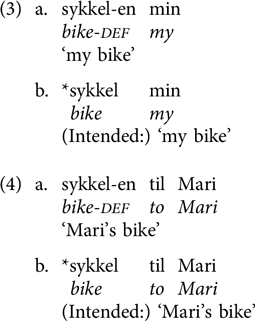
In Construction 2, the prepositions used are either til ‘to’, as in (4a), or åt ‘to’ (on their geographical distribution, see Torp Reference Torp1973). A restriction on this construction is that the possessor in the complement of the PP must be a full noun/proper name; it cannot be a simple pronoun (Johannessen et al. Reference Johannessen, Julien, Lødrup, Kristin and Johannessen2014:70). Footnote 4 Compare (2), in which the possessor is a proper name, with the unacceptable example in (5), in which the possessor is a pronoun (henne ‘her’):

The data presented thus far are from Norwegian as spoken in Norway, henceforth referred to as homeland or European Norwegian (EurNo) (I use the two terms synonymously). The main aim of this study, however, is to investigate split possession and definiteness marking in American Norwegian (AmNo). AmNo is a heritage language spoken by the descendants of immigrants who came to North America from Norway in the nineteenth and twentieth centuries (Haugen Reference Haugen1953; Johannessen & Salmons Reference Johannessen, Salmons, Janne Bondi and Salmons2015). Footnote 5 Today’s speakers of AmNo are second to fifth generation immigrants (typically third or fourth generation). They are bilingual, often having acquired Norwegian at home as young children and English from around school age; as adults, English is their dominant language. Today’s speakers of AmNo are predominantly of a mature age, and the language has not been passed on to the next generation.
The study aims to establish the extent to which split possession is retained in AmNo and to analyse the differences between AmNo and the homeland variety. This can enhance our understanding of syntactic change in situations of language contact and reduced input. Moreover, split possession in closely related varieties is an excellent testing ground for hypotheses about the diachrony of lexically restricted syntactic phenomena. Following Julien (Reference Julien2005:191–193), I will analyse the pattern with bare forms as a reflex of a formal feature [poss] on the N head of certain kinship nouns. To compare the distribution of this feature in the two varieties and analyse the diachronic changes that have taken place, I will apply a recent version of parametric theory (Biberauer & Roberts Reference Biberauer, Ian, Adam and Ian2017; Biberauer Reference Biberauer2017, Reference Biberauer, Federica and Jan2018; Roberts Reference Roberts2019), which encompasses an explicit and principled account for small-scale parameters.
The study makes use of the Corpus of American Nordic Speech (CANS), the Nordic Dialect Corpus (NDC) and the Norwegian part of the Language Infrastructure made Accessible (LIA) corpus. On the empirical side, it will be shown that overall, bare kinship nouns are more common in AmNo than in EurNo; this is in accordance with brief observations by Anderssen & Westergaard (Reference Anderssen and Westergaard2012:34–36) and Riksem (Reference Riksem2017:17). In both AmNo and EurNo, there is considerable inter-speaker variation, but the following main tendencies can be observed: in EurNo, bare kinship nouns are in decline, especially in urban speakers (in and around the capital of Oslo). In AmNo, on the other hand, most speakers have retained this feature, and some have even extended it; only a small minority does not use bare kinship nouns. Decline, which is mainly observed in EurNo, can be attributed to a combination of Feature Economy and mixed input, including input from Danish-influenced urban and formal registers, in which the poss feature on kinship nouns is not, or very rarely, present. Present-day AmNo speakers are generally exposed to less mixed Norwegian input; I argue that this favours stability, and also paves the way for analogical extension in accordance with the acquisitional bias Input Generalisation (Biberauer & Roberts Reference Biberauer, Ian, Adam and Ian2017; Roberts Reference Roberts2019). On a more general level, this work is a case study of how developments in heritage languages can be systematic and principled; it demonstrates that despite reduced input, change does not necessarily involve loss or “incompleteness” (see also e.g. Yager et al. Reference Yager, Hellmold, Joo, Putnam, Rossi, Stafford and Salmons2015, Kupisch & Rothman Reference Kupisch and Jason2016 and Bayram et al. Reference Bayram, Kupisch, Cabo and Rothman2019).
The article is structured as follows: In Section 2, I discuss in more detail the conditions and use of bare kinship nouns in Constructions 1 and 2 in EurNo. In Section 3, I present the results from AmNo. Section 4 contains discussion and analysis of the findings (Section 4.1 deals with the formal syntax of bare kinship nouns and the distribution of the poss feature; 4.2 deals with the diachronic developments in EurNo and AmNo). Section 5 concludes the study.
2. Bare kinship nouns in homeland Norwegian
As mentioned in Section 1, certain kinship nouns can appear in their bare form in Constructions 1 and 2 in homeland Norwegian. This does not apply to all kinship nouns; this section sets out to establish more exactly which nouns can be bare, and the extent to which bare forms are used (there is some variation even with the most common kinship nouns, such as mor ‘mother’). As the ideal baseline for comparison with AmNo in this study would be the language of the first emigrants who left Norway in the nineteenth and twentieth century (Larsson & Johannessen Reference Larsson, Janne, Richard Page and Putnam2015:160), I focus particularly on older sources of homeland Norwegian; however, some more recent data have also been included. Section 2.1 describes the data and methodology used; the results are presented in Section 2.2.
2.1 Data and methodology
2.1.1 Sources of data: Language descriptions and corpora
The homeland Norwegian data used in this study are drawn both from previous language descriptions and from speech corpora. Whilst speech corpora provide positive evidence of nouns occurring in their bare form, descriptions in the previous literature can also be a source of negative evidence: the descriptions include implicit or explicit statements about which nouns are not acceptable in their bare form in Constructions 1 and 2. Footnote 6 Studies on kinship nouns in possessive constructions are those of Lødrup (Reference Lødrup2014) and Johannessen et al. (Reference Johannessen, Julien, Lødrup, Kristin and Johannessen2014). More general works in which the topic is discussed, or at least mentioned briefly, are those of Aasen (Reference Aasen1864), Faarlund et al. (Reference Faarlund, Lie and Vannebo1997) and Julien (Reference Julien2005). Aasen’s work dates back to a time around which many of the first emigrants left Norway, and it describes colloquial dialects spoken across the country. This makes it particularly relevant in the context of the present study, which aims to investigate diachronic developments that have potentially happened over several generations, starting with the first emigrants. In addition to Aasen (Reference Aasen1864), some dialect studies focussing on specific geographical areas have been consulted, namely Venås (Reference Venås1977) on the Hallingdal dialect and Dagsgard (Reference Dagsgard2006) on the dialect of Lom and Skjåk. Hallingdal, Lom and Skjåk are located in the interior of South-East Norway, an area from which many of the ancestors of today’s speakers left; dialect features from this area have a particularly prominent place in AmNo as spoken today, even among speakers whose ancestors originally came from other areas (Johannessen & Laake Reference Johannessen and Signe2012a; Hjelde Reference Hjelde2012, Reference Hjelde, Janne Bondi and Salmons2015). The dialect descriptions are well suited for the present purposes also because they focus on older speakers or previous generations (i.e. people born around 1900).
Corpus data are taken from the Norwegian part of the Nordic Dialect Corpus (NDC) (Johannessen et al. Reference Kristiina and Eckhard2009), version 3. Footnote 7 For reasons of scope and in an attempt to approximate the language of the first emigrants, only speakers aged 50 or older were included (age group B in the corpus metadata). With this modification, the sample consists of 1,408,879 word tokens from 355 speakers. In addition to NDC, I have consulted the Norwegian part of the Linguistic Infrastructure made Accessible (LIA) corpus, a digitised collection of older dialect recordings, version 1. LIA (version 1) consists of 1,511,245 word tokens from speakers in 132 places in Norway; some of these speakers were born as early as the 1860s and 1870s. The LIA corpus is well suited to provide a more complete picture of the range of kinship nouns that can be bare in older homeland Norwegian dialects. However, the overviews of how often bare nouns are used (see section 2.2) are based on NDC. The NDC data were mostly collected with methods similar to those used for the Corpus of American Nordic Speech (CANS) (see Section 3.1); this facilitates quantitative comparison.
2.1.2 Corpus data: Key definitions and extraction principles
For the purposes of this paper, the term bare noun, or bare form, simply refers to a (singular) noun that does not have a definite suffix. In Constructions 1 and 2, the definite suffix is generally required even in the presence of a prenominal determiner, as is shown in (6) ((6a) is a psychologically distal demonstrative in the sense of Johannessen Reference Johannessen2008): Footnote 8
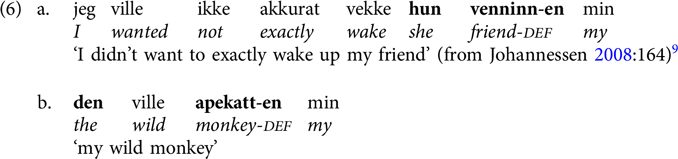
It is only (certain) kinship nouns that may occur with a prenominal determiner, but without the suffix (see (7)):

In cases like (7), the kinship noun is counted as bare, on a par with cases in which no prenominal determiner is present (there are not many examples of this type in the data set, though). Footnote 10
Cases in which two bare kinship nouns are coordinated have been excluded; the lack of definiteness marking in this context may arise for independent reasons (see Heycock & Zamparelli Reference Heycock and Roberto2003). For Construction 2, I excluded kinship nouns in predicate position; predicate nouns followed by til/åt ‘to’ can also lack definiteness marking independently of kinship denotation. Footnote 11
Finally, when analysing the extracted examples, I relied on the phonetic transcriptions in NDC/LIA. I also had access to the sound recordings, and I have listened to many of the examples. Some cases were not entirely clear; for example, the difference between a word-final /e/ and /a/, which distinguishes definite and indefinite weak feminines in several dialects, can be difficult to hear. In cases of doubt, I adhered to the transcribers’ decisions. A consistent revision of all the transcriptions would not be feasible; moreover, following the available transcriptions facilitates replicability.
For a more detailed description of the queries underlying the quantitative results in Sections 2.2.2 and 3.2.2, see footnote 16. I now turn to the results from homeland Norwegian.
2.2 Results
2.2.1 Kinship nouns occurring in their bare form
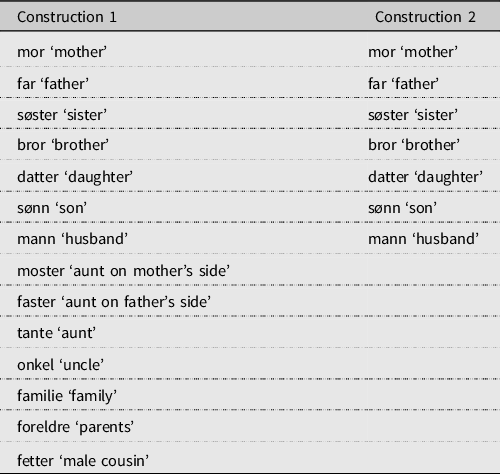
An overview of the nouns attested in their bare form in Constructions 1 and 2 in EurNo, either in the corpora used for this study or in the previous literature, is given in Table 1. Footnote 12 Note that compounds headed by these nouns can also be bare; thus, the fact that mor ‘mother’ is listed implies that a compound such as bestemor ‘grandmother’ can also occur without definiteness marking. The noun foreldre ‘parents’ has been included in its plural form even though this study generally deals with bare singulars.
Kinship nouns attested in their bare form in Constructions 1 and 2 in the EurNo data set
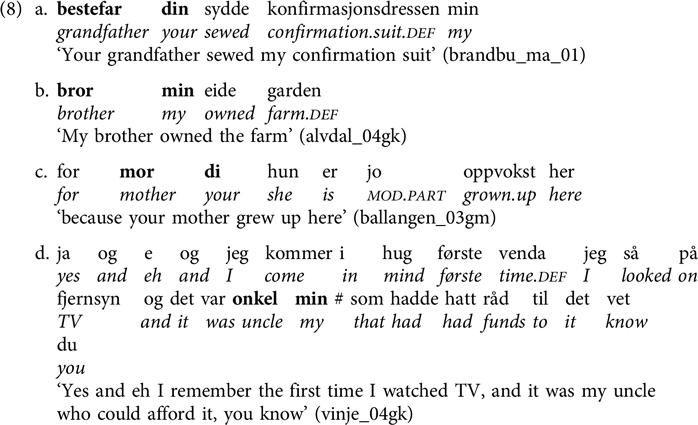
Some examples of bare kinship nouns in Construction 1 from NDC are given in (8): Footnote 13
Some examples of bare kinship nouns in Construction 2 from NDC are given in (9):
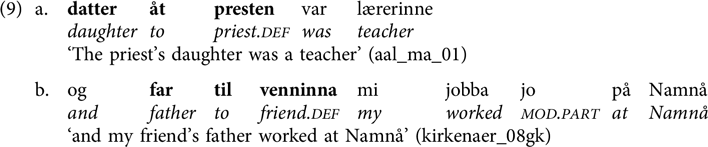
As is evident from Table 1, the kinship nouns occurring in their bare form are generally common kinship nouns denoting relatively close family relations (an exception is fetter ‘male cousin’, which is attested once in Construction 1 in the LIA corpus). As Table 1 is an aggregate of many different sources, it is worth pointing out that there is considerable variation with regard to how the rules for split possession and definiteness marking are described in the literature, and also inter-individual variation (more on this in Section 2.2.2). Aasen (Reference Aasen1864:313) writes that Fader ‘father’, Moder ‘mother’, Broder ‘brother’, Syster ‘sister’, Son ‘son’, Dotter ‘daughter’ and, added in parentheses, “flere lignende” ‘some/several similar [nouns]’, are regularly used in their bare form in Construction 1. Footnote 14 It is not clear exactly which other nouns Aasen is referring to, but he seems to be treating bare forms as a restricted phenomenon occurring in a closed, though somewhat variable, class of nouns. Faarlund et al. (Reference Faarlund, Lie and Vannebo1997:143) state that nouns ending in -r can appear in the bare form with a postposed possessive in Construction 1 (this does not cover, e.g., mann ‘husband’, onkel ‘uncle’ and tante ‘aunt’ in Table 1). Lødrup (Reference Lødrup2014:41), with a reference to Julien (Reference Julien2005:192), observes that Constructions 1 and 2 with bare forms only exist with “a small number of singular core consanguineal kinship nouns and their compounds” (this does not cover mann ‘husband’, and not necessarily tante ‘aunt’ and onkel ‘uncle’). Dagsgard (Reference Dagsgard2006:31–33, my translation), describing the dialect of Lom and Skjåk, writes that “[…] kinship terms such as mother, father, daughter, son, sister and brother” appear without any suffix in Construction 1. Footnote 15 Moreover, Dagsgard (Reference Dagsgard2006:33) notes that mann ‘husband’ is treated on a par with far ‘father’, mor ‘mother’ etc., whereas kjerring ‘wife’ is not.
In general, the corpus data suggest that some speakers employ a wider range of bare nouns than what is indicated in the literature. For example, onkel ‘uncle’ and tante ‘aunt’ are not mentioned in the literature, as far as I am aware. The range of bare nouns in homeland Norwegian still appears to be narrower than what is found in Icelandic. Icelandic allows, e.g., mamma ‘mum’ and pabbi ’dad’ to be bare (Sigurðsson Reference Sigurðsson2006:218), while the Norwegian equivalents mamma and pappa are not acceptable; Icelandic also allows other relational nouns, such as vinur ‘friend’ (Sigurðsson Reference Sigurðsson2006:222) and body part nouns (Thráinsson Reference Thráinsson2007:94, n. 6). However, the range of bare nouns in Icelandic is not quite a superset of the nouns attested in EurNo. For example, (Sigurðsson Reference Sigurðsson2006:222) notes that the noun maður ‘man, husband’ takes the definite suffix in Icelandic; recall that the cognate mann can be bare in EurNo.
I now turn to the variation between bare nouns and nouns with a definite suffix in Constructions 1 and 2.
2.2.2 Use of bare nouns vs. nouns with a suffix
Although the kinship nouns listed in Table 1 are all attested in their bare form in Constructions 1 and 2, there is also a competing pattern whereby the definite suffix is used, even for the most common nouns. Thus, there is variation as illustrated in (10)–(11):
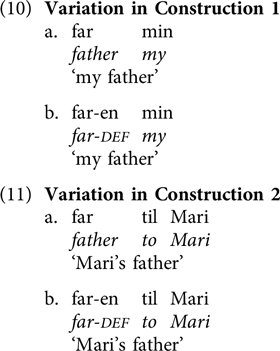
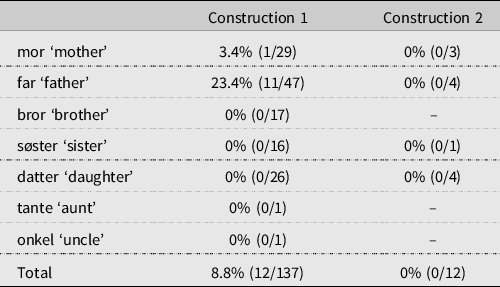
Table 2 shows the overall proportion of bare nouns in Constructions 1 and 2 with some central kinship nouns in NDC. Footnote 16, Footnote 17 Sønn ‘son’ is not included, as it would be difficult to obtain reliable figures for this noun: it ends in an /n/; thus, it is hard to assess whether the definite suffix, which is also /n/ in these phonological environments, is present or not.
Proportions of bare nouns vs. nouns with a definite suffix, NDC, age > 50
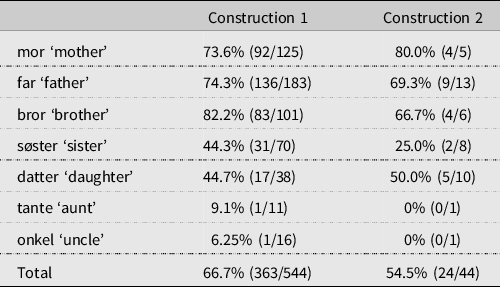
As is evident from Table 2, mor ‘mother’, far ‘father’ and bror ‘brother’ are used in their bare form rather frequently, with some variation between the different lexical items and constructions (these nouns are all monosyllabic; I return to this in Section 4.1.2). For søster ‘sister’ and datter ‘daughter’, the picture is more mixed (bare nouns are used in 50% of the cases or less), and for onkel ‘uncle’ and tante ‘aunt’, bare forms are quite rare (I only found one single example of each). Note that Construction 1 is, overall, much more common than Construction 2; the figures for Construction 2 should be read with caution because of the low number of tokens.
As mentioned, there is inter-speaker variation with regard to whether bare forms are used at all, and if so, with which nouns. Julien (Reference Julien2005:191, n. 35) states (in a discussion of Construction 1) that older speakers from rural areas seem to use more bare nouns. She adds the reservation that she has not investigated this question systematically herself. In order to provide a more detailed empirical account of the difference between rural and urban areas, I queried the NoTa corpus, containing recordings of speakers in the Oslo area, and the results lend support to Julien’s observation. The query was limited to speakers over 50 years old (a total of 49 speakers), in order to distinguish the effect of urban vs. rural backgrounds from the effect of age. As is evident from Table 3, the NoTa speakers use bare nouns only to a very limited extent; there are some examples with far ‘father’ and one example with mor ‘mor’ (all uttered by two individuals), but none with other kinship terms (for discussion of the effect of age, I refer to Section 4.2.1).
Proportions of bare nouns vs. nouns with a definite suffix, NoTa Oslo, age > 50
To get a clearer picture of the variation among the older speakers in NDC (i.e., the speakers represented in Table 2), both on the inter- and intra-speaker level, the results from a selection of individual speakers are presented in Table 4. The selection criterion was that the speakers produce a total of at least 6 relevant kinship nouns (the nouns included in Table 2) in Construction 1.
Proportions of bare nouns; results for individual speakers in Construction 1, NDC, speakers aged > 50 that produce ≥ 6 relevant kinship nouns
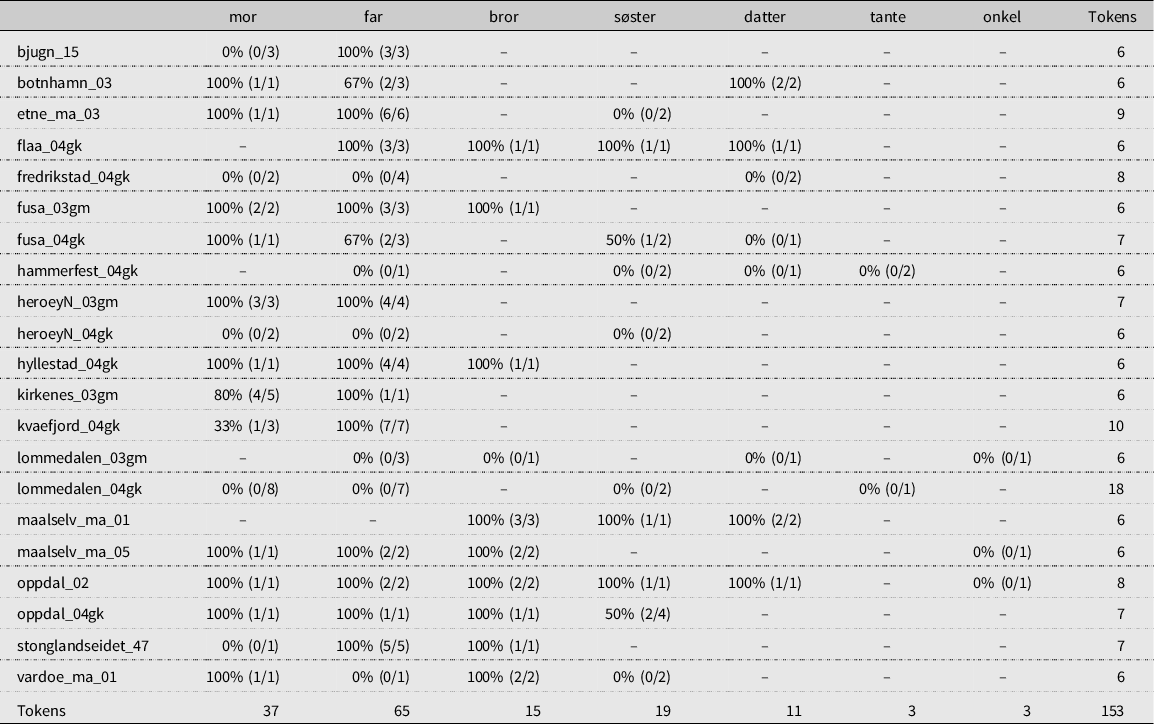
With the caveat that there is only a limited amount of data per speaker, Table 4 suggests that most speakers are relatively consistent in their treatment of individual nouns. The proportions of bare nouns are, with only a few exceptions, either very high (mostly 100%) or very low (0%), even when an individual noun is used several times by the same speaker (this is particularly clear in the case of far ‘father’). There is also considerable consistency within individual speakers across different nouns; e.g., flaa_04gk, heroeyN_03gm, hyllestad_04gk and maalselv_ma_01 always use bare nouns, while fredrikstad_04gk, lommedalen_03gm and lommedalen_04gk do not use bare nouns at all. The speakers etne_ma_03 and oppdal_04gk consistently use bare nouns with mor ‘mother’ and far ‘father’, but not with søster ‘sister’; maalselv_ma_05 and oppdal_02 use bare nouns consistently with all nouns except with onkel ‘uncle’. These individual patterns align with the general patterns in Table 2, whereby mor ‘mother’ and far ‘father’ occur in their bare form at much higher rates than søster ‘sister’ and onkel ‘uncle’. The individual results from e.g. bjugn_15, kvaefjord_04gk and stonglandseidet_47, on the other hand, do not align as directly with the overall results.
I now turn to bare kinship nouns in AmNo.
3. Bare kinship nouns in American Norwegian
3.1 Data and methodology
The AmNo data used in this study are predominantly drawn from the Norwegian part of CANS, version 2 (Johannessen Reference Johannessen2015). This corpus consists of recorded spontaneous speech (interviews and conversations); most of the data were collected using the same methods that were used for NDC (see Section 2.1). In order to make the sample as representative as possible of AmNo as spoken today, only data collected from 2010 onwards were included (version 3 of the corpus contains some older recordings of AmNo heritage speakers, but a systematic investigation of this intermediate stage is beyond the scope of the present study). In total, the sample from CANS consists of 615,454 word tokens from 152 speakers. The corpus searches were conducted in the same way as described for EurNo in Section 2.1. In addition to the data from CANS, speech data from 28 speakers collected on a field trip in 2016 were included. These data consist of interviews, elicitation based on pictures and a storytelling task based on the picture book Journey by Aaron Becker (Reference Becker2013).
A methodological issue in AmNo concerns the pronunciation of unstressed /a/. Lykke (Reference Lykke2020:52) observes a tendency towards a more central articlulation of unstressed vowels in AmNo, which could potentially give rise to a phonetic merger of unstressed /a/ with /e/, implying syncretism between the bare form and the definite singular of weak, feminine nouns such as kone ‘wife’ and tante ‘aunt’ (in the most relevant homeland dialects, the definite singular of these nouns would be kon-a and tant-a). To get an overview of how widespread the central articulation of /a/ is in my data set, and which speakers show this tendency, I queried CANS for the phonetic transcription of all nouns in the definite plural, as this combination of features also has an exponent /a/ in homeland Norwegian, particularly in neuter nouns (e.g., barn-a ‘the children’). The definite plural is a good test case because the indefinite plural mostly has a null exponent (barn-Ø ‘children’); this means that if the realisation of the definite suffix is central (more like /e/ than /a/), there are no other obvious explanations than phonetic merger. I found the central articulation (transcribed as e) in 12.1% of the cases (36/297; irrelevant and mistagged hits were excluded). To control for this in the investigation of which nouns occur in their bare form in AmNo, I left out bare forms that were exclusively used by AmNo speakers who exhibited a tendency towards pronouncing /a/ as /e/ in the independent query for indefinite plurals (this applied to the noun kone in Construction 2).
Note that the definite suffix is generally stable in AmNo (e.g. Anderssen et al. Reference Anderssen, Lundquist and Westergaard2018). Thus, if a kinship noun unexpectedly appears in its bare form, it should not be immediately dismissed as an indication of breakdown of definiteness marking or English influence on possessive constructions (see further discussion in 3.3).
3.2 Results
3.2.1 Kinship nouns occurring in their bare form
Table 5 provides an overview of the kinship nouns attested in their bare form in Constructions 1 and 2 in the AmNo data set. Footnote 18
Kinship nouns attested in their bare form in Constructions 1 and 2 in the AmNo data set. In italics: nouns not attested in their bare form in the EurNo data set
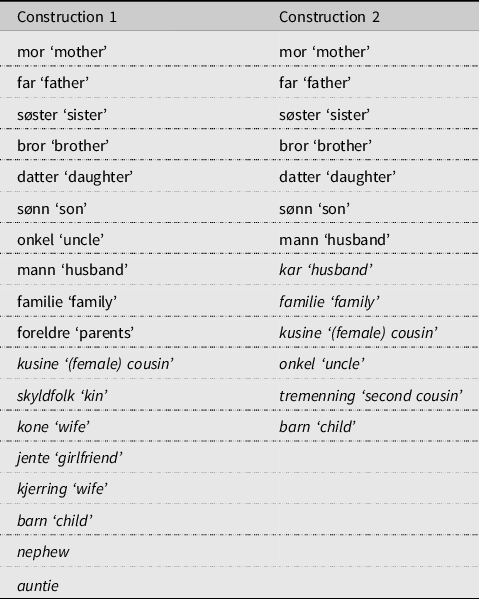
As can be seen in Table 5, bare forms are attested with more kinship nouns in the AmNo data from CANS than in the EurNo data set (bare forms that were only found in AmNo are marked with italics). Footnote 19 The token frequencies for kinship nouns are high in CANS; higher than in NDC (for illustration, compare Table 6 in Section 3.2.2 to Table 2 in Section 2.2.2). Footnote 20 However, this can hardly be the full explanation for the difference between AmNo and EurNo: keep in mind that the AmNo data set is considerably smaller than the EurNo data set (which consists of speech data from both NDC and LIA), and that the AmNo corpus data were not supplemented by descriptions from the previous literature.
Bare kinship nouns in AmNo to a greater extent denote more distant relations and are less-common nouns; they are not just core kinship terms. Relatedly, the AmNo data set includes more of the kinship terms that Dahl & Koptjevskaja-Tamm (Reference Dahl and Maria2001:202) refer to as “improper”, i.e., nouns that have an additional, non-kinship reading which is at least as salient as the kinship one. AmNo includes, e.g., kar, which can mean both ‘husband’ and ‘man’, and barn which can mean ‘first generation descendant’ or ‘person that has not reached puberty’.
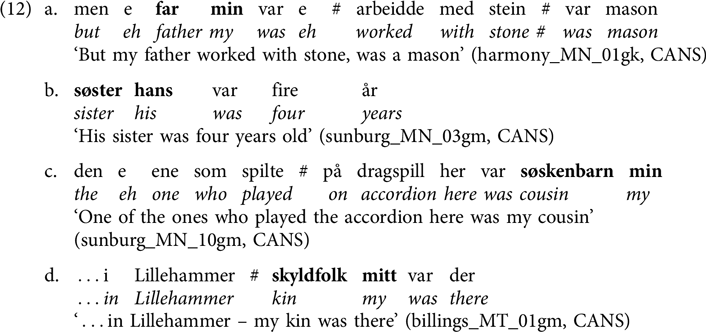
Some examples from Construction 1 are given in (12); (12a) and (12b) are also attested in the EurNo data set, whereas (12c) and (12d) are not.
Examples from Construction 2 are given in (13); the kinship nouns in (13a) and (13b) are attested in their bare form in the EurNo sample, too, whereas the nouns in (13c) and (13d) are not. Footnote 21


In AmNo, more affinal kinship terms (as opposed to consanguineal ones) are used in their bare form. Notably, some AmNo speakers use bare nouns for female spouses (kone ‘wife’, jente ‘girlfriend’ and kjerring ‘wife’ in Construction 1; jente ‘girlfriend’ in Construction 2). This is not attested in the EurNo data set, and for kjerring, Dagsgard (Reference Dagsgard2006:33) explicitly says it does not occur (see Section 2.2). Some AmNo examples with female spouses are given in (14): Footnote 22
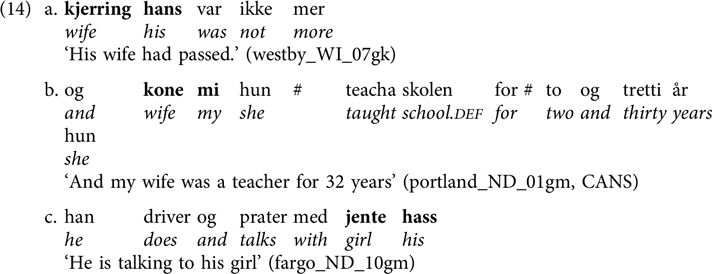
A further point of interest is that bare forms are occasionally found with loan words. This is shown in (15): Footnote 23
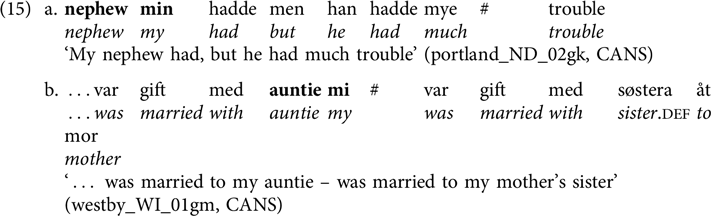
Riksem (Reference Riksem2017, Reference Riksem2018) demonstrates that AmNo speakers mostly use the Norwegian definite suffix in a homeland-like manner even with English nouns; thus, language mixing in itself is not a convincing explanation for the absence of the suffix in (15). Footnote 24 The examples in (15) may be interpreted as a sign of productivity of the pattern with bare kinship nouns. I return to the implications of this in Section 4.2.1.
The nouns moster ‘aunt on mother’s side’ and faster ‘aunt on father’s side’, which, according to Faarlund et al. (Reference Faarlund, Lie and Vannebo1997:143) can be bare in EurNo (see Section 2.2), do not seem to be used in AmNo at all; there are no data for these nouns. There are only two (Norwegian-origin) nouns attested in both AmNo and EurNo which are only found in their bare form in the EurNo data set. One is fetter ‘male cousin’, which is attested once in Construction 1 in EurNo. In AmNo, this noun is used by two speakers, but not in the relevant constructions. The other noun is tante ‘aunt’. This is attested in its bare form in Construction 1 in EurNo, but only with definiteness marking in AmNo. Footnote 25 However, a part of the picture here is that some AmNo speakers say auntie instead of tante.
In addition to the range of kinship nouns attested in their bare form, another special pattern in AmNo can be noted: the restriction on Construction 2, whereby the possessor has to be a noun (not a pronoun), seems to be less categorical than in EurNo. Occasionally, AmNo speakers use Construction 2 with a pronoun as the complement of the possessive PP, as shown in (16):

More research is required to establish the extensiveness this pattern; the contexts are rare and, as an anonymous reviewer points out, factors such as stress and deixis may complicate the picture.
Data show a larger set of bare kinship nouns in AmNo than in the regional EurNo varieties from which the ancestors of the present-day speakers emigrated. Further discussion and analysis of this variation and diachronic change follows in Section 4. I now turn to variation between bare nouns and the competing pattern with a definite suffix in Constructions 1 and 2.
3.2.2 Use of bare nouns vs. nouns with a definite suffix
The proportion of bare nouns in Constructions 1 and 2 for some common kinship nouns in AmNo is given in Table 6. The data are extracted from CANS using the same queries as for the EurNo data in Section 2.2.2; see footnote 16 for details.
Proportions of bare nouns vs. nouns with a definite suffix, CANS
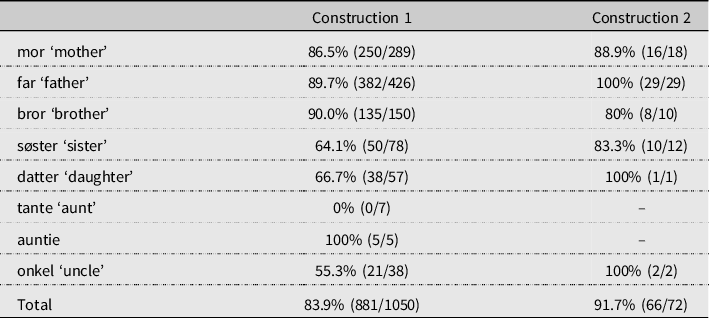
Comparing the results from AmNo to the results from EurNo (cf. Table 2), the overall impression is that bare nouns occur at higher proportions in AmNo. In Construction 1, this applies to all nouns with the exception of tante ‘aunt’ (to which I return shortly). I ran a two-tailed equality of proportions test in R (R Core Team 2020) for each individual noun; for mor, ‘mother’, far ‘father’, søster ‘sister’ and onkel ‘uncle’, the difference between AmNo and EurNo was statistically significant (p < .05), meaning that AmNo overall uses more bare kinship nouns than EurNo. For the nouns bror ‘brother’ and datter ‘daughter’, the difference is not statistically significant (p = .1079 for bror and .05629 for datter). The noun tante ‘aunt’ stands out in that it is not attested in its bare form in AmNo, whereas in EurNo, it is. As mentioned in Section 3.2.1, some speakers use the English loanword auntie instead, and I have included this too in the table.
In Construction 2, bare nouns are also more used in AmNo than in EurNo on an overall level; note that for far ‘father’, the use is consistent. I refrain from drawing any conclusions about the quantitative differences between individual nouns because the construction itself is so infrequent, but comparing the total numbers for Construction 2 (66/72 in AmNo vs. 24/44 in EurNo), bare nouns are significantly more common in AmNo (p < .05).
In order to get a better understanding of the inter- and intra-speaker variation found among the heritage speakers, I present results from individual speakers in Construction 1 in Tables 7–10. All speakers that produce at least 6 relevant kinship nouns in Construction 1 are included. The four tables represent speakers with different behaviours: consistent use of bare nouns in Table 7 (36 speakers); consistently or almost consistently bare nouns with the core kinship terms mor ‘mother’, far ‘father’ and bror ‘brother’ and more variable patterns with other nouns in Table 8 (20 speakers); speakers with mixed and less systematic patterns in Table 9 (8 speakers); speakers who never use bare nouns in Table 10 (5 speakers). As the tables are based on free, spontaneous speech, there is the caveat that all the relevant nouns are not produced by all speakers. It is possible that, e.g., some speakers in Table 7 would end up in Table 8 if they had used a larger range of kinship terms in the interviews/conversations, but there is no way of testing that based on the available data.
Proportions of bare nouns; results for individual speakers in Construction 1, CANS, speakers that use bare nouns consistently
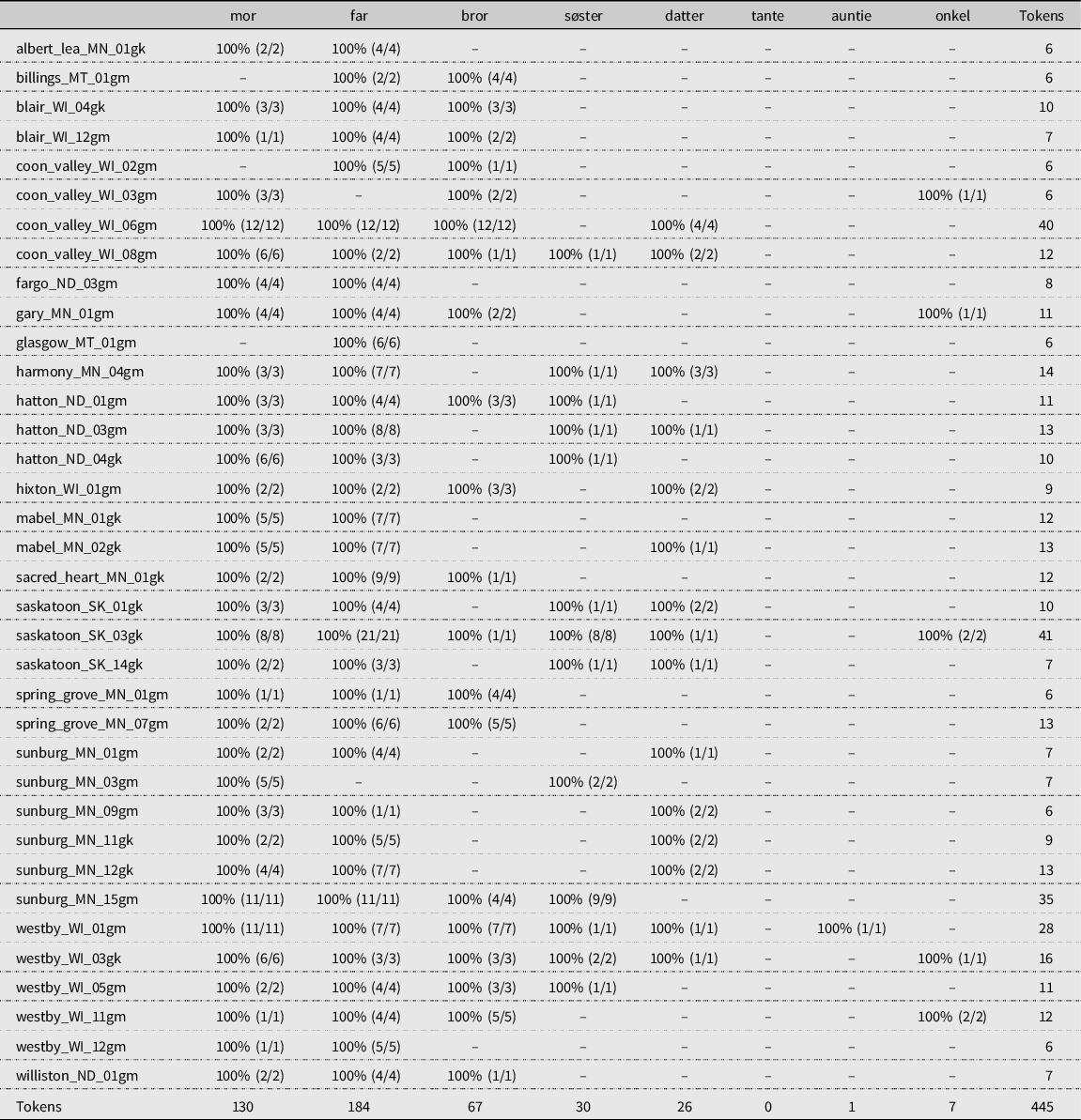
Proportions of bare nouns; results for individual speakers in Construction 1, CANS, speakers that use bare nouns consistently or almost consistently at least with mor ‘mother’, far ‘father’ and bror ‘brother’
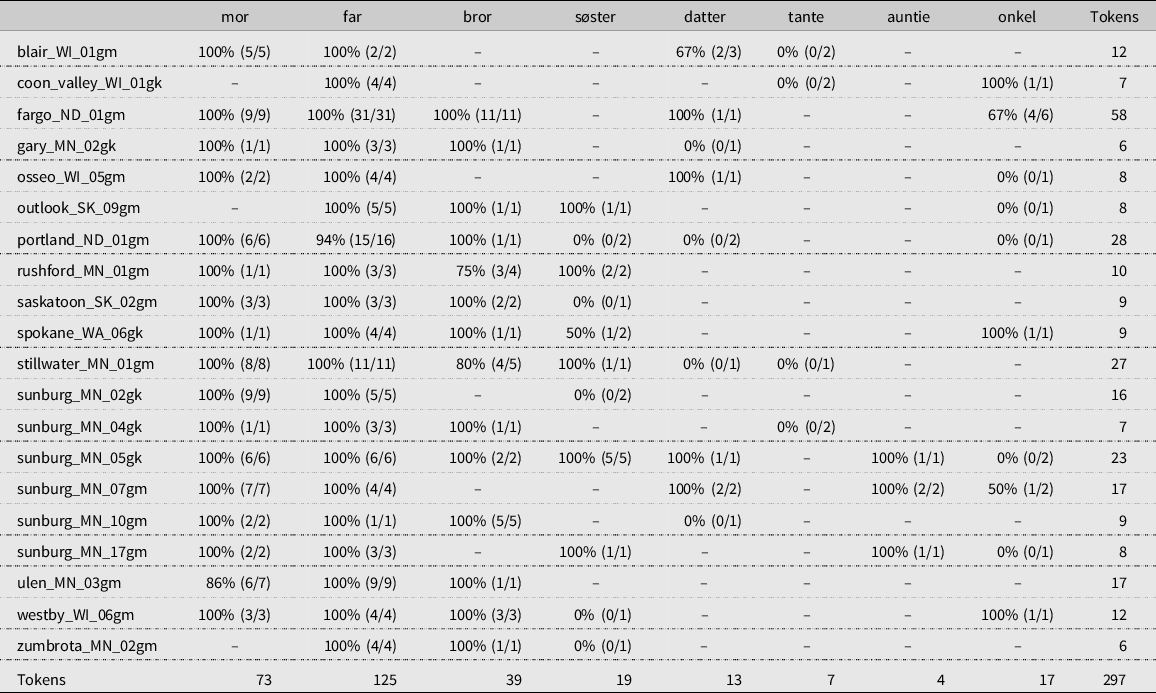
Proportions of bare nouns; results for individual speakers in Construction 1, CANS, speakers with mixed patterns
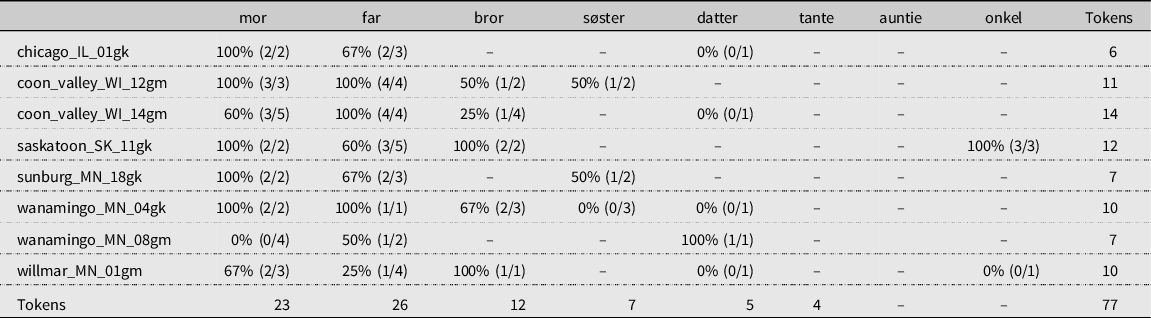
Proportions of bare nouns; results for individual speakers in Construction 1, CANS, speakers that do not use bare nouns

Like in EurNo, most speakers are relatively consistent in their treatment of individual nouns. This is particularly clear in Table 7, but also in Tables 8 and 10. Note that some speakers use certain nouns (notably mor ‘mother’ and far ‘father’) very frequently, e.g., coon_valley_WI_06gm (Table 7), saskatoon_SK_03gk (Table 7), sunburg_MN_15gm (Table 7) and fargo_ND_01gm (Table 8), but without any variation.
Like in EurNo, there is also a high degree of consistency across different nouns. This applies without exceptions to the speakers in Tables 7 (who always use bare nouns) and 10 (who never use bare nouns). The speakers in Table 8 exhibit somewhat more variation, but most of them follow a pattern whereby at least mor ‘mother’, far ‘father’ and bror ‘brother’ are used in their bare form, whereas one or more of the other nouns are used with the definite article in some or all cases. This type of pattern aligns with the general results presented in Table 6, in which mor ‘mother’, far ‘father’ and bror ‘brother’ occur in their bare forms at higher rates than other kinship nouns.
Some of the speakers represented in Tables 7 and 8 are also among the speakers that use bare forms not attested in the EurNo sample (see Section 3.2.1). This applies to sunburg_MN_10_gm, billings_MT_01gm and portland_ND_01gm, and it corroborates the notion of a relatively systematic use of bare forms across different nouns (the remaining speakers cited in Section 3.2.1 are not represented in Tables 7–10 because they produce fewer than 6 relevant kinship nouns in CANS). The speakers that use the loanword auntie without any definite suffix are also represented in Tables 7 and 8; three of them actually use the definite suffix with onkel ‘uncle’ in some or all cases, but they are consistent in using bare forms with all other attested nouns.
The speakers in Table 9, who exhibit mixed patterns with respect to the use of bare nouns, are relatively few (8 speakers), and I will not attempt to explain the variation in these cases. The speakers in Table 10, on the other hand, who do not use bare nouns at all (5 speakers), call for some further discussion, both because their linguistic behaviour is so different from the other speakers, and because they have a considerable impact on the overall results (they produce many of the examples of kinship nouns with a definite suffix).
If one considers the available corpus metadata given for each of the speakers represented in Table 10, it becomes clear that most of them have a background that stands out compared with other speakers in CANS. Typically, the speakers in the corpus are third or fourth generation immigrants whose ancestors left from rural parts of Norway; the speakers are of a mature age and do not have much experience with formal or urban varieties of Norwegian (Hjelde Reference Hjelde2012, Reference Hjelde, Janne Bondi and Salmons2015; Johannessen & Laake Reference Johannessen and Signe2012b, Reference Johannessen, Signe, Janne Bondi and Salmons2015; Johannessen Reference Johannessen2018). The speaker fargo_ND_05gk, however, who is represented in Table 10, has taken Norwegian classes (in addition to learning the language from early childhood); although the exact nature of these classes is not clear from the corpus metadata, one can assume that it would involve exposure to formal and written language, in which bare forms are not used. The speaker minneapolis_MN_01gk is exceptionally young (born in 1975), and her mother came from an urban area in Norway (the city of Tønsberg, west of the Oslo fjord). The speaker spokane_WA_05gm also has ties to urban Norway; his mother came from Oslo, and he has lived in Bergen for two years. The speaker spokane_WA_03gk, too, has connections to Oslo through her mother; moreover, she lived in Oslo for many years during her childhood and adolescence. In an interview, this speaker explicitly expresses that she feels different from many of the other AmNo speakers, who are older than her (she was born in 1959), and whose ties to Norway go several generations back: “[They] have thoughts from the 1800s, Norway in the 1800s […] It is hard to feel a connection to that because I know modern Norway” (my translation). The general picture is that the speakers who do not use bare nouns at all seem to have acquired Norwegian in a context that involves exposure to relatively recent urban or formal varieties of the language. Since some of these speakers produce many kinship nouns, we can expect them to influence the overall results in Table 6. Notably, for the noun datter ‘daughter’, the proportion of bare nouns rises to 67.9% (38/53), which is significantly different from that in EurNo (p = .0187), if we exclude these speakers from the sample. In other words, taking inter-speaker variation in AmNo into account, it is possible to single out speakers that do not use bare nouns at all, but also groups of speakers that use bare nouns even more widely than what is evident from the overall results.
3.3 Intermediate summary and discussion
In this section, I have presented data suggesting that on an overall level, bare kinship nouns in Constructions 1 and 2 are more common in AmNo than in EurNo. It was shown that a larger range of kinship nouns is attested in their bare form in the data set from AmNo than in the data from EurNo; in AmNo, less common and more peripheral kinship nouns are found in their bare form to a greater extent. In both AmNo and EurNo, there is variation between bare nouns and nouns with a definite suffix in the two constructions. There is a general tendency for bare nouns to occur at higher proportions in AmNo, although the difference does not reach statistical significance for all individual nouns.
There is substantial inter-speaker variation in both varieties; in AmNo, the speakers can be divided into subgroups that i) use bare forms consistently; i.e, at even higher rates than what the general figures for the individual nouns would suggest; ii) speakers that use bare forms consistently or almost consistently at least with mor ‘mother’, far ‘father’ and bror ‘brother’, iii) speakers with mixed patterns (less systematic variation than group ii), and iv) speakers that do not use bare nouns at all. The two last subgroups have the fewest members, and several of the speakers that do not use bare kinship nouns at all have had considerable exposure to urban and formal varieties of Norwegian.
Note that the preference for bare forms observed in many speakers of AmNo does not extend beyond kinship nouns. In general, the definite suffix is not in decline. This has been demonstrated by Anderssen et al. (Reference Anderssen, Lundquist and Westergaard2018) and van Baal (Reference van Baal, Jan Heegård and Karoline2018, Reference van Baal2020) for other syntactic constructions, and a randomised sample of nouns (including both kinship and non-kinship nouns) in Construction 1 in CANS shows the same result; cf. Table 11. Footnote 26
Nouns in Construction 1 in CANS; both kinship nouns and non-kinship nouns, randomised sample
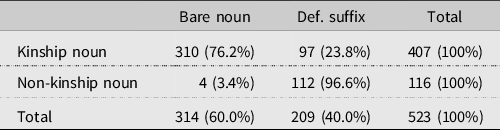
Table 11 suggests that bare forms of non-kinship nouns are very unusual (3.4%), and upon scrutiny, most of the apparently bare forms seem to have an independent, phonological explanation. For example, two of the nouns are masculines ending in /n/ (auksjon ‘auction’ and hund  ‘dog’). The definite suffix -en would be phonologically reduced to /n/ in these environments, and although the textbook pronunciation of a word such as hunden would be disyllabic
  , this is not always clear in spontaneous speech.
Footnote 27
Thus, it is clear that the differences between AmNo and EurNo in Constructions 1 and 2 reflect systematic differences in how kinship nouns are treated in grammar.
, this is not always clear in spontaneous speech.
Footnote 27
Thus, it is clear that the differences between AmNo and EurNo in Constructions 1 and 2 reflect systematic differences in how kinship nouns are treated in grammar.
4. Discussion and analysis
In this section, I discuss and analyse the empirical findings presented in Sections 2 and 3, both from a synchronic and a diachronic perspective. The section has the following structure: In 4.1, I discuss the syntactic derivation of Constructions 1 and 2, and the formal analysis of variation between speakers that use bare kinship nouns and speakers that do not. In 4.2, I discuss the diachronic developments that have taken place in AmNo and EurNo.
4.1 Syntactic analysis
4.1.1 Derivation of Constructions 1 and 2
Recall that nouns in Constructions 1 and 2 generally require a definite suffix, both in EurNo and AmNo; it is only (certain) kinship nouns that can appear in their bare form. A formal analysis of the two constructions should offer an explicit account of why (certain) kinship nouns can appear without definiteness marking. I adopt a proposal from Julien (Reference Julien2005:191–193), whose core idea can be summarised as follows: the relevant kinship nouns differ from other nouns in being inherently relational at the level of their featural make-up. The relevant feature is a possessor feature ([poss]) located in N. The basic structure of the DP, including the poss feature of the relevant kinship nouns, is illustrated in (17) (based on Julien Reference Julien2002, Reference Julien2005): Footnote 28

Most of the labels used in (17) should be self-explanatory, with the exception of nP; nP is the functional projection in which the suffixed definite article is generated (Julien Reference Julien2005:4). n is merged with unvalued features only; it probes down for φ-features and (in the case of definite nominals) a definiteness feature. In simple nominals without adjectival modification, nP as a whole raises to Spec-DP to identify D (in Scandinavian, the DP layer must generally be overtly realised, or “identified”; see Julien Reference Julien2005:ch. 1 for further discussion).
The derivation of Construction 1 with a non-kinship noun proceeds as shown in (18) (this is a simplified version of the derivation proposed in Julien Reference Julien2005:162–163; for expository reasons, only the structure up to nP is included): Footnote 29

The possessive pronoun min, which has a valued poss feature, is merged in Spec-NP. The noun raises past the possessor to n; this yields the postnominal position of the possessive pronoun (Julien Reference Julien2005:143). In possessive constructions, n has an unvalued poss feature. n probes and Agrees with the possessive pronoun; this Agreement relation is spelled out by the suffix -en. This suffix is identical to the definite article; on Julien’s analysis (Reference Julien2005:145), [poss] is “in reality a definiteness feature”, an idea which finds support in parallelisms in the behaviour of definite and possessed nominals: for example, possessed nominals trigger the definiteness effect in existentials/impersonal passives, even when the possessor is prenominal and there is no definite marker present (Julien Reference Julien2005:200) (see also Julien Reference Julien2005:145–147, 199ff and Vangsnes Reference Vangsnes1999:124ff for further discussion of the parallelisms between definiteness and [poss]).
Now, if the noun in Construction 1 is a kinship noun such as far ‘father’, which can occur in its bare form, the derivation proceeds as illustrated in (19):

The difference between this derivation and that in (18) is the presence of a poss feature in N in addition to the poss feature on the possessive pronoun and the poss feature in n. The unvalued poss feature of n is valued by the poss feature of the possessed kinship noun, as illustrated by the arrows. Agreement with the poss feature of an inherently relational noun has no overt spell-out; thus, there is no suffix. Footnote 30
For Construction 2, the derivation is essentially the same. The possessive PP is generated in Spec-NP, similar to possessive pronouns; the preposition can be analysed as a spell-out of a poss feature (Julien Reference Julien2005:145). Just like in Construction 1, n has an unvalued, probing poss feature. In most cases, this feature is valued by [poss] on the preposition; this Agreement relation leads to spell-out of the definite suffix. However, certain kinship nouns carry an additional poss feature that can also value [poss] of n; in these cases, there is no overt spell-out of the suffix. For concreteness, see the derivation in (20):

Having introduced the poss feature, I now turn to a discussion of its distribution in AmNo and EurNo from the perspective of a recent version of parametric theory. This framework is particularly suitable because it provides analytical tools for small-scale, micro-comparative differences of the type that we are dealing with here.
4.1.2 The poss feature as a parametric specification
The analysis of bare kinship nouns presented in the previous section involves a formal feature, [poss], present in the N head of certain nouns. In recent versions of generative grammar, it is a fairly common view that the presence/absence of formal features on (classes of) heads is what constitutes the parameters of cross-linguistic variation, in accordance with the Borer-Chomsky Conjecture, as formulated by Mark Baker:
All parameters of variation are attributable to differences in the features of particular items (e.g., the functional heads) in the lexicon (Baker Reference Baker and Theresa2008:353).
Under this view, the presence of [poss] on some Ns is a parametric specification. For a more detailed account of [poss] on N as a parametric specification, I adopt a recent version of parametric theory that explicitly deals with, and offers predictions about, parameters that are small-scale in the sense that they apply to a small class of heads; see Biberauer (Reference Biberauer2017, Reference Biberauer, Federica and Jan2018), Biberauer & Roberts (Reference Biberauer, Ian, Adam and Ian2017), and Roberts (Reference Roberts2019) (note that this notion of parameter differs in some ways from the “hard-wired” parameters that were proposed in the 1980s (Chomsky Reference Chomsky1981), and takes into account all three factors of language design in the sense of Chomsky (Reference Chomsky2005); for further details, I refer to Biberauer and Roberts’s works, henceforth B&R).
B&R propose a hierarchy of parameter types ordered by the size of the class of items that they apply to. Small-scale parameters are micro or nano parameters (the higher part of the hierarchy is constituted by meso and macro parameters, which apply to larger classes of heads and thus have wider-ranging effects across the grammatical system; the general order of head and complement in harmonic head-initial or head-final languages are examples of macro parameters). Nano parameters apply to just one, or sometimes a handful of lexical items, and the items are unpredictable (they are idiosyncratic and do not form a natural class) (Roberts Reference Roberts2019:85). Micro parameters apply to a restricted, natural-class subset of heads (Biberauer Reference Biberauer2017:51; Biberauer & Roberts Reference Biberauer, Ian, Adam and Ian2017:150); the subset can be small, but it is more predictable than for a nano-parameter.
For some speakers of EurNo, [poss] on N might instantiate a nano parameter. E.g., among the urban speakers (Table 3), there is one speaker who only exhibits [poss] on N on the single lexical item far ‘far’. For other speakers, e.g., some of the older, rural speakers (Tables 2 and 4), [poss] on N is a micro parameter applying to a natural-class subset, e.g., nouns denoting members of the nuclear family (‘mother’, ‘father’, ‘sister’, ‘brother’ etc.). I showed that a recurring pattern in Construction 1 is that mor ‘mother’, far ‘father’ and bror ‘brother’ are treated on a par and occur in their bare form (Section 2.2.2). These three nouns do not seem to form a natural semanic class, as bror ‘brother’ is included, but not søster ‘sister’, but one can still argue for a micro parameter on the assumption that phonological features can define the scope of parameters (Biberauer Reference Biberauer, Federica and Jan2018:101), as the three nouns stand out compared to other kinship nouns in being monosyllabic. Footnote 31
In AmNo, mor ‘mother’, far ‘father’ and bror ‘brother’ also seem to group together in Construction 1, although at proportions that are generally somewhat higher than in EurNo: mor ‘mother’, far ‘far’ and bror ‘bror’ are used in their bare form at proportions between 86.6% and 90% (cf. Table 6) (between 73.6% and 82.2% in EurNo (NDC), cf. Table 2). However, the gap between these nouns and søster ‘sister’ is not as great in AmNo as in EurNo; in AmNo, søster ‘sister’ occurs in its bare form at a proportion of 64.1% (44.3% in EurNo (NDC)). Many speakers employ a larger set of bare kinship nouns, including søster ‘sister’, and also datter ‘daughter’ and other nouns, and for these speakers it seems clear that we are dealing with a micro parameter, with some individual variations. The range of bare kinship nouns for which there is evidence in AmNo (see Tables 5 and 7) seems to suggest that at least some speakers treat all kinship nouns (including male and female spouses) on a par; this is a larger class than what was observed in the EurNo data set. At the same time, there is a minority of AmNo speakers who do not use bare nouns, or who show mixed patterns (Tables 9 and 10). For the speakers who do not use bare nouns, [poss] on N is not a parametric specification; for the speakers with mixed patterns, the parametric status is unclear.
B&R’s approach predicts that micro and nano parameters are diachronically relatively unstable. As they are not robustly attested across the grammatical system, they are more prone to change than macro and meso parameters (see in particular Biberauer & Roberts Reference Biberauer, Ian, Adam and Ian2017). Diacronic instability is indeed what we observe in the morphosyntax of possessive constructions with kinship nouns (or else, there would not be any clear differences between AmNo and EurNo or speaker groups within each speech community). Changes can in principle go in two directions; expanding or reducing the class of items expressing the parametric specification. Both developments can, in the framework of B&R, be related to different acquisitional biases: Reducing the scope of a parametric specification would be motivated by Feature Economy, which is a preference for postulating as few formal features as possible to account for the linguistic input (similar economy principles have also been proposed by Roberts & Roussou Reference Roberts and Anna2003 and van Gelderen Reference van Gelderen2011). Expanding the scope can be motivated by Input Generalisation, which is a tendency to maximise already postulated features; in other words, once a formal feature is postulated, a child will try to apply it as widely as possible in the relevant domain; the effect of this is analogical extensions (Biberauer Reference Biberauer2017; see also Roberts Reference Roberts2007). Which development wins out in which scenario is a complex question which is on the research agenda, and which I cannot address in any depth here, but [poss] on N is a good case study for applying the model. In the next sections, I discuss which of the two varieties of Norwegian was the locus of change (arguing that it was in fact both), and which factors contributed to this development (in particular the decline of [poss] on N in EurNo and the expansion that seems to have taken place in some speakers of AmNo).
4.2 Diachronic developments
4.2.1 Innovation vs. archaism
I have argued for systematic differences concerning the treatment of kinship nouns in AmNo versus the homeland variety EurNo. Data suggest that for the EurNo speakers that employ bare kinship nouns (in formal terms, [poss] on N), the bare forms reflect a nano or micro parameter. For most AmNo speakers, it is a micro parameter, sometimes with a larger scope than what is common in EurNo (see tables 7 and 8). There is some interesting inter-speaker variation (see in particular Table 10), but the most conspicuous tendency is a more widespread use of bare kinship nouns in AmNo than in EurNo. There are two obvious ways in which this difference could have emerged: one is innovation in AmNo, meaning that the use of bare kinship nouns was extended in America, whereas EurNo stayed the same. The other possibility is that AmNo is archaic. This would entail that change happened in EurNo; the AmNo speakers that employ bare kinship nouns widely would reflect a previous stage of Norwegian dialects at which bare kinship nouns were less restricted, a stage that is, evidently, not captured in the EurNo data set presented in Section 2.1. A third option consists of a combination of the two scenarios: a decline in the use of bare kinship nouns in EurNo does not exclude extension in AmNo. I adopt this third view; in what follows, I present arguments that, on the one hand, EurNo is undergoing change in the direction of a more restricted use of bare kinship nouns, whilst at the same time, this option is in most cases being retained and sometimes even extended in AmNo.
For the development in EurNo, a starting point is Julien’s (Reference Julien2005:191, n. 35) observation that bare nouns seem to be associated with older speakers and rural areas in Norway. The difference between rural and urban areas was discussed in Section 2.2.2, where it was shown that speakers in and around Oslo only use bare nouns to a very limited extent and far less frequently than the rural speakers in NDC (Table 3). This suggests ongoing change in Norway, at least in and around the capital. To provide a more detailed empirical account of the effect of age, abstracting away from the Oslo area, I re-ran the queries for Constructions 1 and 2 in a sample consisting of speakers in age group A (mainly under 30) in NDC; these speakers come from the same rural areas as the EurNo speakers represented in Table 2, but they are considerably younger. The results are presented in Table 12.
Proportion of bare nouns vs. nouns with a definite suffix, NDC, age < 30
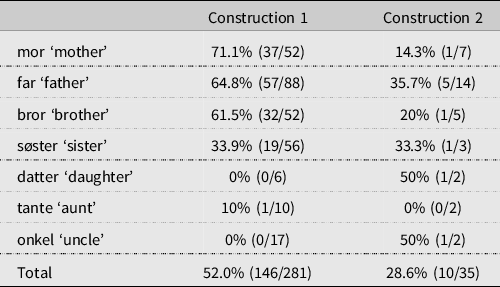
As can be seen in Table 12, the proportions of bare nouns in Construction 1 are generally lower than in the sample from older speakers (see Table 2); however, the difference is only statistically significant for the noun bror ‘brother’ (p < .05). In Construction 2, I found no significant difference between younger and older speakers (the tokens numbers for individual nouns are very low; I tested both individual nouns and the total for all nouns in this construction). In conclusion, there is a very clear difference between Oslo and rural areas in Norway, suggesting innovation in the cities (or at least in the capital); in the rural dialects, however, there is more stability and only a limited decline of bare nouns. This highlights the need to consider AmNo as an additional locus of change. Footnote 32
There are some arguments in favour of an AmNo innovation. First, as mentioned in Section 2.1, measures were taken to make the homeland Norwegian data set resemble the language of the first emigrants as closely as possible (older grammatical literature (Aasen Reference Aasen1864) and older dialect recordings were included), reducing the chance of older dialect features going unnoticed. Second, I have examined two sources that are, admittedly, very modestly sized, but that provide a more direct representation of the language of some of the first emigrants. One is Haugen’s (Reference Haugen1953) transcribed samples of AmNo, which includes speech data from nine speakers that acquired Norwegian in Norway and subsequently emigrated. The other is samples from five first-generation AmNo speakers (a total of 5,827 word tokens, also recorded by Haugen in the 1930s/1940s) that have been included Version 3 of CANS. Footnote 33 The results are presented Table 13, which includes all occurrences of kinship nouns in Construction 1 sorted by speaker.
Results for individual speakers in Construction 1, first-generation speakers in CANS, version 3, and relevant speakers in Haugen (Reference Haugen1953)
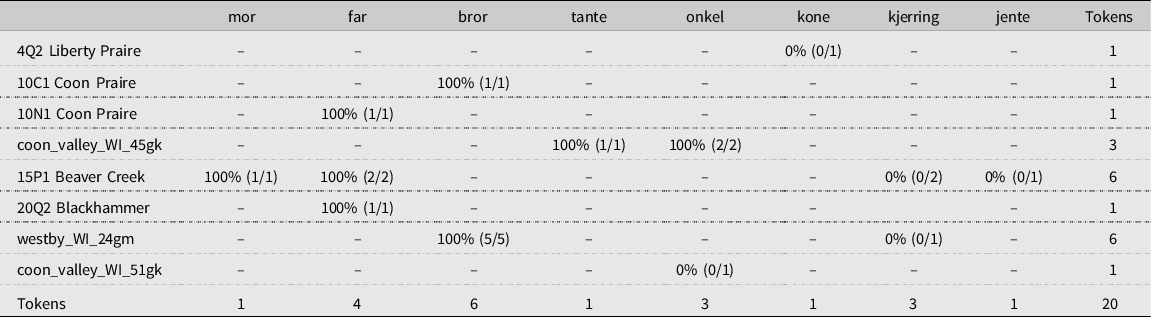
In Table 13, the following points can be noted: First, there are no “unexpected” bare nouns (i.e., bare nouns that are not also attested in the EurNo data set). Second, while bare forms are consistently used with mor ‘mother’, far ‘father’ and bror ‘brother’ (and also with tante‘aunt’), there is more variation with other nouns; notably, bare forms are not used with female spouses (see the columns kone ‘wife’, kjerring ‘wife’ and jente ‘girlfriend’), although this is attested in the present-day AmNo data. With the obvious caveat that absence of evidence does not equal negative evidence, this corroborates the idea that the extensive use of bare kinship nouns observed in some speakers arose in America as an innovation.
A third point to bear in mind is that at least some AmNo speakers use bare forms with loan words. Cf. example (15a), repeated for convenience in (21):

This use with loan words can be seen as a sign of productivity, which is to be expected if bare kinship nouns are being extended in an innovative way.
Summing up, there are arguments both for a decline of bare kinship nouns in EurNo and an extension in AmNo. I take the view that EurNo and AmNo (or at least many of their speakers) are on diverging paths; the observed differences between the varieties are due to changes in both of them. I discuss the different developments in the two varieties in more detail in the immediately following Section 4.2.2.
4.2.2 Decline vs. retention and extension
In EurNo, the clearest diachronic tendency is a decline of bare kinship nouns. In formal terms, this development is consistent with Feature Economy. Bare kinship nouns require an extra feature ([poss] on N) compared with the regular pattern with a definite suffix, and for the pattern with an extra feature to be maintained, robust attestation in the input is necessary. In the spoken Oslo variety and the Danish-influenced Bokmål standard, the feature is already very marginal (many speakers do not use bare nouns at all, see Section 2.2.2), and EurNo speakers have significant exposure to these varieties from a young age, even if they grow up in a rural area (illustratively, children are known to code-switch from their local dialect to a standard-/Oslo-like register in role play; this would not be possible if the children had not been familiar with this variety of homeland Norwegian, see Strand Reference Strand2020 for a recent study). The slight, but discernable tendency towards a decline of bare nouns among young, rural speakers in Norway can, at least in part, be interpreted as a consequence of mixed input, including input from the standard-/Oslo-like variety. An anonymous reviewer suggests that general dialect levelling is probably more important than influence from standard/Oslo-like language; however, these factors are not in principle mutually exclusive.
In AmNo, the most common tendency is retention and sometimes even extension of the poss feature. Present-day AmNo speakers are generally exposed to less-variable Norwegian input than EurNo speakers. This applies both in the sense that there is less dialect variation (Hjelde Reference Hjelde2012, Reference Hjelde, Janne Bondi and Salmons2015 argues that the Norwegian currently spoken in some of the traditional AmNo communties show signs of being a koiné), and in the sense that most AmNo speakers have far less experience with the written language, formal registers and urban varieties. Haugen (Reference Haugen and Dorian1989:64) describes how Norwegian lost territory in formal and written contexts from the first half of the nineteenth century: for example, by 1949, all but 2.7% of the congregations of the United Norwegian Lutheran Church had cancelled or limited their Norwegian services. This is not to say that all speakers were completely cut off from formal and urban Norwegian; Haugen (Reference Haugen1953:352) notes that some speakers in the 1940s were accommodating in the direction of the Bokmål standard. In Coon Vallley and Westby, services in Norwegian were continued, there was a Norwegian “summer school” organised by the church, and Norwegian films were screened well into the 1960s (Hjelde Reference Hjelde, Janne Bondi and Salmons2015:290). The Norwegian newspaper Decorah-Posten existed until 1972 (Lovoll Reference Lovoll1999:329). However, the exposure to formal and standardised language was on a much smaller scale than for speakers in Norway, especially from the mid 20th century; it kept declining, and its effect on the language of present-day speakers, who are the subjects of this study, is very limited. Johannessen & Laake (Reference Johannessen and Signe2012a:366) describe how they had to adjust their spoken Oslo Norwegian in the direction of rural, eastern Norwegian dialects in order to communicate with AmNo speakers during a 2010 fieldwork in the Midwest; Johannessen & Laake (Reference Johannessen and Signe2012b, Reference Johannessen, Signe, Janne Bondi and Salmons2015) find that speakers in Westby and Sunburg do not exhibit any influence from the Bokmål standard in their spoken language (possessive constructions are among the variables they investigate). Hjelde (Reference Hjelde2012, Reference Hjelde, Janne Bondi and Salmons2015), in a study of speakers in Coon Valley and Westby, encountered only one person who spoke a standardised varitety of Norwegian in 2010, but this speaker stood out as an exception. Relatedly, Hjelde (Reference Hjelde, Janne Bondi and Salmons2015:290) observes that the standardised, Bokmål-like variety has no status as a lingua franca in the traditional, AmNo communities today, as very few of the speakers can read Norwegian. One can conclude that mixed Norwegian input, including input from formal registers and urban varieties, which is a likely trigger for change in the direction of fewer bare nouns in EurNo, is only present to a very limited extent in AmNo.
The retention/expansion of [poss] does not apply to all AmNo speakers; there is a non-negligible minority who do not use bare nouns at all (see Section 3.2.2 and Table 10). Recall, however, that a number of these speakers stand out in the sense that they have had formal education in Norwegian and/or contact with the present-day language of Oslo or other urban areas. Thus, their linguistic behaviour can be related to the same factors that have been discussed elsewhere in this section. Some of the speakers are second generation heritage speakers with a parent from urban Norway, and from the individual perspective of these speakers, no change has taken place, as non-use of bare kinship nouns is likely to have been a property of their input.
The expansion of the range of bare nouns exhibited by some AmNo speakers (i.e., extension of [poss] to new Ns) might, on the face of it seem surprising, as generalisation of irregular rules is uncommon in language acquisition (e.g., Schuler et al. Reference Schuler, Charles, Newport, Papafragou, Grodner, Mirman and Trueswell2016 and references therein). However, although [poss] on N is irregular from the perspective of the general rules of Norwegian morphosyntax, it is a feature that occurs quite regularly on a smaller scale, in a semantically defined subclass of the lexicon (kinship nouns), also in the data from the first generation of immigrants and older, rural speakers in the homeland. An overgeneralisation within this class is an analogical extension of the type motivated by Input Generalisation (Section 4.1.2; see also Yang Reference Yang2016ff. on how a rule can become productive in an independently defined subdivision of the lexicon). Because of the low amount of input from other Norwegian varieties, including formal/urban Norwegian, AmNo speakers will have less “counterevidence” than EurNo speakers to prevent them from applying the [poss] feature more widely, to an extended class of kinship nouns. Why this change happened in AmNo exactly at the time when it did, is not entirely clear; this is an instantiation of the actuation problem (Weinreich et al. Reference Weinreich, Labov, Herzog, Winfred and Yakov1968), which is one of the lasting questions in historical linguistics (see Walkden Reference Walkden, Adam and Ian2017 for a recent discussion). However, it does seem clear the development observed in some speakers of AmNo is a type of restructuring that is innovative, but at the same time constrained and systematic, similar to other changes that have been observed in other heritage varieties (e.g., Hopp & Putnam Reference Hopp and Putnam2015). It does not involve loss or “incompleteness” (e.g., Yager et al. Reference Yager, Hellmold, Joo, Putnam, Rossi, Stafford and Salmons2015; Kupisch & Rothman Reference Kupisch and Jason2016; Bayram et al. Reference Bayram, Kupisch, Cabo and Rothman2019), neither does it involve direct cross-linguistic influence from the majority language.
5. Conclusion
This study has dealt with split possession and definiteness marking in AmNo. A conspicuous tendency on the overall level is that bare kinship nouns are more common in AmNo than in the homeland variety EurNo. This is reflected both in the set of kinship nouns used in their bare form by some speakers (more lexical items are attested in the AmNo data set), and the extent to which the option of bare nouns is employed, as compared to the competing pattern with a definite suffix. On the individual level, there is considerable variation between speakers both in EurNo and AmNo. In EurNo, bare kinship nouns are in decline, particularly in the Oslo area, but there is also a slight tendency towards less use among younger, rural speakers. In AmNo, on the other hand, most speakers exhibit retention, and some even extension of this property; however, there is also a minority of speakers who do not use bare nouns.
I have analysed bare kinship nouns as a reflex of a poss feature on N in the relevant nouns, following Julien (Reference Julien2005). The distribution of the poss feature and the differences between AmNo and EurNo, and different speaker groups, were accounted in the framework of a recent version of parametric theory (Biberauer & Roberts Reference Biberauer, Ian, Adam and Ian2017; Roberts Reference Roberts2019). In this framework, [poss] on N is a small-scale parametric specification. It is expected to be diachronically unstable, which is indeed what we observe comparing AmNo and EurNo.
The development towards more bare forms, observed in some speakers of AmNo, is systematic; the use of bare forms is not extendend beyond kinship nouns. The present study adds evidence to the notion that diachronic change in heritage languages does not necessarily involve loss or “incompleteness” (e.g. Yager et al. Reference Yager, Hellmold, Joo, Putnam, Rossi, Stafford and Salmons2015; Kupisch & Rothman Reference Kupisch and Jason2016; Bayram et al. Reference Bayram, Kupisch, Cabo and Rothman2019), despite the reduced input that heritage speakers have access to. It is also a case study in how the grammar of heritage languages can change independently of the patterns of the majority language, or remain stable, despite intense contact.
Acknowledgements
The research presented in this article was partially funded by the European Research Council Advanced Grant No. 269752 ‘Rethinking Comparative Syntax’ (ReCoS), by the University of Bergen and by the Research Council of Norway, project 301114 ‘Norwegian across the Americas’. A travel grant from the University of Oslo, Department of Linguistics and Scandinavian Studies is also acknowledged. I would like to thank the NJL editors and three anonymous reviewers, the audiences at WILA 8 and DIGS 20, Janne Bondi Johannessen, Ida Larsson, Theresa Biberauer and Arnstein Hjelde. All remaining errors are my own.


 Open access

