

The rapid emergence of generative artificial intelligence (AI), exemplified by tools such as ChatGPT, has unsettled writing-intensive pedagogy in higher education. Public commentary oscillates between alarmist predictions about the “death of the college essay” and optimistic claims that AI will transform educational practice altogether (Dilling and Owen Reference Dilling and Owen2025; Zhao, Cox, and Cai Reference Zhao, Cox and Cai2024). Political science is situated squarely within this tension. Analytic essays, policy memoranda, and research-based writing remain central to how students learn to reason, evaluate evidence, and assume responsibility for political claims. The question, therefore, is not whether AI will appear in political science classrooms but rather how writing pedagogy should respond without compromising its educational purpose.
This article advances a middle-ground response that resists both prohibition and uncritical adoption. It argues that generative AI should be treated as neither an existential threat nor a pedagogical shortcut but instead as a tool whose use must be structured around accountability, critical literacy, and equity (Ardoin and Hicks Reference Ardoin and Hicks2024; Spindel and Ackerman Reference Spindel and Ackerman2025). I formalize this approach as Disclose and Defend Pedagogy (DDP): a framework that permits bounded AI use with mandatory disclosure while requiring students to document their process, verify claims, and defend their work through brief oral checks (table 1). The “defend” component is not only evaluative but also constitutive; it requires students to demonstrate ownership of their reasoning, thereby recentering human judgment within AI-assisted workflows. The aim is not to police technology but instead to realign AI use with the core learning objectives of writing in political science.
…generative AI should be treated as neither an existential threat nor a pedagogical shortcut but instead as a tool whose use must be structured around accountability, critical literacy, and equity.
Disclose and Defend Pedagogy Framework
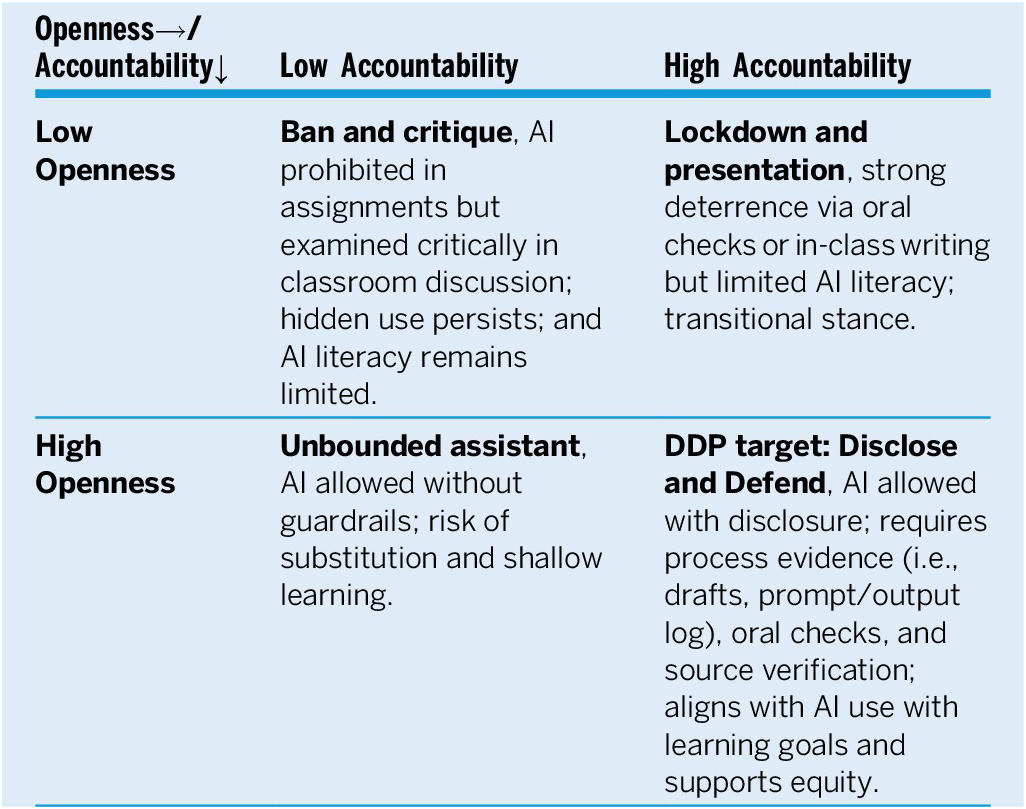
Table 1 Long description
The table is structured with Openness as the horizontal header and Accountability as the vertical header.
Header Row: The X-axis for Openness includes Low Accountability and High Accountability columns.
First Column: The Y-axis for Accountability includes Low Openness and High Openness rows.
Top-Left Quadrant (Low Openness, Low Accountability): Ban and critique. A I is prohibited in assignments but examined critically in classroom discussion. Hidden use persists and A I literacy remains limited.
Top-Right Quadrant (Low Openness, High Accountability): Lockdown and presentation. Strong deterrence via oral checks or in-class writing but limited A I literacy. This is a transitional stance.
Bottom-Left Quadrant (High Openness, Low Accountability): Unbounded assistant. A I is allowed without guardrails. There is a risk of substitution and shallow learning.
Bottom-Right Quadrant (High Openness, High Accountability): D D P target: Disclose and Defend. A I is allowed with disclosure. It requires process evidence such as drafts or prompt and output logs, oral checks, and source verification. This aligns A I use with learning goals and supports equity.
Notes: The recommended quadrant is high openness–high accountability, wherein generative-AI use is permitted with disclosure, process evidence, brief oral defense, and source verification.
Concerns motivating this approach are well founded. Generative-AI systems can produce fluent, well-structured prose across a wide range of prompts, raising fears that students may substitute machine-generated text for intellectual labor. Early discussions among political science educators document widespread concerns about risks to authorship, assessment, and critical thinking (Ardoin and Hicks Reference Ardoin and Hicks2024; Wu and Wu Reference Wu and Wu2024). Subsequent scholarship, however, suggests that AI’s educational effects depend heavily on how it is introduced and constrained. Spindel and Ackerman (Reference Spindel and Ackerman2025) found that AI performance varies sharply with user expertise and task design. Michels (Reference Michels2024) argued that guided, transparent use can support instructional goals by foregrounding verification and source evaluation rather than undermining rigor. The challenge, therefore, is primarily one of pedagogical design rather than technological presence. Rather than endorsing prohibition, recent scholarship emphasizes structured approaches to generative AI in political science classrooms that prioritize guided use over outright bans (Cantwell-Chavez and Davis Reference Cantwell-Chavez and Davis2025).
This article situates DDP within existing debates on writing pedagogy, AI literacy, and educational equity. Although the term “Global South” is contested and risks homogenization (Mampilly Reference Mampilly2025), it is used herein analytically rather than geographically. The Global South, as Dados and Connell (Reference Dados and Connell2012) argued, denotes not only material inequality but also historically produced and ongoing power relations that structure knowledge production. As a result, the concept refers less to a fixed set of countries than to historical and structural positions within global systems of power, development, and knowledge production (Dados and Connell Reference Dados and Connell2012). In higher-education research, the term often captures conditions shaped by infrastructural fragility, uneven digital access, linguistic hierarchies, and institutional-resource disparities that influence how technological change is experienced across academic systems. These structural constraints, including uneven infrastructure, linguistic hierarchies, and institutional capacity, shape how AI enters classrooms differently than in well-resourced US and European settings.
Recent scholarship on the political economy of AI similarly highlights how global data extraction, language dominance, and infrastructural disparities can reproduce inequalities between the Global North and the Global South in the development and deployment of AI systems (Birhane Reference Birhane, Cave and Dihal2023; Shakir, Png, and Isaac Reference Shakir, Png and Isaac2020). As Birhane (Reference Birhane, Cave and Dihal2023) argued, algorithmic systems can reproduce colonial dynamics through data extraction and the imposition of external knowledge systems while obscuring underlying power asymmetries. These dynamics are particularly relevant in the context of generative AI, wherein access to paid tools, reliable connectivity, and English-dominant training data can shape both opportunities and constraints for students and instructors. A practice-grounded, instructor-led case study from a political science course in Lebanon during Spring 2025 demonstrates how these constraints intensify questions of access, transparency, and accountability in writing pedagogy.
The contribution of this article lies not in proposing a novel technology or method but rather in clarifying and operationalizing a set of pedagogical principles—such as openness, accountability, and equity—that frequently are invoked in debates about AI and writing but rarely systematized in political science pedagogy.
The article proceeds as follows. The following section synthesizes scholarship on AI in higher education, writing-as-process pedagogy, AI literacy, and equity by identifying the limits of prevailing responses. I then challenge the “replacement” logic that equates writing with text production and explain why accountability remains central to political science education (Çavdar and Doe Reference Çavdar and Doe2012). Building on this foundation, I present DDP as a practical framework for integrating AI through disclosure, process visibility, and equity-aware design. The case study demonstrates how these principles were implemented in a crisis-affected classroom and reflects on their pedagogical limits. The conclusion argues that resisting both panic and hype requires recentering writing pedagogy on responsibility, context, and care.
EXISTING SCHOLARSHIP
Debates about generative AI in higher education have converged around recurring tensions rather than settled best practices. In political science, in which writing remains central to disciplinary training, these debates focus less on whether AI will be used than on how its presence reshapes authorship, assessment, and learning. Recent scholarship also emphasizes questions of accessibility, transparency, and the uneven conditions under which students encounter AI tools in higher education (Cantwell-Chavez and Davis Reference Cantwell-Chavez and Davis2025). Four fault lines are especially salient: (1) prohibition versus guided use; (2) product-centered versus process-centered writing; (3) detection versus disclosure; and (4) equity-blind versus equity-aware pedagogy. Table 1 situates DDP within these debates.
Prohibition, Guidance, and the Limits of Bans
Initial responses to generative AI emphasized restriction. Early faculty surveys documented widespread concern that text-generation tools would undermine academic integrity and erode critical thinking, leading some instructors and institutions to adopt bans or strict limitations (Ardoin and Hicks Reference Ardoin and Hicks2024; Wu and Wu Reference Wu and Wu2024). Although understandable, these approaches proved difficult to enforce in practice because students continued accessing AI tools outside of institutional control. Subsequent scholarship increasingly questions blanket prohibitions, arguing instead for guided use that foregrounds transparency and instructional intent rather than surveillance (Michels Reference Michels2024; Spindel and Ackerman Reference Spindel and Ackerman2025). DDP addresses this tension by permitting AI use while embedding accountability mechanisms that make intellectual labor visible.
Writing as Process Versus Text as Product
A second fault line concerns how writing itself is understood. Scholarship in political science pedagogy emphasizes writing as a process through which students develop arguments, engage evidence, and clarify analytical stakes (Baglione Reference Baglione2008; Çavdar and Doe Reference Çavdar and Doe2012; Tao and Griffith Reference Tao and Griffith2020). From this perspective, the educational value of writing lies less in polished prose than in the cognitive work required to produce it. DDP builds on process-oriented pedagogy by requiring students to document how ideas develop over time while remaining accountable for claims, even when AI is used as a scaffold.
Detection, Disclosure, and Accountability
A third debate centers on enforcement. As AI-generated text becomes more difficult to distinguish from student writing, reliance on detection tools has drawn criticism due to both technical limitations and pedagogical risks, including false positives and disproportionate impacts on multilingual writers (Spindel and Ackerman Reference Spindel and Ackerman2025). Some educators therefore advocate shifting attention away from detection and toward disclosure and verification practices that emphasize trust and evidence of process (Michels Reference Michels2024).
Rather than attempting to identify illicit use after the fact, disclosure-based models ask students to explain how tools were used and to demonstrate understanding through verification or defense. DDP adopts this logic by treating disclosure as a pedagogical practice rather than as a compliance exercise.
The Myth of Replacement and the Nature of Writing
Much anxiety surrounding generative AI rests on a “replacement” logic that equates writing with the production of text. This assumption misunderstands the role that writing plays in political science education. Writing is not only a vehicle for expressing ideas but also a process through which students develop arguments, evaluate evidence, and assume responsibility for political claims (Çavdar and Doe Reference Çavdar and Doe2012).
Generative AI can produce fluent text without engaging in judgment, interpretation, or accountability. Outputs are generated from statistical patterns rather than understanding or responsibility for claims. When errors appear in AI-generated text, no agent bears responsibility, whereas students are expected to defend their arguments and revise in response to critique.
Research further suggests that AI performance depends heavily on task design and user expertise. Whereas AI can assist with surface-level tasks such as grammar and organization, it remains less reliable for complex analysis and original synthesis without substantial human intervention (De Maio et al. Reference De Maio, Kabalaki, Moshtael and Tejax2025; Spindel and Ackerman Reference Spindel and Ackerman2025).
Equity, Access, and the “Assistant Illusion”
Framing generative AI as a “writing assistant” has become a common compromise in higher education. Although the label suggests a supportive role, it risks obscuring how generative systems actually operate. AI models generate probabilistic text based on patterns in training data rather than evaluating truth or relevance, meaning that output may include incorrect references or misleading generalizations presented in fluent language (Ardoin and Hicks Reference Ardoin and Hicks2024). When students treat such output as authoritative, errors may enter assignments unnoticed.
These concerns intersect with broader questions of equity and access. Access to advanced AI tools is uneven, shaped by subscription costs, connectivity, language proficiency, and institutional capacity (Reeves Reference Reeves2023). Adoption of generative AI therefore must be examined through the lenses of equity and accessibility because unequal access to digital tools and infrastructure shapes how students participate in AI-mediated learning environments (Cantwell-Chavez and Davis Reference Cantwell-Chavez and Davis2025).
Bias further complicates these dynamics. Generative-AI models reflect the social and linguistic distributions of their training data, often privileging US and Eurocentric perspectives and performing unevenly across languages, particularly in Arabic and other underrepresented linguistic contexts (Rafidi and El Khatib Reference Rafidi and Khatib2025). Students therefore encounter AI tools under uneven conditions not only of access but also of linguistic and epistemic representation.
These disparities are particularly visible in under-resourced and crisis-affected educational settings, where infrastructural constraints limit both access to technology and faculty capacity for intensive oversight. Taken together, these dynamics show that the assistant metaphor alone is insufficient: although generative AI can support learning under certain conditions, its risks—misinformation, bias, over-reliance, and unequal access—are unevenly distributed.
Rather than treating equity as an external constraint, DDP incorporates it directly into assignment design by pairing openness with accountability and flexibility attuned to institutional limits.
Literature Gap
Taken together, existing scholarship illuminates the dilemmas posed by generative AI but provides limited guidance on how to redesign writing pedagogy in ways that integrate AI without sacrificing accountability or reproducing inequality. What remains underdeveloped are pedagogical frameworks that operationalize transparency, accountability, and equity in writing instruction under conditions of uneven access. This article addresses that gap by articulating DDP and examining its application in a crisis-affected political science classroom.
FROM ASSISTANT TO ACCOUNTABLE PRACTICE: DISCLOSE AND DEFEND PEDAGOGY
The preceding discussion identified a central problem in current approaches to generative AI: that is, framing AI as a writing assistant without redesigning pedagogy leaves core risks unaddressed. Misinformation, uneven performance across languages, over-reliance on automated output, and unequal access persist unless instructional design reallocates responsibility to students. DDP responds to these challenges by pairing openness with accountability and embedding equity considerations in writing assignments rather than treating them as external constraints.
Existing classroom responses often fall along a spectrum between prohibition and unregulated use. Some instructors adopt a “ban-and-critique” strategy, prohibiting AI use in assignments and critically analyzing AI-generated output in class. Although this approach preserves traditional writing practices and promotes critical literacy, it leaves unresolved questions about how students should navigate AI tools that remain widely accessible outside of the classroom. As illustrated in table 1, this ban-and-critique approach corresponds to the low-openness/low-accountability quadrant, wherein AI use is restricted formally but remains pedagogically under-integrated. By contrast, DDP occupies the high-openness/high-accountability quadrant in table 1, allowing bounded AI use while making intellectual responsibility visible through disclosure, process evidence, and verification.
Design Principles: Openness, Accountability, and Equity
DDP operationalizes a high-openness, high-accountability stance. AI use is permitted but only under conditions that make intellectual labor visible. Students must disclose whether and how AI tools were used and provide evidence of their writing process, such as drafts or brief annotations describing how their ideas evolved. Accountability is reinforced through verification practices and short defenses designed to ensure that students understand and can justify the claims they advance. These mechanisms are not intended to police technology but instead to realign assessment with the cognitive work that writing is meant to cultivate.
DDP operationalizes a high-openness, high-accountability stance. AI use is permitted but only under conditions that make intellectual labor visible.
Equity is treated as a design principle rather than an afterthought. Access to AI tools, connectivity, and language proficiency varies across students and institutions, particularly in resource-constrained settings. DDP therefore incorporates flexibility into assignment design, including shared access to permitted tools, allowances for uneven connectivity, and attention to language-performance disparities when evaluating student work. By integrating these considerations into assignment structure, DDP seeks to ensure that openness and accountability remain feasible rather than punitive.
In practice, implementing DDP requires three minimal conditions observed in this course: (1) structured assignments that make the writing process visible; (2) clear disclosure expectations regarding AI use; and (3) opportunities for brief verification or defense of student reasoning. Without these elements, disclosure risks becoming symbolic rather than pedagogically meaningful.
Classroom Tactics: Making AI Use Visible
A core element of DDP is treating AI as an object of inquiry rather than as an invisible aid. Assignments may ask students to evaluate AI-generated summaries or draft passages by identifying inaccuracies, gaps, and generic reasoning and then to revise their work using course readings and credible sources. These tasks shift attention away from whether AI was used and toward how claims are evaluated and improved.
Disclosure requirements further normalize transparency, making it routine for students to explain how tools contributed to their thinking rather than concealing their use. In this way, disclosure becomes a pedagogical device rather than merely a compliance mechanism.
DDP also incorporates explicit instruction in AI literacy. Courses may include short discussions explaining how generative-AI systems produce text, why output can appear authoritative despite errors, and where performance varies across contexts. Integrating this instruction within writing assignments encourages critical engagement and reduces the likelihood that students treat AI output as epistemically neutral.
In the course examined in this article, these principles were operationalized through staged writing assignments, disclosure statements accompanying submissions, and occasional short oral checks in which students explained how they evaluated sources or revised their claims. Assignment prompts and anonymized examples of student interaction with AI tools are described in the case-study discussion.
Assessment Redesign and Integrity
Traditional assessments that are focused solely on final products are ill suited to an environment in which generative-AI tools are widely available. DDP therefore prioritizes process-oriented assessment. Staged assignments moving from proposal to draft to revision render the development of ideas observable and reduce incentives for wholesale substitution. Evaluation focuses on argument quality, evidence use, and the intellectual contribution that students add beyond any permitted AI assistance.
Integrity within this framework is defined through disclosure rather than detection. Undisclosed use of AI constitutes a breach of academic standards, whereas acknowledged use is evaluated relative to learning objectives. When concerns arise, they are addressed through review of process evidence and dialogue rather than reliance on automated detection systems. This approach reframes integrity as a pedagogical relationship grounded in accountability and trust.
Policy and Pedagogical Limits
DDP does not claim to resolve all challenges posed by generative AI. Its effectiveness depends on class size, instructor capacity, and institutional support, and its practices may require adaptation in large courses and resource-constrained settings. Instructors must balance openness with manageable forms of process verification while institutions provide guidance on evolving AI tools.
Nevertheless, by shifting attention from prohibition or unregulated assistance toward design principles emphasizing responsibility, transparency, and equity, DDP offers a practical framework for integrating AI into political science writing pedagogy without abandoning core educational commitments.
To illustrate how these principles operate in practice, the following section presents a practice-grounded, instructor-led case study from a political science course taught in Lebanon during Spring 2025. The case study is not presented as a controlled experiment but instead as a reflective account of course design and classroom practice under conditions of institutional fragility and crisis. Examining assignment structures, instructional adjustments, and recurring classroom dynamics highlights practical insights and tradeoffs that emerge when integrating generative AI into writing pedagogy.
CASE STUDY: TEACHING WRITING WITH AI IN CRISIS CONTEXTS (LEBANON, SPRING 2025)
This case study presents a practice-grounded, instructor-led account of course design and classroom practice in a political science course taught in Lebanon during Spring 2025—a semester shaped by the aftermath of war, prolonged economic crisis, and ongoing infrastructural instability. The case study is not offered as a controlled experiment or as evidence of causal learning outcomes because the course was not designed as a research study and Institutional Review Board approval was not sought. Instead, it was an instructor-led examination of how writing pedagogy was adapted in response to widespread student use of generative AI. The analysis draws on observable instructional adjustments, assignment structures, classroom interactions, and anonymized examples of student work rather than on interviews, surveys, and identifiable student data.
Context and Pedagogical Constraints
By Spring 2025, in-person instruction had resumed but conditions remained fragile. Power cuts, inconsistent Internet access, and financial strain continued to affect both students and faculty members. At the same time, generative-AI tools were widely accessible outside of the university and increasingly normalized in students’ academic routines. The pedagogical question, therefore, was not whether students would encounter or experiment with AI but rather how writing assignments could be designed to address its presence transparently and equitably.
Compared to the previous semester, AI use surfaced more openly. Early written submissions and classroom discussions suggested that students already had begun using AI-generative tools for tasks such as summarizing readings, brainstorming arguments, refining language, and simplifying complex material. Rather than treating this discovery primarily as a disciplinary issue, the course reframed AI use as an object of collective inquiry: Where does assistance end and authorship begin, and what forms of use remain compatible with the goals of political science writing?
Assignment Redesign and Disclosure Practices
To address these questions, several assignments were redesigned using DDP principles. One short discussion assignment asked students to evaluate the explanatory value of Democratic Peace Theory in international conflict. The full assignment prompt is reproduced herein as an example of a DDP-aligned task.
Students were required to adopt a clear position—either defending or rejecting the theory’s usefulness—and support their argument using course readings and lecture material. Responses were limited to 200–250 words and were required to take the form of a short analytical essay rather than bullet points.
The assignment prompt included the following instructions: “In 200–250 words, evaluate whether Democratic Peace Theory provides a convincing explanation for patterns of international conflict. Take a clear position and support your argument using course readings or lecture material. You may use generative-AI tools only for brainstorming, outlining, or editing. If AI is used at any stage, you must disclose how it was used and submit screenshots of the prompts and responses. AI-generated text may not be submitted as your final answer.”
It is important to note that the assignment explicitly addressed AI use. Students were informed that generative-AI tools could be used only as assistants for brainstorming, outlining, and language refinement. AI-generated text could not be submitted as the final response. If AI tools were used at any stage, students were required to disclose this use and submit screenshots showing the prompts they entered and how the tool was used. Students also were informed that they might be asked to briefly explain and defend their argument. Whereas this assignment emphasized analytical argumentation, other assignments in the course adopted more reflective and forward-looking formats, incorporating similar disclosure requirements while varying the type of writing task and expected learning outcomes.
This disclosure requirement reframed AI use from a hidden practice into a visible part of the writing process. Rather than attempting to prohibit or detect AI use, the assignment made it part of the pedagogical conversation. In class, examples of AI-generated summaries or arguments occasionally were discussed collectively to examine where such output aligned poorly with course readings, relied on generic reasoning, or failed to engage the theoretical debate presented in lectures.
First Anonymized Example of AI-Assisted Revision
The following example is a slightly modified version of a student response designed to preserve anonymity while accurately reflecting the structure and argumentative pattern of submissions in the course. The student initially drafted a short essay arguing that Democratic Peace Theory lacks explanatory power because it reflects the interests and worldview of powerful Western democracies rather than a universal pattern of peaceful behavior. The argument emphasized global inequality, the strategic use of democracy promotion in foreign policy, and the persistence of conflict between powerful and weaker states.
After independently drafting the paragraph, the student used a generative-AI tool to request feedback on how to refine the text while preserving the original argument. The student’s prompt asked the AI system to reduce the word count, improve clarity, and make the paragraph more professional without introducing new concepts. The AI response suggested tightening redundant phrasing and clarifying transitions but did not generate new analytical content.
The student subsequently revised the paragraph and submitted both the final version and screenshots documenting the interaction with the generative-AI tool. The screenshots showed the full sequence of prompts and responses, including the student’s request for editing assistance and the AI tool’s suggestions for trimming and refining the argument. When asked informally during class discussion to explain the reasoning behind the critique of Democratic Peace Theory, the student was able to articulate the argument in their own words and connect it to course discussions on global-power hierarchies and core–periphery dynamics.
Second Anonymized Example of AI-Assisted Ideation and Structuring
A second assignment invited students to produce a forward-looking reflection on peace building by imagining themselves receiving a major international award for contributions to conflict resolution. One anonymized case illustrates a different pattern of generated-AI use—early-stage ideation and structural scaffolding—rather than editing.
In this instance, the student began by consulting a generative-AI tool to understand the criteria and typical framing of such awards and then prompted the system to suggest possible causes related to peace building. The student subsequently requested a more original and forward-looking topic, ultimately selecting a theme centered on the risks of AI in international security—particularly the possibility of unintended conflict emerging from automation, cyber operations, and miscalculation.
The student then used AI to generate an outline for organizing the speech. The prompt listed key components, personal experience, international perspective, central cause, significance, lessons learned, and broader contribution. It then asked the AI system to structure these into a coherent sequence. The AI response proposed a progression from personal narrative to global implications and concluding reflections.
It is important to note that the student did not rely on AI to generate the final text. Instead, the response was written independently and submitted alongside disclosure materials documenting each stage of interaction. In a final step, the student used AI to refine language and flow without introducing new ideas, requesting stylistic improvements while preserving the original meaning.
This example highlights a distinct pattern of AI use compared to the previous case. Rather than functioning as a tool for sentence-level editing, AI operated as a mechanism for topic exploration and structural organization. Because this use was disclosed and the student remained responsible for the substantive argument, authorship was not displaced.
At the same time, this case study also revealed limitations. Although AI-supported scaffolding improved coherence and organization, it did not necessarily deepen engagement with course readings and theoretical frameworks. The resulting argument remained relatively broad and normative, suggesting that AI-assisted structuring can enhance clarity without strengthening analytical depth.
Throughout the course, 16 students submitted disclosure materials documenting their use of generative-AI tools. In most cases, AI was used for brainstorming, editing, and structural suggestions rather than generating complete responses. Because students were aware that they might be asked to explain their reasoning, the disclosure process encouraged them to remain engaged with the substantive arguments that they presented rather than relying on automated output.
Across both examples, a clear distinction emerges between AI use for editing, structuring, and substitution. When constrained through disclosure and paired with accountability measures, AI use tended to remain bounded and visible rather than replacing student reasoning. Although the degree of AI use varied, most students used generative tools primarily for editing, outlining, and brainstorming rather than producing full responses. In several cases, screenshots showed students requesting assistance with word reduction, phrasing, and organization while preserving their original argument. These interactions suggested that when disclosure requirements were explicit, students were more likely to treat AI as a limited writing aid rather than a substitute for analytical work.
Accountability Mechanisms in Practice
Given class size and time constraints, full oral defenses for every assignment were not feasible. Instead, accountability was reinforced through a combination of short in-class checks, targeted follow-up questions, and process-oriented assignment design. Students were asked periodically to explain how particular claims were developed, why certain sources were used, or how competing interpretations were resolved. These moments functioned as informal defenses rather than formal presentations, which allowed instructors to assess understanding without imposing unsustainable demands on class time.
Process visibility also played a central role. Staged assignments, revision requirements, and reflective annotations made it easier to see how ideas evolved over time. When questions arose about a submission, they were addressed through review of drafts and discussion rather than reliance on automated detection tools. This approach reinforced academic integrity as a pedagogical relationship grounded in explanation and accountability rather than in surveillance.
Equity Considerations and Practical Limits
Equity constraints shaped both design and implementation. Not all students had equal access to paid AI tools, stable connectivity, and English-dominant interfaces. Disclosure requirements made these disparities more visible, allowing instructors to distinguish between substantive misuse and uneven access. Flexibility in deadlines, expectations, and modes of engagement therefore was essential to prevent accountability mechanisms from becoming punitive.
The case study also revealed practical limits. Designing and monitoring process-oriented assignments required additional instructional labor, and scaling such practices to larger courses would require institutional support or adaptation. Monitoring disclosure materials and reviewing screenshots added modest administrative overhead, although this remained manageable in a class with 16 students. Moreover, whereas transparency reduced covert reliance on AI, it did not eliminate tensions between efficiency and learning—particularly in a crisis-affected environment in which students faced competing pressures related to financial instability, displacement, and limited infrastructure.
Reflections
Several observations emerge from this classroom experience. First, disclosure-based approaches appear to reduce the incentive for covert AI use by normalizing transparency. When students understood that AI use was permitted under specific conditions and would be evaluated through explanation and accountability, many chose to document their interactions with these AI tools rather than conceal them.
Not all aspects of the approach worked smoothly. Some students initially misunderstood disclosure requirements and assumed that submitting AI-generated drafts alongside their own text was sufficient, requiring clarification that the final submission had to reflect their own analytical reasoning. In a few cases, screenshots revealed that students relied too heavily on AI-generated phrasing before revising their work. These moments became teaching opportunities, allowing the class to examine how generative output can appear persuasive while remaining analytically shallow or disconnected from course readings.
Second, requiring students to defend their arguments, even informally, proved to be an effective way to distinguish between superficial textual fluency and genuine analytical understanding. It is important to note that these outcomes were not uniform; students varied in how effectively they integrated AI into their writing process, with stronger students using it selectively and others initially relying more heavily on generated phrasing. Students who had independently developed their arguments generally were able to explain their reasoning and connect their claims to course material, even when AI had been used for editing or structural refinement.
The comparison between the two examples further suggests that different forms of AI use produce different pedagogical outcomes. Editing and structuring tools can improve clarity and organization, but they do not necessarily enhance theoretical engagement or evidence-based reasoning. This reinforces the importance of aligning AI use with assessment criteria that prioritize analytical depth rather than surface-level coherence.
Third, the case study illustrates that the pedagogical challenge posed by generative AI is not primarily technological but rather instructional. In a context marked by institutional fragility, infrastructural disruption, and uneven access to digital resources, writing pedagogy must adapt in ways that preserve accountability while remaining sensitive to inequality and crisis conditions. DDP does not eliminate all tensions surrounding AI use, but it provides a practical framework for integrating transparency, responsibility, and equity into political science writing instruction.
Rather than presenting a universally replicable model, this case study demonstrates how incremental pedagogical redesign can make AI use visible and evaluable under constrained conditions. In doing so, it shifts the focus of academic integrity away from surveillance and detection and toward explanation, responsibility, and the cultivation of critical reasoning.
Practical Lessons for Implementation
Three practical lessons emerge from this classroom experience. First, disclosure must be paired with structured process requirements; without drafts, annotations, or prompt logs, disclosure risks becoming symbolic rather than pedagogically meaningful. Second, different forms of AI use produce distinct learning outcomes: whereas editing and structuring tools can improve clarity, they do not substitute for engagement with theory and evidence. Third, accountability mechanisms must remain proportional to institutional constraints. In smaller classes, informal defenses and targeted questioning can sustain accountability, whereas larger classes may require adapted forms of process verification.
CONCLUSION
Generative AI has unsettled writing-intensive pedagogy not simply because it produces text but also because it challenges long-standing assumptions about the purpose of writing in political science education. In political science, writing has never been merely a means of communication; it is a practice of reasoning, evidence evaluation, and responsibility for claims. Approaches that frame AI solely as a threat to be banned or a convenience to be embraced miss this central pedagogical stake. The challenge is not whether AI will be used but instead how writing pedagogy can adapt without surrendering accountability or reproducing inequality.
This article argues for DDP as a practical middle ground. Rather than attempting to exclude AI or normalize its unexamined use, DDP integrates generative-AI tools through disclosure, process visibility, verification, and equity-aware design. By shifting attention from detection to accountability, the framework reframes academic integrity as a pedagogical relationship grounded in explanation and responsibility. Writing remains a site of thinking and judgment, even when AI is permitted as a bounded aid.
The classroom case study presented herein illustrates how these principles can operate in practice. In a political science course taught in Lebanon during Spring 2025, writing assignments were redesigned to require disclosure of AI use and documentation of the writing process. Students submitted screenshots of their interactions with AI-generative tools and occasionally were asked to explain how their arguments were developed. Throughout the course, most students used AI primarily for editing, outlining, and word reduction rather than for generating substantive arguments. The disclosure requirement, combined with informal defenses and process-oriented assignments, kept responsibility for reasoning with the student rather than with the technology.
At the same time, the case study underscores that DDP is not a universal solution. Its practices require instructional labor, adaptation to class size and infrastructure, and institutional support to avoid becoming burdensome or punitive. As the case study illustrates, these constraints are particularly visible in crisis-affected environments wherein connectivity, language resources, and institutional stability remain uneven.
Two broader implications follow. First, debates about AI in political science education should move away from technological determinism and toward pedagogical design. The most consequential questions concern how assignments are structured, how accountability is enacted, and whose conditions of access are assumed. Second, equity cannot be treated as an external constraint on otherwise neutral policies. Language-performance disparities, uneven connectivity, and institutional capacity shape how AI is experienced and therefore must be addressed within pedagogical frameworks themselves.
DDP does not claim novelty in isolation; neither does it offer a one-size-fits-all template. Rather, it provides a structured way to think about how openness to generative-AI tools can be paired with mechanisms of accountability and attention to inequality. Its contribution lies in clarifying and operationalizing a set of principles—openness, accountability, and equity—that can guide incremental redesign across diverse teaching contexts.
DDP does not claim novelty in isolation; neither does it offer a one-size-fits-all template. Rather, it provides a structured way to think about how openness to generative-AI tools can be paired with mechanisms of accountability and attention to inequality.
As generative AI continues to evolve, the task for political science educators is not to chase technological fixes but instead to reaffirm why writing matters and to design courses in which responsibility, judgment, and care remain at the center of learning.
ACKNOWLEDGMENTS
The author thanks the editors and anonymous reviewers of PS: Political Science & Politics for their thoughtful and constructive engagement with the article. The author also is deeply grateful to the students whose experiences, insights, and reflections informed and enriched this study. The final stages of writing were supported by the Arab–German Young Academy of Sciences and Humanities through its Research Mobility Program.
CONFLICTS OF INTEREST
The author declares that there are no ethical issues or conflicts of interest in this research.

 Open access

