


Olga left Russia in March 2022 when, after participating in a rally against the full-scale invasion of Ukraine, she was detained and spent 10 days in jail. While she was in prison, someone wrote “Traitor” in red paint on the door of her house. After discussing her options with her family, they decided that she should leave the country. Although she was unprepared to emigrate, her departure went smoothly thanks to the help of volunteers who were Russian emigrants themselves (Demytrie Reference Demytrie2022).
Up to one million Russians made similar journeys following the start of the full-scale invasion of Ukraine in 2022: this exodus is considered the biggest brain drain from Russia since the collapse of the Soviet Union (The Economist 2022). What is little known is that Russian migrants facilitated this exodus.Footnote 1 In 2022, migrant-led support groups reported helping more than 133,800 Russians leave the country.Footnote 2
Social networks are key to enabling migration (Dekker and Engbersen Reference Dekker and Engbersen2014; Tintori et al. Reference Tintori, Kalantaryan, Grubanov-Boskovic, Scipioni, Farinosi, Cattaneo and Benandi2018), providing vital support during early settlement (Palmgren Reference Palmgren2017; Ryan et al. Reference Ryan, Sales, Tilki and Siara2008) and later in the integration process (Battisti, Peri, and Romiti Reference Battisti, Peri and Romiti2022; Palmgren Reference Palmgren2017; Stips and Kis-Katos Reference Stips and Kis-Katos2020). Technological advances have expanded these networks beyond close ties to include casual acquaintances and even strangers, who support both decision making and mobility (Dekker et al. Reference Dekker, Engbersen, Klaver and Vonk2018; van Meeteren and Pereira Reference Van Meeteren and Pereira2018). Yet, such support is selective: networks can act as “bridgeheads” or “gatekeepers,” shaping migrant flows and policies (Böcker Reference Böcker, Anita1994; de Haas Reference De Haas2010) and, at times, even hindering the assimilation of newcomers (Doña-Reveco and Gouveia Reference Doña-Reveco and Gouveia2022; Just and Anderson Reference Just and Anderson2012; Snel, Engbersen, and Faber Reference Snel, Engbersen, Faber and Bakewell2016).
Although many studies explore how host country citizens view migrants (Hainmueller and Hopkins Reference Hainmueller and Hopkins2015; Magni Reference Magni2024), little is known about how migrants themselves decide whom to support (Gaikwad and Nellis Reference Gaikwad and Nellis2017). Existing research also focuses on help given to family and friends (Boccagni Reference Boccagni2015; Haug Reference Haug2008; Heering, Van Der Erf, and Van Wissen Reference Heering, Van Der Erf and Van Wissen2004; Massey et al. Reference Massey, Arango, Hugo, Kouaouci and Pellegrino1999). In contrast, this study examines the motivations of emigrants offering aid to strangers. Unlike most work on labor migration, it looks at crisis migration, in which urgency and uncertainty likely shape migrants’ motivations to help.
This study uses a conjoint experiment embedded in a unique survey of migrants from Russia who left the country after the invasion of Ukraine in 2022 and now reside in more than 60 countries; it analyzes the factors that lead some migrants to accept or reject other migrants in the context of war, political crisis, and repression. We complement the quantitative analysis with insights from 60 in-depth interviews.
Russian migrants are very selective when deciding whom to help emigrate from Russia. They prefer to assist other migrants fleeing because of political persecution or their dissenting political views, rather than those leaving for economic reasons. Major events, such as emigration driven by political crises or the fear of repression, generate solidarity along political lines—solidarity that is amplified when those in need of help display additional vulnerability, such as having experienced repression in Russia. Helping politically motivated rather than economically motivated migrants contributes to building a positive antiwar image of the new diaspora. These findings suggest that migrants may strategically shape the composition of the diaspora, motivated both by political concerns about their home society and by the desire to signal certain values to their host society.
Contrary to what literature predicts, Russian migrants are not more inclined to help co-ethnics over ethnic minorities. Instead, they perceive certain ethnic minorities as more deserving of assistance. Our analysis suggests that the following mechanisms explain why Russian emigrants prefer helping ethnic out-groups. First, ethnic out-groups are seen as more vulnerable due to their disproportionate mobilization and other war-related hardships. Second, group-based guilt and a sense of responsibility for Russia’s actions drive migrants to support victims of the regime, including ethnic minorities.
The remainder of this article proceeds as follows. We first outline our theoretical expectations, which focus on in-group favoritism and group-based guilt and responsibility. We then introduce the case of Russian migrants following the 2022 invasion of Ukraine. Next, we describe our conjoint experiment and interview data. We conclude by presenting our findings and discussing their implications for migrant solidarity and deservingness in contexts of political displacement.
Theory
The conventional view in migration studies holds that migration is primarily facilitated through ethnic networks, in which co-ethnics offer practical, financial, and emotional support to newcomers, thereby reducing the costs and risks of migration (Massey Reference Massey1990). These ties have long been seen as the backbone of chain migration and diaspora formation. However, recent research reveals that support is increasingly being extended beyond ethnic lines, with migrants assisting even complete strangers through online platforms, messaging apps, and social media groups (Dekker et al. Reference Dekker, Engbersen, Klaver and Vonk2018). It remains unclear how migrants determine whom to assist, particularly when resources are limited. What factors make certain migrants more deserving of help in the eyes of other migrants? Does the context of the politically induced migration influence these decisions, and if so, how?
In this study, alongside conventional hypotheses emphasizing preferences for co-ethnics as an important factor in diaspora formation and assistance, we introduce a new set of hypotheses highlighting the importance of political conflict and the solidarities arising from it: these expectations potentially challenge co-ethnic preferences. Although we may expect that people are more willing to help co-ethnics, as predicted by the classic literature on migration formation, we also assume that this pattern may come into conflict with other strategic or emotional considerations, such as group-based guilt and responsibility or political affinity. In what follows, we lay out our hypotheses.
In-group Preferences
In-group favoritism and the tendency to associate with similar others emerge along lines of ethnicity, religion, and political affiliation and lead to the formation of social networks that are demographically and behaviorally homogeneous (Fu et al. Reference Fu, Tarnita, Christakis, Wang, Rand and Nowak2012; McPherson, Smith-Lovin, and Cook Reference McPherson, Smith-Lovin and Cook2001). Research shows strong and consistent evidence of co-ethnic preference in altruistic behavior (Haushofer et al. Reference Haushofer, Lowes, Musau, Ndetei, Nunn, Poll and Qian2023), although the mechanisms underlying this tendency—why it occurs (Habyarimana et al. Reference Habyarimana, Humphreys, Posner and Weinstein2009) or fails to occur in certain contexts (Berge et al. Reference Berge, Bjorvatn, Galle, Miguel, Posner, Tungodden and Zhang2020)—remain under active investigation. In internal migration, preferences for one’s ethnic group may reflect important political considerations; for example, a desire to achieve “safety in numbers.” Minorities experiencing socioeconomic hardship and limited political representation often see the arrival of co-ethnics as a way to strengthen their demographic presence, increase their electoral influence in the city, and counter discrimination (Gaikwad and Nellis Reference Gaikwad and Nellis2017). Based on in-group favoritism literature, we expect Russian migrants to have preferences for their ethnic in-groups:
H1. Migrants will prefer to help those with a Russian ethnic background compared to non-Russian backgrounds.
However, migrants may be selective inside their own ethnic group or even oppose the migration of their co-ethnics. As demonstrated by the case of Venezuelan migrants in Chile, attitudes toward other migrants may also relate to processes of self-construction as an idealized group of deserving migrants. In this way, migrants may favor social groups perceived as “good, educated migrants” whose presence in their host countries is seen as contributing positively to the collective migrant image, in contrast to “bad, uneducated” migrants perceived as harming this image (Doña-Reveco and Gouveia Reference Doña-Reveco and Gouveia2022). Similarly, economically successful immigrants may oppose further immigration because of concerns about being associated with undocumented or uncontrolled immigration (Kaeser and Tani Reference Kaeser and Tani2023).
In the case of Russian migration, given the hostile attitudes toward Russians in response to the Russian aggression, we expect that politically active migrants will prefer to support others who left for political reasons because they are motivated by a sense of political solidarity that often arises during times of repression (Nugent Reference Nugent2020) and by a desire to expand and align themselves with the antiwar segment of the diaspora. We may also expect that the more politically engaged migrants are, the more willing they will be to help those whose motivation for leaving Russia is political, because such support aligns closely with their own political convictions.
H2. Migrants will prefer to help migrants whose motivation to leave Russia is political compared to migrants whose motivation is nonpolitical.
H3. The more politically engaged migrants are, the more they will be supportive of migrants with a political motivation for leaving Russia.
We assume that in-group solidarity may be amplified by a lack of control over their situation and a high level of need (Petersen Reference Petersen2012; Reference Petersen2015; Van Oorschot Reference Van Oorschot2006), important cues of deservingness in heuristics that people usually use to decide who warrants help (Boudreau Reference Boudreau2009; Downs Reference Downs1957; Gigerenzer and Gaissmaier Reference Gigerenzer and Gaissmaier2011; Kahneman, Slovic, and Tversky Reference Kahneman, Slovic and Tversky1982; Mondak Reference Mondak1993; Petersen Reference Petersen2012; Van Oorschot Reference Van Oorschot2006). Hence, we also assume that individuals who leave for political reasons and have experienced repression will be viewed as even more deserving of support, given their lack of control over their circumstances and their greater need to emigrate.
H4. Migrants will prefer to help those whose motivation to leave Russia is political and who have experienced repression, compared to those whose motivation is nonpolitical or political without having experienced repression.
Guilt and Responsibility for Intergroup Solidarity
In the circumstances of migration during wartime and political repressions, we also find it important to add the dimension of guilt and responsibility toward victims of the regime, who also may be a part of the exodus. Collective guilt refers to the emotional response individuals feel for the harmful actions committed by their in-group against an out-group (Doosje et al. Reference Doosje, Branscombe, Spears and Antony1998). It arises from recognizing the in-group’s responsibility for wrongdoing (Čehajić Clancy et al. Reference Čehajić Clancy, Amit Goldenberg and Halperin2016; Zimmermann et al. Reference Zimmermann, Abrams, Doosje and Antony2011) and signals a violation of the group’s own moral standards (Doosje et al. Reference Doosje, Branscombe, Spears and Antony1998). Unlike personal guilt, which stems from one’s own transgressions, group-based guilt does not require direct involvement—only identification with the offending group (Doosje et al. Reference Doosje, Branscombe, Spears and Antony1998). It also tends to be more stable over time than personal guilt (Chudy, Piston, and Shipper Reference Chudy, Piston and Shipper2019). However, collective responsibility goes beyond emotional reactions, reflecting a normative duty or moral obligation to actively address harm caused by one’s group (Zimmermann et al. Reference Zimmermann, Abrams, Doosje and Antony2011). Both guilt and responsibility matter because they represent distinct motivations—emotional and normative—that jointly shape attitudes and behaviors toward victim groups.
Group-based guilt can motivate reparative actions, including support for redress and efforts to address the causes of harm (Rees, Klug, and Bamberg Reference Rees, Klug and Bamberg2015; Wohl, Branscombe, and Klar Reference Wohl, Branscombe and Klar2006). It has shaped intergroup relations in various contexts—for example, Germans’ attitudes toward Jews (Imhoff, Bilewicz, and Erb Reference Imhoff, Bilewicz and Erb2012), white South Africans’ behavior toward nonwhite citizens (Klandermans, Werner, and Van Doorn Reference Klandermans, Werner and Van Doorn2008), and Bosnian Serbs’ views of Bosnian Muslims (Brown and Cehajic Reference Brown and Cehajic2008). This sense of collective responsibility tends to predict more concrete and personally costly engagement with victims, above and beyond guilt (Zimmermann et al. Reference Zimmermann, Abrams, Doosje and Antony2011).
For such guilt to translate into action, individuals must identify with the group responsible for the harm and acknowledge its culpability (Zimmermann et al. Reference Zimmermann, Abrams, Doosje and Antony2011). The willingness to make amends also depends on the strength of group identification and adherence to moral or political values that were violated (Klandermans, Werner, and Van Doorn Reference Klandermans, Werner and Van Doorn2008). Consistent with this, collective responsibility often mediates guilt’s effect on one’s personal commitment to helping others and also directly predicts action beyond guilt (Zimmermann et al. Reference Zimmermann, Abrams, Doosje and Antony2011). However, group-based guilt can also inspire solidarity with others who are not the direct victims of war. For example, individuals who feel collective guilt over social inequality are more likely to support efforts to reduce it (Krauth-Gruber and Bonnot Reference Krauth-Gruber and Bonnot2020). Similarly, guilt may drive support for broader groups affected by state violence.
We expect that attitudes toward ethnic minorities who suffered from the actions of the regime may shape attitudes toward people fleeing the regime. Specifically, we expect that migrants may prefer or favor those minorities over titular nationals (Russians), which would contradict the in-group favoritism hypothesis formulated earlier but would align with the literature on guilt and responsibility. To test this assumption, we examine the case of two ethnic groups that we hypothesize are perceived as victims of the political situation: Russian nationals with Ukrainian heritage and the Buryats.
H5. Migrants will prefer to help other migrants with a Ukrainian/Buryat ethnic background compared to a Russian background.
H6. Migrants who have strong group-based feelings of guilt and responsibility will prefer to help other migrants with a Ukrainian ethnic background.
Context
In February 2022, Russia invaded Ukraine, triggering widespread condemnation. The invasion profoundly affected both countries. Millions of Ukrainians were forced to flee their country, and the invasion of a neighboring country has had a devastating effect on many people in Russia as well, with certain groups arguably suffering more. The war has particularly affected Russian citizens of Ukrainian descent and Ukrainian immigrants, who by 2021 constituted the largest Ukrainian diaspora in the world (International Organization for Migration 2021). For certain social and ethnic groups, the risk of being drafted and killed in the war has been reported to be several times higher than for others (Naylor Reference Naylor2023). The Buryats—a Mongolic ethnic group native to southeastern Siberia and residing primarily in the Republic of Buryatia—have faced some of the highest conscription and death rates in the war in Ukraine (Bessudnov Reference Bessudnov2023; Latypova Reference Latypova2024).
Additionally, up to one million Russians have fled the country, primarily motivated by their dissenting political views, fear of repression, and desire to avoid mobilization (Khinkulova Reference Khinkulova2023). For most, emigration was sudden and unplanned, triggered by the shock of the invasion; many left unprepared and needed support abroad. Travel was hampered by limited visa-free access to many countries, COVID-related border closures, and visa shortages (Sobakina Reference Sobakina2022), as well as visa bans, airspace restrictions, and quickly sold-out flights.
Russian emigrants have played a key role in helping others flee the country: 39% reported assisting fellow Russians in the early months of the invasion and continued doing so after six months abroad (Kamalov et al. Reference Kamalov, Sergeeva, Zavadskaya and Kostenko2023). They quickly established online support networks offering information, shelter, and legal aid (Otorbaev Reference Otorbaev2022; Scire Reference Scire2022), reaching hundreds of thousands, and mobilizing hundreds of volunteers (Troianovski and Kingsley Reference Troianovski and Kingsley2022). In 2022 alone, migrant-led groups reported more than 133,800 assistance requests. These efforts also sparked debates over prioritization, with some initiatives focusing on persecuted individuals (Kim Reference Kim2022).
In host societies, Russian migrants encountered a range of reactions from neutral or welcoming to openly hostile. In addition to typical nationality-based discrimination, they also faced the impact of international sanctions, which restricted rights and services based on citizenship for both those who stayed in Russia and those who left. Migrants experienced interpersonal discrimination and boycotts regardless of their ties to the regime (Brooks Reference Brooks2022). In some countries, they faced restrictive laws, such as bans on vehicles with Russian license plates in Estonia, Latvia, and Lithuania (Atalay Reference Atalay2023; Radio Free Europe 2022).
Data and Methods
To investigate what factors affect the deservingness of other potential migrants, we conducted a forced-choice conjoint experiment among Russian migrants who left Russia after February 24, 2022. Conjoint experiments are the workhorse of many pivotal studies evaluating migrant deservingness (Bansak, Hainmueller, and Hangartner Reference Bansak, Hainmueller and Hangartner2016; Hainmueller and Hopkins Reference Hainmueller and Hopkins2015; Lawlor and Paquet Reference Lawlor and Paquet2022) and have been shown to have high external validity (Hainmueller, Hangartner, and Yamamoto Reference Hainmueller, Hangartner and Yamamoto2015). The experiment design was preregistered; see appendix G for discussion of the preanalysis plan and deviations from it.
In 2022, we surveyed 2,036 Russian migrants who left Russia that year due to war- related circumstances and are now residing in more than 60 countries, including those that received a high influx of new migrants (see figure 1). Although it is a convenience sample, it features a diverse recruitment method (see appendix C). It aligns socio-demographically with similar regional surveys and also mirrors the country distribution of Russian migrants according to official statistics close in time to our survey (see appendix D).
Map of Distribution of Russian Migrants Who Participated in the Survey

We supplemented our conjoint analysis with an analysis of 60 in-depth interviews that were conducted during April and March 2023 (Smyth et al. Reference Regina, Zavadskaya, Semenov, Kamalov, Kostenko, Sergeeva and Turchenko2026). For this purpose, we used data collected within the framework of the OutRush project. Interviewees were recruited through survey and snowball sampling. The sample of interviewees closely resembled our quantitative sample in its basic socio-demographic characteristics. The question—“Which categories of Russians are now most deserving of help, in your opinion?”—was posed to 107 interviewees, of whom 60 specifically discussed Russians who were seeking to leave or had already left the country. Descriptive statistics for the final subset are presented in appendix E.
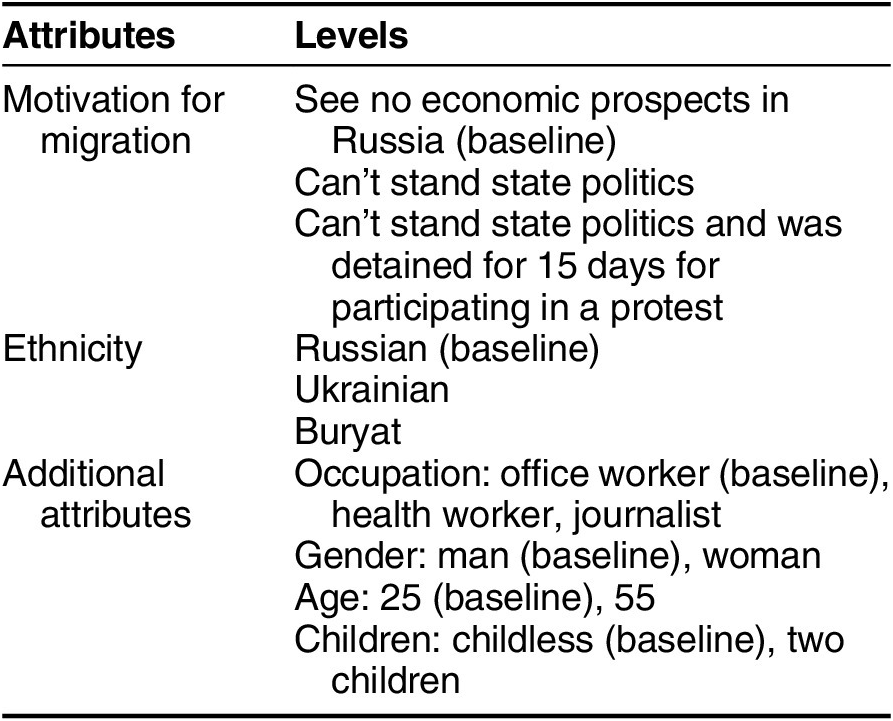
In the conjoint experiment, we asked respondents to choose which profiles of hypothetical Russian individuals—who had diverse ethnic backgrounds and reasons for leaving Russia—they would prefer to help. These profiles represented potential migrants seeking assistance to leave Russia. In addition to the theoretically central attributes, we included age, occupation, and parental status as control attributes to increase the realism of the profiles and facilitate respondent engagement (see table 1 and appendix F.1 for more details). Participants completed two independent conjoint choice tasks. In each task, they were presented with a pair of randomly generated profiles and asked to select their preferred option. Thus, each respondent evaluated a total of four profiles and made two choices. This resulted in approximately 8,000 profile evaluations across all respondents. Descriptive statistics, examples of conjoint profiles, and assumption checks can be found in appendixes E and F.
Conjoint Experiment Attributes

Following Hainmueller, Hopkins, and Yamamoto (Reference Hainmueller, Hopkins and Yamamoto2014), we assess the causal effect of different attributes of conjoint profiles using the average marginal component effect (AMCE) estimator. Estimates of marginal means (Leeper, Hobolt, and Tilley Reference Leeper, Hobolt and Tilley2020) are provided in appendix H.
The study was guided by a preanalysis plan (PAP) that specified a set of hypotheses to be tested, focusing primarily on the AMCEs of key attributes in a conjoint experiment, as well as several planned subgroup analyses (see appendix K). The PAP included preregistered hypotheses testing the AMCEs of the following attributes: age, number of children, ethnic background, gender, motivation for emigration, and profession. All six attribute effects were analyzed as specified in the PAP, with age, number of children, gender, and profession serving as controls. Subgroup analyses were also preregistered, but there were some deviations in the methods and operationalization from the PAP, as described later.
In the subgroup analysis of AMCEs, we used moderators that measured group-based guilt and responsibility, political interest in homeland affairs, and political and civic engagement after emigration. Our PAP does not specify exactly how interactions between experimental attributes and subgroup variables should be executed, which is why we used several approaches. First, following the standard practice for conjoint experiments, we reported conditional AMCEs by estimating AMCEs separately within each subgroup; to quantify differences across subgroups, we estimated interaction effects between the subgroup indicator and each conjoint attribute (Hainmueller, Hopkins, and Yamamoto Reference Hainmueller, Hopkins and Yamamoto2014; Leeper, Hobolt, and Tilley Reference Leeper, Hobolt and Tilley2020). Second, to conduct more fine-grained analyses with continuous moderators or with multiple moderators in the same model, the appendix estimates an OLS specification that interacts the single conjoint attribute with several pretreatment moderators, such as collective guilt/responsibility and political engagement, while leaving all other conjoint attributes not interacted. Because attribute levels were independently randomized, omitting interactions between the moderators and the nonfocal attributes should not bias the focal interaction coefficients. Including several relevant moderators simultaneously also partialed out overlap among them, ensuring that each coefficient reflected its unique moderation effect. This strategy preserves statistical power, controls for confounding moderation pathways, and allows joint tests within a single specification.
To measure group-based guilt and responsibility, respondents were asked to report the extent to which they, as Russian citizens, feel guilt and responsibility regarding Russia’s actions in Ukraine. Guilt is assessed by asking whether they “feel guilt for Russia’s actions in Ukraine,” and responsibility by asking whether they “feel responsibility for the consequences of Russia’s actions in Ukraine.” Each construct was measured using a single-item 5-point Likert scale, ranging from “strongly do not feel” (1) to “strongly feel” (5). For interactions between ethnic background and guilt or responsibility for the war, the PAP did not specify the operationalization; we tested binary, continuous specifications and specification with summative index of guilt and responsibility. For the main analysis, both variables were dichotomized: respondents who selected 4 or 5 were coded as 1 (high guilt/responsibility), and those who selected 1 or 2 were coded as 0 (low guilt/responsibility). Respondents who selected the midpoint (3) were excluded from the binary specification. In the appendix K.3 and K.4, we report heterogeneity analyses using the full 5-point scales. We complemented the analysis by constructing a summative index of guilt and responsibility (Cronbach’s alpha = 0.77, Pearson’s correlation = 0.62) as an overall measure of moral accountability for the war, which we used for joint heterogeneity analysis (appendix K.5).
We measured civic and political engagement with a multi-option question asking respondents whether they had participated in various forms of activism or support over the past three months. The listed activities included signing petitions or publishing political posts; participating in authorized or unauthorized protests; helping other Russian emigrants or Ukrainian refugees; financially supporting independent Russian NGOs, media, and initiatives; and volunteering. Respondents could select multiple options. As discussed in the preanalysis plan, we constructed an index of civic and political engagement ranging from 0 (none of the activities selected) to 7 (all activities selected). Because the PAP did not specify how this index should be used for subgroup analysis, in the appendix we report various approaches to analyzing subgroup effects: treating the index as a continuous variable, dichotomizing it into no activities versus any activities, and dichotomizing it around the mean value of the index (see appendix K.6 and K.8).
Political interest in Russian affairs was measured by asking respondents how interested they were in Russian politics, with four response options ranging from “very interested” to “not interested at all.” Because it was included in the PAP, we treated this variable as another measure of civic and political engagement in an exploratory manner as a continuous and binary variable. Given that the distribution was skewed toward high interest, the variable was dichotomized in the following way: respondents who selected “very interested” were coded as 1, whereas all others were coded as 0 (indicating lower interest).
Additionally, we asked respondents whether they had relatives in Ukraine at the time of the survey and whether they identified as part of an ethnic minority. All other subgroup interactions—country of residence, ethnic minority identity, and relatives in Ukraine—were exploratory and not preregistered.
Results
Figure 2 plots the effects of the help seekers’ characteristics on the probability of receiving support, pooling data for all respondents (for more details, see appendix H).
Effects of Help Seekers’ Characteristics on Respondents’ Decision to Aid Them
Notes. The figure shows the effects of the attributes on the probability of selecting profiles of help seekers for receiving help in their effort to leave Russia. Dots with horizontal lines indicate point estimates with cluster-robust 95% confidence intervals from linear least squares regression. The dots on the zero line indicate the baseline category for each attribute of a help seeker.

Russian migrants preferred assisting political migrants as opposed to migrants with economic motivations for leaving, confirming H2. The presence of political motivation for wanting to leave the country shows the biggest effect and increases the level of support by 20% (p < 0.001) compared to economic motivation. In accordance with H4, the combination of political motivation and the experience of being arrested at rallies amplifies support by 35% (p < 0.001), the largest effect observed among the attributes.Footnote 3
Contrary to H1 and prior evidence showing a reduced willingness to assist out-groups (Haushofer et al. Reference Haushofer, Lowes, Musau, Ndetei, Nunn, Poll and Qian2023), in particular in the context of migration (Gaikwad and Nellis Reference Gaikwad and Nellis2017), Russian migrants in this study preferred to assist help seekers from ethnic minorities. Support for emigres with Buryat descent was 4% (p = 0.024)Footnote 4 higher than for those with Russian backgrounds, while for Ukrainian descent profiles it was 5% (p < 0.001) higher. The results contradict the expected pattern of co-ethnic bias in altruistic behavior, which would predict a preference for helping individuals of Russian ethnic heritage, all else being equal. Instead, Russian migrants expressed greater support for migrants of minority origin, suggesting that mechanisms other than standard co-ethnic bias—perhaps shaped by the unique dynamics of politically induced migration—may be influencing their choices. These preferences confirm H5 and persist regardless of the migrants’ ethnic background or familial connections with Ukraine (see appendixes K.1 and K.2). Additionally, to test whether belonging to an ethnic minority signals political motivations for emigration—and thus conflates ethnicity with motivations for migration—we examined interaction effects between ethnic background and motivations to leave. No significant interactions were found, meaning that the presence of explicit political motivation in a profile does not reduce the effect of ethnic background. Thus, ethnic background communicates something distinct from political motivations for emigration (see appendix I).Footnote 5
Mechanisms behind Preferences for Support
Why are politically motivated help seekers preferred over ones who cited economic conditions? Based on additional subgroup analysis and in-depth interviews, we suggest two mechanisms: (1) political solidarity that is amplified by perceptions of need and (2) diaspora advocacy in the face of discrimination in host countries.
First, empathy and personal identification with the experience of exile were frequently cited motivations for helping others. Informants expressed particularly strong support for politically active individuals, especially those facing government persecution. These individuals were seen as especially vulnerable and lacking control over their circumstances. Thirty-seven of the 60 interviewees cited emigrants’ political position and persecution in Russia as key criteria of deservingness. Interviewees emphasized the moral dimension of these decisions, arguing that opposition to the war constitutes a principled political stance that deserves recognition and solidarity. Remaining in Russia while holding an antiwar position was often described as a form of psychological torture:
“Well, these are my people—people who, just like me, may have overcome their own fears, who decided not to sponsor this war, who refused to keep living in this swamp, who chose to build themselves a new life. And again, they’re close to me in terms of their views.” (Informant 1)
Although H3 is only partially confirmed, solidarity with politically motivated help seekers seems to stem from having shared political positions about the war. Without controlling for other moderation mechanisms, individuals with higher levels of political engagement—measured as political interest or active participation in political and civic activities while abroad—show a greater inclination to support politically motivated help seekers (see Figure 3). Specifically, respondents highly interested in Russian politics are significantly more supportive of politically motivated help seekers (8%) and those with an experience of being arrested in Russia (7%; both p < 0.01). At the same time, when political engagement is measured as active political or civic participation, it shows a positive effect only for help seekers who experienced arrests. The effect remains statistically significant regardless of whether it is measured as a continuous index or a binary variable (see appendix K.6–8).
Subgroup Analysis Based on Levels of Political Engagement
Notes. The graphs on the far right show estimated differences in AMCE between subgroups whose effects are depicted on the left and middle graphs. Conditional AMCEs are obtained by estimating AMCEs separately within each subgroup, and differences across subgroups are quantified by estimating interaction effects between subgroup indicators and conjoint attributes (see appendix K.6 for statistical tests and K.8 for a fine-grained analysis). Dots with horizontal lines indicate point estimates with cluster-robust 95% CI from linear least squares regression. The dots on the zero line stands for the baseline category for each attribute of a potential Russian emigrant seeking help.

However, when controlling for other possible mechanisms such as guilt and responsibility for the war in Ukraine, only the moderating effect of political interest remains statistically significant (see table 28 in appendix K.8). Conversely, the moderating effect of active political participation remains positive but loses statistical significance. At the same time, a sense of collective guilt and responsibility exhibits a significant (p < 0.01) positive moderation effect on preferences to aid politically motivated help seekers who had been arrested in Russia. We interpret the positive moderating effect of guilt and responsibility as indicative of antiwar alignment between emigrants and help seekers, because these feelings serve as strong proxies for attitudes toward the war. The political motivations of help seekers similarly signal a critical stance on the war. This effect may also be reinforced by compensatory mechanisms: politically motivated individuals who have experienced arrests may be perceived by those with a strong sense of guilt and responsibility as victims of the conflict.
The solidarity mechanism is amplified for those seeking help who have a greater need for aid because of their personal circumstances. Nineteen of 60 interviewees emphasized that priority should be given to those who are against the war but lack the resources to leave, pointing out that many such individuals do not have easily transferable professions:
“Well, I think those who are against the war and have stayed in Russia—and can’t leave—they need help. That’s what I think. There are many people who are against it but just can’t afford to leave.” (Informant 2)
The second possible mechanism relates to migrants’ attempts to shape how they are perceived in the host society. Migrants may selectively support certain individuals to enhance representation and reduce the risk of discrimination in their new environment (Gaikwad and Nellis Reference Gaikwad and Nellis2017; Kaeser and Tani Reference Kaeser and Tani2023). Because Russians fleeing the war often do not receive a warm welcome, they may be especially motivated to facilitate the entry of “good”—that is, clearly antiwar—Russians. This helps increase the visibility of the antiwar Russian movement and, ultimately may make the host society’s perceptions more favorable.Footnote 6
In-depth interviews with Russian emigrants support this mechanism: 16 of 60 informants mentioned that supporting antiwar emigres was a way to combat stereotypes and discrimination and to ensure representation of dissenting Russians abroad:
“Of course, the main focus should be on those who are genuinely at risk in Russia. Because otherwise, it can create the impression that some people are simply relocating in search of a more comfortable life.” (Informant 3)
“I believe this [supporting antiwar Russians] is the only way to make it clear to others that Russians aren’t synonymous with Russian politics. That the idea of unconditional support for the war simply isn’t true. That people actually think differently. And those millions of people within the country who oppose the war—they have no voice.” (Informant 4).
Why do Russian emigrants prefer to help ethnic out-groups? Our analysis suggests the following complementary mechanisms: (1) ethnic out-groups are perceived as more disadvantaged by the war and (2) respondents feel responsible for the situation these emigrants have found themselves in.
Interviews reveal that Ukrainians are widely perceived as the most vulnerable group in need of help. When asked specifically about which categories of Russians are most deserving of assistance, many interviewees first emphasized that Ukrainians from Ukraine should be prioritized, because their situation is far worse than that of any Russian citizen. Respondents also frequently mentioned that they had volunteered or donated to Helping to Leave, an NGO that assists Ukrainians—including those in Russia—in reaching safety. Although only one interviewee explicitly mentioned Ukrainians with Russian passports when discussing deserving groups, the majority of Russian migrants interviewed consistently expressed the view that Ukrainians are the primary victims of the war and of the Russian political regime.
Additionally, respondents perceive some groups, such as Buryats and others from ethnic republics in Russia, as more deserving of help because they are at higher risk of mobilization. Nine of the 60 informants emphasized the need to prioritize those at high risk of military mobilization, especially those from vulnerable social groups, including low-income men and ethnic minorities:
“If we take the situation in Bashkortostan [a national republic in Russia], for example, there are lots of young men in villages who are now subject to mobilization and conscription—who, on the one hand, don’t really want to go, but who are under psychological pressure, being told they have to defend the motherland, that it’s their duty to go to war and kill Ukrainians. So, I think the antiwar movement in emigration should now be focused on helping this segment of the population.” (Informant 5)
Figure 4 shows additional evidence of the impact of the war context on deservingness: Russian migrants who feel guilt and a sense of responsibility about the Ukraine conflict exhibit a stronger inclination to support help seekers of Ukrainian descent rather than those of Russian descent. Those with a high sense of responsibility for the consequences of the Russian invasion tend to support help seekers with a Ukrainian background more often than those with a Russian background; they do so 7.7% (p = 0.016) more often than respondents with a low sense of responsibility. Respondents with high levels of guilt are also 5.4% (p = 0.067) more sensitive to help seekers with a Ukrainian background compared to those with low levels of guilt, although this result is only marginally statistically significant. However, a more fine-grained analysis treating guilt as a continuous rather than a binary variable reveals a statistically significant effect (p < 0.01; see appendix K.5). This tendency aligns with H6 and the literature that identifies a positive effect of guilt and responsibility on the propensity to offer compensation (Chudy, Piston, and Shipper Reference Chudy, Piston and Shipper2019; Zimmermann et al. Reference Zimmermann, Abrams, Doosje and Antony2011). This is further confirmed by analyzing the moderating effect of a summative index of guilt and responsibility. When controlling for other potential moderators, such as experiences of repression and political engagement, only guilt and responsibility show a significant moderating effect (see appendix K.5, table 22).
Subgroup Analysis Based on Levels of Group-Based Guilt and Responsibility
Notes. The graphs on the far right show estimated differences in AMCE between subgroups whose effects are depicted in the left and middle parts of the graphs. Conditional AMCEs are obtained by estimating AMCEs separately within each subgroup, and differences across subgroups are quantified by estimating interaction effects between subgroup indicators and conjoint attributes (see appendix K.3 and K.4 for statistical tests and K.5 for a fine-grained analysis). Dots with horizontal lines indicate point estimates with cluster-robust 95% CI from linear least squares regression. The dots on the zero line stands for the baseline category for each attribute of a potential Russian emigrant seeking help.

Conclusion
Political crises often provoke migration, with millions fleeing their homes because of political turmoil. Examples include anti-Bolshevik Russian emigrants after 1917 (Robinson Reference Robinson2002), Cubans in the 1960s (Pedraza-Bailey Reference Pedraza-Bailey1985), Iranians in 1979 (Azadi, Mirramezani, and Mesgaran Reference Azadi, Mirramezani and Mesgaran2020), Venezuelans leaving Maduro’s regime (Chaves-González and Echevarr´ıa Estrada Reference Chaves-González and Carlos Echevarr´ıa2020) and most recently, the mass exodus of Russians following Russia’s full-scale invasion of neighboring Ukraine in February 2022.
Especially during such crises, migrants rely on their networks for support in their migration and assimilation into host countries (Dekker and Engbersen Reference Dekker and Engbersen2014; Dekker, Engbersen, and Faber Reference Dekker, Engbersen and Faber2016; van Meeteren and Pereira Reference Van Meeteren and Pereira2018). However, studies exploring migrants’ deservingness of support rarely focus on preferences and attitudes of migrants toward other migrants. How do migrants determine whom to assist, particularly when resources are limited? What factors make certain migrants more deserving of help in the eyes of other migrants, particularly in the context of a politically induced migration? To answer these questions, we conducted a conjoint experiment within a survey of war-induced Russian migrants.
In the study, in-group preference plays a key role in determining who is seen as deserving of help. However, contrary to research on ethnic favoritism, we find that political affinity is more important than ethnicity. This is explained by two primary mechanisms: (1) political solidarity, which is amplified by perceptions of need, and (2) diaspora advocacy in the face of discrimination in host countries. In other words, political migrants may also seek safety in numbers and so may prioritize supporting those who are politically aligned with them and who help signal to host countries their vulnerability because of repression in their authoritarian homeland. At the same time, supporting antiwar Russians helps construct the image of the so-called good Russian in the eyes of host communities, countering nationality-based discrimination. This is especially important in countries with higher levels of discrimination. This selectivity in providing assistance highlights an important mechanism that may influence diaspora formation, opening a promising avenue for further investigation into how politically motivated migrants strategically shape diasporas in response to both homeland repression and host-country reactions.
Ethnic favoritism does not play the same role in in-group support as it typically does in the in-group favoritism literature: we argue that this difference is due to the specific circumstances of migration. Although the effect of ethnic minority status is not large, it is persistent across both minority groups we tested: Russian citizens with Ukrainian and Buryat heritage compared to Russian citizens with an ethnic Russian heritage.
The mechanisms underlying the choice to support certain ethnic out-groups are that they are perceived as more in need because of the war, and respondents feel a degree of responsibility for the situation these people have found themselves in. As time passes and the immediate pressures of war and politics recede, new patterns of solidarity may emerge, in which motivation for providing support may shift from political alignment to other forms of shared identity and experience.
Our study reveals that recent Russian migrants are selective about which future members of their diaspora they are willing to support: it also highlights mechanisms driving this selectivity, which are linked to repression in the homeland, the circumstances of war, and geopolitical dynamics in host countries—factors that often accompany a sudden migrant influx. These findings have broader theoretical relevance beyond the Russian case: in other contexts where authoritarian repression, political crisis, and geopolitical contestation intersect, similar logics of migrant selectivity may emerge. At the same time, we recognize that these mechanisms may travel less well to other types of migration, such as labor-driven or long-term diasporic movements for which motivations and support structures may differ significantly.
In many instances, host societies and their governments harbor apprehensions about the abrupt arrival of immigrants into their nations. Citizens often fear a decline in welfare (Marx and Naumann Reference Marx and Naumann2018; Vadlamannati Reference Vadlamannati2020) or increased market competition (Dustmann and Preston Reference Dustmann and Preston2007) and are generally unwelcoming toward immigrants (Ford Reference Ford2016; Kootstra Reference Kootstra2016). However, when it comes to humanitarian concerns, such as assisting those less fortunate and politically persecuted, the consensus is that these migrants are more deserving of help (Bansak, Hainmueller, and Hangartner Reference Bansak, Hainmueller and Hangartner2016).
Our findings indicate that preferences for support exhibited by migrants themselves align closely with broader public sentiment on assistance priorities and resonate with policy directives that focus on extending aid to individuals who are perceived to be most affected by the regime’s actions. Consequently, governments of host societies may consider providing legal and financial assistance to networks and organizations of political migrants. These entities offer an efficient and well-informed tool that complements governmental refugee policies, guided by a nuanced understanding of the specific needs felt by those genuinely requiring assistance.
Supplementary material
To view supplementary material for this article, please visit http://doi.org/10.1017/S1537592725104143.



 Open access

