

Introduction
Thirty years after the 1995 United Nations (UN) World Conference on Women: Action for Equality, Development and Peace in Beijing, this article explores whether the world is any closer to realising the goals of gender equality and empowerment in paid and unpaid work that were articulated at that conference. It starts with the 1990s for three reasons. Firstly the Beijing Conference initiated and framed the 30 years of United Nations sponsored policy/programme activity on gender and work that followed. Secondly the 1990s saw the emergence of a range of specialised academic journals, theorising gender questions, including the question of global standards. Thirdly the 1990s also saw the emergence of journals (including ELRR) that addressed the consolidation of the neoliberal order within which struggles to change the gender relations of work and care, were being pursued.
The articles in this final tranche of papers accepted for the Themed Collection in ELRR 36(3) provide new evidence from Australia, India, and Latin America of realities of working and caring lives and prospects for change. This introductory article provides a wider context for that evidence, and for exploring the possibility of change, whether originating from the ‘desks’ of policy development, research and theorising, or from the ‘streets’ of grassroots mobilisation (Viveros-Vigoya Reference Viveros-Vigoya, Davis and Lutz2023). We address the following questions:
-
1. What key themes emerge from a selection of snapshots of gender and work relations in the parts of the globe covered by this collection of articles?
-
2. Since the Beijing conference, what international policy and regulatory agendas have been applied in the quest to improve the paid and unpaid working lives of women and LGBTQIA+ people, and how have these agendas fared?
-
3. Very briefly, what concepts drawn from English language academic debates since the 1990s are particularly helpful in explaining the constraints under which the Beijing goals have been pursued?
-
4. What hopes for change have been offered by regional policy initiatives and grassroots mobilisations in parts of the world reflected in the Themed Collection?
-
5. What is the relationship between hopeful gender policy initiatives and the experiential evidence that is reflected in the empirical studies to which our article provides an introduction?
We begin with an introductory context section which uses a selection of data snapshots to pinpoint some sobering realities in the three geographic regions represented in the Themed Collection in this issue - Australia, India and Latin America. We then overview the key UN-linked global and regional policy and regulatory frameworks that hold out hope of improving gendered working lives: the International Labour Organisation (ILO) Decent Work agenda and the UN Sustainable Development Goals, the latter involving a less than optimistic 2025 mid-decade stocktake. Next, we briefly draw out key themes that have emerged since the 1990s from the theoretical literature on post-coloniality and on the intersection of gender and other oppressions. These themes provide a realistic basis from which to assess emerging signs of hope, based on both grassroots mobilisation and policy initiatives addressing informal work and the redistribution of care. From these various sources, the following tentative conclusions are drawn:
-
1. On average, almost two-thirds of women across the world work in formal labour markets, where gender-segregation however, remains entrenched (as in Australia). This average masks the high incidence of work in barely regulated informal sectors (as in India). In any case, across the world, women spend considerably more hours than men each week in unpaid work. This important work is not assigned an economic value, and its hours are being expanded by the need to contend with the environmental effects of climate change.Footnote 1 There are significant anomalies in what work gets counted and valued, and what work remains invisible.
-
2. The ‘soft regulatory’ standard-setting, monitoring and programme support roles of the UN and the ILO remain vital for maintaining and improving work-related gender well-being. Despite critiques that their human rights framework is imbricated with a global economic order that is post-colonial in name only, both the sustainable development and the decent work agenda hold a mirror to, and help mitigate, some of the impacts of that order.
-
3. Whilst the sustainable development and decent work agendas have addressed gender inequality and power imbalance in work performed in formal labour markets and, increasingly, in informal work, the next frontier, being addressed by an emerging ‘Care Society’ agenda, is to tackle the gender imbalance in work outside either formal or informal economy settings – unpaid care work. This means addressing gender inequalities in value recognition, time allocation, reward distribution, and representation through social dialogue.
These conclusions, drawn from secondary sources – contextual data snapshots, policy analysis, and academic literature, ending with an overview of the emerging Latin American Care Society agenda – are juxtaposed against new research data reported in the seven articles in ELRR 36(3) that contribute to the Themed Collection on Gender and Work, adding to those already in Volumes 35(4) and 36(2). This new set of articles shifts the focus from structure to individual agency. Detailed case studies suggest that whatever policies and programmes are developed, the process of changing lived experience and gender attitudes and behaviours is a slow one. Examples include:
-
1. Evidence of how extreme gender-based occupational segregation in Australia has been reinforced through active male agency in shaping training system redesign;
-
2. Evidence of women’s limited work options, decision-making power and access to financial resources (including their own earnings) in India, where traditional family, class, and caste structures have been embedded in a neoliberal market economy, and where gender stereotypes of subservience are being newly inscribed into digital technology in daily use;
-
3. A Mexican example of the difficulty of avoiding the perpetuation of gendered childcare responsibilities within labour market-based carework, and an Argentinian counter-example of the gender empowerment that has emerged as a by-product of a community food-preparation programme.
We begin by setting the scene for the analysis, with snapshot indicators of types of gendered work, paid and unpaid, in formal and informal labour markets, communities and households, in these three parts of the world. These snapshots lead into a discussion of responses based on policy approaches, academic analysis and grassroots mobilisations. Finally, we juxtapose this general analysis with the new experiential evidence provided, before coming to a conclusion as to ways forward.
Question 1. What are some selected indicators of gender and work contexts 30 years on from the Beijing conference
In 2024, across the world, 64.5% of women aged 15–54 were estimated to be working in formal labour markets, a slight increase from the post-COVID figure of 61.4% in 2022, when the male formal labour market participation rate, by contrast, was 90.6% (UN Women/Women Count 2025). Globally, there is great variation in the extent to which women’s paid work occurs in formal labour markets, where it is open to counting and regulation. In 2024, informal labour markets accounted for 89.4% of all women’s work in Africa, 62.6% across Asia, and 50.5% in Latin America and the Caribbean (International Labour Organisation (ILO)/Our World in Data 2025). In India in 2024, 91.6% of women’s employment was in the informal economy (ILOStat data explorer 2025).
The gender discrepancy in participation in paid work, whether in formal or informal labour markets, is of course a product of the invisible gender difference in hours spent per day in social reproduction work. The United Nations (2025) has published global estimates that, compared with men, on average women ‘spend 2.5 times more hours each day on care and domestic tasks’. In its mid-decade Sustainable Development stocktake, the UN Department of Social Affairs (UN DESA 2025) pointed to solutions such as minimal expenditure of $8 billion per year on clean cooking fuels that would not only cut carbon emissions but deliver an estimated $192.3 billion a year in time and health savings for women and girls. Later in this article we discuss case study evidence of initiatives in Latin America and the Caribbean to address the gender disparity in care-work hours.
Colonial legacy: Segregated work in the formal labour market in Australia
Formal employment in regulated labour markets in Australia is characterised by very high levels of gender-based industry and occupational segregation, (Cortis and Naidoo Reference Cortis and Naidoo2025; Junor et al Reference Junor, Preston, Smith, Williamson, Parker, Donnelly, Gavin and Ressia2025). In 2025, the statutory body Jobs and Skills Australia (JSA) introduced a new Gender Segregation Intensity Scale, commenting with concern that the intensity of occupational segregation had remained largely unchanged between 2006 and 2021, with only 20% of the paid workforce being in ‘gender-balanced’ occupations. Linking occupational segregation to pay inequality, the report identified a total of 100 occupations with male-biased gender pay gaps greater than 25%. The report drew particular attention to a ten-year gender pay gap of 38.1% for First Nations women, which it attributed to the intersectionality of ‘compounding barriers and discrimination’ in work, education and training (JSA 2025).
This Australian gender-segregated occupational structure is the residue of the male breadwinner wage regime used in the twentieth century to create a racialised white national Australian identity, following the 1901 federation of former convict and free settler colonies based on coastal cities and rural land expropriation using the enslaved, unpaid or low-paid labour of First Nations women and men (Bargallie et al Reference Bargallie, Lentin and Turner2026; McGrath et al Reference McGrath, Saunders and Huggins1995). For the first 70 years of the twentieth century, the male breadwinner wage was designed to support a white English-speaking ‘populate or perish’ ethos, although it gradually relaxed after World War II. Strict gender-based occupational segregation was required to protect the male breadwinner wage from being ‘undercut’ by women who were assumed not to have dependents. Unpaid care work was assigned no economic value in national accounts. Since the 1970s, care work, education work and service work has been increasingly shifted to the state and market sectors, feminised and undertaken on a part-time basis, so that now the main gendered life-course difference is in paid hours worked (Baxter 2023). A redistribution of unpaid work has not kept pace.
First Nations women still have a particularly heavy unpaid workload based on care for extended families, kinship networks and communities, exacerbated by a high incidence of poor health and disability amongst children, a heavier care load, and high morbidity rates amongst adults. First Nations women’s care-giving responsibilities also extend to Country, defined physically, linguistically, spiritually, and emotionally in terms of relationships to plants, animals, and landforms (Klein et al Reference Klein, Hunt, Staines, Dinku, Brown, Glynn-Braun and Yap2023).
Risse (Reference Risse2025) critiques a methodological bias in the UN System of National Accounts (SNA) used in Australia, as elsewhere, to determine which unpaid work activities are assigned a monetary value and included in Gross Domestic Product (GDP). Using time use data to estimate the volume of unpaid work excluded from national accounts, she calculates that 55% of women’s labour contribution to the economy consists of unpaid work and care, compared with 31% of men’s labour. To assign an economic value to this contribution, she makes a set of corrections based on a male wage premium, finding as a result that the value of women’s share of the overall labour effort is currently 50.5%.
The paradox of women’s formal labour market work in India
Ghosh (Reference Ghosh2024) and Chandrasekhar and Ghosh (Reference Chandrasekhar and Ghosh2025) address the conundrum that, despite India’s strong growth figures in the post-1991 New Economic Policy era of liberalisation and privatisation, Indian women’s formal labour market participation rate actually declined between 1999 and 2018. Rural women’s participation rate fell from 35% to 25%, whilst urban women’s rate remained at 16%. Though women’s participation rate appeared to jump to 40% between 2018 and 2023–2024, closer examination showed that the change was largely based on a redefinition of labour market participation to include unpaid help in family enterprises such as farms or small shops. On the other hand, women classed as performing ‘domestic duties’ (care work within the household, gathering fuel and engaging in kitchen gardening and livestock and poultry rearing) remained excluded from the statistics as not in the labour force, even when these economic activities were undertaken for remuneration, and despite the economic contribution of this work, whose hours have increased as a result of climate change-induced environmental degradation.
Ghosh (Reference Ghosh2024) notes the limited incentive for Indian women to participate in the formal labour market, resulting from a gender pay gap whereby women earned two-thirds of the male rate. Perceptions of the benefits of public sector work were contradicted by evidence that India’s growth trajectory was being amplified through practices such as the volunteer status assigned to women working in early childhood education or health support, paid at a fraction of the official minimum wage, and by the irregular piece-rate or task-rate remuneration system for women working as teaching aides and auxiliary nurses and midwives. Wichterich (Reference Wichterich2020) identified similar processes of ‘familialisation and voluntarisation’ in rural health provision, with caste stigmata facilitating what she identified as a process of mutually-reinforcing neoliberal and patriarchal value extraction.
In India’s neoliberal economy, it falls to individuals to seek individual solutions to inequality, for example through migration. In looking briefly at the role of migration pathways (both internal and external) in providing gendered access to work, and in shaping its quality, we start with two examples of internal migration in India. The first example is that of the ‘push’ and ‘pull’ factors, based on discrimination, that shape the internal labour migration pathways of LGBTQI+ people. Gnana Sanga Mithra (Reference Gnana Sanga Mithra2025) cites an ILO survey finding indicating 74% of respondents had experienced workplace discrimination, with only 27% being open about their identity at work due to fear of harassment or job loss, while a further 2023 Indian LGBTQ Migration Survey indicated that the destination for 63% of LGBTQ internal migrants was to urban centres such as Mumbai, Delhi, and Hyderabad, where government organisations and NGOs provide social and legal support.
In the case of rural women, Mezzardi (Reference Messadri2024) has documented how employers extract additional surplus value through annual cycles of internal rural-urban migration that provide little economic security to women or their rural communities. She provides examples from both north and south India, whereby urban factory production is subsidised, and state housing and social insurance costs are reduced, as women live part-year in temporary dormitory-style accommodation in cities, supplying low-paid factory labour, and then return part-year to agricultural/horticultural work in their villages. At age 35–40, having been paid wages too low to accumulate savings, they return permanently to the village-based informal economy, working either in subsistence horticulture or home-based garment manufacture.
This analysis of internal migration has interesting points of similarity with and difference from the analysis by Mukherjee (Mukherjee, Reference Mukherjee2025) cited below, relating to the ‘communities of mind’ (cultural norms from families’ origins) that accompany women migrating from rural locations to urban slums. Patterns of employment take-up may vary according to the state from which women migrate, but the ‘community of mind’ concept may be a constant.
A hopeful policy intervention: The invisible economic and social contribution of unpaid household and community work in Latin America and the Caribbean
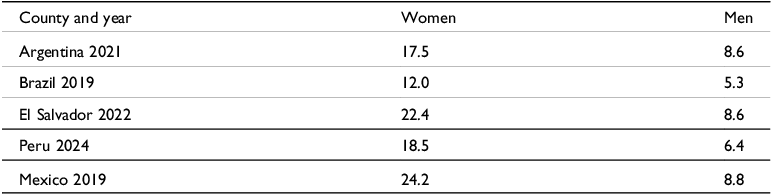
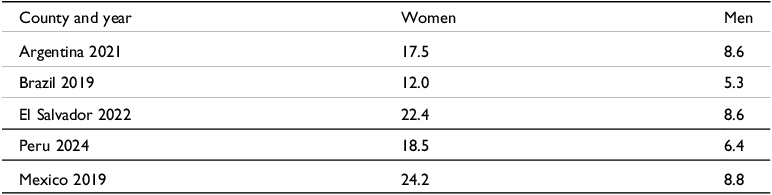
A hopeful policy intervention in Latin America and the Caribbean is a project, discussed more fully below, designed to create greater gender equality in the distribution of time spent on unpaid household and care work. The ILO and the UN Economic Commission for Latin America and the Caribbean (ECLAC) have been mapping the outcomes of cycles of gender-based time-use surveys. The examples provided in Tables 1 and 2 are extracted from substantial pyramids and graphs comparing the average weekly hours worked by women and men, and the average percentages by gender of paid and unpaid time worked. The very fact that this inequality is being measured is an encouraging first sign of change.
Average weekly hours reported spent in paid and unpaid work, by gender, Four Latin American countries
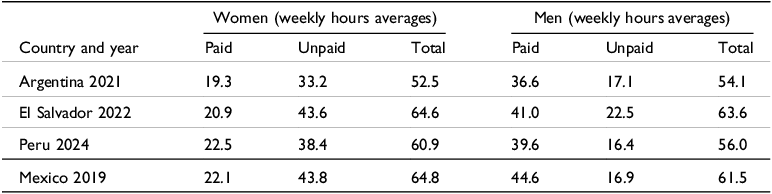
Source: ECLAC (Economic Commission for Latin America and the Caribbean (ECLAC) 2025b.
Percentage of total hours spent per week on domestic work by gender, r, Five countries
From contextual evidence to policy, conceptual framing, and grassroots action
These selective ‘data snapshots’ from three parts of the world provide a contextual backdrop to our analysis of policies, theories, and regional policy and grassroots activations that help shed light on the new evidence and analysis provided in this ELRR 36(3) Work and Care Themed Collection.
Question 2. Sources of hope? Post-Beijing policy frameworks and agendas – Human and labour rights; gender equality, sustainable development and empowerment
The 1995 Beijing Plan of Action identified 12 areas of concern to be addressed by policy mainstreaming. ‘Soft regulatory’ processes have been used over the past 30 years to address these areas of concern by promoting the goals of gender equality and empowerment within a framework of sustainable development.
Gender equality had been inscribed in the 1948 United Nations (UN) Universal Declaration of Human Rights, which expressed
[f]aith in fundamental human rights, in the dignity and worth of the human person and in the equal rights of men and women and determination to promote social progress and better standards of life in larger freedom.
These concepts of ‘progress’ and ‘standards’ imply that it is fair and reasonable to impose a global benchmark, raising the fundamental questions addressed in the Unequal Exchange Theory literature (e.g. Amin Reference Amin1977; Hickel et al Reference Hickel, Doranger, Hanspeter and Suwandi2022).Footnote 2 Enactment of the UN’s ‘faith’ and ‘determination’, linking human rights, gender equality and development, occurs through the UN’s ‘soft regulatory’ relationships with governments. The Beijing Conference articulated 12 areas of concern, and the UN has since addressed these through two policy and programme approaches. The first approach is the insertion of gender equality protections into the labour standards established and monitored by the oldest UN agency, the ILO. The second method has been the inclusion of gender equality and empowerment goals within the Millennium Development Goal 2000–2024 and the Sustainable Development Goal (SDG) 2015–2030 agendas.
ILO regulatory framework
At the 1999 ILO annual tripartite conference, a ‘Decent Work’ agenda was introduced, based on four pillars: job creation, rights at work, social protection, and social dialogue. These rights have been variously formulated over the past quarter-century as consisting of or including the right to collective bargaining; elimination of forced or compulsory labour; abolition of child labour; elimination of discrimination in employment and occupation; and a safe and healthy work environment (ILO 2022a). In advancing the Decent Work agenda, ILO annual conferences formulate Conventions, Protocols and Recommendations. Ratification of Conventions and Protocols imposes a mandatory obligation on signatory governments to ensure implementation, and to demonstrate their compliance with this obligation through a programme of triennial and six-yearly reporting. The ILO also provides background research, monitors implementation, issues policy implementation guidelines and publishes issues papers as a background to the formulation of new standards.
The ILO’s regulatory role is based on monitoring of emerging regulatory gaps and pressure points. For example, in 2022, in response to the growing global threat from within UN member nations, policy guidance drew together advice on the extent to which the working rights of LGBTQI+ people are covered by Convention 1958 on discrimination in employment (No. 111), by the 2010 Recommendation on HIV and AIDS and the World of Work (No. 200); and by the Convention on ending violence and harassment in the world of work (No. 190).
More recently, the ILO has been working with governments in the Latin American and the Caribbean region to revive and more tightly coordinate an approach to employment formalisation, addressing the fact that approximately half the region’s population are working informally, that the proportion has grown since COVID, and that women, minority groups and migrants are most affected. Implementation strategies are based on tripartite dialogue and the ILO’s decent work principles, in an effort to install access to social protection for workers in informal and non-market work, environmental protections and caregiver rights (ILO 2024). This work thus dovetails with the ILO’s support for regional care economy work, which is discussed below.
Goal-setting approaches
In contrast to the ILO’s detailed approach to gaining governments’ ratification of labour standards and monitoring implementation, the UN General Assembly, more broadly, has sought to enrol national governments in a wider project of social and economic development, within which the goals of gender equality and empowerment are both identified separately and mainstreamed across all other goals. Countries’ unanimous commitment to pursuing the goals is supported by a wide range of relevant UN System organisations, coordinated through the Department of Economic and Social Affairs. Progress toward goal attainment is reported annually, against a country’s choice of designated targets chosen by each country from a range linked to measurement criteria.
Between 2000 and 2014, the UN published country reports on the achievement of Millennium Development Goals, including the Beijing goals of gender equality and empowerment. Amongst the gender equality goals, near-universal access to primary education was reported as the closest to being achieved. Subsequently, seventeen Sustainable Development Goals were adopted in 2015, with 2020–2030 being nominated as the decade during which progress towards their achievement is being monitored, again using countries’ self-reporting against achievement targets. Gender equality is again an explicit goal (SDG5), overseen by the entity UN Women, created in 2010, which also has oversight of the mainstreaming of gender equality and empowerment across the other 16 goals.Footnote 3 There has been a particularly strong critique of the yoking together, in SDG8, of decent work and economic growth (e.g. Kreinin and Aigner (Reference Kreinin and Aigner2022)). This yoking together is seen as a neoliberal victory, potentially pitting the pursuit of an extractivist definition of productivity against respect for both environmental and worker wellbeing, and paying scant attention to non-market forms of work. Some would argue there is a similar incoherence in the concept of ‘sustainable development’. Further, an ‘Explainer’ publication (UNWomen 2025b) argues the strengthening link between climate crisis and gender inequality in terms of the increased burden, particularly on Indigenous women, of searching further afield for their water and fuel together with an increased incidence of partner violence, femicide, stillbirths, and vector-borne disease during heatwaves.
Whatever the incompleteness of the SDGs, their use as a monitoring device has already provided a depressing picture of gender inequality. As judged by the specific indicators chosen to evaluate progress in 2025, none of the 17 goals is anywhere near being achieved, with educational access again being the closest to attainment (with some exceptions, such as in Sub-Saharan Africa). We cite several examples, including the fact that 64 million more women than men are food-insecure. In Sub-Saharan Africa and Central and South-East Asia, girls’ secondary education participation lags boys’. Globally, the employment of 27.6% of women compared with 21.1% of men is AI-exposed. Women with disabilities are less likely than women overall to have their family planning needs met or to use the internet. In 2024, 676 million women and girls are living within 50 km of a deadly conflict event–a proportion that had doubled from 8.5% to 17% since 1996 (UN Women/Women Count 2025, 25).
There is a range of possible explanations for these outcomes. Among them are resistance to the goals themselves and an extremely limited scope for implementation within post-colonial economic structures of inequality. We turn now to a brief consideration of academic debates around gender and work that may contribute to an understanding of shortfalls from the UN’s gender agenda.
Question 3 Theoretical frameworks: Core-periphery modes, post-coloniality and intersectionality
The UN concept of ‘sustainable development’ is nested within a set of assumptions about international economic relations and the role of exchange systems in organising them. At the broadest level, locality-based core/periphery models recognise a relationship of inequality between more and less prosperous nations, based on the components of this exchange (raw extraction, agricultural, manufactured, services) and the financial structures, including debt, that enable it. These models have, until recently, failed to take into account how the gender relations of social reproduction underpin all economic activity.
The term core/periphery has been attributed to Raúl Prebisch, Executive Secretary of the UN Economic Commission for Latin America and the Caribbean (ECLAC) from 1950 to 1963 and subsequently Secretary-General of the UN Conference on Trade and Development (UNCTAD) until 1982. Prebisch sought a solution in import-substituting manufacturing; various alternative models of global north/south economic relations have emerged and expanded to include market socialist economies. Over the past two decades, Nancy Fraser has built a gender analysis into the core-periphery discourse. This social reproduction theory approach is part of the Latin American and Caribbean Care Society agenda, a case study of which concludes this discussion.
Fraser (Reference Fraser2016) provides a periodised analysis of a succession of phases in capitalist production systems, in each of which a global northern core has relied on the exploited labour of a colonial periphery as well as on unpaid care work in the core. Arguing that the treatment of these as inexhaustible resources has resulted in a succession of accumulation crises, Fraser argues for a reorganisation of the relationship between production and reproduction based on a revaluing of care.
Post-coloniality
Post-colonial theories argue that the human rights framework established in the wake of World War 2 provides a limited basis for social justice claims. Whyte (Reference Whyte2019) uses archival research to trace how the post-war UN human rights framework laid the moral foundation for a competitive market system, privileging the protection of individualised human rights over avenues for supporting redistributive economic justice claims. Shah (Reference Shah2024) argues that the ongoing enforcement of structural debt incurred in the decolonisation process and perpetuated through subsequent terms of borrowing and trade has resulted in impoverishment, whilst efforts to repudiate this debt have been met with severe economic sanctions and political or armed intervention. In assembling evidence of the adverse public health effects of economic sanctions against former colonies around the globe, Rodríguez et al (Reference Rodríguez, Rendón and Weisbrot2025) estimate that between 1971 and 2021, the death toll of such health effects, falling mainly on the very young and very old, has paralleled the global mortality burden associated with armed conflict.
Intersectionality
The coining of the term ‘intersectionality’ is attributed to US theorist Kimberlé Crenshaw (Reference Crenshaw1991), who compared her experience of living as a Black woman in the US to standing at an intersection with traffic coming from every direction. This individual perspective came to be reflected in a wave of identity theories, in which the competing or compounding influences of gender, race, and class were analysed.
Shifting the focus from individual experience to structures, Collins (Reference Collins2015) described a ‘matrix of domination’ based on mutually constitutive and reinforcing systems, structures and identities operating at levels of analysis from the individual to the state and the international. In response to the tendency towards academic theorising, she also insisted that intersectionality was not only a field of study or analytical strategy, but also the basis of critical praxis and a political tool.
Ossome (Reference Ossome, Davis and Lutz2023), writing ‘from the margins’ (in this case, Africa), has argued how deeply layered were the gender structures of colonisation and slavery, so that the concept of intersectionality does not capture their hidden and embedded nature. Because colonialism did not recognise the individuality of ‘natives’, they were never the subject of rights but of custom, so that for decolonised women to demand civil and political rights, they must first confront both the liberatory and the colonising aspects of the human rights project. While women had not been central to the colonial accumulation process, their gendered reproductive labour was the unacknowledged condition of possibility of colonial rule. As a result, an identity politics of recognition leaves unattended the deep embedding of oppression within the structure of the colonial and post-colonial state.
Gayatri Spivak (Reference Spivak2004, Reference Spivak and Morris2010) confronted the same issue in her much-cited question of the subaltern voice in India. In asking, ‘Can the subaltern speak?’ she was asking about representation in its double sense: depiction or re-presentation and the political representation of speaking for or on behalf of. She problematised both the epistemic violence whereby global Northern academic discourse creates simplified subjects out of concrete, specific reality, and also the disregard for agency in the policy tendency to racialised victim-creation: the ‘white men saving brown women from brown men’ syndrome.
The essential points drawn from the intersectionality literature for our purpose are those of invisibilisation/voicelessness and limited access to rights-based regulation. We turn now to our third key theme – how have women and non-binary people, denied voice and standing, made their voices heard? In this analysis, we refer to both academic and policy literature.
Question 4 A hopeful regional initiative: The Latin American and Caribbean Care Society agenda
Empowerment: Voice and the interactions between mobilisation and policy change
An international mobilisation drove the 1995 Beijing Conference, which initiated the 30-year UN Women’s Equality and Empowerment Plan. Before and since then, whether through a visible presence in streets, public places and forests, through meetings and communal gatherings and (as the concept of ‘hashtag feminism indicates) the use of print and digital media, women and non-binary people have mobilised for change. Mobilisations within the women’s movement itself, such as the Combahee River Collective, initiated the transformational recognition of the intersectionality of oppressions. Jiménez Thomas Rodriguez et al (Reference Jiménez Thomas Rodriguez, Harper and George2021) note the tacit existence of widening rings of support for change objectives from those whose working hours do not allow time to join visible protests. Through a systematic mapping of mobilisations, they identify two pathways from mobilisation to change. The first is regulatory: through changes to laws and policies; the second is through cultural change.
In this final section, we sketch some elements of regional mobilisation in Latin America and the Caribbean, invoking the First Nations concept of buen vivir, components of which include gender and race relations of work and care and relations with nature. These mobilisations have involved: (i) campaigns to uphold the rights of nature (identified in First Nations terms as Mother Earth), (ii) campaigns to uphold the plurality of settler, First Nations and Afro-descendant gender rights, (iii) the Care Society programme of policies, and (iv) successful 2025 applications to the Inter-American Court of Human Rights to redefine care rights.
Voice – The Encuentros
Weidner (Reference Weidner, DeForest, Gill and Vicario2023) traces the history of 15 feminist/gender ‘encounters’ in countries across the Latin American and Caribbean region between 1981 and 2025, each lasting three days, with the objective of allowing different feminist traditions to hear each other’s voices. Workshops and debates compared militant and autonomist strategies, and women from poor communities raised quality-of life-concerns. By the 1990s, the gatherings numbered around 1500, and included Indigenous, Caribbean, Afro-descendent, lesbian and trans activists. Desencuentros (‘disencounters’) included strenuous debates over concepts of decolonisation and challenges to the assumption of gender as the foundation of all oppression.
Voice - Indigenous women’s mobilisations
Perini (Reference Perini2023) describes collective forms of mobilisation by Indigenous and Afro-descendant activists to ensure that ‘neither women nor land are territories of conquest’ in the struggle against aggressive extractivism. Women are organising collective meeting spaces, international networks, marches and sit-ins. In line with traditional practices, they are seeking consensus through communitarian consultation processes and establishing ‘commons’ – communal spaces in which domestic labour is shared. According to Perini (Reference Perini2023), all these practices are helping maintain morale in the face of extractivist verbal and physical violence.
Voice — High-level regional policy conference support for Gender Equality and Care Society agendas
The Care Society agenda emerged in part from the political theory of Joan Tronto (Reference Tronto1993), who redefined care, not as a private feminine responsibility but as a central democratic value. Particularly in the wake of COVID, ECLAC has promoted the care society as a regional contribution to the quest for gender equality, sustainability and social cohesion. Between 1977 and 2025, as part of its long-running Gender Agenda, the UN Economic Commission for Latin America and the Caribbean (ECLAC) has organised 16 triennial conferences, in cities across the region, each attended by about 1000. These have been high-level tripartite policy gatherings, including government representatives, relevant ministers, senior authorities from national mechanisms for the advancement of women, and delegations from ECLAC member states, though Non-Government and Civil Society representatives are also delegates. The 15th and 16th Conferences, supported by research from the ECLAC secretariat and the ILO, have elaborated a comprehensive Care Society agenda, summarised in the Tlatelolco Commitment (ECLAC 2025a). This Commitment, unanimously adopted at the conclusion of the 16th Conference, initiated a ‘Decade of Action to Achieve Substantive Gender Equality and the Care Society’.Footnote 4
Grounds for hope? Changes so far
Some pathways from mobilisation and policy development to concrete change include the following.
Change – Constitutional and legislative recognition of First Nations and Afro-descendant people’s rights and rights of nature – Plurinational States of Ecuador and Bolivia
In 2008, Ecuador became the first country in the world to entrench enforceable rights of nature in its Constitution. It is still the only state to have done so (Pietari Reference Pietari2016). Approved in 2007 by a popular vote of 63%, the Constitution that came into effect in 2008 was part of a political agenda that promised ‘anti-neoliberalism in the service of equity’. Indigenous peoples were able to insert a clause committing the nation to Buen Vivir – ‘living well’ and always in harmony with nature, a concept applying to persons, communities, people, and nationalities. This intercultural project resulted in the creation of a ‘plurinational state’, and undoubtedly enhanced the voice of First Nations and Afro-descendant peoples.
Nevertheless, Kotzé and Calzadilla (Reference Kotzé and Calzadilla2017) point out that specific defence of ‘nature’ at the local level does not amount to adequate defence against the climate systems, generated by global heating, that in turn have been generated by the production and trade systems of global capital. At the local level, too, questions must be asked about how the rosy prospects of a care society painted for the region at the policy level will mesh with the realities on the ground for women in Ecuador, where in 2025 an aggressively extractivist government was elected (Lasso and Venegas Reference Lasso and Venegas2025).
In Bolivia, the outcomes of mobilisations to restrain environmentally destructive land-grabs, mining, and deforestation have also been based on constitutional reform. Dolhare and Lizana (Reference Dolhare and Rojas-Lizana2018) note that, unlike Ecuador’s, the Bolivian constitution does not itself include a recognition of Mother Earth, relying instead on subordinated legislation. They attribute this decision to the practical difficulties faced by the central government, whose social policies are heavily funded by tax revenue from resource extraction. Instead, constitutional changes have focused on legislative provisions whereby First Nations, Afro-descendant people and women have gained recognition of traditional cultural values, self-governance rights, and political representation, and a more decentralised political and legal process has followed. Like Ecuador, Bolivia has operated as a plurinational State, with autonomous governments having created specific seats for Indigenous and Afro-Bolivian women. As well, women’s activism has remained strong, in the ongoing case-by-case struggle over land title against illegal farmers, loggers and miners. Currently, 45% of land titles are being granted to women (Torres Reference Torres2025).
The question that remains is the same question of aggregation as is raised by the UN’s problems with SDGs – how much can be achieved by the inevitable reliance on local or national initiatives? Is such incremental change, or a pattern of advance and retreat, all we can hope for? Is it, however, welcome?
Change – The Inter-American Human Rights Court ruling on care as a human right
In 2025, the Republics of Chile and Colombia gained an Advisory Opinion from the Inter-American Court of Human Rights as to the status of care as a right. On 7 August, the landmark ruling (IACtHR Advisory Opinion [OC-31/25]; Henríquez Viñas and Ragone Reference Henríquez Viñas and Ragone2025) officially recognised the right to care, framing it as a ‘natural’ necessity, fundamental to human life and dignity.
This right was ruled to be autonomous and independent (and hence unconditional), and to have three interdependent dimensions: the right to receive care (essential for dignity, especially for dependent individuals); the right to provide care under fair conditions; and the right to self-care for personal well-being. It is founded on three main pillars: co-responsibility of state, families, and civil society; solidarity in response to mutual dependence and gender equality, and refusal of the gender typing of care as a female responsibility. The ruling stops short of a full eco-centric paradigm in which nature is the subject of rights. It does however, permit extension of the right to care to include environmental stewardship by a) framing a healthy environment as a prerequisite for the dignified exercise of the right to give and receive care and b) identifying the state’s duty of care as a tool for resilience in the face of climate emergency.
It is too early to identify what impact this ruling will have in the context of regional political realities. It has, however, become another part of the policy and discursive framework.
Change – Policy guidelines for implementing the Tlatelolco Commitment
It is also too soon to comment on the exciting 10-year policy agenda set in motion by ECLAC’s Care Society framework. This work will proceed in tandem with the ILO’s intensive regional programme on the informal economy. At this point, we will simply foreshadow our view that the ‘Care Diamond’ concept of how care work is socially allocated and the ‘5Rs’ agenda for reassessing the value and role of care work in each arm of the diamond, providing promising frameworks for a productive dialogue about rethinking the work of care.
In brief, in 2007, Razavi’s concept of the care diamond set up a schematic architecture to describe the way care is provided and received in any society or community across a diamond whose vertices are households, the state (at various levels), markets and not-for-profit organisations. In using this framework for a gender-equitable reallocation of care, ECLAC emphasises the importance of local solutions that take account of, and improve, existing configurations of relationships among the four care sectors, particularly taking account of questions of location and accessibility.
The 5Rs model, developed by UN Women (2022), building on the work of Elson (Reference Elson2017), provides a policy framework for progressing towards a care society. The 5 Rs are: Recognise, Reduce, Redistribute, Reward, and Represent, and they are interwoven in ECLAC’s proposed policy and governance structure. For example, Recognition of care work – as a need, a right, and that it is indeed work, will require a recalibration of the entire social security system so that the value of time spent outside the labour market in care work is included in a calculation of retirement benefits. The overall reduction of care work time will require a commitment to public investment, taking account of local accessibility factors, in services like childcare and elder care, but also in infrastructure, water, energy, and transport. Redistribution of care work means shifting care responsibilities more equitably both between women and men, and also between households and service providers, including the state, the market, and communal arrangements. Ensuring that care work is valued and rewarded appropriately involves the full application of decent work and safe work agendas, as well as social wage policy. Representation means both access to union representation and collective bargaining and voice in policy making (ECLAC 2025c).
Still in its early stages, the Latin American and Caribbean Care Society agenda appears to be putting in place a comprehensive roadmap towards a new gender order. It provides a vision of a society that would, in part, meet the aspirations expressed in some of the areas of concern addressed in the Beijing Plan of Action, particularly relating to equality in the overall social division of labour.
In comparison with this ambitious programme, we turn now to articles in the Gender and Work Themed Collection in this issue. Some of these articles present sober realities that jar with the global optimism of the Beijing agenda, even while documenting women’s resourcefulness and resilience. Each holds up a mirror to aspects of existing gender orders in a part of the world. We summarise them to help answer our final major question, ‘How does the analysis and experiential evidence presented in the collection compare with a vision for universal gender equality and empowerment?’
Question 5. To what extent do the articles in this ELRR issue, 36(3), Gender and Work collection provide cause for hope in gender equality and empowerment, sustainability and/or social cohesion?
How women are disadvantaged in the Australian apprenticeship system: Smith, Erica
Smith examines the systematic disadvantage faced by women in the Australian apprenticeship system. While women constitute 48% of the Australian workforce, they represent only 28% of apprentices and trainees. Smith demonstrates how vocational education and training structures, historically created for men, continue to marginalise women through two mechanisms: exclusion from male-dominated traditional trade apprenticeships, as well as systematic devaluation of feminised occupations within the apprenticeship system itself.
The research traces government apprenticeship policy developments from 1954 to 2024, including recent policy responses to post-COVID labour shortages and clean energy transitions, participation statistics and occupational analysis by gender from 1995 to 2024, and compares recent funding rates in 2024 for male-dominated versus feminised occupations. Analysis of government reports reveals how ‘traineeships’, shorter apprenticeships introduced in the 1980s specifically to provide women equal access in feminised occupations, have been progressively delegitimised and defunded. Participation data shows a peak in 2012 (44%) when traineeships expanded the system, but participation declined to one-third by 2024 following government recommendations to remove financial support for traineeships. Funding data reveal stark disparities, with male-dominated trades receiving hourly training rates two to four times higher than feminised occupations and funded for three to four times longer periods. Smith shows that post-COVID developments further entrench gender inequalities as the government’s ‘Apprenticeships Priority List’ and ‘new energy’ incentives overwhelmingly favour male-dominated occupations, while some feminised occupations, such as retail and business, now receive no employer support.
Smith draws on labour aristocracy and social construction of skill theories, arguing that trade unions in male-dominated areas have successfully allied with employers and captured government support to protect male privilege within the apprenticeship system. The paper argues that the encouragement of women into trades has shifted from a gender equity position to a national interest argument, with women serving as reserve labour to address temporary labour shortages rather than achieving actual gender equality.
The agency of women in the common kitchen programme in Tucumán (Argentina): Millon, Emilia
Spotlighting a local social policy programme originally designed to address childhood hunger in the province of Tucumán in Argentina, Millon examines the enabling impact this has on women’s agency. The Common Kitchen programme was established in 2008 following the 2001 economic crisis to halt acute child malnutrition, by converting dining halls into communal cooking spaces, under the slogan ‘eating at home again’, with women collectively preparing daily meals for thousands of families and individuals using state-funded basic supplies.
Drawing on feminist epistemology and agency as a methodological framework, the research uses qualitative methods, including individual interviews and a focus group workshop with the women participating in the kitchen (aged 22–63 years and mostly with incomplete secondary education and unemployed or informally employed). Feminist epistemology recognises knowledge as situated practice, which considers the researcher’s own position and treats agency as a performative and embodied practice expressed through women’s personal narratives.
Millon’s analysis reveals contradictions: while the programme perpetuated gender roles with women performing unpaid reproductive work at home and in the ‘common kitchen’, it simultaneously created a public space that enabled a discernible agency to emerge. Women active in the programme exhibited household decision-making autonomy, self-identified as household heads and during the interviews spoke about challenging traditional gender roles.
The programme generated unexpected benefits by fostering a sense of community that created additional spaces for engagement. Women saved time and money, with some forming productive cooperatives, launching gastronomic ventures and fairs, creating radio programmes sharing information about gender violence and women’s rights, and some re-engaged with the education system to formally complete their primary or secondary schooling. Millon describes these communal spaces with shared activities as fostering a ‘kind of resistance consciousness’. The paper argues that if public policies enable women to access and take ownership of public spaces, the networks and sustained community engagement they establish can empower them and foster agency and autonomy, even while women maintain unpaid reproductive work. These community-based approaches may be more effective than market-focused policies for fostering feminist resistance that addresses gender inequalities in Latin American contexts.
The gender consequences of childcare distribution: an analysis of Mexico through the welfare diamond model, Alloatti, Magali, N. & Matos de Oliveira, Ana Luíza
Alloatti and Matos de Oliveira apply Razavi’s welfare diamond model to examine how the distribution of paid and unpaid childcare in Mexico across four rewrite dimensions: family/household, state, market, and not-for-profit (NFP) sectors, reproduces and strengthens gender inequalities. Drawing on data from the Mexican National Institute of Statistics and Geography (INEGI) between 2018 and 2022 and utilising published studies on Latin America and Mexico, the authors operationalise the dimensions by examining unpaid work and labour market participation (family/household), public spending and infrastructure (state), private services within and outside households (market), and the distribution of paid and volunteer workers (NFP).
Within each dimension, the authors identify four key findings. First, they show evidence of significant state reduction in public childcare provision, which consequently transfers childcare responsibilities back to households, markets and NFP sectors. Second, within families/households, women demonstrate gendered patterns of unpaid domestic and care work that constrain labour market participation, with disparities in access to care alternatives shaped by income and education. Third, evidence from the market sector shows increased private childcare provision, particularly informal arrangements within households, led by cash transfer policy changes. Fourth, within the NFP sector, the paper shows that community-based initiatives are largely organised by women from disadvantaged communities, responding to multiple basic needs simultaneously, such as food, gender violence protection, health care and extending to childcare.
The authors argue that across all four dimensions, gender norms position childcare as women’s responsibility within and outside the household. Consequently, they posit that expanding public childcare will not automatically alleviate the pressure on women unless issues around the quality and accessibility of childcare are addressed, as well as social perceptions that mothers should provide care. Alloatti and Matos de Oliveria conclude that the inter-dimensional character of childcare provision requires context-specific policies, appropriate to countries and societies in the Global South, that historically lack strong welfare systems.
Invisible toiling hands: The work and life of domestic workers in rural India: Singh, Deepika
Singh investigates the nature and organisation of paid domestic work in rural India, where more than two-thirds of India’s population resides. This paper addresses a critical gap in domestic work scholarship, which overwhelmingly focusses on urban migrant workers. Singh demonstrates that, unlike in urban contexts, where dual-income households have generated a demand for domestic workers in formal paid employment, domestic work in rural areas remains deeply rooted in caste-based servitude and feudal structures.
Based on qualitative interviews with 25 part-time live-out women domestic workers in the Chandauli district, a disadvantaged rural district in the state of Uttar Pradesh, most identified as belonging to disadvantaged castes (17 OBC and 7 SC) who were forced into domestic work due to economic crisis, not out of choice. Many served as primary family earners due to widowhood, abandonment, or disabled or alcoholic husbands, working for upper-caste Brahmin and Kshatriya families (landowners, government officials, and business class). These families hire domestic workers to maintain caste and class status by avoiding household tasks deemed impure or degrading.
The paper documents master-servant rather than employer-employee relationships. Caste determines hiring, with employers routinely refusing to employ Dalits or Muslims. Domestic workers experience routine humiliation, including eating with separate utensils, leftover food, sitting on floors, harsh language, and denial of sick leave. Hierarchies exist within domestic work itself, with middle-caste women hired to work as cooks, while Dalits are assigned cleaning tasks and prohibited from kitchens or prayer rooms. Workers themselves perpetuate discrimination, with some refusing to work in lower-caste or Muslim families.
Consistent with other articles examining structural inequalities perpetuated through labour arrangements, Singh argues that in post-colonial rural India, feudal relations persist, with domestic work serving as a site reproducing intersecting social relations of caste, gender, and class. These marginalised women navigate a double burden of productive labour from agricultural and domestic work in upper-caste homes, alongside reproductive labour in their own homes. Yet, they remain largely invisible to policymakers, resulting in a lack of targeted interventions, social protection schemes, and legal safeguards.
Work-related decision-making and economic well-being among married women in India: Patwardhan, Vedvati, Hay, Katherine, Raj, Anita, Nambiar, Apoorva, Ambast, Shruti, Singh, Abhishek & McDougal, Lotus
Addressing another critical research gap on women’s work in India, Patwardhan et al investigate how married women’s agency over their decision to work shapes their employment patterns and economic outcomes. The authors argue that conceptually, existing research overlooks whether women have agency over the fundamental decision to engage in paid work itself, while methodologically, survey instruments lack adequate measures to distinguish who has the final say from mere participation in the decision-making processes. This distinction is particularly important in patriarchal societies like India, where social norms often prioritise unpaid domestic labour over paid employment.
The authors employ econometric approaches including logistic regression, inverse probability weighting, and partial identification on a novel survey instrument measuring decision-making power, workforce participation and financial resource control. The survey data were collected in 2022 from 2,786 married women across Bihar, Uttar Pradesh, and Maharashtra, three of India’s most populous states.
The results indicate that more than half of married women surveyed lacked decision-making power over their own work choices, with husbands holding final authority. However, when women are sole decision-makers, they are significantly more likely to engage in paid work. The relationship between joint decision-making (with spouses) and paid work is more complex and context-dependent. In states like Maharashtra with less entrenched patriarchal norms, women have greater opportunities to influence joint decisions. Critically, the results show that women often lack control over their own earnings, even when they have control over money generally. This distinction implies that paid work does not necessarily translate into economic empowerment. The authors caution against using women’s workforce participation alone as a proxy of economic empowerment, unless accompanied by control over financial resources. They call for interventions that address intra-household dynamics and transform social norms to strengthen women’s household bargaining power.
Slum women’s agency to participate in paid work in Kolkata City, India: Mukherjee, Annesha
The third article examining women’s work in India builds on analyses of caste-based feudal structures in rural domestic work (Singh) and women’s decision-making agency (Patwardhan et al) to examine barriers to women’s economic participation in low-income urban contexts. Mukherjee investigates why female work participation rates in Indian slums remain puzzlingly low despite the distress-driven employment hypothesis predicting that acute poverty compels women to work.
Employing a mixed-method approach combining survey data with interviews of ever-married working-age women in two slum areas of Kolkata city in West Bengal, the paper examines how the slum location and the distinct spaces created within them influence women’s labour market decisions. The research findings show that slum location determines available and accessible employment opportunities for women. The slum located in a residential area enabled domestic work in neighbouring households with sufficient flexibility to balance both productive and reproductive work. The second slum in an industrial area paradoxically restricted women to home-based work due to community disapproval of factory employment. Interstate migrant women from conservative states (like Bihar and Uttar Pradesh) exhibited the lowest work participation rates across caste groups and religions, reproducing restrictive gender norms from their places of origin that discourage paid work outside the household. Challenging conventional assumptions about distress-driven employment, the study shows that, nevertheless, women develop an intrinsic value of paid work as a right and means of livelihood.
Mukherjee argues that whether restrictive gender norms can be negotiated depends fundamentally on the space women reside in. Both ‘communities of mind’ (cultural norms from families’ origins) and ‘geographical communities’ (residential locality norms) shape women’s employment opportunities and access. The paper calls for locality-specific policies led by local governments that address the intersecting roles of spatial configurations, community norms, and migration patterns in constraining women’s employment agency, advocating a bottom-up approach to inclusive development.
Gender, Work, and the Anthropomorphisation of Technology: Varghese, Ashwin and Rajeev, Aishwarya
In this Contested Terrains article, Varghese and Rajeev examine why assistive technologies, including Siri, Alexa, Cortana and service sector chatbots, are predominantly gendered as feminine. The authors argue that while current research has focused on how technology shapes gender relations, there is a research gap examining how gender relations shape technology design. They contend that the gendering of emerging assistive technology is performative, relational, and co-constituted by the sexual division of labour and gendered norms of work.
Combining a literature review with empirical analysis of the use of chatbots in 65 service sector websites across India, the authors reveal that the anthropomorphisation and deliberate feminine gendering of technology serve commercial interests, rendering emergent technology palatable and enticing to users. This normalises extensive data collection as surveillance appears benign, while also reinforcing gendered patriarchal norms of work. Drawing on feminist scholarship, the paper explains how expectations of women’s care work, both practical and emotional labour, are transferred into commercial customer service interactions.
Research on preferences shows that people associate feminine voices with helpfulness and masculine voices with authority, demonstrating how these dynamics are carried through in technology design. The empirical findings highlight these patterns through culturally specific manifestations. Of 43 websites with chatbots, 18 were female (often depicted in sarees with folded hands conveying traditional Indian femininity), only 2 were male (in banking), and 23 were gender-neutral.
Varghese and Rajeev argue that while increasing gender representation among technology designers is necessary, it remains insufficient without addressing how these gendered labour divisions perpetuate the gendering of assistive technology.
Conclusion
We are far from realising the optimistic hopes for women’s economic equality and empowerment, expressed 30 years ago at Beijing by a convergence of women from the global north and south. Certainly, labour standards continue to be developed, with the ILO exploring ways to extend them to women in informal labour market work, and the Latin American Care Society agenda seeking to reduce gender inequality in the unpaid work of sustaining the communal fabric of daily living and the natural environment.
Although the Beijing goals were developed and universally endorsed by official delegates and NGO and grassroots representatives from around the world, it has been claimed that they impose a universalising or hegemonic global northern perspective. These claims have been made, both within some strands of global southern feminism (see, e.g. Tamale Reference Tamale2024), and also by global northern advocates of cultural relativism (see Cao Reference Cao2022 for a critique of this stance and an argument that oppressive regimes have been its beneficiaries). Feminist international human rights jurists Charlesworth and Chinkin (Reference Charlesworth and Chinkin2022) are exploring how the boundaries of the existing human rights framework may be widened, and, having provided evidence of the emerging (if incomplete) care and natural rights framework taking shape in Latin America and the Caribbean, we argue that now is not the time to retreat.
Certainly, the process that began with the Beijing Conference seems naively optimistic. The UN SDG programme of goal-setting and monitoring relies on good-faith national reporting against standards to which member nations from around the globe have agreed. It assumes commitment from market socialist economies, global northern former colonisers and their settler satellites, and a global south of former colonies conscripted into debt by the threat of sanctions or actively participating in environmentally and humanly reckless extractivism. Meanwhile, the US, as global financial system linchpin and chief sanctions-enforcer against debtor nations, has foreshadowed its 2026 withdrawal from UN social justice programmes.
In its 30-year post-Beijing stocktake, the UN identifies the most hopeful signs of gender empowerment as being in the field of education, even while noting that women’s occupations are more threatened by the AI revolution (United Nations Entity for Gender Equality and the Empowerment of Women 2025). As illustrated in the articles by Smith and by Varghese and Rajeev in this ELRR 36(3) collection, even in education and AI, traditional gender norms continue to be reproduced. We have provided examples of effectiveness in prompting change for women of grassroots mobilisations. At the same time, we must also recognise the limited agency (despite resourcefulness within these limits) that is the reality of the daily working lives so powerfully documented – in the articles by Mukherjee, Patwardhan et al and Singh in our collection. We therefore conclude by respecting the warning by Spivak (Reference Spivak and Morris2010) against making pronouncements about a uniform road to hope with respect to, or on behalf of, all women. At the same time, we draw attention to the need to note the human rights agenda, enhanced to include the rights of nature, and to follow with interest global southern initiatives in this direction, such as those emerging from Latin America and the Caribbean, addressing issues such as those raised by Millon and by Alloatti and Matos de Oliveira.
Thus, there was never a more important time than now for the decolonisation of human rights frameworks, for the ILO to forge ahead in expanding the reach of the decent work concept, or for the UN to continue to champion and expand the scope of gender justice and sustainability programmes, including at the regional level.
Funding Statement
The authors received no funding for researching or writing this article
Conflicts of Interest
The authors declare no conflict of interest

 Open access

