




1. Introduction
1.1. Motivation
Design influences our daily lives. We interact constantly with a wide range of products – not only in terms of their function but also through their form, aesthetics and emotional appeal. Designers are, therefore, responsible for creating solutions that accommodate the diverse needs, abilities and preferences of all users. However, current design practices often fall short in addressing the diversity in user needs – particularly with regard to gender (Dray et al. Reference Dray, Busse, Brock, Peters, Bardzell, Druin, Burnett, Churchill, Williams, Holtzblatt and Murray2014; Jakobs, Trevisan, & Schmitt Reference Jakobs, Trevisan, Schmitt, Ji and Choi2021).
In many cases, products are designed and tested predominantly with male users in mind, leading to systematic mismatches in usability, ergonomics and safety for women. This persistent imbalance is referred to as the Gender Design Gap. Its consequences range from products with higher implications like injury risks to products not accounting for female anthropometry. These shortcomings highlight a critical need for more inclusive design approaches. Despite the existence of human-centered design methodologies, such as design thinking, design-for-all and human factors engineering (e.g., VDI/VDID 2424 (Verein Deutscher Ingenieure e.V 2023), gender-specific needs are often insufficiently addressed in practice (Khayamian Esfahani, Morris, & Erickson Reference Khayamian Esfahani, Morris and Erickson2019). The underlying methods tend to generalize across user groups, treat gender superficially or rely on stereotypical assumptions. As a result, products continue to inadequately serve large portions of the population – particularly women – even though women influence the majority of global purchasing decisions (Konstantina Reference Konstantina2023).
This issue is somehow induced and partly exacerbated by the gender data gap, which results from inadequate or biased data collection. Without gender-disaggregated data, product development lacks the empirical basis to adequately reflect gender differences. In “Invisible Women,” Criado-Perez (Reference Criado-Perez2020) has vividly illustrated how such data gaps lead to the development of products – from medicines to digital services – that systematically overlook women’s needs. Although gender equality has gained increasing attention globally, progress remains slow. The Global Gender Gap Index shows that only 68.6% of the global gender gap has been closed by 2024, and at the current pace, full gender parity is not expected for another 134 years (Pal, Piaget, & Zahidi Reference Pal, Piaget and Zahidi2024). While economic, political and educational dimensions are regularly monitored, the role of gender in product design has only recently emerged as a critical concern for equity and inclusion. Historically, technology has often reflected and reinforced gender biases. Scholars such as Cockburn & Ormrod (Reference Cockburn and Ormrod1993) and Weber (Reference Weber1997) have shown how early technological artifacts – from microwave ovens to cockpit designs – were tailored to male users, marginalizing or excluding women. Even today, gender and diversity considerations remain underrepresented in many technical domains. Rentetzi (Reference Rentetzi2024) notes that gendered assumptions in technology have historically served to regulate and limit women’s access to science, work and even their own bodies. Social transformations, however, are increasingly reshaping these dynamics – from the design of professional attire for different body types to the production of inclusive spacesuits that accommodate more than just “standard” male sizes.
The growing recognition of gender as a social megatrend – shaped by increasing awareness of gender diversity and the dissolution of traditional roles – has begun to impact design practices (zukunftsInstitut 2024). This trend calls for inclusive strategies that go beyond binary thinking and stereotypical shortcuts. It also reframes diversity not as a constraint but as a driver of innovation. As Doneys et al. (Reference Doneys, Kusakabe, Wamboye, Elmhirst, Chib and Chatterjee2022) argue, insufficient consideration of gender has both practical and ethical implications: products may cause harm, alienate users or miss market opportunities, while inclusive design can lead to more sustainable and meaningful innovation.
These developments underline the urgent need to re-evaluate current design paradigms and systematically integrate gender perspectives throughout the entire product development process – from early ideation through to implementation and evaluation. Doing so not only improves inclusivity and usability but also enhances user satisfaction, safety and commercial viability.
1.2. State-of-the-art
In the state of the art, first, exemplary shortcomings due to the insufficient consideration of gender in product development are outlined. The resulting risks, usability deficits and discriminatory effects for women are discussed based on current empirical findings. Second, established product development frameworks are examined to assess whether and how they incorporate gender-specific user requirements. Furthermore, gender-aware design approaches are reviewed in terms of their practical applicability, followed by a synthesis of implications for engineering design and the identification of a research gap.
1.2.1. Empirical evidence of the gender design gap in products
Gender-specific differences in anatomy and physiology – such as variations in body size, strength and soft tissue distribution – can significantly influence how individuals interact with products (Blair Reference Blair2007; Blanchy et al. Reference Blanchy, Bouchard, Bonnardel, Lockner and Aoussat2015). These physiological factors affect load distribution, reachability and pressure points during product use, particularly in interfaces involving seating, handles or wearables. Furthermore, studies show that men and women also perceive and evaluate product requirements differently. Women often prioritize hedonic characteristics such as attractiveness, whereas men tend to focus more on utilitarian aspects like functionality and efficiency (Canning Reference Canning2012; Jakobs, Trevisan, & Schmitt Reference Jakobs, Trevisan, Schmitt, Ji and Choi2021). When these differences are not adequately addressed during the design process, female users are often confronted with poor user experience, discomfort or even health and safety risks.
Numerous studies and real-world cases illustrate the tangible consequences of neglecting gender in product design. These include usability deficits, safety hazards and the systematic exclusion of female users – highlighting the practical and ethical urgency of closing the Gender Design Gap. A particularly striking example can be found in the automotive sector: female drivers are approximately 47% more likely to sustain serious injuries in car crashes largely due to crash test dummies historically being based on average male anthropometry and posture. Although body height is typically accounted for, critical differences – particularly in soft tissue distribution, spinal alignment and seating posture – remain unaddressed in current safety standards, putting female occupants at disproportionate risk (Bose, Segui-Gomez, & Crandall Reference Bose, Segui-Gomez and Crandall2011; Linder & Svedberg Reference Linder and Svedberg2019).
Similar issues exist in occupational safety, where personal protective equipment (PPE) such as gloves, goggles and respiratory masks is frequently designed around male hand and facial dimensions, likely resulting in poor fit and reduced protection for many women (Coltman, Brisbine, & Steele Reference Coltman, Brisbine and Steele2021; Hoernke et al. Reference Hoernke, Djellouli, Andrews, Lewis-Jackson, Manby, Martin, Vanderslott and Vindrola-Padros2021). Workplace design also reveals structural limitations. Although office standards like DIN EN 527-2 (DIN Deutsches Institut für Normung e.V. 2019) and ISO 6385 (DIN Deutsches Institut für Normung e.V. 2016) cover a wide anthropometric range, they do not fully capture gender-specific patterns of posture or pressure distribution, especially in seated positions. Women often exhibit distinct lumbar curvature and pelvic tilt, which affect how they interact with chairs and work surfaces. This has prompted early-stage development of office chairs specifically tailored to female users – though empirical studies evaluating such chairs remain limited (Dun & Liu Reference Dun and Liu2020). In manual labor and construction contexts, ergonomic mismatches are even more pronounced. Products such as bricks, cement bags and handheld tools are often standardized based on male grip span, upper body strength and hand size. As a result, these items frequently exceed the ergonomic capacity of female users, often leading to fatigue, reduced performance or injury risk (Criado-Perez Reference Criado-Perez2020). For instance, grip-intensive tools like screwdrivers have been shown to elicit different wrist angles and workpiece orientations between genders, which may affect not only comfort but also precision and force transmission (Dempsey, McGorry, & O’Brien Reference Dempsey, McGorry and O’Brien2004). Similar ergonomic barriers exist in agriculture and aviation, where control elements in machinery or cockpits are typically configured for male reach and strength. A notable study found that only 30% of female pilots could comfortably operate U.S. military cockpits, compared to 90% of male pilots. This difference was not due to insufficient skill but resulted from cockpit layouts that did not accommodate shorter reach distances or smaller hand sizes. The remaining 10% of male pilots who could not operate all controls were primarily outliers in terms of arm length or torso height – indicating that a broader, more inclusive design would benefit all users, not just women (Weber Reference Weber1997).
Biases in healthcare training tools can contribute to disparities in care. A recent observational study found that 95% of adult Cardiopulmonary Resuscitation (CPR) training manikins are flat-chested and appear male or androgynous, with only one featuring female secondary sex characteristics (Szabo et al. Reference Szabo, Forrest, Morley, Barwick, Bajaj, Britt, Yong, Park-Ross, Story and Stokes-Parish2024). While the study itself did not measure clinical outcomes, it highlights concerns that the lack of anatomical diversity in manikins may reinforce hesitancy to perform CPR on women and thus perpetuate inequities in emergency response (Perman et al. Reference Perman, Shelton, Knoepke, Rappaport, Matlock, Adelgais, Havranek and Daugherty2019).
Consumer products and sports equipment, in particular, reflect similar gender-related mismatches. Historically, bicycle saddles were designed based on male anatomical characteristics, leading to a higher probability of health issues for women, such as sores, chronic inflammation and, in severe cases, tumors requiring surgery (Carpes et al. Reference Carpes, Dagnese, Kleinpaul, Martins and Mota2009; Guess et al. Reference Guess, Partin, Schrader, Lowe, LaCombe, Reutman, Wang, Toennis, Melman, Mikhail and Connell2011). One reason for this oversight was the assumption that women mainly value safety and aesthetics in bicycle design, coupled with their underrepresentation in user surveys (McCullough, Lugo, & van Stokkum Reference McCullough, Lugo and van Stokkum2019). Only growing public attention and consumer advocacy prompted manufacturers to begin developing anatomically appropriate saddles for female users (Piazza et al. Reference Piazza, Cerri, Breda and Paggiaro2020). In winter sports, skis marketed to women were long derived from male models – merely shortened, lightened and altered in color, following a “pink it and shrink it” approach (Khayamian Esfahani, Morris, & Erickson Reference Khayamian Esfahani, Morris and Erickson2019; Endler Reference Endler2021). Similarly, soccer cleats designed for male foot morphology have caused instability and increased injury risks for female athletes (Althoff & Hennig Reference Althoff and Hennig2014; Althoff Reference Althoff2016). In response, Nike introduced the first football shoe specifically engineered for female anatomy in 2023 (Nike Inc. 2023).
Lastly, protective clothing and body armor in healthcare, policing and the military often fail to accommodate the proportions and soft tissue distribution of female bodies. Poor fit not only reduces effectiveness but may actively endanger the wearer (Coltman, Brisbine, & Steele Reference Coltman, Brisbine and Steele2021). Even in digital domains such as augmented and virtual reality, visual calibration frequently favors male depth perception patterns, which can result in discomfort and spatial disorientation for women (Munafo, Diedrick, & Stoffregen Reference Munafo, Diedrick and Stoffregen2017).
Together, these diverse cases offer compelling empirical support for the existence of a persistent Gender Design Gap. They demonstrate that “neutral” design often implicitly centers male users, with substantial implications for comfort, safety and usability across numerous sectors. Addressing these biases requires not only technical adjustments but a fundamental rethinking of how diversity is integrated into design processes.
1.2.2. Existing product development approaches and their limitations
Despite the wide adoption of human-centered design principles in engineering, most established product development frameworks continue to treat the user as a generic, undifferentiated entity. As a result, gender-specific needs are rarely addressed systematically, often leading to the implicit reproduction of male defaults within technical design processes.
The VDI 2221 guideline (Verein Deutscher Ingenieure e.V 2019), a foundational engineering design model in German-speaking contexts, provides a structured, iterative development process focusing on functionality, feasibility and cost-effectiveness. However, it does not include specific tools or steps to identify or integrate gender-related factors into product development. Similarly, the Pahl and Beitz design methodology (Gericke et al. Reference Gericke, Bender, Pahl, Beitz, Feldhusen, Grote, Bender and Gericke2021) offers a systematic approach to problem-solving and product embodiment but does not reflect user diversity beyond broad ergonomic considerations. These models were developed within historically male-dominated engineering cultures, which continues to shape their implicit assumptions (cf. Criado-Perez Reference Criado-Perez2020; Endler Reference Endler2021).
DIN EN ISO 9241-210 (DIN Deutsches Institut für Normung e.V. 2020), the international standard for human-centered design, introduces valuable user-oriented principles, including iterative development, user feedback and context-of-use analysis. Gender is not addressed explicitly, but the standard supports methods such as interviews, observations and persona development, which can be used to explore gender differences indirectly. However, these methods often depend on how inclusively they are applied in practice. For instance, persona-based approaches risk reinforcing binary or stereotypical views of gender unless designers intentionally reflect a spectrum of identities and experiences.
Human Factors Engineering (HFE), as outlined in VDI/VDID 2424 (Verein Deutscher Ingenieure e.V 2023 or ISO 9241-220:2020 (ISO 2019), aims to optimize human–system interaction based on physical, cognitive and social variables. While gender is nominally included among these factors, it is often treated as secondary or supplementary. HFE relies on anthropometric databases that include gender-specific body dimensions, strength profiles and reach data, which are crucial for designing safe and comfortable workspaces or interfaces. Nonetheless, the translation of these data into gender-sensitive design decisions is not yet widespread in industrial practice (Verein Deutscher Ingenieure e.V 2023.
The distinction between reactive and proactive user integration methods further clarifies these gaps. Reactive techniques such as user interviews, usability testing or user feedback allow gender aspects to emerge indirectly, but they rely heavily on the diversity of the test sample and the awareness of the design team. In contrast, proactive approaches – such as the use of normative requirements, digital human models or Quality Function Deployment (QFD) – could enable early identification of gender-based design constraints. However, such tools rarely include sex-disaggregated datasets or support systematic gender modeling in practice (Reinicke Reference Reinicke2004).
In sum, while conventional design frameworks provide useful process structures, they lack explicit integration of gender as a systematic design dimension. This absence hinders the development of inclusive products and reinforces structural biases that often go unnoticed in early design stages.
1.2.3. Gender-aware design approaches
In response to the limitations of traditional engineering design methodologies, several gender-aware approaches have been developed in research and practice. These seek to address biological as well as socio-cultural differences between users and incorporate these aspects systematically into the design process. However, their uptake in mainstream product development remains limited due to their conceptual nature or lack of operational tools.
One of the most widely recognized frameworks is Gendered Innovations 2, developed by Schiebinger et al. (Reference Schiebinger, Klinge, Paik, Sánchez de Madariaga, Schraudner and Stefanick2011–2020). It offers a collection of case studies, methodological guidelines and checklists to help researchers and practitioners systematically consider sex and gender in the development of innovations. While the approach highlights how gender-sensitive design can drive creativity and technological advancement, it is primarily targeted at science and research contexts and less geared toward operational integration in industrial product development workflows.
The Fraunhofer Guide to Gender Aspects (Bühler & Schraudner Reference Bühler and Schraudner2006) builds on this foundation by offering a structured set of 16 questions that can be used to evaluate gender relevance in R&D projects. It encourages reflection on both biological and social dimensions of gender – such as hand size or normative role expectations – and supports the early identification of potentially exclusionary design decisions. However, while the guide aligns well with broader strategies for including gender aspects in innovation, its practical application in engineering remains a challenge, especially in highly standardized or efficiency-driven environments.
A more process-integrated example is the user integration approach by Paetzold (Reference Paetzold, Bender, Gericke and Beitz2021), which systematically incorporates diverse user groups – including different genders – throughout the entire development cycle. Using qualitative methods such as interviews, prototype testing and co-creation workshops, the approach enables deeper insight into gender-specific expectations and constraints. This participatory model is closely related to co-design and participatory design methods, which actively involve users as contributors, evaluators and problem solvers. By embedding such practices from the ideation phase onward, gender-sensitive design becomes a continuous and reflexive process.
The Design Thinking methodology also supports gender inclusivity, particularly through its early phases of “Understand” and “Empathize,” where in-depth user research and emotional mapping are used to uncover hidden needs and perspectives (Waidelich et al. Reference Waidelich, Richter, Kolmel and Bulander2018). Design Thinking emphasizes cross-functional collaboration, iterative prototyping and a solution-oriented mindset – making it adaptable for addressing gender-based differences. However, unless gender is deliberately considered as a research dimension, it may be overlooked even in this flexible and inclusive framework.
Another relevant concept is Design for All, which originates from Universal Design principles and aims to create products that are usable by as many people as possible without the need for adaptation. While not specifically focused on gender, it promotes the elimination of usage barriers from the outset and encourages design solutions that accommodate variation in ability, size, strength and social identity (Persson et al. Reference Persson, Åhman, Yngling and Gulliksen2015). Yet, due to its broad scope, Design for All often lacks concrete methods to specifically address gender-related physiological or experiential differences. In line with John Clarkson & Coleman (Reference John Clarkson and Coleman2015), the terms “Inclusive Design,” “Universal Design” and “Design for All” describe the same conceptual paradigm, differing mainly in regional terminology (UK, USA and EU, respectively). Consequently, this paper uses the term “Design for All” consistently to ensure terminological clarity. Although inclusive design provides an important conceptual umbrella for user diversity, it does not offer specific mechanisms for embedding gender systematically into the design process. This study addresses this issue by proposing a methodological framework based on engineering design theory.
In industrial practice, although gender aspects are rarely formalized, they still implicitly influence design decisions, as the previously described examples with crash test dummies have already shown, resulting in higher injury risks (Bose, Segui-Gomez, & Crandall Reference Bose, Segui-Gomez and Crandall2011; Forman et al. Reference Forman, Poplin, Shaw, McMurry, Schmidt, Ash and Sunnevang2019) or the not properly fitting PPE and implants for different genders (Hawker et al. Reference Hawker, Wright, Coyte, Williams, Harvey, Glazier and Badley2000). Industry process models reflect these tendencies; the Dyson engineering design process (James Dyson Foundation 2022), the Bosch user experience process (Robert Bosch GmbH Reference GmbH2016) and the Philips CoCreate (Philips 2024) approach provide illustrative contrasts. Dyson applies a technically driven, iterative process emphasizing testing and optimization (James Dyson Foundation 2022). Bosch incorporates UX research but lacks explicit mechanisms to capture gender-specific data (Robert Bosch GmbH Reference GmbH2016). In contrast, Philips CoCreate takes a human-centered, design-thinking-based approach involving stakeholder co-creation (Philips 2024). Despite these advanced practices, explicit gender integration remains the exception.
In summary, these gender-aware approaches provide valuable conceptual tools and ethical orientation for inclusive product design. However, they tend to remain underutilized in industry due to their limited integration with engineering workflows, unclear responsibilities within teams or a lack of supporting process infrastructure.
2. Aims
The aim of this research is to develop a structured and practically applicable framework for systematically integrating gender-specific aspects into the product development process. While the importance of gender diversity is increasingly acknowledged in public and academic discourse, its operational implementation in engineering remains insufficient. Existing tools and guidelines often lack methodological depth, process integration and practical usability for engineering teams. This study, therefore, seeks to bridge the gap between theory and practice by embedding gender as a systematic design factor throughout all development phases. The barriers preventing the implementation of gender-aware design in engineering can broadly be grouped into two complementary categories. First, knowledge- and data-related barriers arise from the limited availability of gender-disaggregated user data and the insufficient consideration of gender in engineering education and practice. Second, structural barriers relate to the limited integration of gender aspects within established engineering workflows, unclear responsibilities within development teams and the absence of supporting process infrastructure. Both dimensions interact and jointly contribute to the persistent underrepresentation of gender considerations in product development.
The motivation for this research stems from persistent shortcomings in current engineering design practices, particularly knowledge- and data-related barriers that hinder the systematic consideration of gender in design processes. Product development processes typically rely on anthropometric and ergonomic databases that are biased toward male data, leading to one-size-fits-all solutions that disadvantage women and non-binary users (Parnell & Plant Reference Parnell and Plant2024). This affects fundamental design parameters such as grip strength, reachability or interface size. Moreover, gender bias is frequently introduced in the early stages of requirement definition, where user needs are often derived from default male prototypes or male user feedback (Tizard et al. Reference Tizard, Rietz, Liu and Blincoe2022; Tizard, Rietz, & Blincoe Reference Tizard, Rietz, Blincoe, Damian, Blincoe, Ford, Serebrenik and Masood2024). This results in specifications that neglect the preferences, capabilities or constraints of a broader user population (Criado-Perez Reference Criado-Perez2020; Iqbal et al. Reference Iqbal, Anwar, Filzah, Gharib, Moose and Taveter2023; Schauer et al. Reference Schauer, Schaufel, Nunn, Kohls and Fu2024).
Evaluation practices further reinforce these imbalances and illustrate the broader knowledge-related barriers in engineering practice. Usability tests and validation studies often fail to include gender-diverse participant groups or to analyze differences across user segments, which in turn leads to suboptimal user experiences for women and other marginalized groups. Compounding this issue is a lack of awareness within engineering teams themselves. Gender-sensitive design principles are rarely taught in engineering education, nor are they standard in industry training programs (Mills et al., Reference Mills, Ayre and Gill2011). As a result, engineers often lack the awareness or tools to question design assumptions or validate inclusivity in product decisions (Tizard et al. Reference Tizard, Rietz, Liu and Blincoe2022; Tizard, Rietz, & Blincoe Reference Tizard, Rietz, Blincoe, Damian, Blincoe, Ford, Serebrenik and Masood2024).
Moreover, structural barriers within established product development processes further impede the implementation of gender-aware design. Established product development frameworks – such as those defined in ISO or VDI standards – offer no explicit procedural guidance for integrating gender considerations. Gender is often treated as a peripheral issue rather than as a central component of usability and design quality. This research addresses both the structural and knowledge-related barriers by developing a framework that enables the systematic integration of gender aspects into existing engineering workflows while also supporting the identification and integration of gender-relevant data through structured user profiling, requirement checklists, reference datasets and gender-sensitive evaluation procedures embedded in the framework modules. Although this framework does not directly address existing data gaps, it provides a methodological structure that identifies where and what types of gender-specific data are required within the product development process. Based on human-centered design literature and ergonomics research (Persson et al. Reference Persson, Åhman, Yngling and Gulliksen2015; DIN Deutsches Institut für Normung e.V. 2020), user-related requirements can be grouped into three main categories: (1) physiological and anthropometric parameters, such as body dimensions and strength capabilities; (2) psychosocial and behavioral parameters, including perception, cognitive load, and interaction preferences; and (3) usage context descriptors, such as environmental conditions and the social visibility of use. This structure reflects the common distinction between user characteristics and contextual factors within the context-of-use concept in human-centered design. By making these categories explicit, the framework helps design teams to identify missing or biased data sources at each stage of development, enabling them to incorporate gender-relevant insights in a traceable and systematic way rather than as isolated considerations.
In summary, the work responds to four systemic shortcomings in current product development: the lack of gender-specific data, bias in requirement definition, limited gender awareness in engineering education and practice and the absence of gender integration in established development frameworks. By addressing these interconnected issues, the proposed framework aims to support inclusive and equitable product outcomes from the outset.
To address this gap, the following research questions are examined:
-
• How can gender-specific physiological and psychological aspects be identified and incorporated in product design?
-
• How can these aspects be embedded systematically into existing development processes?
-
• What methods and tools are necessary to ensure practical industrial applicability?
3. Significance
This research offers a multifaceted contribution to the field of product development by formalizing gender inclusion as both a methodological challenge and a practical design task. From a scientific perspective, the work closes a long-standing gap between gender studies and engineering design by operationalizing abstract principles in a structured and replicable way. Rather than offering general checklists or isolated recommendations, the proposed framework builds on empirical data and existing design logic to support engineering teams in addressing gender-specific needs systematically and proactively.
Beyond its academic relevance, the framework is designed with practical application in mind. It is modular in structure and can be integrated into existing engineering workflows, making it compatible with widely used development models such as VDI 2221 (Verein Deutscher Ingenieure e.V 2019), Pahl & Beitz (Gericke et al. Reference Gericke, Bender, Pahl, Beitz, Feldhusen, Grote, Bender and Gericke2021) or ISO 9241-210 (DIN Deutsches Institut für Normung e.V. 2020). This ensures that design teams can apply the framework without overhauling their processes while still addressing usability deficits and safety risks that disproportionately affect underrepresented user groups.
The approach also offers a high degree of transferability. Although this study focuses on gender, the underlying methodology can be extended to include other diversity dimensions such as age, physical capability or cultural background. Moreover, the framework could be methodologically compatible with the integration of digital design tools, including CAD environments and virtual simulations, where gender-aware parameters could be defined and validated in real time. This opens the possibility for embedding inclusive design into the digital backbone of product development itself.
Finally, the societal relevance of this research is considerable. Products that reflect the realities of all users contribute to social equity, inclusion and participation. As gender equity becomes increasingly important in policy frameworks, ESG (Environmental, Social, Governance) strategies and corporate accountability, the ability to design inclusively is no longer optional – it is a necessity.
4. Methodological evaluation and analytical results
The development of the proposed framework builds on a two-step methodology grounded in design theory and practice-oriented analysis. Recognizing a clear gap in the systematic integration of gender aspects within current engineering design processes, the first step involved a structured evaluation of existing product development frameworks to identify both limitations and transferable elements.
This included academic models, normative standards (as discussed in Section 1.2) and industry-specific development approaches. The goal was not only to assess whether and how gender-specific aspects are currently considered but also to establish a conceptual foundation for further development. Evaluation criteria were derived from recurring deficiencies noted in the literature, such as the lack of gender-specific data, biased requirement definitions, limited gender awareness in engineering education and practice and the absence of gender integration in process models. Beyond identifying whether gender is explicitly considered, the analysis also examined how and at which stages gender-relevant aspects could theoretically enter each development process. This deeper layer of evaluation ensures that the results move beyond a generic comparison of frameworks and instead highlight the specific integration potential of each model.
Second, based on this analysis, a structured set of requirements was derived to guide the development of a new framework. These requirements reflect the essential characteristics that a product development framework must fulfill to enable the systematic and practical consideration of gender-specific user needs. To ensure conceptual clarity and practical relevance, the identified requirements were classified into methodological and content-related categories. Methodological requirements describe the structural and procedural characteristics the framework must fulfill to be suitable for industrial use. Content-related requirements, on the other hand, define the thematic focus and functional aims of the framework, particularly with regard to user inclusion and gender-specific design considerations.
For example, while many traditional engineering design models such as Pahl & Beitz (Gericke et al. Reference Gericke, Bender, Pahl, Beitz, Feldhusen, Grote, Bender and Gericke2021) or ISO 9241-210 support iterative procedures and structured workflows, they rarely offer explicit guidance on how gender-specific anthropometric differences or usage behaviors should be integrated into design decisions. This observation was extended by evaluating selected industry frameworks (e.g., from Dyson, Bosch and Philips), which further demonstrated the lack of systematic gender integration across both academic and corporate models.
These requirements then served as the basis for a structured evaluation of selected existing frameworks. This included both established theoretical approaches and applied industry processes. The goal of the evaluation was to determine the extent to which current approaches already fulfill the defined criteria and to identify specific gaps that need to be addressed in the conception of a new, gender-sensitive product development framework.
4.1. Requirement derivation
To provide a robust basis for the conceptualization and evaluation of a new framework, a clear and structured set of requirements was defined. In order to capture both procedural and thematic aspects of product development, a distinction was made between methodological requirements, which concern the process structure and operational feasibility of the framework, and content-related requirements, which define its focus areas and functional objectives. The derivation of methodological requirements is grounded in established design theory and systems-engineering literature (e.g., Baumgart Reference Baumgart and Lindemann2016; Bender & Gericke Reference Bender, Gericke, Bender and Gericke2021a). Each requirement reflects principles of structured decision-making and iterative refinement as described in these foundational works, adapted for the inclusion of gender-specific aspects. These methodological requirements are derived from established design theory. The idea of structured, standardized procedures (criterion I) and iterative progression (criterion II) is consistent with the systematic design models (e.g., Eppinger & Ulrich (Reference Eppinger and Ulrich2015), Hubka & Eder (Reference Hubka and Eder1996)). Transparency and traceability (criterion III) reflect the documentation principles emphasized in systems design theory, while the efficiency-related requirements (criteria IV.I–IV.III) address the industrial feasibility highlighted in applied product development models. The expandability and modularity requirements (criteria V.I–V.II) correspond to the adaptable process logic described by Blessing & Chakrabarti (Reference Blessing and Chakrabarti2009). Together, these sources provide the theoretical basis for the requirement categories summarized in Section 4.1.
4.1.1. Methodological requirements
The methodological requirements derive from an understanding of a framework as a structured instrument to systematize business processes and support decision-making. Accordingly, the framework must provide a structured and standardized approach to guide the progression through development phases in a reproducible manner (Requirement I). This reflects the understanding of a framework as a methodical and organizational scaffold that facilitates structured decision-making and systematic progression through development phases. In addition, product development is an inherently dynamic and iterative process. Therefore, the framework must be capable of supporting iterative procedures and flexible development cycles that allow a continuous refinement (Requirement II). Given the interdisciplinary nature of product development, the framework must also ensure transparency and traceability of decisions and results, enabling coherent collaboration across multiple functions and departments (Requirement III). Beyond procedural clarity, the practical applicability of the framework in real-world industrial contexts requires a high degree of usability and efficiency. To that end, the framework should be designed for ease of application, meaning it must not rely on cost-intensive software systems (Requirement IV.I), should require only minimal time expenditure in typical project settings (Requirement IV.II) and must not necessitate specialized expertise or personnel for its use (Requirement IV.III). Lastly, to ensure transferability across different industries and organizational structures, the framework should possess a high level of adaptability, which is achieved through expandability to accommodate different contexts (Requirement V.I) and a modular structure that enables the selective application of framework components (Requirement V.II).
4.1.2. Content-related requirements
The content-related requirements define the scope and thematic relevance of the framework. Given the engineering design focus of the intended application, the framework must support the development of physical products that are sensorially perceivable by users during interaction and use (VI). Furthermore, the framework must be applicable within industrial product development environments, where constraints on time, cost and quality must be met (VII). To ensure broad usability across various design scenarios, the framework should be suitable for both the development of new products and the evaluation of existing ones (VIII). It should also consistently reflect a user-centered perspective, ensuring that user needs and preferences inform all phases of development (IX). Finally, and most critically, the framework must explicitly support the systematic integration of gender-specific user requirements, covering both physiological characteristics and psychologically and socially shaped expectations, behaviors and needs (X).
4.2. Evaluation of existing frameworks
Based on the methodological and content-related requirements defined in Section 4.1, a structured evaluation was conducted to assess the extent to which existing product development frameworks support the integration of gender-specific user requirements. The process analysis includes both theoretical and industrial models. In addition to academic frameworks, industry-specific processes such as the Dyson engineering design process, Bosch UX process and Philips CoCreate methodology were examined. These processes demonstrate different balances between technical rigor and user-centered design. Dyson emphasizes iterative testing, Bosch incorporates UX validation checkpoints, and Philips employs co-creation workshops. Comparing these approaches highlights that gender aspects are rarely a defined criterion at any development stage. Since company-specific processes are often proprietary, only limited documentation exists. Therefore, the evaluation of the industrial processes relies on publicly available descriptions. Future research should include structured interviews and workshops with industry partners to validate these analyses. In total, eight frameworks were analyzed, which are shown in Table 1. The evaluation was performed using a qualitative scoring system, whereby each requirement was assessed on a four-point scale ranging from 0 to 3. A score of 0 indicates that the requirement is not fulfilled, 1 that it is partially fulfilled, 2 that it is mostly fulfilled and 3 that it is fully fulfilled. This scale allows for a differentiated comparison of the frameworks with regard to their alignment with the 10 previously defined requirements (see Section 4.1).
Requirements-based evaluation of existing frameworks

Table 1. Long description
The table has columns for eight frameworks: General Procedural Model by Pahl and Beitz, Human-Centered Product Development per D I N 9241-210, Design Thinking, Dyson Engineering Design Process, Bosch User Experience, Philips CoCreate, Guide to Gender Aspects by Fraunhofer-Instituts, and Gendered Innovations 2. The first column lists requirements: I Structured and standardized procedure, II Iterative approach, III Transparency and traceability, IV.I No cost-intensive software support required, IV.II Low time effort, IV.III No additional expertise or personnel required, V.I Expandability, V.II Modularity, sum of Methodical requirements, VI Physical and sensorially perceivable products, VII Industrial product development processes, VIII New development and product evaluation, IX User-centeredness, X Gender-specific user requirements, and sum of Content Requirements. Each cell contains a score from zero to three or n.a. for not applicable. For example, under ‘Structured and standardized procedure’, most frameworks score two or three, except Philips CoCreate with one and Guide to Gender Aspects as n.a. For ‘Iterative approach’, most frameworks score three, Philips CoCreate scores two, and Guide to Gender Aspects is n.a. For ‘Transparency and traceability’, scores are mostly two or three, Philips CoCreate has one, Guide to Gender Aspects is n.a. For ‘No cost-intensive software support required’, all applicable frameworks score three except Gendered Innovations 2 with two. For ‘Low time effort’, scores range from one to three, with Guide to Gender Aspects as n.a. For ‘No additional expertise or personnel required’, most frameworks score three, General Procedural Model scores two, Gendered Innovations 2 scores one, Guide to Gender Aspects is n.a. For ‘Expandability’, Gendered Innovations 2 scores three, most others score one or two, Guide to Gender Aspects is n.a. For ‘Modularity’, only Gendered Innovations 2 scores three, Human-Centered Product Development scores one, others score zero or n.a. The sum of Methodical requirements ranges from fourteen to twenty-one, with Guide to Gender Aspects as n.a. For ‘Physical and sensorially perceivable products’, all frameworks score three. For ‘Industrial product development processes’, all but Guide to Gender Aspects and Gendered Innovations 2 score three; those two score one. For ‘New development and product evaluation’, scores are mostly two or three, Guide to Gender Aspects and Gendered Innovations 2 score three. For ‘User-centeredness’, scores range from one to three, Guide to Gender Aspects and Gendered Innovations 2 score three. For ‘Gender-specific user requirements’, only Guide to Gender Aspects and Gendered Innovations 2 score three, others score zero. The sum of Content Requirements ranges from nine to thirteen, with Guide to Gender Aspects and Gendered Innovations 2 scoring highest.
To complement the requirement-based scoring, Table 2 provides a qualitative comparison focusing on the potential for gender integration across representative theoretical and industrial processes. This table highlights the stage within each model where user aspects are introduced, whether gender differentiation is possible at that point and which structural factors prevent systematic consideration. The observed limitations arise from the underlying methodological intent of each approach. For example, Design Thinking emphasizes creative divergence and exploration, intentionally avoiding rigid data structures. This explains not only its strength in user empathy but also its weakness in terms of traceability and reproducibility. Conversely, ISO 9241-210 was developed from an ergonomic and usability perspective, focusing on user–system interaction rather than psychosocial or physiological gender variation. Engineering-oriented models, such as those of Pahl & Beitz, or industrial adaptations, such as the Dyson process, prioritize functional optimization and testing but neglect user differentiation in the early design phases. These systemic orientations clarify the origins of the shortcomings summarized in Table 3.
Gender integration potential of existing design frameworks
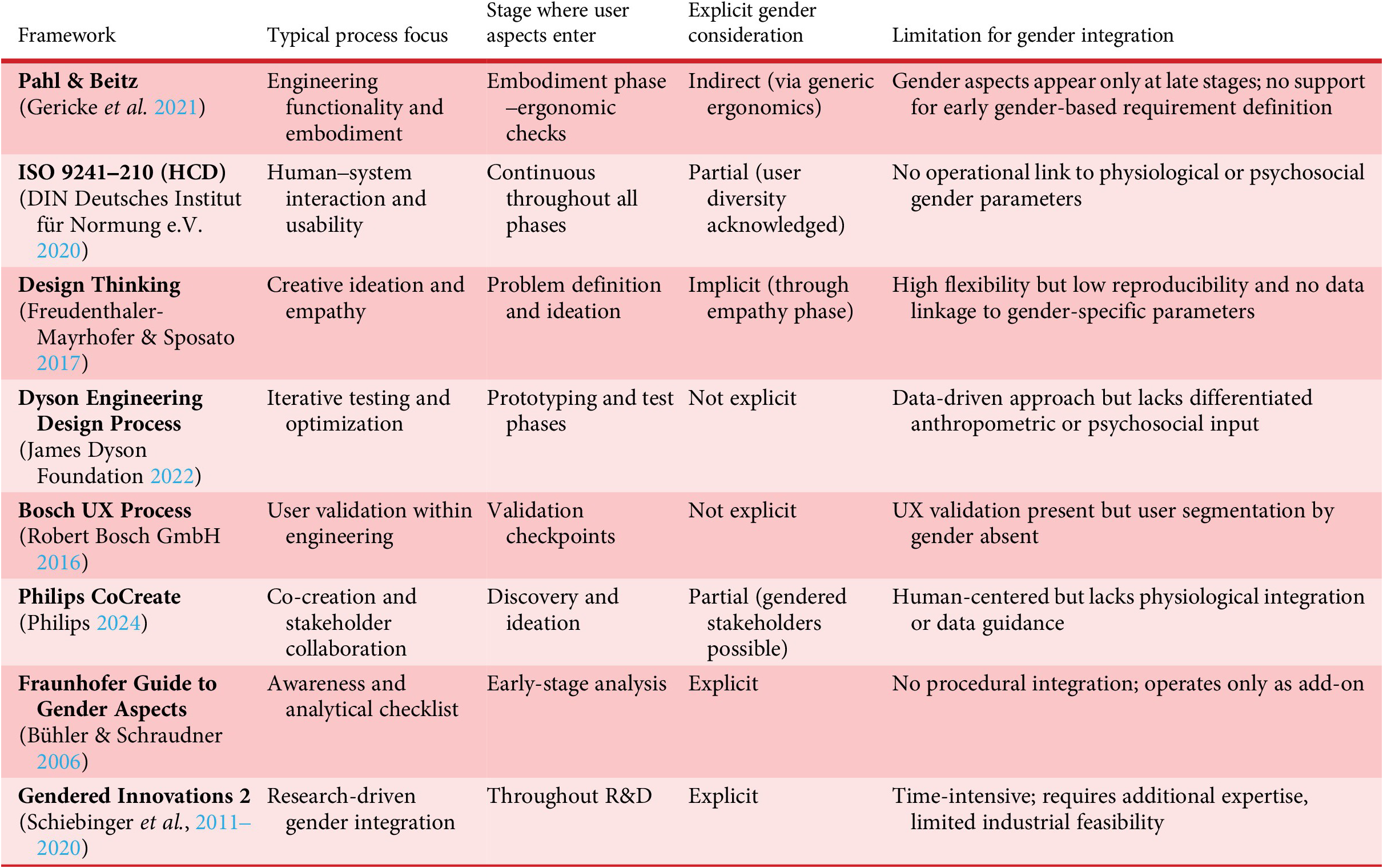
Table 2. Long description
The table contains five columns: Framework, Typical process focus, Stage where user aspects enter, Explicit gender consideration, and Limitation for gender integration. From top to bottom, the frameworks are: Pahl and Beitz (Gericke et al. Reference Gericke, Bender, Pahl, Beitz, Feldhusen, Grote, Bender and Gericke2021) focuses on engineering functionality and embodiment, with user aspects entering at the embodiment phase via ergonomic checks, gender considered indirectly, and the limitation is late-stage gender appearance with no early support. ISO 9241–210 (H C D) (DIN Deutsches Institut für Normung e.V. 2020) centers on human–system interaction and usability, user aspects enter continuously, gender is partially considered through user diversity, but lacks operational links to gender parameters. Design Thinking (Freudenthaler-Mayrhofer and Sposato Reference Freudenthaler-Mayrhofer and Sposato2017) emphasizes creative ideation and empathy, user aspects enter at problem definition and ideation, gender is implicit via empathy, but flexibility leads to low reproducibility and no gender data linkage. Dyson Engineering Design Process (James Dyson Foundation 2022) is about iterative testing and optimization, user aspects enter at prototyping and test phases, gender is not explicit, and lacks differentiated anthropometric or psychosocial input. Bosch U X Process (Robert Bosch GmbH Reference GmbH2016) focuses on user validation within engineering, user aspects enter at validation checkpoints, gender is not explicit, and user segmentation by gender is absent. Philips CoCreate (Philips 2024) is about co-creation and stakeholder collaboration, user aspects enter at discovery and ideation, gender is partially considered if stakeholders are gendered, but lacks physiological integration or data guidance. Fraunhofer Guide to Gender Aspects (Bühler and Schraudner Reference Bühler and Schraudner2006) focuses on awareness and analytical checklists, user aspects enter at early-stage analysis, gender is explicit, but there is no procedural integration and it operates only as an add-on. Gendered Innovations 2 (Schiebinger et al. Reference Schiebinger, Klinge, Paik, Sánchez de Madariaga, Schraudner and Stefanick2011–2020) is research-driven for gender integration, user aspects enter throughout R and D, gender is explicit, but it is time-intensive, requires additional expertise, and has limited industrial feasibility.
Mapping of analytical findings to framework design principles

Table 3. Long description
Beginning at the top row, the table has four columns: Analytical finding (linked criteria), Observed limitation, Derived design principle for the new framework, and Target framework module. The first row details late or missing integration of gender requirements (I, II, X), with the limitation that gender aspects are addressed only during validation. The principle is to introduce gender checkpoints in early analysis and requirement definition, targeting Module 1 – Context profiling. The second row addresses lack of modularity and expandability (V dot I, V dot I I, VII), noting frameworks are not adaptable across industries. The principle is to design the framework as modular and scalable for partial or full adoption, targeting Module 2 – Framework architecture. The third row highlights missing traceability and data linkage (I I I, I X), with no documented chain connecting gender data to design outcomes. The principle is to establish traceable documentation linking gender data and design decisions, targeting Module 3 – Data integration and traceability. The fourth row covers post hoc gender validation only (I I, I X, X), where user diversity is tested but not embedded throughout. The principle is to integrate iterative evaluation loops with explicit gender-based feedback, targeting Module 4 – Evaluation and feedback. The fifth row discusses analytical depth but low industrial feasibility (I V dot I through I V dot I I I, VII), with gender guides not usable under real-world constraints. The principle is to translate analytical tools into lightweight, industry-feasible modules, targeting Module 5 – Industrial integration guidelines.
4.2.1. Evaluation of methodological requirements
With respect to the methodological criteria, the Human-Centered Design process as defined by ISO 9241-210 (DIN Deutsches Institut für Normung e.V. 2020) exhibits the highest overall alignment. It provides a structured and iterative process (I, II) and emphasizes transparency in the interaction between users and technical systems (III). However, when examined more closely, limitations become apparent. The ISO 9241-210 model offers a pragmatic implementation and is less time-intensive, making it more applicable in typical industrial contexts. Nevertheless, it reveals clear shortcomings in terms of adaptability. While iterations and user feedback loops are supported in principle (II), the framework lacks a modular structure that would allow selective application or targeted expansion for specific product contexts (V.I, V.II). The absence of independent submodules limits its flexibility and restricts its compatibility with diverse product development environments.
Similar deficiencies are evident in the Design Thinking approach as described by Freudenthaler-Mayrhofer & Sposato (Reference Freudenthaler-Mayrhofer and Sposato2017). Although it provides an iterative and user-centered methodology (II, IX), it does not exhibit a high degree of standardization (I) and lacks modular elements for efficient adaptation (V.II). Furthermore, varying interpretations of the Design Thinking process in the literature contribute to a low level of formalization, which in turn reduces transparency and reproducibility (III).
The general procedural model by Pahl and Beitz (Gericke et al. Reference Gericke, Bender, Pahl, Beitz, Feldhusen, Grote, Bender and Gericke2021) offers a well-documented and structured engineering approach (I, III). However, it too lacks modularity and flexibility in implementation and does not support the targeted expansion of its components to accommodate gender-related or other diversity factors (V.I, X).
The corporate development processes examined – Dyson Engineering Design Process (James Dyson Foundation 2022), Bosch User Experience (Robert Bosch GmbH Reference GmbH2016) and Philips CoCreate (Philips 2024) – are largely based on either the ISO standard or Design Thinking principles. As such, they inherit many of the strengths and weaknesses of these approaches. In particular, they are generally well-suited for industrial use and provide usable structures (VII), but they tend to lack transparency in their documentation and show no explicit modularization (III, V.II). Due to limited publicly available documentation, a deeper methodological assessment of the Bosch and Dyson processes remains constrained.
The Fraunhofer Guide to Gender Aspects (Bühler & Schraudner Reference Bühler and Schraudner2006) was excluded from the methodological evaluation as it is conceived as a checklist rather than a procedural framework in the classical sense. While useful as a supplementary tool, it does not provide a process structure that could be evaluated against the defined criteria (I–V). The Gendered Innovations 2 (Schiebinger et al., Reference Schiebinger, Klinge, Paik, Sánchez de Madariaga, Schraudner and Stefanick2011–2020) process was also found to have limitations. Although it provides valuable analytical tools for integrating biological and social dimensions of sex and gender into research and development processes, the application of its extensive checklists typically requires additional expertise and considerable time commitment (IV.III, IV.II). This compromises its ease of application and limits its potential for routine integration into industrial product development.
4.2.2. Evaluation of content-related requirements
Regarding content-related requirements, all evaluated frameworks support the development or analysis of physical, sensorially perceivable products (VI). They are designed for tangible interactions and consider physical user experience in varying depth. In terms of user-centeredness (IX), the ISO 9241-210 (DIN Deutsches Institut für Normung e.V. 2020) process and Design Thinking (Freudenthaler-Mayrhofer & Sposato Reference Freudenthaler-Mayrhofer and Sposato2017) approach provide relatively strong support. Both prioritize user involvement and emphasize iterative engagement with target groups. However, only two frameworks – the Fraunhofer Guide to Gender Aspects (Bühler & Schraudner Reference Bühler and Schraudner2006) and the Gendered Innovations 2 (Schiebinger et al., Reference Schiebinger, Klinge, Paik, Sánchez de Madariaga, Schraudner and Stefanick2011–2020) process – explicitly address gender-specific user requirements (X). While other frameworks assume general user needs, they fall short of differentiating based on sex or gender and do not incorporate psychosocial or ergonomic differences that might affect product interaction and acceptance. At the same time, both gender-focused frameworks exhibit limitations with respect to applicability in industrial development environments (VII). The Fraunhofer Guide is aimed primarily at research settings and is not tailored for the constraints and structures of corporate engineering processes. The Gendered Innovations 2 framework, although more comprehensive, does not cover the full scope of industrial product development phases in an operationalizable manner.
Moreover, only a few frameworks explicitly support application across both new product development and the evaluation of existing products (VIII). While Design Thinking and ISO 9241-210 can in principle be applied to both contexts, this flexibility is not structured explicitly within their procedural logic. Frameworks lacking this dual applicability reduce the potential for retrospective product improvement through a gender lens.
4.3. Conclusion of the evaluation
Evaluation of existing frameworks reveals that none of the assessed models fulfil the methodological and content-related requirements for integrating gender-specific aspects into engineering design to a sufficient degree. The analysis shows that criteria I–V, which cover aspects such as structure, iteration, transparency and modularity, are generally only met at a basic level by most models. In contrast, criteria VI–X, which address the thematic and content-related aspects of user and gender integration, are largely overlooked. This dual deficiency suggests that current frameworks either lack gender relevance despite offering methodological rigor or lack methodological applicability despite offering gender awareness.
A closer examination of the individual criteria reveals where these gaps originate. For instance, although ISO 9241-210 performs well in terms of standardization and iteration (criteria I and II), it lacks explicit mechanisms for modular expansion (criteria V.I and V.II) or the integration of gender data (criterion X). Design Thinking satisfies user-centeredness (IX) but fails to ensure transparency or reproducibility (III). Industrial frameworks such as Dyson Engineering, Bosch UX and Philips CoCreate demonstrate practical robustness (criterion VII), yet they reveal low traceability (criterion III) and no measurable gender differentiation (criterion X). Conversely, gender-oriented frameworks such as Fraunhofer’s Guide to Gender Aspects and Gendered Innovations 2 fulfil criterion X explicitly, but they score poorly on industrial feasibility (criterion VII) and efficiency (criteria IV.II and IV.III).
These cross-comparisons confirm that none of the existing approaches combine engineering feasibility with gender-aware design. They also highlight the interdependencies between certain methodological criteria. For example, reducing time and personnel requirements can limit transparency or user-centeredness. To ensure the reliability of the evaluation results, an internal validation procedure was applied. Each author independently assessed all frameworks according to the defined criteria (I–X) using the four-point scale described in Section 4.2. The individual assessments were then compared, and deviations were discussed in a structured consensus meeting. Median scores were used as the final ratings to minimize individual bias and emphasize converging evaluations. This procedure increases transparency and ensures that the results reflect a balanced interpretation of all evaluators’ judgments.
Based on these detailed findings, the observed shortcomings can be categorized into four overarching deficit areas.
-
(1) Lack of early-stage gender integration (criteria I, II, X);
-
(2) Insufficient process modularity and adaptability (criteria V.I, V.II, and VII);
-
(3) Missing traceability and data linkage between design stages (criteria III and IX);
-
(4) Limited industrial applicability due to cost, time or expertise constraints (criteria IV.I–IV.III).
These deficit areas form the conceptual foundation for the framework developed in Section 5. Table 3 maps each analytical finding to the corresponding design principle and framework module, thereby ensuring transparent derivation from the state of the art.
5. Framework development
To address the structural shortcomings identified in current product development practices, a new modular framework was developed to support the integration of gender-specific user requirements throughout the design process. The resulting framework is composed of four core modules subdivided into a total of 11 submodules, which guide users from the identification of user needs to the implementation and validation of gender-sensitive design solutions. Its structure is compatible with established models such as VDI 2221 and ISO 9241-210, allowing seamless integration into existing engineering workflows. The overall framework is illustrated in Figure 1; detailed visualizations of the submodules are available as supplementary material.
A modular framework for integrating gender-specific requirements into product development.

Figure 1. Long description
From left to right, the flowchart is divided into four main modules. Module I, Specify the Usage Context, contains Submodule I.I Define and describe the users, and Submodule I.II Define and describe the usage environment. Module II, Determine Gender-Specific User Requirements, contains Submodule II.I Select appropriate methods for user integration, Submodule II.II Identify gender-specific user requirements, and Submodule II.III Evaluate applied standards and reference models. Module III, Develop Design Solutions, contains Submodule III.I Design user tasks, user-system interaction, and interface, Submodule III.II Specify the design solution, Submodule III.III Adapt the design solution based on user-centered evaluation results, and Submodule III.IV Communicate design solutions to those responsible for implementation. Module IV, User-Centered Evaluation of the Design Solution, contains Submodule IV.I Method selection and evaluation of requirement compliance, and Submodule IV.II Need for building knowledge about biological and social gender factors. Arrows connect each module sequentially from left to right.
To ensure transparency between these analytical results and the subsequent framework development, Table 3 maps the key findings to the corresponding design principles and framework modules. This mapping clarifies how each shortcoming identified in the evaluation directly informed the structure of the framework presented in Section 5.
It builds on the principles of human-centered design and expands them by systematically addressing biological and socio-cultural dimensions of gender. Each module corresponds to a critical phase in the product development process and is structured to allow independent and iterative application, ensuring adaptability (requirement V) and ease of use (requirement IV). The framework adheres to the well-established distinction between the problem and solution spaces in design theory (Blessing & Chakrabarti Reference Blessing and Chakrabarti2009; Eppinger & Ulrich Reference Eppinger and Ulrich2015; Bender & Gericke Reference Bender and Gericke2021b). This distinction ensures that gender considerations are addressed during both problem definition, through requirement clarification and context profiling, and solution development, where design parameters and evaluations are adapted accordingly. Although the overall structure adheres to established human-centered design principles, the framework introduces three key innovations. First, it incorporates gender-specific data and psychosocial parameters into both the problem and solution phases, rather than treating them as external considerations. Second, it explicitly links each development phase to the relevant methodological and content-related criteria set out in Section 4, ensuring traceability from evaluation to synthesis (see Table 3 and Table 4). Third, it provides a configurable modular architecture that allows selective integration into existing industrial processes. These features distinguish it from conventional human-centered design frameworks, which address inclusion conceptually, but lack depth in terms of procedural implementation.
Identification of gender-specific user requirements
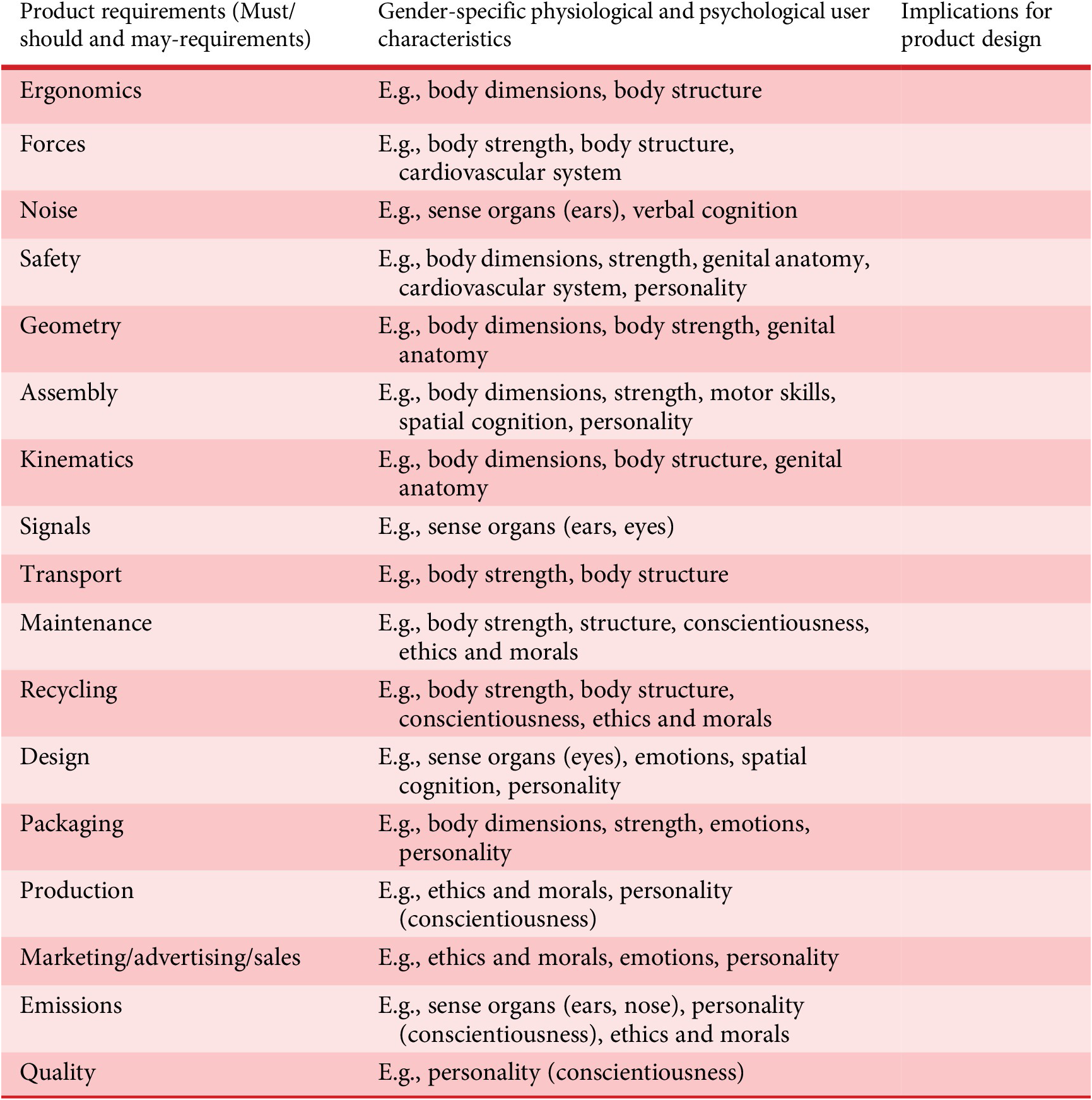
Table 4. Long description
The table has three columns. The first column lists product requirements: Ergonomics, Forces, Noise, Safety, Geometry, Assembly, Kinematics, Signals, Transport, Maintenance, Recycling, Design, Packaging, Production, Marketing/advertising/sales, Emissions, and Quality. The second column details gender-specific physiological and psychological user characteristics for each requirement. For Ergonomics: body dimensions and body structure. For Forces: body strength, body structure, cardiovascular system. For Noise: sense organs (ears), verbal cognition. For Safety: body dimensions, strength, genital anatomy, cardiovascular system, personality. For Geometry: body dimensions, body strength, genital anatomy. For Assembly: body dimensions, strength, motor skills, spatial cognition, personality. For Kinematics: body dimensions, body structure, genital anatomy. For Signals: sense organs (ears, eyes). For Transport: body strength, body structure. For Maintenance: body strength, structure, conscientiousness, ethics and morals. For Recycling: body strength, body structure, conscientiousness, ethics and morals. For Design: sense organs (eyes), emotions, spatial cognition, personality. For Packaging: body dimensions, strength, emotions, personality. For Production: ethics and morals, personality (conscientiousness). For Marketing/advertising/sales: ethics and morals, emotions, personality. For Emissions: sense organs (ears, nose), personality (conscientiousness), ethics and morals. For Quality: personality (conscientiousness). The third column, implications for product design, is empty for all rows.
5.1. Module 1: Context analysis and problem definition
The first module serves to establish a clear understanding of the target user groups and the usage context, with the aim of identifying product-related gender challenges early in the development process. Unlike traditional product planning procedures, which often rely on generalized user profiles, this module emphasizes differentiated user segmentation. It distinguishes between sex-based physiological dimensions and gender role-related behavioral expectations. To achieve this, it introduces a twofold profiling approach: First, user descriptions are extended to explicitly include biological characteristics (e.g., height, strength, body proportions) relevant to design. For instance, in the case of hand tools, grip span and hand strength may vary considerably between male and female users, requiring differentiation early in the planning phase. Second, social expectations and role attributions associated with the product or context are analyzed, using an adapted interpretation of a concept of product-induced user stigmatization (Buker Reference Buker2022). Figures S1 and S2 in the supplementary material also include guiding questions to assess gender stereotypes and usage visibility in context. These supplementary tables support the profiling of user diversity by mapping social roles and perceived gender norms against physical usage contexts, such as public versus private use, or visibility of use. This allows designers to anticipate social acceptance barriers or stereotypical usage attributions that may affect product success. An example would be the social expectation that power tools are used by men, which may discourage female users or result in designs optimized for male posture and motion paths. While most examples in this study refer to biological sex-related differences, gender identity can also influence user perception and product acceptance. The inclusion of a non-binary category acknowledges psychological and social dimensions of gender that may affect design perception, even when physiological parameters are similar (Canning Reference Canning2012).
The innovation of this module lies in its early detection of exclusion risks that may not be evident in standard persona methods. By explicitly considering mismatches between user self-perception and environmental expectations, this module enables the anticipation of social usability barriers. Its structured user-environment profiling generates a robust foundation for requirement specification in subsequent modules and contributes to reducing implicit bias in early development stages.
5.2. Module 2: User requirements and data collection
Building on the contextual insights of Module 1, the second module focuses on the elicitation and documentation of gender-sensitive user requirements. Conventional user integration methods are often limited in their ability to capture sex-specific ergonomic needs or gender-based usage preferences due to sampling biases or method constraints. This module addresses these gaps through a threefold structure.
First, it guides the selection of suitable methods for user integration, balancing proactive and reactive approaches and evaluating their appropriateness for capturing gender variance. This is operationalized through Supplementary Figure S3, which presents a comparative matrix of user integration methods (e.g., interviews, digital models, standards), including respective advantages and limitations with regard to time, cost and depth of gender differentiation. For instance, reactive methods like field studies allow targeted user feedback but are time-intensive, whereas proactive approaches like digital human models offer iterative scalability but require careful parameterization of gender-relevant variables. In addition to this, Table 4 structures 16 categories of product requirements by mapping them to gender-specific ergonomic, psychological or ethical dimensions. For example, the category “Packaging” is linked to body strength, emotional perception and preference for personalization, enabling targeted gender-inclusive adaptations. To support structured requirement elicitation, Table 2 illustrates the reference checklist used for identifying gender-specific factors across physiological and cognitive domains.
Second, it facilitates the structured identification of gender-specific physiological and cognitive factors using a curated reference sheet that consolidates findings from interdisciplinary studies (see Supplementary Figures S3 and S4). These data are visualized in Supplementary Figure S4, distinguishing between physiological (e.g., strength, sensorics) and psychological (e.g., motivation, emotional response) gender differences. The figure not only lists such factors but also links them to specific product interactions – e.g., how differences in spatial cognition or grip force may affect assembly or tool use. These factors include, for example, differences in hand size, grip strength, thermal perception or spatial orientation. As an example, women generally exhibit lower average grip strength than men, which can significantly affect the force required to operate a mechanical latch or trigger. Third, the module includes a critical review of normative reference models and design standards to assess whether they adequately reflect gender-diverse data. This is supported by Supplementary Figure S5, which provides a checklist of evaluative questions, such as whether current standards reflect diverse body data or unintentionally reinforce binary defaults. This is particularly relevant when standards rely on legacy anthropometric data collected primarily from male populations, as is the case for many ISO-derived reach and clearance tables.
In comparison to existing frameworks such as ISO 9241-210, which remain method-neutral and rely on implicit designer decisions, this module operationalizes gender integration by formalizing data sources and validation criteria. The result is a more evidence-based and traceable set of user requirements, which enhances both inclusivity and design robustness.
5.3. Module 3: Conceptualization and ideation
Module 3 transforms the requirements gathered in Module 2 into concrete design concepts and specifications. While traditional ideation frameworks like Pahl & Beitz or Design Thinking provide general guidance for creative development, they typically do not specify how physiological and behavioral diversity should inform design decisions. This module addresses that shortcoming by embedding gender-specific insights into the core of the ideation process.
It begins by translating usage requirements into interaction scenarios, interface logic and physical design parameters. This includes the adaptation of geometric dimensions, force thresholds or layout options to accommodate anatomical variation across genders. The gender-relevant design factors are systematized in Figure 2, including aspects such as reachability, conformity with user expectations and error tolerance. This figure illustrates how submodule III.I organizes user-centered design principles into usability categories like task appropriateness, error tolerance or learnability, making gender-related needs explicitly mappable to UI/UX elements. For instance, “customizability” is emphasized to account for individual anatomical variation and role-based interaction strategies across gender identities. Particular emphasis is placed on tasks involving physical manipulation or extended interaction durations, where comfort and usability are especially sensitive to ergonomic mismatches. For example, in the design of a bicycle saddle, prolonged load distribution on soft tissue requires gender-specific shaping and cushioning to prevent discomfort or injury, a factor long overlooked in conventional unisex designs.
Development of design solutions.
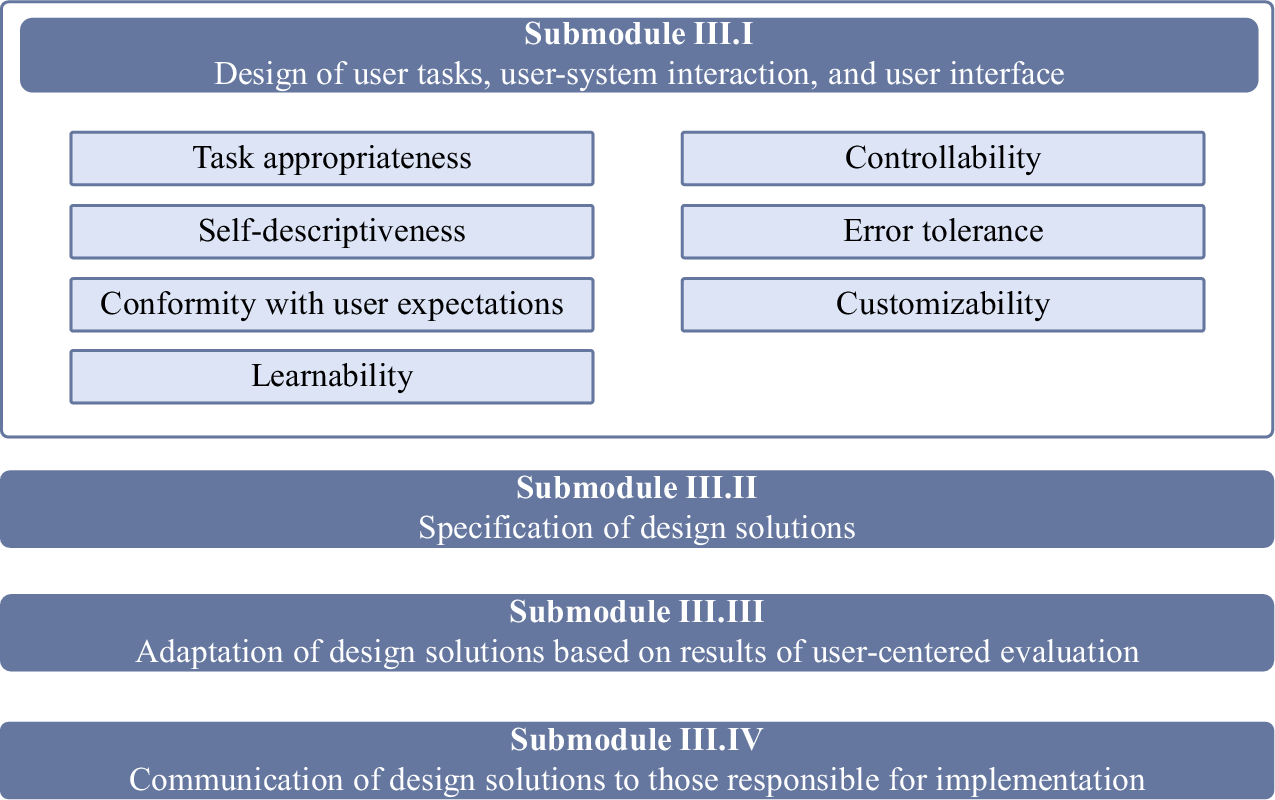
Figure 2. Long description
At the top, Submodule I I I dot I covers design of user tasks, user-system interaction, and user interface, listing task appropriateness, controllability, self-descriptiveness, error tolerance, conformity with user expectations, customizability, and learnability. Below, Submodule I I I dot I I is specification of design solutions. Next, Submodule I I I dot I I I is adaptation of design solutions based on user-centered evaluation. At the bottom, Submodule I I I dot I V is communication of design solutions to those responsible for implementation.
Following initial specification, the module supports iterative refinement based on early feedback and inspection results, thereby enabling a cyclical alignment between design hypotheses and user validation. The final submodule ensures that the rationale behind gender-related design decisions is systematically documented and communicated to implementation teams. This improves traceability and cross-functional alignment, especially in large development settings.
The benefit of this module lies in its structured transition from user research to design embodiment. It bridges the gap between abstract inclusion goals and actionable product features, enabling gender considerations to shape core functional design rather than being relegated to superficial adaptations. An illustrative case includes the specification of wearable medical sensors, where strap placement and material stiffness must accommodate soft tissue distribution differences to ensure both comfort and data reliability.
5.4. Module 4: Evaluation and prototyping
The fourth module evaluates whether the proposed design solutions adequately meet the diverse requirements identified in previous phases. Most conventional usability testing lacks sensitivity to gender-based variability due to homogeneous sampling or undifferentiated analysis. This module introduces a structured evaluation strategy that integrates gender diversity into the core of testing protocols.
The module supports the selection of appropriate evaluation methods and outlines criteria for assessing whether existing validation procedures adequately capture gender-specific differences. This is operationalized through a requirements validation form provided Figure 3, which can be used to document compliance with physiological and psychosocial design criteria. Figure 3 presents key evaluation criteria that allow gender-relevant “Must,” “Should,” and “May” requirements to be assessed post-prototyping, including physiological fit and psychological acceptance. It also includes guiding questions to assess whether gender stereotypes are unintentionally reinforced by the design. For example, developers are prompted to ask whether product aesthetics could unintentionally alienate non-male users. It further includes a mechanism for identifying knowledge gaps in gender-related data and integrating new findings into iterative refinement cycles. This ensures that overlooked dimensions – such as differences in posture, interaction fatigue or cognitive load – can be retroactively addressed. An illustrative case includes the specification of wearable medical sensors, where strap placement and material stiffness must accommodate soft tissue distribution differences to ensure both comfort and data reliability.
User-centered evaluation of design solutions.

Figure 3. Long description
At the top, a blue header reads ‘Submodule I V dot I Method Selection and Evaluation of Requirement Compliance.’ Below, two horizontally aligned boxes ask if user requirements can be validated through reactive approaches—such as interviews, workshops, user feedback, prototype tests, field studies, forums, and communities—or through proactive approaches, including requirements derivation, simulation-based approaches, standards, and guidelines. A downward arrow points to a numbered list of six questions: 1. Whether physiological differences among women, men, and non-binary individuals have been considered in the design. 2. Whether psychological differences among gender groups have been addressed. 3. If applicable, how many Must, Should, and May requirements from Submodule I I dot I I are fulfilled, with blanks for each. 4. Whether underlying standards and reference models are up to date. 5. Whether standards and models are based on research findings that consider sex differences. 6. Whether there is a risk of reinforcing stereotypes or offending personal identity through the product’s appearance, such as gender roles or culturally loaded symbolism.
One key strength of this module is its balance between qualitative and quantitative feedback, allowing both subjective user experience and objective performance indicators to guide the redesign process. While inspired by checklists such as those used in Gendered Innovations 2, this module is adapted for industrial application and focuses on efficiency and clarity, avoiding extensive documentation demands or high personnel requirements.
5.5. Implementation and validation
Although not graphically separated as an independent module in the overview diagram (to preserve clarity), the final step of the framework focuses on implementation and long-term validation. Unlike existing frameworks that treat implementation as a handover activity, this module embeds gender-specific metrics and comparative benchmarks into final validation procedures. Though not shown as a distinct module in Figure 1, this phase is supported by the evaluation tools introduced in Figure 3 and Supplementary Figure S5, which ensure traceable validation against inclusive success criteria. It ensures that inclusivity objectives are not only documented but also translated into measurable criteria, such as improved usability scores across gender-diverse groups or reduced discrepancy in performance indicators. Moreover, it includes guidance for the documentation of inclusive design practices as part of internal knowledge systems, supporting organizational learning and standardization.
A distinguishing feature of this module is its orientation toward scalability and sustainability. It moves beyond project-specific solutions by enabling the generalization of successful design strategies into reusable design principles or internal standards. This not only increases the return on investment of inclusive design efforts but also supports broader diversity and inclusion goals within the organization.
6. Analysis and discussion
The Gender-Sensitive Product Development Framework presented contributes to the ongoing discourse on inclusive and equitable design by addressing a well-documented gap in the integration of gender-specific user requirements in engineering practice. When compared to established development frameworks, several advancements become evident.
In contrast to ISO 9241-210 (DIN Deutsches Institut für Normung e.V. 2020), which emphasizes general user-centered design principles without specifying how sex or gender should be operationalized, the framework offers an explicit structure for identifying, integrating and validating gender-specific design factors from the earliest phases of product development. The integration of gender considerations is not left to discretionary adaptation but embedded as a procedural requirement throughout all five core modules. This systematic approach stands in marked contrast to the high-level conceptual orientation of the Gendered Innovations model (Schiebinger et al., Reference Schiebinger, Klinge, Paik, Sánchez de Madariaga, Schraudner and Stefanick2011–2020), which, while offering rich methodological insights and examples, lacks operational implementation tools suitable for industrial engineering contexts. Likewise, the framework advances beyond the Fraunhofer Guide to Gender Aspects (Bühler & Schraudner Reference Bühler and Schraudner2006), which provides valuable reflection prompts but does not translate these into actionable development routines or product-specific criteria.
One of the key strengths of the framework lies in its structured and standardized approach, its high degree of user-centeredness and the integration of both biological and social gender dimensions as fundamental criteria for product development. Moreover, its modular architecture allows targeted adaptation to existing product development processes, such as VDI 2221, without requiring complete procedural refit. The systematic differentiation of physiological and psychosocial gender dimensions further enables design teams to move beyond simplistic binary representations or stereotypical user profiles – thereby avoiding the “pink it and shrink it” pitfall, which has characterized many past attempts at female-specific product variants (Endler Reference Endler2021). Although developed for gender integration, the modular architecture additionally allows adaptation to other diversity factors such as age, ability or culture. For example, ergonomic data in Module 2 can incorporate age-dependent strength curves, while color and symbol conventions in Module 3 can reflect cultural variation. This scalability underlines the framework’s general value for inclusive design across user diversity dimensions.
Despite these strengths, the application of the framework is not without limitations. First, there remains a significant lack of gender-disaggregated user data in many industrial sectors. While the framework provides tools to identify such gaps and to guide user research accordingly, the empirical foundation required for comprehensive gender-aware evaluation is still developing. Nevertheless, the effectiveness of the framework depends heavily on the availability and quality of gender-specific data. While physiological and anthropometric data are relatively well documented, psychological and behavioral parameters are under-researched and difficult to operationalize in engineering contexts. Perception, cognitive workload and risk behavior are factors that influence product interaction, yet they are rarely captured quantitatively. Addressing these aspects requires collaboration between engineers, psychologists and ergonomists. Consequently, the framework should be understood as a structure that highlights these data dependencies and enables them to be considered when evidence becomes available. This limitation is closely linked to the restricted objectivity of several modules, which rely heavily on qualitative assessments, particularly when evaluating social stigma or gender-based exclusion risks. Second, the successful implementation of the framework is dependent on organizational readiness. Resistance to change, limited awareness of gender-sensitive design and insufficient training in inclusive development practices can impede adoption. Integration into established quality management or innovation processes may require additional alignment efforts. A specific risk lies in the resource effort required to implement the framework in companies, which includes not only time and personnel but also infrastructural considerations, particularly in SMEs. Furthermore, design processes are always adapted to organizational and project contexts. In industrial environments, agile frameworks and stage-gate models modify theoretical structures, influencing where gender considerations can be embedded. Contextual adaptation is, therefore, a precondition for realistic gender integration. The evaluation in Section 4 compared design processes individually to highlight their potential for gender integration. In practice, however, companies often combine these approaches, for example, by adopting Pahl & Beitz structures alongside Design Thinking workshops. While the present analytical framework did not focus on such complementarity, acknowledging this integration highlights the applicability of the framework to hybrid industrial processes. At the same time, it is important to recognize that the relevance of gender varies significantly across product categories. The modular structure of the framework explicitly accommodates this: if no gender-related improvement potential is identified in the initial analysis, subsequent gender-specific steps can be bypassed without compromising methodological consistency. This ensures that the right amount of effort is invested and unnecessary procedural complexity is avoided in domains where gender differentiation has little or no impact on usability or safety. In this sense, the framework should not be applied uniformly to all product types. Its modules are most beneficial where gender-related physiological or psychosocial variation significantly affects design outcomes, such as in consumer ergonomics, healthcare or mobility. For purely technical or system-level developments, the framework can be reduced to its generic, user-centered components to maintain methodological coherence while avoiding overextension. Additionally, the integration capability of the framework into existing workflows remains partially unclear. While designed to be modular and extendable, there is no empirical evidence yet on how well the modules can be embedded into complex, regulated development environments – such as those seen in the medical or aerospace sectors.
A recurring debate in gender-sensitive design is whether the best inclusive outcomes are achieved through dual design strategies, such as developing gender-specific product variants, or universal strategies that serve all users equally (Persson et al. Reference Persson, Åhman, Yngling and Gulliksen2015). The literature shows that both approaches coexist: gender-specific solutions (e.g., female-specific PPE or sports gear) can efficiently address physiological differences, while universal approaches aim to reduce segmentation and promote equitable use. The proposed framework does not prescribe one approach over the other but rather provides decision points for selecting between them. This trade-off is embedded in the customizability module, where product requirements are evaluated according to physiological versus psychosocial variation. Therefore, design teams can decide whether differentiation or universality is more appropriate, depending on the context of the product and the available data. Furthermore, gender bias in design is not unidirectional. Certain products, such as baby strollers or kitchen tools, are optimized for female users and disadvantage taller or stronger male users. Moreover, substantial variation exists within gender groups due to age, ability or socio-technical experience. Addressing these intersections reinforces the need for context-specific rather than generalized gender assumptions.
Opportunities arise, however, in the potential to raise awareness of gender equity within and beyond the boundaries of engineering teams. The implementation of the framework could serve as a catalyst for more inclusive corporate practices, particularly when communicated effectively across departments. Its adaptability also offers the chance to refine the framework further for industry-specific or cross-product development initiatives. From a technological standpoint, the framework could also be supported by low-code platforms such as Microsoft PowerApps. While not part of the journal submission, a demonstrator built in PowerApps showed that core elements of the framework can be operationalized without requiring complex or cost-intensive IT infrastructure. This supports the framework’s goal of ease-of-use and accessibility (requirement IV), particularly for organizations already integrated into the Microsoft 365 ecosystem. However, limitations regarding interface flexibility, scalability and privacy regulation (e.g., in user feedback collection) must be considered when planning larger deployments.
Furthermore, while the framework differentiates between biological and socially constructed aspects of gender, there remains a risk of overgeneralization – particularly with regard to psychological attributes or behavioral patterns. Future applications of the framework must remain vigilant to avoid essentializing gender or reinforcing normative assumptions. In this sense, the framework should be understood as an evolving tool that supports reflexive, evidence-based development processes rather than as a static checklist of design adaptations.
Finally, a significant limitation lies in the current lack of empirical validation. While the framework was systematically derived and evaluated against well-established criteria, its performance in improving inclusivity, usability or user satisfaction has yet to be confirmed through real-world product development projects. This restricts the ability to derive firm conclusions about its impact on development outcomes or its acceptance by engineering teams. Accordingly, further research must focus on controlled case studies across product categories and industries, as well as on quantifying the added value of inclusive design practices from an economic and innovation perspective.
7. Conclusion and outlook
This paper introduced a Gender-Sensitive Product Development Framework, a structured and modular approach to systematically integrate gender aspects into all stages of industrial product development. In contrast to existing models, the framework translates conceptual awareness of gender diversity into a practical, step-by-step methodology accessible to engineers and product designers.
The framework enables early identification of exclusion risks, guides the collection of gender-disaggregated user data and supports the translation of physiological and psychosocial gender differences into actionable design specifications. Its modular structure allows for seamless integration into existing engineering workflows and supports iterative improvement and traceability. By embedding inclusive design logic into core development routines, the framework helps mitigate the systemic biases that continue to shape contemporary products and user experiences.
Future research will focus on the empirical validation and refinement of the framework through applied case studies. In particular, the planned application and evaluation of the framework in the context of ergonomic product development will serve to test its practical utility and scalability. Additionally, further investigation is needed to assess the economic impacts of gender-conscious product development – both in terms of market access and user satisfaction. The potential integration of the framework into digital design environments, such as CAD systems or simulation tools with gender-aware parameter settings, also presents an important avenue for expanding its accessibility and impact. Future research should also adapt the framework’s supporting materials, such as reference data and requirements catalogues, to consider other diversity factors, particularly age. There is already a wealth of literature-based datasets documenting age-related physiological and psychological differences (e.g., changes in hand strength, cognitive load or perception). Integrating such data into the framework’s modules would enable it to be applied to age-inclusive design.
In sum, this work contributes both conceptually and practically to the field of inclusive engineering design. By offering a framework that is theoretically grounded, procedurally defined and operationally implementable, it provides a foundation for more equitable and user-aligned product innovation.
Supplementary material
The supplementary material for this article can be found at http://doi.org/10.1017/dsj.2026.10065.
Financial support
This work was supported by the German Research Foundation (DFG) under grant number WA 2913/32-3.
Use of Artificial Intelligence (AI) Tools
The authors used the generative artificial intelligence tool ChatGPT (OpenAI, version GPT-5.3) during the writing process to support language editing, drafting and refinement of text passages. The tool was used solely as a writing aid. All content generated with the assistance of this tool was critically reviewed and edited by the authors, who take full responsibility for the final content of the manuscript.
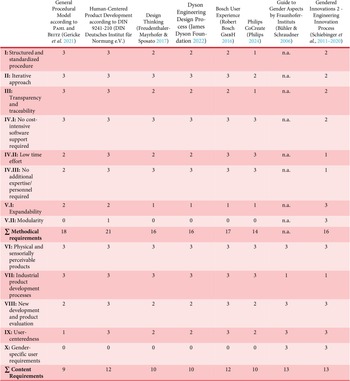
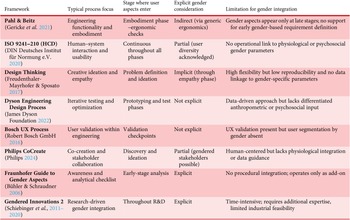
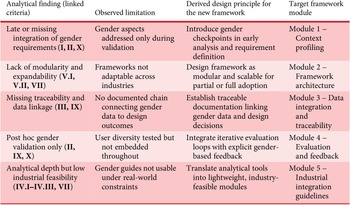
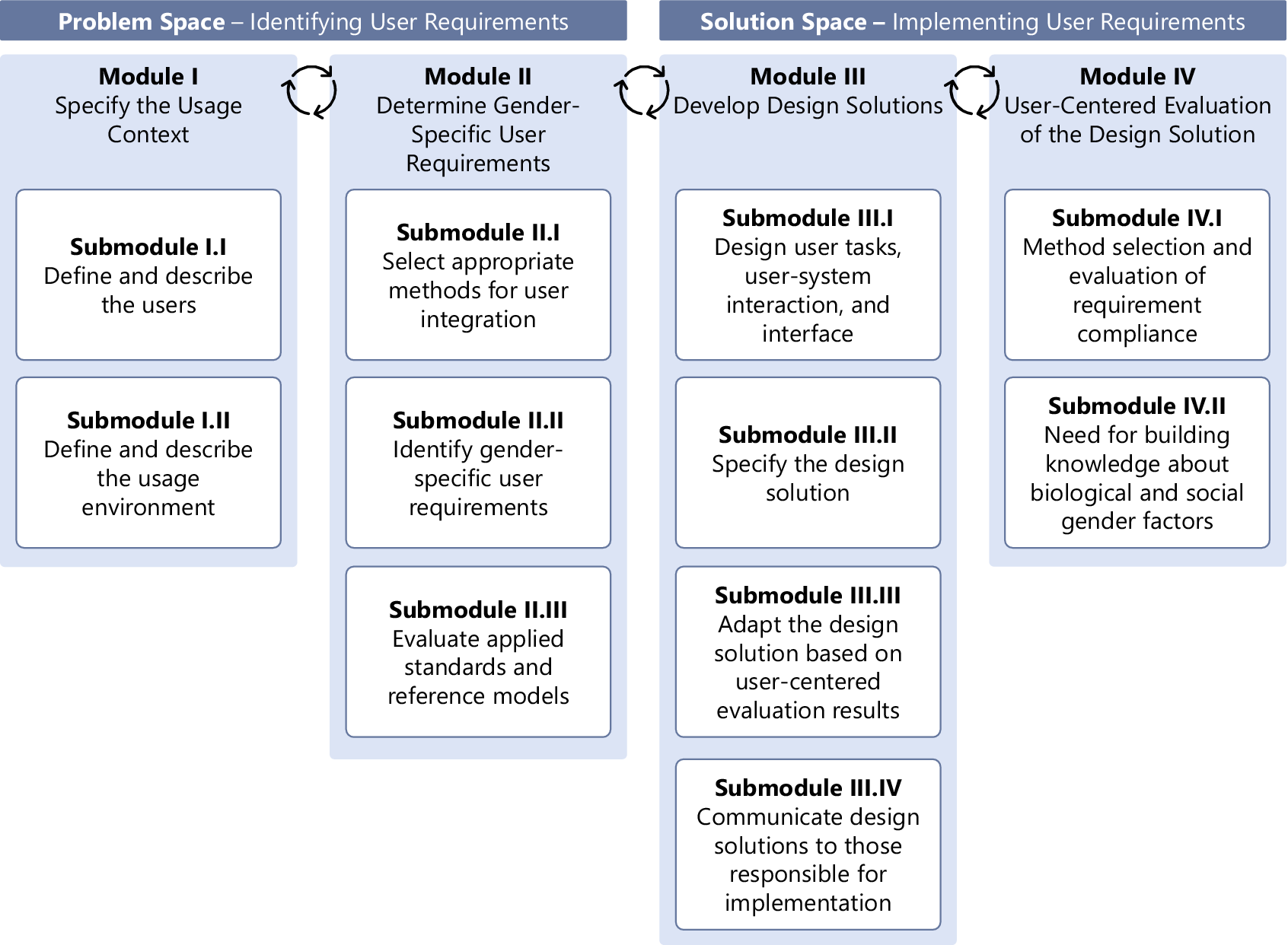
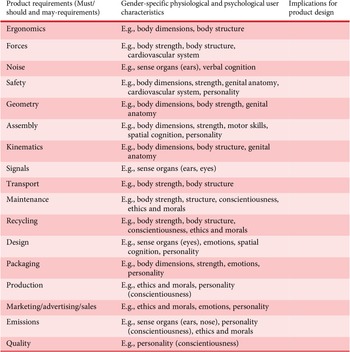
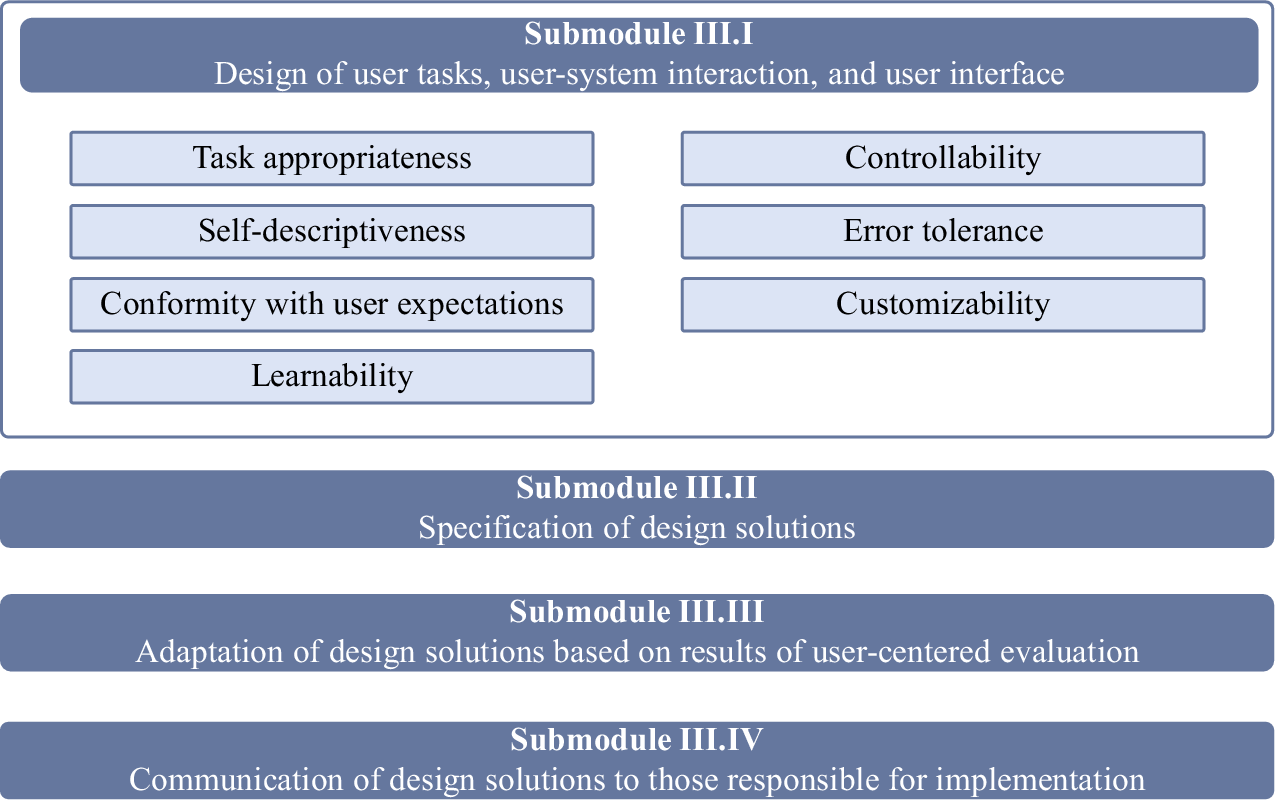
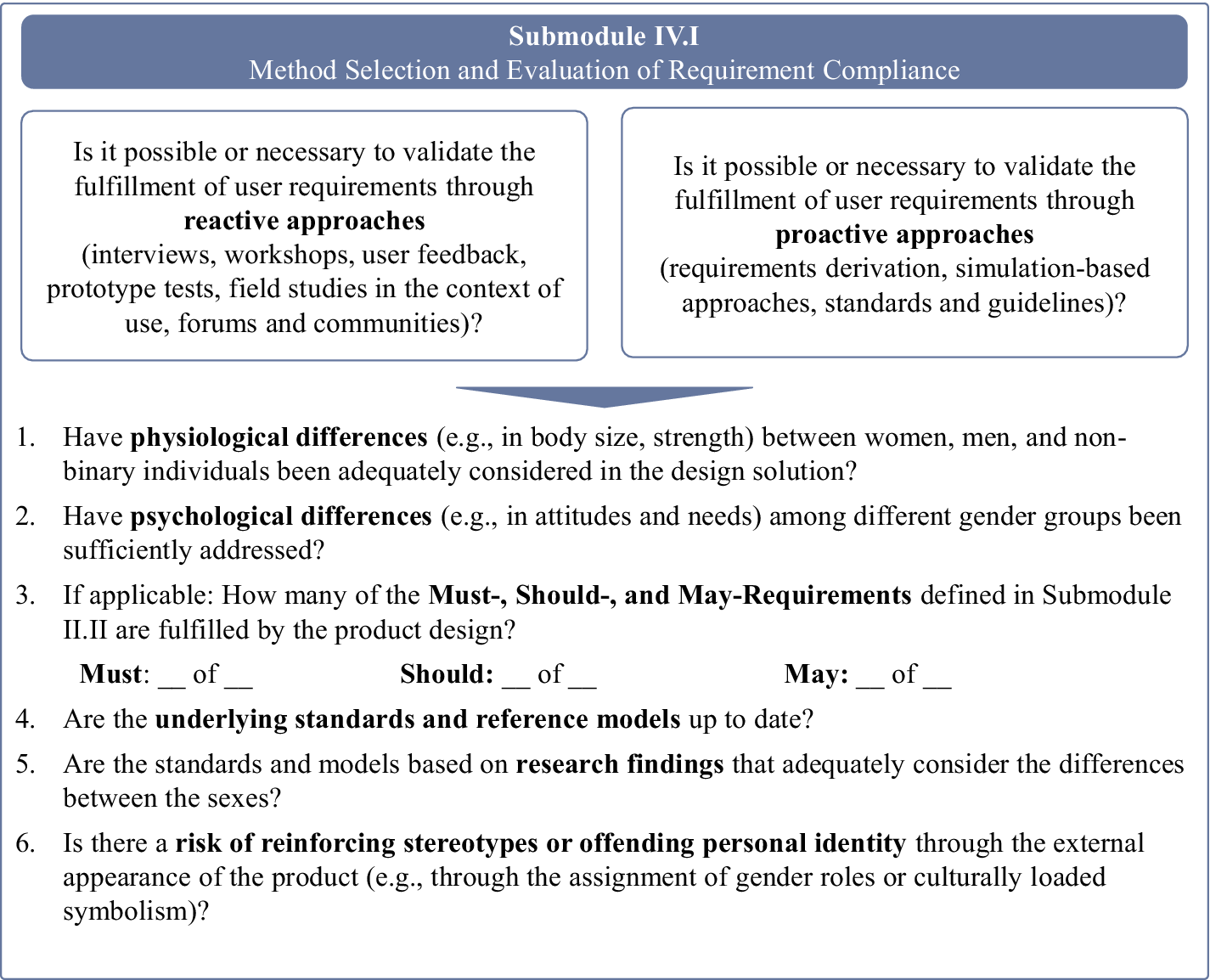


 Open access

