




1. Introduction
Entrepreneurship has historically enhanced the growth and transformation of modern economies as a driver of innovation and competitiveness (Acs, Reference Acs2006; Audretsch and Thurik, Reference Audretsch and Thurik2001; Baumol, Reference Baumol1990; Baumol and Strom, Reference Baumol and Strom2007; Shane, Reference Shane2000). Defined as the process of starting new businesses or introducing new goods, services, or processes to the market (Shane, Reference Shane2003, Reference Shane2003; Shane and Venkataraman, Reference Shane and Venkataraman2000; Venkataraman, Reference Venkataraman1997), it is recognized as a crucial source of economic dynamism and market or industry development (Drucker, Reference Drucker1985; Schumpeter, Reference Schumpeter1928, Reference Schumpeter1934, Reference Schumpeter1942). Similarly, the absence or deficiencies of entrepreneurial activity have been regarded as causes of economic backwardness (Baumol, Reference Baumol1990; Sáez-García, Reference Sáez-García2017; Sluyterman and Westerhuis, Reference Sluyterman, Westerhuis, Jones and Tadajewski2016).
In Spain, insufficient entrepreneurship and its impact on economic growth have sparked a rich academic discussion. This debate originated in the early 20th century, when intellectuals associated with the Generation of ‘98 and the political movement of “Regenerationism” identified the lack of an entrepreneurial spirit as one of Spain’s fundamental problems (Valdaliso and García Ruiz, Reference Valdaliso and García Ruiz2013). Nearly a century later, Gabriel Tortella echoed these arguments, highlighting that low educational levels and certain social and cultural values associated with the “castizo” model were significant barriers to the emergence of a genuine entrepreneurial spirit in Spain, thereby explaining the country’s slow economic development in the 19th and early 20th centuries (Tortella, Reference Tortella1994). Although Spanish entrepreneurs existed, they were perceived as few and lacking enough daring, which hampered the nation’s industrialization. These interpretations have led to the view that foreign capital and firms were instrumental in compensating for the domestic shortfall in initiative and innovation, particularly in knowledge- or technology-intensive sectors (Álvaro-Moya et al, Reference Álvaro-Moya, Fellman and Puig2020; Castro, Reference Castro2007; Puig and Álvaro-Moya, Reference Puig and Álvaro-Moya2015; Puig and Castro, Reference Puig and Castro2009; San Román et al, Reference San Román, Puig and Gil-López2023).
A more recent line of research has led to this thesis evolving to recognize that Spain’s slow economic growth was more closely related to institutional constraints rather than a lack of entrepreneurship. This shift in perspective has inspired Spanish economic historiography to delve deeper into the institutional and educational determinants of entrepreneurship. Often employing quantitative indicators, this research has facilitated both national and international comparisons.Footnote 1 As a result, now there is a broad consensus that a notable entrepreneurial spirit was present during Spain’s economic takeoff in the 20th century. During this period, increased entrepreneurial activity, such as business creation, and economic growth coexisted (Torres, Reference Torres2000; Tortella, Reference Tortella and Torres2000a).
However, the extent to which this entrepreneurial activity influenced long-term economic growth remains an open question. While Spanish economic historiography has extensively studied the determinants of entrepreneurship, there is a notable lack of quantitative studies that measure its contribution to long-term economic development. This paper aims to fill this gap by addressing the question: Has there been a link between entrepreneurship and modern economic growth in Spain? To this end, we draw inspiration from Audretsch and Keilbach (Reference Audretsch and Keilbach2004) and their concept of “entrepreneurship capital,” measured by the number of newly established companies per million inhabitants, as an additional factor in the neoclassical equation.Footnote 2 Following this approach, we evaluate the contribution of entrepreneurship to Spain’s GDP per capita growth over the period 1886–2000.Footnote 3 Additionally, we use data on the size and legal form of these start-up firms to examine the impact of these business characteristics on long-term economic growth.
In this paper, we test the relationship between entrepreneurship and economic development using OLS estimates in first differences. In addition to addressing the potential issue of reverse causality, we perform two robustness checks. First, we assess the impact of entrepreneurship on labor productivity, as all mechanisms through which entrepreneurship capital is expected to influence economic growth involve productivity (Audretsch and Keilbach, Reference Audretsch and Keilbach2004)—for instance, knowledge spillovers (Romer, Reference Romer1986; Lucas, Reference Lucas1993), increased competition (Feldman and Audretsch, Reference Feldman and Audretsch1999), and diversity (Jacobs, Reference Jacobs1969). Second, we estimate a vector autoregressive (VAR) model and conduct Granger causality tests.
Our results suggest that entrepreneurship capital has had a positive and statistically significant effect on Spain’s economic growth during the period 1886–2000. The OLS estimations report a positive correlation between business creation and the growth of GDP per capita and labor productivity. In contrast, the VAR model and Granger causality tests suggest that it is entrepreneurship that drives economic growth, rather than the other way around. Interestingly, in the long term, this effect depends on neither the average size nor the legal form of new Spanish companies. However, the analysis reveals that the impact of both variables varies across different time periods. Regarding firm size, a positive effect on GDP per capita is observed during the “developmentalism” period, highlighting the role of larger business creation in boosting economic results during Spain’s second phase of industrialization. For legal forms, we found a positive correlation between modern legal forms and Spain’s economic growth between 1886 and 2000, underscoring the significant role of joint-stock companies. However, this result appears to reflect the broader impact of entrepreneurship—predominantly driven by modern businesses since the mid-20th century—rather than the specific contribution of the legal form itself. To our knowledge, this is the first empirical study to quantify the historical contribution of entrepreneurship to Spain’s economic growth.
The remainder of this paper is organized as follows. Section 2 presents our literature review on entrepreneurship and economic growth, highlighting the contributions of the Spanish economic historiography. Section 3 describes our methodology and data. Section 4 presents and discusses our main findings on the contribution of entrepreneurial capital and its profile—business size and legal form—to Spain’s long-term economic growth. The final section offers our concluding remarks.
2. Entrepreneurship and economic growth
The debate about the determinants of economic growth remains open (Easterly, Reference Easterly2001; Helpman, Reference Helpman2004). Solow’s (Reference Solow1956) work prompted a deeper understanding of the complexity of growth phenomena and the identification of its determinants. According to neoclassical theory, economic growth hinges on two primary productive factors—physical capital and labor—and an implicit factor: technological change. Endogenous growth theory expanded this framework by introducing knowledge as another crucial factor, which is transmitted through externalities and generates spillover effects in the economy (Lucas, Reference Lucas1988; Romer, Reference Romer1986). Years later, North (Reference North1990, Reference North2005) emphasized the significance of institutions in the analysis of growth and inspired a new discussion on the role of institutions in the economic growth process (Urbano et al, Reference Urbano, Aparicio and Audretsch2019).
During the last decades, several economic scholars have also argued for the inclusion of entrepreneurship among the determinants of economic growth (Baumol and Strom, Reference Baumol and Strom2007; Gil-López et al, Reference Gil-López, Zozimo, San Román and Jack2016; Urbano et al, Reference Urbano, Aparicio and Audretsch2019; Wennekers and Thurik, Reference Wennekers and Thurik1999). They, in fact, recover an old concern for understanding the entrepreneur as a productive factor that should be introduced into economic development theory (Knight, Reference Knight1921; Schumpeter, Reference Schumpeter1934, Reference Schumpeter and Wohl1949). Following this approach, Audretsch and Keilbach (Reference Audretsch and Keilbach2004) proposed that the neoclassical production function had overlooked a crucial factor linked to output: entrepreneurship capital, described as “a region’s endowment with factors conductive to the creation of new businesses” (p. 951). They argued that this omission contributed to the under-exploration of the empirical link between entrepreneurship and variations in economic performance, often relying solely on case studies.
Following the pioneering work of Audretsch and Keilbach (Reference Audretsch and Keilbach2004), a specific body of business and economic literature has emerged dedicated to uncovering the factors that shape the dynamics of business creation and their resulting impact on the economic results (Acs and Armington, Reference Acs and Armington2006; Audretsch and Keilbach, Reference Audretsch and Keilbach2004; Audretsch et al, Reference Audretsch, Keilbach and Lehman2006; Audretsch and Thurik, Reference Audretsch and Thurik2001; Carree and Thurik, Reference Carree, Thurik, Acs and Audretsch2010; Van Stel, Reference Van Stel2006). Many studies have empirically analyzed the interrelation between entrepreneurship and economic growth, aiming to address the gap left by neoclassical theory (Acs et al, Reference Acs, Audretsch, Braunerhjelm and Carlsson2012; Audretsch, Reference Audretsch2007; Audretsch and Keilbach, Reference Audretsch and Keilbach2004; Rico and Cabrer-Borrás, Reference Rico and Cabrer-Borrás2019; Stoica et al, Reference Stoica, Roman and Rusu2020; Urbano et al, Reference Urbano, Aparicio and Audretsch2019; Valliere and Peterson, Reference Valliere and Peterson2009; Wong et al, Reference Wong, Ho and Autio2005). In this line of research, economic growth has been measured in different ways: a country or region’s GDP, GDP per capita, labor productivity, or total-factor productivity.
In general, the main hypothesis of this research posits that entrepreneurship has a positive impact on economic growth (Acs and Audretsch, Reference Acs and Audretsch2003), which is widely supported by empirical findings. For example, using data from German regions, Audretsch and Keilbach (Reference Audretsch and Keilbach2004) concluded that entrepreneurship capital plays a significant role in shaping output and productivity. They argue that entrepreneurship facilitates knowledge spillovers, enhances competition, and injects diversity. Similarly, Acs et al. (Reference Acs, Audretsch, Braunerhjelm and Carlsson2005) also identified a positive impact of entrepreneurship on economic growth, in addition to investments in research and human capital. Studies such as those of Callejón and Segarra (Reference Callejón and Segarra1999), Erken et al. (Reference Erken, Donselaar and Thurik2018), and Holtz-Eakin and Kao (Reference Holtz-Eakin and Kao2003) have provided evidence of a positive relationship between business dynamics and higher levels of productivity.
However, studies have also yielded mixed results, indicating that there is currently no definitive and convincing conclusion regarding the role of entrepreneurship in economic development (Baumol, Reference Baumol1968; Box et al, Reference Box, Lin and Gratzer2014; García Ruiz and Toninelli, Reference García Ruiz and Toninelli2016). Indeed, although Audretsch et al. (Reference Audretsch, Bönte and Keilbach2008) found a positive impact of entrepreneurship on growth, they explicitly suggested the need for further research to support that result and to enhance the measurement of entrepreneurship, even though any proxy is an imperfect estimate. Available measures are indeed diverse and concern different levels of analysis, individual versus organization: Audretsch and Keilbach (Reference Audretsch and Keilbach2004), for instance, used the number of start-ups relative to the population, stating that this is the most appropriate measure of entrepreneurial capital. Others have taken advantage of the indicators provided by the Global Entrepreneurship Monitor (GEM) database, including nascent entrepreneurs (Van Stel et al, Reference Van Stel, Carree and Thurik2005), total early-stage entrepreneurial activity (Acs et al, Reference Acs, Estrin, Mickiewicz and Szerb2018; Rico and Cabrer-Borrás, Reference Rico and Cabrer-Borrás2019; Van Stel et al, Reference Van Stel, Carree and Thurik2005),Footnote 4 opportunity-driven early-stage entrepreneurship, or necessity-driven early-stage entrepreneurship (Kim et al, Reference Kim, Castillejos-Petalcorin, Park, Jinjarak, Quising and Tian2022).Footnote 5 Entrepreneurship has also been approached through data on self-employment (Bjørnskov and Foss, Reference Bjørnskov and Foss2013) and the number of business owners per workforce (Erken et al, Reference Erken, Donselaar and Thurik2018).
Some studies have suggested that the impact of entrepreneurship on economic growth is contingent upon various factors, such as the types and phases of entrepreneurship, the stage of a country’s development, or the quality of the institutional environment. For instance, Stoica et al. (Reference Stoica, Roman and Rusu2020) found that opportunity-driven entrepreneurship has a greater impact in European transition countries. In contrast, necessity-driven entrepreneurship would have a similar impact in European innovation-driven countries with a higher level of income. Likewise, using data from GEM, Van Stel et al. (Reference Van Stel, Carree and Thurik2005) found that entrepreneurial activity is positively correlated with growth in rich countries and inversely associated in low-income countries. Prieger et al. (Reference Prieger, Bampoky, Blanco and Liu2016) distinguished between developed and developing countries, finding a positive effect of entrepreneurship on growth in developing countries but no effect in developed countries.
When discussing the varied results obtained, certain authors explicitly emphasize the necessity of an institutional analysis to understand the entrepreneurial endowments within different regions and countries. Such an approach proves valuable not only for explaining differences in growth rates among nations but also for elucidating why entrepreneurship yields distinct effects across various contexts (Acs et al, Reference Acs, Desai and Hessels2008; Urbano et al, Reference Urbano, Aparicio and Audretsch2019). Examining data spanning 25 EU countries from 2003 to 2014, Bosma et al. (Reference Bosma, Content, Sanders and Stam2018) underscore the role of institutional quality in fostering productive entrepreneurship, thereby facilitating economic growth.
The literature has also shown that the impact of entrepreneurship on economic growth may depend on the characteristics of the companies, including their size and legal form (Trullén, Reference Trullén2006). Regarding the first issue, there is currently a broad debate. While Chandler’s (Reference Chandler1977, Reference Chandler1990) work has inspired extensive literature emphasizing the key role of big companies in economic growth through economies of scale and diversification (Cassis et al, Reference Cassis, Colli and Schröter2016; Chandler et al, Reference Chandler, Amatori and Hikino1997), other authors have highlighted the advantages of small- and medium-sized enterprises (SMEs) for economic development, particularly their greater capacity for innovation and adaptation (Audretsch and Thurik, Reference Audretsch and Thurik2000; Binda, Reference Binda2013; Binda and Colli, Reference Binda and Colli2013; Carree and Thurik, Reference Carree, Thurik, Audretsch and Thurik1999). On the other hand, regarding companies’ legal form, there seems to be a general consensus on its influence on economic growth, as it determines how investors in multi-owner firms combine their assets and efforts to create new companies and new investments (Guinnane et al, Reference Guinnane, Harris, Lamoreaux and Rosenthal2007). In this sense, corporations have traditionally been considered a significant driver of economic development (Chandler, Reference Chandler1977; Hansmann and Kraakman, Reference Hansmann and Kraakman2000; Rosenberg and Birdzell, Reference Rosenberg and Birdzell1986). More recently, Guinnane et al. (Reference Guinnane, Harris, Lamoreaux and Rosenthal2007) also pointed to the limited liability company as a legal form capable of boosting economic growth.
Focusing on the case of Spain, the interest in entrepreneurship and its impact on economic growth dates back to the traditional hypothesis about “the weakness of the Spanish entrepreneurial spirit” (Tortella, Reference Tortella2000b, p. 207). Contrary to this idea, Valdaliso (Reference Valdaliso, Cuervo and Sastre2005) was the first to analyze the relationship between entrepreneurship and GDP per capita in Spain between 1886 and 1990. Through descriptive analysis, he observed a positive correlation, concluding that entrepreneurship has driven economic development—although without empirical testing. Interestingly, Tortella et al. (Reference Tortella, García Ruiz, Ortiz Villajos and Quiroga2008) reached a similar conclusion using the same method of analysis—a correlation graph—while adding a series of explanatory variables for entrepreneurship, including income, innovation, interest rates, unemployment rate, and education. However, more recently Tortella et al. (Reference Tortella, Quiroga and Moral-Arce2011, Reference Tortella, Quiroga, Moral-Arce, García-Ruiz and Toninelli2016) have suggested that it is not just the quantity of entrepreneurship itself but its quality—in terms of education—that influences the economic outcomes.
Thus, since the early 2000s, an expanding body of economic history research has aimed to investigate the determinants—particularly educational—of entrepreneurship in Spain and its influence on the country’s economic development. While literature on entrepreneurship determinants has highlighted the significance of education—specifically, slow educational progress—and institutions for the quality of entrepreneurship in Spain (García Ruiz, Reference García Ruiz, García-Ruiz and Toninelli2016; García Ruiz and Pérez-Amaral, Reference García Ruiz, Pérez-Amaral, Tortella and Quiroga2013; García Ruiz and Toninelli, Reference García Ruiz and Toninelli2016; Tortella et al, Reference Tortella, García Ruiz, Ortiz Villajos and Quiroga2008, Reference Tortella, Quiroga and Moral-Arce2011, Reference Tortella, Quiroga, Moral-Arce, Tortella and Quiroga2013, Reference Tortella, Quiroga, Moral-Arce, García-Ruiz and Toninelli2016), another line of research has explored how certain business characteristics, such as their size and legal form, might have influenced modern growth in the country. In this regard, a well-known thesis in Spanish economic history argues that the absence of big corporations—or the lack of a “business revolution” (Carreras and Tafunell, Reference Carreras, Tafunell, Chandler, Amatori and Hikino1999, p. 301)—has constrained economic growth (Carreras, Reference Carreras, Comín and Aceña1996; Carreras and Tafunell, Reference Carreras and Tafunell1993, Reference Carreras, Tafunell, Comín and Aceña1996; Carreras et al, Reference Carreras, Tafunell, Torres, Amatori and Jones2003). Other authors, however, argue that Spain’s deviation from the Chandlerian model of large corporations has resulted in a growth pattern led by SMEs (Caruana et al, Reference Caruana, Larrinaga and Matés2011; Fernández-Pérez and Puig, Reference Fernández-Pérez and Puig2004; Hernández-Barahona et al, Reference Hernández-Barahona, GIL-López and San Román2025). Concerning legal forms, Guinnane and Martínez-Rodríguez (Reference Guinnane and Martínez-Rodríguez2018), Jiménez Araya (Reference Jiménez Araya1974), and Tafunell (Reference Tafunell, Carreras and Tafunell2005) suggest that the adoption of modern structures, such as a corporation or limited company, has been a positive driver of economic modernization and growth in Spain.
Likewise, the impact of entrepreneurship on national GDP and productivity has also been tested in several empirical studies, which have generally found a positive interrelation between them (González-Pernía and Peña-Legazkue, Reference González-Pernía and Peña-Legazkue2015; Massón, Reference Massón2007; O’kean et al, Reference O’kean, Congregado and Menudo2006; Rico and Cabrer-Borrás, Reference Rico and Cabrer-Borrás2019; Salas-Fumás and Sánchez-Asin, Reference Salas-Fumás and Sánchez-Asin2010). However, these works, aligned with the approach of Audretsch and Keilbach (Reference Audretsch and Keilbach2004), often measure the performance of the Spanish economy over very recent and short periods, thus lacking a long-term lens.
In summary, although the relationship between entrepreneurship and economic growth has been extensively analyzed, few studies have used long-term datasets, resulting in a scarcity of studies with historical perspectives. Consequently, findings tend to be inconclusive and lack generalizability across different times and contexts, potentially influenced by the varying stages of economic development or the specific nature of entrepreneurial activities. Our paper aims to address this gap by examining the relationship between entrepreneurship and modern economic growth in Spain between 1886 and 2000. In doing so, we contribute to the ongoing debate in Spanish historiography concerning the role of entrepreneurship and business dynamics in the country’s economic performance.
3. Method and data
Our study begins with the implementation of the new Commercial Code of 1885 and extends throughout the entire 20th century. The 1885 Commercial Code aimed to establish a robust system of advertising new companies with sufficient guarantees for third parties (Martín et al, Reference Martín, Garrués and Hernández2003). This code ensured more accurate recording of information and required companies to register and specify their legal forms. This enables us to capture not only the aggregate impact of entrepreneurship but also the effects of firm size and legal structure on Spanish economic development.Footnote 6
To achieve our main purpose of assessing the impact of entrepreneurship on long-term economic growth in Spain, we formulate a series of hypotheses to guide our empirical analysis:
Hypothesis 1 (H1): Entrepreneurship capital has positively driven modern economic growth in Spain—inspired by Tortella et al. (Reference Tortella, García Ruiz, Ortiz Villajos and Quiroga2008) and Valdaliso (Reference Valdaliso, Cuervo and Sastre2005).
Hypothesis 2 (H2): There has been a positive relationship between the average size of new companies and modern economic growth in Spain—inspired by Carreras and Tafunell (Reference Carreras, Tafunell, Comín and Aceña1996, Reference Carreras, Tafunell, Chandler, Amatori and Hikino1999).
Hypothesis 3 (H3): The legal form of new companies has influenced modern economic growth in Spain—inspired by Guinnane and Martínez-Rodríguez (Reference Guinnane and Martínez-Rodríguez2018), Jiménez Araya (Reference Jiménez Araya1974), and Tafunell (Reference Tafunell, Carreras and Tafunell2005).
To test our three hypotheses, we adopt the model proposed by Audretsch and Keilbach (Reference Audretsch and Keilbach2004), which is the predominant methodology used in economic and business literature for measuring the impact of entrepreneurship on economic growth. Following Romer (Reference Romer1990), the authors formulate a Cobb–Douglas production function, in which gross value added (Yt) is expressed as a function of physical capital (Kt), labor factor (Lt), knowledge capital (Rt), and entrepreneurship capital (Et):
 \begin{equation}\textit{Y}_{\textit{t}}{\text{ }} = {\text{ }}\alpha {\text{ }}\textit{K}_{\textit{t}}{{ }}^{\beta \textit{1}}{\text{ }}\textit{L}_{\textit{t}}{{ }}^{\beta \textit{2}}{\text{ }}\textit{R}_{\textit{t}}{{ }}^{\beta \textit{3}}{\text{ }}\textit{E}_{\textit{t}}{{ }}^{\beta \textit{4}}{\text{ }}\varepsilon _{\textit{t}}\end{equation}
However, the literature has also emphasized the convenience of including additional factors that influence economic growth into the model (Rico and Cabrer-Borrás, Reference Rico and Cabrer-Borrás2019; Stoica et al, Reference Stoica, Roman and Rusu2020; Tahir and Burki, Reference Tahir and Burki2023). Thus, research using this methodology often incorporates proxies for human capital (Ht), public expenditure (PEt), and trade openness (TOt) as independent variables in the equation. Therefore, we propose the following expanded model:
 \begin{equation}\textit{Y}_{\textit{t}}{\text{ }} = {\text{ }}\alpha {\text{ }}\textit{K}_{\textit{t}}{{ }}^{\beta \textit{1}}{\text{ }}\textit{L}_{\textit{t}}{{ }}^{\beta \textit{2}}{\text{ }}\textit{R}_{\textit{t}}{{ }}^{\beta \textit{3}}{\text{ }}\textit{E}_{\textit{t}}{{ }}^{\beta \textit{4}}{\text{ }}\textit{H}_{\textit{t}}{{ }}^{\beta \textit{5}}{\text{ }}\textit{PE}_{\textit{t}}{{ }}^{\beta \textit{6}}{\text{ }}\textit{TO}_{\textit{t}}{{ }}^{\beta \textit{7}}{\text{ }}\varepsilon _{\textit{t}}\end{equation}
Using the logarithm transformation, we derive the following equation to test H1:
 \begin{equation}{\textit{ln}}{\textit{Y}_{\textit{t}}} = \alpha + \beta _{\textit{1}}{\textit{ln}}{\textit{K}_{\textit{t}}} + \beta_{\textit{2}}{\textit{ln}}{\textit{L}_{\textit{t}}} + \beta_{\textit{3}}{\textit{ln}}{\textit{R}_{\textit{t}}} + \beta _{\textit{4}}{\textit{ln}}{\textit{E}_{\textit{t}}} + \beta _{\textit{5}}{\textit{ln}}{\textit{H}_{\textit{t}}} + \beta_{\textit{6}}{\textit{ln}}\textit{PE}_{\textit{t}} + \beta _{\textit{7}}{\textit{ln}}\textit{TO}_{\textit{t}} + {\varepsilon _{\textit{t}}}\end{equation}
In our paper, the dependent variable Yt represents Spain’s GDP per capita—since it is a more accurate indicator of economic growth than the GDP. Our interest variable, Et, following Audretsch and Keilbach (Reference Audretsch and Keilbach2004) and García Ruiz and Pérez-Amaral (Reference García Ruiz, Pérez-Amaral, Tortella and Quiroga2013), quantifies entrepreneurship capital as the number of new companies in Spain, adjusted for the country’s total population. This definition confines entrepreneurship to the creation of new businesses, thereby excluding the phenomenon of intra-entrepreneurship or corporate entrepreneurship—innovative activities within existing firms. The data encompass both private and public companies, reflecting the view that if entrepreneurship is understood as the creation of new business ventures, then the state can also be considered “entrepreneurial.”Footnote 7 Although our proxy of entrepreneurship overlooks the role of individual entrepreneurs, this approach was chosen to ensure the collection of a consistent and long-term dataset.
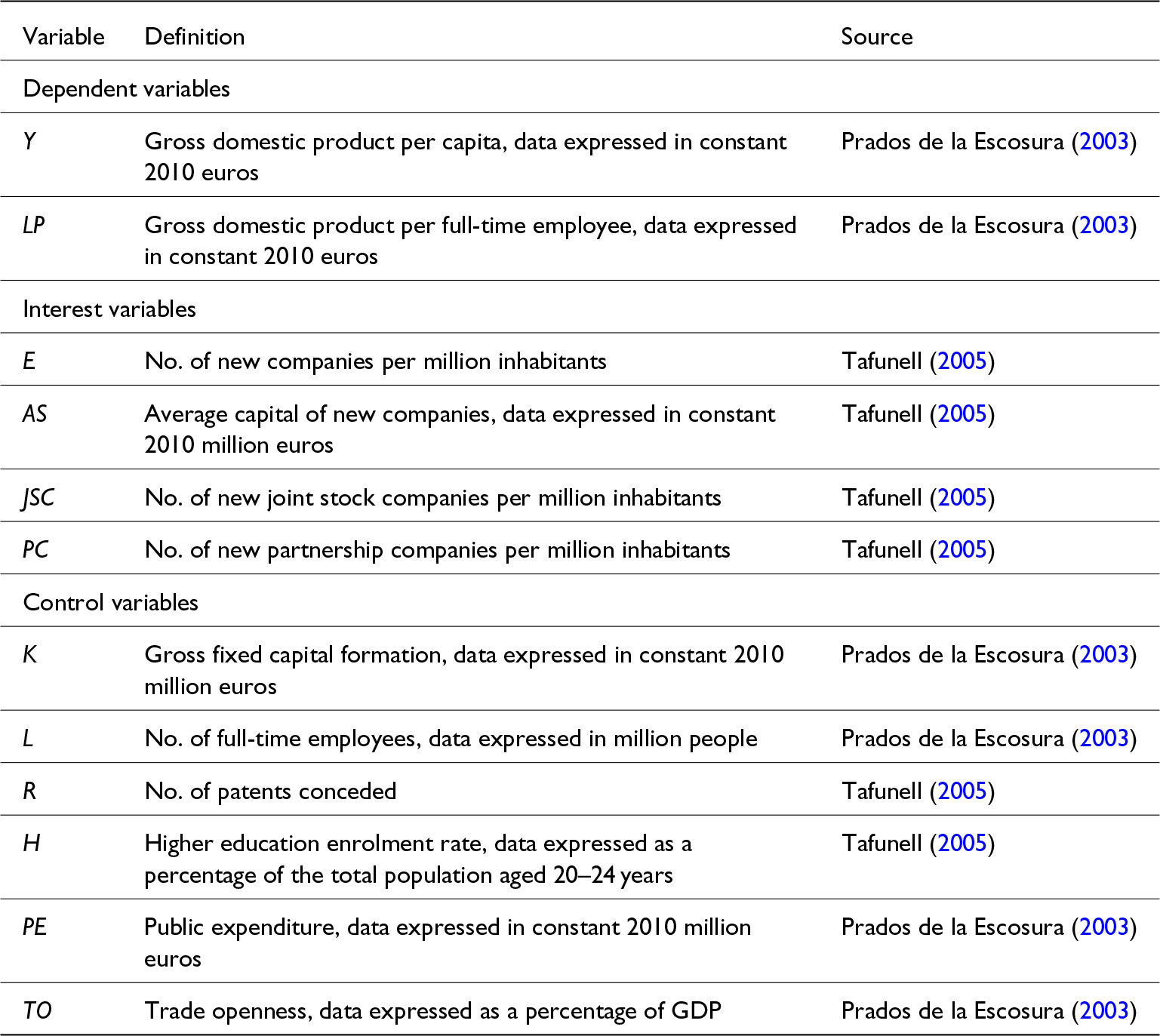
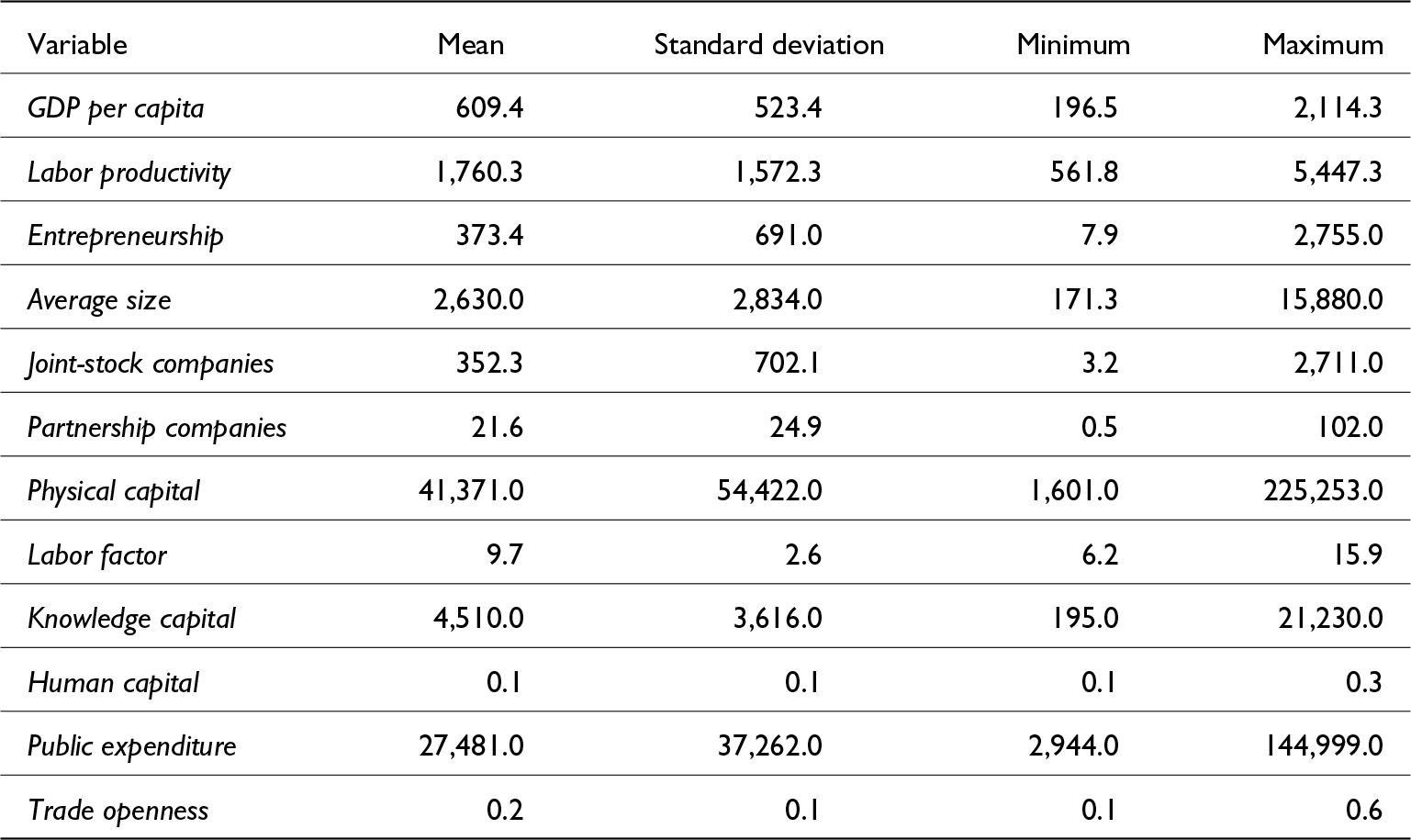
In addition to the aforementioned variables, our econometric model incorporates several control variables. They encompass different factors, identified by economic growth theories, that influence economic performance: physical capital (proxied by gross fixed capital formation), labor factor (measured by the number of full-time employees), knowledge capital (number of granted patents), human capital (higher education enrolment rate), public expenditure, and trade openness. Table 1 presents a description of the dependent, interest, and control variables used in this study, along with their definitions and the sources from which we collected our data. Table 2 shows the main descriptive statistics of the variables. Our analysis is primarily based on two main data sources: Estadísticas Históricas de España, Siglos XIX-XX coordinated by Albert Carreras and Xavier Tafunell and El progreso económico de España (1850–2000) by Leandro Prados de la Escosura.
Description of the variables considered in our analysis

Source: Own elaboration.
Main descriptive statistics of the variables

Source: Own elaboration
We use Equation (4) to test H2, replacing the variable Et with ASt, which measures the average size of new companies in Spain in terms of capital. For testing H3, we introduce variables JSCt (the number of new joint-stock companies per million inhabitants) and PCt (the number of new partnership companies per million inhabitants) into the analysis using Equation (5):
 \begin{equation}{\textit{ln}}{\textit{Y}_{\textit{t}}} = \alpha + \beta_{\textit{1}}{\textit{ln}}{\textit{K}_{\textit{t}}} + \beta _{\textit{2}}{\textit{ln}}{\textit{L}_{\textit{t}}} + \beta _{\textit{3}}{\textit{ln}}{\textit{R}_{\textit{t}}} + \beta _{\textit{4}}{\textit{ln}}\textit{AS}_{\textit{t}} + \beta _{\textit{5}}{\textit{ln}}{\textit{H}_{\textit{t}}} + \beta _{\textit{6}}{\textit{ln}}\textit{PE}_{\textit{t}} + \beta _{\textit{7}}{\textit{ln}}\textit{TO}_{\textit{t}} + {\varepsilon _{\textit{t}}}\end{equation}
 \begin{align}{\textit{ln}}{\textit{Y}_{\textit{t}}} &= \alpha + \beta _{\textit{1}}{\textit{ln}}{\textit{K}_{\textit{t}}} + \beta _{\textit{2}}{\textit{ln}}{\textit{L}_{\textit{t}}} + \beta _{\textit{3}}{\textit{ln}}{\textit{R}_{\textit{t}}} + \beta _{\textit{4}}{\textit{ln}}\textit{PC}_{\textit{t}} + \beta _{\textit{5}}{\textit{ln}}\textit{JSC}_{\textit{t}} + \beta _{\textit{6}}{\textit{ln}}{\textit{H}_{\textit{t}}} + \beta _{\textit{7}}{\textit{ln}}\textit{PE}_{\textit{t}} \nonumber\\ &\quad + \beta _{\textit{8}}{\textit{ln}}\textit{TO}_{\textit{t}} + {\varepsilon _t}\end{align}
Equations (3)–(5) are estimated by the OLS method in first differences to eliminate possible spurious correlations between entrepreneurship and economic growth. In addition, given the potential problems of heteroscedasticity that are usually present in real-time series, we have also estimated the equations with heteroscedasticity correction (Peña, Reference Peña1990).
Finally, the possible existence of reverse causality constitutes a potential problem for our results. The exact nature of the causal relationship between entrepreneurship and economic growth is unclear. To address this endogeneity problem and confirm the directionality of the relationship between the variables, we perform two robustness checks. First, we test the impact of entrepreneurship on labor productivity (LPt), since all mechanisms through which entrepreneurship capital should influence economic growth involve productivity (e.g., knowledge spillovers or competition). Second, when we obtain a positive and statistically significant correlation between entrepreneurship and economic growth, we estimate the following VAR model:
 \begin{equation}{\textit{Z}_{\textit{t}}} = {\textit{A}_{\textit{0}}} + \mathop \sum \nolimits_{\textit{i} = \textit{1}} {\textit{A}_{\textit{i}}}{\textit{Z}_{\textit{t} - \textit{i}}} + \textit{BX}_{\textit{t}} + {\textit{u}_{\textit{t}}}\end{equation}
where Z is a vector containing the endogenous variables of the model; X is a vector containing the exogenous variables;Footnote 8 A 0 is a vector of intercepts; Ai is a coefficient matrix that measures the effect of Zt−i on Zt; and B is a coefficient matrix that captures the effect of Xt on Zt. ut is the vector of error terms.Footnote 9
Among other advantages, the VAR model enables the consideration of mutual causality between different variables. Additionally, this method facilitates the examination of causality direction using the Granger causality test. This technique cannot provide definitive conclusions about causal relationships; however, the Granger causality test is generally considered to demonstrate the probability of causation more strongly than simple correlation (Geweke, Reference Geweke, Griliches and Intriligator1984). Therefore, this methodology enhances the possibility of testing our empirical results on the relationship between entrepreneurship and economic growth in Spain during the period 1886–2000 (Box et al, Reference Box, Lin and Gratzer2014; Carree and Thurik, Reference Carree and Thurik2008).
4. Results and discussions
1. Entrepreneurship capital
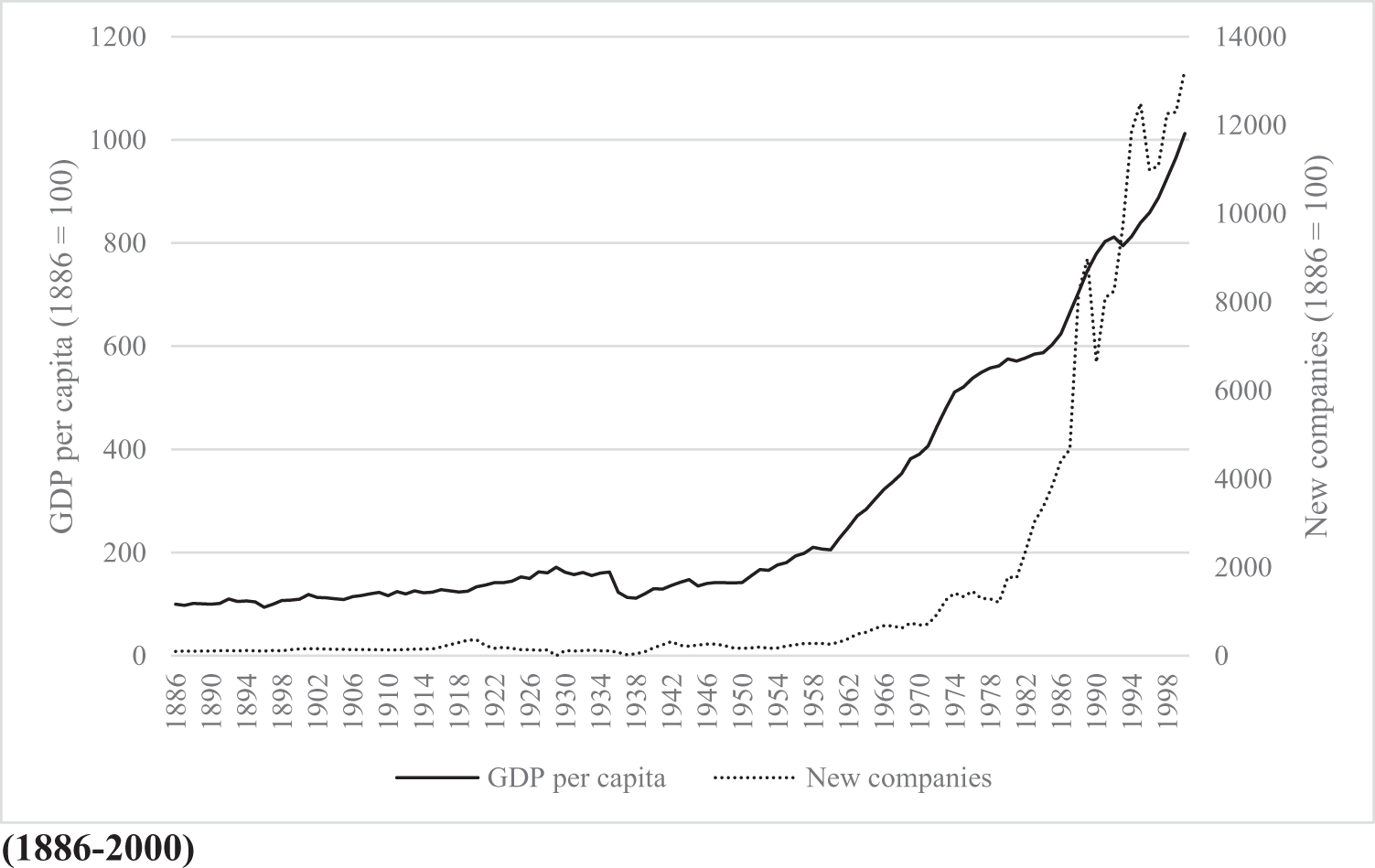
Figure 1 illustrates the evolution of GDP per capita and business creation in Spain from 1886 to 2000. Both series exhibit similar long-term trends, in line with findings by Tortella et al. (Reference Tortella, García Ruiz, Ortiz Villajos and Quiroga2008) and Valdaliso (Reference Valdaliso, Cuervo and Sastre2005): slow growth during the late 19th century and the first half of the 20th century, followed by a notable upturn since 1960, coinciding with the implementation of the Spanish Stabilization and Liberalization Plan 1 year earlier.Footnote 10 The strong positive correlation between the two series is evident, with specific periods showing an inverse correlation, such as during the Dictatorship of Primo de Rivera (1923–1930) and the II Spanish Republic (1931–1936), as well as the economic crisis between 1978 and 1985. During the 1920s and 1930s, despite GDP per capita growth, there was a significant decline in the number of new companies. Indeed, from the end of the 1920s, fluctuations in the number of start-ups became more pronounced due to the deterioration of business confidence associated with the last stages of the Dictatorship of Primo de Rivera, the international crisis of 1929, and the structural and labor policy reforms of the first republican governments. Conversely, between 1978 and 1985, the slowdown in GDP per capita coincided with a notable surge in business creation in Spain, driven by the extensive renewal of the national business landscape during those years (Valdaliso, Reference Valdaliso, Cuervo and Sastre2005).
Evolution of GDP per capita and number of new companies in Spain (1886–2000). Source: Own elaboration based on GDP per capita data from Prados de la Escosura (Reference Prados de la Escosura2003) and new companies’ data from Carreras and Tafunell (Reference Carreras and Tafunell2005).

Beyond these specific periods, the main difference between the temporal evolution of GDP per capita and business formation is the greater volatility of the latter. Although our proxy for entrepreneurship capital seems to be a reliable leading indicator of modern Spanish economic growth cycles, the fluctuations in this series are significantly more pronounced than those of GDP per capita. This finding is consistent with expectations, given Spain’s status as a late-developing country. Amorós and Cristi (Reference Amorós and Cristi2008) suggest that countries with lower GDP per capita exhibit higher variance in their levels of entrepreneurial activity. Similarly, Amorós et al. (Reference Amorós, Cristi and Minniti2009, Reference Amorós, Cristi and Minniti2011) report that lower entrepreneurial volatility is associated with countries that have more predictable and consistent institutional frameworks, sufficient government subsidies for new and growing firms, and better entrepreneurship education and training.
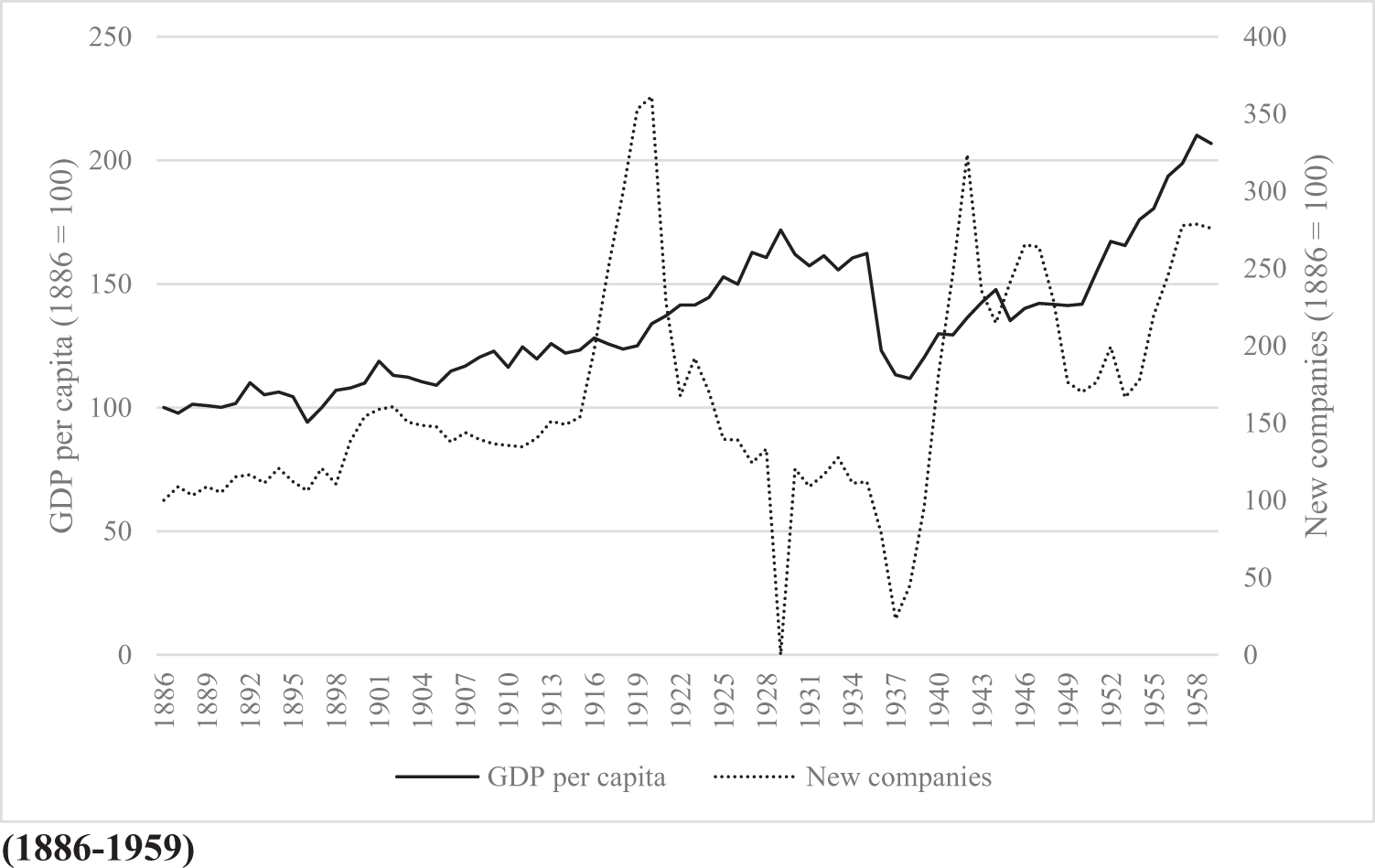
Examining the evolution of the newly established companies per year in Figure 1, it becomes clear that, despite cyclical fluctuations, the long-term trend remains notably stable up to the 1950s. This suggests that the modernization of the Spanish economy in the 1960s was not preceded by a sustained and prolonged increase in investment through the establishment of new firms (Tafunell, Reference Tafunell, Carreras and Tafunell2005). To address the difficulty of visualising fluctuations in our proxy for entrepreneurial capital before 1960 due to scaling issues, Figure 2 focuses on the period from 1886 to 1959. Within this period, there are three significant short-lived booms: the surge in the late 19th century, the remarkable growth during World War I, and the singular recovery in the 1940s following the Civil War. These periods of growth were interspersed with intervals characterised by stagnation and contraction.
Evolution of GDP per capita and number of new companies in Spain (1886–1959). Source: Own elaboration based on GDP per capita data from Prados de la Escosura (Reference Prados de la Escosura2003) and new companies data from Carreras and Tafunell (Reference Carreras and Tafunell2005).

In 1899, the repatriation of capital from the lost Spanish colonies triggered a remarkable rise in the establishment of new companies in the context of an economic boom. The rapid economic recovery of the country following the loss of the colonies was facilitated by the inflow of investment, financial expansion, and the process of nationalising assets (Maluquer De Motes, Reference Maluquer De Motes1999). Following the culmination of this growth cycle in 1904, the formation of new societies stabilized until the onset of the subsequent expansionary phase, also driven by an external factor, World War I. At this time, the heightened demand from belligerent countries led to a new boom in companies’ establishment, a trend not replicated until the industrialization of the 1960s. However, the decline in new company formations, which started in 1920 following the post-war crisis, persisted for two decades, suggesting that the economic gains experienced during the European war were purely conjunctural.
The apparent recovery post-Civil War, as reflected in the figures between 1940 and 1943, is somewhat misleading. Many of the companies established during this period are essentially re-registrations of businesses that existed before the war. The extent to which this inflation of business registrations is fictitious remains unknown (Torres, Reference Torres and Barciela2003). Thus, after a decade in the 1950s marked by sporadic and challenging entrepreneurial progress in a context of increasing openness and economic recovery, the early 1960s marked the onset of sustained growth in company creation. Between 1960 and 1973, business creation intensified, far exceeding previous levels. Spain’s full reintegration into the international economy and the opening of trade and finance following the 1959 Stabilization Plan accelerated growth and facilitated catch-up with Western Europe (Prados de la Escosura et al, Reference Prados de la Escosura, Rosés and Sanz-Villaroya2011). This period laid the foundations for a flourishing of new businesses under improved economic expectations. Since then, the series depicting new companies shows a strong upward trend, marking a significant departure from the relatively flat trajectory observed over the long term until the mid-20th century.
The oil crisis temporarily interrupted this growth trend. The severity of the economic downturn, the instability associated with the democratic transition, the industrial crisis of 1979, and the rising cost of capital understandably discouraged business creation. Since the early 1980s, the series of newly established businesses resumed its upward trajectory, which continued until the year 2000, except for brief downturns in 1990 and 1996.Footnote 11 During these last two decades of the 20th century, entrepreneurship capital doubled, driven by the growth experienced by the Spanish economy and the country’s integration into European institutions and international markets.
After this descriptive analysis, the observed correlation between business creation and economic growth in Spain is now tested econometrically. The non-stationarity of the series and their similar trends make it necessary to estimate the equations in first differences to avoid possible spurious correlations.
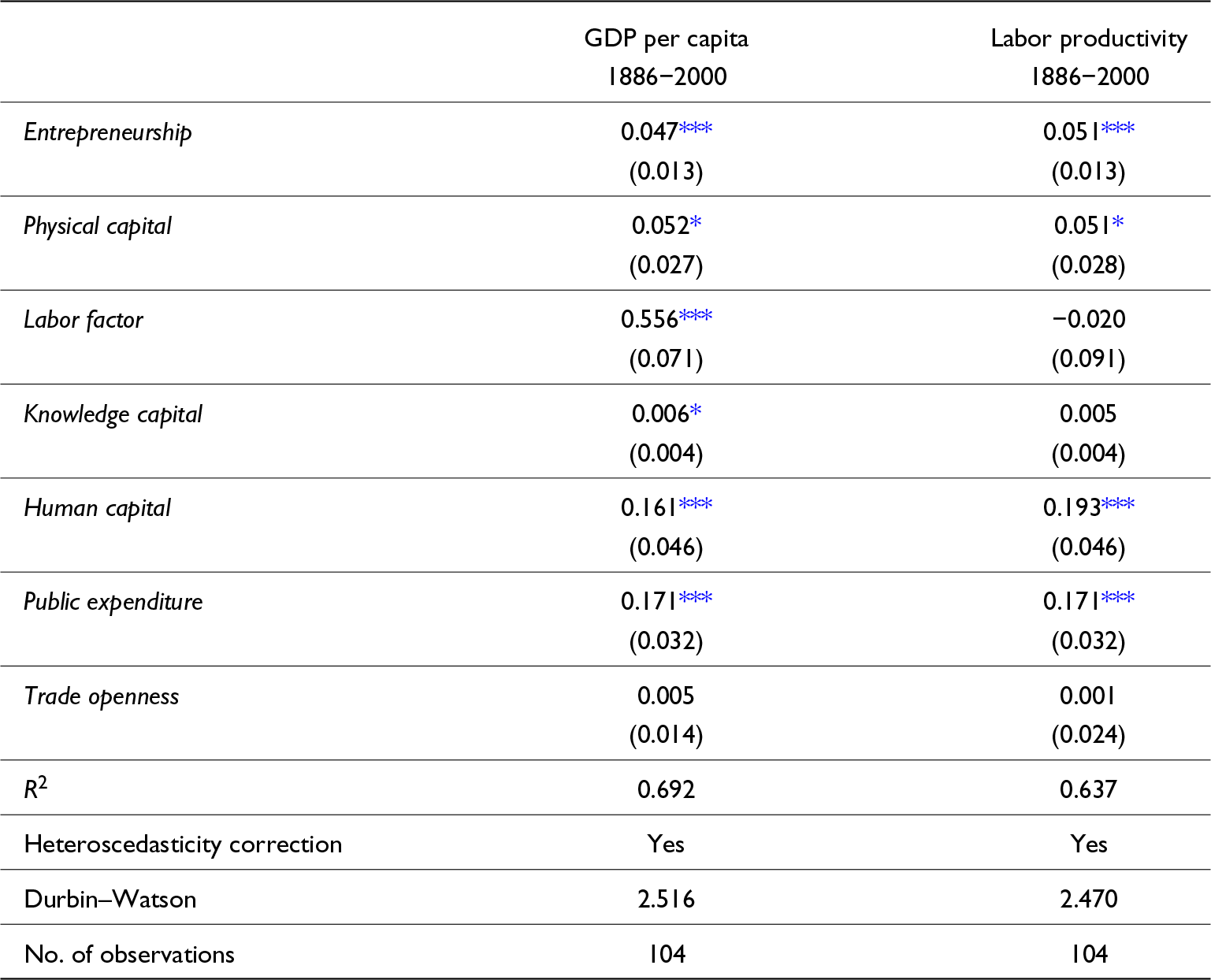
The OLS estimation results of Equation (3), reported in Table 3, confirm our H1: entrepreneurship capital has been a significant driver of long-term Spanish economic growth. The results support a positive and statistically highly significant effect of business establishment on national GDP per capita and labor productivity. Specifically, a 1% increase in the growth of entrepreneurship capital generates approximately a 0.05% increase in the growth of the two macroeconomic indicators evaluated. This positions entrepreneurial capital as a substantial factor in Spain’s modern economic growth—less influential than human capital, public expenditure, and, above all, labor, but comparable to physical capital and more determinant than knowledge capital and trade openness.
OLS estimation results of Equation (3)

Notes: Robust standard errors are shown in parentheses. Asterisks denote statistical robustness:
* at the 10% level, ** at the 5% level, and *** at the 1% level.
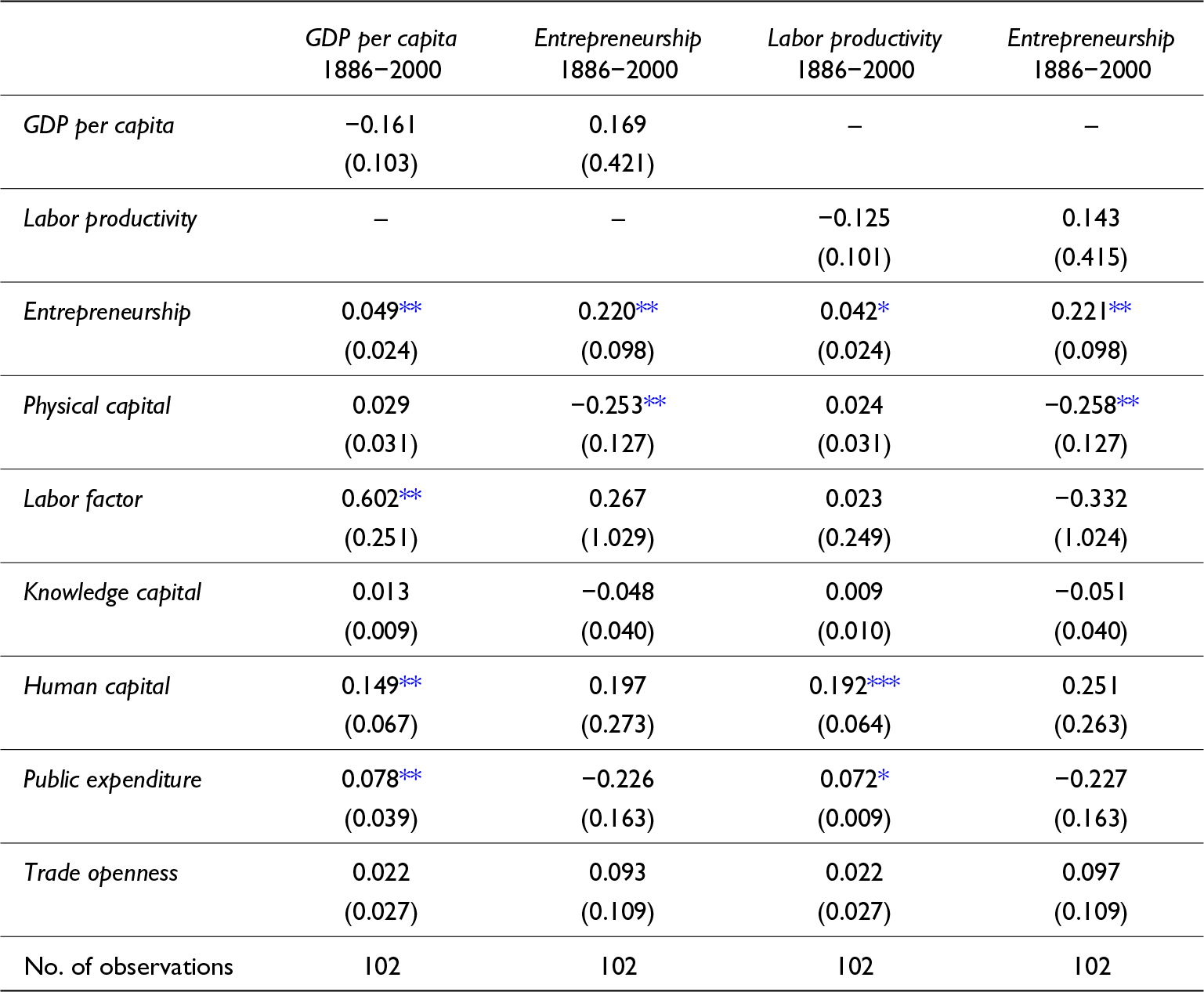
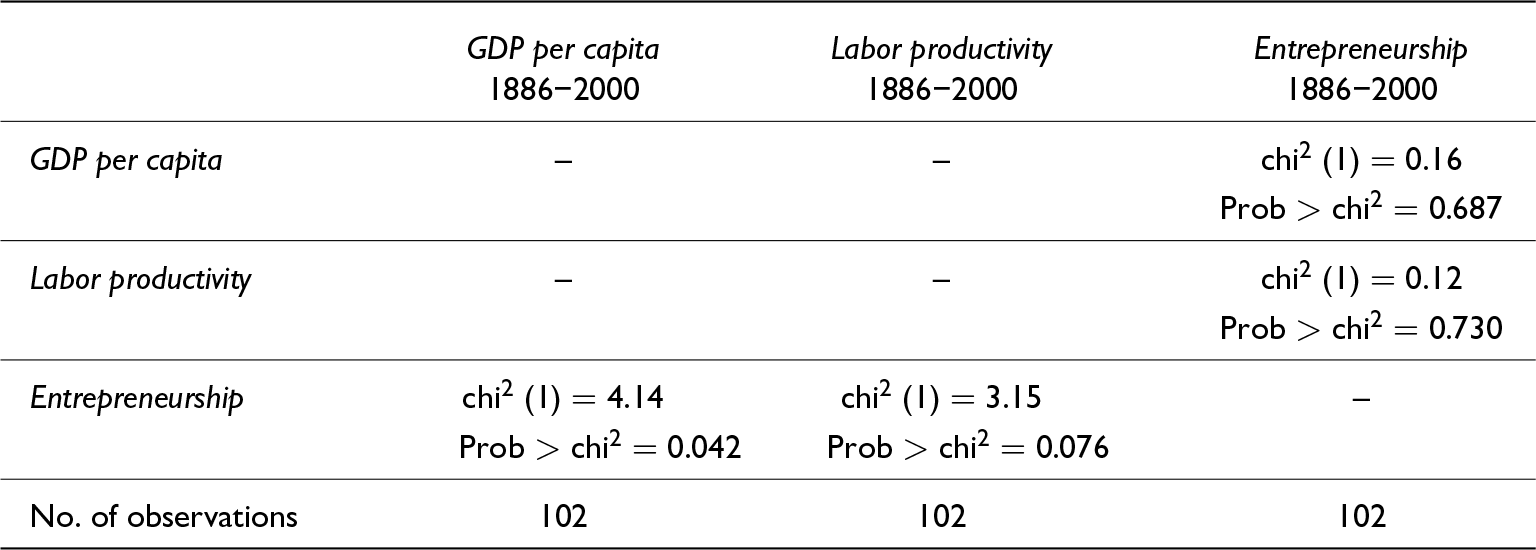
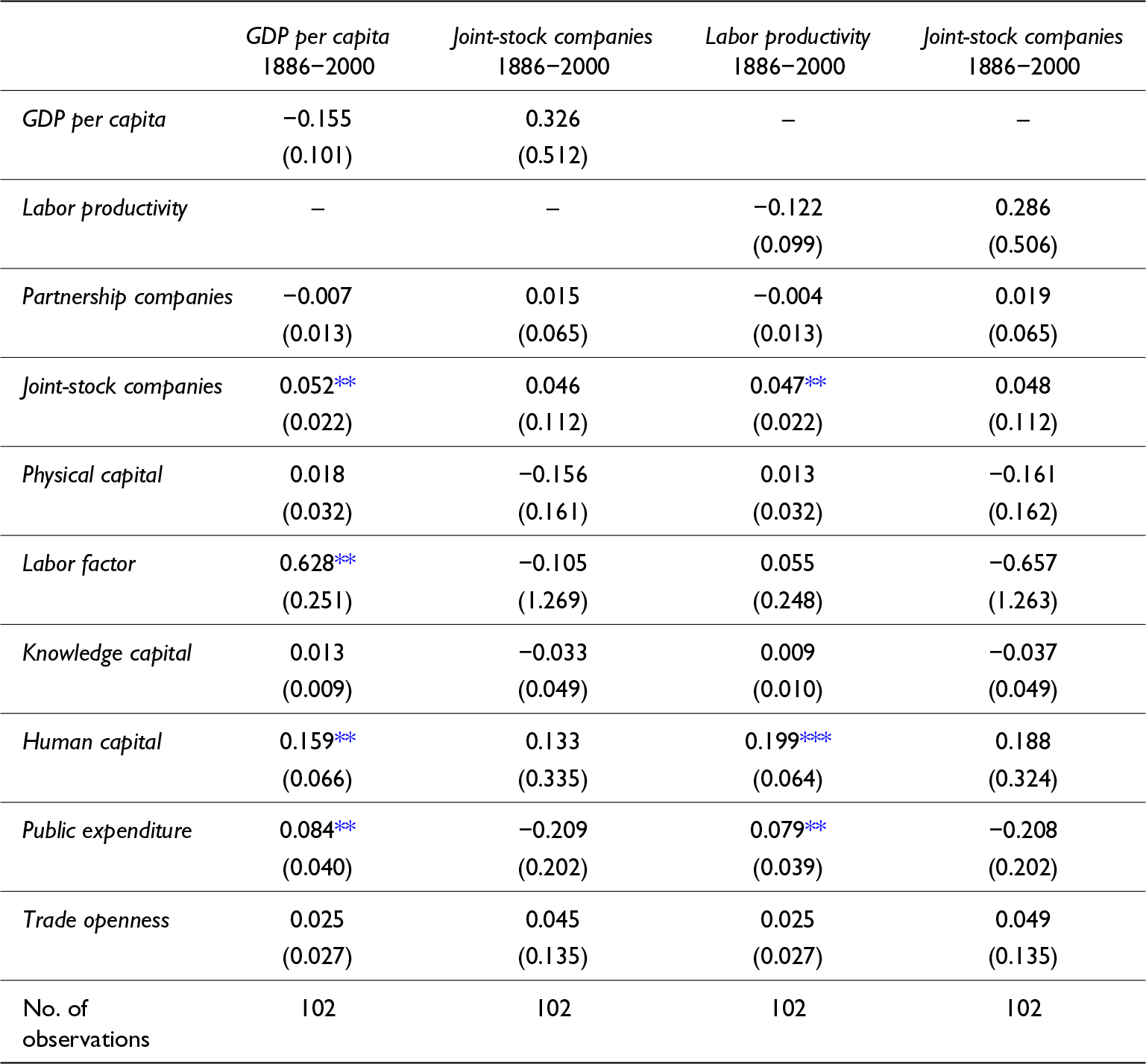
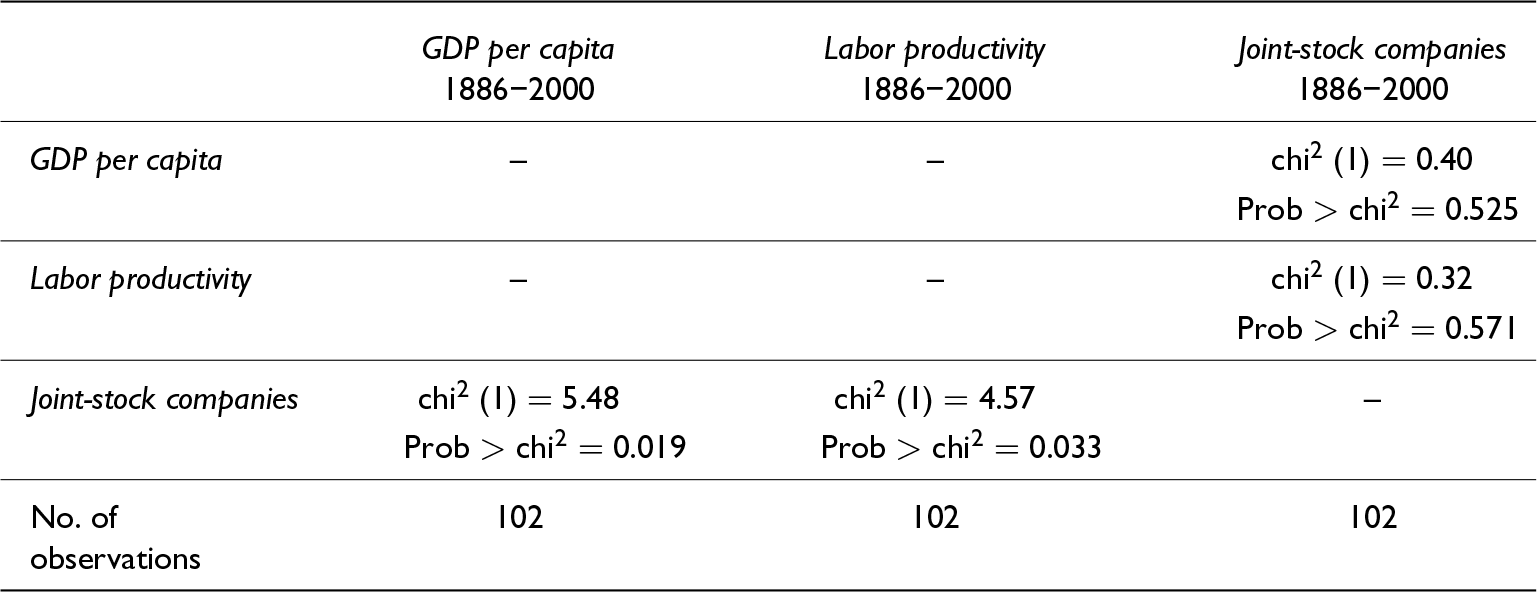
Given the risk of reverse causality, a VAR model and the Granger causality test have been estimated. Their results, presented in Tables 4 and 5, support the notion that entrepreneurship indeed causes economic growth, rather than the other way around. Consistent with the OLS results, the VAR model reports a significant coefficient close to 0.05 for the first lag of the entrepreneurship variable, both when analyzing GDP per capita and labor productivity. In addition, Granger causality tests indicate that the effect of entrepreneurship on GDP per capita and labor productivity is statistically significant at the 5% and 10% levels, respectively, while the reverse effect is far from significant.
Estimation results of VAR model (6) including variable E

Notes: R and H are considered exogenous variables. First differences were applied to ensure stationarity of the variables. Robust standard errors are shown in parentheses. Asterisks denote statistical robustness:
* at the 10% level, ** at the 5% level, and *** at the 1% level.
Granger causality test between entrepreneurship and economic growth

Note: Granger causality tests calculated from the VAR model (6) including variable E.
The above result aligns with the prevailing consensus that entrepreneurship plays a crucial role in economic growth. It also challenges the traditional view that a lack of entrepreneurial spirit has hindered Spain’s economic development. If we define entrepreneurship as the creation of new businesses, our findings provide evidence that the development of entrepreneurship during the 20th century in Spain positively influenced the country’s economic growth (Torres, Reference Torres, Comín and Aceña1996, Reference Torres and Barciela2003; Tortella, Reference Tortella1994, Reference Tortella, Comín and Aceña1996; Tortella et al, Reference Tortella, García Ruiz, Ortiz Villajos and Quiroga2008; Valdaliso, Reference Valdaliso, Cuervo and Sastre2005).
2. Business size and legal form
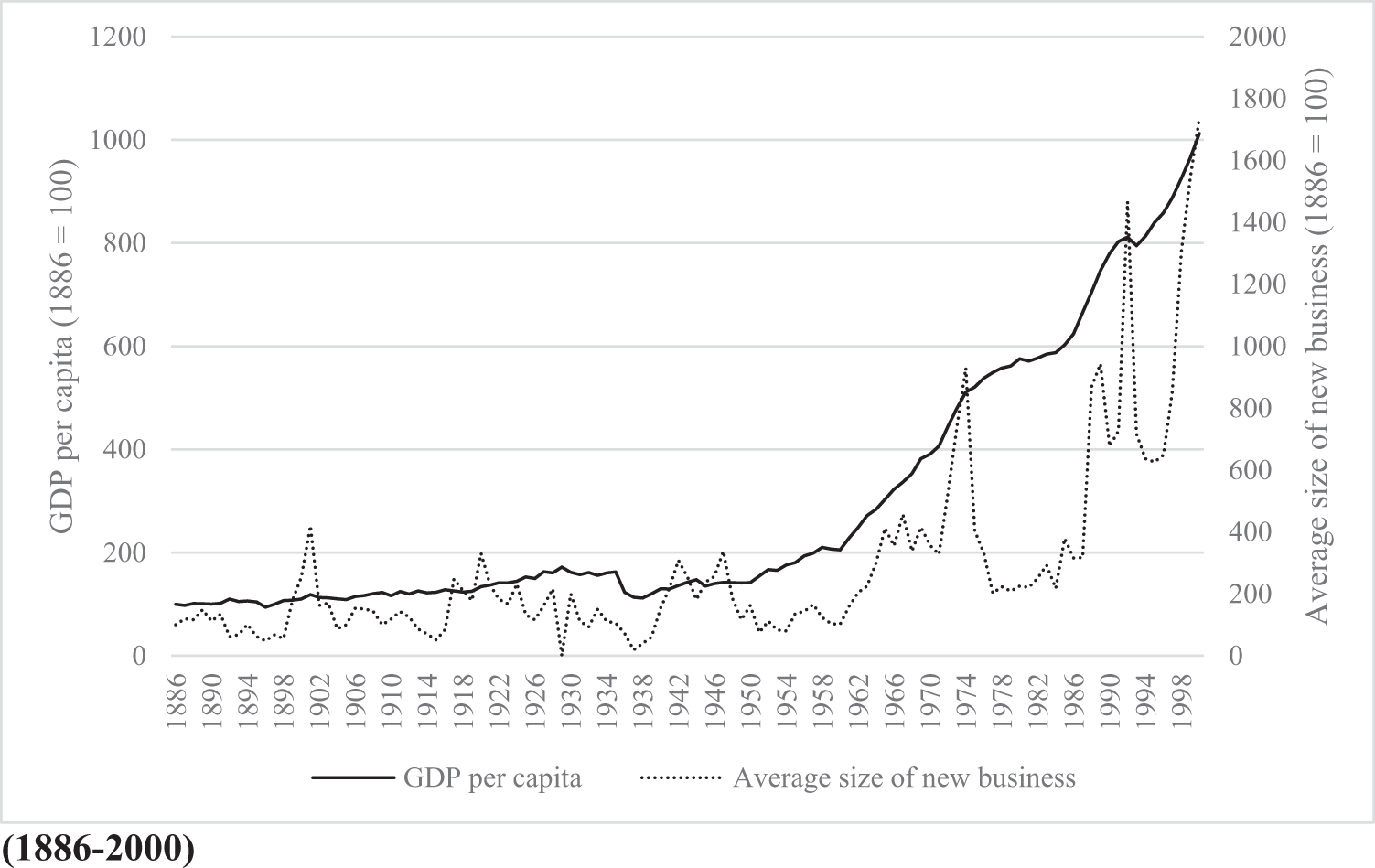
Having tested and confirmed the importance of entrepreneurship capital for long-term Spanish economic growth, we now address the impact of entrepreneurship through the profile of the new companies—size and legal form. Regarding the first aspect, Figure 3 illustrates the evolution of the average size of newly established companies in Spain, alongside that of GDP per capita, during the analyzed period. Both series show a high correlation, at least until the 1970s. The average business size series follows a similar trajectory to the business creation series but exhibits more pronounced fluctuations. Again, the inflexion point in both series is evident in the 1960s. Prior to this decade, we can identify upward and downward phases closely mirroring those in the business formation series.
Evolution of GDP per capita and average size of new business in Spain (1886–2000). Source: own elaboration based on GDP per capita data from Prados de la Escosura (Reference Prados de la Escosura2003) and average business size data from Carreras and Tafunell (Reference Carreras and Tafunell2005).

After 1960, despite sustained growth in company creation, the increase in the average size of new businesses is somewhat blurred by significant cyclical fluctuations. Although both the average capital and the number of new firms grew significantly during the Spanish “developmentalism,” surpassing the maximum values of previous periods, this parallelism breaks down after 1974. From then onward, the trajectory of the average capital of new businesses seems closely aligned with fluctuations in business expectations and the broader economic cycle, showing more pronounced variability. This underscores the adaptability advantages of SMEs in highly uncertain environments. The depression caused by the two oil shocks of the 1970s persisted for a decade, causing the average size of new businesses to regress to levels of the early 1960s. The recovery following the crisis, since 1985, spurred strong growth in average business size during the second half of the 1980s, mirroring the broader boom in the Spanish economy and its increasing orientation toward international markets. The downturn at the beginning of the following decade is also evident in the size series, despite the still unexplained peak in 1992 (Tafunell, Reference Tafunell, Carreras and Tafunell2005). Finally, the new growth cycle in the last 5 years of the 20th century reached a new historical maximum, illustrating an increasing establishment of larger companies and, once again, a common trend between business capital and economic growth.
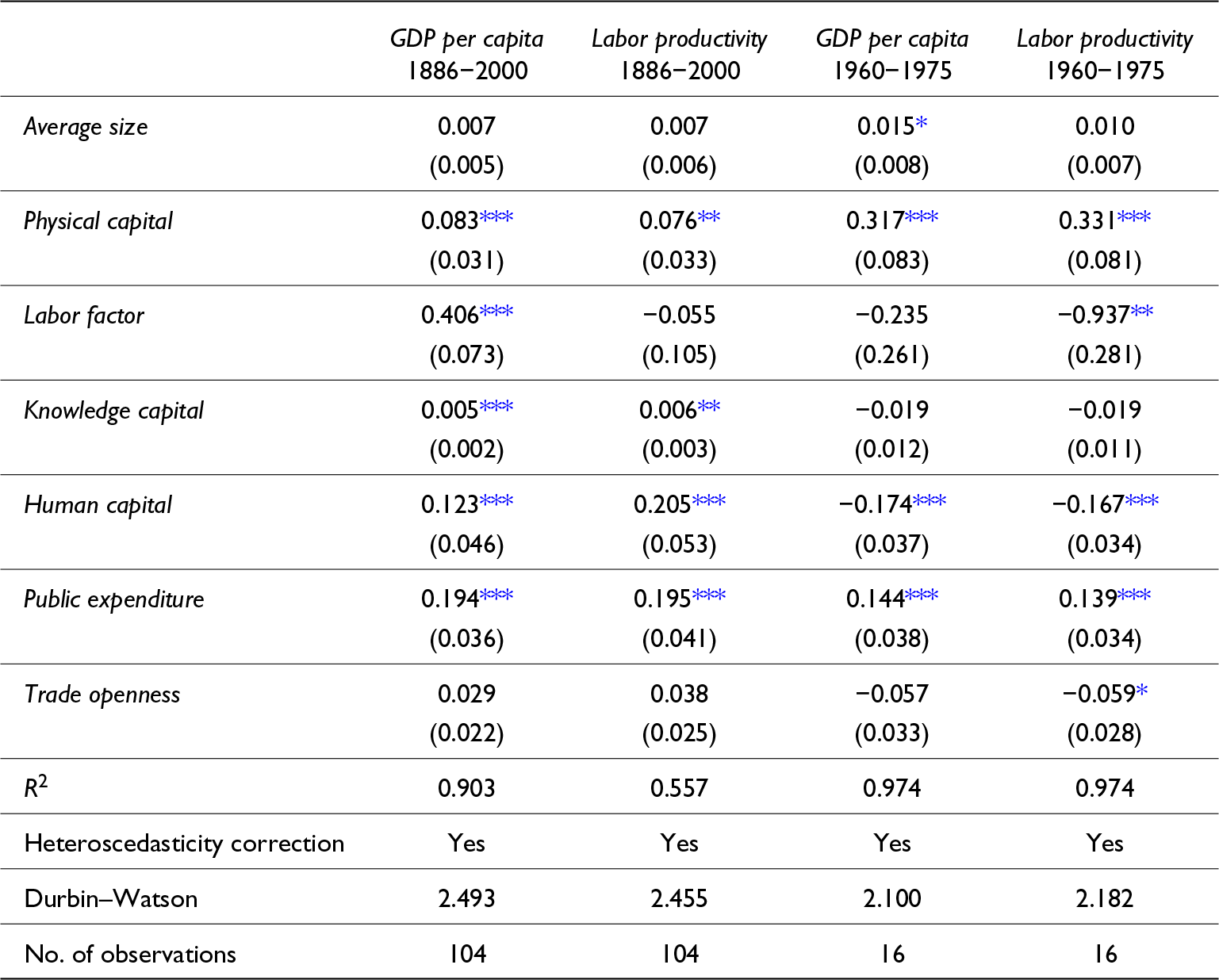
Therefore, consistent with Tafunell (Reference Tafunell, Carreras and Tafunell2005), these findings suggest that there might be a relationship between the size of new business and GDP per capita, meaning that Spain’s modern economic growth tended to coexist with an increase in business capital. However, the OLS estimation results of Equation (4), reported in the first two columns of Table 6, do not support a positive effect of new business size on economic growth, thus failing to confirm our H2. The results suggest a null effect of the average size of new firms on GDP per capita and labor productivity for the whole period studied. This aligns with Massón (Reference Massón2007), who reported similar results for the years 2000–2005. These findings suggest that the commonly perceived absence of large corporations, often interpreted as a limitation to the contemporary Spanish economic development, has not necessarily hindered national economic growth. However, this does not imply that the creation of bigger businesses has never contributed to Spanish economic growth. Notably, during the “developmentalism” period, the size of new firms reports a significant positive effect on GDP per capita, shown in the third column of Table 6. This correlation could be attributed to the specific phase of the Industrial Revolution that Spain was experiencing. Specifically, the transition to a mass production system—typically associated with the positive effects of business size on economic growth—largely occurred during these years of “developmentalism.”Footnote 12
OLS estimation results of Equation (4)

Notes: Robust standard errors are shown in parentheses. Asterisks denote statistical robustness:
* at the 10% level, ** at the 5% level, and ** at the 1% level.
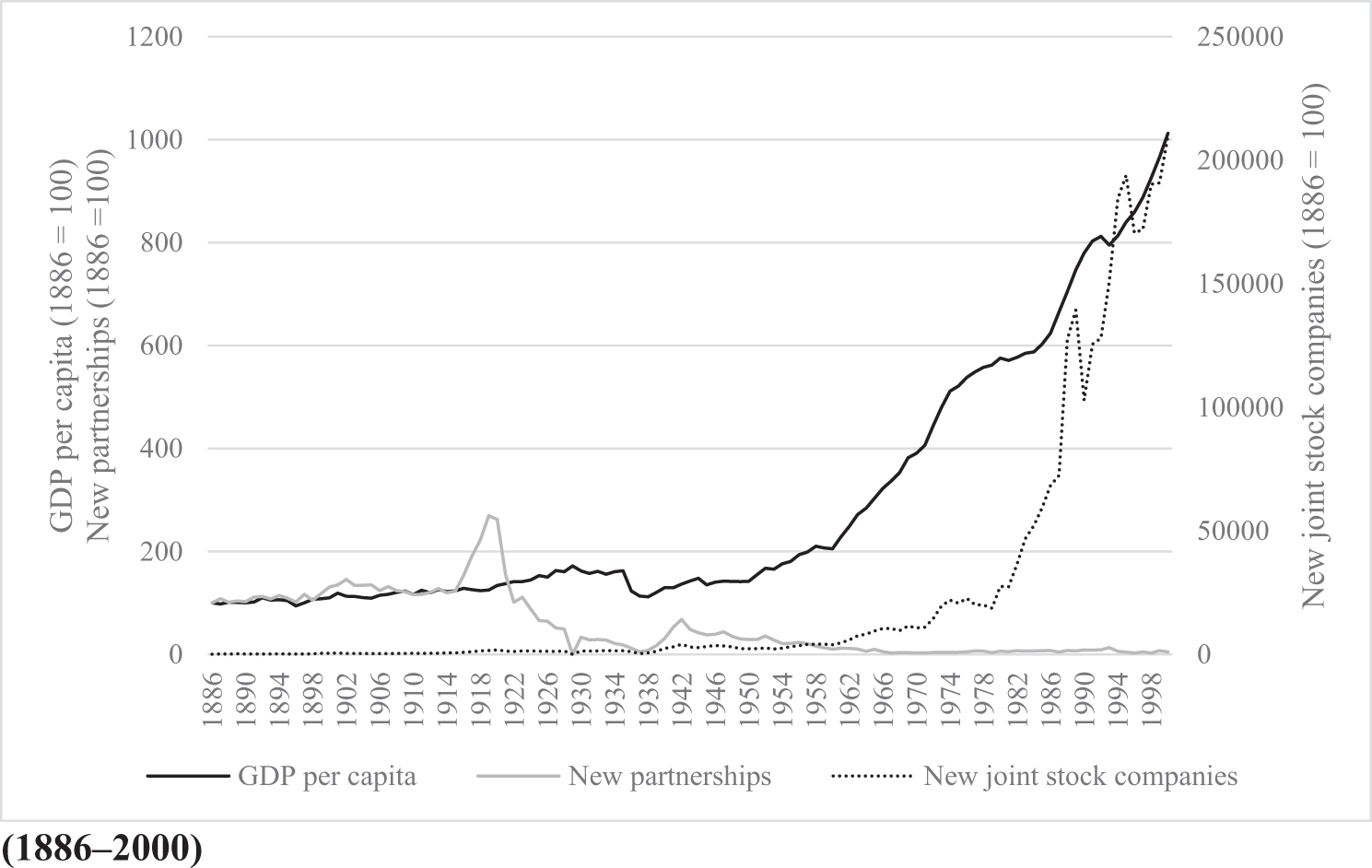
Regarding legal forms, Figure 4 illustrates the evolution of new companies by their legal structure distinguishing between joint stock companies (modern legal forms) and partnership companies (traditional legal forms). Partnership companies predominated among new businesses until 1923 and maintained a significant share in the Spanish business structure until the end of the Civil War. However, since then, joint stock companies have dominated the business landscape in Spain: by 1955, 90% of newly incorporated companies had adopted modern legal forms, and this figure exceeded 98% by 1963. This finding aligns with the observed increase in the average size of newly established companies, as bigger firms tend to adopt modern legal forms (Martín Aceña, Reference Martín Aceña1993).
Evolution of GDP per capita and number of new companies, by legal forms, in Spain (1886–2000). Source: Own elaboration based on GDP per capita data from Prados de la Escosura (Reference Prados de la Escosura2003) and new partnerships and joint stock companies’ data from Carreras and Tafunell (Reference Carreras and Tafunell2005).

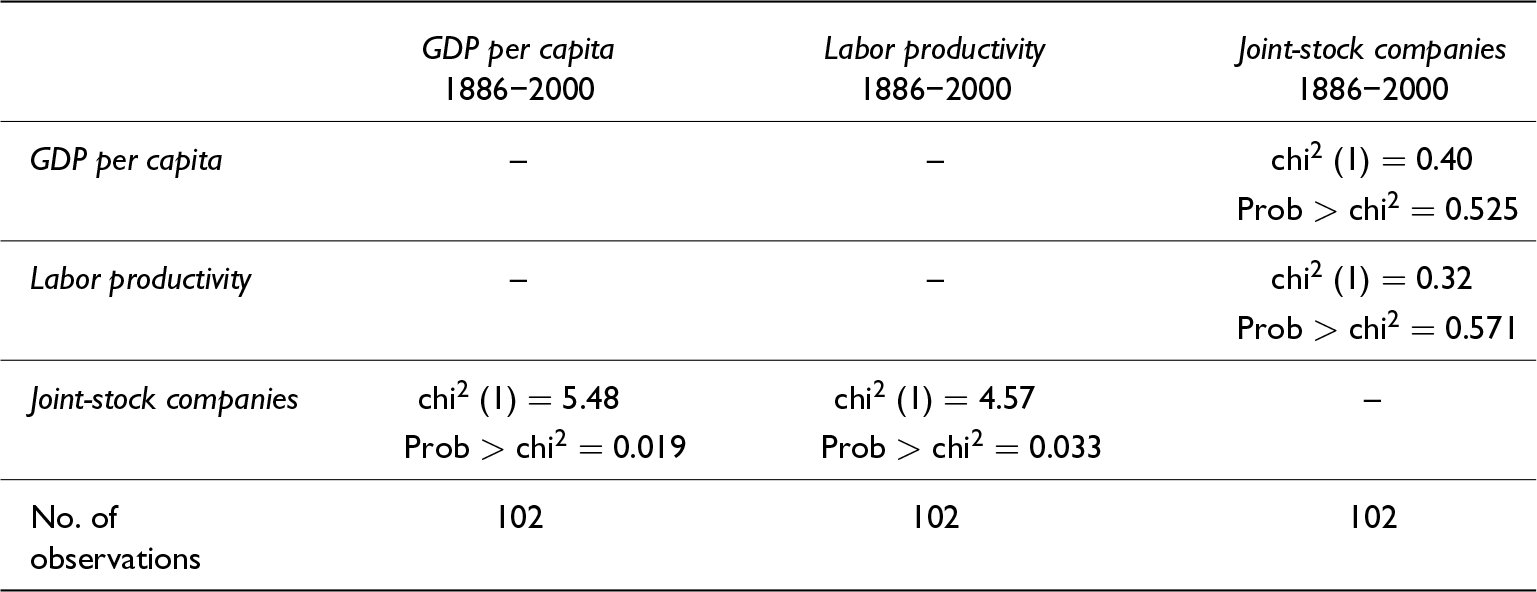
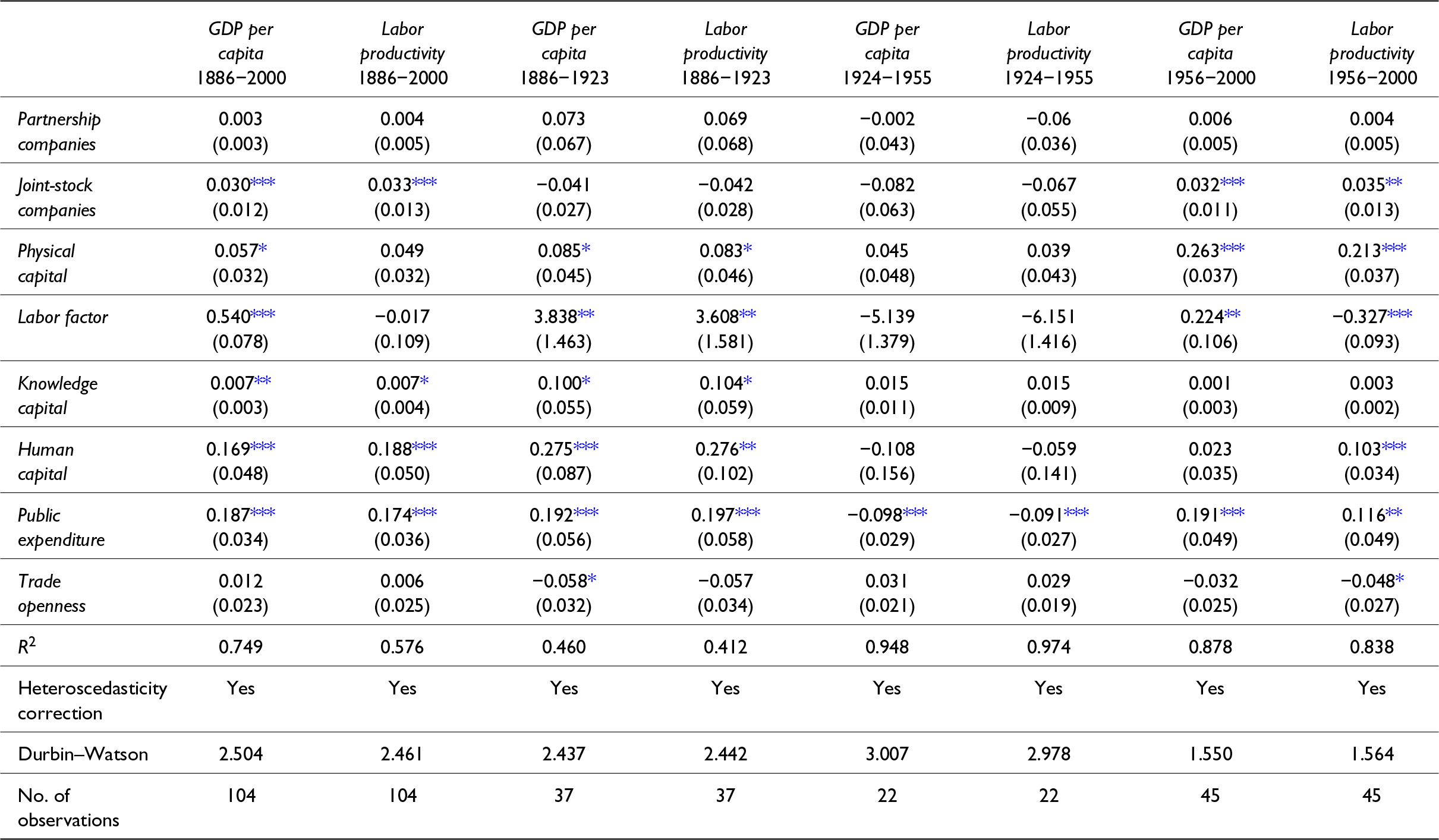
Thus, what Figure 4 shows is that joint stock companies have driven economic growth in Spain, while partnership companies have played a marginal role in the national economy since the 1950s. This observation is further supported by the OLS estimation results of Equation (5), presented in the first two columns of Table 7, which show a positive and significant effect of joint stock companies on GDP per capita and labor productivity growth, and a null effect for partnership companies. The VAR model and the Granger causality test, reported in Tables 8 and 9, respectively, reinforce these findings. Thus, the empirical analysis initially supports our H3, suggesting that the legal form of companies has influenced economic growth in Spain. However, when we divide the sample into three sub-periods: 1886–1923, 1924–1955, and 1956–2000, the results, shown in columns 3–8 of Table 7, reveal that, while partnership companies have not boosted economic growth in any of these periods, joint stock companies reported a positive effect only in the third period.Footnote 13 Therefore, although our findings are consistent with the interpretation of joint stock companies as an indicator of Spain’s economic modernization (Guinnane and Martínez-Rodríguez, Reference Guinnane and Martínez-Rodríguez2018; Jiménez Araya, Reference Jiménez Araya1974; Tafunell, Reference Tafunell, Carreras and Tafunell2005), they do not suggest that the legal form of firms has determined Spain’s economic growth. To that end, we should have found a positive relationship between joint stock companies and economic growth during periods when the presence of partnership companies was not residual; however, the model does not show such results. Although the period 1956–2000 does report a positive and significant coefficient, this is likely because almost all firms created during these years were joint stock companies, meaning that the effect captured reflects entrepreneurship rather than the legal form of the new companies. Thus, we consider that our findings fail to confirm H3.
OLS estimation results of Equation (5)

Notes: Robust standard errors are shown in parentheses. Asterisks denote statistical robustness:
* at the 10% level, ** at the 5% level, and *** at the 1% level.
Estimation results of VAR model (6) including variables PC and JSC

Note: R and H are considered exogenous variables. First differences were applied to ensure stationarity of the variables. Robust standard errors are shown in parentheses. Asterisks denote statistical robustness:
* at the 10% level, ** at the 5% level, and *** at the 1% level.
Granger causality test between joint stock company and economic growth
Note: Granger causality tests calculated from the VAR model (6) including variables PC and JSC.
5. Conclusions
The objective of our paper is to explore the relationship between entrepreneurship and modern economic growth in Spain. To this end, we have assessed the contribution of Spain’s entrepreneurship capital to national GDP per capita and labor productivity growth during the period 1886–2000, following an approach inspired by Audretsch and Keilbach (Reference Audretsch and Keilbach2004). Entrepreneurship capital, measured by the number of start-up firms per million inhabitants, is understood as the country’s endowment with factors conducive to the creation of new businesses. This study addresses a gap in the literature, as the long-term impact of entrepreneurship on economic growth in Spain remains largely unexplored.
In addition to analyzing the effect of entrepreneurship capital on economic output, our research extends beyond business creation by exploring the evolving profile of national business dynamics. Specifically, we examine the size and legal form of start-up firms over time. This approach enables us to contribute to well-established debates in Spanish economic historiography regarding the limitations of entrepreneurship as a factor contributing to slow growth during the 19th and 20th centuries. To our knowledge, our study is the first attempt to test econometrically the long-term contribution of entrepreneurship to Spain’s economic growth.
Although our approach is primarily quantitative and econometric, following the prevailing method in economic studies that analyzes the link between entrepreneurship and economic performance, we contribute by offering a long-term historical perspective where time-series data are contextualized within the country’s economic history. Echoing Landes et al. (Reference Landes, Mokyr and Baumol2010), we agree that “the importance of history to entrepreneurship cannot be underestimated” (p. vii), and contend that the application of a long-term, historical lens to quantitative studies is crucial to enrich conclusions regarding the dynamics of entrepreneurship and its relationship to economic growth.
According to our results, a 1% increase in entrepreneurship growth generates approximately a 0.05% increase in Spain’s economic growth when analyzing the period 1886–2000. Comparing this finding with other independent variables included in our model highlights the importance of entrepreneurial capital for Spanish long-term growth: its impact is similar to that of physical capital and higher than that of knowledge capital and trade openness. So, our main result regarding the link between entrepreneurship and Spanish economic performance contributes to challenging the traditional assumption that the entrepreneurial factor has hindered the country’s economic growth. Moreover, the VAR model and the Granger causality tests employed support the directionality we propose between entrepreneurship and economic growth. This result is of great importance since Box et al. (Reference Box, Lin and Gratzer2014), the only study that had previously analyzed the long-term causality between entrepreneurship and growth, did not find such a relationship for Sweden during the period 1850–2000.
A distinctive characteristic of Spain is the relative scarcity of large companies and the prevalence of SMEs. For some authors, particularly Tortella, this evidences the lack of entrepreneurial initiative. For others, like Carreras and Tafunell, the underlying causes include a relatively small domestic market size and specific institutional factors. The traditional importance of business groups in our country has also been associated with the relative weakness of large companies. Regarding the association between the average size of new businesses and economic growth, we have not found a significant relationship for the whole period. While this is likely influenced by the scarcity of large companies in Spain, our result does not support the argument that the lack of such firms has been a determining factor in the country’s economic backwardness. This does not mean, however, that the establishment of large companies did not play a crucial role in Spanish economic growth at some stages of the 20th century. As shown in the analysis, we found a certain positive correlation between the new business size and GDP per capita for the period 1960–1975. Although the effect of these years is diluted in a long-term view, it should not hide the importance of new companies’ size in explaining the period of highest GDP per capita growth in Spain.
Finally, this paper questions the hypothesis of Guinnane and Martínez-Rodríguez, Jiménez Araya, and Tafunell regarding the importance of the adoption of modern legal forms—such as a corporation or limited company—for Spanish economic growth during the 20th century. Our study has identified a positive correlation between modern legal forms and Spain’s economic growth between 1886 and 2000, indicating that joint stock companies have constituted a valuable indicator of the country’s economic development. However, our findings do not support the interpretation that the slow diffusion of joint stock companies has been a factor contributing to Spain’s economic backwardness, since no significant effect of this legal form on economic growth is observed prior to 1956. Moreover, the positive and significant effect observed for the period 1956–2000 seems to capture the impact of entrepreneurship rather than the influence of the legal form.
This research has one crucial limitation, which relates to our approach to measuring entrepreneurship, specifically its focus on the creation of new businesses. While this decision was made to build a consistent and long-term dataset, it means that we cannot consider the impact of all the innovative activities occurring within established firms and also overlook the role of individual entrepreneurs. Therefore, we cannot assess the quality of entrepreneurial activity in Spain, but only its quantity. In addition, using data on “new firms” instead of the “stock of firms” prevents us from capturing the impact on Spain’s economic growth of the increase in size and change in legal structure of already established companies. However, this methodological choice ensures consistency with the Audretsch and Keilbach (Reference Audretsch and Keilbach2004) framework and aligns with interpretations of entrepreneurship in Spain found in Valdaliso (Reference Valdaliso, Cuervo and Sastre2005), Tortella et al. (Reference Tortella, García Ruiz, Ortiz Villajos and Quiroga2008), or García Ruiz and Pérez-Amaral (Reference García Ruiz, Pérez-Amaral, Tortella and Quiroga2013).
Our work opens several avenues for future research, particularly the opportunity to conduct long-term comparative studies that can better contextualize the case of Spain. It also paves the way for measuring the long-term impact of different types of entrepreneurs, considering factors such as their qualifications, profiles, or sectors of activity, on Spain’s economic performance. The challenge of constructing long-term datasets could be addressed by employing, for instance, prosopography methods. In any case, we hope that our work will inspire more long-term studies that allow Economic History to contribute to the debates on the relationship between entrepreneurship and economic growth.
Acknowledgements
The authors are grateful to Víctor M. Gómez Blanco for his invaluable assistance with the quantitative aspects of this paper. The authors also thank the three anonymous referees for their helpful and constructive comments.

 Open access

