




1. Introduction
Understanding early vocabulary development in infants is of great importance because, in modern societies, children’s productive vocabulary size predicts their literacy competence (Lee, Reference Lee2011), school success (Snowling et al., Reference Snowling, Duff, Nash and Hulme2016), and even academic achievements later in life (Bleses et al., Reference Bleses, Makransky, Dale, Højen and Ari2016). Infants usually utter their first words at around the age of 1, and at the age of 2, they already have about 100 words in their productive vocabulary (Jackson-Maldonado et al., Reference Jackson-Maldonado, Thal, Marchman, Bates and Gutierrez-Clellen1993). However, the number of words 2-year-old children produce can vary greatly between 0 and more than 600 (Frank et al., Reference Frank, Braginsky, Yurovsky and Marchman2017; Samuelson, Reference Samuelson2021). The basic milestones of vocabulary development are in place for infants who are learning only one language (monolinguals) and also for those who are exposed to more than one language from birth (bilinguals), despite the fact that the latter have to split their time between two (or more) languages (Hoff et al., Reference Hoff, Core, Place, Rumiche, Señor and Parra2012; Petitto et al., Reference Petitto, Katerelos, Levy, Gauna, Tétreault and Ferraro2001).
The problem is that our current understanding of early bilingual childhood development is mostly based on data from Western, educated, industrialised, rich, and democratic (WEIRD) societies (Henrich et al., Reference Henrich, Heine and Norenzayan2010) with a bias towards higher socioeconomic status (SES). Participant recruitment from such samples hinders generalisability of results across world’s populations (Arnett, Reference Arnett2008; Falk et al., Reference Falk, Hyde, Mitchell, Faul, Gonzalez, Heitzeg, Keating, Langa, Martz, Maslowsky, Morrison, Noll, Patrick, Pfeffer, Reuter-Lorenz, Thomason, Davis-Kean, Monk and Schulenberg2013). Moreover, communication development in endangered languages, such as Mexican Indigenous languages, which are acquired in a Spanish-dominant context, might unfold differently (e.g., slower) than that of vital languages, such as English, Spanish, or French (Reese et al., Reference Reese, Keegan, Mcnaughton, Kingi, Carr, Schmidt, Mohal, Grant and Morton2018). The reason for these potential differences is not that the underlying learning mechanisms would differ for endangered languages. Rather, it is a matter of the social situation of Mexican Indigenous languages and their speakers, which often involves language endangerment, different levels of linguistic prestige, speaker discrimination, lack of educational language materials, and so on, but also living in poverty.
To the best of our knowledge, not much is currently known about early vocabulary development in bilingual Indigenous children, despite the fact that there are researchers (e.g., Pye, Reference Pye2021) who call for reorienting the field towards studying the acquisition of Indigenous languages, many of which are rapidly disappearing. Including children from low-SES families and exposed to an endangered minority language and a vital majority language in studies on early bilingual vocabulary development is necessary in order for the field to move towards more inclusive and equitable research and to get a bigger picture of the issues that may arise in the process. Therefore, the present study provides novel data on early bilingual vocabulary development from a non-WEIRD and understudied population: Mexican Indigenous infants from low-SES contexts.
1.1. Early bilingual vocabulary development
Based on evidence from industrialised countries, bilingual infants develop language in a similar way to monolingual infants (Bialystok, Reference Bialystok2001; Marchman et al., Reference Marchman, Martínez-Sussmann and Dale2004; Parra et al., Reference Parra, Hoff and Core2011). Importantly, bilingual infants are comparable to their monolingual peers with similar SES in total vocabulary size and acquisition rate (Hoff et al., Reference Hoff, Core, Place, Rumiche, Señor and Parra2012; Patterson, Reference Patterson2004; Patterson & Pearson, Reference Patterson, Pearson and Goldstein2004; Pearson et al., Reference Pearson, Fernández and Oller1993; Pearson & Fernández, Reference Pearson and Fernández1994; Thordardottir, Reference Thordardottir2011). However, an important lag compared to monolingual children can present itself in vocabulary size of bilinguals when only one of the languages to which the child is exposed is evaluated (Gatt & O’Toole, Reference Gatt and O’Toole2016). Therefore, both languages of a bilingual infant are to be considered when assessing their total vocabulary size and to prevent misdiagnosing them with language development disorders when, in fact, they may just be developing in a way that is normal for bilinguals (Hoff, Reference Hoff2021).
Parental reports, such as the MacArthur–Bates Communicative Development Inventories (CDI; Fenson et al., Reference Fenson, Marchman, Thal, Dale, Reznick and Bates2012), are often used in studies of early bilingual vocabulary development to estimate infants’ vocabulary size. Different language versions of CDI have been successfully implemented in monolingual and bilingual settings to provide a comprehensive inventory of infants’ receptive and productive vocabulary (DeAnda et al., Reference DeAnda, Arias-Trejo, Poulin-Dubois, Zesiger and Friend2016), since young children typically understand more words (receptive vocabulary) than they can utter (productive vocabulary). In previous studies, bilingual infants’ vocabulary size has been related to two main factors: relative language exposure and SES (DeAnda et al., Reference DeAnda, Arias-Trejo, Poulin-Dubois, Zesiger and Friend2016; Hoff, Reference Hoff2013). These two factors have been used in research as a proxy for linguistic input quantity and quality, respectively (De Cat, Reference De Cat2021), and are discussed in more depth in the following subsections.
1.2. Language exposure
Relative language exposure is directly linked to productive vocabulary size in bilingual infants (David & Wei, Reference David and Wei2008; Pearson et al., Reference Pearson, Fernandez, Lewedeg and Oller1997; Poulin-Dubois et al., Reference Poulin-Dubois, Bialystok, Blaye, Polonia and Yott2013) as well as in slightly older children (Bedore et al., Reference Bedore, Peña, Summers, Boerger, Resendiz, Greene, Bohman and Gillam2012): the more exposure to one of their languages the children have, the more words in that language they will say. Similar to its effects on vocabulary size, relative language exposure also correlates with the rate of vocabulary acquisition in bilingual children: the more vocabulary they already have, the faster they acquire new words (Hammer et al., Reference Hammer, Lawrence and Miccio2008; Pearson, Reference Pearson2007; Pearson et al., Reference Pearson, Fernandez, Lewedeg and Oller1997; Thordardottir et al., Reference Thordardottir, Rothenberg, Rivard and Naves2006). This is in line with studies carried out in monolingual children (Hoff, Reference Hoff, McCartney and Phillips2006).
Studies on the effects of language exposure on early vocabulary development are normally conducted in bilingual children who are exposed to well-known languages, such as English, Spanish, and French. While these languages are vital majority languages spoken in various countries, they might also be minority languages in some bilingual settings (e.g., Spanish in the United States). Importantly, minority languages are acquired less easily than majority languages due mainly to the lack of environmental support (Hoff, Reference Hoff2021); in this sense, more relative exposure is needed for a minority language to be mastered to the same degree as the majority language (Pearson et al., Reference Pearson, Fernandez, Lewedeg and Oller1997; Vihman et al., Reference Vihman, Lum, Thierry, Nakai, Keren-Portnoy, McCardle and Hoff2006). For example, in bilingual children who are learning one prestigious societal language (e.g., English) and one minority and/or endangered language (e.g., Irish), the relationships between language exposure and expressive vocabulary size might not follow the same pattern for both languages (O’Tooley & Hickey, Reference O’Toole and Hickey2019). In their study of bilingual Irish–English children of 17–36 months of age, O’Tooley and Hickey (Reference O’Toole and Hickey2019) showed that there was a clear positive relationship between the exposure to English and the children’s English vocabulary size. However, children’s home exposure to Irish, their dominant language, did not clearly relate to their Irish vocabulary size unless English was not used at home at all. The importance of minority language exposure from home has recently also been investigated by Ezeizabarrena and García Fernández (Reference Ezeizabarrena and García Fernández2023), who studied bilingual children’s vocabulary size in the minority Basque language in contact with majority languages, such as Spanish or French. The authors measured language exposure by the means of three exposure-related variables: relative input (<60%, 60%–90%, >90%), language of parental communication (speaking Basque either always, sometimes, or never), and parents’ linguistic profile (one or both Basque-speaking parents). In their study, all three variables of language exposure to the minority language from home were shown to be significantly positively correlated with the minority language vocabulary size, with the effects becoming apparent between 18 and 29 months of age and growing in size during the following 2 years of the infant’s life.
Based on this evidence, predominant relative exposure to the minority language from home seems to be a key factor in early bilingual vocabulary development, because children whose parents speak a minority language to them usually do not get additional exposure to this language outside the home. At the same time, however, exposure from home only might not be enough for children to acquire the minority language in the long run (Mancilla-Martinez & Vagh, Reference Mancilla-Martinez and Vagh2013; Miękisz et al., Reference Miękisz, Haman, Łuniewska, Kuś, O’Toole and Katsos2016). In contrast, the majority language does not seem to even need to be spoken at home in order for the children to achieve a native-like competence in it later on, since they are exposed to it everywhere else (Duursma et al., Reference Duursma, Romero-Contreras, Szuber, Proctor, Snow, August and Calderón2007). This illustrates the imbalance of the effects of exposure on vocabulary size in early bilingual acquisition of minority and majority languages, but also the many different outcomes that may arise from different bilingual settings. Therefore, new language pairs as well as underrepresented bilingual populations are more than necessary to further investigate the effects of minority language exposure from home on children’s productive vocabulary size. For this, the timeframe of 18–36 months seems to be especially informative.
1.3. Socioeconomic status
Low SES has been shown to negatively affect both children and adults in terms of their cognitive functioning, executive functions, and memory (Farah, Reference Farah2017; Tooley et al., Reference Tooley, Bassett and Mackey2021). These, in turn, have adverse implications for many aspects of language acquisition, including early vocabulary development. For example, the vocabulary size of children from typical American families at 36 months was found to be twice the size in high-SES contexts in comparison to low-SES contexts (Hart & Risley, Reference Hart and Risley1995). Low SES has also been linked to smaller vocabulary sizes in older children (from 36 months to 13 years of age) from monolingual settings, independently of their race (Farkas & Beron, Reference Farkas and Beron2004). These effects of SES on language may be a result of the underlying effects of SES on children’s brains. For example, children from low-SES have been reported to have lower functional development of their prefrontal cortex than children from mid/high-SES homes (Moriguchi & Shinohara, Reference Moriguchi and Shinohara2019).
As for children growing up with more than one language, early vocabulary development has been mostly reported in bilingual populations biased towards medium and high SES, while fewer studies have focused on low-SES bilingual samples (e.g., Fernald et al., Reference Fernald, Marchman and Weisleder2013; Hoff, Reference Hoff2013; Hurtado et al., Reference Hurtado, Marchman and Fernald2008). In the latter, low SES has been linked to smaller vocabulary sizes in children from multilingual settings (Fernald et al., Reference Fernald, Marchman and Weisleder2013; Singh et al., Reference Singh, Yeung, Cheng and Heng2023). Importantly, however, low SES is commonly conflated with bilingualism in speakers of minority languages, such as Spanish-speaking children learning English in the United States (Hoff, Reference Hoff2013). In an effort to tease apart the effects of bilingualism and SES, Meir and Armon-Lotem (Reference Meir and Armon-Lotem2017) reported that bilingualism can negatively affect children’s vocabulary size in each language (when compared to monolinguals) while not hindering their cognitive abilities, whereas low SES clearly shows negative effects on both children’s linguistic abilities and their cognitive development. In other words, in low-SES speakers of minority languages, the problem for language development is not their bilingualism as such, but the situation of poverty they are immersed in.
Before we discuss these SES effects any further, please bear in mind that SES is an outcome of systemic issues that place families and their children at risk, rather than the parents themselves being at fault for not doing enough for their children. That said, the effects of SES on children’s vocabulary size have been shown to be mediated via parents’ education and book reading practices (Singh et al., Reference Singh, Yeung, Cheng and Heng2023), as well as by the differences in child-directed speech complexity (Hoff, Reference Hoff, Bornstein and Bradley2003). In addition to the differences in input quality, mothers from low-SES contexts also speak to their children less than mothers from high-SES contexts (Hoff, Reference Hoff, Bornstein and Bradley2003), which might reduce the input quantity that children get in their mother tongue. There might be several other underlying causes for the effect of SES on vocabulary size, since SES is directly related not only to the economic dimension, but also to health, psychological well-being, educational attainment, and occupational status.
In the particular context of Mexico, children who grow up listening to an Indigenous language generally belong to lower SES than children who only grow up listening to Spanish. This is because the Indigenous people are among the poorest in Mexico: in 2018, 70% of the Indigenous population of Mexico was living in poverty, compared to 39% of the non-Indigenous (CONEVAL, 2019). This commonly translates to varying degrees of formal education (including little to no schooling), high levels of illiteracy, malnutrition, obesity, among others. Although Mexican Indigenous people constitute only less than 10% of the total population nowadays (CDI, 2016), about 85% of the Mexican Indigenous population is bilingual (INEGI, 2011). Therefore, bilingualism is a default reality of the majority of Mexican Indigenous population, and it has to be considered in Indigenous language studies. At the same time, truly low-SES samples are underrepresented in early bilingual vocabulary development research, so including poverty-stricken populations in such studies is imperative.
1.4. The present study
The present study builds on the current knowledge of early vocabulary development in monolingual and bilingual infants from WEIRD populations where CDIs are readily available for their cultures and languages (Dale & Penfold, Reference Dale and Penfold2011). As a result, early vocabulary development in these settings is relatively well-documented, including the effects of language exposure and SES on infants’ vocabulary size (see Sections 1.2 and 1.3).
In sharp contrast to this, only a handful of studies have investigated bilingual Indigenous children’s early vocabulary acquisition using CDIs. For example, Vogt et al. (Reference Vogt, Mastin and Aussems2015) adapted the CDI I and II (short versions) into two languages of Mozambique, Changana and Ronga. However, when the CDI was applied to a bilingual Ronga-Portuguese situation, the researchers asked the parents to report whether their 12-to-25-month-old children produced the word either in Ronga or Portuguese, thus only measuring their total conceptual vocabulary and not reporting vocabulary size in each language separately. In a similar light, when developing an adapted version of CDI for Xhosa-speaking children in the 16-to-30-month age range, Dowling and Whitelaw (Reference Dowling and Whitelaw2018) acknowledged the difficulty of teasing apart between Xhosa and English vocabulary, since many of the children in the pilot study who were declared monolingual in Xhosa by their parents preferred the English words for various everyday objects, while using Xhosa words for others. Although integrating scores from two languages seems to be a valid and useful strategy with bilingual infants and toddlers (Mancilla-Martinez et al., Reference Mancilla-Martinez, Pan and Vagh2011), it does not provide detailed information about vocabulary composition between their two languages.
As for measuring vocabulary in both languages separately, Reese et al. (Reference Reese, Keegan, Mcnaughton, Kingi, Carr, Schmidt, Mohal, Grant and Morton2018) conducted a study in New Zealand, which reported on 24-month-old children’s vocabulary sizes in Māori and English. They found an adverse effect of SES on children’s total vocabulary size; however, the study design did not include the effect of language exposure on vocabulary size in either language. Therefore, what remains to be investigated is how parental input in the Indigenous language and the majority language influences Indigenous infants’ early bilingual vocabulary development, since these effects might be different to those reported in the literature for well-described and vital languages.
To address these gaps in the literature, the present paper describes productive vocabulary development in terms of vocabulary size and bilingual composition, in a sample of Mexican Indigenous infants who are exposed to an Indigenous language from home as well as to Spanish. It is important to mention that most Mexican Indigenous languages are not related to each other, let alone to Spanish. In present-day Mexico, there are 11 Indigenous language families, which comprise 68 language groups with 364 individual language varieties (INALI, 2008). For example, Otomi speakers do not understand Zapotec, and vice versa. Therefore, speakers of different Indigenous languages usually speak Spanish in order to communicate with each other. What these different speakers do have in common is the context of Indigenous language use, which is mostly oral and in the home, as opposed to Spanish, which is the language that is both spoken and written, and used in most communicative situations in the Mexican society. While we are aware that linguistic properties, such as how typologically different the two languages of a bilingual are, may influence dual language learning (Floccia et al., Reference Floccia, Sambrook, Delle Luche, Kwok, Goslin, White, Cattani, Sullivan, Gervain, Abbott-Smith, Krott, Mills, Rowland and Plunkett2018) and that differences in input quality may be sources of great variability in dual language learners outcomes (Place & Hoff, Reference Place and Hoff2016), in the present work the rationale behind grouping the bilingual speakers of Spanish and one of eight different Mexican Indigenous languages is their status as minority language bilinguals who live in low-SES homes, as well as the commonalities in the context of use of the minority language by Indigenous language speakers.
Another important aspect of the present study to mention is that we used the Mexican Spanish version of MacArthur–Bates Communicative Development Inventory – CDI II (Jackson-Maldonado et al., Reference Jackson-Maldonado, Bates and Thal2003) to estimate children’s productive vocabulary size in both of their languages. It was beyond the scope of this work to develop a translated and adapted version of the CDI II for each of the eight Mexican Indigenous languages considered here and, therefore, the Mexican Spanish word list was used to estimate the size of children’s productive vocabulary in both of their languages. Crucially, this still allowed us to explore the relationships between infants’ vocabulary size in both languages and their exposure to the Indigenous languages as well as the degree of their mothers’ bilingualism in terms of relative language dominance.
Based on previous studies, we hypothesised that there would be a positive effect of relative language exposure on infants’ vocabulary size in both of their languages, but more relative exposure to the minority (Indigenous) language might be needed for the infants to reach a comparable vocabulary size as in the majority language (Spanish). The latter prediction is related to the fact that the use of Mexican Indigenous languages is overall discriminated and stigmatised and that there is a lack of support for their acquisition outside the home. Also, we predicted smaller productive vocabulary sizes in children who are growing up in lower SES settings than those from higher SES. Finally, we expected the mothers’ degree of bilingualism to be related to children’s vocabulary size in both of their languages.
2. Method
2.1. Participants
A total of 32 Mexican Indigenous mother–child dyads participated in the study. All 32 mothers were bilingual to different degrees, but all were speakers of Mexican Spanish and one of the following Mexican Indigenous languages (the number of speakers in the sample is given in parentheses): Zapotec (14), Mixtec (6), Otomi (4), Mazatec (3), Nahuatl (2), Mixe (1), Chinantec (1), and Triqui (1). These mothers were included in the study because they confirmed that the Indigenous language was spoken in the home where their child was growing up, that the child’s age was approximately between 18 and 36 months, and that the child had normal vision and hearing and no history of neurological disorders.
The children’s ages ranged from 16 to 37 months of age (mean age 27 ± 7 months). The mothers’ ages ranged from 23 to 42 years (mean age 31 ± 5 years). In terms of age of acquisition (AoA), 9 of the 32 mothers learned both languages from birth (AoA = 0), while 19 learned the Indigenous language from birth with Spanish as a second language (AoA range 3–15 years) and 4 learned Spanish from birth with the Indigenous language as a second language (AoA range 2–10 years). The average AoA of Spanish in the mother sample was 5 ± 5 years, while the average AoA of Indigenous language was 1 ± 2 years.
Participants were interviewed in three states of the Mexican Republic: Querétaro, Baja California, and Oaxaca (Figure 1). Within the first group of five participants in total, four were interviewed in Amealco de Bonfil, in the south of the state of Querétaro, and one in the capital of the state of Querétaro, Santiago de Querétaro. Eight participants who belong to the second group were migrants from the state of Oaxaca, interviewed in San Quintín, Baja California, where they lived at the time of the study. The third group consisted of 19 participants, 13 of whom lived in the capital of the state of Oaxaca, Oaxaca de Juárez, and 6 in surrounding communities (3 in San Pablo Güilá and 3 in San Miguel del Valle).

Figure 1. Data collection sites within the Mexican Republic. A: Querétaro; B: Baja California; C: Oaxaca.
2.2. Materials
The Mexican Spanish version of MacArthur–Bates Communicative Development Inventory – CDI II (Jackson-Maldonado et al., Reference Jackson-Maldonado, Bates and Thal2003) was used to estimate the size of children’s productive vocabulary, both in Spanish and in the Indigenous language. At the present time, there are no versions of CDI II in the Mexican Indigenous languages that were spoken by the participants of this study. Using the Mexican Spanish version of CDI II, of course, implies several limitations to the vocabulary size estimation in the Indigenous languages. Although Indigenous communities are a part of Mexican culture, the version used might not be completely culturally appropriate for all Mexicans, since cultural and ethnic diversity of Mexico is not homogeneous. Second, the inventory used in this study is normally used up to 30 months of age and, herein, we considered children of up to 37 months of age. However, this instrument was previously used on Spanish–English bilingual children from low-SES families in the United States and was shown to successfully capture bilingual vocabulary development between 24 and 36 months of age, despite the 30-month-old ceiling in high- and medium-SES populations (Mancilla-Martinez et al., Reference Mancilla-Martinez, Pan and Vagh2011). Finally, it is reasonable to assume that imprecisions would also arise from the task of the mothers to report on their children’s vocabulary not in one, but in two languages at the same time. Considering these limitations, the CDI II was deemed by the authors of this paper the most appropriate instrument for the children’s vocabulary size estimation in both languages, since there is presently no better way of doing so. This is also in line with Kelly et al. (Reference Kelly, Kidd and Wigglesworth2015), who call for being pragmatic in Indigenous language assessment and using the best available method at the time.
Similar to vocabulary size, relative language exposure is also usually reported in the form of a parental report, which has proven to be a reliable measure of language exposure (e.g., Bedore et al., Reference Bedore, Peña, Summers, Boerger, Resendiz, Greene, Bohman and Gillam2012; Marchman et al., Reference Marchman, Martínez-Sussmann and Dale2004; Parra et al., Reference Parra, Hoff and Core2011; Thordardottir et al., Reference Thordardottir, Rothenberg, Rivard and Naves2006). In the present work, infants’ language exposure and use were estimated by using a simple questionnaire consisting of 11 questions and based on the parental report from Duursma et al. (Reference Duursma, Romero-Contreras, Szuber, Proctor, Snow, August and Calderón2007). The survey enquires about the languages spoken in the household (both at the infant and by the infant), about who speaks them, and for how many hours per week are they spoken by the different people. The questions were the following:
-
1. What language does the child’s mother speak to them?
-
2. What language does the child’s father speak to them?
-
3. What language do other adults in the home (other than the parents) speak to the child?
-
4. What language do the other children in the home speak to the child?
-
5. What language does the child speak to their mother at home?
-
6. What language does the child speak to their father at home?
-
7. What language does the child speak to other adults in the home (other than the parents)?
-
8. What language does the child speak to their friends outside the home?
-
9. How many hours a day is the child with their mother?
-
10. How many hours a day is the child with their father?
-
11. How many hours a day is the child with other adults in the home?
To measure participants’ SES, CNS AMAI 2022 (Asociación Mexicana de Agencias de Inteligencia de Mercado y Opinión AC, 2022) was used, which is an SES calculator developed and used in Mexico. It consists of six easy-to-answer questions to quickly determine the respondent’s SES on a continuum of SES scores ranging from 0 to 300, while also providing the pertinence of the participant to a social class on a 7-level scale that reflects the SES division of the Mexican society. The questions cover the following topics: educational level of the head of household, number of complete bathrooms in the home, number of cars in the home (understood as the sum of cars, vans, and pickups in the home), Internet connection at home, number of household members over 14 years of age who work, and number of bedrooms in the home. Each answer comes with a score, which adds to form the final score.
To assess mothers’ dual-language background and usage patterns, we administered the Bilingual Language Profile (BLP) questionnaire (Birdsong et al., Reference Birdsong, Gertken and Amengual2012; Gertken et al., Reference Gertken, Amengual, Birdsong, Leclercq, Edmonds and Hilton2014), since it provides detailed information on relevant determinants of bilingualism, while being easy to use and quick to apply. Crucially, BLP was previously successfully used in Mexico with an Indigenous population (an Otomi-Spanish bilingual population) to describe their degree of bilingualism in these languages (Mulík et al., Reference Mulík, Amengual, Maldonado and Carrasco-Ortíz2021a).
The BLP is divided into four modules, each contributing equally to the overall language score. These modules are language history, language use, language competence, and language attitudes. The language history module assesses the age at which the bilingual began learning their languages and became comfortable using them. It also considers the total number of years of formal classes in both languages, time spent in a region where each language is spoken, and use of each language with family, friends, colleagues, or classmates. The language use module asks bilinguals to report the percentage of time they use each language in a typical week, including communication with others, talking to themselves, and mental calculations. The language competence module collects information on participants’ perceived competence in their two languages, including oral and written expression, listening comprehension, and reading ability. The language attitudes module of the BLP questionnaire asks about participants’ attitudes towards their two languages, such as whether they identify with the culture represented by each language, and whether it is important for them to be perceived as native speakers of each language.
Language dominance is calculated based on the data collected from the four modules. The BLP produces a partial score for each module and for each language. The total score for each language is calculated by weighting the values obtained in the four different modules (Birdsong et al., Reference Birdsong, Gertken and Amengual2012). The global linguistic dominance score is calculated by subtracting the total score obtained for Spanish from the total score obtained for the Indigenous language. This way, negative numbers designate linguistic dominance towards Spanish, positive numbers suggest language dominance towards the Indigenous language, and global dominance scores close to zero identify a relative balance of the two languages in the bilingual. The higher the absolute value of the BLP score, the more monolingual the person; the closer to zero the absolute value, the more bilingual the person.
2.3. Procedure
The data were collected as part of a larger study on processes involved in novel word learning in Mexican Indigenous infants. Before it was carried out, all participating mothers were informed about the aims of the study, about the instruments that would be used, and about the procedures that would be implemented during and after the study. Once the participants were satisfied with how all of their questions were answered by the researcher, they gave their written consent to voluntarily participate in the study. The informed consent form, and all the procedures and instruments used in the study, were approved by the Research Ethics Committee of the Faculty of Psychology at the Autonomous National University of Mexico. In order to protect participants identity, the collected data were anonymised before analysis.
2.4. Data analyses
Productive vocabulary size of the infants was estimated both in Spanish and in the Indigenous language. The data were obtained from part A (Vocabulary Checklist) of CDI II by orally asking the mothers, word by word, whether their child said the word in the Indigenous language, in Spanish, in neither language, or in both languages. For 27 out of 32 children, all 680 items in the 23-word categories of the Vocabulary Checklist were covered. These children’s vocabulary size was estimated by adding the number of words they said in each language. For the remaining five children, only a part of the Vocabulary Checklist was covered. These children’s vocabulary size was estimated by calculating what was the proportion of vocabulary that the filled in part represented in the rest of the sample (in the 27 children) and then the sum of words was multiplied by this number for the remaining 5 children.Footnote 1 The number of translation equivalents was estimated for each child by counting the number of words they said in both languages. Total and conceptual productive vocabulary was calculated for each participant as well, with the total productive vocabulary being the sum of the words said in Spanish and the words said in the Indigenous language, while the conceptual productive vocabulary being the total productive vocabulary minus the number of translation equivalents (Core et al., Reference Core, Hoff, Rumiche and Señor2013; Pearson et al., Reference Pearson, Fernández and Oller1993). Despite total and conceptual vocabulary being both a common measure of bilinguals’ vocabulary in the literature, they may differ in several aspects (Byers-Heinlein et al., Reference Byers-Heinlein, Gonzalez-Barrero, Schott and Killam2024). For example, total vocabulary of bilingual children between 14 and 36 months has been shown to be similar (Core et al., Reference Core, Hoff, Rumiche and Señor2013; Hoff et al., Reference Hoff, Core, Place, Rumiche, Señor and Parra2012) or even higher (Bosch & Ramon-Casas, Reference Bosch and Ramon-Casas2014; Junker & Stockman, Reference Junker and Stockman2002) when compared to monolinguals. On the other hand, the measure of conceptual vocabulary might also show similar measures between bilinguals when comparing them to monolinguals (De Houwer et al., Reference De Houwer, Bornstein and Putnick2014; Junker & Stockman, Reference Junker and Stockman2002) or show bilinguals to have lower scores than monolinguals (Core et al., Reference Core, Hoff, Rumiche and Señor2013; Thordardottir et al., Reference Thordardottir, Rothenberg, Rivard and Naves2006). In the present work, we decided to use both measures of expressive vocabulary size to get a more comprehensive picture of children’s abilities. Finally, we also calculated infants’ vocabulary composition, expressed as the percentage of Indigenous language words in their vocabulary, which was estimated by calculating the proportion of vocabulary they said in the Indigenous language of the mother by dividing the number of productive words estimated in their Indigenous language by the total productive vocabulary estimation. This was used as a measure of balance between the two languages, to give us a better idea of which language the children produced more words in, relative to the other language.
The infants’ language exposure was estimated from the answers given by their mothers in the questionnaire. Their language exposure to the Indigenous language was calculated as relative to their exposure to Spanish, together adding to 100%. It is important to mention that even those children whose mothers reported them having no exposure to an Indigenous language were included in the analyses. The reason for this is that this measure is an estimate of direct exposure, which does not account for the children possibly overhearing the language. This way, even children with reported 0% exposure to the Indigenous language can be reported to have some Indigenous words in their vocabulary (which was in fact the case for two children in our sample). On the other hand, there is also the possibility of parents not reporting on their children’s exposure to the minority language consistently with reality, as has been reported before for Polish children in the United Kingdom and Ireland (Miękisz et al., Reference Miękisz, Haman, Łuniewska, Kuś, O’Toole and Katsos2016).
The SES data were evaluated according to the guidelines that the questionnaire provides. Each question is assigned a score, and the sum of all the points that the participants get in the question is the final score that is used to estimate the SES on the scale. The seven social classes of the Mexican society are reflected in the SES ranges as follows (social class [SES range]): very low [0–47], low [48–94], low-high [95–115], medium-low [116–140], medium [141–167], medium-high [168–201], and high [202–300].
Mothers’ language dominance on a numerical scale was obtained from the BLP questionnaire and used for analyses. Mother’s dominant language was determined by whether their total BLP score was negative (Spanish-dominant) or positive (Indigenous language-dominant). Please note the difference between small (e.g., 1) and high (e.g., 132) positive scores; while for both the dominant language is Indigenous, a BLP score of 132 out of 218 suggests that the mother’s relative language dominance is very skewed towards the Indigenous language, whereas a BLP score of 1 is very close to zero and, therefore, represents an almost perfectly balanced bilingualism between the slightly more dominant Indigenous language and slightly less dominant Spanish. The same applies to negative BLP scores.
As for statistical analyses of the data, most of the studied variables showed data that were not normally distributed (in both Kolmogorov–Smirnov and Shapiro–Wilk tests). Therefore, the nonparametric Spearman’s correlations were used to analyse relationships between the studied variables. In terms of strength, those values of rSpearman that are closer to zero describe weaker associations, whereas the closer the rSpearman values are to 1 or −1, the stronger the association between the studied variables is. As for significance, p <0.050 is considered a significant result of the statistical test.
3. Results
3.1. Overall results
The estimates of productive vocabulary size of the 32 children in the sample, as measured by CDI II, ranged from 3 to 628 words in Spanish (mean vocabulary size 194 ± 190 words) and from 0 to 200 words in the Indigenous language (mean vocabulary size 32 ± 57 words) from a total of 680 word items on the list. The children’s exposure to the Indigenous language from home ranged from 0% (100% exposure to Spanish) to 95% (5% exposure to Spanish), with the mean exposure to the Indigenous language in the sample as a whole being 29 ± 33%. The mothers’ bilingualism was on the spectrum from being Spanish-dominant (−132 out of −218) to being dominant in the Indigenous language (132 out of 218), with some of the mothers also being balanced bilinguals (scores around 0); the mean value of the dominance score of the sample being −26 ± 62, making the sample Spanish-dominant on average. The SES scores ranged from 29 to 152 out of 300, the mean value being 94 ± 29 and the bulk of the data belonging to low SES. This information is displayed in Table 1 for each participant separately.
Table 1. Participants’ characteristics. *Positive BLP values designate mothers dominant in the Indigenous language; negative BLP designate Spanish-dominant mothers; BLP values close to zero designate relatively balanced bilinguals. These are not categories, but a continuum of relative language dominance: the higher the absolute value of the BLP score, the more monolingual the mother; the closer to zero the absolute value, the more bilingual the mother

3.2. The effects of infants’ age on their vocabulary size
Figure 2 shows the effects of infants’ age on their estimated vocabulary size, regarding conceptual, total, Spanish, and Indigenous language vocabulary. The results of Spearman correlations revealed that infants’ age is positively related to both conceptual (rSpearman(32) = 0.554, p = 0.001) and total (rSpearman(32) = 0.558, p = 0.001) vocabulary size. However, when separated by language, only Spanish vocabulary size (rSpearman(32) = 0.523, p = 0.002) but not the Indigenous language vocabulary size (rSpearman(32) = 0.060, p = 0.745) correlates with infants’ age.

Figure 2. The effects of infants’ age on their vocabulary size.
3.3. The effects of infants’ language exposure on their vocabulary size and composition
Conversely to the effects of age on infants’ vocabulary size, the results of partial Spearman correlations whilst controlling for age revealed that infants’ relative exposure to the Indigenous language (and, therefore, also to their relative exposure to Spanish) is not significantly related to either conceptual (rSpearman(29) = −0.043, p = 0.818) or total (rSpearman(29) = 0.020, p = 0.913) vocabulary size. When separated by language whilst controlling for age, only the Indigenous language vocabulary size (rSpearman(29) = 0.657, p < 0.001) but not Spanish vocabulary size (rSpearman(29) = −0.245, p = 0.183) correlated with the amount of infants’ exposure to the Indigenous language. Figure 3 shows the effects of infants’ exposure to the Indigenous language on their vocabulary size in Spanish and in the Indigenous language.

Figure 3. The effects of infants’ exposure to the Indigenous language on their vocabulary size in Spanish (left, nonsignificant) and in the Indigenous language (right, significant).
In terms of vocabulary composition, the proportion of Indigenous vocabulary in infants’ total vocabulary is related to the amount of exposure they have to the Indigenous language (rSpearman(29) = 0.705, p < 0.001) whilst controlling for age. Figure 4 illustrates this relationship. It is evident from Figure 4 that this is not a completely proportional, one-to-one relationship, because 50% of language exposure does not result in 50% of vocabulary proportion, but it is rather skewed towards the majority language (Spanish). Thus, according to the data obtained in our sample, in order to achieve 50% of vocabulary in each language of the bilingual infants, as much as 82% of exposure to the Indigenous language (and only 18% of relative exposure to Spanish) is needed (Figure 4).

Figure 4. The effects of infants’ exposure to the Indigenous language (%) on the proportion of their vocabulary in the Indigenous language (%).
3.4. The effects of socioeconomic status on infants’ vocabulary size
No effect of SES on infants’ vocabulary was found (data plots not shown). The results of partial Spearman correlations whilst controlling for age revealed that the SES of infants’ home is not significantly related to either conceptual (rSpearman(29) = −0.103, p = 0.583) or total (rSpearman(29) = −0.050, p = 0.790) vocabulary size. Similarly, when separated by language whilst controlling for age, neither the Indigenous language vocabulary size (rSpearman(29) = 0.129, p = 0.488) nor the Spanish vocabulary size (rSpearman(29) = −0.114, p = 0.542) correlates with the infants’ SES.
3.5. The effects of mothers’ bilingualism on infants’ language exposure and vocabulary size
Figure 5 shows the effects of mothers’ bilingual profile on infants’ exposure to the Indigenous language, the proportion of Indigenous language vocabulary, and the infants’ estimated vocabulary size in both languages. As for exposure to the Indigenous language, a positive partial correlation whilst controlling for infants’ age was found between this variable and the mothers’ bilingual profile (rSpearman(29) = 0.671, p < 0.001), in a sense that the more dominant the mothers are in the Indigenous language, the more exposure to the Indigenous language the infants get (Figure 5a). However, while Spanish-dominant mothers (negative BLP scores) are raising children with a relatively low proportion of Indigenous words in their productive vocabulary, there is a much greater variability in the proportion of Indigenous vocabulary for infants whose mothers are relatively balanced bilinguals (BLP scores around 0) or Indigenous language-dominant bilinguals (positive BLP scores) (Figure 5b). Finally, the mothers’ language dominance partially correlates with vocabulary size in the infants’ Indigenous language whilst controlling for their age (Figure 5c). Infants’ Indigenous vocabulary size positively correlates with the mothers’ BLP scores (rSpearman(29) = 0.645, p < 0.001), while for their Spanish vocabulary size, there is a nonsignificant trend of negatively correlating with the mothers’ BLP scores (rSpearman(29) = −0.296, p = 0.106). Although the correlation is only significant for the Indigenous language and not for Spanish, it is evident from Figure 5c that these relationships are skewed in favour of Spanish.
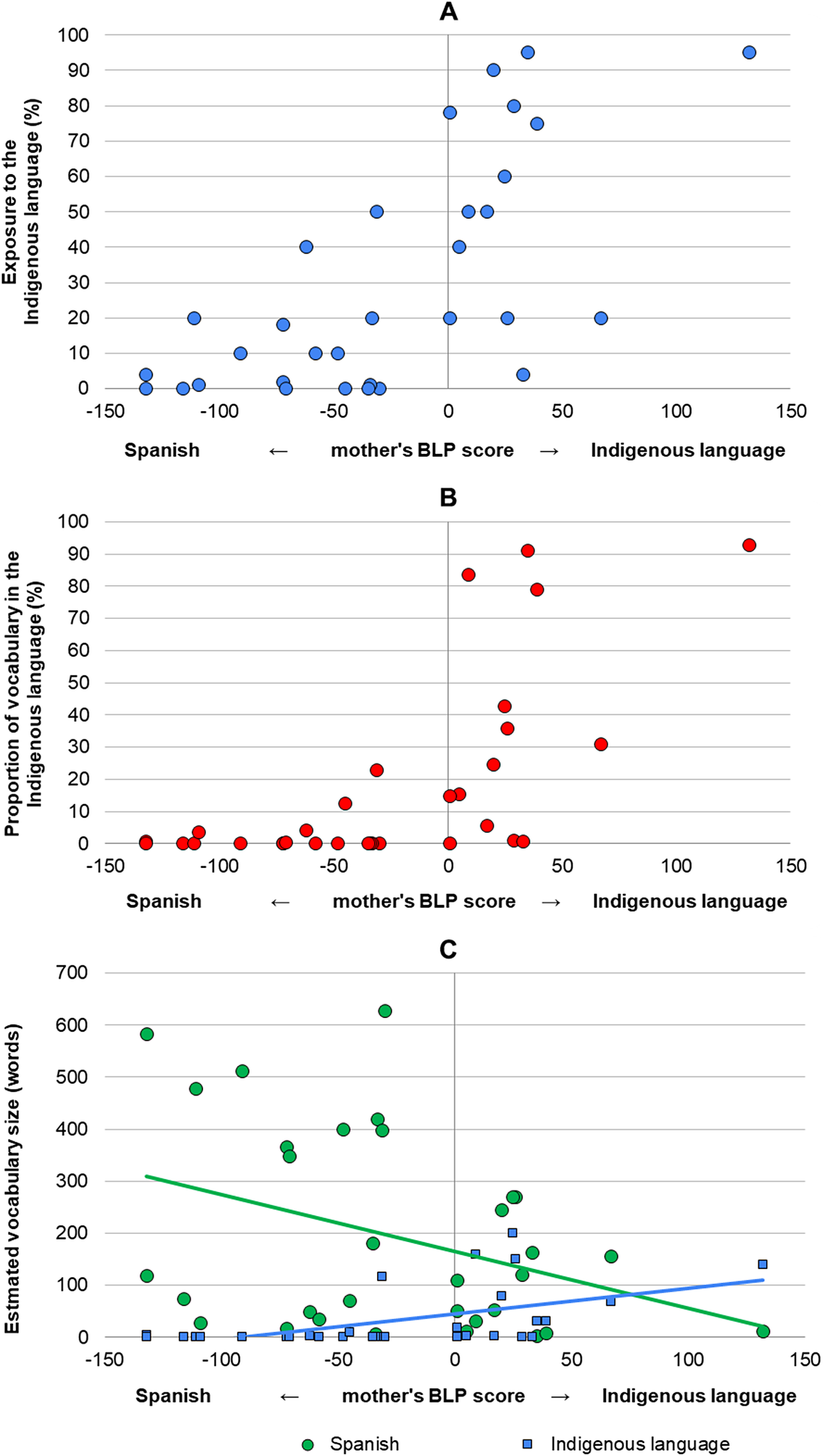
Figure 5. The effects of mothers’ bilingual profile on infants’ exposure to the Indigenous language (panel A), the proportion of Indigenous language vocabulary (panel B), and the infants’ estimated vocabulary size in both languages (panel C).
4. Discussion
The aim of this study was to evaluate how Mexican Indigenous bilingual infants’ exposure to the Indigenous language predicts their vocabulary development both in the Indigenous language and in Spanish, the dominant language of Mexican society. The present study not only adds to the growing body of research that deals with early bilingual vocabulary development in general, but especially it also provides novel data relevant to low-SES samples from understudied bilingual populations, such as speakers of endangered Indigenous languages. The key finding of our study is that, whilst controlling for infants’ age, their relative language exposure satisfactorily explains only their expressive vocabulary size in the Indigenous language, but not the majority Spanish language. Moreover, the mothers’ relative language dominance seems to be related to children’s vocabulary size in both languages, although the association was only statistically significant for the Indigenous language. These results suggest that the higher the mother’s relative language dominance towards the Indigenous language is, the larger the infant’s productive vocabulary size in the Indigenous language will be. However, this also means that the higher the mother’s relative language dominance towards Spanish, the smaller the infant’s productive vocabulary size in the Indigenous language. These results are discussed in greater detail in the following paragraphs.
As for the effects of age, our results showed that infants’ age correlated with all vocabulary size measures except for Indigenous vocabulary size. This suggests that, while Indigenous infants’ productive Spanish vocabulary will most certainly increase with age, growing up in Mexico in an Indigenous family does not necessarily guarantee that a child will acquire a productive vocabulary in the Indigenous language. This is consistent with earlier studies that show that the acquisition of a minority language in bilingual children might plateau (i.e., not further develop in time) if they are only exposed to it in the home (Mancilla-Martinez & Vagh, Reference Mancilla-Martinez and Vagh2013; Miękisz et al., Reference Miękisz, Haman, Łuniewska, Kuś, O’Toole and Katsos2016). Instead, there are factors other than age that seem to influence infants’ productive vocabulary development in the Indigenous language in this specific situation of Mexican Indigenous bilingualism.
One such factor appears to be the amount of exposure to an Indigenous language at home, since it is a significant predictor of the size and proportion of Indigenous vocabulary in a child’s total productive vocabulary whilst controlling for age. However, the relationship between relative exposure to a language and the proportion of vocabulary in this language is not equal, since Spanish words tend to dominate infants’ overall vocabulary. This is in line with previous research on minority language acquisition, where more relative exposure has been shown to be necessary in a minority language than in the majority language for the two languages to be acquired evenly (Pearson et al., Reference Pearson, Fernandez, Lewedeg and Oller1997; Vihman et al., Reference Vihman, Lum, Thierry, Nakai, Keren-Portnoy, McCardle and Hoff2006). Our finding also corroborates the notion that, even if there is exposure, minority languages can vanish from families in as few as three generations of speakers (Fishman, Reference Fishman1966), and here specifically due to a language shift towards Spanish-dominant bilinguals, heritage speakers of Mexican Indigenous languages, and Spanish monolinguals with Indigenous progenitors (Canuto Castillo, Reference Canuto Castillo2015; Mulík et al., Reference Mulík, Corona-Dzul, Amengual and Carrasco-Ortíz2021b). These results draw parallels between Spanish acquisition within an English-dominant context (United States) and Indigenous language acquisition within a Spanish-dominant context (Mexico), in a sense that the minority status of Indigenous languages in Mexico can make it difficult for children to learn them because they are often surrounded by the majority language, Spanish, which is more prestigious and has more learning resources available to them. In the same vein, Hoff (Reference Hoff2021) reports that bilingual children from immigrant families in Florida (with a minority language used more at home and with English as a majority, societal language) most commonly develop stronger skills in the majority language but more varied and weaker skills in the minority language. The author concludes that this is because successful language acquisition requires substantial and continued environmental support; the fact that bilingual environments do not always provide the same levels of quality and quantity of children’s exposure to each language puts the minority language in disadvantage. This, indeed, seems to be the case also in the present study.
In terms of comparisons with studies on Indigenous children vocabulary development, our results are similar to those of Reese et al. (Reference Reese, Keegan, Mcnaughton, Kingi, Carr, Schmidt, Mohal, Grant and Morton2018). The authors reported greater vocabulary sizes in English than in Māori for bilingual children from New Zealand. This resembles our results in terms of Mexican Indigenous children’s bilingual vocabulary being skewed towards Spanish at the group level, which seems to be a common feature of Indigenous bilingual vocabularies in situations of Indigenous language endangerment. Additionally, Reese et al. (Reference Reese, Keegan, Mcnaughton, Kingi, Carr, Schmidt, Mohal, Grant and Morton2018) found a negative correlation between their English and Māori vocabulary (r = −0.49, p < 0.001; Reese et al., Reference Reese, Keegan, Mcnaughton, Kingi, Carr, Schmidt, Mohal, Grant and Morton2018). Although in the present study we did not observe a significant correlation between the vocabulary sizes in the two languages (rSpearman(32) = −0.193, p = 0.291), our results suggest a certain degree of complementarity between the Indigenous language and Spanish vocabulary. These findings are in line with the complementarity principle (Grosjean, Reference Grosjean, Grosjean, Li and Bialystok2013), which states that bilinguals use different languages in different situations; it is rare for bilinguals to use all languages in all situations.
One way in which we observed the abovementioned complementarity between the two languages is via relative language dominance of the infant’s mother in Spanish and the Indigenous language. Crucially, not only does the mothers’ BLC score correlate with the relative exposure to the Indigenous language that the infants get, but it also correlates with their Indigenous language vocabulary size. These results suggest that measuring their primary caretaker’s bilingual language profile, along with infants’ age, could inform us about the infant’s bilingual vocabulary development. In line with this finding of ours, Ezeizabarrena and García Fernández (Reference Ezeizabarrena and García Fernández2023) showed that, besides relative language exposure to Basque, the linguistic profile of parents and the language of interparental communication was also a relevant predictor of children’s productive vocabulary size in Basque. However, they did not measure parents’ linguistic profile on a scale as we did, but as a categorical variable instead: whether only one or both parents were speakers of Basque. As shown in our data, using a continuous bilingualism scale instead of a categorical bilingualism scale might provide a finer predictor of productive vocabulary size in bilingual children with one minority and one majority language.
Finally, in the present study, we did not observe a statistically significant effect of SES on Indigenous infants’ early bilingual vocabulary development. The explanation for this result is that, in our sample, there was not sufficient SES variability captured in order for us to observe any effects of SES on early vocabulary learning (i.e., on the scale of 0–300, our samples comprised SES scores of 29–152, one family corresponding to very low [0–47], 7 to low [48–94], 16 to low-high [95–115], 5 to medium-low [116–140], and 3 to medium [141–167] social classes in Mexico). In other words, despite the data spanning five out of the total of seven social classes established in Mexico, there seems to be no effect of SES on early bilingual vocabulary size in this range (or, at least, in our sample). Nevertheless, even in the absence of such effects, our study still provides valuable data on vocabulary size and composition in bilingual Indigenous infants from low-SES contexts and its relationship to relative language exposure and mothers’ bilingual language profile, with most variability being represented by the different language combinations considered in this work and various geographical location of the participants within the country.
5. Conclusions, limitations, and future studies
The present study has successfully provided novel data on early bilingual vocabulary development in Mexican Indigenous infants from low SES. In this vulnerable population, the effects of relative language exposure and mothers’ language dominance on infants’ vocabulary size and composition were established. Thus, the present work extends these effects, reported in literature for higher SES and non-Indigenous languages, to a common but severely understudied context of young Indigenous bilinguals of Mexico.
As mentioned above, the present study has several limitations. First of all, the instrument that was used to estimate infants’ vocabulary size both in Spanish and in the Indigenous language is meant to be used for Mexican Spanish only. In the absence of a better measure of vocabulary size, we opted for using this instrument in both languages of the bilingual infants and mothers. Nevertheless, future studies would benefit from adaptations of the CDI II, specifically for the Indigenous languages and cultures of Mexico. These should account for words that may be early acquired in the Indigenous language but not in Spanish, as well as for word frequency in each of the target languages. Such culturally and linguistically appropriate adaptations are already in place for several Indigenous languages, mainly in Africa and Oceania (see https://mb-cdi.stanford.edu/adaptations.html). Second, in the present work, we measured language exposure as relative exposure to the Indigenous language compared to the exposure to Spanish. In future studies, absolute exposure to the languages might also be explored as a factor, since infants from different cultures (be they monolingual or bilingual) might be receiving different amounts of language input as they grow. The vast cultural diversity of Mexico makes this point especially relevant for studying early vocabulary development in Indigenous bilingual children. Also, herein only the productive vocabulary was considered; however, receptive vocabulary size should also be measured in future work. This would be especially relevant for passive bilinguals, that is, bilinguals who understand both languages but speak only one of them. Finally, future studies that aim to collect CDI or other vocabulary data in Indigenous languages such as those considered in the present work should rely on close collaboration with community researchers (i.e., members of the Indigenous community that can be trained in data collection and analysis). In our experience, this aspect was crucial not only for participant recruitment and for establishing effective communication with Indigenous mothers, but also in order to understand the cultural and linguistic aspects of each visited community and language. It also makes comprehensive communicating of the outcomes of such studies to the communities more feasible.
The present work also has implications for education and Mexican Indigenous bilingualism in general. According to our results, infants’ mothers’ bilingual language profile seems to be a key variable that influences the exposure to the Indigenous language from home, as well as the children’s vocabulary size in the Indigenous language and their relative proportion of Indigenous words in their production vocabulary. Indigenous communities could benefit from these findings to help mitigate intergenerational language loss. In face of the continuous decline of the Indigenous language use among the native populations of Mexico, a revalorisation of Indigenous bilingualism as an asset rather than a hurdle is needed.
Funding statement
S.M. would like to thank CONAHCYT for financial support (Grant No. BP-PA-20220619131628471-2306121).
Competing interest
The authors declare no competing interests. No AI tools beyond spell-check and English grammar correction were used in the preparation of the manuscript.


 Open access

